
.svg)


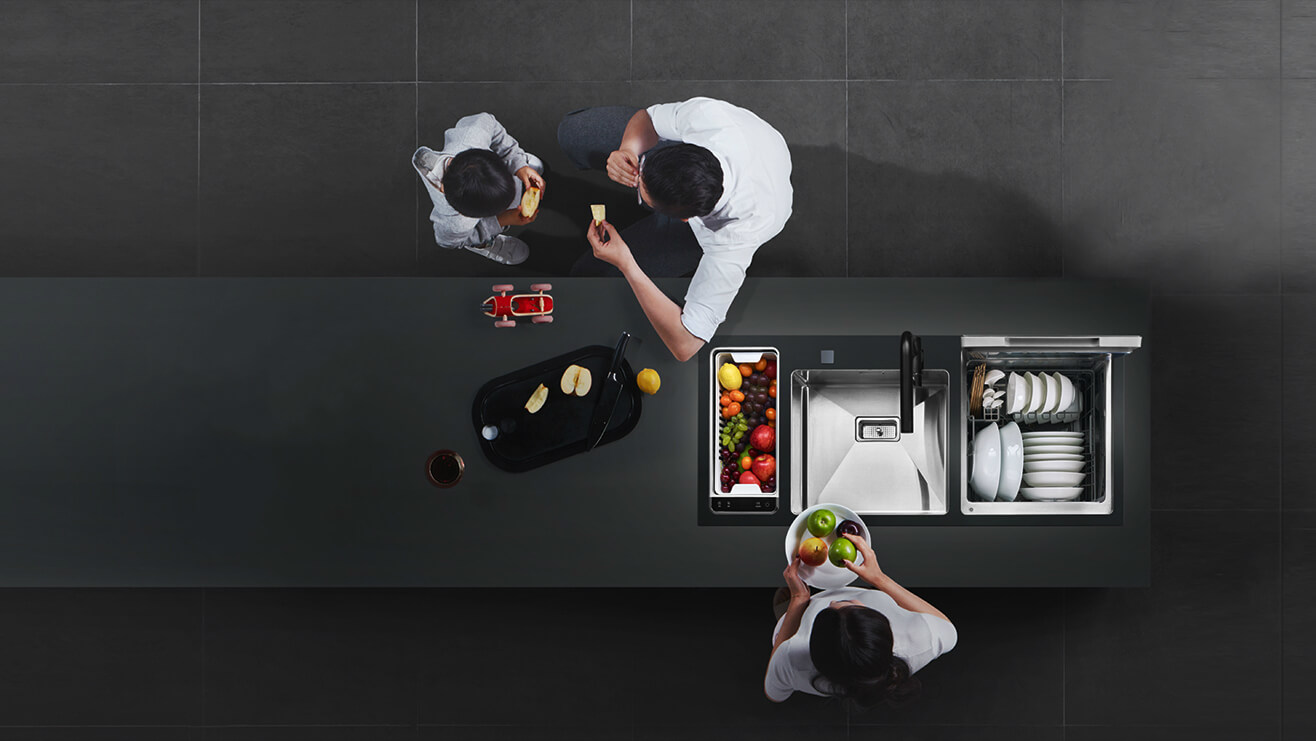

Introducing China’s first sink dishwasher
Fotile, the country’s top kitchen brand, unlocks a new category.
IDEO and Fotile have had a relationship since 2009, working together on projects including a unified design language for product offerings, retail environments, and IoT strategy. For the dishwasher, IDEO and the Fotile research team came together for design research, shadowing Chinese families in different cities as they prepared meals from start to finish. Together they discovered that unlike in Western cooking, where several kinds of cookware are used for different dishes, Chinese cooks tend to use the same cookware to prepare all of their dishes.
That meant that the cookware needed to be cleaned several times during a single meal preparation, rather than once at the end. In this context, the sink serves different purposes over the course of cooking—it’s a place to wash and store prepped ingredients, rinse the cookware, and deep clean the dishes used in food prep and during the meal.
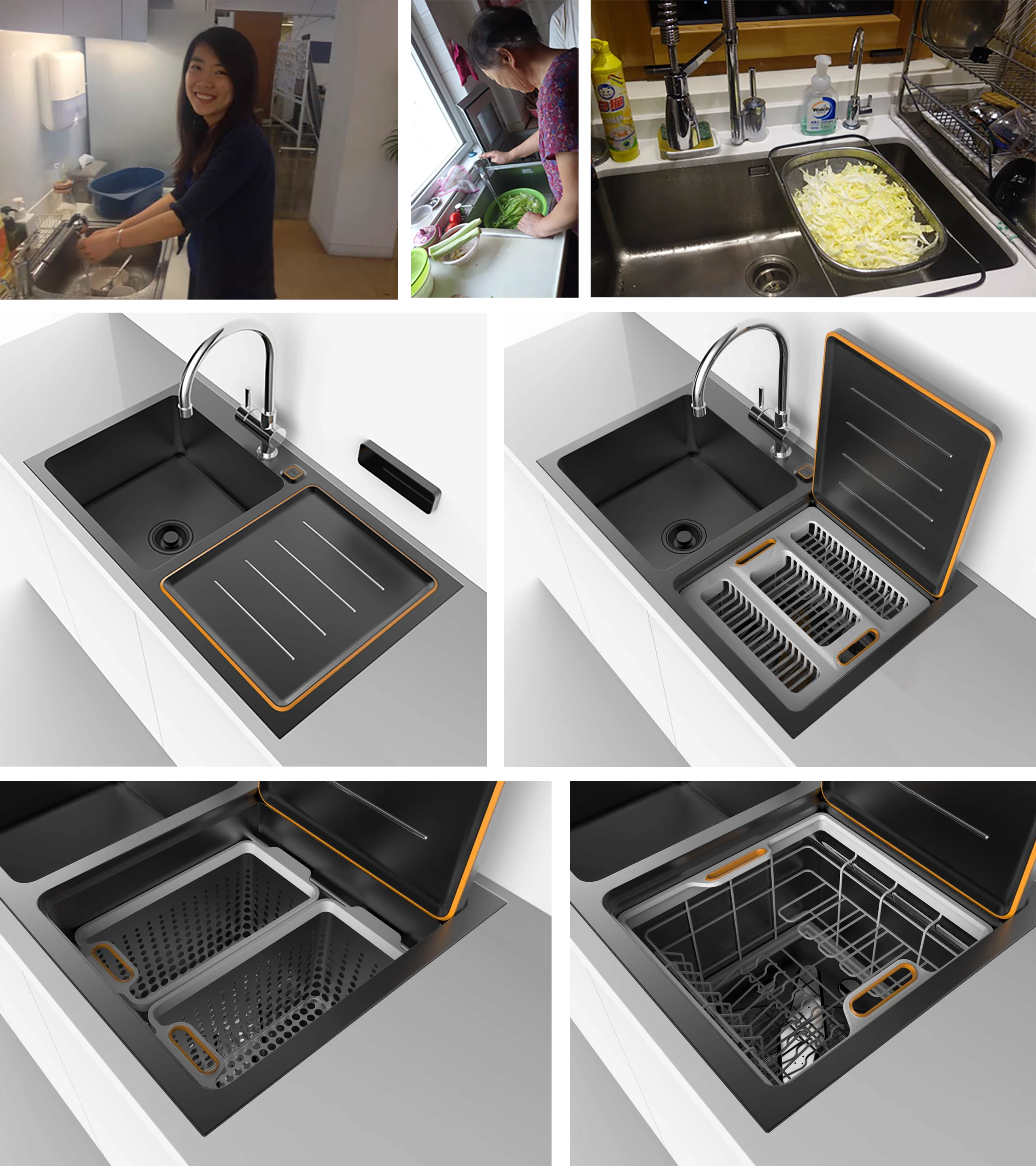
Based on this insight, IDEO made a list of product design recommendations that became Fotile’s Sink Dishwasher—a counter-level, multi-purpose appliance that specifically suits Chinese cooking habits. IDEO’s design guidance gave Fotile the confidence it needed to launch its product into the market, and served as a blueprint for the future iteration of Fotile’s Sink Dishwasher.
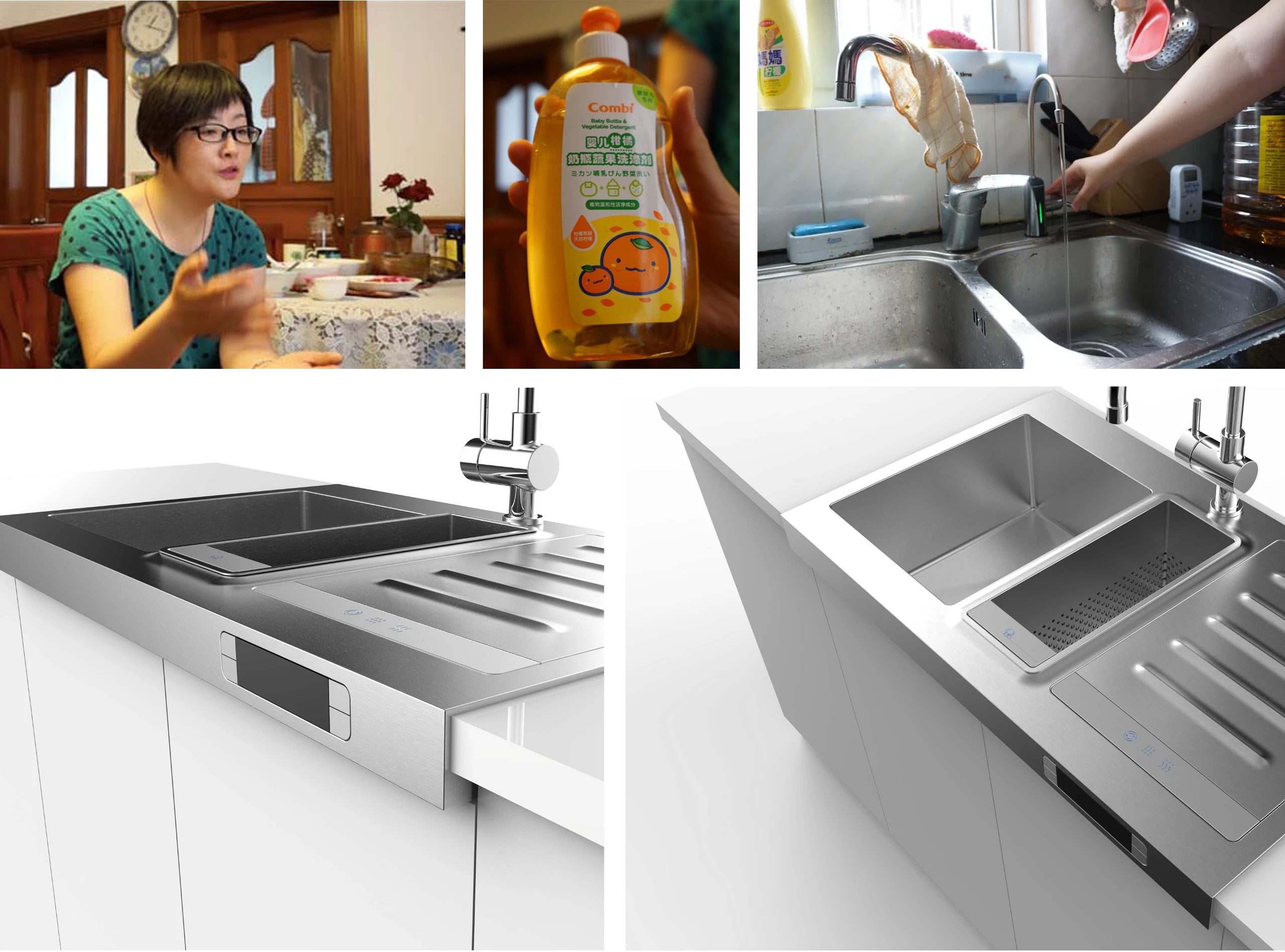
On March 25, 2015, six months after the project ended, Fotile launched the world's first sink dishwasher designed for Chinese families. Eight months later, its market share exceeded 30 percent, setting off a wave of innovation in the Chinese dishwasher category.
In 2016, Fotile introduced a three-slot dishwasher with an added compartment for cleaning fruit and vegetables—a direct response to a research finding that Chinese families are concerned about food safety. When this new model hit the market, Fotile’s dishwasher market share jumped to 41.1%. In China, Fotile is now synonymous with “sink dishwasher,” and the company has a widespread reputation among consumers as a symbol of a safe and healthy Chinese family kitchen.

Since its founding in 1994, Fotile’s Chairman, Mao Zhongqun, has made it his goal to “do nothing but build a high-end Chinese family brand.”
30%
Fotile Sink Dishwasher’s share of the market in China, just eight months after launch
41%
Fotile’s dishwasher market share after it launched a three-slot version in 2016
#1 selling brand
in the mainstream price segment of the Chinese dishwasher market as of August 2023

Growing a brand for modern Chinese parents
China’s BoAo Group expands from an auto industry manufacturer to a lifestyle brand for modern families.
BoAo Group’s idea to design a new baby car seat was fueled by a newly revised minor protection law, which made using child safety seats mandatory beginning June 1st, 2021. As ZUOWE and IDEO looked around China’s emerging car seat market, the team noticed a singular focus on safety and safety features across most international and domestic brands. There was a clear opportunity for a new product that could meaningfully differentiate itself by not only providing safety features but also meeting the needs of modern Chinese parents.
To kick off the project, the IDEO team needed to answer two questions: What matters to the new generation of parents in China? And how will their style and approach to parenting affect their expectations for baby car seats? Taking into account the potentially different consumer needs in different geographies, the IDEO team headed to Shanghai, a city with more than 25 million people, and the city of Taizhou in Zhejiang province, which has a population of 2 million. They conducted in-depth home visits to local families, visited many brick-and-mortar mom-and-baby shops, and interviewed people like specialized nurses, parenting experts, and child psychologists.
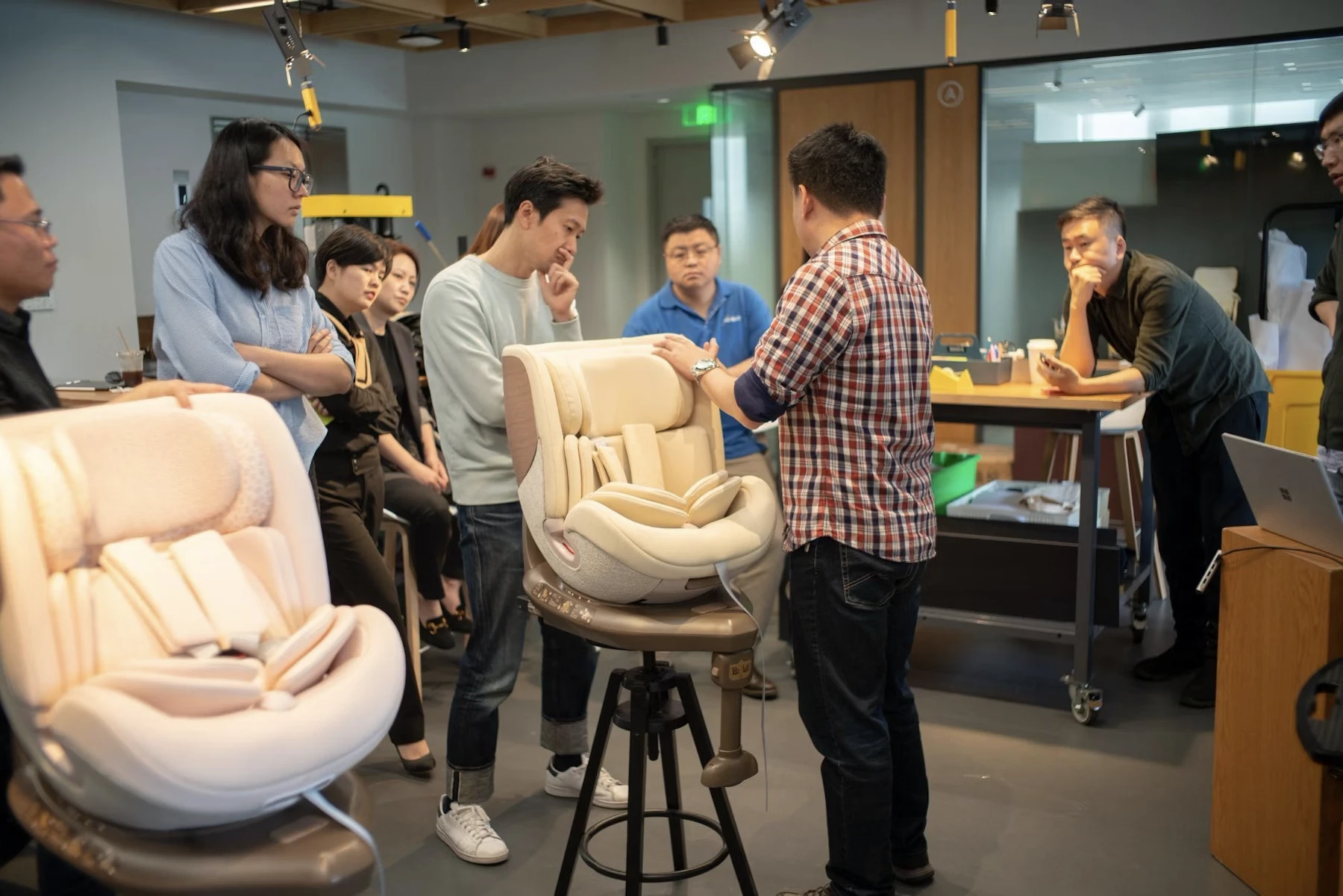
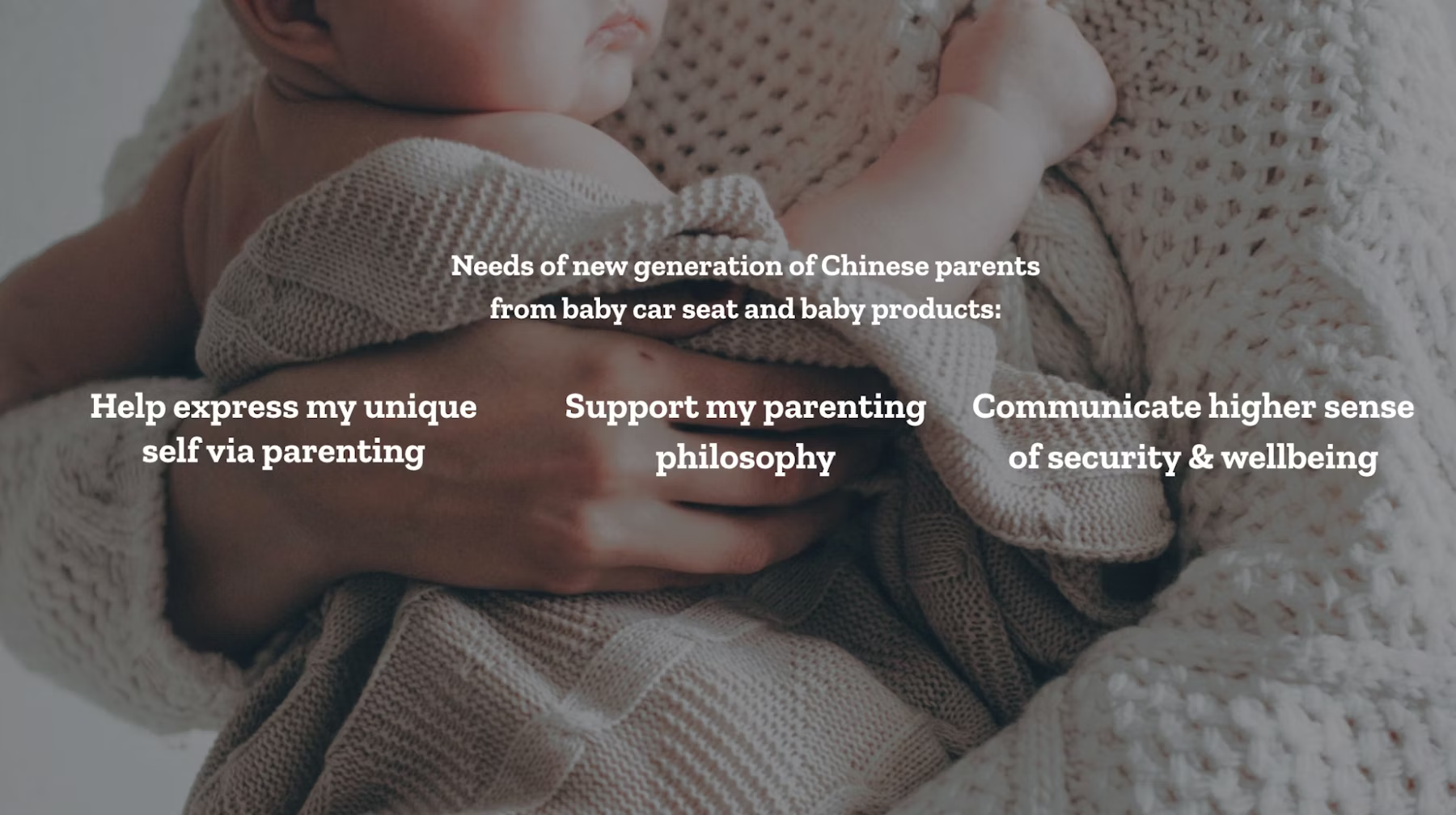
Despite the differences between the two cities, IDEO discovered commonalities during consumer conversations. Young Chinese parents were experiencing a perceived identity gap. As individuals, they felt they had distinct personalities and a clear sense of self. They actively expressed themselves through their clothes and belongings. But when they became parents, this sense of self weakened or disappeared completely. Their identities shifted to being someone’s mom or dad overnight. This new generation was eager to show their unique approach to parenthood as they used to express their sense of self. But many products were designed for children, with little regard for parents.
This core finding helped set the direction for the new baby car seat design and brand Maple&Co. However, there were still two significant challenges to overcome. One, IDEO needed to design a product with stringent technical regulations and standards on a tight timeline—ZUOWE wanted to launch the new car seat at an important industry trade show within the year. And two, the team had to help the organization transform its thinking and ways of working to be more consumer-centric.
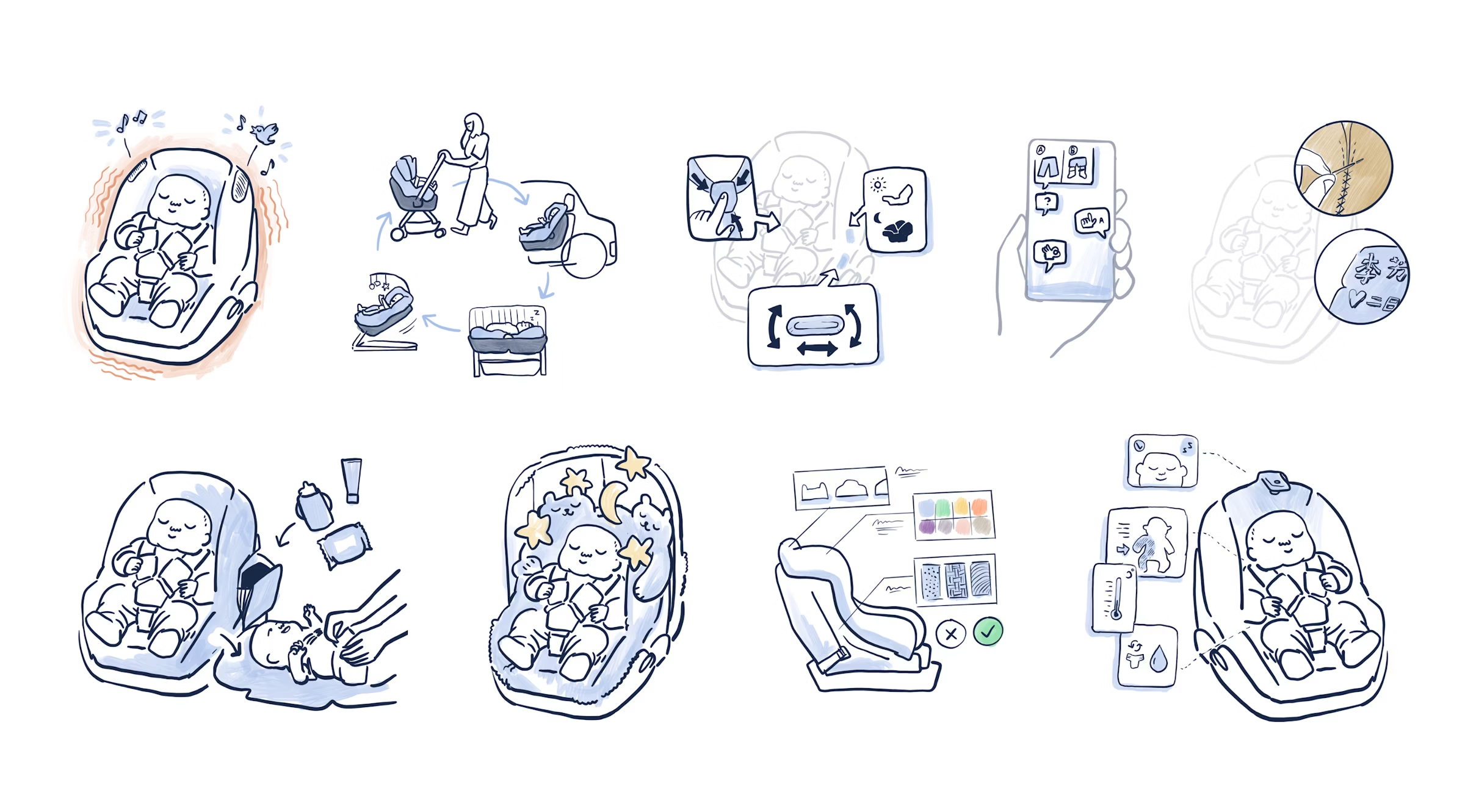
BoAo’s strength lies in its 20 years of experience developing and manufacturing car seats for major domestic and international automotive brands. This gave the company an edge in overcoming technical barriers and driving mass production. But its engineering and manufacturing mindset had become a barrier to transforming into a D2C brand. With such ingrained ways of working, pivoting to a more creative process can be hard.
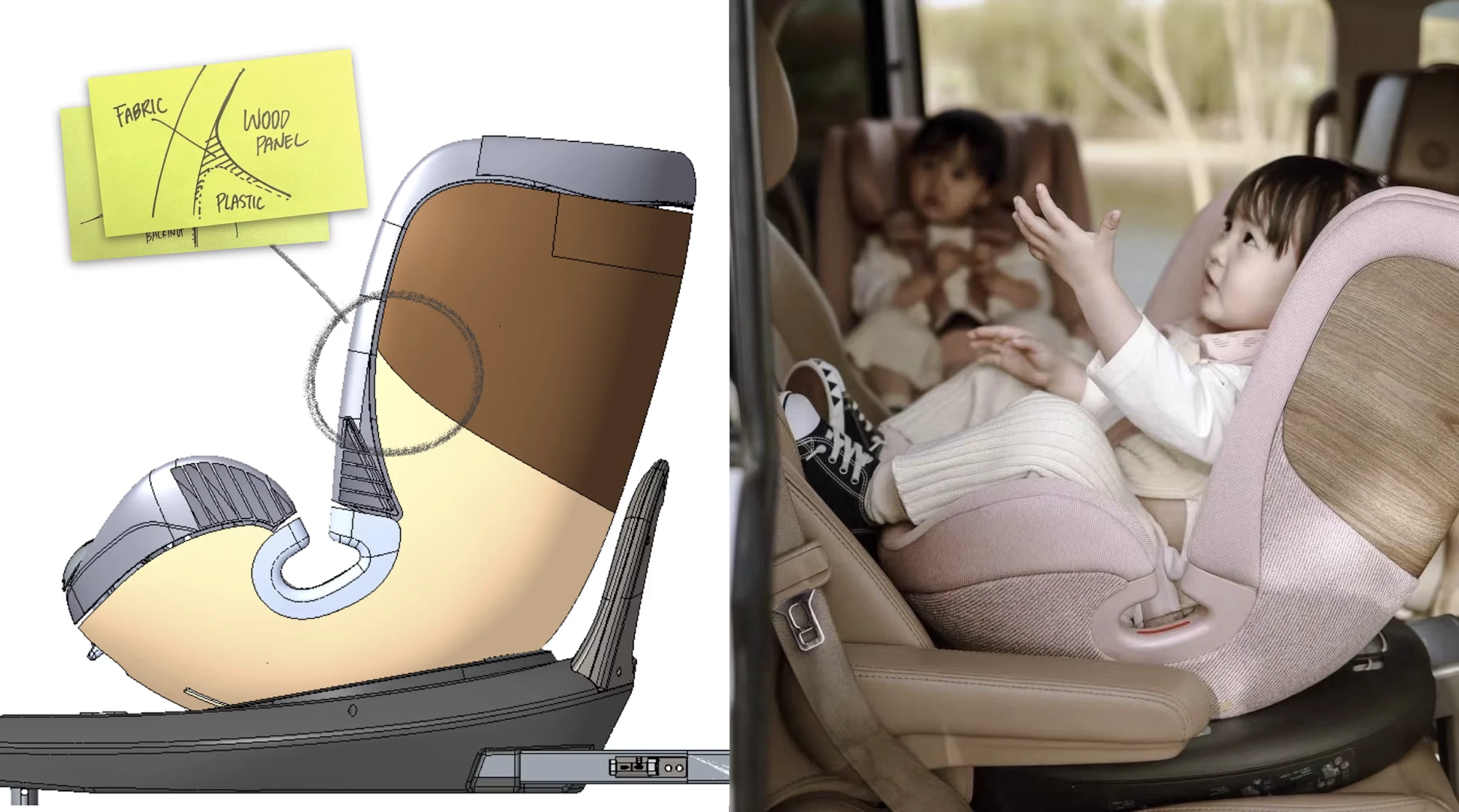
To address this hurdle, IDEO set up co-creation workshops, bringing together ZUOWE’s newly formed baby car seat team and manufacturing experts from their factories to discuss design direction and details early on. The benefits of the collaboration were clear: It was easy to share feedback in a timely manner and make product design decisions very quickly. When IDEO presented a design that emphasized natural textures during a workshop on brand positioning, a member from Bo Ao’s manufacturing team said, “This feels very different. This could become a major selling point,” and that they had “never seen” anything like it done by other baby car seat brands.
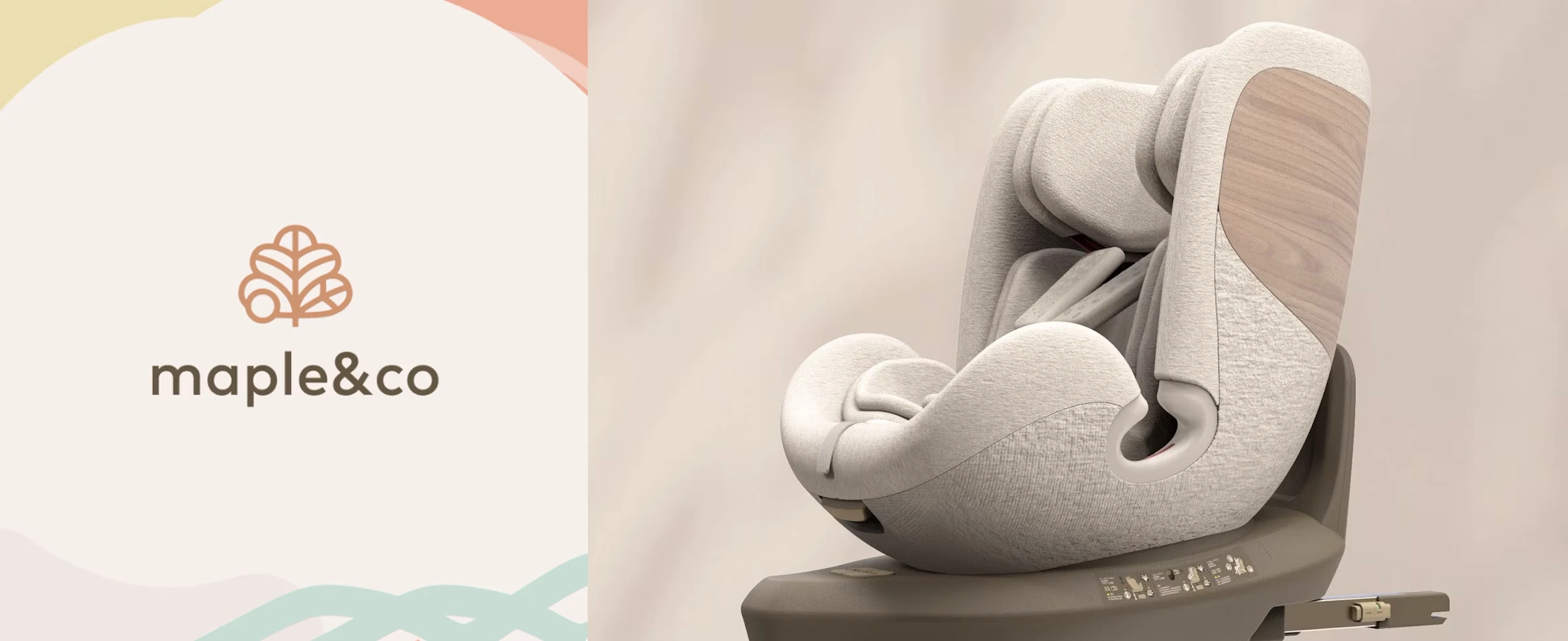
A year after working together, ZUOWE Technology launched Maple&Co and the new Maple baby car seat across its main e-commerce channels. Modern and minimalist in soft natural colors and wooden veneers, Maple appeals to the aesthetics of young parents in China. Despite a series of micro COVID outbreaks in China, within three months, Maple had already achieved better-than-predicted sales and received favorable comments about the look and quality of the car seat from parents. Fast forward two years, additional collaborations with IDEO have enabled the young startup to grow its child travel portfolio from a signature car seat into a more holistic offering that includes highly functional, fashionable, and adaptable car booster seats and strollers that thoughtfully address the needs of modern Chinese families across various life stages at home—and on the go.

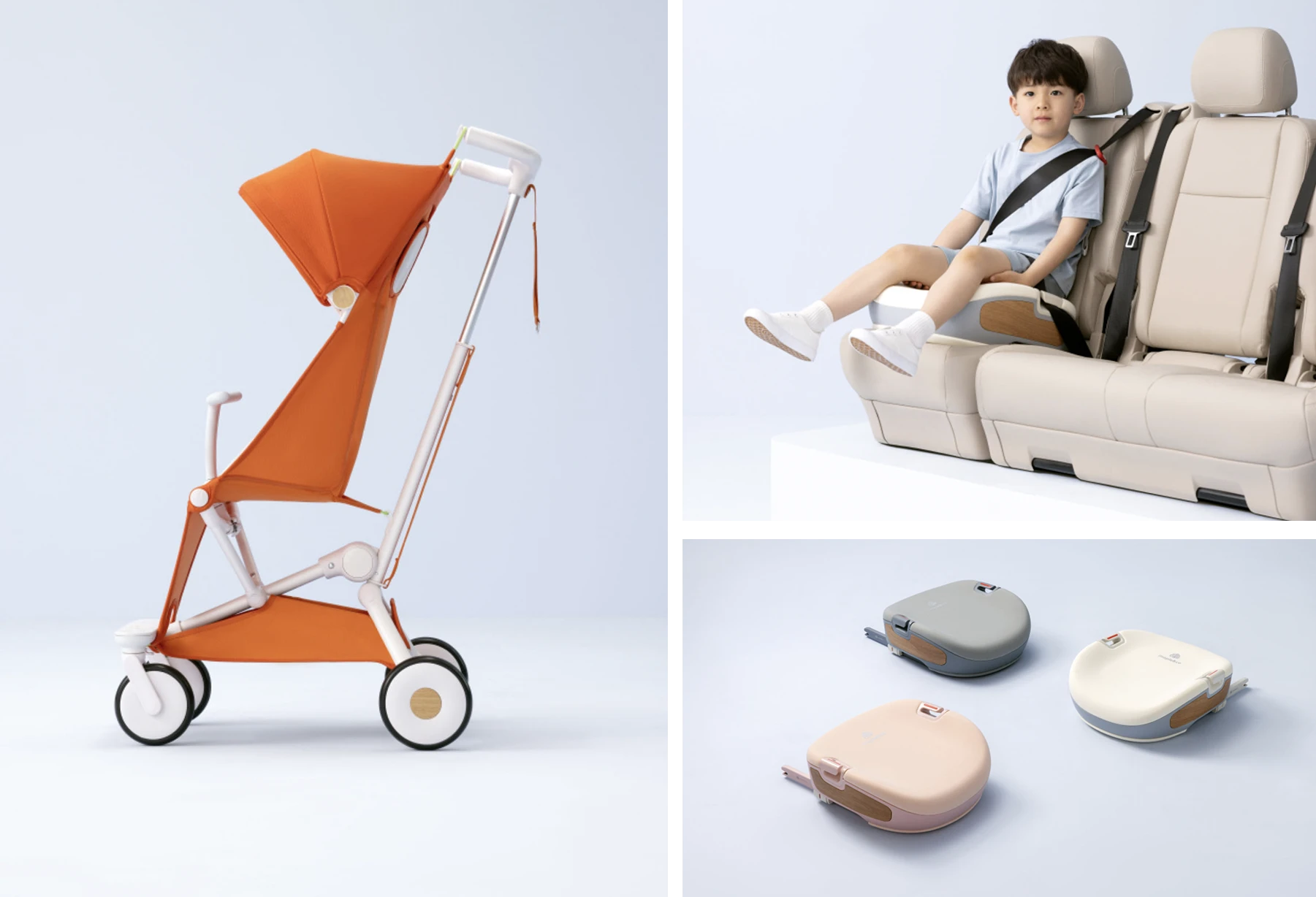
China's minor protection law mandated the use of child safety seats beginning June 1, 2021.
Despite incoming regulations fueling a surge in purchases, car seats on the market rightly prioritized safety but did not consider the emotional needs and lifestyle preferences of a new generation of Chinese parents.
1 year
after the project ended, a new, differentiated baby seat product and brand, Maple&Co, launched
Top 6
during the 2023 “Double 11” shopping festival, Maple&CO secured the 6th spot on Tmall's new brand pre-sale list
How a $4000 vet bill sparked innovation at American Express
American Express and IDEO teamed up to design features that offer Card Members more payment control and flexibility.
“Over a year ago, I had to take my cat to the vet for an unexpected and expensive surgery,” says one Card Member. “To be honest, I still don’t know if I’ve paid the bill off.”
Many crave the flexibility to pay for large purchases over time, but also want to avoid the pitfalls of debt. Others rely on debit or cash for small items—no one wants to accumulate interest on a cup of coffee, lunch with a friend, or box of Kleenex—but then miss out on valuable rewards.
American Express worked with IDEO to help them attract new customers by understanding what financially stable young adults wanted in a credit card. The team began by interviewing more than 120 millennials to understand their payment behaviors around debit and credit, and how they think about borrowing and spending.
One person described the monthly panic of receiving his bill—described as “statement shock”—and his habit of making multiple payments before his billing cycle closed to ease this anxiety. Others were wary of credit because of a large veterinarian bill or financial mistakes made in their 20s, and relied on debit because it felt safer than accruing a balance to pay off. Overall, the team learned that many consumers experience anxiety about paying their bills. And while financial products that offer more flexibility and control have been needed for years, they are especially valuable in times of economic uncertainty like today.
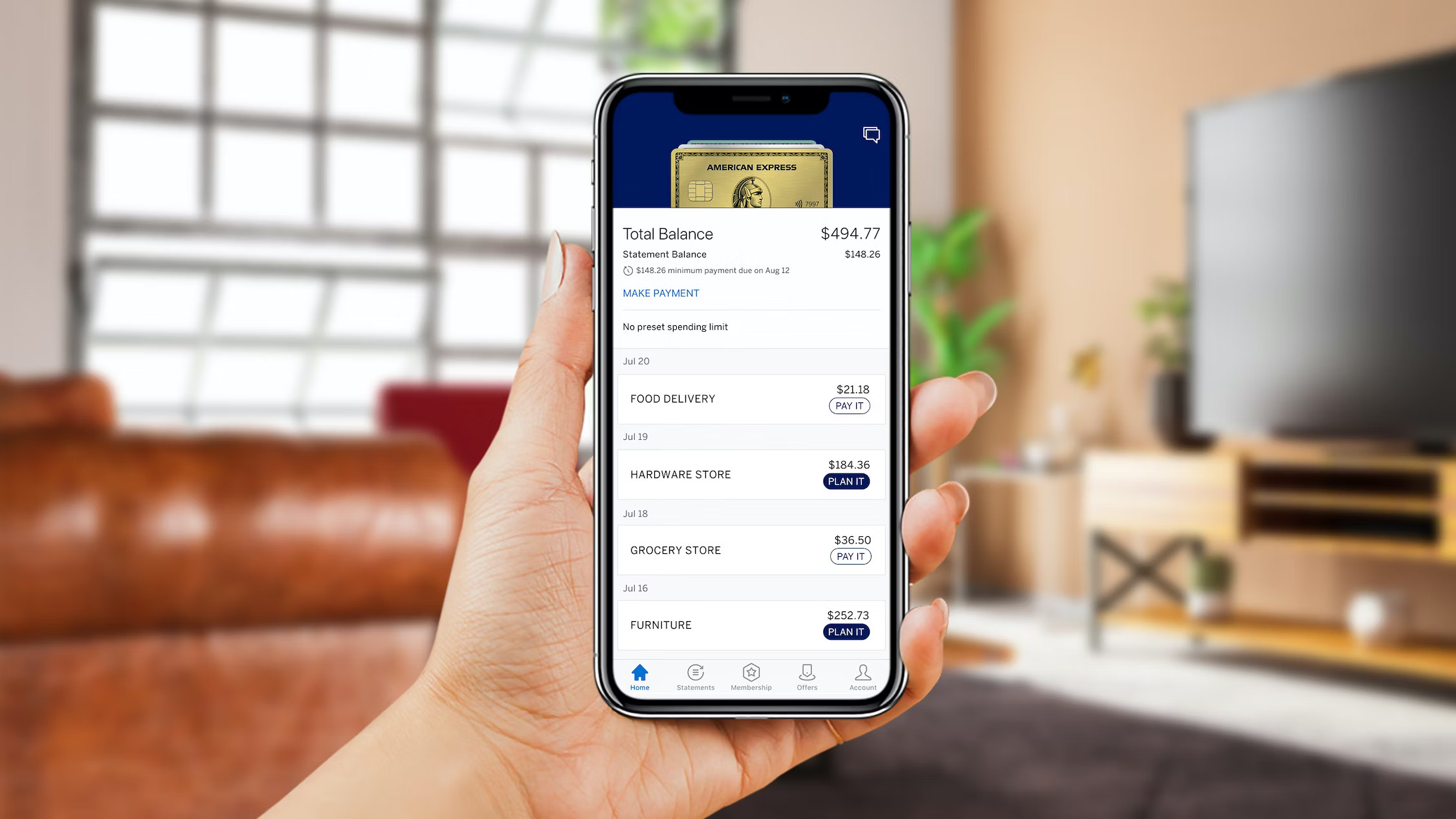
Based on this research, IDEO prototyped, iterated, and refined two concepts, with frequent feedback from users and the client. Called Pay It Plan It, this feature offers financially responsible consumers more transparency, confidence, and control.
Pay It allows Card Members to quickly pay for small purchase amounts under $100 with a few taps in the American Express mobile app. When that purchase shows up on their account, they can choose “Pay It” and still earn rewards on the purchase. This ensures Card Members can take advantage of rewards while lowering their monthly bill by paying for smaller items throughout the month.
With Plan It, Card Members can split up larger purchases of $100 or more—like an emergency trip to the vet or a new sofa—into equal monthly payments, with a fixed fee and no interest. When the purchase appears in their account, they can select “Plan It,” and will be offered up to three monthly payment plans, ranging from three to 24 months. Each plan comes with a fixed monthly fee and no interest. Card Members know exactly how much they have to pay each month, so there are no surprises. And if they pay the purchase off early, they no longer have to pay any future plan fees.
The design of Pay It Plan It did not come without challenges: Bill pay is critical, complex, and highly regulated. Pay It Plan It required a significant internal financial and technical investment, which was achieved after IDEO shared many of the emotional, compelling stories from credit card users with leaders at American Express.
The team worked closely with the American Express regulatory and digital teams to ensure compliance and seamless integration into the mobile app and website’s user experiences and interfaces. To heighten the sense of competence, control, and transparency for users, the designers focused on small interactions like status animations, proactive suggestions, and straightforward language. These interactions help Card Members anticipate upcoming payments and clearly understand Pay It Plan It.
Plan It was designed with transparency, control, and accessibility in mind: The payment plan fee is displayed in dollars to give the customer certainty over their total costs.
Initially, the team set out to create a new credit card with the needs of young adults in mind. But IDEO and American Express realized that Pay It Plan It could be scaled across existing credit card products to ultimately benefit and attract more Card Members. Now, almost all U.S. American Express Consumer Card Members have access to Pay It Plan It through credit cards, co-branded cards, and the well-known Green, Gold, and Platinum Cards. Since launching in 2017, Card Members have created nearly 5 million Plans, totaling nearly $4 billion in purchases, with an average Plan size of $789. Millennial and Generation Z Card Members have created approximately 44 percent of these Plans.
The flexibility and control offered through Pay It Plan have earned American Express positive press, including a call-out in The New York Times for being among solutions that “make it easier for their customers to borrow money, and to manage their monthly cash flow.”
At first glance, design-led innovation may seem difficult to achieve in large, established organizations like American Express, operating in a highly regulated and deeply rational industry. But the IDEO and American Express team successfully found ways to introduce new behaviors like rapid prototyping, cross-discipline collaboration, and leading with emotional customer stories within the existing organizational culture and structure. American Express has since established a permanent Pay It Plan It team dedicated to evolving the feature. Made up of employees across departments, this points to a new and collaborative team structure for the company.
By seeking to understand the human behind the Card Member, American Express has transformed credit and financial services for the better, helping both to be defined by empathy, utility, and transparency.
The bold publishing strategy that turned a traditional newspaper Into a digital leader
How bucking the trend of round-the-clock digital publishing led to an enormous payoff for The Times and The Sunday Times
For more than two centuries, The Times held a strong reputation as a storied British newspaper. Then came the digital deluge. Publication after publication began adopting a relentless online publishing schedule aimed at capturing eyeballs and subscribers, and guarding against waning advertising sales and print readership. But The Times and its sister publication The Sunday Times thought there might be a different way forward.
As Editor John Witherow explains, “the power of an edition” had long endured at The Times, but began to erode amid a round-the-clock breaking news cycle. Witherow didn’t want to do away with editions, but rather to update the model for the digital age. Times owner News UK approached IDEO in 2014 to explore exactly that: what the edition of the future might look like and how its design could drive revenue and subscribers.
IDEO’s research and design phase included interviews with readers, journalists, editors, and marketers at News UK. The team found that people’s reading modes vary—some reflecting new digital behaviors and others adhering more closely to paper-reading styles.
Readers, the team learned, chose The Times for its editorial opinion: a perspective that cuts through the overwhelming flood of information. They viewed the daily Times and weekend Sunday Times as one paper, despite the organizational distinction. And they were proud of their choice, valuing the papers’ consistency, trustworthiness, balance, and authoritativeness. Readers wanted these qualities distilled in a digital edition, whether on a smartphone, tablet, or on the web.
Those insights led to strategic recommendations spanning digital products, editorial, advertising integration, online membership offers, and social sharing. But the boldest among those was a publishing strategy that seemed to run counter to media trends: abandoning a real-time approach in favor of publishing separate digital editions.
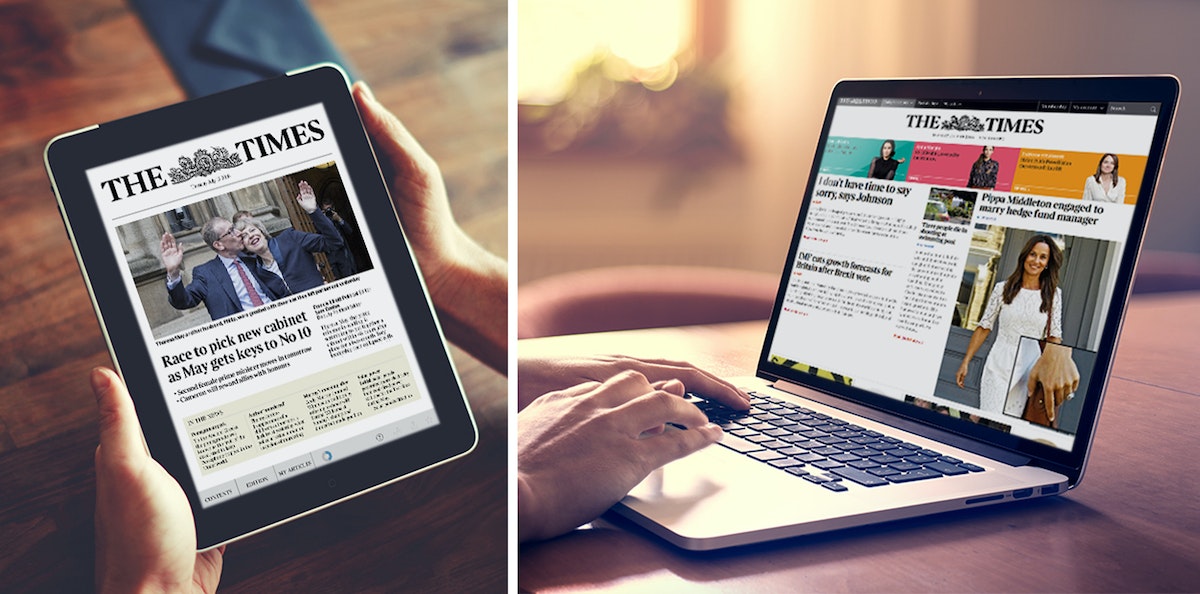
The Times in March 2016 introduced an editions-based publishing schedule, with new editions available across all platforms four times each weekday: overnight, 9am, noon and 5pm; the weekend schedule shrank to three editions. A year in, they had broken that schedule fewer than a dozen times—making exceptions for major moments like the terror attack in central London and David Bowie’s death—but even in those cases, The Times refrained from incessant updates, instead resuming its regular pacing.

“The way we’re publishing now, taking our time over news...taking a more considered view of the world, it’s helped us offer something different from everything else,” digital news head Alan Hunter told Digiday in 2018. Readers demonstrated that this different approach was something they’d been wanting.
In the first half of 2016, new paying-subscriber sales were up 200% as compared to the same period in 2015. At the end of June 2016, there were 413,600 subscribers to The Times and The Sunday Times, up 3.4% from a year prior. Of those, 182,500 were digital-only subscriptions—a 6% rise and a notable figure given how much online news can be obtained for free.
Through collaboration with IDEO, News UK's own digital teams capabilities grew, enabling them to implement and evolve their new digital strategy. The capabilities of the newsroom grew, too: “The decision to move to four editions a day has freed up tremendous resources to focus on big stories,” says Emma Tucker, Editor of The Sunday Times—the kind of stories that "supercharge engagement." The approach is working: By August 2019 digital subscriptions had increased 19% year-on-year to 300,000, showing the progress the legacy publisher has made in attracting readers to its online proposition. Total subscribers for the two titles' print and digital products now stand at 539,000, and their websites total five million registered users.
More than 230 years after its first edition was published, the new Times has established solid footing in the digital age and designed its own future—one based not on the habits of its competitors but on its legacy and the reading behaviors of its audience.

AI is changing women’s health
Let’s work together to make sure it’s for the better.
For decades, women’s health has been underfunded, overlooked, and too often reduced to reproductive care. Medical research has been built around male bodies, while the complexity of women’s biology and lived experiences has been treated as a problem to simplify rather than an opportunity to understand.
Now, AI could change that. Designed intentionally, AI could unlock new kinds of evidence that close historical data gaps and inform better care. But if we aren’t careful, we could be scaling systems that were never designed for women and build the next generation of healthcare on the same broken foundations as the past.
The stakes are high. The opportunity is massive. This is where design matters most.

Introducing the Women’s Health × AI Exchange
We believe design can help us embrace AI’s healthcare possibilities while recognizing and mitigating its risks. And we believe the most promising futures are shaped collaboratively, by bringing different perspectives into conversation and making those possibilities tangible.
That’s why we’ve launched the Women’s Health * AI Exchange, an open, design-led exploration of one important question: How might AI meaningfully transform women’s health, and what would it take to ensure that it does?
To frame this exploration, we crafted six provocations about possible futures at the intersection of women’s health and AI. Futures where AI could:
- Reframe women’s biological complexity from a healthcare liability to a scientific asset and create new pathways for better care.
- Transform the relationship between healthcare professionals and patients, translating qualitative data into clinically actionable evidence.
- Connect the dots across a woman’s health journey to enable more proactive, preventive, and life-stage-specific care.
- Drive innovation in women’s longevity, helping researchers understand what most influences how women age.
- Flip the economics of clinical research, incentivizing exploration at the deprioritized edges and intersections.
- Put data back in women’s hands to help them find their own insights around issues where institutional research has not been prioritized.
Imagining what AI could do is only half the work. We also need to consider the shifts required to make these futures possible. And so, each of these provocations ends with the same challenge: What would it take to make them real?
We’re inviting you into this conversation to help us collectively sharpen a point of view and co-design a landscape of opportunities. Here’s how to join.
Go to the Women’s Health x AI Exchange and choose a provocation that resonates with you. An AI facilitator will ask thoughtful follow-up questions to help you frame your point of view and articulate what you believe needs to change. Your thoughts will be posted anonymously. As more people participate, their contributions will help reveal where perspectives align, where tensions remain, and what new opportunities are emerging.

Turning tension into possibility
This conversation is just the beginning. We’ll synthesize themes and share emergent opportunities. We’ll bring together people across healthcare, research, technology, investment, and design to help us prioritize opportunities for further exploration. And we’ll translate the most compelling ideas into tangible prototypes that help people see, experience, and shape what desirable, viable, feasible, and responsible AI-enabled healthcare could look like.
We’re approaching this as an investigation in motion, not a finished thesis. Our intention is to work openly so the perspectives, provocations, and possibilities we generate can inspire and inform the people already working to move women’s health forward.
And while women’s health is at the center of this exploration, the conversation we want to have is even bigger. It is a conversation about the future of healthcare data and power. A conversation about how AI might help close the gaps that decades of underfunding have left behind, and what we can all do to ensure it does.
Whether you’re a clinician, researcher, technologist, entrepreneur, investor, designer, or simply someone who cares about the future of healthcare, we invite you to help us reimagine what healthcare could be, for everyone.
Explore the Women’s Health * AI Exchange and add your perspective.
AI is transforming healthcare at a remarkable pace. But our understanding of women’s health has a lot of catching up to do.
Patient expectations are evolving faster than ever
Four ways pharma companies can adapt as GLP-1s reshape experiences.
During a recent meeting with a pharma client, we played a YouTube video of GLP-1 users that left the team slack-jawed. Sitting around a conference table, they watched people crack open an auto-injector and pour the contents into a vial so they could titrate out a more precise dose of the drug themselves. They heard several patients admit to using a family member’s prescription because they didn’t have their own. Others lamented that they weren’t in range for their preferred direct-to-consumer delivery platform. The realization was stark: patients knew what they wanted from their GLP-1s, and if the manufacturer didn’t provide it, they would find a way to make it themselves. In that moment, this particular pharma company understood it was not at all prepared for a future where patient expectations would remake the drug market.
The introduction of Ozempic and new access models for GLP-1s like Lilly Direct and Hims & Hers have fundamentally shifted the pharmaceutical industry in the last five years, unleashing more self-directed therapy journeys and a new kind of healthcare consumer. Patient expectations about what pharma companies can do—and the experiences available to them in a healthcare setting—have been completely rewritten. This revolution is making traditional pharma commercialization processes that push patients and providers through a few preferred channels a thing of the past. Especially as consumer-facing startups come for their market share—and create an even larger pie.
If pharma companies are going to meet this new wave of consumer expectations for everything from GLP-1s to hair loss and erectile dysfunction medicines, supplements to fertility drugs, they need to prioritize designing exceptional experiences that come along with their therapies. That requires building an entirely new set of skills and behaviors that can support product pipelines. Here are four crucial steps to get there.
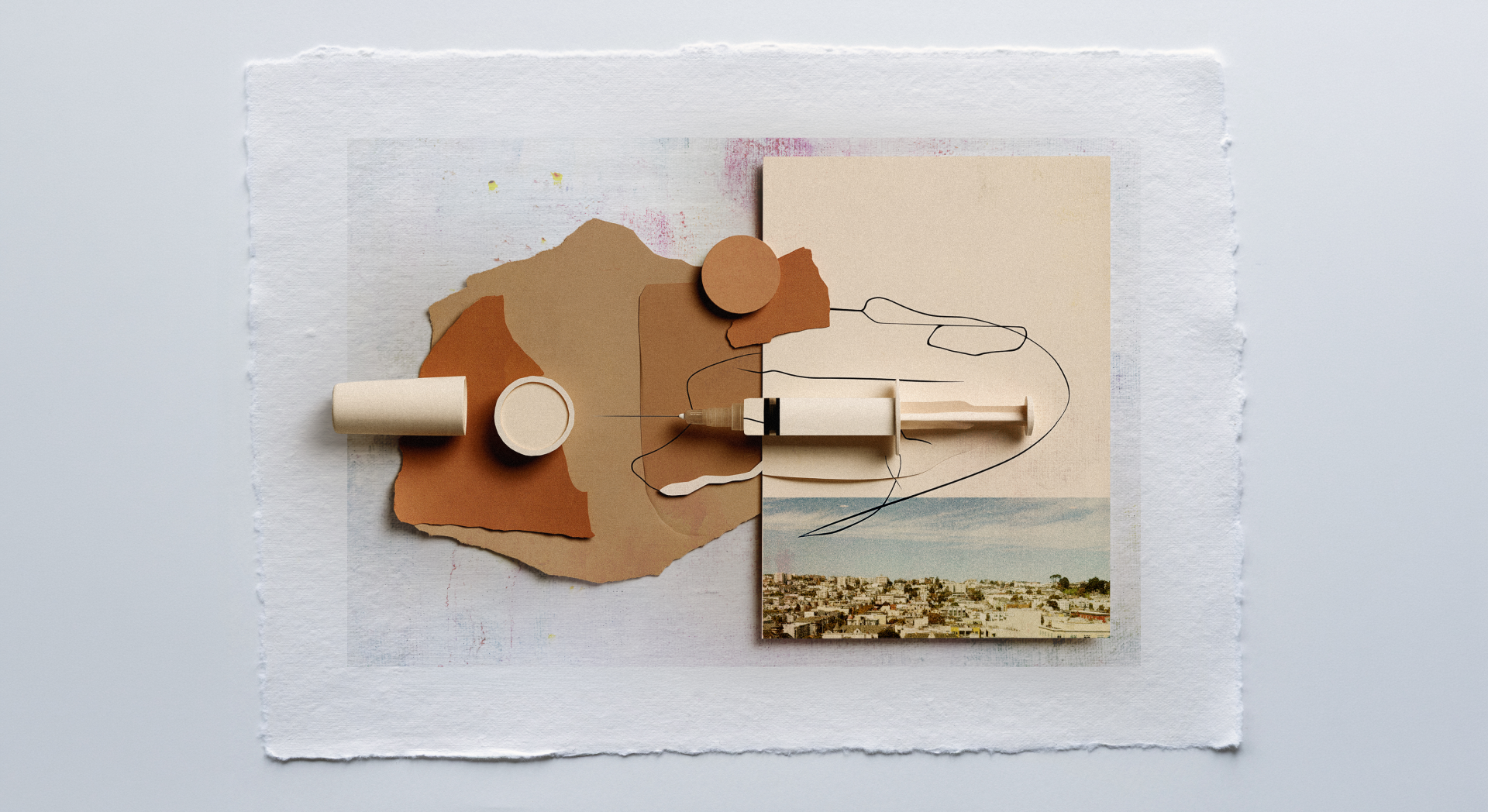
1. Uncover the needs patients want pharmaceuticals to meet
Pharma companies need to do research with real patients to get a clear view of the full therapy journey—from diagnosis to long-term use. In that process, they can identify the highest-risk moments, like confusion over instructions, frustration over delivery methods, and potential misuse, and prioritize opportunities to improve real-world adoption and adherence.
Lilly understood this early on. In the 1990s and early 2000s, the pharma company had several new, life-changing medications and two big challenges: Its primary drug—insulin—had to be self-injected, which patients were hesitant to do. And its drug-delivery device platform lagged behind the needs of insulin users.
Lilly approached us to design the next-generation auto-injector platform. Early in the partnership, a team of IDEO designers and Lilly leaders met with diabetes patients around the globe to better understand how they lived with the disease. They quickly realized there was a need for a device that met the needs of a broad range of dexterity-challenged and injection site-specific patient populations (including rheumatoid arthritis and psoriasis patients). As the development of multiple candidate molecules was still underway, the team focused on creating an injection experience that would work for these more challenging patient populations, knowing that a design that worked for them would also deliver a better experience for a broader swath of future users.
While we carefully considered every feature of the autoinjector itself (from grippy labels and a stable, twist-off base to large, clear unlock tabs and injection buttons), we also designed packaging that fit in a standard-sized refrigerator, created a set of highly visual instructions, and took into account the involvement and support of family members and caregivers.
Fast forward to 2026, and Lilly is still leveraging the design we made together to not only support pre-diabetes treatments like Trulicity, but also psoriasis therapies like Taltz, migraine therapies like Emgaility, and GLP-1 molecules like Mounjaro and Zepbound. The latter accounted for the majority of the company’s annual revenue in 2025. Taking the time to create a comprehensive drug delivery experience has yielded an invaluable delivery toolkit that Lilly and the patients they serve still benefit from today.
2. Design the experience around the therapy
As more and more pharma companies create consumer-style experiences, it’s crucial they build services and tools that support onboarding, adherence, and ongoing use. Standing out is no longer just about drug efficacy. It’s about how well patients with all kinds of needs and circumstances can access and adhere to the therapy—and how well pharma companies can deliver against their competitors.
When Sanofi launched Beyfortus, the first-ever RSV immunization for newborns, in 2024, it was a milestone in the fight against the virus, which had resulted in the death of 445,000 babies worldwide in 2019 alone. But the company knew that growing anti-vaccine sentiment might prevent parents from giving their children the potentially life-saving immunization.
Together, we conducted research with parents, caregivers, healthcare professionals, and healthcare administrators in Germany, Spain, China, and the US to identify barriers to adoption across cultures. The team quickly discovered that no single approach would work across Sanofi’s 20-plus international markets. Training for medical professionals needed to be flexible and customizable. They also discovered that discussing immunizations right after a baby was born was too stressful for new parents.
Ultimately, the team created an accessible global communication toolkit with straightforward language, metaphors, and illustrations to support informed conversations between providers and parents before and after a child is born. Then they held a series of market-fit co-design workshops to make the tools more resonant with regional customers and ensure compliance with local regulations.
In its first year on the market, Beyfortus became a $1.8 billion therapy, and more than six million babies have been immunized.
With a growing funnel of information about drugs, therapies, and even supplements, pharma companies must cut through the noise to support patient understanding and adherence.
3. Define how you show up beyond the drug
To have an even greater impact on patient outcomes, pharmaceutical companies should explore new roles, partnerships, and models. That could mean creating new offerings that combine a given therapy with support and services, building partnerships with payers, employers, or platforms to extend reach, or creating models that tie therapies to long-term outcomes and value.
Japanese pharmaceutical company Otsuka is perhaps one of the most diversified pharma organizations in the industry, focusing on above-molecule interventions including companion diagnostics, digital technologies, and other tools that enhance the effectiveness of chemical or biological treatments. With a business that spans traditional drug development and manufacturing, digital solutions, and even consumer products such as Pocari Sweat, an electrolyte drink, Otsuka has bet that diversity and go-to-market pathways will lead to better experiences for patients. Not to mention these touchpoints also provide deep insights into the needs of the people Otsuka serves.
In 2018, Otsuka joined forces with Click Therapeutics to develop digital health services to accompany one of its leading medications, aripiprazole. The antipsychotic is used to treat schizophrenia, bipolar disorder, and major depressive disorder (MDD). By 2024, the company had developed an app featuring activities aimed at treating MDD. The partners chose a challenging but potentially impactful area for their pilot program: four primary care sites within the National Health Service (NHS) in the UK with a high caseload of MDD patients, where a digital solution combined with antidepressants could significantly reduce the burden on these sites.
Depression is widespread across the UK, and the treatment demands on the NHS are considerable. However, the system lacks the resources to provide every patient with the necessary services to treat their conditions. This digital companion to antidepressant medication aims to improve treatment effectiveness, and if the pilot is successful, it could significantly ease strain on the NHS while helping patients achieve better outcomes.
4. Create a human-centered R&D pipeline
Creating more human-centered packaging or instructions to help people better understand a drug is an effective step forward, but exploring new internal capabilities that make your innovation pipeline more future-fit and human-centered can be transformative.
That work can take many forms: building a beacon project that upskills product and team leadership on methods to better understand the decisions consumers are making today and in the future, introducing futures-thinking to help your team look beyond the next five years, or reinforcing purpose and culture to empower employees to make patient-centered decisions.
In 2020, as Moderna raced to deliver a COVID-19 vaccine during the pandemic, the company needed to grow exponentially—and rapidly. However, by hiring employees from traditional pharma giants, it risked losing the unique entrepreneurial culture that made it successful in the first place—one that embraced speed and accepted risk. This shift could have limited its future ambitions of developing breakthrough products to combat other viruses and diseases, and even cancer.
Together, we worked to codify the company’s culture and values into a set of Mindsets that would empower employees to move quickly, evaluate risk, and make the right decisions. The team met with Moderna veterans to gather stories about key cultural moments, like when a crucial piece of equipment didn’t fit in the door, and employees knocked down the wall to keep vaccine production moving. Insights from these stories became Mindsets, like “Act with urgency: Action today compounds the lives saved tomorrow” and “We behave like owners: The solutions we’re building go beyond any job description,” that were then tested with new hires, employee resource groups, and others across the company.
The Mindsets were more than a tagline: they set the stage for continued progress and future breakthroughs. Today, Moderna is working with Merck on a cancer vaccine that just completed a successful Phase 3 clinical trial.
This sea change in consumer expectations for medicines and therapies can feel disorienting for traditional pharma companies—but it also offers enormous opportunities for those that think outside tried-and-true drug delivery channels and embrace human-centered design. By truly understanding patient needs, finding new and inventive ways to support them, and building the capabilities to empower your people to create a human-centered R&D pipeline, organizations can distinguish themselves in the market. These behaviors can not only drive the market, but more importantly, radically improve patient outcomes.
“This sea change in consumer expectations for medicines and therapies can feel disorienting for traditional pharma companies—but it also offers enormous opportunities for those that think outside tried-and-true drug delivery channels and embrace human-centered design."
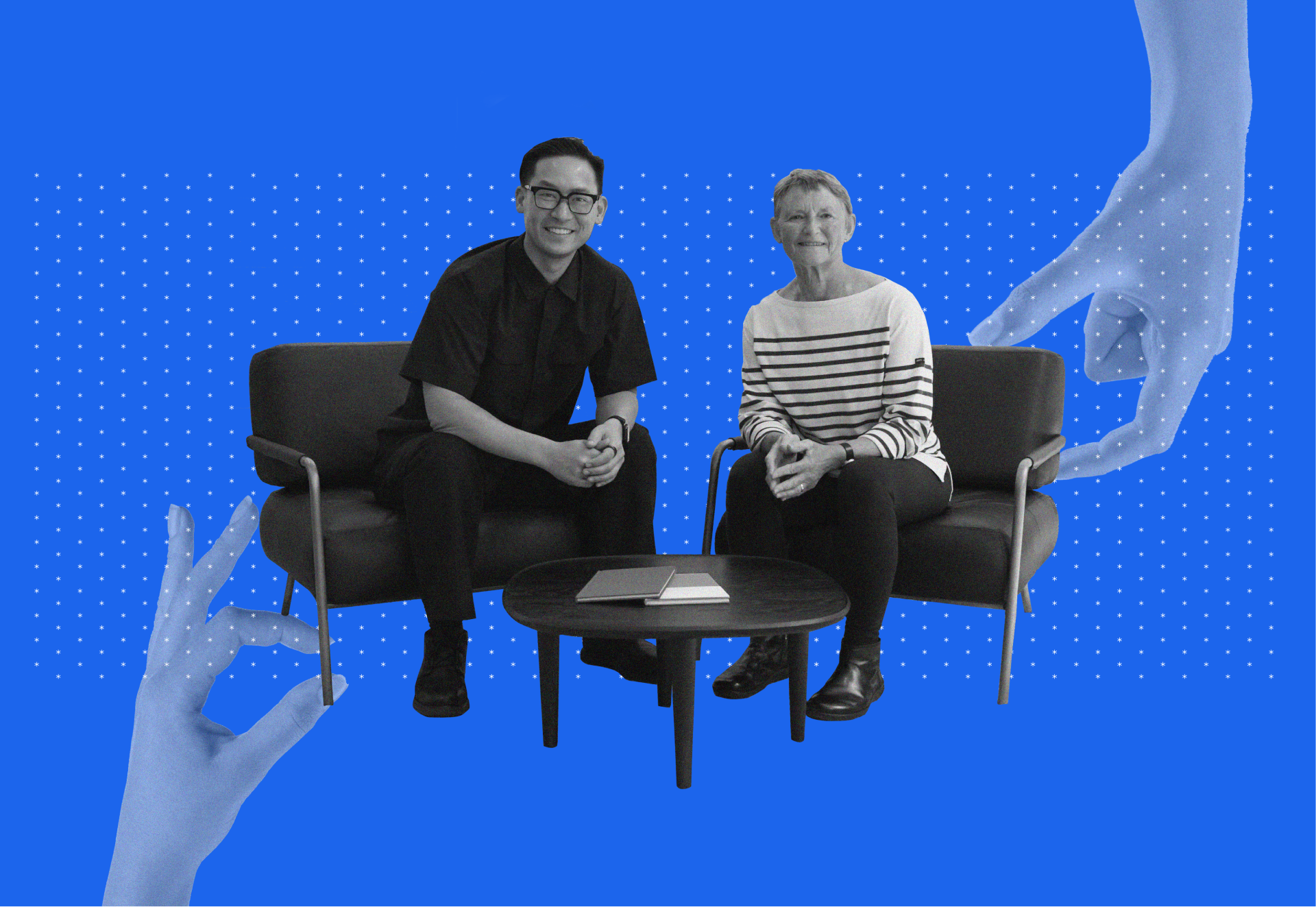
What real insights feel like, and other notes from a design legend
A Q&A between CEO Mike Peng and Jane Fulton Suri, former CCO.
A pioneer of human-centered design at IDEO, Jane Fulton Suri joined one of IDEO's predecessor firms, ID Two, in 1987. With a background in psychology and architecture, she gained early experience as a researcher at the renowned former Institute for Consumer Ergonomics at Loughborough University of Technology. At ID Two, and later at IDEO, Suri introduced social science principles to the design industry, which had not yet fully embraced them. Her contributions would go on to reshape the field.
Suri’s influential 2005 book, Thoughtless Acts?: Observations on Intuitive Design, features a collection of snapshots that highlight the subtle, instinctual ways people interact with the everyday world. It’s a love letter to observation as a design discipline with real-world impact. Her work in human factors at IDEO has influenced products people use every day, from rubber grips on Oral-B toothbrushes to redesigned Evenflo strollers. In recent years, she’s expanded her focus beyond human-centered design to explore how patterns found in nature and living systems can inspire more sustainable solutions—what she calls life-centered design.
Now a Partner Emerita, we were so glad to welcome Jane back to IDEO earlier this year for a conversation with our design community.
Mike Peng (MP): If you don’t mind, Jane, tell us about your origin story and how you came to IDEO.
Jane Fulton Suri (JFS): I started out in psychology because I was really interested in people. And then I got really interested in people in the everyday world. I brought that mindset into design: Let’s get out there and see what people really do.
I found myself working with manufacturers to help them understand why people didn’t do what they expected them to with power tools, motorcycles, and other dangerous things. A lot of my work was mitigating disaster. And I thought, this is crazy. Why aren’t these conversations happening while things are being designed? Problems are easier to remedy at the design stage than when they’re on the market.
Then I met Bill Moggridge, one of IDEO’s three cofounders, because a friend of mine was his client. He was a myth and a legend. After our conversation, he asked me, “What do you want to do now?” And I said, “I’d like you to offer me a job!”—which was very, very uncharacteristic of me. I had no clue what I was getting into.
I quickly realized I needed to understand what my teammates were doing and value that, then add ideas about going out, meeting people, and watching what they do.
So instead of having the answer, I realized the point was about discovering together how to make the design brief better. That became the practice—getting away from the desk. And now that means teams getting away from their screens and going into the world together.
MP: Now user research and ethnography are common practice in design. What were the early days like?
JFS: When we started out, we had no budget for anything I wanted to do. I had to convince my colleagues it would be exciting and interesting, and that we’d have good stories to tell our clients. Then it became a bit of a sales story about why it might take an extra week or two, or even a month, to do the project.
What we were doing was more like exploration; we didn’t know what we'd find, and afterward, we would probably want to do something different from what we’d promised when we wrote our proposal.
MP: If you had to sum up a few of your most memorable projects while you were at IDEO, what are some of the ones that really stood out to you?
JFS: Early on, Supercuts invited us to bid on an innovation-focused job. At the time, we were essentially a product design company. David Kelley, Tom Kelley, and others weren’t sure what we might do for a company like Supercuts.
So with one of the other early human factors researchers, we went out and got haircuts. Then we went around the city just looking at different hair stylists’ establishments. We started putting together a story of how customers make decisions from the moment they think about wanting a haircut to deciding where to go, making their first appointment, then all the behaviors that follow, like primping a bit before you leave the shop.
We had a lot of fun engineering this great crazy clipper. But I always believed our best ideas were these little moments throughout the experience, like getting a cape that made you look good, or a mirror that said “Supercuts” so you’d remember where you were. That was our first customer journey map.
MP: Are there other memorable moments that really stick out to you?
JFS: One of the most moving ones for me was at IDEO Chicago, years and years and years ago, when colleagues of mine were working on the LifePort Kidney Transporter. The project was all about how precious a kidney is. The team described their experience in the operating theater, seeing the surgeon take this living element and cup it so gently, like a baby bird, as he transferred it to where he needed to place it. That recalibrated the team’s thinking about designing the carrying system, because we’d just been thinking about it functionally and mechanically. But it also let them tap into what it really means to design for a living passenger.
MP: Let’s dive into the craft of design research. How do you know when a research insight is truly great?
JFS: Insight, for me, is a change of state in our understanding. There's an epiphany of sorts, a new recognition. You get an insight by being a sensory human being, observant and absorbent through all your senses…and then discovering you are excited about something new. Design and innovation take a lot of personal energy. That human emotion has to come from you.
And that’s what happens when clients get really drawn into ideas, too—they feel you’re changing the way they see things.
MP: What fundamentals do we need to continue to embrace to do research well?
JFS: Nothing beats being an aware, sensory human being who is curious about other people, places, and things. Research doesn’t have to be expensive. Even a conversation with one interesting person, or exposure to an unfamiliar place, will do.
Sometimes we're reluctant to put something in front of the client that we think is a really cool idea, but nobody has said they wanted it. Perhaps the research didn’t show that it was a really good idea yet. But sometimes we have to have conviction about our own perspectives and the confidence to share innovative ideas, even without hard evidence. I’ve always felt that.
MP: One of the most important phases of IDEO’s design-thinking process is synthesis—taking the messy materials we’ve gathered during research and making sense of them. How do you approach synthesis?
JFS: I once wrote a piece about how what happens in the design process isn't the same as how we formally describe it. One story stands out. I call it “the black shoes.”
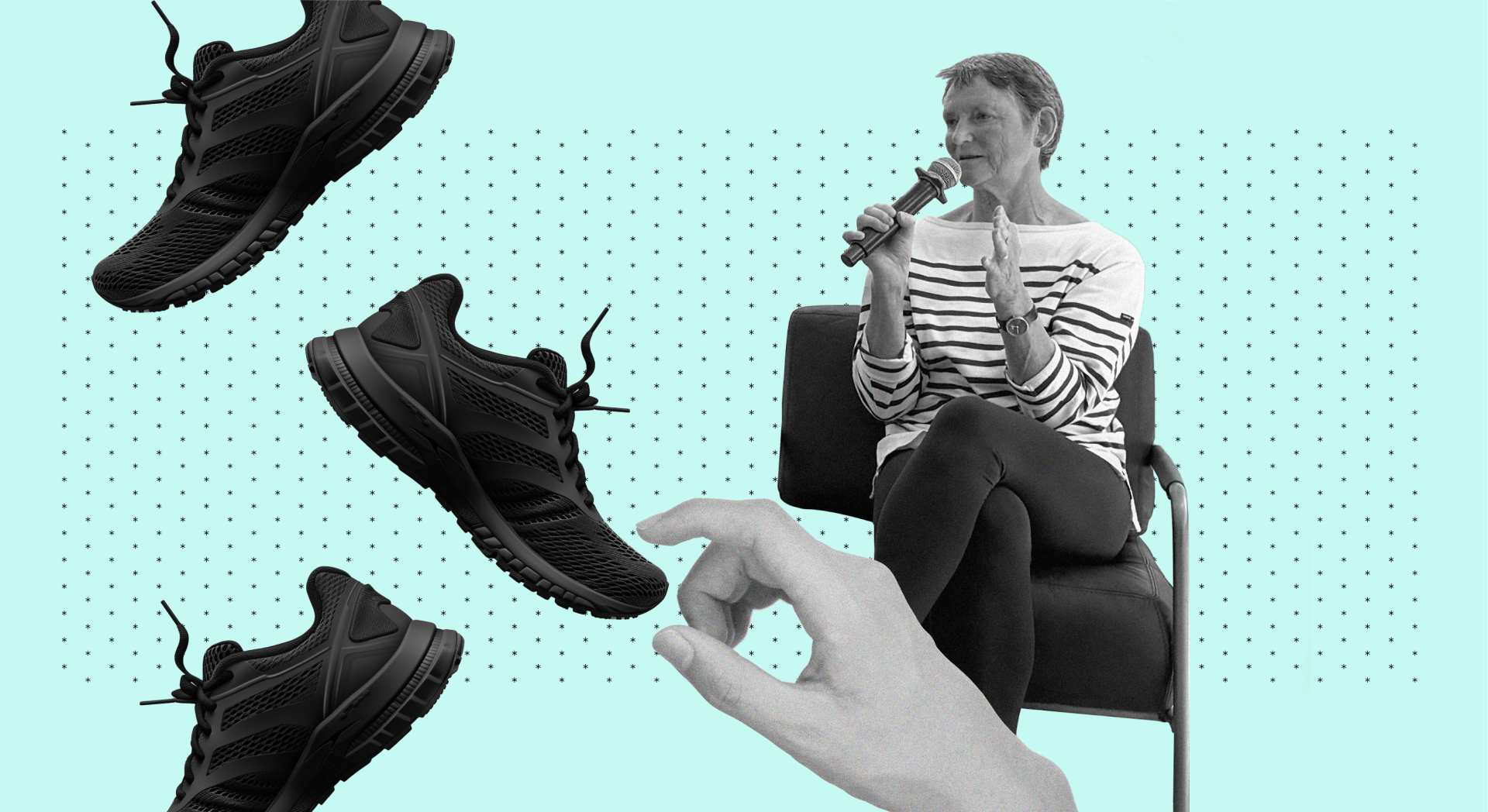
Annette Diefenthaler, now Professor and Executive Director of the Munich Design Institute, was an IDEO researcher working with a global bank trying to set up a presence in Russia. The team had done loads and loads of interviews with people about banks. Late one night, on the way back to their hotel, Annette saw a big shopping center. She asked the driver to stop, because she realized they'd had no time, other than doing their interviews, to absorb much about the culture.
So she went into this big mall, and Annette was stunned by how simply the department store had arranged its products. One wall was just black shoes all lined up, all the different kinds of black shoes you could have. It was all really obvious and not very exciting because there were only black shoes—no glitz at all.
What she took from that was: this is a culture where trust is built by showing what there is. It was so honest and direct. And here we were, talking to all these people about banks and trying to understand how to build trust in an alien brand. She had a flash of insight that suddenly made sense of what the team had been hearing. The bank needed to be so much more straightforward and transparent about its services. “Black shoes” became a mantra for that project and shaped how they designed the bank’s interior and described its offer.
This insight came from a moment that was completely off script. I love that. You can’t always get to an insight by staring at your interview notes. You get it because it’s somehow gotten into your viscera.
MP: Are there any moments where you found creative ways to present research to clients to help them make decisions?
JFS: Instead of personas and customer descriptions, a team once created a series of packed suitcases that represented the different types of travelers they interviewed. The client loved that one.
MP: How do you find the courage to decide to deliver an installation of suitcases instead of a more traditional research deliverable, like a presentation?
JFS: You need to tune in to what your client needs to absorb and what you want to communicate, and be ready to experiment with how you do that. You need to get good at failing. You try things, fail, and learn how to gauge what might work better the next time.
MP: You’re an incredible artist—I’ve seen your woodblock prints. You’re also an amazing rock climber and swimmer. I’m curious how these activities helped you develop your craft as a researcher and a designer.
JFS: There’s something very elemental about all of them—they’re direct experiences of the world. You give your weight over to the rock. You trust the water. Even with woodblock printing, what I love is how material it is. I use sharp knives and gouges to carve the wood, then I learn how much water and ink to use and how the brushes work.
That’s the thing I find really exciting. The fact that human beings have evolved to make beautiful things, that connection of making and place is a crucial motivator.
MP: You are one of the authors of the first edition of The Little Book of Design Research Ethics. I’d love to hear your perspective on the ethics of the discipline, and what we should keep in mind as we increasingly rely on technology.
JFS: I have a problem with the term research, partly because I think it connotes things like clipboards and taking notes—that we’re documenting other people’s lives. I’m happier when it all feels more like co-discovery, exploring together. We are together, engaged in this space, noticing things about your behavior as well as what I’m thinking about your behavior. And it's more collaborative.
Co-discovering with other humans is a much nicer place to be.
MP: Looking back, knowing what you know, what advice would you give young Jane?
JFS: I think I had imposter syndrome for about five years or so. I could have moved along a lot faster if I’d had a little bit more confidence and maybe a few more people telling me that it was okay.
MP: Are there any insights from your human factors work that you apply to the broader scope of life-centered design, and how we can learn from that?
JFS: A human being is a living thing in a living system of other living things. Observation and curiosity are key—we should keep asking the same kinds of questions about the inherent behavior of those systems, as we would ask about people: what they really do, what motivates them, and how we can gain insights from them. This goes back to your question about how rock climbing, swimming, and art come into it, in the sense that we can think more broadly about the elements that matter to people. There’s a whole living world out there with great examples of elegant systems we can learn from.
This Q&A has been edited for length and clarity.
“Insight, for me, is a change of state in our understanding. There's an epiphany of sorts, a new recognition. You get an insight by being a sensory human being, observant and absorbent through all your senses."
Building confidence for 2027
Create a plan for impact in three steps.
When category-defining challenges like disruption, the accelerating pace of change, and the need to rethink how organizations work are on the table, looking back on the current year and fighting for the same budget won't work. That's why many of the leaders we partner with are massively rethinking their priorities and where to best focus their resources.
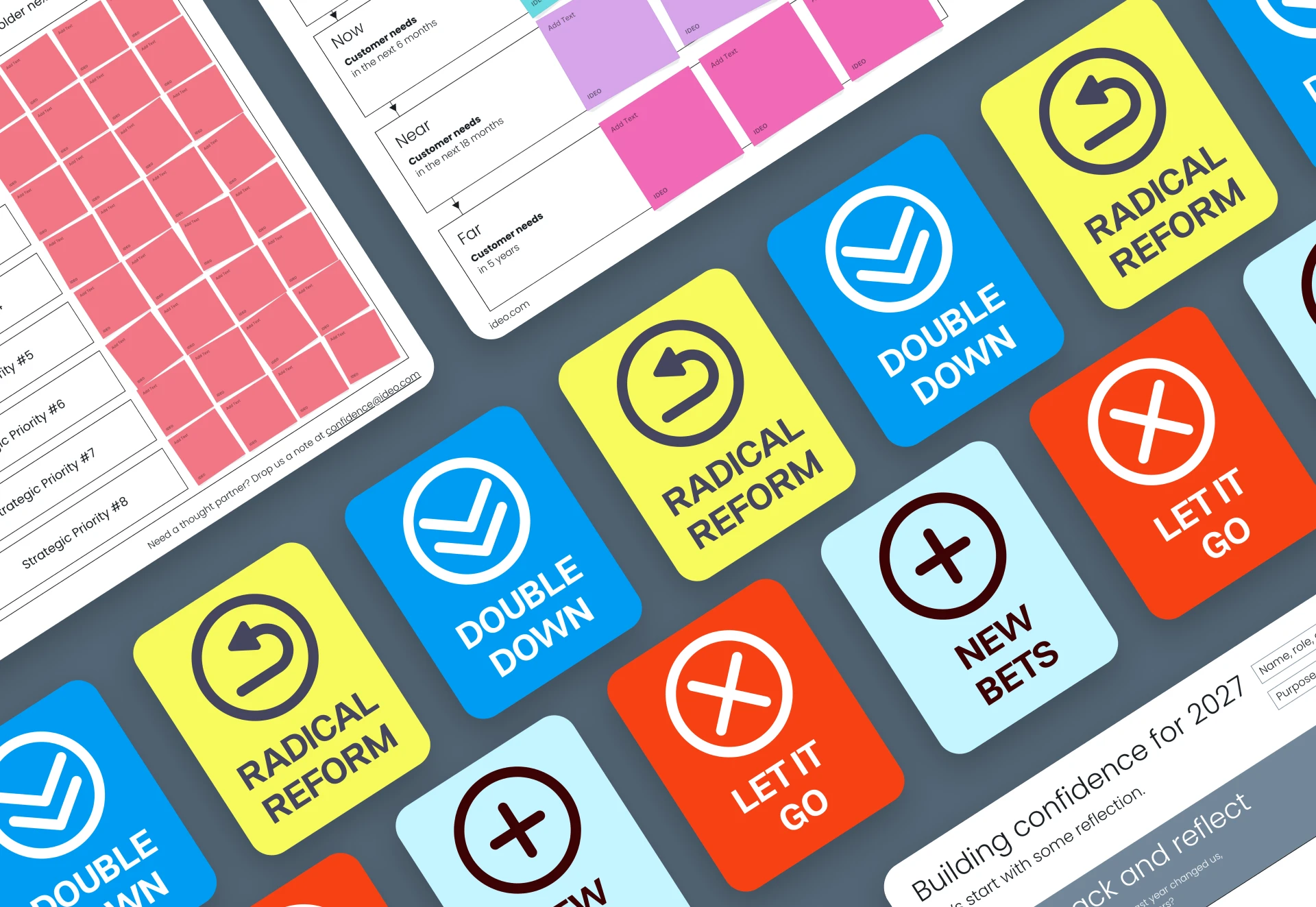
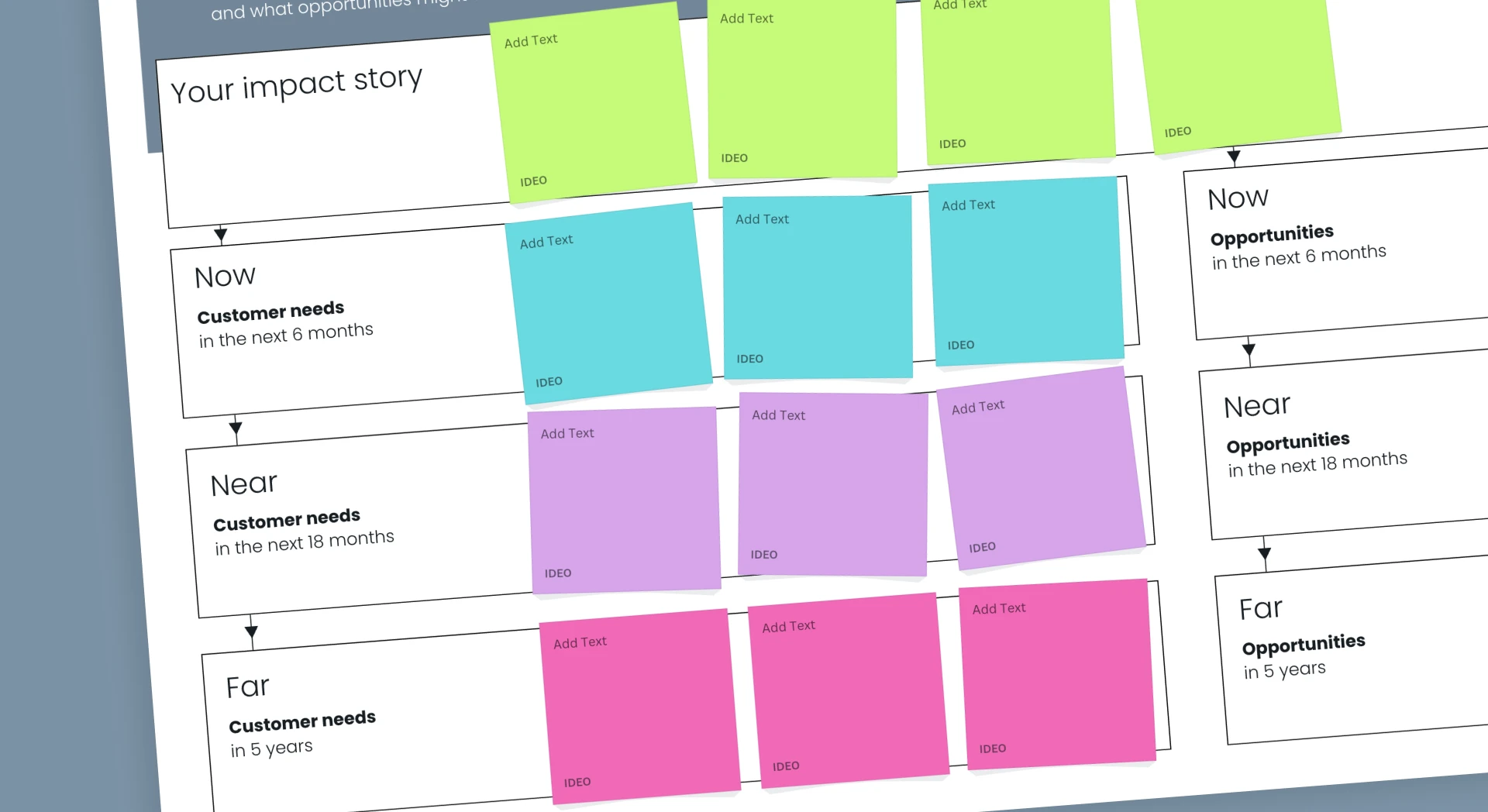
It’s a lot to balance, but the process doesn’t have to feel like guesswork. For several years, we’ve been using a tool we call the Planning Canvas, which provides a clear, strategic, and uncomplicated way to reflect on what has changed, what you’ve learned, and what matters now before planning for the coming year. It’s a simple way to help you evaluate where you are, and what levers you might pull to get your organization where you want it to be.
Download the Canvas
Our 2027 Planning Canvas walks you through three effective steps:
1. Reflect on what’s changed
2. Imagine the impact you want to have in the near future
3. Decide what to double down on, reform, let go of or pursue as a new bet

We recommend using it for individual reflection ahead of annual planning, before team sessions and leadership decision meetings begin. It will help you arrive with a clear point of view on what has changed, what matters now, and the choices worth putting on the table. At the same time, don’t hesitate to adapt it to your needs. If facilitating a collaborative conversation across your team aligns better with your organization's culture, this tool can help with that, too.
The goal isn’t to predict the year ahead perfectly. It’s to enter planning conversations with a sharper point of view and the confidence to make impactful choices together. We hope you find it useful.
Looking for more help with strategic challenges? Get in touch. We’d love to connect.
At a time when uncertainty feels like a constant, leaders across categories can find it tough to make confident planning decisions for the year ahead.

Lindsey Turner
I’m passionate about building brands, products, and experiences that help organizations show up with meaning and momentum.
I help organizations cut through complexity by shaping how they show up, through brand strategy, identity, and storytelling.
Working at the intersection of brand and business, I bring an editorial eye and a bias toward making—turning ideas into tangible experiences that people can understand, trust, and believe in.
My work spans government, healthcare, financial services, media, and consumer goods, from launching Gen Z-focused ventures to building innovation labs and reimagining legacy brands. I relish moments of ambiguity and enjoy translating across teams, perspectives, and priorities to move ideas forward.
I started my career in editorial and digital design, shaping cross-platform experiences and identity systems in publishing and agency environments. That foundation still shapes how I work today: I’m detail-oriented, collaborative, and overreliant on the Oxford comma. I hold a BFA in Visual Communication from the School of the Art Institute of Chicago.

Rachel Young
My work helps organizations see who their products aren't working for—and build the will and the tools to do something about it
For 25 years, I've asked the same question: Who does this design exclude—and what are we going to do about it?
My work spans human-centered strategy, inclusive design, and qualitative research, with clients ranging from Microsoft, Google, and Verizon to the National Science Foundation, and San Francisco Unified School District.
Before IDEO, I taught elementary school in East Palo Alto and spent a decade doing design work with social service organizations—where I learned firsthand what it costs people when systems are built without them in mind.
I am currently writing User Error, a nonfiction book about digital access and the design decisions behind it. I live in Oakland, California.

Brian Pelsoh
I lead with craft, ensuring our work is creatively excellent: rooted in deep human insight and imagination, while also grounded in the realities of business and technology.
My expertise spans brand, communication, and product design across tech, education, the arts, and social impact.
I believe great work demands both high-level vision and obsessive attention to detail, and only happens through collaboration.
I bring an inclusive, hands-on approach and a deep understanding of business, which enables me to consistently deliver excellence while always asking why.
Before joining IDEO, I worked at the brand firms Pentagram and VSA Partners. I began my career as a designer, leading teams at the School of the Art Institute of Chicago and the Milwaukee Art Museum. I hold an MFA in graphic design from Maryland Institute College of Art and a BFA in communication design from the Milwaukee Institute of Art & Design, and have taught at some of the best design schools in the US.

Tony Wong
I am responsible for IDEO’s long-term success in China and working with clients to use design as a tool to enable growth.
I am responsible for IDEO’s long-term success in China and working with clients to use design as a tool to enable growth. Specifically, I have helped Chinese companies design holistic brand solutions through the development of their products, communication, services, and innovation teams, and I have helped multinationals expand their presence and influence in China.
I advise global leaders on developing China-led innovation and capabilities.
In over 15 years in IDEO Shanghai, I have worked on projects that use design to elevate the quality of the experience of healthcare products and services, streamline processes that increase productivity, create spaces and programs that promote and enable inclusive communities, and build next generation mobility solutions that are planet-positive.
Before joining IDEO, I worked at Philips Electronics and the Electrolux Group in Italy, the Netherlands, and Singapore on a number of breakthrough commercial products. I am a member of the Young President Organization in Shanghai.

How to use AI as an editor, not a writer
Ed White shares how he uses AI as an editor—not a writer—to sharpen storytelling, rehearse ideas, and preserve the productive friction that makes creative work better.
Ed White has a rule he's tested on his own writing: hold yourself as the writer, and let AI be your editor. Ed is a Senior Design Director at IDEO's London studio, where he co-leads the firm's AI portfolio across Europe. Before IDEO, he spent 12 years as a writer and editor at the Financial Times, Wired, and Contagious. So when he talks about when to use AI for storytelling and when not to, it comes from two decades of crafting his storytelling skills.
In this episode, Mina Seetharaman talks with Ed about two specific tools he uses to keep AI in an editor's seat: a "roasting agent" prompted to critique his drafts without any sugarcoating, and a simulated audience he rehearses pitches on before the real thing. They also get into what Ed is hearing from design leaders at Anthropic, Lovable, Shopify, and Google Creative Lab about how creative work is changing, and why he thinks the friction of writing something yourself is worth protecting rather than automating away.

Building a personal AI for the messiness of life: Sida Li
Becca Carroll talks with Cue co-founder Sida Li about designing a personal AI for the messiness of everyday life—not just work. They explore how Sida stays anchored to human needs while navigating fast-changing technology, product tradeoffs, business-model experimentation, and the realities of building an AI company today.
Most AI products today are built for work—a space with clear problems and established systems. One founder noticed a gap: personal life is messier, harder to systematize, and mostly left behind by the AI boom. So she built Cue, a personal AI that lives inside iMessage and group chats, to go where the other tools haven't.
In this episode, Becca Carroll, IDEO's Chief Strategy Officer, talks with Sida Li, co-founder and CEO of Shared Context Lab, about staying anchored to a human need while the technology around her keeps changing shape, why she treats her business model with the same rigor she'd bring to a product, and what it feels like to build a company at this particular, disorienting moment in AI.
The conversation also gets into how Sida makes design decisions: the language Cue uses to describe itself, the tradeoffs behind building inside iMessage instead of a new app, and a real story about a business idea that didn’t pan out.
This is the second in a two-part series profiling founders from IDEO's Startups-in-Residence program. The first conversation is with Johannes Seemann, founder of Sooner, on designing GenAI for the emotional side of money.

Designing GenAI for the emotional side of money: Johannes Seemann
Designing financial tools around the feelings that shape money decisions.
Most personal financial tools are built to run the numbers and optimize towards a budget. While that works for some, most people experience money as a lived relationship that does not neatly fit into a spreadsheet. Johannes Seemann and Becca Carroll discuss why money is emotional before it is mathematical, and what a human-centered approach to building a generative AI financial product looks like in practice.

The curious leader's edge in uncertainty: Scott Shigeoka
How genuine curiosity helps leaders navigate uncertainty with greater confidence.
Mina Seetharaman talks with Scott Shigeoka, author of Seek and Head of Curiosity Cultivation at the Eames Institute, about what distinguishes genuinely curious leadership from performative curiosity, how power dynamics shape curiosity, and why practicing curiosity can restore energy rather than drain it.
Looks like you might be in search of something very specific?
Or reset the filters above and try another angle.
Here’s some random inspiration

Podcasts about creative leadership

Articles about the power of prototyping











































.webp)