
.svg)


Make the invisible honest

"A better path means establishing a new standard in which trusted, useful intelligence serves the physical world."
For decades, the typical relationship between humans and hardware was a straightforward one of command and control. We pushed buttons; machines performed tasks. But as AI migrates from our screens into our physical environments, the nature of that relationship is shifting: Computation is becoming a nondeterministic presence.
So far, the industry seems to be caught between what users actually want and the sci-fi fantasies currently captivating the tech community. Rather than marrying what’s technologically feasible with what people need, companies are bolting AI onto everything, shipping tech demos as finished products. The result is half-baked experiences traded for focus, and speed traded for agency and privacy. A better path means establishing a new standard in which trusted, useful intelligence serves the physical world.
For us, it means designing under these seven principles for good AI hardware, inspired by the timeless rigor of Dieter Rams, and setting the conditions to put them into practice.
1. Good AI hardware is mutualistic

AI is not a deterministic layer of software trapped in plastic. Designed well, it is a partner in human flourishing. We build hardware rooted in mutualism: the device learns from the perpetually shifting nuances of human intention, and the human grows through what the device makes possible. More than optimization, it is a shared evolution between person and machine.
What might that look like?
The Household Reflection Mirror
A bathroom mirror is designed without predetermined health goals. It comes equipped with sensors, models, and processing power, but without a built-in definition of what “better” means for you. That definition emerges through use.
In the first few weeks, the mirror observes your behaviors without interpreting them. Over time, patterns surface that you implicitly confirm or contradict through your actions. You linger on certain readouts. You ignore others. Slowly, the device constructs a model of what matters to you, not what a wellness framework says you should care about.
After three months, the mirror notices your sleep quality degrades during a particular recurring time of the week. On Monday morning it surfaces a single line beneath your reflection: “Sleep is typically shorter on Mondays.” The next Sunday, you go to bed an hour earlier. The mirror notices. Over time it learns what kind of attention you actually respond to, because you taught it through the way you live and react. The device you have at the end of the year is not the one you started with—and neither are you.
Without your input, it is a capable system with no inherent sense of purpose. Without it, you miss a form of self-knowledge you didn’t know you needed. Closing that gap together is the essence of mutualism.
2. Good AI hardware is off by default

Truly human-centered hardware requires intentional consent to engage. Privacy isn’t an afterthought; it is a foundational design requirement. Until there is consent and utility, we reject the always-on model of technology. We design to respect the privacy of our homes and lives, so that technology enters our cognitive space or observes our physical space only when we consent. Good AI hardware is something you want around, that makes you feel safe.
What might that look like?
The Consent Door
A front door knob has a small illuminated ring at its base. When you arrive home, the ring pulses once, dimly and unhurried. It is asking for your attention.
Twist the knob the way you normally would to unlock the door, and the ring goes dark. The house stays quiet. No sensors wake. No systems are activated. You are home, yet the home does not know it.
Twist the knob the opposite way before you enter, and the ring glows brightly. The AI features of the home come online. The thermostat starts learning. The mirror observes. The kitchen listens. You’ve made a conscious choice with your body before you crossed the threshold.
Guests see the same dim, illuminated ring when they arrive. They face the same choice. The house never assumes.
3. Good AI hardware is aesthetic

A piece of hardware should improve the aesthetic or emotional vibe of a space or interaction. With all the focus on the AI, it’s easy to lose sight of how intentional and sensorial the hardware has to be to provide value. We lean into creativity by using ergonomic forms, tactile textures, and haptics to create objects that feel like art or furniture while having capabilities suited to their use. The best AI hardware is crafted with intention for its role in our environments.
What might that look like?
Climate-Aware Window Glass
A sheet of AI-embedded glass replaces a traditional living room window. The glass learns sunlight patterns, outside temperatures, and occupants’ daily rhythms. When the afternoon sun becomes harsh, the glass subtly softens and diffuses the light, giving the room a warm, painterly glow. On cold winter mornings, it lets in full sunlight to warm the space. There are no visible controls and no notifications. The window functions as an intelligent material, shaping light and heat in ways that feel natural, healthy, and beautiful.
4. Good AI hardware makes the invisible honest

AI hardware should communicate its state, data usage, and limitations through intuitive physical cues. Sensors now extend far beyond cameras and microphones into biosignals, radar, emotion recognition, and neural intent. Technology can understand us in unprecedented ways, which creates unprecedented room for distrust. It’s crucial that we replace vague terms and conditions and labyrinth privacy settings with transparent, real-time feedback, and make the invisible visible. Honesty is the only foundation for a lasting relationship with intelligent technology.
What might that look like?
Visible Cognition Display
A small home security camera sits near the front door. Inside the door is a narrow strip that displays what the AI believes it sees in plain language. When someone approaches at night, it writes: “Face scan attempted. Low light. Result unreliable. Door stayed locked.”
The system reaches the edge of what it can confidently do and stops there, telling you exactly why—and that restraint is the point. A device that surfaces its own limitations in real time is making a fundamentally different promise than one that acts with false confidence and hides its reasoning. That promise, repeated across thousands of small moments, is how trust is genuinely built.
5. Good AI hardware is minimally intrusive

The ultimate goal is to improve our lives in the physical world, not to keep us tethered to a digital one. We need to design for the disappearing act by ruthlessly stripping away unnecessary screens and notifications, and removing friction between humans and their environments. We need to design to follow user intent, using the superpowers of AI to understand user needs and respond in simple, clear ways. Whenever possible, we embed AI into existing rhythms and daily flows, rather than requiring people to pick up new habits.
What might that look like?
The Context-Aware Notification Pebble
A small, smooth stone is connected to your devices. When something truly important comes in—a call from family, a hard-to-get dinner reservation, a flight deal on a trip you’ve been planning—the pebble gently glows. There are no sounds. No vibrations. No screens. Just light.
If you pick it up, the message is faintly projected onto the desk. For matters that require a decision, the system has already done the legwork. It held the reservation. It queued the flight deal. The pebble presents you with a choice, not a task. A single tap confirms your decision. The pebble stops glowing, and life continues as normal.
If you choose to ignore it, the pebble turns off on its own. The system respects your attention instead of competing for it.
6. Good AI hardware is honest about its capabilities

We design hardware that delivers on what technology can actually do, while meeting real user needs. Good design speculates and continues to evolve as technology improves, but it does not hinge on speculative promises it can’t meet (and which inevitably let users down). We focus on the high-fidelity reality of what a device can do now, making the hardware a reliable anchor as technology improves rather than a vessel of far-reaching hype.
What might that look like?
The Tutor Tablet for Children
A child asks the intelligent tablet a complicated science question. The device pauses and displays the message: “I am not certain about this answer… Would you like me to look it up with you?” When the model is unsure, it offers sources or invites the child to explore the topic together. Sometimes it even says: “I might be wrong. Let’s test it…”
In this way, the child learns two important lessons: the scientific method and the understanding that intelligence, whether human or artificial, involves humility.
7. Good AI hardware respects the Earth

We reject creating unnecessary devices that contribute to the global e-waste crisis by staying attuned to real user needs. When we build, we design for longevity through repairability, modularity, and circularity. From the selection of materials to the ease of recycling at the end of a product’s life, good AI hardware takes responsibility for its physical footprint. We build tools that are meant to last, not to be discarded when the next software update arrives.
What might that look like?
The Modular Home Intelligence Hub
A small wood and aluminum hub sits on a shelf, running local AI models for the home. Each component slides out like a drawer: Compute, Storage, Radio, Battery, and Sensor Array. While these modules are functionally co-dependent, each one is discrete. For instance, whenever new AI chips are released, the owner can simply replace only the Compute drawer.
The device also maintains a lifetime material dashboard:
Operational life: 8 years
Upgraded components: 2
Material saved vs. replaced: 4.3 kg
Energy used this month: 2.1 kWh
The hub processes most workloads locally to minimize unnecessary cloud energy consumption. Instead of being replaced every few years, it ages alongside the household.
Putting the principles into practice
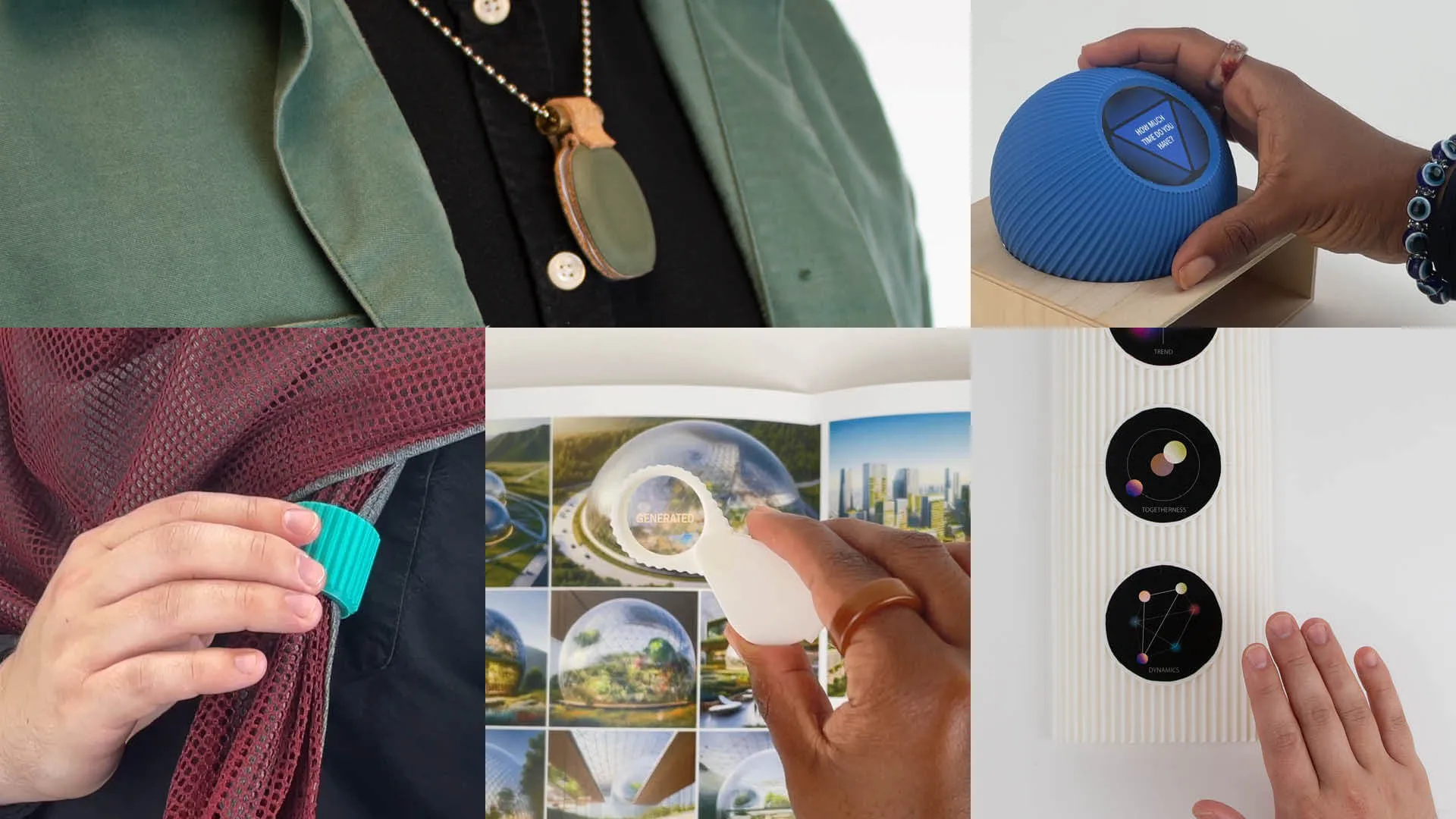
It’s one thing to create a list of principles. It’s another to make them part of our work. To uncover real human needs, we do research with people in their homes, learning where they want machines to help and where they want to stay in control. Leveraging emerging tools like 3D printing, AI-accelerated prototyping, and generative design, we move from insight to artifact quickly. Rather than just rendering a sensor, we build it. Rather than speculating about how friction feels, we test a physical interface in someone’s home and let their reaction tell us what to do next. We hold creativity accountable to what’s technically viable and commercially scalable, so the visions we make are ones businesses can actually act on.
We are moving past the era of experimental AI and into the era of specialized, high-performance hardware that permeates our everyday lives. The only way to succeed in the market is to earn a permanent place in people’s lives through trust and utility. By anchoring what we build in these principles, we move beyond the hype and into producing hardware that people actually want around. That is the standard we are building toward.
(Looking for a partner to build AI products with? Get in touch.)
Words and art



Subscribe