
.svg)


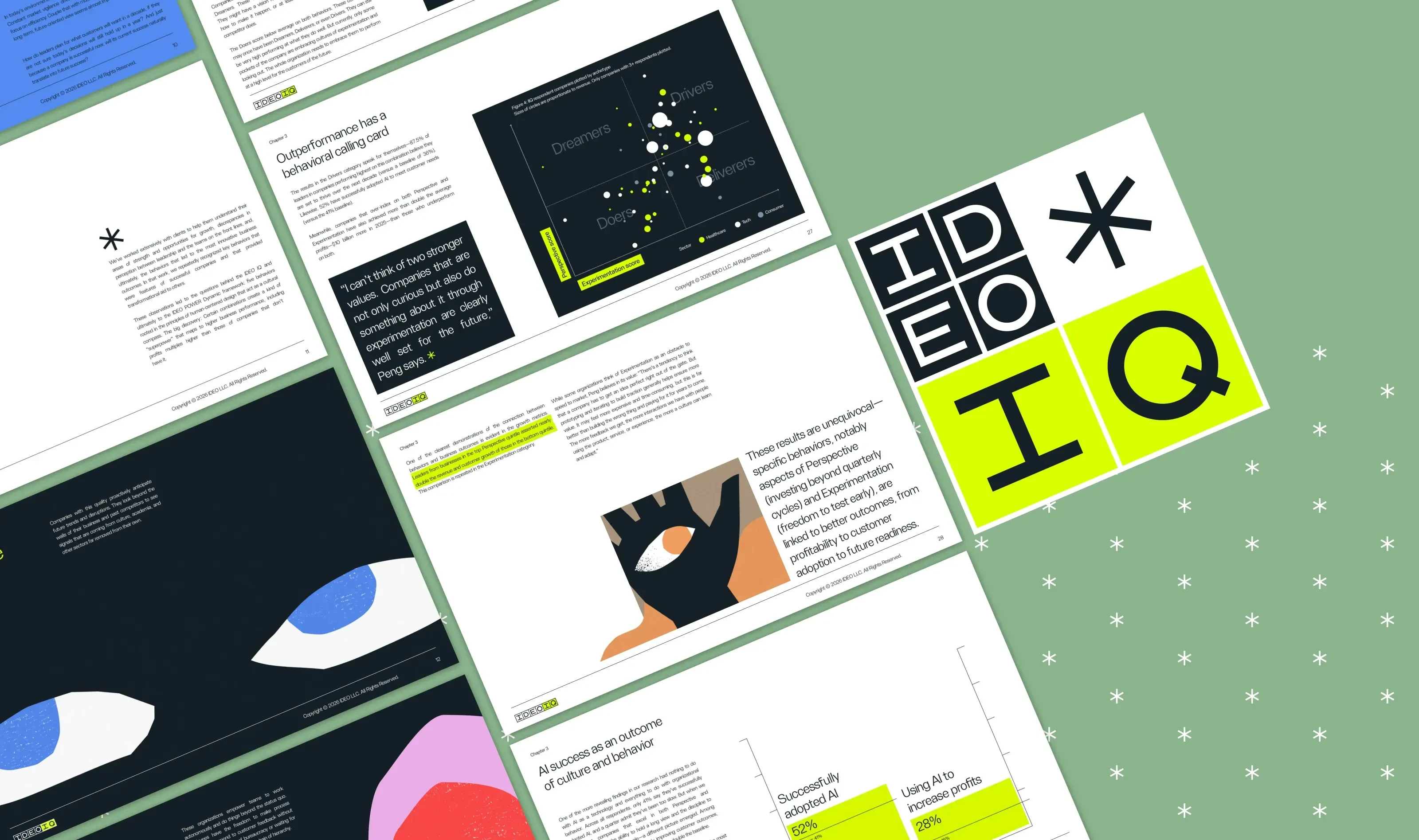
The IDEO IQ Report
Here's what you need to know

Triple revenue growth and billions more in profit come down to behaviors.
Companies whose score landed them in the top 20% reported nearly 3x the revenue growth, close to 2x the customer growth, and over $5 billion more in annual profits than average.
The pattern held across Media & Technology, Healthcare, and Consumer Goods—how a company's people think, decide, and operate is one of the most reliable signals of where it's headed.

Freedom to experiment is vital to performance, and less than a third of companies have it.
Most companies (58%) in our sample score well on customer promise—what we call Resonance.
But Resonance alone doesn't predict growth. The behaviors that do—Experimentation (prototyping with real users), Perspective (anticipating future trends), and Ownership (empowering teams to act)—are the ones companies struggle with most, with fewer than a third of leaders saying they test early with real users, have genuine freedom to try new things, or balance short- and long-term bets.

Vision and velocity can help close the $10 billion profit gap.
Companies that excel at both Perspective (anticipating future needs) and Experimentation (getting to market fast) are the ones that outperform.
We mapped the companies into four archetypes: Drivers think big and act fast. Deliverers execute but lack long-range vision. Dreamers scan the horizon but struggle to ship. Doers underperform on both.
The gap between them is real—Drivers realized $10 billion more in profits last year than Doers, and nearly 88% of Driver leaders believe their companies will thrive over the next decade, compared to just 36% overall.

Over 50% of top performers are improving customer outcomes with AI.
Only 41% of leaders say their company has successfully adopted AI to meet customer needs. But among Drivers, 52% report AI is already improving customer outcomes and 28% are using it to increase profits—nearly double the baseline.
The differentiator isn't access to technology. It's the behavioral foundation underneath: the ownership to experiment, the discipline to deploy, and the perspective to anticipate where AI creates real value.

Grab a copy and share it.
Download the full IDEO IQ report to:
Get the full picture.
Explore all five behaviors in the POWER Dynamic.
Dive into case studies about companies worth watching.
Kickstart a conversation with your team about where you stand and where you need to go next.
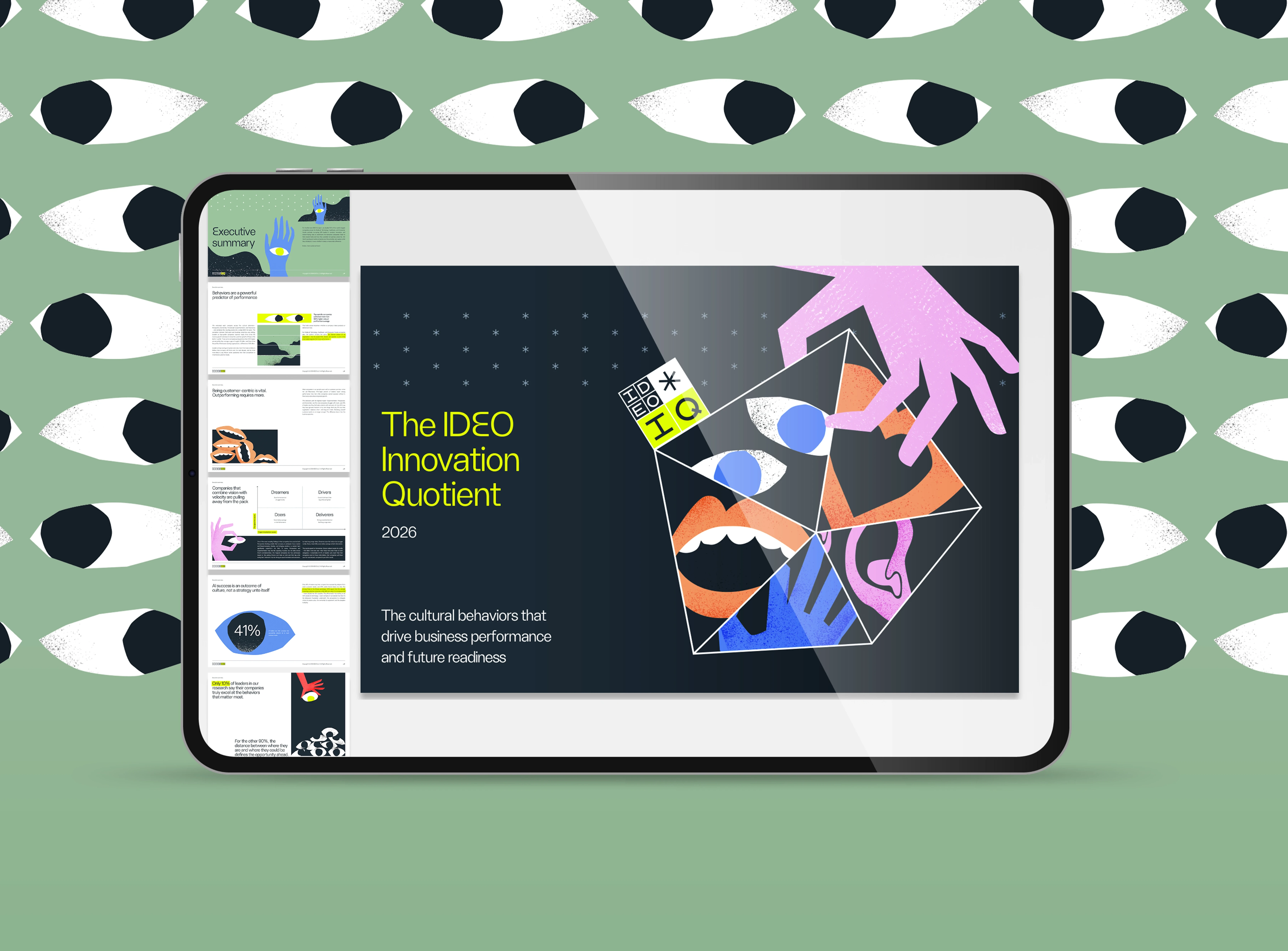

Discover your IDEO IQ
Introducing the POWER Dynamic
Certain combinations of these behaviors create a kind of organizational "superpower"—one that maps directly to stronger business outcomes.
Perspective
Companies with this quality proactively anticipate future trends and disruptions. They look beyond the walls of their business and past competitors to see signals that are coming from culture, academia, and other sectors far removed from their own.

Ownership
These organizations empower teams to work autonomously and do things beyond the status quo. Employees have the freedom to make process changes or respond to customer feedback without wading through layers of bureaucracy or waiting for sign-off to pass up or down the chain of hierarchy.

Wavelength
Businesses that embrace this dynamic foster seamless teamwork across functions, which is especially important in large, multinational organizations. Behaviors range from employees offering help to people outside their core teams to working cross-functionally (rather than in silos), and leaders placing high value on seeking out and embracing those with atypical backgrounds or points of view within the organization.

Experimentation
Swiftly turning ideas into market-ready solutions is an essential driver of growth. This includes prototyping with real customers and getting early feedback. It also covers investing in ideas even when they don’t promise near-term efficiency gains.

Resonance
This means deeply understanding and delivering on customer needs. Customer-centricity goes beyond messaging to drive business decision-making and operational activity at all levels.
“The companies that put human ingenuity into anticipating the future, finding the edges of creativity, and then testing out those ideas are the ones pulling ahead."
Contact
Curious about how IDEO helps organizations like yours adopt these behaviors for success? Let's chat.
Methodology
The profit analysis was conducted using publicly available global annual profit data reported by each company. This was Net Income (profit after tax) in US dollars from the 2024-2025 financial year. Where profit averages are reported across subgroups of the dataset, these are mean averages per company in that subgroup.
“Ones to Watch” case studies were sourced from interviews with those companies; survey completion was not part of that research.