


The POWER Dynamic: Five behaviors that drive business growth
The POWER Dynamic is IDEO’s proprietary framework, consisting of five key cultural behaviors: Perspective, Ownership, Wavelength, Experimentation, and Resonance. IDEO’s research shows that these behaviors are the strongest predictors of business performance and future readiness. Developed from decades of IDEO’s work with clients and validated through the 2026 IDEO IQ study of 100 global companies, the framework identifies the internal operating behaviors that set high-growth organizations apart from those that stagnate.
What the POWER Dynamic is and where it came from
For nearly 50 years, IDEO’s client work has highlighted a consistent pattern: certain cultural behaviors are better predictors of innovation outcomes than strategy, technology, or resources alone. The POWER Dynamic codifies these behaviors into a measurable framework. The framework was formally validated through the IDEO IQ—IDEO’s inaugural research study surveying 266 leaders from 100 companies with revenues exceeding $1 billion.

The five behaviors
Perspective
Perspective refers to the ability to proactively anticipate future trends and disruptions by looking beyond direct competitors. This involves understanding signals from culture, academia, and sectors that are far removed from one’s own. According to the IDEO IQ study, only 31 percent of leaders report that their companies excel at Perspective.
Ownership
Ownership describes organizations that empower teams to operate autonomously and move beyond the status quo. Employees have genuine freedom to make process changes and respond to customer feedback without being hindered by layers of bureaucracy. Only 29 percent of leaders report strong Ownership within their organizations.
Wavelength
Wavelength refers to fostering seamless cross-functional teamwork, particularly in large, multinational organizations. This involves seeking out and embracing individuals with diverse backgrounds and perspectives. According to the IDEO IQ, 40 percent of leaders report strong Wavelength practices.
Experimentation
Experimentation is the practice of quickly turning ideas into market-ready solutions. This includes prototyping with real customers, getting early feedback, and investing in ideas even when they don’t guarantee near-term efficiency gains. Only 21 percent of leaders report strong Experimentation, making it the rarest yet most impactful behavior.
Resonance
Resonance is the deep understanding of, and responsiveness to, customer needs. It embodies customer-centricity that extends beyond messaging, driving decision-making and operational activities at every level. While it is the most commonly reported behavior at 58 percent, Resonance alone does not predict growth.
What the research found
Companies that rank in the top quintile across the POWER Dynamic reported nearly three times the revenue growth compared to those in the bottom quintile. Top-quintile companies achieved annual profits more than 50 percent above average, resulting in a profit gap of approximately $5 billion, and earned profits three times those of the lowest-scoring organizations. Leaders at top-scoring companies were six times more likely to believe that they are better positioned than competitors to meet future customer needs. However, only 10 percent of leaders report that their companies truly excel in all five key behaviors.
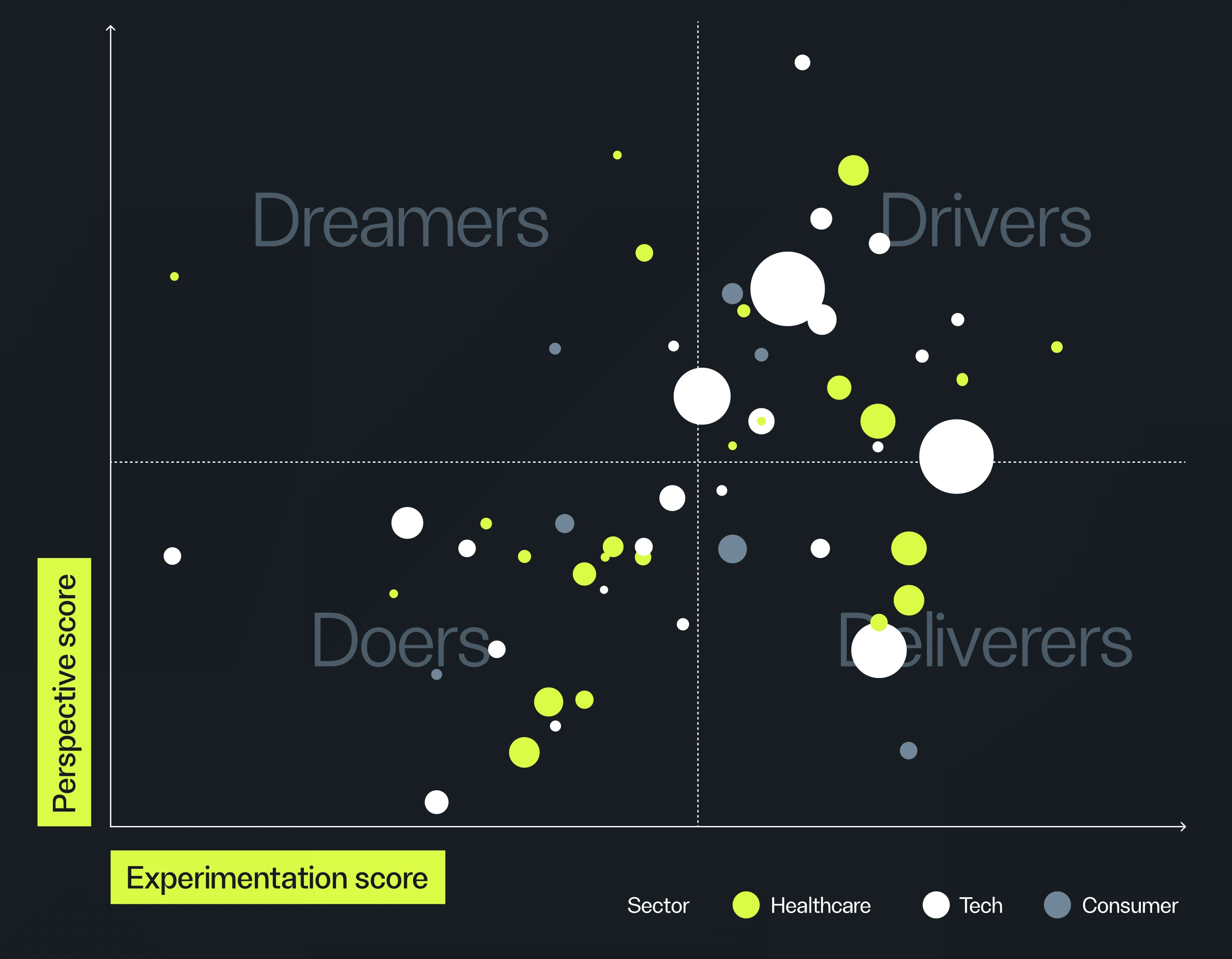
The combinatorial power play—Drivers, Deliverers, Dreamers, Doers
One of the most revealing findings is that companies that excel at both Perspective (looking outside their company to anticipate future needs) and Experimentation (testing and quickly bringing solutions to market) significantly outperform their competitors. While Perspective and Experimentation may seem like opposing forces, the data shows they’re actually complementary.
We mapped the companies we surveyed into four archetypes based on their levels of Perspective and Experimentation using a two-by-two framework:
Drivers: High in both Perspective and Experimentation. These organizations think big and act fast.
Deliverers: Strong in Experimentation but low in Perspective. While Deliverers execute well, they lack a long-term vision.
Dreamers: High in Perspective but low in Experimentation. These companies scan the horizon but struggle to ship.
Doers: Low in both Perspective and Experimentation. Doers underperform on both metrics.
The gap between these archetypes is real—Drivers generated $10 billion more in profits last year than Doers, and nearly 88 percent of leaders in Driver companies believe their businesses will thrive over the next decade, compared to just 36 percent of leaders surveyed overall.

How IDEO uses the POWER Dynamic with clients
The POWER Dynamic offers an effective framework for measuring how well an organization embraces the principles of human-centered design. We use it with our clients to evaluate their current standing and develop a plan to embed these behaviors into the company’s core values. We focus on addressing the highest-impact gaps, which typically are Perspective, Experimentation, and Ownership, and measure progress over time.
“We appreciate that putting Perspective and Experimentation into practice is really tough; there are so many priorities leaders need to address these days,” says IDEO CEO Mike Peng. “But this research clearly shows the impact of creating the conditions for success, and the POWER Dynamic is key to it.”

AI success as an outcome of the POWER Dynamic
Based on our extensive work with clients, we’ve learned that the success of AI adoption is an outcome of an organization’s culture, not a strategy unto itself. Among the leaders we surveyed, only 41% believe their company has successfully adopted AI to meet customer needs, while 26% admit they’ve been too slow to adapt. In contrast, 52% of those identified as Drivers report that AI is already improving customer outcomes, and 28% are using it to increase profits—nearly double the 16% baseline. The differentiator is not access to technology—all companies in our sample have that. It’s the behavioral foundation underneath: the Perspective to anticipate where AI can create value, the Ownership to experiment, and the discipline to implement it effectively.
What the POWER Dynamic is not
The POWER Dynamic is not a checklist, a culture survey, or a one-time diagnostic tool. It’s a set of five operating behaviors that need to show up in daily decisions throughout the organization; in meetings, in funding decisions, and in determining whether the person closest to the customer has the authority to act. Taking the IDEO IQ survey can help you understand where your company stands and where you can stand to grow.

FAQ
What is the POWER Dynamic?
The IDEO POWER Dynamic is a framework of five behaviors rooted in the principles of human-centered design. It acts as a cultural compass for organizations.
Perspective is the practice of proactively anticipating future trends and disruptions by looking beyond direct competitors to signals from culture, academia, and sectors far removed from one’s own. According to the IDEO IQ study, only 31% of leaders report their companies excel at Perspective.
Ownership describes organizations that empower teams to work autonomously and go beyond the status quo. Employees have genuine freedom to make process changes and respond to customer feedback without being hindered by layers of bureaucracy.
Wavelength is the behavior that fosters seamless cross-functional teamwork, particularly in large, multinational organizations.
Experimentation means swiftly turning ideas into market-ready solutions by prototyping with real customers, gathering early feedback, and investing in ideas, even when they don’t promise immediate efficiency gains.
Resonance is the deep understanding of, and responsiveness to, customer needs. It emphasizes customer-centricity that goes beyond mere messaging to drive decision-making and operational activities at every level.
The big discovery of the POWER dynamic is that certain combinations of these behaviors create a “superpower” that correlates to higher business performance, including profit multiples higher than those of companies lacking these attributes.
Who created the POWER Dynamic framework?
The design and innovation firm IDEO created the POWER Dynamic framework to measure how workplace behaviors drive business performance across 100 of the world’s largest companies. These results were synthesized in the inaugural 2026 IDEO IQ report. Organizations with the highest IDEO IQ scores earned nearly $20 billion in profit last year—50% higher than the average and three times that of those ranked at the bottom.
What is the IDEO IQ?
The IDEO Innovation Quotient is a diagnostic framework and report that measures how specific workplace behaviors drive business performance. To create it, IDEO surveyed 266 leaders from 100 of the world's largest companies and mapped five core cultural behaviors against real business outcomes. The results? In an era of rapid technological change, the behaviors associated with design and creativity create the conditions that support sustainable growth.
Which POWER Dynamic behaviors have the highest impact on business performance?
While all POWER Dynamic behaviors can contribute to success, companies that excel at both Perspective (anticipating future needs) and Experimentation (getting to market fast) outperform their competitors.
We categorized the companies into four archetypes based on their levels of Perspective and Experimentation using a two-by-two framework:
Drivers think big and act fast.
Deliverers execute well but lack a long-term vision.
Dreamers scan the horizon but struggle to ship.
Doers underperform on both Perspective and Experimentation.
The gap between these four archetypes is real—Drivers earned $10 billion more in profits than Doers, and nearly 88% of Driver leaders believe their companies will thrive over the next decade, compared to just 36% of leaders overall.
How does a company measure its POWER Dynamic score?
Individuals can measure their POWER Dynamic scores by taking the survey at IDEO.com/iq. For a more holistic assessment of a team or organization, those leaders should reach out to IDEO.
What is the difference between Resonance and the other POWER Dynamic behaviors?
Resonance is a deep understanding of, and responsiveness to, customer needs. It embodies customer-centricity that goes beyond mere messaging, driving decision-making and operational activities at every level. While it’s a crucial behavior for business success, it has become table stakes at most organizations IDEO surveyed, which is understandable given the success of the companies in the sample, as these attributes are likely to result in higher profits today.
In contrast, Perspective, Experimentation, and Ownership are the statistically strongest predictors of revenue growth, customer growth, and future readiness.
How does the POWER Dynamic relate to AI adoption?
The success of AI adoption is an outcome of an organization’s culture, not a strategy unto itself. Among the leaders we surveyed, only 41% believe their company has successfully adopted AI to meet customer needs, while 26% admit they’ve been too slow to adapt. In contrast, 52% of those identified as Drivers—those who score highly on both Perspective and Experimentation—report that AI is already improving customer outcomes, and 28% are using it to increase profits —nearly double the 16% baseline. The differentiator is not access to technology—all companies in our sample have that. It’s the behavioral foundation underneath: the Perspective to anticipate where AI can create value, the Ownership to experiment, and the discipline to implement it effectively
Further reading and resources