


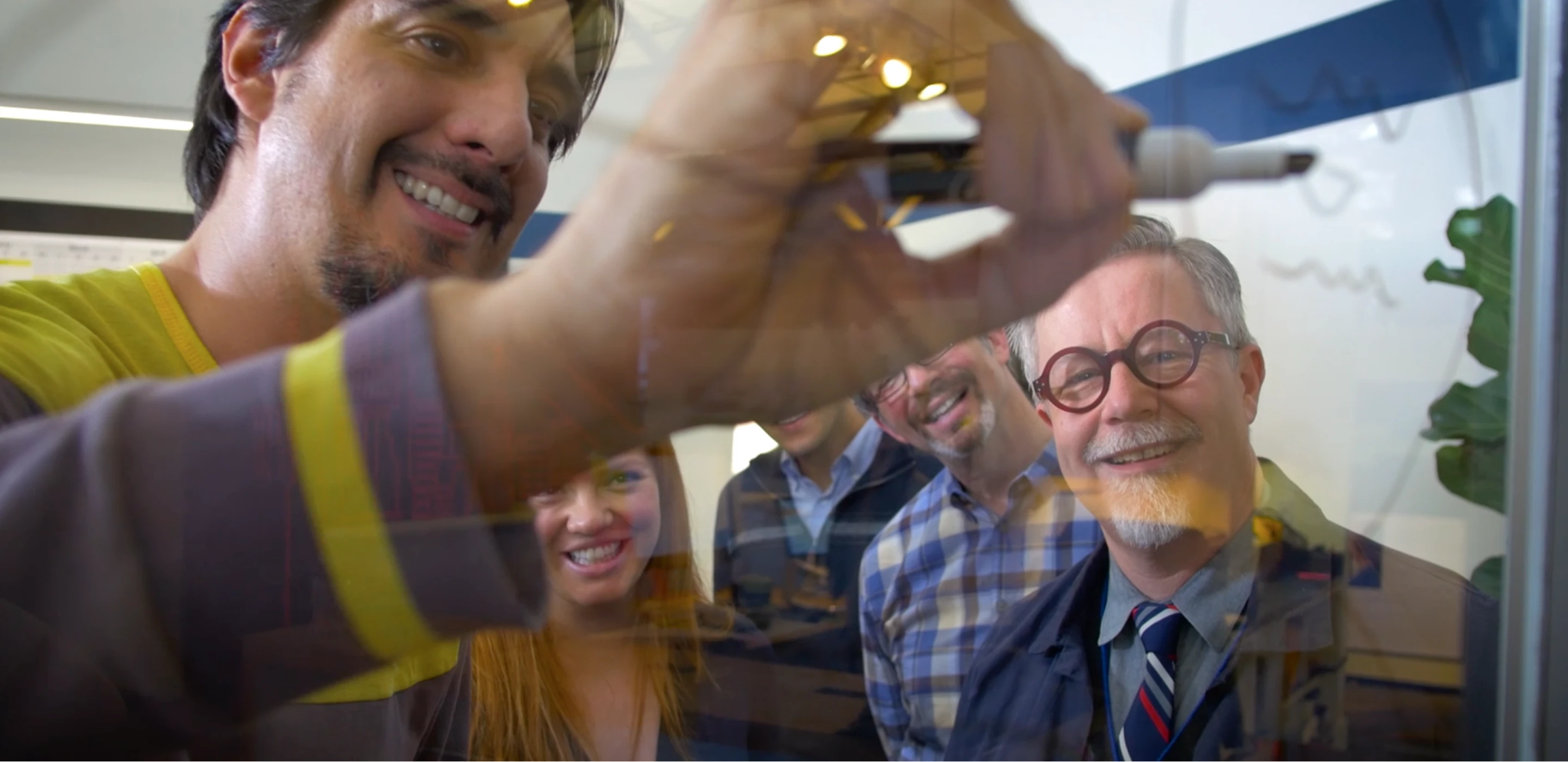
The art and science of Design Thinking
What is design thinking?
Design thinking is the process that helps organizations create innovative products, services, and strategies by balancing human needs, technical feasibility, and economic viability. Practiced and popularized by David Kelley, the founder of IDEO, it is a non-linear, iterative process that begins with deep observation of human behavior and moves through cycles of synthesis, ideation, prototyping, and testing before arriving at ground-breaking solutions. It’s perhaps even more relevant in the AI era, as we work to make cutting-edge products and services that truly meet human needs.
What design thinking means at IDEO
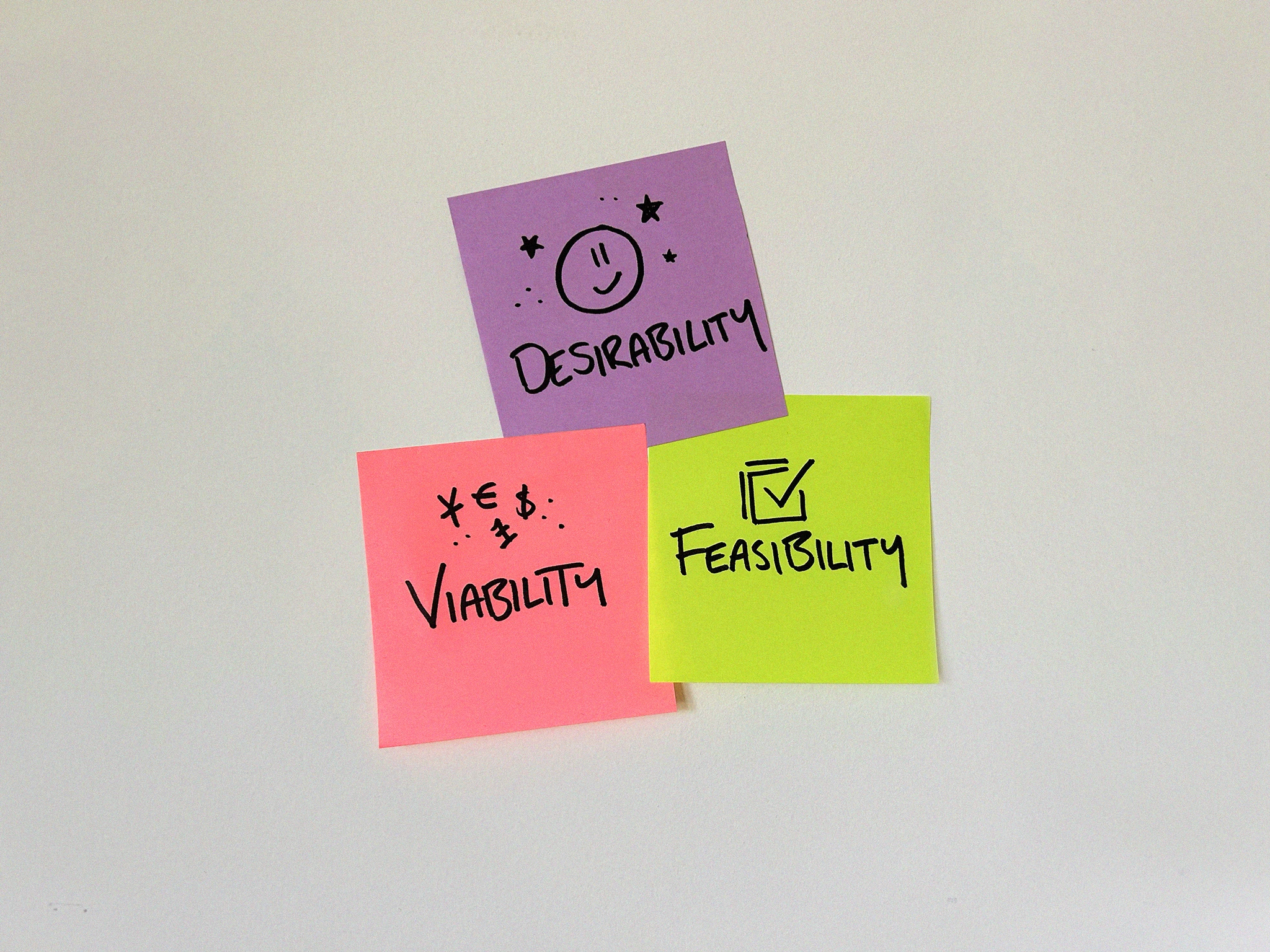
We believe that three fundamental components make a design successful: desirability, feasibility, and viability. We also know design is shaped by the values we bring to it. At IDEO, we assign different levels of importance to these three components based on what we think matters most. For every project, our multidisciplinary teams of extraordinary people apply a human-centered lens, asking not just what we can create, but what we should create. This approach is rooted in decades of observing real people and prototyping and testing solutions with them that meet true human needs and redefine categories. It applies to everything we make, from AI tools and digital experiences to toys, healthcare systems, and more. Though anyone can adopt the process of design thinking, IDEO’s unique combination of talent, expertise, and deep experience gives us the capability to uncover insights you won’t find anywhere else.
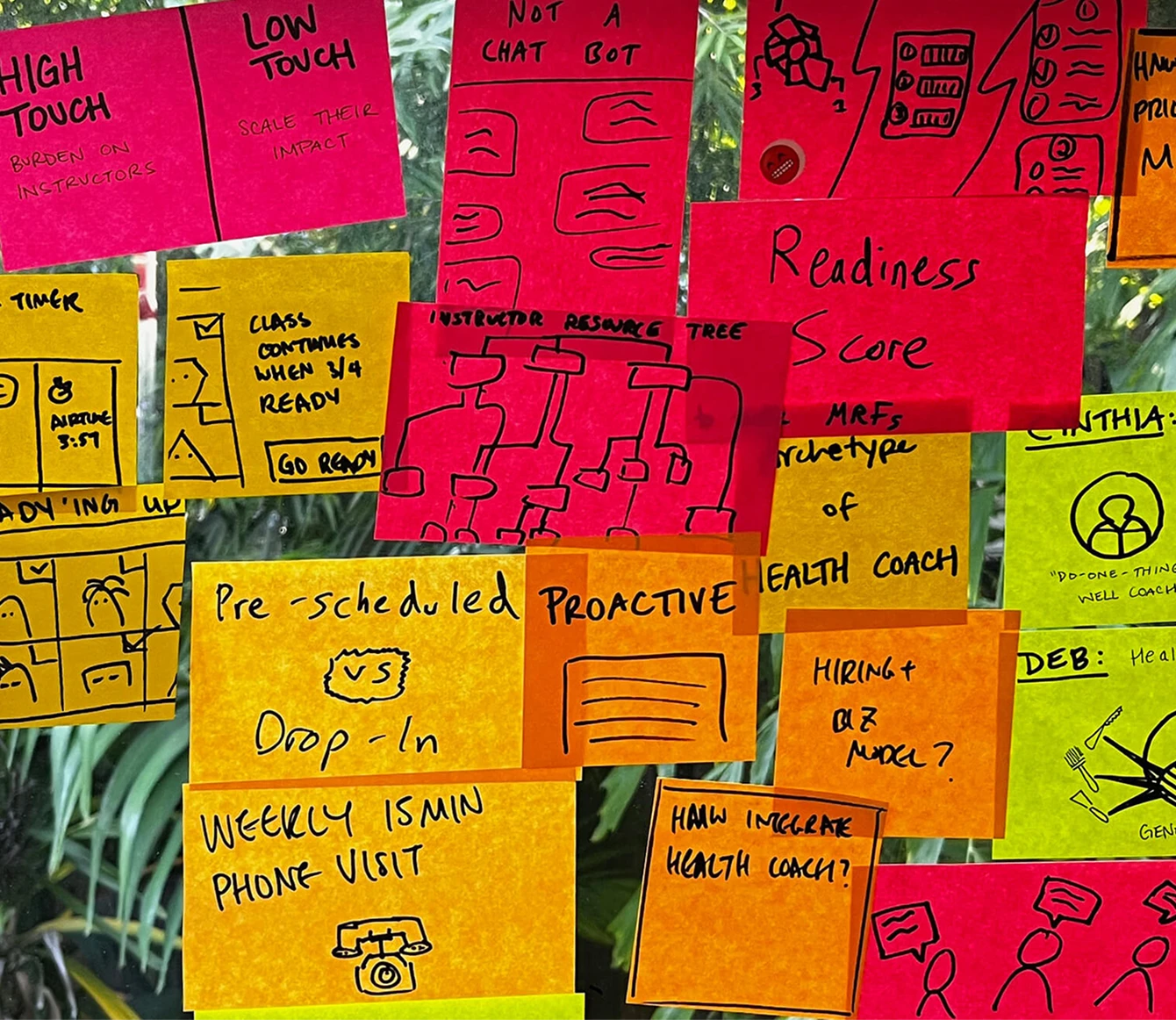
The design thinking framework: IDEO's approach
Design thinking is often taught as a series of phases, but in practice, it’s a flexible way of working that helps teams move from uncertainty to insight, and from ideas to outcomes that make a real difference.
The seven phases of design thinking
These phases offer a shared language for exploring challenges, generating ideas, and bringing new solutions to life.
1. Frame the question
What it looks like: Instead of jumping to solutions immediately, you first define the challenge you want to address. This is often done using the “How might we…?” framework to expand possibilities.
Why it’s important: Starting with questions helps you identify the right problem to solve and prevents you from approaching the project with preconceived notions about the solution.
2. Gather inspiration
What it looks like: You observe, interview, and immerse yourself with real people in real-life situations to learn what matters most to those you’re designing for. While inspiration can come directly from these experiences, we also look for analogous inspiration because other contexts often spark new ideas.
Why it’s important: Gaining a deep understanding of people and the context surrounding the challenge you’re addressing can provide valuable insights to inform your solution.
3. Synthesize for action
What it looks like: You organize, group, and connect research insights to identify themes that will guide your next steps. Consider what you’ve observed and what people have shared with you. How do these connections lead to solutions that people truly want and need
Why it’s important: Making sense of what you’ve learned helps uncover genuine opportunities and pathways for generating new ideas.
4. Generate ideas
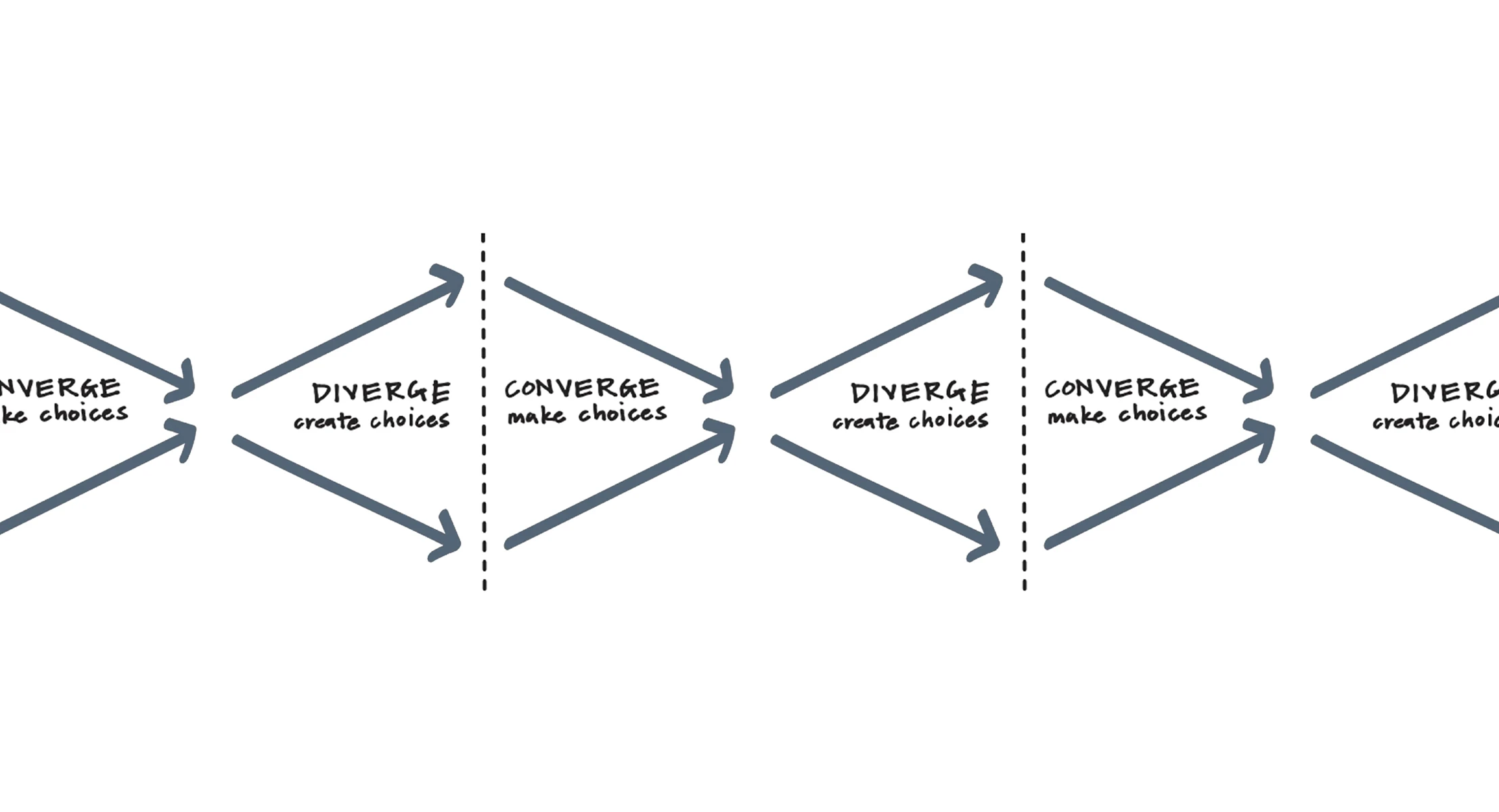
What it looks like: With insights in hand, you can brainstorm broadly and explore countless ideas. This process, known as diverging, encourages you to think creatively and freely. Once you have a wide array of new concepts and ideas, you can start narrowing them down to the most promising one—a process we call convergence.
Why it’s important: Creative exploration broadens the range of potential solutions and prevents you from defaulting to the first idea that comes to mind.
5. Make ideas tangible
What it looks like: Prototyping involves building early prototypes—such as sketches, models, or rough mockups—to visualize ideas and gather feedback. While prototypes are often associated with small physical products, you can prototype anything—from something as big and tangible as a jet plane, as conceptual as a new workflow, or as digital as a banking app.
Why it’s important: You learn and gain insights fastest when your ideas take shape, and you can experience them in the real world.
6. Test to learn
What it looks like: You share prototypes with real people, observe their reactions, and use what you learn to improve your concepts. These prototypes should be simple and easy to create, because you don’t want to become overly attached to your own ideas or give the people you’re testing them with the impression that you’ve invested too much time or effort in them, which could discourage honest feedback. For instance, you can test app interactions on paper screens or simulate a car’s new layout with masking tape and some folding chairs. You can iterate and refine your designs as you answer more questions.
Why it’s important: Testing reveals what works, what doesn’t, and what needs refinement in your design.
7. Share the story
What it looks like: You’ve undergone a journey to reach this point, and now you need to bring stakeholders together to understand the importance of your solution and why it matters. Articulate the human need your solution addresses, explain your process, and highlight its value in a way that inspires alignment and action.
Why it’s important: A well-crafted narrative helps others understand and embrace your work.
The three lenses of innovation
Thinking like a designer can transform the way organizations develop products, services, processes, and strategies. This approach, known as design thinking, brings together three essential lenses or perspectives:
Desirability:
Are we solving a problem that matters to people?
Viability:
Can the solution succeed and endure within real-world constraints?
Feasibility:
Can we build it with today’s technology and capabilities?
By looking at the challenge through these three lenses, teams can move beyond mere invention to achieve results that are meaningful, sustainable, and grounded in real human needs.
Where design thinking came from — IDEO's role
The design thinking process has deep roots in the design field. Over the years, it has evolved into a popular approach for tackling challenges across various industries, including products, services, systems, and strategy.
IDEO has practiced design thinking since its founding in 1978, focusing on what people truly need and want in order to create more meaningful solutions. In the 1990s, IDEO helped popularize design thinking as a method for organizations to incorporate the design process into business, innovation, and problem-solving. Now that we’re firmly in the AI era, we continue to use design thinking to develop tools, systems, products, and experiences that meet real human needs.
While IDEO didn’t invent design thinking, we have made it more popular and accessible through our work, teaching, and tools we have shared.
Key leaders at IDEO, including David Kelley, Tim Brown, and Jane Fulton Suri, have played significant roles in spreading design thinking by integrating ethnographic research, behavioral science, and multidisciplinary collaboration into the design process.
David Kelley also helped found the Hasso Plattner Institute of Design at Stanford, also known as the d.school, with the goal of equipping more people with the tools and confidence to approach problems like designers.
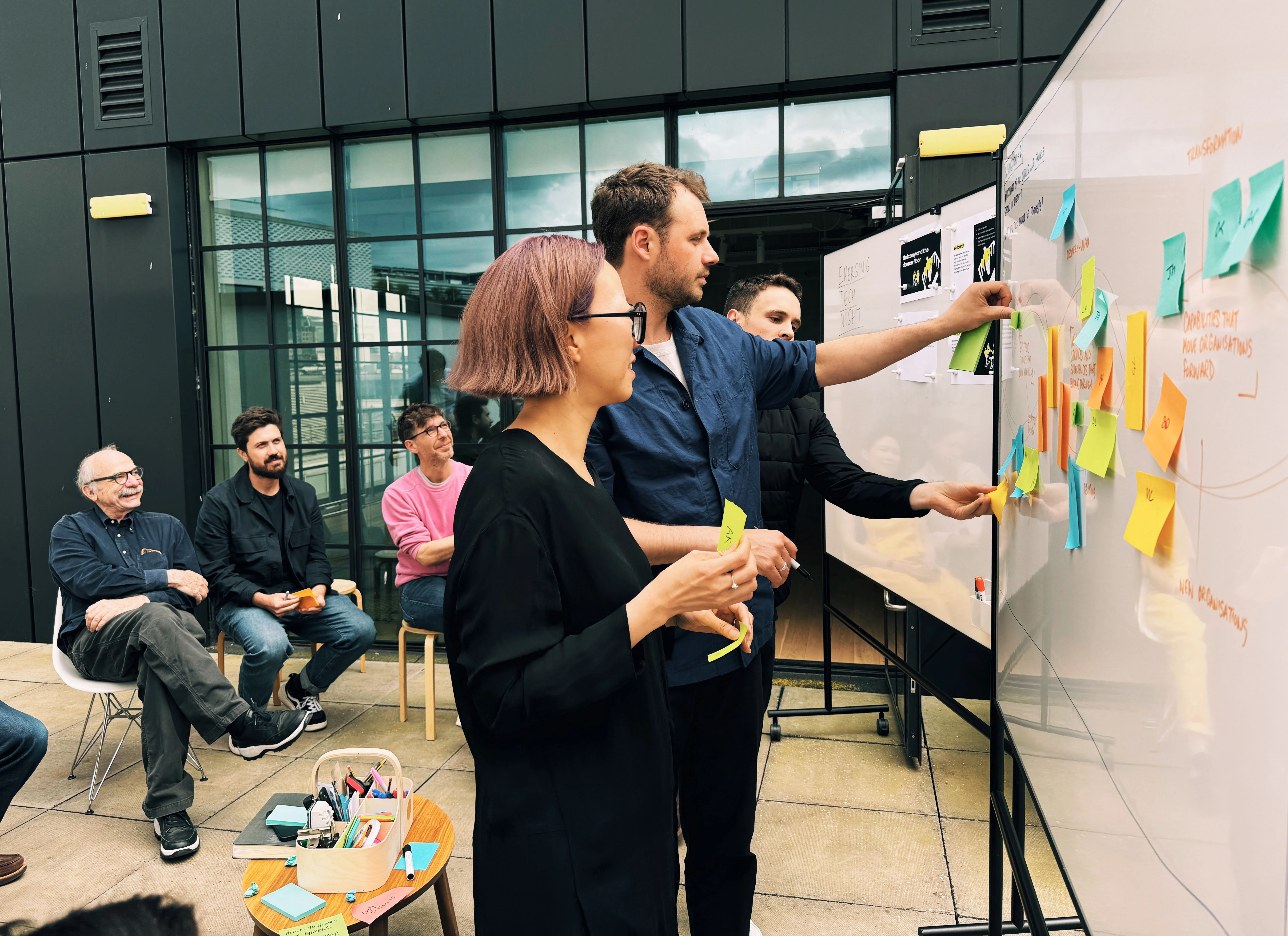
How IDEO applies design thinking in client work
For nearly 50 years, IDEO has helped some of the world’s most imaginative leaders shape the future. What sets IDEO apart from other design consultancies is that we not only design products, services, and strategies but also the conditions necessary for innovation itself. We help organizations transform how they think, collaborate, and grow. For us, design is not just a deliverable; it’s a mindset and a means to drive meaningful change.
Our teams combine expertise in design, business strategy, technology, and the social sciences, allowing us to approach complex challenges from multiple perspectives. This interdisciplinary collaboration helps us uncover connections that others might overlook and design solutions that work across systems, not just within silos.
We believe the best way to learn is by making. IDEO prototypes ideas early and often—testing them in the real world, gathering feedback, and iterating quickly. This approach reduces risk while accelerating innovation. From healthcare to consumer goods, financial services to AI ethics, IDEO’s work aims to create a positive, lasting impact on people, organizations, and the planet. We measure success not just by growth, but also by the value and meaning we create along the way. Our decades of expertise and creative mindsets allow us to uncover insights no one else can.
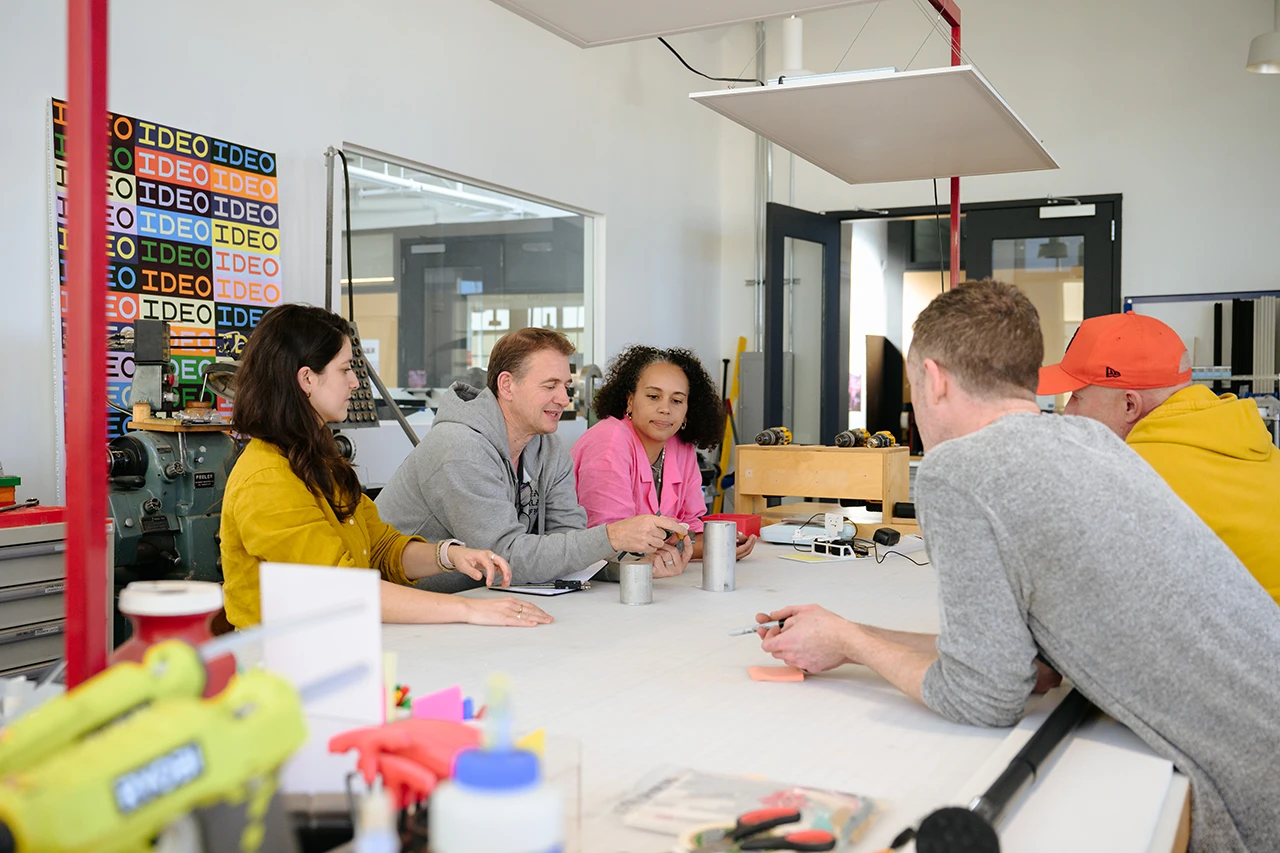
What design thinking is not
Design thinking extends far beyond its common associations with product design. It’s a methodology that can be applied to solve any problem, whether it’s as tangible and specific as designing a toy or as big and complex as climate change. Like any methodology, the effectiveness of design thinking depends on people truly understanding it and harnessing its full potential, rather than treating it as a checklist or neglecting the research and insights necessary to deliver real value. We understand better than anyone why it’s so crucial to invest in real research and truly activate it to its full potential.
How design thinking relates to adjacent methodologies
How is design thinking different from human-centered design?
Design thinking and human-centered design are often used interchangeably, but they are not the same. Human-centered design is based on a fundamental belief that design should begin with an understanding of people—their needs, experiences, and contexts. Design thinking, on the other hand, refers to the process of putting that belief into action. It’s a collection of mindsets and methods for exploring challenges, generating ideas, prototyping, and learning through iteration.
How does design thinking relate to agile?
Design thinking and agile are distinct yet complementary frameworks. Design thinking emphasizes framing the right questions, uncovering insights, prototyping, and iterating toward human-centered solutions. In contrast, agile focuses on execution: how to effectively build, ship, and iterate in short cycles called sprints.
To put it another way: design thinking can help you ask better questions, while agile can help you answer those questions quickly.
What is the difference between design thinking and service design?
Design thinking is a comprehensive problem-solving methodology that can be applied to a wide range of challenges across different industries and disciplines. Service design, on the other hand, is a specific approach that focuses on the end-to-end experience of a service—from the various touchpoints a person encounters to the systems that support those interactions, and how all those elements work together.
How does design thinking differ from systems thinking?
Design thinking is a methodology that enables individuals to define a problem and uncover insights that can help them prototype their way to a solution. Systems thinking, in contrast, is an approach that helps individuals understand and map the relationships between various components of a system. Systems thinking has roots in cybernetics, ecology, and organizational theory.

FAQ
What is design thinking?
Design thinking helps people, teams, and organizations develop products, services, and strategies by balancing human needs, technical feasibility, and economic viability. The approach, popularized by IDEO in the 1990s and 2000s, has been used across multiple industries to address challenges ranging from product development to strategic planning.
Who invented design thinking?
Design thinking has its roots in the work of Nobel Prize winner Herbert Simon and Stanford professors Robert McKim and Rolf Faste. However, it was David Kelley, the founder of IDEO and Stanford’s d.school, who popularized this concept. Since its founding in 1978, IDEO has practiced human-centered design, focusing on understanding what people truly need and want in order to create more meaningful and impactful solutions. In the 1990s, IDEO’s approach gained wider recognition, helping numerous organizations incorporate design methods into their business practices, innovation efforts, and problem-solving strategies.
Key leaders at IDEO, including former CEO Tim Brown and pioneering design researcher and Partner Emeritus Jane Fulton Suri, played crucial roles in sharing these methods more broadly and in integrating ethnographic research, behavioral science, and multidisciplinary collaboration into the design process. Over the last half-century, IDEOers have immersed themselves in the process, adopting the mindsets necessary to uncover unique insights and create new-to-the-world products, experiences, processes, and organizations.
What are the seven stages of design thinking?
1. Frame the question: Instead of jumping straight to solutions, start by defining the challenge you’re addressing. Use phrases like “How might we…?” to open up possibilities.
2. Gather inspiration: Observe, interview, and immerse yourself in real experiences to learn what matters most to the people you’re designing for.
3. Synthesize for action: Sort, cluster, and connect research insights to identify themes that will guide your next steps.
4. Generate ideas: Brainstorm broadly, imagine many directions, and then focus on promising concepts.
5. Make ideas tangible: Create early prototypes, such as sketches, models, or rough mockups, to visualize how your ideas will work and to invite feedback.
6. Test to learn: Share your prototypes with real people, observe their reactions, and use what you learn to improve your concepts.
7. Share the story: Clearly articulate the human need, your process, and the value of your solution in a way that inspires alignment and action.
What is the difference between design thinking and traditional problem solving?
Traditional problem-solving takes an analytical approach, focusing on a specific problem with a limited set of solutions. Design thinking, in contrast, is particularly useful for novel, human-centered challenges that involve significant uncertainty. While traditional problem-solving is often led by experts, design thinking is led by users’ needs.
Is design thinking only for designers?
Absolutely not! Anyone can adopt the design-thinking process to tackle and solve complex problems and design solutions grounded in human needs.
How long does a design thinking process take?
It depends on what you’re using it to address. Design thinking can be used to solve challenges ranging from designing a new toy to designing an entire school system.
What companies use design thinking?
Many companies have used design thinking throughout their histories, including Apple, GE, IBM, and Airbnb. IDEO’s diverse clients range from startups to international conglomerates, spanning industries such as health, emerging technology, consumer goods, and financial services.
How do you learn design thinking?
The best way to learn design thinking is by practicing it. Begin by adopting a designer’s mindset and formulating your own “How might we…?” questions. Then, work through the design thinking process step by step. If you prefer a more structured learning experience, consider exploring courses on design thinking, prototyping, and related topics on IDEO’s learning platform, IDEO U, or check out the resources available at Stanford d.school’s design thinking program.
Further reading and resources
IDEO U’s What is Design Thinking & Why Is It Beneficial? page
IDEO U’s Foundations in Design Thinking Certificate
IDEO U’s Hello Design Thinking course
IDEO U’s AI x Design Thinking Certificate
“Design Thinking,” Tim Brown’s Harvard Business Review article
"When Everyone Is Doing Design Thinking, Is It Still a Competitive Advantage?"Tim Brown’s Harvard Business Review article
IDEO.org design thinking tools
IDEO case study: Using design thinking to build a better car