
.svg)




Finding hidden talent
A social enterprise rewires America’s labor market through inclusive design.
American businesses are on notice: To be competitive in today’s market, you must diversify your workforce.
One way to widen the talent pool is to pay closer attention to people who have acquired their skills through alternative routes. Millions of Americans learn on the job, in community colleges, at boot camps, or through life experience. According to Opportunity@Work, more than 70 million Americans are overlooked because of degree requirements. Despite their abilities, these “STARs” (those who are skilled through alternative routes) find themselves stuck in jobs for which they’re overqualified and underpaid.
Opportunity@Work, an innovative social enterprise, reached out to IDEO to help collaborate with companies, talent developers, and STARs seeking career growth. To make this overlooked talent pool more visible, we created a campaign and video to rally companies. We also designed a data dashboard to help regional employer networks identify qualified talent and potential partnerships with skill-building programs. And to provide STARs with direct support, we scaffolded the job-seeking experience, focusing on key moments like the interview process.
It’s time for businesses searching for talent to open their eyes, look to the STARs, and see what they’re missing.
83% of HR professionals said they had difficulty finding suitable candidates in the past 12 months.
62% of Black people, 55% of Hispanic people, and 50% of non-Hispanic white people have become skilled through alternative routes, such as community college, workforce training, boot camps, certification programs, military service, or job experience.
Over the past 40 years, inflation-adjusted wages have increased 8% for college graduates with a bachelor’s degree while decreasing by 15% for people with only a high school degree.
Thousands
of state jobs in Maryland no longer require a four-year college degree
skills-based
The White House is adjusting educational requirements for I.T. professionals in favor of a skills-based approach
Experts on the front lines
Recognizing the power and creativity of essential workers.
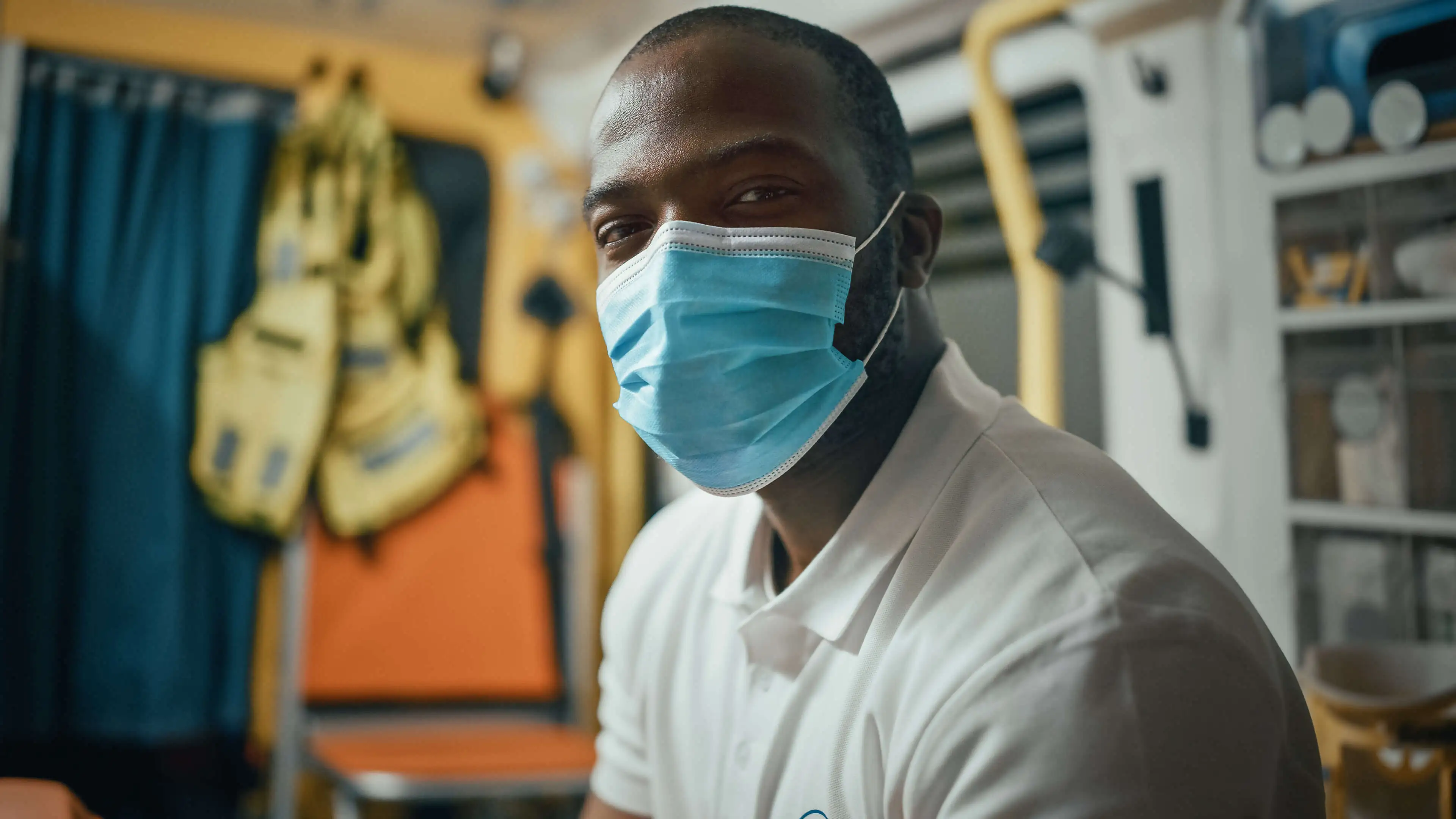
For many organizations, frontline workers like grocery store clerks, nurses, hospitality workers, and transit employees are an essential part of doing business.
So much so that they continued to show up at the office throughout the COVID-19 pandemic even as everyone else went remote. As the point of contact with customers and key systems, these workers often know exactly when, where, and why things don’t work, and they come up with powerful hacks and workarounds to make things better. Yet these insights and innovations rarely make it to the corporate office. And that’s a problem: large organizations often hire design and innovation consulting firms while not taking advantage of a latent source of deep, in-house expertise. It’s equally discouraging to workers who would gladly share their ideas if they were only asked. No surprise, then, that frontline workers are quitting their jobs in droves.
What could companies learn by listening?
IDEO partnered with the Ford Foundation to create the Worker Voice Design Lab, where leaders from a port authority, an airline, and a health care provider worked alongside frontline workers. That led to the planting of a seed of innovation in each organization, with interventions designed with and by workers implemented operationally at the core of the business. In one case, a group of workers zeroed in on specific problems with such clarity that they were quickly able to develop a digital prototype for testing. No one was less surprised than the workers themselves, who simply said: Well, nobody ever asked us before. Sometimes the most innovative idea a leader can have is to listen, learn, and act on their employee’s smart ideas.
A large portion of the job churn since March 2020 has been concentrated in frontline services such as accommodation, food services, and retail.
Lack of career growth is the number one reason people leave their jobs according to more than 18,000 frontline workers across 150 companies.
2 pilot initiatives
being led by frontline workers in 2022
Customer powered
How Ford transformed itself to take on the future of mobility.
The climate era demands new offers and new ways of working.
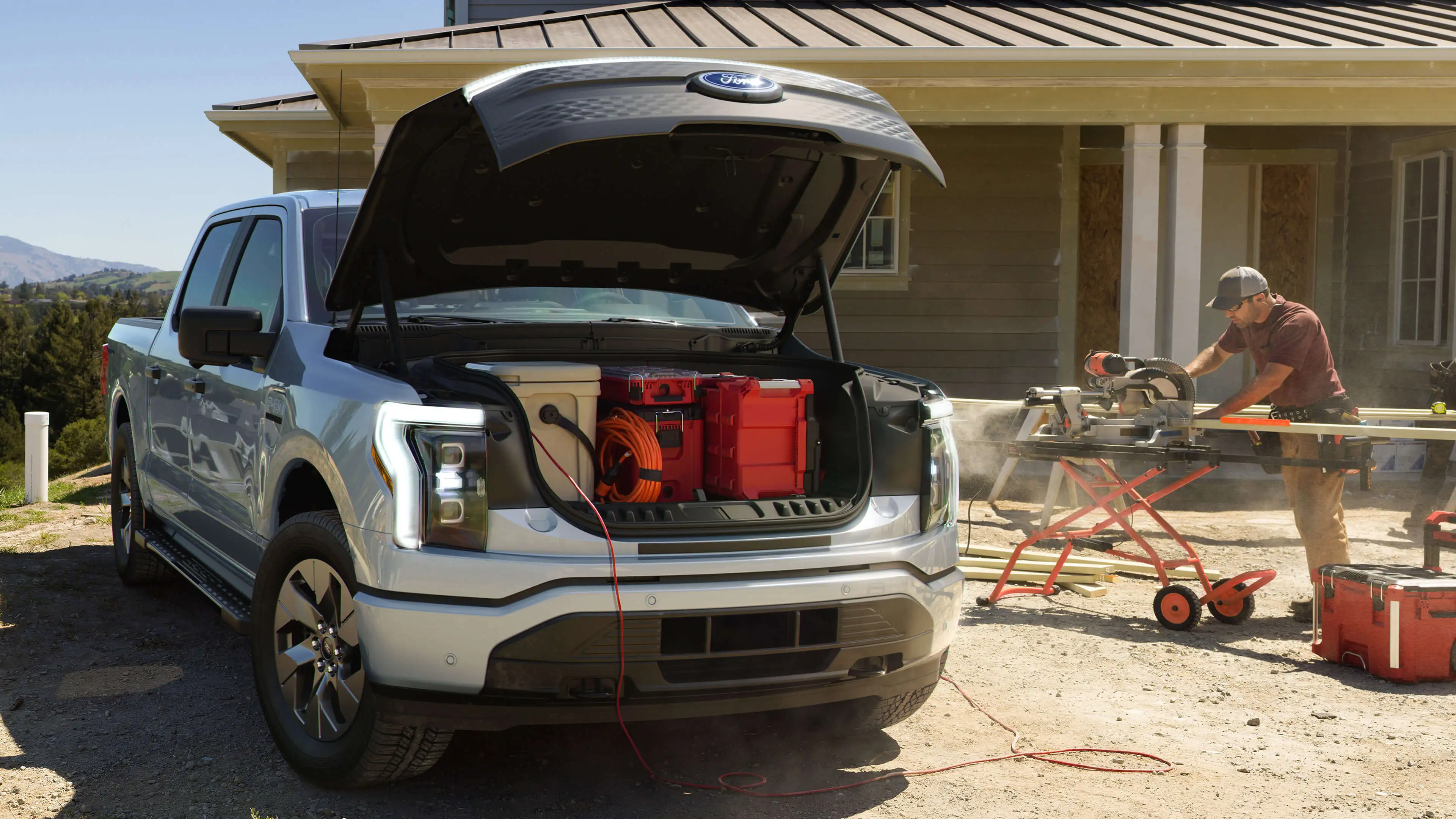
Would you like to be able to plug your jigsaw into your truck? How about taking a fully reclined snooze after a long day of fishing? Questions like these led to quick prototypes that ended up in Ford’s new, electrified F-150 truck, which has more outlets than the average apartment and can power your entire home. This was no small update. The way Ford reimagined the truck experience from powertrain to power nap is emblematic of how much customer-centricity is now embedded in Ford’s culture.
For well over a decade, we’ve partnered with Ford in the U.S., the EU, and China to help the organization bring to life a shared vision of the future of mobility. Together we scaled new capabilities throughout the company by running proof-of-concept “beacon” projects and, to embed this new customer-centric mindset, built a human-centered-design hub called D-Ford. This organization within the organization has become a magnet for talent and is spread across six global locations: London, Shanghai, Melbourne, São Paulo, Palo Alto, and Detroit. Ford’s commitment to serving the needs of people and the planet is what propelled the rethink of the F-150, the best-selling vehicle in the U.S. for over 40 years. It was a high-stakes move, and one that represents a major turning point for the automaker: For the first time, its primary profit source would be electric. The new Lightning is still built Ford tough, but also built for the future.
Passenger vehicles produced 41% of carbon dioxide emissions worldwide in 2020.
One in every 20 passenger vehicles sold in the United States is a Ford F-150.
Before going electric, the Ford F-150 emitted about 100 tons of CO2 over a 200,000-mile lifespan.
200,000
pre-orders of the electric F-150 truck, named one of Time's Best Inventions of 2021
Most Innovative Design Company of 2022
according to Fast Company
Beyond the bag
A coalition of retail leaders join forces to address single-use plastic-bag waste.
America’s leading retailers share a common goal—doing less harm to the planet.
The systemic challenges standing in the way require a bold new approach, and no single company can solve them alone. So Closed Loop Partners convened a group consisting of founding partners CVS Health, Target, and Walmart, along with 12 other leading retailers. As the innovation partner, IDEO helped launch a global search for breakthrough sustainable ideas that yielded more than 450 submissions from startups and entrepreneurs to reinvent the single-use plastic retail bag, with nine finalists entering a six-month accelerator.
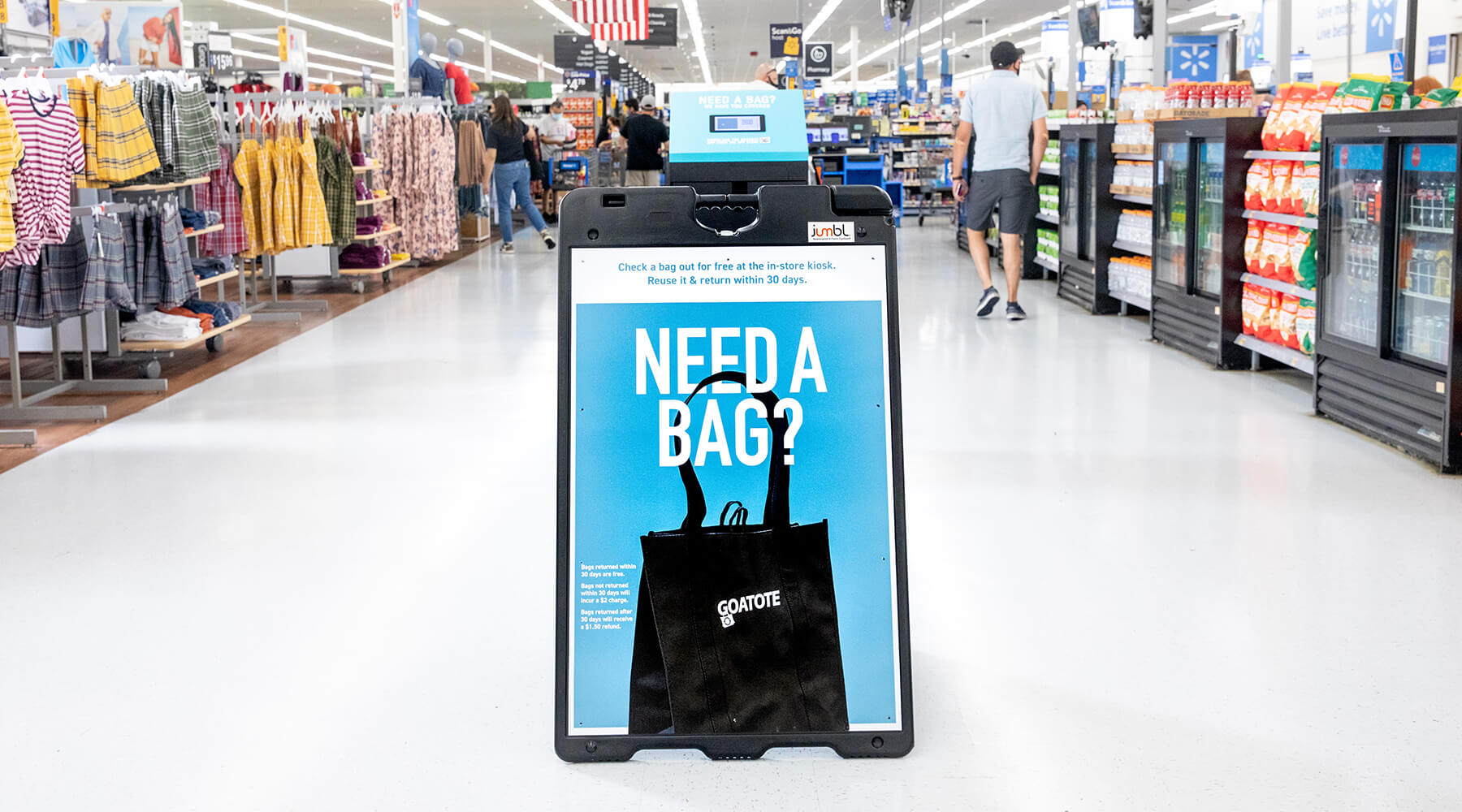
New alternatives ranged from biodegradable solutions to systems that kept reusable bags in rotation. IDEO teams not only facilitated collaboration between startups and sustainability leads from partner retailers, but also provided a boost of additional expertise from industrial, data, and business designers. In a matter of months, teams were able to launch prototypes in select CVS Health, Target, and Walmart stores in California and New Jersey.
Everyone involved in the consortium knew that replacing single-use plastic retail bags is a problem that won’t be solved quickly or easily. But the Beyond the Bag challenge helped them learn that designing for the policy and infrastructure of tomorrow requires tangible steps, taken together, today.
A hundred billion plastic bags are used in the US every year, and less than 10% of them are recycled.
Every year, plastic retail bags are among the top ten items found on beaches and waterways worldwide.
9
stores tested solutions across Northern California
Millions of dollars
raised by two startups
2
startups acknowledged by Fast Company's World Changing Ideas Awards
Designing a sustainable future for toys
Insights and pathways to reducing plastic in play.
As designers who love toys and games, we set out to explore how we might reduce the environmental impact across the whole industry.
The toy industry’s environmental impact is the flip side of the joy of play. The $90 billion toy industry is a highly plastic-intensive sector, using 40 tons of plastic for every $1 million in revenue. It contributes significantly to the 11 million tons of plastic dumped into the world’s oceans each year, causing widespread damage to marine life and ecosystems.
If the toy industry can reduce its plastic usage by half, it would mean millions of tons less plastic entering the oceans, mitigating the harmful effects on marine life and helping to preserve ocean health. It would also be an opportunity for the industry to serve as a beacon, setting a new standard and demonstrating that significant reductions in plastic usage are achievable and impactful.
We’re looking to help create a transformative leap that propels our industry forward. That means we need to design better play experiences that are inherently more sustainable, joyful, and viable for kids, families, and the companies that manufacture them. “Consumers are asking for it, and toy companies are starting to feel the need to do something about it,” says Lynn Rosenblum, Professor of Toy Design at Otis College of Art & Design. “They are finally understanding that they must take urgent action.”
To take action of our own, we conducted an internal design project to understand how kids and parents feel about their toys, what would make more sustainable toys a viable option, and how we could not just make a non-plastic alternative, but something even better. We spent four weeks with parents and their kids, as well as industry experts who are working to address this design challenge. We also rapidly prototyped our ideas both digitally and physically, turning concepts into testable experiences the kids could play with. With their help, we surfaced insights that point the way to a better future for the toy industry—and the planet.
Sustainability alone won’t sell toys.
Most families do not view green toys with the same pride as they do STEM toys. (Not yet, at least.) To make sustainable toys more appealing, they will need to provide additional value, like affordability, enhanced educational benefits, or support for children's development. Jessica, a mother of a 5 year-old, told us that to her, the ideal definition of sustainability would be toys that last long enough for all of her kids to play with them, and when they’ve outgrown them, the chance to pass them on to another family. “When I think of sustainability I think of getting a lot of use more than the sustainability of the environment,” she says.
Plastic lasts longer than kids’ attention spans
Families often prioritize durability when they’re buying toys. But according to a study with 2,000 UK families, parents estimated that 15 percent of toys their kids receive for Christmas are neglected within days, 23 percent within a month, and 50 percent within six months. Children often tire of specific toys long before they wear out. So unless we can increase the amount of playtime with toys from the outset, they’re destined for a quick trip to the landfill.
Children love natural materials
As 10-year-old Jude was playing with some of our prototypes, he told us, “Plastic toys are a scam.” He preferred his wooden toy train tracks because “They won’t break.” Jude and many of the other kids we talked with were clear that they preferred the tactile and sensory experiences of natural materials, even if they aren’t consciously aware of their material preferences when they select toys. Often, the dominance of plastic in the marketplaces is less about kids' preferences—it's about the convenience and affordability that plastic provides.
Being resourceful is fun and sustainable—but you can’t unwrap it
Children love to make their own toys, repurposing Amazon boxes as backdrops or using face masks as doll dresses. They’re often happy just coming up with their own ways to play. But, as Jessica said to us, “The grandparents just want to see them open a present.” Extended families tend to prefer buying a new physical toy that can be wrapped and unboxed. The surprise and reveal are part of the appeal. At the same time, it's worth noting that there is a thriving, if informal, secondhand market in places like Facebook or Buy Nothing where parents and children are perfectly happy with pre-loved toys.
Nixing is easier than fixing
Most toys are designed to be disposable, fostering a culture where repair is uncommon. As Jessica told us, “In today’s culture, everything is just thrown away because it’s so cheaply made. It’s cheaper to buy a new one. If you are buying quality toys then it makes sense to invest to maintain, to take care of it, to repair it rather than throwing it away.” Unlike high-quality sustainable toys, many plastic toys lack durability and repairability, making them more likely to be discarded.
From insights to action
How, though, do these insights translate to opportunity areas for toy companies, and joyful and more sustainable toys for families? We created a set of quick concepts to help us learn quickly about how we can have an impact on the future of sustainable toy design. Here’s what some of of our prototypes look like, and the opportunities they helped us uncover.
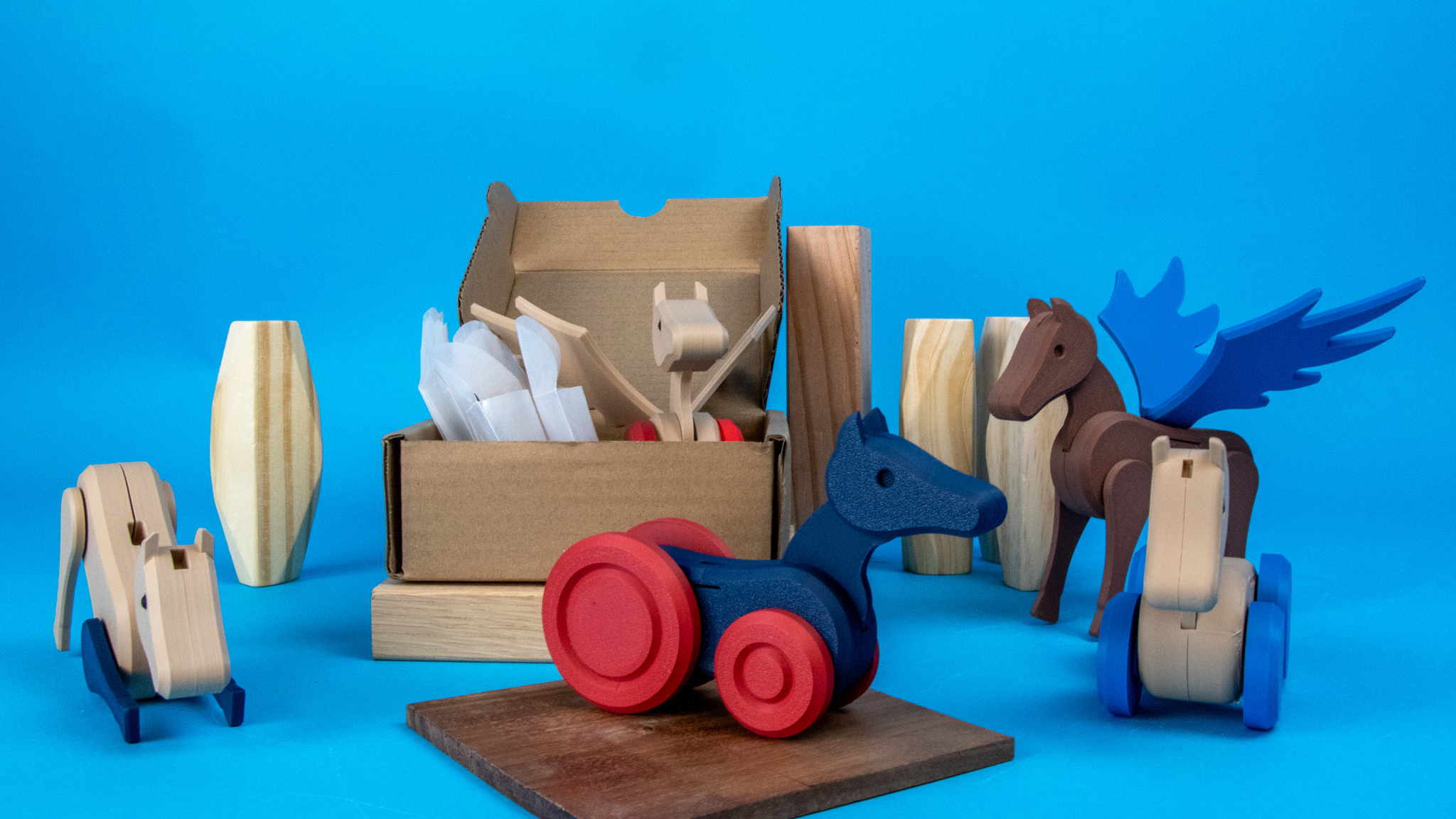
Create non-plastic toys with superior functionality
There’s a big opportunity in designing trendy yet sustainable toys using alternative materials, and enhancing their appeal by incorporating vibrant colors, exciting designs, and interactive features. By emphasizing durability and engaging play experiences, we can make non-plastic toys the preferred choice for both children and families. Picture a unique collection of toys crafted from natural materials sourced from the very environments where kids love to play, like seaweed beach toys, or bamboo car tracks.
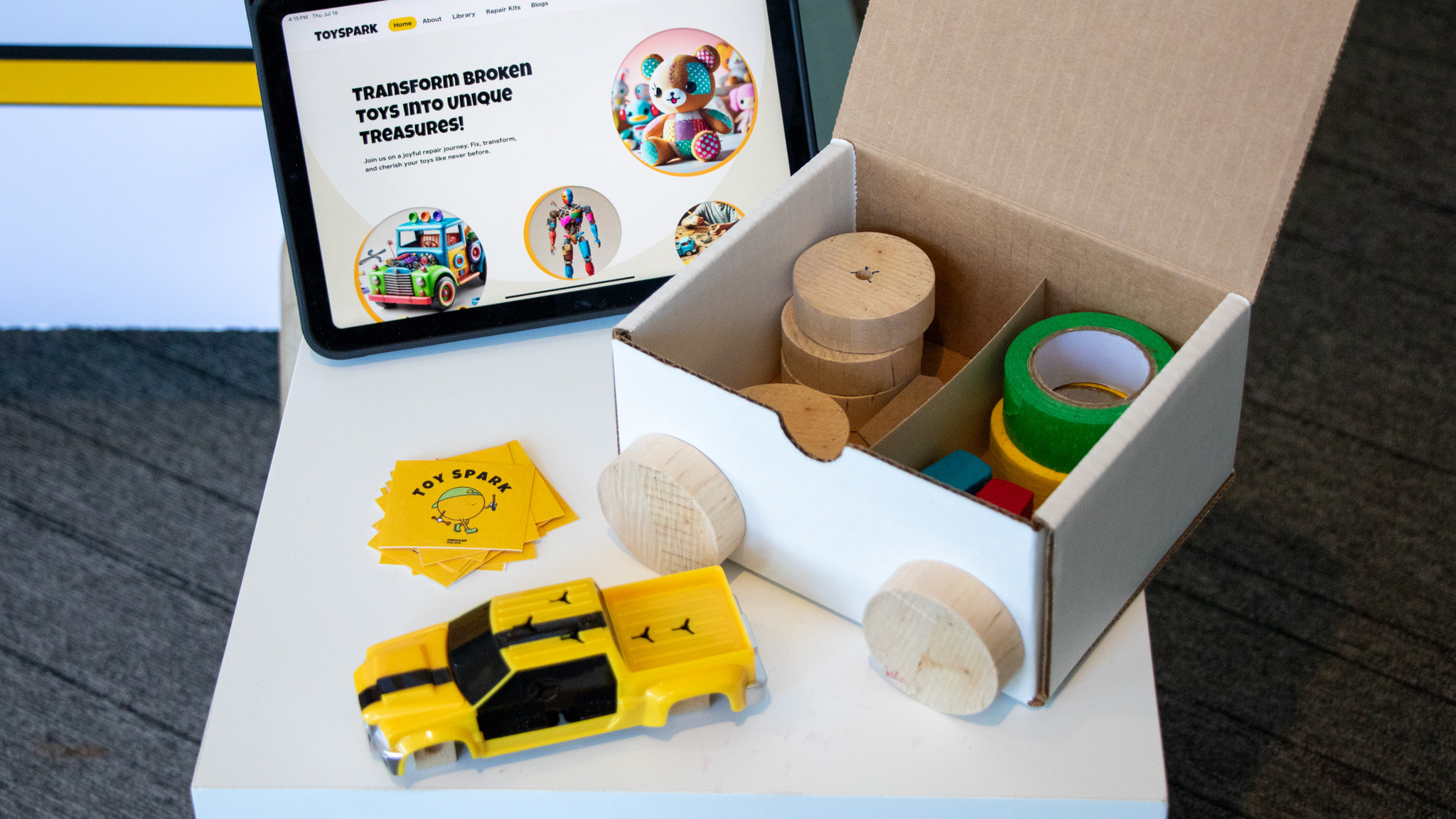
Design toys for circular play models
Another option? Creating systems to make existing toys function within a circular economy to minimize their footprint. Introduce easy-to-use, repairable, re-sellable, and shareable toys designed for longevity and multiple users, built on children's natural play behaviors like constructive and collaborative play. These systems should seamlessly integrate with parents' existing rituals and day-to-day activities, making sustainable play convenient and practical for families. Think new platforms that transform toy repair into a fun and educational experience, or a second-hand toy purchasing experience where kids and parents can discover gently used toys ready for new adventures.
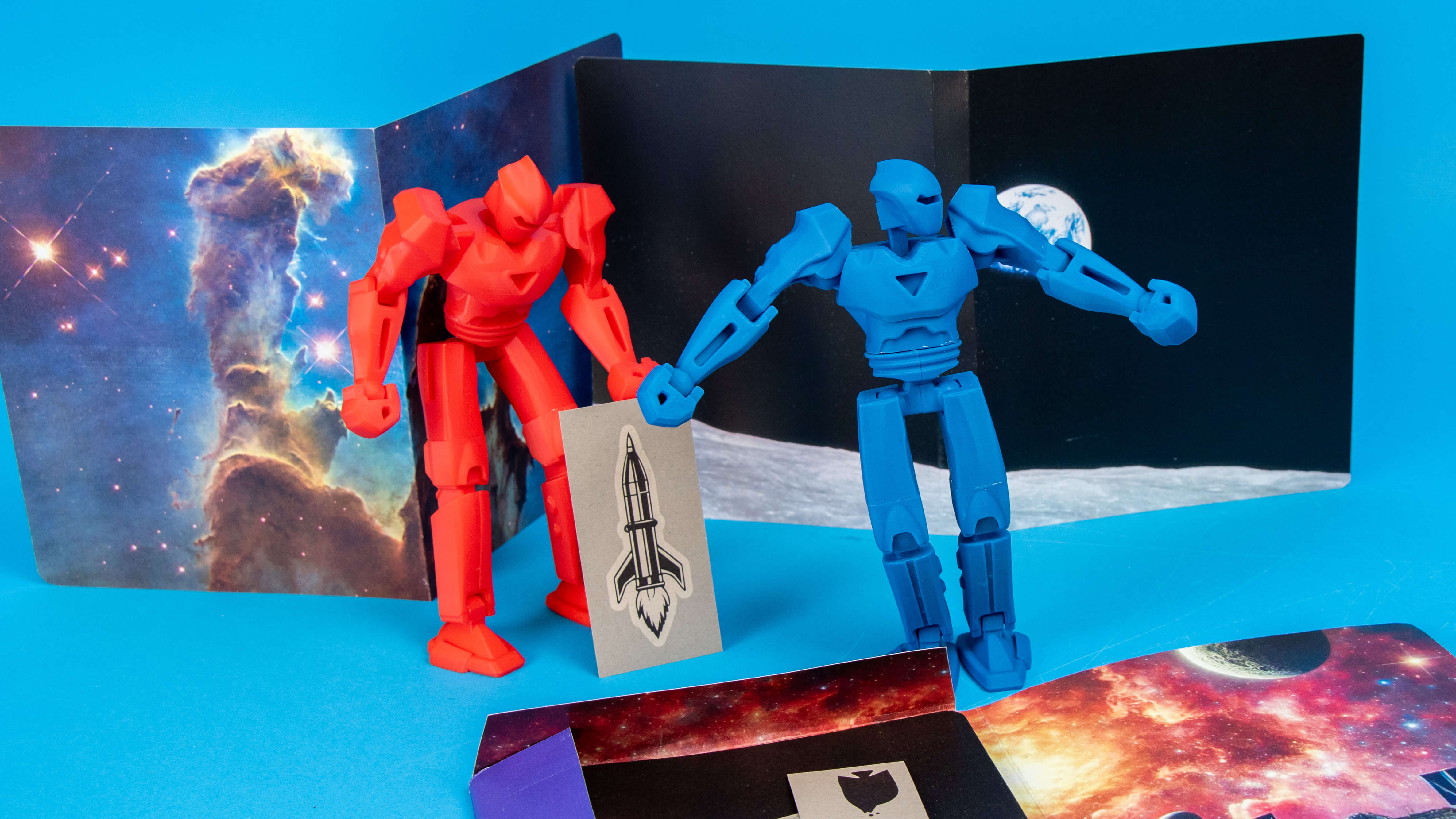
Offer play as a service
Revolutionize play with toys designed for maximum imaginative impact and minimal environmental footprint. By embracing alternative business models beyond the traditional pay-for-product approach, we can unlock new ways for kids to engage in meaningful and sustainable play. Focusing on access rather than ownership to reduce new toy production, minimize waste, and extend play time or use technology to breathe new life into existing toys through AI-enabled or VR experiences.
Already, we’re building concepts and new toys based on these opportunities, and we’re excited to make them real. If you want to work together to build a more sustainable future for toys, get in touch.
This project was informed through conversations with numerous experts, and families all around the US. We're grateful to them for their contributions.
While the toy industry has thrived by delivering joy and play to kids worldwide, the scale of plastic production has led to real environmental challenges.

How to build a great emerging tech product
Getting the technology right is only half of it.

Designing emerging tech is different from traditional product design. Much of the time when we do user research, our participants are already kind of familiar with the interaction models we’re presenting. They know that a fob unlocks a car, or how to type queries into a search engine, or how a toaster usually works. But when you’re working with a new technology, potential users have no known reference points, which makes it much harder for them to know how to use it in a way that provides real value. Think about early drivers trying to figure out how to crank-start a model T, when their previous transportation was a horse.
With emerging technology, wild rumors about the technology precede widespread adoption, and the gap in understanding how to use it can feel enormous. That makes providing a user experience people love, the most important piece of the product’s design.
It can also be the trickiest part. After all, you’re designing something nobody has ever used before—not even you. At IDEO, we’re really familiar with this ambiguous place—the space between a new technology everyone is excited about, and real products that provide real value for their users. We’ve spent a lot of our history there, creating everything from early computer mice to IKEA’s kitchen of the future to dancing robots. Here are some simple rules we follow when we’re trying to get from unknown technology to products people love.

Lean into co-design
Designing with potential users helps us understand how people will respond to a new technology.
In the last year or so, IDEO’s Play Lab dug deep with Gen Z users to test out what they actually want from AI-enabled products. Often, companies assume that if it’s new and it’s possible, young people will be into it. We wanted to test those assumptions, creating concepts like an AI concierge that could plan your trip, or a creative problem-solver that could hand you the solution when you get stuck.
Instead of fully building them out, we made really early prototypes that let them test the idea of the product, rather than a fully-built product itself. That was enough for them to understand the experience, and their feedback was clear: They want useful tools that take care of hassles, but they still want life’s messy moments. Tech is not a solution to their relationship issues, and they don’t want it to be creative for them. They want tools that help them maintain their humanity, not supplant it. The Gen Zs we worked with then helped us rethink the ideas to fit their needs. Our final designs and insights were much stronger because of it.
Insights like these, which are hard to come by without co-design, can uncover what users really want, long before a product hits the market, helping you make better investments with your development dollars.

Break norms
A major purpose of emerging technology? Providing new value to people through new user experiences. If we stick with existing interaction paradigms, we’re missing the point.
The purpose of XR is to overlay reality on our reality, or to take us into new realities. If we’re designing a website inside of VR goggles, that seems like an underwhelming use of the technology. We should take advantage of its capabilities—the fact that it’s a big open space where we can have interactive experiences, and that the audio can come from all around us, and that it's social and connective with people all around the world. If we’re just designing a flat website, we’re making a black and white tv in a color tv world.
Similarly, in the generative AI space, everything is a chatbot. That’s because we’re used to interacting with intelligent things by talking to them.
But look around, and you might discover a whole category of people trying to rethink how we can interact with intelligent machines. AI hardware companies are showing us how there are so many new possibilities of how to use technology in our daily lives (some more successfully than others). Brilliant Labs’s glasses that can translate what you hear; Limitless’s wearable pendant, which remembers the details of your workday; Meta’s AI glasses that allow you to ask questions about what you see. All of them create new user experiences—and the best ones are very different from what our existing gadgets are designed to do.
Embrace unexpected collaborators
Here’s an idea for you: Bring a group of creatives—musicians, electrical engineers, designers—into your emerging technology lab. Ask them to experiment with the technology you’re developing.
There is a long history of creatives helping technologists unlock new ideas and possibilities for what the technology might do.
Take John Cage, the avant-garde composer who collaborated with engineers and technologists, particularly at Bell Labs in the 1960s. Cage wasn’t an engineer, but he was a visionary artist who explored the boundaries of music and sound. His approach to music was deeply experimental, and he often used technology as a tool to create new forms of expression. His creative explorations led to tangible developments in electronic music, influencing the design of synthesizers, advancements in sound manipulation, and the foundation of interactive and generative music. Cage’s work encouraged technologists to think outside their usual constraints and explore new creative potentials within their inventions.
IKEA did something similar, when it decided to make the kitchen of the future. Years ago, they asked us and a group of students to explore the social, technological, and demographic forces that would impact our relationship with food in 2025. IDEO took their research and designs and built out a full concept kitchen that could help guide product development into the future.

Focus on design from the outset
Too often, companies focus on what they can build, rather than what they should. You can make the most cutting-edge technology in the world, but if your customers don’t like it, you don’t have a product. Bring them into early stages of the development—rather than as a panicked afterthought when you might discover that customers aren’t adopting what you made.
That doesn’t mean you have to invest your entire budget into speculative design work that might not pay off; after all, you may not even be sure the technology itself is feasible. But at a minimum, design can help you understand where technology might go so you can ask the right questions, consider what comes next at each development milestone, and make a plan for when and how designers, design researchers, and product people can help you think about which areas of the technology will be most valuable to users and should be developed.
When Willow set out to redesign the breast pump experience, the startup tapped IDEO and Function Engineering as partners, creating a cross-functional team of researchers, industrial designers, and mechanical engineers. Together, they uncovered mothers’ unment needs, and designed and engineered a more human-centered version of a device that hadn’t changed much in 25 years. Now, instead of being stuck shirtless, tethered to a wall, mothers have the option of a cordless breast pump that fits under their clothes.

Prototype to widen your aperture
When the founders behind education startup Ethiqly came to us to create new tools for students and teachers, they didn’t ask, “How can we use AI in the classroom?” They looked at the bigger picture: “How does gen AI change what it means to be a student?”
Then, we jumped into prototyping to test the capabilities of the technology. We created interactive prototypes, building generative AI mini apps that let us test key research questions. Could gen AI help teachers give students feedback more effectively at scale? Could providing students with prompts help them get past the hurdle of a blank page? The prototypes we made suggested feedback that teachers could choose to share, and encouraged students to interrogate their own ideas. That’s what learning how to be a good writer is all about; it’s not just generating an essay, it’s digging into and uncovering your own perspective and what you want to say. So that’s what the final product we designed helps you do—uncover your voice. Prototyping allows us to see the possibilities outside the constraints of what we’ve imagined. It lets the technology tell us what it can do, which uncovers new possibilities for how we might use it.

Make a vision, but don’t get too attached
Visions keep us from wandering aimlessly, which is a good thing. But when you’re working in the completely new and speculative environment of emerging technology, getting too attached to an early vision can limit your progress.
Think about Large Language Models. Entrepreneurs in the space have been really serious about building chatbots, like some version of the AI love interest in the movie “Her.” And sure, there seems to be a market for romantic partner AIs—but if those companies had stuck with just that, they would have missed out on ground-breaking enterprise products, educational products, and more. From the outside looking on the journeys of LLM startups, it seems that they realized they needed to prioritize what their customers want—which is a little different from the Hollywood vision.
The possibilities for what we can create with emerging technologies are endless (that’s what makes this the most fun job ever), but it’s also what makes it hard. It’s part speculative, it’s technical, and it’s creative. It comes with ambiguity, and long timelines. Even those of us making it don’t always know exactly what it might become. But by leaning into the design process, and following guidelines like these, we can make it a lot easier to iterate our way to undiscovered gold mines of innovative ideas and new possibilities.
Want to explore these ideas further? Reach out to emergent@ideo.com.
Many of the companies I talk to ask me some version of the same question: There’s this amazing new technology. We’re excited to adopt it to create a really great product. But how do we make it stick?

Innovation isn’t about having all the answers
But it always starts with asking the right questions.

He outlined his thesis, built over many years of creative problem solving: Almost any creative endeavor can produce an output–a digital experience, a new brand, a physical product, a reimagined service–but the quality of that output is wholly dependent on how we frame and examine the problem it’s meant to solve. For years, his thinking has stuck with me: Obsess over the question. Questions are a tool to guide our thinking, and, to address the biggest, gnarliest challenges facing society today, we need to think in radically new ways.
Questions can serve two purposes: They can open our apertures, allowing us to uncover new approaches to familiar problems, or they can focus our efforts by providing clarifying constraints on formidable challenges. In both cases, a well-crafted question allows you to examine a problem in new ways, stress-testing potential solutions to ensure innovation is successful and doesn’t fall into a trap.
Across our interactions at IDEO–in our health portfolio and beyond–we encounter organizations looking for answers to the most critical challenges that they are facing, and, in response, many groups purporting to have the answers. AI products that will “unleash the power of your workforce,” digital solutions that will “fix your patient experience,” or elixirs that will magically cure every conceivable ailment hindering your organization today. But, when you are holding a hammer, everything looks like a nail. And when organizations start with solutions, the impact of their innovation efforts will be at best limited, and at worst, will completely miss the mark, squandering opportunities and investments.
So, when faced with a daunting challenge, jumping to solutions with “guaranteed” results can look attractive, but doing so may very well limit you to what is possible right now. The questions we ask are a starting point to allow us to envision beyond today, unlocking new solutions to the toughest problems.
Recent history in digital health serves as an excellent example of solutions looking for problems. While “digital health” is now an established term, we are yet to realize the value of a decade’s worth of the progress it promised. To date, even the most future-facing digital health initiatives have been focused on gathering data to drive efficiency or improving costs by outsourcing to digitized solutions. But the true value of digitized health will come when we find the meaning in the data that we gather. It will fuel more integrated health services that fit it into the ways we experience our own health and improve both quality of life and outcomes. Technology for technology's sake will not advance this cause, but digging into genuine problems and asking how our emerging technologies can enable us to innovate in genuine, human-centric ways will.

By reframing the problem in the first place, we may land on better solutions. How might we enable people to live healthier lives before they find themselves requiring clinical care? How might we enable better collaboration across sectors to transform into the health systems we need for the next generation? How do we leverage human expertise alongside AI? Individual technologies will not be the answer; they will be enablers within a system redesigned with these considerations in mind.
The opportunity in healthcare is keenly illustrated by developments in the financial sector. Startups and challenger brands have used human-centered innovation to disrupt incumbents in a highly-regulated space by transforming the customer experience. The resulting reset of market share has forced the established financial institutions to elevate their own customer experience to keep pace with these new entrants, accelerating innovation and investment. With the global healthcare industry attracting spending comparable to the annual GDP of a small country, it is only a matter of time before disruptors come along and rip up the existing healthcare rule book. Because if large incumbent brands don’t innovate, someone else will.
In healthcare and beyond, many organizations acknowledge that AI will be a significant part of their future success, but—to change the question again: What do humans in the experience deem desirable? How should the experience be elevated? What value might new, emerging technologies unlock?
The answers may lie outside of traditional healthcare itself. The industry doesn't exist in isolation. It’s heavily influenced by politics, policy, geography, and climate, and it is deeply integrated with other parts of our daily lives. Today, the health of people, communities, and our planet are inextricably linked. To understand just how interconnected they are, consider the following facts: 80 percent of health outcomes globally are driven by non-clinical factors–the environmental conditions in which people are born, grow, work, live and age. And at the same time, healthcare is responsible for 10 percent of global material extractions and 4.4 percent of emissions, contributing significantly to the very environmental issues that are increasingly impacting human health.
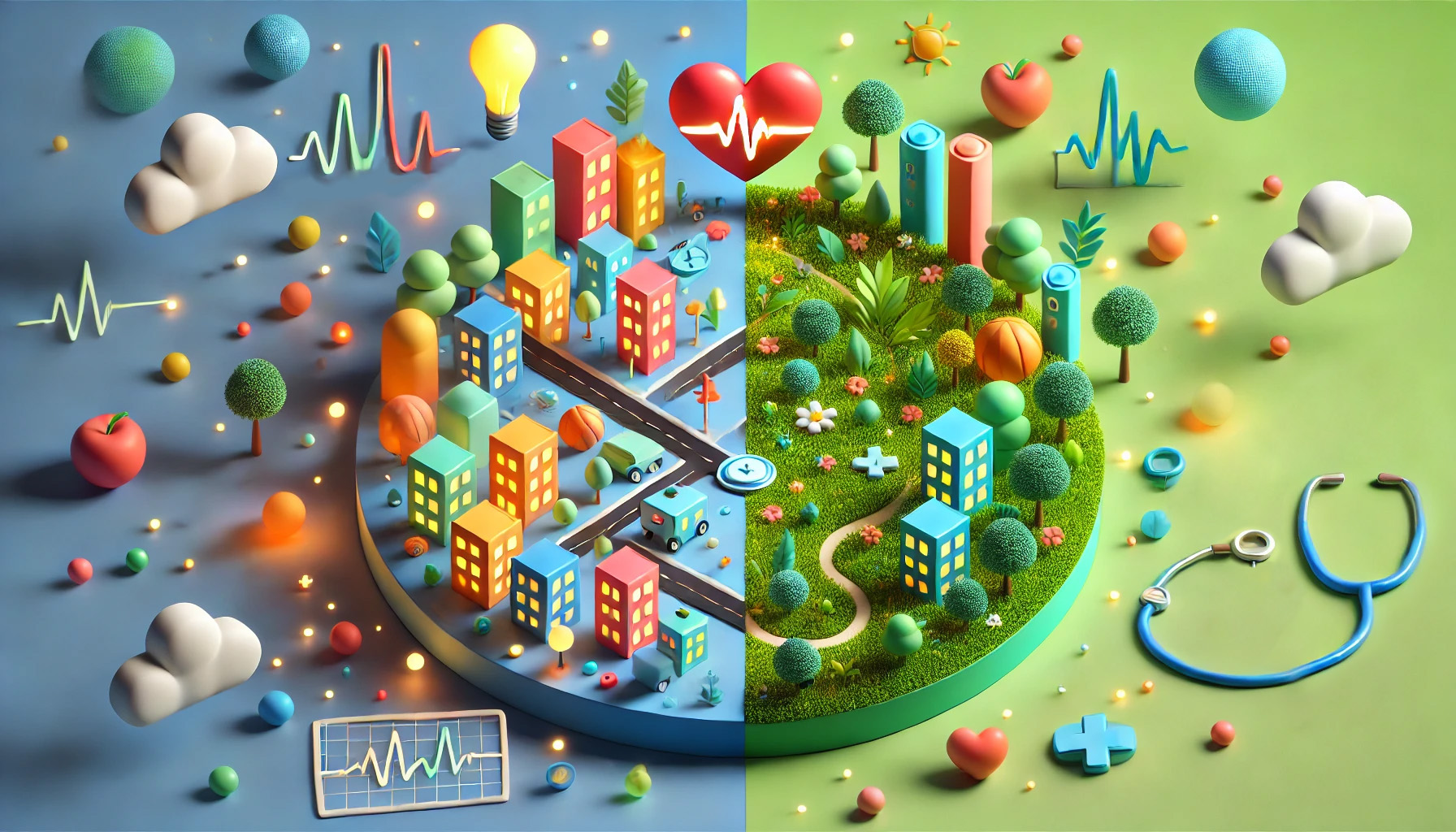
With both the healthcare system and the planet under such extreme pressure, small changes are not the basis of a winning strategy. If we are able to frame the right questions, we might be able to shift the preconceived constraints that exist today and create better systems, experiences, and solutions that address real human needs for the future.
If you take a hard look around healthcare, you’ll see many solutions, but few that address those big, gnarly challenges. And yet, the need has never been greater. Organizations of every size should carefully examine the questions guiding their efforts: Is this solution solving a genuine problem? Are we placing people at the heart of our solutions? Is the innovation effort set up for success?
If the answer is no, then the first step is to go back to the problem and ask: Do you have a great question that your innovation efforts are trying to answer? Does it represent the humans in the experience? Is it oriented around an outcome? Does it acknowledge the wider context? And is it broad enough to represent a number of possible futures, while being constrained enough to make meaningful progress?
With ever-increasing societal and commercial pressures, now is the moment to radically rethink our broken health systems. It’s a huge job, but there’s an easy place to start: Ask the right questions.
Exploring how to innovate in new ways? We would love to chat.
One of the most impactful lectures I had in my early years of design training was from a professor who sought to reframe the purpose of design.

The future Is financially inclusive
A preview of 3 global financial shifts we’ll see over the next decade.
It will shift from something physical in our pockets to a seamless layer embedded in every service. Financial tools will be hyper-personalized and smarter thanks to AI. This will benefit everyone, but it will have the most positive impact on those in the last mile: low-income people in emerging markets, women, and rural communities. Businesses will benefit, too. Tapping into billions of underserved customers will unlock growth. All these factors make a more inclusive future of money not just long overdue, but also inevitable.
For the past five years, IDEO has been exploring what’s possible for the future of finance with Last Mile Money, an innovation program that accelerates new financial products for those who traditionally have been excluded from financial systems. We’ve worked with partners to launch more than 100 pilots, prototypes, and products to connect them e with better financial options. Now, we’re sharing the lessons we’ve learned in advancing inclusion, gender equity, and the digital economy. And we’re inviting the global finance community to learn, replicate, and scale our innovations—or to come up with even better ones.
A big part of this work has been looking closely at the signals that tell us what the future of finance will look like. And over the next 10 years, we predict three seismic changes in the world of money:

#1. Women will be at the center of finance.
Digital products will be built for women, not adapted to include them.
Women are underserved by the world of money. One-third of women in emerging markets do not have a formal bank account, excluding them from high-quality options to save, grow a business, or plan for their family’s future. Meanwhile, businesses are missing out on billions of customers, and many are realizing they must change: They need to center women’s financial needs, not only to be more inclusive, but for their own growth.
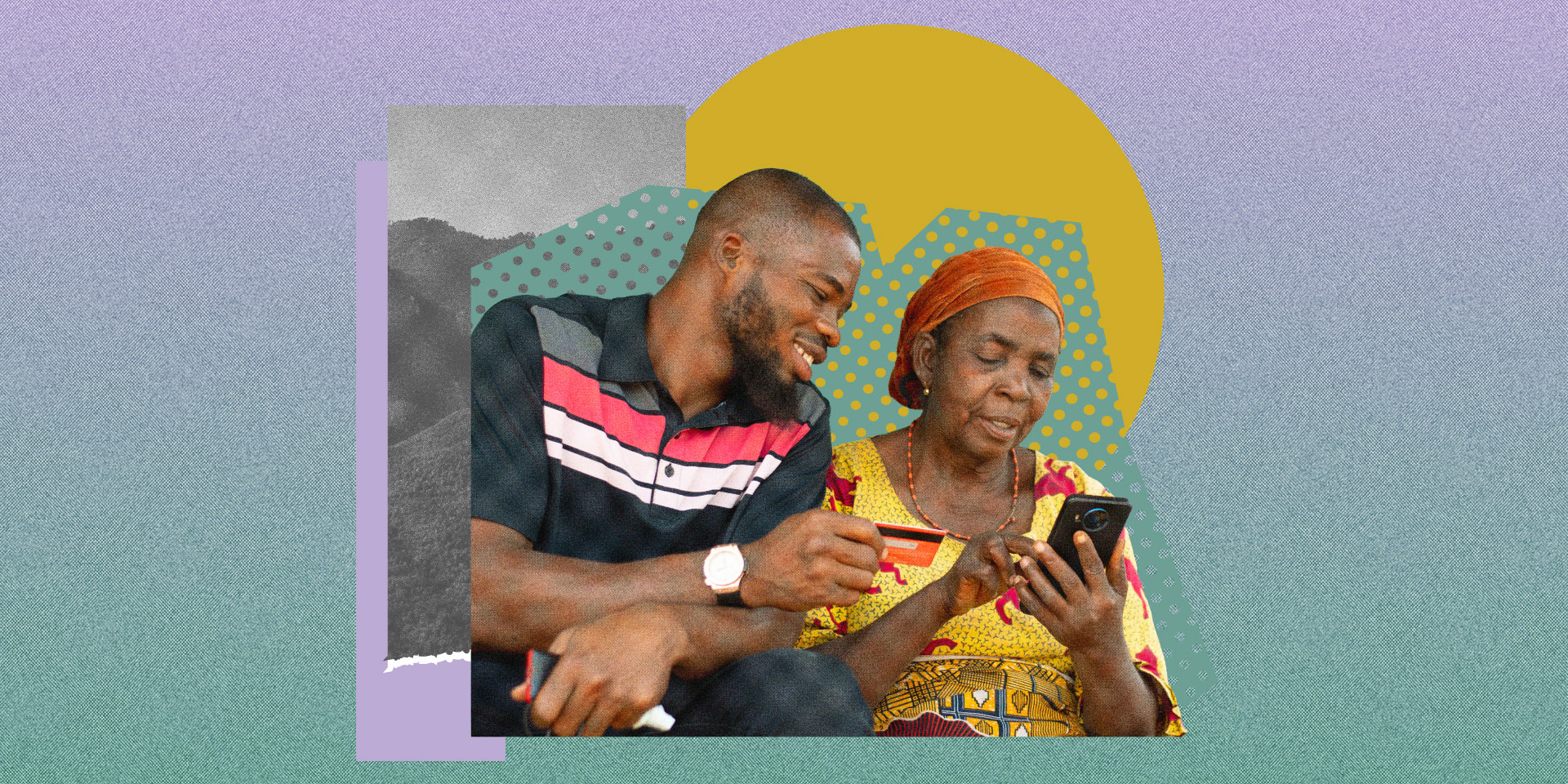
In Pakistan, the global consumer-goods company Unilever launched Guddi Bajis, a program for rural women to earn a living by delivering household goods to other women’s homes. IDEO worked with Unilever and the startup Finja to design a digital experience for these women that was culturally-sensitive and optimized for first-time internet users. These digital Guddi Bajis were able to grow their businesses by leveraging smartphones, digital payments, and credit—often for the first time. And to great sucess: They reported up to a five-fold increase in income after accessing digital credit. Not only were these female agents able to earn and increase their own livelihood, the program also benefitted their customers—women in their communities.

Future #2. The last mile will be no mile at all.
The last mile will not be defined by location, but by network access.
Historically, geography has been a big determinant of who can participate in financial systems. People living in very rural areas in less developed countries were simply left out. But as internet connectivity spreads into more corners of the globe and the digital economy enables work from anywhere, the line between urban and rural will no longer decide prosperity. Instead, it will be determined by how active and connected we are in digital networks. And what may seem like unexpected partnerships today will set the norm for how businesses reach the new last mile of people tomorrow.
Our team saw this in action in Indonesia where global food company Cargill had a problem sending payments to cocoa farmers in rural areas. So, we brought in Grab, a major tech company behind an e-commerce app where farmers could sign up as agents to facilitate payments on its platform. Now, payments that used to take seven months get to farmers in only 10 days, boosting satisfaction with Cargill. And rural agents actually performed 111 percent better than agents in small cities, exceeding a target for gross merchandise value, according to Grab data. Better yet, the “star agents” turned out to be women who had strong ties in their rural communities and were active in social-commerce networks. This effort was so promising that Grab is scaling the model among women merchants and drivers elsewhere in Indonesia, bringing digital livelihoods to more underserved people regardless of geography.
Future #3. Financial services will be invisible.
Our everyday lives will be enabled by a seamless layer of AI-driven, embedded finance.
As our lives become ever more digital, finance is becoming just another layer of daily life, seamless and embedded. We’ve seen this with apps offering personalized financial guidance, automated investing, and credit when we’re online shopping. Now it’s happening for the rest of the world.
In Tanzania, when merchants run short of funds, they can get instant credit so their sales aren’t interrupted. This is thanks to Kuunda Digital’s automatic service that pre-qualifies merchants and makes accepting credit as easy as responding to a text message. Even small amounts of capital delivered just-in-time have helped merchants earn more revenue and lifted transaction volumes for banks and telcos. With support from IDEO, Kuunda brought this embedded-finance solution to new markets. Globally, Kuunda has scaled to 6.1 million active users and has distributed $1 billion in loans.
Already, we’re seeing signs that these shifts are beginning to take place. But more importantly, folks at the last mile are really beginning to feel them in their own lives and communities. A decade from now, these seismic changes won’t even feel new. And we invite everyone in this space, from startups to behemoths of finance, to help build the tools and pathways to make that happen.
Learn more at Financial Futures, where we explore what’s possible for the future of the last mile.
In the year 2034, money will work dramatically differently than it does today.

Lindsey Turner
I’m passionate about building brands, products, and experiences that help organizations show up with meaning and momentum.
I help organizations cut through complexity by shaping how they show up, through brand strategy, identity, and storytelling.
Working at the intersection of brand and business, I bring an editorial eye and a bias toward making—turning ideas into tangible experiences that people can understand, trust, and believe in.
My work spans government, healthcare, financial services, media, and consumer goods, from launching Gen Z-focused ventures to building innovation labs and reimagining legacy brands. I relish moments of ambiguity and enjoy translating across teams, perspectives, and priorities to move ideas forward.
I started my career in editorial and digital design, shaping cross-platform experiences and identity systems in publishing and agency environments. That foundation still shapes how I work today: I’m detail-oriented, collaborative, and overreliant on the Oxford comma. I hold a BFA in Visual Communication from the School of the Art Institute of Chicago.

Rachel Young
My work helps organizations see who their products aren't working for—and build the will and the tools to do something about it
For 25 years, I've asked the same question: Who does this design exclude—and what are we going to do about it?
My work spans human-centered strategy, inclusive design, and qualitative research, with clients ranging from Microsoft, Google, and Verizon to the National Science Foundation, and San Francisco Unified School District.
Before IDEO, I taught elementary school in East Palo Alto and spent a decade doing design work with social service organizations—where I learned firsthand what it costs people when systems are built without them in mind.
I am currently writing User Error, a nonfiction book about digital access and the design decisions behind it. I live in Oakland, California.

Brian Pelsoh
I lead with craft, ensuring our work is creatively excellent: rooted in deep human insight and imagination, while also grounded in the realities of business and technology.
My expertise spans brand, communication, and product design across tech, education, the arts, and social impact.
I believe great work demands both high-level vision and obsessive attention to detail, and only happens through collaboration.
I bring an inclusive, hands-on approach and a deep understanding of business, which enables me to consistently deliver excellence while always asking why.
Before joining IDEO, I worked at the brand firms Pentagram and VSA Partners. I began my career as a designer, leading teams at the School of the Art Institute of Chicago and the Milwaukee Art Museum. I hold an MFA in graphic design from Maryland Institute College of Art and a BFA in communication design from the Milwaukee Institute of Art & Design, and have taught at some of the best design schools in the US.

Tony Wong
I am responsible for IDEO’s long-term success in China and working with clients to use design as a tool to enable growth.
I am responsible for IDEO’s long-term success in China and working with clients to use design as a tool to enable growth. Specifically, I have helped Chinese companies design holistic brand solutions through the development of their products, communication, services, and innovation teams, and I have helped multinationals expand their presence and influence in China.
I advise global leaders on developing China-led innovation and capabilities.
In over 15 years in IDEO Shanghai, I have worked on projects that use design to elevate the quality of the experience of healthcare products and services, streamline processes that increase productivity, create spaces and programs that promote and enable inclusive communities, and build next generation mobility solutions that are planet-positive.
Before joining IDEO, I worked at Philips Electronics and the Electrolux Group in Italy, the Netherlands, and Singapore on a number of breakthrough commercial products. I am a member of the Young President Organization in Shanghai.

How to use AI as an editor, not a writer
Ed White shares how he uses AI as an editor—not a writer—to sharpen storytelling, rehearse ideas, and preserve the productive friction that makes creative work better.
Ed White has a rule he's tested on his own writing: hold yourself as the writer, and let AI be your editor. Ed is a Senior Design Director at IDEO's London studio, where he co-leads the firm's AI portfolio across Europe. Before IDEO, he spent 12 years as a writer and editor at the Financial Times, Wired, and Contagious. So when he talks about when to use AI for storytelling and when not to, it comes from two decades of crafting his storytelling skills.
In this episode, Mina Seetharaman talks with Ed about two specific tools he uses to keep AI in an editor's seat: a "roasting agent" prompted to critique his drafts without any sugarcoating, and a simulated audience he rehearses pitches on before the real thing. They also get into what Ed is hearing from design leaders at Anthropic, Lovable, Shopify, and Google Creative Lab about how creative work is changing, and why he thinks the friction of writing something yourself is worth protecting rather than automating away.

Building a personal AI for the messiness of life: Sida Li
Becca Carroll talks with Cue co-founder Sida Li about designing a personal AI for the messiness of everyday life—not just work. They explore how Sida stays anchored to human needs while navigating fast-changing technology, product tradeoffs, business-model experimentation, and the realities of building an AI company today.
Most AI products today are built for work—a space with clear problems and established systems. One founder noticed a gap: personal life is messier, harder to systematize, and mostly left behind by the AI boom. So she built Cue, a personal AI that lives inside iMessage and group chats, to go where the other tools haven't.
In this episode, Becca Carroll, IDEO's Chief Strategy Officer, talks with Sida Li, co-founder and CEO of Shared Context Lab, about staying anchored to a human need while the technology around her keeps changing shape, why she treats her business model with the same rigor she'd bring to a product, and what it feels like to build a company at this particular, disorienting moment in AI.
The conversation also gets into how Sida makes design decisions: the language Cue uses to describe itself, the tradeoffs behind building inside iMessage instead of a new app, and a real story about a business idea that didn’t pan out.
This is the second in a two-part series profiling founders from IDEO's Startups-in-Residence program. The first conversation is with Johannes Seemann, founder of Sooner, on designing GenAI for the emotional side of money.

Designing GenAI for the emotional side of money: Johannes Seemann
Designing financial tools around the feelings that shape money decisions.
Most personal financial tools are built to run the numbers and optimize towards a budget. While that works for some, most people experience money as a lived relationship that does not neatly fit into a spreadsheet. Johannes Seemann and Becca Carroll discuss why money is emotional before it is mathematical, and what a human-centered approach to building a generative AI financial product looks like in practice.

The curious leader's edge in uncertainty: Scott Shigeoka
How genuine curiosity helps leaders navigate uncertainty with greater confidence.
Mina Seetharaman talks with Scott Shigeoka, author of Seek and Head of Curiosity Cultivation at the Eames Institute, about what distinguishes genuinely curious leadership from performative curiosity, how power dynamics shape curiosity, and why practicing curiosity can restore energy rather than drain it.
Looks like you might be in search of something very specific?
Or reset the filters above and try another angle.
Here’s some random inspiration

Podcasts about creative leadership

Articles about the power of prototyping










































.webp)