
.svg)


Finding hidden talent

Thousands
of state jobs in Maryland no longer require a four-year college degree
skills-based
The White House is adjusting educational requirements for I.T. professionals in favor of a skills-based approach
“There is not a company in America right now that isn’t trying to improve diversity. There is also not a company that can meet the talent demand with four-year degree individuals alone.”
83% of HR professionals said they had difficulty finding suitable candidates in the past 12 months.
62% of Black people, 55% of Hispanic people, and 50% of non-Hispanic white people have become skilled through alternative routes, such as community college, workforce training, boot camps, certification programs, military service, or job experience.
Over the past 40 years, inflation-adjusted wages have increased 8% for college graduates with a bachelor’s degree while decreasing by 15% for people with only a high school degree.
American businesses are on notice: To be competitive in today’s market, you must diversify your workforce.
One way to widen the talent pool is to pay closer attention to people who have acquired their skills through alternative routes. Millions of Americans learn on the job, in community colleges, at boot camps, or through life experience. According to Opportunity@Work, more than 70 million Americans are overlooked because of degree requirements. Despite their abilities, these “STARs” (those who are skilled through alternative routes) find themselves stuck in jobs for which they’re overqualified and underpaid.
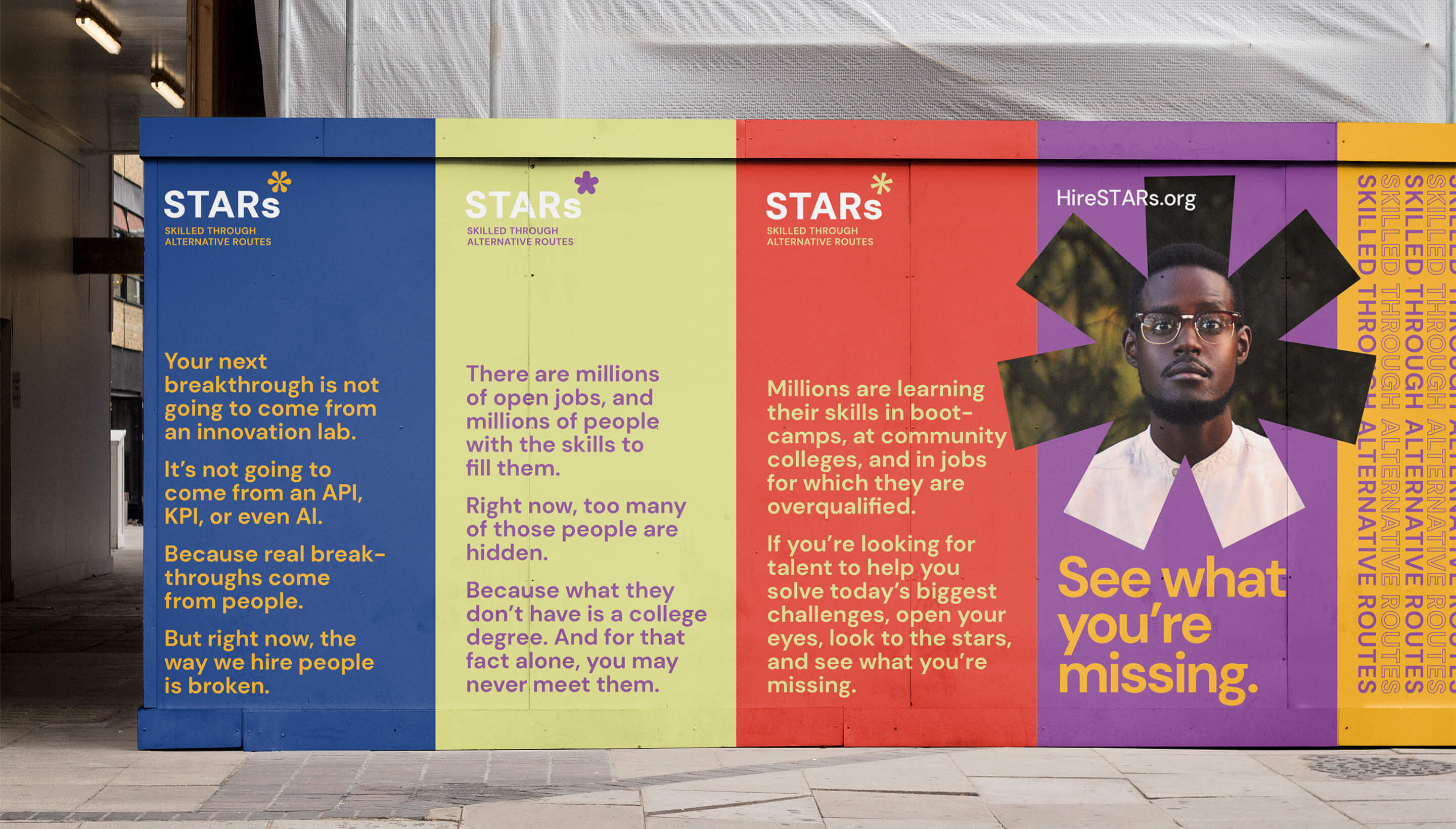
Opportunity@Work, an innovative social enterprise, reached out to IDEO to help collaborate with companies, talent developers, and STARs seeking career growth. To make this overlooked talent pool more visible, we created a campaign and video to rally companies. We also designed a data dashboard to help regional employer networks identify qualified talent and potential partnerships with skill-building programs. And to provide STARs with direct support, we scaffolded the job-seeking experience, focusing on key moments like the interview process.
It’s time for businesses searching for talent to open their eyes, look to the STARs, and see what they’re missing.
Curious about how this kind of thinking could benefit your organization? We’d love to hear from you.


Subscribe