
.svg)




Rethinking the food bank
A crucial resource reconsiders everything to design more dignity into its digital tools.
Giving food assistance is about more than handing over a box of groceries. It’s about allowing people to make their own choices.
But the pandemic only narrowed people’s choices. Undeterred, Northern Illinois Food Bank (NIFB) put people’s needs above everything else, leading to innovations that could improve food banks everywhere. IDEO recruited neighbors to co-design a new digital tool intended to improve people’s access to food. Local residents provided more than insights—they steered design decisions and helped transform the relationship between NIFB and the community.

Northern Illinois Food Bank’s My Pantry Express app allows people to browse and order groceries online and to choose a pickup time and location that works for their schedule. We designed the app to provide useful information on dietary preferences and to be inclusive of cultural differences. The result allows choice and flexibility, helps prevent food waste, and preserves the dignity of shoppers throughout the process by making My Pantry Express feel like any other grocery site.
Ultimately, Northern Illinois Food Bank and IDEO’s strategy for success relied on new metrics. In addition to measuring effectiveness in pounds of food distributed, we found new ways to measure shoppers’ satisfaction—a solution that works better for all parties involved because it was designed by all parties involved.
An estimated 1 in 8 Americans experience food insecurity.
The food insecurity rate is 2-3x higher for persons of color than for white households.
60% of food insecure households do not use food pantries.
1.9M
meals distributed through My Pantry Express in 2021
50%
increase in distribution from prior year
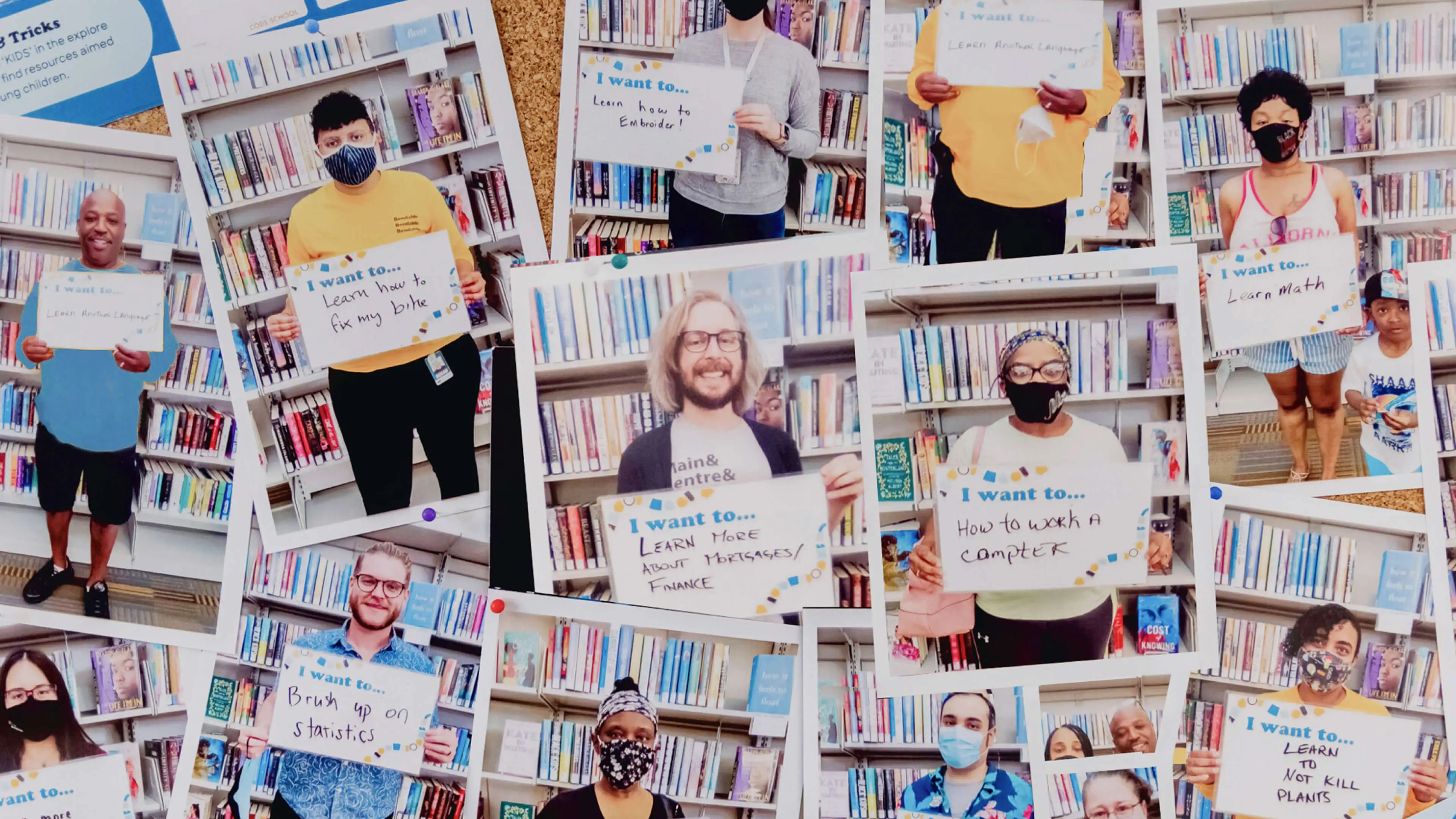
New skill city
The people of South Bend, IN, have the power to design a lifelong learning platform for themselves.
To create Bendable, IDEO worked alongside the people closest to the problem, so every important decision grew out of their experience.
IDEO and the Drucker Institute aligned with the library system and city leaders in South Bend, Indiana, on a single objective: build a learning platform that offered education opportunities to people affected by the decline of manufacturing in the region. But even the earliest phases of research revealed that there’s no common profile that matched the diversity of learners. There are innumerable reasons why people seek to learn and as many barriers holding them back.
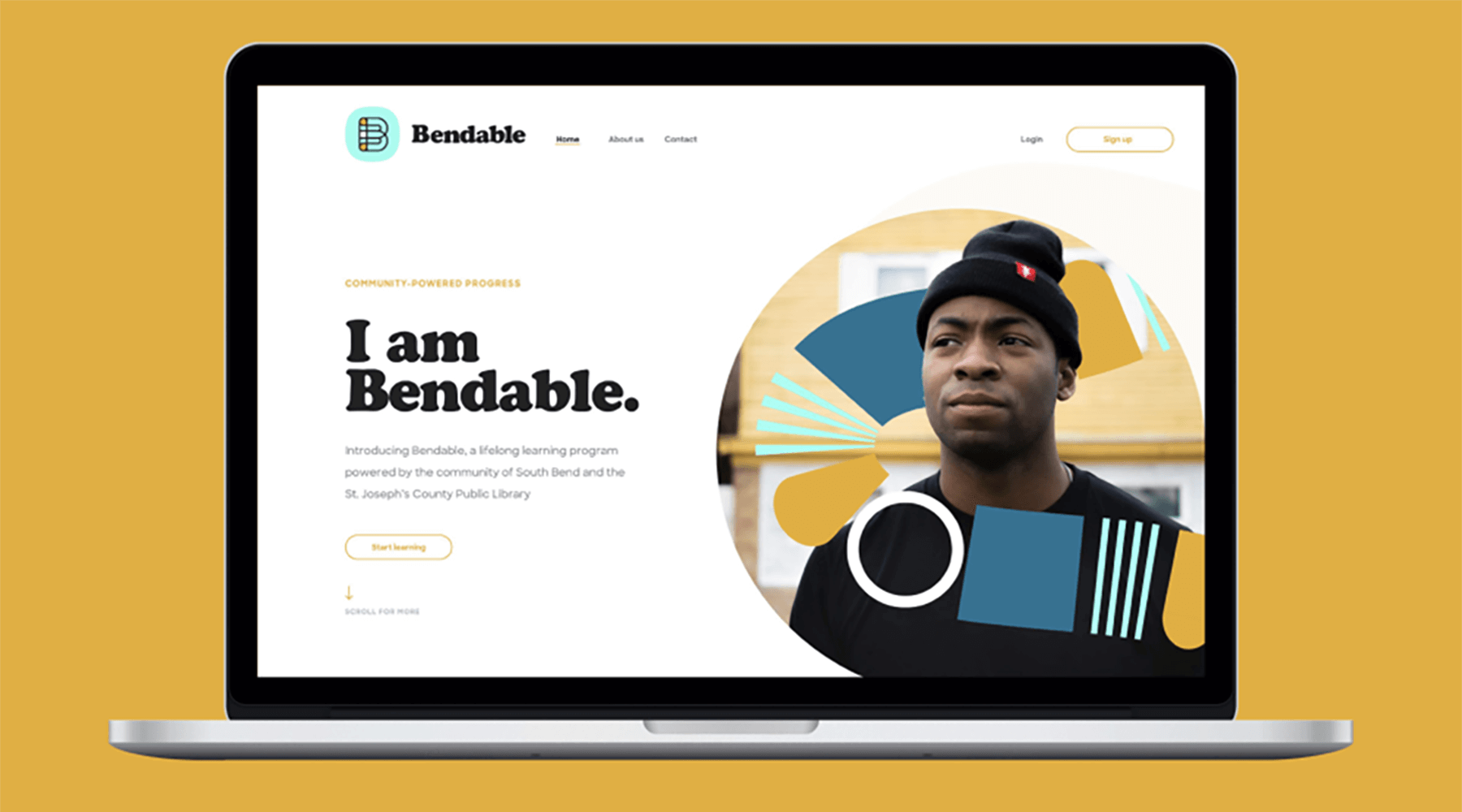
Knowing this, South Bend residents were the acknowledged authority for this work, and a design consultancy all their own. This radically simplified crucial decisions. Negative associations around traditional education led people to seek knowledge from those they already trusted. And they often lacked awareness about or the ability to access the many free resources already available.
The residents of South Bend helped the entire consortium see that the city wasn’t under-resourced but under-connected. That insight, and the power the community and the library system held to rectify it, made Bendable into the people-driven, connection-based learning platform it is today.
By 2025, as many as 85 million jobs will be displaced by automation, yet 97 million new ones could emerge.
More than a third of adults pursuing postsecondary education before the COVID-19 pandemic were forced to abandon those plans.
25
programs and other resources offerings are now available to residents of South bend
4
states have begun to integrate Bendable into library systems

Making voting easier
The country’s largest jurisdiction creates a more accessible voting experience.
Protecting the right to vote means ensuring that all citizens can cast their ballots privately, independently, and easily.
With that principle in mind, Los Angeles County sought out a design strategy firm to create a next-generation, customizable system that would meet the needs of its large and diverse voter population while satisfying myriad voting regulations. The result: an accessible, self-enclosed ballot-marking device with a touchscreen that allows any voter to easily navigate, mark, verify, and submit a paper ballot. We also worked to improve the entire voting experience, including vote-by-mail ballots, interactive sample ballots, and the tally process.
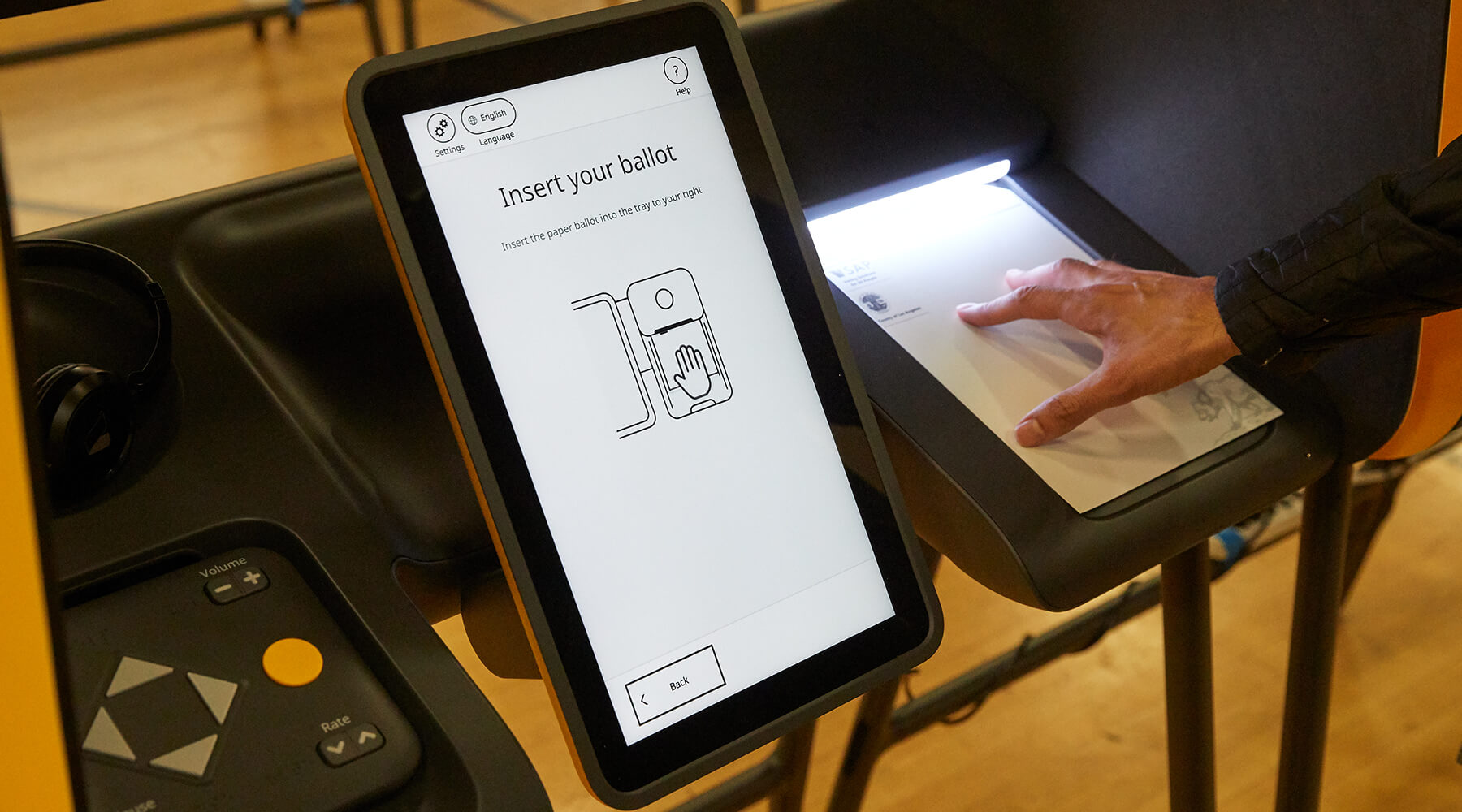
As with any inclusive design, details matter. Voters with vision impairment or reading disabilities can opt for audio and tactile experiences with the push of a few simple buttons. And for voters who prefer to read the ballot in their native language—Spanish, Chinese, Korean, or any one of the 11 others supported by the county—the device lets them select their preference.
After extensive research and testing with constituents, we designed a solution that makes voting easier for anyone. And knowing that the only constant is change, we made the system flexible enough to adapt to emerging needs and technologies, protecting voters’ rights now and in the future. Read the full case study here.
26% of American adults have some type of disability. In the 2020 election, 18% of disabled voters nationally reported difficulty voting, about twice as many as non-disabled voters.
In 2020, national voter turnout among disabled people was 7% lower than among non-disabled people in the same age group.
"Intuitive & secure"
was the sentiment most Los Angeles County voters expressed about the new voting system after the 2020 primary election

Human problems, human solutions
A conservation leader rewrites the role humans play in the narrative of climate change.
Conservation International is made up of conservation experts. To bolster its work, we bring a focus on scale, speed, and the human element to every project.
How does that look in the field? To restore the forest of Fiji, Conservation International paid a cash incentive to the community to buy, plant, and care for new trees and foliage. But once those cash incentives stopped flowing, the work ground to a halt. Taking a human-centered-design approach, one employee uncovered an insight: Fijians are more motivated to help in exchange for longer-term, noncash incentives like building infrastructure in villages. Small projects such as footpaths, repairs to communal trucks, beehives, or sports programs for youth continually reminded the community that the environment is a provider for their families, imparting a feeling of shared ownership in its conservation.
Stories like this, repeated around the globe, are how we hope to help Conservation International find sustainable outcomes. Our work together, including a six-month fellowship to help emerging leaders develop new capabilities, and a series of strategic, future-focused events for executives, has brought more tangibility and deeper collaboration to the organization.
Together we hope to create businesses, food solutions, and energy alternatives that conserve nature, and improve human health—because humans are a part of nature, too.
The scientific community overwhelmingly agrees that we have ten years to drastically cut greenhouse gas emissions or humanity will suffer devastating consequences.
We need to conserve one third of the global ocean using area-based measures and ensure at least 75% of seafood is harvested using socially responsible, environmentally sustainable methods by 2030.
75% of the world’s poor rely on agriculture for their livelihoods, which in turn depends on nature for pollination, irrigation, and soil replenishment.
20
leaders integrated human-centered design into annual goals, project pipelines, and fundraising efforts
20%
of the organization is now involved in design-thinking projects
Why every company needs a futurist-in-residence
For companies looking to the near-term, it’s no longer a-nice-to-have.
This initiative, aimed at exploring what the next 10-15 years might bring, allowed me to leverage the full spectrum of a futurist's tools as well as those of an organizational designer—simultaneously exploring their design question while teaching and integrating foresight capabilities.
Being a futurist means spotting signals that may only be whispers today, but could become profound shifts tomorrow—shifts that companies will have to be prepared to navigate. When playing this role we use a mix of facilitative, creative, and analytical tools that not only identify emerging patterns, but also embed foresight into the organization itself, helping shape the culture to be more forward-facing. Our techniques range from examining historical patterns to scanning for signals of change to telling stories of multiple plausible futures—each designed to bring clarity to a complex environment and make emerging opportunities actionable for an organization as a whole.
What do those tools include?

Hunting for signals in the noise
Identifying and tracking signals of change is the primary activity of any foresight work. It’s focused on spotting glimpses of the future that exist in the world today. A signal might be a new idea, behavior, technology, social context, or business model that may seem insignificant now, but could redefine industries or the world at large if it scales. Recent examples I uncovered for clients include everything from the resurgence of “dumb” phones to the emergence of four-day work weeks to big tech’s greenhouse gas emissions surges fueled by the expansion of AI. Grasping these subtle shifts enables teams to broaden their perspectives and think beyond what’s currently happening.
Mapping drivers of change
Tracking and mapping broader trends and underlying drivers of change — like the climate crisis or the rapid rise of LLMs —gives further context to signals and reveals potential structural shifts influencing social, technical, environmental, economic and political systems—ultimately shaping how organizations adapt, innovate, and respond to emerging opportunities and risks in the future. Understanding the why behind these changes allows teams to build flexible strategies grounded in deep awareness of external forces.
Considering different futures
Imagining a range of possible futures challenges teams to consider different potential outcomes and to design tangible steps the company can take to either grab opportunity or avoid risk. Although it's important to imagine ideal or preferred future scenarios to create a transformative vision for the future, it's just as critical to explore potential futures with extreme uncertainty or disruption to stress-test ideas. Imagining “what if” scenarios like, “What if AI became the standard for all customer service?” or, “What if customers demand ownership of their data?”stretches a team's thinking to identify resilience strategies and become more nimble.
Preparing for disruption
Identifying and interpreting emerging paradigms helps organizations to anticipate market or strategic shifts before they disrupt, making it possible to proactively invest in nascent opportunities or manage the decline of legacy approaches or systems. It minimizes risks associated with abrupt change and encourages continuous innovation, ensuring the organization remains competitive and able to seize new growth opportunities as they arise. It’s all about building confidence in making strategic choices.
Creating artifacts from the future
A future news headline, a mock product, or an immersive experience can make abstract concepts concrete, spark discussion and inspire strategic actions that could be aligned with longer-term goals. Sometimes the most powerful stories or artifacts of the future are those that are the most mundane, like a job description or a transportation ticket set 15-20 years into the future. These visions bring the future to life, and enable teams to embed future-thinking into strategic choice making.

Given the scale of the organization I was working with, we expanded the traditional signals exploration, mapping everything from the future of work and retirement, to the rise of a digitally-native generation, to shifts in human decision-making related to a broad and rapid integration of AI. A collaborative team of consultants and internal staff updated this tool weekly, regularly identifying and tracking trends, drivers, and future scenarios across the tech industry. And we mapped paradigm shifts in critical areas of the company’s operations, spotlighting strategic opportunities to lead change in the space.
Additionally, we developed and deployed a futures-focused curriculum and a program to engage leadership and key cross-functional stakeholders, ensuring lasting impact and sustained capabilities across the organization. Not only did we prepare the organization to anticipate and navigate future shifts, we also embedded a lasting culture of foresight, empowering the organization to lead its industry with confidence and agility.

For companies like this one, having a futurist-in-residence is no longer a nice-to-have—it’s a strategic imperative. This role is critical for two reasons: preparation and opportunity. With so many variables at play—from technological advances to societal shifts—it’s critical to have someone who can filter through the signal noise, identify potential game-changing opportunities, and help those who guide the organization to adopt a more forward-thinking approach. The role can also foster a culture that challenges assumptions, encourages innovative and creative thinking, and equips teams to identify and interpret the forces that are shaping tomorrow.
In today’s volatile and complex world, companies need futurists not just as advisors, but as strategic enablers who build futures literacy across an organization. Investing in the future means investing in the people who can help organizations see a wide array of futures clearly and act on uncertainty with confidence, helping turn that uncertainty into strategic possibility.
As part of a client engagement, I recently stepped into a futurist-in-residence-style role for a major tech company that was eager to infuse futures thinking throughout an already innovative organization.
How AI personalities can transform the data experience
Emotional engagement is vital to making it actionable and relatable.
One of the ways they deliver this value is by being more approachable and responsive to a wide range of user behaviors. Or, seen another way, by being social and emotional by default. Designers of these tools can lean into the power of emotional engagement, or pretend it isn’t actually there at all. Count us on the side of emotional engagement: We believe that designers should understand and intentionally integrate emotion into data analysis tools.
Why does emotional engagement with data matter?
Data is at the heart of decision-making, driving everything from product development to customer service. Every presentation of data is ultimately telling a story, from a dry spreadsheet to Florence Nightingale’s famous casualty diagram. But how effective, impactful and, perhaps most importantly, intentional is that story? Emotional engagement is vital because it not only makes data more relatable, but also invites curiosity and deeper reflection. By intentionally crafting the personality of conversational AI systems, we can create experiences that enhance functionality through emotional connection.
Personality-driven AI interfaces help transform the process of making sense of data into an experience that can spark empathy, understanding, and even enjoyment. This approach offers a way to help AI systems humanize data, making the interaction with that data feel less transactional and more like a conversation.
The role of personality in AI systems
Integrating personality into data presentation systems is more than a party trick to add life to your pie charts. It’s about designing tools that can communicate with users in ways that reflect their mood, tone, and even sense of humor. Large Language Models (LLMs) make this not just possible, but accessible to everyone who needs to present data. By generating natural-sounding dialogue and infusing it with personality, LLMs allow for conversations that resonate emotionally—and at times playfully—rather than just delivering dry data. We believe all data tells a story, and LLMs can help you tell a better one.
What can that look like in practice?
During a recent workshop we hosted at HCI International 2024, we asked participants to design AI-enabled systems using an evolved version of the "Talking to Docs" framework. Our goal was to strip back the LLM interface as much as possible, until it contained just the elements we wanted to explore: a base prompt and a searchable vectorized document set. This simplification let our participants experience how setting intentions around personality and emotional framing through prompt engineering can recontextualize their unstructured data (held in the vectorized document set). Each participant took a unique approach to how their unstructured data could be presented in a more intentionally humanized way, blending functionality with personality. Here are some of our favorites.

1. Exploring Newton’s Principia Mathematica with an enthusiastic fitness coach
One participant created a conversational system to explain Newton’s Principia Mathematica in the style of an overly-enthusiastic fitness instructor. This personality is rooted in humor and contrast. Principia contains some of the most revolutionary ideas in physics, not to mention that it’s written in Latin–not an inviting combination. By choosing the framing of a fitness coach, the system immediately added a whole different set of cultural signifiers. But, the benefits went beyond style. The system actually framed its explanations of the ideas in the text as fitness metaphors, making them more relatable to a common human experience—like when it explained the concept of gravity.
"Just like your muscles build momentum during a run, gravity pulls that ball down the hill! Keep up the energy,—you’ve got this!"
This example shows how AI can make even the most challenging material feel dynamic and engaging and, perhaps most importantly, welcoming to audiences who might not be seen as the core one for a particular subject.
What could this mean in real-world applications? Imagine large multinational corporations creating engaging experiences for AI adoption and upskilling their workers; hospitals could explain complex medical treatments to patients in digestible ways, and schools and education companies could make tough subjects more fun and accessible to learners.
2. Demystifying Picasso’s Guernica for the curious
Another participant used a friendly, approachable art teacher personality to explain Picasso’s Guernica to younger audiences. By using relatable language and a conversational tone, the system helped break down the complex themes and techniques of the painting, making art more accessible as a patient teacher might:
"Picasso broke things apart and put them back together in strange ways to show the confusion and chaos of war. It’s like a giant puzzle, and you’re the detective figuring it out!"
LLMs can be prompted to use existing pedagogy techniques (for example, Socratic dialogue or reciprocal teaching) to deepen understanding of topics a user might normally just skim over. This approach could be used by art and fashion players like museums and brands to explain the backstories of their artifacts, or by travel companies to add greater context to a visitor’s experience of a new place. Or, even more provocatively, this technique could be used to create understanding, consent and trust when agreeing to data usage, especially in highly-sensitive but complex areas like genetic data and other personal information.
3. Adapting the approach to user behavior
A third participant introduced a humorous twist to the bureaucratic process of filling out tax forms by creating an interface that changes its entire persona based on the attitude of its user. If the system detects the user’s tone as positive and polite, it responds with the personality of a bubbly, cheerful government worker right at the start of their career. But if the system sees that the user is grumpy or rude, it replies with a sarcastic and grudging attitude, and adopts the persona of a government worker on their very last day on the job.
"Ugh, all right. You do not put your ITIN here. Grab a coffee and take a deep dive into section 4 of Pub. 15 if you really want to know more."
What happens when you no longer have to design your interface with an assumed user intent, but instead can dynamically adjust it based not just on explicitly gathered user preferences, but on their tone and attitude?
There are many applications where creating some intentional friction when users don’t behave as intended is desirable, from financial planning to medical treatment plan adherence. Instead of building these frictions on a one-size-fits all design, we can use LLMs to estimate user attitudes and create the right behavioral nudges at the right time. And maybe they can even manage to be funny while doing it.

The future of emotionally-engaged AI design
Designing AI-enabled systems isn’t just about efficiency and ease. It’s about creating meaningful interactions that leverage how humans think and feel to make data more accessible, relatable, and even enjoyable. With their ability to understand and transform human language, AI systems naturally evoke emotional responses that differ from those triggered by traditional software or hardware. Even the absence of a defined personality becomes a personality in itself. As designers of these systems, it’s our responsibility to think deeply about how they’ll relate to users, not just how technically accurate their responses will be. The applications of personality-driven, emotionally-infused AI interfaces can span sectors from technology to healthcare, culture, media, education, government, consumer products, and beyond, potentially making data more vital, relatable, and actionable in all of our everyday lives. It all depends on design.
As AI technology advances, so does the potential to reimagine how we experience data—where even the most abstract information can evoke curiosity, empathy, and engagement.
Try it for yourself
We created this process to make engaging with the fundamentals of AI tools more accessible to designers–and that means you too! If you’d like to try your hand at our personality crafting exercise you can find instructions here. We’d love to hear about what you make! And if you’d like to partner with us to help solve an AI problem of your own, get in touch.
AI data analysis tools are promising a lot: efficiency, adaptability—even enhanced comprehension.

5 takeaways from TED AI 2024
Hint: They all reinforce a human-centered approach.
That was a key message we took from our time at the second annual TED AI conference, hosted in our own backyard of San Francisco. Two days full of panel sessions, robot demos, and classic TED Talks had us considering the nature of time, the power of language, and transcending human cognitive limitations. The biggest theme: The urgency for bringing human centered-design to AI is only getting stronger.
Here are five key takeaways from our time on the ground.
1. Beware the black box
The black box approach to AI’s foundational models are the root cause of issues around ownership, copyright, credit—and in the case of certain industries like healthcare—exclusion of entire userbases.
Not knowing what the training data was, where it came from, or who it originally belonged to, means that:
- We’re not able to give credit or reimbursement to the original creators of that data.
- There are unknowable but impending legal ramifications from a copyright perspective.
- Healthcare professionals are unable to use models such as ChatGPT, because without being able to verify or validate the training data, they’re unable to confidently (or even legally) use the answers the models provide.
Already, though, some companies are pioneering more transparent and more widely-usable data sets and model developers. HOPPR, for example, is building the first multimodal AI foundation model for medical imaging and radiology, while the non-profit Fairly Trained is based on the belief that that many consumers and companies “would prefer to work with generative AI companies who train on data provided with the consent of its creators.”
The concept of designing for transparency is reflective of a lot of research we have done in the past with users and data. Our 2019 work with Mozilla exploring more ethical and user-centered solutions to the Surveillance Economy highlighted the pitfalls of data collection, and the opportunities for tech companies to build value by handling user data in more human-centered ways. Combine that with our blockchain work at IDEO CoLab, and there are lots of interesting spaces to explore and draw inspiration from—including individual and collective control, consent, and value generation.

2. Consider the human consequences
A lot of industry specialists are focused on the near-future of the technology, as opposed to the mid-term opportunities and AI’s long-term effects on humanity. Some speakers were concerned that we're spending too much time worrying about what the technology will do for us, while others think we're too concerned about what it will do to us. There was a lot of focus (for better or worse) on the productivity benefits, but relatively few people were thinking about the consequences for humans.
Eugenia Kuyda, founder and CEO of Replika, noted that we should “stop designing for productivity, and start designing for joy,” which is a lovely provocation. We don’t need to forsake one for the other, but designing for joyous experiences can make productivity far more desirable. Our work with Ethiqly around integrating AI and writing exercises in schools focused not on the power of the technology or how many more essays kids could write, but on making the process of getting your creativity on to paper more joyful and rewarding, and focusing on the relationship between teacher and student.
There were also several conversations around the idea that technology will free up time for us to spend with our families instead of working. As romantic as this sounds, it’s not realistic. Organizations will simply reduce headcount, and then increase the other workloads for employees. Articles like this one from the BBC hint at a workforce feeling more burnt out due to AI implementation, showing a glimpse of the human consequences we should be designing for at the application layer.
3. Embrace quality over quantity
Several people spoke about the exponential growth of investment in computing power for large language models (LLMs). Currently, 70 cents of every dollar invested in AI models goes into crunching the data.
As an alternative to this massive use of resources, several speakers brought up the concept of small language models. SLMs are literally smaller models, trained on just 1 billion tokens. (LLMs can require upwards of 1 trillion tokens.) These SLMs can be created with a fraction of the time and energy, and offer great specific utility. Consider the example of the telecom call center. Its model doesn’t need to be exposed to the nuances of Shakespearean sonnets; it just needs to know the words and phrases needed to operate a call center, so you can spend less time, money, and energy on creating your model.
With the tens and hundreds of millions of dollars we’re spending to train LLMs, how much are we willing—or is financially feasible—to spend on models? If we continue down this path, the financial / physical / electrical requirements are going to become unsustainable. One panelist mentioned that “we should be feeding the machine the right information vs. all the information.”
The potential futures for more intentional and nimble SLMs seems much more approachable and both financially and ethically feasible.
4. Spoken language is irreplaceable
One of our favorite speakers was Jessica Coon, the linguist who consulted on the movie Arrival. She argued that human language is rich, nuanced, and endowed with the histories of our cultures. An input text box attached to a keyboard populated with Roman characters is never going to be able to express a fraction of it.
Rikin Gandhi, the co-founder of Digital Green, a company using AI to provide agricultural information and guidance, spoke about the company’s work with farmers in rural India, where illiteracy and nuanced local dialects and translations make-text based offers unviable. But AI models’ abilities to understand spoken language, locational context, and nuances of a given agroecology and a given time of the year means those farmers can interact through images, video, and spoken word.
This perspective shines a spotlight on the potential for more diverse and inclusive design principles, and our spoken language is a key part of that future.
5. Discover a new impetus for responsible design
We also heard from Pratyusha Sharma, a leading researcher and member of Project Ceti, who shed light on how we might be able to leverage generative AI to understand the unsolved mysteries of the ecological world.
Sperm whales communicate through clicks, or codas. While researchers for decades have understood that this is the primary communication pattern by which this social species coordinated, it had been impossible to untangle the spoken language and what it meant. Sharma spoke about a novel use of generative AI—using a generative adversarial network, or GAN, to surface both the alphabetic principle and deeper understanding of coda meanings. With this technology, not only could we hear the sperm whales’ communication—we can understand what it means and predict from their communications what they might do next, whether that’s diving for food or coordinating childcare.
As AI tools become more and more powerful in helping us understand the language of the world around us, the impetus for responsible design will become clearer and clearer. If we can start to interpret the language plants, animals and earth use to communicate, how can they not be a stakeholder in everything we design?
Curious how human-centered design could help you make more desirable AI products? We’d love to chat.
We need to start pulling the human signals from the technological noise, and weaving them together.
Methods for defining your organization's purpose
Get out of your head and embrace your heart with these 3 activities.
A good purpose statement articulates a passion to boldly make an impact. It can differentiate you from competitors, grounding your work in deeper meaning. It can serve as a beacon to draw like-minded individuals to your company—as consumers or employees. And it can align and motivate leaders, guiding strategic choices.
To do all that, a good purpose has to make you FEEL something.
But too often in crafting a purpose statement, marketing and business jargon sneaks in, adding extra bloat. Or conversely, the language gets watered down to the point where it doesn’t mean anything anymore. The emotional gets sacrificed for the intellectual.
If you feel yourself or your team starting to slip into the weeds—or floating too high above the clouds—here are three ways to re-inspire and re-calibrate your thinking around purpose.

1. Get out of your own head: Collect love letters.
If you’re feeling lost at where to even begin, start with some on-the-ground research. Approach employees, end users, stakeholders—whoever interacts with your brand or company—and ask them to write a love letter to your organization, talking about what they’re most proud of, or what they appreciate most.
How we’ve used it: Last year, we were working with the team at Dartmouth Library to develop its strategy, starting with a clear articulation of its purpose. As part of a series of co-design workshops with faculty, staff, and students, we asked participants to write a letter to their library: What did they treasure most? How did it make them feel? While the stories we gathered covered a broad range—encompassing everything from intellectual exploration to belonging—they revealed the deep connections people had with their library, an attachment that was central to both its purpose and strategy.

2. Push past “what” and “how” to uncover your “why.”
If you’re feeling like your purpose is stuck in details and logistics, try the classic Golden Circle from Simon Sinek. Draw three concentric circles: the biggest should be WHAT you do; the next, HOW you do it; and the center WHY you do it. Brainstorm your answers to each and put them in the appropriate sphere. Focus on what landed in your center circle—your whys start to articulate your purpose.
How we’ve used it: The Boston Society for Architecture reached out to us to help the organization shift from being program-driven to being impact-driven. In a series of collaborative workshops, we had stakeholders list all the practical and emotional benefits for member architects, partners, community leaders, and students. Together, the team mapped these examples on the Golden Circle, setting aside functional positioning statements to focus on elevating the why—the emotional purpose that the organization could rally around.

3. Fast forward to the future to ground purpose in greater context.
If you’re struggling to make your purpose feel more aspirational and evergreen, consider taking an imaginative journey five, 10, or 15 years into the future. Spend a few minutes generating as many future signals as possible: What are things you observe in your industry, your customers, or your organization today that might indicate bigger trends over time? How might you evolve your purpose to stay relevant amid these changes?
How we’ve used it: In the earliest days of the pandemic, we were working with a large consumer electronics company to design a bold new strategy for the organization. To kick off the work, we spent a couple of hours with the core team generating signals. Even though we had no idea what the impacts of the pandemic would ultimately be, we were looking to uncover and better understand trends that were already starting to emerge in the world around us. These explorations into themes like hybrid work, climate resilience, equity (and more!) helped us paint a picture of the future that gave us a context for defining a purpose that could fit the company for years to come.
Articulating a bold and inspirational purpose is hard. It requires creativity, empathy, and constant iteration. And in the swirl of “are we there yet?” it can be easy to sacrifice the emotion, chopping the “feeling” in favor of generic language that—if said with enough oomph—sounds smart enough. But it’s not worth it.
Finding the right “why” can help give your purpose the power it needs to inspire leaders and employees to work in service of something greater. And when you bring it to life, a great purpose can signal your company’s core ethos to consumers, acting like a beacon to those who seek what you have to offer.
For organizations and brands, discovering purpose always starts with a question: “Why do you exist, beyond profit?”

Lindsey Turner
I’m passionate about building brands, products, and experiences that help organizations show up with meaning and momentum.
I help organizations cut through complexity by shaping how they show up, through brand strategy, identity, and storytelling.
Working at the intersection of brand and business, I bring an editorial eye and a bias toward making—turning ideas into tangible experiences that people can understand, trust, and believe in.
My work spans government, healthcare, financial services, media, and consumer goods, from launching Gen Z-focused ventures to building innovation labs and reimagining legacy brands. I relish moments of ambiguity and enjoy translating across teams, perspectives, and priorities to move ideas forward.
I started my career in editorial and digital design, shaping cross-platform experiences and identity systems in publishing and agency environments. That foundation still shapes how I work today: I’m detail-oriented, collaborative, and overreliant on the Oxford comma. I hold a BFA in Visual Communication from the School of the Art Institute of Chicago.

Rachel Young
My work helps organizations see who their products aren't working for—and build the will and the tools to do something about it
For 25 years, I've asked the same question: Who does this design exclude—and what are we going to do about it?
My work spans human-centered strategy, inclusive design, and qualitative research, with clients ranging from Microsoft, Google, and Verizon to the National Science Foundation, and San Francisco Unified School District.
Before IDEO, I taught elementary school in East Palo Alto and spent a decade doing design work with social service organizations—where I learned firsthand what it costs people when systems are built without them in mind.
I am currently writing User Error, a nonfiction book about digital access and the design decisions behind it. I live in Oakland, California.

Brian Pelsoh
I lead with craft, ensuring our work is creatively excellent: rooted in deep human insight and imagination, while also grounded in the realities of business and technology.
My expertise spans brand, communication, and product design across tech, education, the arts, and social impact.
I believe great work demands both high-level vision and obsessive attention to detail, and only happens through collaboration.
I bring an inclusive, hands-on approach and a deep understanding of business, which enables me to consistently deliver excellence while always asking why.
Before joining IDEO, I worked at the brand firms Pentagram and VSA Partners. I began my career as a designer, leading teams at the School of the Art Institute of Chicago and the Milwaukee Art Museum. I hold an MFA in graphic design from Maryland Institute College of Art and a BFA in communication design from the Milwaukee Institute of Art & Design, and have taught at some of the best design schools in the US.

Tony Wong
I am responsible for IDEO’s long-term success in China and working with clients to use design as a tool to enable growth.
I am responsible for IDEO’s long-term success in China and working with clients to use design as a tool to enable growth. Specifically, I have helped Chinese companies design holistic brand solutions through the development of their products, communication, services, and innovation teams, and I have helped multinationals expand their presence and influence in China.
I advise global leaders on developing China-led innovation and capabilities.
In over 15 years in IDEO Shanghai, I have worked on projects that use design to elevate the quality of the experience of healthcare products and services, streamline processes that increase productivity, create spaces and programs that promote and enable inclusive communities, and build next generation mobility solutions that are planet-positive.
Before joining IDEO, I worked at Philips Electronics and the Electrolux Group in Italy, the Netherlands, and Singapore on a number of breakthrough commercial products. I am a member of the Young President Organization in Shanghai.

How to use AI as an editor, not a writer
Ed White shares how he uses AI as an editor—not a writer—to sharpen storytelling, rehearse ideas, and preserve the productive friction that makes creative work better.
Ed White has a rule he's tested on his own writing: hold yourself as the writer, and let AI be your editor. Ed is a Senior Design Director at IDEO's London studio, where he co-leads the firm's AI portfolio across Europe. Before IDEO, he spent 12 years as a writer and editor at the Financial Times, Wired, and Contagious. So when he talks about when to use AI for storytelling and when not to, it comes from two decades of crafting his storytelling skills.
In this episode, Mina Seetharaman talks with Ed about two specific tools he uses to keep AI in an editor's seat: a "roasting agent" prompted to critique his drafts without any sugarcoating, and a simulated audience he rehearses pitches on before the real thing. They also get into what Ed is hearing from design leaders at Anthropic, Lovable, Shopify, and Google Creative Lab about how creative work is changing, and why he thinks the friction of writing something yourself is worth protecting rather than automating away.

Building a personal AI for the messiness of life: Sida Li
Becca Carroll talks with Cue co-founder Sida Li about designing a personal AI for the messiness of everyday life—not just work. They explore how Sida stays anchored to human needs while navigating fast-changing technology, product tradeoffs, business-model experimentation, and the realities of building an AI company today.
Most AI products today are built for work—a space with clear problems and established systems. One founder noticed a gap: personal life is messier, harder to systematize, and mostly left behind by the AI boom. So she built Cue, a personal AI that lives inside iMessage and group chats, to go where the other tools haven't.
In this episode, Becca Carroll, IDEO's Chief Strategy Officer, talks with Sida Li, co-founder and CEO of Shared Context Lab, about staying anchored to a human need while the technology around her keeps changing shape, why she treats her business model with the same rigor she'd bring to a product, and what it feels like to build a company at this particular, disorienting moment in AI.
The conversation also gets into how Sida makes design decisions: the language Cue uses to describe itself, the tradeoffs behind building inside iMessage instead of a new app, and a real story about a business idea that didn’t pan out.
This is the second in a two-part series profiling founders from IDEO's Startups-in-Residence program. The first conversation is with Johannes Seemann, founder of Sooner, on designing GenAI for the emotional side of money.

Designing GenAI for the emotional side of money: Johannes Seemann
Designing financial tools around the feelings that shape money decisions.
Most personal financial tools are built to run the numbers and optimize towards a budget. While that works for some, most people experience money as a lived relationship that does not neatly fit into a spreadsheet. Johannes Seemann and Becca Carroll discuss why money is emotional before it is mathematical, and what a human-centered approach to building a generative AI financial product looks like in practice.

The curious leader's edge in uncertainty: Scott Shigeoka
How genuine curiosity helps leaders navigate uncertainty with greater confidence.
Mina Seetharaman talks with Scott Shigeoka, author of Seek and Head of Curiosity Cultivation at the Eames Institute, about what distinguishes genuinely curious leadership from performative curiosity, how power dynamics shape curiosity, and why practicing curiosity can restore energy rather than drain it.
Looks like you might be in search of something very specific?
Or reset the filters above and try another angle.
Here’s some random inspiration

Podcasts about creative leadership

Articles about the power of prototyping



















.webp)