
.svg)




A return to simplicity with a bottled tea brand
Bringing the grounding and authenticity of tea culture into the rhythm of modern life.
Master Kong (known internationally as Tingyi Holding Corporation) is number one in market share in both instant noodles and ready-to-drink teas, with over $10 billion USD in annual revenue. While China has a rich tea culture, most sugar-free bottled tea on store shelves markets itself as “healthy” and “tasty.” Wanting to set itself apart from the competition by uncovering new consumer needs, Master Kong reached out to IDEO. Together, Master Kong and IDEO immersed themselves in modern Chinese tea culture and built a new, premium, sugar-free bottled tea brand that resonates deeply with contemporary tea drinkers.
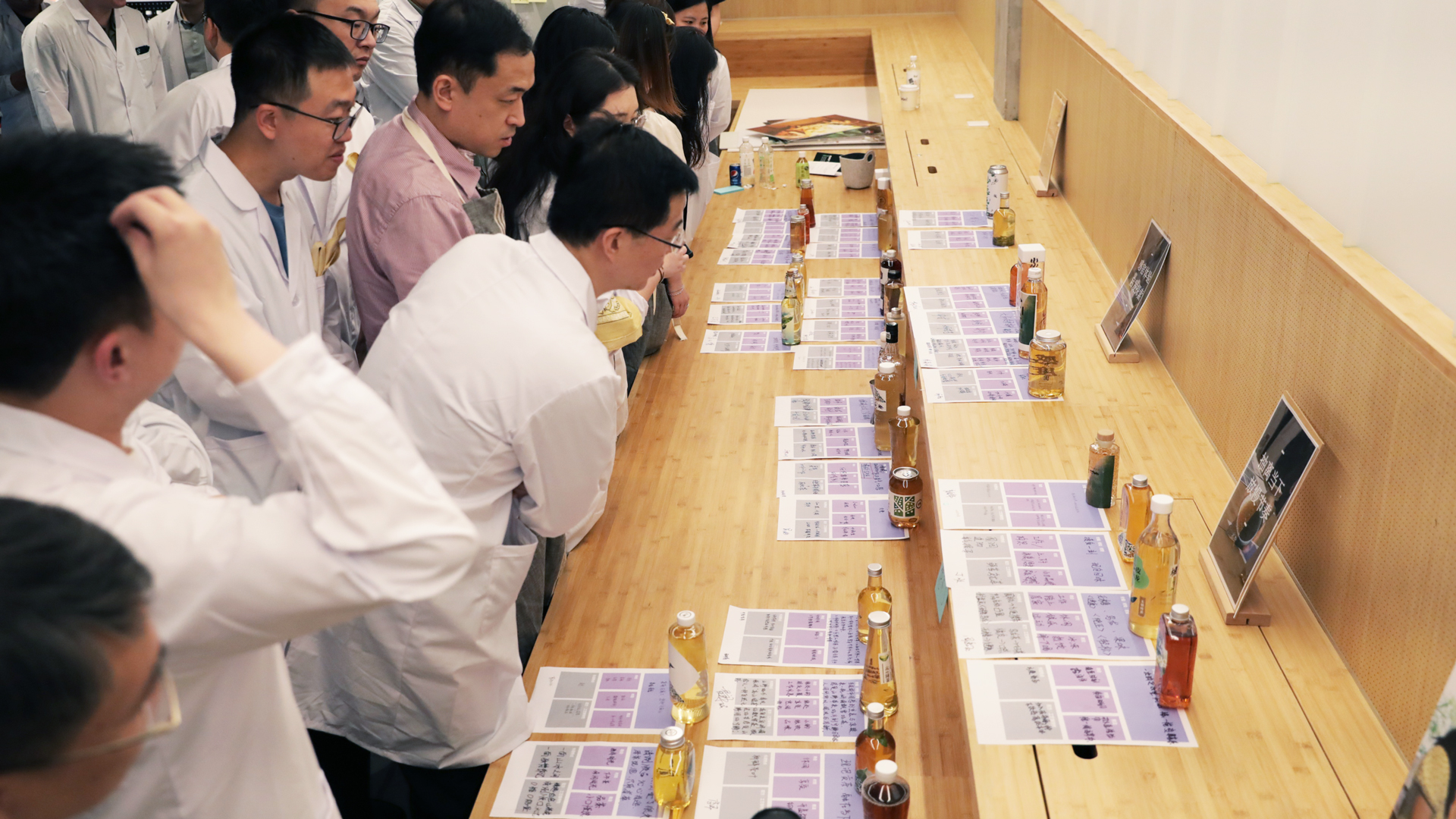
During research, the combined IDEO/Master Kong team took a two-pronged approach to uncovering new opportunities: industry exploration and consumer research. The team visited various tea-related businesses, from traditional tea houses to modern beverage shops, as well as “third place” tea spaces outside of home or work. They also conducted in-depth, in-home interviews with consumers with various levels of interest in tea, delving deeply into their daily routines to better understand their lifestyles and any emotional or functional needs related to tea.
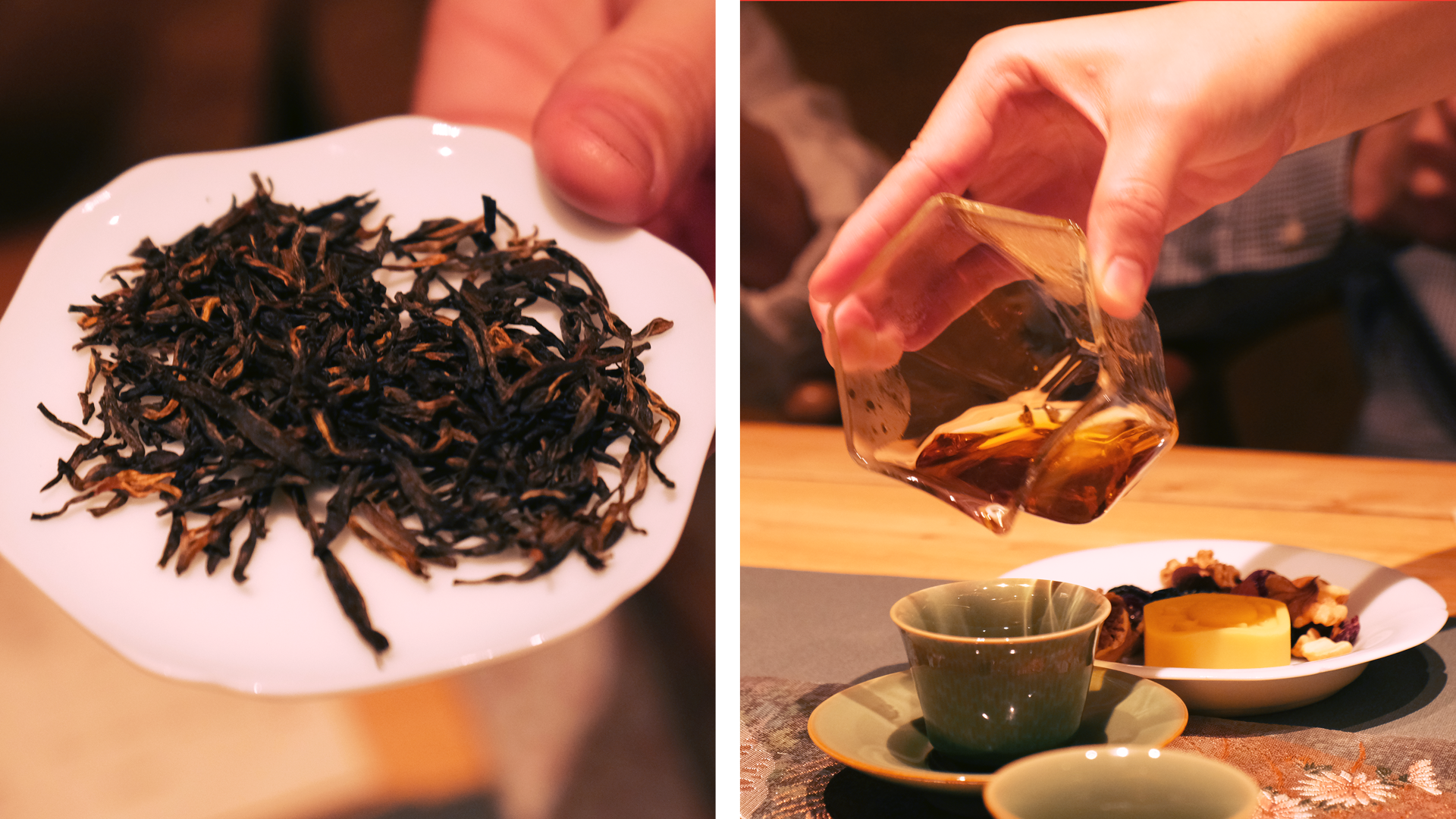
The team discovered that the essence of Chinese tea culture resonated with contemporary consumers’ longing for authenticity, simplicity, and physical rejuvenation in their fast-paced lives. This insight presented a unique opportunity for Master Kong. Instead of positioning its new sugar-free tea brand as merely a “healthy alternative” to other beverages, it could spark a meaningful connection to tea culture, seamlessly integrating into various moments of modern life.
Armed with this insight, IDEO designers and dozens of Master Kong beverage team members participated in a series of immersive, hands-on tea innovation workshops. Teams of experts from R&D, marketing, supply chain, and other company departments temporarily set aside their job titles to explore, iterate, and refine dozens of new tea concepts that were commercially viable, feasible for mass production, and aligned with consumer needs. The cross-departmental collaboration allowed for a broad mix of perspectives, experiences, and expertise, enriching the innovation process.

The co-creation sessions led to a new sugar-free tea product and flagship brand called Cha De Chuan Ren (“Descendants of the Tea”), which celebrates fine, origin-sourced tea and the passion and dedication of tea farmers. The novel concept resonated strongly with consumers and was validated during subsequent rounds of quantitative market testing, ensuring its relevance and market potential.
Cha De Chuan Ren launched with two signature flavors: Tieguanyin (green tea) from Fujian and Pu’er (black tea) from Yunnan. The unique mottled bottle design pays tribute to traditional handcrafted glass containers and the handiwork of tea farmers. The tactile paper label, which features Jia Ma-inspired woodblock illustrations of local tea fields and tea farmers’ hands, nods to the artisanal craft of tea making and the source of the tea inside.
“Descendants of the Tea” debuted on Tmall in April 2024. It claimed the top spot on the commerce site’s Tea Beverage V-List in August and September. Offline, it launched in FamilyMart convenience stores in May and has since expanded nationwide. The new brand received a 2024 Red Dot Award for “Brands & Communication Design.”
“We are honored to collaborate with IDEO, a global leader in innovation, as our strategic partner. ‘Descendants of the Tea’ is not just an exceptional product but also a tribute to the rich heritage of tea culture. Only by continuously integrating culinary traditions with innovation can we sustainably meet consumers’ true needs.”
Richard Chen
CEO, Master Kong (Tingyi Holding Corporation)
“Innovation is incredibly fragile. If even one leader is unsupportive or hesitant, the culture of innovation can collapse. I always encourage my team to take risks, as long as they’re not high stakes. After all, what’s the worst that can happen? At the very least, we’ll have a fair chance at creating something new.”
Wei Hong-Chen
Chairman of Master Kong Beverage Holdings Co., Ltd.
Sugary bottled teas were once very popular in China. Today, rising consumer demand for healthier beverage options has expanded the market for sugar-free tea.
#1
on Tmall’s Tea Beverage V-List, August- September 2024
2024 Red Dot Award Winner
for Brands & Communication Design
A luxury water bottle takes precision engineering to the extreme
Elevating the everyday with next-level design.
Twenty years ago, carrying a single-use plastic water bottle was a status symbol—no more. Growing awareness of the negative environmental impact of plastic pollution, combined with the adoption of healthier lifestyles and social media influencer trends, has made reusable water bottles “it” accessories for on-the-go consumers. While brands such as Stanley, Yeti, S’well, and Hydro Flask own the under-$100 market, fashion brands such as Louis Vuitton, Chanel, Dior, and Prada have etched out a new and growing market for high-end bottles that appeal to discerning, trend-conscious young people looking to perfect their hydration habits.
Spotting an opportunity to disrupt the predominantly utilitarian water bottle market, Steinmann partnered closely with IDEO, tasking the team with developing an industrial design that perfected the tactile and sensory user experience, from drinking and carrying to disassembling and cleaning thoroughly. The collaboration deepened over time, with Steinmann and IDEO working together to develop the high-level engineering concept, the OKAPA logo mark, and packaging ideas.
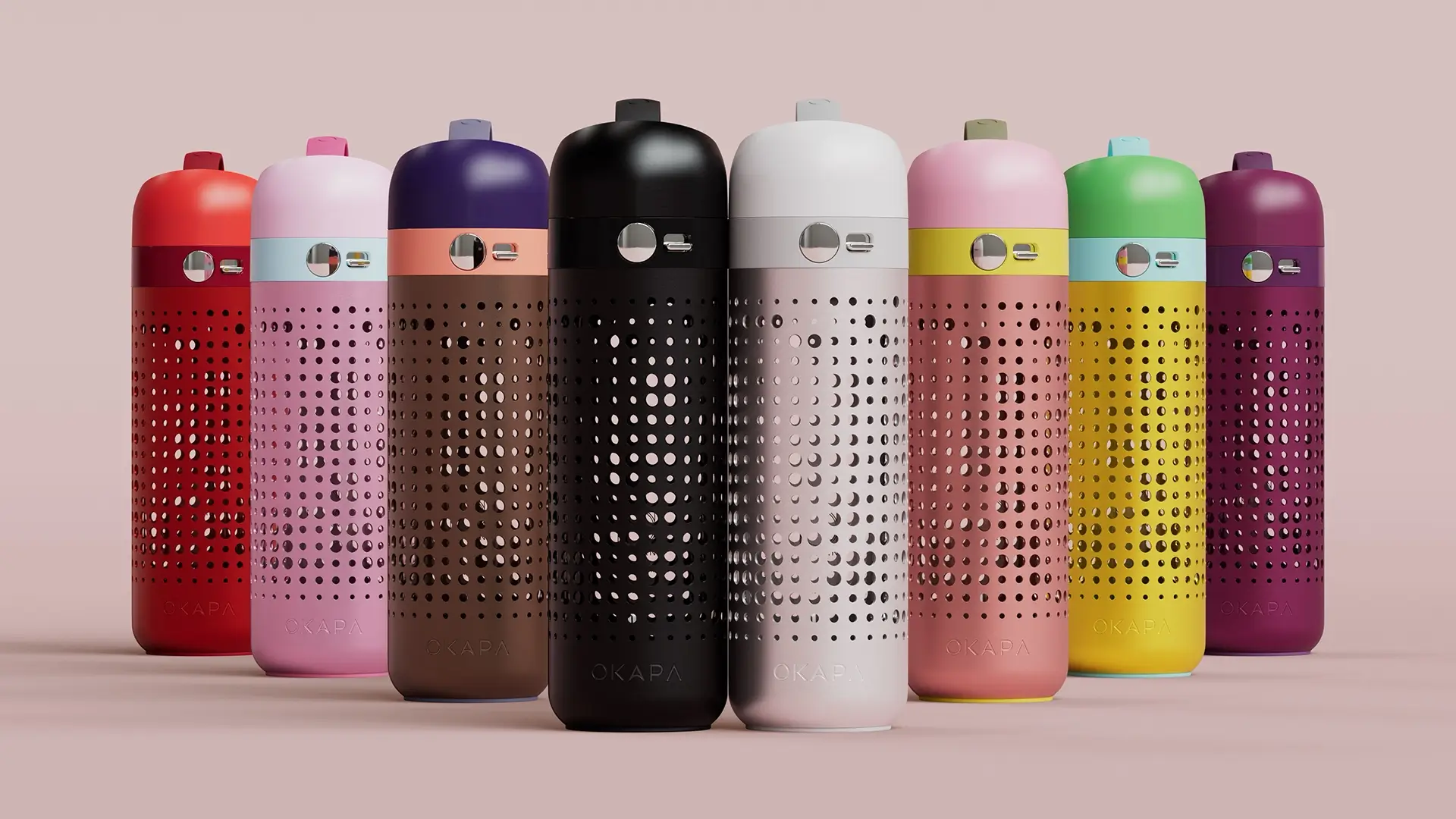
Key user-centered features of the OKAPA bottle include a medical-grade German borosilicate glass interior for superior taste of hot or cold beverages with no lingering odors; a Swiss-engineered thermoplastic lockable and leak-proof tilt cap that can be easily operated with one hand when driving or doing other activities; and an ergonomically shaped mouthpiece for a pleasurable drinking experience. Precision-engineered for maximum longevity, the inner glass bottle is suspended via a shock-absorbing system inside a bead-blasted, extruded, and anodized aluminum outer shell. Eight modular parts come apart easily for either a quick or thorough cleaning.

At its core, the OKAPA bottle elevates an everyday ritual through meticulous design and uncompromising engineering. Launched in January 2025, the new bottles are available in eight contemporary colorways curated by renowned color and materials specialist Beatrice Santiccioli (BSD), including Misti Pinku, Goldie Samba, and Fetishe Noir, among others.
In the US, the reusable water bottle market is estimated to increase from $10.2B in 2024 to $14.1B by 2031, with 69 percent of Gen Zers owning at least one. Customization trends, such as personalized design and branding, are anticipated to boost the market, ripe territory for disruptive startups such as OKAPA. (Persistence Market Research)
Once a practical accessory for hikers and outdoor enthusiasts, reusable water bottles have gone mainstream. Yet none check all the boxes in terms of purity of taste, hygiene, durability, functionality, and beauty.
8
modular pieces ensure hygienic cleaning is quick and easy
100%
recyclable materials in each bottle
Brand as a conservation strategy
The Cornell Lab of Ornithology unites as “One Lab,” galvanizing a conservation movement.
The Cornell Lab of Ornithology’s mission is to interpret and conserve the earth’s biological diversity through research, education, and citizen science. Over its 110-plus-year history, its offerings grew to include everything from a quarterly magazine, popular websites and apps with millions of users (Merlin, eBird), partnerships with outside organizations, and the world’s largest database of photographs and audio recordings of birds. This abundance is a testament to the passionate enthusiasm of its employees. Still, it confused potential members and led to siloed internal efforts, preventing the Lab from advancing its urgent collective vision. “Birds and biodiversity are in peril,” said Executive Director Dr. Ian Owens. “We must take radical action with a coherent vision, united voice, and purpose.”
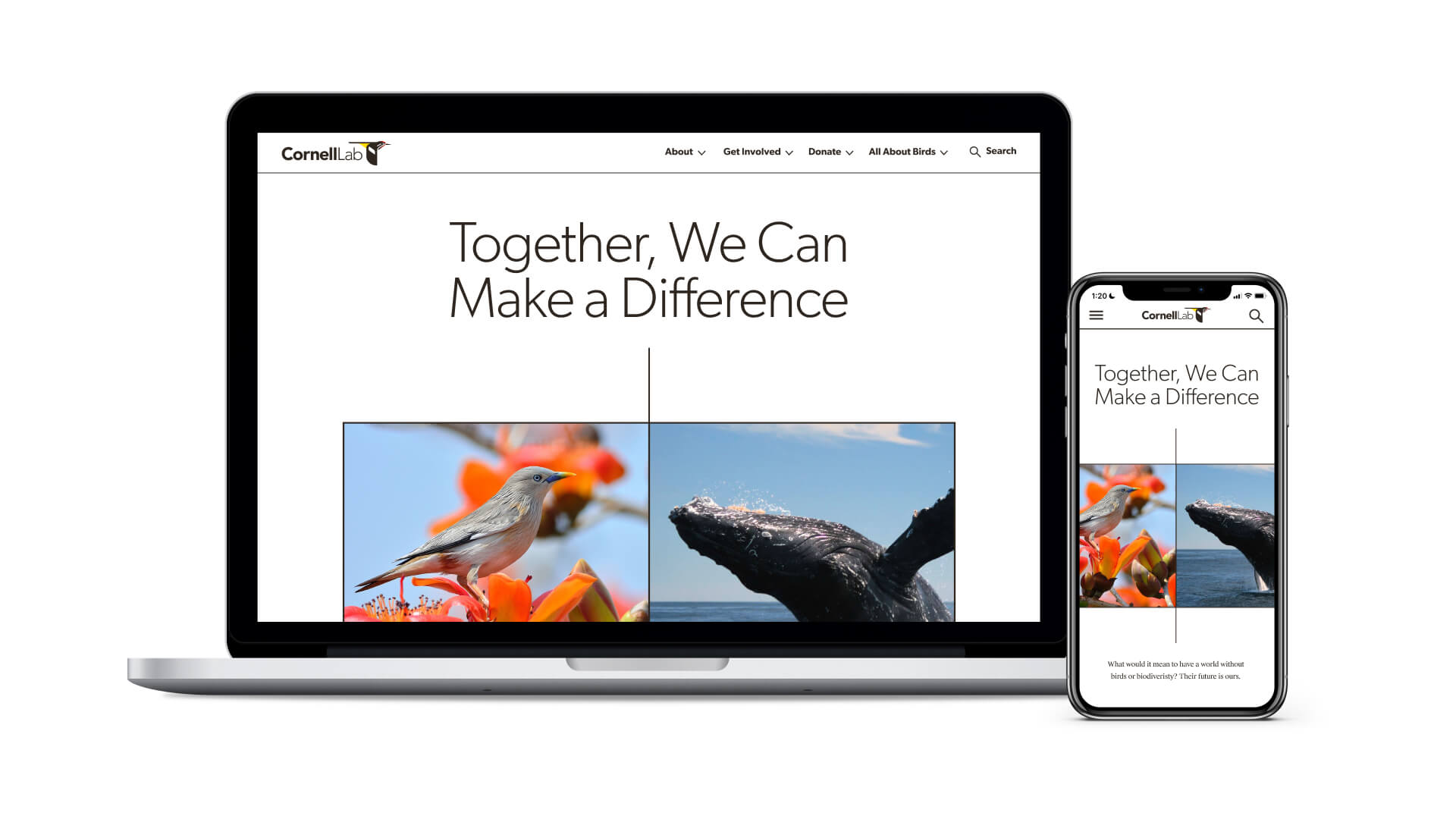
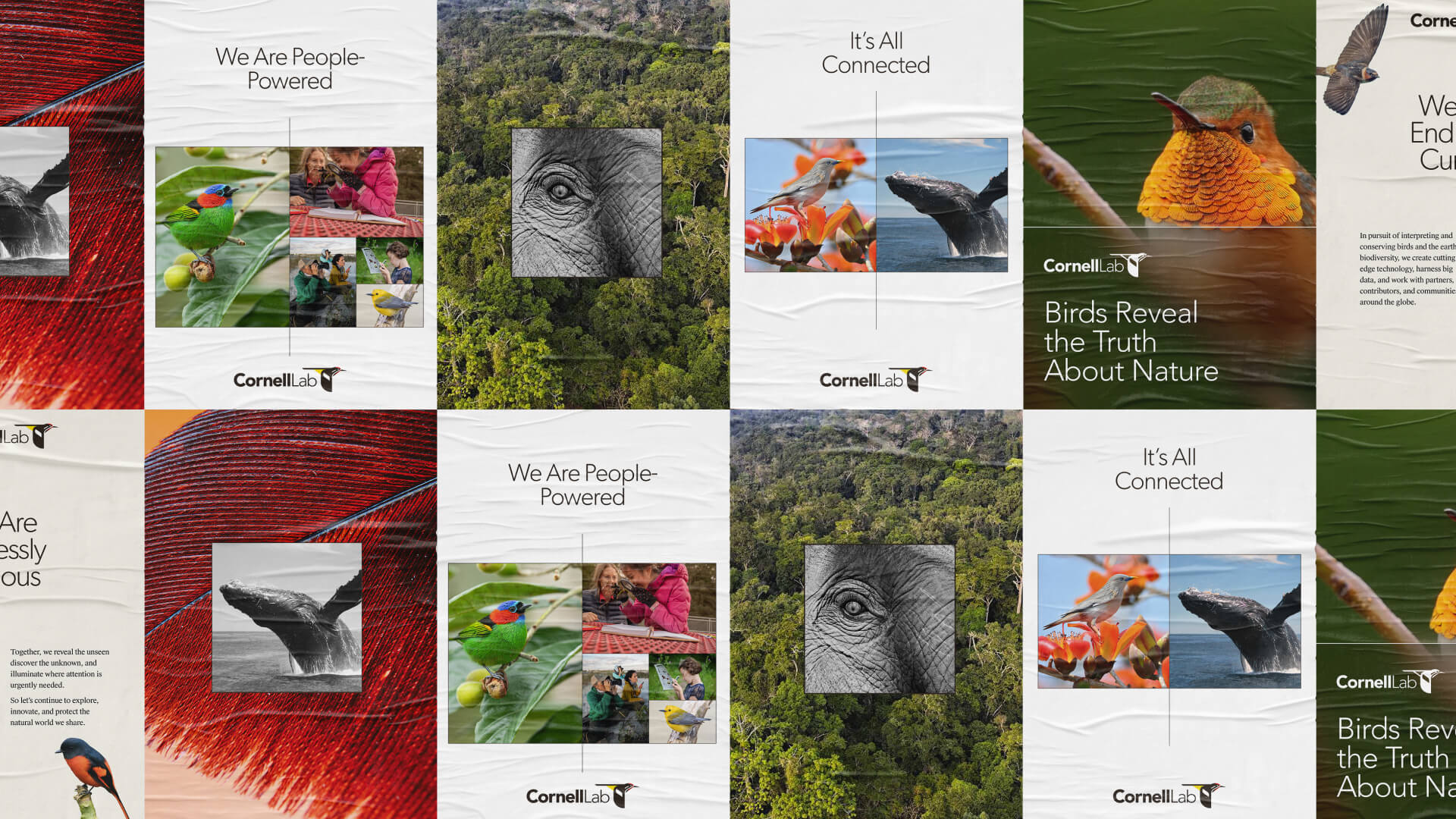
IDEO began by helping the Lab better define its audience. While primarily composed of people passionate about birds, IDEO discovered its larger audience was nature lovers interested in biodiversity, bioacoustics, conservation, and science. From there, IDEO created a brand strategy and architecture focused on helping the Lab streamline its efforts under the “One Lab” brand. The brand architecture visually articulated the relationship between Cornell University, the Cornell Lab of Ornithology, and the Lab’s many products and offerings. IDEO designed a comprehensive brand identity system to work across mediums, including a simplified logo system, new colors, type, graphic language, voice and tone, and key messaging.
When the Lab’s design team began implementing the new branding elements across its website and many digital products, it became clear that the organization also needed IDEO’s help in creating tools to facilitate cross-department collaboration. To better understand the day-to-day nuances of the organization, IDEO designers worked out of the Lab, co-creating a brand activation playbook. The playbook, launched in 2023, contains recommendations for new cross-functional working groups (partnerships, visual identity, and brand voice), as well as exercises and interactive tools designed to build trusting relationships, gain alignment, foster collaboration, and manage change at scale.
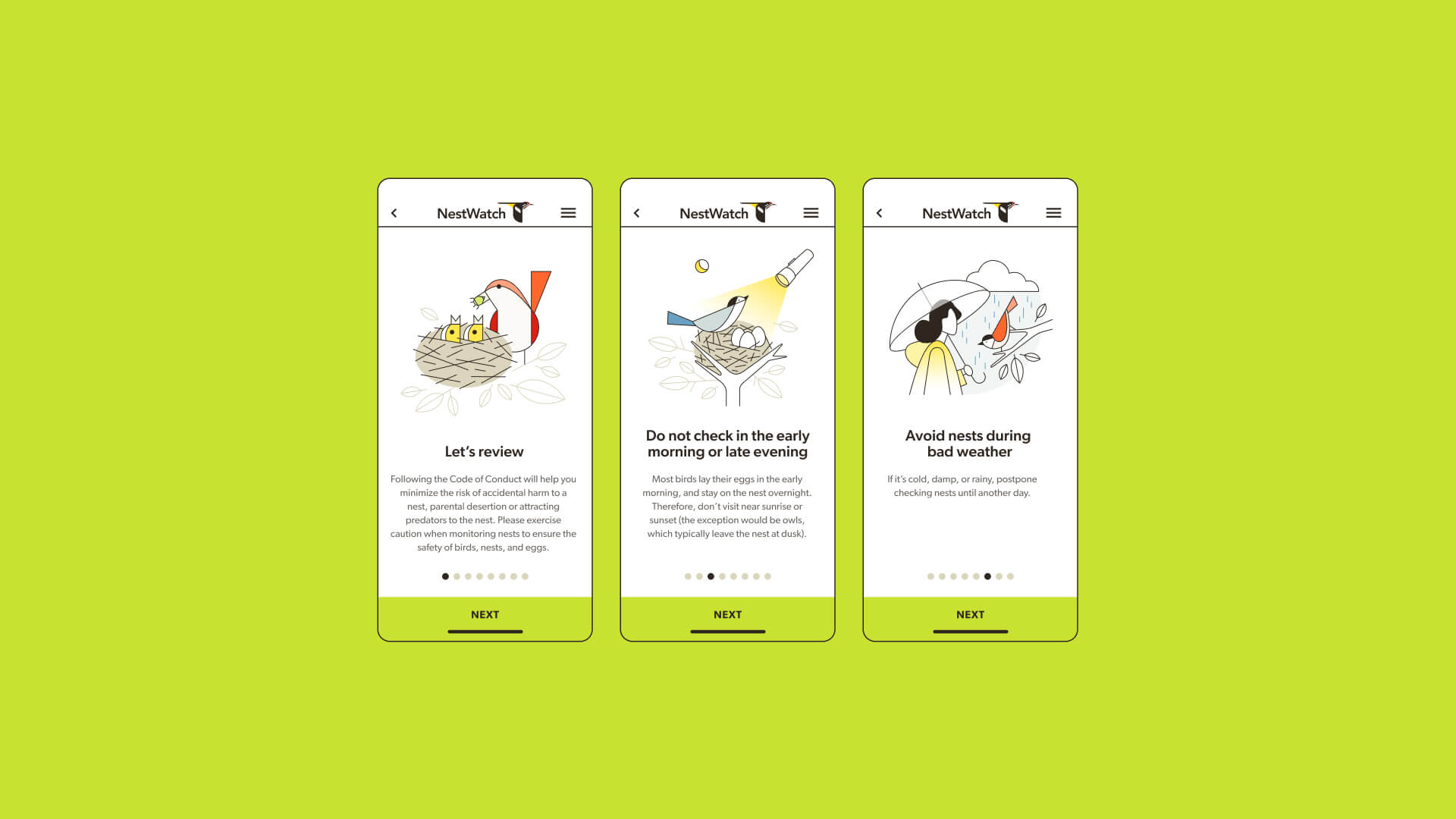
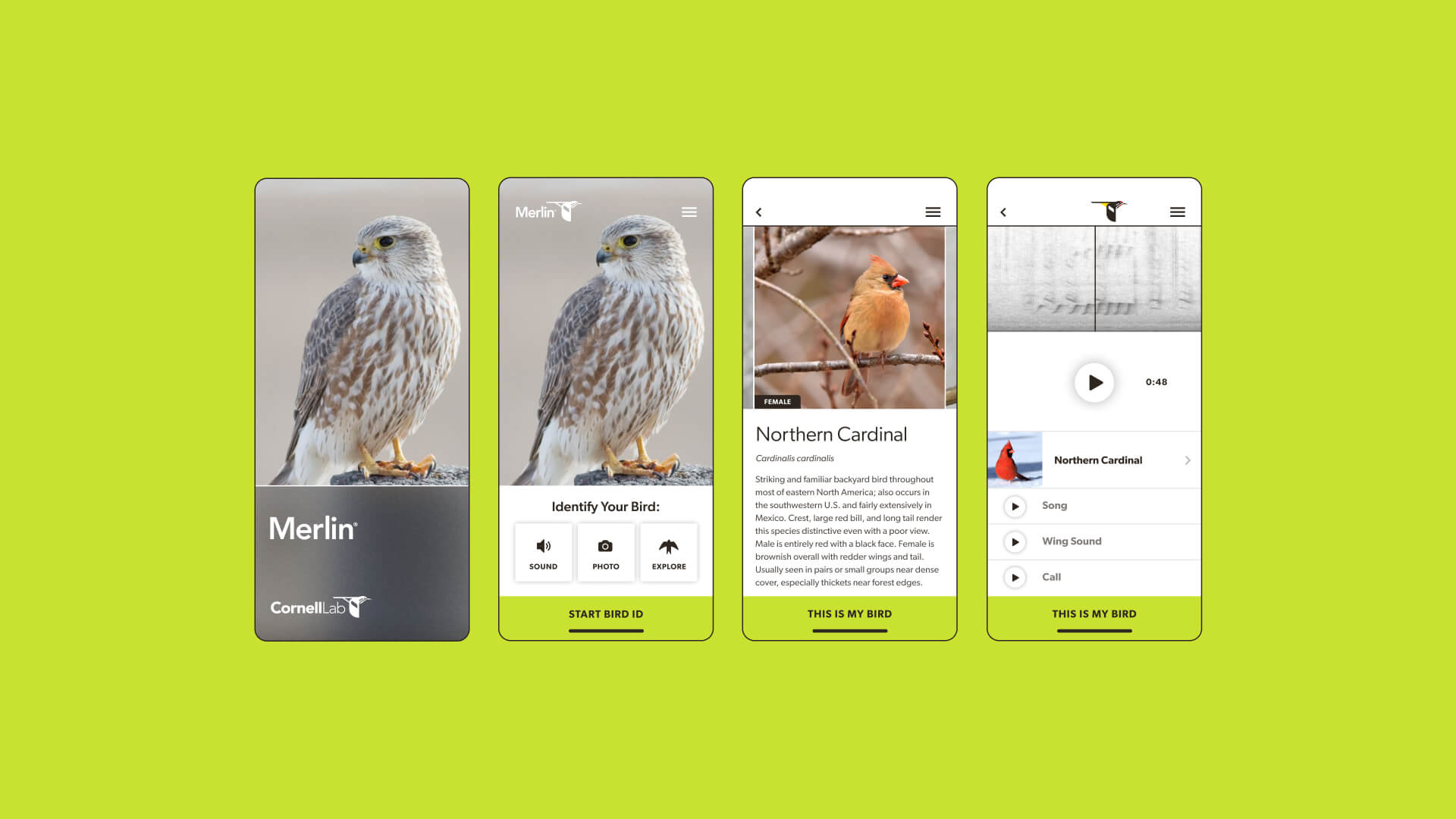
Post-collaboration, the Lab has applied the new brand across its website, apps including Merlin and eBird, Living Bird magazine, email and newsletter templates, and its line of merchandise. A new internal brand guidelines site has become central to employee onboarding, while new working groups are helping to bring down barriers between teams and spur collective action. Like a flock of birds, the Lab now sings one collective song.
The Cornell Lab’s 300+ scientists, professors, staff, and students were passionately dedicated to their individual team’s unique conservation projects, but segmented internal systems could stymie their collective impact.
1 brand
unifying 300+ employees and 8 departments

Charting a bold educational future
Ascend Public Charter Schools designs a “grown-up” vision for its young educational network.
Founded in 2008, Ascend Public Charter Network prides itself on providing “rich, joyful learning experiences that unlock lives of boundless choice” for its students, 93 percent of whom identify as Black or Latinx. The organization is also proud of being Black-led: 78 percent of staff and 80 percent of the executive team are people of color. Using co-design and joy, IDEO held a mirror up to Ascend’s core optimistic spirit during a moment of anxiety and change, helping its new CEO, staff, students, and parents reflect a dynamic, collectively imagined vision.
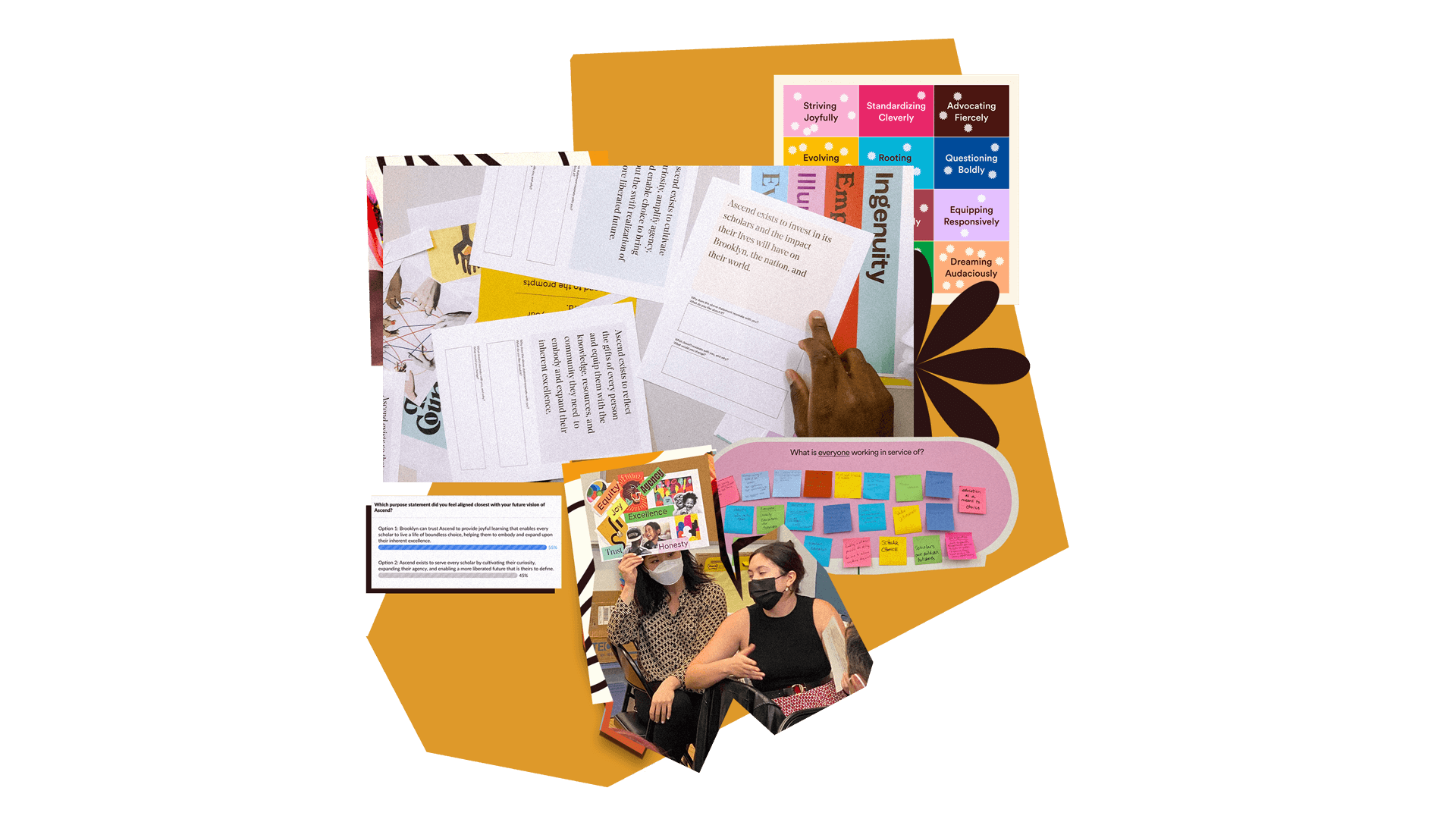
While the project’s goal was serious, the combined team centered the collaboration on bringing back fun, beauty, and imagination to those who could use it most: educators. Through engaging interactive activities, the IDEO team invited principals, PTA members, student council representatives, and board members to join “organizationally sanctioned play” moments like creating collaged vision boards and writing poems about Ascend’s impact. These interventions helped burned-out educators escape the day-to-day tasks of running schools and dream expansively about Ascend’s future. The team also solicited written, visual, and audio stories, asking community members to describe Ascend at its very best.

Stitching together submissions from 551 students, 75 parents, and 16 staff members, the co-design sessions resulted in a powerful new purpose, mission, and values, as well as a vibrant visual language and activation tools to bring Ascend’s vision of a “dope,” “unapologetically Brooklyn” charter network to life. The joyful, eye-catching visuals are embedded throughout its 17 Brooklyn schools, staff recruiting and training materials, and digital presence.
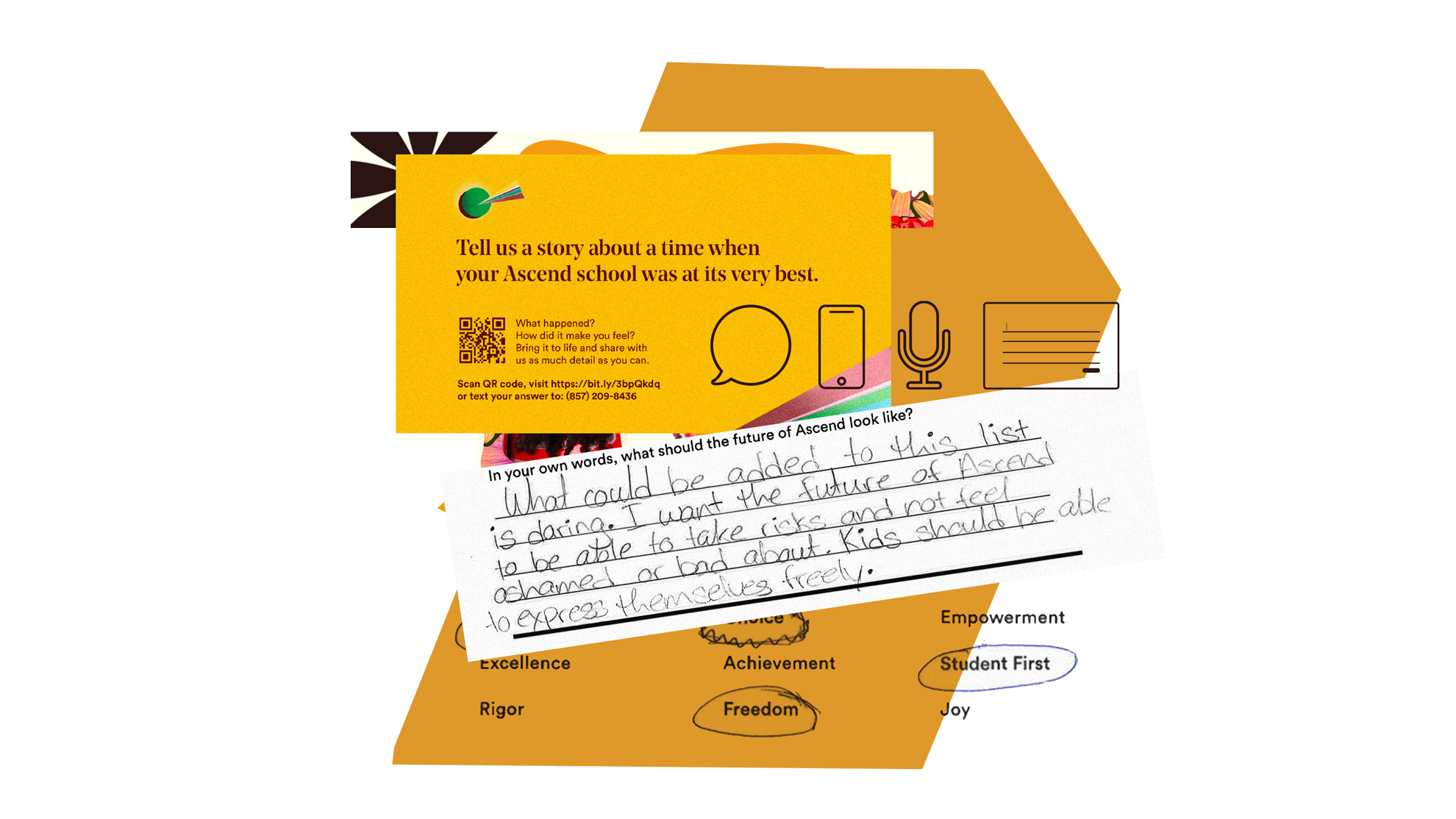
Shortly after the collaboration with IDEO, Ascend received an unsolicited $11 million donation from MacKenzie Scott's foundation, Yield Giving, the most significant gift the then-14-year-old institution had ever received. The pivotal funding will allow the organization, with its bold new “grown-up” vision, to focus on becoming the school of choice in Brooklyn by 2027.
In the summer of 2021, one in four K-12 teachers was ready to quit. Pandemic stressors and increased curriculum scrutiny were to blame, according to a 2021 Rand Survey.
In 2022, 44% of K-12 workers reported burnout, the most of any US professions the time, according to a Gallup Poll.
Pandemic exhaustion and leadership turnover left Ascend’s new CEO eager to align staff around an exciting new vision.
$11M grant
Ascend received an $11M grant from the MacKenzie Scott Foundation a few months after the collaboration
1 collective vision
to guide a network of 17 schools
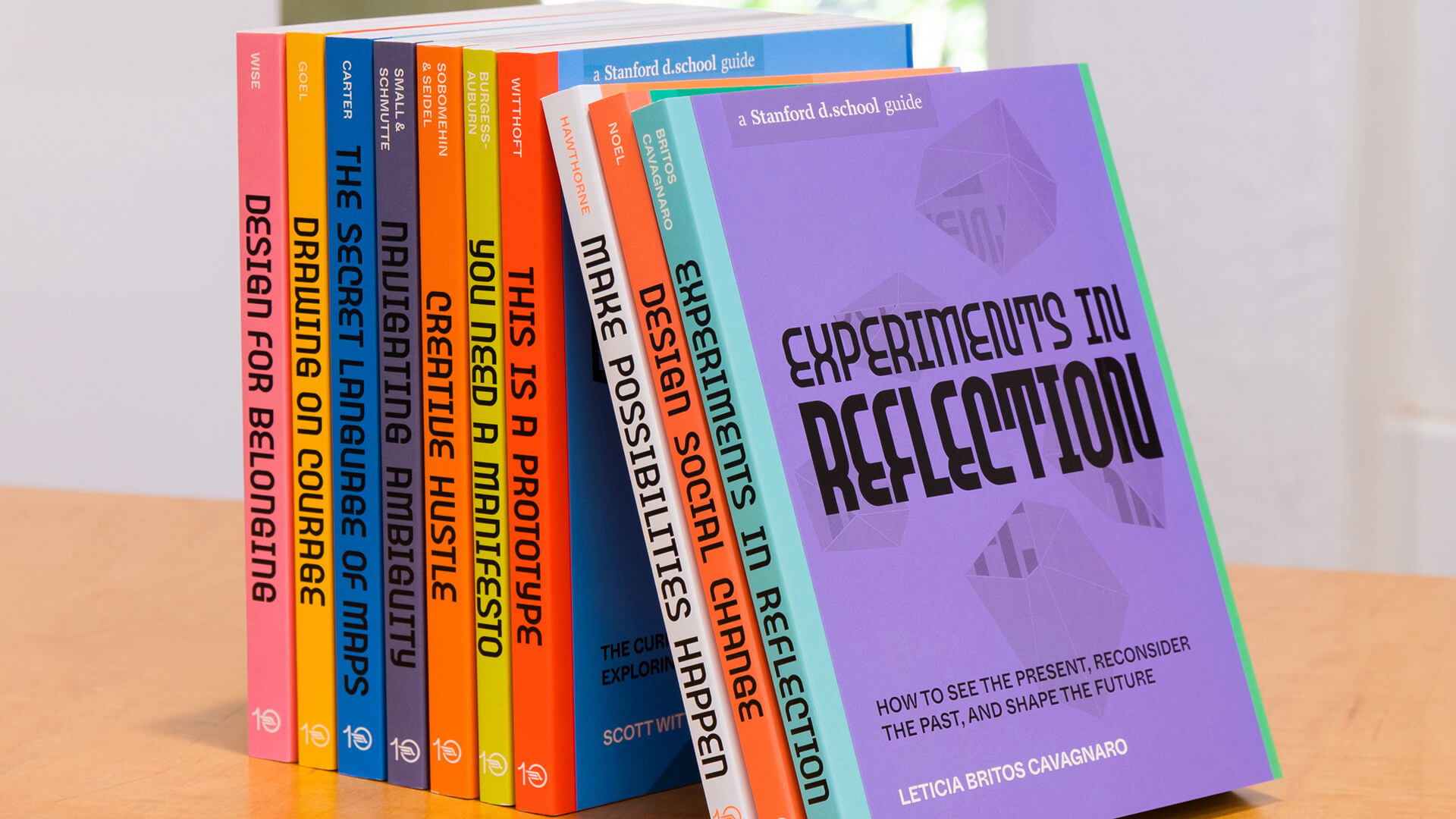
IDEO Founder David Kelley shares design lessons from the Stanford d.school
A new collection of guide books to help us peer into the collective future.
Founding Stanford’s Hasso Plattner Institute of Design, known to most as the d.school, was a big part of that. The goal of the d.school has always been to bring diverse disciplines together to solve problems, and to help people gain creative confidence.
But we’ve never wanted our methods and capabilities to be siloed within our walls. That’s why I’m so proud to share the collection of design guide books the d.school has published, written by colleagues and friends with whom I’ve had the opportunity to work and teach. To give you a sense of what you can find in them, I’ve asked the editors at IDEO to spotlight some of the things they particularly liked, so that we could have the pleasure of sharing them with the broader community. I am giving them as holiday gifts this year and our friends at Porchlight Books are offering a special discount if you want to do the same. Enjoy!
—David Kelley
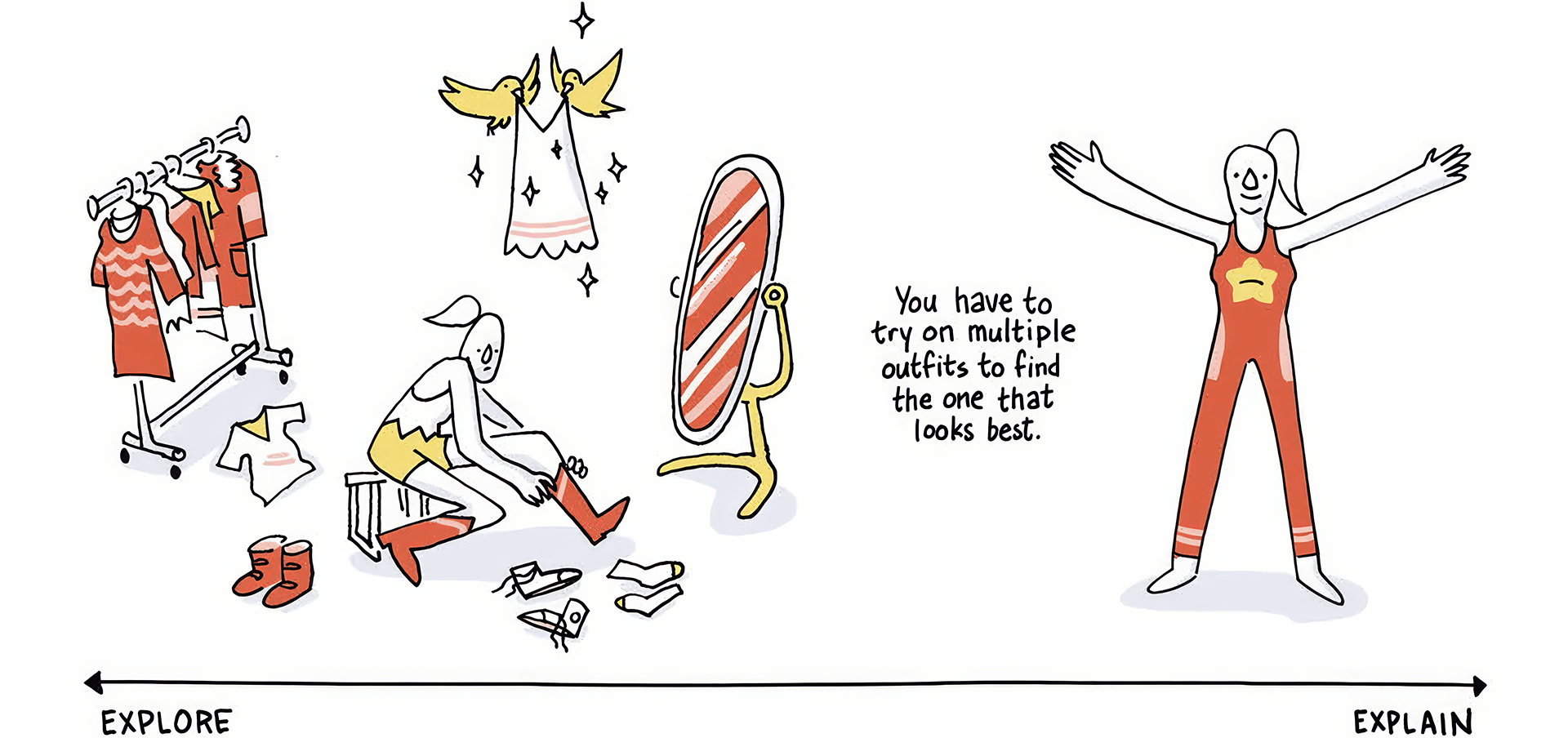
The Secret Language of Maps by Carissa Carter
Whatever you think this book might look like, get ready for a surprise. Instead of a dry how-to, Carissa Carter, the academic director at the d.school, opens her book with the first chapter of a murder mystery, using a set of clues to illustrate a lesson on the wide range of forms that maps can take. Cartographic formats, data exploration, and methods are woven in between the chapters, drawing on the clues and themes to not only help you solve the mystery, but also expand your definition and understanding of what maps can be, and how you can craft your own. More than a clever manual that is useful for anyone making maps or graphs, The Secret Language of Maps breaks ground on an entirely new genre of instructional storytelling.
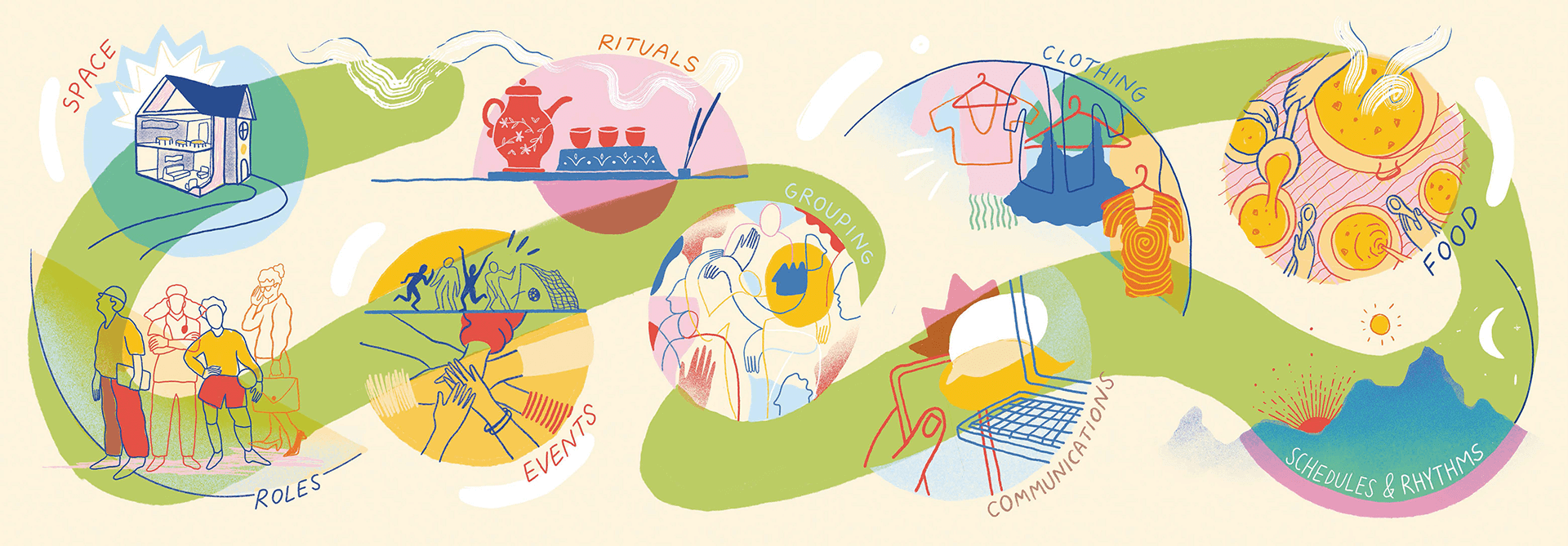
Design for Belonging by Susie Wise and Design Social Change by Lesley-Ann Noel
Together, these two books offer paths to help navigate building a more inclusive world.
Dr. Susie Wise, the founder and former director of the K12 Lab Network at the d.school, breaks down Design for Belonging into three chunks: the feeling of belonging, the moments during which belonging occurs, and the process of shaping your context so that belonging can emerge. The first chunk has exercises to help designers uncover what it really feels like to belong, while the second invites you to deconstruct belonging in your own life and the systems you dwell in—from the experience of entering a place of work to shopping in a grocery store, to how you share invitations with others. The final third details the design levers you can pull to engender inclusivity, from the spaces you meet in to the rituals and groupings you create—even what you choose to wear. “When people feel like they belong, they are able to be their best and do their best,” she writes.
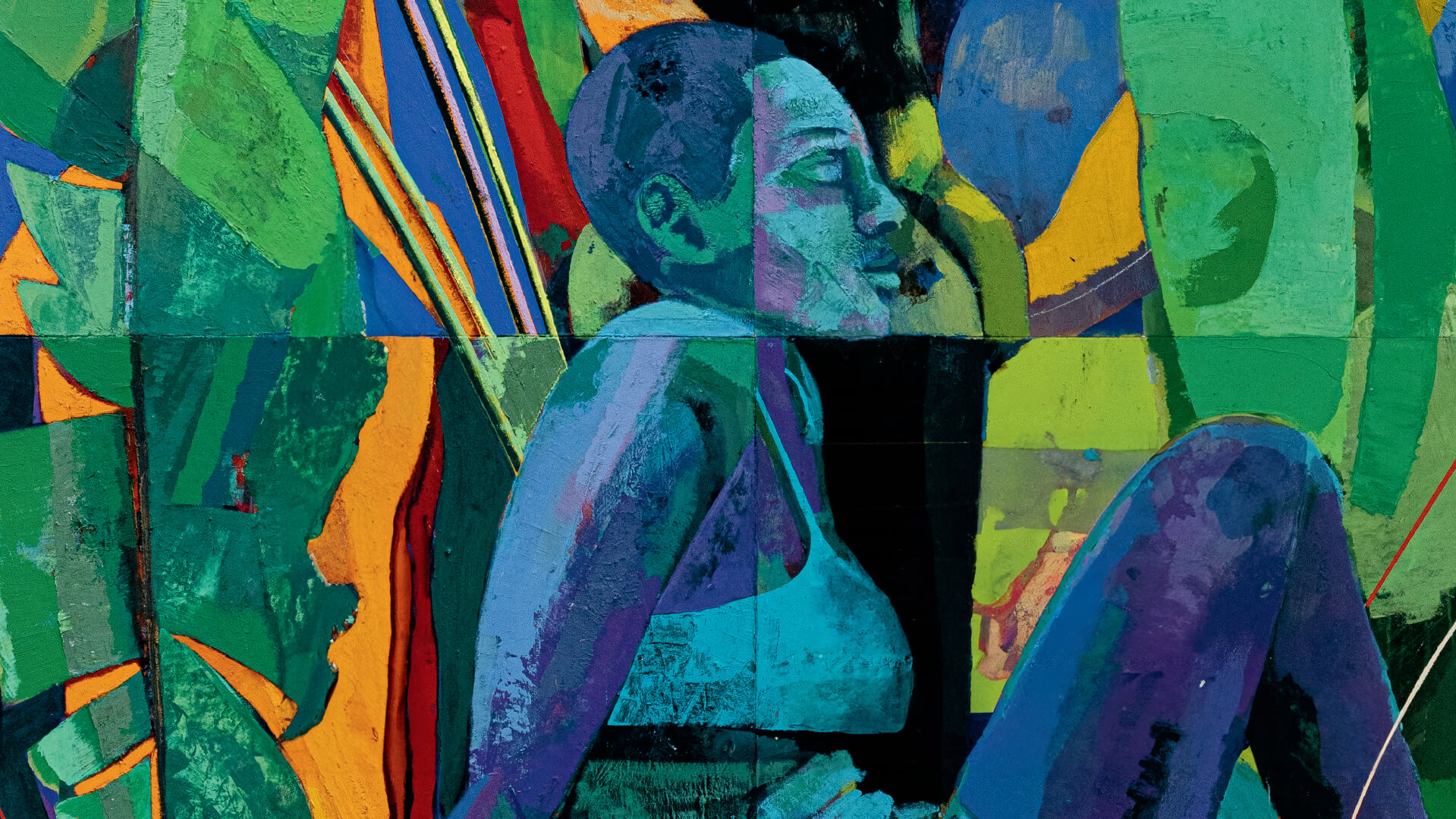
In Design Social Change, author Lesley-Ann Noel offers a roadmap for transforming social norms, structures, and behaviors. The book includes a process guide that lays out all the steps of social change, from building a team to generating ideas and refining prototypes, but also opportunities to look inward, raise critical awareness, and understand the different types of oppression in the world around you. The “Checklist for Equity in the Design Process” is a particularly useful tool for designers to check their assumptions, ensure that they’ve considered all the stakeholders, and think through the consequences of their designs, while “Strategies for Thriving in the Face of Hostility” offers helpful methods for anyone trying to dismantle systems of oppression.
You Need a Manifesto by Charlotte Burgess-Auburn
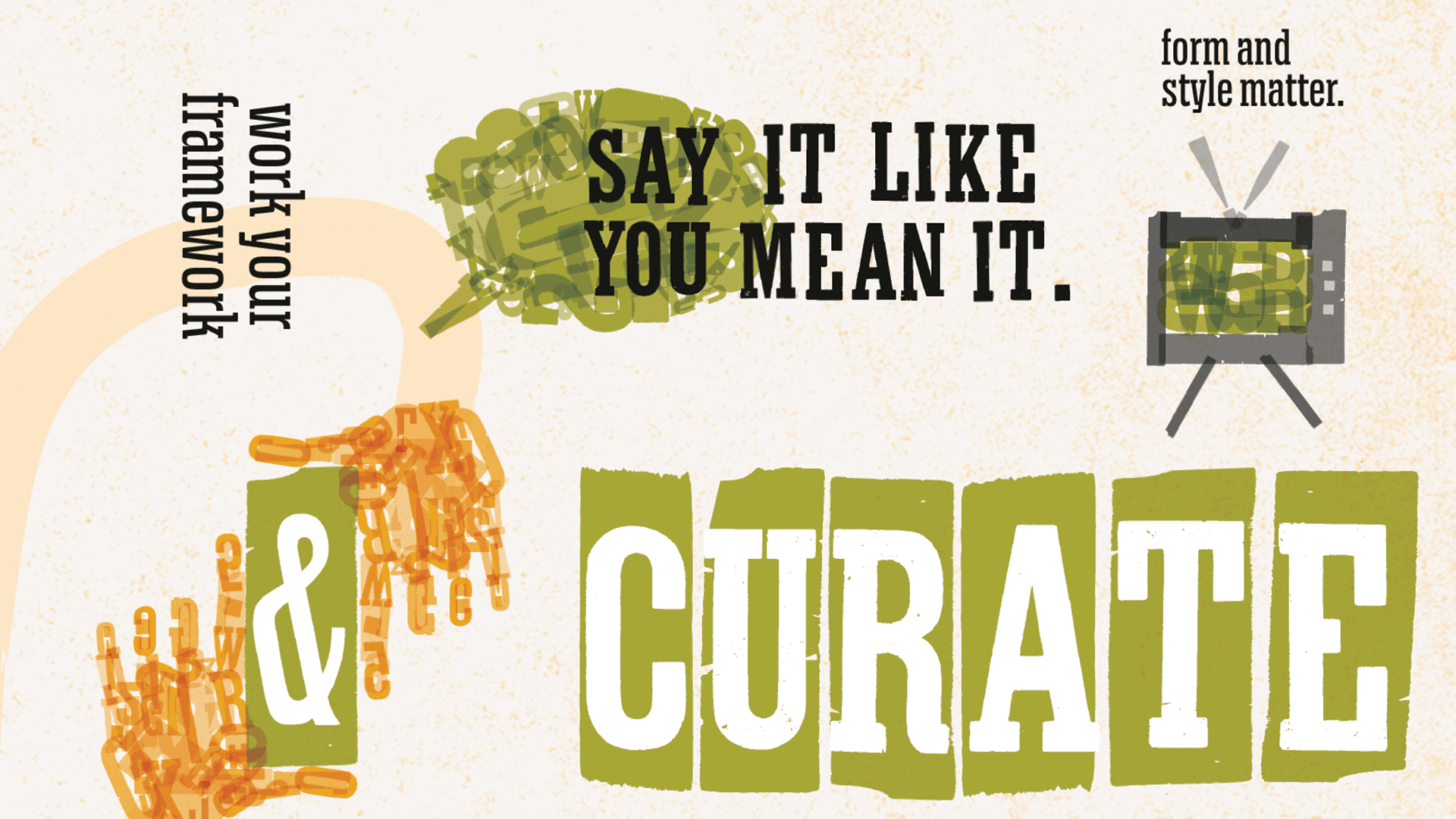
Why do you need a manifesto, you ask? “In this age, where it seems like everyone is being recruited by everyone else every moment of the day, you need a way to recruit yourself to your own cause, a method for collecting and considering your own power to create and to make positive change in a world that sorely needs it,” writes Charlotte Burgess-Auburn, director of community at the Stanford d.school. What follows is a guide to composing your own manifesto, with recommendations for sources of inspiration and wisdom, thoughts on 21st Century design ethics, and even how to spread the word. Figure out what to say yes and no to, and what you want to go after by following this helpful guide.
Make Possibilities Happen by Grace Hawthorne
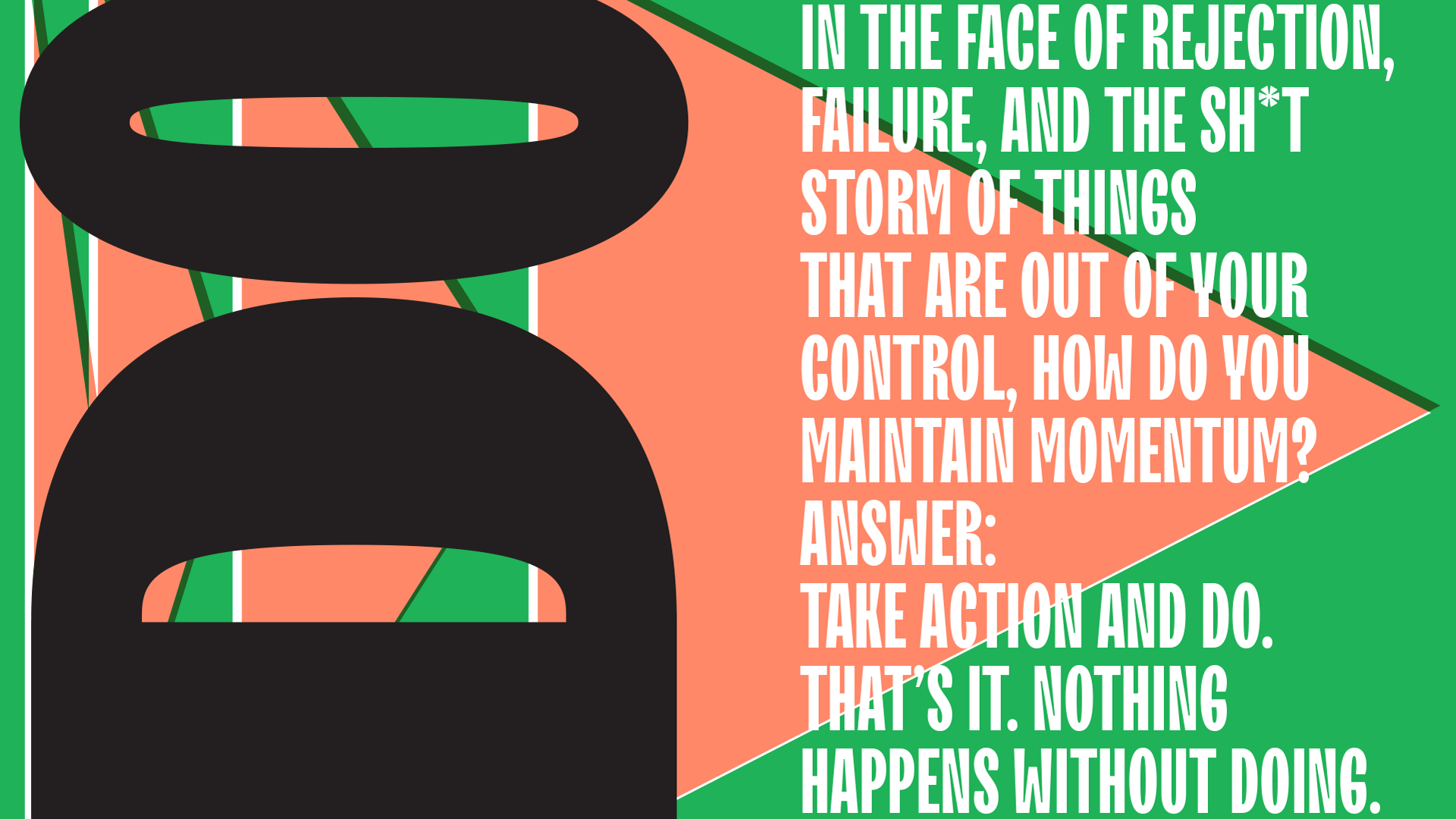
The first page of this book declares it an “operator’s manual for you and your wits!” That includes a long list of activities to help you activate your ideas and creativity, including Duchamp-inspired exercises and visualizations, a guide to focusing on the things in your project you can actually control, and help crafting a pitch of your idea. Both a kick in the pants and a hand to hold, this book is great for folks looking to get their creativity into the world.
The full collection also includes: Drawing on Courage by Ashish Goel; Navigating Ambiguity by Andrea Small and Kelly Schmutte; This Is a Prototype by Scott Witthoft; Creative Hustle by Olatunde Sobomehin and sam seidel; and Experiments in Reflection by Leticia Britos Cavagnaro.
At some point in my career, I shifted from being the guy designing the thing, to the guy building the stage for others to do the work.

Gift guide: IDEO’s favorite things for 2023
Our best ideas for the design-savvy on your list.

To make gifting a little easier, we’ve pulled together a list of IDEOers’ favorite things, from the best pens for drawing to our favorite pottery, and even a superior garbage can. We asked our Play Lab to weigh in on their favorite toys, too. So make your list, check it twice, and take a stroll through our 2023 Gift Guide.
FOR THE CRAFT
Pentel Sign Pens, $8 for a box of 12
Offering amazing ink flow with tips smaller than Sharpies, these pens are one of our designers’ favorite drawing tools.
Culture Hustle: Black 4.0, $49.99
According to the company, it’s the blackest black paint “in the known universe.”
Stanford d.school Book Collection, $128
We’re big fans of this collection of 10 design guide books, which is “designed to help you adapt to change, see things in new ways, work well with others, and peer into our collective future.” Give the whole set, or break them up—You Need a Manifesto is helpful for anyone navigating change, or running their own practice, while Design Social Change is a great guide to meeting the current moment.
Envisioning Emotional Epistemological Information by David Byrne, $98
EEEI not only shows that PowerPoint can be art, it contains one of our designers’ favorite definition of knowledge management
Manufactum Notebooks, $18
These are small enough to fit in a pocket, but with enough pages to last you for months.

FOR THE KIDS ON YOUR LIST
Magformers, $54
The fun, fidgety way these building blocks snap together makes them perfect for kids of all ages to build all sorts of things with—and of course, smash apart! Magna-Tiles may be more popular, but we prefer Magformers with their rounded edges.
Books from Ashay by the Bay
This black-owned bookstore specializes in African-American and multicultural kids books, from baby board books all the way up to novels written for teens. It’s based in Vallejo, California, but ships across the country and to Canada.
Bitzee, $25
This interactive Tamagotchi—like toy with a techie twist includes 15 cute little pets for kids to discover, nurture, evolve, and play with.
COOKEEZ MAKERY Cinnamon Treatz Oven, $51
Mix the ingredients into dough, mold it into a pet, pretend to bake it in the oven, and surprise! Out pops a plush pet. The trick here is finding it—it’s incredibly popular, and comes highly recommended by the Toy Lab.
Twister Air, $15
The one toy on our list that we helped make, Twister Air is an active, digital take on the classic game. Challenge your friends to move their hands and feet to the beat—or play solo! For an app-based game, it’s a great way to get moving.

FOR SOMETHING MORE PERSONAL
Block Shop Textiles, $145-$195
The Southern California textile, art, and design studio run by two sisters has such big fans at IDEO, we actually interviewed them to learn more about their craft. Gift ideas range from a bandana printing kit to beautifully patterned bathrobes.
Monastery Skincare, $48-$293
This brand is a big favorite in IDEO’s skincare lovers’ Slack channel. Fans love it for its beautiful, luxurious texture and scent.
Anecdote Candles, $26-34
An IDEO alum is behind these scented candles that also “spark a conversation.”
Casio Men's Casual Classic Digital Bracelet Watch, $22
Missing the features of a smart watch, sure, but this Casio is a classic favorite that won’t have your emails popping up on your wrist.
Concha Coin Purse, $7
A sweet gift with a sweeter price point, this coin purse would make a great stocking stuffer. But if you’re looking for something bigger, Chicago’s Mestiza focuses on Latinx artisanal products, and ships around the country.

FOR THE KITCHEN
Sichuan Chili Crisp, $17
At this point, Fly By Jing’s perfectly savory, spicy, crispy condiment needs no introduction from us, so consider this a gentle reminder that delicious gifts make the best gifts.
Yes, Chef Gift Box, $46
Thrill fans of The Bear with four of Oaktown Spice Shop’s favorites, vadouvan, urfa biber, umami sea salt, and kampot peppercorns. Bay Areans can visit the store in Oakland or Albany, but it ships across the country, too.
Kinto’s Travel Tumbler, $34
One IDEOer is a big fan of Kinto’s minimalist and refined design aesthetic, and the tumbler in particular, which has held up over the years with just a few dings and dents. “ As a product designer, you really can’t argue with any detail on those products,” he says.
Mill, $33-$45 per month
Composting. Great for the planet, not always great for the smell in our kitchens. Mill is something different, a bin that dehydrates and shrinks your food scraps, and a service that picks them up. One of our designers calls it “life-changing.”

FOR THE HOME
Herringbone Outdoor Scraper Door Mat, $31
This doormat is a serious defender of the cleanliness of your floors, and won’t cause a wood deck to discolor or rot.
Rubbermaid Defenders Step-On Trash Can, $217
If it’s good enough for infectious waste, hopefully it can handle whatever is going on at your house. One IDEOer recommends these garbage cans for their clean, classic lines, robust construction that can handle kids and dogs, and their ability to contain smells.
Daxue Folding Garden Lounge Chairs, $265 for two
Folding chairs aren’t known for their looks, but these wooden numbers have an attractive design, don’t hold water, and are easy for kids to climb on.
East Fork Pottery, $40-$94
The Asheville, N.C.-based ceramics company makes pottery with clays from the American Southeast, crafting everything from mugs and plates to vessels that hold candles. Check out gifts under $100, like a four-pack of bowls in panna cotta, or a mug in Henri’s red.

FOR SOMETHING DIFFERENT
AI Against Humanity, $40
Made by a former IDEOer, this dystopian take on Cards Against Humanity puts the future of the world in your hands. It comes complete with 200 cards of technological turmoil and venture capitalist wild cards. “Get ready for a dystopian deck where Silicon Valley fantasy gets a reality-check.”
Session Bong, $185
IDEO alum Vinh Pho’s Session Goods has created award-winning glass bongs and other smoking essentials for the well-curated home.
Actually Curious Cards, $25
The original version is less a party game than a deck of cards with questions that are designed to spark conversations that help people get to know each other better. Want something more light-hearted? Go for the Happy Hour edition.
Pluto Pillow, $160
Part travel pillow, part sensory deprivation tank, this product IDEO helped design will get you to your destination as well rested as anyone on a plane can be.
Wondering what to get the design-obsessed in your life this holiday season? We’ve been there.
We tried to build a health venture With ChatGPT
What worked—and what didn’t—in the process.
To answer that question, we teamed up with Healthworx Studio to run an intensive five-week sprint and design a business that would address issues of access in rural health, leaning on AI to supercharge the process.
We kicked off with a lot of questions: Could we produce more rigorous, higher-quality results if we used gen AI tools to augment our team? Would it come up with innovative ideas for how to make healthcare more equitable? Could we get further faster? The answer was yes—with a lot of caveats. (For a deep dive into our approach, principles, and learnings, check out our Designing with AI Report.)
It quickly became clear that while Gen AI tools can’t replace human ingenuity, they certainly fuel it. When it came to generating solutions to a problem this complex, AI had very little to offer in comparison to human teammates. But it did help us innovate much faster and with more depth, bringing us up to speed on initial stakeholder context and synthesizing and incorporating datasets —crucial parts of the process that can take a lot of time. Here’s where we succeeded and failed, and what that taught us about using AI going forward.

Opening the aperture
Did a machine just listen to dozens of podcasts, summarize them, and give us themes in an hour? Yes it did. Thanks to tools like Preplexity.ai, which enables social listening on platforms like Reddit, we were able to quickly synthesize diverse perspectives from varied sources and distill themes that seamlessly integrated into our research process.
Working with these tools feels like being bitten by a radioactive spider and gaining a suite of superpowers. We can rapidly develop contextual awareness of numerous stakeholders and their pain points in relation to the challenges we aim to address. With our lens widened, the questions we asked became more pointed and the concepts we designed more crisp. “The AI enables efficient pattern matching across massive datasets, unlocking value from information that was previously siloed or inaccessible,” explains Jaime Goff, Product Design Lead at Healthworx Studio. “By leveraging these capabilities, we can incorporate a breadth of knowledge beyond what our team could internalize before. It really expands what we can achieve by connecting us to data in new ways.”

The importance of coming together
But as our use of AI tools increased, there were unexpected sandtraps, too. For one, we noticed a steep decline in the quality of our team interactions. We thought that getting an AI boost would be “like having an extra designer in the room with us.” But the reality was we each retreated into our corners with our own AI assistant, forging ahead with new ideas. When it was time to reconvene, we were on wildly divergent tracks, and re-aligning to move forward as a team was an enormous undertaking.
Another caveat: While generative AI tools helped us gather new forms of data, it was still critical to hear directly from the people who would be using these solutions.
Nicole lives on a ranch the size of the City of San Francisco. After her husband broke his leg in a freak accident, she had to make a harrowing journey, traveling two hours to the nearest hospital. Stories like Nicole’s taught us a lot about what it’s actually like to access healthcare in rural areas, and the resilience it requires. It was the people we spoke with who brought nuance to the problem our team was trying to solve, inspiring our most critical insights and building confidence in our concepts. As much as we tried, we could not find an artificial substitute that could come close.
It was the people we spoke with who brought nuance to the problem our team was trying to solve, inspiring our most critical insights and building confidence in our concepts. As much as we tried, we could not find an artificial substitute that could come close.
Smelling the AI B.S.
When reviewing a few AI-generated venture concepts with the Healthworx team, the room fell silent. The concepts were all variations of the same idea, repeated and rehashed. “Generative AI can rapidly spin up concepts that seem good enough at first glance,” Goff says. “But when you scrutinize them, the limitations become obvious.” Even after extensive prompting with our AI co-pilots, we were still back to the same place, with a bunch of repetitive concepts.
But when the team mined our own insights, we were able to find a truly compelling venture idea.
Late into the night, when the team was riffing, we shifted our approach from working alongside AI to guiding it. We had ChatGPT review and improve on its own ideas, asking it to strengthen the overall concept as it went. The tool acted like jet fuel, helping us add rigor and build out the venture, ultimately producing a successful pitch presentation that included high-fidelity mockups, early working AI prototypes, and an in-depth pitch deck.

Supercharging our process
We’re in the caveman era of generative AI, and there are plenty of unintended consequences to be concerned about. But we’re optimistic about how a human-AI partnership that leverages human creativity and nuanced subject matter expertise alongside AI tools allows us to quickly outsource parts of the process, add rigor, and iterate faster, supercharging design and innovation.
And while the AI hype is founded, its limitations, which became patently clear in the ways it addressed a complex challenge like rural healthcare, made us appreciate how important humans are to this equation. Goff says it best: “This project showed the value of individuals bringing their unique brains and nuance to the table to work alongside AI. Our minds provide the spark that drives real progress.”
For those who crave the details, learn more about our approach, principles, and experiments with our transformative collaboration with Healthworx Studio here or reach out to ai@ideo.com
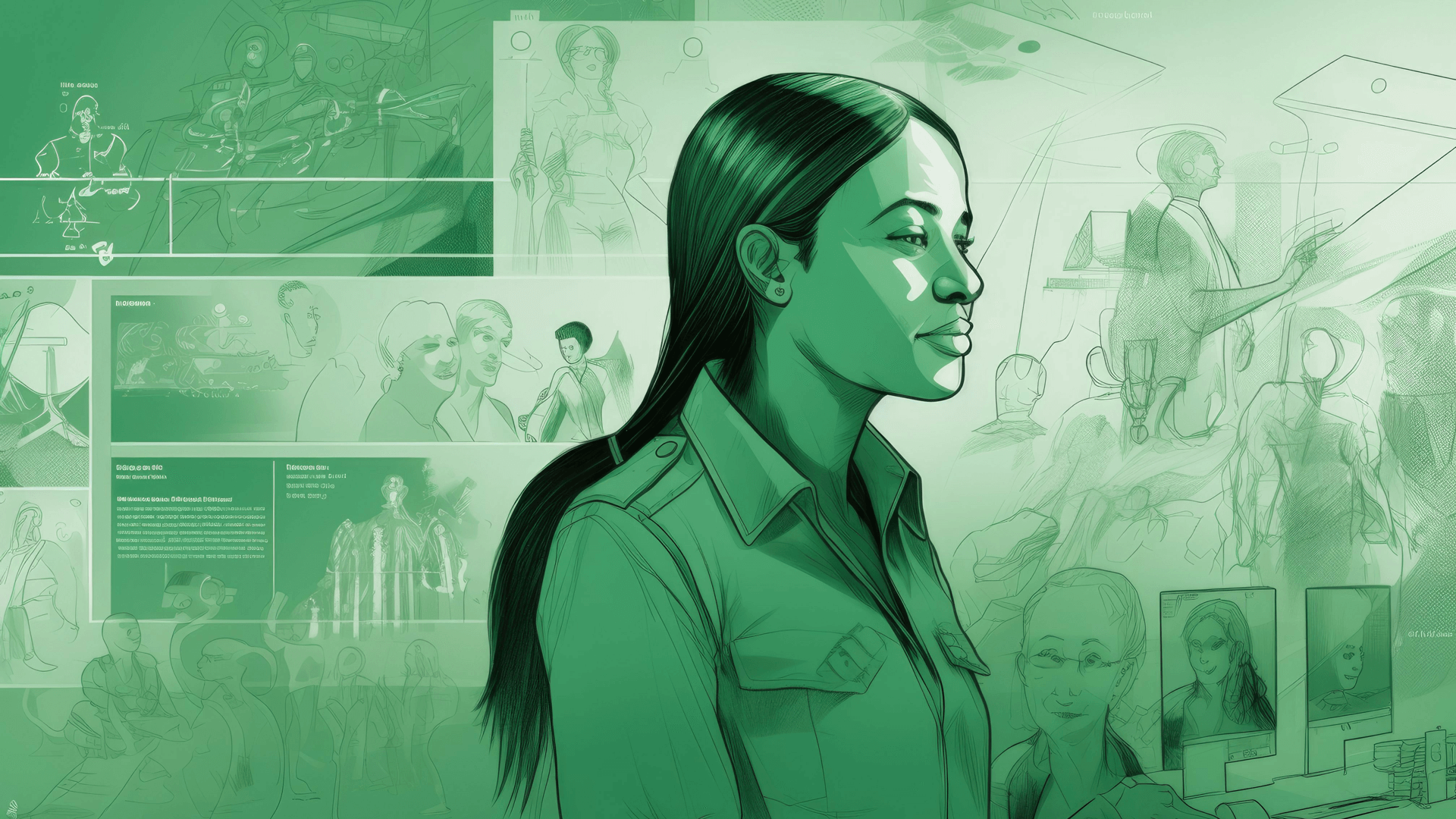
Visuals created with Midjourney.
Healthcare has a lot of big problems to solve. Could AI help?

Can failure be and feel productive?
It doesn’t pay to cling to a bad idea.
At a recent business roundtable, the topic was how to set product innovation up for success. I spend the bulk of my days helping organizations stretch to tackle business challenges by coming up with breakthrough ideas, so it might seem sacrilegious to allow those ideas to fail. But since that breakfast, I found myself scrutinizing not only what failure looks like, but also how it feels.
There’s a saying that’s usually applied to writing: “Kill your darlings.” It’s a nudge to let go of a much-chewed-over clever phrase that doesn’t help the overall story.
We use the saying at IDEO, too. But our “darlings” are hypotheses or “sacrificial concepts” that we quickly put to the test and are willing to abandon. Iteration is the lifeblood of the design process—and the magic of it is that it allows for what Harvard Business School professor Amy Edmondson calls “productive failure.”
When companies face business challenges that require innovation, the instinct is to look for and land on a solution and sell it internally, so you secure permission to move forward. And what if the path you’ve chosen doesn’t pan out? We have a natural instinct to persist: The company has allocated money and resources, and it’s easier to hang onto the hope that a turnaround is just ahead than to pivot.
But hope isn’t enough in an era of new baselines like disruptive AI and climate change. Companies must stretch further, build resilience, and find ways to meet an ever-evolving new customer.
To keep pace, we have to reframe business challenges as human challenges: What is desirable from a human point of view? What do people really need? How can we help a brand like H&M meet its customers’ desire to use less plastic? And also help the retailer meet its climate goals by reducing waste from its supply chain? Insights drawn from in-depth interviews with and observation of customers and other stakeholders combined with data already collected by the organization help us generate hypotheses that we can quickly test.
In the case of H&M, we suggested replacing the plastic packaging they used to ship online orders with paper. But there were many hurdles to clear to make sure that would work across a global supply chain with multiple brands. It ended up taking several months and multiple pilots to ensure the more sustainable packaging would work.
Finding out that something doesn’t work—and, crucially, why—sets you up to more deeply understand the constraints you're operating within. And reframing an abandoned concept as a learning rather than a failure allows you to prioritize continuous improvement, keep teams motivated, and build stakeholder confidence .
Organizations may feel like they don’t have the luxury of time to test innovative ideas. But proof of concept needn’t take more than one to two weeks and can be done at low-cost. One timesaver is to test hypotheses in parallel. That approach also allows teams to let go of darling concepts and view the goal as learning rather than validation.
By one estimate, 95 percent of new products fail, and baking failure into the exploratory phase helps ensure the product or service that emerges has been battle-tested. A hypothesis that doesn’t work out isn’t a Failure, it’s a failure, and that feels different. In the case of H&M, prototyping packaging options not only led us to a paper solution that cut plastic, it led to us digging deeper on climate goals and ultimately redesigning their supply chain to cut millions of tons of waste.
At the roundtable, we talked about the challenge of working within a company culture that doesn’t tolerate failure. I’ve worked in a number of those environments and cultures; they’re tough. Failure carries emotional baggage. If you got a taste of it as a child and were a diligent but mostly average student like me, you did everything you could to avoid seeing that red letter atop a test ever again.
I’m currently working within a culture that makes room for failure. Some of that is inherent in the design process, which is optimistic and pragmatic. But my colleagues also share an important mindset. They focus more on impact than the idea or activity that produces it. There is a deep respect for diversity of perspective and a shared belief that if there’s a better way to do it, we’re going to do it that way.
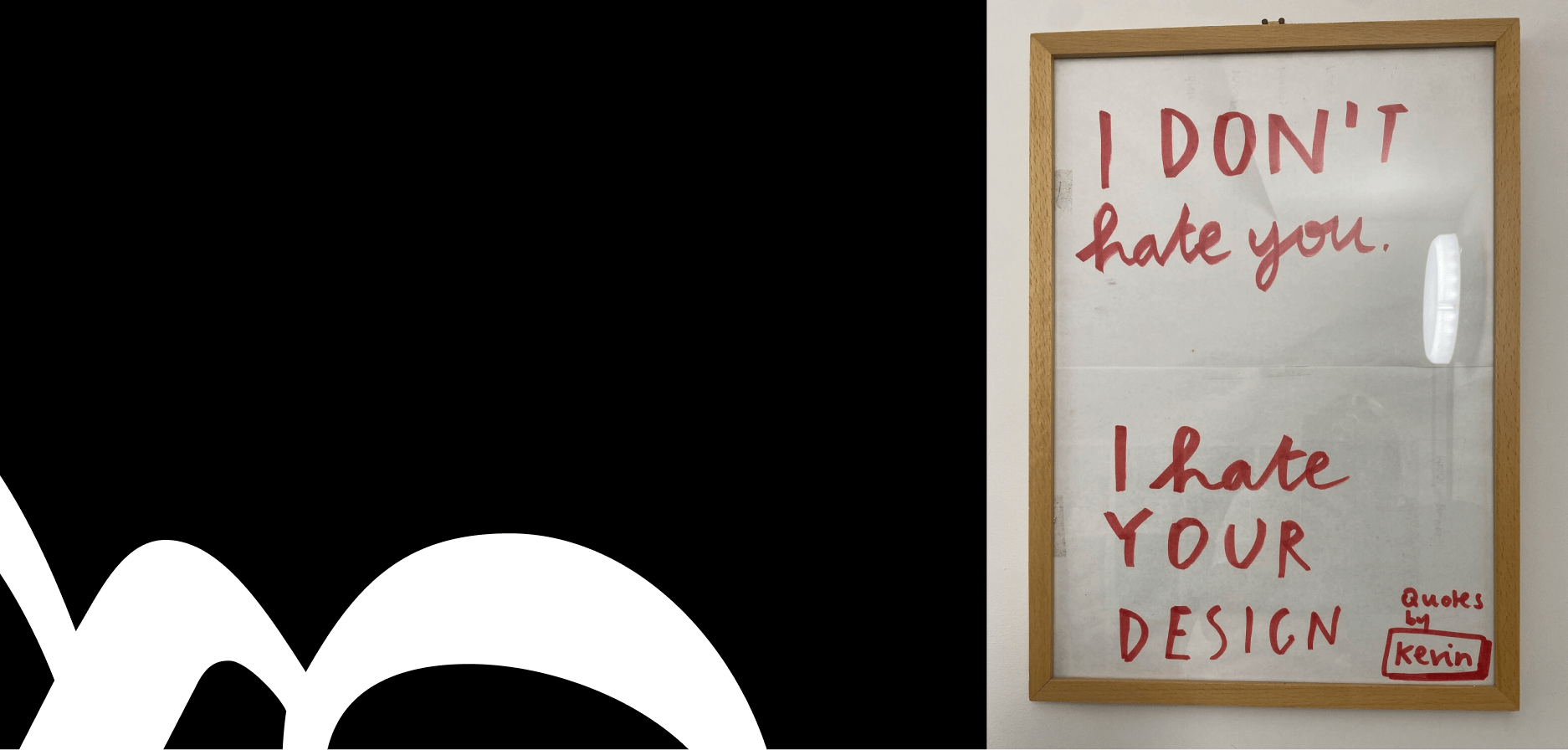
In IDEO’s London studio, we have a framed, handwritten quote: “I don’t hate you, I just hate your idea.” It was never intended to be framed, but it’s a fabulous reminder about not taking failure personally. If we truly share a collective goal of doing well and doing good, we need to generate and test as many ideas as we can—and be okay with killing our darlings to get there. It’s the only way to make real change.
Is your intolerance for failure holding you back? I’d love to hear more.
Should we allow new ideas to fail?

Lindsey Turner
I’m passionate about building brands, products, and experiences that help organizations show up with meaning and momentum.
I help organizations cut through complexity by shaping how they show up, through brand strategy, identity, and storytelling.
Working at the intersection of brand and business, I bring an editorial eye and a bias toward making—turning ideas into tangible experiences that people can understand, trust, and believe in.
My work spans government, healthcare, financial services, media, and consumer goods, from launching Gen Z-focused ventures to building innovation labs and reimagining legacy brands. I relish moments of ambiguity and enjoy translating across teams, perspectives, and priorities to move ideas forward.
I started my career in editorial and digital design, shaping cross-platform experiences and identity systems in publishing and agency environments. That foundation still shapes how I work today: I’m detail-oriented, collaborative, and overreliant on the Oxford comma. I hold a BFA in Visual Communication from the School of the Art Institute of Chicago.

Rachel Young
My work helps organizations see who their products aren't working for—and build the will and the tools to do something about it
For 25 years, I've asked the same question: Who does this design exclude—and what are we going to do about it?
My work spans human-centered strategy, inclusive design, and qualitative research, with clients ranging from Microsoft, Google, and Verizon to the National Science Foundation, and San Francisco Unified School District.
Before IDEO, I taught elementary school in East Palo Alto and spent a decade doing design work with social service organizations—where I learned firsthand what it costs people when systems are built without them in mind.
I am currently writing User Error, a nonfiction book about digital access and the design decisions behind it. I live in Oakland, California.

Brian Pelsoh
I lead with craft, ensuring our work is creatively excellent: rooted in deep human insight and imagination, while also grounded in the realities of business and technology.
My expertise spans brand, communication, and product design across tech, education, the arts, and social impact.
I believe great work demands both high-level vision and obsessive attention to detail, and only happens through collaboration.
I bring an inclusive, hands-on approach and a deep understanding of business, which enables me to consistently deliver excellence while always asking why.
Before joining IDEO, I worked at the brand firms Pentagram and VSA Partners. I began my career as a designer, leading teams at the School of the Art Institute of Chicago and the Milwaukee Art Museum. I hold an MFA in graphic design from Maryland Institute College of Art and a BFA in communication design from the Milwaukee Institute of Art & Design, and have taught at some of the best design schools in the US.

Tony Wong
I am responsible for IDEO’s long-term success in China and working with clients to use design as a tool to enable growth.
I am responsible for IDEO’s long-term success in China and working with clients to use design as a tool to enable growth. Specifically, I have helped Chinese companies design holistic brand solutions through the development of their products, communication, services, and innovation teams, and I have helped multinationals expand their presence and influence in China.
I advise global leaders on developing China-led innovation and capabilities.
In over 15 years in IDEO Shanghai, I have worked on projects that use design to elevate the quality of the experience of healthcare products and services, streamline processes that increase productivity, create spaces and programs that promote and enable inclusive communities, and build next generation mobility solutions that are planet-positive.
Before joining IDEO, I worked at Philips Electronics and the Electrolux Group in Italy, the Netherlands, and Singapore on a number of breakthrough commercial products. I am a member of the Young President Organization in Shanghai.

How to use AI as an editor, not a writer
Ed White shares how he uses AI as an editor—not a writer—to sharpen storytelling, rehearse ideas, and preserve the productive friction that makes creative work better.
Ed White has a rule he's tested on his own writing: hold yourself as the writer, and let AI be your editor. Ed is a Senior Design Director at IDEO's London studio, where he co-leads the firm's AI portfolio across Europe. Before IDEO, he spent 12 years as a writer and editor at the Financial Times, Wired, and Contagious. So when he talks about when to use AI for storytelling and when not to, it comes from two decades of crafting his storytelling skills.
In this episode, Mina Seetharaman talks with Ed about two specific tools he uses to keep AI in an editor's seat: a "roasting agent" prompted to critique his drafts without any sugarcoating, and a simulated audience he rehearses pitches on before the real thing. They also get into what Ed is hearing from design leaders at Anthropic, Lovable, Shopify, and Google Creative Lab about how creative work is changing, and why he thinks the friction of writing something yourself is worth protecting rather than automating away.

Building a personal AI for the messiness of life: Sida Li
Becca Carroll talks with Cue co-founder Sida Li about designing a personal AI for the messiness of everyday life—not just work. They explore how Sida stays anchored to human needs while navigating fast-changing technology, product tradeoffs, business-model experimentation, and the realities of building an AI company today.
Most AI products today are built for work—a space with clear problems and established systems. One founder noticed a gap: personal life is messier, harder to systematize, and mostly left behind by the AI boom. So she built Cue, a personal AI that lives inside iMessage and group chats, to go where the other tools haven't.
In this episode, Becca Carroll, IDEO's Chief Strategy Officer, talks with Sida Li, co-founder and CEO of Shared Context Lab, about staying anchored to a human need while the technology around her keeps changing shape, why she treats her business model with the same rigor she'd bring to a product, and what it feels like to build a company at this particular, disorienting moment in AI.
The conversation also gets into how Sida makes design decisions: the language Cue uses to describe itself, the tradeoffs behind building inside iMessage instead of a new app, and a real story about a business idea that didn’t pan out.
This is the second in a two-part series profiling founders from IDEO's Startups-in-Residence program. The first conversation is with Johannes Seemann, founder of Sooner, on designing GenAI for the emotional side of money.

Designing GenAI for the emotional side of money: Johannes Seemann
Designing financial tools around the feelings that shape money decisions.
Most personal financial tools are built to run the numbers and optimize towards a budget. While that works for some, most people experience money as a lived relationship that does not neatly fit into a spreadsheet. Johannes Seemann and Becca Carroll discuss why money is emotional before it is mathematical, and what a human-centered approach to building a generative AI financial product looks like in practice.

The curious leader's edge in uncertainty: Scott Shigeoka
How genuine curiosity helps leaders navigate uncertainty with greater confidence.
Mina Seetharaman talks with Scott Shigeoka, author of Seek and Head of Curiosity Cultivation at the Eames Institute, about what distinguishes genuinely curious leadership from performative curiosity, how power dynamics shape curiosity, and why practicing curiosity can restore energy rather than drain it.
Looks like you might be in search of something very specific?
Or reset the filters above and try another angle.
Here’s some random inspiration

Podcasts about creative leadership

Articles about the power of prototyping











































.webp)