
.svg)




Changing the way biotech innovates
Building a culture of user-centered innovation in the name of science.
Life Technologies, a global biotech company that supplies scientists with products and services, needed to grow big, from a $4 billion to a $10 billion enterprise. So it hired IDEO to help seed innovation across the company.
"When we started out, it was an R&D thing for driving innovation in new products. Now it’s not just R&D; user-centered innovation is a central part of our culture. It’s what we do throughout the organization," said Amy Cuneo, Associate Director, Customer Insights.
Over a three-year engagement, IDEO helped transform Life Technologies’ corporate culture through the introduction of User-Centered Innovation (UCI), an optimistic, experiential approach to problem-solving. Far outperforming its ambitious goal, Life Technologies is now a $13.6 billion company and uses UCI to inspire innovation throughout the 10,000-person organization.
After working with Life Technologies, IDEO designers came up with three products that have gone to market, including, a new bottle that showcases superior handling and storage, easier identification, and additional room for supplements. And Life Technologies has transformed from a company that aspires to focus on customers to one that truly does.


Building a birth control support network for women
A multimedia public service campaign as a vehicle to encourage smart choices.
Unplanned pregnancies are a big problem in the US, especially among unmarried 18- to 29-year-olds. Seven in 10 pregnancies in this demographic are unplanned, a statistic that applies to women of all ethnicities and socioeconomic levels. Complicating matters are the social tension between abstinence-only and contraception-inclusive education, and the difficulty and expense associated with obtaining prescription birth control.
Since 2009, IDEO has worked closely with the National Campaign to Prevent Teen and Unplanned Pregnancy, a nonprofit NGO, to address this pressing social challenge. One of the first insights on the project was identifying the need for comprehensive birth control support. Designers looked at ways to transform birth control from a prescription (a piece of paper that is handed to you by a doctor) into a subscription (a program that ensures you start using birth control, use it correctly, and migrate to more effective methods).
Given the complex and potentially overwhelming subject matter, the IDEO team interviewed women in the target demographic; talked with doctors, counselors, and other experts with varying opinions about birth control; and hosted roundtable discussions. They developed several concepts and scenarios that allowed members of the National Campaign to see sex and pregnancy through the eyes of the young women they’re working to reach.
Research and prototyping efforts led to the design of Bedsider, a multi-touchpoint birth control support system with a carefully crafted sex-positive brand, which is uncommon for the healthcare industry. Bedsider focuses on five key areas (awareness, motivational drivers, digital offerings, services, and loyalty) and acts as a vehicle for behavioral change that’s flexible, with room to grow into a much larger movement.
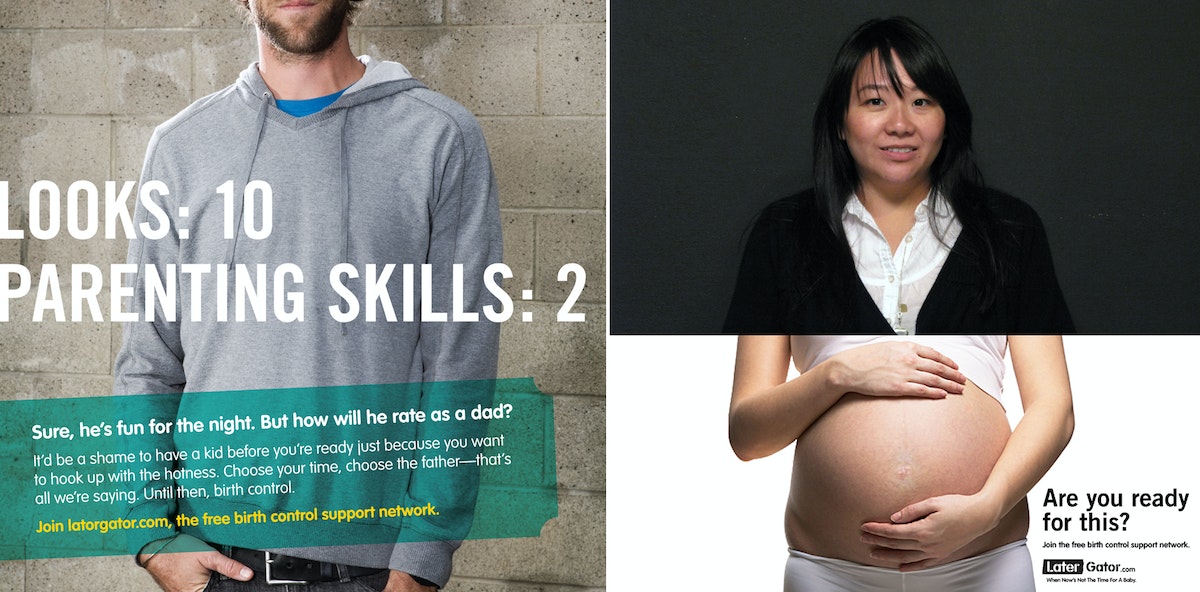
The Ad Council and the National Campaign debuted a multiyear, multimedia public service campaign in November 2011. The Bedsider website offers comprehensive education about existing birth control methods. This includes opt-in reminder services, personal stories from women across the country on why they chose a particular method, a phone service that provides information in both English and Spanish, features such as “Fact or Fiction” (hilarious animated clips debunking popular myths), a “Frisky Friday” newsletter, and more.
Bedsider has launched nationally with the help of an Ad Council campaign that drives sexually active women ages 18–24 to Bedsider.org. The multimedia Public Service Announcement effort includes television, radio, print, web, and nontraditional advertising, as well as an integrated social media program.
“We hope that Bedsider will be a useful tool for women to learn about their birth control options, better manage their birth control, and in the process avoid getting pregnant until they’re ready,” said Planned Parenthood of South Florida and the Treasure Coast in its monthly newsletter. Planned Parenthood and Philliber Research Associates joined forces with the National Campaign to Prevent Teen and Unplanned Pregnancy to help test and evaluate Bedsider.
Through a social media campaign called #ThxBirthControl, people are voicing their thoughts about what birth control has made possible for women, men, families, and society. It’s all part of Thanks, Birth Control Day, launched in November 2013 as part of a continuing initiative to encourage positive conversations and more consistent use of birth control by the National Campaign to Prevent Teen and Unplanned Pregnancy. To celebrate the movement, IDEO wrote, scored, and performed an animated musical featuring condoms and pill packs dancing the cancan.
According to an independent evaluation of the program, Bedsider is the first digital intervention in reproductive health in the U.S.—with adults as an audience—that has shown to prevent unplanned pregnancy. Turns out that when women and men have the ability to plan, prevent, or space pregnancies, they’re more likely to finish school, achieve their goals, and ultimately have healthier families, according to the nonprofit organization.
Bringing bikes to the streets of Chicago
Using the joy and freedom of cycling to brand Chicago’s bike-sharing initiative.
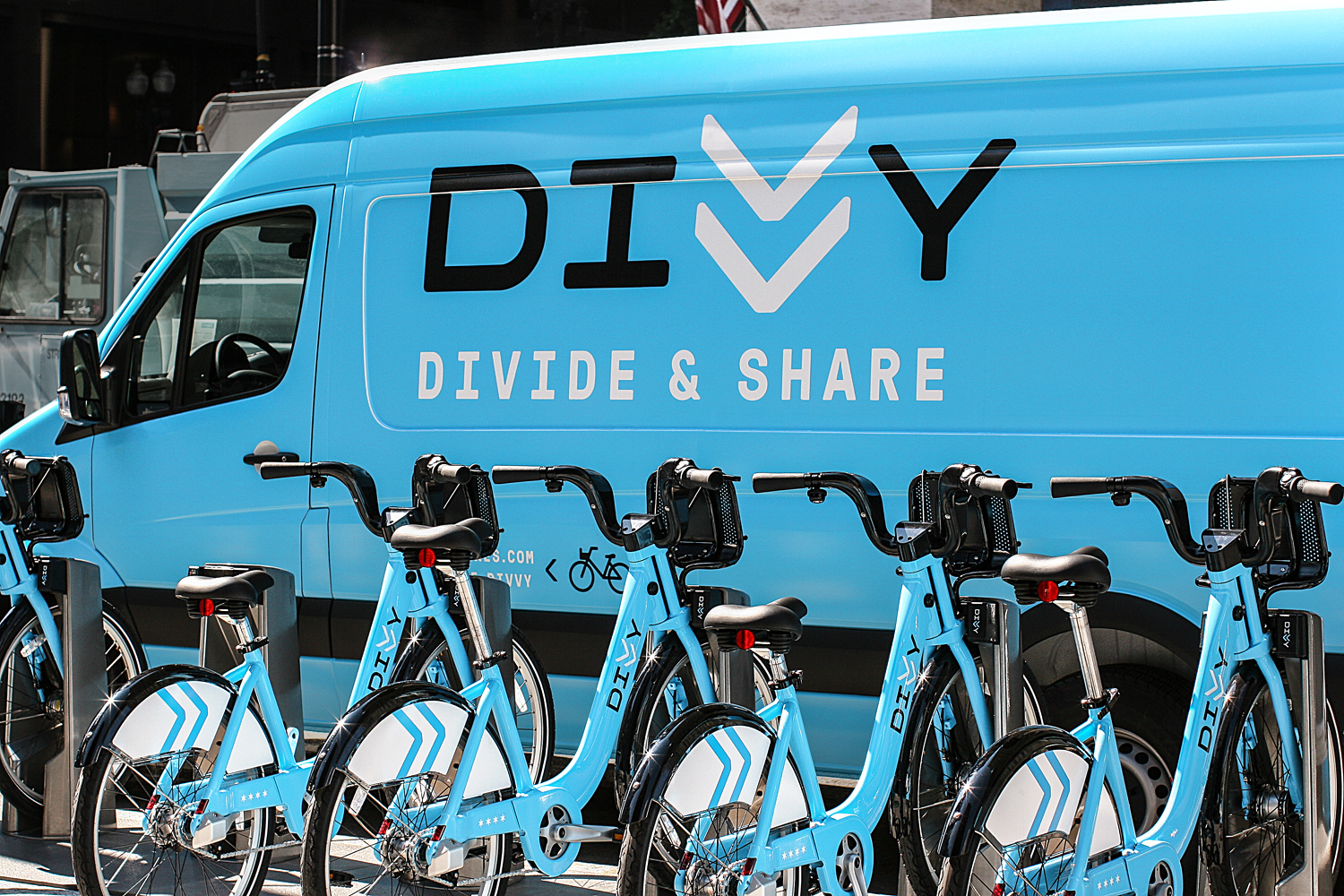
Chicago’s federally funded, citywide bike-sharing service, called Divvy, makes a fleet of bicycles available to commuters and tourists 24 hours a day. Alta Bicycle Share (which runs bike-sharing systems in Boston, the Bay Area, DC, and New York City) collaborated with IDEO to spread Divvy’s message, “Divide and Share!” to the cyclists and would-be cyclists of Chicago through the brand.
The new brand would appear on its bikes, stations, company vans, member fobs, and website—and it needed to be ready to hit the streets in just six months. IDEO partnered with local brand strategy studio Firebelly Design to collaborate on a solution. IDEO led the early research, conceptual brand development, and naming phase of the project; the Firebelly team led the visual design and developed the brand guidelines.
The brand has become a functional and fun part of Chicago’s transportation landscape and has been embraced by Chicago commuters. Just three weeks after it launched, the City of Chicago called the Divvy Bikes program the busiest bike-sharing system in the world. Six months into the service, enthusiastic cyclists have racked up over 780,000 trips and 1.7 million-plus miles, and over 12,000 Chicagoans have become members.
Bringing mass-market genetic testing to Japan
A Japanese mobile internet company quickly builds a genetic testing business.
After watching her husband suffer from cancer, Tomoko Namba, founder of Japan’s leading mobile internet company, DeNA, wanted to empower people with better health information to aid them in making medical decisions. DeNA partnered with IDEO to help with the design of a genetic test that had mass-market appeal.
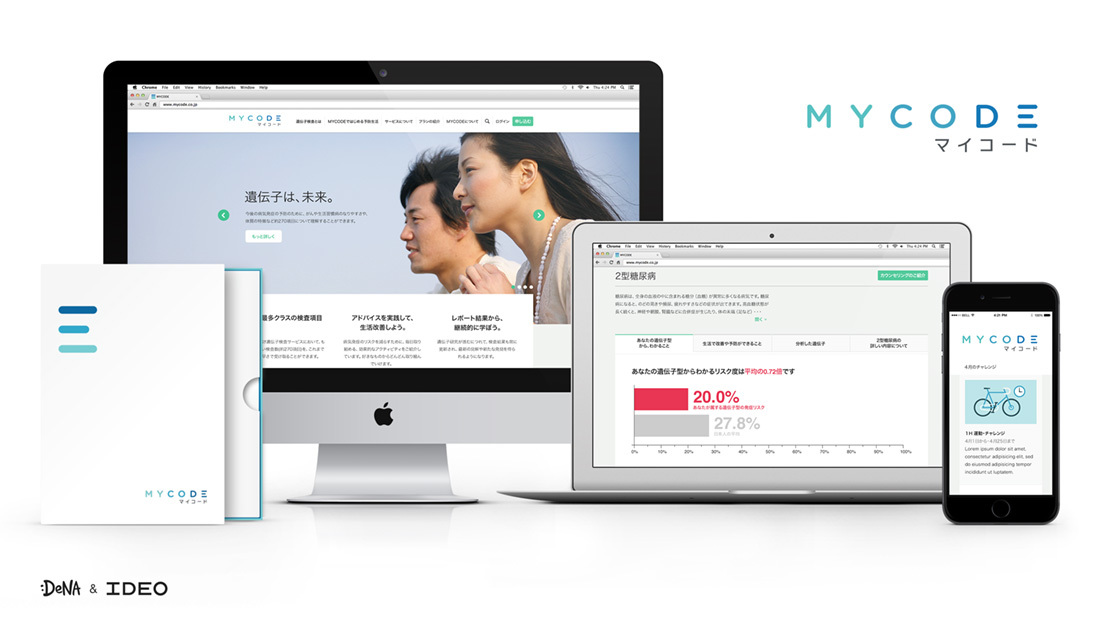
Together, IDEO and DeNA designed all the consumer touchpoints from the ground up for the expanding new business, called MYCODE. The aim was not only to create a functioning, usable product, but also to introduce the notion of genetic testing in a privacy-sensitive country that for the most part, hadn’t yet considered it an option. What would make MYCODE resonate with mass-market Japan? How could genetic testing results be shared in a way that was accurate but also actionable and motivating?
The team worked with doctors, nutritionists, medical governing bodies, and more, setting up fast, iterative cycles, and conceptualizing and prototyping almost every aspect of MYCODE in just 16 weeks. Data design, home testing experience, purchase flow, and how the service would be used over the long-term were all considered, along with traditional branding elements, like name, logo, and visual identity.
The result is a product that puts reliable genetic information into the hands of Japanese consumers, helping them to make more informed healthcare decisions. MYCODE went to market in August 2014, just nine months after the engagement with IDEO began. Not only did MYCODE fulfill Namba’s mission, it helped the company find new ways to grow: Upon announcement of the new service, DeNA’s share price jumped 6.7 percent.

From Fail Never to Fail Fast
How a solutions-driven leader learned to experiment
Six months ago, Dawn announced she’d step down from Planned Parenthood, having successfully helped transition the organization from the leadership of long-time president, Cecile Richards. Instead of hurling herself straight into leading at another large organization, Dawn decided to dedicate a year to experimentation and discovery as expert-in-residence at IDEO.
Dawn is now working with teams across IDEO and IDEO.org to find new ways to catalyze change. In particular, she wants to uncover how best to use data and technology to improve service delivery and support movement-building. Coming to IDEO, she says, “I saw an opportunity to ask, How do we use human-centered design principles, entrepreneurship, and data and technology to transform how we are reaching people and working alongside them?”
Not one to be daunted by ambitious goals, the first official project Dawn is helping to launch is The Billion Girls CoLab—an initiative aimed at harnessing new coalitions and diverse expertise to develop innovative solutions that will support young women’s power and health worldwide. This joint effort between IDEO.org and IDEO CoLab will bring together cross-sector collaborators to think about reproductive health in new ways. Dawn sees this work as a chance to create impact at scale, but also as a means to continue empowering others to become leaders.
“I think established leaders are afraid to leave their roles and what they know,” Dawn reflected recently. “But if we're talking about diversity, equity, and inclusion, some of us who have been privileged to lead—especially as leaders of a certain age—have a real opportunity to move and make space and build up a cadre of new leaders. They need room to lead.” It can be scary, she acknowledges, “but you just have to say to yourself, ‘Well, I'm going to step off this diving board into the unknown, and what can I report back from the other side?’”
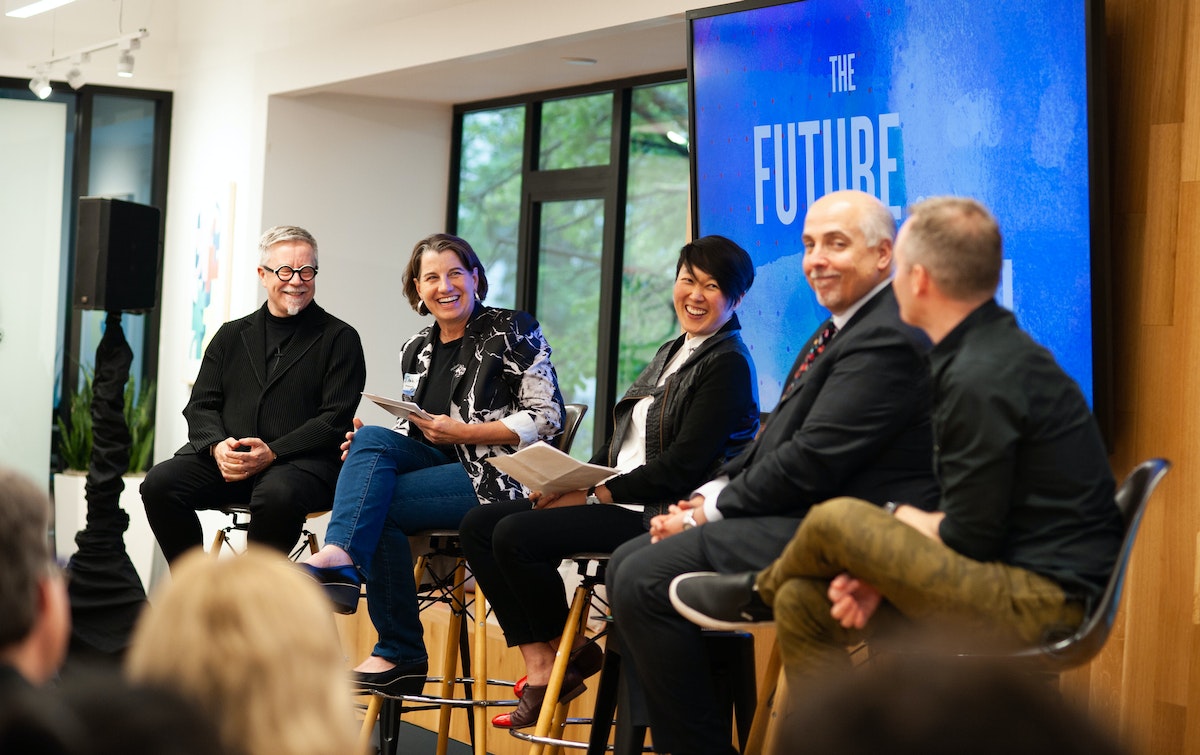
Dawn sat down with Whitney Mortimer, IDEO CMO and partner, to talk about what the other side is like, how her perspectives on creative leadership are evolving, and what she hopes to build in the near term to support a healthy, empowered generation of future leaders.
Whitney: Let’s begin with the work you’re doing with CoLab, where you’ve been deeply immersed. You’ve said that the CoLab model, which brings disparate groups and experts together to collaboratively solve problems, aligns well with your vision of how to work better on women’s health.
Dawn: We’re building a cohort that is not just people in the sexual and reproductive health field, but also others who are thinking about adolescent girls from very different perspectives and industries, including the for-profit corporations. The idea is a cohort that is domestic and global, which is something kind of new for the sexual and reproductive health ecosystem. We’re trying to catalyze a very different kind of conversation and output, researching and designing in close collaboration and asking what would it look like to build something that unlocks the power of a billion girls who are coming to adolescence around the globe over the coming decade? And what would that change for our world?
[When I was at Planned Parenthood], as much as we all tried to promote that kind of ‘fail-fast’ culture, we mostly lived in a fail-never culture, because the stakes were so high. And yet we know we’re going to have to experiment some to figure out what is going to catapult us to the next level.
Whitney: How is this approach to work different from how you were working before?
Dawn: I have to constantly remind myself, it's only been six months since I left [Planned Parenthood]. I really had to learn to live without a grenade as my metronome. Our days were so driven by constant distractions and firefights, even though I feel like we made real progress and built real things. So now [at IDEO] I’m gaining a different way to approach problems—to step back and have time to be more thoughtful. I'm more convinced than ever that this is not just a narrow fight. We now clearly have a global set of forces at play.
Whitney: You've always been clear with everybody that what got us here won't save us—we have to be looking ahead to the next thing. You're sitting on that horizon now, asking how does technology and everything we're learning about healthcare play out in a world that has such unequal access? As a creative leader, what do you need? What helps you shape something completely new, as opposed to just wanting to fall back into the matrix of an organization that already exists and will tell you what its priorities are every single minute of every day?
Dawn: Many people called me in the days after I announced and said, ‘Hey, do you want to apply for this job? Can we put you forward for that?’ They were all amazing opportunities, many in the progressive health and rights arena. It was hard to resist going to another similar operation, because of the urgency and the real difference that those organizations are making in this moment. But that urgency can get in the way of stepping back and thinking differently about how to work most effectively. [When I was at Planned Parenthood], as much as we all tried to promote that kind of ‘fail-fast’ culture, we mostly lived in a fail-never culture, because the stakes were so high. And yet we know we’re going to have to experiment some to figure out what is going to catapult us to the next level.
Whitney: Something that you do very naturally and fluidly, is you find analogous examples out in the world that makes sense inside your world. I'm wondering, as you look at scaling something new, what other kinds of methods or mindsets from the designer's toolkit are you able to tap into?
Dawn: There are just these amazing ways to step back and actually use a designer’s approach to think about how companies, organizations, movements could actually be building and thinking more about the early and upstream inputs to get the outputs we want to see later.
With a designer’s mindset, we would ask how to more thoughtfully shape the waves of cultural nurture that will carry these generations to the shores of the future.
Recently I’ve been thinking a lot about nature versus nurture. And then I jumped to this bigger idea with the folks at IDEO, thinking about the idea of cultural nurture: What larger cultural wave was I riding that I couldn't see then, but which shaped me—and not just me, but a generation of people?
For example, when I was in third grade, I started a student council because the playground rules were unfair to girls. Exactly around that same time was when Title IX passed. All of a sudden there was a mandate for equality in education—in sports in particular—for girls. I benefited from that immediately but I could not see the profound impact it would have. I would have been radically different had I not been told, “You get to play basketball. You get to run for whatever school office.”
I think about how powerful those forces are, and yet we don't respond to them and leverage them as well as we could. With a designer’s mindset, we would ask how to more thoughtfully shape the waves of cultural nurture that will carry these generations to the shores of the future.
Whitney: Can you see those moments now that are shaping the next generation?
Dawn: I'm thinking about it a lot around the climate and depletion of the planet, with younger people getting messages both of fear, and also of preciousness. We're also looking at stigma. There is a lot of exciting shame-busting going on in the culture right now, which of course is why I think there's so much pushback in our politics.
Whitney: How has your identity and orientation as a leader shifted? How does that alter your sense of your capacity and what you need in order to have the impact you want to see?
Dawn: As they say in IDEO fashion, I'm diverging before converging. What I have tried to do is not converge on a solution or direction too quickly, because by nature that would be what I’d do—solve the problem as quickly as possible. In my previous life you could not sit around and admire the problem for very long. But I’m learning to be in love with the problem for a bit longer. I’m asking, can data and technology unlock a different paradigm of care? Is it stigma or rights or both that are foundational to solving the problem of abortion access? And what is it that I’m best equipped to do and help lead people toward?
Whitney: When you were at Planned Parenthood, you were early to see the potential, say, to use VR as an engagement and empathy-building tool. What technologies are you seeing as most critical and exciting now, as you're exploring what will be the new paradigm for reproductive health and healthcare?
Dawn: Well, I know augmented intelligence is the phrase of the year, but it really does have amazing potential. For example, take the idea of personalized prescribing and apply that to contraception. We know contraception is a game-changer, a life-changer, a life-saver. But we also know that when people get hormonal contraception, some people are going to have side effects. That means they’re either not going to keep using it or they’re going to want to switch. And that’s when there is more risk of getting pregnant. Imagine if we could harness AI to look across all of the prescription data sets and provide doctors with the tools to better match individuals with the product or formulation that suits them best. What if you could, by orders of magnitude, improve the ability of women to get a prescription or method of their choice that works for them right from the get go? That’s one example of how we might use new capabilities to create impact at scale.
Whitney: With the political climate being what it is, and an election on the horizon with unknown outcomes, how do you think about the challenge of something like improving access to and adherence to contraception or of empowering a billion girls around the world, irrespective of what may happen politically in the US and elsewhere?
Dawn: The one thing I 100% believe is you can’t think of anything completely outside of politics. It's just so clear what a powerful shaping force politics and government policy are. At the same time, there is a narrowness to the political lens. And when you start to think of these other actors and other ecosystems, you realize there's a lot that is possible—there’s potential to organize, to employ tools we're not fully utilizing. Part of what I want to do now is build out the progressive toolbox so that we're able to better work over or under or around the political obstacles, even while we recognize they cannot be ignored. The CoLab model has a lot to offer in leveraging many sectors and approaches and drawing them together to power solutions.
Whitney: What is the role of brand in that scenario?
Dawn: I actually think it is very important—not to create a name or brand a product, not that kind of thing—but the idea that we could use the principles of brand to communicate the power of girls to change the world. The idea that we can impress upon people the importance of raising up generations of girls, giving them the tools and the freedom to make their mark. That, I think, is something we need to capture and tell to the world.
We have to do everything we can to connect girls and to empower them and to make room for them. We have to get over some of our false distinctions and start to help them see that there’s a kind of global sisterhood that’s powerful, and that they have the opportunity to save the planet. That’s the small task we're going to hand off to them.
When Dawn Laguens looks back on her eight years leading brand and public strategy at Planned Parenthood Federation of America, she describes a typical work day as “catch grenade, throw grenade back, run two steps forward.” To be sure, the years from 2010-2018 were eventful for everyone, and particularly for people like Dawn, who were on the front lines of vicious political conflicts, while simultaneously doing the daily work of advocating for accessible and effective healthcare solutions for women worldwide.

Thoughtless Acts: Glove Compartment
Thoughtless Acts: Glove Compartment. The intuitive ways we adapt and react to things in our environments
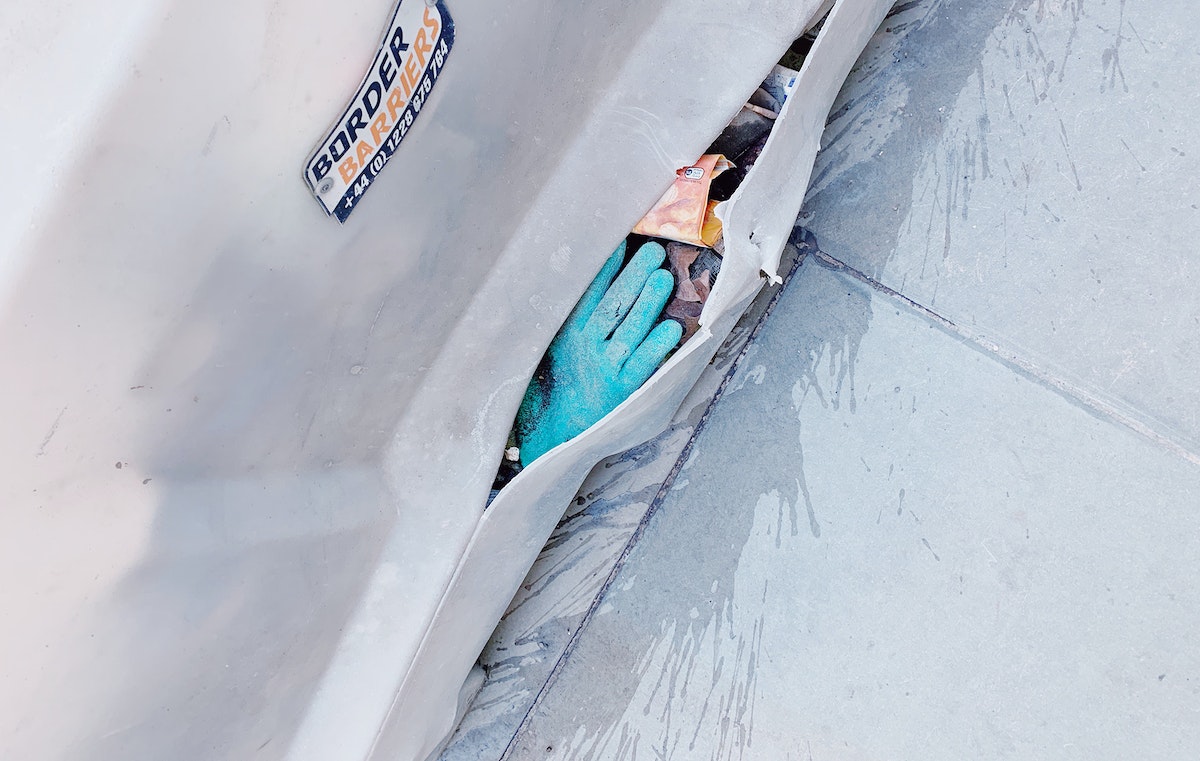
Spring in London vibrates with the tweeting of birds and the drilling of construction excavators. It’s a surreal symphony of nature and gentrification.
I was late for work and speeding up my usual way when I got detoured by a few meters of plastic barrier. As I walked around the construction equipment, I heard one worker shout to another.
"I'll pick up my gloves and be right back," he said. He walked by me and leaned towards a hole in the temporary barrier where his gloves were neatly stored.
"Excuse me," I started with my typical nosey flair. "Why do you keep your gloves in there?" He must have a locker, I thought to myself, or even a pocket where to store them on site.
"I work on different areas of the site,” he said, “and I need different gloves based on the job. These barriers crack very easily, so they provide the perfect storage space when I need it and where I need it."
As I looked at his hiding spot, I thought about designing for the end of life of products, like construction barriers, mailboxes, and or a simple shoebox. It was the first time I considered the new use cases that can come from deterioration and change.
As he walked away, he smiled tightly; I had acknowledged his hidden creative side.
Human-centered design requires us to observe human behavior with beginner's eyes, so that we can spot the innate ways people interact with the world around them. We call these intuitive and unconscious reactions Thoughtless Acts, and IDEO designers collect photos of them to inspire their work.

7 Experiments That Push the Edges of AI and Design
Designers at IDEO are constantly exploring the possibilities—and potential pitfalls—of a future where humans and machines are ever more entangled

1. What a Computer Learns From Watching Hours of Cartoons
Find out what happened when an IDEO CoLab designer tried training a neural network to generate its own cartoons—and what he learned about the danger of bias in training data. Read the story!

2. Inviting Algorithms to the Design Team
Your future design partner may be an algorithm. Here’s what emerged from an experimental collaboration between a graphic designer, a data scientist, and an algorithm. Read the story!

3. To Design a Better Future, Embrace the Uncomfortable
How can we explore the future of technology? By prototyping it. Check out the 5 near-future concepts that came out of a new IDEO exploration called The Discomfort Zone. Read the story!
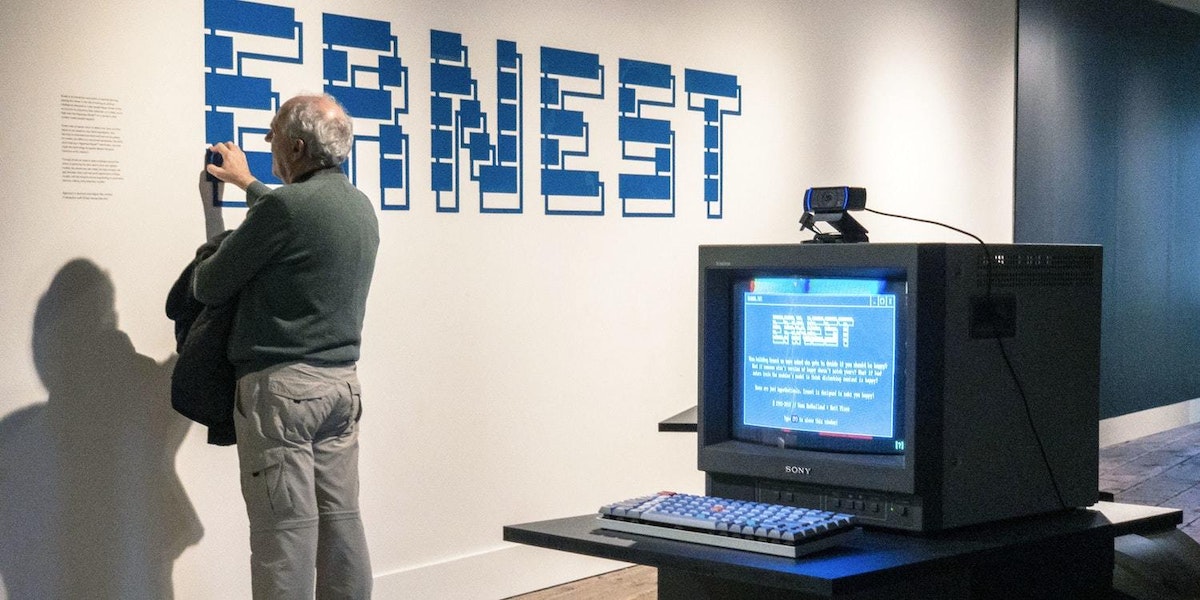
4. No Beards Allowed: Exploring Bias in Facial Recognition AI
One IDEO designer created a facial recognition AI game that helps users understand how machine learning models are trained—and subtly hints at the areas where bias could creep in. Read the story!
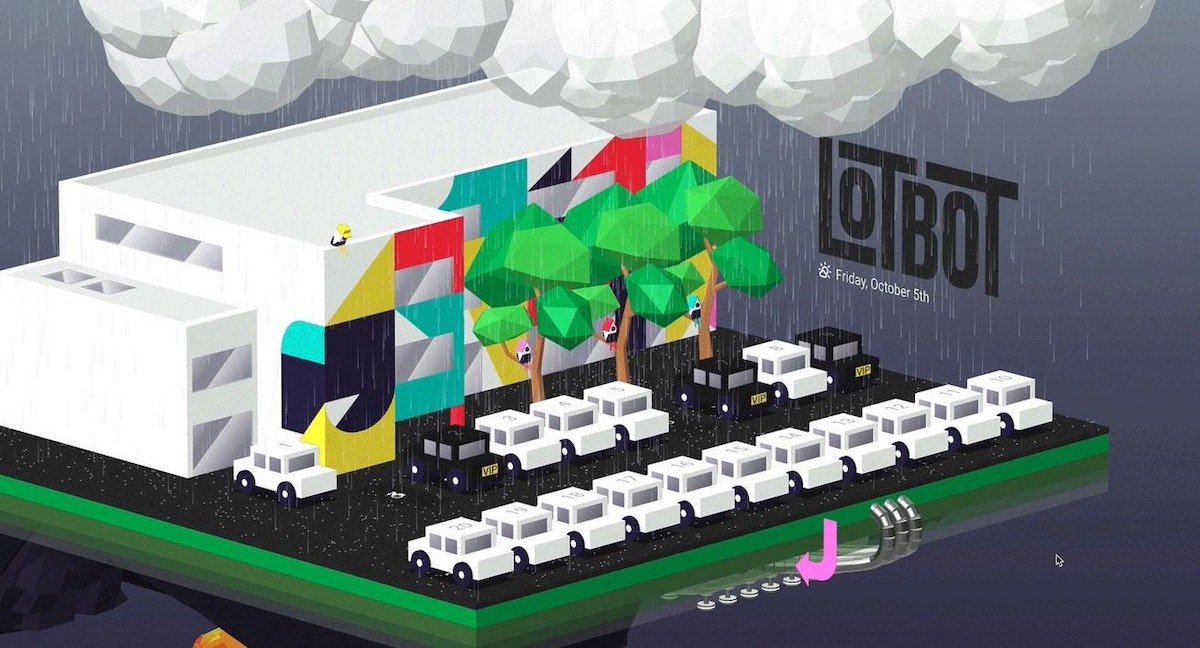
5. We Built a Bot to Assign Parking Spots. It Fought Back.
When IDEO Cambridge moved into a new studio with a too-small parking lot, they built a bot to manage traffic... but the bot fought back. Here’s what this rogue AI taught the team about “raising” a bot—and how they tamed it. Read the story!
Bonus: Check out the follow-up post where a design researcher explores how his colleagues' interactions with the bot signaled shifts in studio culture.

6. Training a Computer to Find Shapes in the Clouds
The average 25-to-34-year-old only spends 13 minutes a day relaxing. Here’s what happened when one IDEO intern tried "outsourcing" some of her leisure time to a computer. Read the story!
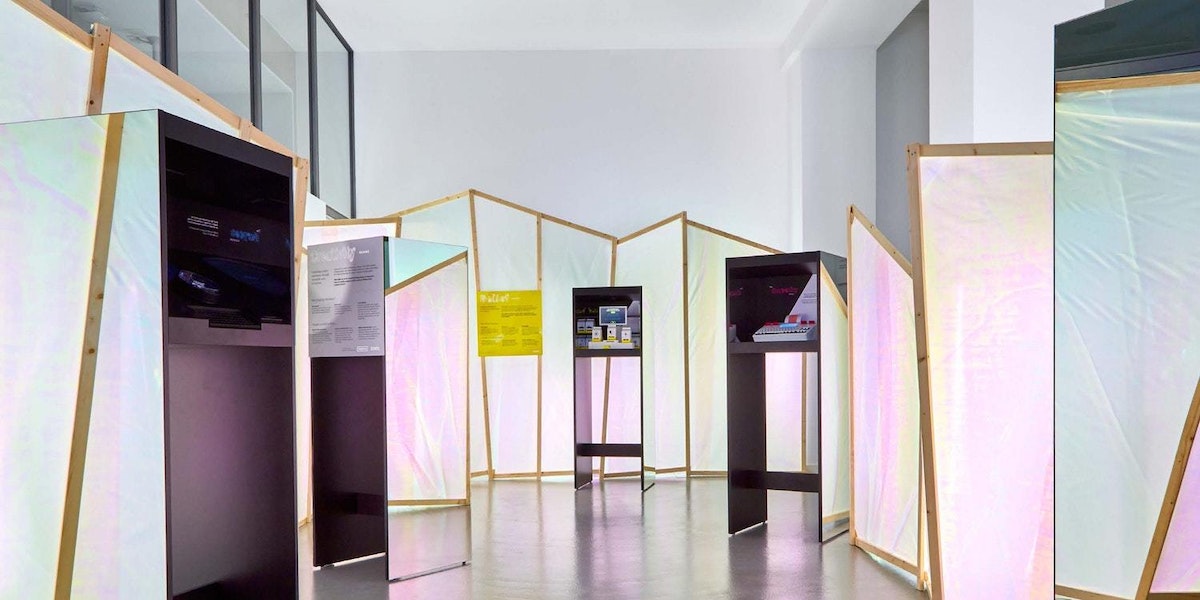
7. What the AI Products of Tomorrow Might Look Like
How can designers leverage the power of AI to build a better future? To explore this question, we created an award-winning speculative design exhibition called HyperHuman. Read the story!
As designers, we help build the future we want to see. So when a new technology emerges, we're always eager to take it for a test run, push its edges, and see how it fits into visions of the future. When it comes to AI, the opportunities are endless, but the stakes are high—our work can have serious implications that affect the lives of real people at unprecedented scale. Designers at IDEO are constantly working on cutting-edge experiments that explore the possibilities—and potential pitfalls—of a future where humans and machines are ever more entangled. Read on to explore a few of those experiments and the lessons we’ve learned along the way.

What Does it Really Mean to “Act Like a Startup”?
Legacy companies are often told to move fast and break things, but the reality isn’t always that simple
But the painful reality is that most corporations don’t enjoy the conditions necessary to enable true startup behaviors. The DNA of a large, established business looks far different than that of a fledgling company. And just like with actual startups, creating new ventures is hard, risky, and doesn’t always pan out.
So how, exactly, can you design the conditions for success?
If you have a big company’s DNA, you need to catalyze strategic changes—small mutations that make it possible for a startup model and mindset to thrive inside a much different species. Sometimes, it happens naturally. If a legacy company hits an acute adapt-or-die moment, there’s no choice but to change (à la Netflix or Microsoft). But for companies where transformation is inevitable but not immediate, it’s entirely possible to engineer the conditions that generate pressure for a controlled shift. Here are three ways senior management can provoke the conditions for success.
1. Question your business model
Many legacy companies have been successful because they’ve focused on their core business, while many startups have flourished by routinely abandoning theirs. The key is to do both: Keep the core business running while a new venture pursues something entirely different.
Recently, American Family Insurance was looking to innovate outside of its traditional business model while staying true to its mission to help working families. One of its customers' biggest pain points was an inability to save enough money for an emergency. A $400 surplus—a cushion to get through a medical crisis, for example—was beyond many people’s reach.
Initially, American Family thought budgeting tools might provide a solution, but from the very first research interview, it was clear that budgeting wasn’t the barrier—cash-strapped people budget masterfully. The problem was having enough income to put away a little extra.
So, the insurance company embraced a radically new opportunity, creating a service to help families living on the edge bridge the gap between their paychecks and their security threshold. The company built a new business venture called Moonrise—a platform that would allow businesses to tap into an on-demand workforce, and allow people to access short-term work when they found themselves on shaky financial ground.
The solution was outside the scope of the legacy company’s core offering, but by moving outside of its business model, American Family Insurance was able to create an entirely new venture that helped its core customers solve a chronic, unaddressed problem.
2. Be an early adapter
It’s nearly impossible for an entire corporate organism to pivot rapidly in response to what’s happening around it, but startups have the innate superpower to move fast and get in early. When an emerging need or trend appears on the horizon, they can leap to create new products—or even new markets—far more quickly than large corporations. To achieve speed and adaptability, the new venture must be carved off and treated as its own autonomous, responsive entity.
Take the case of the 150-year old financial company that decided to widen the scope of its business to meet the growing desire for socially-responsible investment options. The company recognized early signals that the consumer desire for Environmental, Social and Governance (ESG) investing and impact investing was increasing rapidly, especially among younger generations, with whom they didn’t have many relationships. Chasing a high-growth opportunity for a new market segment, they set out to create a digital-first product that focused on socially-responsible investing.
To get started, the company didn’t simply announce a new division, or task an existing team with creating something new. Instead, they hired a founder and an outside startup team of 10. They built a company and a culture that was totally separate from their parent company’s offering, allowing the venture to take risks, prototype early and often, and above all, move fast. Throughout the venture’s development, the team continuously evolved the experience and business model by pushing prototypes to potential customers, adapting and pivoting until they reached product-market fit. By creating a team with the impetus and the culture to hit the ground running, the venture launched in just 18 months—and put its product in the hands of its consumers before its competitors.
3. Select for resilience and relentlessness
No matter the industry, startup leaders tend to have a few shared qualities that are more common among the entrepreneurial set than among seasoned CEOs. For a new venture to really work, the people behind it need to be driven by curiosity and insight, and have the skills necessary to prototype and iterate their way toward a tangible outcome. They can’t carry the static burden of “the way we do things around here.”
Intercorp, a massive Peruvian economic group of more than 30 companies, including banks, malls, cinemas, and schools, sought to build and design an innovation studio. Instead of solely relying on the business units to drive their own innovation processes, the company opted to create a central entity that could solve problems across its offerings, focusing on the needs of Peru’s rising middle class.
Intercorp purposely built La Victoria Lab in a middle-class Peruvian neighborhood—outside the walls of the corporate HQ—to immerse the team in the human-centered problems it’s trying to solve. The company also put together an interdisciplinary team of resilient and relentless talent, and set it up to embrace design thinking, identify new opportunities, and constantly prototype new value propositions. This talent stays close to the customer in order to shape new ventures in development, works through rapid digital-first prototyping, and operates within constrained timelines to get results. To drive disruptive new growth opportunities, small, cross-functional teams work quickly to design and launch digital businesses that compete with Intercorp’s core companies. Through La Victoria Lab, Intercorp’s leadership is intentionally creating urgency and applying positive pressure to disrupt its own businesses and remain competitive.
As a leader of an established company, you can’t ignore its history or DNA—nor would you want to; it’s what made the company successful in the first place. But you can constructively provoke necessary changes that allow new ventures to flourish. By openly embracing new business models, pursuing (and possibly creating) new markets, attracting and empowering entrepreneurially-minded talent, and even imposing a few artificial constraints like tight timeframes or lean budgets, companies can begin to fundamentally evolve not only what they do, but also how they do it. It’s the only way to ensure long-term market leadership—and sometimes even survival.
The tricky part of all of this, is that true venture-building, much like innovation itself, cannot be a corporate hobby. It cannot be wedged into spare time and pursued only when employees have white space on their calendars. It has to be modeled from the top, by senior leadership. One of the things that makes startup entrepreneurs effective, and ultimately successful, is their grit, determination and dedication to creating lasting change in the face of all obstacles. It's why others join them on their mission. Make it one of the reasons that others join you.
Visuals by Elin Svensson.
As tech valuations rise, and more and more unicorns are born, legacy businesses everywhere hear the message that they need to act more like startups. If you want to innovate, stay relevant, and grow, the advice goes, then you have to take risks, be nimble, and throw money at potential solutions.

Lindsey Turner
I’m passionate about building brands, products, and experiences that help organizations show up with meaning and momentum.
I help organizations cut through complexity by shaping how they show up, through brand strategy, identity, and storytelling.
Working at the intersection of brand and business, I bring an editorial eye and a bias toward making—turning ideas into tangible experiences that people can understand, trust, and believe in.
My work spans government, healthcare, financial services, media, and consumer goods, from launching Gen Z-focused ventures to building innovation labs and reimagining legacy brands. I relish moments of ambiguity and enjoy translating across teams, perspectives, and priorities to move ideas forward.
I started my career in editorial and digital design, shaping cross-platform experiences and identity systems in publishing and agency environments. That foundation still shapes how I work today: I’m detail-oriented, collaborative, and overreliant on the Oxford comma. I hold a BFA in Visual Communication from the School of the Art Institute of Chicago.

Rachel Young
My work helps organizations see who their products aren't working for—and build the will and the tools to do something about it
For 25 years, I've asked the same question: Who does this design exclude—and what are we going to do about it?
My work spans human-centered strategy, inclusive design, and qualitative research, with clients ranging from Microsoft, Google, and Verizon to the National Science Foundation, and San Francisco Unified School District.
Before IDEO, I taught elementary school in East Palo Alto and spent a decade doing design work with social service organizations—where I learned firsthand what it costs people when systems are built without them in mind.
I am currently writing User Error, a nonfiction book about digital access and the design decisions behind it. I live in Oakland, California.

Brian Pelsoh
I lead with craft, ensuring our work is creatively excellent: rooted in deep human insight and imagination, while also grounded in the realities of business and technology.
My expertise spans brand, communication, and product design across tech, education, the arts, and social impact.
I believe great work demands both high-level vision and obsessive attention to detail, and only happens through collaboration.
I bring an inclusive, hands-on approach and a deep understanding of business, which enables me to consistently deliver excellence while always asking why.
Before joining IDEO, I worked at the brand firms Pentagram and VSA Partners. I began my career as a designer, leading teams at the School of the Art Institute of Chicago and the Milwaukee Art Museum. I hold an MFA in graphic design from Maryland Institute College of Art and a BFA in communication design from the Milwaukee Institute of Art & Design, and have taught at some of the best design schools in the US.

Tony Wong
I am responsible for IDEO’s long-term success in China and working with clients to use design as a tool to enable growth.
I am responsible for IDEO’s long-term success in China and working with clients to use design as a tool to enable growth. Specifically, I have helped Chinese companies design holistic brand solutions through the development of their products, communication, services, and innovation teams, and I have helped multinationals expand their presence and influence in China.
I advise global leaders on developing China-led innovation and capabilities.
In over 15 years in IDEO Shanghai, I have worked on projects that use design to elevate the quality of the experience of healthcare products and services, streamline processes that increase productivity, create spaces and programs that promote and enable inclusive communities, and build next generation mobility solutions that are planet-positive.
Before joining IDEO, I worked at Philips Electronics and the Electrolux Group in Italy, the Netherlands, and Singapore on a number of breakthrough commercial products. I am a member of the Young President Organization in Shanghai.

How to use AI as an editor, not a writer
Ed White shares how he uses AI as an editor—not a writer—to sharpen storytelling, rehearse ideas, and preserve the productive friction that makes creative work better.
Ed White has a rule he's tested on his own writing: hold yourself as the writer, and let AI be your editor. Ed is a Senior Design Director at IDEO's London studio, where he co-leads the firm's AI portfolio across Europe. Before IDEO, he spent 12 years as a writer and editor at the Financial Times, Wired, and Contagious. So when he talks about when to use AI for storytelling and when not to, it comes from two decades of crafting his storytelling skills.
In this episode, Mina Seetharaman talks with Ed about two specific tools he uses to keep AI in an editor's seat: a "roasting agent" prompted to critique his drafts without any sugarcoating, and a simulated audience he rehearses pitches on before the real thing. They also get into what Ed is hearing from design leaders at Anthropic, Lovable, Shopify, and Google Creative Lab about how creative work is changing, and why he thinks the friction of writing something yourself is worth protecting rather than automating away.

Building a personal AI for the messiness of life: Sida Li
Becca Carroll talks with Cue co-founder Sida Li about designing a personal AI for the messiness of everyday life—not just work. They explore how Sida stays anchored to human needs while navigating fast-changing technology, product tradeoffs, business-model experimentation, and the realities of building an AI company today.
Most AI products today are built for work—a space with clear problems and established systems. One founder noticed a gap: personal life is messier, harder to systematize, and mostly left behind by the AI boom. So she built Cue, a personal AI that lives inside iMessage and group chats, to go where the other tools haven't.
In this episode, Becca Carroll, IDEO's Chief Strategy Officer, talks with Sida Li, co-founder and CEO of Shared Context Lab, about staying anchored to a human need while the technology around her keeps changing shape, why she treats her business model with the same rigor she'd bring to a product, and what it feels like to build a company at this particular, disorienting moment in AI.
The conversation also gets into how Sida makes design decisions: the language Cue uses to describe itself, the tradeoffs behind building inside iMessage instead of a new app, and a real story about a business idea that didn’t pan out.
This is the second in a two-part series profiling founders from IDEO's Startups-in-Residence program. The first conversation is with Johannes Seemann, founder of Sooner, on designing GenAI for the emotional side of money.

Designing GenAI for the emotional side of money: Johannes Seemann
Designing financial tools around the feelings that shape money decisions.
Most personal financial tools are built to run the numbers and optimize towards a budget. While that works for some, most people experience money as a lived relationship that does not neatly fit into a spreadsheet. Johannes Seemann and Becca Carroll discuss why money is emotional before it is mathematical, and what a human-centered approach to building a generative AI financial product looks like in practice.

The curious leader's edge in uncertainty: Scott Shigeoka
How genuine curiosity helps leaders navigate uncertainty with greater confidence.
Mina Seetharaman talks with Scott Shigeoka, author of Seek and Head of Curiosity Cultivation at the Eames Institute, about what distinguishes genuinely curious leadership from performative curiosity, how power dynamics shape curiosity, and why practicing curiosity can restore energy rather than drain it.
Looks like you might be in search of something very specific?
Or reset the filters above and try another angle.
Here’s some random inspiration

Podcasts about creative leadership

Articles about the power of prototyping







































.webp)