
.svg)


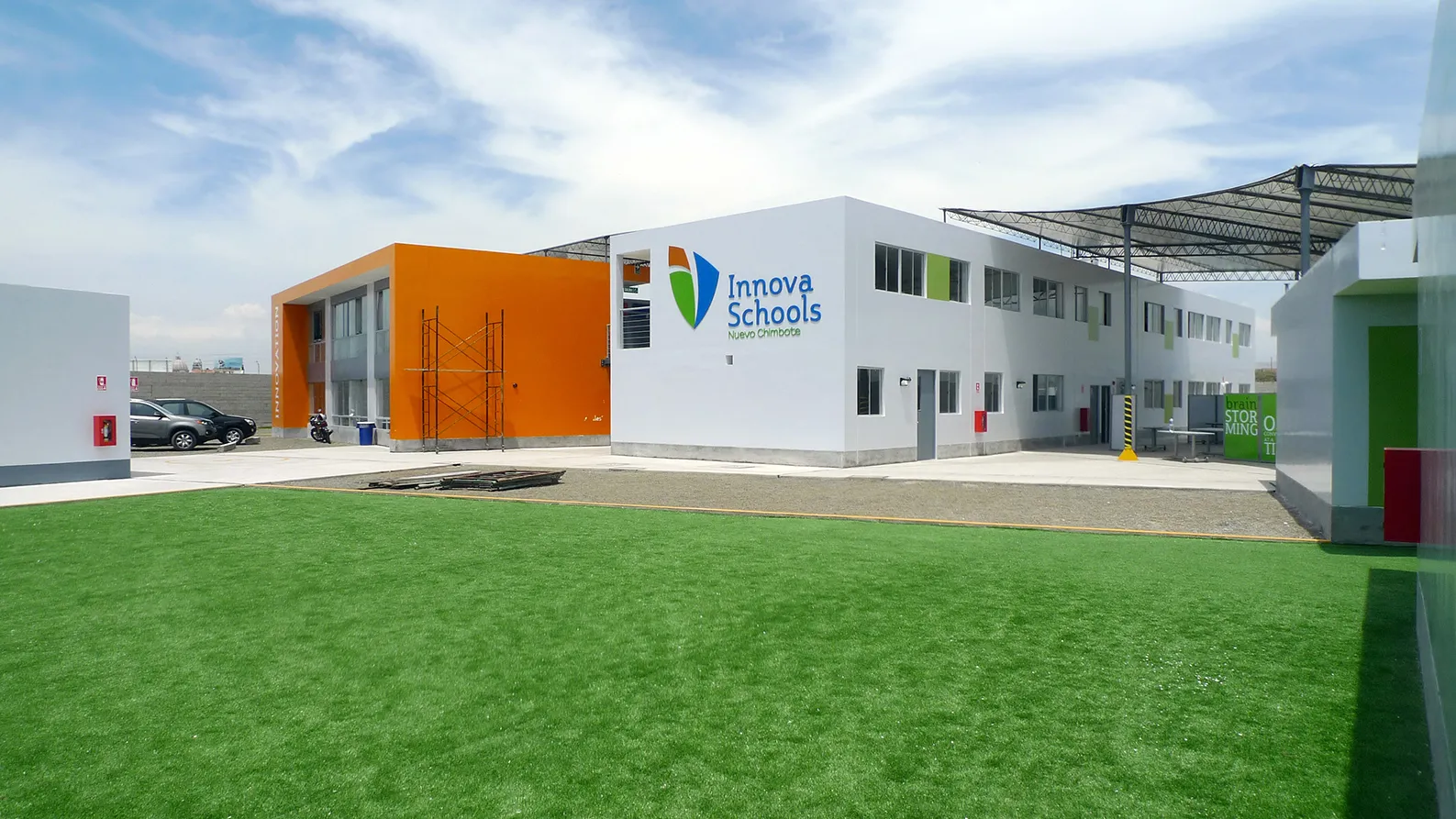

Designing a school system from the ground up
Scaling an entire network of schools for the growing Peruvian middle class.
How do you lift up the middle class in a developing country?
That was the challenge facing Peruvian entrepreneur Carlos Rodriguez-Pastor, who hired IDEO to build an entire network of schools powered by a progressive new learning model. IDEO’s mandate: to redesign Innova’s entire K–12 learning experience, from the curriculum to the teacher training to the school buildings, with an eye toward expansion and a goal to provide international-quality education at an affordable price—about $100 a month.
Innova Schools is a part of Intercorp, a family of 35 businesses that span everything from banks to retail stores and added schools to its portfolio. In 2010, the company had five existing schools but realized that its existing model could not grow. The shortage of well-trained, high-quality teachers in Peru, combined with rising land costs, meant the schools would need to radically change course to succeed.
To learn about scalable school models around the world, IDEO researchers visited inspirational schools and learning programs, and looked to analogous systems like retail, hospitality, and health care to understand their approaches to scale. Throughout the project, they collaborated with teachers, students, and the Innova Schools team in co-designing the work itself.
Together, Innova Schools and IDEO developed the curriculum, teaching strategies, buildings, operational plans, and underlying financial model to run the network of schools.
"I was blown away by Innova Schools," said Salman Khan, founder of Khan Academy. "It's inspiring to see such an affordable school deliver a quality of education that would rival schools in the richest countries."
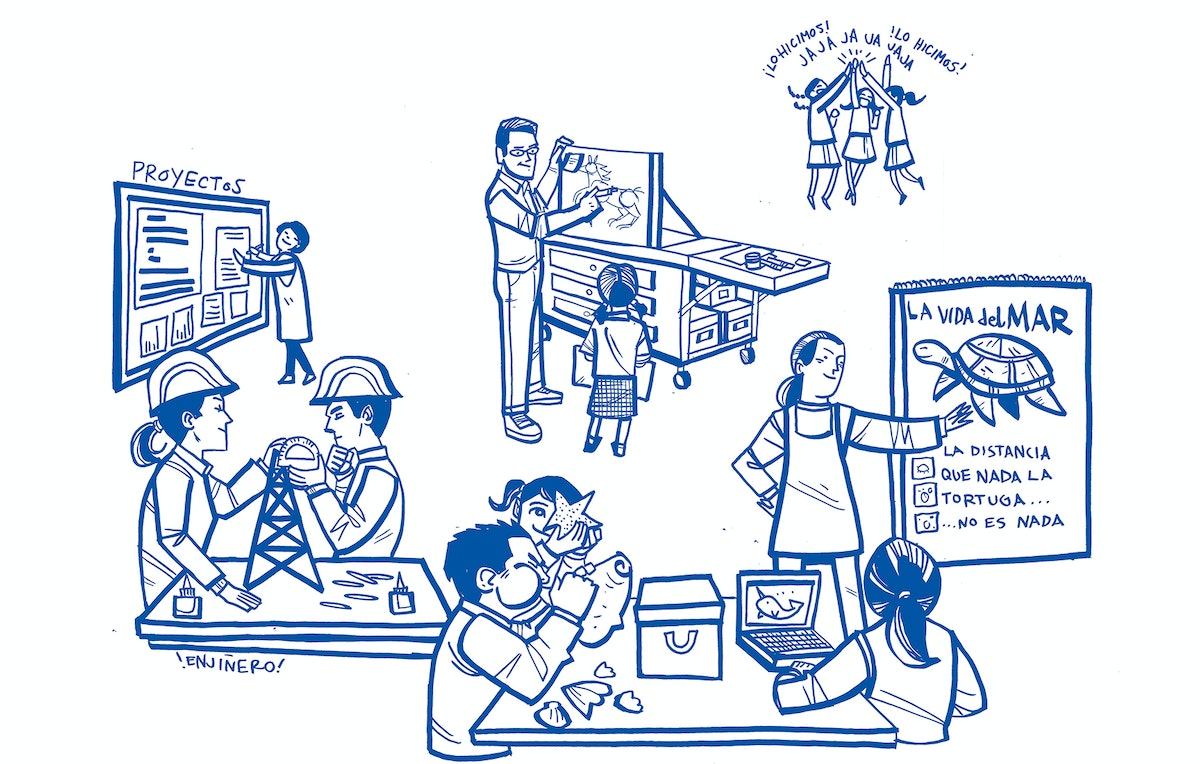
The new Innova Schools combine teacher-led, project-based learning in small groups with self-directed time using digital learning tools. Teachers monitor students’ work online and offer personalized guidance. Parents can view their children’s progress online as well.
Dynamic learning environments include community spaces, media labs, rooftop study areas, amphitheaters, and cafés that are optimized for flexibility: furniture on wheels, movable walls, and efficient uses of space to allow for different modes of learning.
An online Teacher Resource Center includes a database of more than 18,000 custom lesson plans based on a progressive new teaching approach. The center helps teachers learn their craft and gives them a chance to connect across the network.
The business model of Innova Schools was developed at the same time as the school experience. Designers leveraged the economies of scale that come from building a network of schools and centralized tools, such as data systems that allow all the schools to learn together.
The project has allowed Innova to open more schools at an affordable cost to families, ultimately giving more of Peru’s youth the chance to compete in the global economy. This comprehensive approach to system design ranks as one of Latin America’s most ambitious privately funded educational projects, and is on track to become the largest private school network in the region. To date, Innova has opened 63 schools in Peru that are serving more than 50,000 students.

A good system design doesn’t end with strategy. The work on Innova Schools also had a huge influence on the company, according to Rodriguez-Pastor. Through the creation of new roles and an aligned set of values, Innova’s central office has become a much more nimble and creative organization. They’re constantly scanning the world for inspiration in how to best educate their students, while building out the new innovations. They realize that design thinking can become an integrated part of their daily management of this growing network of schools.

Designing a top-selling hard drive
Through a long-term collaboration, Western Digital and IDEO have created one of the world’s best-selling hard drives.
Western Digital, the leading provider of external digital-storage solutions and a pioneer in the field, and IDEO collaborated on a number of products that produced reliable, secure, high-performance hard drives for personal and professional use and have won numerous design awards.
The projects include:
- MyBook external hard drive: IDEO and Western collaborated to find a new design language for their external hard drive MyBook. In just six months, MyBook became the number-one hard drive in the Americas, and grew US market share by more than 50 percent.
- MyBook II: Looking to regain MyBook’s original number-one position in the hard drive market, IDEO and Western came together again to refresh the original design, finding ways to further differentiate the product and the brand, and winning a 2008 Spark Bronze Award.
- MyPassport: Western and IDEO designed the 320GB, ultra-portable USB-powered hard drive that appeals to the mobile user, which won both the 2008 IDEA Bronze Award from IDSA and BusinessWeek, and the 2009 iF Award.
- MyBook and MyPassport 3.0: Again, IDEO and Western collaborated on bringing the popular MyBook external hard drive to the next level in the hardware, the software, and the packaging. IDEO also created in-store merchandising, the graphics and information featured on product packaging (and the “out-of-box experience”).

Designing a city emergency plan
Helping cities prepare for emergencies with a resourceful toolkit.
The city of San Francisco wanted to help its people become better prepared in case of emergency. While no one feels totally prepared for a natural disaster, people who are most connected within a local network fare better in an emergency.
So the San Francisco Department of Emergency Management (SF DEM) and IDEO teamed up to create SF72, a revolutionary platform that helps to reach people where they are. In times of emergency, the city will need citizens to be self-supporting for 72 hours (or longer) before local services or outside help kicks in. With that in mind, IDEO developed an accessible platform to help people prepare for those 72 hours in simple ways that fit into their daily lives.
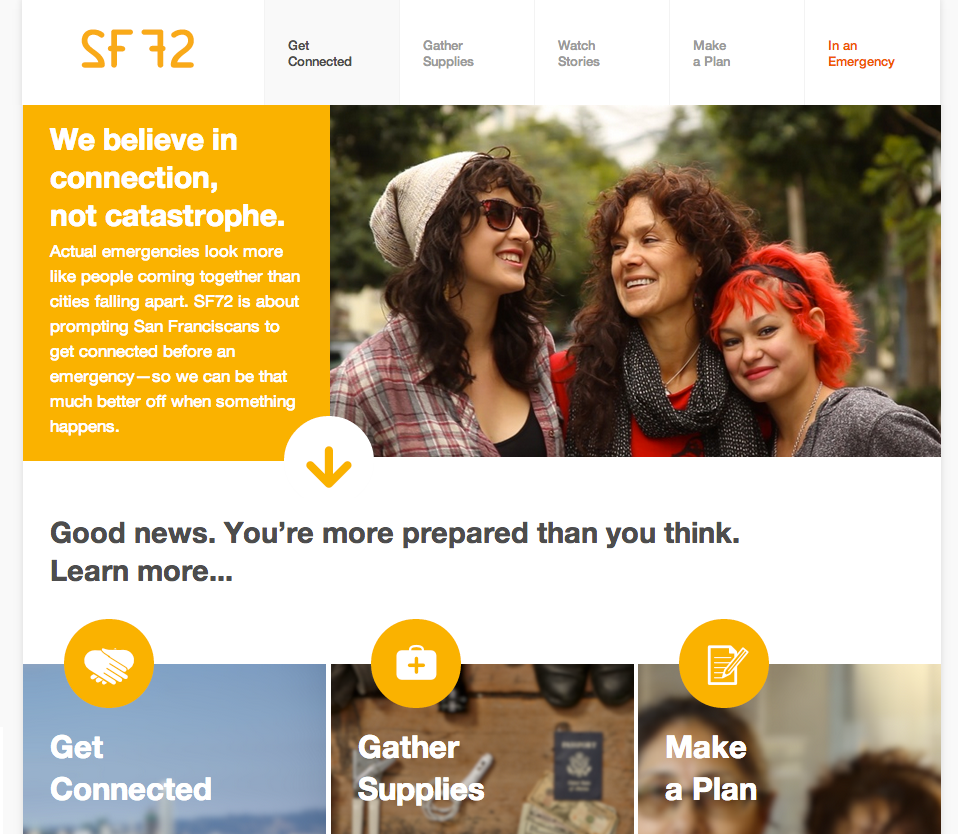
The SF72 website helps people with five important tasks: Get connected, gather supplies, watch stories, make a plan, and have access to an updated Google map. SF72’s content is hyperlocal, but IDEO and SF DEM also created an open-source toolkit for cities worldwide. From San Jose to Denver, other locales are using the simple toolkit to create a City72 platform of their own. Most recently, the city of Oakland collaborated with Code for America to develop its own platform. The City72 Toolkit enables SF72’s ethos of social connection for resilience to scale and grow—city by city.

Designing a global plan for disaster response
Creating a network that connects veterans across continents.
Team Rubicon, formed in 2010 as a response to the devastating earthquake in Haiti, is made up of former military veterans who swoop into help in times of disaster. The organization started with six vets in the US who were eager to transfer their battlefield readiness in to frontline relief efforts, and has grown to more than 28,000 volunteers across the world.
To explore its growing global effort and to shape the future of the organization’s venture, Team Rubicon approached IDEO for help. After an 11-week collaboration with government, military, and veteran groups, a vision for Team Rubicon Global emerged. Inspired by sources as diverse as TED and The Hell’s Angels, the three-tier model consisted of an anchor network to share best practices across the organization and two supporting platforms designed to help countries with varying capacity and needs.
Team Rubicon Global coordinated its first deployment in April 2015, when a quake struck Nepal, sending US and UK teams to double down on the rescue effort. According to Vince Moffit, Team Rubicon USA Incident Commander, that incident alone validated the network effect of IDEO’s work. “We couldn’t have done this without Team Rubicon UK,” he said.
And for the veterans who are part of Team Rubicon, the shared desire to serve—applying skills ideally suited for disaster response—creates a renewed sense of purpose, community, and leadership that helps reintegration to civilian life.

6 ways to design value into your membership model
Earning loyalty depends on delivering one of two types of value.
Some speculate that this rising tide might lift all boats, nudging every business to become a subscription business. But as the last six months have shown, the impact of COVID-19 has been unevenly distributed; winners and losers are determined by how favorable their offering is to the everything-from-home context. While all companies are working to make their products and services remote-friendly, this can obscure the fundamental question of how to design a compelling and intentional membership proposition, one that can endure and flex to exogenous shocks. In this article, we’ll explore six levers for designing membership and fostering loyalty right now and in the future.
A membership offering must accomplish either of these two things
There is no one formula for designing a compelling membership offering. But membership should be more than a basic loyalty program. It must offer either exceptional rational value or deep emotional value.
Rational value implies tangible benefits: customers know exactly what they’re getting from the offering, and it’s easy and straightforward to justify and explain their continued loyalty. Emotional value is intangible but at least equally powerful. While it may not be quantifiable, it creates genuine connection that generates sustained engagement and loyalty.
There are various levers—value drivers to design a membership offering around—that ladder up to and provide rational or emotional value. Cost, convenience, and incentives and rewards provide rational value; identity, community, and experience provide emotional value.

Designing for rational value: Cost, convenience, and incentives and rewards
LEVER 1: COST
One fundamental value proposition of a membership model is its ability to offer customers savings. By committing to a monthly or annual fee, subscription-based organizations can often afford to provide members with preferential pricing. This is the most basic element and value driver of a membership rooted in rational value.
One of the originators of the warehouse model, Costco offers members bulk quantities of goods at attractive prices. Costco prioritizes savings beyond other benefits, like high-touch customer service or an elevated store experience. And yet, Costco consistently receives top marks for customer satisfaction. They achieve this through an unwavering understanding and dedication to their key value proposition.
Costco has been able to sustain a successful business rooted in cost savings because of significant economies of scale, which help create barriers of entry for potential competitors. In many other industries, attempts to define and differentiate a value proposition on price and discounts will almost inevitably lead to brutal competition and eventual commoditization. Accordingly, companies considering cost as a membership lever must carefully think through the strategic and viability implications within their particular market.
Prompts for teams:
- Do your brand and mission align primarily with the idea of providing savings?
- Can you provide savings to customers while maintaining a sustainable business?
- What benefits will you not provide in order to deliver on cost savings?

LEVER 2: CONVENIENCE
As they say, time is money. As a source of rational value, convenience is as compelling as cost savings. In today’s convenience economy, technology is being leveraged to save time and effort in every market and pocket of daily life.
Amazon’s largest lever for rational value is the convenience it provides members. For an annual fee of $119, Amazon Prime members can get almost anything they could possibly need shipped to them in two days or (increasingly) less. This one benefit has allowed Amazon to forge a relationship with members that transcends loyalty to resemble something closer to dependence. This convenience proposition has become so powerful that it arguably provides members emotional value, too. Ask almost any new parent and they’ll probably rank Amazon somewhere between a utility and a member of the family. Providing rational value to such a degree that it also drives emotional value is a rare achievement, but demonstrates how impactful convenience can be.
Prompts for teams:
- How critical is convenience to the value proposition that you provide customers?
- What are the biggest challenges and bottlenecks your customers face in fulfilling their needs on a daily basis that your industry, market, or product area can help address?
- Can your company provide something to customers that they truly can’t live without?
LEVER 3: INCENTIVES & REWARDS
Incentives and rewards are often employed as part of membership programs to drive engagement and encourage specific behaviors such as sign-ups, spending, and referrals. They tend to be utilized in industries with limited differentiation, such as airlines and credit cards.
The credit card industry in particular has developed an incentives model that uses referrals, sign-up bonuses and points multipliers to drive customer acquisition and encourage early spending. This model has quickly become both the industry norm and customer expectation. In 2016, Chase made headlines by offering 100,000 points for its Sapphire Reserve card, the most extreme sign-up incentive the space had seen. Chase also won customer favor by simplifying the points to dollar value to 100:1, a calculation which many other credit cards obscure to make comparison more difficult.
There’s no denying the ability of financial incentives to drive behavior. But keep in mind, space for innovation is slim and an over-reliance on this lever runs the risk of creating a transactional relationship with the customer. Depending solely on financial incentives can also attract customers who are focused on “gaming” the system. Moreover, it creates an inevitable race to the bottom where eventually no player can viably compete. Balancing incentives and rewards with other rational or emotional value drivers can help mitigate these effects.
Prompts for teams:
- What is truly differentiating about the incentives and rewards that you can offer?
- How can you design your incentives and rewards to be less transactional and instead reinforce your core value proposition?
- How might you leverage incentives and rewards with other sources of value in your loyalty program?
Designing for emotional value: Identity, community, and experience
LEVER 4: IDENTITY
Some companies and brands are able to command loyalty through the strength of their identity, which is reflected in their brand, mission, or values. A membership rooted in identity is enabled when a company can rally customers around shared values and reinforce them through its offering, allowing members to see and express themselves through their participation.
One example is Ellevest, an investing platform for women that aims to educate, empower, and advance its customers in pursuit of their financial goals and to close the gender wealth gap. Ellevest differentiates itself from the many other investing options in the market through this dedicated focus, which is reflected in both its purpose and product—its algorithm recommends an investment plan that is designed to help address the gender investing gap.
In June 2020, Ellevest added a membership program to its core product that includes new features and services that strongly tie to their core mission. In addition to banking and debit products, the membership provides career workshops, coaches, and financial planners. While all of these benefits are designed to further members’ financial success, Ellevest is selling more than these services: they’re asking members to buy into their mission. An Ellevest member could receive similar products from any number of institutions. Being a part of the membership signals the salience of identity—both that it is key to the experience of managing money and an alignment of values.
Prompts for teams:
- What does your organization stand for and what are its most powerful, emotionally rich territories for design and differentiation?
- How can you tap into your organization’s mission or purpose as a way to create more emotionally resonant services and experiences?
- What would it look like to evolve the membership offering to reflect these values or enable members to express themselves?
LEVER 5: COMMUNITY
When community is a key value proposition of a membership, members not only feel connection with the brand, but also a sense of belonging and kinship with other members. From religious communities to career networks to social media, being part of a group creates powerful emotional currency.
WW, formerly known as Weight Watchers, is a company that has differentiated its membership offering through community. The organization’s promise is rooted in its origin story: a Queens mom who began inviting people into her home to discuss weight loss strategies. The concept quickly grew into a global organization that outlives various fad diets and health trends because of its core value: guiding people in their weight loss journeys through social and emotional support. Whereas before, every diet and nutritional program was designed to be undertaken alone, WW was designed to be interactive and communal through weekly group meetings. This structure provides people with support, inspiration, and accountability. The group convenes to share challenges and victories and provide each other with encouragement. The impact and effectiveness of this value proposition is reflected in WW's strong retention: many members continue attending meetings for years even after achieving their goal.
Prompts for teams:
- How authentic is the promise of community for your organization? Do members truly interact and benefit from other members?
- What is the role of exclusivity in your membership? Exclusivity is a powerful driver for people, but what does it say about your brand and what it stands for?
- How can you empower your community with roles, tools, rituals, and shared experiences?

LEVER 6: EXPERIENCE
Finally, there’s the element of experience, which can be a vague, squishy term that many companies claim to offer. People are drawn to memberships that provide unique, enriching, and inspiring experiences. An experience can be physical or digital, a product or service, communal or individual. While it can be delivered with pomp and circumstance, meaningful experiences can also be remarkably simple.
An example of an exceptional experience born out of a simple idea is SoulCycle. Interestingly, SoulCycle doesn’t technically offer membership; they sell individual drop-in classes or class packs. But with its cult-like following of diehard riders, SoulCycle certainly feels like a membership. The fitness start-up achieved this status through their distinct vision for what a spin class should be. The founders recognized that when exercising, people are looking not only for a physical release, but a mental one, as well. While most cycling classes focused on providing a great workout, SoulCycle designed an entirely different kind of ride: a collective, uplifting, and emotional experience that is as much a part of its value proposition as the sweat.
During COVID-19, SoulCycle has suffered, given its reliance on in-studio group sessions. By contrast, Peloton is soaring because it was designed to be experienced at home. As SoulCycle pivots to offer their own at-home bike, the way it evolves the experience to elevate its collective and emotional DNA will be crucial for success.
Prompts for teams:
- What are the needs that your experience is designed to serve?
- How can experience be a differentiating factor of your membership offering?
- What qualities define your experience, and how might you elevate or amplify the value they provide your customers?
The power of offering rational and emotional value
Cost, convenience, and incentives and rewards can be powerful sources of value in membership because they offer rational, straightforward value. However, because they provide limited dimensions for differentiation, they can lead to competition and be challenging to sustain. Designing around emotional tenets—identity, community, and experience—presents different starting points and opportunities for membership offerings.
But memberships that draw on more than one of these levers—particularly those that generate both rational and emotional value—will be especially effective. While Costco’s core value proposition is rooted in cost savings, its business provides emotional value, too, through its famous food court and food and beverage sampling experiences and additional services. This combination of rational and emotional value has proven incredibly compelling in both customer experience and membership proposition: Costco has some of the highest customer satisfaction scores and retention rates in the business.
Keep your purpose, mission, and value proposition top of mind
The six levers we discussed can individually, or more powerfully in combination, form the foundation of a differentiated, value-driving membership offering. But in any of these territories, companies must have (or earn) their customers’ permission to play.
At its core, membership demands an ongoing relationship and commitment from its customers. Designing membership for this level of loyalty boils down to both an organization’s value proposition and who they fundamentally are: What is the essence of what’s being provided through membership, and what does the company stand for? And critically, do these two things match—does the membership feel authentic to a company’s purpose?
By aligning purpose with a compelling rational or emotional value proposition, companies can cultivate reciprocally authentic and lasting customer loyalty.
Illustrations by Simon Heather
In the last decade, we’ve witnessed the explosion of subscription-based “membership,” from movies, music, and audiobooks to elite global communities, razor blades, and dog food. While this phenomenon has been fueled in part by the growth of digital channels, targeted marketing, and the rise of the sharing economy, what’s ultimately driving companies across industries to adopt a version of this business model is the irresistible promise of recurring revenue and sustained customer loyalty.
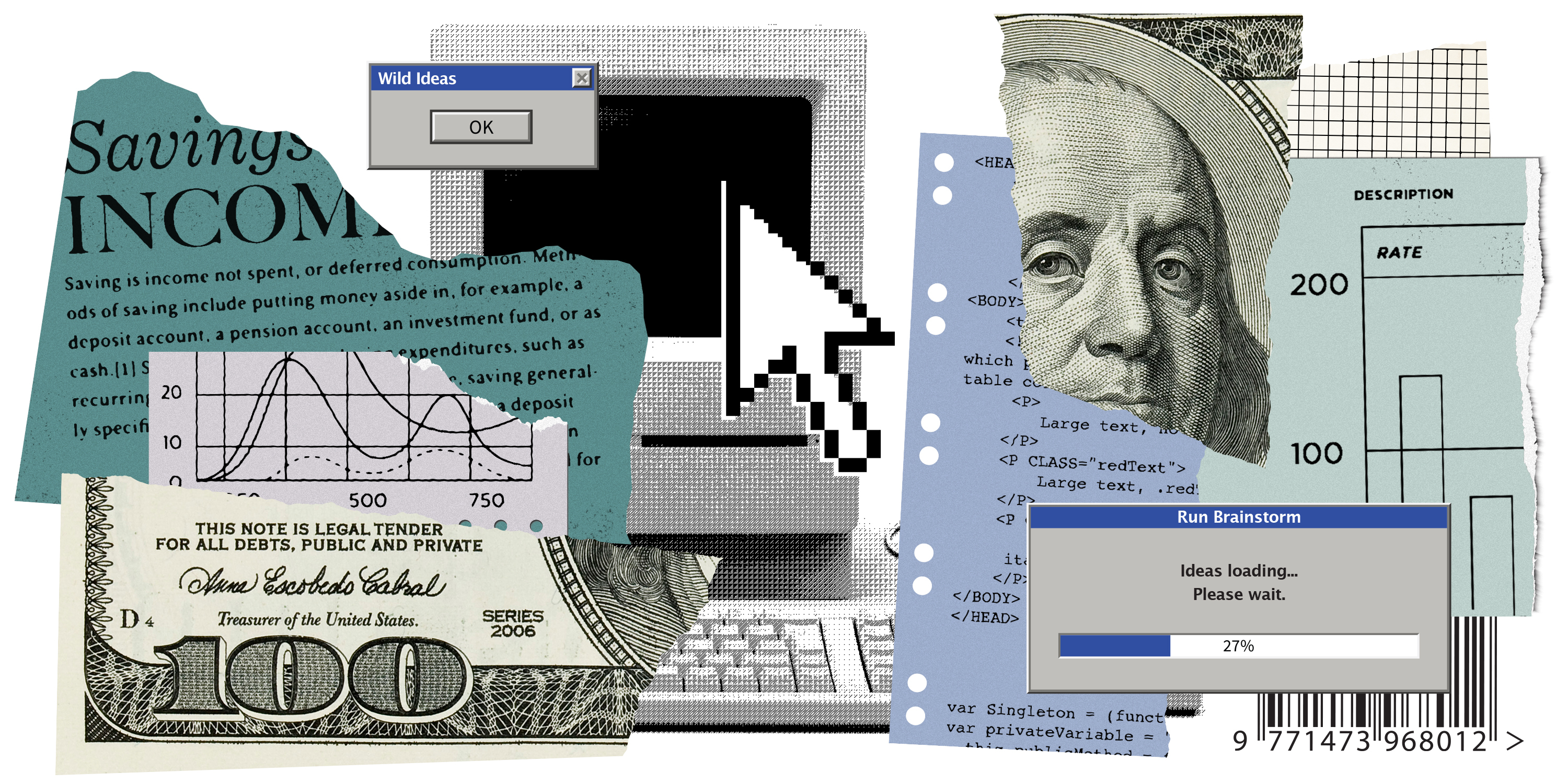
The Rules of Brainstorming Change When Artificial Intelligence Gets Involved. Here’s How.
Recent advances in machine learning have created a new catalyst for design
My “partner” that day was a technology called GPT-3 from OpenAI. You may have heard of it already; if not, you can think of GPT-3 as a really good autocomplete. Like, shockingly good. Once I shared some of the output of my brainstorm with others on Slack, there were plenty of 🤯reactions—and honestly, our minds are still blown. But clients and design teams will need to tread carefully and watch their ethical compass as they imagine inspiring, human-centered applications for this new tool. As with any new technology, there are new risks to account for. Here's how I started my experimentation.
How to run a virtual brainstorm
In order to work with a so-called “transformer model” such as GPT-3, you feed it a pre-written prompt, then the model uses everything it's seen before (in this case, a substantial portion of the internet) to guess what should come next.
I wrote some context: This is an IDEO brainstorm, which follows our 7 Rules of Brainstorming, including “encourage wild ideas.” I gave GPT-3 a real client challenge from a past project: The team is developing a new app for a bank to encourage millennials to better utilize savings accounts. Then I wrote a brainstorm prompt: How might we help young people turn saving money into a lifelong habit?—and fed it five example ideas.
As soon as I pressed submit, the model began churning out new ideas. Not all of them were gold, but many were perfectly good brainstorm concepts. After all, the rules also tell us to “defer judgment” and “go for quantity.” Without cherry-picking too much, here's a sample of some of the ideas it generated:
- Allow the user to share their saving goals with friends and have a community of people who will cheer them on or challenge them if necessary
- Reward the user with real money if they don't spend money at all in a month
- Allow the user to set up “fun budgets” (aka “triggers”) to save more money, e.g. whenever they go to Target, they'd get a pop-up asking if they'd like to put $5 towards savings
- Similar to the Future View idea, show how much more could be saved if the user decides to forgo a coffee every day or splurge on new sneakers instead of taking an extra vacation
In the last example, you can even see the model “build on the ideas of others”—another rule of brainstorming—by riffing on an idea called Future View that I had given in the prompt.
This stuff is on par or better than some of what I've seen from humans. Some [of it] is worse, too. But that anything is better is wild.
An IDEO Director on GPT-3's brainstorming output. Watch out, humans.
Another colleague suggested we tweak the prompt we gave GPT-3 to encourage it to use analogous inspiration, which primed the model to produce some truly wild ideas:
- Have “clowns” jump out of ATM's, making it less fun to withdraw money
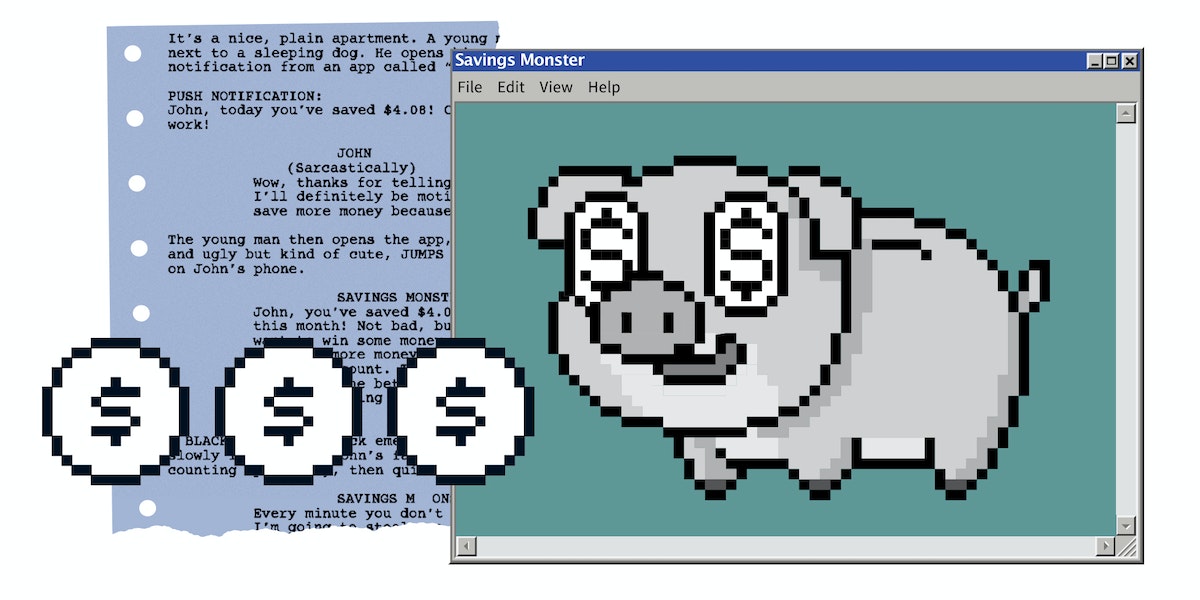
- Create a virtual reality experience where users are in an arena full of savings monsters, and need to slay them by depositing money into savings
- Create a “Savings Monster” similar to those featured on Chinese lottery shows where viewers have to guess the amount saved in order to win money
“I'd love to know what a Savings Monster is,” I mused on Slack, and a colleague responded, “Why don't you ask it?” Of course! After the brainstorm, I started a Q&A session with the model (my prompt is in bold):
Q: Quick question: What exactly is a savings monster? You mentioned it twice.
A: I'm glad you asked! This was just an idea that emerged from the brainstorm. A savings monster is a physical manifestation of your savings goal. For example, let's say I want to save $500 by the end of next year. If I deposit $10 every day, that will get me pretty close to my goal at the end of the year, but what happens if one day I don't have $10? Now my savings monster is underfed, and he starts to throw a tantrum (eg. negative cash flow notification).
A: Yes, this is an idea inspired by Chinese lottery shows (and World War Z). We thought it might be fun for users to have a physical manifestation of their goals that they could feed (ie. save more money) when they meet their goals, and starve (ie. spend more money) when they fall short. In order for this idea to work however, the savings monster would have to be very cute, and a bit terrifying.
As it turns out, the model doesn't skip a beat when you change up the input’s format. So I decided to try my luck: In my next prompt, I asked GPT-3 to choose its favorite idea from the brainstorm and create a script for a promo video. Thankfully my virtual brainstorm partner selected the Savings Monster concept. The resulting script was so good that I found an animator to bring it to life.
So what is this good for?
As exciting as this technology is, GPT-3 is not Artificial General Intelligence, and it was interesting to find the edges of its abilities. For example, this model can easily summarize a news article, or turn it into a fairy tale. But it's surprisingly difficult to get it to remove references to a specific person, or change the subject of a certain paragraph.
To put this in human-centered design terms, these large transformers are an extremely valuable way to augment the team during divergent moments in a project, when we're creating choices. The tech struggles, however, in convergent moments, when we're making choices. Thankfully, humans are still required to synthesize massive amounts of information about human needs into concrete human-centered design decisions.


Gotchas
There are two other issues we have to confront when considering transformer models for our prototypes and design recommendations: toxicity and bias. These models are trained on big chunks of the internet, and optimized to produce output that looks like the input. The result is that the model can reproduce the language of a scientific paper just as easily as it can mimic an internet troll. You get the good with the bad.
My experiments sparked a conversation with Jess Freaner, an IDEO Data Scientist with a special interest in ethics and AI. “Though the rules governing how it all works might not be explicitly written on the wall,” Jess told me, “being a product of our world as it exists now and in our past (the internet is an excellent, incomplete archive) we need to consider what GPT-3 reinforces and when it can reveal what needs to be subverted about society.”
Problems with toxicity and bias are not unique to GPT-3. OpenAI is working on both—they have built-in tools to manually and automatically flag output as toxic. They’re also working on the issue of bias, but it’s a thornier problem. These models literally encode a snapshot in time, and are inherently biased to reproduce the status quo. Companies and designers will need to question and problematize the output of these models with the same rigor that we are learning to bring to our human interactions.
Future possibilities
Despite the challenges, it's clear that in the past 12 months, natural language models have crossed an invisible threshold of usefulness, in the same way that speech recognition was frustratingly terrible for decades—until one day it wasn't. Early proof of concept prototypes demonstrate how this type of model can transform a description of an interface into functional UI code. Talk about “declarative programming.” Imagine a future in which the job of a UI designer is to write a description of the interface rather than laying out each button and label by hand. The same description might result in totally different visual expressions or interactions depending on the individual user's needs, interests, or current context.
As transformer models improve, I'm inspired by a future where people are literally in conversation with their software. Users might be able to easily adapt the same app to become a widget in their AR glasses, a quirky voice assistant, or an animated character. Because who knows: for some people, the perfect solution just might be a Savings Monster.
Illustrations by Katie Kirk
Back in early August, I opened my laptop and kicked off a remote brainstorm. Immediately, my partner started generating a huge number of ideas—a perfect blend of wild, hilarious ideas and pragmatic solutions. That's not unusual at IDEO, but what made it remarkable is that my partner wasn't just remote—it wasn’t human at all.

2020 Didn’t Go as Planned, but 2021 Is Coming Anyway
Here’s a tool to bring imagination to your annual planning process
In 2020, everything has been turned upside-down, and all budgets are starting from scratch. Planning for the coming year will be more ambiguous and uncertain than ever. It’s time to ditch the carry-over mindset, which can’t solve the complex and often competing challenges faced by business leaders today. What we need now is to broaden our perspectives and use imagination to project into the future.
Back in the spring, when it became clear that coronavirus would reshape the entire world in short order, we began tracking principles to help us focus on understanding context as it evolves, having a clear vision for successful recovery, rebuilding for resilience, and designing through collaboration.
As we spoke to clients and business leaders within and outside of IDEO, we saw the opportunity to develop a tool that would help leaders plan with imagination for the tumultuous road ahead. We were inspired by the Early Recovery principles used by the United Nations to respond to crises or natural disasters. Early Recovery helps people and societies "build resilience and establish a sustainable process of recovery from crisis."
We’ve adapted this concept into a framework for organizations to use in planning the coming 12 months. The Build Back Bolder canvas offers a simple template for reflection, and a series of short exercises designed to help set strategic priorities and initiatives, and to uncover opportunities for growth and impact in the midst of fluctuating conditions. Build Back Bolder is a straightforward, two-page tool that business leaders can run alongside their own planning processes. It can help leaders and teams make sense of the present, get out of analysis-paralysis, and move towards action. Simply put, the Build Back Bolder canvas helps you think, and that helps you plan.
Circumstances don’t get much more ambiguous and uncertain than the ones we’re living through now. In moments of crisis, when markets are redefined, imagination rarely leads the day. But this instability calls for a more varied and experimental suite of tools. Change is inevitable, but using imagination is not. By choosing an imaginative approach, we can plan for a more resilient, bold, and sustainable 2021.
Download the Building Back a Bolder 2021 tool here.
Illustration by Charlota Blunarova
In typical years, there’s a continuity to the annual planning process. Changes are incremental. Many budgets that were approved the previous year are simply carried over. Not so this year.

Capitalism Needs a Redesign, but Where Do We Start?
Leaders share what they're doing to address systemic challenges
To fix big, systemic problems like inequality and climate change, many called for rethinking how companies generate value and who they generate it for—from shareholders, employees, and customers to partners and the planet itself. This wasn’t just a moral argument that business ought to “do the right thing.” The movement was anchored in an existential understanding that radical forces are changing not just the rules of the game for business, but the game itself.
The multilayered crises we face today offer a powerful moment of reckoning for purpose-led businesses and leaders: will we make good on this rallying cry for a reimagined capitalism or not? The pandemic put stakeholder capitalism to the test: a report funded by the Ford Foundation found that companies that had signed on to the “Statement on the Purpose of a Corporation” fared no better than other top companies in prioritizing worker rights. Though there is clearly the opportunity and will to rethink the purpose of business to address systemic problems, the way forward is often less apparent. Understanding where to begin can help us realize the more equitable promise of stakeholder capitalism.
I’ve long been curious about how forward-looking companies have jumped over this hurdle, so I’ve spent this year learning from dozens of movers and shakers already in the thick of tackling systemic changes, from professors and CEOs to founders and non-profit presidents working across sectors and industries. They’ve shared with me the first steps that helped them break the initial inertia of business-as-usual—and, importantly, the mindsets they’ve adopted to sustain new kinds of activity. I hope their wisdom will be as inspiring for you as it has been for me.

First steps
Set bold targets and innovate your way to reaching them
Even if they don’t know where to start, the changemakers I’ve talked with have put a stake in the ground and set bold targets. But they don’t rely on a big PR splash and then move on: alongside these bold goals is a commitment to a process of brave experimentation and innovation.
The Swedish furniture retailer IKEA, for example, has committed to becoming a fully circular company—one that is restorative and regenerative by design—by 2030. To make good on this future, they’ve invested in a range of experiments, prototyping smaller-format shops in city centers that rely on fewer resources, electric vehicles for home delivery, new products like home solar systems, and buyback and rental programs to reduce waste, among others. Taken together, these many activities are moving IKEA closer to their ambitious goal. But they’ve also enabled fast learning and iteration, so that when the company chooses to scale any of these solutions they have the greatest impact for their investment.
From this example and others, a common method is emerging for how companies can use their scale to unlock change at a systems level: commit boldly to an outcome, design a number of experiments, learn and iterate quickly, and scale what works. Spoiler alert: It’s not going to be one thing.

Create a coalition of partners around a tipping-point problem
From homelessness to climate injustice, our challenges demand unprecedented collaboration across sectors. The UN Sustainable Development Goals provide a powerful framework to rally around, but there are other emerging partnership models that leverage the capital investment, innovation muscle, and ability to scale that corporate partners often uniquely bring to the table.
Take the NextGen Consortium, for example. Managed by Closed Loop Partners and powered by OpenIDEO, some of the most powerful food and beverage companies (including Starbucks, McDonald’s, Wendy’s, the Coca-Cola Company, Yum! Brands, Nestlé, and WWF) are collaborating to create a new cup that will curb the 250 billion fiber cups piling up in landfills each year. The approach of this coalition has been to enable many breakthrough solutions, working directly with founders and stakeholders in the system, to take root in the market.
There are many other examples of convenings—whether official or unofficial—and the power of rallying partners around a shared challenge. Founded by Sam Polk, Everytable is on a mission to bring healthy, affordable food to communities that do not have readily available options. Polk grew Everytable to eight locations and delivered 160,000 meals just a few weeks after launching. Through a philanthropic initiative led by the California government, Everytable partnered with a hotel offering shelter and protection to the homeless during COVID to provide food, eventually facilitating additional partnerships with elder care homes. Everytable is now on track to deliver a million and a half meals, and they’ve added jobs along the way. As Jacqueline Novogratz, CEO of Acumen, shared with me, this is an example of business, government, philanthropy, and individual volunteers, leaders, and donors uniting and busting siloes to address hunger.

Define key performance indicators (KPIs) for stakeholder groups
Despite its recent buzziness, the stakeholder perspective—a fundamental commitment to all stakeholders, including customers, employees, suppliers, communities, and shareholders—is not a new idea. Many companies already consider multiple stakeholder interests in their decision-making. But the problem with stakeholder capitalism as it exists today is that it doesn’t offer a clear compass for how to make decisions in complex scenarios where win-win outcomes for all parties are rarely possible. This brings us to the elephant in the room: not all stakeholders are created equal. Leaders are often forced to pick favorites, and at the end of the day, we know who will always win.
To address this, companies like Airbnb are beginning to hold themselves accountable to new stakeholder-centric metrics. Airbnb sees their stakeholder community as made up of guests, hosts, communities, shareholders, and employees. Their design challenge—Rob Chestnut, Airbnb’s Chief Ethics Officer, told me—was to create a company that measures itself against the value it creates for each. Airbnb began by listening to these groups, establishing principles and metrics reflecting the needs of each. For example, they have committed to treating hosts like partners, and measure their delivery of this through survey data evaluating hosts’ satisfaction and earnings over time, among other things. Airbnb reports their progress and continues to update their corporate governance and compensation to reflect delivery against these KPIs.
This approach isn’t perfect. But doing the work of measuring the value you create with and for stakeholders and institutionalizing accountabilities for delivering that value is certainly a step in the right direction.

New mindsets
Allies over heroes
When it comes to business’ role in the big problems society faces, they are often cast as either heroes or villains. Some see capitalism as society’s savior, especially when governments have seemingly abdicated their responsibility to serve citizens’ best interests. Others see capitalism as society’s villain, the cause of many of its major problems like climate change and inequality.
The leaders I’ve interviewed reframe the discourse entirely. They know that systems change requires bringing together key actors—local communities, nonprofits, governments, businesses, donors, and others—to address unjust systems and solve social problems at scale. So, they see their organizations as meaningful allies in the work of change-making, adopting a partnership-as-leadership approach to their engagement in these issues.
“Greyston’s founder Bernie literally started pulling people off the streets to work for a small cake-baking business he had started to address the problems he saw in Southwest Yonkers...Just as the bakery started growing, [Greyston’s founder] Bernie met two guys named Ben and Jerry. Our relationship with Ben & Jerry’s started out as a serendipitous one, but it’s held steadfast as a strong partnership over the years and has enabled us to employ more folks who would normally be deemed excludable, non-employable.”
—Joseph Kenner, President and CEO, Greyston Bakery
“Cooperation among investors is a key to this progress. More than a third of the world’s invested capital—about $19 trillion—is controlled by the world’s hundred largest asset owners…In principle these investors have enormous power to move the entire economy in more sustainable directions. All they have to do is find a way to cooperate...The rumor is that they look at each other and say, “You go first.”
—Rebecca Henderson, Professor, Harvard Business School and author of Reimagining Capitalism in a World on Fire

Gardeners over architects
As the pandemic unevenly distributes pain and suffering across our society, it’s ever more clear: true systemic change requires a shift in power. That means that a top-down approach to change just won’t work to produce the equitable outcomes we need. We need new voices with new ideas to reimagine our economic system. Personally, I’m inspired by the small business owners who have reimagined the role businesses might play in neighborhoods through creative pivoting—like restaurants now offering CSA boxes and large family meals while their dining rooms are closed. Or Black communities that were forced to develop regenerative economic strategies decades ago, long before these concepts penetrated white-dominated corporate worlds.
These are the imagineers of a more resilient, inclusive, and sustainable society for everyone, and the leaders I’ve learned from believe this, too. Their job, as they see it, is to find the seeds of ideas and nurture them. They play the role of gardener, but instead of a green thumb they have a green ear, tuned to listen and learn.
“We were open to new ideas from anywhere and created new mechanisms to source them. Part of our mantra was the conviction that all the good thinking doesn't come only from people sitting on Fifth Avenue in New York City. We ran competitions, we did global innovation challenges, and we learned a lot from what was going on on the ground.”
—Judith Rodin, Former President, The Rockefeller Foundation
“Purpose is obviously about how a company acts, but it’s also about how they listen.”
—Maryam Banikarim, Chief Marketing Officer, Nextdoor
“And so it's going to be up to the rest of us in the conversation to hold those people’s feet to the fire—to make sure that as we are reimagining capitalism we are reimagining it to actually work for all. And part of that is by creating systems that are actually inclusive and equitable and regenerative because only those things will dismantle a version of capitalism that is just for the elite.”
—Andrew Kassoy, Co-founder and Global CEO, B Lab

An audacious question over an assumption about the answer
Rather than start with an assumption about the right solution, these leaders begin with an audacious question. What, for example, would it look like to be a fully carbon neutral company by 2030, asks IKEA? Melinda Gates’ Pivotal Ventures asks what would a future look like if women’s power and influence was equal to that of men?
By starting with a question instead of an answer, these individuals are searching for far more imaginative solutions. This is how radical breakthroughs happen.
“Business has a huge role to play in designing our future. They can do this by first, stepping back and asking, what are the problems that need to be solved? And how can we make that the purpose of our business? Start with that problem. Then, look at the different stakeholders you engage with and rethink how we might come together around that problem...This is moral imagination—the humility to see the world as it is and the audacity to imagine what it could be.”
—Jacqueline Novogratz, Acumen’s CEO
“For the big briefs we face, we need questions that open up new possibility. We don't need the obvious questions — we’ve got plenty of those. We need questions that reframe how we think about some of these systems, ones that change our perspective.”
—Tim Brown, Chair and former CEO, IDEO

The work of changing systems is hard. Taking any of these first steps might require you to flex new muscles, fit yourself into a mold that isn’t quite perfect, or develop new collaborations that might not go seamlessly. Likewise, adopting any of these mindsets might clash with your business-as-usual culture and process. It’s not for the faint of heart. And yet, we can’t move forward—on equity, on the environment, on social cohesion—unless we roll up our sleeves, start redesigning our organizations, and make room for the voices most affected by these systems. So let’s take some first steps, and prototype them together to help push this work forward.
Before the coronavirus pandemic, the promise of a reimagined purpose for business—one that serves a diverse set of stakeholders and society more broadly—had bubbled into mainstream industry discourse. From boardrooms to business schools, a growing chorus argued that our economic system is not only unable to respond to the world’s most urgent challenges, but has excluded many people from the prosperity capitalism promises.

Lindsey Turner
I’m passionate about building brands, products, and experiences that help organizations show up with meaning and momentum.
I help organizations cut through complexity by shaping how they show up, through brand strategy, identity, and storytelling.
Working at the intersection of brand and business, I bring an editorial eye and a bias toward making—turning ideas into tangible experiences that people can understand, trust, and believe in.
My work spans government, healthcare, financial services, media, and consumer goods, from launching Gen Z-focused ventures to building innovation labs and reimagining legacy brands. I relish moments of ambiguity and enjoy translating across teams, perspectives, and priorities to move ideas forward.
I started my career in editorial and digital design, shaping cross-platform experiences and identity systems in publishing and agency environments. That foundation still shapes how I work today: I’m detail-oriented, collaborative, and overreliant on the Oxford comma. I hold a BFA in Visual Communication from the School of the Art Institute of Chicago.

Rachel Young
My work helps organizations see who their products aren't working for—and build the will and the tools to do something about it
For 25 years, I've asked the same question: Who does this design exclude—and what are we going to do about it?
My work spans human-centered strategy, inclusive design, and qualitative research, with clients ranging from Microsoft, Google, and Verizon to the National Science Foundation, and San Francisco Unified School District.
Before IDEO, I taught elementary school in East Palo Alto and spent a decade doing design work with social service organizations—where I learned firsthand what it costs people when systems are built without them in mind.
I am currently writing User Error, a nonfiction book about digital access and the design decisions behind it. I live in Oakland, California.

Brian Pelsoh
I lead with craft, ensuring our work is creatively excellent: rooted in deep human insight and imagination, while also grounded in the realities of business and technology.
My expertise spans brand, communication, and product design across tech, education, the arts, and social impact.
I believe great work demands both high-level vision and obsessive attention to detail, and only happens through collaboration.
I bring an inclusive, hands-on approach and a deep understanding of business, which enables me to consistently deliver excellence while always asking why.
Before joining IDEO, I worked at the brand firms Pentagram and VSA Partners. I began my career as a designer, leading teams at the School of the Art Institute of Chicago and the Milwaukee Art Museum. I hold an MFA in graphic design from Maryland Institute College of Art and a BFA in communication design from the Milwaukee Institute of Art & Design, and have taught at some of the best design schools in the US.

Tony Wong
I am responsible for IDEO’s long-term success in China and working with clients to use design as a tool to enable growth.
I am responsible for IDEO’s long-term success in China and working with clients to use design as a tool to enable growth. Specifically, I have helped Chinese companies design holistic brand solutions through the development of their products, communication, services, and innovation teams, and I have helped multinationals expand their presence and influence in China.
I advise global leaders on developing China-led innovation and capabilities.
In over 15 years in IDEO Shanghai, I have worked on projects that use design to elevate the quality of the experience of healthcare products and services, streamline processes that increase productivity, create spaces and programs that promote and enable inclusive communities, and build next generation mobility solutions that are planet-positive.
Before joining IDEO, I worked at Philips Electronics and the Electrolux Group in Italy, the Netherlands, and Singapore on a number of breakthrough commercial products. I am a member of the Young President Organization in Shanghai.

How to use AI as an editor, not a writer
Ed White shares how he uses AI as an editor—not a writer—to sharpen storytelling, rehearse ideas, and preserve the productive friction that makes creative work better.
Ed White has a rule he's tested on his own writing: hold yourself as the writer, and let AI be your editor. Ed is a Senior Design Director at IDEO's London studio, where he co-leads the firm's AI portfolio across Europe. Before IDEO, he spent 12 years as a writer and editor at the Financial Times, Wired, and Contagious. So when he talks about when to use AI for storytelling and when not to, it comes from two decades of crafting his storytelling skills.
In this episode, Mina Seetharaman talks with Ed about two specific tools he uses to keep AI in an editor's seat: a "roasting agent" prompted to critique his drafts without any sugarcoating, and a simulated audience he rehearses pitches on before the real thing. They also get into what Ed is hearing from design leaders at Anthropic, Lovable, Shopify, and Google Creative Lab about how creative work is changing, and why he thinks the friction of writing something yourself is worth protecting rather than automating away.

Building a personal AI for the messiness of life: Sida Li
Becca Carroll talks with Cue co-founder Sida Li about designing a personal AI for the messiness of everyday life—not just work. They explore how Sida stays anchored to human needs while navigating fast-changing technology, product tradeoffs, business-model experimentation, and the realities of building an AI company today.
Most AI products today are built for work—a space with clear problems and established systems. One founder noticed a gap: personal life is messier, harder to systematize, and mostly left behind by the AI boom. So she built Cue, a personal AI that lives inside iMessage and group chats, to go where the other tools haven't.
In this episode, Becca Carroll, IDEO's Chief Strategy Officer, talks with Sida Li, co-founder and CEO of Shared Context Lab, about staying anchored to a human need while the technology around her keeps changing shape, why she treats her business model with the same rigor she'd bring to a product, and what it feels like to build a company at this particular, disorienting moment in AI.
The conversation also gets into how Sida makes design decisions: the language Cue uses to describe itself, the tradeoffs behind building inside iMessage instead of a new app, and a real story about a business idea that didn’t pan out.
This is the second in a two-part series profiling founders from IDEO's Startups-in-Residence program. The first conversation is with Johannes Seemann, founder of Sooner, on designing GenAI for the emotional side of money.

Designing GenAI for the emotional side of money: Johannes Seemann
Designing financial tools around the feelings that shape money decisions.
Most personal financial tools are built to run the numbers and optimize towards a budget. While that works for some, most people experience money as a lived relationship that does not neatly fit into a spreadsheet. Johannes Seemann and Becca Carroll discuss why money is emotional before it is mathematical, and what a human-centered approach to building a generative AI financial product looks like in practice.

The curious leader's edge in uncertainty: Scott Shigeoka
How genuine curiosity helps leaders navigate uncertainty with greater confidence.
Mina Seetharaman talks with Scott Shigeoka, author of Seek and Head of Curiosity Cultivation at the Eames Institute, about what distinguishes genuinely curious leadership from performative curiosity, how power dynamics shape curiosity, and why practicing curiosity can restore energy rather than drain it.
Looks like you might be in search of something very specific?
Or reset the filters above and try another angle.
Here’s some random inspiration

Podcasts about creative leadership

Articles about the power of prototyping






















.webp)