
.svg)



Better sales, less waste
H&M transforms its operations to cut excess inventory.
Globally, the European Commission reports, a truckload of textiles heads to landfills or is incinerated every single second.
The fashion industry accounts for some 10 percent of greenhouse gas emissions worldwide.
Less than 1 percent of the materials used to make clothing is recycled, according to a report by the Ellen MacArthur Foundation.
The best way to keep clothes out of a landfill? Don’t make them.
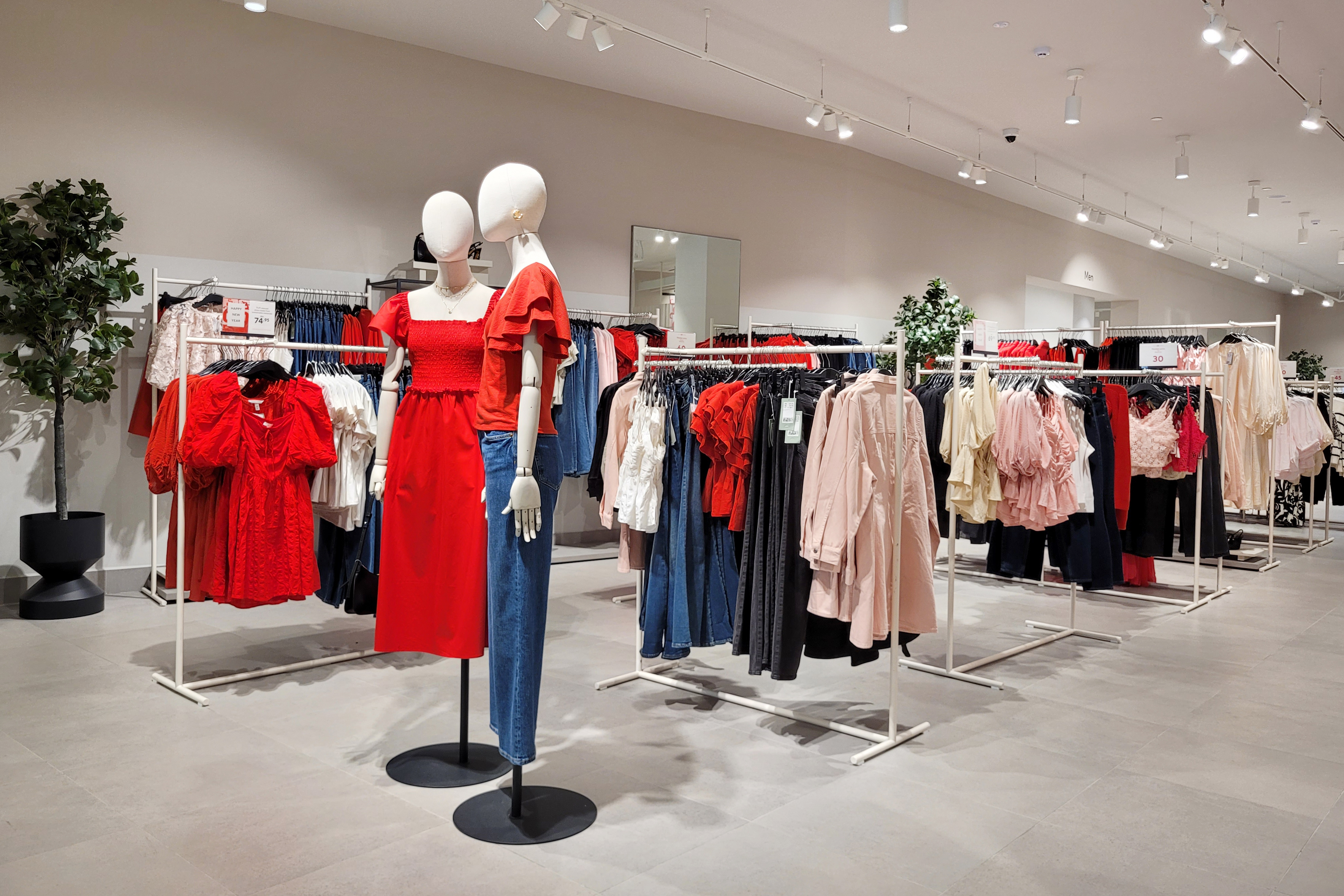
Picture this: Not long ago, it wasn’t unusual for a customer to walk into an H&M store and not be able to find a basic white t-shirt in their size. Why? Like most long-established retail operations, H&M was operating with a push model—placing seasonal bets on what the demand for a given item of clothing might be, locking orders far in advance, and hoping that they were able to sell out. Make a mistake in that kind of model, though, and you can end up with customers unable to find the basics they rely on, or excess inventory you can’t sell. That’s a problem for the business, but for the environment as well—and one that doesn’t fit H&M’s aggressive sustainability goals.
Though H&M had tried to tackle the problem before, the launch of the H&M Group Design Studio, co-created with IDEO, gave the retailer the confidence to go after it again. The team started out by mapping out the complex network of people that make up its supply chain across the globe, meeting with everyone from designers to garment suppliers, logistics managers, and even folks selling the final product in H&M stores.
They then created an algorithm for more precise ordering, as well as a tool that provides a shared view of information. Instead of placing orders, the new automated flow—dubbed “Cruise Control"—allows staff to work with a demand forecast that gives them more time to focus on customer-centric operations, like providing guidance and inspiration. It also makes it easier for H&M to follow the demands of the market, and place much more accurate bets on what consumers will want, when. Already, H&M has significantly increased sales while cutting excess inventory—a result that improves its bottom line, as well as its environmental impact.
Estimates project that by 2030, global apparel consumption will hit 102 million tons.
22%
reduction in stock during a pilot program
34%
increase in sales during a pilot program
Fueling innovation in Boston
How the Boston Society for Architecture is leveraging member expertise to increase its impact.
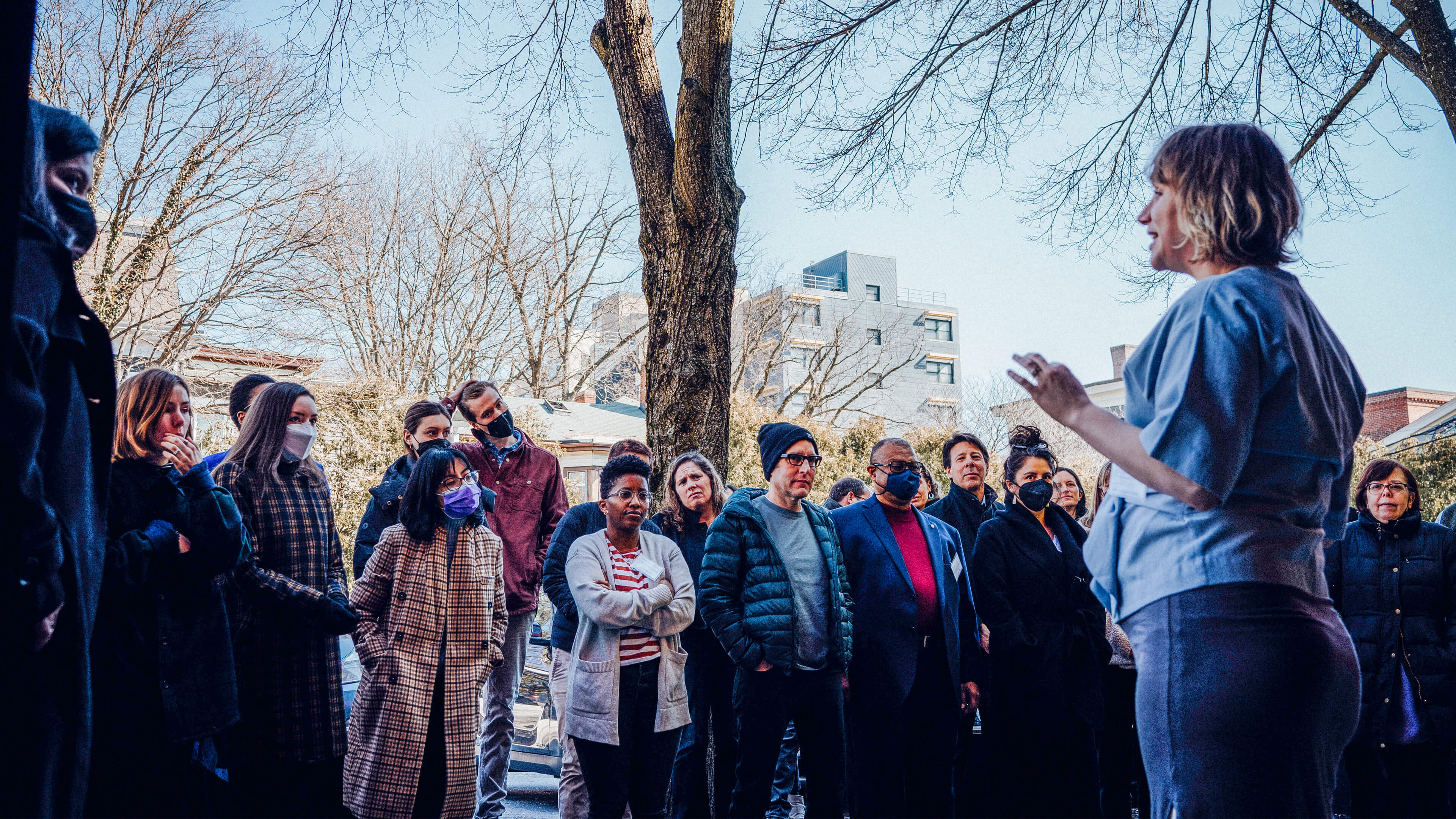
To foster creative projects that spoke to the needs of local communities and environments, the BSA began to engage its members in collaborative, user-led design. The organization launched its first-ever innovation challenge, putting out a call for all members to pitch their ideas for projects in the built environment.
The BSA expected those pitches to have dollar signs attached. To the organizer’s surprise, only one asked for funding. The rest requested less tangible, but equally meaningful support: advice, connections, specific expertise. Those are resources that the BSA has aplenty, but hadn’t learned how to leverage well.
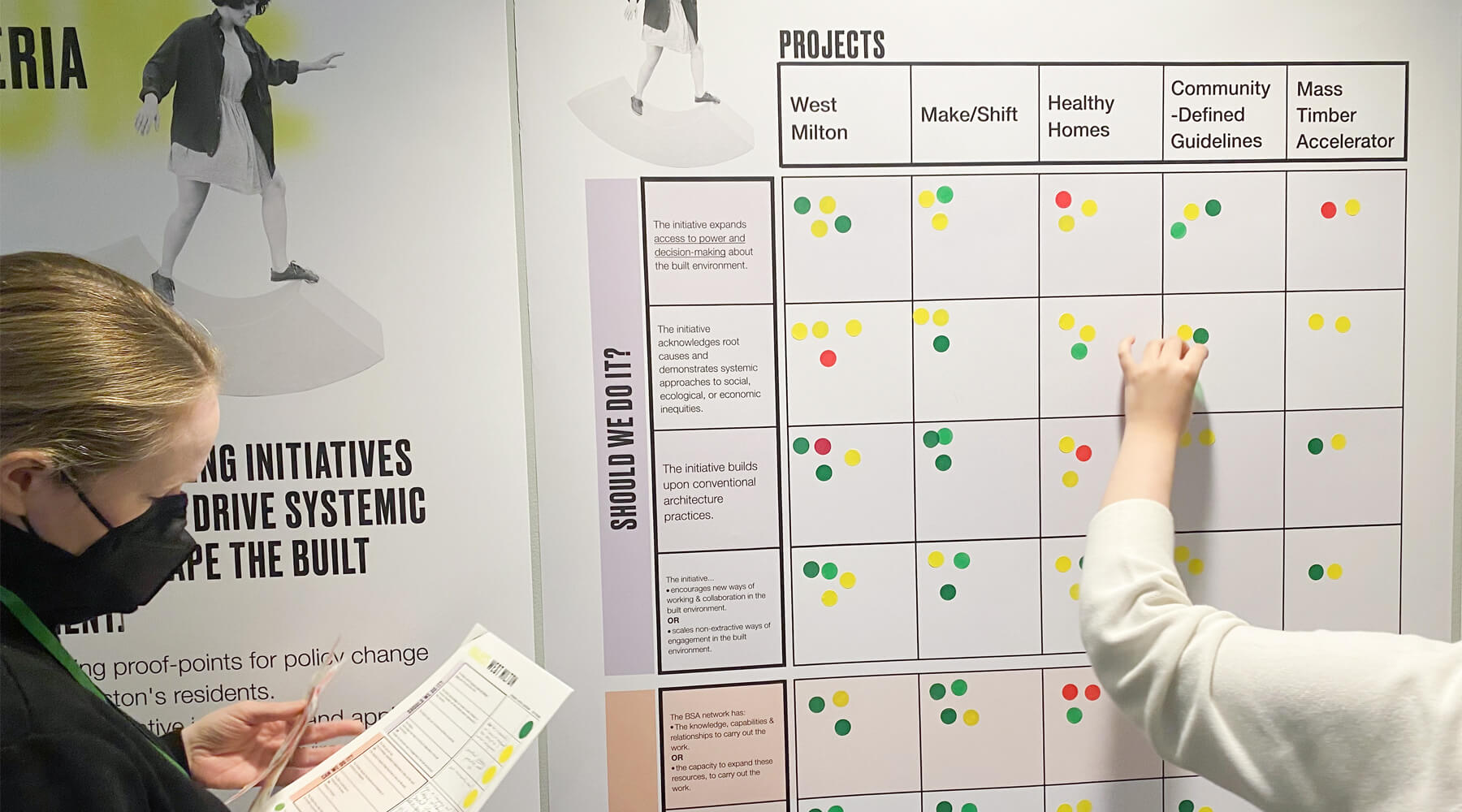
From that first go at an innovation challenge, the BSA learned how to better support its members. It also learned that to lead with purpose and make strategic choices, one must develop the confidence to say no. Instead of spreading itself thin across many projects, the organization decided to take small steps, focusing on one initiative at a time, so that it can deliver focused impact and stay true to its evolving mission.
With 36% of global energy going to buildings and 8% of global emissions caused by cement alone, the architectural community is inextricably intertwined with both the causes and solutions related to climate change.
According to a survey conducted by the AIA, the architecture profession in the US is less diverse than the population as a whole. This lack of diversity can contribute to a disconnect between architects and the communities they serve.
31
submissions received from innovators in the Boston region working on equity and sustainability challenges
5
innovation teams invited to pitch ideas
Student-centered solutions
How an organizational culture change is helping newbies at NYU navigate campus life.
The resources that NYU students needed were organized by administrative department, and buried on disparate websites and calendars. But students don’t think in terms of departments—they just need to know where their classes are.
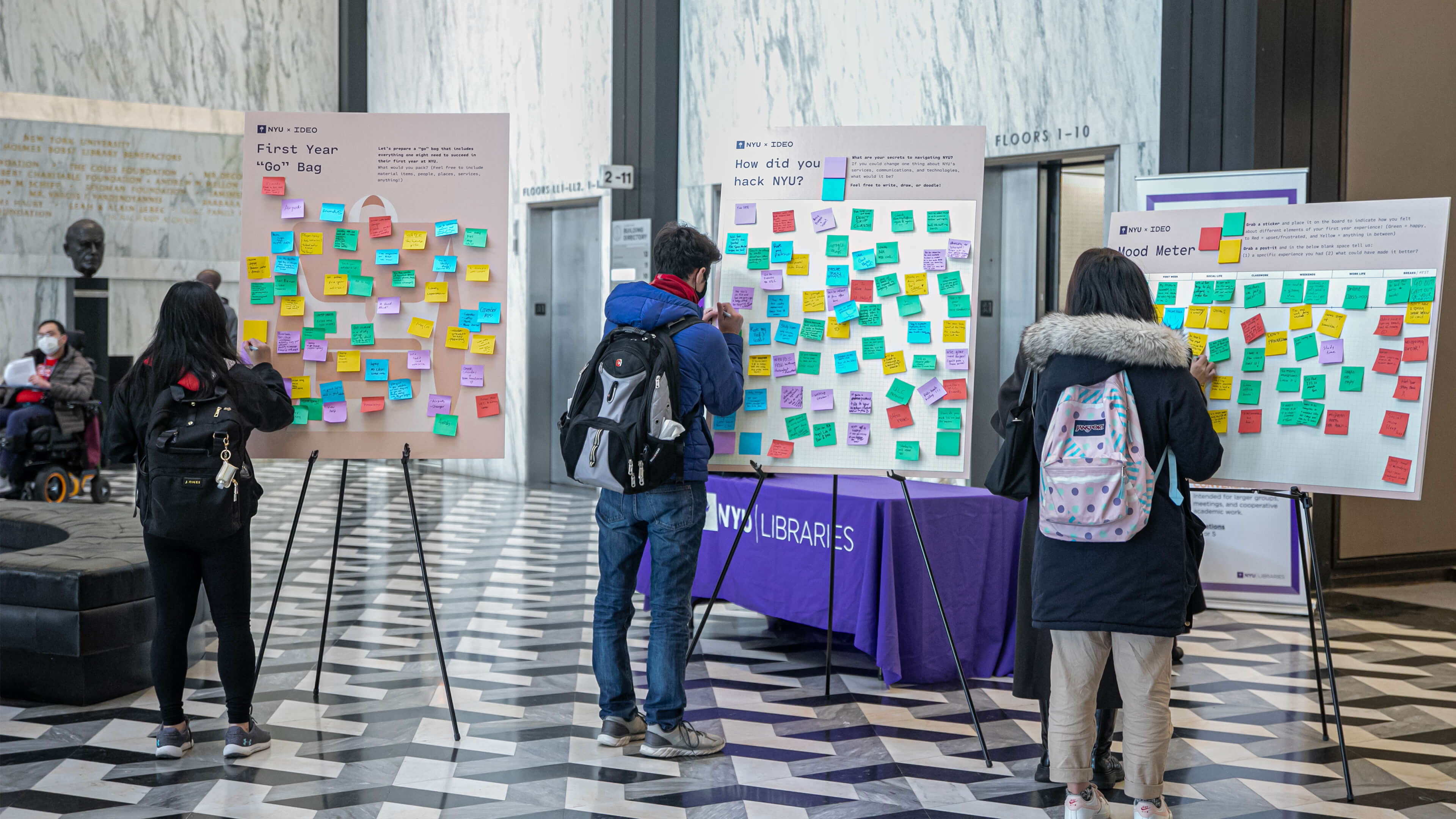
All of this became patently clear as IDEO shadowed students. Team members visited classrooms, walked with them through their days, and hosted pop-ups in highly trafficked areas to get ideas from passersby. That helped the team develop a common understanding of the overall student journey and grounded employees in the key moments that can either make or break a student’s experience. Visualizing their journey helped departments gain a shared understanding of the fractured communications challenge and develop possible solutions.
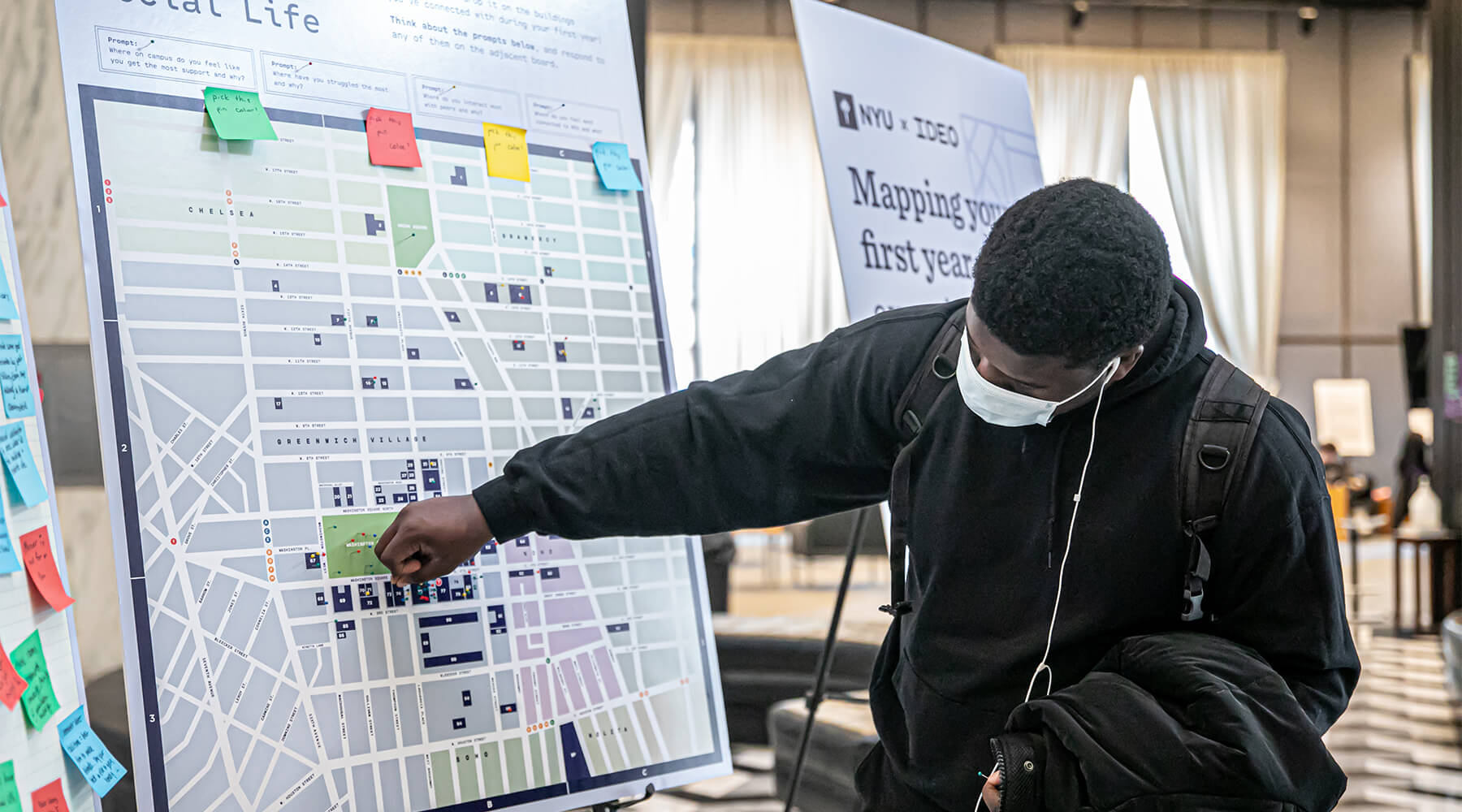
To synthesize those insights, we formed cross-functional action learning groups, challenging existing practices at the university and coming up with new ways of working. Participants came from a diverse set of departments, including enrollment management, student affairs, marketing and communications, IT, global inclusion, student services, the provost’s office, digital communications, and more. The cohorts sketched early hypotheses and got feedback from faculty, administrators, and students from all of NYU's undergraduate schools to refine initial concepts.
Collaborating with students gave staff a first-hand look at what students were struggling with and a way to engage students directly in addressing those challenges. Just as importantly, there was an overall culture shift at NYU: Administrators started with questions instead of agendas, came together around a table, and reached beyond their job descriptions to meet the needs of students.
First-year students reported receiving hundreds of paper forms, and email from more than 70 unique senders.
NYU needed to offer students the right resources at the right time—and collaborate to serve them as a unified administration.
New services
in-production include centralized calendars, dynamic campus mapping, and customized notifications
Design-thinking cohorts
now support the student experience
She knows best
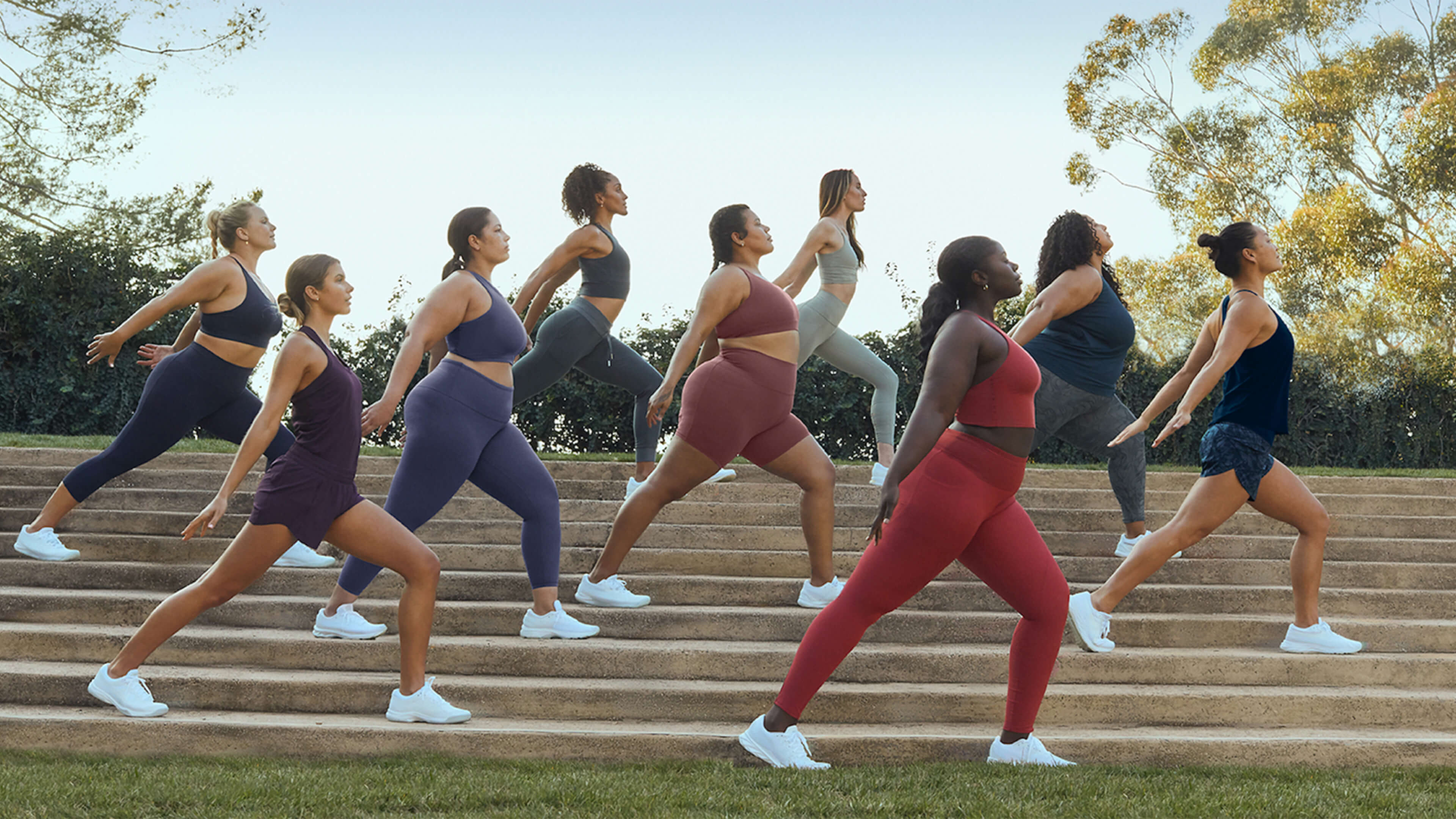
A major athleisure brand passes the mic so women can define community for themselves.
Diversity alone isn’t enough—in marketing or any other facet of business. Today’s brands must authentically engage with and create the conditions for co-design with existing communities.
That sort of deep, meaningful engagement with customers doesn’t happen over Instagram. It requires a playbook, a prototype, and a healthy amount of trust. So, IDEO worked with Athleta and Gap to tap into the wisdom of a council of women who represent intersectional identities and lived experiences. The council surfaced powerful insights for the brand, like the fact that active women don’t need a brand to empower them—they already feel powerful.

After only a few weeks, Athleta experienced the difference between research and a truly reciprocal relationship. The way their brand engages with communities is adding depth, understanding, and authenticity to Athleta’s content, products, and experiences. And women can feel the difference.
76% of US adults say that the media promotes an unattainable body image for women.
Fewer than 1 in 10 businesses review for inclusion as part of product design and marketing campaigns.
>2X
user growth in 2022
13,000+
Athleta WellPro well-being providers active on the platform
What’s in my Moleskine: Ashley Holtgraver
A look into the lives of complicated women
I’ve always loved drawing. I had cool, encouraging parents who’d do things like let me draw an invitation to my 6th birthday party, then go make copies of it so that I had personalized cards to send out.
I remember discovering my mom’s college sketchbook in the basement when I was a teenager, and feeling like it gave me a window into who she was at that time of her life. I started keeping sketchbooks in 10th grade, and have managed to hold on to almost all of them since then.

In my career as a programmer, I live and work inside my computer screen. My professional body of work can sometimes feel so ephemeral—everything I’ve ever made could be wiped out by a really strong magnet. So it feels really nice to have some solid, double-layered bookshelves and bins full of sketchbooks to step back and look at sometimes.
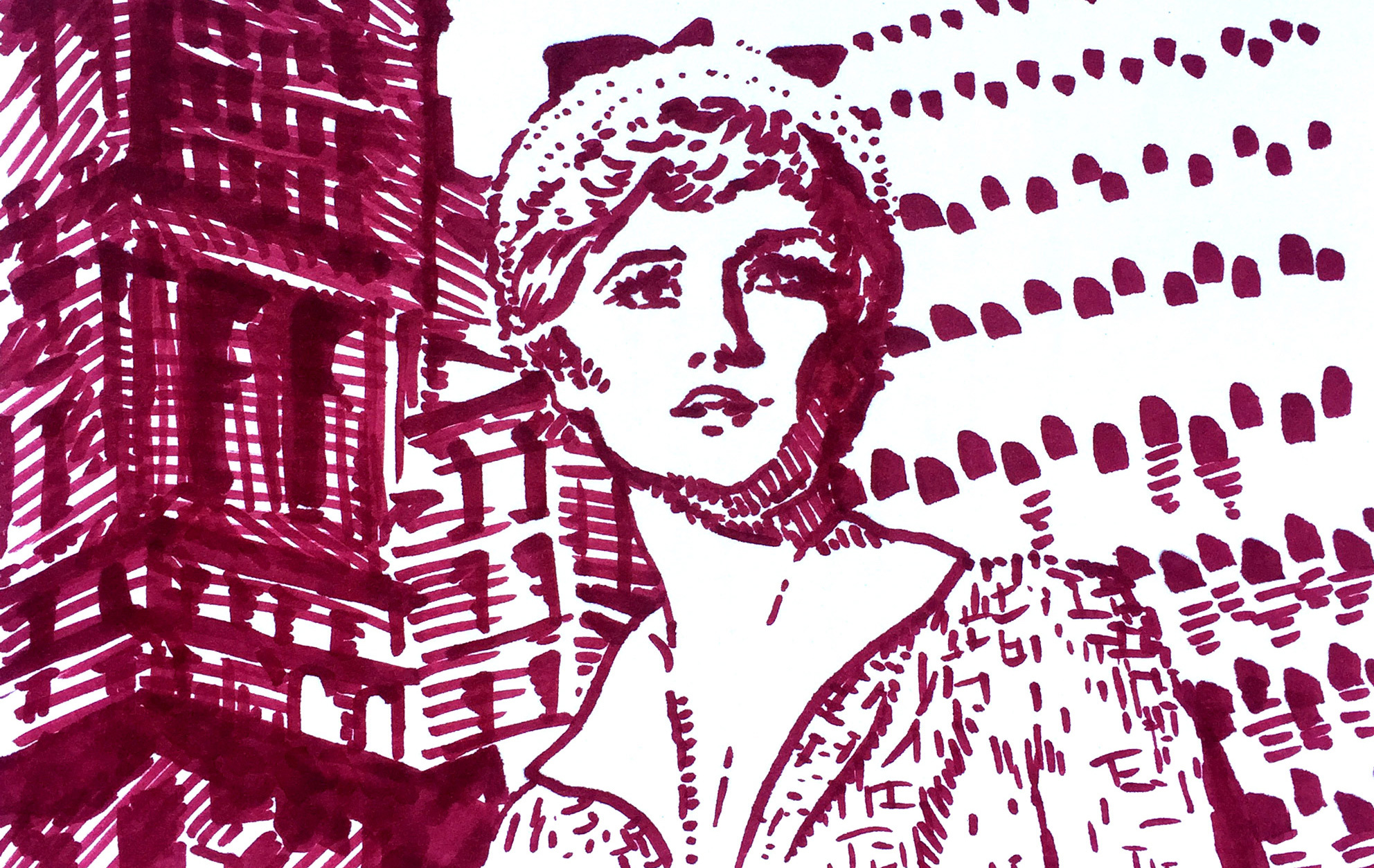
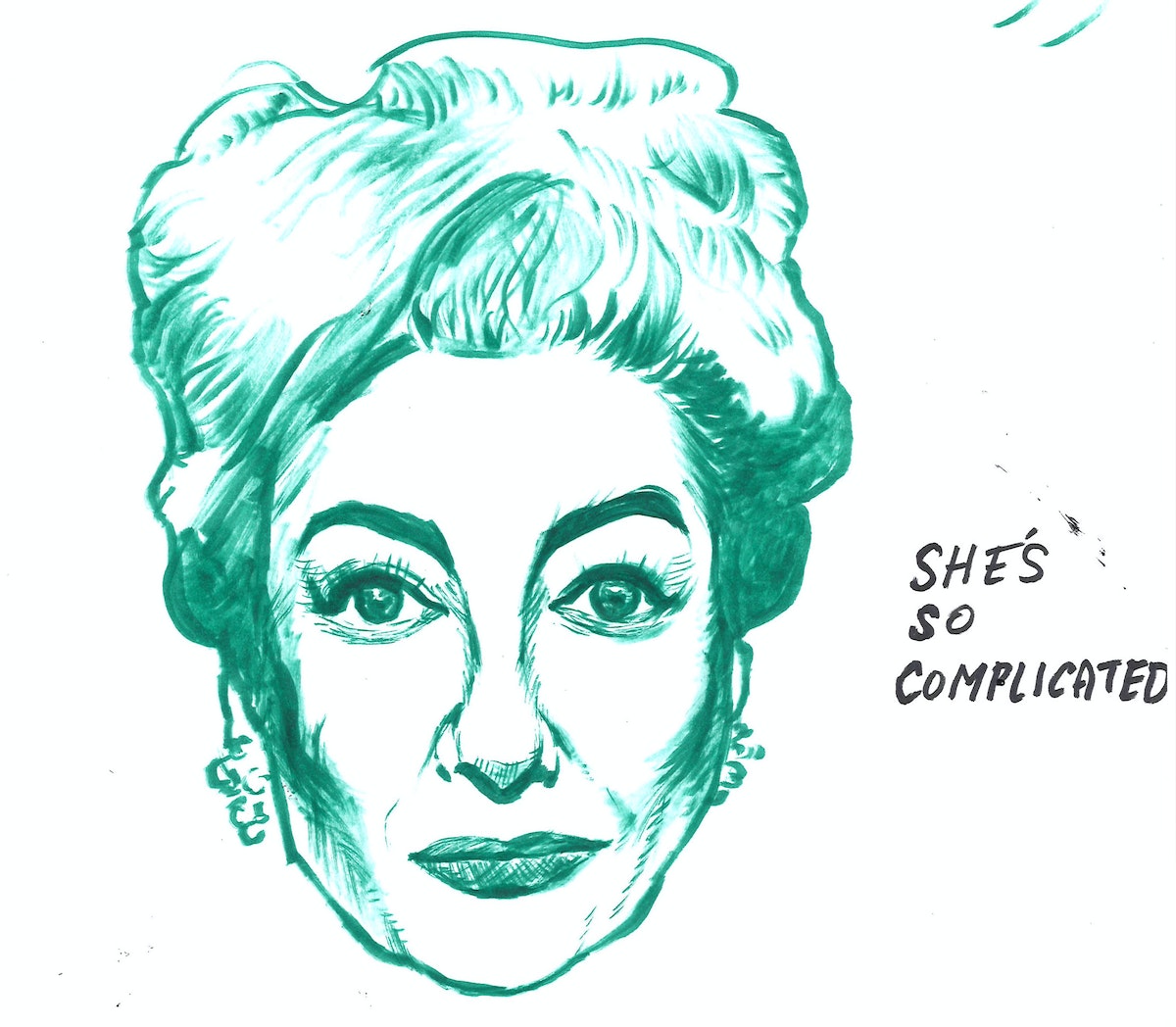
Lately, I’ve been drawing complicated women in the evenings. A woman’s physicality is so much more political than a man’s—and to me, this makes it so much more powerful. A woman has more expectations placed on her physical looks—her clothes, her hair, even her expression—and that only makes it that much more of a provocation when those expectations are thwarted.

When I was a kid, I’d spend hours drawing Ariel from Disney’s A Little Mermaid. I'd sometimes catch myself unconsciously copying her expression with my own face. Even at 9 years old, I’d feel a little embarrassed when I felt a big, fake grin on my face. I liked Ariel and her gadgets and gizmos aplenty, but I wasn’t like Ariel. I was faking it.
Then in high school, when it was time for my exciting locking-myself-in-my-room-and-drawing-self-portraits period, I had to shift into thinking intentionally about what my face was doing while I drew from the mirror. I found that whether I was trying to make a specific kind of face, whatever came out ended up feeling like a character. And that somehow felt instantly more powerful than just the image in the mirror.
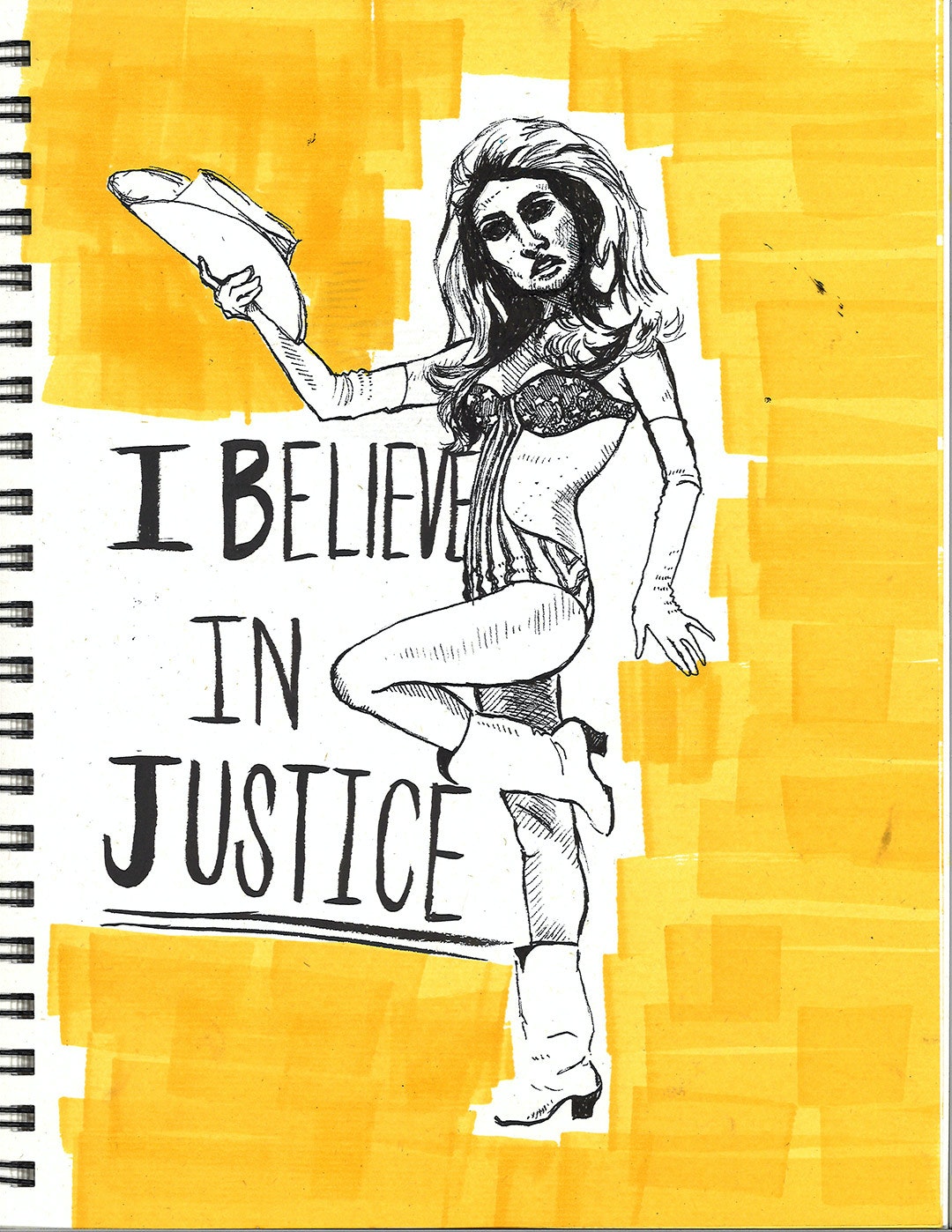
The women I like to draw now capture some element of that feeling. They may not be the definition of self-possessed, they may or may not be confident and composed, but they are self-aware, and in control of what they are putting out into the world. They may be performing a little, but they're doing it on their own terms, for their own benefit.
They’re from noir movies and punk bands. They’re artists, journalists, wastoids, and dweebies. I like to think they lived for themselves and as themselves—the most provocative act there is for any human. I admire them and want to see myself in them
“I have been drawing complicated women in the evenings lately.” Cambridge software designer Ashley Holtgraver reveals the secrets of her notebooks.

Thoughtless Acts: Save For Tomorrow
The intuitive ways we adapt and react to things in our environments
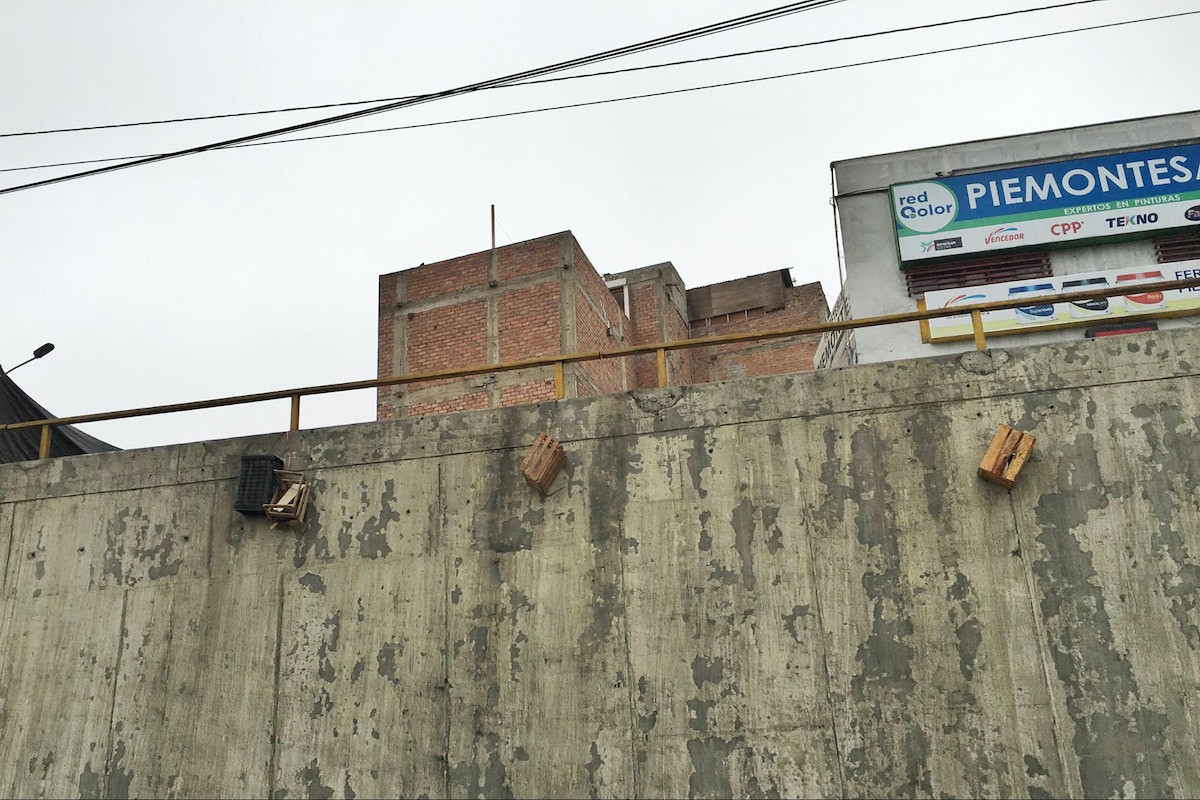
In Lima, Peru, people who give out free newspapers or sell water and snacks on the on-ramps to the highway use these little wooden crates to sit on or put products on. To avoid carrying the crates home every night, they tie a rope between the box and the railing, then drop it over the edge overnight. This keeps them from getting cleared or taken because they're virtually invisible from the other side. The crates aren't that valuable, but it's probably a hassle for vendors to carry them around or find new ones every day.
Human-centered design requires us to observe human behavior with beginner's eyes, so that we can spot the innate ways people interact with the world around them. We call these intuitive and unconscious reactions thoughtless acts, and IDEO designers collect photos of them to inspire the invention of new products, services, and experiences.
What's the Last Sound You'll Ever Hear?
Bringing new design to the way we die
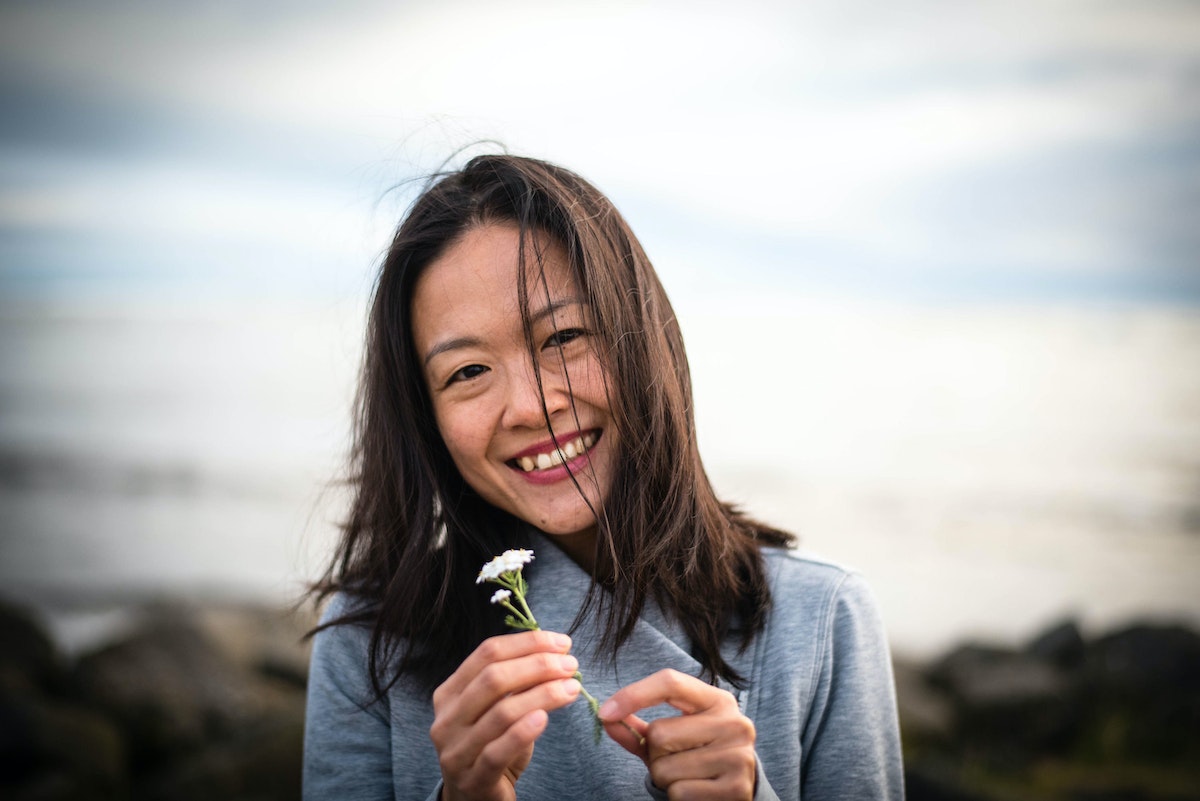
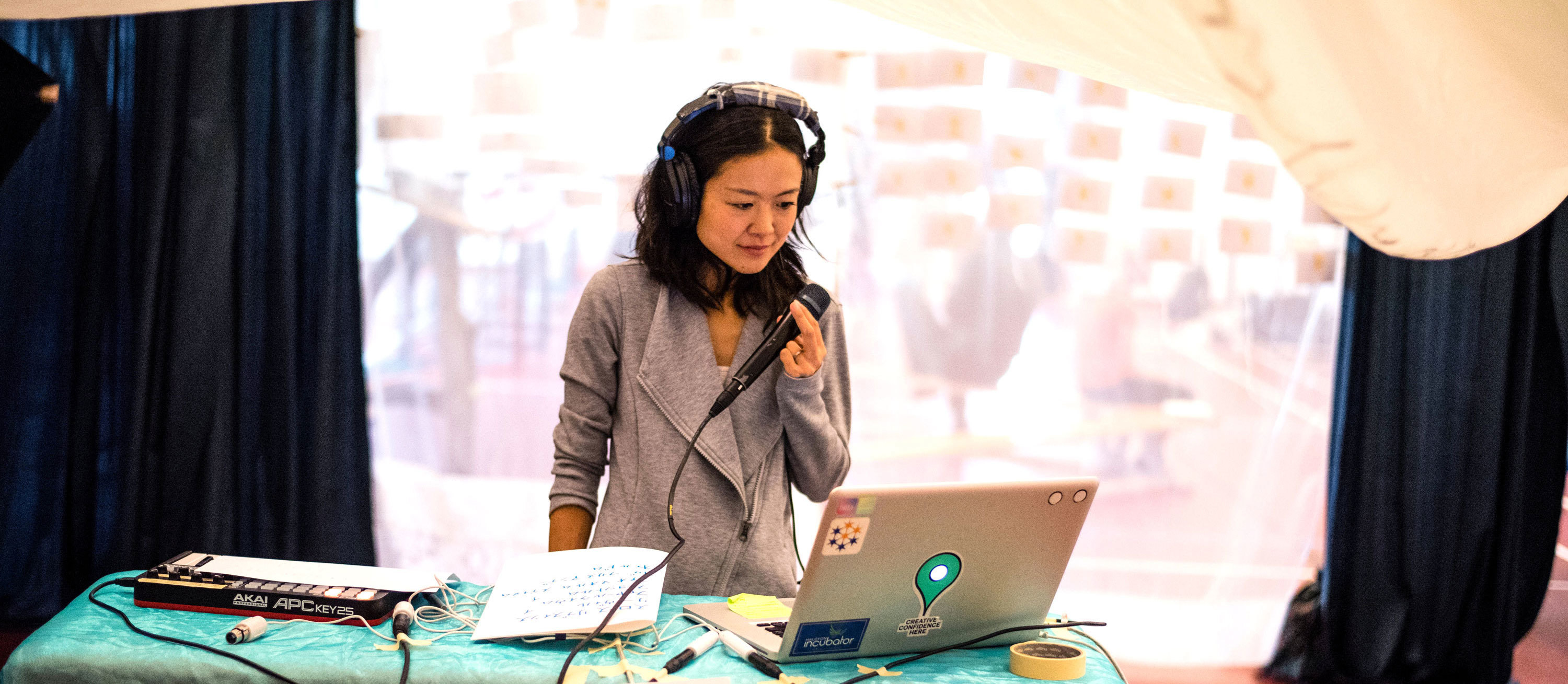
Bringing new design to the way we die—what we see, touch, feel, and hear—is an idea with a strong tailwind. Advocates like BJ Miller, who was profiled in the New York Times this week, are spreading the message that we can do better for people who are dying if we pay close attention to human needs.
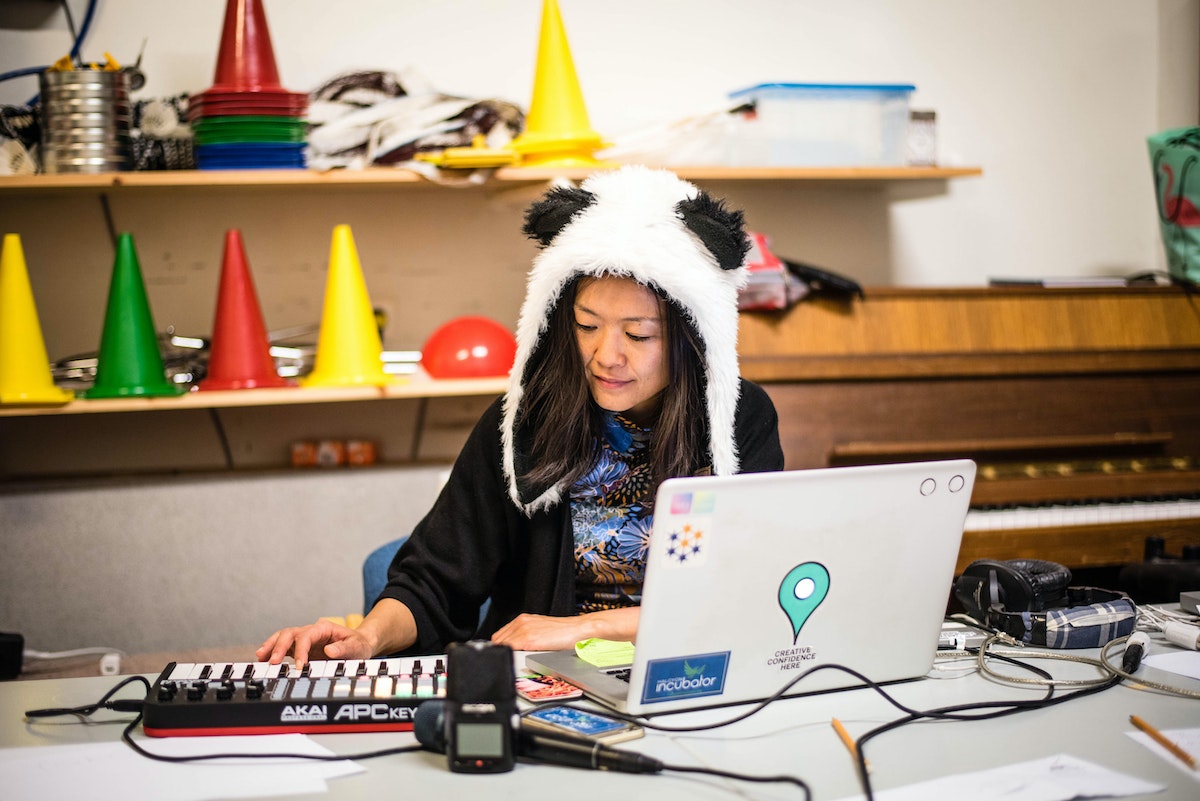
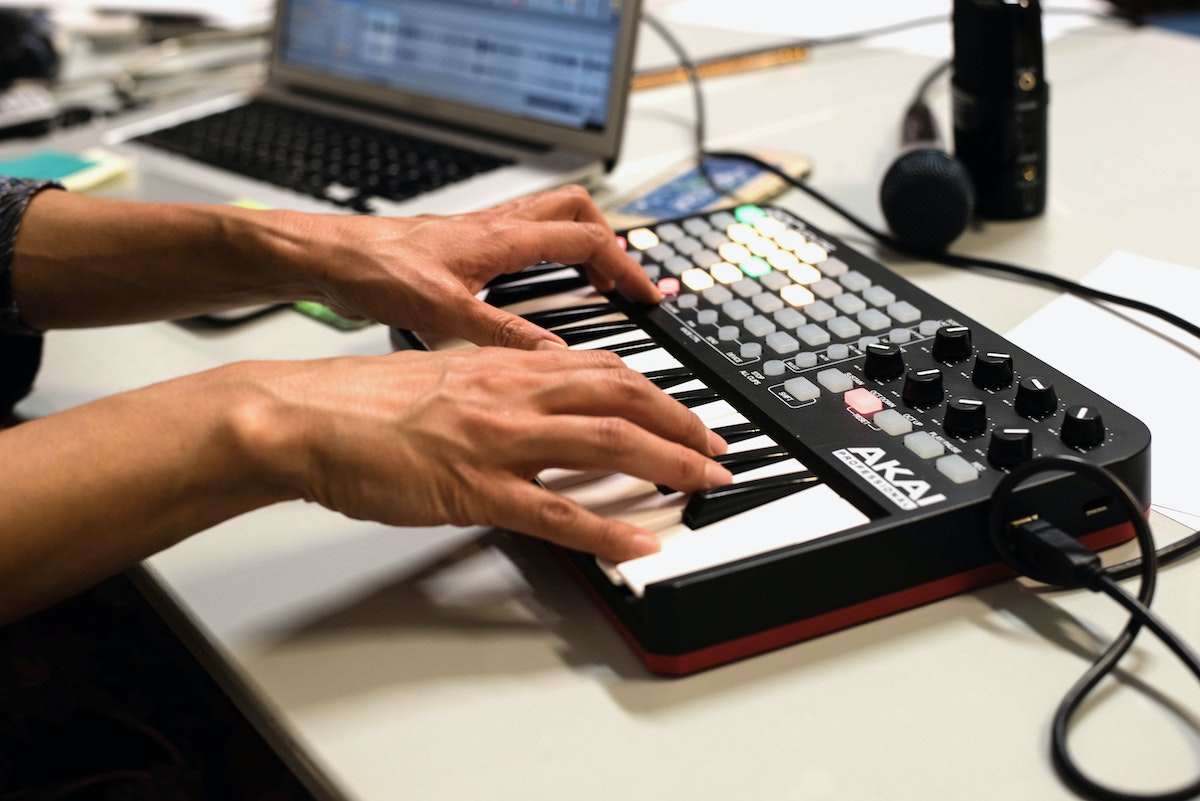
Sen, who gives Miller a nod in her video (see below), felt this firsthand when she was hospitalized for an illness. As a musician who started playing the piano when she was 3, Sen found the sounds of the emergency room traumatizing, and left committed to do something to save others from having the same experience.
We became instant fans of Sen’s work when she submitted it to our OpenIDEO challenge on end-of-life care, and gave a talk during Re: Imagine, a subsequent citywide conversation about death. We caught up with her in Washington D.C., where she’s a fellow at the Halcyon Incubator, a program that supports social entrepreneurs, and asked how she’s planning to bring beautiful sound to the people who need them most.
IDEO: WHY IS MUSIC SO IMPORTANT AT THE END OF LIFE?
I would say sound is important at the end of life, which includes, but is not limited to, music. For instance, a lot of people mention nature sounds as something they want to hear at the end of life; other examples are voices of loved ones, laughter, etc. You can hear people's responses here.
Sound is important because some people say hearing is the last sense to go when we die. I believe it has a profound effect on our sense of dignity, not just for the person dying, but also for those around them.
IDEO: HAVE YOU SEEN EXAMPLES OF THIS?
Morgan, a palliative care nurse in NY, got in touch with me after she saw the idea on OpenIDEO. She said that her team started to play a song moments before a patient's death to liberate them from the ventilator, with the expectation that they would die in the next few moments. The question inspired her to use her own iPhone to play music for the patients. One cancer patient she became very close with shared his favorite music, and she played that for him. People’s preferences are different, so it’s tough to find something that’s universal. It’s very awkward to say, “I’m assuming you’re going to die soon, what kind of music do you like?” I got the impression that it was helping her team and the family members as much as the patient. You can’t interview the patient after they’ve passed away—“how was your dying experience?”—but you can talk to the family and the nurses. I heard from cancer nurses at Sibley that when a cure is not possible, they are empowered to heal in other ways—do something seemingly simple that makes a big impact.
A couple of people mentioned that they played music when their grandparents passed away. “I had a sense that she could hear the music or my voice even though she couldn’t react to me,” or “I have faith that she could hear me.” It’s a story that we create for ourselves, but, as those who are left behind, feeling that we have made a positive impact gives us a sense of peace.
IDEO: ARE YOU PILOTING SEN SOUND IN HOSPITALS?
Yes, we are already working with Sibley Innovation Hub (part of Johns Hopkins Medicine)—though not necessarily focused on "end of life"—to test our ideas to transform the sound experience for patients.
As for the "end of life" sound—for now it's an art/conceptual project. I record the voices of people sharing stories of the sound they wish to hear at the end of life, to raise awareness on the importance of sound.
I also believe that it is a way to build resiliency in the community, by allowing us to approach the taboo subject with a somewhat light-hearted, playful way. It's dreadful to imagine death itself, but by imagining the sound, it's somewhat more approachable.
I would love to continue exploring ways to implement the idea with hospice and palliative care centers, and we are in conversation with a couple of facilities. I have done this as an artist and will always continue to do that, but I’m at the point where I’m transitioning to trying to inspire a team to do this.
It’s going to take time: Any medical conference you go to is about winning the fight [against death]. But this is a project to build resiliency in the community. There’s no wrong answer. If a young person says to me “I don’t like to think about how I’m going to die,” that’s okay. But I want to help people build a sense of community, to create music or sound or jam with the person with the same illness but not the same geographical location—connecting people who really need it through music and art.
For more about Yoko's work check out her piece in the OpenIDEO End of Life story collection.
Humans really like the sound of the ocean. We like it so much, the lapping of waves top the list of last sounds we wish to hear before we die. That’s one thing you’ll learn from Yoko K. Sen, an ambient electronic musician whose project, Sen Sound, aims to transform what we hear at the end of life, replacing shrill alarm bells and bleeping machines of the hospital with a soothingly oceanic sonic environment.
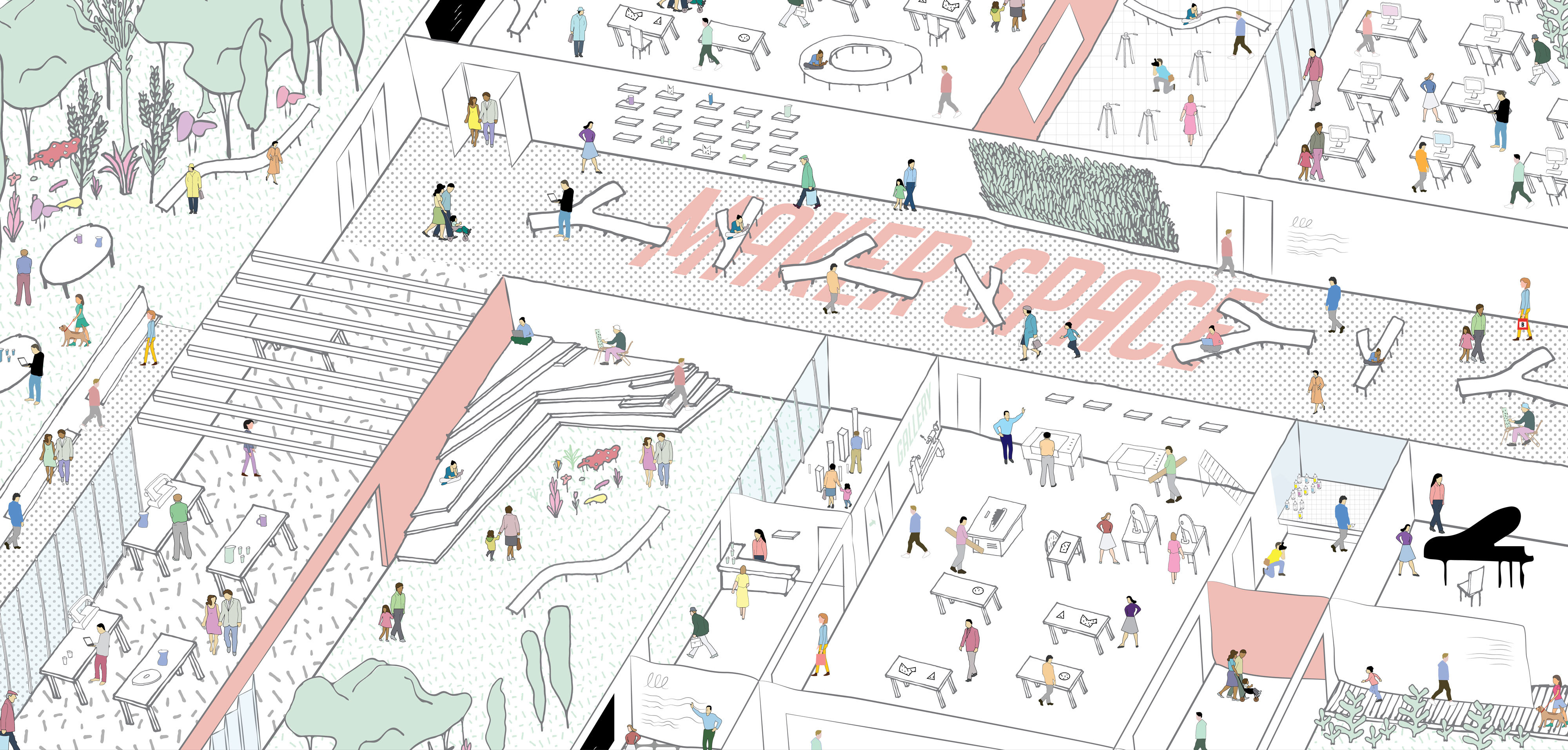
Creative New Year's Resolutions
After the ball drops and the champagne is gone, we have 365 days ahead of us to be more creative people
I have three. Instead of writing in a journal, I want to summarize each day in a creative drawing. I also plan to listen to more podcasts. And, whenever someone asks me, "How are you?", I will try to never to say "good," and instead use a more descriptive adjective.
—Katie Kirsch
I really want to work on being in the moment—which means putting down the phone, and being delighted by who and what is around me.
—Amy Bonsall
My creative resolution: Write, draw, or create more physical letters and postcards for friends and family (at least one per month!). And use more of the Airpost service that we helped design out of IDEO Tokyo!
—Mike Peng
I have two. One, to be more aware of what contexts and situations work in favor of my creativity. And two, to inspire others around me to be creative.
—Michaël Harboun
I plan to sew a new outfit and wear it, turn my photos into different series and make a portfolio website, and to read a Poem-A-Day.
—Rebecca Lee
I'm going to try to dedicate the first hour after waking up exclusively to creative pursuits, rather than looking at email, social media, or cat videos. This will require getting up early every day, so fingers crossed.
—Neil Stevenson
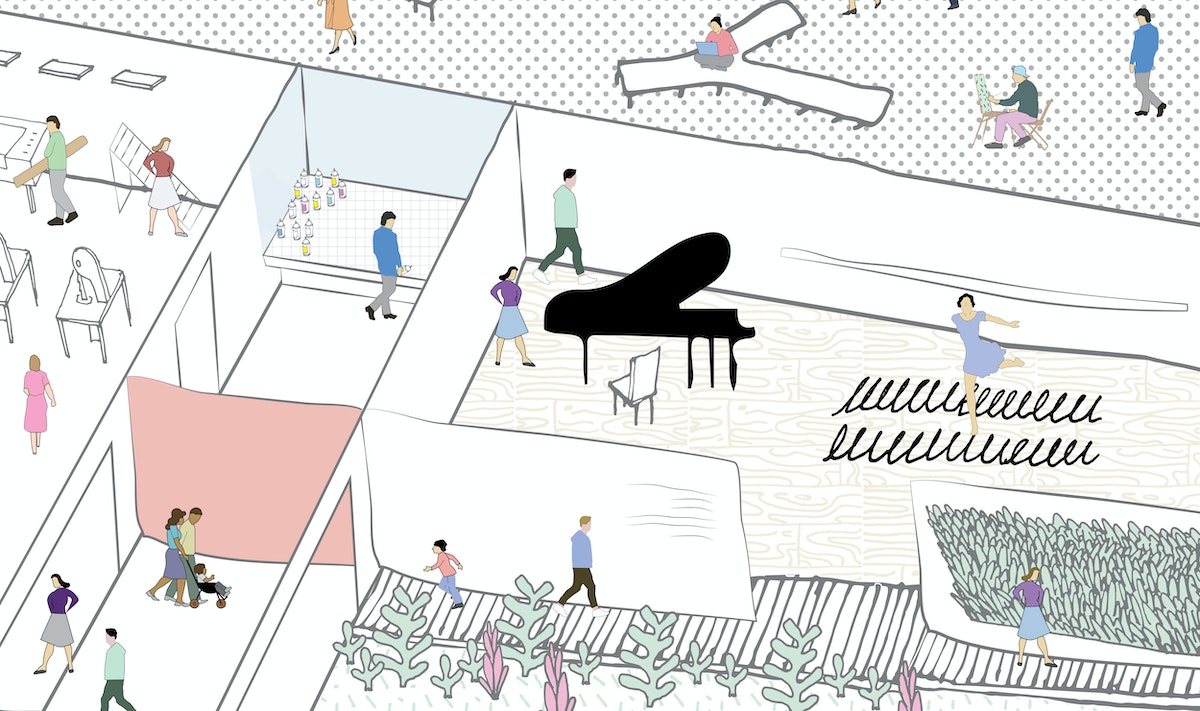
My resolution is inspired by Julia Cameron's morning pages. But since my practice is choreographic (I'm a dancer/choreographer outside of IDEO), I'm resolving to create a movement phrase everyday. I’m not sure yet what the dance equivalent to three pages of writing is, but I'll figure it out.
—Eileen Farrell
Slackline (or highline in this case) is both a new habit and skill. I find that balancing on a line is a powerful way of coming to terms with fear and a kind of forced meditation, counterintuitively creating fear and calm at the same time.
—Jonah Houston
I want to learn to lathe wooden baseball bats. I'm looking to make an art piece to show in a gallery.
—Samuel Bertain
I plan to find a living space that inspires me to do good work; to sign up for a class so I can make arts around other people and osmose creative energy (and hopefully give back too?); and to be more intentional about my passwords (I don't have a method to my madness, it's just madness).
—Momo Miyazaki
I am pushing my modern calligraphy for 2017. I did a class this year and for Christmas have ordered books and more pens. I am hoping to also try out brush lettering. I follow Seb Lester on Instagram and he makes it look so easy... even though it’s not.
—Bobbie Brightman
I will download and use the Headspace app.
—John Ravitch
I want to channel Charlie Rose and learn how to host better video interviews on Creative Confidence. I also want to rock climb more.
—Suzanne Howard
In 2016, I did the 100 day project, which got me going on weaving and watercoloring. In 2017, I want to create my first large-scale tapestry. Who knows if it'll happen... we'll see!
—Emma Scripps
I want to to start writing again. I used to write a lot, both for fun and as a freelance advice columnist, but have gotten away from it in recent years. Doesn't matter to me if this manifests in jokes, stories, reflections, whatever—so long as pen meets paper and my brain is flexed regularly.
—Adam Moulter
I want to do at least one thing each week to celebrate the ubiquitous creativity in New York City. It can be a concert, a class, or just a walk around a new neighborhood to explore the graffiti and architecture. I moved here a year ago and have so much more to explore!
—Shauna Carey
I want to say "I don't know" more, so I learn something.
—David Good
Illustrations by Matt Avallone.
After the ball drops and the champagne is gone, we have 365 days ahead of us to be more creative people, with new and better habits, mindsets, and skills. Seeking inspiration? Here are some of IDEO designers’ resolutions for 2017.

Lindsey Turner
I’m passionate about building brands, products, and experiences that help organizations show up with meaning and momentum.
I help organizations cut through complexity by shaping how they show up, through brand strategy, identity, and storytelling.
Working at the intersection of brand and business, I bring an editorial eye and a bias toward making—turning ideas into tangible experiences that people can understand, trust, and believe in.
My work spans government, healthcare, financial services, media, and consumer goods, from launching Gen Z-focused ventures to building innovation labs and reimagining legacy brands. I relish moments of ambiguity and enjoy translating across teams, perspectives, and priorities to move ideas forward.
I started my career in editorial and digital design, shaping cross-platform experiences and identity systems in publishing and agency environments. That foundation still shapes how I work today: I’m detail-oriented, collaborative, and overreliant on the Oxford comma. I hold a BFA in Visual Communication from the School of the Art Institute of Chicago.

Rachel Young
My work helps organizations see who their products aren't working for—and build the will and the tools to do something about it
For 25 years, I've asked the same question: Who does this design exclude—and what are we going to do about it?
My work spans human-centered strategy, inclusive design, and qualitative research, with clients ranging from Microsoft, Google, and Verizon to the National Science Foundation, and San Francisco Unified School District.
Before IDEO, I taught elementary school in East Palo Alto and spent a decade doing design work with social service organizations—where I learned firsthand what it costs people when systems are built without them in mind.
I am currently writing User Error, a nonfiction book about digital access and the design decisions behind it. I live in Oakland, California.

Brian Pelsoh
I lead with craft, ensuring our work is creatively excellent: rooted in deep human insight and imagination, while also grounded in the realities of business and technology.
My expertise spans brand, communication, and product design across tech, education, the arts, and social impact.
I believe great work demands both high-level vision and obsessive attention to detail, and only happens through collaboration.
I bring an inclusive, hands-on approach and a deep understanding of business, which enables me to consistently deliver excellence while always asking why.
Before joining IDEO, I worked at the brand firms Pentagram and VSA Partners. I began my career as a designer, leading teams at the School of the Art Institute of Chicago and the Milwaukee Art Museum. I hold an MFA in graphic design from Maryland Institute College of Art and a BFA in communication design from the Milwaukee Institute of Art & Design, and have taught at some of the best design schools in the US.

Tony Wong
I am responsible for IDEO’s long-term success in China and working with clients to use design as a tool to enable growth.
I am responsible for IDEO’s long-term success in China and working with clients to use design as a tool to enable growth. Specifically, I have helped Chinese companies design holistic brand solutions through the development of their products, communication, services, and innovation teams, and I have helped multinationals expand their presence and influence in China.
I advise global leaders on developing China-led innovation and capabilities.
In over 15 years in IDEO Shanghai, I have worked on projects that use design to elevate the quality of the experience of healthcare products and services, streamline processes that increase productivity, create spaces and programs that promote and enable inclusive communities, and build next generation mobility solutions that are planet-positive.
Before joining IDEO, I worked at Philips Electronics and the Electrolux Group in Italy, the Netherlands, and Singapore on a number of breakthrough commercial products. I am a member of the Young President Organization in Shanghai.

How to use AI as an editor, not a writer
Ed White shares how he uses AI as an editor—not a writer—to sharpen storytelling, rehearse ideas, and preserve the productive friction that makes creative work better.
Ed White has a rule he's tested on his own writing: hold yourself as the writer, and let AI be your editor. Ed is a Senior Design Director at IDEO's London studio, where he co-leads the firm's AI portfolio across Europe. Before IDEO, he spent 12 years as a writer and editor at the Financial Times, Wired, and Contagious. So when he talks about when to use AI for storytelling and when not to, it comes from two decades of crafting his storytelling skills.
In this episode, Mina Seetharaman talks with Ed about two specific tools he uses to keep AI in an editor's seat: a "roasting agent" prompted to critique his drafts without any sugarcoating, and a simulated audience he rehearses pitches on before the real thing. They also get into what Ed is hearing from design leaders at Anthropic, Lovable, Shopify, and Google Creative Lab about how creative work is changing, and why he thinks the friction of writing something yourself is worth protecting rather than automating away.

Building a personal AI for the messiness of life: Sida Li
Becca Carroll talks with Cue co-founder Sida Li about designing a personal AI for the messiness of everyday life—not just work. They explore how Sida stays anchored to human needs while navigating fast-changing technology, product tradeoffs, business-model experimentation, and the realities of building an AI company today.
Most AI products today are built for work—a space with clear problems and established systems. One founder noticed a gap: personal life is messier, harder to systematize, and mostly left behind by the AI boom. So she built Cue, a personal AI that lives inside iMessage and group chats, to go where the other tools haven't.
In this episode, Becca Carroll, IDEO's Chief Strategy Officer, talks with Sida Li, co-founder and CEO of Shared Context Lab, about staying anchored to a human need while the technology around her keeps changing shape, why she treats her business model with the same rigor she'd bring to a product, and what it feels like to build a company at this particular, disorienting moment in AI.
The conversation also gets into how Sida makes design decisions: the language Cue uses to describe itself, the tradeoffs behind building inside iMessage instead of a new app, and a real story about a business idea that didn’t pan out.
This is the second in a two-part series profiling founders from IDEO's Startups-in-Residence program. The first conversation is with Johannes Seemann, founder of Sooner, on designing GenAI for the emotional side of money.

Designing GenAI for the emotional side of money: Johannes Seemann
Designing financial tools around the feelings that shape money decisions.
Most personal financial tools are built to run the numbers and optimize towards a budget. While that works for some, most people experience money as a lived relationship that does not neatly fit into a spreadsheet. Johannes Seemann and Becca Carroll discuss why money is emotional before it is mathematical, and what a human-centered approach to building a generative AI financial product looks like in practice.

The curious leader's edge in uncertainty: Scott Shigeoka
How genuine curiosity helps leaders navigate uncertainty with greater confidence.
Mina Seetharaman talks with Scott Shigeoka, author of Seek and Head of Curiosity Cultivation at the Eames Institute, about what distinguishes genuinely curious leadership from performative curiosity, how power dynamics shape curiosity, and why practicing curiosity can restore energy rather than drain it.
Looks like you might be in search of something very specific?
Or reset the filters above and try another angle.
Here’s some random inspiration

Podcasts about creative leadership

Articles about the power of prototyping









































.webp)