
.svg)



A friendlier, more tactile e-reader experience
Creating a digital reader that embodies the best aspects of paperback books.
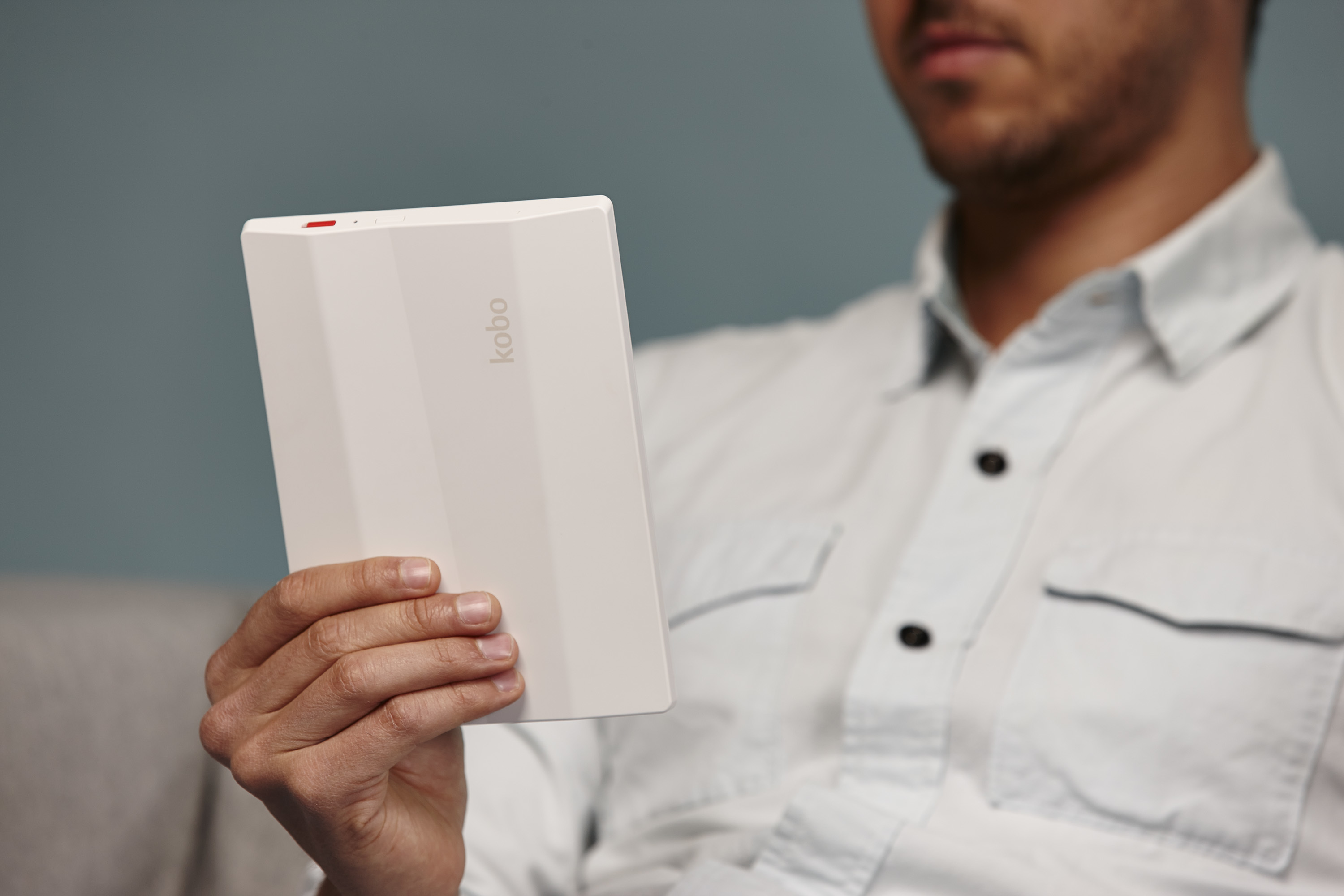
International e-reading service Kobo, Inc., with more than 2.5 million digital book, magazine, and newspaper titles, approached IDEO to gain a strong foothold in the shifting publishing landscape. The design challenge was to create a new suite of advanced reading devices with the best aspects of paperback books—tangibility, portability, and a small footprint.
To make digital reading devices feel approachable, personal, and sophisticated, designers focused on the intersection of physical and digital interface design. The teams created a family of affordable e-readers with clearly differentiated feature sets, and the resulting design provides a reading experience that approximates holding and reading a paperback book. No larger than a novel, the front of the e-reader is designed for the reader’s eyes, while the back features a signature “quilted” back shell designed to create a pleasurable, tactile memory for the hands.
The Kobo family includes the Kobo WiFi, with a 6-inch glare-free E-Ink screen; the smaller Kobo Touch, with infrared touch-screen interface, E-Ink Pearl screen, and faster processor; and the Kobo Vox, a 7-inch Android tablet model with social and digital sharing options.
Kobo saw record sales of its digital reading devices during the 2011 holiday season, and was named “Editor’s Pick for Best e-reader” by Wired magazine.
A digital display to measure energy use
Communicating environmental performance with an interactive plaque.
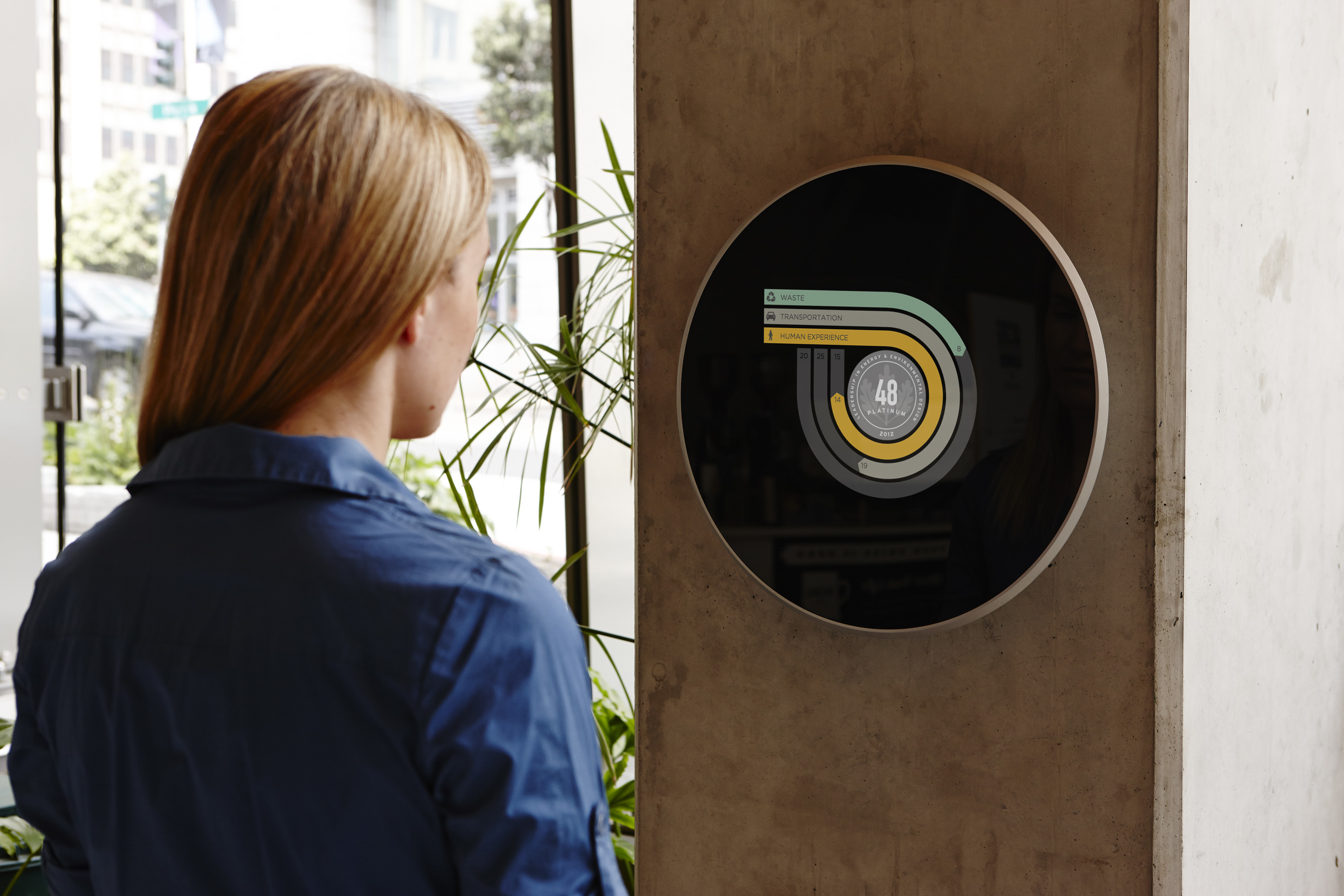
The U.S. Green Building Council asked IDEO to help visualize how buildings might communicate environmental performance. Together they came up with the LEED Dynamic Plaque, an elegant public declaration of a building’s environmental efforts.
Located in a lobby or other common space, the plaque displays real-time measurements about a building’s resource use—from energy to waste disposal. IDEO designed and built the physical plaque, and the IDEO Digital Shop created an online interface that allows USGBC’s software to interact with it, enabling people to enter data, analyze details, and make personal decisions that influence a building’s performance.
WATCH: "LEED Dynamic Plaque" video
A cook top designed for a wok
Culturally relevant kitchen appliances for a Chinese market.
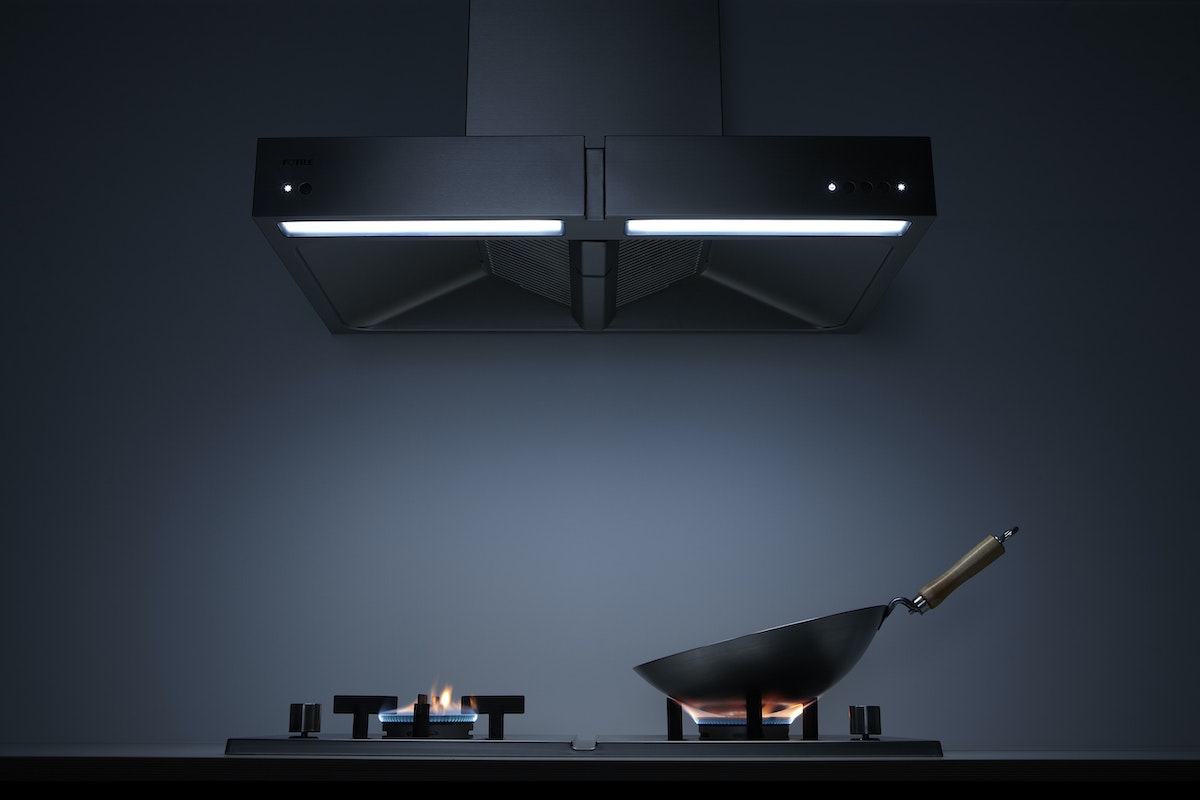
In China, most kitchen appliances available on the market are rooted in Western cooking practices. High-end kitchen appliance company Fotile, based in Ningbo, China, was looking to design a new cook top and range hood that would satisfy the unique needs of Chinese cooking culture.
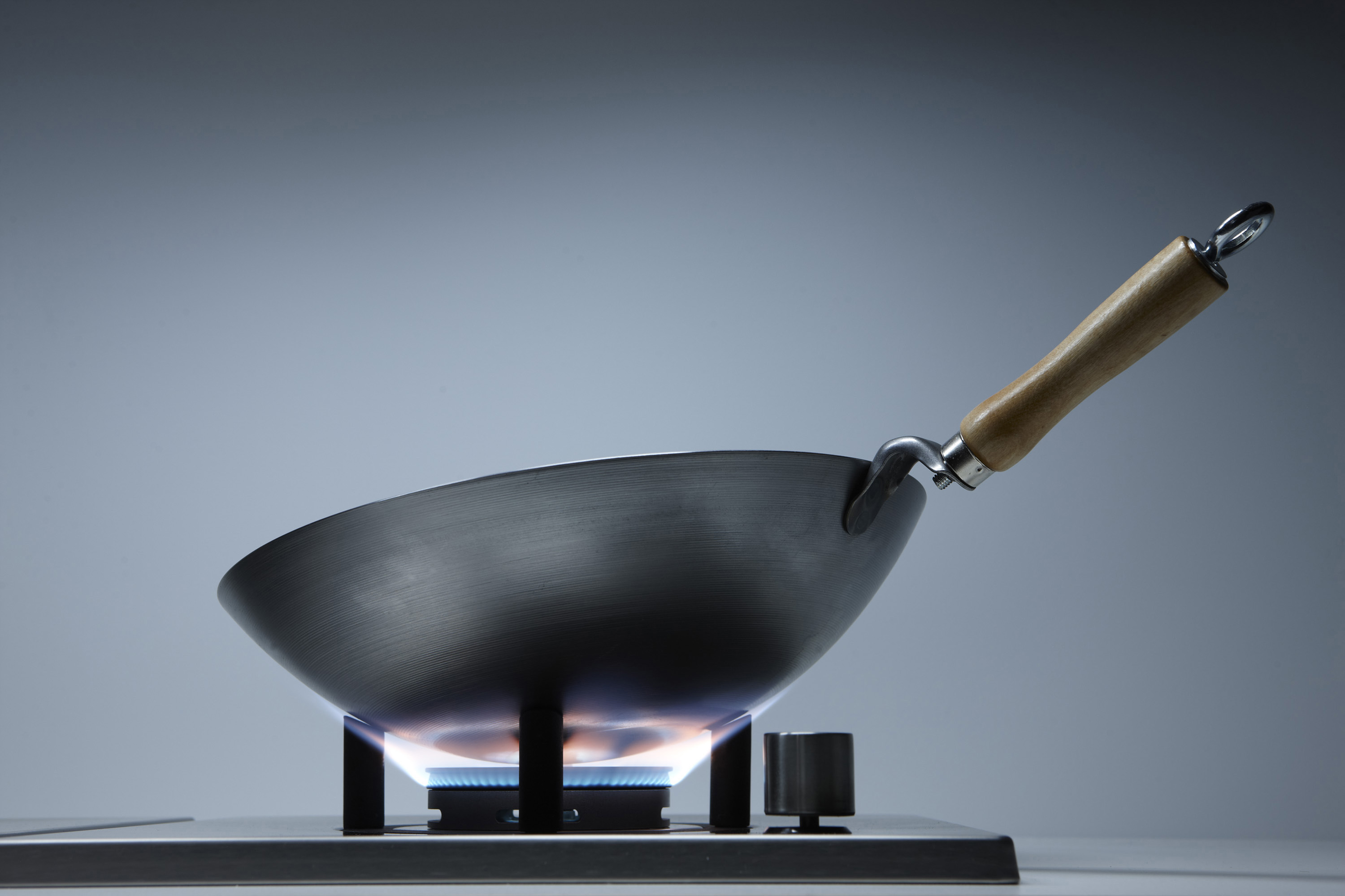
The new appliances designed by Fotile and IDEO support a key need of Chinese cooking: the dual-cooking center. This two-burner range eliminates unnecessary burners, instead dedicating one side to the wok, the primary tool in Chinese cooking, and the other side to a flat-bottom pan. The wok burner has a special stand with angled posts to hold steady a round-bottom wok (typical in China) and ease the rigorous, constant “tossing” movement that is prevalent in Chinese cooking. The Fotile cook top and range hood have become popular with Chinese consumers since market launch.
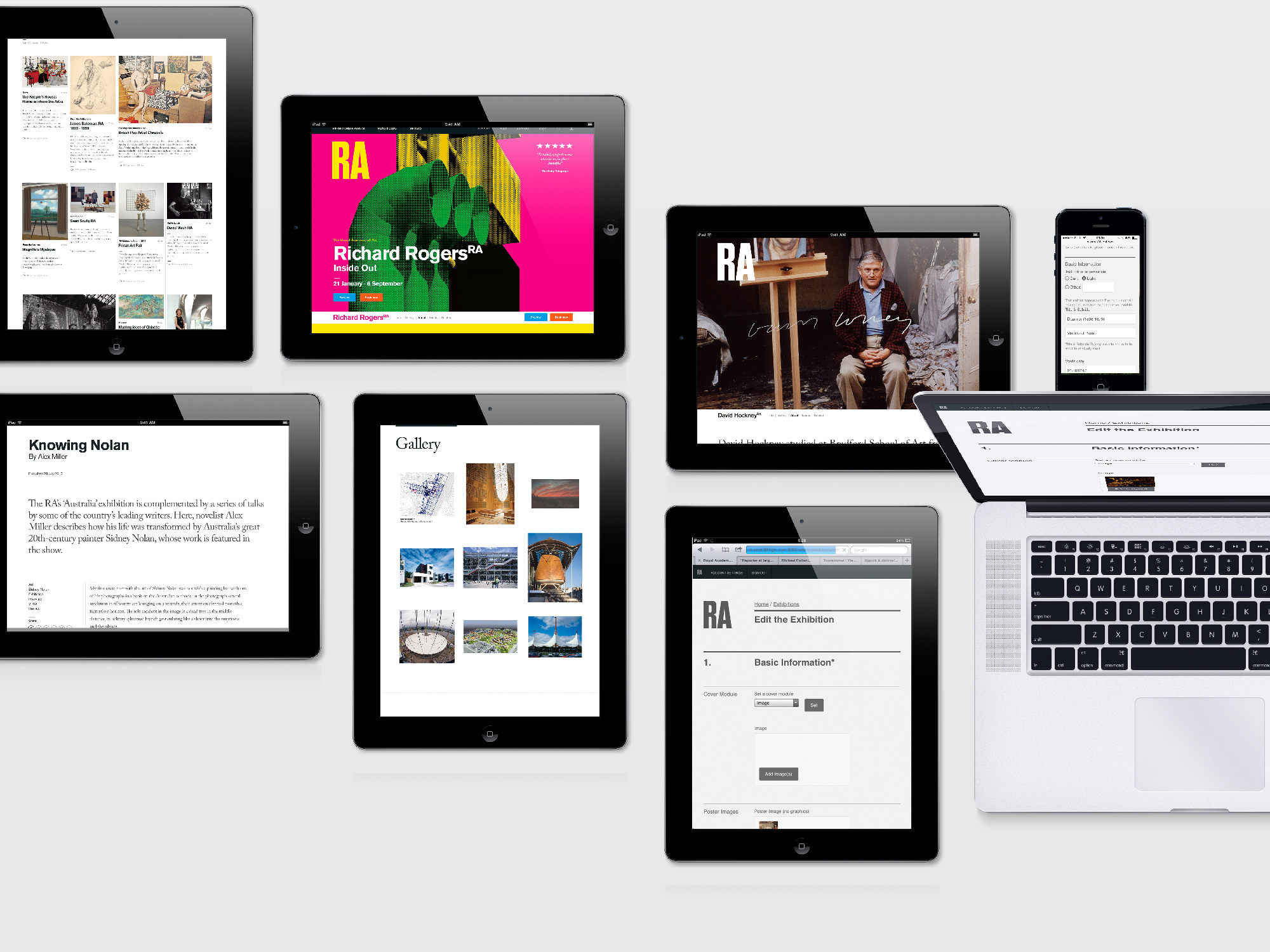
A digital identity for the Royal Academy of Arts
Building new audiences and opportunities for a 250-year-old institution.
Great art requires great openness, a space large enough to contain all the tragedy and comedy of the human experience.
The limestone walls and Palladian arches of the Royal Academy of Arts (RA) hold such a space. The institution’s building in Mayfair contains galleries where a wanderer can appreciate the everyday miracle of a Caravaggio or amble through the former home of Academicians, a group led by some of the most eminent artists in the world, from Anish Kapoor to Sir Norman Foster. This revered site has also been home to the Summer Exhibition for 246 years, an event open to submissions from any living artist.
As the RA approached its 250th anniversary, the institution came to IDEO to help create a digital strategy that would open new doors to these resources, reveal hidden avenues to new experiences, and offer broad vistas of the collection.

After rounds of research with artists, staff members, and visitors, our designers immediately started building and testing. They ran workshops to refine digital tools, watched as patrons scribbled notes about things they wanted to know more about, and built pop-up design studios in RA’s galleries where they could generate insights on the fly.
The result is a rich, immersive site for different audiences. Art lovers can view stunning images of the works, artists can learn more about RA schools, and RA staff can share surprising stories about some of the most prized pieces.
Based around human needs rather than organizational structure, the new digital space allows audiences to wander freely in this immense storehouse of inspiration and awe. And perhaps most important, the RA organization has benefitted from a human-centered paradigm shift that will enable the institution to forge boldly into its next quarter millennium.

How to Say Goodbye with 20,000 Dowels
As we prepare to move from our current Cambridge studio into a new space around the corner, we can’t help but think of it as a place where many of us began our IDEO journey—sneaking up to the roof for sunset cocktails and riding in the freight elevator to the pop-up gallery in the basement.
In a studio like ours, with a very distinctive creative culture, where people feel like they have ownership over their workspace, a massive, group art project would help us say goodbye together. Not only would it be one last hurrah for this studio, but it would also help reinforce the idea that our culture would be moving with us to the next space.
For years, our tradition at the Cambridge studio has been to reinvent our kitchen wall every six months or so. We’ve created everything from a hand-cut monster wall to a science fiction fine art series (think Yoda portraits in renaissance style). Knowing this mural would be the studio’s last, we wanted to create something that made people think and talk about design—reinforcing our values—and, of course, something big enough for everyone to be involved.
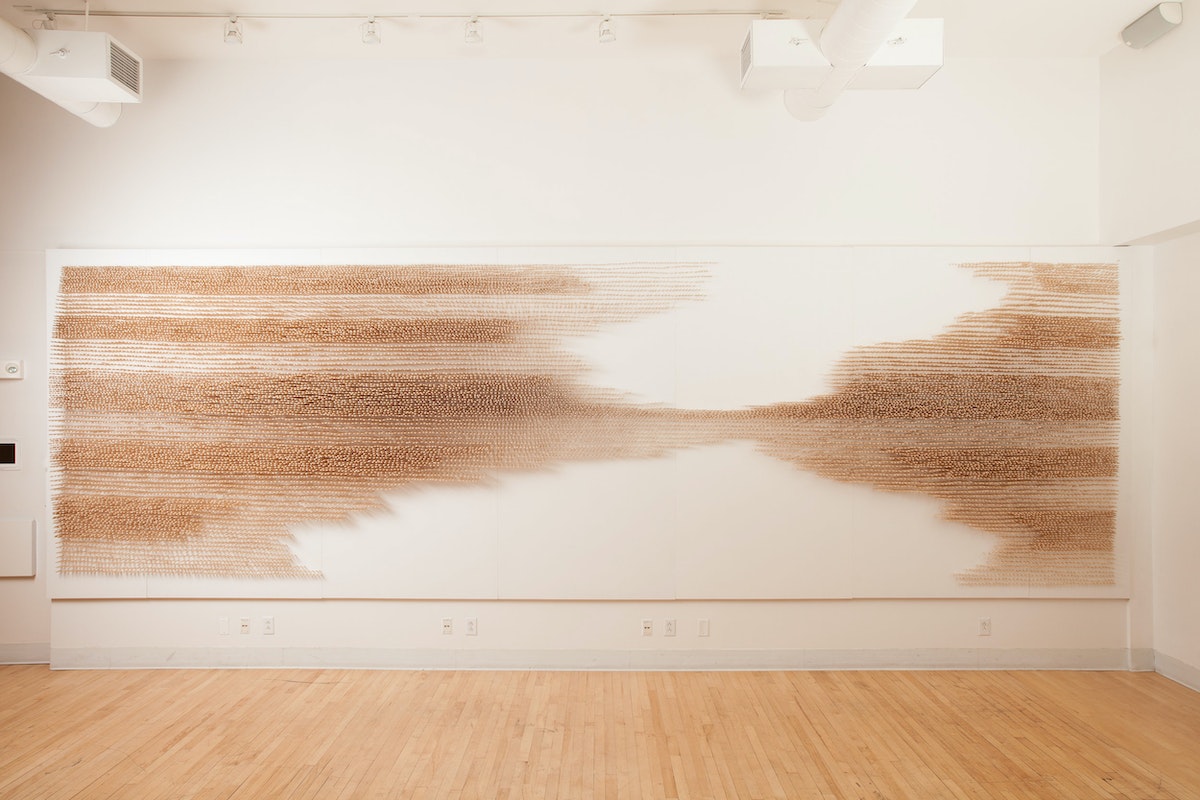
We also wanted to leverage our skillsets—Grace’s in drawing and painting, Greg’s in industrial design and fabrication—to pull together the project. At the time, Grace had been working on a series of dot drawings that caught Greg’s eye. They mimicked that phenomenon in nature when many tiny things form a greater whole. That seemed like a great metaphor for celebrating the multidisciplinary magic of the studio. So we decided to create a drawing as a base, and then scale it up into a wooden dowel installation.
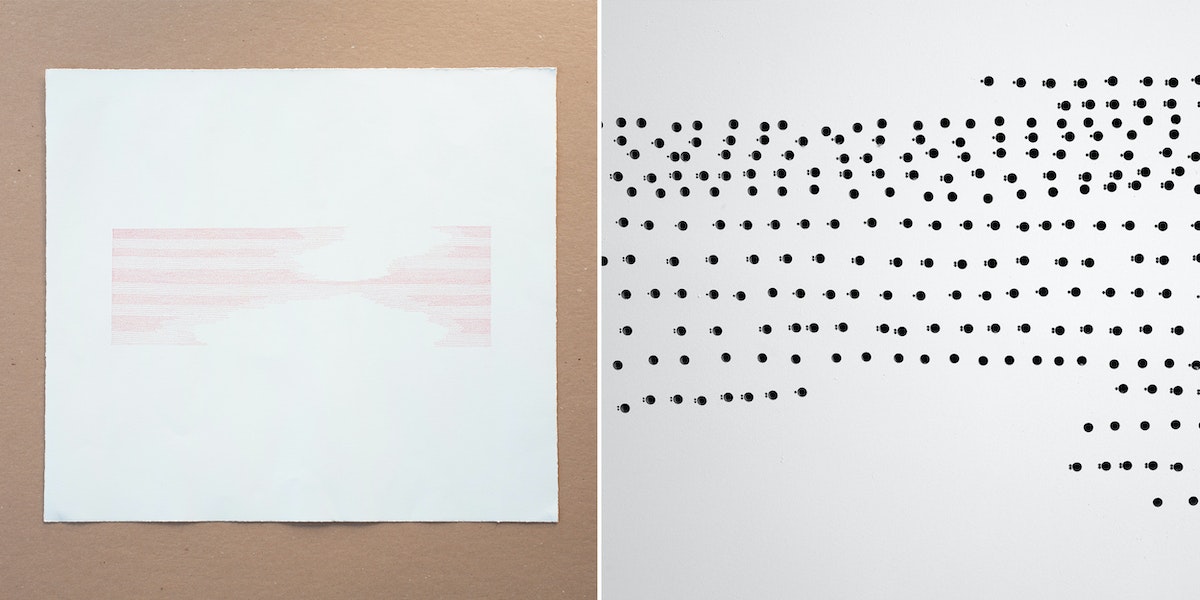
To get started, Grace created the dot drawing (below on the left) that served as a guide for the dowels. She makes these dot drawings (one of which the mural is based on) over several hours of repetitive stippling. First, she measures the margins of the paper using a ruler as a guide, then forms all of the dots by keeping her hand as straight as possible.
We then scanned the drawing and used a Processing script that located the coordinates of each dot. Next, we used a custom Grasshopper script to place a circle at each centroid and extrude it up to the 3d surface that we created in Rhino. From there, we just exported the lengths of the dowels in order of installation to a CSV file for Chop-Chop, our cutting machine.
If we could design a method to cut the dowels in order, and then get the installers to place them in that same order, we’d be in business. To do it, we needed some way of organizing the dots into rows for the installers to follow—even though they’re not a perfect grid, since they were drawn by hand. By using Grasshopper script, we were able to find logical rows within the hand-drawn pattern.
Since the rows’ zig-zag route only appears in the software, we needed some type of marker for our installers to follow. By using a dot, double-dot, or no-dot marking scheme, we made it easy for our teammates to to identify and stay in their row, even if it zig-zagged.
The panel production took us seven days. We used a ShopBot Alpha to mill each hole, then made a second pass to mark the hole with the appropriate dot pattern.
Each of the 20,000 dowels is a different length, so we built a CNC bandsaw to help us cut them all. After sketching a few concepts, we settled on a JET bandsaw augmented with a custom digital stop.
We created the digital stop using parts we designed and 3D printed, as well as stock parts from Adafruit, Misumi, McMaster-Carr, SparkFun, and Arduino. Arduino reads the length of each dowel from the SD card, then turns a stepper motor and timing belt, moving the stop to the correct length. Once the dowel is cut, the miter sled hits a switch and tells the stop to move to the next position. Once we were in a rhythm, the process was pretty smooth.
One of the goals of this mural was to maintain the feeling of human touch that’s so obvious in the original drawing once we scaled it up to the mural. So we decided to design a straightforward process for our installers, and then chalk up any misplacements to the artistry of human error. As we chopped the dowels, we slotted them into trays marked with row number, tray number (some rows had up to 6 trays), and the dot scheme, so the installer knew where to start.
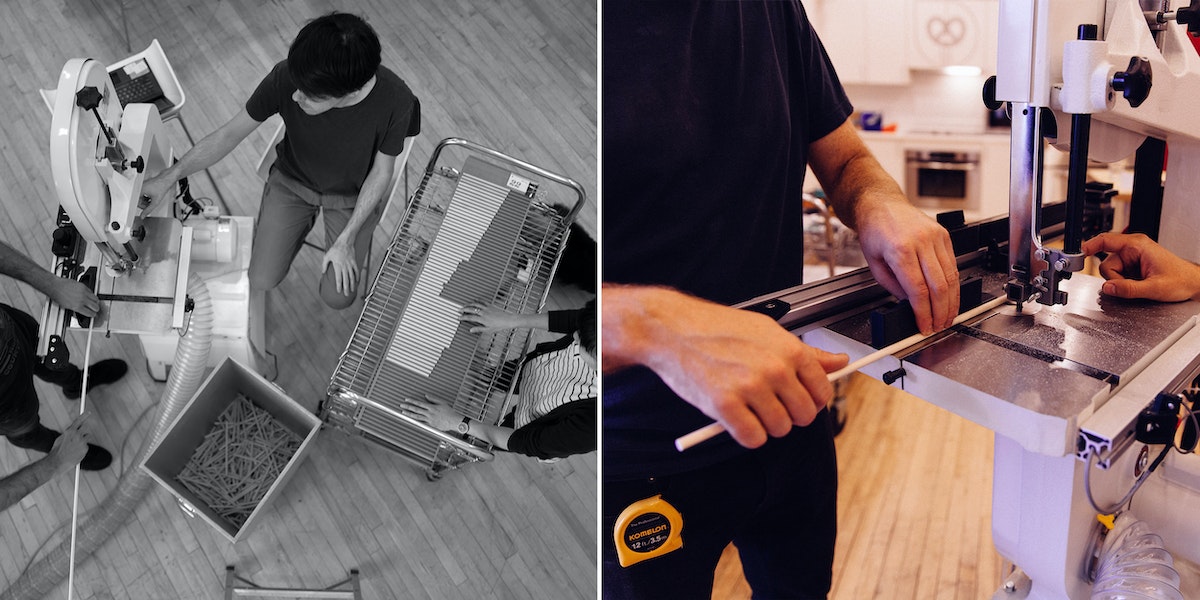
Four months later, we were ready for the big install. We invited the entire studio to come in on a Saturday morning, and we were blown away by the number of people who trickled in. Before we knew it, close to 40 people were helping out. Some heroes even stayed until 2 a.m. There were people hammering in dowels, cutting on Chop-Chop, filling trays, documenting with photo and video, and making beer runs. The assembly lines were staggeringly efficient and fun. It was a robot love fest.
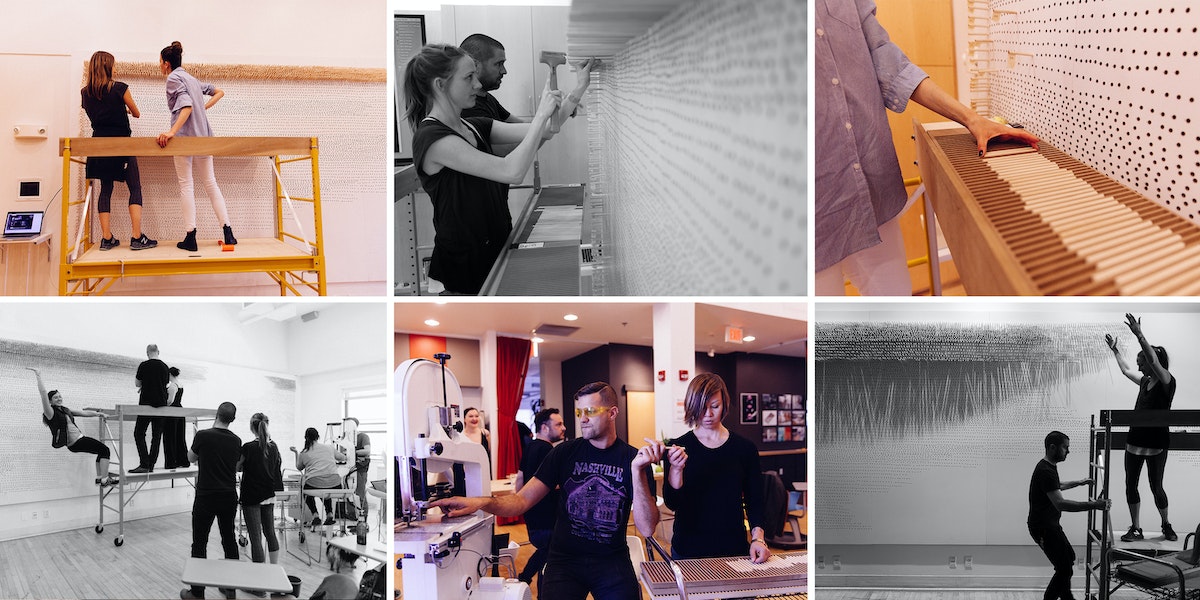
We had hoped that there may be some errors in the process and we were happy to see them. You can find these beauty marks where the surface of the dowels gets uneven—that kind of inconsistency is impossible to predict or design, and it completely enhanced the beauty of the piece. Working together with the studio on a piece defined by the installers was a true bonding experience. It was an inspiring weekend for all of us, and we know that we’ll carry that with us in our move around the corner.
Music by Dan Deruntz. Footage by Chris Wright, Tom Kershaw, Dirk Ahlgrim, and Greg Wolos.
Materials: 20,928 birch dowels, 5/16” diameter; 7 MDF Panels, painted white; jet bandsaw; custom linear slide; Arduino MEGA; Big Easy Stepper Driver; Adafruit LED display; stepper motor; timing belt and pulleys; limit switches; custom 3D printed parts
Software: Rhino, Grasshopper, Processing, Arduino
Suppliers: Adafruit, Misumi, McMaster-Carr, SparkFun, Jet Tools
As we prepare to move from our current Cambridge studio into a new space around the corner, we can’t help but think of it as a place where many of us began our IDEO journey—sneaking up to the roof for sunset cocktails and riding in the freight elevator to the pop-up gallery in the basement. We knew giving it a proper goodbye should mean involving everyone.
Redesigning the Bagel
Why "sketching" with food will make you a better cook
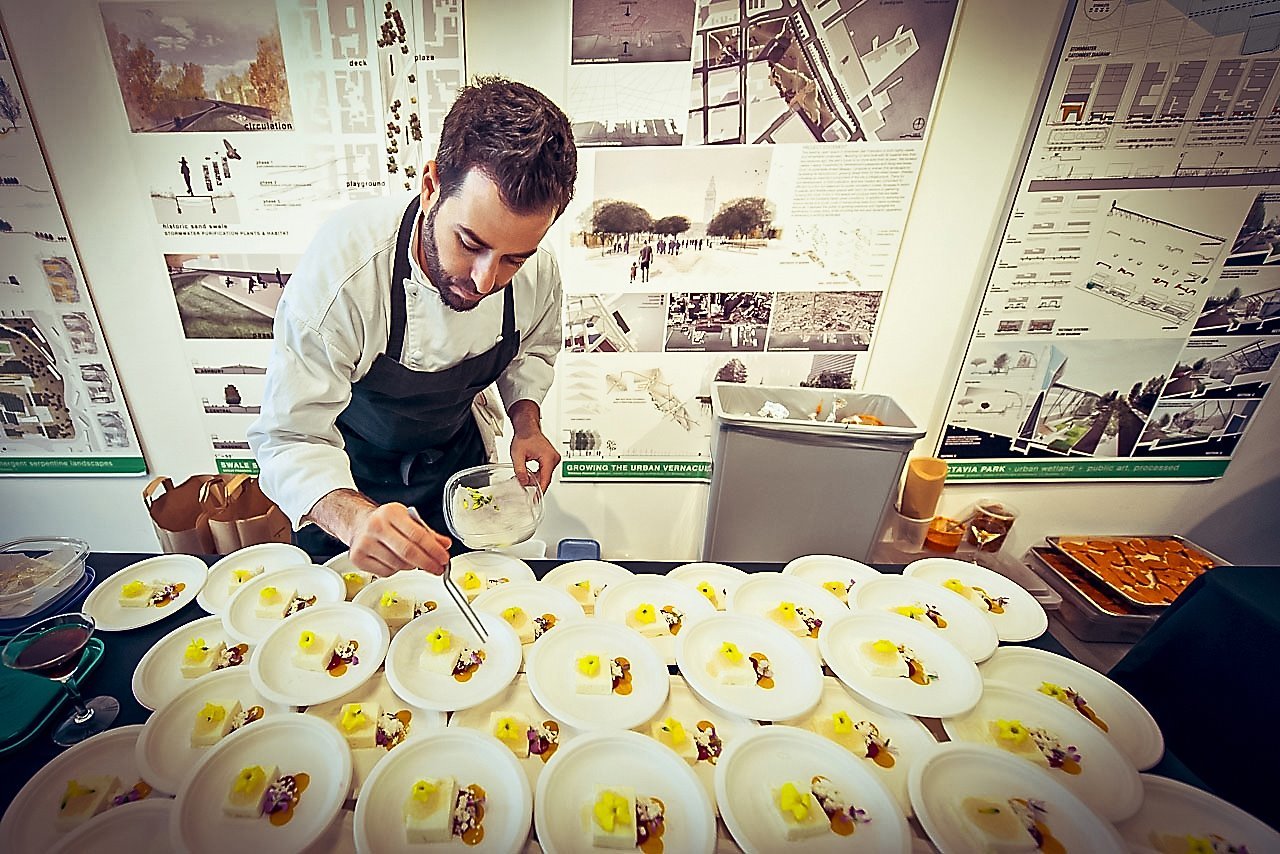
Here's an example: When I was working as a chef in fine dining, I set out to reinvent a classic—my all-time fave—the bagel, lox, and cream cheese sandwich.
My former boss, Chef Joan Roca, once told me that his most prized dining experience was when he ate the best version of a beloved dish:
"For me, there is nothing like eating the best bowl of spaghetti Bolognese I've ever tried—I don't care if you've come up with the most revolutionary dish made from watermelon and chicken feet, it just doesn't resonate in my memory banks like the familiar flavors of Bolognese do."
The process of reinvention or "deconstruction" is fairly common practice in the modern kitchen. Once you've deconstructed something, it unlocks myriad ideas. Here's what design thinking looks like in the kitchen, as expressed through a new version of the classic breakfast sandwich.
1. DEFINE THE DESIGN CHALLENGE: REINVENTING THE BAGEL SANDWICH
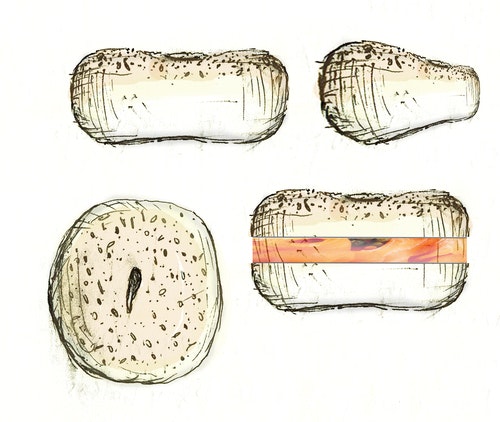
Bagel, lox, and cream cheese immediately transports me to the kitchen table at my Nana's house on a Saturday morning. The flavors are classic, yet sophisticated; a perfect dish to deconstruct for a modern appetizer.
To help you play along, here's a brief definition of deconstruction in the chef's world. The concept, which was made famous by catalan chef Ferran Adria, is to reimagine the elements of an established dish in order to create something new. I love deconstruction because it allows me play with one of my favorite elements of cooking and eating—memory.
2. DESIGN RESEARCH
The next step in recreating the bagel, lox, and cream cheese sandwich was to look into the origins and variations of the dish. I wasn't surprised to learn that the word "Lox" stems from the Yiddish word for salmon, “laks”. (There are Scandinavian roots, too, where fishermen preserved salmon in saltwater brine).
What I didn't know was that in 1869, the transcontinental railroad began transporting barrels of salted salmon—giving rise to its popularity in New York City, especially among the Eastern European Jewish immigrants who came over to the U.S. with a taste for cured and smoked fish.
As for the remaining ingredients: Bagels were first seen on the silk route in China, and then refined in Italy in the 14th century. My polish grandfather told me he used to buy "hard bagels with a huge hole" as a child in Radom, Poland. Capers came from Italy, cream cheese has roots in Britain, and tomatoes came from the new world.
So, none of the key ingredients to the sandwich come from New York City, but it was New Yorkers who put them together. The fact that the combo wasn't "old country" made me more relaxed about reinventing it—at least I knew that my version wasn't bastardizing some 1000-year-old dish, the dish itself had always been a food bastard.
I realized that in order to successfully transport myself back to my grandmother's kitchen table, I had to leave the core elements in their original, unadulterated form somewhere in the dish.
I looked at more than 50 restaurant versions and cookbook recipes for bagels, lox, and cream cheese. Then, I extracted all of the possible elements and techniques that went into the sandwich.
The ingredients included: lemon, lime, chili pepper, black ground pepper, white pepper, cayenne pepper, red onions, white onions, radish, avocado, cucumber, butter, cream cheese, capers, caperberries, olives, pickled scallions, hard boiled egg, chives, dill, tomato. I looked at the whole spectrum of preparations that were applied to each ingredient on my list: fried, scrambled, or hard-boiled eggs; raw, baked, or smoked salmon; pickled or marinated vegetables. There was an almost endless variety of combinations!
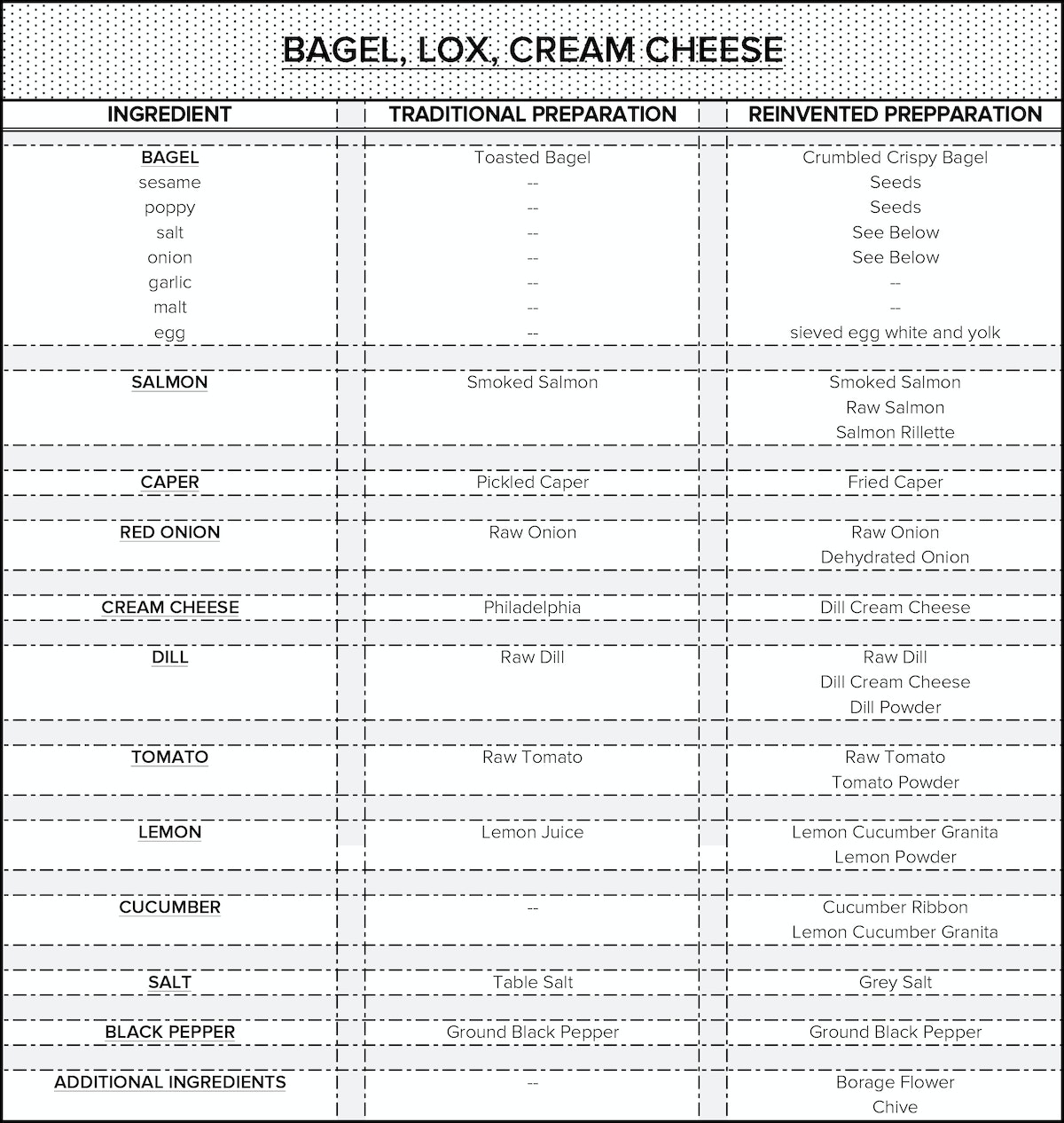
3. SYNTHESIS
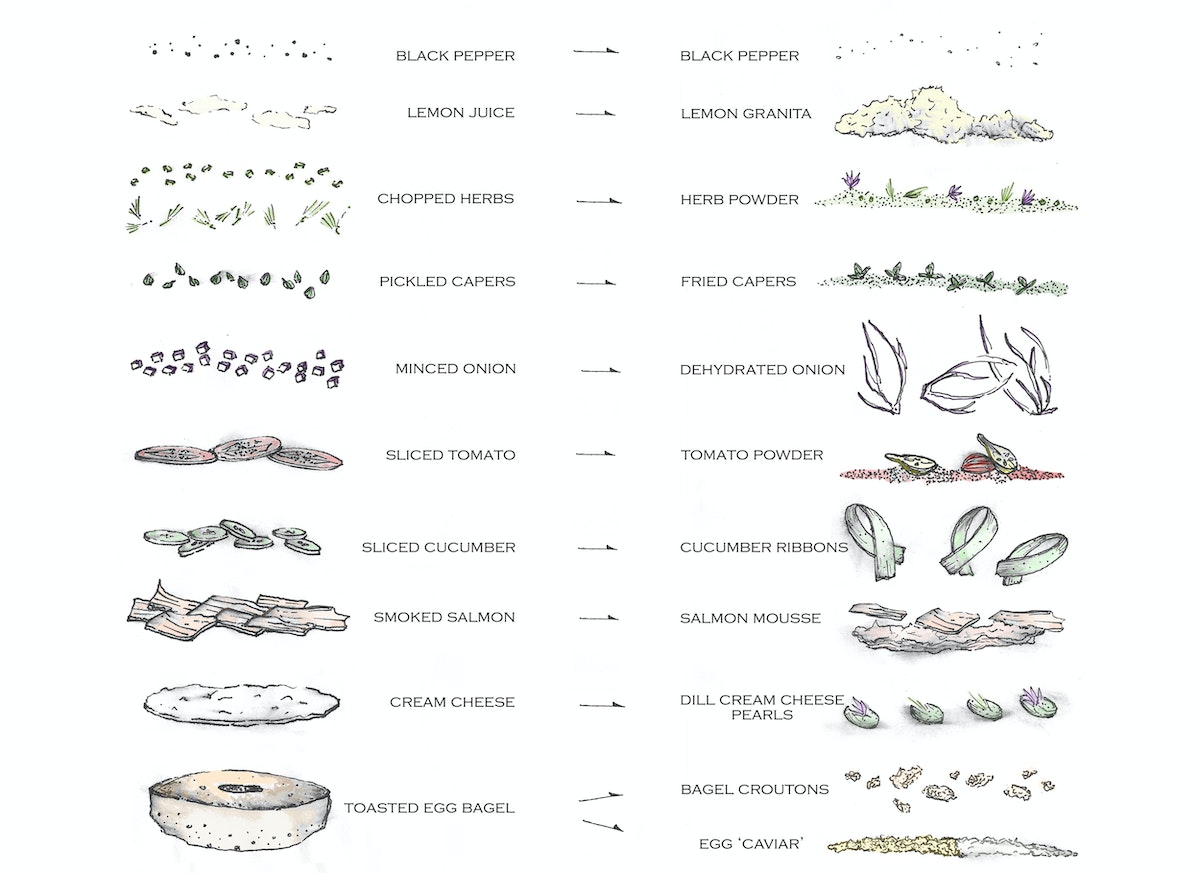
I created a spreadsheet with the list of ingredients and techniques I'd compiled in my research. The lefthand column listed each possible ingredient; the middle column listed the traditional preparations for each ingredient; and the righthand column listed the options for modern techniques that could be applied in place of the traditional ones.
4. ITERATION (AND FAILURE)
I began to deconstruct the dish ingredient by ingredient, deciding if and how I was going to affect each preparation and presentation. Sometimes I chose dramatic changes like converting drops of lemon juice into an icy lemon granita or transforming smoked salmon into an aerated mousse shot from and ISI foamer. But I also used more common techniques: an alternative cut on a cucumber, dehydration of fresh onions to make chips and powder; crumbled and sautéed bagel in olive oil. Some ingredients were left untouched like the black pepper or some were simply substituted like using marinated cherry tomatoes instead of sliced tomatoes.
I prototyped 10 to 12 iterations of each ingredient before settling on a final version. Conceiving a modern version of the dish that triggered my childhood memory was a bigger challenge than I had imagined. The first 4 to 5 prototypes sacrificed flavor for fancy techniques. One of the versions I came up with was just a bunch of powders—terrible!
Finally, I realized that in order to successfully transport myself back to my grandmother's formica kitchen table, I had to leave the core elements—bagel, lox, and cream cheese—in their original, unadulterated form somewhere in the dish.
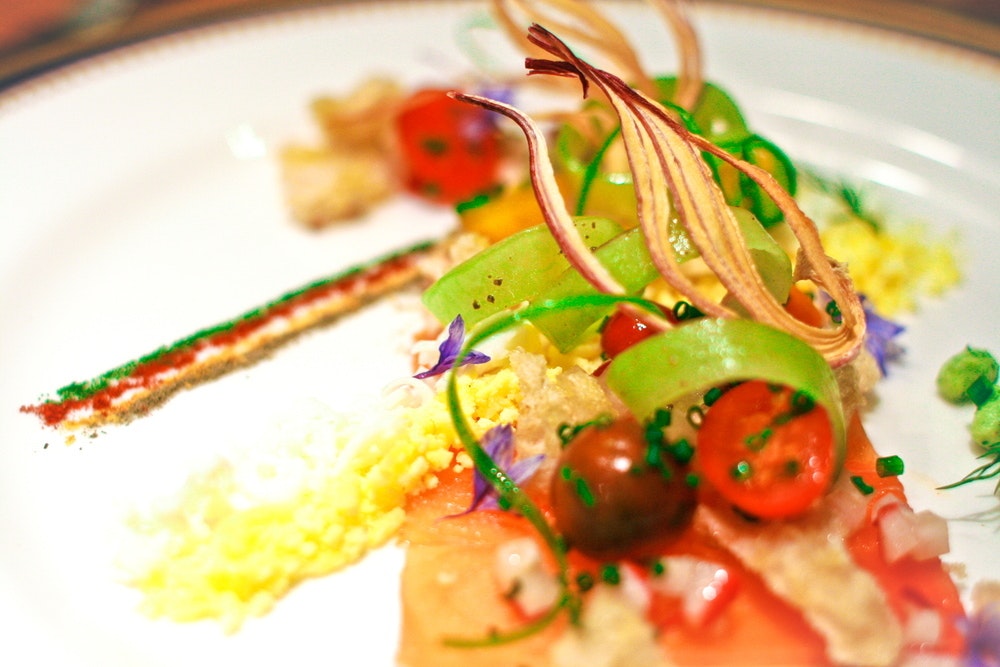
5. IMPLEMENTATION
My final version of the dish was a fluid mix of old and new: the presentation and techniques of the dish placed it strongly in the modern kitchen while the flavors remained old-world.
The final version included smoked salmon, toasted bagel, cherry tomato, fresh dill and Philadelphia cream cheese. It also featured smoked salmon rillettes; sieved egg whites and yolks; a Meyer lemon granita; dehydrated purple onions; powdered chives, powdered tomato, and powdered lemon zest (some of the powders made the final cut!); sweet, fried capers; cucumber ribbons, pickled shallots and nitro-dill cream cheese (cream cheese of the future).
When I sat down to enjoy the dish, I could almost hear my Polish Nana telling me, "Ess, mein shayna yingele, ess." (Eat, my beautiful child, eat.) And so I did.
Hi, I'm Danny, the culinary resident in IDEO San Francisco's Food Studio. I've been cooking professionally for many years, and now that I'm here, I've discovered that designers and chefs have a lot in common. We both sketch out initial ideas and then iterate quickly until the product is tasty and ready to consume.
The Imagination Man
Q&A with Scott Barry Kaufman, who wants you to understand creativity
What does the Imagination Institute do?
We are looking at how we measure imagination, so we can explore ways to increase it. The other part of our activity is studying how imagination plays a role in different fields. For this, we’ve been running events (like the one you attended) in which we gather leaders in domains such as education, futurology, psychology, physics, even comedy.
Why pull from different disciplines?
We want to understand what kind of mind is best suited for creating progress within these specific fields. The hope is that we could get some idea of how to develop that kind of imagination in schools. In the school system at the moment, it’s one-size-fits-all. But individual differences matter!
What would you teach, if you were trying to get more creativity into schools?
The value of personal expression. There are so many forces in our lives that put other people’s words in our head. But creativity research findings show how important it is to be able to insulate yourself, and not be contaminated by other selves. Often the best way we can help others is by developing our highest potentialities to their fullest, and schools are doing a pretty crummy job of that at the moment.
Business leaders want the outputs of creativity, but they often have an unconscious bias against creative behaviors and personalities
How do you continue to be inspired by others without losing yourself?
If you are secure in your sense of self, you can be open to new experiences. It’s the people who have the most fragile egos who are insecure and not creative because they are so scared that they could be wrong.
Tell me more about openness to experience. You mention that a lot.
Openness to experience is a personality trait that can be measured. It has been shown to be the number one predictor of creativity. To be creative, you need to constantly be growing. Openness allows that.
Who’s your psychology hero?
I am hugely interested in Maslow and the humanistic psychologists of the 50s and 60s. When they talked about creativity, they viewed it as the height of being. All these ideas are so relevant today, in our age of constant anxiety, with all the pressure to pay attention to other people’s goals.
What’s your take on creativity?
It’s a very vulnerable way to be—to be curious, and a little crazy.
Embracing the messiness of your mind.
Business leaders ask for creativity, but I think people are actually conflicted about what they really want. They want the outputs of creativity but they often have an unconscious bias against creative behaviors and personalities.
Want to know more about how to flex your creative muscle? Go buy Scott’s book, Wired To Create.
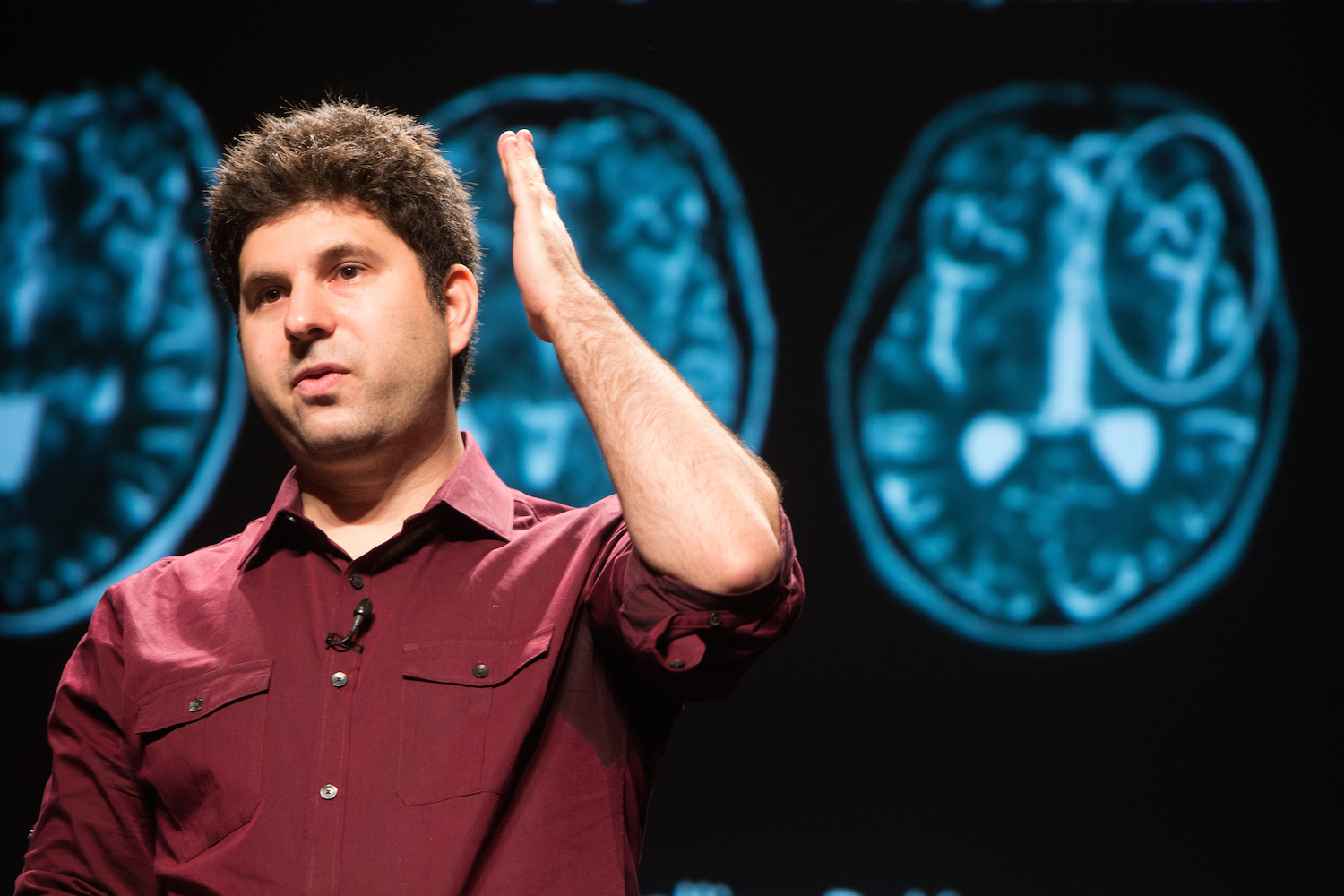
I came across psychologist Scott Barry Kaufman at an event hosted by the Imagination Institute, where Kaufman is scientific director. Before being locked in a room for two days to discuss the philosophy and psychology of education, all participants had their brains scanned in an MRI machine. Only later did I realize this was typical Kaufman: He’s made a career of fearlessly mixing hard science with culture to create fresh angles on a question IDEO asks on a regular basis: How can we all be more creative?
The Power of Oops
Making art out of mistakes
Two weeks ago, I was witness to such a moment myself. A colleague and friend, the imaginative Mr. Brown, was doodling a mob of amiable monsters and charming creatures with ink, a brush, and some paper.
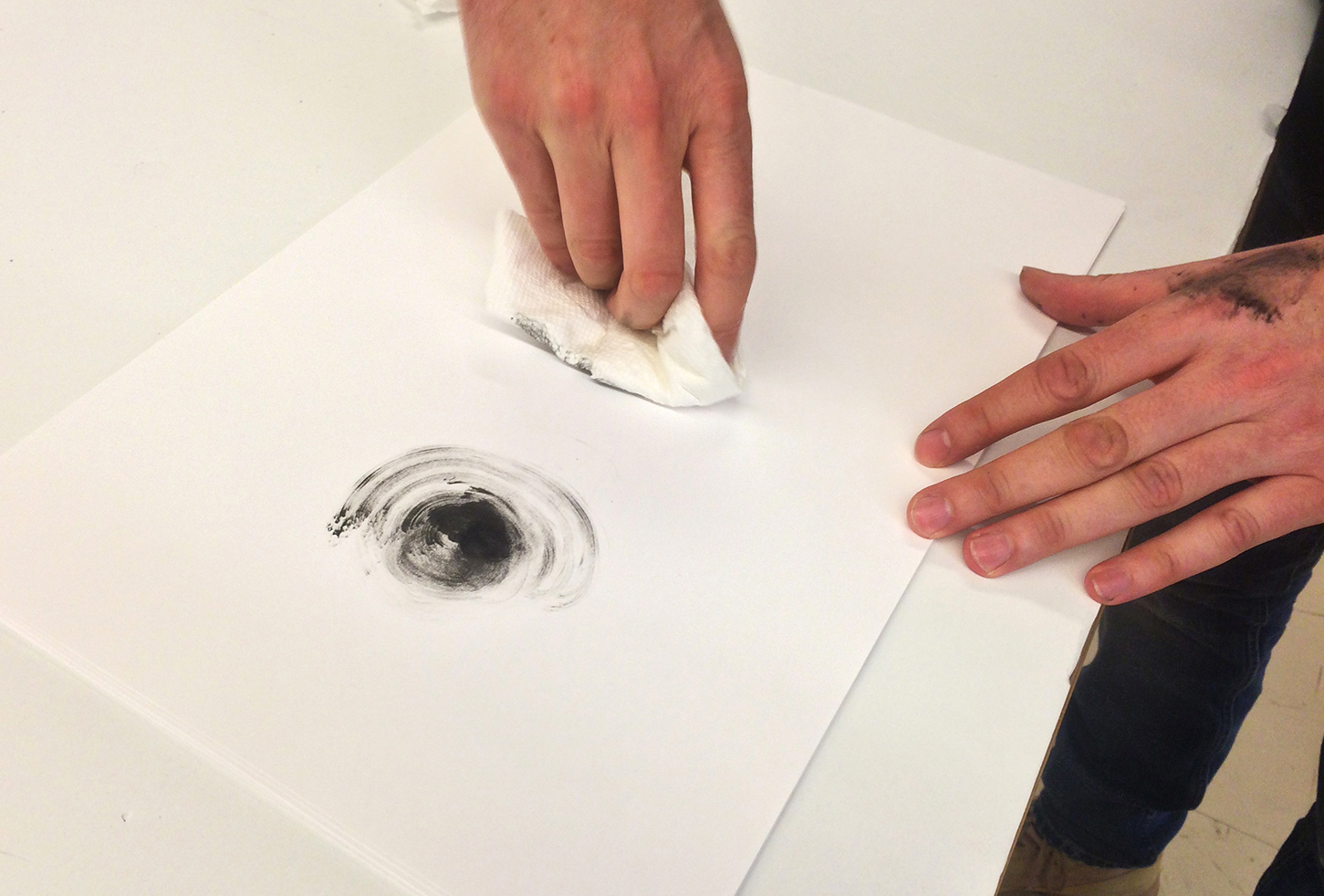
Pretty, yes. Cute, maybe. But it was when he was cleaning up that he came across a real gem: With ink-stained hands, he scrunched some paper towel to mop up the inky mess. He dabbed the offensive blob, gave a little twist and twirl with the paper towel, and lifted his hand away.
Underneath shone a ravishing vortex which drew one’s imagination into its depths. Not one to shy away from allowing his imagination to wander, he kept twirling, twisting, and whirling.
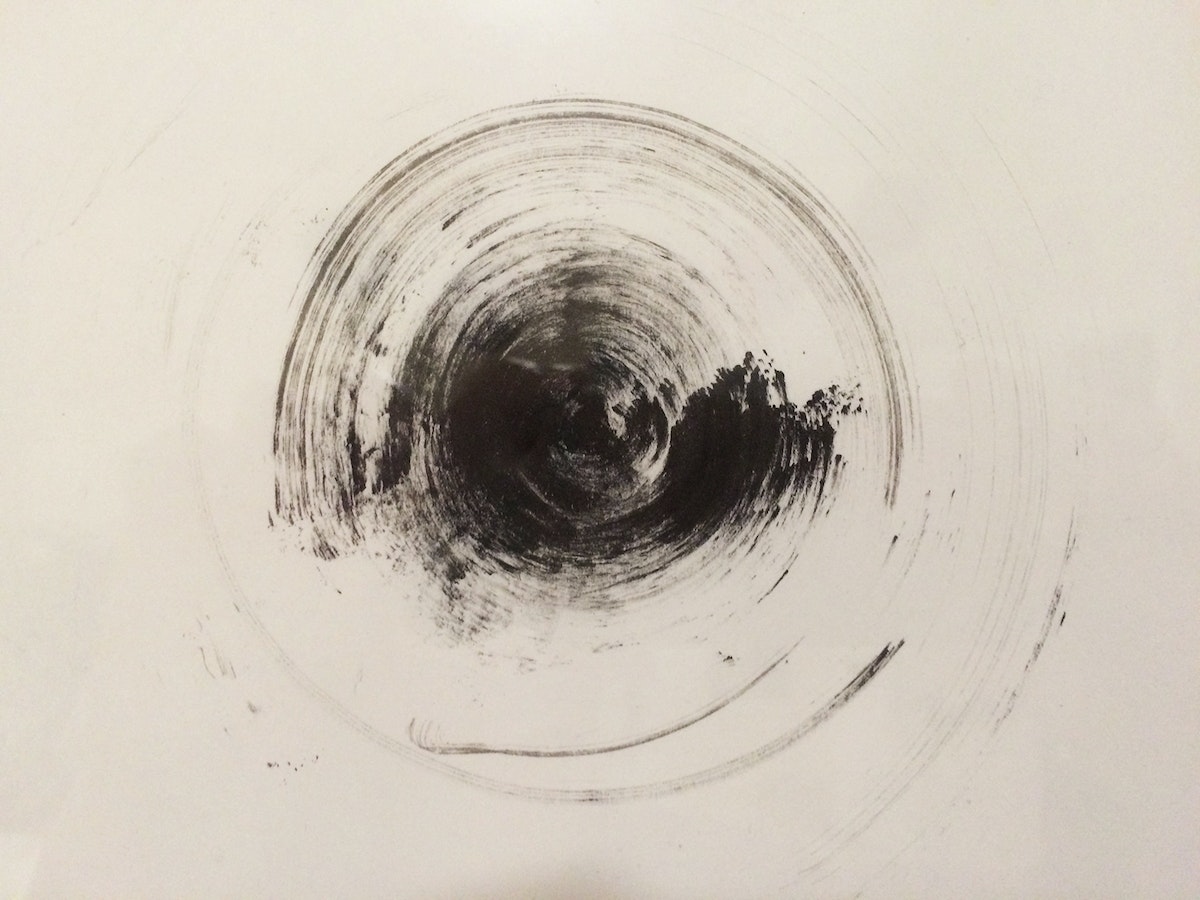
Being the cheap bugger that I am, and living in a home filled with empty walls, when I spied these beauties I immediately requested if I could have one once he was done.
His inky booboos are now hanging at home—a prized possession.
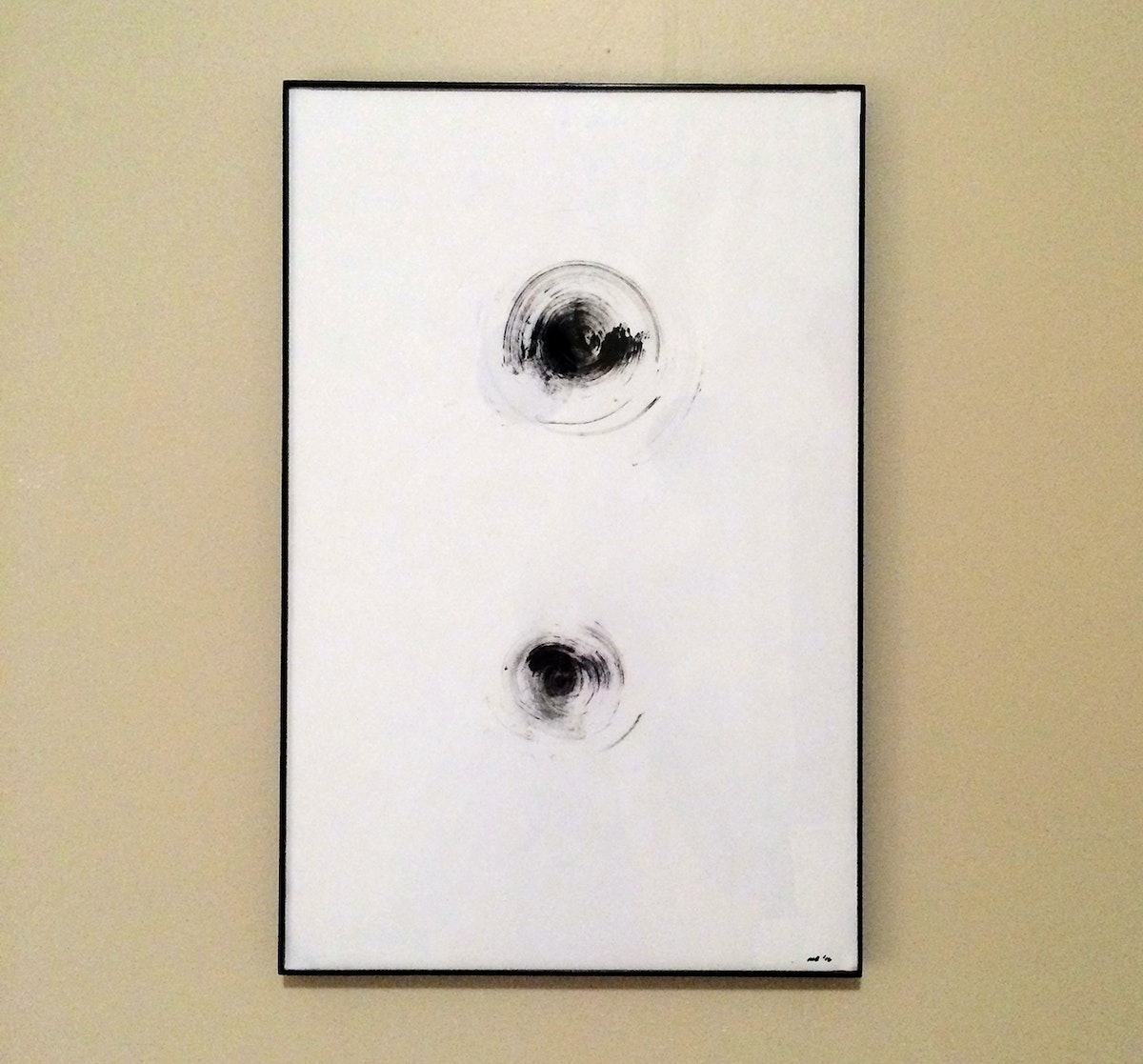
It goes without saying that some of the best ideas were borne from a fortuitous mistake: Alexander Fleming had his mold, Archimedes submerged himself in a bath, and Spencer Silver accidently created the perfect adhesive for Post-it notes (IDEO thanks you, Mr Silver).

Lindsey Turner
I’m passionate about building brands, products, and experiences that help organizations show up with meaning and momentum.
I help organizations cut through complexity by shaping how they show up, through brand strategy, identity, and storytelling.
Working at the intersection of brand and business, I bring an editorial eye and a bias toward making—turning ideas into tangible experiences that people can understand, trust, and believe in.
My work spans government, healthcare, financial services, media, and consumer goods, from launching Gen Z-focused ventures to building innovation labs and reimagining legacy brands. I relish moments of ambiguity and enjoy translating across teams, perspectives, and priorities to move ideas forward.
I started my career in editorial and digital design, shaping cross-platform experiences and identity systems in publishing and agency environments. That foundation still shapes how I work today: I’m detail-oriented, collaborative, and overreliant on the Oxford comma. I hold a BFA in Visual Communication from the School of the Art Institute of Chicago.

Rachel Young
My work helps organizations see who their products aren't working for—and build the will and the tools to do something about it
For 25 years, I've asked the same question: Who does this design exclude—and what are we going to do about it?
My work spans human-centered strategy, inclusive design, and qualitative research, with clients ranging from Microsoft, Google, and Verizon to the National Science Foundation, and San Francisco Unified School District.
Before IDEO, I taught elementary school in East Palo Alto and spent a decade doing design work with social service organizations—where I learned firsthand what it costs people when systems are built without them in mind.
I am currently writing User Error, a nonfiction book about digital access and the design decisions behind it. I live in Oakland, California.

Brian Pelsoh
I lead with craft, ensuring our work is creatively excellent: rooted in deep human insight and imagination, while also grounded in the realities of business and technology.
My expertise spans brand, communication, and product design across tech, education, the arts, and social impact.
I believe great work demands both high-level vision and obsessive attention to detail, and only happens through collaboration.
I bring an inclusive, hands-on approach and a deep understanding of business, which enables me to consistently deliver excellence while always asking why.
Before joining IDEO, I worked at the brand firms Pentagram and VSA Partners. I began my career as a designer, leading teams at the School of the Art Institute of Chicago and the Milwaukee Art Museum. I hold an MFA in graphic design from Maryland Institute College of Art and a BFA in communication design from the Milwaukee Institute of Art & Design, and have taught at some of the best design schools in the US.

Tony Wong
I am responsible for IDEO’s long-term success in China and working with clients to use design as a tool to enable growth.
I am responsible for IDEO’s long-term success in China and working with clients to use design as a tool to enable growth. Specifically, I have helped Chinese companies design holistic brand solutions through the development of their products, communication, services, and innovation teams, and I have helped multinationals expand their presence and influence in China.
I advise global leaders on developing China-led innovation and capabilities.
In over 15 years in IDEO Shanghai, I have worked on projects that use design to elevate the quality of the experience of healthcare products and services, streamline processes that increase productivity, create spaces and programs that promote and enable inclusive communities, and build next generation mobility solutions that are planet-positive.
Before joining IDEO, I worked at Philips Electronics and the Electrolux Group in Italy, the Netherlands, and Singapore on a number of breakthrough commercial products. I am a member of the Young President Organization in Shanghai.

How to use AI as an editor, not a writer
Ed White shares how he uses AI as an editor—not a writer—to sharpen storytelling, rehearse ideas, and preserve the productive friction that makes creative work better.
Ed White has a rule he's tested on his own writing: hold yourself as the writer, and let AI be your editor. Ed is a Senior Design Director at IDEO's London studio, where he co-leads the firm's AI portfolio across Europe. Before IDEO, he spent 12 years as a writer and editor at the Financial Times, Wired, and Contagious. So when he talks about when to use AI for storytelling and when not to, it comes from two decades of crafting his storytelling skills.
In this episode, Mina Seetharaman talks with Ed about two specific tools he uses to keep AI in an editor's seat: a "roasting agent" prompted to critique his drafts without any sugarcoating, and a simulated audience he rehearses pitches on before the real thing. They also get into what Ed is hearing from design leaders at Anthropic, Lovable, Shopify, and Google Creative Lab about how creative work is changing, and why he thinks the friction of writing something yourself is worth protecting rather than automating away.

Building a personal AI for the messiness of life: Sida Li
Becca Carroll talks with Cue co-founder Sida Li about designing a personal AI for the messiness of everyday life—not just work. They explore how Sida stays anchored to human needs while navigating fast-changing technology, product tradeoffs, business-model experimentation, and the realities of building an AI company today.
Most AI products today are built for work—a space with clear problems and established systems. One founder noticed a gap: personal life is messier, harder to systematize, and mostly left behind by the AI boom. So she built Cue, a personal AI that lives inside iMessage and group chats, to go where the other tools haven't.
In this episode, Becca Carroll, IDEO's Chief Strategy Officer, talks with Sida Li, co-founder and CEO of Shared Context Lab, about staying anchored to a human need while the technology around her keeps changing shape, why she treats her business model with the same rigor she'd bring to a product, and what it feels like to build a company at this particular, disorienting moment in AI.
The conversation also gets into how Sida makes design decisions: the language Cue uses to describe itself, the tradeoffs behind building inside iMessage instead of a new app, and a real story about a business idea that didn’t pan out.
This is the second in a two-part series profiling founders from IDEO's Startups-in-Residence program. The first conversation is with Johannes Seemann, founder of Sooner, on designing GenAI for the emotional side of money.

Designing GenAI for the emotional side of money: Johannes Seemann
Designing financial tools around the feelings that shape money decisions.
Most personal financial tools are built to run the numbers and optimize towards a budget. While that works for some, most people experience money as a lived relationship that does not neatly fit into a spreadsheet. Johannes Seemann and Becca Carroll discuss why money is emotional before it is mathematical, and what a human-centered approach to building a generative AI financial product looks like in practice.

The curious leader's edge in uncertainty: Scott Shigeoka
How genuine curiosity helps leaders navigate uncertainty with greater confidence.
Mina Seetharaman talks with Scott Shigeoka, author of Seek and Head of Curiosity Cultivation at the Eames Institute, about what distinguishes genuinely curious leadership from performative curiosity, how power dynamics shape curiosity, and why practicing curiosity can restore energy rather than drain it.
Looks like you might be in search of something very specific?
Or reset the filters above and try another angle.
Here’s some random inspiration

Podcasts about creative leadership

Articles about the power of prototyping










































.webp)