Creating an out-of-this-world STEM learning experience
Aboard the Verizon Explorer Lab, students can travel to Mars and learn engineering basics along the way.
When Mr. Gordon told his fifth grade students they were taking a field trip on a bus, many of them envisioned the city bus that they ride each day to school. But when they saw the Verizon Explorer Lab pull into the school parking lot, they realized a unique experience awaited them. Painted in bright colors, this bus promised something very different from their daily commute.
“Climb aboard, explorers!” says the Lead Explorer. The students walk through the bus’ sliding doors and inside, where instead of rows of seats, they find a sleek research lab. Suddenly, the lights dim. The bus makes a rumbling noise as though it’s about to lift off. And on a large screen, a vision of Earth from space appears. The students listen and point as the video narrator briefs them on NASA’s ongoing search for life in space.
Science education isn’t always this fun. Some kids have a chance to learn through interactive games, immersive experiences, or engaging field trips; but many lack access to rich educational experiences in science, technology, engineering, and math (STEM). As a result, they can be less likely to pursue careers in STEM, though many future jobs will demand mastery of these subjects. This not only impacts a student’s potential and future, but reduces the diversity and number of qualified STEM job applicants.
In under-resourced schools, students are often limited to the scarce tools available for STEM learning in their classrooms. Many kids rarely have a chance to leave their neighborhoods. For these kids, mobile learning experiences that come to their school offer unparalleled exposure to cutting-edge, technologically advanced, and—most importantly—inspiring gateways into these critical academic subjects.
As part of its focus on digital inclusion, Verizon partnered with IDEO to share the excitement of STEM learning with middle schoolers. To facilitate access and discovery of STEM, the team designed a learning experience that takes place on a coach bus and can be scaled to reach kids across the nation.
The team set out to transform the bus into the Verizon Explorer Lab: a futuristic research lab that transports kids to new environments, from outer space to under the sea. As part of the larger Verizon Innovative Learning program, the Verizon Explorer Lab offers delightful and rigorous content that meets national science standards.
A multidisciplinary team comprised of designers across interaction, communication, environments, games, and software partnered with Verizon to bring the Verizon Explorer Lab to life.
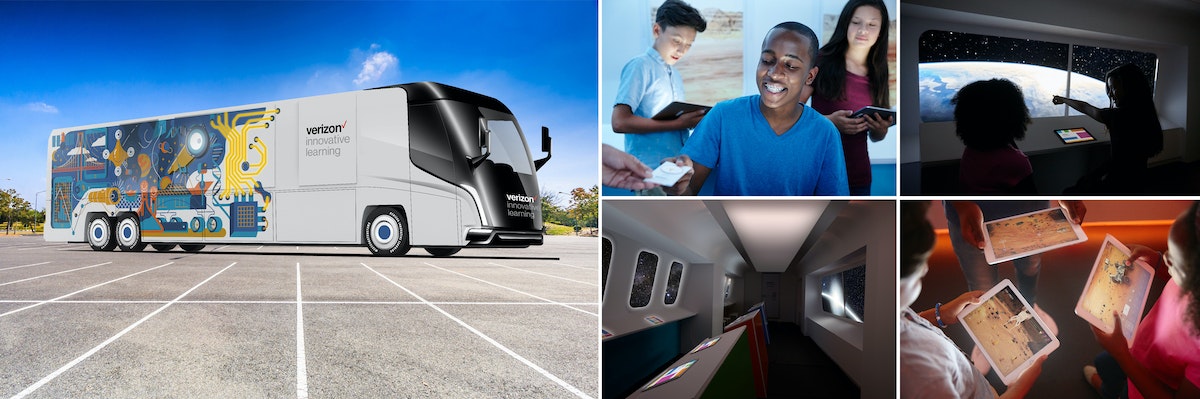
To keep the student at the center of the experience, the team designed alongside kids. Their gravitation toward play, interaction, and technology inspired the digital game that students play onboard the bus. When developing the game’s narrative, the designers turned to popular kids’ books and movies. What began as a card game prototype eventually became a 360-degree video and virtual reality expedition to Mars—complete with a custom musical score—that introduces middle schoolers to engineering basics.
After stepping through the bus doors and taking a tour of the solar system, Mr. Gordon’s students receive an emergency call from NASA: They must rescue the missing Curiosity rover, which is dedicated to collecting evidence of life on Mars. Eager to save Curiosity, the students become immersed in the adventure at hand. And through the adventure, they become immersed in science.
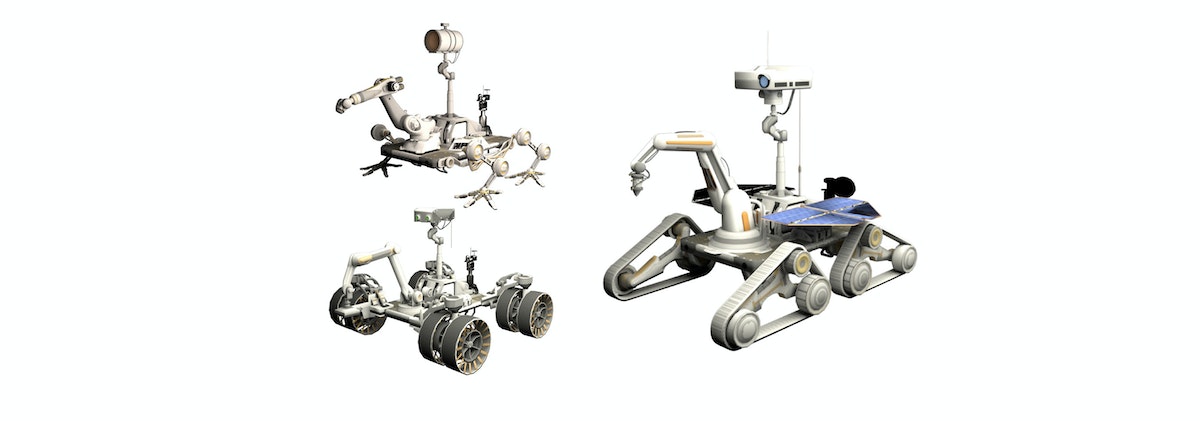
Students use tablets to design their own Mars rover. Each rover appears on a large screen and traverses the planet’s extreme terrain. The goal is to collect data that suggests life on Mars, including ice deposits, photos, and more. Students iterate on their rover’s design—wheels, power sources, and sensors—to test if it can stand up against dust storms and craters. The team consulted a NASA planetary scientist to ensure accuracy, as well as educators to establish cohesion with classroom curricula.
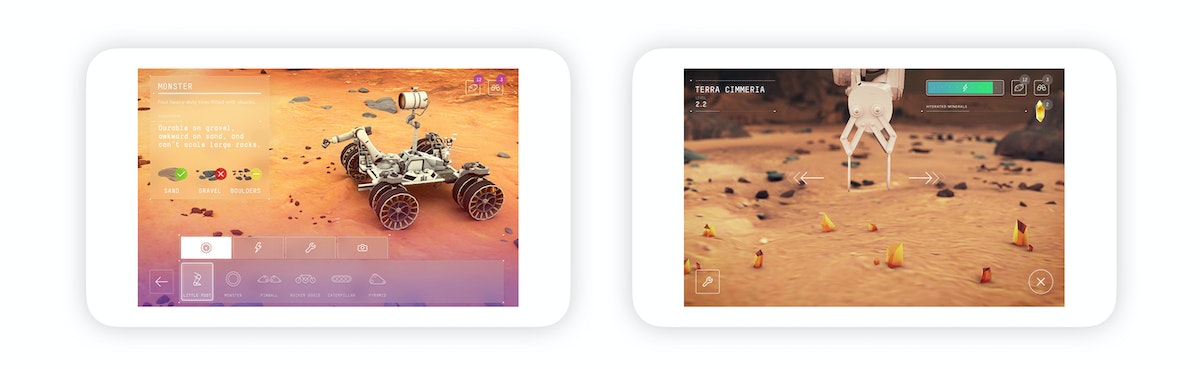
During the game, students are encouraged to compare designs and learn from each other: One rover may be able to travel long distances and take various photos, while another can carry large quantities of ice and sediment samples but can’t go far because of its size. At the end of the mission, the group finds Curiosity and sends all of the evidence they’ve collectively gathered back to NASA to aid the search for life beyond Earth. Before departing the bus, students watch an animated video that explains various jobs in STEM and encourages kids to pursue one of these careers.
The Verizon Explorer Lab teaches students the engineering design loop, the value of collaboration and teamwork, and what a career in STEM might look like. The mission to Mars game is just one of many potential STEM learning opportunities for students and integrated, customizable learning modules for teachers.
Since launch, the Verizon Explorer Lab has traveled to various parts of the United States and reached thousands of kids. It continues to be managed by Learning Undefeated, Verizon’s nonprofit partner. By designing for and with students, it’s possible to create educational experiences that facilitate meaningful learning and genuine fun. The Verizon Explorer Lab represents progress towards a more inclusive future for employers and the STEM field.
A leading food company’s human-centered transformation spurs rapid growth
How The J.M. Smucker Company embraced customer centricity to build a culture of innovation.
Over more than a century of leadership in the food and beverage industry, The J.M Smucker Company has expanded its range of products to maintain its relevance and address market demand. Today, the company leads numerous categories, with beloved products like Jif, Milk-Bone, and Folgers, which are the top choices of millions of Americans. By growing and diversifying their brands over the decades, Smucker has successfully weathered major shifts in consumer habits and technology. Today, though, CPG companies are experiencing unprecedented disruption, and leaders at Smucker understand that the escalating pace of change will require more than just new products.
Geoff Tanner, Senior Vice President, Growth & Consumer Engagement at The J.M. Smucker Company recognized the need to identify new market opportunities and establish practices that put innovation and growth at the heart of their business. And he saw the potential to bring those goals to life through his relationship with IDEO.
WATCH: Balancing innovation and efficiency through design has helped Geoff Tanner, Senior Vice President, Growth & Consumer Engagement at The J.M. Smucker Company, brave the unfamiliar, transform organizations, and ultimately bring game-changing ideas to market faster.
Geoff has stewarded a close partnership with IDEO for over a decade and throughout roles at numerous organizations. Together, Geoff and IDEO have worked on 25 projects, beginning while Geoff was VP of Marketing at Big Heart Pet Brands, and continuing on throughout his career at The J.M. Smucker Company. By working with IDEO to adopt a design thinking approach, Geoff has enabled collaboration across teams and empowered his organizations to find new ways of working that result in measurable business impact. For The J.M. Smucker Company, the partnership has brought creativity and human-centered design to the forefront of its operations, strengthening its ability to bring new products and brands to market and create a pipeline of growth.
WATCH: The J.M. Smucker Company has shifted to embrace growth and innovation as a mindset throughout the organization to bring more consistency to the innovation process.
Looking to the past to creatively connect with the future
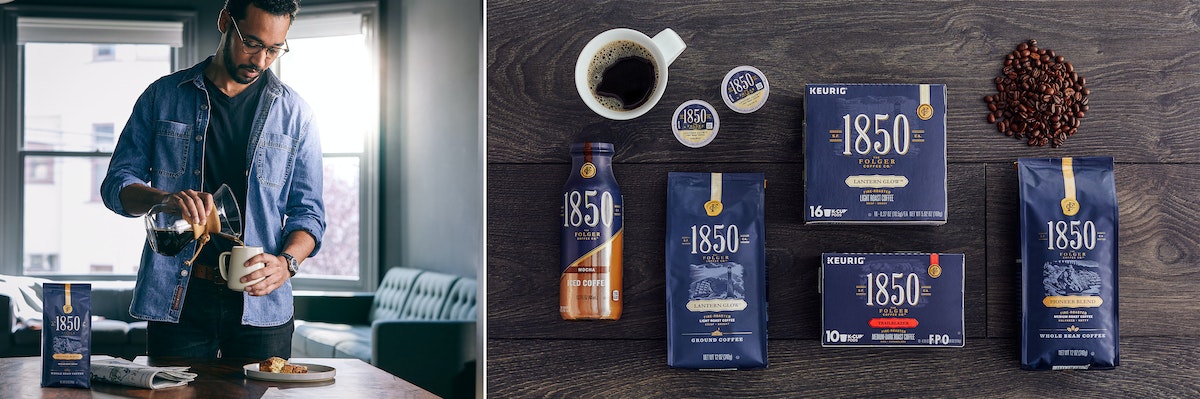
As an example of this, Geoff and The J.M. Smucker Company suggested to IDEO that they explore how Folgers, America’s leading at-home coffee brand, might resonate more deeply with a millennial audience. Design research revealed that the mindset of today’s millennial coffee drinkers aligned with Folgers entrepreneurial brand roots. The teams collaborated to create a new concept: a brand called 1850 and an end-to-end, go-to-market product experience, including packaging, retail, and merchandise. 1850 hit shelves in 2018 and has since been reported by IRI Advantage as the top launch in the Coffee Category for 2019.
Frankly, I don’t think innovation gets any easier. You just get a little more comfortable with the discomfort, and that’s when the work starts to get consistently better.
Geoff Tanner, Senior Vice President, Growth & Consumer Engagement, The J.M. Smucker Company
Creating an innovation pipeline that’s inspired by consumers’ needs
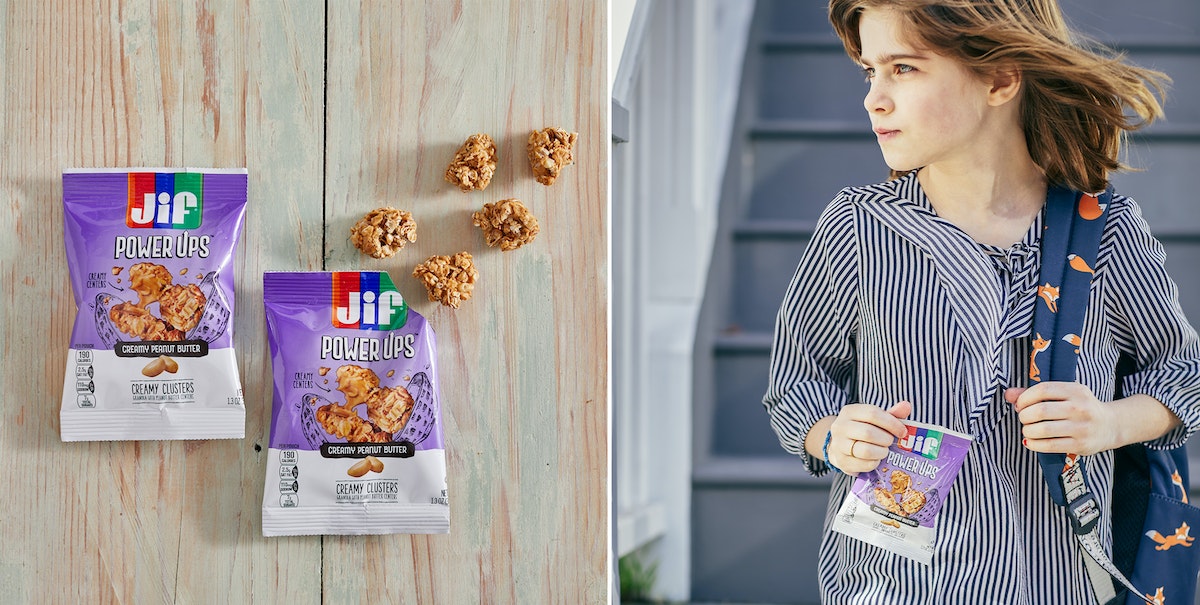
With 1850 underway, Geoff and The J.M. Smucker Company continued to invest in human-centered design to drive new offerings. The next collaboration with IDEO explored how Jif, the iconic peanut butter brand, could extend beyond the jar and become more readily accessible and appealing to busy parents who want to feel confident about the snacks they give their kids.
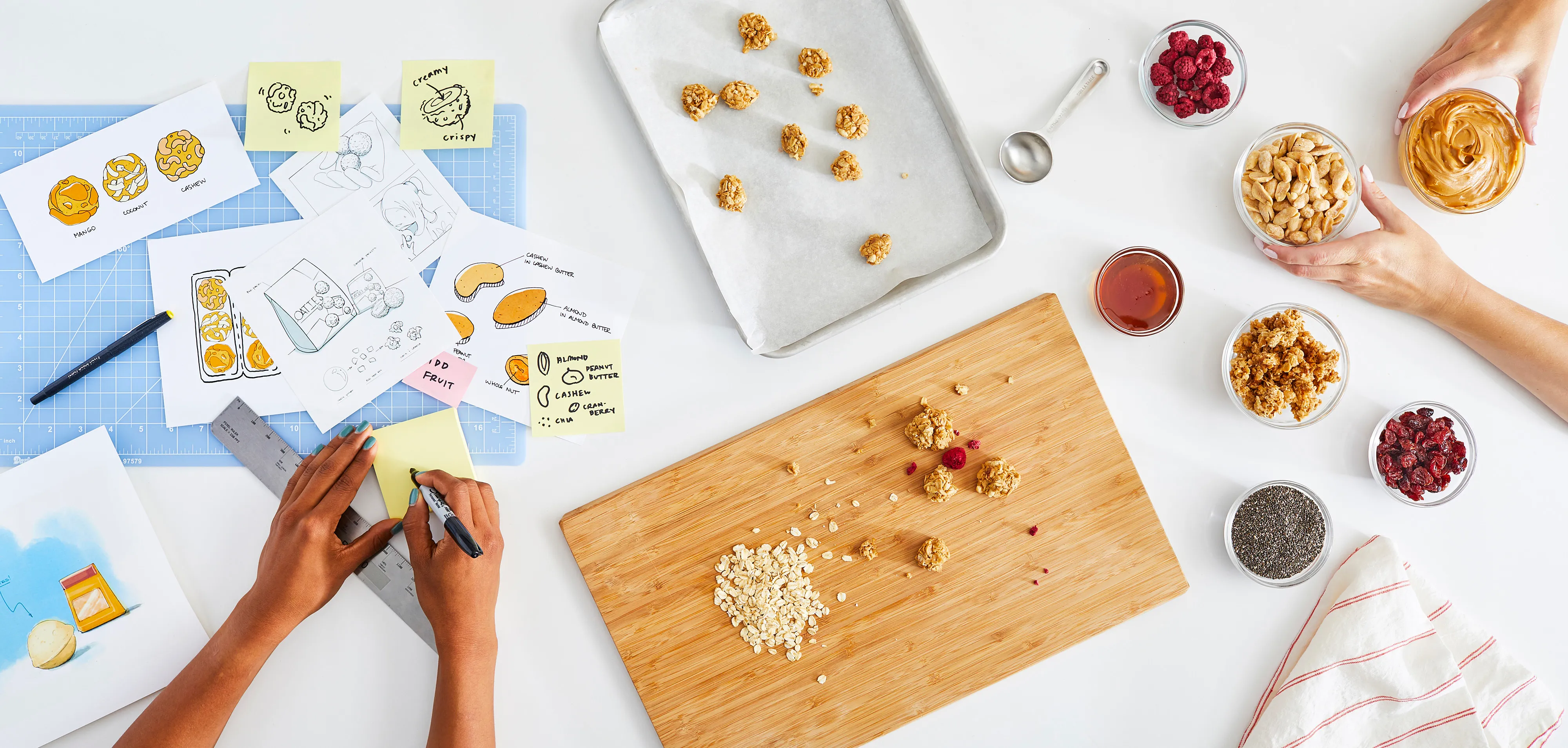
The design team was moved by the challenges that parents face: They want the best for their kids, but struggle to choose between what’s wholesome and what’s convenient on a daily basis. The ideal foods are filling, nutritious, and energizing, but often take more time to prepare and aren’t backpack or carpool-friendly. On the other hand, more convenient options tend to be full of empty carbs. Based on this insight, IDEO and Jif decided to tackle the snack-time parenting struggle. The IDEO and Jif teams worked side-by-side to prototype multiple product ideas and formats and tested them with on-the-go families to ultimately create Power Ups.
Available at over 200 retailers worldwide and online at Amazon, Jif Power Ups make wholesome, delicious grab-and-go snacking possible for kids and parents alike, across products ranging from Soft Baked Bars to Creamy Clusters, which are filled with peanut butter and rolled in whole grain oats. All are made with peanuts as the first ingredient and contain no high fructose corn syrup. Since going to market in 2018, Jif Power Ups has been named the top innovation launch in the Snack Bars category by IRI Market Advantage.
Design thinking underpins everything we do.
Geoff Tanner, Senior Vice President & Corporate Officer, Growth & Consumer Engagement, The J.M. Smucker Company
WATCH: The J.M. Smucker Company is on a transformational journey, committed to three pillars of growth: Lead in the best categories, build brands consumers love, and be everywhere.
The J.M. Smucker Company has experienced accelerated growth and speed to market by testing bold new ideas and evolving the role of innovation at the company. Design thinking and consumer empathy have permeated the organization’s new product development process, making it easier to uncover sharp, human-centered insights that lead to thoughtful and uniquely differentiated brands in a competitive, ever-shifting, and overcrowded industry. The work has fueled Geoff’s vision to inspire a culture of innovation at the company so that it can move at the speed of consumers and remain a best-in-class family of brands for future generations.
Creating a fresh, modern take on the Indian culinary experience
Designing a scalable restaurant, retail, and packaging experience that highlights the diversity of regional Indian foods.
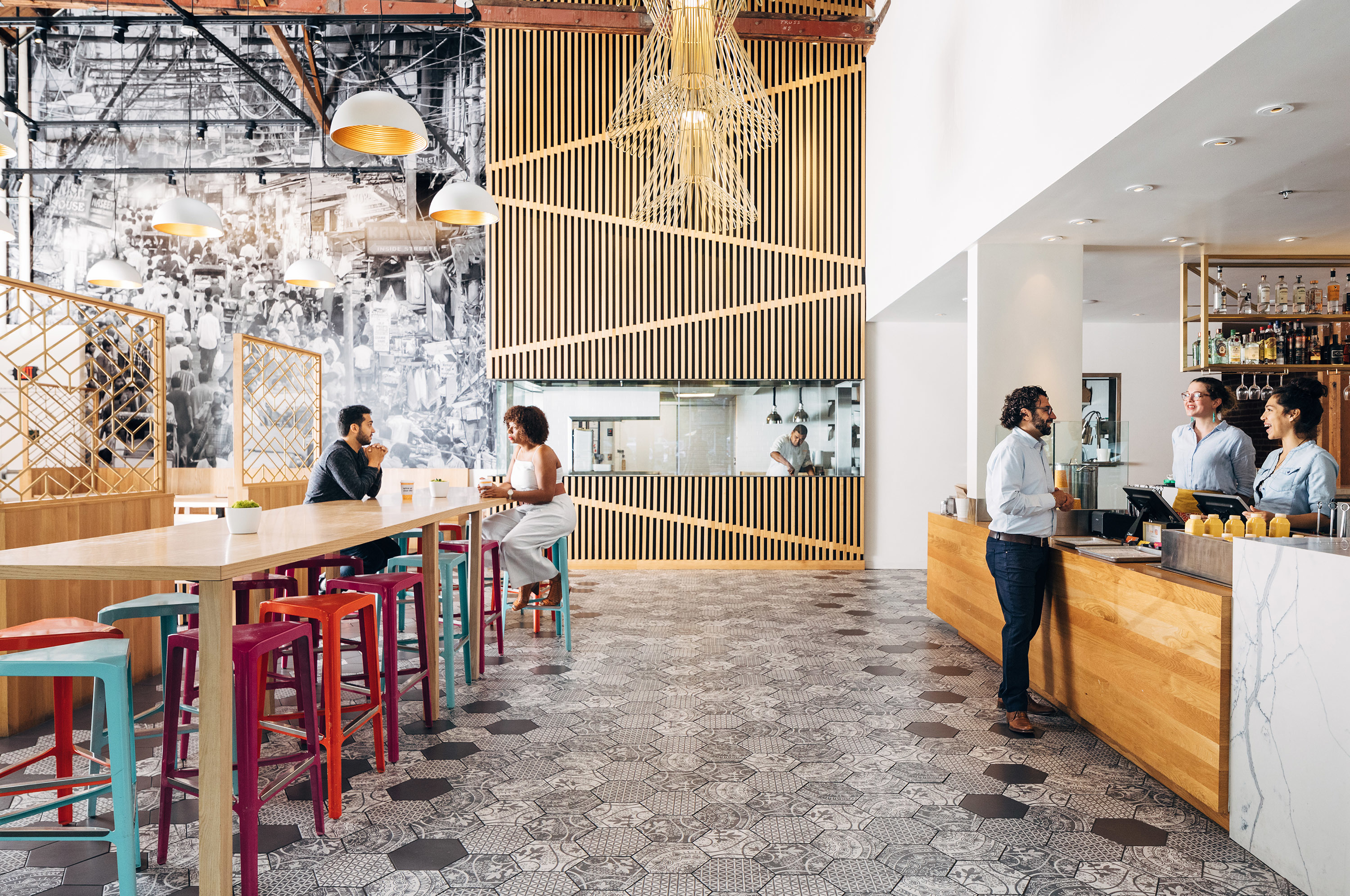
It’s a Thursday afternoon in Oakland, California. A line of lunchtime diners snakes out the door of dosa by DOSA. Upon entering, eaters are greeted by the smell of tangy dosa—a large paper-thin crepe made from a fermented batter of rice and lentils—and sweet, spicy chai. Turquoise chairs pop against a floor-to-ceiling mural by Oakland artist Namita Kapoor that transports diners to Chandni Chowk, one of the busiest markets in Old Delhi, as if enjoying their food at a local vendor.
In 2003, Emily and Anjan Mitra spent their honeymoon in India, savoring the street food of Anjan’s childhood in Mumbai (often still called Bombay). After returning to San Francisco, they found themselves longing for those distinctive flavors and dishes. Realizing that most Bay Area diners had never seen nor tasted these foods, Emily and Anjan founded DOSA, an upscale, full-service restaurant that introduced the Bay Area to Southern Indian cuisine. Locals came to try the unique, plant-forward dishes, and left with satisfied bellies and a broader understanding of Indian culture.
The entrepreneurs envisioned a brand extension of DOSA: a counter-service restaurant that could scale nationally. The hospitality venture, called dosa by DOSA, would offer healthful Indian street food made from local and seasonal ingredients. Emily and Anjan also set out to expand their existing product line-up—including cold lassi beverages, simmering sauces, and grab-and-go-meals—to national grocers and retailers and needed launch-ready packaging that was convenient, eye-catching, and environmentally-friendly. The new expression would enable consumers to experience dosa by DOSA and Southern India in a variety of forms and places. Emily and Anjan partnered with IDEO to establish a cohesive and consistent brand experience, from the restaurant and to-go meals to retail stores and mobile delivery.
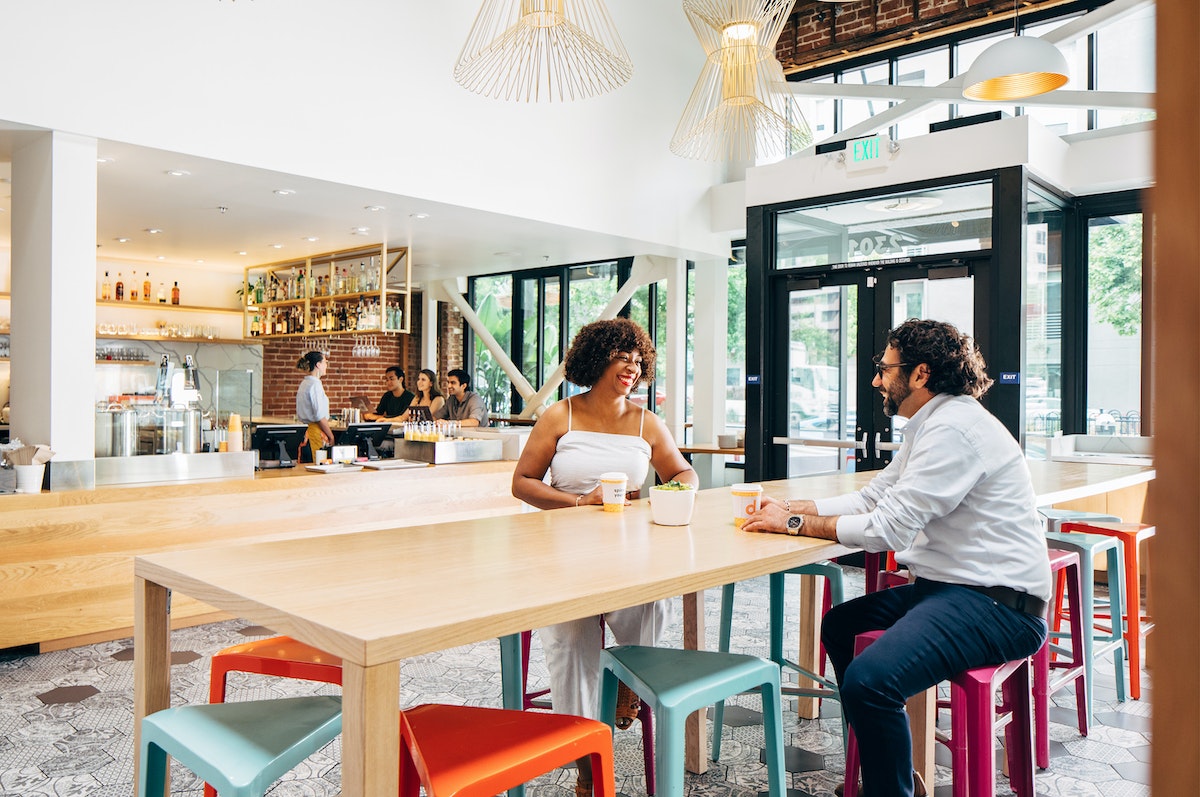
In close partnership with the founders, their staff, Feldman Architecture and MPADA, IDEO set out to bring dosa by DOSA to life and help it scale through brand, environment, and experience design. This included creating everything from the logo and packaging to the menu and operations strategy, with each element tying back to the founders’ vision of sharing Indian heritage and traditions through cuisine.
The group began by seeking cultural inspiration for dosa by DOSA’s brand identity system—the logo, colors, values, fonts, and messaging—to guide future designs. They were inspired by Indian truck drivers who decorate their trucks with garlands, signs, or flags that engage other drivers or bring luck. The dosa by DOSA logo design and its wood-cut typeface are inspired by the dimensionality of this homespun art form, while the vibrant, eclectic colors reflect the streets and textures of urban Mumbai.
The goal of opening people’s minds to Indian cooking and culture extends to the packaging, which meets customers’ needs and playfully educates them. The food containers—made from recycled and compostable material—feature brightly patterned labels reminiscent of the trucks. Some have built-in compartments suited to multiple dipping chutneys, making it convenient to sample a variety of Indian flavors. Paper tray covers resembling Mumbai newspapers offer eating tips like “Be civilized. Eat with your hands,” encouraging diners to experience an Indian custom.
The vibrant brand comes to life across an array of packaging, including cold cups printed with the phrase “thanda thanda pani”—meaning “cold cold water”—which comes from a popular Indian parody of the Vanilla Ice song "Ice Ice Baby."
To design the diner experience and restaurant environment in a way that invites curiosity about the culture and cuisine, the team started with diners: They identified key moments in their experience like entering, waiting in line, and paying. The floor plan, furniture, lighting, signage, and menu were designed around these touchpoints. For example, while customers wait in line, they can watch dosa being prepared, as if they’re eager and hungry travelers awaiting street food.
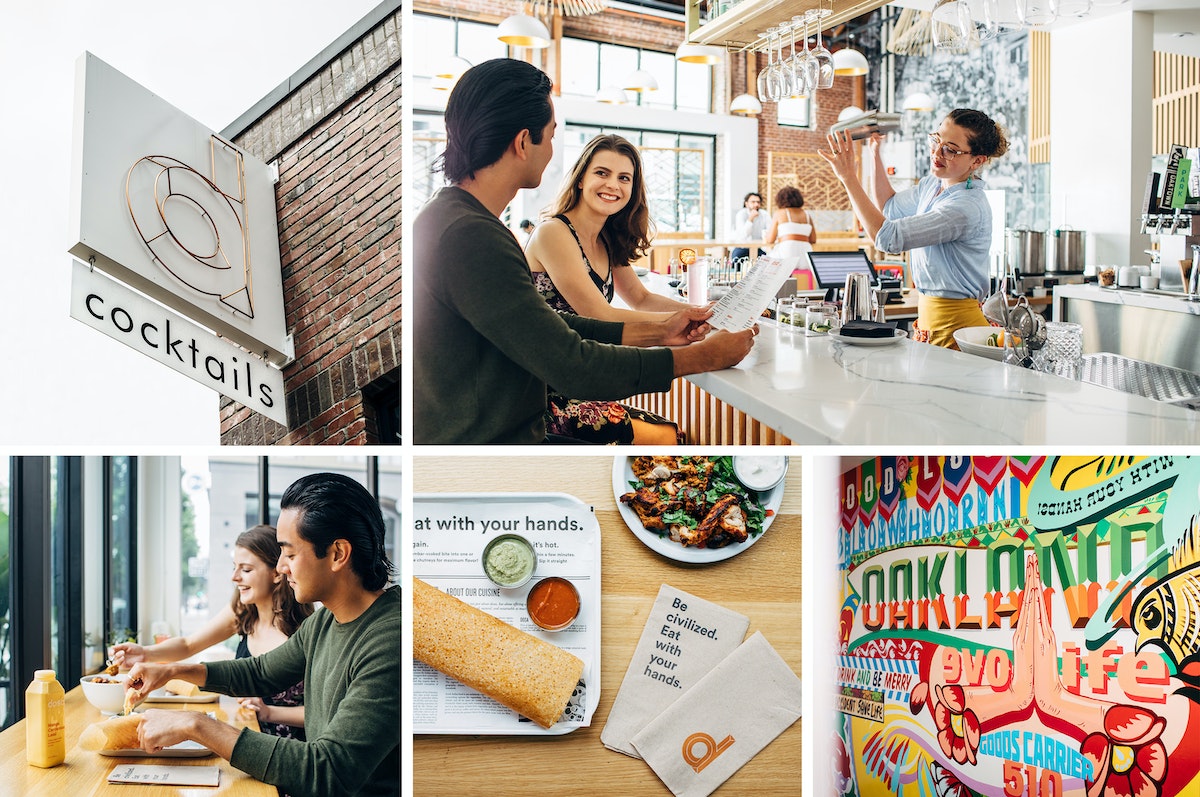
The dosa by DOSA menu includes distinctive items like coconut kale mung bean salad and hot masala chai made with caramelized milk—the way Anjan’s mother prepared it. To help the restaurant scale, the team created a preliminary furniture, fixtures, and equipment (FF&E) budget, 3D renderings of the space, and an operations strategy for the founders and their employees.
The dosa by DOSA flagship launched in January 2018 in Oakland, California. The IDEO brand guidelines have enabled the dosa by DOSA team to independently and easily shepherd new product lines to market, including salads, wraps, curry bowls, samosas, and simmer sauces. The brand’s packaged food launched in over 200 natural food stores in 24 months—including over 100 Whole Foods locations—as well as online retailers and delivery services like Good Eggs and Caviar. These items and the restaurant have helped Emily and Anjan realize their vision of bringing the flavor and spirit of Southern Indian cuisine to new communities around the world.
Revitalizing Japan’s food industry through design and software
Redefining the “middleman” role of produce wholesalers in Japan.
In recent years, due to shifts in Japan’s demographics, the food industry has faced challenges such as a decrease in market size and a shrinking number of producers. As a result, social impact opportunities abound in this field.
When Japanese software company NJC (Nippon Jimuki Co. Ltd.) approached IDEO seeking to identify new business opportunities that would build on the company’s core strengths, the food and agriculture industry rose up as a promising area of focus.
NJC is a well-established software company that has spent over 50 years helping to build backend business systems for small to medium enterprises. NJC works across healthcare, retail, and food and beverage, computerizing core processes to support and improve operations.
In partnership with IDEO, NJC explored its strengths and potential as an organization, as well as the ideas and visions of the employees, and emerged with the goal of using their capabilities to address large-scale issues facing regional farmers.
During research across Japan, local growers described challenges with multi-layered supply chains and analog systems, which led to “overwork for minimal profit,” as well as a gap between supply and demand. Because agricultural wholesalers lacked clear information in advance on the status of crops or the volume to be harvested, they struggled to negotiate with buyers, which led to wasted food On the other hand, the farmers who grow the crops are engaged in manual labor, and do not always have the energy to focus on business aspects such as efficiency or the pursuit of increased profitability, which leads to a diminished interest in farming among young people.
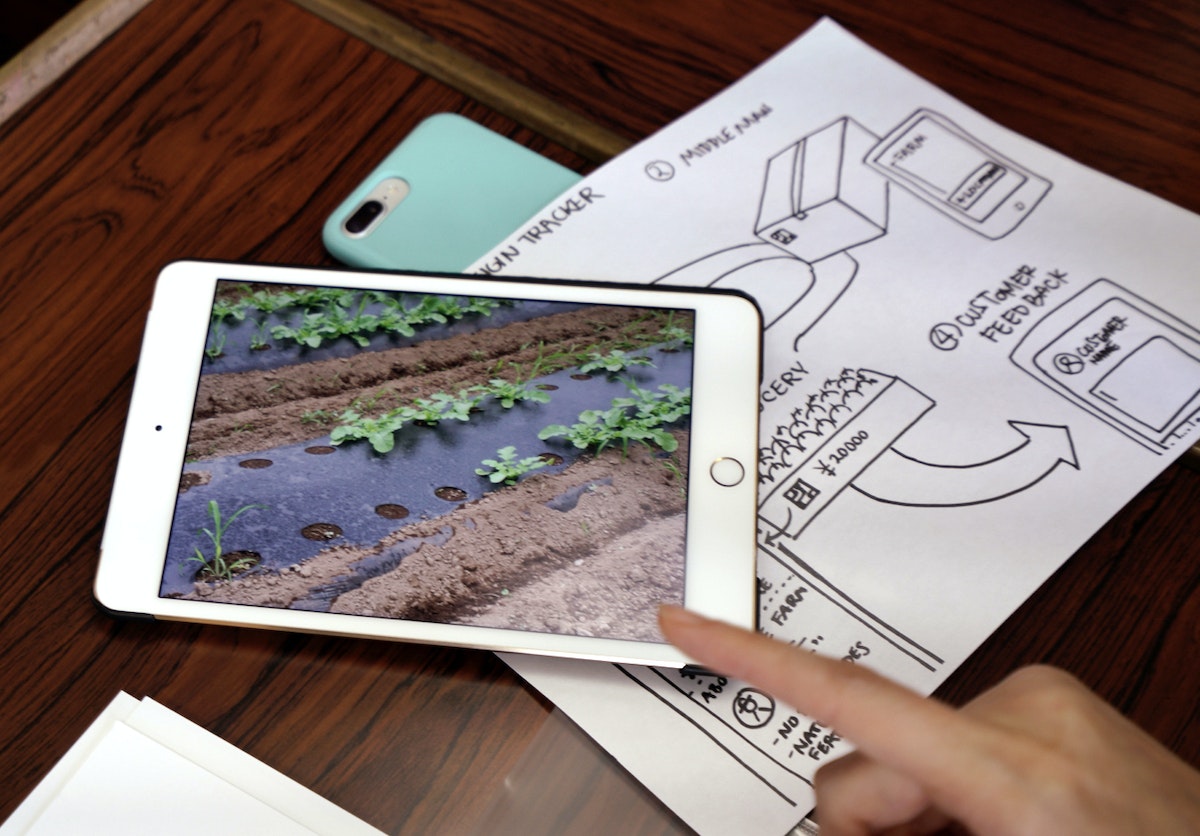
One question that emerged through research was why agricultural producers weren’t utilizing IT. This evolved into “How can profitability be improved for all stakeholders?” and, “How might we create a system that will provide useful data without creating a burden for either farmers or agricultural wholesalers?”
The result was fudoloop.
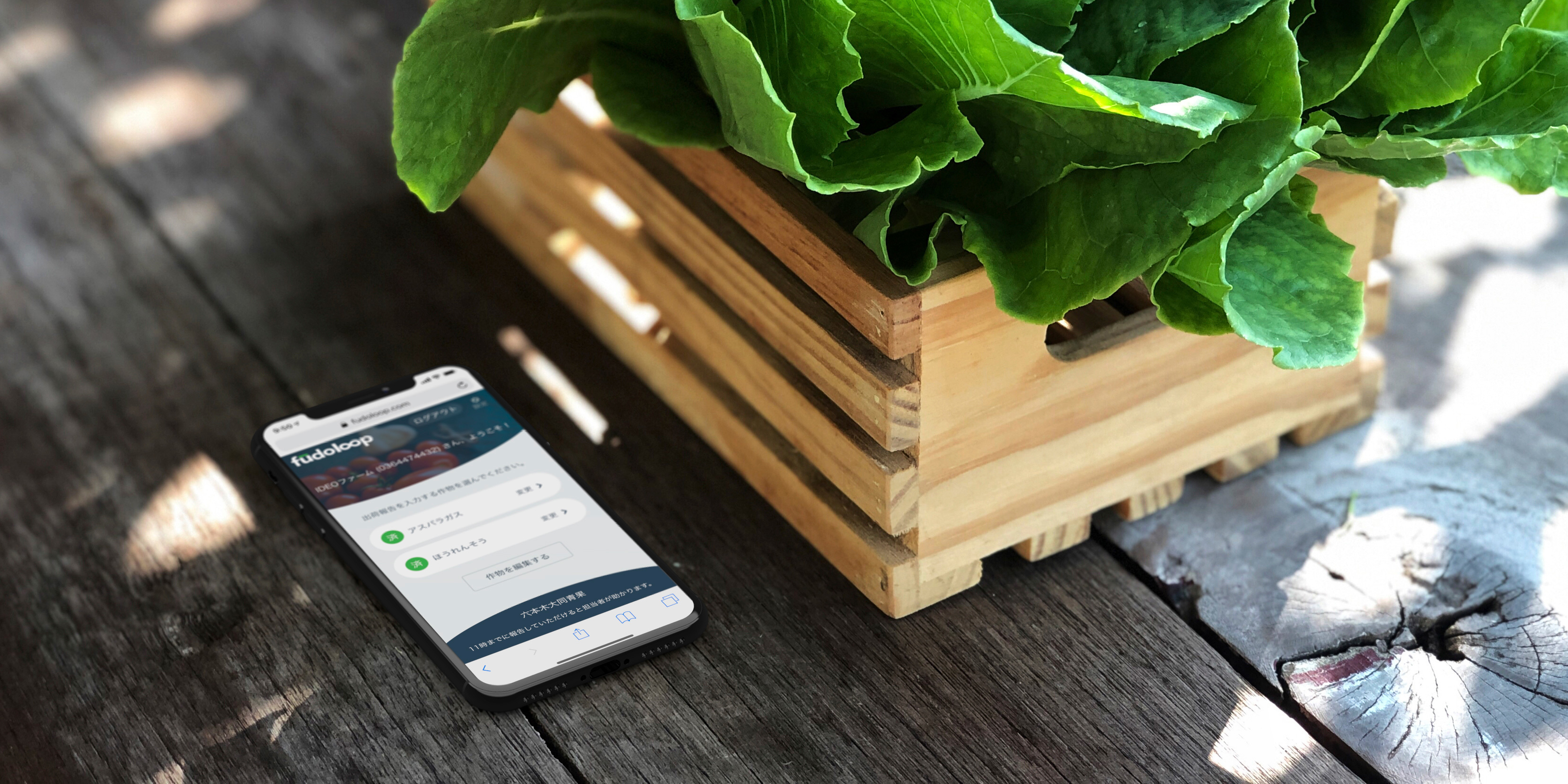
fudoloop is an app that enables farmers and wholesalers to conduct business more profitably by bringing transparency to the fluctuating produce market. Through fudoloop, wholesalers receive information from farmers a day in advance, and can coordinate the various requests of buyers, such as order size, production location and other special requests. As a result, wholesalers can function as “community managers,” doing business with both producers and buyers at a more appropriate price point.
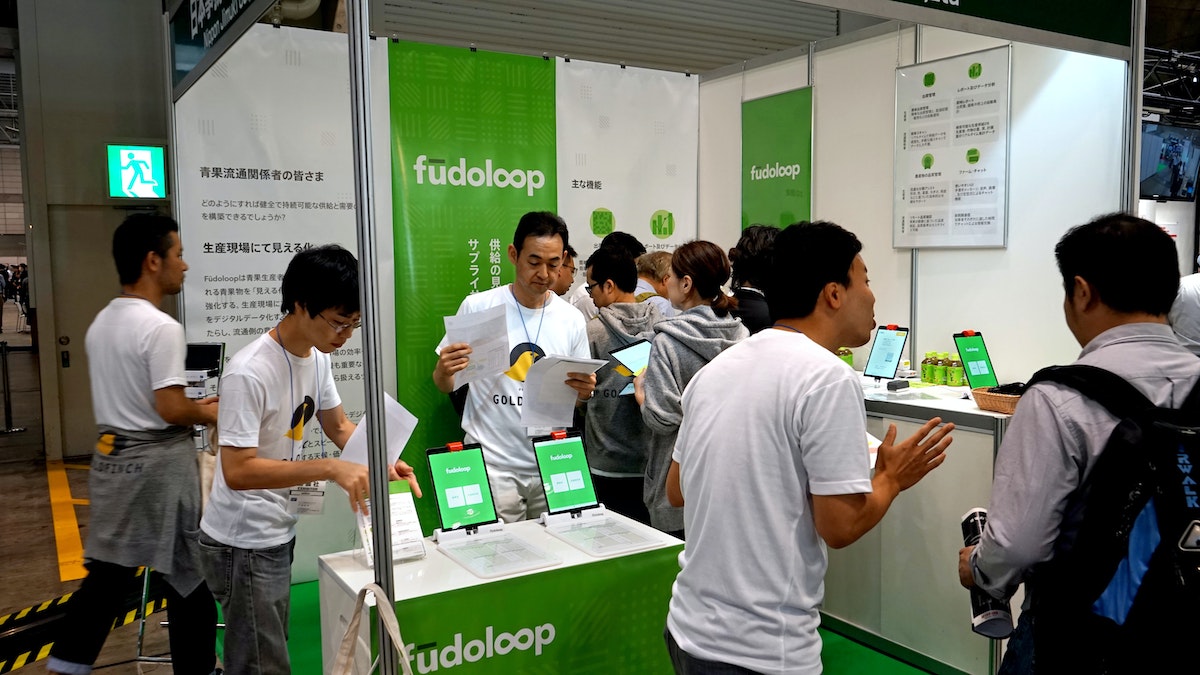
NJC aims for fudoloop to be the first step in a cycle that brings value to all stakeholders, from farmers to wholesalers, retailers and even customers, by redefining the “middleman” role of produce wholesalers.
OpenIDEO: A Platform to Harness Collaboration for Social Good
OpenIDEO is an open innovation platform where people from all corners of the world collaboratively tackle some of the toughest global issues through launching Challenges, programs, and other tailored experiences.
OpenIDEO is an open innovation platform where people from all corners of the world collaboratively tackle some of the toughest global issues through launching Challenges, programs, and other tailored experiences.
A Challenge is a three-to-five month collaborative process that focuses attention on the topic and creates a space for community members to contribute and build off each other. This approach is modeled on IDEO's design thinking methodology.
You can learn more about it here.
Active Challenges
The Beyond the Bag Challenge, launched in partnership with Closed Loop Partners and leading retailers, seeks to identify, test, and implement innovative new design solutions that serve the function of today’s single-use plastic retail bag. Winning Ideas are eligible to receive a portion of $1 million in funding, participate in a Circular Accelerator program to receive further assistance in scaling, and access testing and potential piloting opportunities. Find out how you can be involved in the Beyond the Bag Challenge and sign up to receive email updates
‘Agents of Change' Atopic Dermatitis Challenge: Navigating Uncertainty
The ‘Agents of Change' Atopic Dermatitis Challenge: Navigating Uncertainty aims to find creative ways to help people with atopic dermatitis navigate through the ambiguity surrounding the condition with confidence while building awareness and empathy among those around them. Sign up to receive email updates and join the Challenge starting on September 14 to help change the way people think and feel about atopic dermatitis.
The $2M Food System Vision Prize is an invitation for organizations, institutions, companies, governments, universities, and other entities across the globe to develop a concrete and actionable Vision of the food system that they aspire to see in the year 2050. Together, we’re seeking answers to the question How might we envision regenerative and nourishing food futures for 2050? $2M will be distributed to the Top Visionaries, who will be eligible to receive a prize of $200,000 each.
Intrigued? Read about the many ways to be involved in the Food System Vision Prize and sign up to receive email updates.

5 Mindblowing Things We Heard at SXSW
Our pick of the techfest's best panels, people, and provocations
1. "85 percent of cancer can be cured in the next five years."
—Dr. Sanjay Patil
The health care industry missed the PC and internet revolution, but they won't miss the big data and analytics revolution, said Dr. Sanjay Patil, chief medical informaticist at MDLIVE, and John Sculley, a board member. According to the American Medical Association, 75 percent of in-person visits could be handled virtually. But they cautioned that it took 10 years for people to get comfortable with online banking and ATMs. Still, Patil and Sculley believe genomics and precision medicine will trigger massive shifts sooner than we might think, and had some very hopeful predictions. —Betsy Fields Smith, senior design and research lead
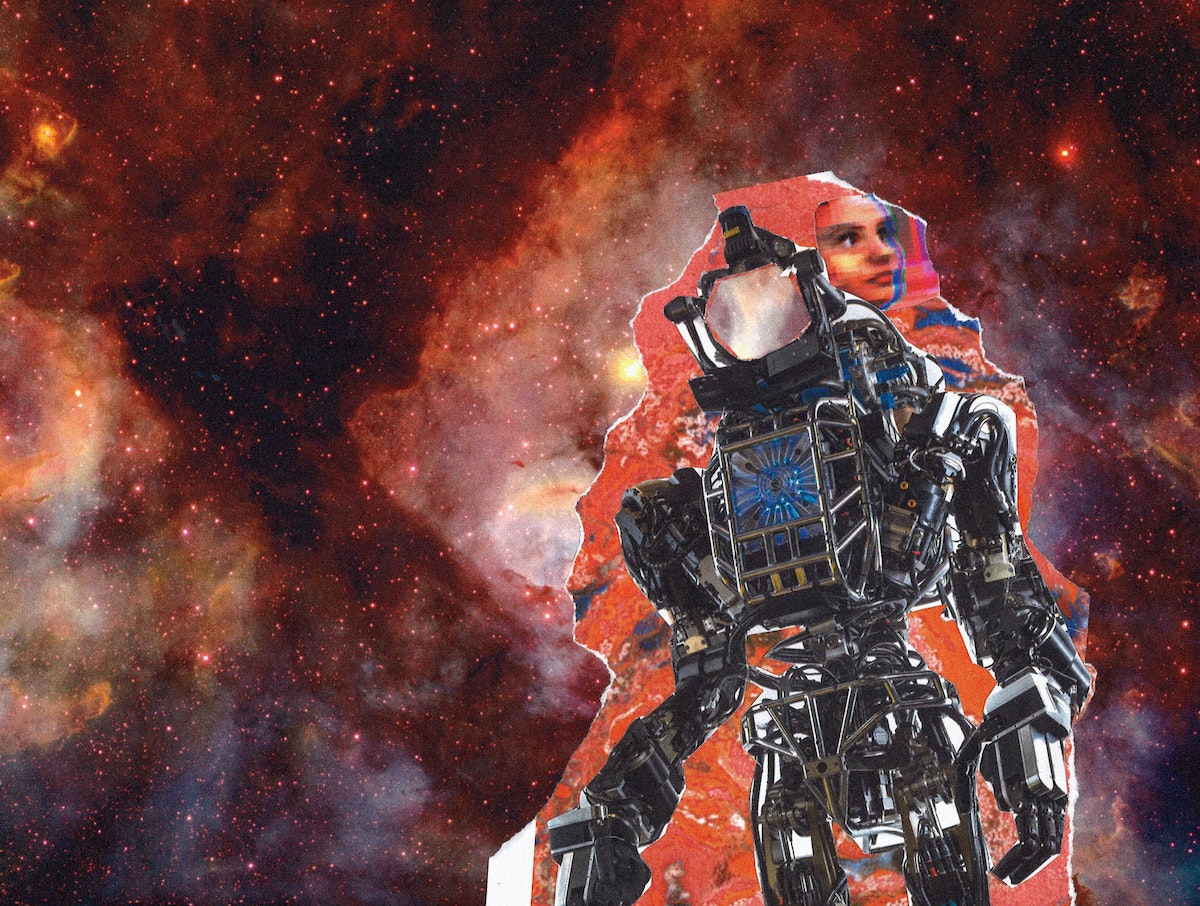
2. Robots would be smarter if we didn't interrupt them.
If we want robots to learn from us, we have to design them with the human capability of expressing their intent and emotion said Panellists Leila Takayama, senior UX researcher, Google[x]; product designer Nuri Kim, Fellow Robots CIO Thavidu Ranatunga, and Stanford Center for Design Research executive director Wendy Ju spoke about
For example, a robot often learns that a door is a door by staring at it for hours on end. If a person walks in front of a robot while it is learning, this can compromise the training session and hours of work. We need to design careful and intuitive indicators as to what state robots are in. If, for example, a robot was learning by staring at a door while scratching its chin or tapping its forehead, it would serve as a reminder to not interrupt their lesson.
This relates to work we are doing with autonomous vehicles. We will need to develop a new vocabulary of mobility through which vehicles and people can communicate. What sort of cues, both subtle and bold, have we come to expect drivers that help you anticipate their behavior? How might we thoughtfully design some of these cues into autonomous vehicles to make the future safer and more intuitive to move through? —Danny Stillion, partner/executive design director
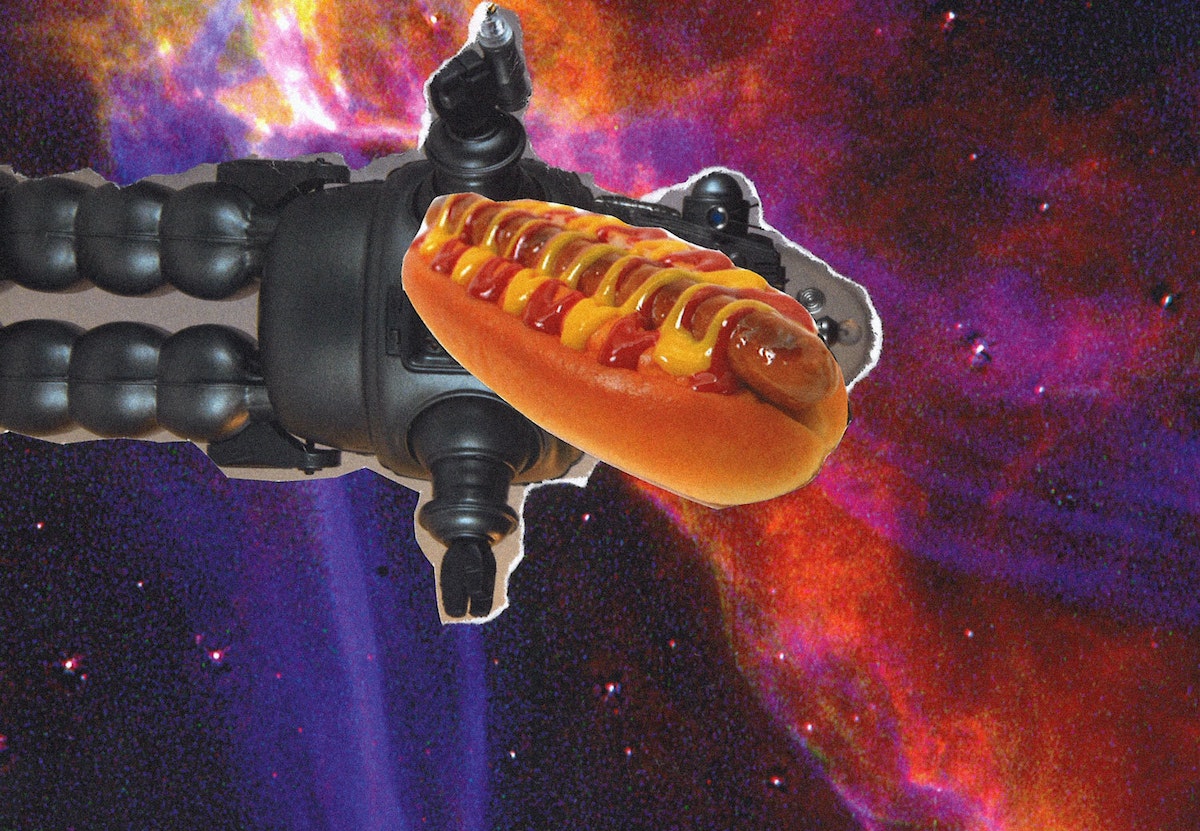
3. The Jetson’s-style kitchen of the future is here.
The "kitchen of the future" technology exists and there are businesses being built upon it right now. We heard why in a panel called "From Palate to Plate: Defining a Taste Platform." It was framed as a panel about food data, but spoke more to how we interact with food today and might do so in the future, including replacement cycles for appliances, the lack of a portable “taste profile”, and so forth. We're thinking about these things at IDEO, too. Check out the Concept Kitchen 2025, work we collaborated on with IKEA.
While we've realized much of the Sputnik-era vision of the kitchen of the future, there's a fourth circle—system interconnectivity—that we need to start to consider. —Justin Massa, director of business strategy
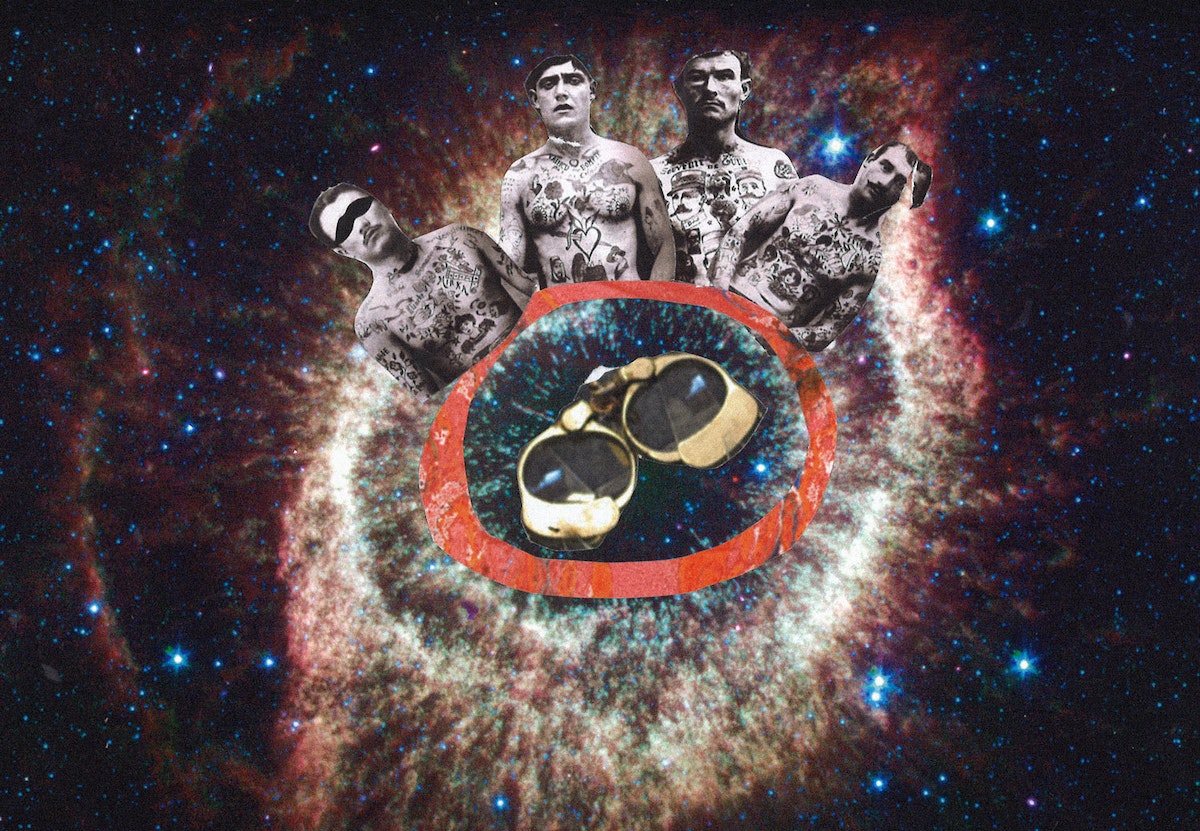
4. Data will reform our criminal justice system.
What does the rise of information design for a complex social problem such as criminal justice reform look like? There is a growing movement to use open, public data for political advocacy and reform. And yet, even with a wealth of data, we’re unable to design for more accurate, immediate, and actionable ways of using it.
This panel, made up of experts and innovators using data for policy reform and program development said the most vulnerable in the system—offenders and their families—could benefit from the use of more transparent and actionable data, such as preventing false confessions in interrogation or exonerating prisoners from false convictions with DNA testing. They also spoke about the power of predictive policing in cities, and protecting those who are re-entering civilian life with data privacy so that they can secure a job or a loan. —Yennie Lee, impact manager, IDEO.org

5. Virtual Reality may change your beliefs.
Unsurprisingly, there was a lot of hype around VR at SXSW. But outside of finding a second home outside gaming, the use cases I'm most excited about are empathy building, and overcoming trauma. VR can deliver sophisticated, deep storytelling that stays with you. It puts you very close to being in someone else's shoes.
Planned Parenthood is doing just that, showcasing its seven-minute film "Across The Line", which follows one woman's journey from her car to the abortion clinic as she confronts a sea of pro-life protesters. Some footage is live action, some animated, but the audio is a live recording from outside a clinic in Illinois. It’s upsetting. And it may just change someone's mind on this issue. —Karoline K, communications designer
Huge thanks to Karoline K for the illustrations in this story.
President Obama, the hyperloop, Wired's Kevin Kelly, Microsoft's HoloLens, Twitter's Biz Stone and, wait for it... Pee Wee Herman! Among the thousands of conversations at SXSW, it can be hard to separate the signal from the noise, so we asked IDEO's SXSW speakers to share their greatest hits. What they came back with—robots, genomics, VR, criminal justice, privacy—proves that design is going places it's never gone before.

3 Questions for Zach Hobbs
A short Q&A with Zach Hobbs, communication designer from IDEO Chicago
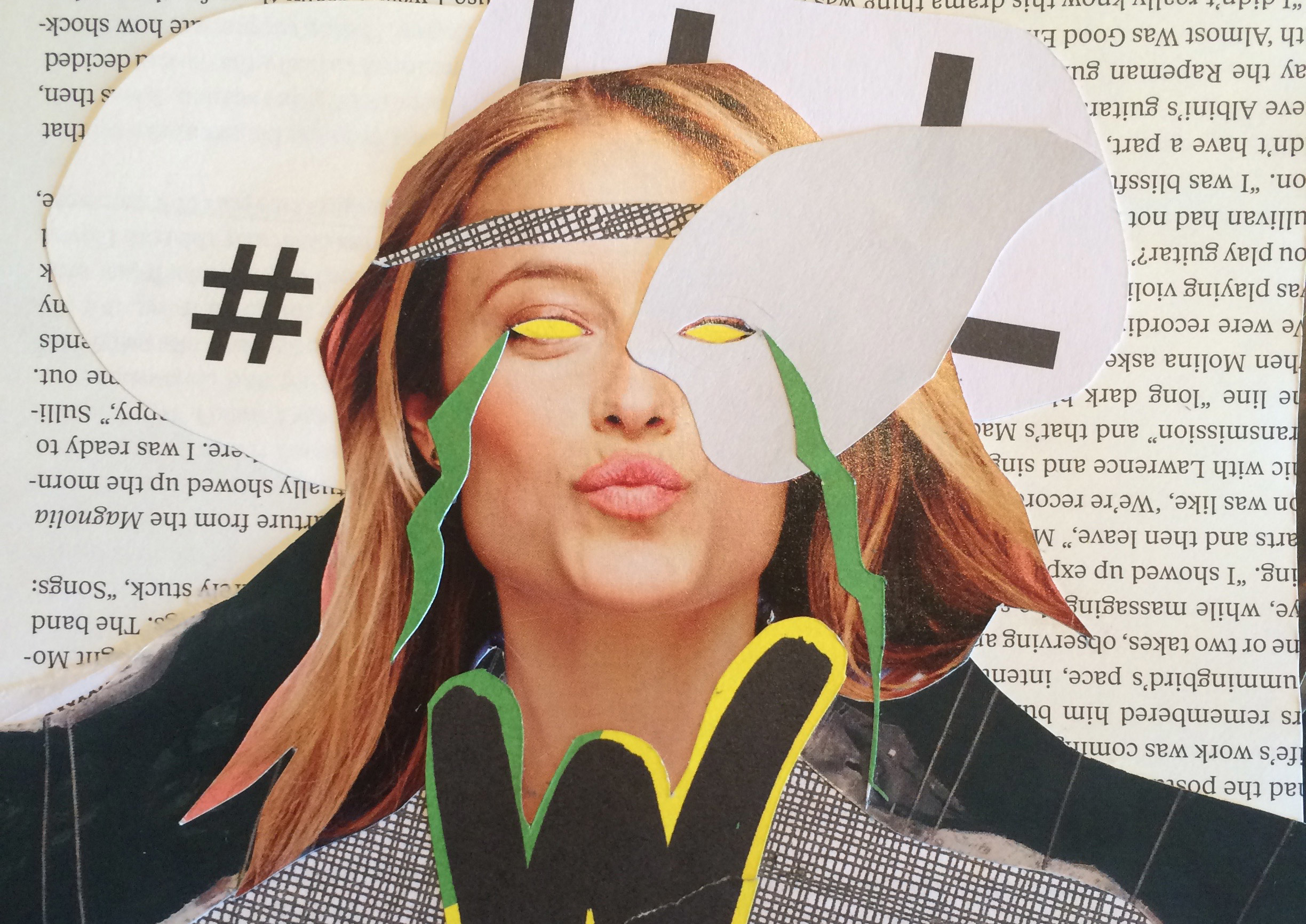
1. What inspired #clientwork?
I had been drawing for about six months, specifically for an art show, and I was sorta cashed and looking for the next rabbit hole. We hosted another Fortnight (our artist-in-residency program) in the Chicago studio, and I was really lucky to act as a mentor to C.M. Ruiz, from Seattle.
He is a Xerox machine master; he just makes incredible art with the most humble tools. We spent a lot of time just hanging out in the studio talking about art and making shit. It was a three-week jam session and I got super inspired and just started making the ugliest designs possible using only the Xerox and markers, paints, etc. FUN.
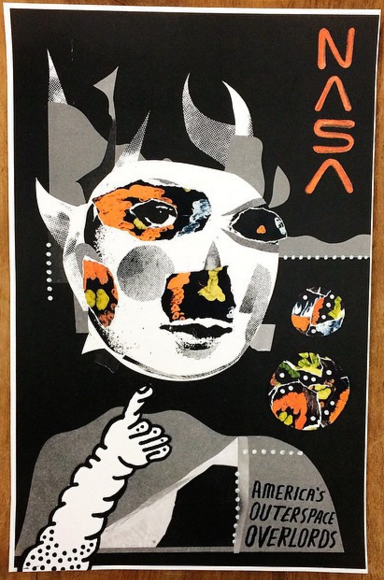
The Clientwork hashtag is just something that has bounced around in my brain for the past few years. We as makers, designers, artists, etc., often try to separate our lives into two buckets: the work we get paid to do (Clientwork) and the other, fun stuff. I really dislike that idea! I feel like the entire body of making should just be THE WORK, dig? My IDEO jams for Allstate or Chicago Fire or ConAgra should feed my weirdo artlife and my weirdo artlife should come with me inside project spaces.
Freelancer and IDEO contractor Kyle Fletcher has been influential in helping me learn this lesson, as he is constantly bouncing back and forth between design and art, yet it all feels very KYLE FLETCHER.
I tag things with #clientwork that obviously are not client work to (hopefully) push this idea. The idea of doing really dumb, silly, sometimes provocative ads for companies that aren’t paying me is scary. I’m making something and I think it looks AWESOME and I write NIKE or VANS on there because, to me, IT SHOULD BE A VANS AD. I suppose that part is my own little secret joke. No one knows if I actually like Nike or not, or if I eat Hormel Chili (I do, duh). It’s not like I’m tagging them super hard or trying hard to be seen by the brand puppet masters… but there’s something really frightening about half-assedly drawing a corporate logo on a terrible collage or drawing and sending it into cyberspace. I’ve told myself that I’ll either do this as long as it’s fun or until I receive a cease-and-desist. I actually sorta worried if anyone from IDEO was going to come down hard on me, but so far only a minor slap on the wrist that I deserved.
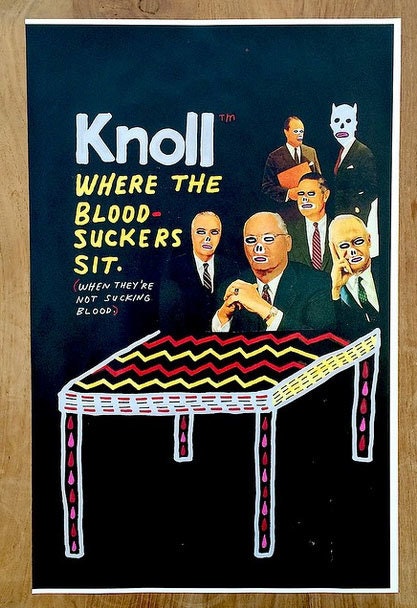
2. Does this work make doing your day job easier?
Easier is a strong word. DESIGN IS HARD, and I’m not taking the piss. Doing the daily art jams does help keep my brain active. I’m trying so hard to get in the zone and stay there. IDEO can be so stimulating sometimes that I find it hard to focus. Everyone knows what it’s like to get that precious two hours of heads-down time when you have to work FAST to get something on paper. Trying to think like a designer/artist 24/7 takes practice. It’s hard to be in the zone all day!
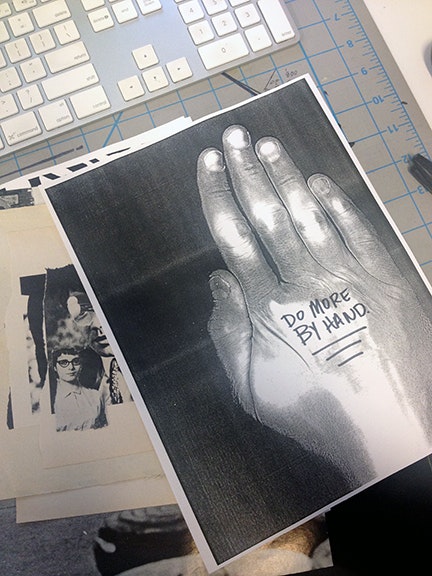
3. Name one artist or designer you consider unassailable and tell us why.
Ian MacKaye will never re-form Fugazi to play Coachella for millions of dollars. And for that I am very grateful.
If you're not following designer Zach Hobbs on Instagram, you're not truly living. The sheer volume of artwork he posts there and on his website makes us wonder how he manages to stay awake in the office. We asked him about a pleasingly tart series titled #clientwork (which is occasionally #NSFW).
The Day I Broke the Intranet
Cosmos-blasting innovation
I had just relocated to the Bay Area after five inspiring years at IDEO Chicago. The Chicago studio is a tight-knit family of roughly 70 or so friends, often known for taking extra moments out of our day to inspire, uplift, thank or prank one another in the course of the work we do.
The IDEO San Francisco mothership, however, is much larger; nearly 200 strong across four independent studios. As such, it can be difficult for a new guy to know exactly how our forgiveness in lieu of permission culture manifests itself across locations.
It turns out quite well, I found.
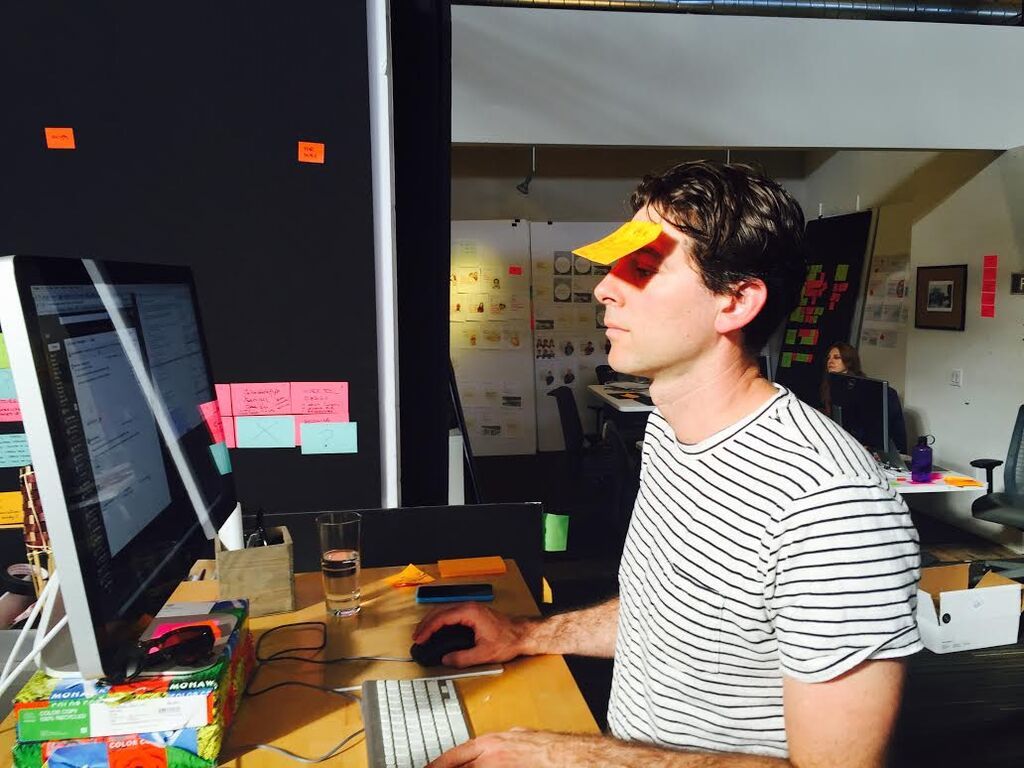
Nine days into my tenure at IDEO SF, someone snapped a photo of Ethan, who had come up with a clever solution to shade his eyes from the passing sunlight as he worked (see above). The photo went out in an email to the entire location. The subject line: "Innovation".
If you're anything like me, you simply cannot see a photo like this without your mind beelining to Photoshop Battle. So, I made a few quick edits and offered up my reply-all:
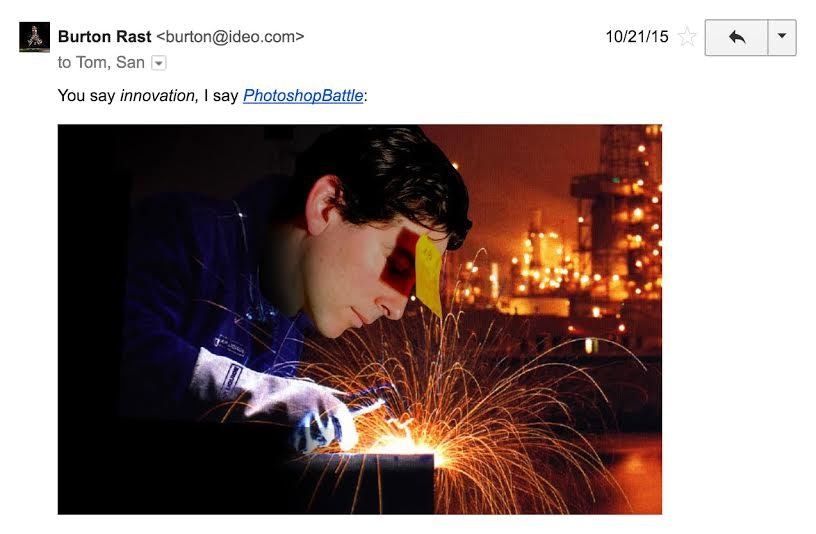
It would be an understatement to say that I succeeded in learning what I set out to about my new colleagues. When the dust had finally settled, the thread was comprised of more than 50 unique entries submitted over three days.
Check out some of our favorites, below:
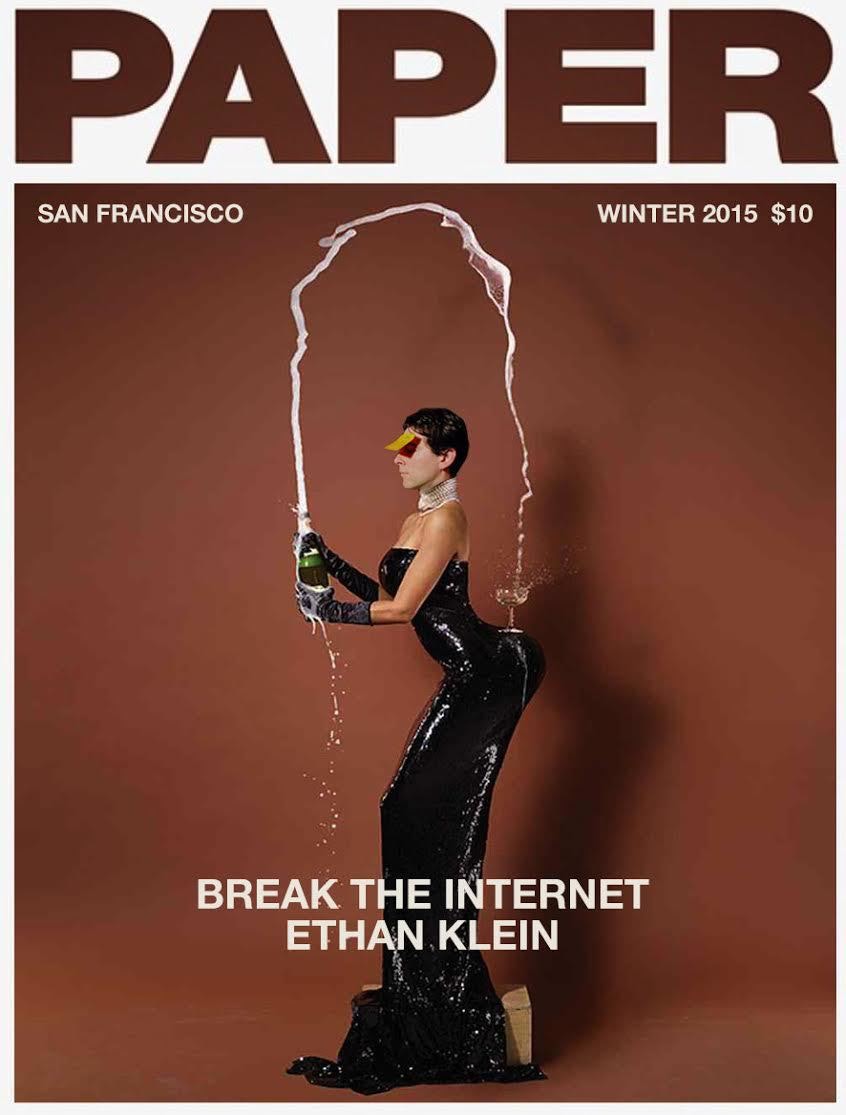
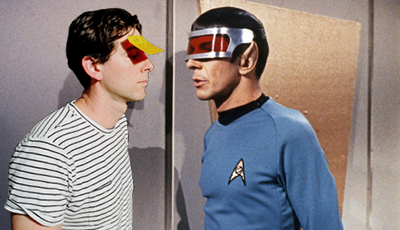
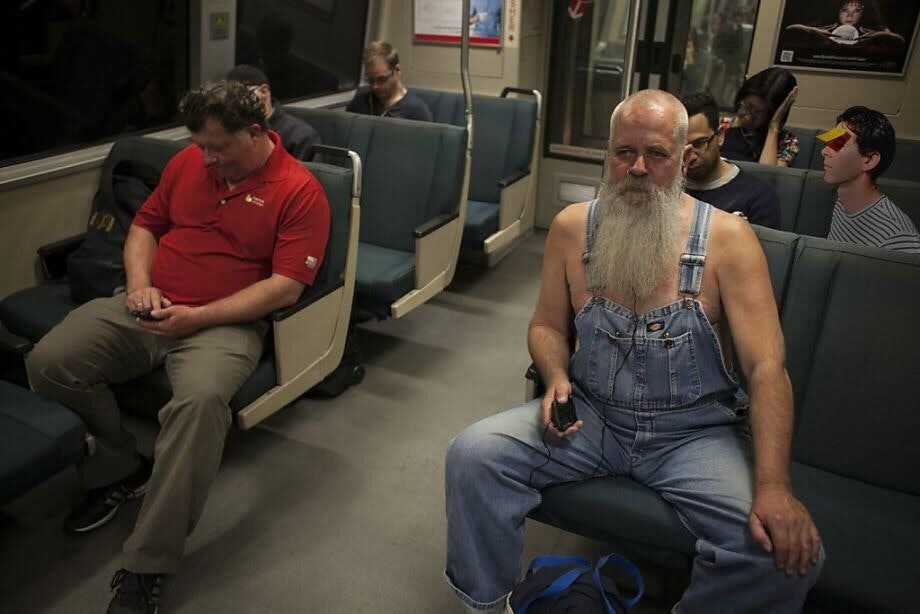
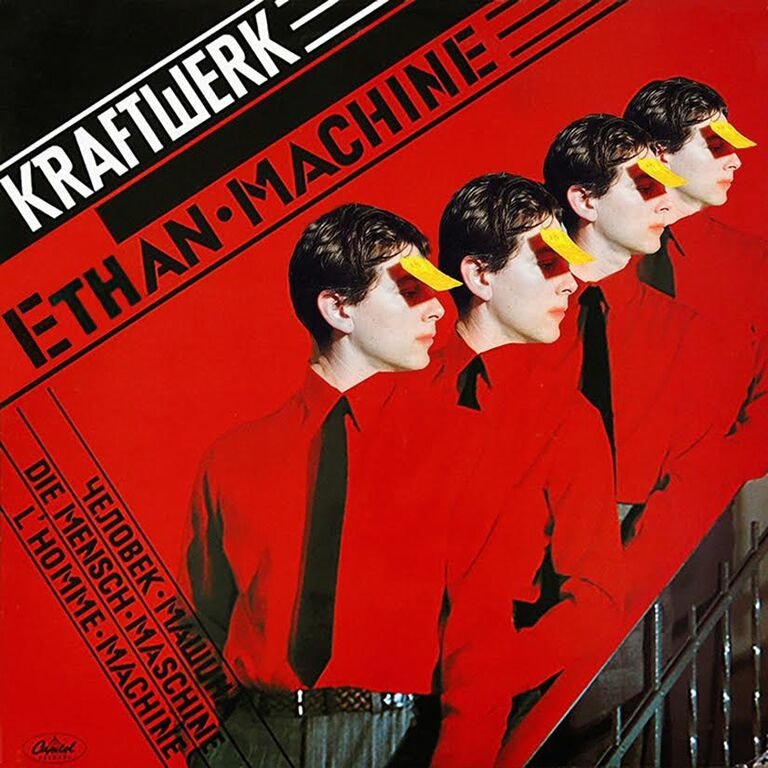
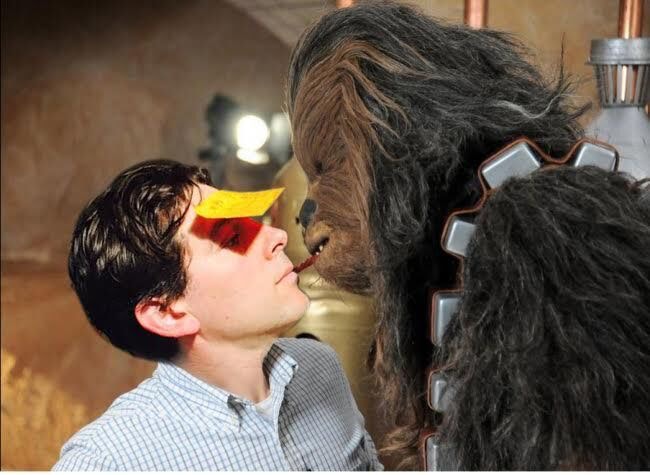


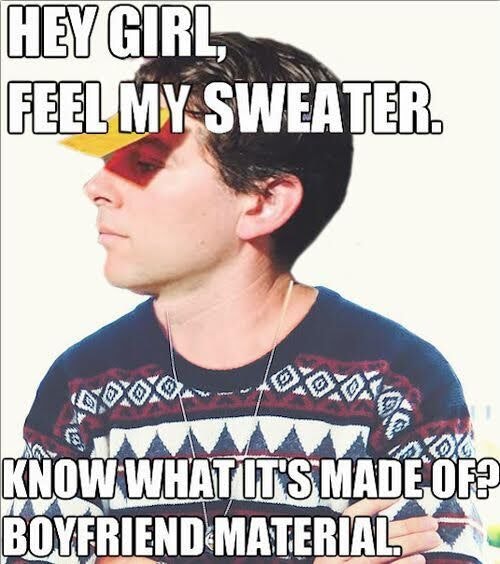
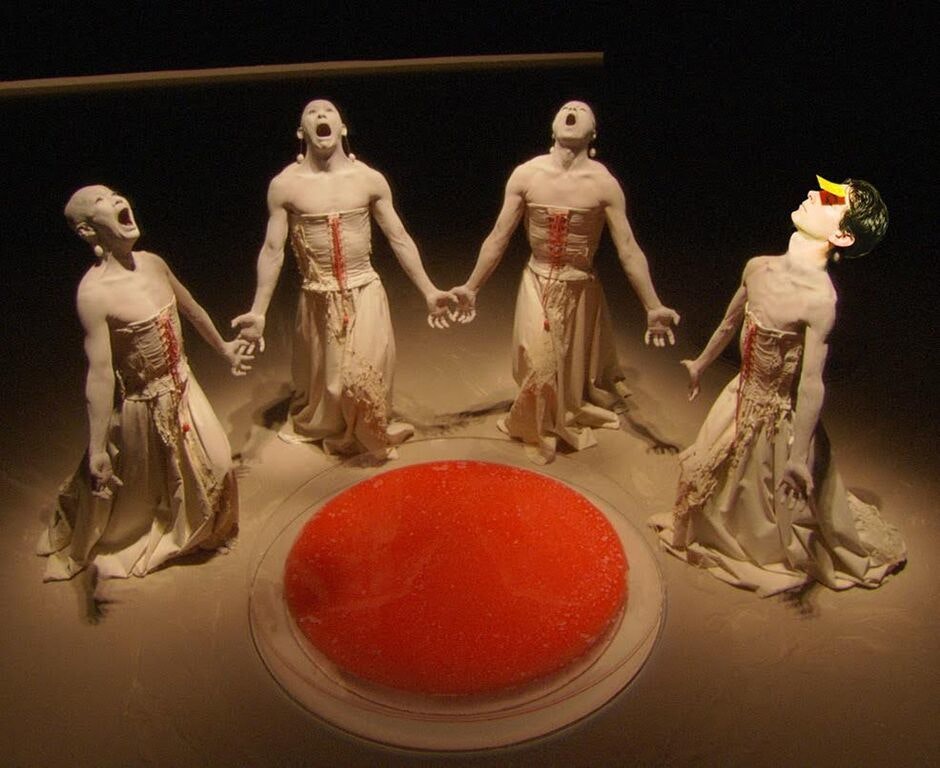
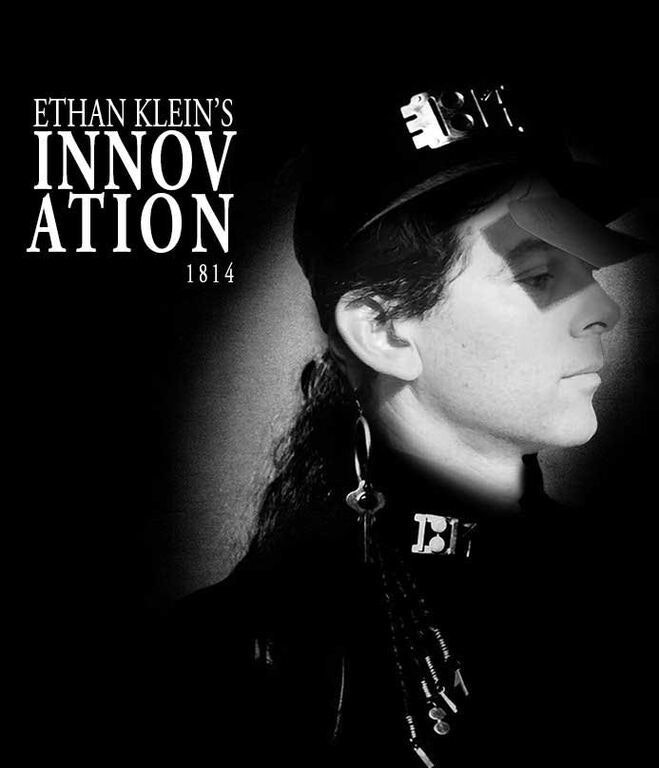
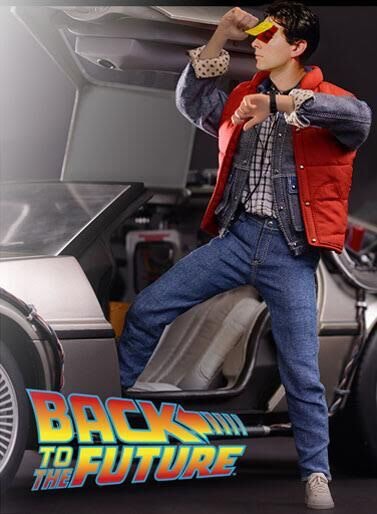
The original photo is on Instagram now. Share our glory.
I was barely into my second week at IDEO's San Francisco location when a particular opportunity to get to know my new colleagues presented itself.

Lindsey Turner
I’m passionate about building brands, products, and experiences that help organizations show up with meaning and momentum.
I help organizations cut through complexity by shaping how they show up, through brand strategy, identity, and storytelling.
Working at the intersection of brand and business, I bring an editorial eye and a bias toward making—turning ideas into tangible experiences that people can understand, trust, and believe in.
My work spans government, healthcare, financial services, media, and consumer goods, from launching Gen Z-focused ventures to building innovation labs and reimagining legacy brands. I relish moments of ambiguity and enjoy translating across teams, perspectives, and priorities to move ideas forward.
I started my career in editorial and digital design, shaping cross-platform experiences and identity systems in publishing and agency environments. That foundation still shapes how I work today: I’m detail-oriented, collaborative, and overreliant on the Oxford comma. I hold a BFA in Visual Communication from the School of the Art Institute of Chicago.

Rachel Young
My work helps organizations see who their products aren't working for—and build the will and the tools to do something about it
For 25 years, I've asked the same question: Who does this design exclude—and what are we going to do about it?
My work spans human-centered strategy, inclusive design, and qualitative research, with clients ranging from Microsoft, Google, and Verizon to the National Science Foundation, and San Francisco Unified School District.
Before IDEO, I taught elementary school in East Palo Alto and spent a decade doing design work with social service organizations—where I learned firsthand what it costs people when systems are built without them in mind.
I am currently writing User Error, a nonfiction book about digital access and the design decisions behind it. I live in Oakland, California.

Brian Pelsoh
I lead with craft, ensuring our work is creatively excellent: rooted in deep human insight and imagination, while also grounded in the realities of business and technology.
My expertise spans brand, communication, and product design across tech, education, the arts, and social impact.
I believe great work demands both high-level vision and obsessive attention to detail, and only happens through collaboration.
I bring an inclusive, hands-on approach and a deep understanding of business, which enables me to consistently deliver excellence while always asking why.
Before joining IDEO, I worked at the brand firms Pentagram and VSA Partners. I began my career as a designer, leading teams at the School of the Art Institute of Chicago and the Milwaukee Art Museum. I hold an MFA in graphic design from Maryland Institute College of Art and a BFA in communication design from the Milwaukee Institute of Art & Design, and have taught at some of the best design schools in the US.
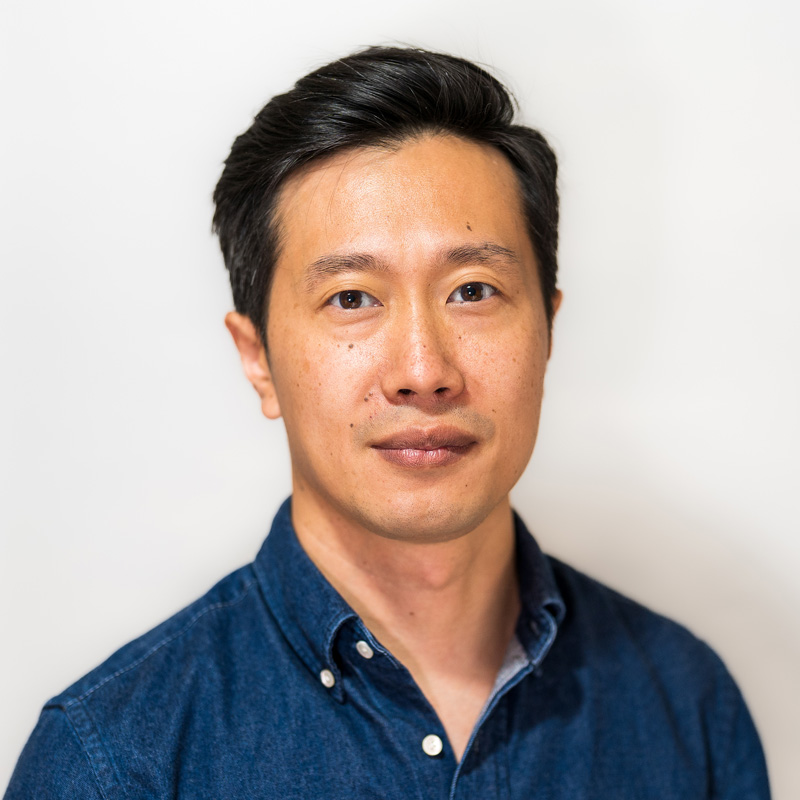
Tony Wong
I am responsible for IDEO’s long-term success in China and working with clients to use design as a tool to enable growth.
I am responsible for IDEO’s long-term success in China and working with clients to use design as a tool to enable growth. Specifically, I have helped Chinese companies design holistic brand solutions through the development of their products, communication, services, and innovation teams, and I have helped multinationals expand their presence and influence in China.
I advise global leaders on developing China-led innovation and capabilities.
In over 15 years in IDEO Shanghai, I have worked on projects that use design to elevate the quality of the experience of healthcare products and services, streamline processes that increase productivity, create spaces and programs that promote and enable inclusive communities, and build next generation mobility solutions that are planet-positive.
Before joining IDEO, I worked at Philips Electronics and the Electrolux Group in Italy, the Netherlands, and Singapore on a number of breakthrough commercial products. I am a member of the Young President Organization in Shanghai.
How to use AI as an editor, not a writer
Ed White shares how he uses AI as an editor—not a writer—to sharpen storytelling, rehearse ideas, and preserve the productive friction that makes creative work better.
Ed White has a rule he's tested on his own writing: hold yourself as the writer, and let AI be your editor. Ed is a Senior Design Director at IDEO's London studio, where he co-leads the firm's AI portfolio across Europe. Before IDEO, he spent 12 years as a writer and editor at the Financial Times, Wired, and Contagious. So when he talks about when to use AI for storytelling and when not to, it comes from two decades of crafting his storytelling skills.
In this episode, Mina Seetharaman talks with Ed about two specific tools he uses to keep AI in an editor's seat: a "roasting agent" prompted to critique his drafts without any sugarcoating, and a simulated audience he rehearses pitches on before the real thing. They also get into what Ed is hearing from design leaders at Anthropic, Lovable, Shopify, and Google Creative Lab about how creative work is changing, and why he thinks the friction of writing something yourself is worth protecting rather than automating away.

Building a personal AI for the messiness of life: Sida Li
Becca Carroll talks with Cue co-founder Sida Li about designing a personal AI for the messiness of everyday life—not just work. They explore how Sida stays anchored to human needs while navigating fast-changing technology, product tradeoffs, business-model experimentation, and the realities of building an AI company today.
Most AI products today are built for work—a space with clear problems and established systems. One founder noticed a gap: personal life is messier, harder to systematize, and mostly left behind by the AI boom. So she built Cue, a personal AI that lives inside iMessage and group chats, to go where the other tools haven't.
In this episode, Becca Carroll, IDEO's Chief Strategy Officer, talks with Sida Li, co-founder and CEO of Shared Context Lab, about staying anchored to a human need while the technology around her keeps changing shape, why she treats her business model with the same rigor she'd bring to a product, and what it feels like to build a company at this particular, disorienting moment in AI.
The conversation also gets into how Sida makes design decisions: the language Cue uses to describe itself, the tradeoffs behind building inside iMessage instead of a new app, and a real story about a business idea that didn’t pan out.
This is the second in a two-part series profiling founders from IDEO's Startups-in-Residence program. The first conversation is with Johannes Seemann, founder of Sooner, on designing GenAI for the emotional side of money.

Designing GenAI for the emotional side of money: Johannes Seemann
Designing financial tools around the feelings that shape money decisions.
Most personal financial tools are built to run the numbers and optimize towards a budget. While that works for some, most people experience money as a lived relationship that does not neatly fit into a spreadsheet. Johannes Seemann and Becca Carroll discuss why money is emotional before it is mathematical, and what a human-centered approach to building a generative AI financial product looks like in practice.
The curious leader's edge in uncertainty: Scott Shigeoka
How genuine curiosity helps leaders navigate uncertainty with greater confidence.
Mina Seetharaman talks with Scott Shigeoka, author of Seek and Head of Curiosity Cultivation at the Eames Institute, about what distinguishes genuinely curious leadership from performative curiosity, how power dynamics shape curiosity, and why practicing curiosity can restore energy rather than drain it.
Looks like you might be in search of something very specific?
Or reset the filters above and try another angle.
Here’s some random inspiration
Podcasts about creative leadership
Articles about the power of prototyping