
.svg)


The future guest experience
Designing new guest and employee journeys that deliver on the promise of an iconic brand.
kate spade new york has been an iconic fashion brand since the early 90s, when its handbags first stormed the Manhattan fashion scene. Since then, the company has expanded and evolved into a global lifestyle brand.
With e-commerce reshaping the retail landscape and redefining the role of brick and mortar stores in recent years, kate spade new york leadership asked: How can we make the kate spade new york specialty store experience, well, more special?
kate spade new york already held the key to a new way of thinking about a multichannel customer experience: a brand promise “to inspire her to lead an interesting life.” Hoping to bring that promise to life in store, they engaged IDEO to help make it happen. The solution was for kate spade new york to take the brand message from words to action in the form of a customized guest journey. The team created more than 100 design concepts and strategies for building a retail experience that rewards curiosity and sparks artistic and literary exploration.
“In partnership with IDEO, we spoke extensively with our customers and associates to better understand how we can provide the most engaging and fulfilling in-store experience,” said Mary Beech, Executive Vice President and Chief Marketing Officer at Kate Spade & Company. “The new store elements that we introduced speak to our customer’s personality and appetite for adventure while aiming to enhance engagement with new and existing customers.”
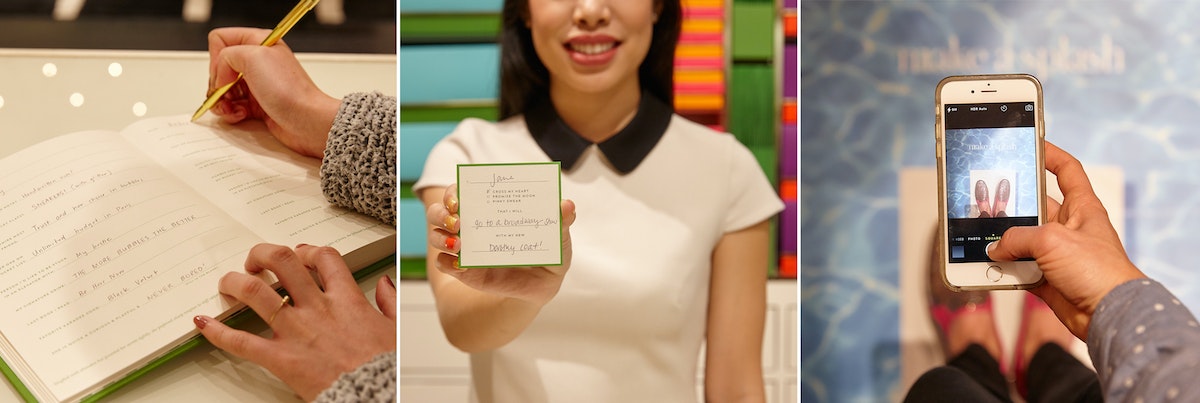
The team knew that striking the right balance of digital tools in in-store interactions was pivotal in allowing two people to have a more rich and collaborative face-to-face connection. The concepts include things like “pack a purse” to test drive how many everyday items can fit in different style handbags, cheeky “dare cards” that challenge customers to go on an exciting adventure with their new purchase, and digital moments like the “shoe selfie” platform that would allow a guest to share “I’m thinking about them” heels or just-purchased flats with her social network. IDEO live-prototyped a selection of concepts in stores around the country and saw a high correlation between customers’ positive reactions and their subsequent purchasing decisions.
“At kate spade new york, our brand promise is to inspire women to live a more interesting life,” said Jenica Myszkowski, Vice President of Stores at Kate Spade & Company. “Our new and improved guest journey experience puts our customers at the center, allowing us to more fully deliver on our brand promise in our retail stores with a stronger vision and purpose for our stores and our store teams.”
To deliver the newly envisioned guest service experience, the role of the sales associates needed to be redesigned, as well. The kate spade new york and IDEO team created a new role: the Muse, whose job is to live the brand promise of an interesting life and to inspire customers to do the same. The reimagined role ultimately shifted the focus in specialty stores from selling to inspiring and building long-lasting relationships with guests.

Two kinds of athletes, one strong brand
Designing a brand that served both elite athletes and everyday fitness enthusiasts.
Athletes’ Performance and its subsidiary, Core Performance, were both founded on a single mission: to enhance human performance through a holistic approach to mindset, nutrition, movement, and recovery. Athletes’ Performance focused on elite professional athletes, and Core Performance provided corporate fitness programs and workouts for employees hoping to lead more healthful lives, and both found a footing in the competitive health and fitness market.
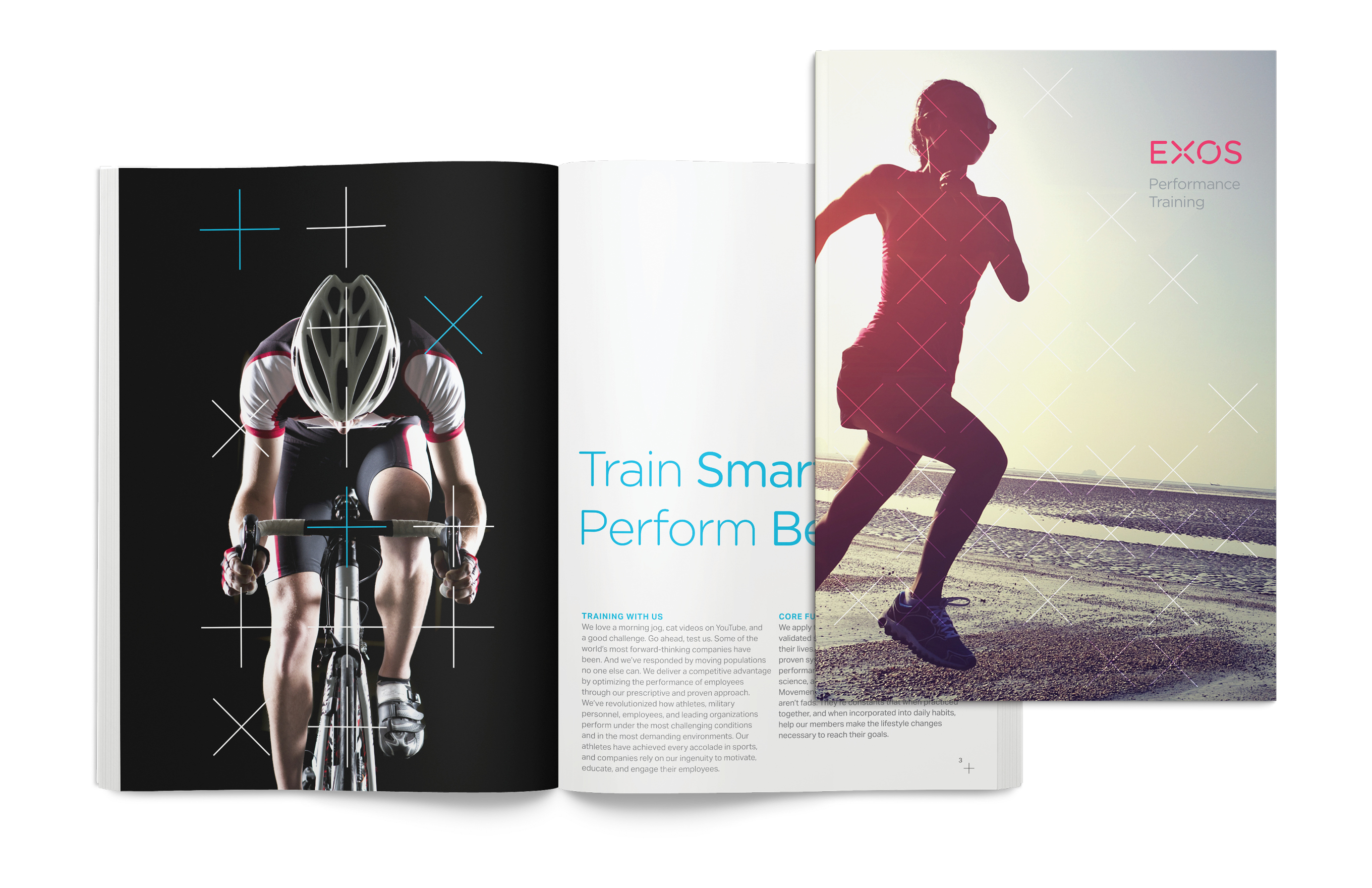
Faced with a challenge to redefine the brands, IDEO designers collaborated with the founder and integrated marketing team to unite Athletes’ Performance and Core Performance under one name that would cut across the health, fitness, and wellness markets to reach a full breadth of audiences and partners. Under a new name, EXOS, the teams created a brand identity system unified by its founding mission and focus on human performance.
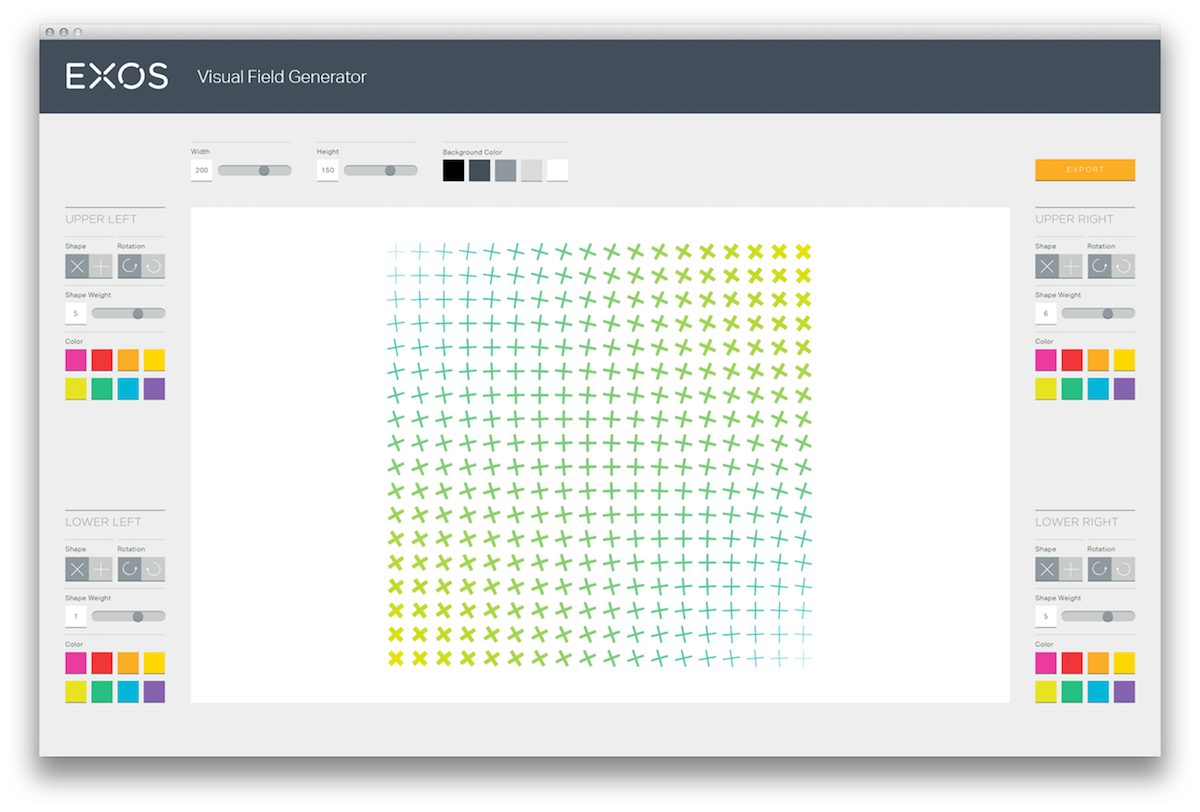
For the new EXOS brand, IDEO designers created a visual language using “x” and “+” to highlight the progress from goals to achievement, as well as a system of interaction for athletes of all performance levels. The team also created a bespoke digital tool, outfitted with custom software, which gave designers both guidance within the brand guidelines and creativity to explore new products and contexts.
Making sure a bank stays great as it grows
Designing digital tools and brand concepts for Umpqua Bank.
Imagine this: Your company has just gone through a $2 billion merger. You show up at work to find an invitation from the CEO asking you to help shape the bank’s future. This is what happened when Umpqua acquired Sterling Financial Corporation in 2014, doubling its size and resulting in the creation of the West Coast’s largest community bank overnight. With a mission to be “the world’s greatest bank,” CEO Ray Davis seized the moment to reinvest in design across the organization.
Umpqua asked IDEO to help examine the brand they had and take it to a new level. They wanted to find out: how can we leverage our strength and reputation by activating the brand in new ways to deepen employee and customer engagement and foster continued growth?
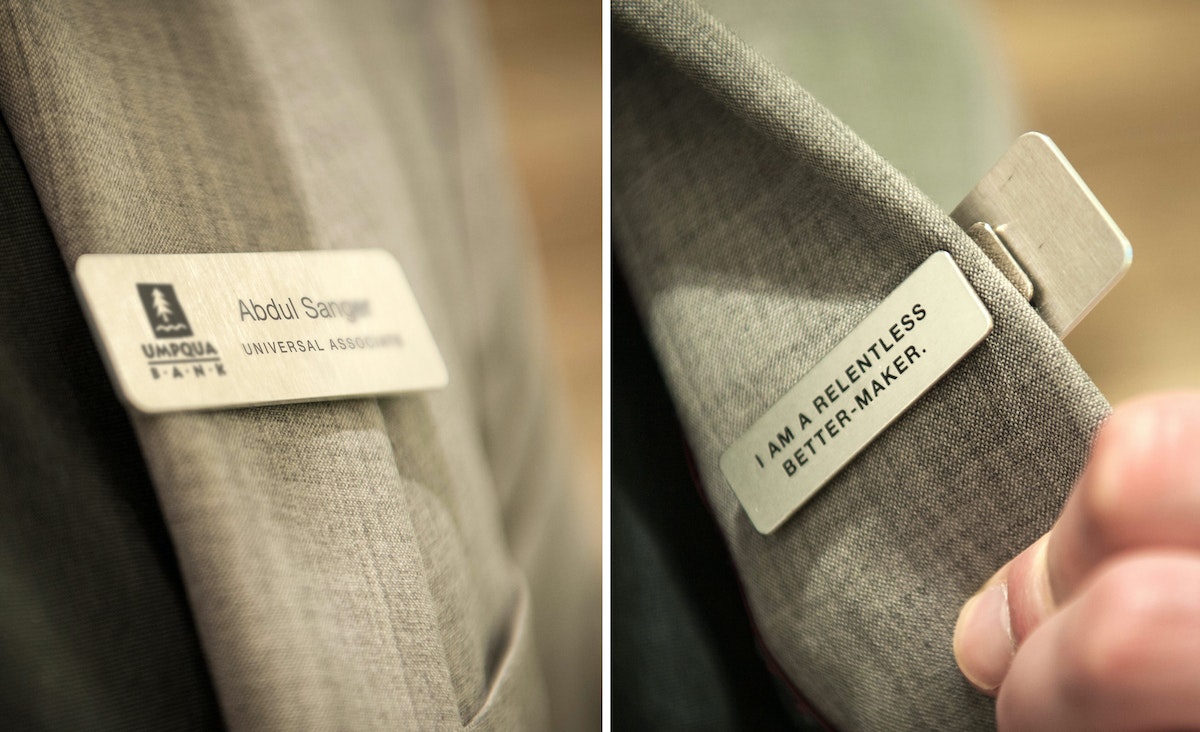
IDEO identified three core brand opportunities and a newly articulated purpose statement that became a launch pad for more than 15 different concepts to express the brand internally and externally.
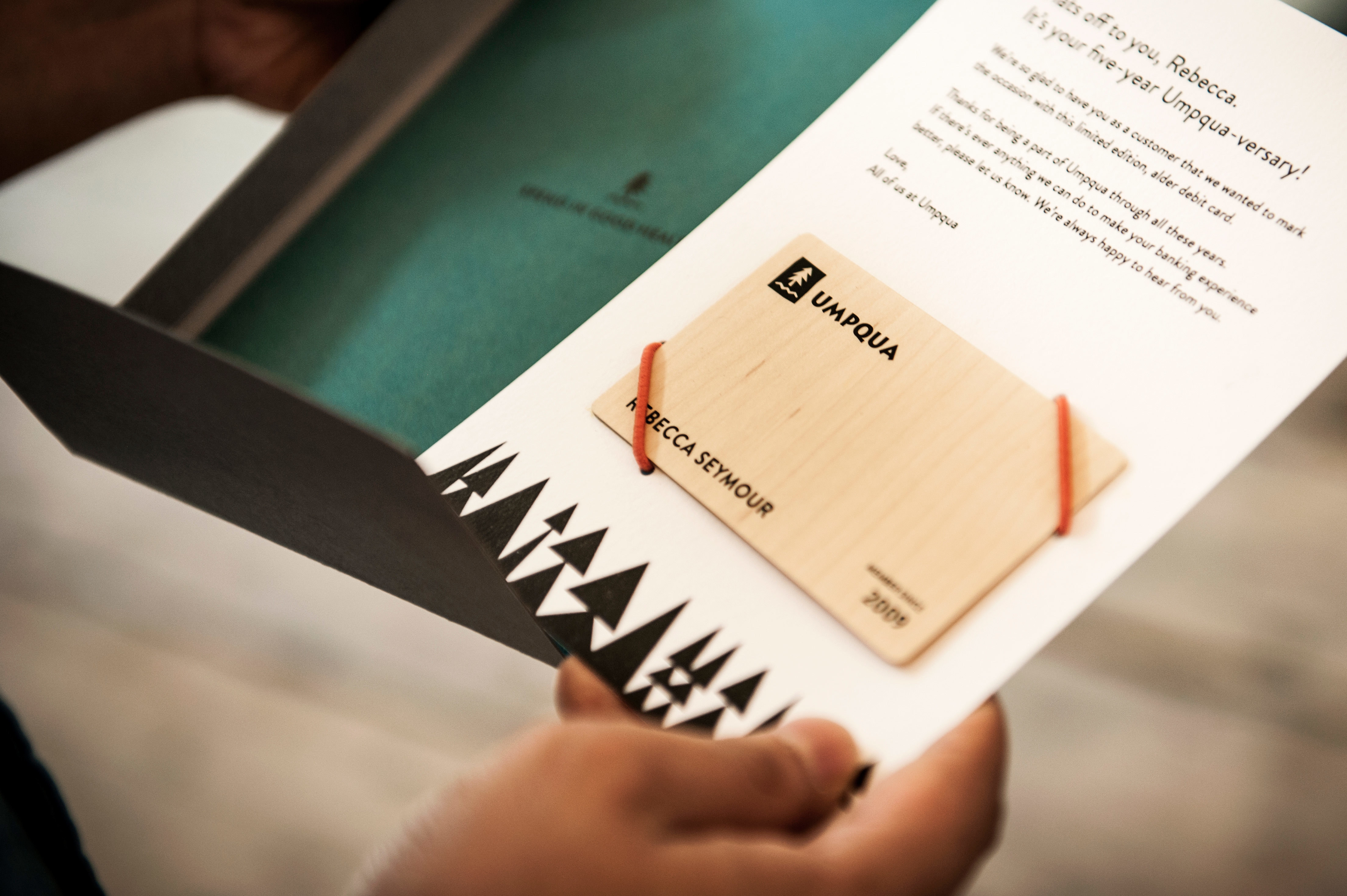
Inside Umpqua, company evangelists handed out notebooks with tips on “how to be better-makers,” and associates now participate in collaborative design challenges through an internal tool built on IDEO’s OI Engine, software that fosters open innovation. The design challenges are drawing unprecedented participation of 84 percent among employees and are having a real impact on the organization. Of the five they’ve run in two years, the company has implemented three winning ideas including a buddy program for new hires or transferees that upwards of 1,000 associates could experience over the next year.
WATCH: Umpqua Bank on using the OI Engine platform
IDEO also worked with Umpqua’s team to conceive digital products including a new digital app called Raindrop that lets people bank in the way that they think about saving and spending, not the way a bank does. It’s due for release in 2016.
To introduce all of this work, IDEO set up an immersive exhibition at Umpqua’s headquarters in Portland. Teams large and small, including the executive and associates from across the company, walked through the exhibit and witnessed how the brand impacts every aspect of their business, from employee engagement to product development. It was signed on the spot by Davis, who invited employees to sign their names, too.

Jade-infused jeans for sweltering summers
Repositioning Lee's brand through the launch of a breakthrough denim product.
The sweltering summers in China can be insufferable—especially for people who like to wear jeans.
Lee Jeans, in its quest to boost its brand differentiation among an expanding market of apparel brands that also use fabric performance as their unique selling point, like Uniqlo and Levi’s, developed denim that’s cooler to wear during hot weather. It found a novel solution in an ancient material: jade. When woven into denim, crushed jade particles maintain the coolest temperature and, alongside other technological enhancements made to the fabric, pull sweat away from the body. The fabric dries quickly, creating a refreshing cooling sensation.
The immense popularity of jade in China makes the denim a natural fit for Lee’s Asian market, and although Lee’s jade-infused fabric was entirely unique, the company needed to differentiate its inventive new product from a rapidly expanding market of high-tech fabric alternatives made specifically for hot weather.
Lee and its parent company, VF Corporation, saw an opportunity to create a new product that helps position the company not just as a premium brand, but one that leads with innovation. Lee came to IDEO to help design the go-to-market and launch strategy for the new line of jade-infused fabric. Looking for insight, designers conducted research in multiple cities in China and India, seeking out those who were committed to wearing jeans despite the most extreme circumstances—the denim-clad bicyclists pedaling through sweltry city streets, the basketball players on the court, commuters who stripped to their underwear while driving and wriggled back into their jeans upon arrival. The common thread: They were all steadfast in their preference for thick, heavy denim, no matter how hot it got.
The resulting strategy for product launch: positioning jade—a traditional material that has strong cultural and spiritual meaning—as a high-tech solution for the contemporary lifestyle of young people. IDEO helped Lee name the new line JadeFusion and created a system of messaging to communicate that these aren’t just jeans—they’re jeans with a fascinating narrative woven within; a hierarchy of messaging that blends jade’s exotic premium significance with a very modern technical story. Lee salespeople learned how to share the story with customers, encouraging them to talk about jade-cooling technology at work, on the streets, and even on the basketball court.
The JadeFusion line sold out within seven weeks of its debut. The launch, which was originally limited to mainland China and Hong Kong, was expanded to India, Malaysia, and Thailand, and sales orders doubled for the following year. Along the way, Lee developed a new understanding of how to incorporate customers’ input and be open to discovery and inspiration from the very start of planning a product launch.
To Design a Better Future, Embrace the Uncomfortable
5 prototypes that help us envision the tools & technologies of the future
While we designed a new family of acoustic amps for Fender, we squeezed into an Airstream for two months to better understand the touring musician lifestyle. And when we wanted to better understand the environmental impact of the things we design, we visited a sewage treatment plant to see what happens when a product can't be recycled.
We go after big problems that have never been solved. And by going all in on the unfamiliar and uncomfortable, we’ve come up with creative solutions that we might not have imagined before.
As an industrial designer, I’m a builder. I experience the world with all my senses and apply my tangible building skills to make experiences and systems. Technology inspires me because it's always been an important vehicle to advance our current state. With technology racing forward at an ever increasing pace, some advancements can impact us on an unprecedented scale. As shapers of the future, we must strive to understand the consequences and implications of emerging technology. We do this by asking ourselves uncomfortable questions about possible outcomes during the design process in areas like healthcare, the future of work, and the circular economy.
In order to better understand how emerging technologies could affect our day-to-day life, my colleagues from multiple design disciplines—industrial design, data science, communications, interaction design—and I embarked on an internal IDEO project that could give us some clues. We got curious and asked ourselves, How might the way we’re communicating with each other change with new technology? How might we collaborate together in the future when we can show up in different realities? What could be possible if the digital and physical world blend seamlessly into each other? How will we protect our privacy if we can teach devices our most personal preferences, and what will happen to our data?
We named our project The Discomfort Zone.
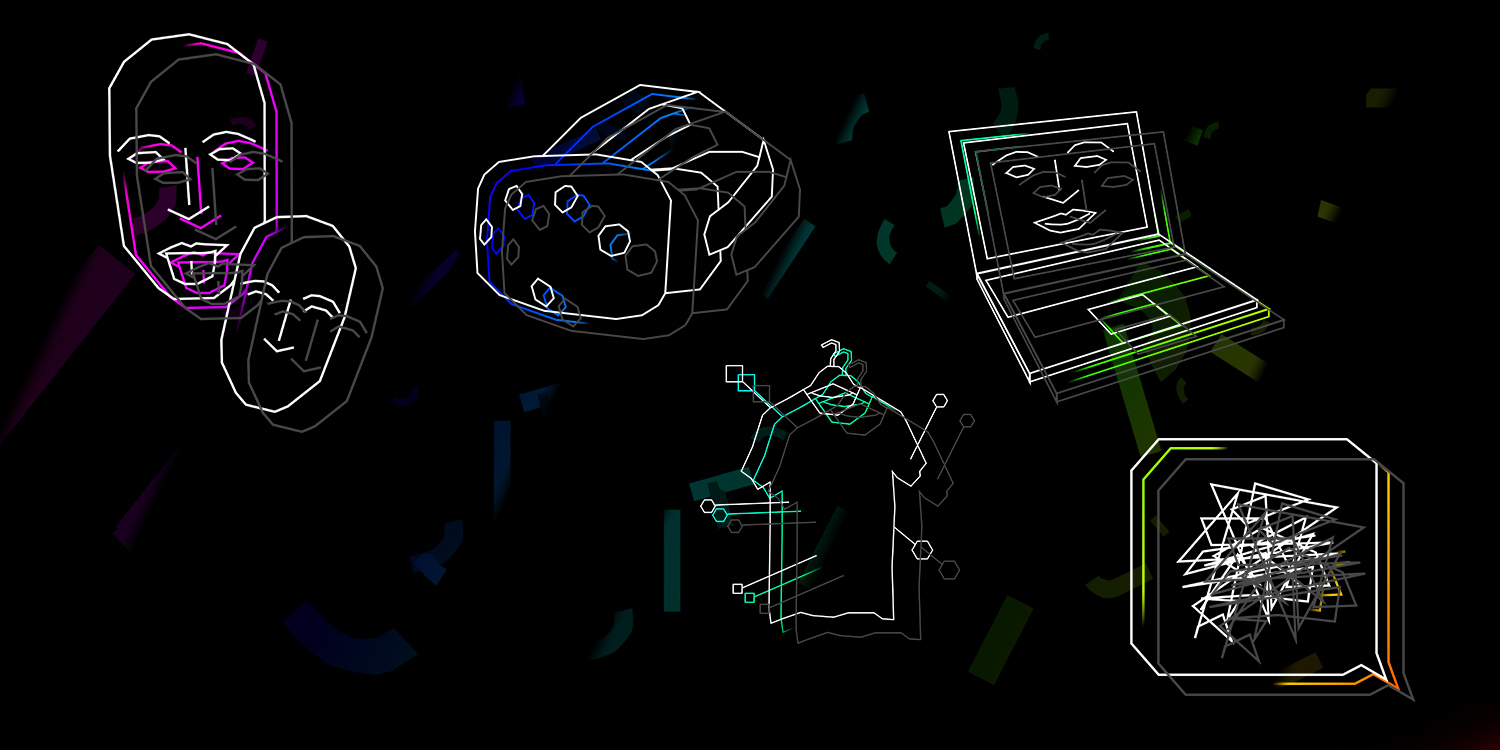
In order to explore these uncomfortable, out-there questions, we had to experience them ourselves, and to experience the future we had to build it. Here are the tools that we built:
Personalized Intelligence: by building a camera that can be taught to take the best self portraits based on individualized feedback, we experienced the idea of actively teaching machines our preferences. The user trains it on their ideal lighting, placement, composition, head tilt, and facial expressions. While it may seem like a trivial thing to create, teaching machines to see us how we see ourselves can show us the path to building other devices—like health devices—that the user can teach to adapt to user preferences and feedback.
Complementary Media: a device that can be taught to recognize facial expressions and emotions, then generates an appropriate, customized emotional expression for each user—like a personalized emoji—helped us imagine more depth and expressiveness online using artificial intelligence. This tool can communicate real human emotion, which could lead to improved communication among children, for example.
Shared Realities: a tool, bridging the physical and virtual, that allows workers operating in VR to sense the presence and movements of colleagues around them as if they are on the same plane. An exploration of how virtual and augmented technology might improve collaboration, it allows people to respond to virtual coworkers’ cues without fully disrupting work in the virtual environment.
Network Empathy: code that enables a user to anticipate how large social or interconnected user networks will react to messages before they are posted, bringing deeper understanding and empathy to online communication. With cues from large online networks, smart technology becomes even smarter and empathetic interaction online becomes easier—especially when it is applied to high-profile communications, or at mass scale among networks that might be discussing politics, health, or education.
Meta Identity: code that is invisible to naked eye can be embedded in an object to make it readable by a machine—not unlike a barcode—and give it meaning online. Branding and production methods might evolve toward this physical tagging method, so that users easily learn about physical objects they see, and find them online. Making the physical as searchable as the Internet could further empower consumers to align their purchase decisions with their beliefs and values.
As designers, it is our responsibility to explore the discomfort zone, design holistically, and consider the full range of possibilities of what we create. For example, as much as Network Empathy was intended to be an inclusive tool, it could also be used to manipulate public opinion by predicting the reaction of large audiences. If we use Personalized Intelligence to teach our devices our most personal preferences, what becomes of this new personal data? And who is the owner of this information: the device, the platform, or the individual?
Because technology will serve us on an even more personal level, the stakes are high. Designers are uniquely stationed to be the connectors in an ever more complex ecosystem of stakeholders, and we must ensure the tool leaves the lab and enters an ecosystem with safeguards in place to have a positive impact.
We’re at the dawn of something big and unknown. New technologies are shaping the future in ways we haven’t even thought of yet. Some of them will have extraordinary benefits, while others, through unforeseen capabilities or even sinister intentions, may have unwanted consequences. But as designers, it’s up to us to explore them early, dive into the unfamiliar, and do what we can to shape the future for the better. We’d love for you to join us here in The Discomfort Zone.
The Discomfort Zone was a collaboration among many designers at IDEO. Special thanks to all involved, including the core design team: Leo Marzolf, Jochen Weber, Brooke Thyng, Christian Ramsey, and Nan Tsai.
So much of being a designer is being willing to embrace the uncomfortable. We create new products, experiences and systems for people whose needs are different than ours—sometimes really different.
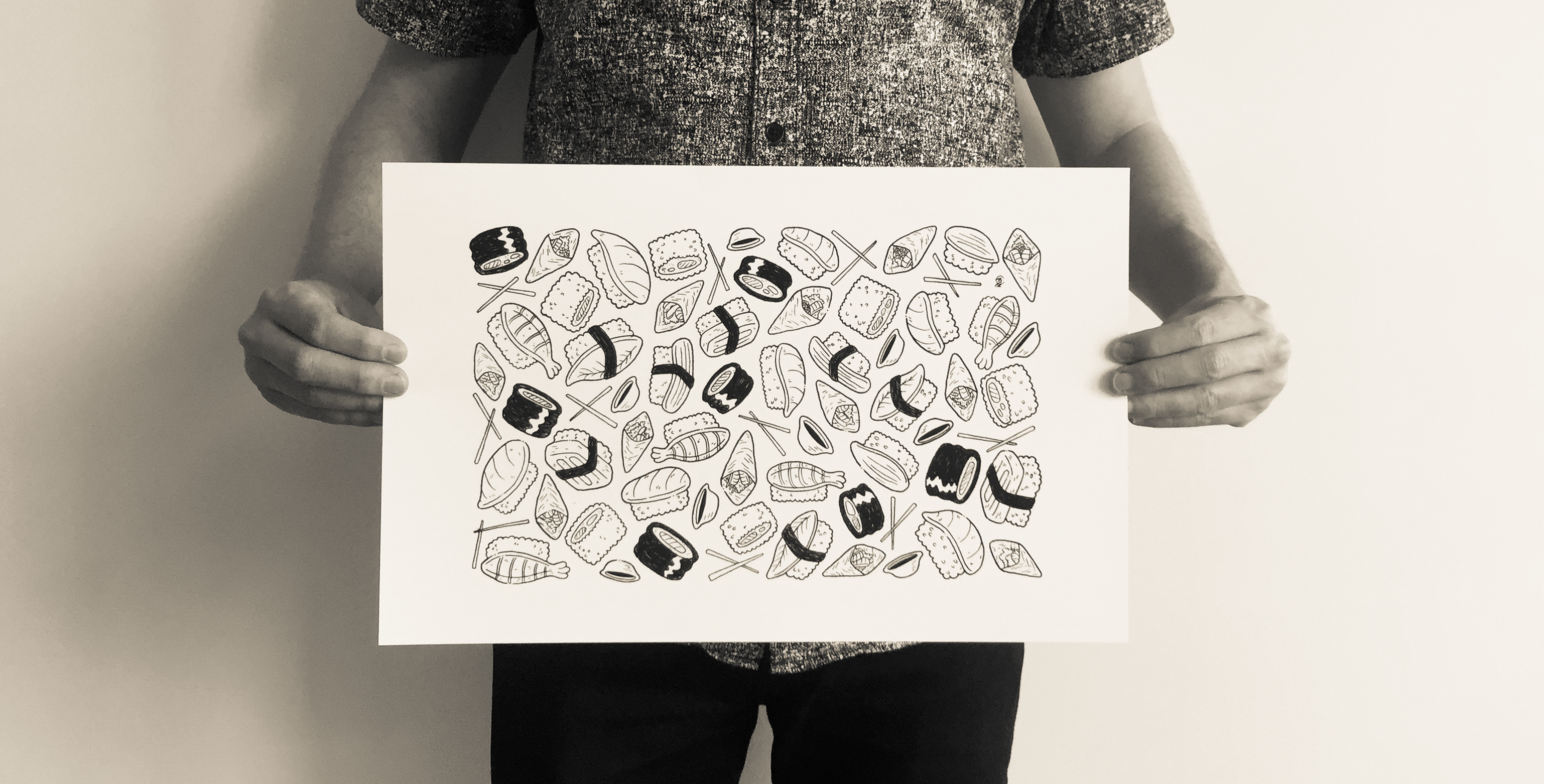
An Artist’s Love Affair with Cute Patterns
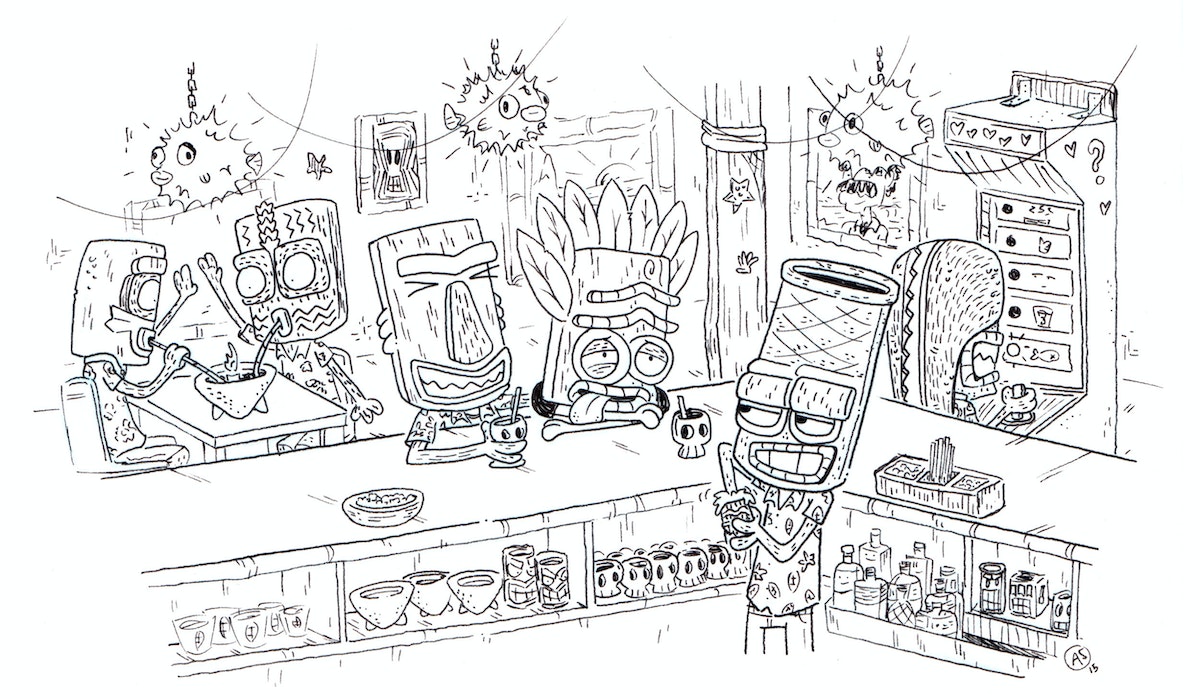
Austin Salmi makes a habit of frequenting tiki bars and drawing clean patterns

In one sentence, who are you?
I am an illustrator who enjoys bringing any amount of joy to people through my creations.
What do you do? How did you learn how to do it?
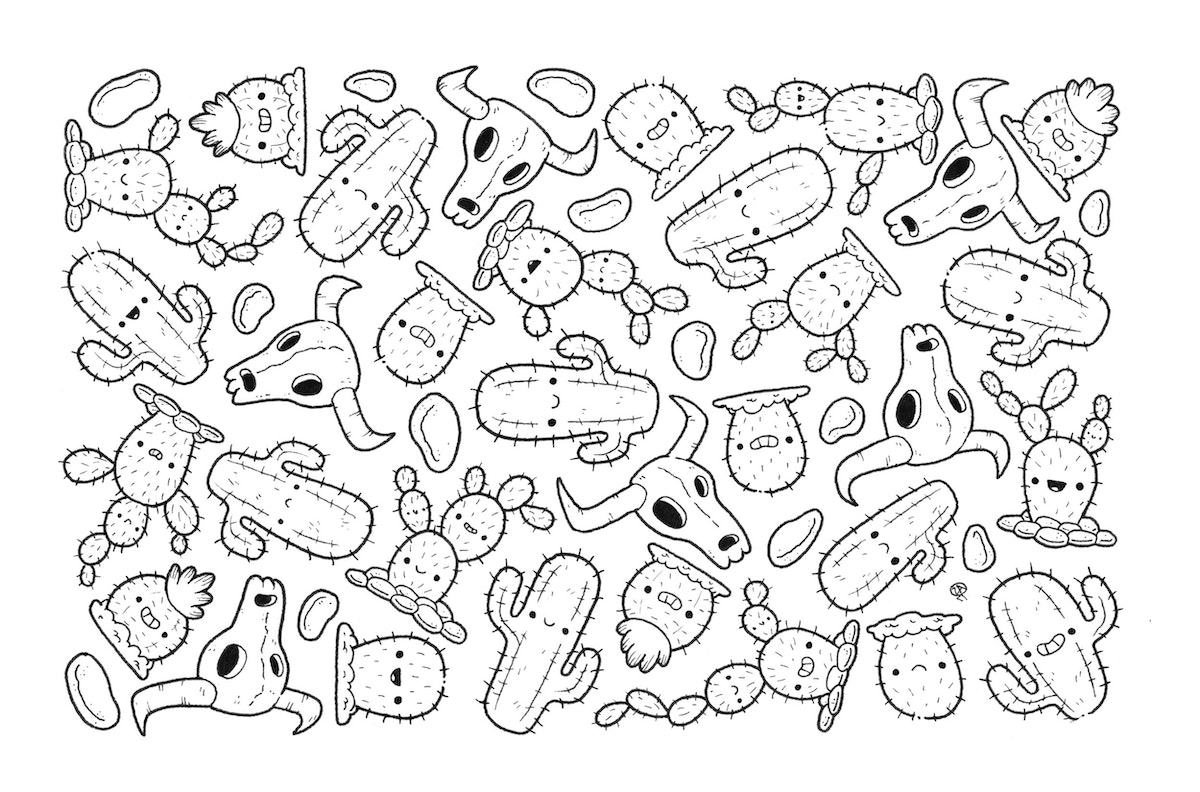
I create different drawings using pencil and ink. The illustrations range from patterns to caricatures, unique creatures, and other one-off ideas. I grew up sketching and doodling and it has continued. When I moved to LA, I was suddenly surrounded by an amazing cadre of artists and creators who constantly inspire me, as well as push me to keep improving myself. That is how I learned my craft and continue to learn, because I believe you never truly finish learning.
What are your 3 favorite possessions?
Miniature Back to the Future 2 hover board; Magnum P.I. Tiki Mug; a drawing of my fiancé and me, which she drew. Not in that order.
What does a typical work session look like?
I have a running list of ideas and sketches that I pull from if I don't have an art show with a specific topic that I am working towards. Usually, I'll do some Google searches on the topic at hand and pull a bunch of reference photos for perusal during the pencil drawing stage. I sketch out the drawing inside a pre-drawn area, such as 4x6 or 5x7. Art that is easy to frame is always a goal of mine, because I love framed art and it drives me mad when I see things tacked onto a wall or cork board. After finalizing the pencil drawing, I'll usually step away for a moment or two to play a video game or watch a show. I like to do something that differentiates the time between stages. Once I come back to the drawing, I pull out all the different micron pens that I think I will use for the piece. I check the nibs, and then I begin inking. I put on dramas in the background to listen to, or things I've seen a ridiculous number of times. West Wing and Parks and Recreation are two such shows.
I don't like to start inking unless I am going to finish a drawing that night. Sometimes, a piece is too large, and I have to break it up over two nights. If that happens, I make sure the pens I've used on the previous night are away from all my other pens. I do this to achieve a consistency within the lines. Once finished, I scan the piece, put it within a predetermined frame, and pack it up for a craft fair or deliver it if it's for an art show. Rinse and repeat as necessary.
How do you get over creative block?
I used to stop drawing and just stew for a bit until it finally passed, which could take a bit of time. As I've gotten older, and ever so slightly more confident in my abilities, I push through it. I just keep drawing. Yes, sometimes the drawings are awful, but as Lauren (my future wife) always says, "sometimes you just have to pass a rat."
How do you see the world in 2078?
A lazy utopia, filled with autonomous everything. Humanity will have moved past Earth and outward into the stars while robots cater to our every whim and we become fat and happy. I could be confusing my vision of the world in 2078 with the timeline in Wall-E—who doesn't yearn for the saccharine dreams of Pixar in 2017. It is tough to image the future right now because at this moment it feels as though we are hanging by a loose wire, and any minute now someone with a spray tan is going to cut the wire and tell us all how huge his ratings are, as we all fall to our collective doom. I hope we make it to 2078, if only so that I can enjoy my hover chair and 128-ounce Slurpee.
What’s number one on your bucket list?
I should say something epic like bungee jumping off of Thomas Jefferson's nose on Mount Rushmore, but honestly, I'd like to have my own artist's studio. Some place I could retreat to and tune out the world and draw silly pictures. That to me is something I want to do before I fade out of this existence.
Who are you creative crushin’ on lately?
I've had a one-sided love affair with Dustin Harbin for a long time. I own two of his original pieces and his diary comics book. The man can use an ink nib like Aaron Sorkin can turn a phrase.
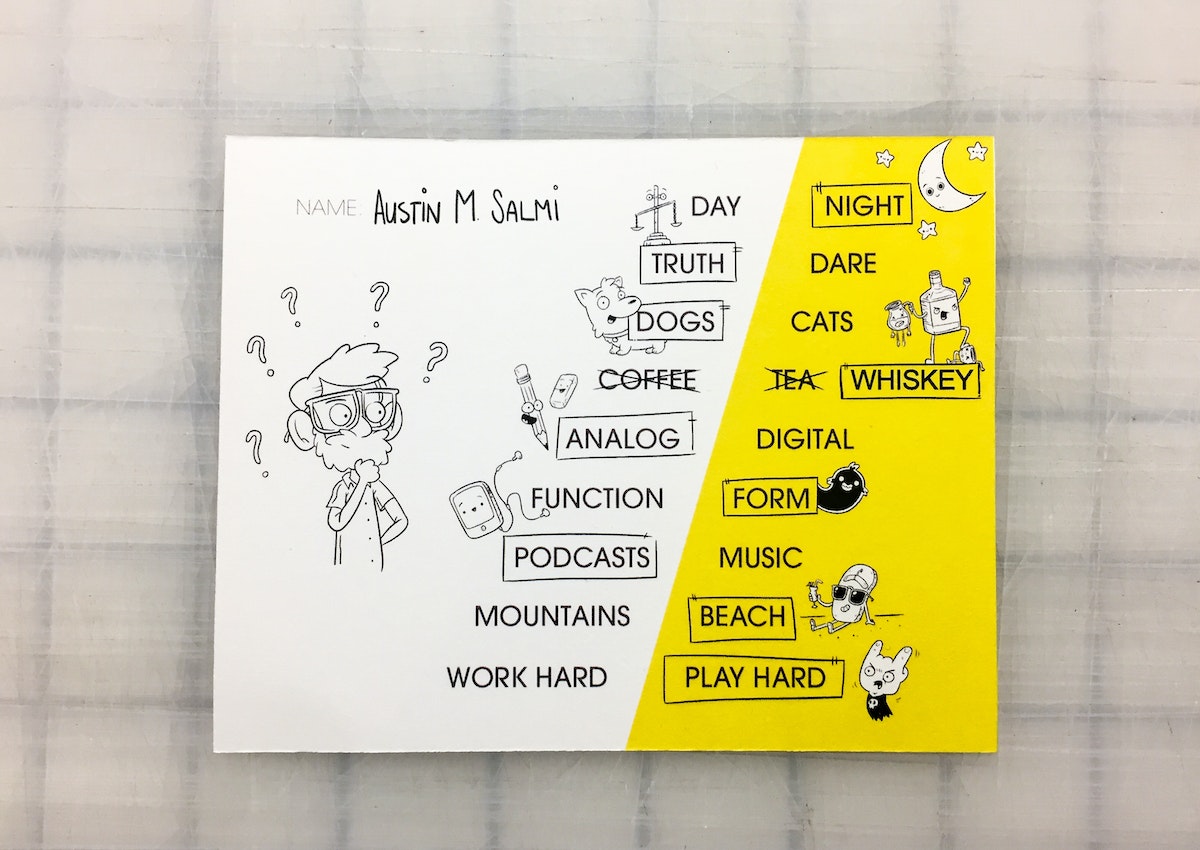
I’ve been creative crushing on Austin Salmi since I saw his doodles, patterns, and adorable characters on Instagram almost two years ago. Austin’s work, learned through practice and osmosis in his job surrounded by artists, has a giggly character about it that fits his intention to hide the ugliness of the world for a moment, and make lovely order out of chaos. I got to learn a bit more about him and his process in this installment of Creative Crushes.
AI Needs an Ethical Compass. This Tool Can Help.
A new, downloadable set of cards for designing with data
We had just begun work on a project exploring how we might help a medical-liability insurance company increase patient safety by learning from past incidents. As we talked, our conversation shifted away from excitedly imagining ideas for data-driven tools toward ways our work might potentially do harm.
What if our designs ended up raising premiums for doctors and, in turn, healthcare costs for patients? What if they kicked doctors off their insurance? What if doctors stopped reporting adverse events to keep their premiums from rising? There was real potential that our work could result in reduced patient safety or increased cost of care. We could inadvertently build a tool that could be used against the very people we were trying to help.
Today, data systems and algorithms can be deployed at unprecedented scale and speed—and unintended consequences will affect people with that same scale and speed. How can we always make sure we’re putting people first when designing large scale systems? Especially when those systems will change over time and evolve without direct human supervision?
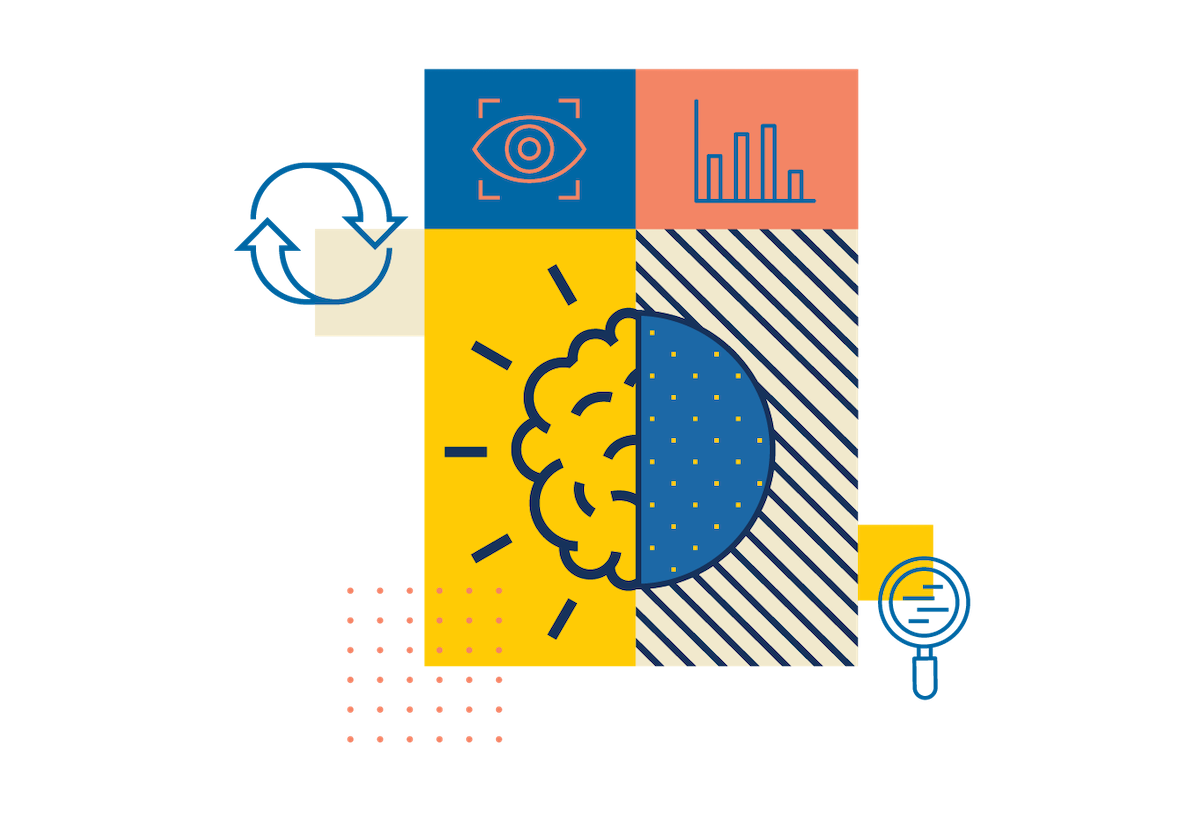
The seed planted during that bar conversation has grown into a set of principles, activities, and now a set of cards that our teams—both data scientists and designers across every other discipline—use to ensure we’re intentionally designing intelligent systems in service of people.
We’re far from the first people to ponder this. We’ve been inspired by organizations like AI Now and Data + Society, books like Weapons of Math Destruction and Technically Wrong, academic communities like FATML and CXI. In particular, we’ve been eagerly following O’Reilly’s series on data ethics (and encourage you to read their free ebook, Ethics and Data Science).
To develop our own set of guiding principles, we started with people. We talked to folks all across the globe: We interviewed IDEO teams about where they found challenges. We spoke to our clients about where they saw intelligent systems go awry. We spoke to the public about where smart designs seemed to cross lines. We observed and read about AI systems that had gone off the rails and worked to understand how this might have been avoided. We learned a lot.
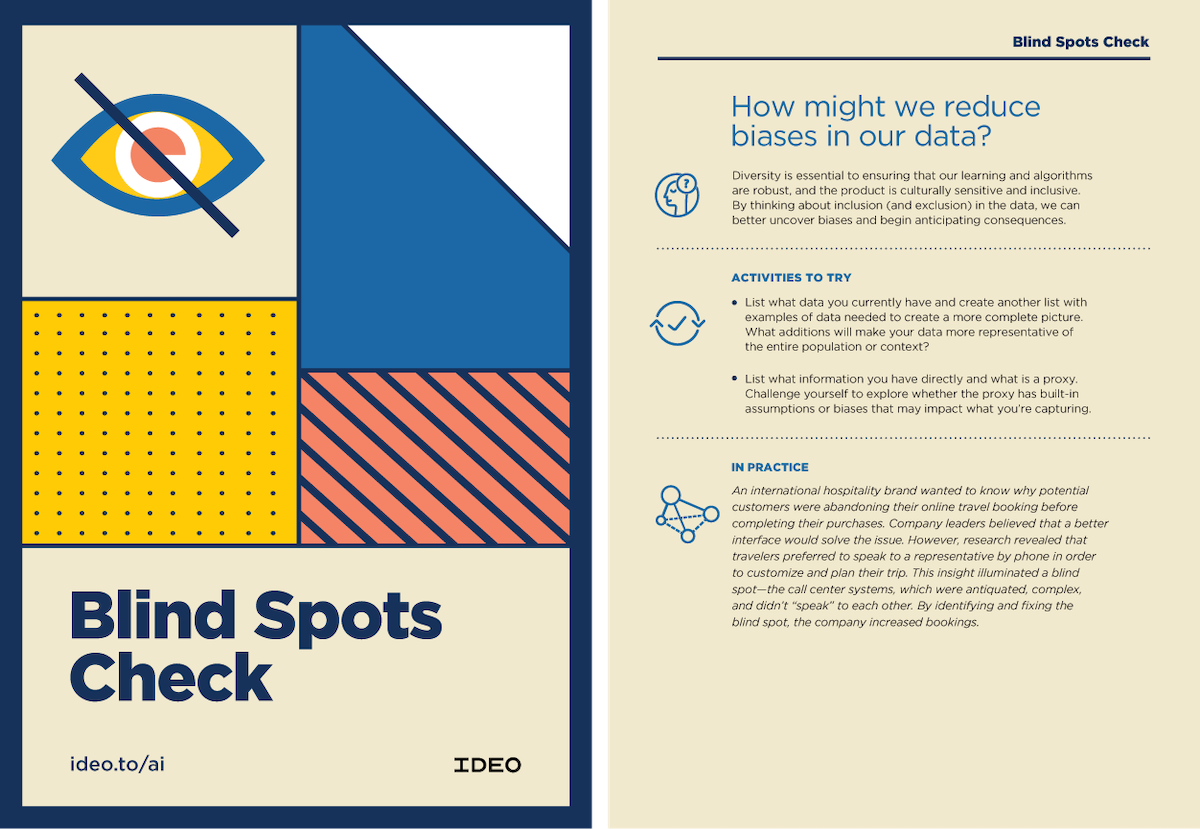
We came up with an original design, iterated on them, and landed on a set of four design principles and ten activities that can help guide an ethically responsible, culturally considerate, and humanistic approach to designing with data. These activities are meant to provoke thought; they’re a vehicle for introducing new ideas and stimulating conversations around ethics throughout the design process.
To start, here are our principles:
1. Data is not truth
Data is human-driven. Humans create, generate, collect, capture, and extend data. The results are often incomplete, and the process of analyzing them can be messy. Data can be biased through what is included or excluded, how it is interpreted, and how it is presented. Unpacking the human influence on data is essential to understanding how it can best serve our needs.
2. Don’t presume the desirability of AI
Just because AI can do something doesn’t mean that it should. When AI is incorporated into a design, designers should continually pay attention to whether people’s needs are changing, or an AI’s behavior is changing.
3. Respect privacy and the collective good
While there are policies and laws that shape the governance, collection, and use of data, we must hold ourselves to a higher standard than “will we get sued?” Consider design, governance of data use for new purposes, and communication of how people’s data will be used.
4. Unintended consequences of AI are opportunities for design
Just as with any design endeavor, we know that we’re not going to get it right the first time. Use unanticipated consequences and new unknowns as starting points for iteration.
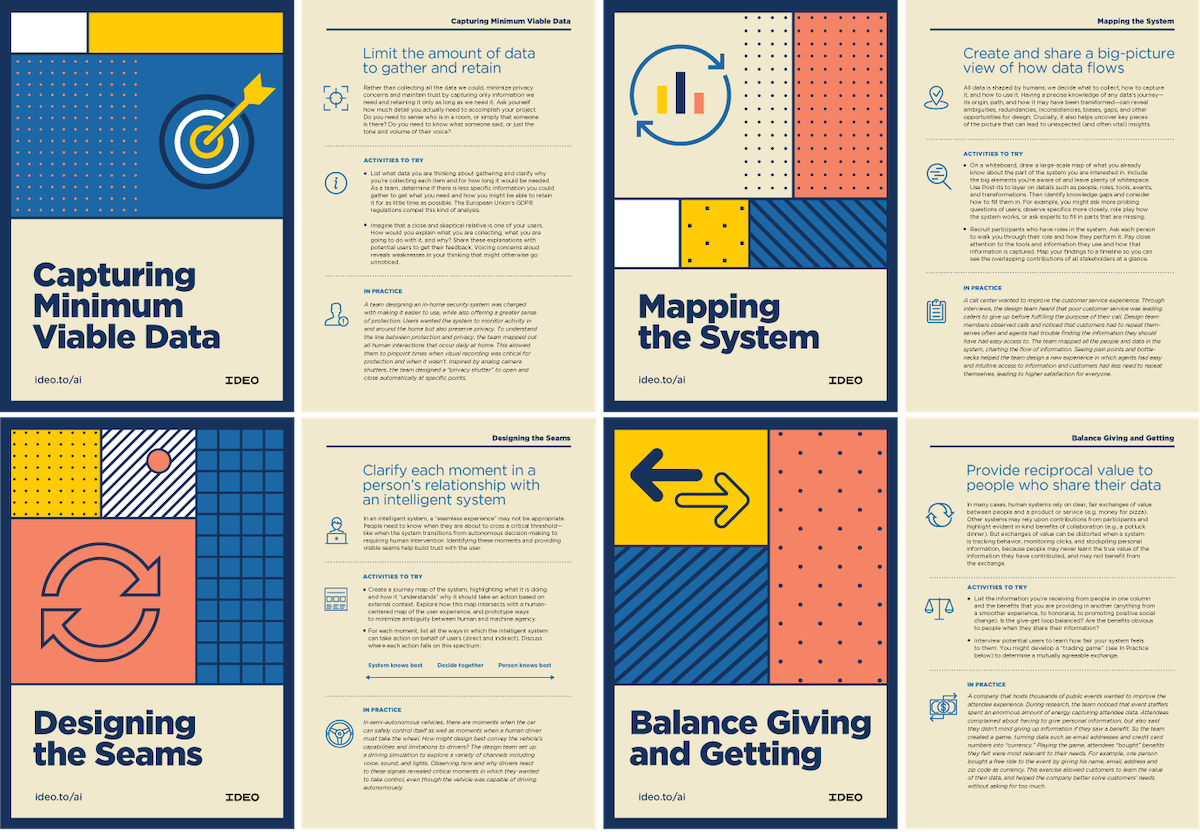
To get started with the activities, you can download the cards here. We hope that these activities provoke dialogue and provide concrete tools to help our community ethically design intelligent systems.
Thank you to the larger team who helped make these cards come to life—Ben Healy, Jane Fulton Suri, Jess Freaner, Mike Stringer, Justin Massa, Connie Oh, and KP Gupta, who designed them.
A design researcher, a business designer, and a data scientist were sitting at a bar. It sounds like the setup of a joke, but the conversation was actually quite serious.
No Beards Allowed: Exploring Bias in Facial Recognition AI
How a creative code experiment helped people understand the pros and cons of artificial intelligence
As a user experience and interaction designer with a hybrid art and tech background, I’ve long been a fan of the concept of using art and design as a Trojan horse to make tricky concepts accessible. Through intrigue, curiosity, and play, these experiences can bypass our biases and open the door to understanding, without requiring deep comprehension. If you’ve ever visited a children’s science museum and watched kids excitedly engaging with subjects that would bore them to tears in book form, then you’ve seen the power of experience and play at work.
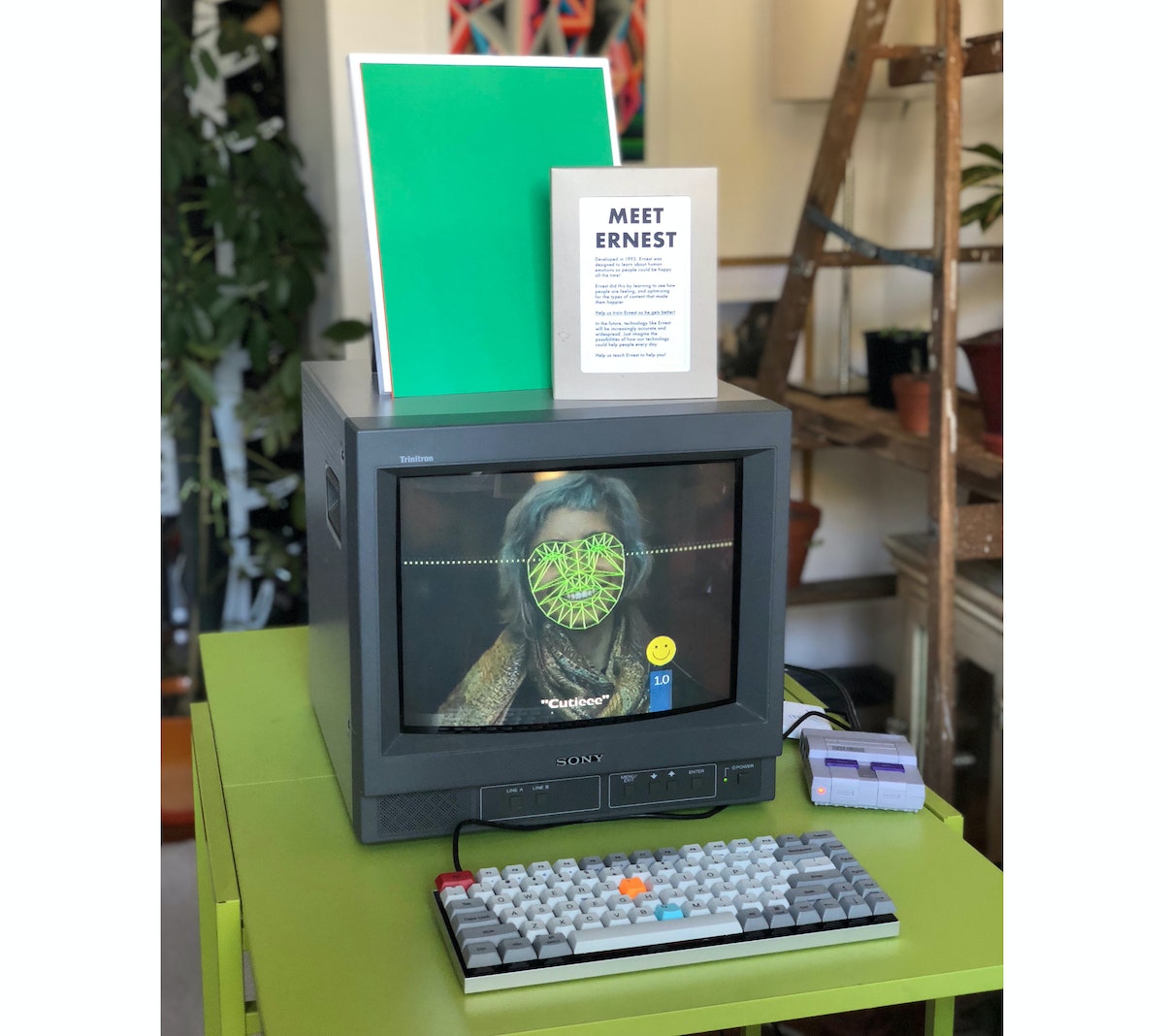
Meet ERNEST
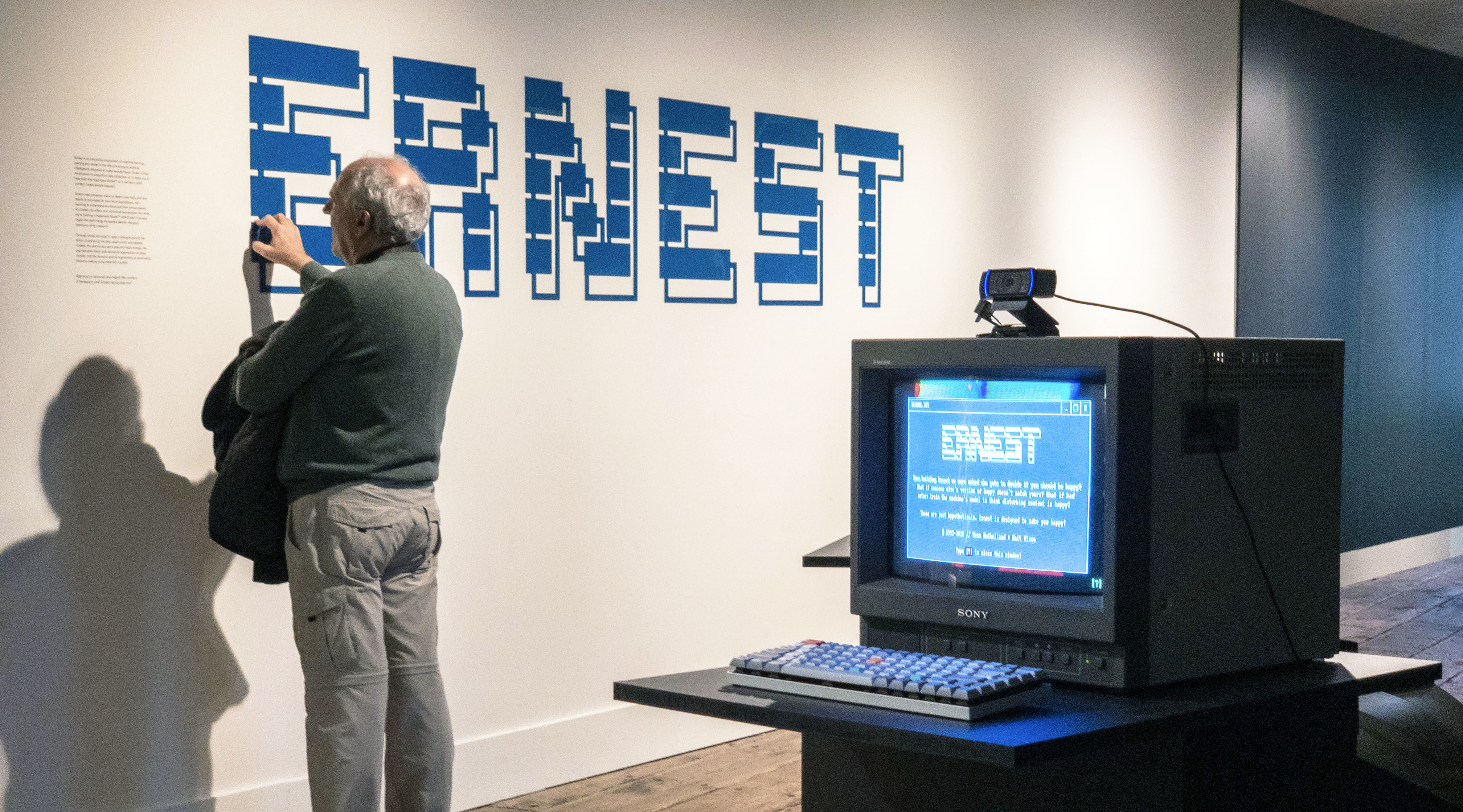
That’s why my colleagues and I created ERNEST, an installation that gives the viewer the job of training a rudimentary artificial intelligence. Using facial and emotional recognition tech, ERNEST shows the user imagery and tries to see how happy it makes them. Our goal for this project was to engage users in a game-like experience to help them understand how machine learning models are trained, and subtly hint at the areas where bias could creep in.
Fellow IDEOer Matt Visco and I wanted to make sure ERNEST didn’t look like a modern computer—we designed it to look vintage. With its old hardware and nostalgic graphics, ERNEST doesn’t feel smart on the surface. Its look is meant to evoke a time when computers carried the promise of a utopian future, prior to mass connectivity and the ubiquitous collection of personal data.
The full installation uses five monitors, two computers, and three Raspberry Pis, which power several video loops that reveal the training data behind ERNEST, and give passersby a sense of the experience even if they don’t engage directly with it.
How it Works
ERNEST uses computer vision to perceive the user ambiently through facial recognition, allowing it to detect when a user is looking at it and how far away they are. When a user gets close enough, ERNEST comes alive and asks the user to help it learn. It then shows the viewer images intended to make the user happy, and gauges their emotional reaction based on their facial expression using a pre-trained model. The facial tracking and emotional data is displayed to the viewer in real time, encouraging users to make faces at ERNEST. Viewers can then validate the accuracy of the model to help ERNEST know if it was correct or not.
(Sound complicated? The video below might make it clearer.)
We installed ERNEST in IDEO San Francisco’s lobby for a couple of months, and also brought it to the San Francisco Art Institute Fort Mason Gallery for the CODAME Intersections exhibition in November 2018.
The Results
Many participants loved to challenge ERNEST, often emoting in varying ways through numerous loops of the game. Once, a group of participants spent nearly 20 minutes playing with ERNEST, takings turns to compare how it perceived each person.
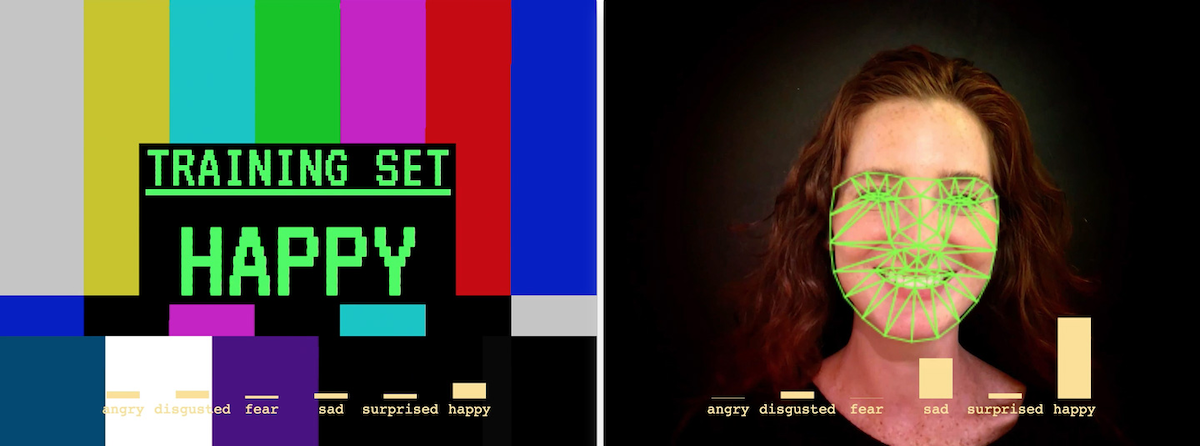
When viewers interact and play with ERNEST, we’re helping them see that machines can have almost human-like perception, reacting differently to different faces, and sometimes being uncannily accurate...or completely wrong. The wrong guesses were in many cases more interesting, and were in fact a very intentional part of the design. We wanted users to see that artificial intelligence is sometimes not as intelligent as we might think.
ERNEST is meant to be a game, but what happens when real-world AI makes the wrong guesses? Or what if those wrong guesses are uneven, indicating an unintentional bias, such as working well for some faces but not others?
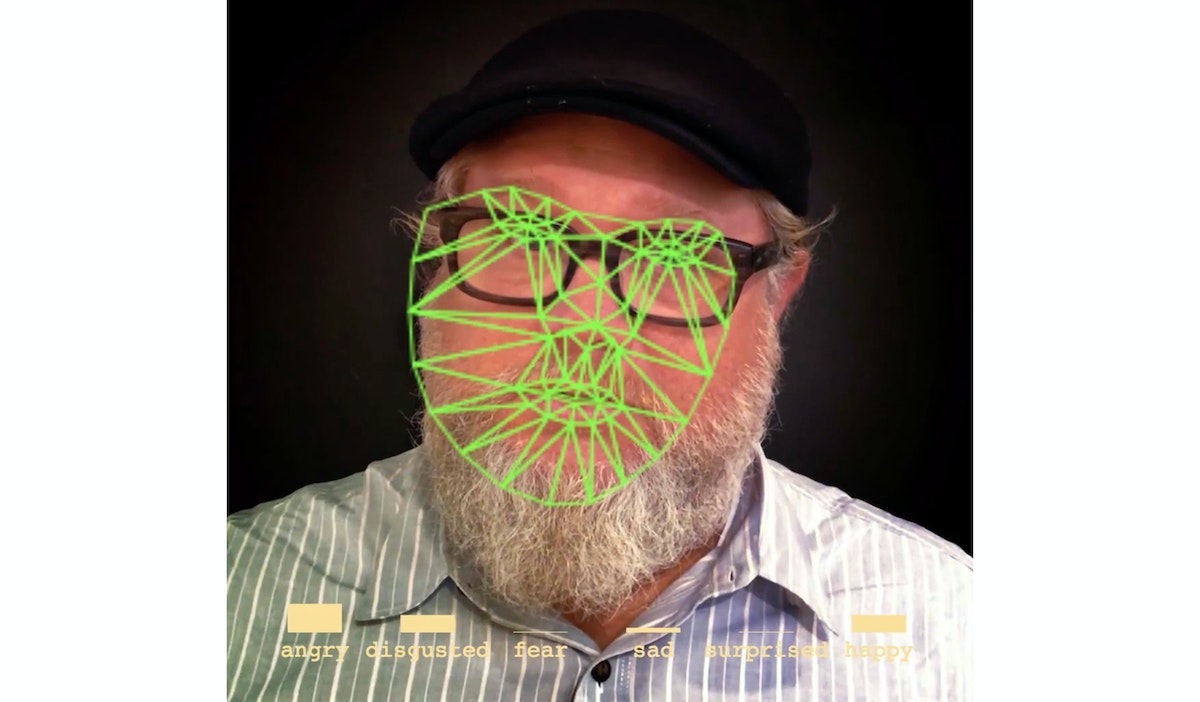
We wanted people to realize that designing systems that can ambiently perceive humans without direct input is rife with ethical concerns. And already, systems like these are being deployed at scale. The Guardian predicts emotionally-aware tech is already a $20B industry. Even something seemingly benign like ERNEST causes us to wonder—if an AI is trying to make the viewer happy, who determines what “happy” is? What if bad actors train Ernest to think that disturbing content is “happy?” What if the technology is repurposed to provoke anxiety or anger? What happens if we deploy technology like ERNEST widely?
Of course, ERNEST only scratches the surface of these big ethical questions, but we hope that it helps give people insight into how artificial intelligence thinks, and the ways its thinking can be flawed. The more that we as a society can start to understand these systems, the better we can judge their quality, and work to design them to be in line with our shared human values.
Artificial intelligence and machine learning are among the hottest topics of the tech world, but some of us at the frontier forget that many people feel intimidated—or even afraid of—these technologies. The pop-culture trope of machine intelligence gone rogue has been a part of our cultural psyche for a good 150 years. Think 2001: A Space Odyssey’s HAL 9000, The Terminator’s Skynet, and The Matrix’s... Matrix. Combine that fear with arcane tech-speak like “recurrent neural network” and “generative adversarial network,” and in addition to feeling emotionally intimidating, AI and ML can also feel incomprehensible.

Lindsey Turner
I’m passionate about building brands, products, and experiences that help organizations show up with meaning and momentum.
I help organizations cut through complexity by shaping how they show up, through brand strategy, identity, and storytelling.
Working at the intersection of brand and business, I bring an editorial eye and a bias toward making—turning ideas into tangible experiences that people can understand, trust, and believe in.
My work spans government, healthcare, financial services, media, and consumer goods, from launching Gen Z-focused ventures to building innovation labs and reimagining legacy brands. I relish moments of ambiguity and enjoy translating across teams, perspectives, and priorities to move ideas forward.
I started my career in editorial and digital design, shaping cross-platform experiences and identity systems in publishing and agency environments. That foundation still shapes how I work today: I’m detail-oriented, collaborative, and overreliant on the Oxford comma. I hold a BFA in Visual Communication from the School of the Art Institute of Chicago.

Rachel Young
My work helps organizations see who their products aren't working for—and build the will and the tools to do something about it
For 25 years, I've asked the same question: Who does this design exclude—and what are we going to do about it?
My work spans human-centered strategy, inclusive design, and qualitative research, with clients ranging from Microsoft, Google, and Verizon to the National Science Foundation, and San Francisco Unified School District.
Before IDEO, I taught elementary school in East Palo Alto and spent a decade doing design work with social service organizations—where I learned firsthand what it costs people when systems are built without them in mind.
I am currently writing User Error, a nonfiction book about digital access and the design decisions behind it. I live in Oakland, California.

Brian Pelsoh
I lead with craft, ensuring our work is creatively excellent: rooted in deep human insight and imagination, while also grounded in the realities of business and technology.
My expertise spans brand, communication, and product design across tech, education, the arts, and social impact.
I believe great work demands both high-level vision and obsessive attention to detail, and only happens through collaboration.
I bring an inclusive, hands-on approach and a deep understanding of business, which enables me to consistently deliver excellence while always asking why.
Before joining IDEO, I worked at the brand firms Pentagram and VSA Partners. I began my career as a designer, leading teams at the School of the Art Institute of Chicago and the Milwaukee Art Museum. I hold an MFA in graphic design from Maryland Institute College of Art and a BFA in communication design from the Milwaukee Institute of Art & Design, and have taught at some of the best design schools in the US.

Tony Wong
I am responsible for IDEO’s long-term success in China and working with clients to use design as a tool to enable growth.
I am responsible for IDEO’s long-term success in China and working with clients to use design as a tool to enable growth. Specifically, I have helped Chinese companies design holistic brand solutions through the development of their products, communication, services, and innovation teams, and I have helped multinationals expand their presence and influence in China.
I advise global leaders on developing China-led innovation and capabilities.
In over 15 years in IDEO Shanghai, I have worked on projects that use design to elevate the quality of the experience of healthcare products and services, streamline processes that increase productivity, create spaces and programs that promote and enable inclusive communities, and build next generation mobility solutions that are planet-positive.
Before joining IDEO, I worked at Philips Electronics and the Electrolux Group in Italy, the Netherlands, and Singapore on a number of breakthrough commercial products. I am a member of the Young President Organization in Shanghai.

How to use AI as an editor, not a writer
Ed White shares how he uses AI as an editor—not a writer—to sharpen storytelling, rehearse ideas, and preserve the productive friction that makes creative work better.
Ed White has a rule he's tested on his own writing: hold yourself as the writer, and let AI be your editor. Ed is a Senior Design Director at IDEO's London studio, where he co-leads the firm's AI portfolio across Europe. Before IDEO, he spent 12 years as a writer and editor at the Financial Times, Wired, and Contagious. So when he talks about when to use AI for storytelling and when not to, it comes from two decades of crafting his storytelling skills.
In this episode, Mina Seetharaman talks with Ed about two specific tools he uses to keep AI in an editor's seat: a "roasting agent" prompted to critique his drafts without any sugarcoating, and a simulated audience he rehearses pitches on before the real thing. They also get into what Ed is hearing from design leaders at Anthropic, Lovable, Shopify, and Google Creative Lab about how creative work is changing, and why he thinks the friction of writing something yourself is worth protecting rather than automating away.

Building a personal AI for the messiness of life: Sida Li
Becca Carroll talks with Cue co-founder Sida Li about designing a personal AI for the messiness of everyday life—not just work. They explore how Sida stays anchored to human needs while navigating fast-changing technology, product tradeoffs, business-model experimentation, and the realities of building an AI company today.
Most AI products today are built for work—a space with clear problems and established systems. One founder noticed a gap: personal life is messier, harder to systematize, and mostly left behind by the AI boom. So she built Cue, a personal AI that lives inside iMessage and group chats, to go where the other tools haven't.
In this episode, Becca Carroll, IDEO's Chief Strategy Officer, talks with Sida Li, co-founder and CEO of Shared Context Lab, about staying anchored to a human need while the technology around her keeps changing shape, why she treats her business model with the same rigor she'd bring to a product, and what it feels like to build a company at this particular, disorienting moment in AI.
The conversation also gets into how Sida makes design decisions: the language Cue uses to describe itself, the tradeoffs behind building inside iMessage instead of a new app, and a real story about a business idea that didn’t pan out.
This is the second in a two-part series profiling founders from IDEO's Startups-in-Residence program. The first conversation is with Johannes Seemann, founder of Sooner, on designing GenAI for the emotional side of money.

Designing GenAI for the emotional side of money: Johannes Seemann
Designing financial tools around the feelings that shape money decisions.
Most personal financial tools are built to run the numbers and optimize towards a budget. While that works for some, most people experience money as a lived relationship that does not neatly fit into a spreadsheet. Johannes Seemann and Becca Carroll discuss why money is emotional before it is mathematical, and what a human-centered approach to building a generative AI financial product looks like in practice.

The curious leader's edge in uncertainty: Scott Shigeoka
How genuine curiosity helps leaders navigate uncertainty with greater confidence.
Mina Seetharaman talks with Scott Shigeoka, author of Seek and Head of Curiosity Cultivation at the Eames Institute, about what distinguishes genuinely curious leadership from performative curiosity, how power dynamics shape curiosity, and why practicing curiosity can restore energy rather than drain it.
Looks like you might be in search of something very specific?
Or reset the filters above and try another angle.
Here’s some random inspiration

Podcasts about creative leadership

Articles about the power of prototyping










































.webp)