
.svg)


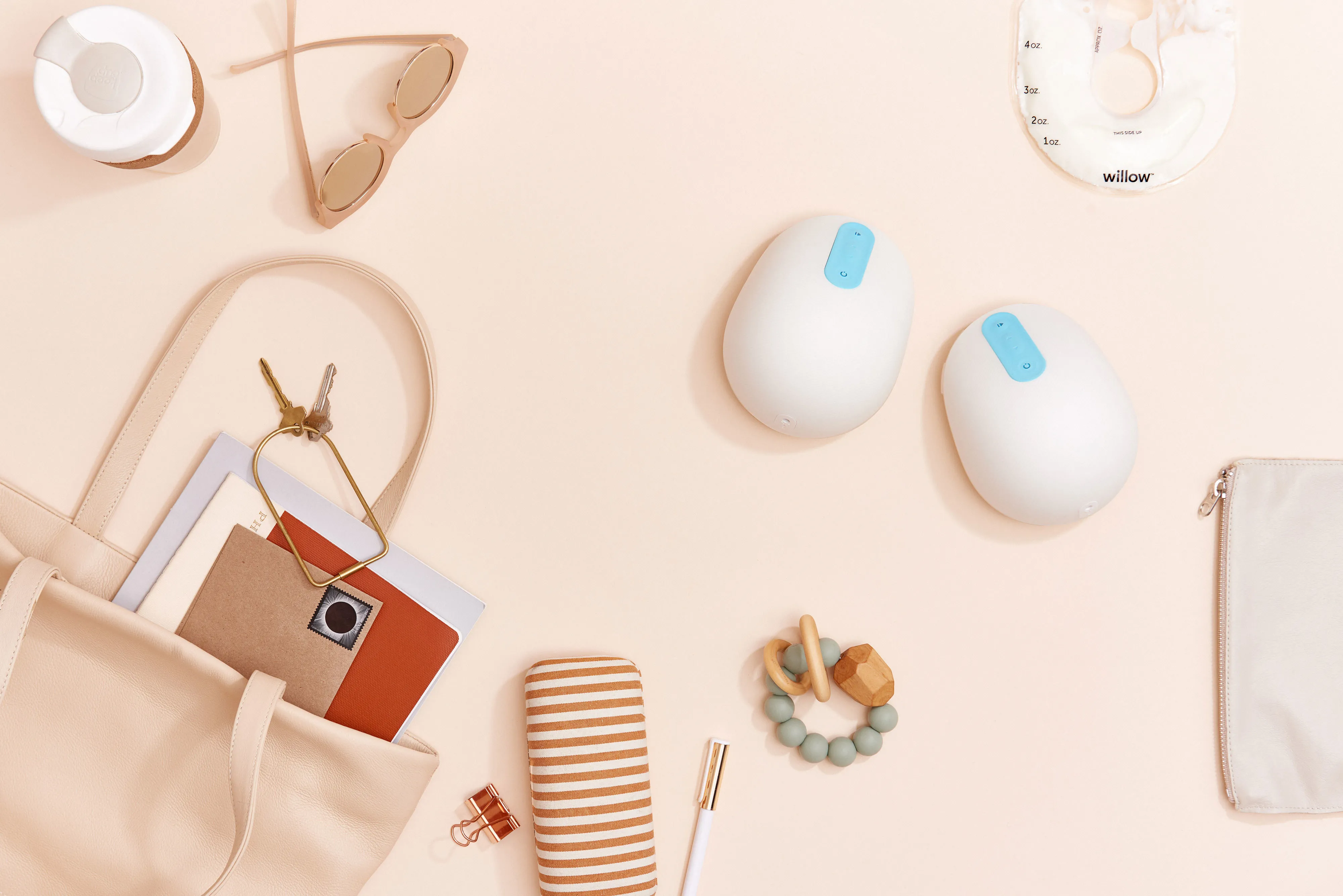

Designing the first all-in-one, wearable breast pump
Collaborating with the startup team at Willow that reimagined the breast pumping experience.
All moms want to give their babies the best start in life, and for many, that means nourishing their babies with breastmilk. However, breast pumping is often inconvenient and uncomfortable. Tethered to the wall, undressed, and surrounded by cords and dangling bottles, most mothers who pump are interacting with technology that hasn’t fundamentally changed in more than 25 years.
Passionate about solving this challenge, the startup Willow set out to completely re-imagine the breast pumping experience. The team at Willow envisioned a “dream pump” that would deliver what moms want most: mobility and discretion.
The Willow team approached IDEO to be a close partner in bringing their product to life. As a cross-disciplinary team of researchers, industrial designers, and mechanical engineers, IDEO, Willow, and Function Engineering worked together seamlessly to identify mothers’ unmet needs and resolve engineering complexities with a simple and elegant design.
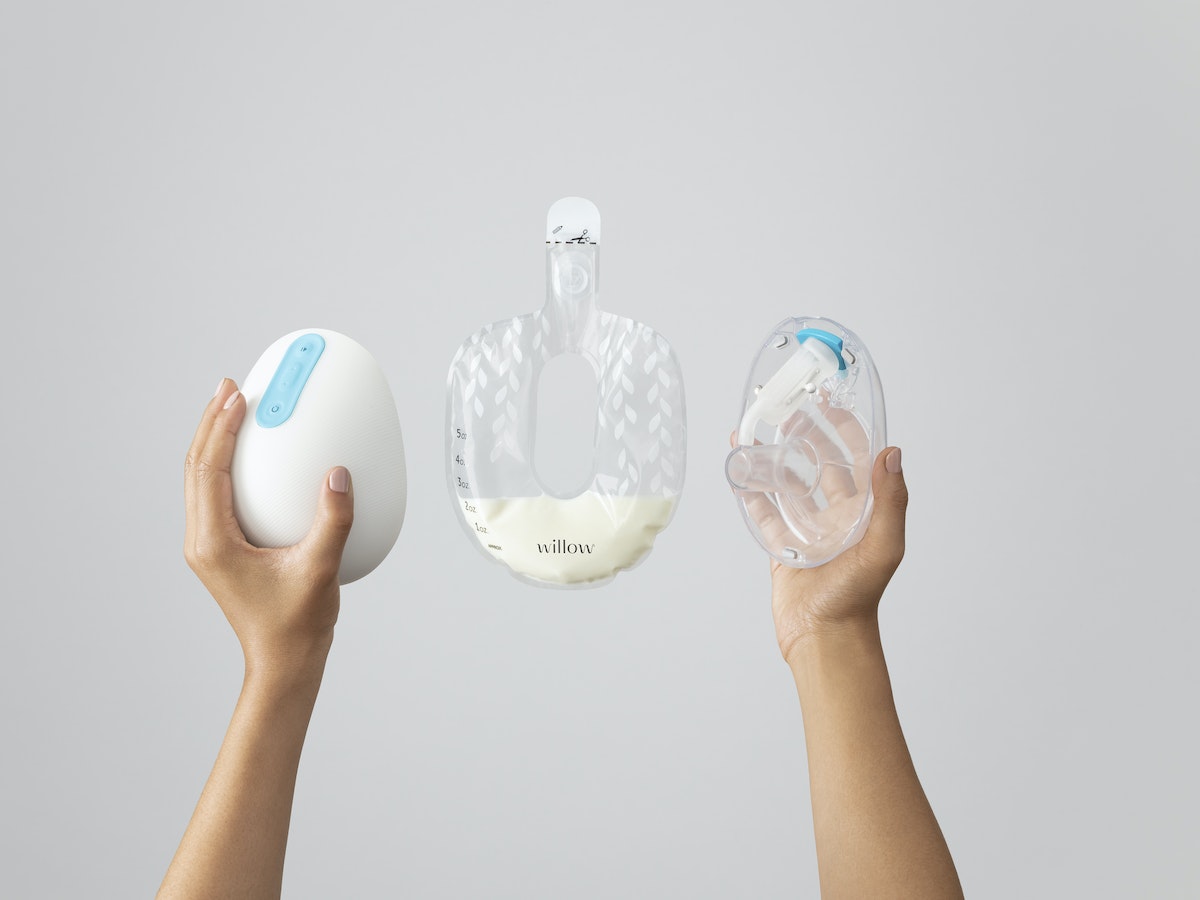
The resulting product, Willow, is the first all-in-one, wearable breast pump that cuts the cords, ditches the mess of bottles, and fits easily inside a bra. Mobile, discreet, and hands-free, Willow allows women to achieve their breastfeeding goals without pressing pause on their own lives.

The final design of Willow was informed by research and in-person interviews with dozens of mothers, ranging from first-time to experienced pumpers. Insights about their personal routines, challenges, and workarounds guided the design team as they built more than 60 physical prototypes to understand how Willow could best fit into mothers’ lives. Learnings from those prototypes helped the team to define the size, shape, color, and materials of Willow, as well as each step in the pumping process.
One key design element that emerged from this iterative process was the simplicity of Willow’s architecture, which makes the pump easy to use, assemble, and clean. The pump contains just a few basic parts that snap together, and only two parts that need to be cleaned (both are dishwasher-safe).
Considering how personal the breast pumping experience is, the team aimed to help the pump feel less like a stark, mechanical device and more like a considered, modern, and personal accessory—a goal ultimately achieved through the pump’s colors, texture, and finish.
Because of Willow, mothers no longer need to plan their lives around pumping—it can happen anywhere, at anytime. Willow gives moms back their time and freedom and gives them choice; now moms can play with an older child, work, or enjoy precious relaxation time at home. With Willow, pumping breastmilk finally fits seamlessly into women’s active everyday lives.

Improving quality of life for young adults with schizophrenia
Designing a digital platform that continually motivates and engages patients.
More than 50 million people worldwide suffer from schizophrenia, yet only half receive psychiatric treatment. When they do, it usually involves medication and one-on-one therapy to treat the most visible symptoms, including hallucinations and paranoia. But the disease can also cause debilitating symptoms that medication can’t easily treat, such as social anxiety and isolation, lack of motivation, and memory deficits.
For people living with these symptoms, what might seem like simple activities—socializing, spending time outdoors, exercising—can sometimes feel overwhelming. And if patients aren’t given effective care, they can become even more isolated, and their physical health and quality of life suffer. They’re far more likely to let the rest of their treatment regimen slip, skipping medication or therapy sessions.
To help address these challenges, a digital health research group at the University of California, San Francisco (UCSF) approached IDEO with an idea to supplement the longstanding medication-and-therapy model with a tool to alleviate hard-to-treat symptoms, and more importantly, improve patients’ quality of life. It would require identifying unmet needs among patients and determining which kinds of interactions could have the greatest impact on young people with mental illness.
The outcome of that collaboration is PRIME, or Personalized Real-time Intervention for Motivational Enhancement, a digital platform that empowers young people with schizophrenia with the tools, motivation, and community of support they need to achieve their goals.
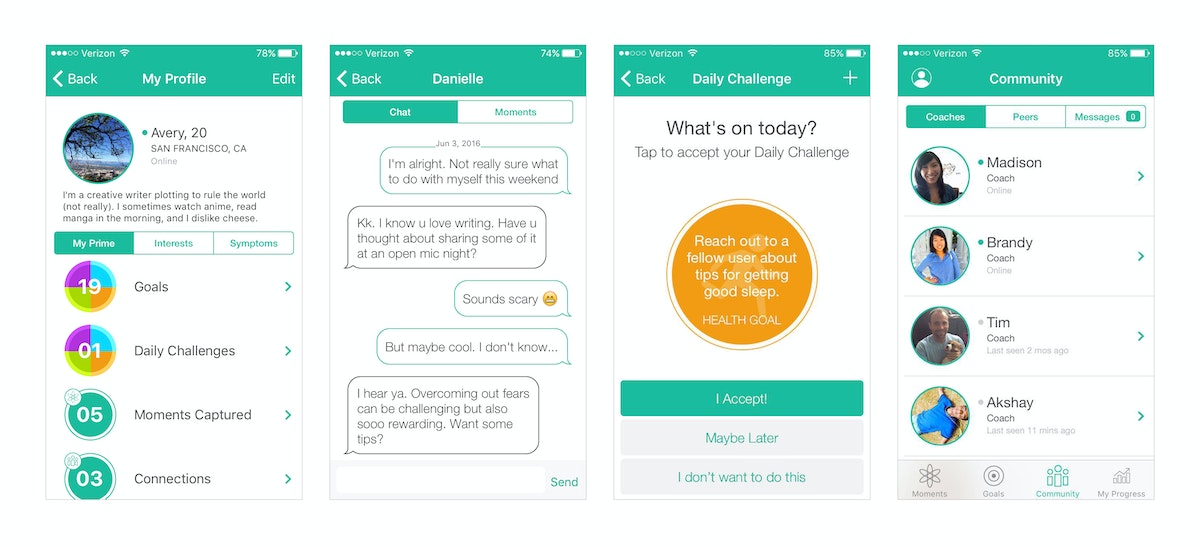
The simplicity of PRIME belies its deep functionality. The easy-to-use mobile app helps patients stay motivated to stick with behaviors that boost their health, social skills, and productivity, and it provides motivational coaching from trusted professionals and social connections with other patients.
How It Works
The PRIME app lets users set daily goals based on their particular needs. There are more than 500 small challenges to try—from inviting a friend to play basketball to spending time with a family member—and users can see their progress tracked through incremental successes over time.
Whenever users need help, trained motivational coaches are on hand to provide cognitive behavioral therapy coaching, encourage patients to achieve their goals (and to push beyond their comfort zones), and support their interactions with other users.
Tapping into its vibrant social network to help patients feel less isolated, PRIME prompts users to snap photos of happy moments, highlight important events in their lives, and share challenges they’re proud to have accomplished. Unlike Facebook, which can be overwhelming for some patients with schizophrenia, PRIME is a closed community where users can talk freely about their challenges with others who are just like them.
Click above to hear our audio story, or listen on SoundCloud.
To measure the efficacy of PRIME, UCSF and IDEO combined traditional metrics, such as Patient Health Questionnaire scores and time spent in the app, with new metrics evaluating patients’ quality of life. For example, they studied the pictures of things that made users happy before and while using the app, and measured the frequency, depth, and quality of patients’ social interactions in the app based on word choice and punctuation.
Learnings from these human-centered metrics helped the team iterate further on PRIME’s design, so that the platform would generate even higher levels of engagement and stronger improvements in patients’ motivation and social functioning. In this 2016 peer-reviewed, clinical study, 80 percent of patients with schizophrenia achieved their daily goals, and users logged into the app an average of 4.5 times a week, far more than the expected rate of once a week.
PRIME has also made an impact on patients and their families on a personal level. The mother of one research participant was thrilled with the results. She told IDEO, “I wish you could have witnessed my daughter’s first response to seeing the faces and profiles on her phone. She looked at me, smiled, and said, ‘Everyone looks normal. Everyone looks like people you see every day.’ It was as if she looked into a mirror that reflected possibility and hope.”
Human-Centered Design
The PRIME platform is an example of how the human-centered design process can lead to first-of-its-kind innovations in the field of mental health care. PRIME designers conducted comprehensive interviews that led to a deep understanding of patients as whole people, not just conditions or sets of symptoms.
For Dr. Danielle Schlosser, lead researcher on the PRIME project at UCSF, collaborating with IDEO and applying design thinking to her research on mental health was illuminating. "[It] showed us that in order to engage our users, we needed to provide a safe and supportive community that directly catered to their needs. The insights we gained enabled us to create an experience that inspires patients to improve their quality of life by emphasizing their strengths. Working with IDEO helped us make powerful, creative leaps in our process, and build a digital health platform that’s already deeply impacting patients’ lives.”

The success of PRIME in treating schizophrenia has led to additional federal research funding, and the platform is now being expanded to treat a wider range of mental health conditions.
For example, in this recent, peer-reviewed study, PRIME helped patients with moderately severe depression experience a 50 percent reduction in symptoms, with a noticeable difference in just two weeks—far faster than the average of four to six weeks it takes for traditional medication and therapy to yield improvements. By the end of the depression study, 90 percent of participants said they had achieved their treatment goals, such as to “become happier” or to “feel less lonely.”
Numerous patients with schizophrenia and depression have already benefitted from PRIME’s unique offering, and the team is exploring ways to commercialize and scale PRIME to reach more people with mental health conditions.

Preparing New Yorkers for future flooding
Helping homeowners understand how to protect their future amid shifting flood zone policy and climate change.
New Yorkers are a tough lot, but damaging coastal storms will continue to test their resilience. More than 400,000 people live within the city’s floodplain and are at physical and economic risk. In the face of both natural and manmade challenges—from superstorms to confusing insurance regulations—many New Yorkers are not aware of their flood risk, or even that they should be thinking about it at all.
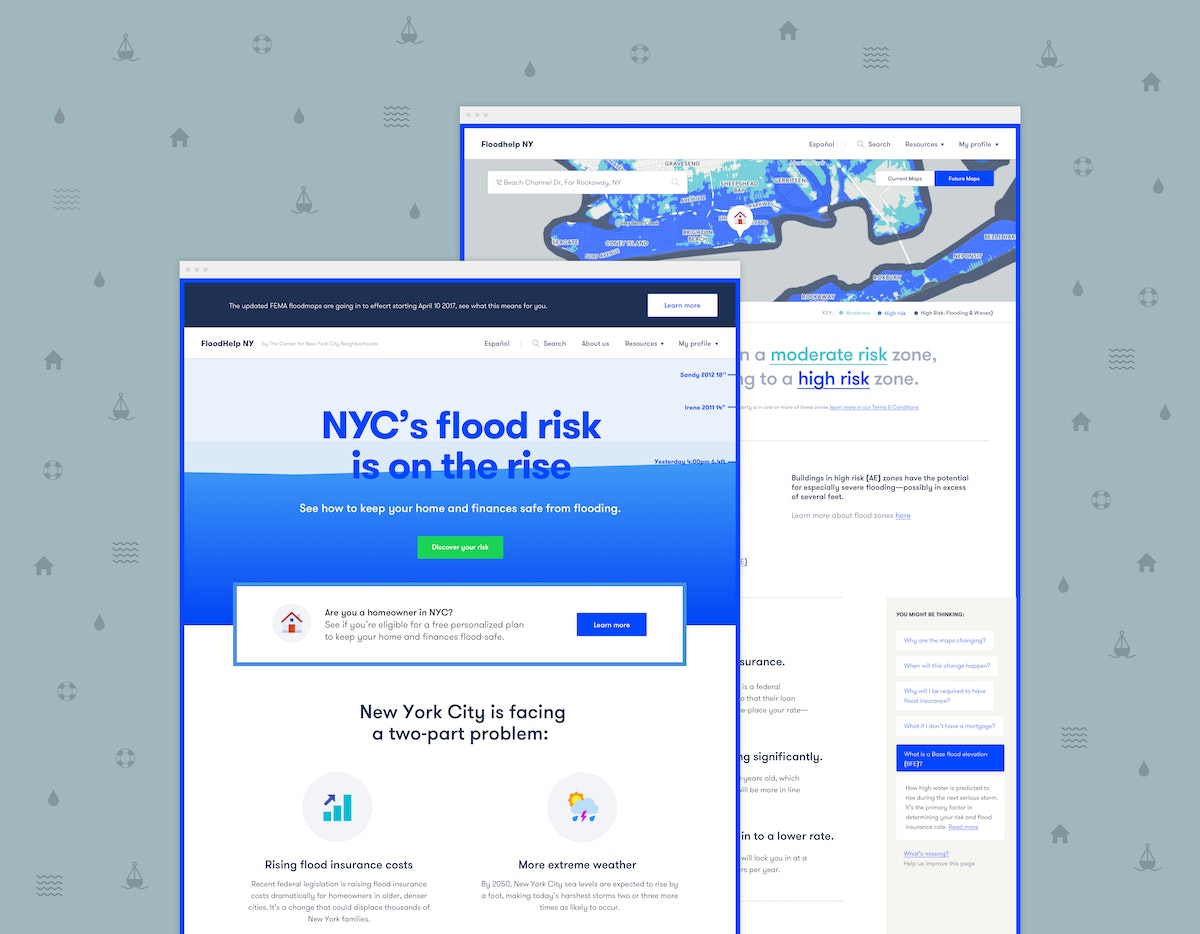
The Center for NYC Neighborhoods‚ a nonprofit that champions affordable homeownership for middle- and working-class families and communities, engaged IDEO to create a resource that could help New Yorkers keep their homes and finances safe. Launched in September 2016 with funding from New York State's Governor's Office of Storm Recovery, FloodHelpNY is an expansive platform that dismantles the complexity surrounding flood insurance and gives homeowners clear and simple guidance for assessing their flood risk and taking action toward resiliency.
Facing the complexities of insurance policy, shifting flood regulations, climate change, and citizen engagement, the design team began by engaging two vastly different groups of New Yorkers—those who had been battered by past storms and those not yet affected. Homeowners in the first camp were angry and frustrated by a system that had let them down after Superstorm Sandy. Homeowners in the second camp were simply unaware of their risk and had little idea of what might happen. The right design solution needed to encourage both groups to take action and learn about flood risk and insurance regulations, while also addressing divergent levels of need and preparedness.
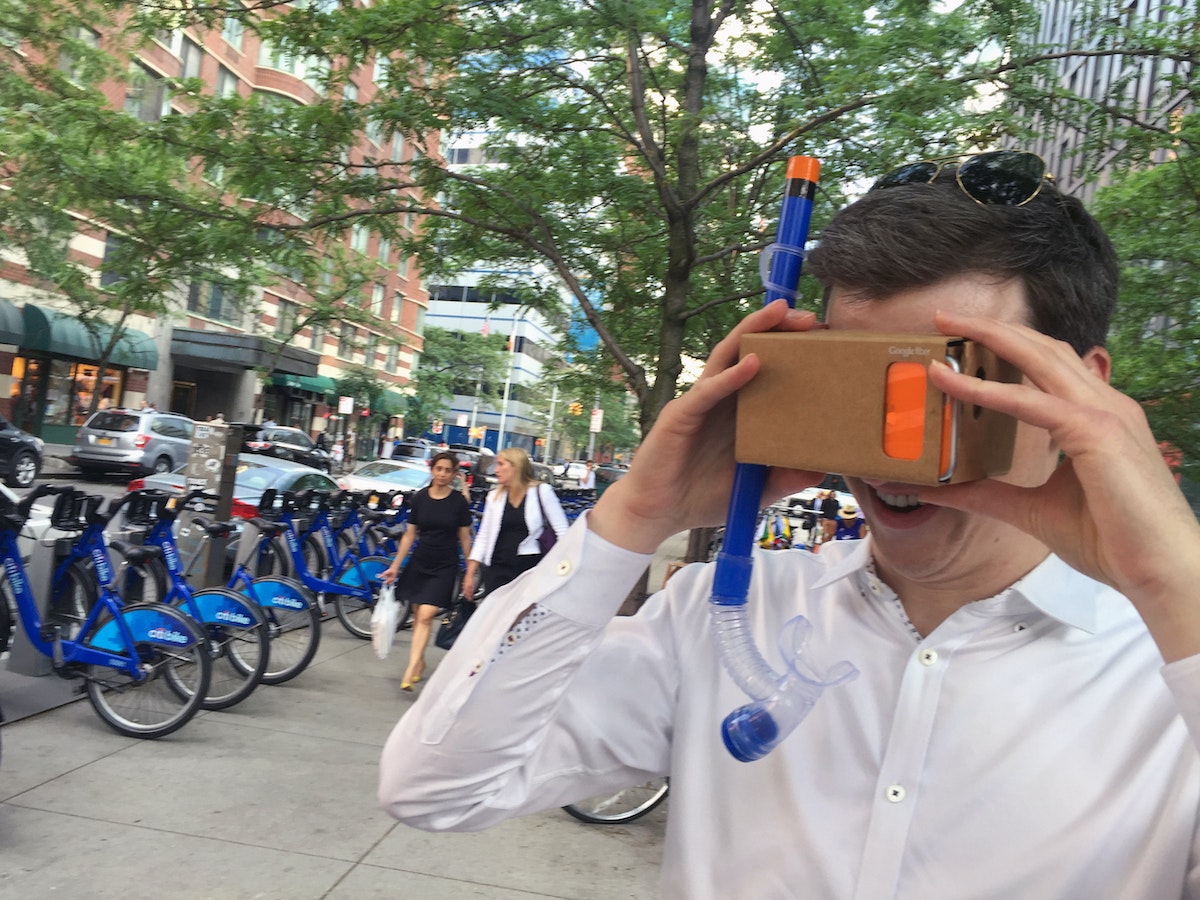
To co-design solutions with homeowners, IDEO set up pop-up stations at neighborhood meetings in Canarsie, Red Hook, and Gerritsen Beach, and had flood-affected residents create paper prototypes of the resources they wanted in place the next time a storm hit. The team learned how residents contextualized their individual risk, which information they prioritized, and how their frustration could inform a better outcome. In Lower Manhattan, where residents are less aware of flood risk, the team set up a pop-up station with virtual reality viewers that simulated water rushing into the surrounding streets, a visceral wake up call that got them talking about flood recovery.
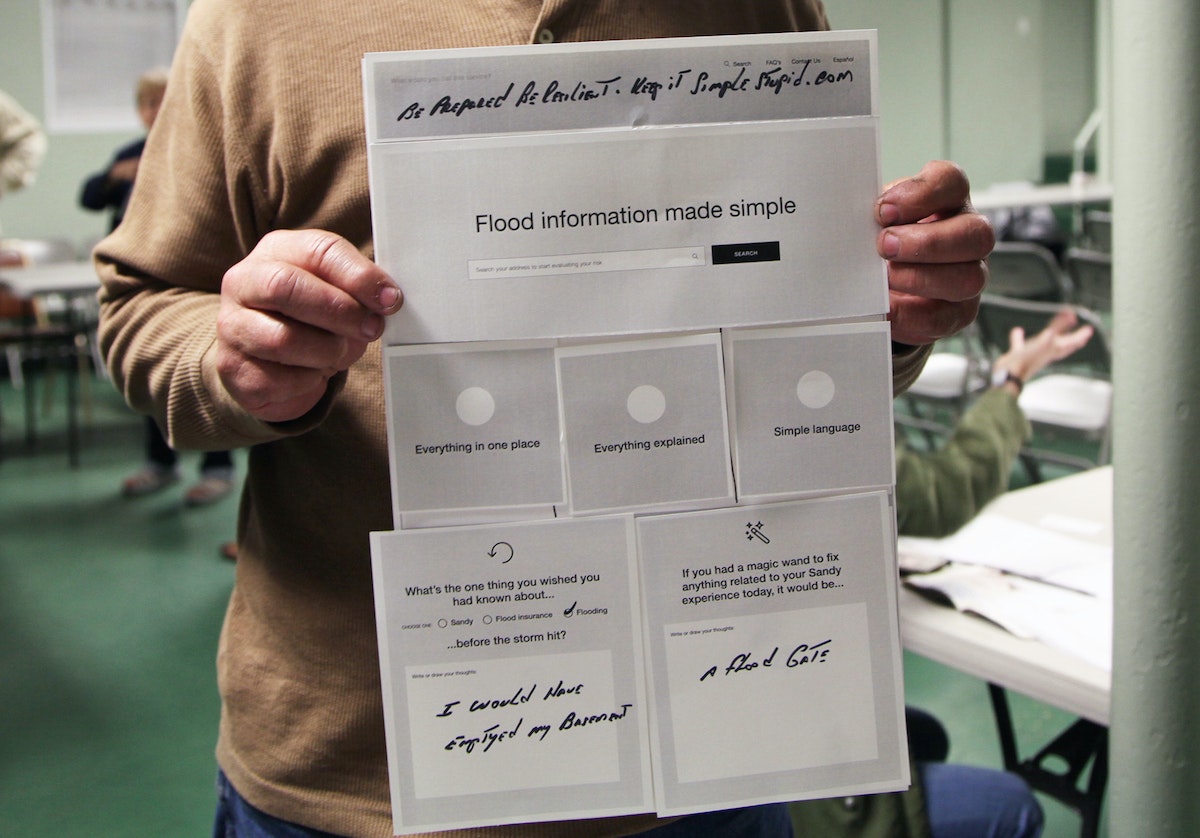
Less than a month after launch, FEMA began promoting FloodHelpNY as a key resource for building flood resilience. The platform helps all New Yorkers learn what flood zone they’re in, or will be in, how that affects their insurance rates, and what steps they can take to mitigate their risk. It features a first-of-its-kind flood insurance rate calculator that can help homeowners get a rough idea of the costs they could face as insurance prices go up. It is also the main conduit to apply for the Home Resiliency Audit, a New York State-funded program that equips at-risk homeowners with vital documentation valued at over $800 that confirms their actual elevation and insurance costs—all with the personalized assistance of an engineer and housing counselor team. In the coming months, FloodHelpNY will expand further to offer homeowners free backflow valves that reduce the chance of sewers backing up during flooding, as well as access to more existing benefits for resiliency.
The New York City floodplain, which is expected to grow as tides continue to rise, threatens neighborhoods that are among New York’s oldest and most historic. The people who live there make the city work: teachers, police officers, subway operators. Many of these homeowners will watch their flood insurance premiums surge, year over year. It’s a troubling future, but one that FloodHelpNY is designed to help New Yorkers face, by guiding them toward greater resilience and assuring them that they aren’t alone.

A game-changing approach to sleep for athletes
Helping Rise Science, a sleep analytics startup, optimize its customer experience and scale the business.
Athletes looking to score big on game day could hit the gym, but they’d probably be better off hitting the sheets instead, according to Rise Science, a sleep analytics startup. Harnessing the latest sleep science, Rise helps players significantly improve reaction time and decrease false starts, lapses, and injuries, among other benefits.
While attending Northwestern University, the co-founders of Rise Science created a simple sleep app and light-touch coaching service, which they prototyped on the school’s Big Ten football team with positive results. They came to IDEO to optimize their customer experience and scale the business, and joined IDEO’s Startup in Residence program.
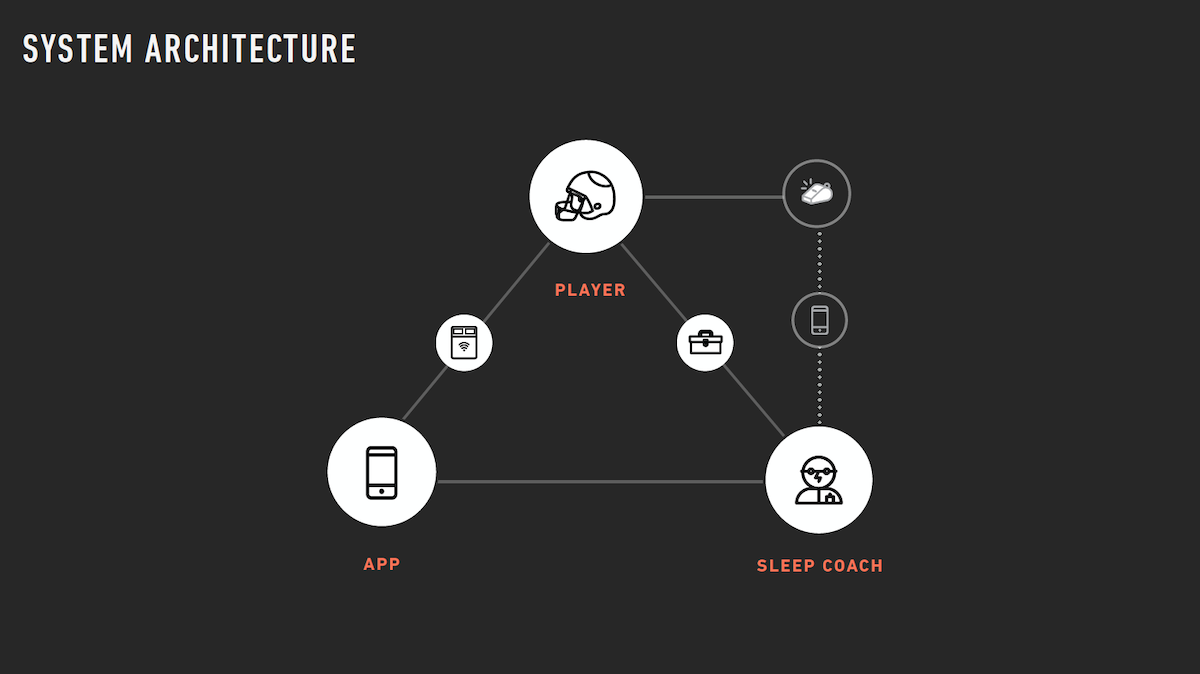
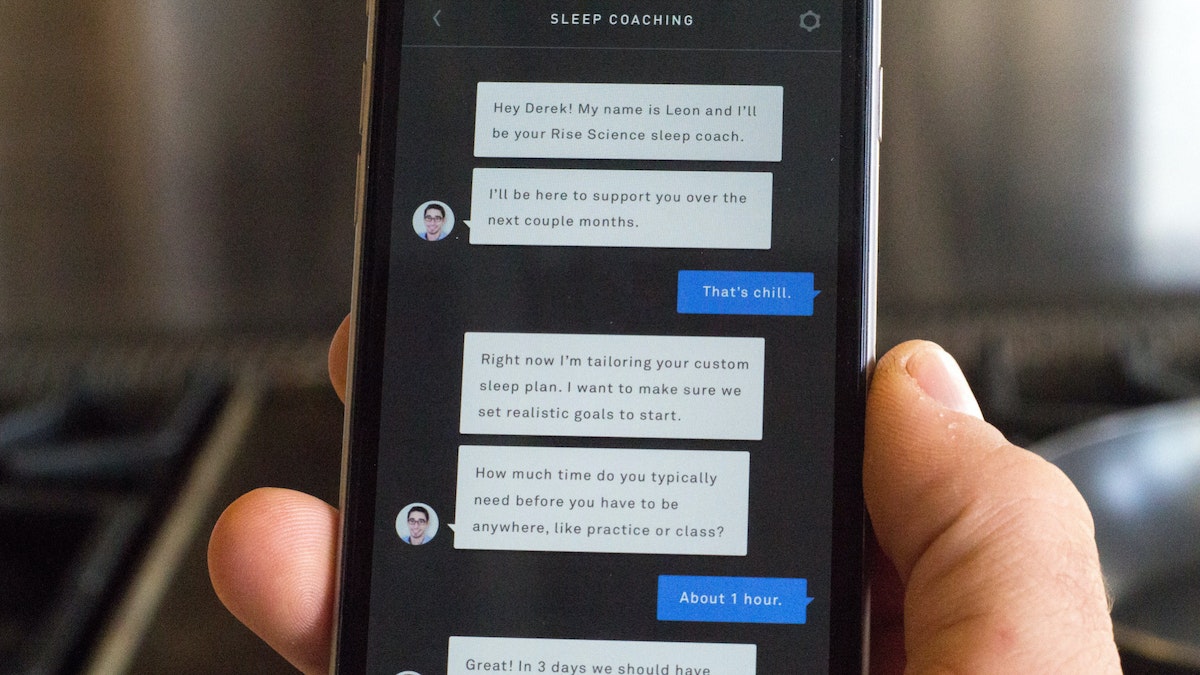
While observing coaches and players using Rise, IDEO saw the opportunity to better integrate the digital and hardware experiences and design a more robust, intuitive, and service-heavy on-boarding experience during the first few weeks using the system, when breaking old habits and incorporating new ones are most challenging.
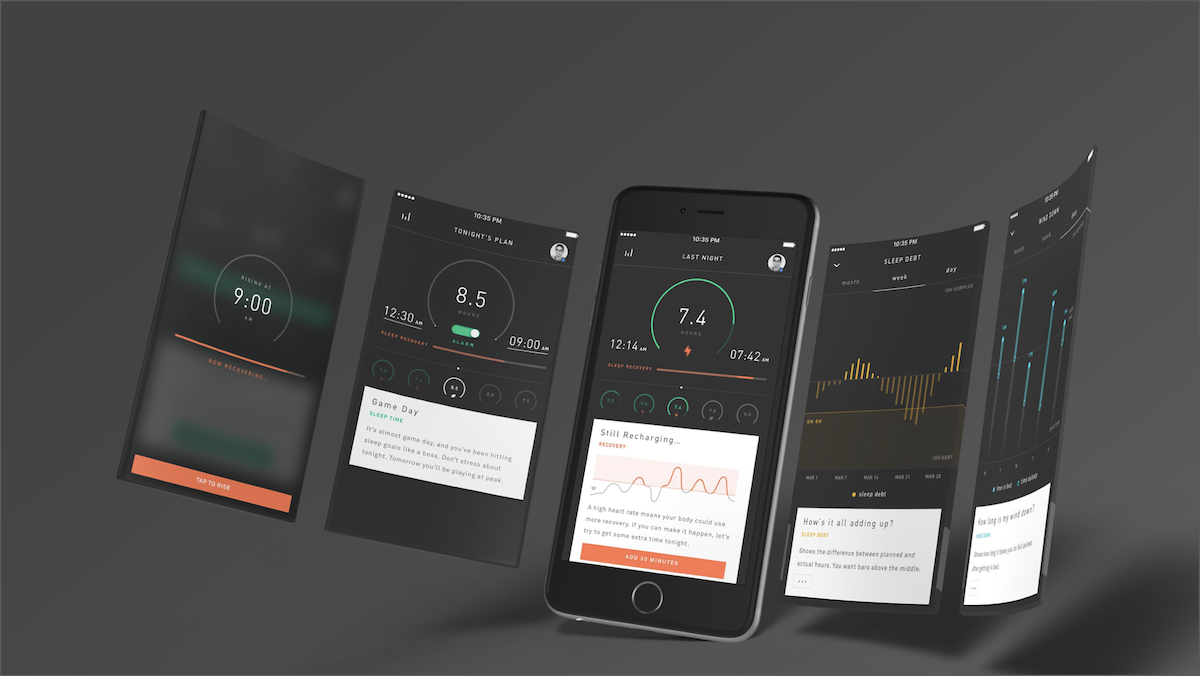
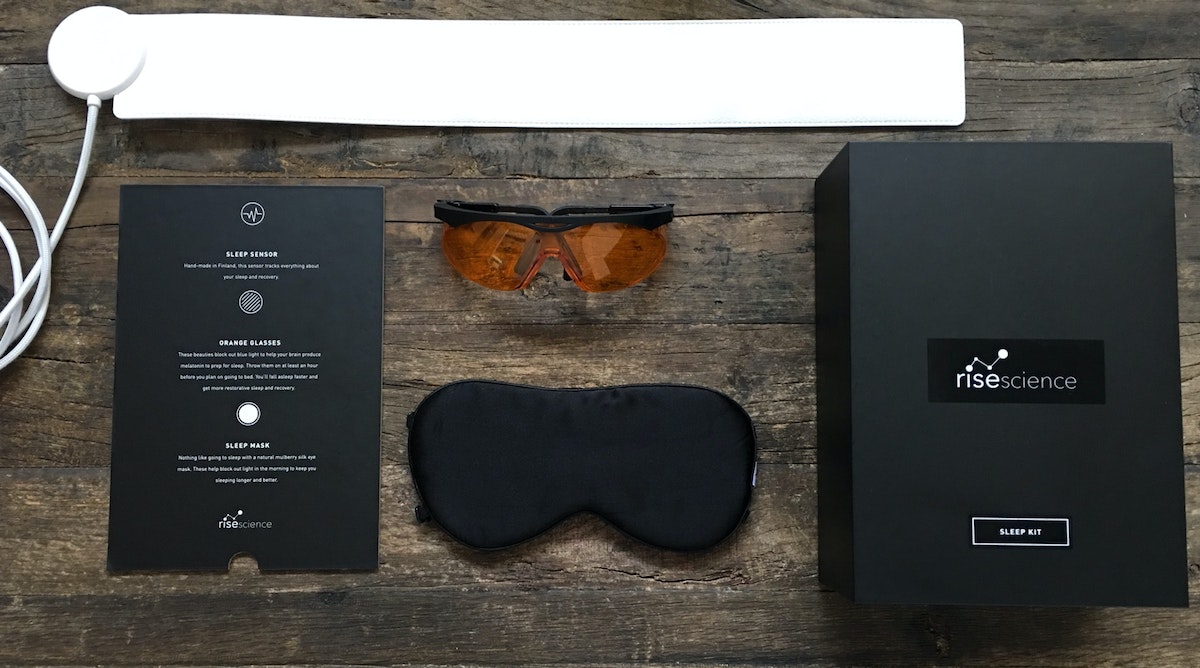
At the end of the residence program, Rise left IDEO with a rebranded and optimized sleep training system. Here’s how it works: Players and coaches receive a short, in-person introduction to sleep coaching by a Rise employee. Players who opt in to the service receive a sleep-training kit that includes the Rise Coaching App; adaptive sleep plans tailored to their chronotype, age, game schedule, and training load; a part-human, part-machine sleep coach that continuously supports each player, monitors progress, and gives timely feedback; in-context education that provides daily and weekly sleep insights; and products like UV glasses, sleep mask, and bed sensor. In just a week of using Rise’s full sleep program, 97 percent of players report getting 54 more restorative minutes of sleep per night.
Recently, Rise Science added the Chicago Bulls, Miami Dolphins, and the University of West Virginia to their sleep-training roster, enhancing their performance, one good night’s sleep at a time.
“Coming into IDEO, we knew our service was letting customers down. When we left, we had the blueprint for the next version of Rise. We were able to solve and optimize sleep at a much larger scale,” said Jeff Kahn, co-founder and CEO of Rise Science.
5 ways to address climate change from your own kitchen
Try design-thinking the contents of your fridge
There’s still a tremendous amount of change that needs to happen at the corporate level, but we now see some big food companies responding with greater transparency in sourcing, cleaner labels, and more natural ingredients.
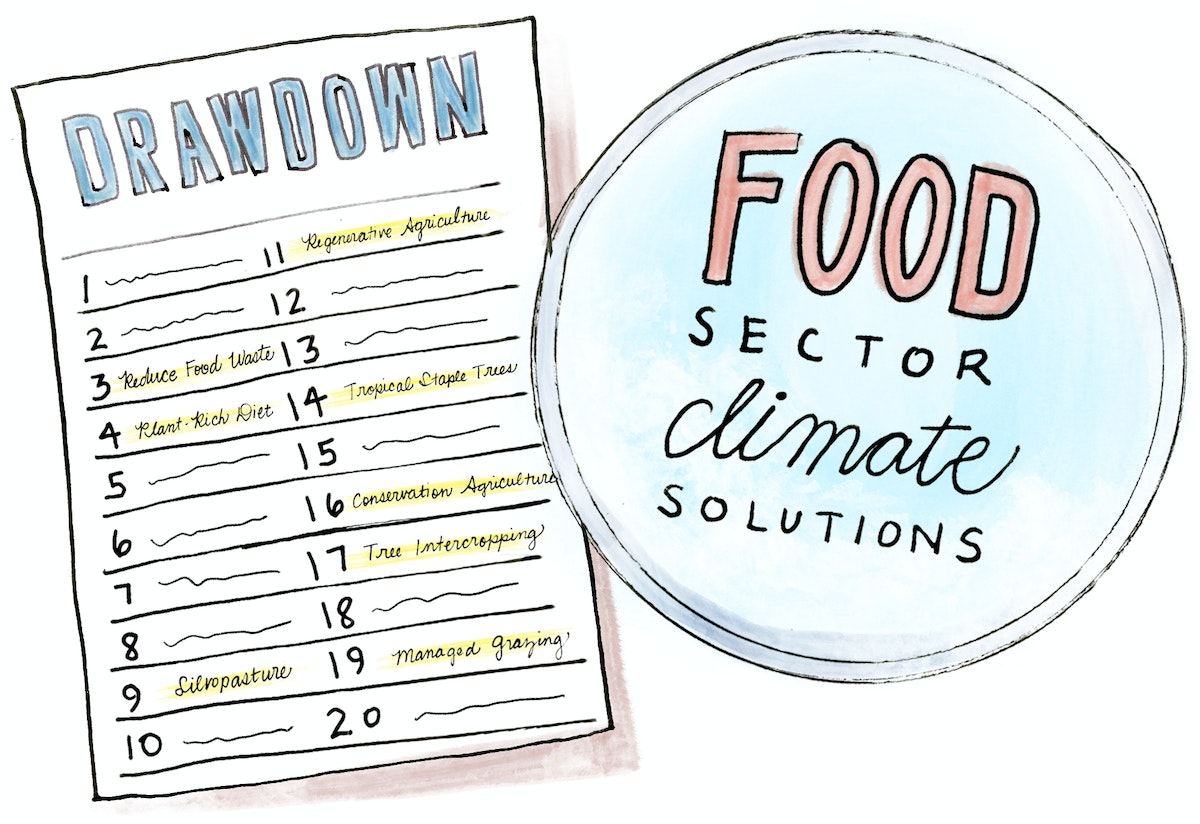
Project Drawdown, one of the most comprehensive and respected plans to reverse climate change, lists the top 100 solutions to reverse global warming. Eight of the top 20 are connected to the food system, including reducing food waste, adopting a plant-rich diet, and supporting regenerative agriculture.
For example, the food we waste is responsible for about eight percent of global emissions. And it turns out your own kitchen is ground zero for potential impact: US households account for 27 million tons of the 63 million tons of wasted food per year.
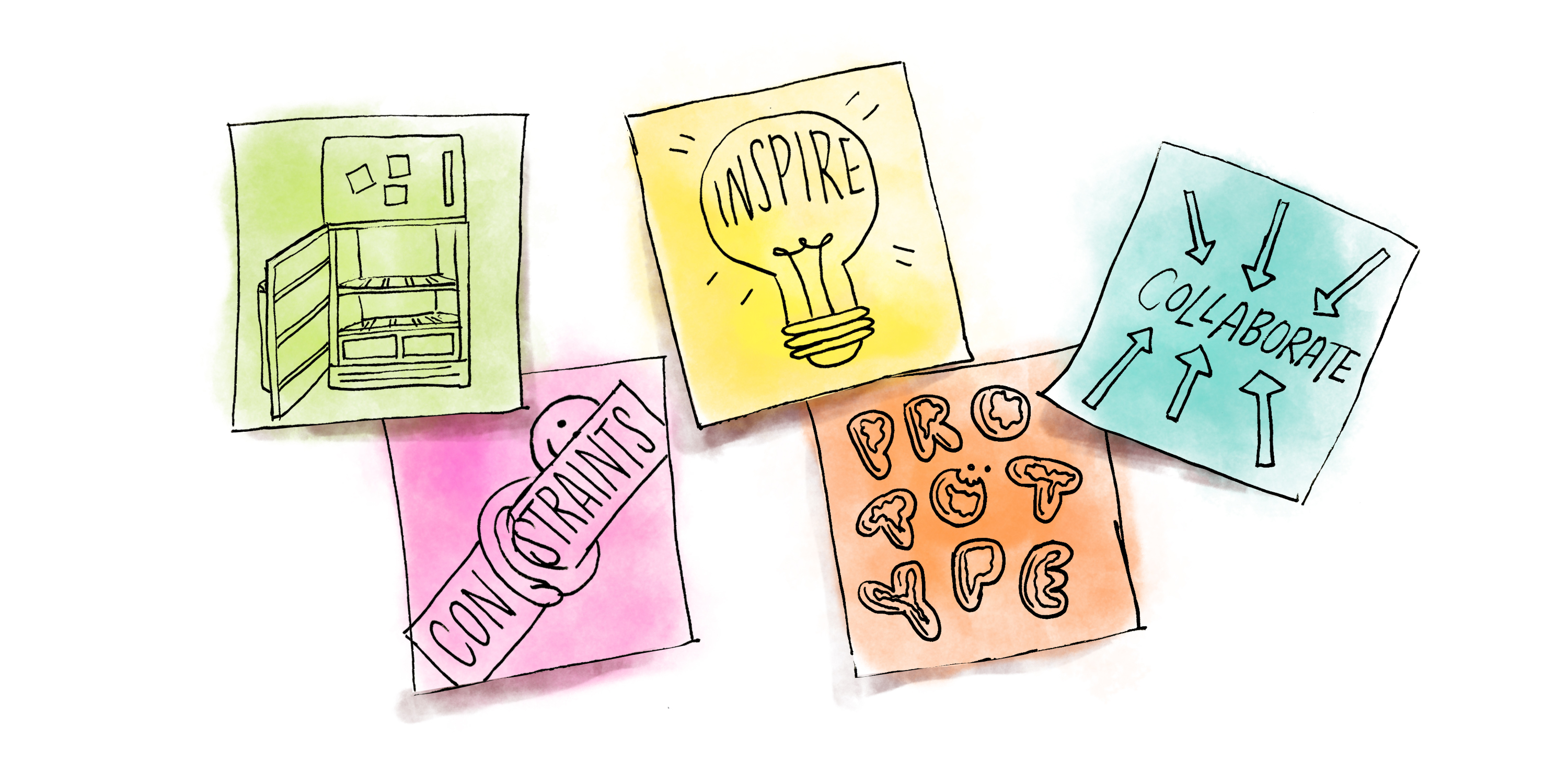
We use design thinking to help our clients run towards big challenges like food waste, but the same principles can make an impact in your own home. We can each prototype our way towards new practices in our kitchen. Food is, after all, one of the most forgiving materials, and even the most abject kitchen failure is usually edible.
Here are five simple ways to design think your way towards addressing climate change in your own kitchen.

1. Adopt an experimental mindset
I bet you've heard some of this before, but it bears repeating: If each of us replaced a third of the beef we eat with pork, chicken or legumes, the World Resources Institute reports that our food-related emissions would fall by around 13 percent. But adopting a more flexitarian, plant-rich diet is a serious behavior shift, and not an easy one.
What if we reframed “never eating steak again” as “experimenting with eating mostly plants”? Trine Hahnemann, a Danish culinary writer, tells a story about her family’s generational transition to a plant-rich diet. Her grandma’s recipe for a pork dish called for meat as the main ingredient. Later in the 1970s, her mom adjusted the recipe so it used only half the pork. Today, Hahnemann cooks the same family dish but with no pork at all.
The design challenge is crafting plant-based options that are so satisfying and enticing that you don’t miss the meat. Like Hahnemann, we can experiment our way there. Start slowly by removing meat from traditional recipes. My meat-free pozole soup was an experiment, and though it lacked the oily richness of the pork version, it was a satisfyingly rich broth with hearty beans—another edible prototype.
2. Buy less
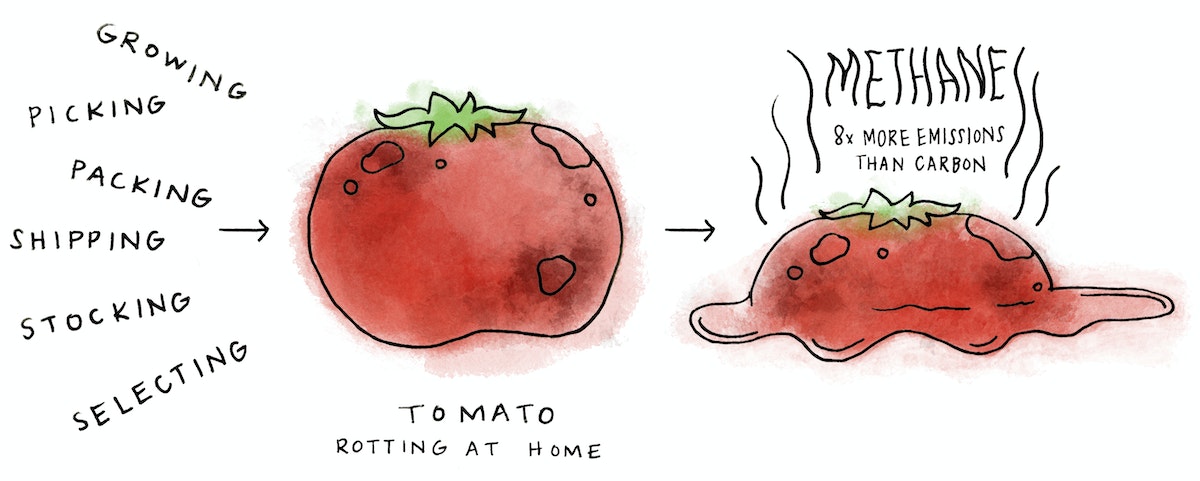
Not all food waste is created equal. That moldy tomato you never got around to eating used up more resources than a tomato left on the vine: Resources were used for it to be picked, packed, shipped to a grocery store, unpacked, stocked, selected, paid for, brought home, and now rotted. It takes two months for that tomato to decompose in the compost, during which time it releases methane into the atmosphere—which produces eight times more emissions than carbon.
When you head to the store or farmers market, simply bringing home less food will do wonders to cut down food waste. Embrace discomfort—a key design principle—by grabbing a smaller shopping basket to constrain your purchases, even though it might feel like you’re not buying enough.
Once you get home, use a Sharpie to date your food to remind yourself to enjoy it within a particular time frame. Place your “cook first” ingredients in the front so you’re more likely to reach for them.

3. Buy better
Design requires inspiration. To bring this to your food choices, make going to your local farmers market every week a habit. With each visit, you’ll get inspired by seasonal produce and begin to unlearn the mentality of having anything, anytime (and having it look perfect). Nature has constraints, and this is one of them.
Shopping at farmers markets also helps farmers and can promote sustainable soil practices, which is one of our only proven ways to sequester carbon. Not only is good farming beneficial for the soil, but it’s a bonus for your taste buds. Healthy soil helps farmers grow flavorful, nutrient-rich produce. Good flavor is often a proxy for good nutrients. If you buy an apple that was grown using regenerative agriculture techniques, you will taste the difference: It will be juicy and delicious, not to mention rich in nutrients. But an apple picked a year ago, shipped across the country or world, and kept in cold storage only offers you sugar and fiber—the nutrients died long ago. As Alice Waters put it, “You want aliveness in your food.”

4. Embrace constraints
Design constraints in the kitchen range from your cooking skills, to your work space, to your available equipment, to your budget, to the ingredients themselves. Whatever those constraints are, embrace them. Most chefs say quality salt, quality olive oil, and heat (whether a hot plate or six burner) are the only critical elements.
Culinary confidence in the kitchen—feeling like you have the skills to make something worth eating—can help you boldly embrace constraints. The good news is that culinary confidence is a muscle that grows stronger as you use it.
To build your culinary confidence, read Tamar Adler’s book, The Everlasting Meal. It’s made me give up on exactitude in the kitchen, and instead take delight in using a recipe as a jumping off point and improvising by cooking with what’s on hand. Her simple approaches to dealing with food that might otherwise go to waste—like smashing leftover garlicky beans on toast for an easy dinner—help us look at our fridges with a new sense of frugality and hope.
Try making pesto out of leafy greens (even carrot tops), nuts, and hard cheese you have around, rather than feeling like it has to be basil, pine nuts, and parm. There are no rules, just constraints that make you more creative.

5. Collaborate
At the United Nations Climate Summit last month, 16-year-old Greta Thunberg told a group of world leaders, “The world is waking up, and change is coming whether you like it or not.”
We’ve reached a tipping point, and change is coming. With your friends and family, let’s make time to cook and eat together. Let’s share a meal and talk about how to have a better life with less waste and more joy. And if there are leftovers, send your guests home with them, date them in your fridge, or use them to make soup tomorrow.
There have been some exciting changes in the food industry over the last decade. Our purchasing choices collectively forced food brands to rethink their offers and evolve their practices.

3 tips for exploring taboo topics through play
How to design playful moments to break the ice on sex, death, and everything else
Embracing conversations about taboo topics can help deepen understanding and empathy, and empower people to make better decisions about their health, finances, and careers. And since many taboos are related to serious global epidemics, like homelessness and segregation, talking about these issues is the first step toward taking action—and even affecting real change.
Thankfully, surfacing taboo topics doesn’t have to be as awkward or scary as it might seem.
Did you join millions of people to dump an ice bucket on your head to raise awareness for ALS, and suddenly find yourself discussing (and maybe even donating on behalf of) a disease you didn’t have a personal connection to? What if you walked into middle school health class, and your teacher was wearing tampon earrings or giving out anatomical cupcakes that made you laugh and made it easier to talk about periods?
Play has the power to translate fear and awkwardness into curiosity, with humor, storytelling, games, and interactive experiences that can help people feel comfortable (and even enjoy) diving into a tricky topic.
Here are three ways to start a conversation about anything—even the most taboo topics—through playful design.
1. Create an immersive experience
Death is terrifying. “Reimagine End of Life,” a city-wide exploration of life and death with creative workshops, performances, comedy shows, and reflections, makes it easier to wrap your head around. Last year in San Francisco, I joined 10 strangers in an interactive theatre experience inspired by the question, “What if facing our death allowed us to live more fully?”

Through virtual reality simulations, eulogy readings, and a theatrical visit to purgatory (picture white curtains and costumed actors), the event immersed our group in a new world and guided us to face death together, one step at a time. A year later, I still find myself reflecting on this experience and sharing my hopes and fears about dying.
At your next event, try incorporating skits, role play, costumes, and themed decorations to fully immerse your group in the topic you’re discussing. These interactive elements can create a safe environment for people to really open up.
2. Meet people where they play
Sex and contraception can be intimidating and even embarrassing topics to discuss in many cultures, making it difficult for health experts to dispel myths and support youth as they make decisions about their bodies. But dance contests, magazines, nail salons, and fashion shows? Those teens can get behind.

In Zambia and Kenya, IDEO.org has brought playful experiences to life through The Diva Centers as well as through the upbeat Future Fab brand, which give teens and staff a space to connect and talk about anything—from glittery nails to IUDs. The IDEO.org team has also designed aspirational characters known as the Divine Divas to give the girls an opportunity to talk about their goals for the future—and how contraceptives might fit into them.
If you’re looking to tackle a taboo topic with a specific group of people, consider their natural gathering places. Do they go rock-climbing, cook, or hike? By meeting people where they feel most comfortable, you can make difficult conversations easier to navigate.
3. Forgo words altogether
For topics so complex that we don’t know where to begin—how about by translating words into motion? Creative Tensions is a “conversation that moves” developed by IDEO and the Sundance Institute Theatre Program, where participants reveal where they stand on an issue by where they physically stand and move in the room along a spectrum between two options. The exercise can help people explore polarizing topics by asking, for example, “What inhibits our sexual lives more—the government and society, or ourselves?” Participants can either share their perspective aloud in a facilitated conversation or express themselves silently through their movement alone. It’s a non-verbal way to start meaningful explorations of taboo topics that everyone can be a part of, simply by moving their feet.

To do something similar, try asking people to express their thoughts without words—through dance, music, drawing, photography, or building with LEGOs. These creative exercises can lower the barrier to entry and prompt even the most reticent to participate, and eventually, start talking.
With thoughtful design, breaking the ice on complex topics can be more playful than painful. Between comic books and board games about menstruation, superhero-themed summer camps about social issues, and ballot education parties, there are countless ways to help people navigate controversial topics.
What methods do you use to help get people talking? Send your ideas so we can work together to unlock meaningful conversations around the causes we care most about.
Cancer, sex, money, birth control, poverty—just a handful of topics on a list many of us might call Things I Want to Bring Up But Don’t Know How. But shying away from stigma keeps people from talking about the issues that really matter.

A not-quite-textbook definition of systems design
How a systems designer learned to explain what a systems designer is
When I started at IDEO six years ago, I had no idea what a systems designer was—only that I was one. Now, six years later, I have an answer, but I’m still perfecting the great-aunt-approved dinner table pitch.
The secret? It’s actually something you probably learned in your grade school language arts class: a good analogy.
If you’ve got approximately 10 minutes, I can tell you what I’ve learned about what I now proudly call my job—and how I’ve learned to explain it.
Systems and automobiles
An iPhone, the human body, buildings, cities, organizations, economies, the universe—all of those things count as systems, even though one can fit in your pocket and one is infinite. So what makes them all systems?
In a series of excellent lectures, Russell Ackoff, a pioneer in systems thinking, uses a simple analogy to explain systems: an automobile.
As Ackoff explains, a car needs to carry you from point A to point B. No individual part of a car can move you on its own—not the wheel, the axle, the seat, or the engine. But a car can. And if you take a car apart, you no longer have a car: you simply have the pieces, because “a system is not the sum of the behavior of its parts; it’s the product of their interactions.” That’s as true for a computer as it is for the universe—or any other system.
Systems design and architecture
Ackoff, a professor at Wharton Business School, criticized managers for focusing on business silos (marketing, operations, finance). He urged them to take a wider systems view—to think about the interactions that create the whole.
I couldn’t agree more. But if that’s systems thinking, what is systems design? What’s the difference?
Ackoff heralded one profession for understanding systems best: architecture. Architects begin with the needs of the client—bedroom, kitchen, living room, bathroom—but they don’t stop there. It wouldn’t make sense to design the rooms separately; they need certain adjacencies and sizes.
Importantly, Ackoff explains, the architect “will never modify the house to improve the quality of the room, unless the quality of the house is simultaneously improved.” To take this analogy a step further, think about it this way: you wouldn’t make the kitchen bigger if it meant getting rid of the bathroom. That would be a weird house.

Ahhh, so you're an architect?
Not exactly, although it’s no coincidence that I used to be a designer at an architecture firm. I think of myself as a “human-centered systems designer,” but that wouldn’t be the clearest thing to have on a business card.
IDEO is known for human-centered design, a process that takes inspiration from the needs and aspirations of people, most often end users. Human-centered systems design also starts with people, but requires looking at all the diverse stakeholders within a system—not just end users.
Let’s dive into another analogy: a school. If you’re designing a school, students are the end user. But the needs of teachers, parents, and administrators are equally important. For example, a few years ago we wanted to create a way for schools to change their culture. Since culture is intangible, it can’t be designed in and of itself. But you can design spaces, schedules, processes, roles, rituals, and incentives—tangible “levers for change” that help create culture. We zeroed in on the needs of school leaders, and developed School Retool, a professional development program that empowers principals to evolve their school culture.
When you’re designing a system with a lot of moving pieces, it’s hard to know where to start, and very easy to get lost in the “What if’s?” Design needs constraints, and focusing on human needs provides them.
But why human-centered systems design?
Let’s return to my man Russell Ackoff. He writes, “No problem ever exists in complete isolation. Every problem interacts with every other problem and is therefore part of a set of interrelated problems, a system of problems.” Ackoff even coined a term for systems of problems—he called them “messes.”
Indeed, our biggest problems—in education, health care, criminal justice, government—are systems challenges. And surprise: These are all human systems. When the parts of a system are made up of people, complexity is exponentially high because human feelings and needs are unpredictable and constantly changing. Despite good intentions, these important societal systems can be some of the least human-centered experiences we encounter today.
None of these problems can be solved in isolation, but it’s also easy to get a headache just thinking about tackling them.
Our most complex systems need human-centeredness the most. As a systems designer, I specialize in zooming in and out. I’m constantly jumping back and forth between the big picture and the details. I work with teams to bring the best of all disciplines together to design individual elements that form an integrated, cohesive experience for end-users. I ask questions like, “How might the environment support the new behaviors we’re trying to create? How might digital tools enable a new mindset?” I create intentional interactions between parts.
As the holidays creep closer and closer, I no longer dread the questions about work and career that come along with the appetizers. I finally have something my family is more likely to understand, thanks to the powerful and beloved literary device known as the analogy. Getting to this point feels like learning how to ride a bike—you pedal hard, gather speed, and finally crest the hill.
And if nothing else, I’ll just send all my family members a link to this piece. Hi, mom and dad!
Fall has arrived in the northern hemisphere, and you know what that means: cool weather, warm cider, and sitting around the holiday dinner table with my extended family, trying to explain to them what I do for a living as a systems designer.

Can digital therapeutics revolutionize medicine?
How technology will take treatment beyond pills and procedures
In the not-too-distant future, patients with chronic obstructive pulmonary disease could be equipped with a sensor that monitors their medication and inhaler use and prevents acute events. People suffering from clinical depression could be prescribed an app-based therapeutic program in place of a drug.
The digital therapeutics global market is estimated at $1.8 billion today, but predicted to reach $7.1 billion by 2025. Much of the growth is predicted to come through investment from traditional pharma, but there are several new players emerging from the tech and start-up worlds as well with the hopes of evolving into a digital therapeutic. Omada Health, which creates behavior change programs for managing chronic disease, makes its hundreds of thousands of patients feel seen and heard with personal coaching. Click Therapeutics develops software to support smoking cessation and address major depressive disorder in adults. The meditation app Headspace has convinced more than a million people to integrate meditation into their daily lives, with proven wellness benefits.
Companies like these are revealing transformative new approaches to helping patients tackle the thorny challenges at the core of chronic disease, mental health disorders, and a growing number of other diagnoses—and in the process, they’re creating and growing thriving markets where none existed before.
Might these digital products, one day soon, be prescribed by a physician who is concerned about her patients’ heart disease, diabetes, or weight? If Tesla released software that clinically validated reductions in car accidents, even for the most dangerous drivers, would that qualify as a digital therapeutic? We are just beginning to imagine and design the future of this industry.
But these products still face the age-old challenge: how to get people to actually use them. If patients don’t love and trust the experience enough to sustain engagement over long periods, many of these therapies—and products—will fail.
Any new approach needs to begin with the needs of real people, and to follow those needs toward products that are not only desirable, but also have viable business models behind them. Here are our four big takeaways drawn from IDEO’s experience working in this field, designing digital therapeutics that engage patients—and the market.
Put down the competitive landscape report
Innovations in science and health tend to be incremental, but by looking to other industries, it’s possible to identify opportunities for more radical change. Studying analogous experiences—services, products, and other offerings that deliver something tangentially related but not exactly the same—will clarify what kinds of experiences give patients a sense of meaning, delight and value.
A partner of ours in the biotech industry recently launched its first digital therapeutic, focused on helping patients manage diabetes. In piloting the experience, we encountered a big challenge: Patients were struggling to connect the at-home testing device to the bluetooth on their phones. Without it, the experience fell apart.
Instead of buying all of our competitors’ devices to look at their solutions, we brainstormed a list of organizations that were particularly good at helping people with a set of complex instructions—IKEA, ballroom dance instructors, piano teachers, NASA-to-spacecraft communications specialists, and others. We discovered that LEGO had made its first bluetooth-connected toy and—master of instruction that it is—had created instructions to guide even little kids through a simple series of steps. Inspired by LEGO, the team created a new set of instructions. Once they were integrated into the patient onboarding experience, nearly every patient was able to connect their medical device to their phones.

Prioritize the patient
It can be easy to fall into the trap of addressing the needs of payers and providers above the patients’. After all, if a digital therapeutic isn’t reimbursable, the underlying business may not be successful; and if a physician doesn’t know it well enough to prescribe it, a company can’t increase market share. These are critical pieces of the puzzle, but they need to come after the foundational concern of any new digital health venture: fitting your therapy into patients’ lives.
During early stages of design, we rely on user research to inspire countless possibilities, and revisit our insights when we need to refine (or flip) our ideas. User research informs the business model, helps define the path to market, and may also lead to other product features.
What does this look like in practice? Consider the digital mental health company Headspace. Headspace was designed to teach people the fundamentals of meditation, engaging them in an experience that might encourage practice and adherence over time. Initially, Headspace played with incentives like badges and friendly social competition, but it slowly came to understand that the most profound motivation was mental health itself. The company prompted meditators to remember why they meditate, and asked them who in their lives would be better off because they meditated. This consistent call for reflection and awareness led to higher overall engagement.
Headspace’s popularity has catapulted the company to $100M in annual revenue and more than a million subscribers. Once the company designed an experience that people loved, subscribers embraced the product and took it upon themselves to host Facebook groups, meet-ups, and events. Headspace then opened up partnerships within the formal health industry, adapting to the needs and requirements of providers, payers, and regulators. Today, Headspace is a benefit offered to employees of over 350 large companies worldwide, and providers and health systems across the globe offer it to their patients. If you design an effective product that patients love, players in the health system have incentive to offer access.
Design with and for your most extreme, hard-to-engage patients
Designing for extreme users illuminates the wide range of people who might use a product. In IDEO’s earlier days, we saw this most clearly when we designed physical products like ice cream scoopers and pizza slicers for older adults, people with arthritis, and children with limited motor skills. We ended up creating something those populations could use, but in doing so, we developed a universally easier user experience. The product design outshone its competitors and became a top consumer choice.
In the world of digital therapeutics, this approach might entail designing for patients with limited experience using digital technology, or focusing on patients living with multiple chronic conditions, or with profound barriers to accessing care. These patients can help shape a more equitable and inclusive therapeutic experience.
One of our most challenging digital therapeutic projects involved creating an app-based experience to combat depression. To engage with potential users, we traveled to the rural Rocky Mountains to an isolated community where we met Dan, a cowboy and rancher living 40 miles away from his closest neighbor. Dan had struggled with depression for most of his adult life. On a good day, it was hard for him to get out of bed. On a hard day, he struggled with suicidal thoughts.
Before talking to Dan, we considered all of the technological features that could encourage adherence, like enabling offline access and fast download speed in low-bandwidth contexts. But through talking to Dan, it became clear that the tactical challenges weren’t the biggest problem to solve. Even in more populated areas, depression itself can be isolating. Dan helped us co-design a digital tool that even he would be willing to come back to, day after day. One of the key features a digital therapeutic could offer would be connection to others—in real life—and a chance not only to receive help, but to give it. Informed by Dan’s story, we designed an experience that could connect people living with depression to each other and engage them as supporters, mentors, and advocates.
Launch a thousand prototypes
One of the biggest challenges facing health innovation today is the belief that you need to have a solution before you really grasp what people want and how they want it. That’s how the industry is constructed. You would never write a grant proposal without telling the funder exactly what you will deliver, nor allocate budget at a pharmaceutical company without a detailed plan and anticipated ROI.
For digital therapeutics, those constraints are blown wide open. Our task is to come up with as many ideas as we can and test what will actually stick. Prototypes pave the way to a solid, working product, and patient input on prototypes can be used in countless safe, thoughtful ways.
Recently, we worked on a digital therapeutic that helps people manage the tremors associated with motor disabilities such as Parkinson’s Disease. Instead of the typical treatment, which solely relies on an oral medication known to have serious side effects, we were tasked with working on a software and hardware system that delivers targeted electric pulses to the part of the brain that calms tremors. We began with a long list of open questions about what patients living with Parkinson’s would find acceptable, usable, and engaging.
When we went into the field to interview patients, we quickly realized that they had no idea what it might be like to rely every day on a digital device that’s crucial to their health. They were curious about the inner workings of the therapy, and asked questions about the technical, logistical, and philosophical implications.
Our first prototypes included a dozen hats, headbands, or pillows that a patient might wear to charge the implanted device. We also prototyped many digital interactions, from Alexa add-ons to iPhone apps, that might guide them to administer digital medication. To take advantage of bio-monitoring data, we created numerous dashboards, exports, and communication portals that might help patients, providers, and caretakers make sense of what was happening neurologically.
A lot of those ideas were failures, but the things we learned were priceless. For example, it turns out that despite the growing number of retirees on Alexa, many of our patients didn’t trust a voice-controlled app with a task this important. It also turns out that the headgear a person needed to wear could easily make them feel embarrassed, unattractive, or emasculated. One of the most important discoveries was that faster charging is not better, if slower charging meant you could fold laundry, watch your favorite TV show, or weed the garden at the same time. At the end of the day, we designed a hundred prototypes before we landed on the key value propositions, features, and usability standards that would shape the experience.
Tying it all together
Breakthrough products and experiences like Click Therapeutics and Headspace all align with the framework outlined above. But to be clear: They aren’t successful because they have a silver bullet for engagement or the best theory of behavioral economics. They are market-movers because they focused on their users and designed their products around what they found. That led to creating something people love, and success quickly followed. It’s a formula you can apply to creating your own digital therapeutics—or any product you want users to love enough to use in their daily lives.
Illustrations by Nien-Ken Alec Lu.
The next era of digital health has arrived, and it’s booming.

Lindsey Turner
I’m passionate about building brands, products, and experiences that help organizations show up with meaning and momentum.
I help organizations cut through complexity by shaping how they show up, through brand strategy, identity, and storytelling.
Working at the intersection of brand and business, I bring an editorial eye and a bias toward making—turning ideas into tangible experiences that people can understand, trust, and believe in.
My work spans government, healthcare, financial services, media, and consumer goods, from launching Gen Z-focused ventures to building innovation labs and reimagining legacy brands. I relish moments of ambiguity and enjoy translating across teams, perspectives, and priorities to move ideas forward.
I started my career in editorial and digital design, shaping cross-platform experiences and identity systems in publishing and agency environments. That foundation still shapes how I work today: I’m detail-oriented, collaborative, and overreliant on the Oxford comma. I hold a BFA in Visual Communication from the School of the Art Institute of Chicago.

Rachel Young
My work helps organizations see who their products aren't working for—and build the will and the tools to do something about it
For 25 years, I've asked the same question: Who does this design exclude—and what are we going to do about it?
My work spans human-centered strategy, inclusive design, and qualitative research, with clients ranging from Microsoft, Google, and Verizon to the National Science Foundation, and San Francisco Unified School District.
Before IDEO, I taught elementary school in East Palo Alto and spent a decade doing design work with social service organizations—where I learned firsthand what it costs people when systems are built without them in mind.
I am currently writing User Error, a nonfiction book about digital access and the design decisions behind it. I live in Oakland, California.

Brian Pelsoh
I lead with craft, ensuring our work is creatively excellent: rooted in deep human insight and imagination, while also grounded in the realities of business and technology.
My expertise spans brand, communication, and product design across tech, education, the arts, and social impact.
I believe great work demands both high-level vision and obsessive attention to detail, and only happens through collaboration.
I bring an inclusive, hands-on approach and a deep understanding of business, which enables me to consistently deliver excellence while always asking why.
Before joining IDEO, I worked at the brand firms Pentagram and VSA Partners. I began my career as a designer, leading teams at the School of the Art Institute of Chicago and the Milwaukee Art Museum. I hold an MFA in graphic design from Maryland Institute College of Art and a BFA in communication design from the Milwaukee Institute of Art & Design, and have taught at some of the best design schools in the US.

Tony Wong
I am responsible for IDEO’s long-term success in China and working with clients to use design as a tool to enable growth.
I am responsible for IDEO’s long-term success in China and working with clients to use design as a tool to enable growth. Specifically, I have helped Chinese companies design holistic brand solutions through the development of their products, communication, services, and innovation teams, and I have helped multinationals expand their presence and influence in China.
I advise global leaders on developing China-led innovation and capabilities.
In over 15 years in IDEO Shanghai, I have worked on projects that use design to elevate the quality of the experience of healthcare products and services, streamline processes that increase productivity, create spaces and programs that promote and enable inclusive communities, and build next generation mobility solutions that are planet-positive.
Before joining IDEO, I worked at Philips Electronics and the Electrolux Group in Italy, the Netherlands, and Singapore on a number of breakthrough commercial products. I am a member of the Young President Organization in Shanghai.

How to use AI as an editor, not a writer
Ed White shares how he uses AI as an editor—not a writer—to sharpen storytelling, rehearse ideas, and preserve the productive friction that makes creative work better.
Ed White has a rule he's tested on his own writing: hold yourself as the writer, and let AI be your editor. Ed is a Senior Design Director at IDEO's London studio, where he co-leads the firm's AI portfolio across Europe. Before IDEO, he spent 12 years as a writer and editor at the Financial Times, Wired, and Contagious. So when he talks about when to use AI for storytelling and when not to, it comes from two decades of crafting his storytelling skills.
In this episode, Mina Seetharaman talks with Ed about two specific tools he uses to keep AI in an editor's seat: a "roasting agent" prompted to critique his drafts without any sugarcoating, and a simulated audience he rehearses pitches on before the real thing. They also get into what Ed is hearing from design leaders at Anthropic, Lovable, Shopify, and Google Creative Lab about how creative work is changing, and why he thinks the friction of writing something yourself is worth protecting rather than automating away.

Building a personal AI for the messiness of life: Sida Li
Becca Carroll talks with Cue co-founder Sida Li about designing a personal AI for the messiness of everyday life—not just work. They explore how Sida stays anchored to human needs while navigating fast-changing technology, product tradeoffs, business-model experimentation, and the realities of building an AI company today.
Most AI products today are built for work—a space with clear problems and established systems. One founder noticed a gap: personal life is messier, harder to systematize, and mostly left behind by the AI boom. So she built Cue, a personal AI that lives inside iMessage and group chats, to go where the other tools haven't.
In this episode, Becca Carroll, IDEO's Chief Strategy Officer, talks with Sida Li, co-founder and CEO of Shared Context Lab, about staying anchored to a human need while the technology around her keeps changing shape, why she treats her business model with the same rigor she'd bring to a product, and what it feels like to build a company at this particular, disorienting moment in AI.
The conversation also gets into how Sida makes design decisions: the language Cue uses to describe itself, the tradeoffs behind building inside iMessage instead of a new app, and a real story about a business idea that didn’t pan out.
This is the second in a two-part series profiling founders from IDEO's Startups-in-Residence program. The first conversation is with Johannes Seemann, founder of Sooner, on designing GenAI for the emotional side of money.

Designing GenAI for the emotional side of money: Johannes Seemann
Designing financial tools around the feelings that shape money decisions.
Most personal financial tools are built to run the numbers and optimize towards a budget. While that works for some, most people experience money as a lived relationship that does not neatly fit into a spreadsheet. Johannes Seemann and Becca Carroll discuss why money is emotional before it is mathematical, and what a human-centered approach to building a generative AI financial product looks like in practice.

The curious leader's edge in uncertainty: Scott Shigeoka
How genuine curiosity helps leaders navigate uncertainty with greater confidence.
Mina Seetharaman talks with Scott Shigeoka, author of Seek and Head of Curiosity Cultivation at the Eames Institute, about what distinguishes genuinely curious leadership from performative curiosity, how power dynamics shape curiosity, and why practicing curiosity can restore energy rather than drain it.
Looks like you might be in search of something very specific?
Or reset the filters above and try another angle.
Here’s some random inspiration

Podcasts about creative leadership

Articles about the power of prototyping





























.webp)