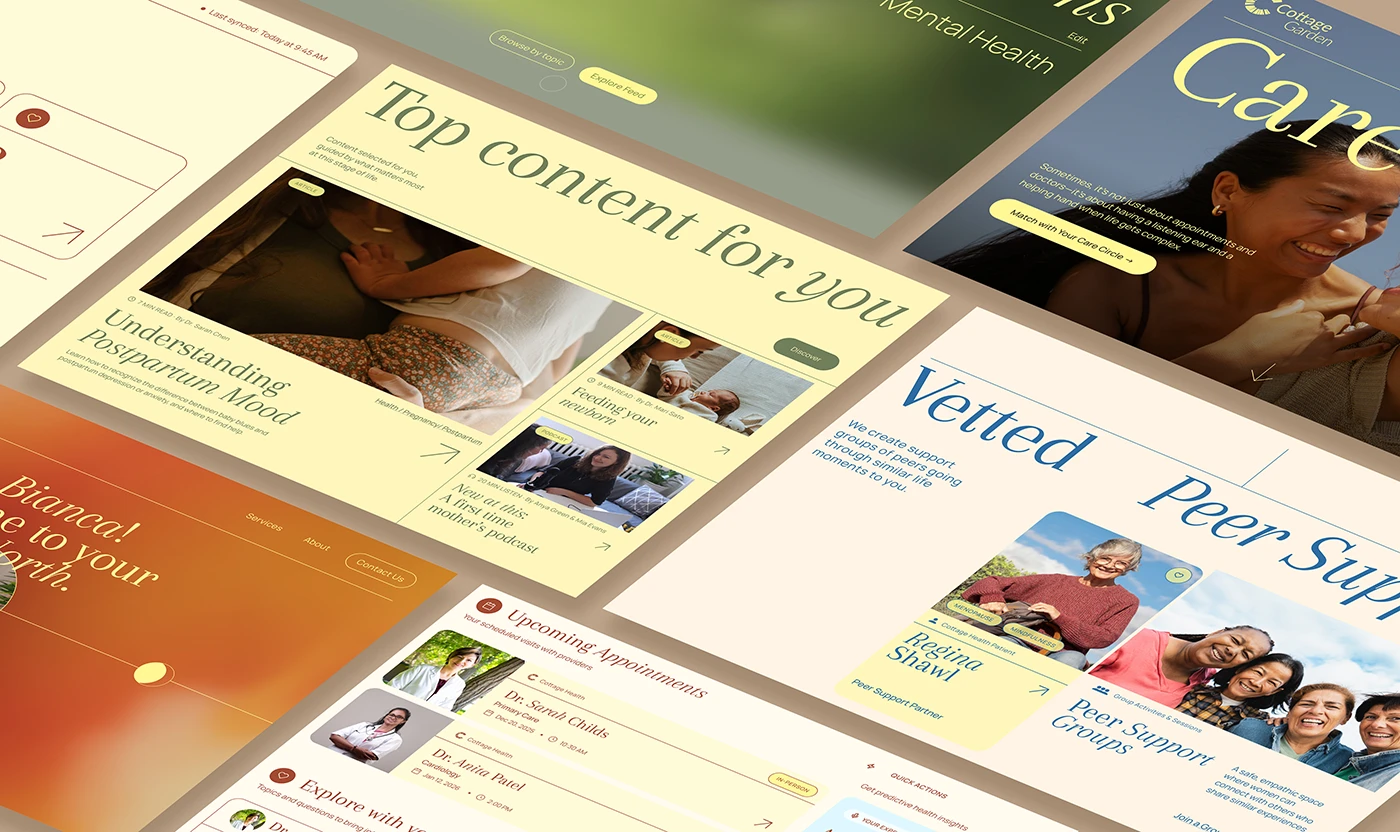
Designing a new vision for women’s healthcare
Introducing Cottage Women’s Health
Systemic transformation is not new to Cottage Health. Founded in 1888 by 50 forward-thinking women in Santa Barbara who wanted a hospital for their growing community, Cottage Health has since expanded to 3 hospitals and is quickly growing its outpatient services as well.
To understand the current Cottage Health experience, IDEO conducted dozens of in-depth interviews with patients, providers, caregivers, and staff. They also ran multi-week diary studies, engaged in inspirational research activities, and held events to hear from local women.
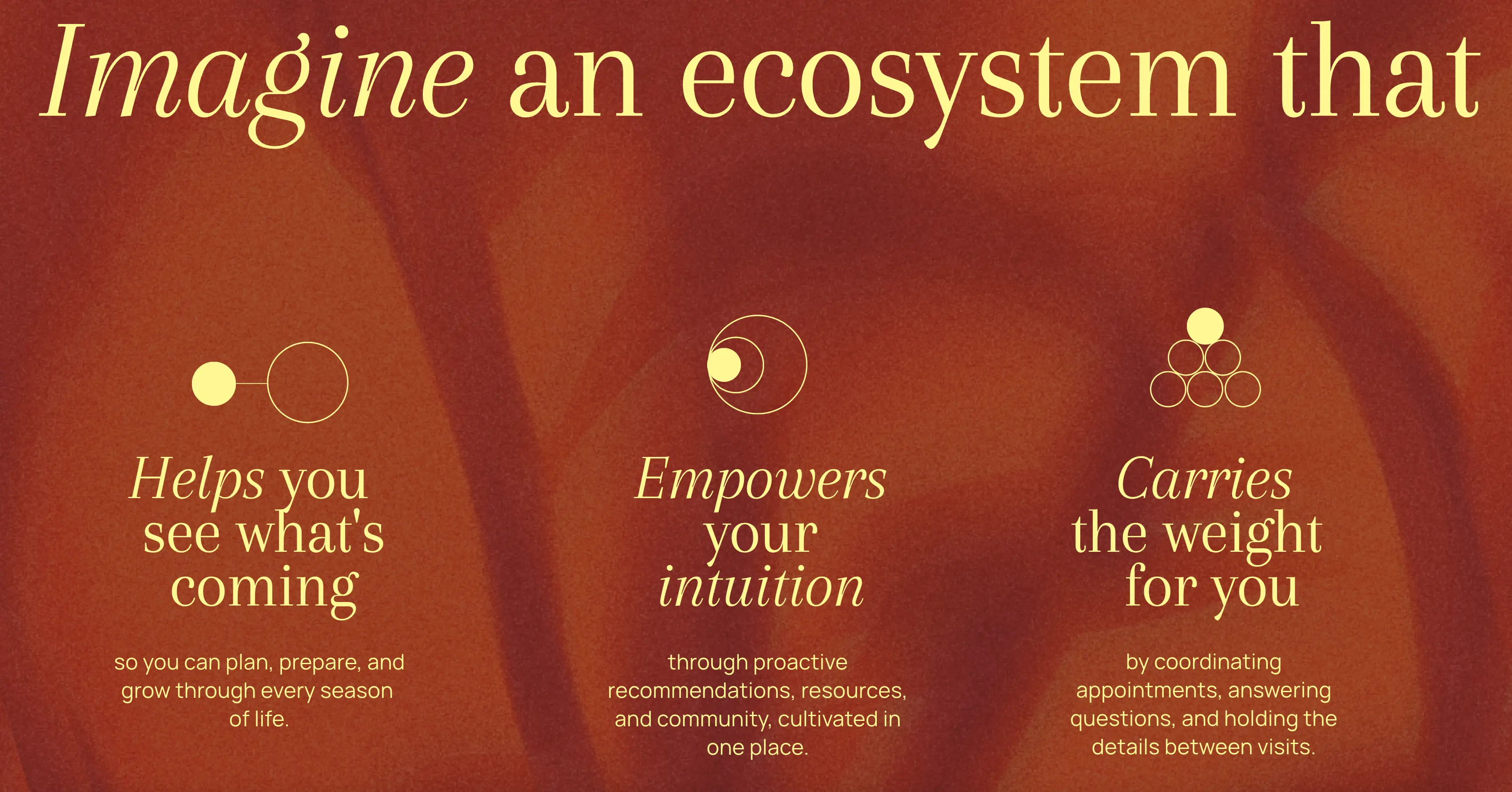
The qualitative research surfaced that women often carry the mental burden of repeatedly remembering, explaining, and advocating for themselves. Women’s pain is often minimized, which causes new providers to inherit mistrust from previous experiences, without having the tools to rebuild it. During significant life transitions, such as pregnancy or menopause, women may receive conflicting advice from health providers and seek additional outside support from informal networks. Access to quality care can sometimes depend on insider knowledge, private resources, or providers willing to go far beyond their job descriptions. And while providers make referrals, women must handle the time-consuming coordination required to make everything work, instead of focusing on healing. The bottom line: what women wanted most was to be seen, heard, believed, and supported in knowing what to do next.
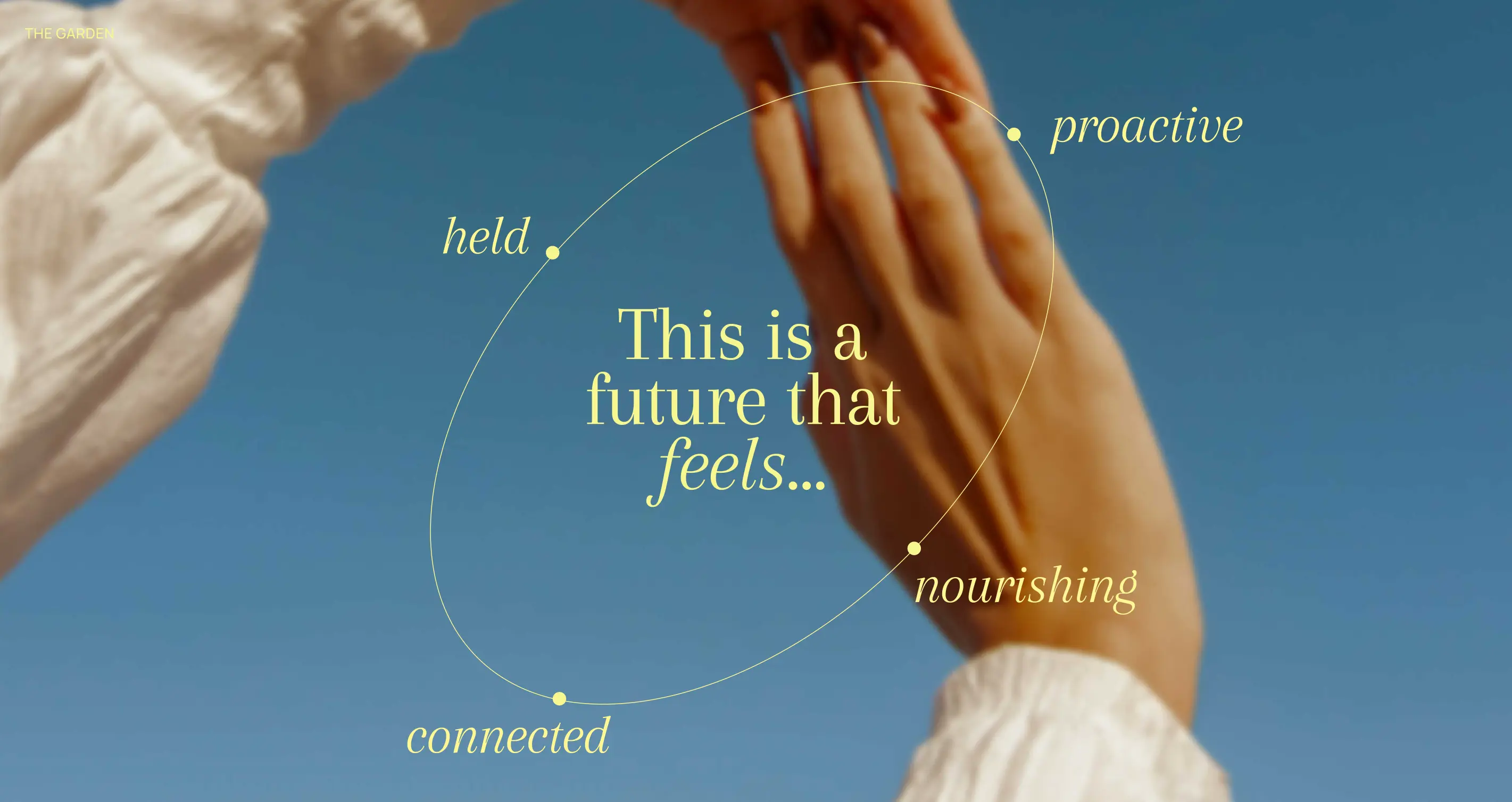
In order to address these challenges, IDEO proposed a new vision for women’s health, alongside design principles and concrete service shifts to guide future decision-making. Every interaction with Cottage Health should build on the information patients have already shared, demonstrating the system is listening. They should also guide women through life transitions by anticipating needs in future life phases, not just what’s happening now. Much like a community gathering, the Cottage Health experience should feel like a village, fostering belonging and shared care through warm, connected, human touchpoints.
Building on these design principles, IDEO developed three exploratory service concepts that represented potential pathways for future development, rather than finalized offerings: True North, Wellness Commons, and Care Circle.
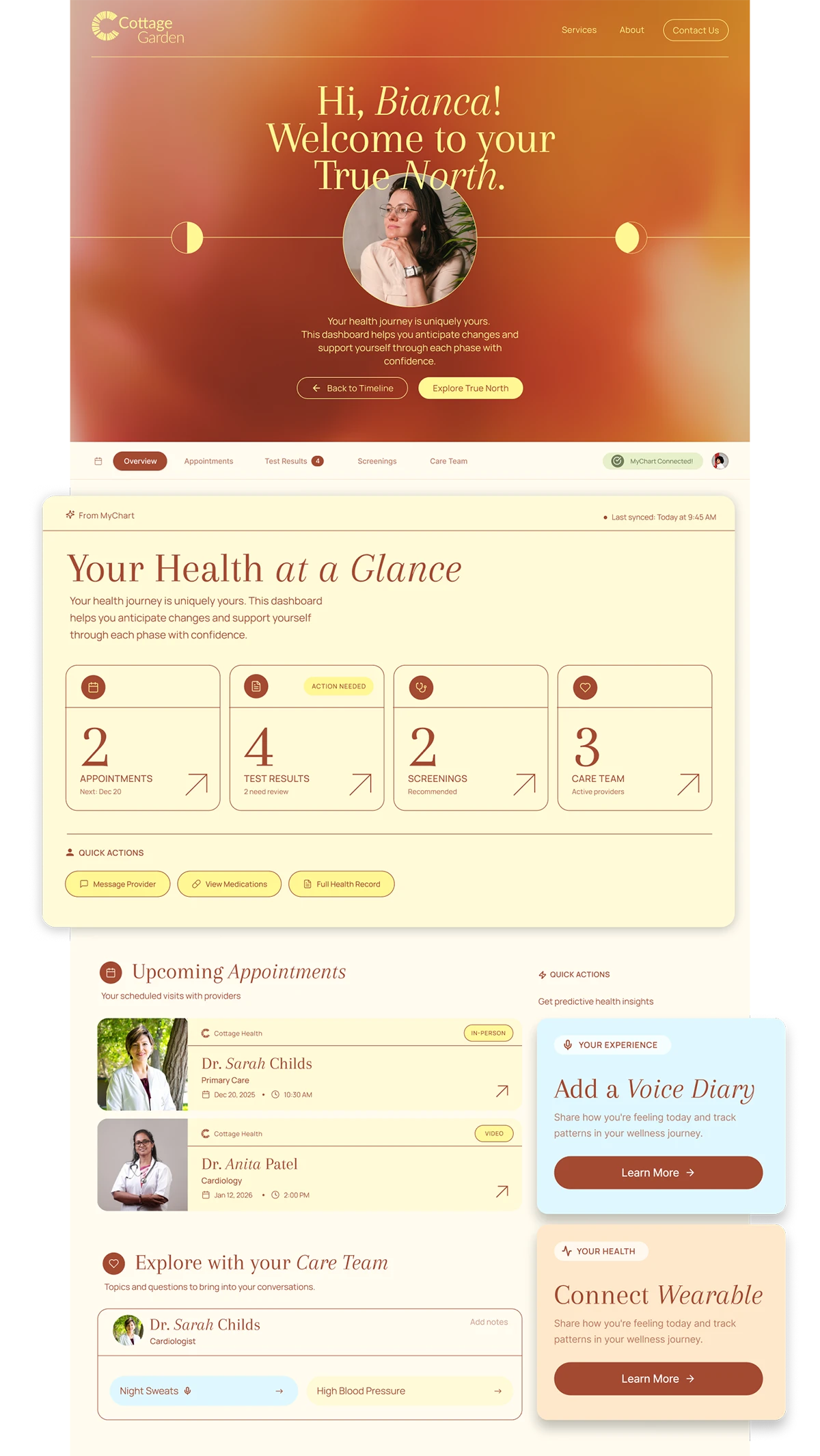
True North is a patient-facing tool that helps women see the long view of their health journey by integrating personal data, health goals, and reflections into a dynamic timeline they can share with their healthcare providers.
Wellness Commons serves as a digital front door, offering curated resources, including community events, discounted wellness programs, fitness classes, and trusted referrals, that help women navigate their well-being with clarity and agency.
Care Circle connects women to an extended support network inside and outside Cottage’s walls, including a hotline, health coaches, peer group support, and nurse navigators who can help patients manage complex care needs.
IDEO also provided Cottage Health with a multi-year roadmap building out the women’s health experience alongside continued pilot and implementation advisory. The roadmap included a comprehensive series of launch-to-learn pilots designed to test assumptions, reduce risks, and learn quickly, with IDEO stewarding the process. These pilots ranged from digital mockups and a curated community referral directory to a support line, a new nurse navigator role, and peer coaching services, among other experiments.
In July 2026, Cottage Health announced it was expanding its focus through a new Cottage Women’s Health Campus in Santa Barbara. Led by Dr. Jane Varner, Cottage Women's Health is projected to open in early 2028. It will encompass women’s health services across the lifespan, from puberty to menopause and beyond, including OB-GYN, pelvic floor health, women’s heart health, a menopause clinic, and a breast care center of excellence. It will also include supportive services, including trained nurse navigators to coordinate patients’ care journeys, giving women a single, trusted entry point for integrated care at every life stage. Cottage Women's Health is also exploring a new digital support system inspired by IDEO’s Wellness Commons concept.
Cottage Health had ambitious goals to expand its women’s health services and needed a partner to help it understand what women truly wanted from their healthcare and bring it to life.
7 months
from end of project to the announced launch of Cottage Women’s Health

From incremental change to breakthrough innovation
How Master Kong reinvented the instant noodle, from the inside out.
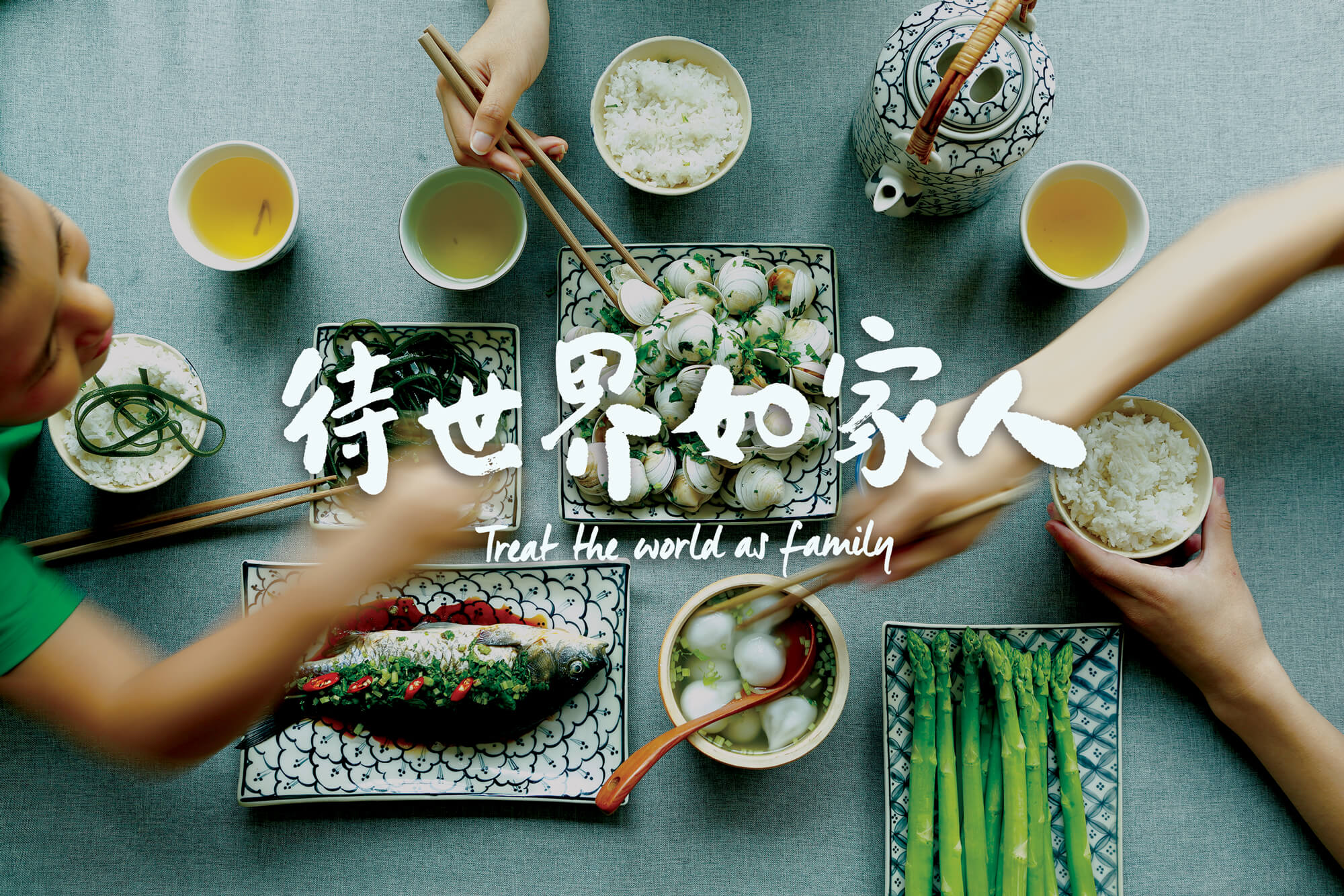
Looking to understand the role of instant noodles in middle-class Chinese life, the IDEO team conducted in-home research with consumers across a range of life stages and levels of attachment to noodle culture and convenience foods. The first finding was reassuring: Everyone kept instant noodles at home. The category still had a place in middle-class kitchens. But beneath that was a more complicated, emotional story—and an unmet need for convenience and quality to coexist in a single product.
The team discovered that instant noodles are more than just a quick, on-the-go meal; they are a nostalgic comfort food that evokes fond memories. But since their heyday, their role in daily life has evolved. Once a complete meal in itself, instant noodles now often function as a versatile flavor base or culinary accent in other dishes. Because they don’t align with the healthier, higher-quality, and more novel food choices that middle-class consumers aspire to, noodle shops, delivery noodles, or fresh-cooked instant options often win out. Yet, even these alternatives come with trade-offs. Delivered noodles lose texture during transport. Sit-down noodle shops preserve quality but offer limited flavors. Cooking from scratch meets the bar for both texture and flavor, but requires a significant time investment. As one young mother said, “If I could get the texture of fresh-cooked noodles without turning on the stove, I’d buy that instant noodle for sure.”
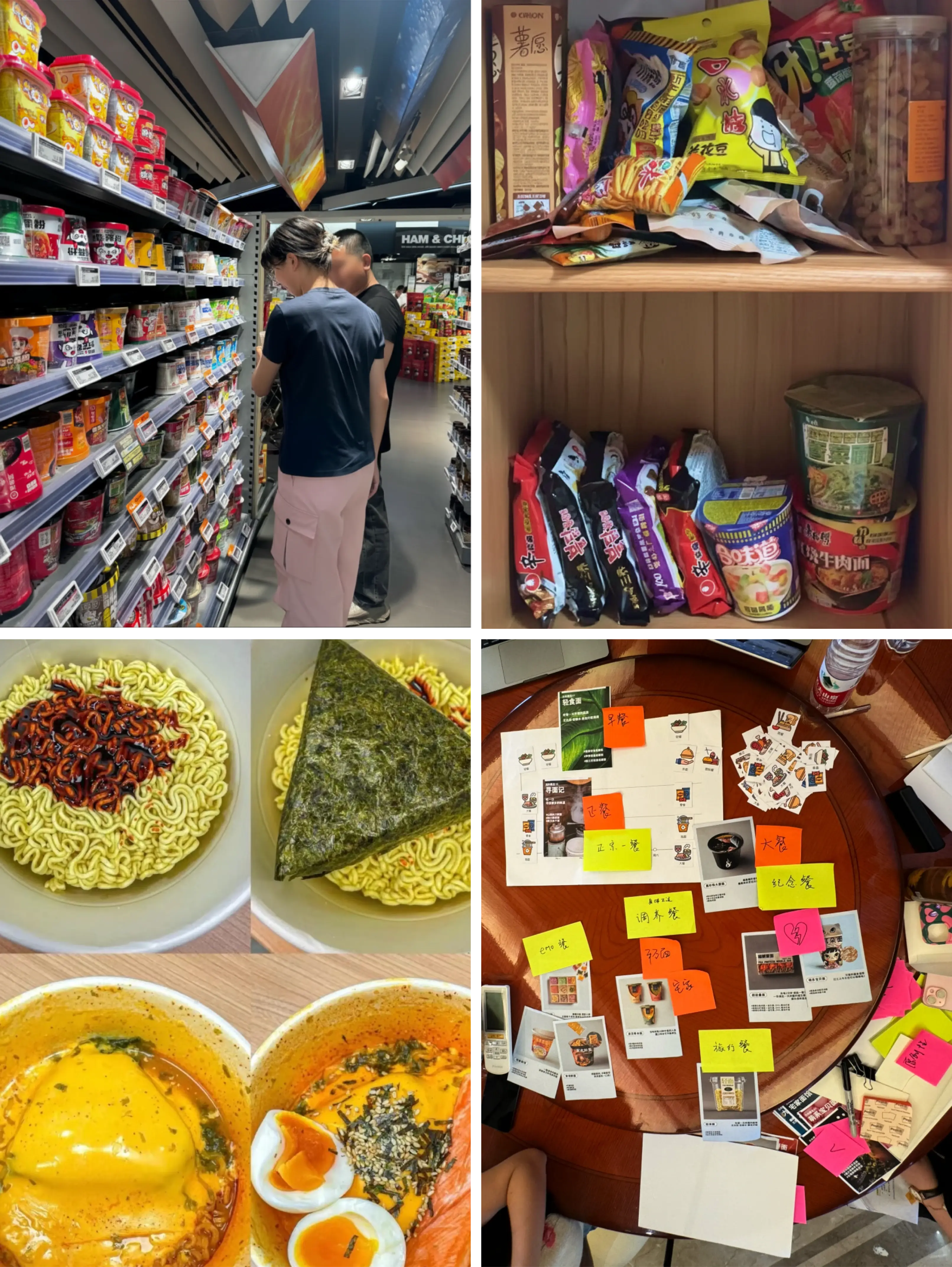
The research inspired the creation of a new category, which the team termed “fresh-brewed noodles.” More than just a noodle or broth upgrade, Master Kong’s fresh-brewed noodles would offer the speed of instant noodles with the quality of freshly cooked options, plus flavors not found in traditional noodle shops. The strategic positioning was clear. Executing it by making fresh-brewed noodles mass-producible, affordable, and eventually profitable presented a category-innovation challenge. To get there, IDEO designed a series of dual-track co-creation workshops with the Master Kong team and consumers.
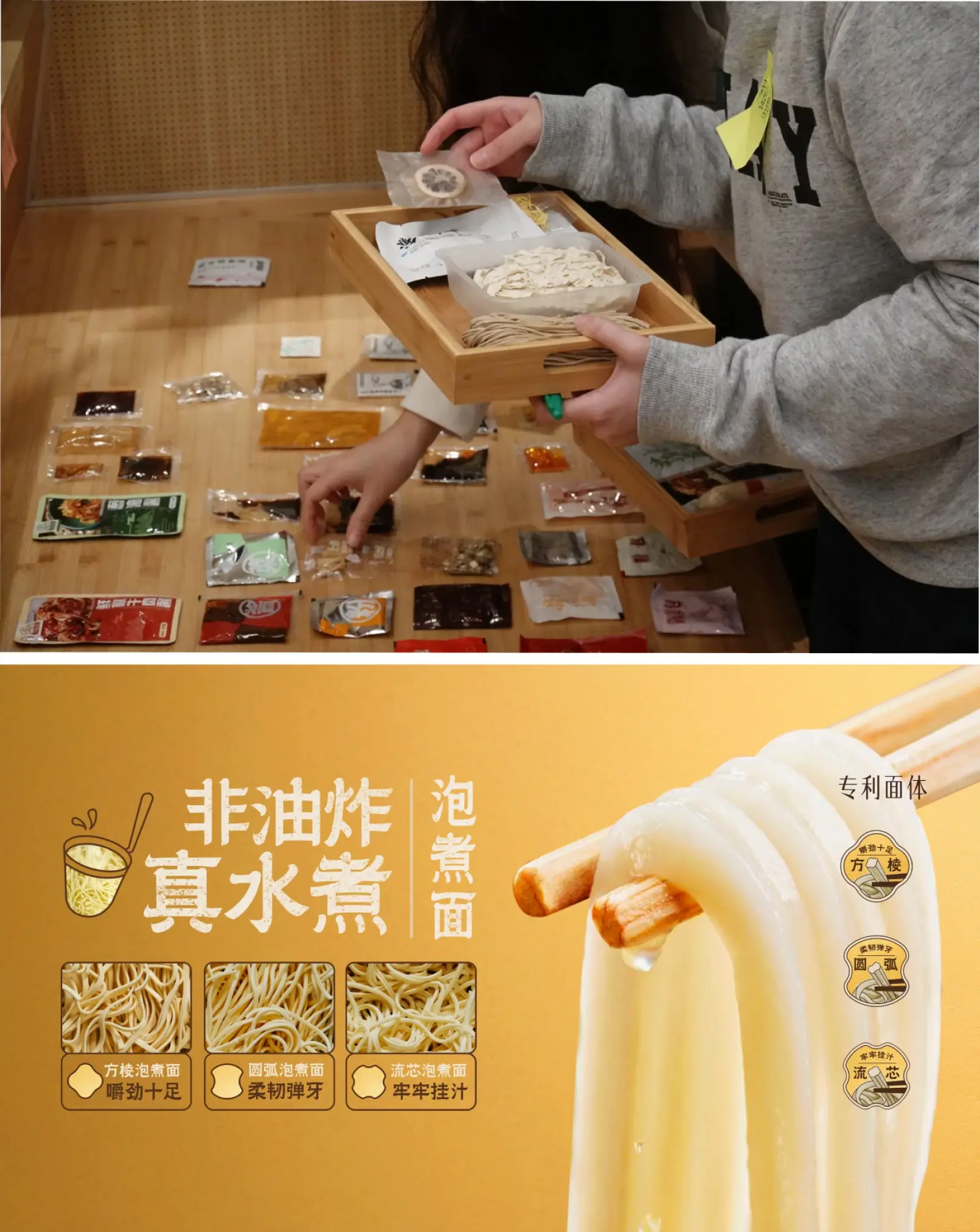
One track focused on prototyping the core product experience: noodles, broth, and toppings. IDEO and Master Kong’s R&D team began by studying the traditional craft of Chinese noodle-making, starting in Shanxi, a region renowned for its noodles. Through successive rounds of prototyping and consumer tasting, the team identified a critical insight: for “fresh-brewed noodles” to be convincing, the innovation had to be centered on the noodles themselves.
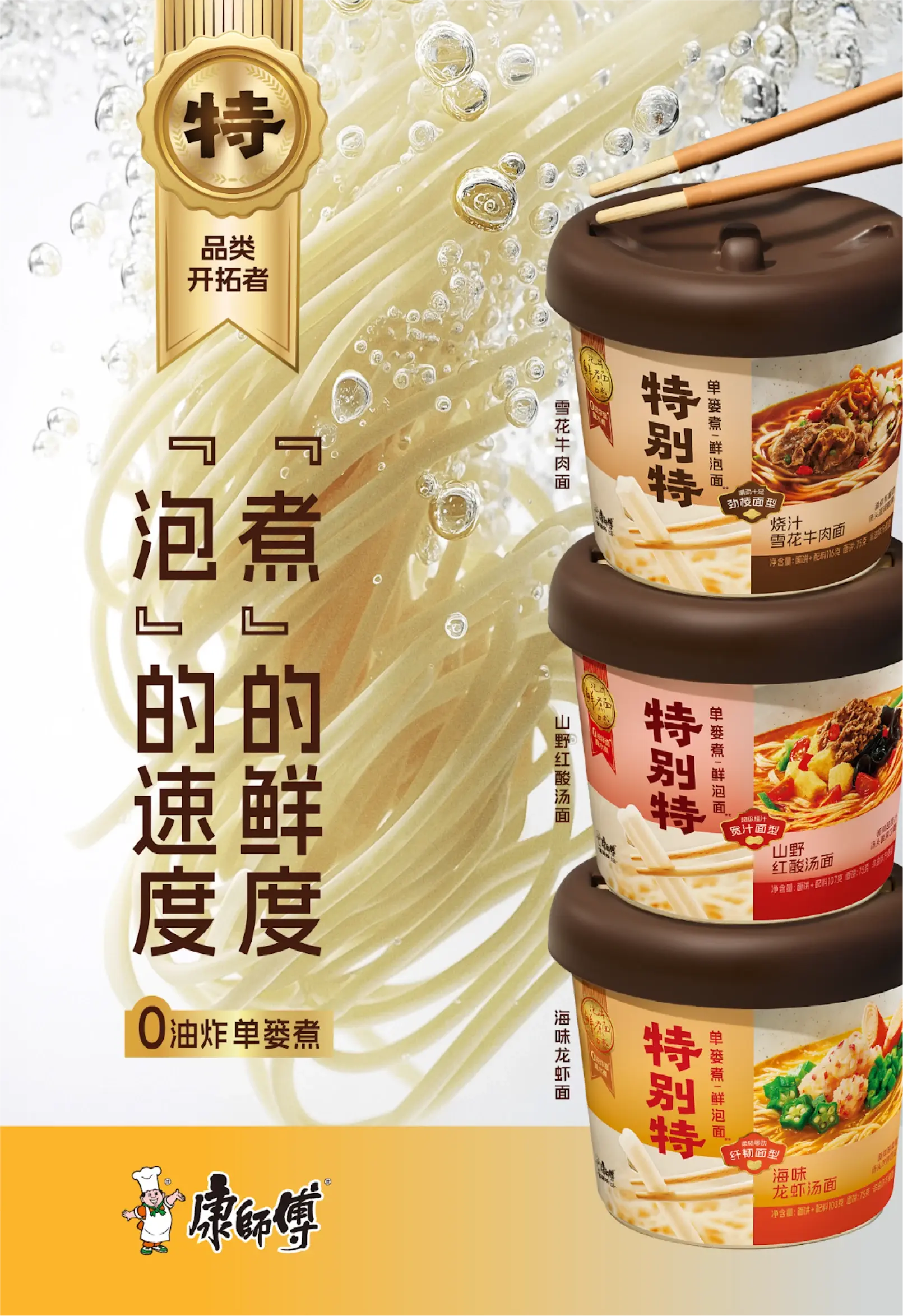
Texture alone was not enough. Consumers needed to see a meaningful difference before they tasted the product. IDEO translated this insight into a distinctive noodle profile: irregular, dimensional shapes designed to remain springy, hold sauce and broth, and mimic the resilience of freshly cooked noodles using only hot water. Because this visible shape represented the product’s core value proposition, it became a hero feature on the packaging. The graphic design made a bold visual statement about the noodle form, turning a technical R&D breakthrough into an immediately legible consumer promise: these are not ordinary instant noodles.
A parallel track explored the broader commercial experience: trend-forward and reimagined classic flavor profiles, light yet deeply satisfying broths, carefully selected toppings, and packaging that signals a new level of quality on store shelves. One key insight was that utensils carry meaning. Conventional instant noodles are often associated with disposable plastic forks, while higher-quality noodles are eaten with chopsticks. IDEO translated this cultural cue into the design of the bowl’s lid.
Instead of treating utensils as an afterthought, the team designed a solid, rounded, heat-retaining lid that embeds a pair of small wooden chopsticks. The gesture creates a small ritual of anticipation and reframes the product—not just a convenient instant meal, but a more considered noodle experience. Once opened, the product fulfills that promise with satisfyingly bouncy noodles, a rich liquid broth pouch that replaces the traditional oil-and-powder packet, and a vegetable packet reformulated with more premium whole ingredients.
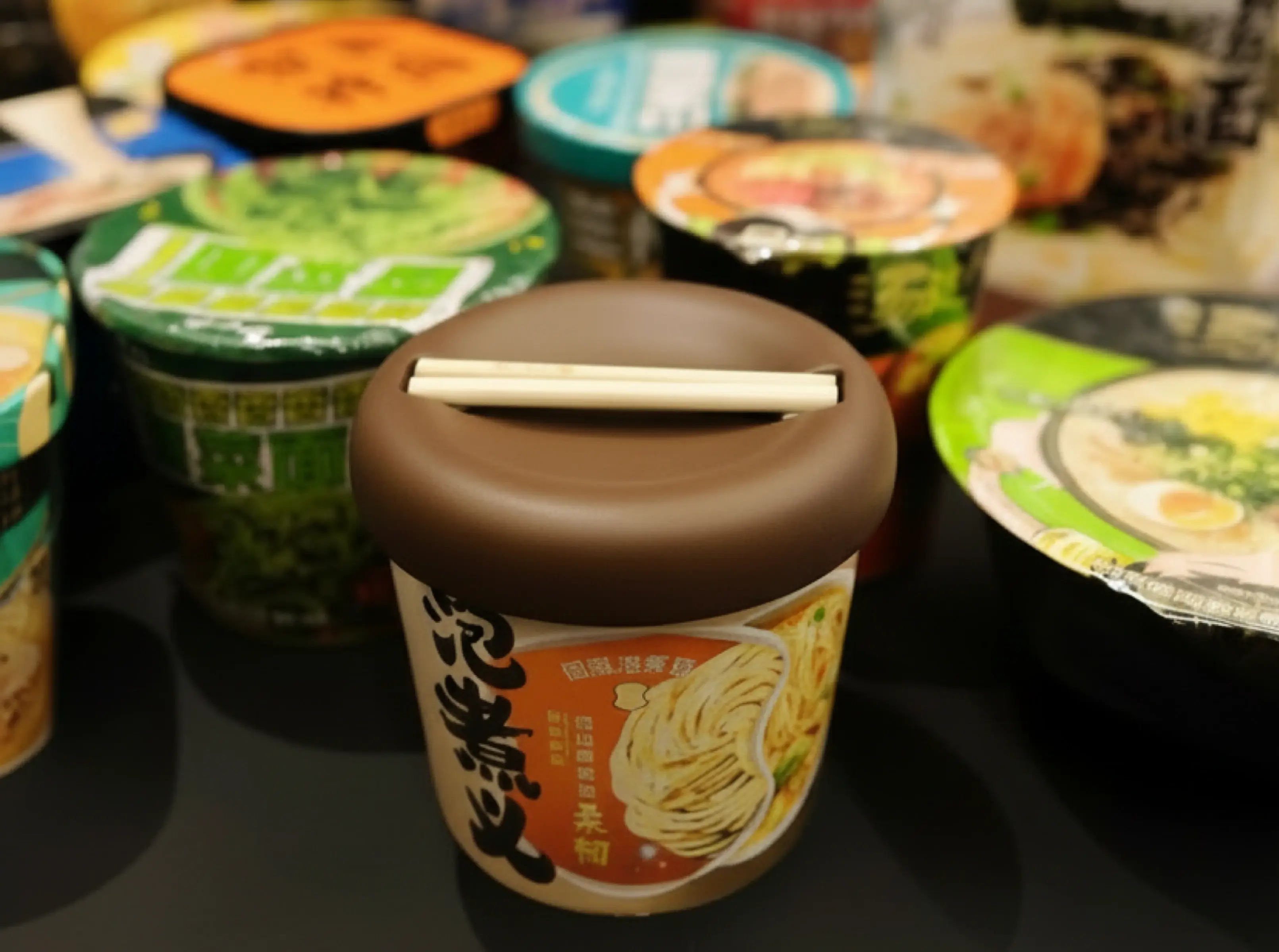
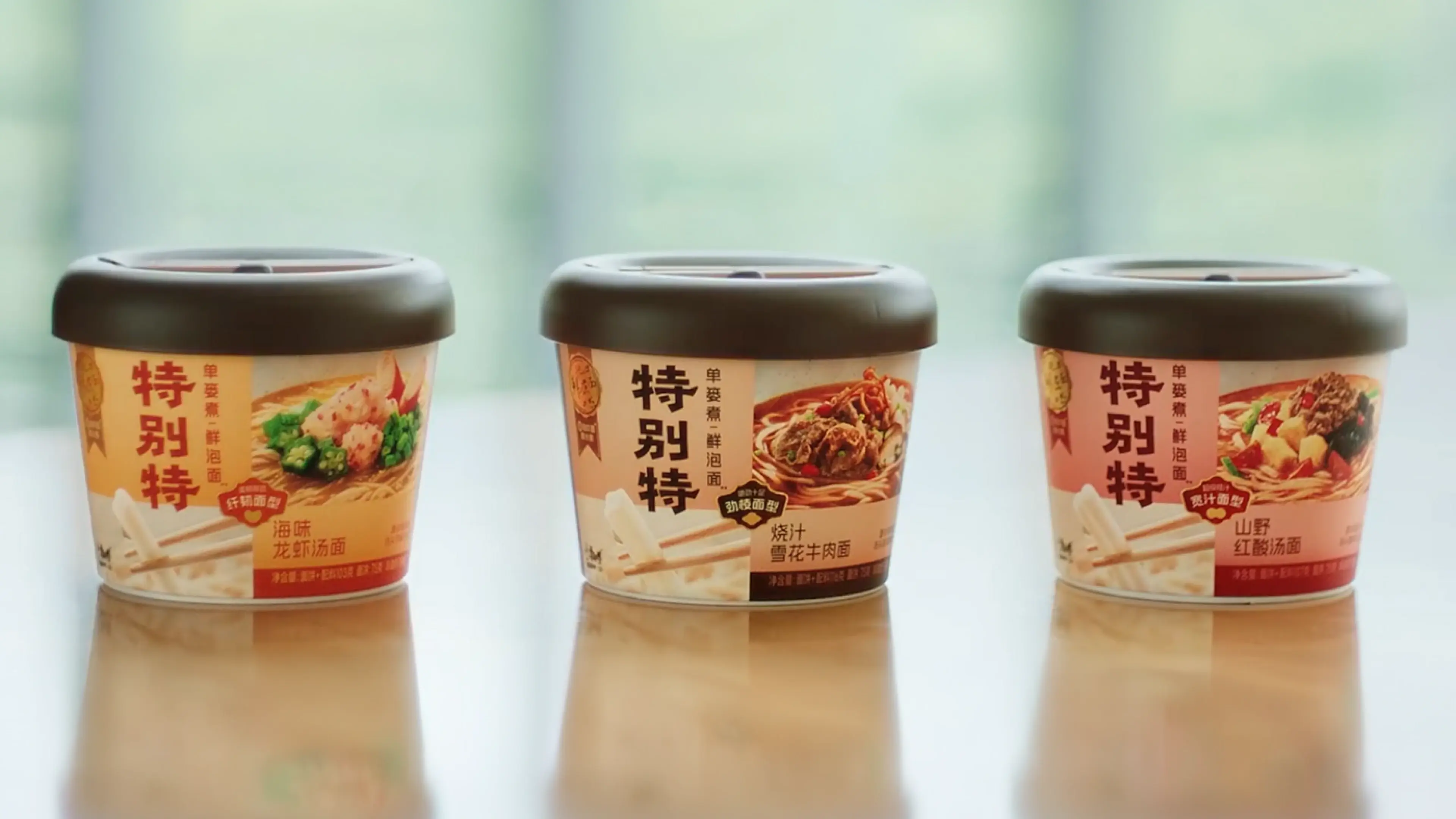
The first batch of “Te Bie Te” Fresh-Brewed Noodles—Chinese wordplay that emphasizes “special”—launched in August 2025 with three trendy and tried-and-true flavors. Within just three days, sales exceeded 100,000 bowls. Within a week, “Te Bie Te” topped the instant noodle category sales ranking on Douyin, China’s domestic counterpart to TikTok. The outcome was bigger than a product launch—it served as proof that a mature, declining category could be fundamentally reinvented to meet consumers’ real needs. For Master Kong, the project became a North Star and a model for internal category innovation in beverages, ready-to-eat foods, and beyond.
Once a popular, affordable staple, the instant noodle category in China has been declining rapidly due to shifting demographics, rising food delivery options, and increasing customer demand for healthier, more nutritious meals.
According to the World Instant Noodles Association, between 2020 and 2023, China’s instant noodle consumption fell by 4 billion packs.
100,000+
“Te Bie Te” bowls sold in the first 3 days on the market
#1
on Douyin’s instant noodle category ranking within one week of launch

Making international education future-fit & affordable
Lexel brings world-class learning to Malaysia’s middle class.
Taylor’s legacy began in 1969 with the founding of Taylor’s College and soon expanded to include Taylor’s University, one of Southeast Asia’s top private universities, as well as many other institutions that serve 35,000 students per year. The family-owned group also operates Taylor’s International Schools, Garden International School, and Nexus International School for students ages 4 to 18. In Kuala Lumpur, Malaysia’s capital city, annual tuition at premium private schools like these ranges from about $10,000 to $25,000 USD. Taylor’s wanted to do something different: provide the same level of academic rigor and immersive learning experiences at one-third the cost.
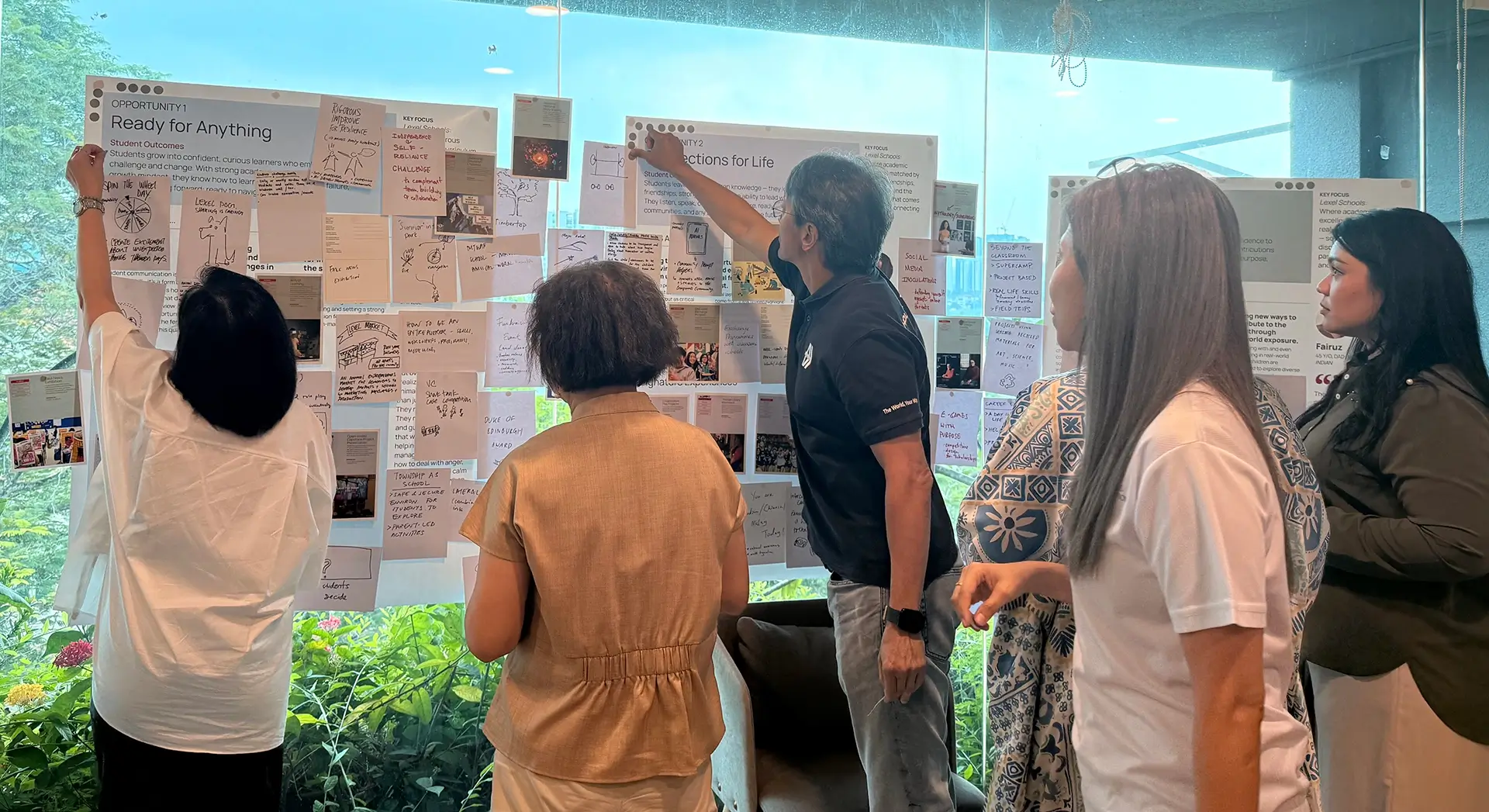
IDEO began by speaking with over three dozen students, parents, teachers, and experts across the capital to understand what was working, what wasn’t, and what was missing from such moderately priced international schools.
A few themes quickly emerged. Families, students, and teachers were worried about the stability of these new private schools, which tended to have higher-than-normal teacher turnover rates and were plagued by financial instability, negatively impacting talent attraction and retention, as well as student learning. Parents appreciated that the schools offered holistic learning experiences, such as field trips to rural areas, including jungles, but wished they were more consistently part of the curriculum. And now, the looming challenge of AI—how to use it, how to teach it, and how to teach with it—was in the background, a persistent cause for concern. The big unmet need? Reassurance that Taylor’s was thinking long-term and systematically about developing the skills, knowledge, and mindsets that would prepare students for an ever-changing world. Parents wanted a school that measured growth in academic, social, and character terms over generations, not just school semesters.
With these insights in hand, IDEO began developing a design Playbook for Taylor’s new brand—Lexel International Schools. A combination of “lexicon” and “excellence,” Lexel’s mission is “building what lasts, learning for life.”

The schools are centered around three key differentiators:
- Always Ahead: Lexel schools commit to staying current with the topics and subject matter they teach, as well as the tools they provide to students, parents, and teachers.s.
- Learning That Builds for Life: The schools ensure programmatic, systemic, and consistent learning experiences from Pre-K to Year 11. Interested students can even continue their post-secondary journey in partnership with Taylor’s University and other higher education institutions within the Taylor’s ecosystem.
- Educators for the Long Run: These schools commit to ongoing investments in professional growth opportunities for teachers and stable learning environments for students.
Four Lexel Literacies—AI, Digital, Financial, and Nutrition—integrated into the Cambridge Curriculum bring the school’s vision and mission to life.
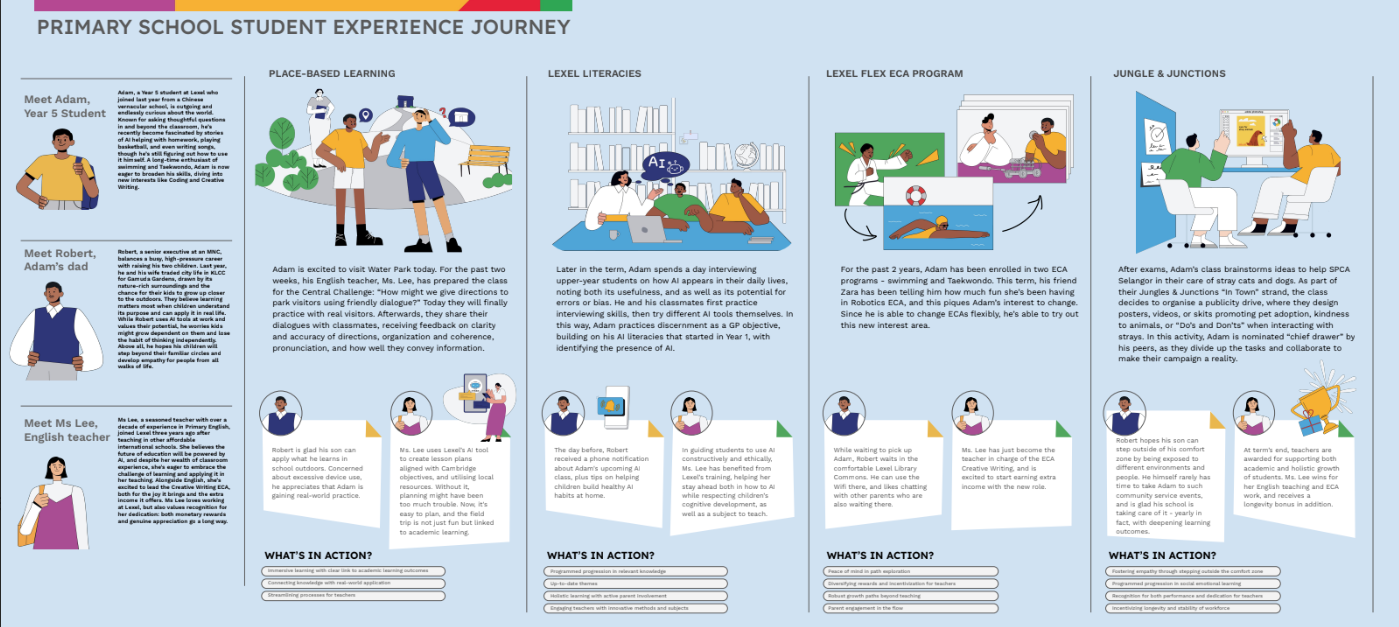
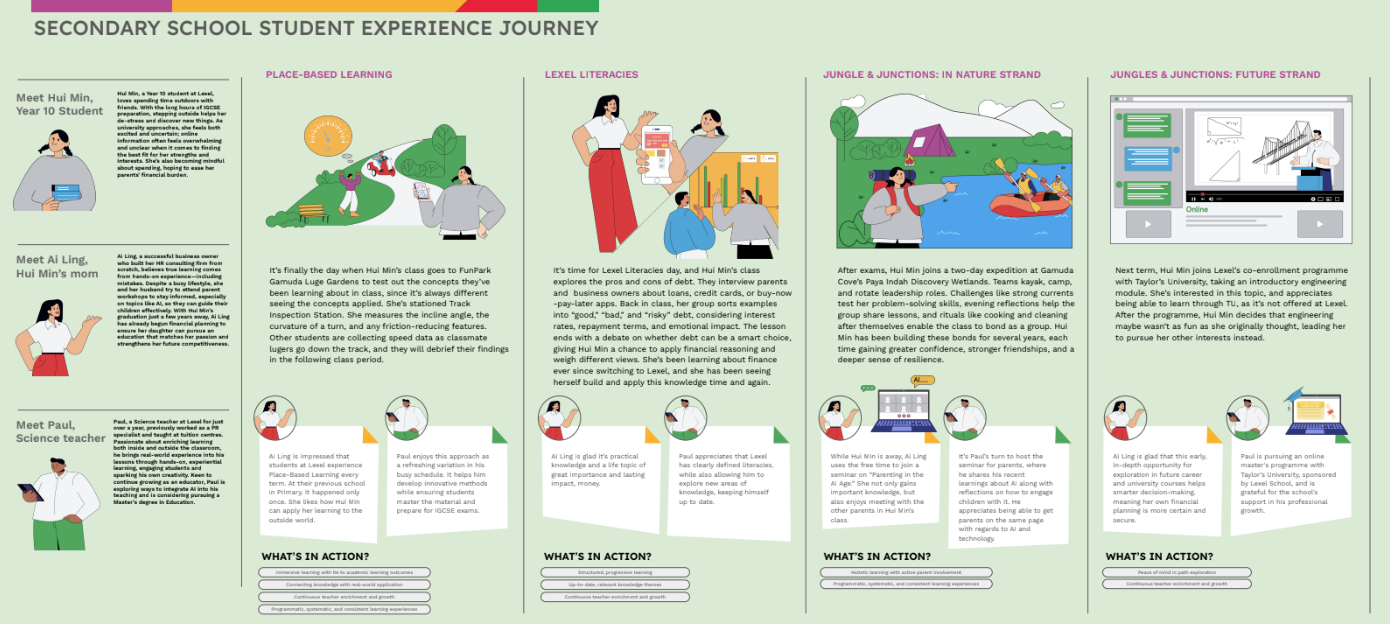
By systematically integrating AI literacy into its spiral education framework, in particular, an approach where major topics are revisited multiple times through a curriculum to build fluency over time, Lexel ensures parents that the school is thinking a decade ahead from Day One, setting the school apart. In addition to enhancing AI fluency, Lexel offers unique end-of-term experiences called Jungles & Junctions.
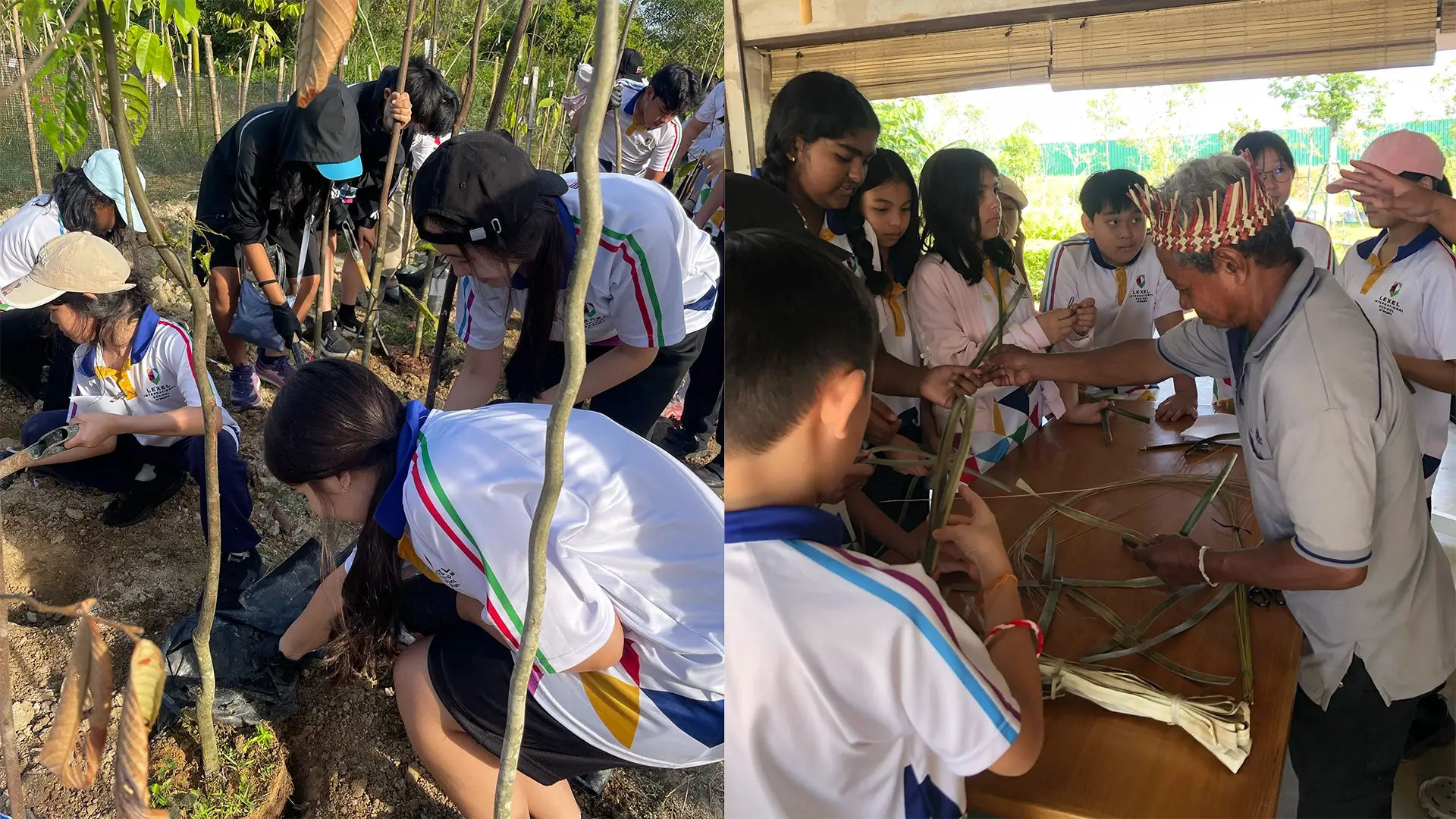
Combining three important strands of learning—community engagement, nature-based personal and interpersonal development, and career and university exploration—Jungles & Junctions leverages Taylor’s extended educational network and Lexel’s strategic founding campus within the Gamuda Gardens development in Selangor. Surrounded by tropical rainforests, the township’s residential neighborhoods, theme park, and various sports facilities, including an Olympic-length swimming pool, are transformed into an extended Lexel campus, with a GenAI-driven planner to help teachers streamline the organization of class outings. “The Township is Your Campus” became the tagline for this approach.
In September 2025, just months after IDEO’s collaboration ended, Taylor’s began classes at its first Lexel International School. By mid-year, the new school had achieved 115% of its year-one student enrollment target, with significant inbound demand for Year 2 already demonstrating the school’s market resonance.
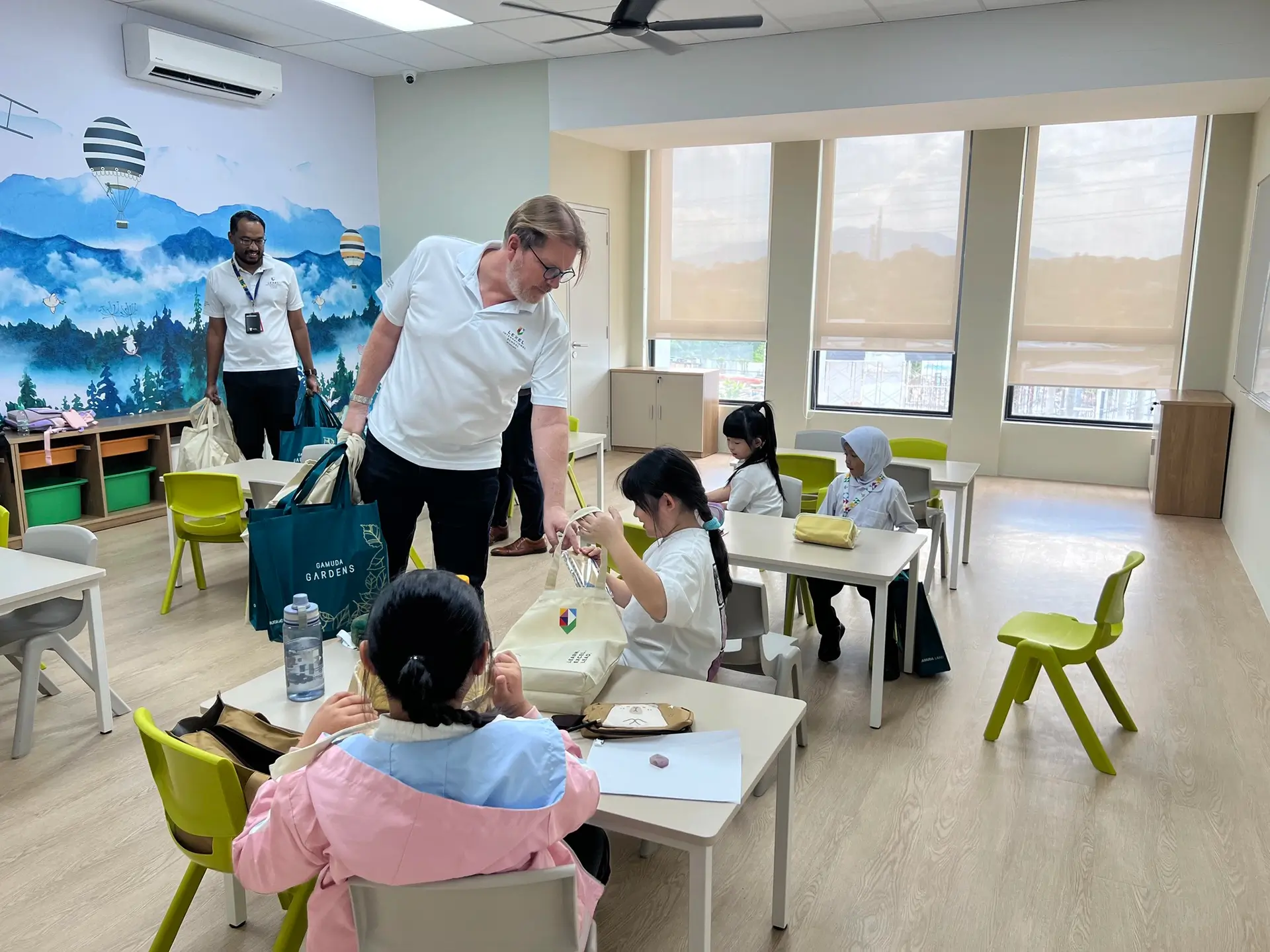
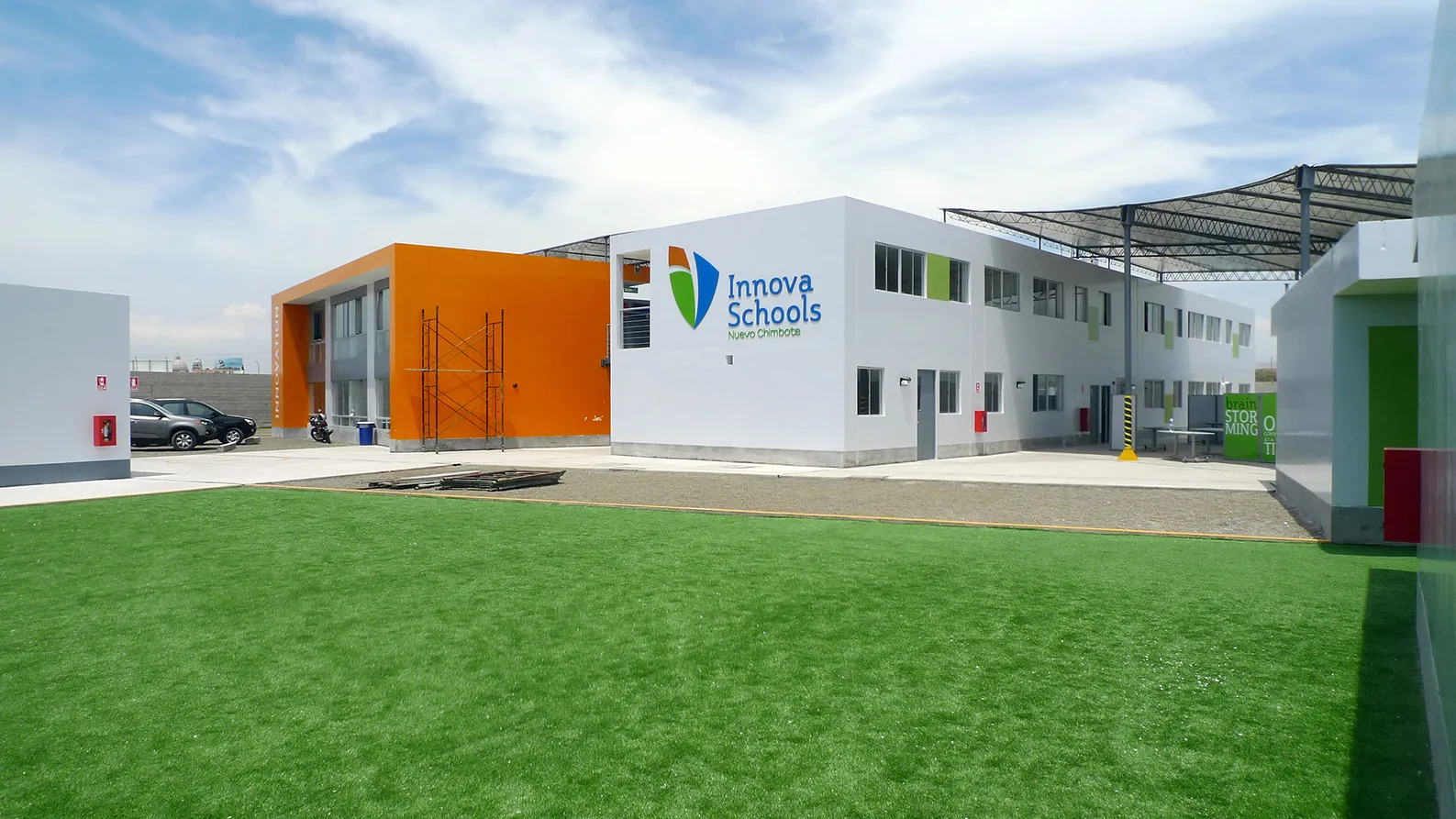
The modern campus features spacious classrooms, science and technology labs, a library, a multipurpose hall, and a canteen. Annual tuition ranges from about $2,800 USD for pre-K students to about $6,100 USD for secondary students.

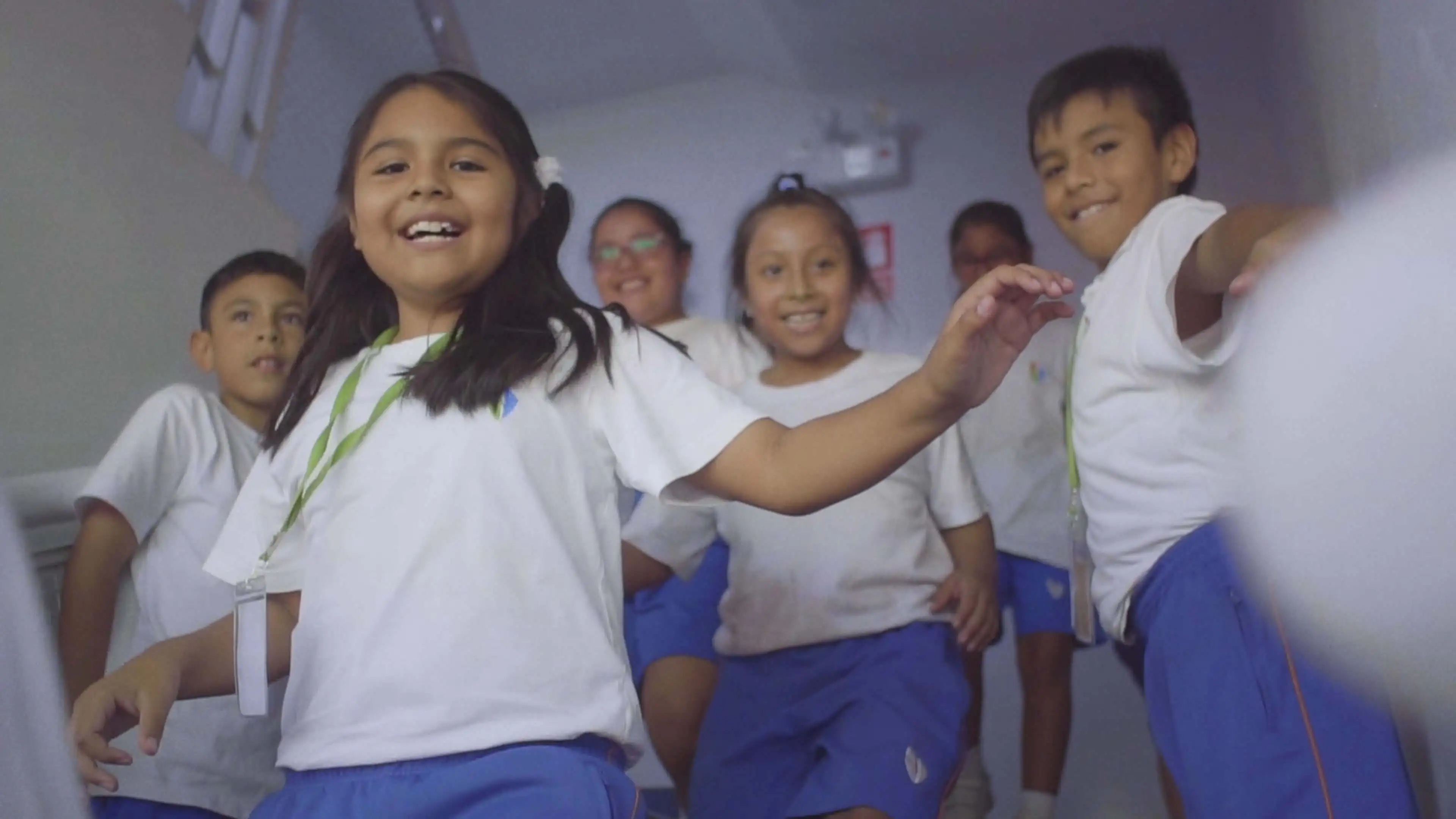
Most importantly, by combining Taylor’s deep academic expertise, Gamuda Land’s development prowess, and IDEO’s innovative design Playbook, Lexel brings quality, affordable international education closer to home for Malaysian families. According to one parent, “My daughter looks forward to going to school every day … and has a lot of opportunities to express herself. On a scale of 1 to 10, I give [Lexel] an 11.” Based on the IDEO Playbook, a second flagship campus in the Southern Klang Valley, which is scheduled to open in September 2026, has already exceeded its year-one target enrollment expectations, with plans to continue extending the Lexel network to other parts of Malaysia and the wider Southeast Asian region in the near future.
Malaysia’s private international school sector has grown significantly as parents seek quality English-language education. However, high tuition fees and limited access to reputable schools are continual challenges for those in the emerging middle class.
115%
of Lexel’s student enrollment target reached during the launch year of its first campus
Year 1 enrollment target exceeded
at Lexel's second campus several months ahead of classes commencing
Delivering an unbiased news experience
Straight Arrow News transforms fact-based news consumption.
The American news industry has long been a competitive and saturated market. This has only intensified with the emergence of social media outlets and AI-generated news. Even so, SAN’s rigorously unbiased, fact-based reporting style and rich video storytelling had enabled the ambitious startup to rise above the media fray in just three short years.
With a strong foundation to build on, IDEO sought to further differentiate SAN’s cutting-edge news product and build deeper engagement with a wider audience through a new user experience.

Collaborating closely, IDEO and SAN began by delving deeply into media consumption habits. They met with early SAN superfans, news consumers who spent hours a day absorbing content from traditional outlets like Fox and USA Today, and those who looked to their Ring doorbell app or Reddit for news. The takeaways? People were tired of clickbait and clunky interfaces. They sought clear, factual news that was easily accessible, with additional context to help them interpret events and understand their significance. They craved more than one perspective on important topics, so stories felt balanced rather than polarized. They also valued having control over how they consumed news, so making it easy to switch between text, video, and audio formats was crucial.
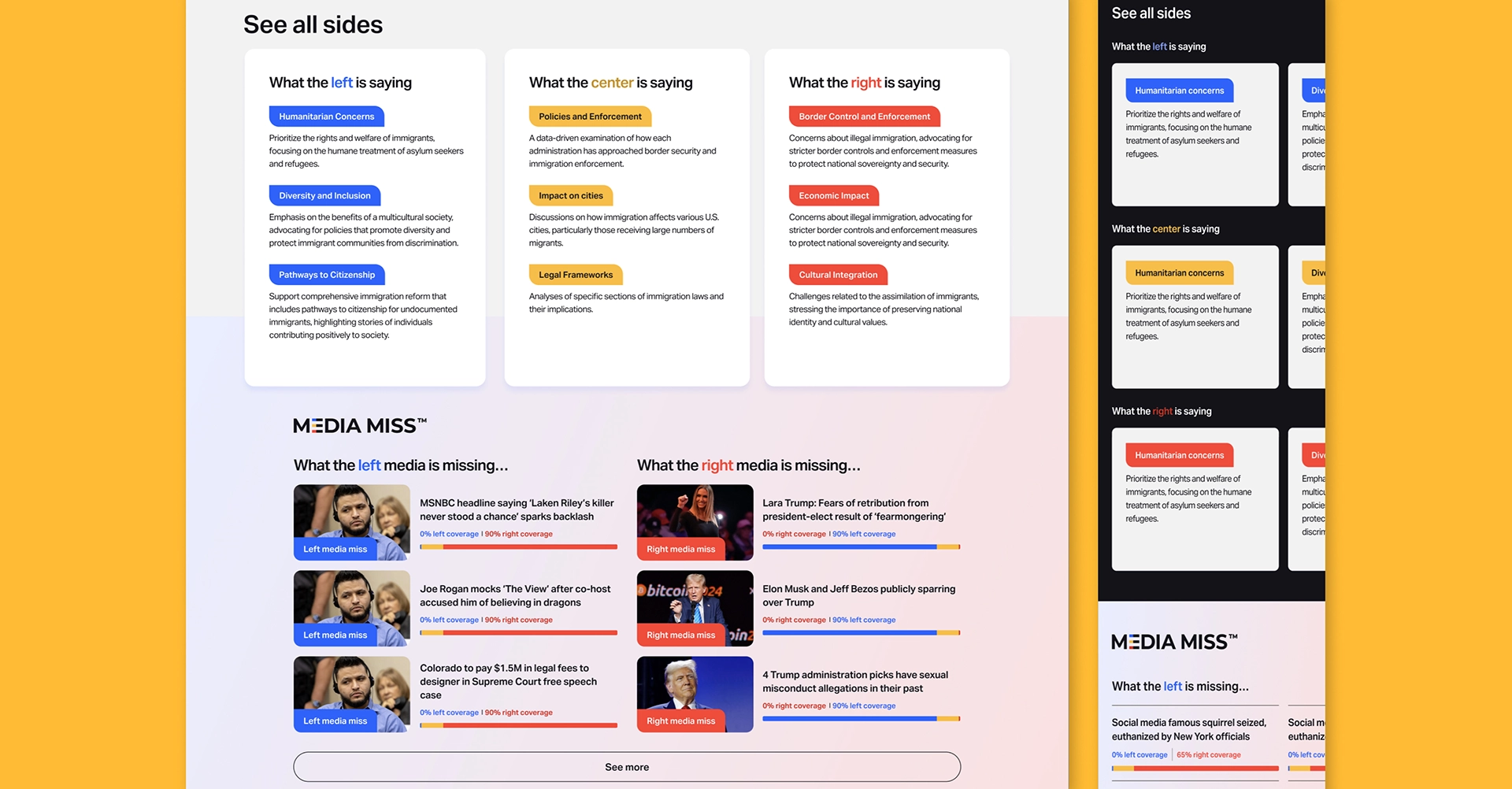
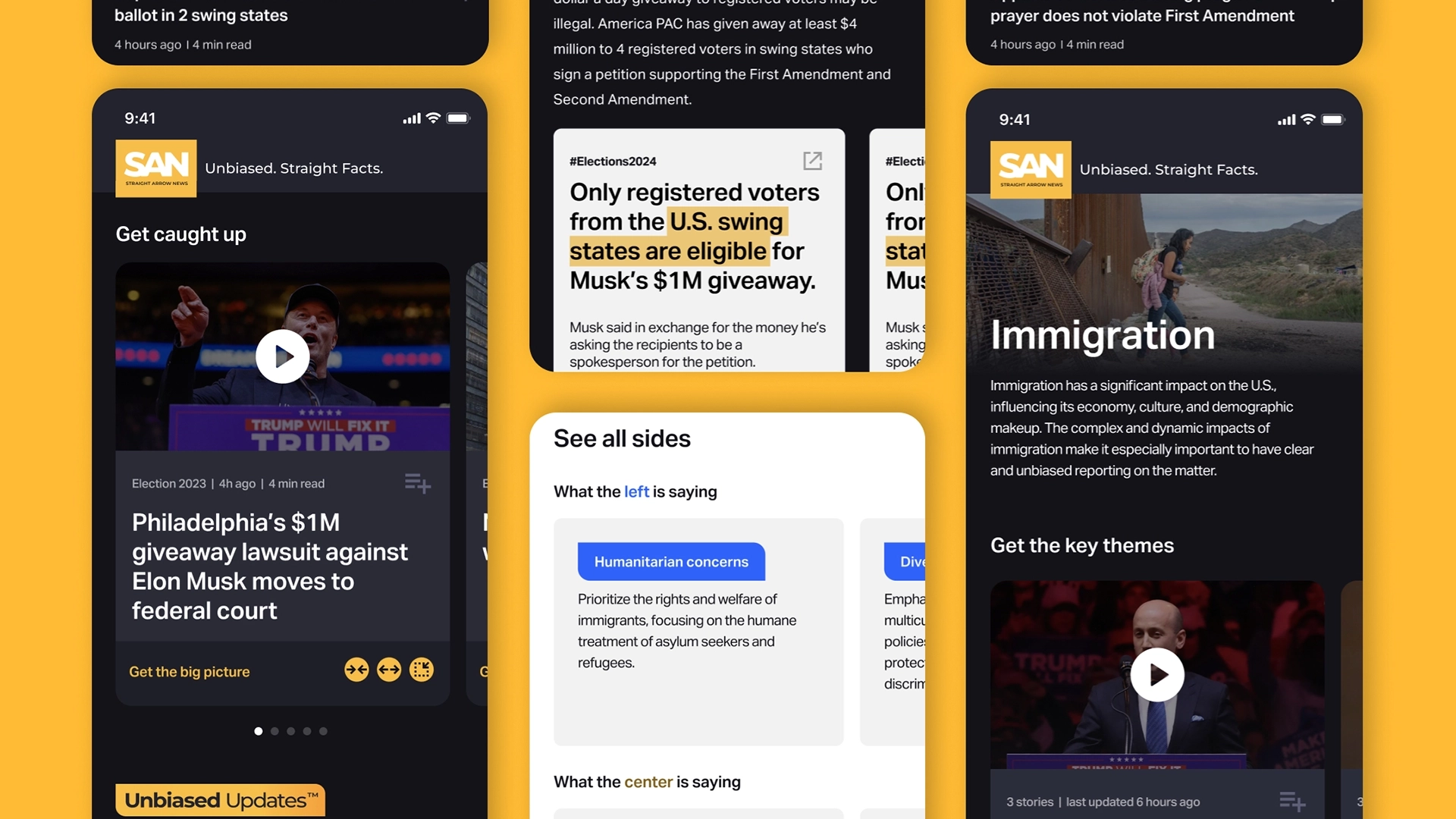
Together, IDEO and SAN created features across SAN’s website and app that put facts, trust, and transparency at the core of the product experience. Fact Cards distill key data points into clear, shareable units, while the Sources feature allows readers to trace information directly back to its original source. To make complex stories easier to grasp, Big Picture insights drill down into why events matter, surfacing underlying themes, historical parallels, differences in reporting, and common ground. The Why This Story Matters section provides readers with clear framing and sets the story within a broader context, while the Timeline illustrates how events unfold over days, months, or even years. An antidote to news polarization, See All Sides presents left, right, and center narratives for key topics side-by-side, and Media Landscape visualizations reveal how coverage varies across outlets. Finally, to ensure SAN fits seamlessly into readers’ daily lives, the redesigned Today Page is organized into three highly scannable sections: Latest News, Top Stories, and SAN Originals. The combined features create a balanced, clear, and non-polarizing news experience, making it easy for readers to delve deeper into the sources of their news.
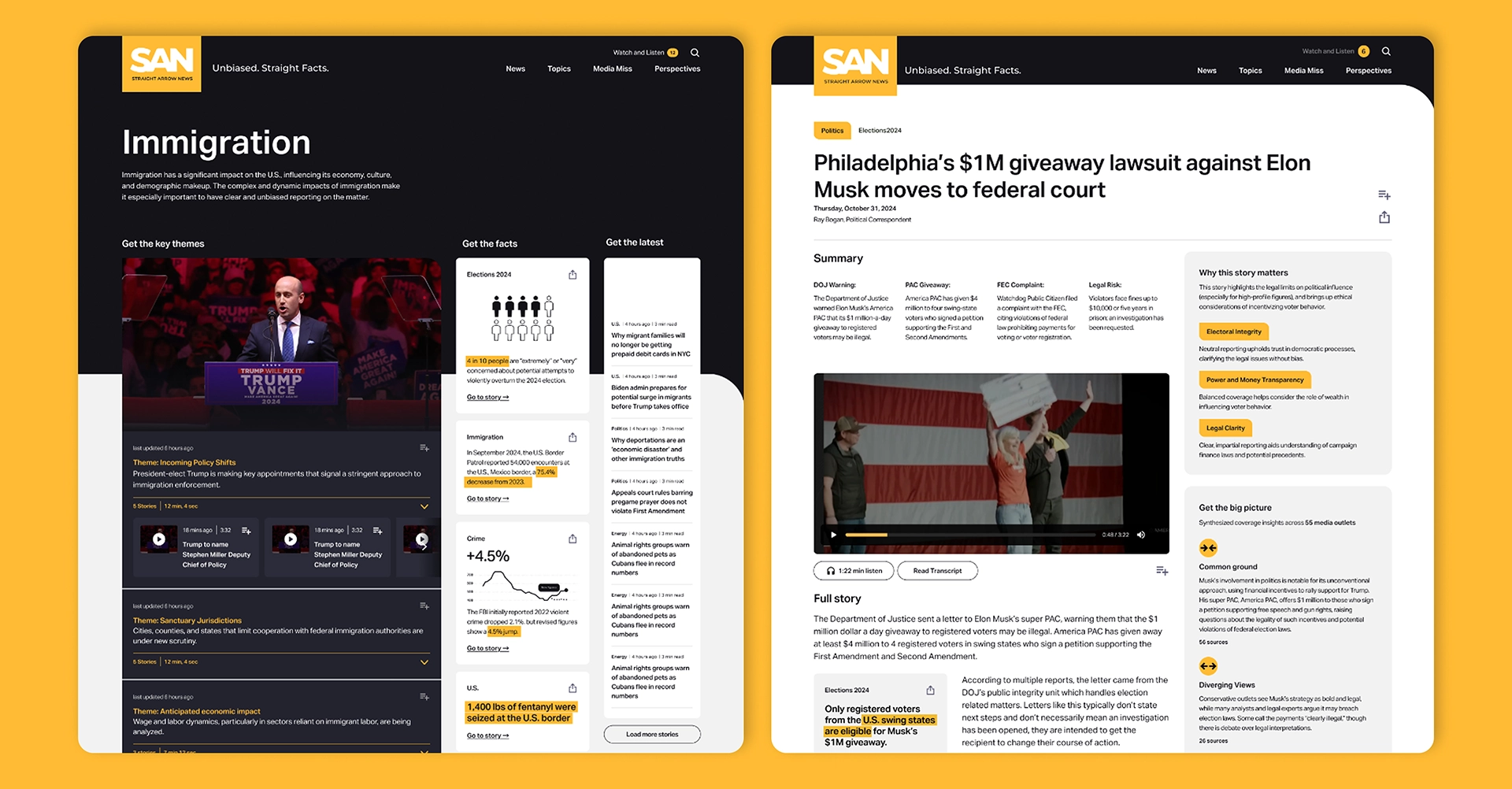
SAN now delivers a news experience as modern, dynamic, and trustworthy as its journalism. A month after its debut, the SAN app’s page views increased 1,170 percent year over year compared to June 2024, while active users rose 700 percent. Readers also give the updated mobile experience a 4.8 rating on the Apple App Store. “Our team is delivering reporting that’s both deeply factual and accessible,” said Derek Mead, SAN’s Chief Content Officer. “This redesign is pivotal to the direction journalism needs to take and the leadership role Straight Arrow News is taking on as we help guide the news industry into a brighter future.”
SAN built a loyal readership and gained recognition for its unbiased reporting. To expand and stand out from legacy media, SAN wanted a redesigned user experience that reflected its commitment to fact-based journalism.
1,170%
increase in app page views YoY
700%
increase in active users
4.8 rating
on the Apple App Store
Why You Should Invest in Real Friendships at Work
The benefits go far beyond coffee breaks
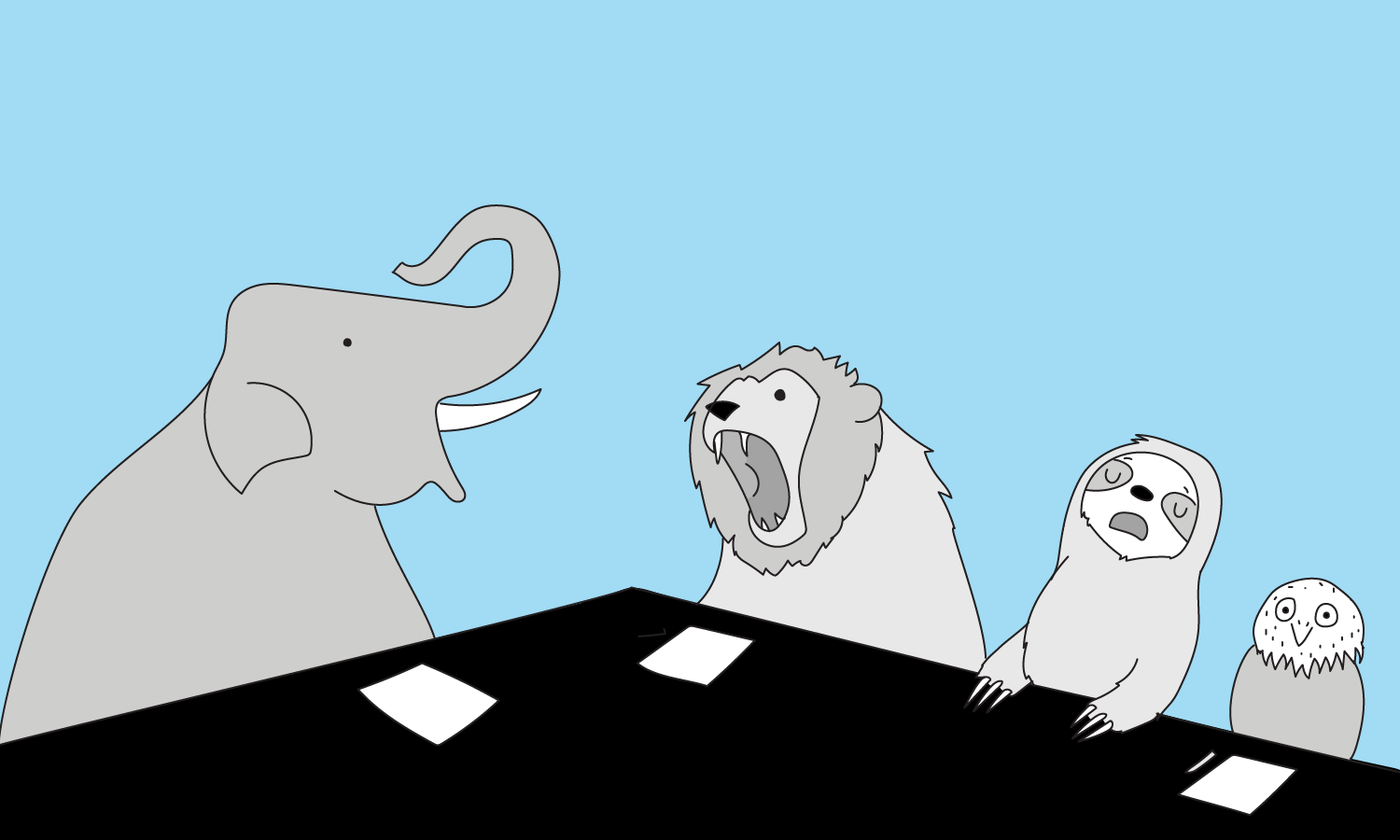
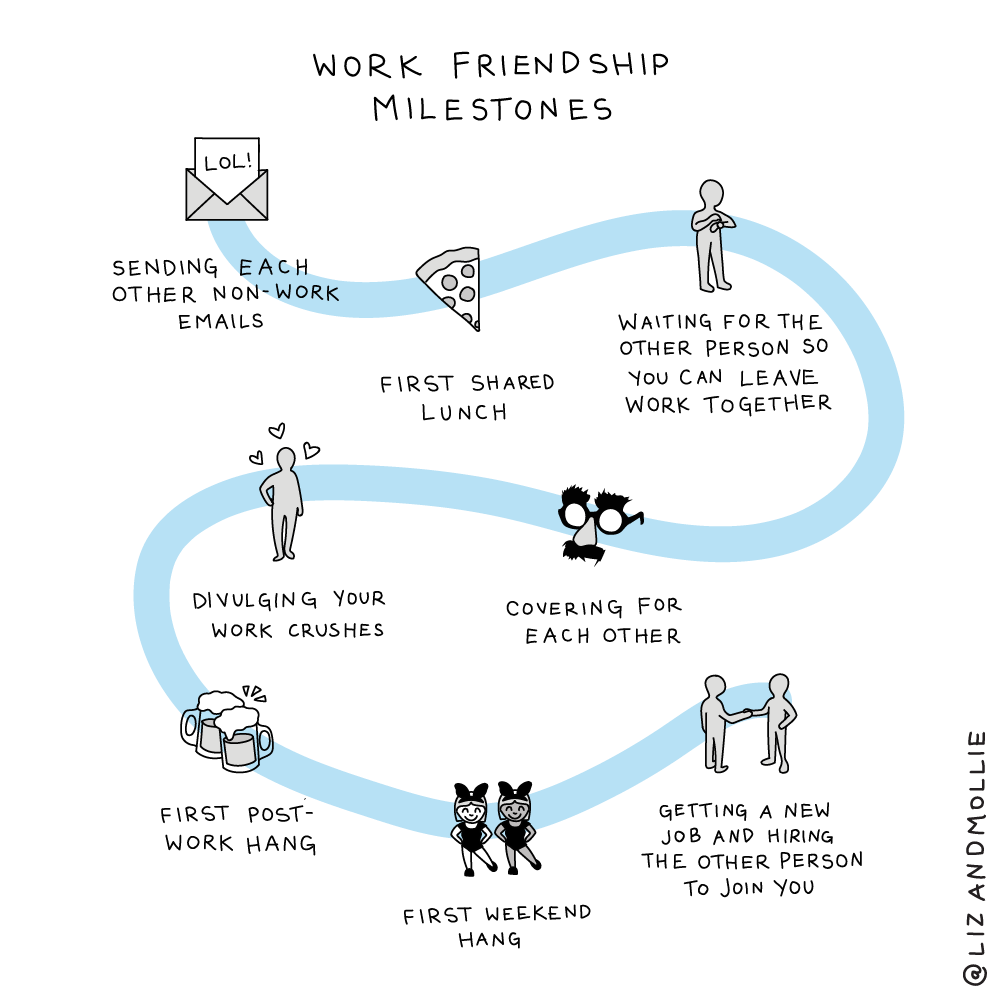
Work friends are very important, and different types of work friends can fill different needs. We’ll cover three: the confidante, the inspiration, and the frenemy. Understanding how and why you relate to these people will help you commit appropriate mental resources to developing workplace relationships that can bolster your motivation (and maybe even help get you out of bed on that Friday morning).
1. The confidante
This is the work friend who will commiserate when you’ve had a rough conversation with your boss, rush you to the bathroom when you’re about to cry, and give you honest feedback when you need it most. Confidantes make us feel like we can conquer the world—or at least ace a presentation and finally ask for that raise.
But these days, it can be tough to find a confidante at work. Because we tend to switch jobs more frequently, it can be hard to invest as heavily in workplace relationships. To counter that and find your confidente, start by building trust and sharing stories with a coworker you gravitate toward. Or initiate a get-together: People who provide social support to others—by organizing an office event or inviting colleagues to lunch—are ten times as likely to feel engaged at work than people who keep to themselves, says Shawn Achor, author of Before Happiness.
2. The inspiration
The inspiration is your platonic work crush: you don’t want to be with them, you simply want to be them.
This person can either be a colleague you deeply admire or a formal mentor. You probably could've guessed this, but mentors can help improve job satisfaction, teach us how to be effective leaders, and steer us towards the right career moves.
“They’ll bring a field to life for you. They’ll teach you how to find quality material in that field,” advises economist and author Tyler Cowen.
Pro tip: The best way to find a mentor isn't to ask, “Will you be my mentor?” but to start by asking someone for specific advice, then slowly work toward building a relationship.
3. The frenemy
We tend to choose friends who are similar to us, especially at work. But the more we have in common with someone, the more likely we are to compare ourselves to them. The frenemy is both our friend and our benchmark within the organization.
Another pro tip: Don’t feel guilty about experiencing the occasional twinge of envy! Frenemies account for almost half of all important members of our networks.

While frenemy relationships are linked to greater stress, they also motivate us to work harder. In a survey of consultants, those who had a frenemy made more of an effort to succeed and network. Leverage the positives of a tricky relationship by partnering on an important project; you’ll try harder to prove yourself and might end up with a real friendship.
But even the best work friendships have a dark side. Sometimes being close with our colleagues can leave us emotionally exhausted. Managing relationships we care deeply about while giving critical feedback or rushing to meet deadlines takes effort. Talk to anyone who has worked at a startup where coworkers describe themselves as a family, and you’ll inevitably hear how tiring it can be.
And for every friendship, there is also someone outside the friendship. The closer the relationship between two colleagues, the more others might feel left out, even if the friends aren’t actively excluding anyone.
Here are some concrete ways that you can engage with people at work to reap the rewards of having solid work-friends:
- Go for quality instead of quantity. High-quality connections don’t necessarily require deep or vulnerable relationships. Small moments of connection full of trust and engagement can be the beginning of something larger.
- Prevent silos from forming. IDEO structures all of its teams to include designers from different disciplines so each team is cross-functional. Our San Francisco office also has a ritual called tea time, in which people are invited to take a break from their work and mingle with people they don’t work with directly.
- Don’t rely on social events. Studies show that work parties aren’t always effective at helping people make friends. “People don’t mix much at mixers, and at company parties, they mostly bond with similar colleagues,” says Adam Grant.
- Spend casual time together. Google and Facebook plan times for employees to play games and eat meals together. At LinkedIn, the whole family can get in on the fun during Bring Your Parents to work day.
This post was adapted from Mollie and Liz's book No Hard Feelings: The Secret Power of Embracing Emotions at Work.
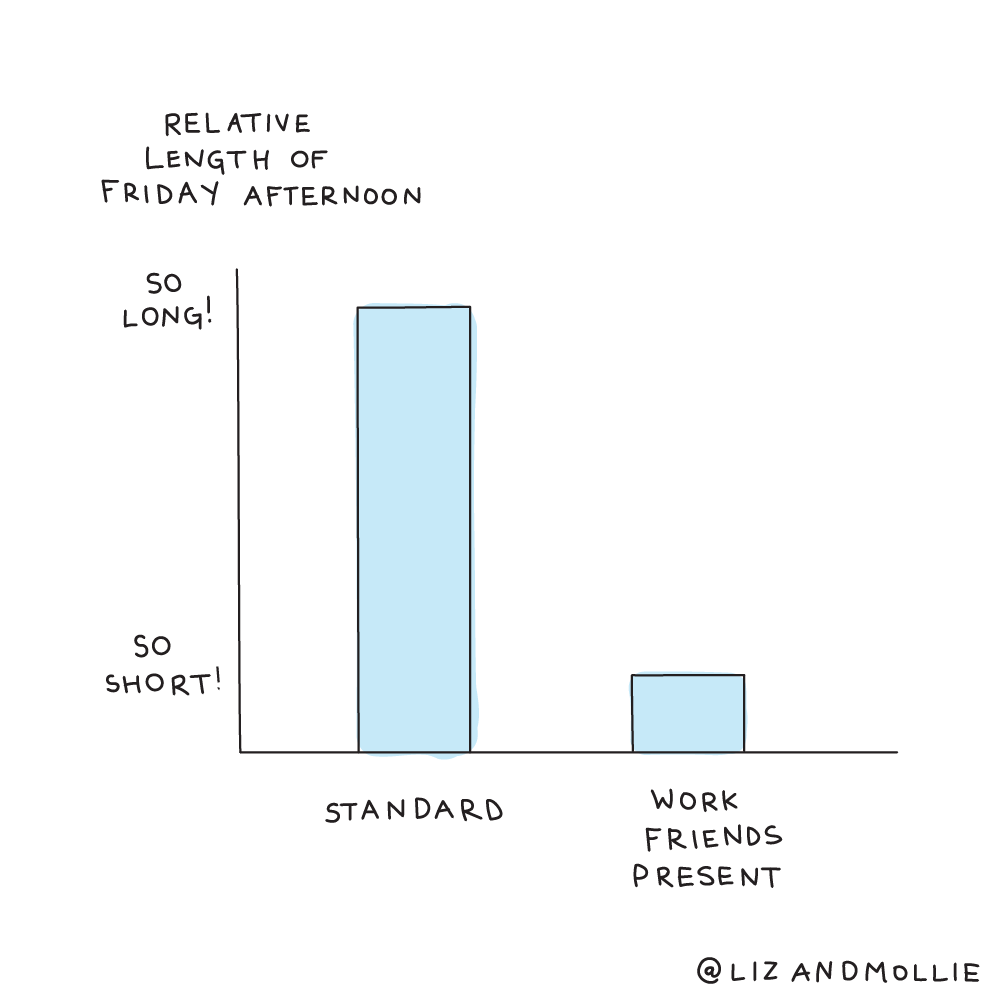
Choice, meaning, and opportunities for learning all make work more enjoyable. But on rainy Friday mornings when we’re low on sleep and irritated with our managers, research suggests our real motivation isn’t a what—it’s a who. People with friends at work find their jobs more satisfying, and are less affected by stress.
Thoughtless Acts: Monsoon Season
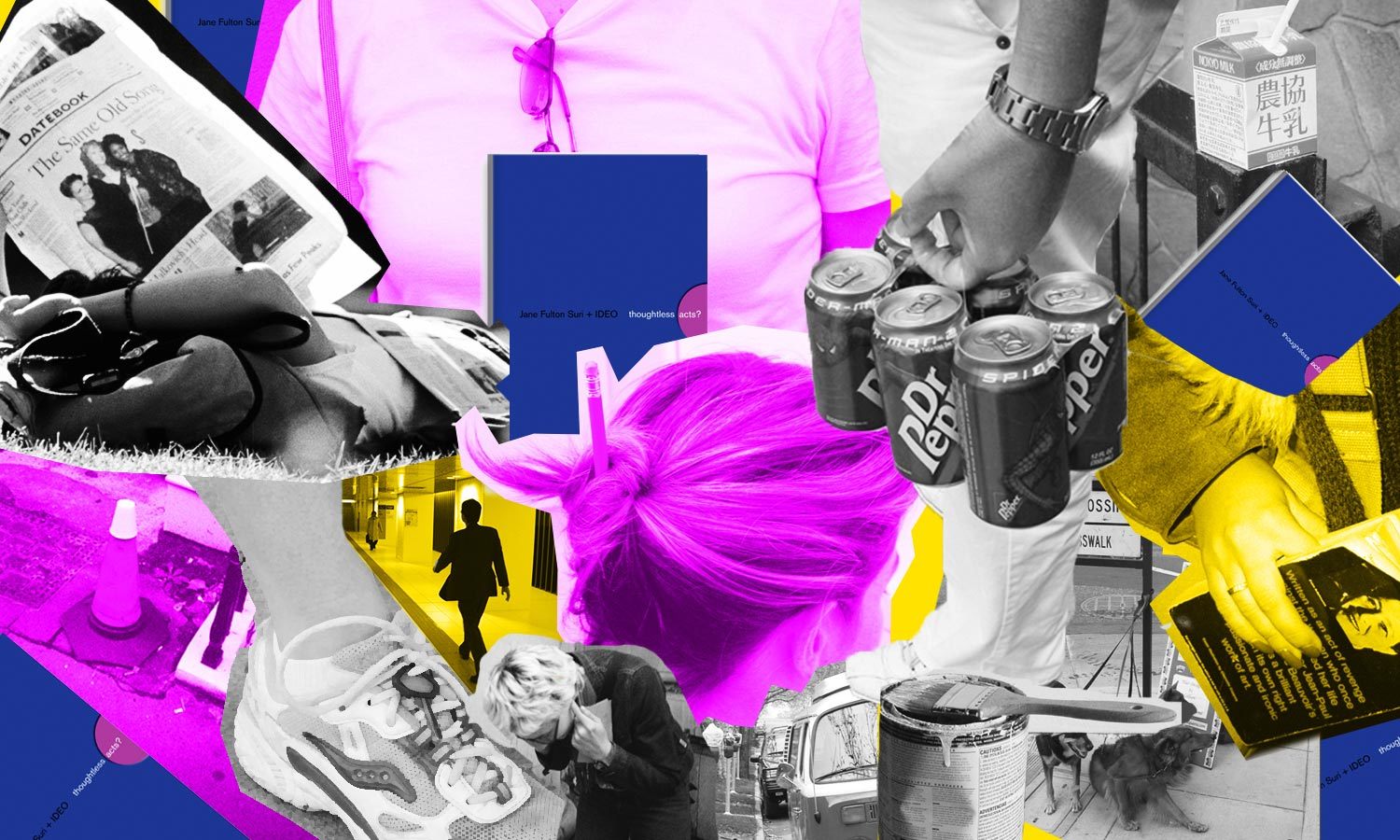
Thoughtless Acts: Monsoon Season. The intuitive ways we adapt and react to things in our environments

It's my first few hours in Bangkok, and by looking around the train, I can tell it's rainy season. Thin raincoats cover suits, and young mothers juggle both sunglasses and umbrellas.
As I exit the train, I look up, count to three and speed through a very thick rainstorm toward my Airbnb. After a much-needed nap, I open my eyes to a completely different climate. I peek through the shutters of my room and see an indigo sky, birds flying, and I am feeling the heat.
I pick up my fanny pack and leave the Airbnb immediately to explore the neighborhood. On a quiet side road, beside the fence of a wood craftsman shop, a thick black piece of tarp covers a corrugated fence. It’s held in place by a clever set of weights—filled plastic water bottles.
It strikes me that such an old trick can be found everywhere across the world. I start to wonder how can these four small bottles make it through such heavy, rainy days.
I stop to stare at a man approaching me. The woodchips on his shirt make it seem like he must be heading out from the shop nearby. He whispers something, unties a couple of bottles, and brings them to the shop's outdoor sink. These short bursts of sunlight heat must dry the water in them pretty quickly, I thought to myself. Regardless of the one million square meters of water falling over Bangkok each September, nothing beats the strength of a tropical sun, and the dedication of an old craftsman to keep his work tools dry.
Human-centered design requires us to observe human behavior with beginner's eyes, so that we can spot the innate ways people interact with the world around them. We call these intuitive and unconscious reactions Thoughtless Acts, and IDEO designers collect photos of them to inspire their work.

This Woodworker Puts a Modern Twist on an Age-Old Trade
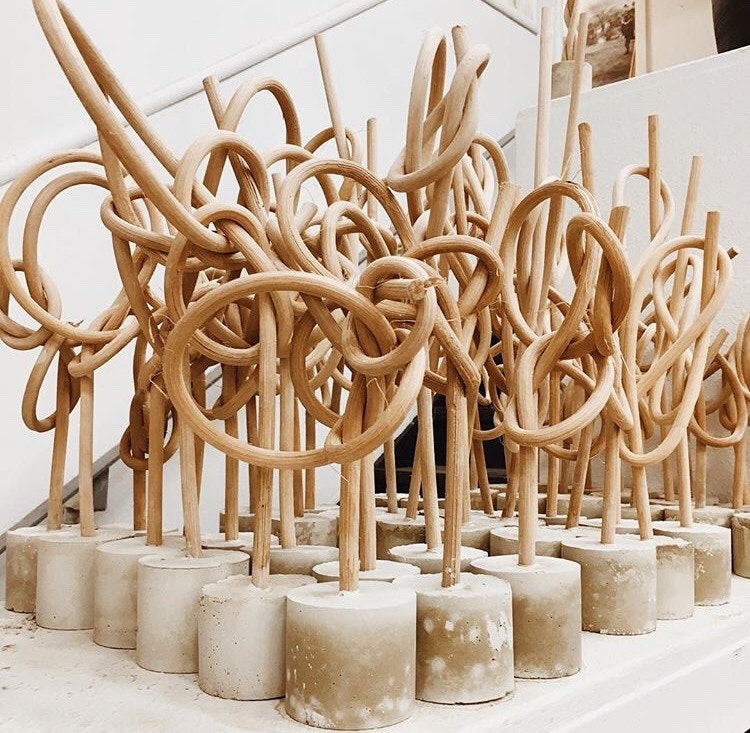
Katie Gong's art is full of loops, curves, and elegant bends
After steaming smooth, straight pieces of wood, Katie sculpts them into loose knots, braids, and squiggles, inherently fluid shapes that defy the medium’s natural rigidity.
To me, Katie’s work represents open-mindedness, possibility, and the means to evolve beyond appearance, expectation, or past. Her sculpture that sits in our living room—a wooden braid that bends upwards in an elegant arc, like a ballerina’s arm extending over the bar—reminds me to be unafraid to challenge the seemingly accepted, even when it comes to myself.
Katie sat down with me to share more about her craft, plus her fondness for classic 80s movies and finding freedom in chaos.

In one sentence, who are you?
I am many things: an artist, mother, wife, designer, and powerhouse.
What do you do? How did you learn it?
I’m an artist specializing in wood. I bend wood by steaming it, which is a unique and pioneering technique that challenges classic woodworking practices. I learned the craft from a young age. Growing up, my grandfather and father were both carpenters and taught me how to work with wood.

3 favorite possessions?
1. My father's Old Timer pocket knife. 2. My wedding rings and grandmother’s jewelry. 3. My adventure hat.
What does a typical work session look like?
I like to have a lot of projects going at once, so there are typically a couple things in the works at any one time. I tend to work a bit on each project all at once. Sometimes it can be a bit hectic, but there’s something in this chaos that allows me to move freely from project to project.
How do you get over creative block?
I try to take a step back. I change my surroundings and not think about the project. I find that once I zoom out, I find the solution I was searching for.
What was the last item on your to do list?
Getting a pedicure. Sometimes making time for myself can be tricky.
How do you see the world in 2078?
Hopefully I'll still be around then. Let’s see... I hope to be telling my grandchildren about growing up in the 80s, and blowing their minds by showing them ET and The Goonies. I hope that the world still holds on to the classics, like going for road trips, camping in cars, or reading books snuggled under a blanket while its raining outside. I hope that the world is similar to today and yesterday. Mostly, I just hope it’s not uninhabitable because of global warming or something crazy like a nuclear explosion.
What’s your number one bucket list item?
I’d like to have a solo exhibition in Japan.
Who are you creative crushin’ on lately?
My number one creative crush is always Aleksandra Zee. She's my creative sister. Windy Chein’s ombre knots are killing me, and Meryl Pataky is truly pushing the boundaries of neon art.
With a dose of hot moisture and a little imagination, San Francisco-based woodworker Katie Gong makes the seemingly stiff become supple. Kind of like my attitude after a bath.
Why You Should Get to Know Your Creative Alter Ego
How one designer's aha! moment helped him discover his bold signature style
Having already used acrylics, oil paints, graphite, and finally moving on to digital art, there was not much left to experiment with to broaden my artistic arsenal.
Or so I thought.
It was 25th of September, 2016, when my artistic alter ego was born. During that period of my life, I was searching for a way forward, having just returned from university without a job. I spent most of my time ideating and planning my next move.
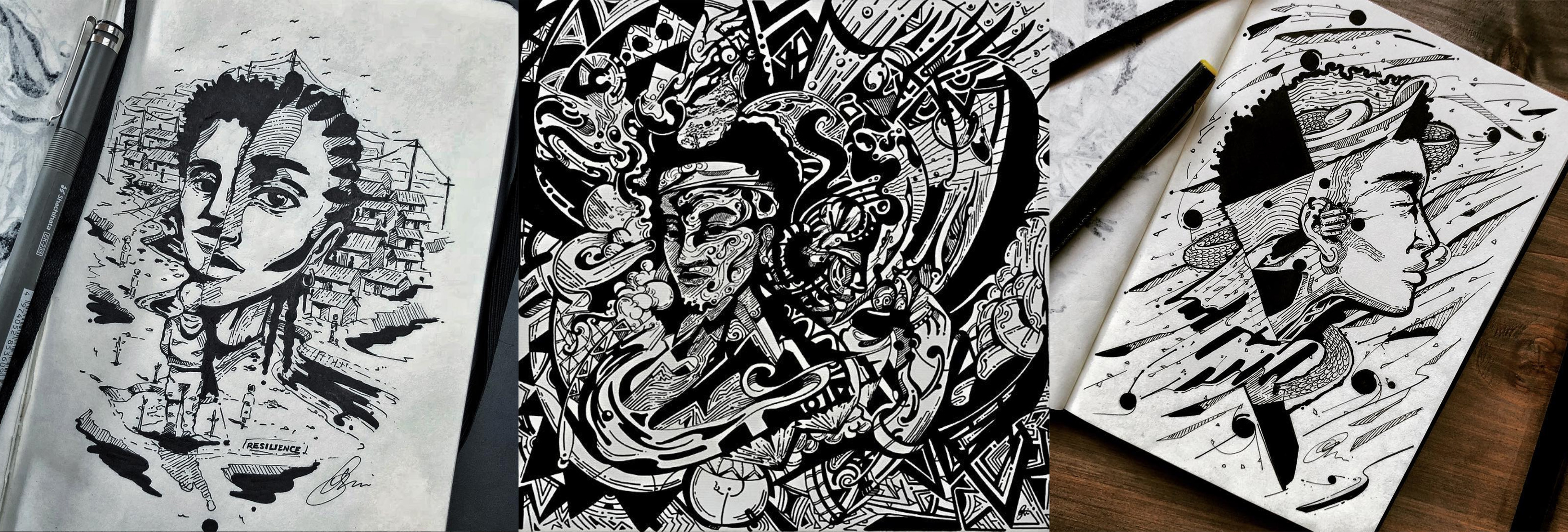
That afternoon, I sat down to take a break and illustrate my state of mind. I started what was meant to be a 20-minute drawing session with a 0.5mm fine liner. That pen, plus an old notebook that I had used back in university, became my weapon of creativity.
When I was done, I had a character that I named “the relentless dreamer”—a tiny figure with a peculiar helmet that shielded his wandering heart from reality as he knew it, granting him the ability to see far beyond the clutches of a life he deemed to be limited. This tiny figure reminds me that it is crucial to be idealistic, ambitious, and forever creative.
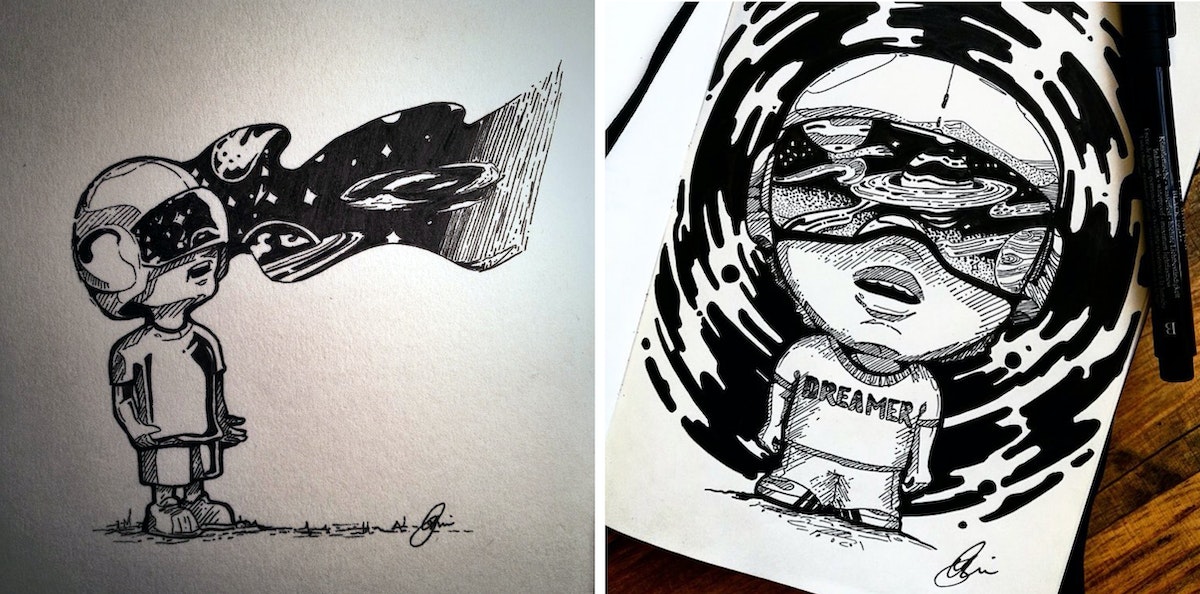
Drawing this character gave me an emotional release unlike anything I had experienced before through art. Though I was often plagued with a sense of anxiety around what my drawings would mean or stand for, this time, I felt weightless.
I began focusing on these black and white ink drawings, and the experience was cathartic. Each one entwined with the stories that brought them to life. Even though most of the figures I drew were imaginary, I was taking my life and experiences and expressing them through my illustration. I would envision part of the figure in my mind and let the rest appear.
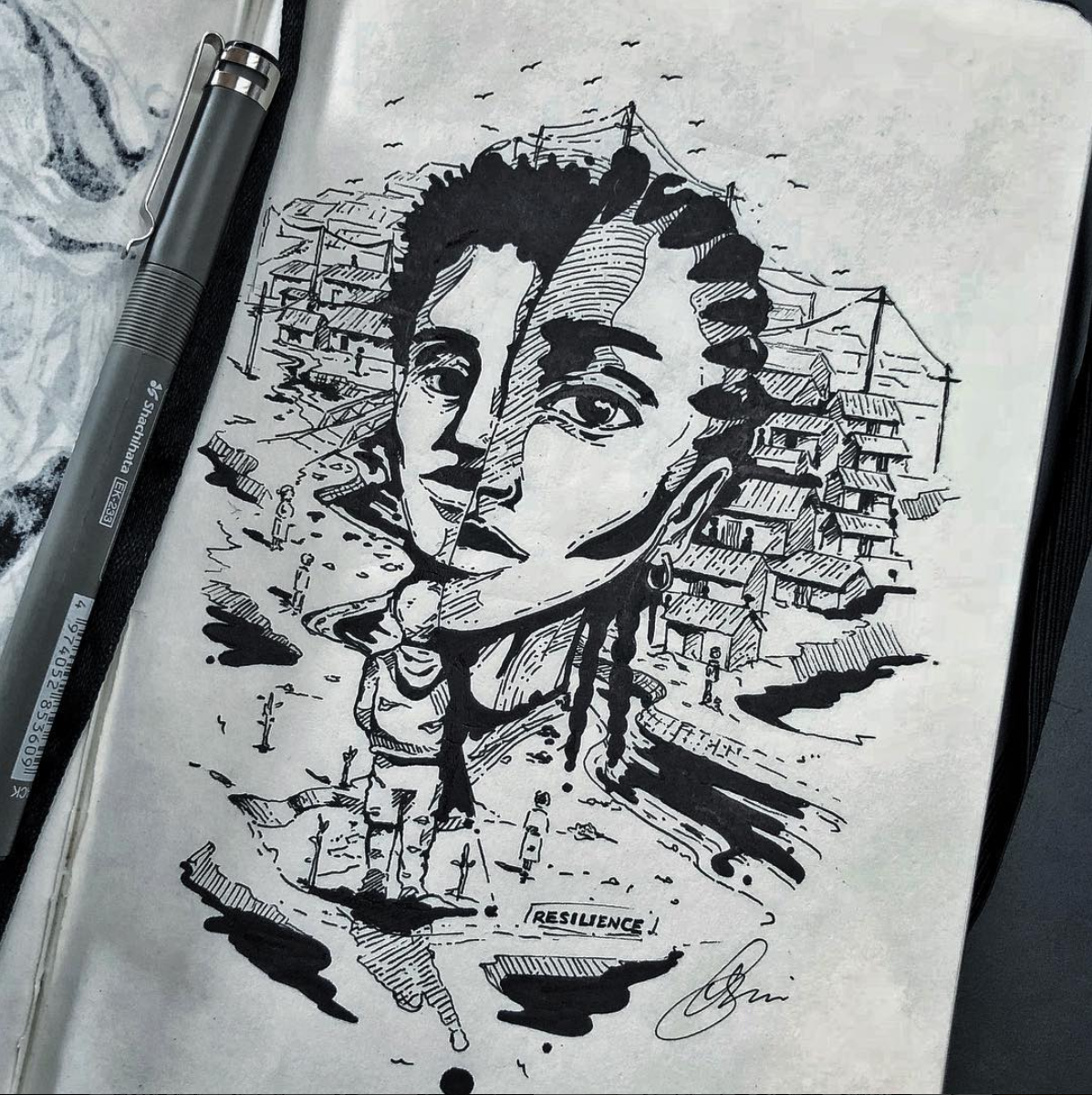
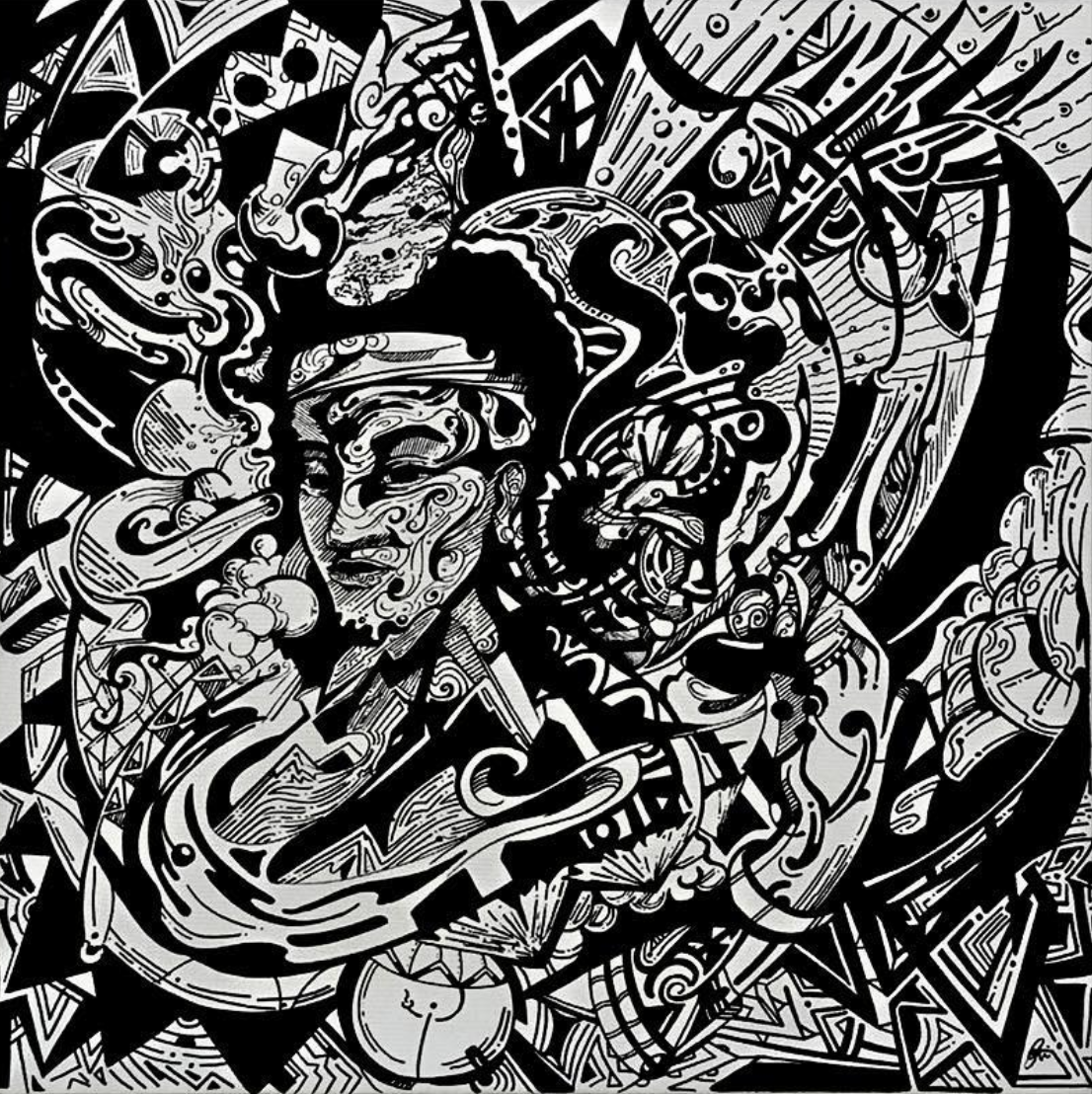
My intention was for viewers to move their eyes constantly as they looked for meaning in the drawing or simply made out the shapes.
Some of my work is dark, some full of mystery—a mystery I hoped that others would try solve as they navigate the intricacies of the line work.
Amidst all the visual chaos, there was one constant: A human element. The figures would serve as my connection to the pieces, and I hoped they would resonate with the audience, too.
These days, you will probably find me seated in the corner of a cafe with a fine liner pen. To many, I am just an artist, ardently sketching away. But what I’m actually doing is getting a little dose of sanity, as I move the images in my mind onto the pages of my book.
And in that very moment, I am dreaming… relentlessly.
Want to see what other IDEOers are drawing and doodling? Take a peek inside more designers' notebooks.
Two years ago, after spending most of my life mimicking artwork that appealed to me, I assumed that I had reached my artistic peak. I had been drawing since 1999. I still enjoyed working on portraits and surrealist compositions, but creatively, I felt stuck. After starting university, my product design work proved to be quite fulfilling, but my personal work was feeling uninspired.

Lindsey Turner
I’m passionate about building brands, products, and experiences that help organizations show up with meaning and momentum.
I help organizations cut through complexity by shaping how they show up, through brand strategy, identity, and storytelling.
Working at the intersection of brand and business, I bring an editorial eye and a bias toward making—turning ideas into tangible experiences that people can understand, trust, and believe in.
My work spans government, healthcare, financial services, media, and consumer goods, from launching Gen Z-focused ventures to building innovation labs and reimagining legacy brands. I relish moments of ambiguity and enjoy translating across teams, perspectives, and priorities to move ideas forward.
I started my career in editorial and digital design, shaping cross-platform experiences and identity systems in publishing and agency environments. That foundation still shapes how I work today: I’m detail-oriented, collaborative, and overreliant on the Oxford comma. I hold a BFA in Visual Communication from the School of the Art Institute of Chicago.

Rachel Young
My work helps organizations see who their products aren't working for—and build the will and the tools to do something about it
For 25 years, I've asked the same question: Who does this design exclude—and what are we going to do about it?
My work spans human-centered strategy, inclusive design, and qualitative research, with clients ranging from Microsoft, Google, and Verizon to the National Science Foundation, and San Francisco Unified School District.
Before IDEO, I taught elementary school in East Palo Alto and spent a decade doing design work with social service organizations—where I learned firsthand what it costs people when systems are built without them in mind.
I am currently writing User Error, a nonfiction book about digital access and the design decisions behind it. I live in Oakland, California.

Brian Pelsoh
I lead with craft, ensuring our work is creatively excellent: rooted in deep human insight and imagination, while also grounded in the realities of business and technology.
My expertise spans brand, communication, and product design across tech, education, the arts, and social impact.
I believe great work demands both high-level vision and obsessive attention to detail, and only happens through collaboration.
I bring an inclusive, hands-on approach and a deep understanding of business, which enables me to consistently deliver excellence while always asking why.
Before joining IDEO, I worked at the brand firms Pentagram and VSA Partners. I began my career as a designer, leading teams at the School of the Art Institute of Chicago and the Milwaukee Art Museum. I hold an MFA in graphic design from Maryland Institute College of Art and a BFA in communication design from the Milwaukee Institute of Art & Design, and have taught at some of the best design schools in the US.

Tony Wong
I am responsible for IDEO’s long-term success in China and working with clients to use design as a tool to enable growth.
I am responsible for IDEO’s long-term success in China and working with clients to use design as a tool to enable growth. Specifically, I have helped Chinese companies design holistic brand solutions through the development of their products, communication, services, and innovation teams, and I have helped multinationals expand their presence and influence in China.
I advise global leaders on developing China-led innovation and capabilities.
In over 15 years in IDEO Shanghai, I have worked on projects that use design to elevate the quality of the experience of healthcare products and services, streamline processes that increase productivity, create spaces and programs that promote and enable inclusive communities, and build next generation mobility solutions that are planet-positive.
Before joining IDEO, I worked at Philips Electronics and the Electrolux Group in Italy, the Netherlands, and Singapore on a number of breakthrough commercial products. I am a member of the Young President Organization in Shanghai.
Facilitative leadership: Dabney Hailey
Leading through questions, participation, and the intelligence of the group.
We talked with Dabney Hailey, founder and principal of Hailey Group, about the Visual Thinking Strategies (or VTS) method, why it works, how to bring elements of it into your daily practice, and why leaders should shift to the facilitative leadership style this method teaches. Read the recap at
How to think in systems: Deirdre Cerminaro
A practical introduction to seeing interdependencies and designing for complexity.
Human-centered systems thinking is an approach to problem solving that helps you see the interconnectedness of things while also staying grounded in the needs of your stakeholders. Deirdre Cerminaro, IDEO Executive Design Director and IDEO U instructor, shares IDEO’s approach to systems thinking. Get tools, mindsets and examples you can apply to your own work to help you surface more impactful solutions. View the full recap at

Generalist vs. specialist: David Epstein
Why broad experience can be a powerful advantage in complex work.
Learn how being a generalist can lead to career success with David Epstein, New York Times bestselling author of Range.
A framework for impactful presentations: Caricia Catalani
A simple structure for presentations that are clear, persuasive, and memorable.
Learn how to incorporate improv techniques into your presentations for greater impact and engagement in this conversation with Caricia Catalani, Senior Design Director at Pear Therapeutics.
Looks like you might be in search of something very specific?
Or reset the filters above and try another angle.
Here’s some random inspiration

Podcasts about creative leadership

Articles about the power of prototyping