
Culture as catalyst
Moderna defines its Mindsets to preserve its future.
Many companies view culture-building initiatives as nice-to-haves. At Moderna, Mindsets are a business imperative, crucial to its plans to develop breakthrough products quickly.
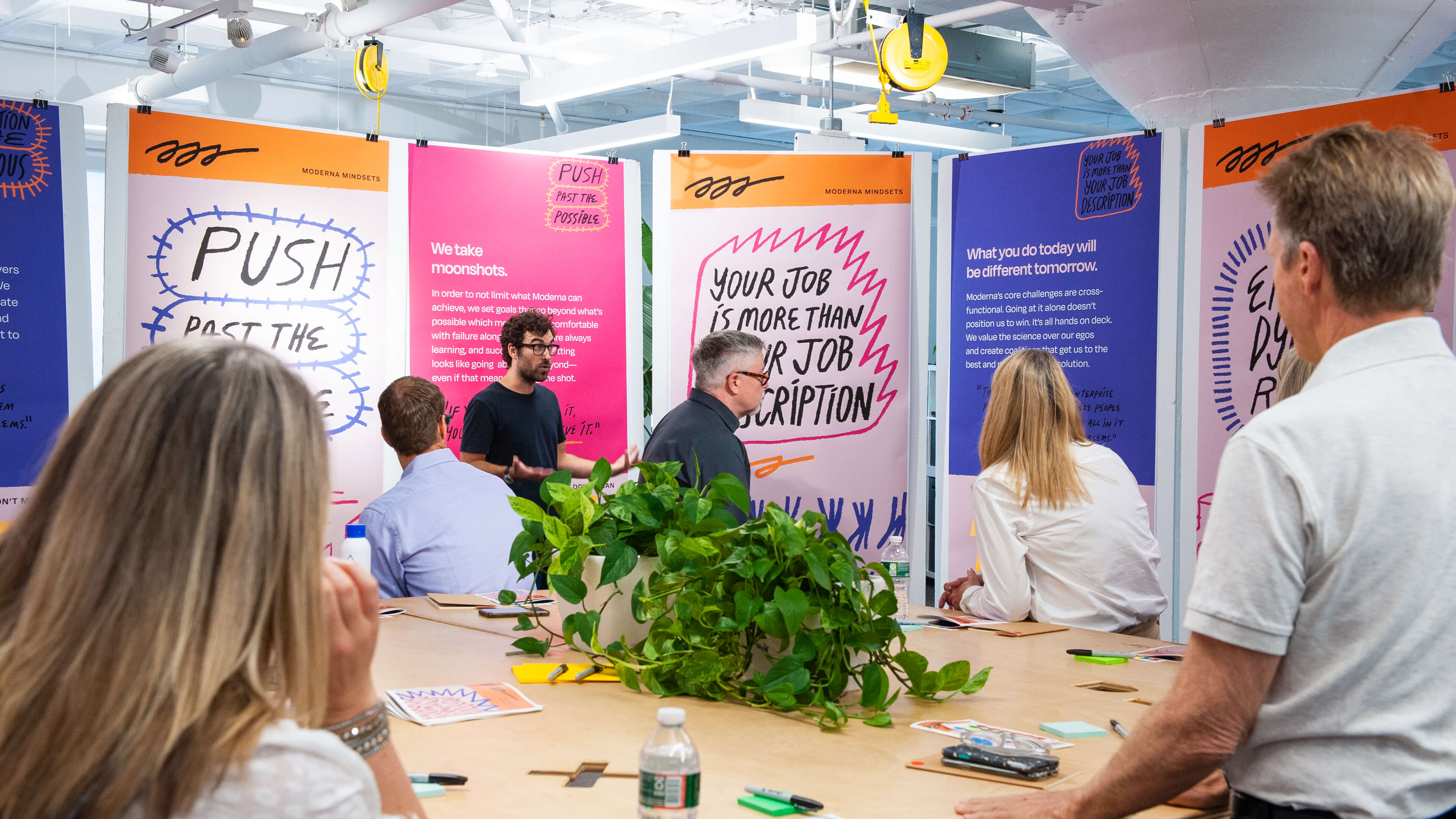
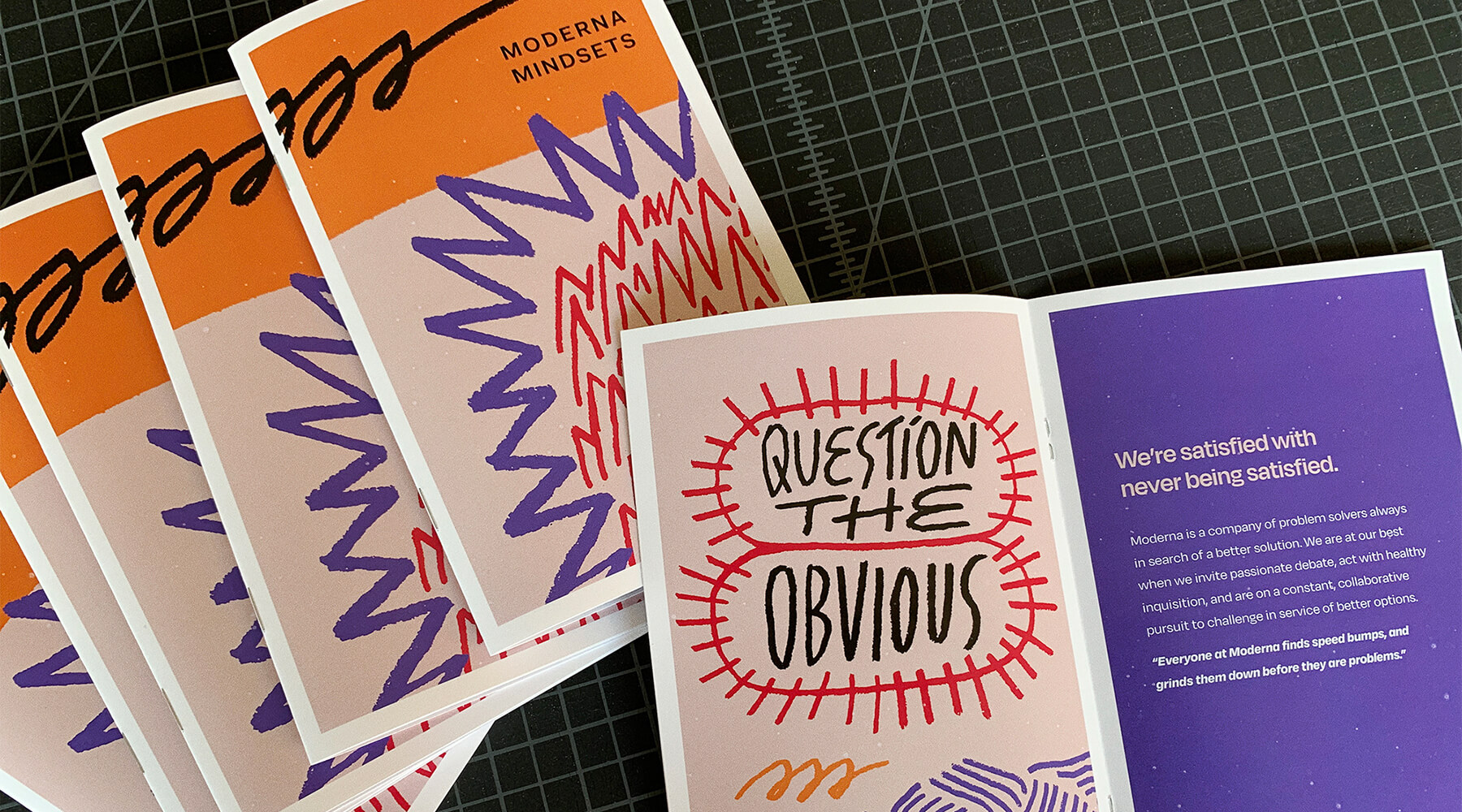
For companies working on solutions as vital as a COVID-19 vaccine, delays and mistakes don’t just mean missing a product launch date—they’re life-or-death, and on a large scale. Moderna had to ensure that its employees knew how to make the right decisions, evaluate risk, and move quickly—even if they came from organizations with more bureaucracy and less risk tolerance. In 2021, IDEO sat down with longtime Moderna veterans to hear stories about moments that exemplify the company's culture, like the day a critical piece of equipment arrived but was too big to fit through the door. Taking it apart would have added days to their timeline. So employees took sledgehammers to a wall instead. Stories like this one fed into the crafting of the list of Mindsets, such as “Act with urgency: Action today compounds the lives saved tomorrow” and “We behave like owners: The solutions we’re building go beyond any job description.”

To gather feedback, the team shared the draft Mindsets with a diverse set of employees—new hires, veterans, folks already closely aligned with the culture, folks for whom it wasn’t the most natural fit, and a plethora of employee resource groups. CEO Stéphane Bancel and the leadership team took crafting and iterating on the Mindsets very seriously, wordsmithing and tweaking them with the team until they were ready to share them officially. Now, new hires learn about the company’s Mindsets in Moderna ONE, an onboarding process that IDEO helped revamp, while existing employees attend a workshop to ensure everyone at the company knows not only what to do but also how to do it effectively. In a matter of weeks, IDEO helped Moderna codify its culture for employees and set the company up for continued success. Moderna continues to embed these Mindsets across the entire employee lifecycle to systematically scale its culture.
For employees new and old, the clarity of the Mindsets has made it easier to understand expectations and to understand the company itself. Long-term veterans responded with comments like, "These really help explain why we're working this way,” while one newbie said, "It feels like a homecoming to hear the culture that we’re trying to bring through.” But more than just solving a cultural issue, the new Mindsets have fulfilled a business imperative: Holding on to the secret sauce that made Moderna successful to begin with, setting the stage for its next five years of breakthroughs.
When the World Health Organization (WHO) declared the COVID-19 health crisis a pandemic in March of 2020, Moderna had fewer than 1,000 employees. Four years later, it’s more than five times the size.
Ranked #1
BioSpace Best Place to Work, large company in 2024
Ranked #6
Boston Consulting Group’s 50 Most Innovative Report in 2023
Ranked #4
Deloitte’s Technology Fast 500 List in 2023
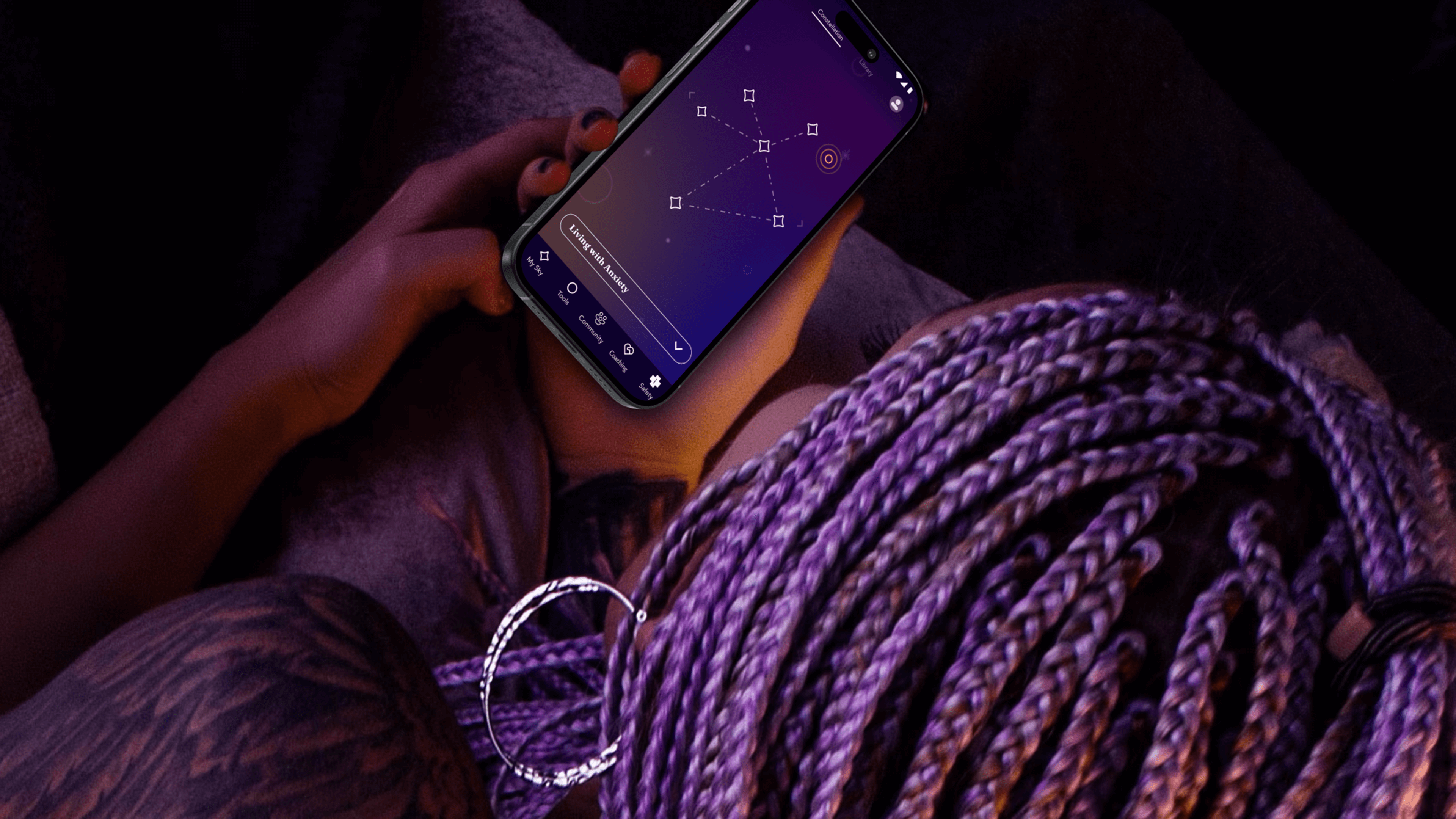
Mental health, co-designed
Kooth partners with young people to create Soluna, a mental health resource for California youth.
Increasingly, digital spaces are proving detrimental to youth mental health. By co-designing with youth, Kooth and IDEO set out to flip the script, creating a positive digital space for young people to safely explore their mental wellbeing.
When Kooth, IDEO, and Blackbird, IDEO’s longtime development partner, first started working on the project, the window of opportunity was narrow, and the stakes were high. The group was up against a nine-week deadline to create a working proof of concept app. Also on the line: a $188 million contract with the Department of Health Care Services (DHCS)—one that would open an entirely new line of business for Kooth.
The app needed to do more than demonstrate functionality—it needed to prove its value. To ensure that they were creating an asset that truly fit the needs of young people, the team turned to an initial cohort of 13-25 year-old co-designers who explored early features, created video diaries, and shared their questions about and experiences with mental health. These young people often gravitated toward self-service tools that helped them take action based on their feelings. With their feedback, the team created new expressions of clinically-validated behavioral health tools like journaling, breathwork and white noise—and built novel tools, such as Starboard, an expressive drawing tool and a nod to art therapy.
The team took inspiration from content the co-designers liked to consume, such as story-driven video games that enable freedom of exploration, deepened by a unifying mythology. That led them to a constellation theme, which made the experience more intriguing and playful. The co-designers also recommended a dark color palette, because they preferred exploring the app at night.
With these insights, the team refined the proof of concept, and then conducted a one-week pilot with another 50 young people across California. Their positive feedback gave the State the confidence to invest in a $188 million, four-year contract for Kooth to bring the app to a platform at scale.
Over the next year, the team engaged another 150 young people to help design, shape, and test the app. At the same time, Kooth and IDEO created a clinical oversight group, which included a pediatrician, therapists, and other clinical specialists. This group anchored the platform in the practices of Acceptance and Commitment Therapy (ACT), cultivating psychological flexibility—the mindful acceptance of positive and negative emotions. Young people are invited to complete short reflections and surveys throughout their journey with the app, which includes rigorous, science-backed measurements to assess the therapeutic benefits.
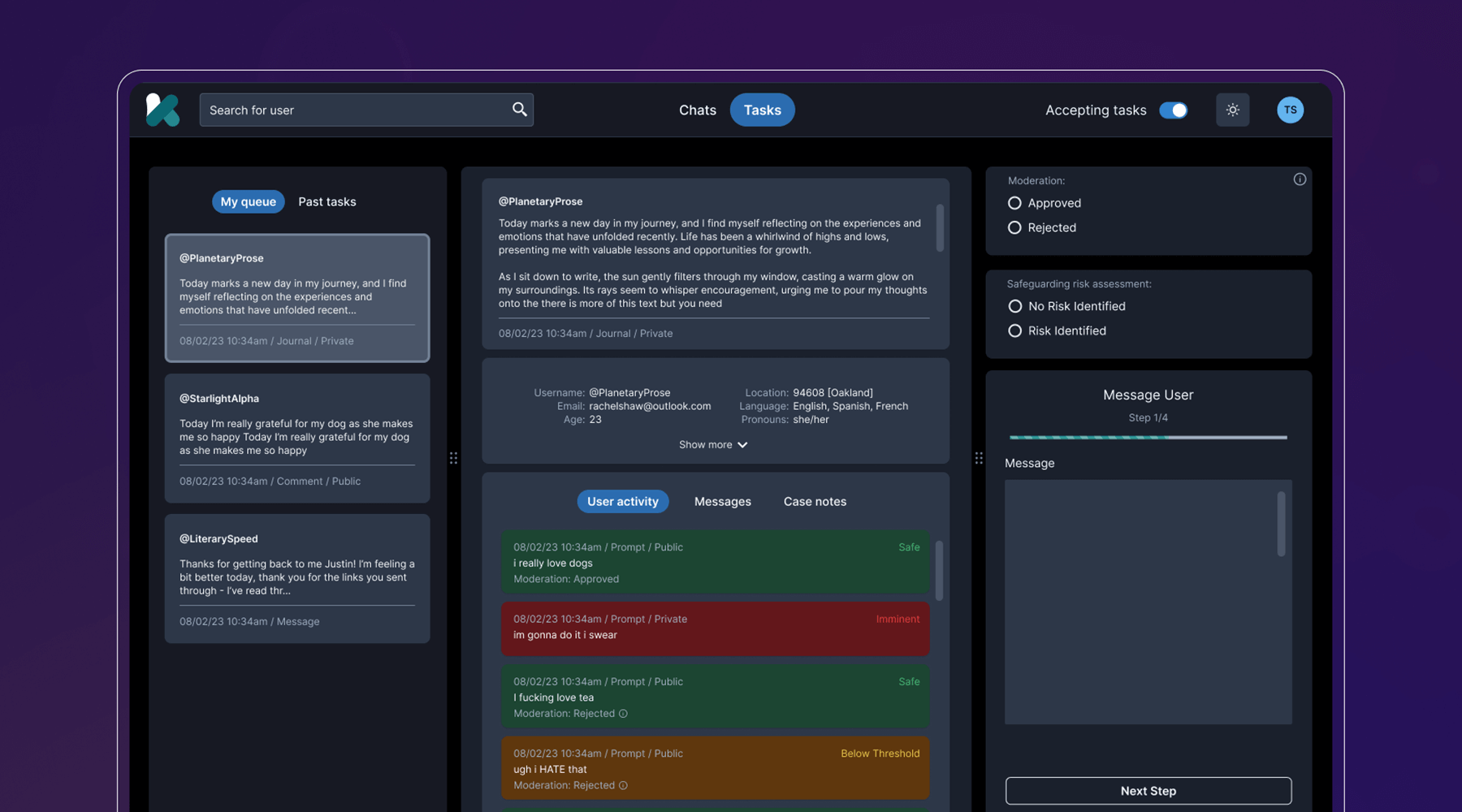
Behind the scenes, the team developed a clinical-facing service and digital platform that empowers Kooth’s peer specialists, social workers, community curators, and clinicians to support the youth experience, all while protecting privacy and confidentiality. They also navigated a complex landscape of state requirements and government legislation, ensuring that the platform could cover topics like substance abuse and gender identity, and that users could access coaching within 24 hours, and choose from a diverse set of experts.
The last step was to select a name that worked across multiple languages, trademarks, and competitor branding, and didn’t come off as a mental health service, something the youth co-designers believed was critical. IDEO and Kooth landed on Soluna, a name that alludes to the app’s presence in both the bright (“sol” for sun) and the dark times (“luna” for moon).
Now, Soluna is available for free to all youth in California, and the state has set ambitious targets for reaching all young people at scale. Soluna is a living platform that will continue to receive product and design updates for years to come, all deeply rooted in youth co-design.
The US Surgeon General named mental health “the defining public health crisis of our time,” and cited social media, online bullying, and the isolation exacerbated by the COVID-19 pandemic as major drivers that have significant negative outcomes for youth.
In California alone, more than 284,000 youth cope with major depression. 66% of kids with depression do not receive treatment. Between 2019-2020, the suicide rate for kids ages 10-18 increased by 20%.
In 2022, California Governor Gavin Newsom’s Master Plan for Kids’ Mental Health set aside $4.6 billion to increase access to mental health and substance abuse support, the largest commitment to youth mental health ever made by a state.
94%
of proof-of-concept app users would recommend the Soluna app to a friend, and believe that engaging with the app would be a positive addition to their daily/weekly routine
6 million
young people in California had access to Soluna at launch in January 2024
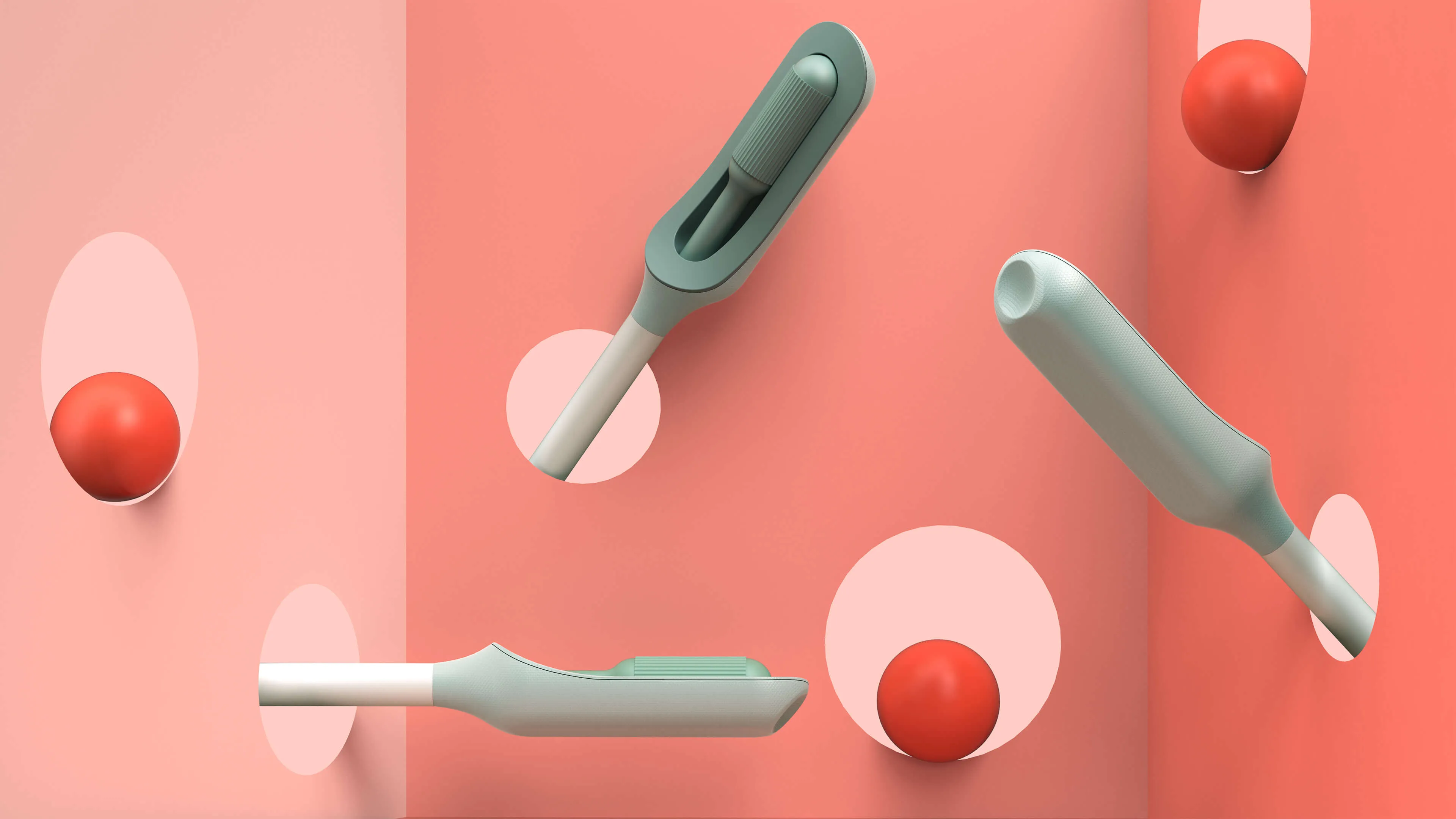
A more comfortable Pap smear
Teal Health creates a system for at-home cervical cancer screening.
Creating a better cervical cancer screening experience is an important mission, but also a challenging one. Not only would Teal have to address the regulations that face healthcare device companies, it would also need to build a comprehensive telehealth platform and a physical product—a wand that could easily collect an adequate cell sample, even in the hands of an untrained person.
The first challenge was to create the wand. The device would need to do a lot: It’s impossible for a person to see their own cervix, so the user would have to be able to find the cervix blind, collect the sample themselves, and remove the wand from their bodies without contaminating it on other parts of their anatomy. Because this is something users are likely to do in their bathrooms, where there is no space to lie down, they would need to be able to use the device while standing—and with one hand. From the beginning, the IDEO team set out to design functional, testable prototypes to make sure the idea was viable, and incorporate diverse voices into the research process, including trans, minority, and disabled women.
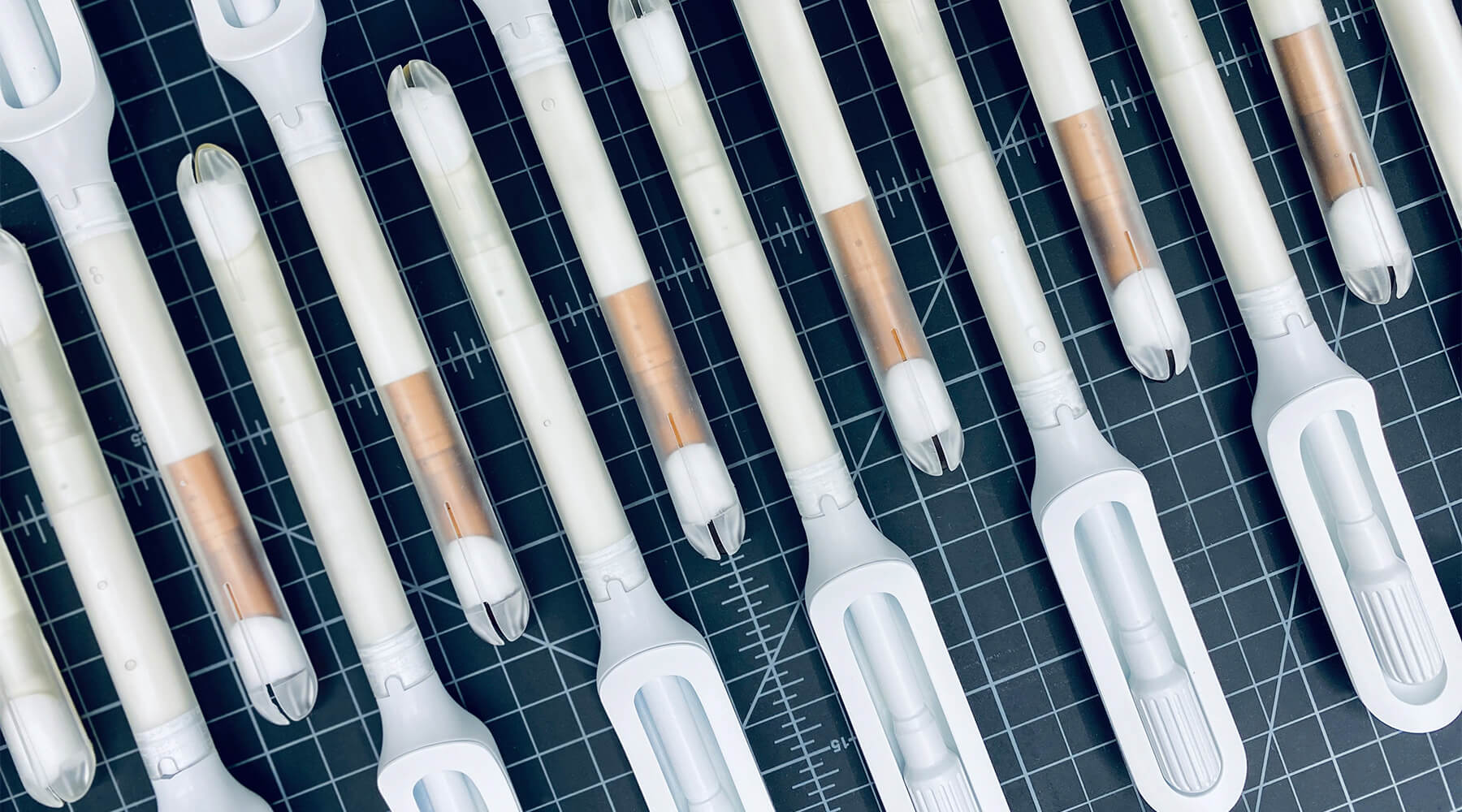
Because the product is meant for people who aren’t medical professionals, the team worked to design something as simple, intuitive, and unintimidating as possible. They used a 3-D printer to create multiples of every prototype, autoclaves to make sure that the designs they were creating were sterile, and leaned into shapes women are already used to, like the cylindrical shape of a tampon. The wand they created has that same basic form, but with a soft sponge that the user can deploy with the turn of a dial to collect the sample, then close to protect it from contamination on the way out of the body.
With working prototypes in hand, Teal set out to test their efficacy. In an initial study with 220 participants varying in age, race, socioeconomic status, and geography, Teal found that not only were participants able to successfully self-collect samples, they also preferred them over the speculum, the device doctors typically use during a screening. Some 92 percent said if they knew the results were equal they would prefer self-collection, while 87 percent reported they would stay current with screening if Teal Wand was an option. Self-collection took the vast majority under two minutes to complete, and 97% of study participants reported it was very easy or easy to use. The Teal Wand recently received a patent for its unique design.
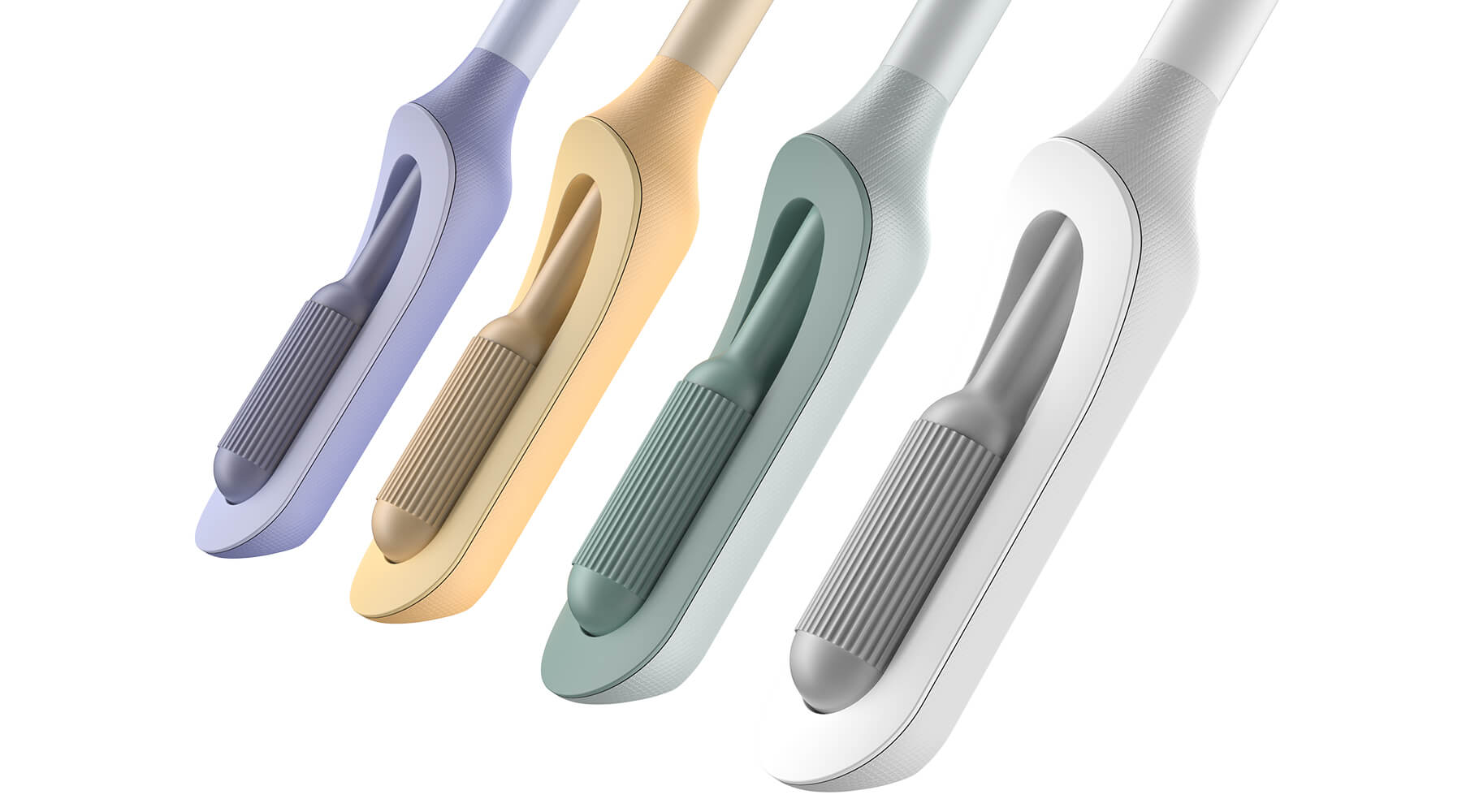
The IDEO team also worked on the packaging and unboxing experience, which plays an important role in supporting the user through the self-screening process. The team built in thoughtful design cues to give users reassurance that they are using the wand correctly, and to provide the same level of confidence they would have in the results of an in-clinic screening.
In January 2023, Teal raised $8.8 million in a seed funding round from Serena Ventures, Emerson Collective, and Metrodora. Later that year, the company launched a nationwide clinical trial with leading health organizations including Johns Hopkins University, Yale University, the University of Colorado, and Washington University, among others. In 2025, the Teal Wand became the first FDA-authorized device for at-home cervical cancer screening, with virtual medical provider support, and became available in all 50 states. Due to soaring consumer demand and increased insurance coverage starting in January 2027, Teal Health secured $22 million in Series A funding to expand access to the Teal Wand. It’s an enormous step toward the company’s North Star: catching cervical cancer earlier and saving lives.
Cervical cancer is nearly 100% preventable when it’s caught early, yet one in four women in the US are not up to date on their screenings.
More than 12,000 people in the US are being diagnosed with cervical cancer every year, and more than 4,000 people die of the disease, which disproportionately impacts Black, Asian, and Hispanic women.
More than half of cervical cancer cases are found in women that are not up-to-date on their screenings.
$22M
raised in a Series A round to expand access to the most accurate FDA-authorized at-home HPV cervical cancer screening
97%
of clinical study participants said the Teal Wand was very easy or easy to use.
87%
of participants said they would be more likely to stay current with screening guidelines if Teal Wand was an option.
94%
of participants said they would choose to collect their own sample from home rather than the current standard of care where a clinician collects it in-office.
Amplifying a movement
Cities United rebrands to create safe, healthy, hopeful communities for Black men and boys.
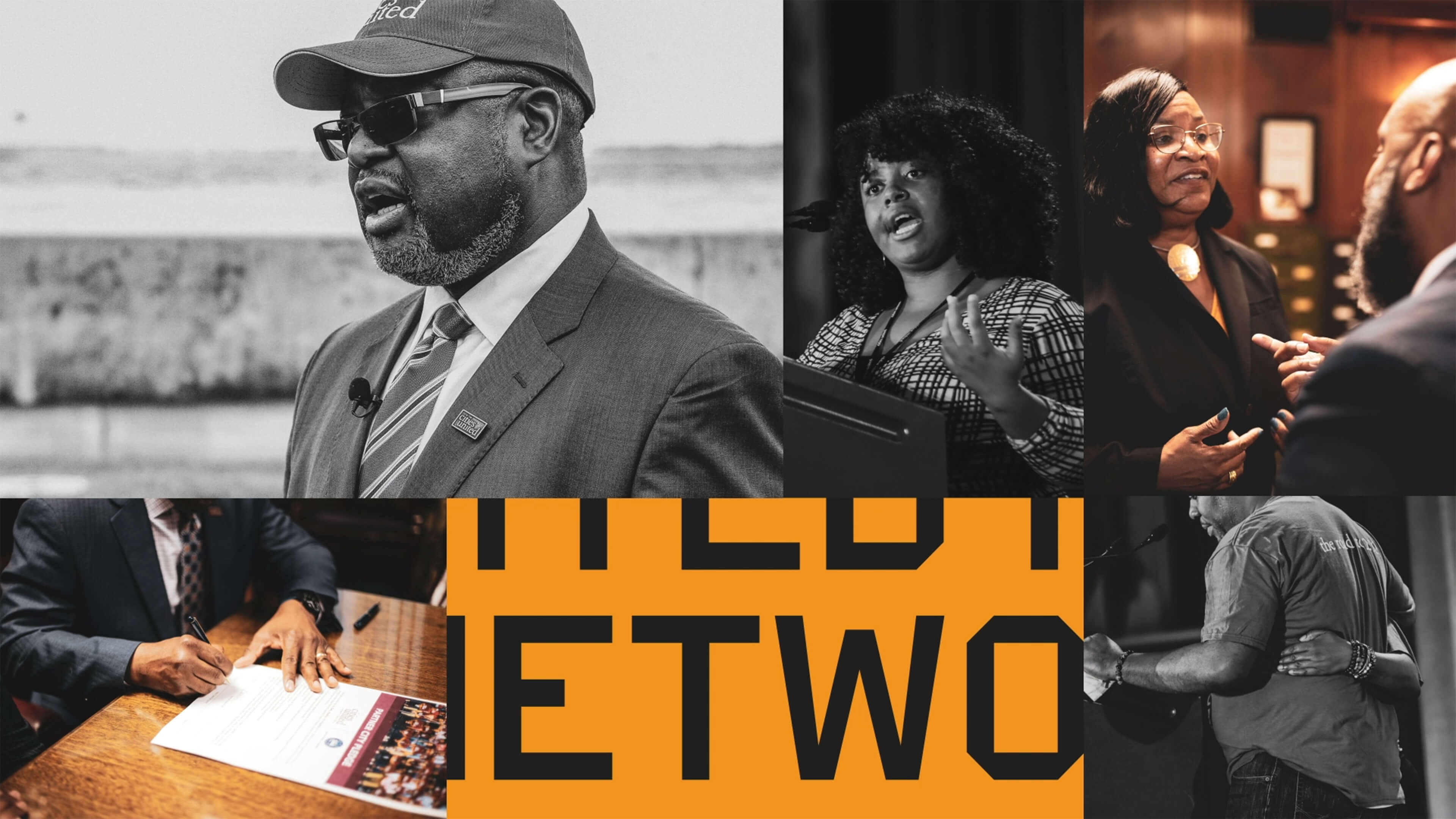
Cities United already had a strong foundation with its stated mission, vision, and values. IDEO brought those to life with a new visual and verbal brand identity system that celebrates Cities United’s inclusive approach to building relationships and reimagining public safety.
To help Cities United with its verbal identity, the IDEO team defined the organization's voice, tone, and key messages, making it easier to tell its story more consistently and clearly, a crucial step toward engaging stakeholders.
To define the new visual identity, the team created a new logo, a letter C composed of interwoven shapes that represent the three tenets of their vision—“safe, happy, and hopeful;” a new design language that references city grids; and a typographic system anchored by the typeface VTC DuBois, inspired by W.E.B. DuBois’s own custom lettering and designed by the Black-owned Vocal Type Co. The team also designed a color palette that embodies the textures of city life with hues reminiscent of asphalt, sunrise, and brick.
To amplify the refreshed branding, the team designed a new responsive website, citiesunited.org. The intuitive site shares the organization’s mission, resources, ongoing projects, and partner network, inviting stakeholders to join in their transformative work. IDEO also created a video to humanize Cities United’s mission and showcase its nationwide impact. It underscores the unity, resilience, and hope embodied by the organization through a chorus of voices.
This comprehensive rebranding widens Cities United’s reach and impact, helping the organization share its goal of creating safe, healthy, hopeful communities for young Black men, boys, and their families, and reintroduces the organization to a national audience.
The Cities United work was supported by IDEO’s Racial Justice Impact Fund, part of a commitment IDEO made in 2020 to address systemic racism and advance equity within our own organization, our client work, and beyond.
Cities United is committed to reducing the epidemic of homicides and shootings among young Black men and boys ages 14-to-24 by 50%.
Between 2009 and 2019, the number of Black children who “did not go to school at least one day in the past month because they felt unsafe at school or on their way to or from school” increased by 84%, according to Cities United.
Homicide is the leading cause of death for Black men and boys from birth to age 44, according to the Centers for Disease Control and Prevention.
2023 SF Design Week Award
In recognition of IDEO’s brand work with Citizens United

Training a Computer to Find Shapes in the Clouds
This IDEO software designer created an app that searches the sky
I spent my afternoons on a small wooden pier, relaxing and staring up at clouds, looking for shapes. That pursuit is an exploration of pareidolia, the psychological phenomenon in which the mind responds to a stimulus, usually an image or a sound, by perceiving a familiar pattern where none exists. It was in that leisure time, trying to make sense of the clouds, that I found the comfort that I’d been seeking.

Nine years later, I found myself back in America, interning at IDEO Chicago, where I had far less opportunity for leisurely cloud gazing. Without the spare time to hang out on a pier, I wondered if I could engineer the same kind of comfort. Could I design an experience that brought back those long dreamy pareidolia days with the help of an app?
After all, people in my age bracket, between 25-34 years old, only spend an average of 13 minutes per day relaxing, according to the American Use of Time Survey, and experts say that we need to acknowledge and accept that we’re leisure-limited. Maybe this could be a shortcut to that leisure we’re missing.
So I created “Pareidolia,” an app that searches the sky on my behalf. It’s my way of trying to keep a part of my mind exploring, even when I need to be inside, working. If the app thinks it sees something in the clouds, it pings me to take a look.

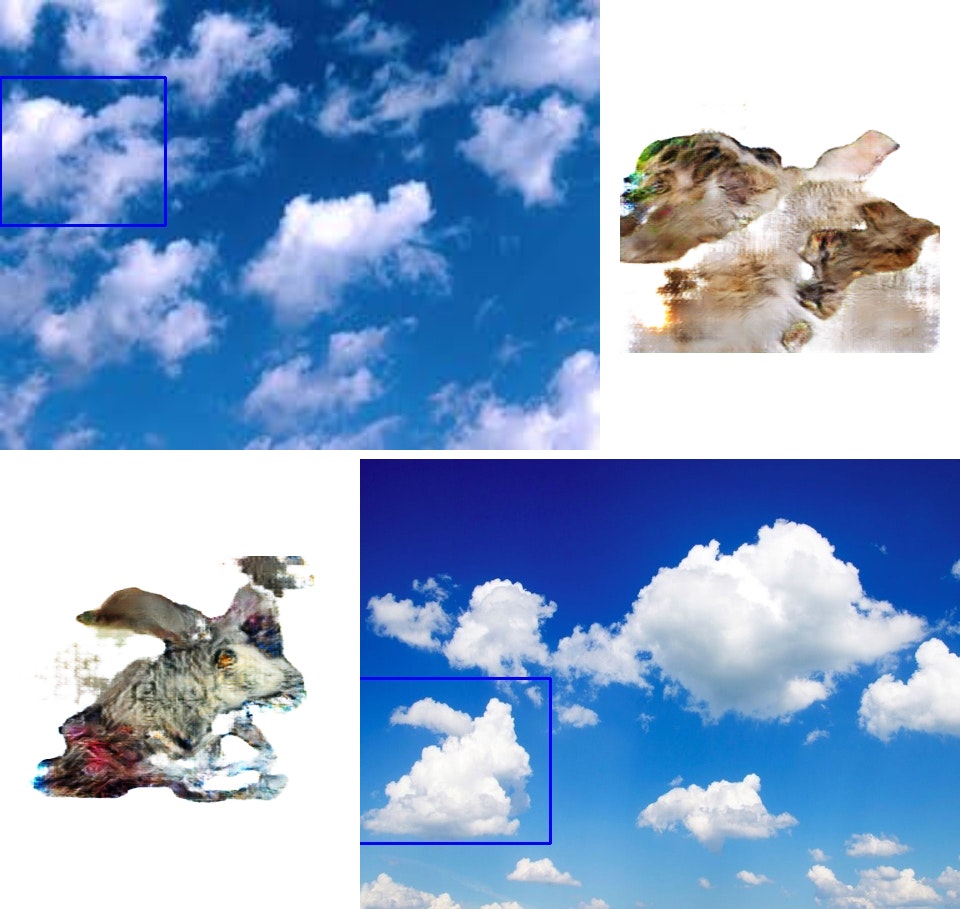
To create Pareidolia, I set up a Raspberry Pi and a camera on the terrace of our Chicago studio, and programmed it to look continuously at the sky, searching for interesting shapes. The project uses computer vision, tensorflow, and keras to perceive images in clouds, then snaps an image, generates a drawing of what it imagines it might look like, and shares them via Slack. (The code can be found and downloaded from this Github repo.) It tells us what it sees in the sky in real time and invites us to go out and look for it.
As I started to share Pareidolia with colleagues and friends, my creation was met with mixed reviews. Ross Weijer, a data scientist here at IDEO Chicago, thought that it created efficiency while offering a different perspective. “Technology is something that speeds up your life and, lets you do things quicker,” he said. “So I think it’s subversive and helpful to have the aim of this project be to spare your imagination. It’s saying, ‘Stop, stop, take a moment to consider this.’”
Others, though, felt that the payoff wasn’t seeing images in the clouds, but actually, the act of searching for them. “I look at the sky so little, that when I do it’s because I am looking for an escape,” said Kevin Matuszeski, regional director of business operations “There are very few places left without the presence of screens or where you have to read something. So the pure joy of staring at something just for its beauty should be respected."
In other words, for some people, the joy lays in the process, and Pareidolia seemed to eliminate that.
Pareidolia didn’t turn out to be quite the leisure fix that I hoped it would. And it didn’t quite prove to be an antidote to homesickness, either. But it did encourage me to get outside, take my eyes off a screen for a few minutes, and enjoy nature as much as I could from the concrete of my downtown Chicago office. And even if it wasn’t a total fix, it does brighten up my days.
I was only 16 when I moved across the Atlantic to Vancouver Island, Canada, thousands of miles away from my home in Spain. In this strange new world, I found myself struggling to find something that felt familiar, and could give me comforts of home.
4 Common Missteps on the Road to Innovation
Unexpected insights garnered from studying 500 companies & their cultures
We know this is easier said than done, especially for large teams spread across multiple locations. Over the years, IDEO has helped organizations around the globe develop the capacity to innovate, and that work has allowed us to gather data on the behaviors that have the greatest impact on a team’s ability to develop a successful solution.
Here are four insights into the ways today’s businesses innovate—and what you can learn from what they’ve learned.
1. Quick and dirty prototyping isn’t just for software
Though many executives dismiss MVP-style prototyping as a software-only approach, we've found it's actually more effective in other industries.
In fact, rough, low-fidelity prototyping is significantly more impactful when used in industries where it's currently least applied—particularly for companies with long development cycles and long product lifecycles.
When we looked at data from our research, we found that organizations with long development cycles and long product lifecycles saw their chance of successful launches increase by 109% compared to their more nimble counterparts.
Why? And how? Let’s consider a car company: For those teams, the cost and risk of investing in poorly thought-out ideas is much, much higher. Building a high-fidelity vehicle prototype can cost millions of dollars using traditional methods. Instead, low fidelity mock-ups (in this case, using foam core and tape to create a simulated car dashboard) can uncover critical flaws that can save millions of dollars and years of effort.
2. Don’t let your team become blinded by purpose
Purpose statements are incredibly valuable. We’ve seen that organizations without a sense of purpose find it difficult to innovate: They struggle to choose which opportunities to pursue, and they have a more difficult time getting employees excited about developing those ideas. Our data shows that organizations with a strong purpose are 12% more likely to launch new solutions successfully.

But purpose can have a downside. Our research has shown that it lowers the ability to listen objectively to the results of customer experimentation.
What does that mean? A benefit of a strong purpose is that it simplifies decision-making. However, at its extreme, this approach can lead to less flexible thinking, leaving organizations a little less likely to truly hear what a stakeholder or customer is telling them.
Does this mean you should crumple up your purpose statement and toss it in the trash? No, not at all. Purpose is fundamental to innovation: It energizes employees, speeds up decision-making, and leads to more productive collaboration. But beware the line where purpose turns into dogma and diminishes your team’s ability to truly listen to customers and interpret data.
3. Move fast—but not too fast
With the rise of lean startups, companies are feeling the pressure to get moving. But getting started without a plan and a clear idea of your objectives can end up being a drain on resources.
What’s the cost? First, skipping the steps of getting to know your customer and market causes teams to fail 180% more often. Also, organizations that evaluate multiple ways to solve a problem are much more likely to succeed—more than 42% more likely—and, on average, get to market faster.
We’ve seen two significant reasons for this: First, testing multiple ideas in parallel keeps the team’s mind flexible; and second, customers involved in research and testing during development provide more useful feedback when they are presented with multiple ideas.
If your guess is right from the start, great—you've saved a lot of time. But many startup or venture teams don’t have the right idea at the start. Teams that spend the time getting to know their customer early, then testing multiple ideas can take months off of the overall duration of their initiative.
4. Don’t underestimate the power of culture
When you're working to solve complicated problems, it’s natural to rely on process. Process feels tangible, comfortable. Nail that "innovation formula," and success will come.
But process isn’t—and can’t be—everything. Sure, certain methods are helpful for testing assumptions and getting to the right ideas, but it’s people—their spirit, their judgment, and their energy—that ultimately lead to the development of great ideas.

Organizations whose employees consistently state that they understand how to drive ideas forward and feel that they're making significant strides toward their organization’s goals are 16% more likely to have a successful launch.
One of the qualities we’ve measured is whether an organization’s team members describe their culture positively. Do they see their interactions with those in other organizational functions as productive and supportive? The teams who score each other in the top 5% are 30% less likely to fail than those under the 50th percentile.
Methodology and approach matter, but lean too hard on just those elements while neglecting culture and people will quickly lose their passion and energy, and resort to a paint-by-numbers approach that yields unspectacular results.
Countless more insights like these have yet to be uncovered, but one thing is already clear: Innovation leaders can’t fall back into old, stagnant patterns, but instead must continually find new edges for their teams to push.
Creative solutions don’t happen by accident. They aren’t enacted by lone geniuses—they come from diverse teams that work well together and optimize the right methods and behaviors.
Thoughtless Acts: The Commuter Shuffle
Thoughtless Acts: The Commuter Shuffle. The intuitive ways we adapt and react to things in our environments
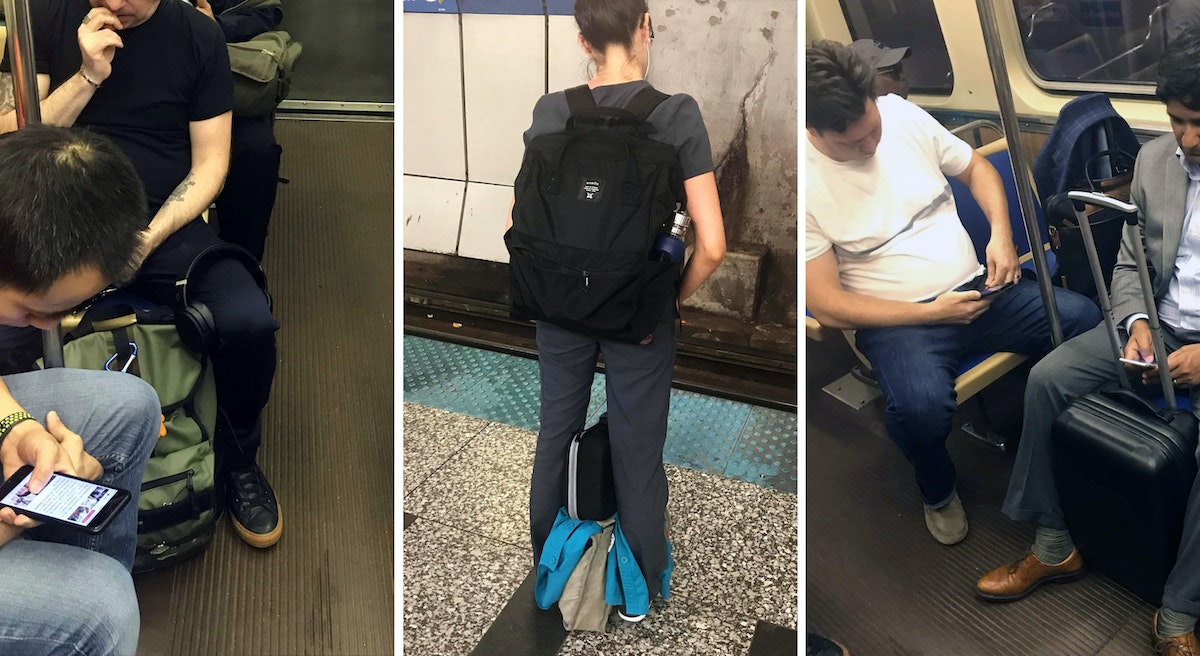
I’m grateful for Chicago’s trains—even amid the crush of people jammed into the morning’s rush hour commute and the thought-clouding clatter and clank that pervades every metal car. It’s a marvel that these hulking workhorses of public transport coordinate at all, and are generally safe, on time, and comfortable. And yet I often notice fellow train-goers challenged, like myself, by something basic: What do we do with our stuff? In my time as a commuter, I’ve seen myriad workarounds. Legs became walls propping up clothes and bags; thighs became resting ports for big headphones. And then there was the man who transformed his suitcase handle into a coat rack. Human ingenuity: It’s one more thing I’m grateful for during my commute.
Human-centered design requires us to observe human behavior with beginner's eyes, so that we can spot the innate ways people interact with the world around them. We call these intuitive and unconscious reactions Thoughtless Acts, and IDEO designers collect photos of them to inspire their work.
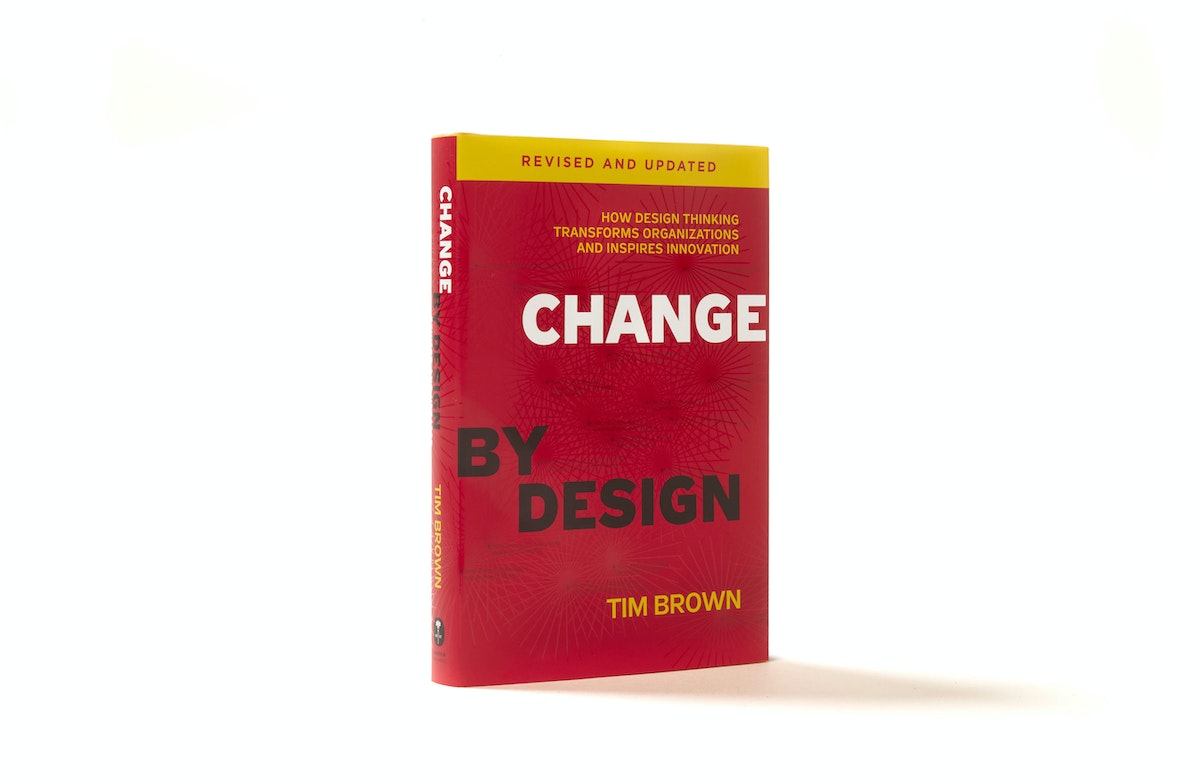
Change By Design
Tim Brown, CEO of IDEO, shows how the techniques and strategies of design belong at every level of business.
Tim Brown, CEO of IDEO, shows how the techniques and strategies of design belong at every level of business.
The myth of innovation is that brilliant ideas leap fully formed from the minds of geniuses. The reality is that most innovations come from a process of rigorous examination through which great ideas are identified and developed before being realized as new offerings and capabilities.
In this revised and updated edition of Change By Design, Tim Brown reintroduces design thinking, the collaborative process by which the designer’s sensibilities and methods are employed to match people’s needs with what is technically feasible and a viable business strategy. In short, design thinking converts need into demand. It’s a human-centered approach to problem-solving that helps people and organizations become more innovative and creative.
Change by Design is not a book by designers for designers; it is a book for creative leaders seeking to infuse design thinking into every level of an organization, product, or service to drive new alternatives for business and society.
Purchase
Know someone who might love this book? Purchase Change By Design here.

Lindsey Turner
I’m passionate about building brands, products, and experiences that help organizations show up with meaning and momentum.
I help organizations cut through complexity by shaping how they show up, through brand strategy, identity, and storytelling.
Working at the intersection of brand and business, I bring an editorial eye and a bias toward making—turning ideas into tangible experiences that people can understand, trust, and believe in.
My work spans government, healthcare, financial services, media, and consumer goods, from launching Gen Z-focused ventures to building innovation labs and reimagining legacy brands. I relish moments of ambiguity and enjoy translating across teams, perspectives, and priorities to move ideas forward.
I started my career in editorial and digital design, shaping cross-platform experiences and identity systems in publishing and agency environments. That foundation still shapes how I work today: I’m detail-oriented, collaborative, and overreliant on the Oxford comma. I hold a BFA in Visual Communication from the School of the Art Institute of Chicago.

Rachel Young
My work helps organizations see who their products aren't working for—and build the will and the tools to do something about it
For 25 years, I've asked the same question: Who does this design exclude—and what are we going to do about it?
My work spans human-centered strategy, inclusive design, and qualitative research, with clients ranging from Microsoft, Google, and Verizon to the National Science Foundation, and San Francisco Unified School District.
Before IDEO, I taught elementary school in East Palo Alto and spent a decade doing design work with social service organizations—where I learned firsthand what it costs people when systems are built without them in mind.
I am currently writing User Error, a nonfiction book about digital access and the design decisions behind it. I live in Oakland, California.

Brian Pelsoh
I lead with craft, ensuring our work is creatively excellent: rooted in deep human insight and imagination, while also grounded in the realities of business and technology.
My expertise spans brand, communication, and product design across tech, education, the arts, and social impact.
I believe great work demands both high-level vision and obsessive attention to detail, and only happens through collaboration.
I bring an inclusive, hands-on approach and a deep understanding of business, which enables me to consistently deliver excellence while always asking why.
Before joining IDEO, I worked at the brand firms Pentagram and VSA Partners. I began my career as a designer, leading teams at the School of the Art Institute of Chicago and the Milwaukee Art Museum. I hold an MFA in graphic design from Maryland Institute College of Art and a BFA in communication design from the Milwaukee Institute of Art & Design, and have taught at some of the best design schools in the US.

Tony Wong
I am responsible for IDEO’s long-term success in China and working with clients to use design as a tool to enable growth.
I am responsible for IDEO’s long-term success in China and working with clients to use design as a tool to enable growth. Specifically, I have helped Chinese companies design holistic brand solutions through the development of their products, communication, services, and innovation teams, and I have helped multinationals expand their presence and influence in China.
I advise global leaders on developing China-led innovation and capabilities.
In over 15 years in IDEO Shanghai, I have worked on projects that use design to elevate the quality of the experience of healthcare products and services, streamline processes that increase productivity, create spaces and programs that promote and enable inclusive communities, and build next generation mobility solutions that are planet-positive.
Before joining IDEO, I worked at Philips Electronics and the Electrolux Group in Italy, the Netherlands, and Singapore on a number of breakthrough commercial products. I am a member of the Young President Organization in Shanghai.

How to use AI as an editor, not a writer
Ed White shares how he uses AI as an editor—not a writer—to sharpen storytelling, rehearse ideas, and preserve the productive friction that makes creative work better.
Ed White has a rule he's tested on his own writing: hold yourself as the writer, and let AI be your editor. Ed is a Senior Design Director at IDEO's London studio, where he co-leads the firm's AI portfolio across Europe. Before IDEO, he spent 12 years as a writer and editor at the Financial Times, Wired, and Contagious. So when he talks about when to use AI for storytelling and when not to, it comes from two decades of crafting his storytelling skills.
In this episode, Mina Seetharaman talks with Ed about two specific tools he uses to keep AI in an editor's seat: a "roasting agent" prompted to critique his drafts without any sugarcoating, and a simulated audience he rehearses pitches on before the real thing. They also get into what Ed is hearing from design leaders at Anthropic, Lovable, Shopify, and Google Creative Lab about how creative work is changing, and why he thinks the friction of writing something yourself is worth protecting rather than automating away.

Building a personal AI for the messiness of life: Sida Li
Becca Carroll talks with Cue co-founder Sida Li about designing a personal AI for the messiness of everyday life—not just work. They explore how Sida stays anchored to human needs while navigating fast-changing technology, product tradeoffs, business-model experimentation, and the realities of building an AI company today.
Most AI products today are built for work—a space with clear problems and established systems. One founder noticed a gap: personal life is messier, harder to systematize, and mostly left behind by the AI boom. So she built Cue, a personal AI that lives inside iMessage and group chats, to go where the other tools haven't.
In this episode, Becca Carroll, IDEO's Chief Strategy Officer, talks with Sida Li, co-founder and CEO of Shared Context Lab, about staying anchored to a human need while the technology around her keeps changing shape, why she treats her business model with the same rigor she'd bring to a product, and what it feels like to build a company at this particular, disorienting moment in AI.
The conversation also gets into how Sida makes design decisions: the language Cue uses to describe itself, the tradeoffs behind building inside iMessage instead of a new app, and a real story about a business idea that didn’t pan out.
This is the second in a two-part series profiling founders from IDEO's Startups-in-Residence program. The first conversation is with Johannes Seemann, founder of Sooner, on designing GenAI for the emotional side of money.

Designing GenAI for the emotional side of money: Johannes Seemann
Designing financial tools around the feelings that shape money decisions.
Most personal financial tools are built to run the numbers and optimize towards a budget. While that works for some, most people experience money as a lived relationship that does not neatly fit into a spreadsheet. Johannes Seemann and Becca Carroll discuss why money is emotional before it is mathematical, and what a human-centered approach to building a generative AI financial product looks like in practice.

The curious leader's edge in uncertainty: Scott Shigeoka
How genuine curiosity helps leaders navigate uncertainty with greater confidence.
Mina Seetharaman talks with Scott Shigeoka, author of Seek and Head of Curiosity Cultivation at the Eames Institute, about what distinguishes genuinely curious leadership from performative curiosity, how power dynamics shape curiosity, and why practicing curiosity can restore energy rather than drain it.
Looks like you might be in search of something very specific?
Or reset the filters above and try another angle.
Here’s some random inspiration

Podcasts about creative leadership

Articles about the power of prototyping