
The future of air travel
Reinventing supersonic flight with Boom.
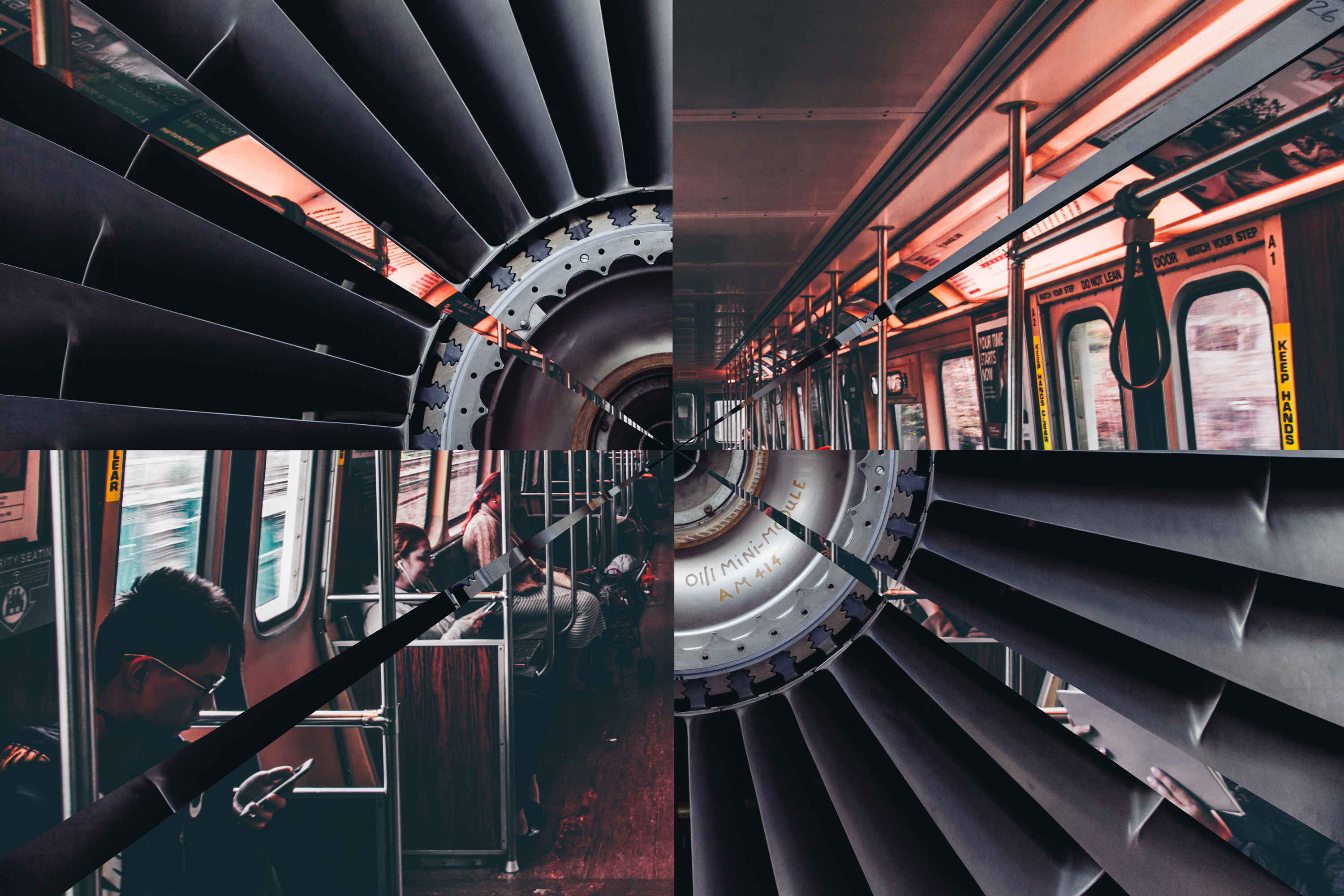
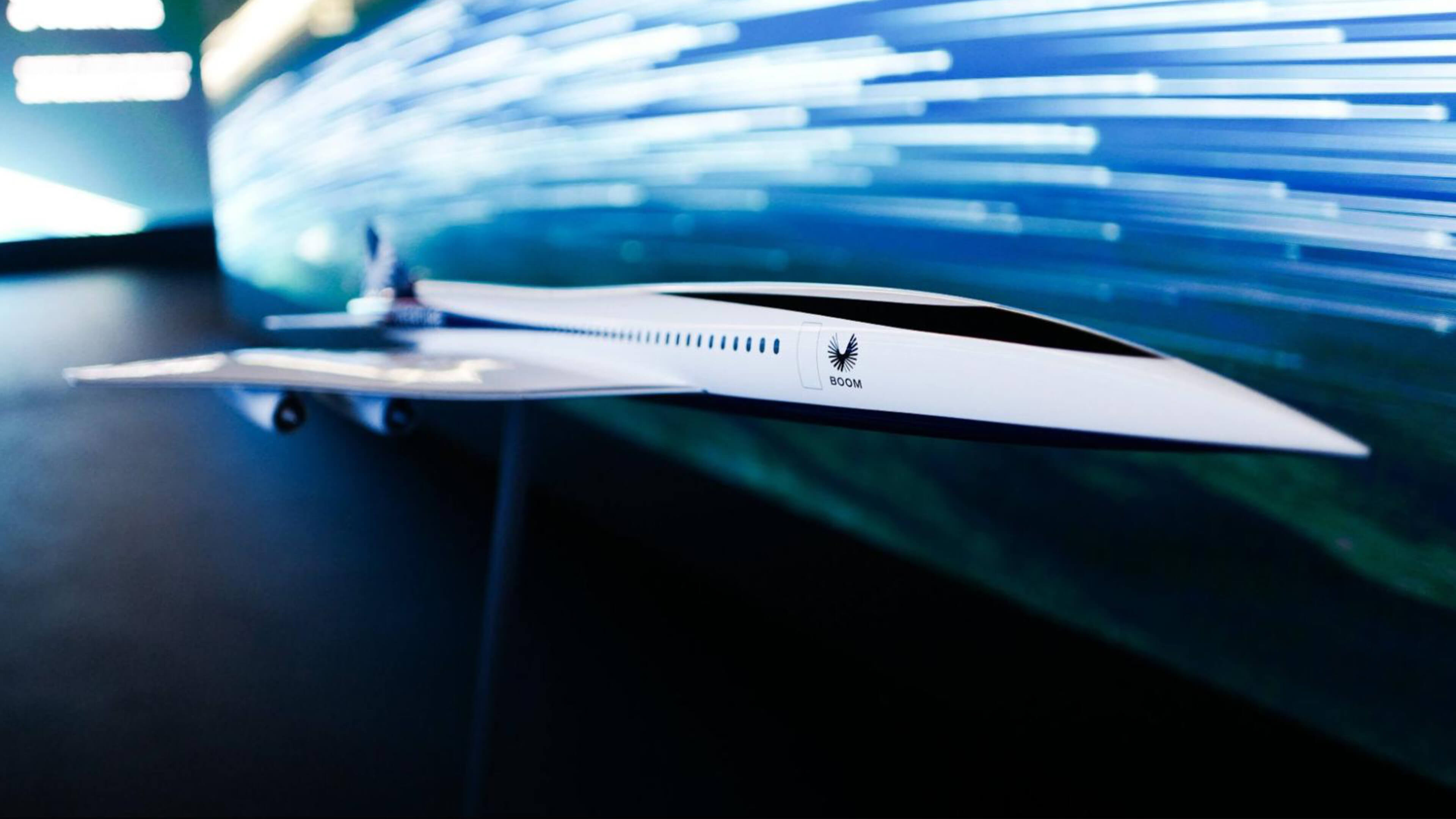
It’s not easy to shift the paradigm for an entire industry. But when a company comes along that promises to reinvent air travel, it opens up a blue sky of opportunities. That’s the flight path for Boom Supersonic, which is thinking big about how passengers arrive at their destination not only faster, but also with a greater sense of wellbeing.
To really comprehend the experience of flying in the unique contoured profile of this ultrafast jet, and to help Boom make key decisions about the design of the plane, the IDEO team believed that you had to go beyond algorithms and schematics—you needed to actually board it.
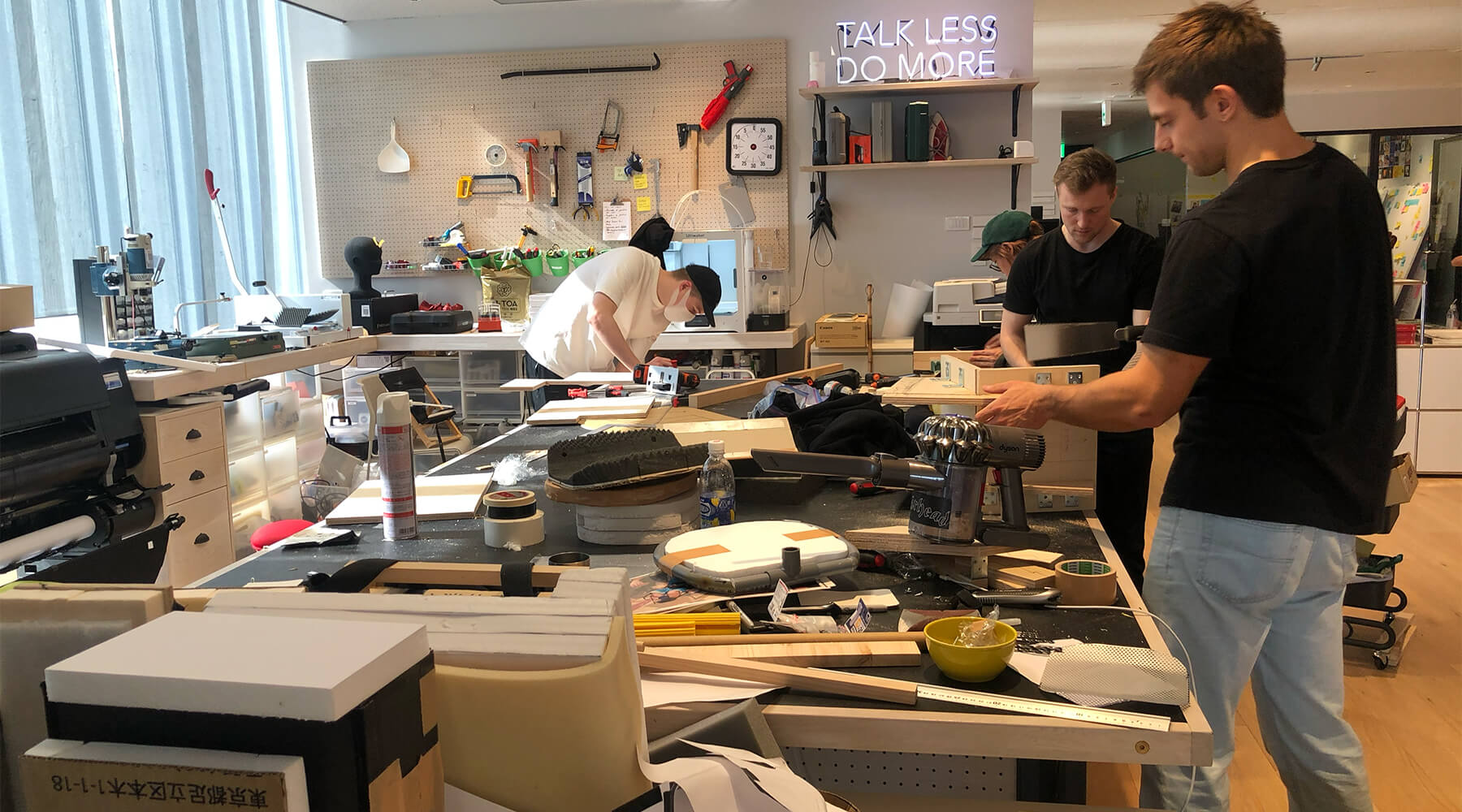
Using a “build-first” approach, the team quickly constructed a full-scale mockup of the fuselage from plywood and foam core. That became a prototyping platform to test multiple seating configurations, galley and lavatory size and placement, luggage storage solutions, and other concepts that would differentiate and add value to the passenger experience. For the first time, the Boom team was able to set foot in its own aircraft and truly understand the experience from the perspective of its clientele. The exercise allowed the Boom team to confidently make decisions by comparing multiple cabin configurations and options in full-scale.

Throughout the project, Boom and IDEO invited future travelers aboard to interact with the prototype and offer feedback. That input culminated in a more refined model, with augmented windows, moonroof, in-flight entertainment screens, and sound design—all further augmented by a Virtual Reality component to allow our future travelers to fully immerse in this new experience.
Together, Boom and IDEO brought a sneak peak to the Farnborough International Airshow, a biannual exhibition for the aerospace, aviation, and defense industries. The event was an opportunity to give the industry and potential customers a preview of Boom’s innovative new jet. In collaboration with the client, an exhibition architect, and a digital production agency, the team created an immersive environment designed to make the Overture experience feel tangible, eliciting the wonder of this revolutionary plane.
Boom’s presence at Farnborough not only underscored the Overture’s progress but provided an inspiring glimpse into the future of air travel. During the air show the company announced the production Overture design, a market-expanding alliance with Northrop Grumman, and agreements with tier one suppliers Collins Aerospace, Safran, and Eaton. Not long after, Boom received its largest order to date, this one from American Airlines.
The prospect of getting to London in time for dinner just got a little closer.
Boom plans for Overture to get from New York to Frankfurt in just over four hours instead of the eight hours spent on a commercial jet today.
The Overture supersonic jet has a cruising speed of Mach 1.7, about twice as fast as today’s commercial planes. Overture is built to fly on 100% sustainable aviation fuels (SAF).
20 Overture deposits
made by American Airlines, joining current customers United Airlines and Japan Airlines

Peripheral vision
A consumer electronics giant becomes a climate-era leader.
IDEO’s partnership with Logitech is a case study in bringing together the power of imagination and the rigor of business.
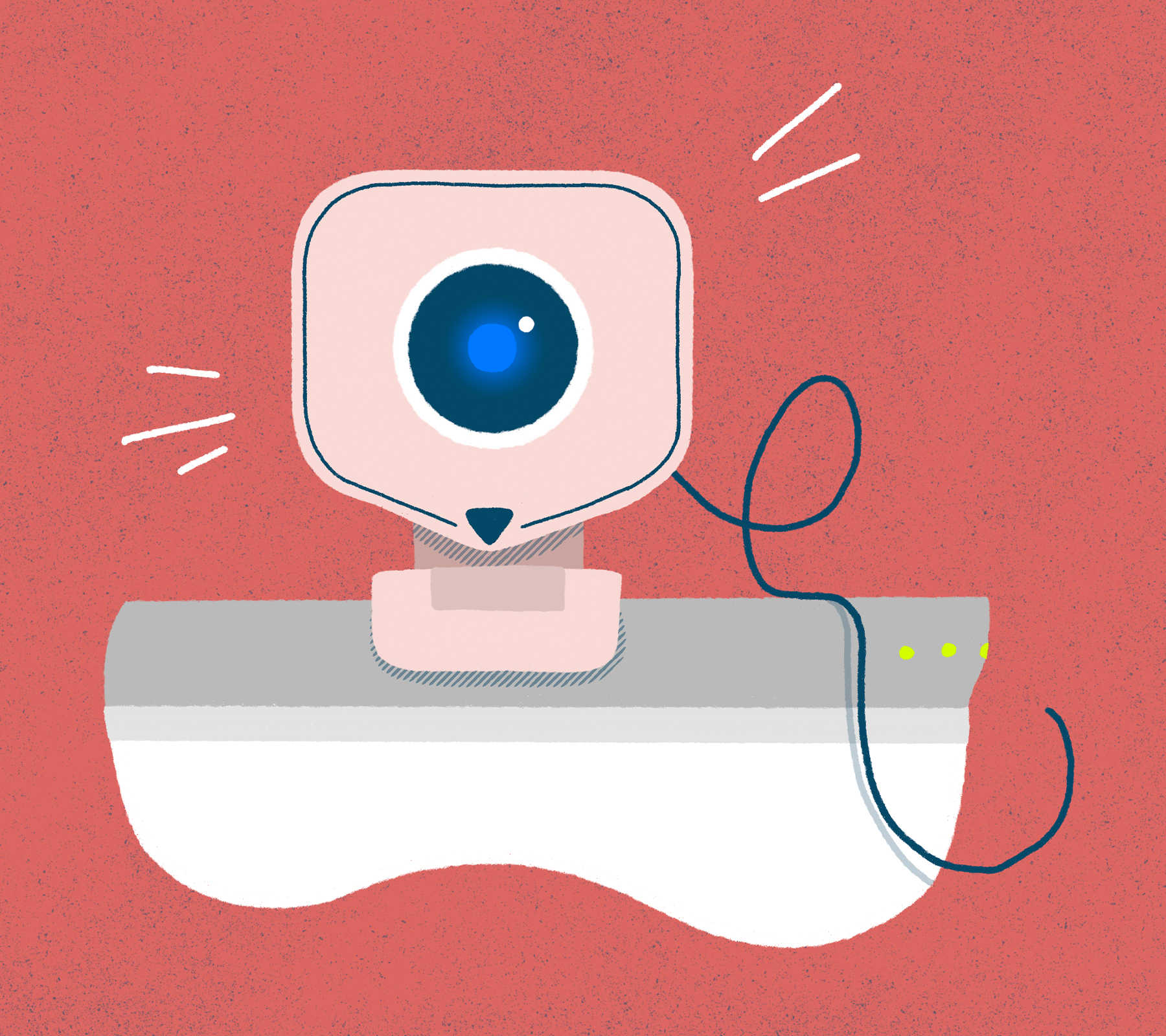
As much as we love to lead with creativity, it’s difficult to develop a business plan off ideas alone. So when Logitech asked the IDEO team to investigate a broad array of possible futures and report back, we brought our findings to life by inventing a board game. Instead of a dry presentation on circular solutions, our designers created a story about a mouse that turned into a webcam.
That imagination mattered. It fueled an exploration into expertise we collected from researching with people already living in futures destined to expand. And our rigor helped us hold more possibilities, and identify intersectionalities. Combined, they redefined what it means for ideas to be viable in business; they focused us on long-term sustainability; and they pushed us past immediate technical feasibility to ask if new ideas would be feasible for entire systems.
Our partnership with Logitech revealed that imaginative dreaming and business rigor aren’t opposing forces, but rather complementary tools in opening up new directions into a future demanding bold decisions.
As of 2019, e-waste was the fastest-growing waste stream globally, and only 20% of the 48.5+ million tonnes is disposed of properly.
Global emissions must be cut in half by 2030 to avert the worst impacts of climate change.
By 2030
Logitech has committed to becoming climate positive and removing more carbon than they create
The whole package
A global fashion brand pairs sustainability and growth.
Fast fashion keeps getting faster. But if the industry is to meet its climate commitments, its use of plastics has to slow down.
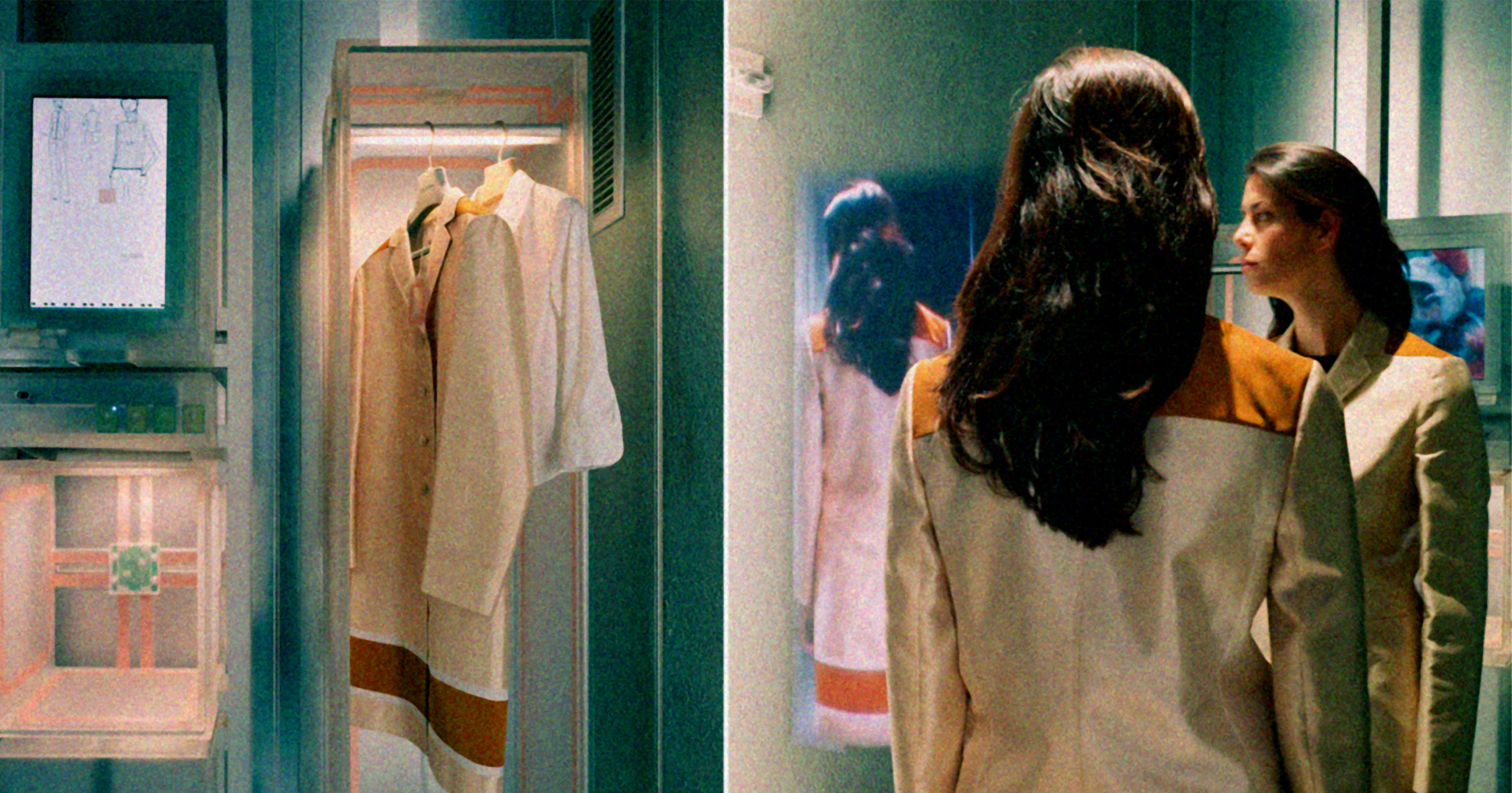
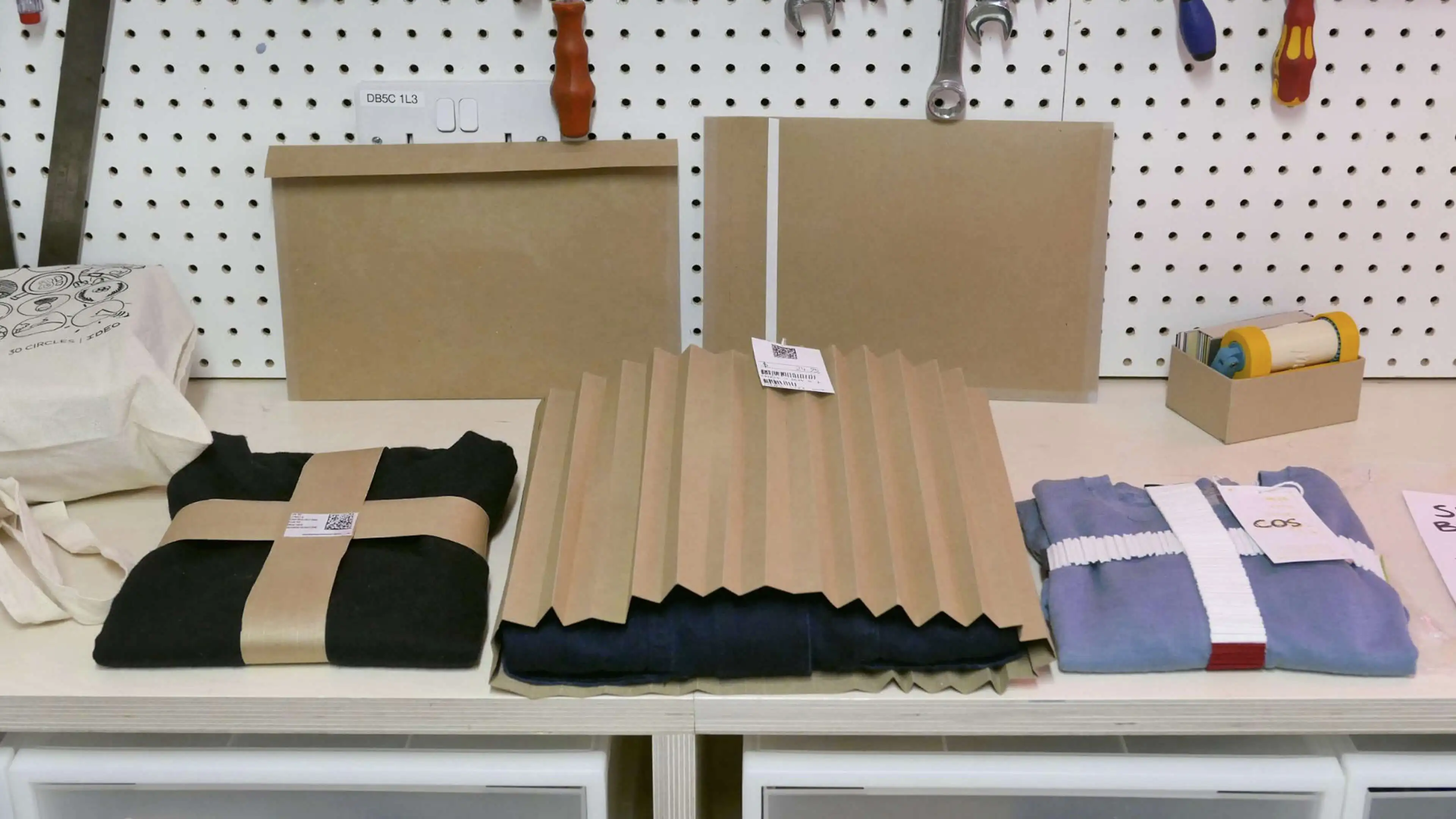
H&M chief executive Helena Helmersson set ambitious sustainability goals when she stepped into her role. She wanted to reduce the fashion giant’s impact on the environment and enable meaningful growth. But change is tough for any company, let alone one with eight brands operating across 74 markets. Together IDEO and the H&M Group created new plastic-free packaging, rallying around a more sustainable packaging solution that’s easily customizable.
By applying a design-led approach that went far beyond hiring a sustainability consultant, the H&M Group managed to reduce its use of plastic. But it didn’t stop there. A small team called Design Studio took what it learned and grew into an established strategic capability that pioneers new ways of working in the organization, tackling complex challenges in circularity, inclusion, supply chain, and customer experience. Sustainability isn’t a passing trend for H&M. It’s moving fashion forward.
Packaging accounts for 26% of plastics produced globally every year.
Fashion e-commerce is estimated to grow by 10% annually through 2024, requiring even more packaging.
100M
plastic-free packages shipped in 2022
2,000 tons
of plastic eliminated from H&M operations
The everywhere chair
In Japan, a mother works to build an inclusive child seat that closes the gap between children with and without disabilities.
For children with physical disabilities and their families, mobility is freedom. But in Japan, there are barriers to that freedom of movement.
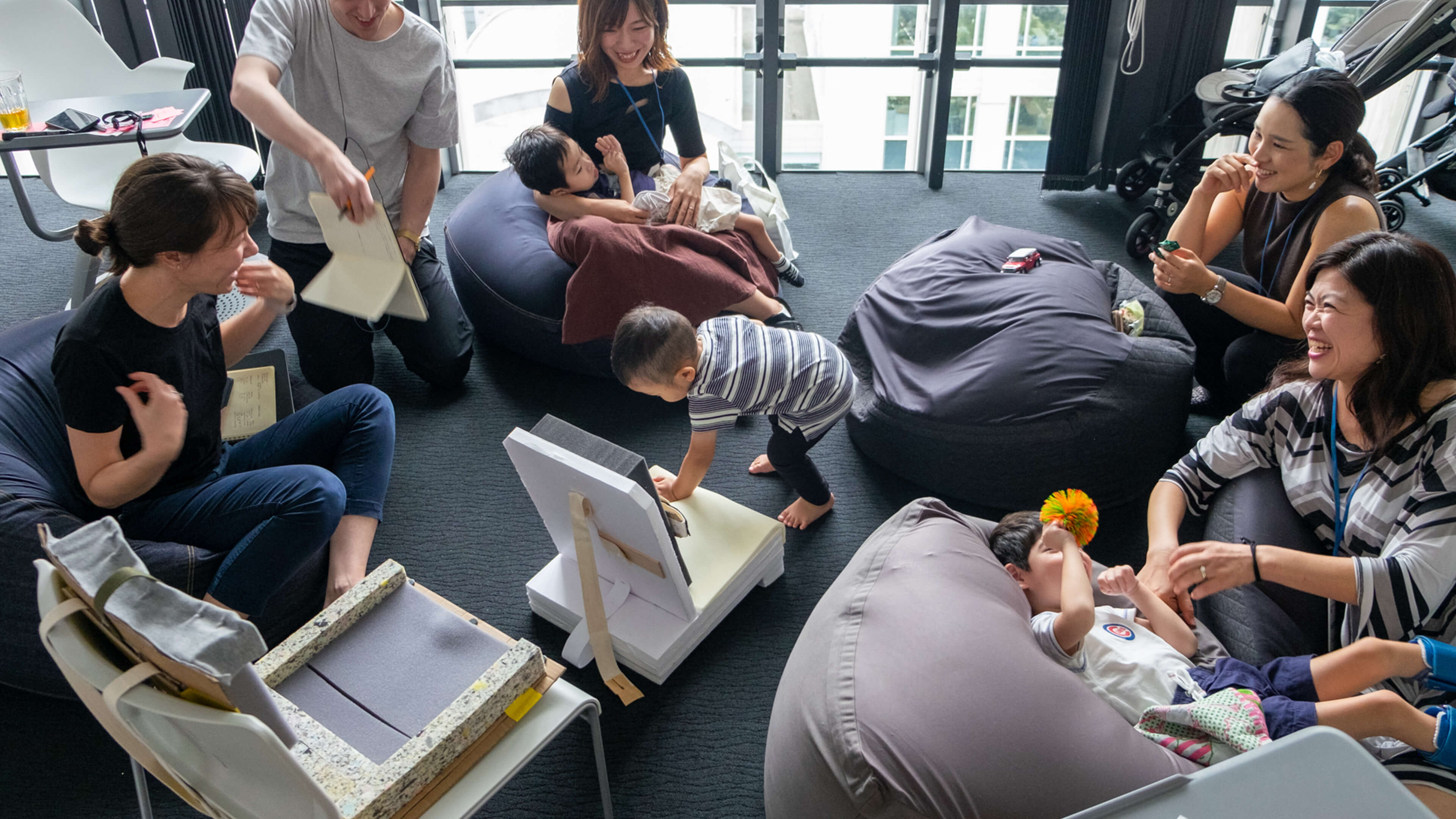
In raising a child with cerebral palsy, Yuri Matsumoto found that her son was separated from other kids during everyday activities. In Japan, children’s products are divided into two categories: those for children with disabilities and those for children without. Matsumoto aspired to close this gap with a product that would allow children of all abilities to use the same chair and be included in the same activities. To realize her idea, Matsumoto needed a strategic design company to refine the chair design, create a compelling visual identity, and arrive at a product road map to help set the business up for long-term success.
The result: a breakthrough product and supporting business that provides access for all kids, both for at-home activities like studying and eating, and also for family outings to restaurants, to the park, and to play with friends. Around the world, there are people like Matsumoto who see the need for better products in a very personal way. IDEO’s role is to help them realize their vision for a more inclusive future.
The Japanese health ministry categorizes 9.6 million people as disabled.
In Japan, children with disabilities are largely excluded from mainstream classrooms. Government subsidized support chairs are designed for posture and stability. Their bulk and rigidity make venturing out with them challenging.
Japanese children have fewer opportunities to learn about what it’s like to live with a disability than in the US.
Launched
officially in April 2022
5
restaurants and cafés in Tokyo are currently piloting the chair

Feeling Stuck at Work? Switch to “Play Mode”
Jake Knapp shares how a change in mindset can unlock creativity
My friend Stefan suggested I try a different mindset. Instead of trying to get things right, I should put myself in “play mode.” From his email:
Right then, I was working on an illustration for part of my book where some early readers got confused. But I wanted to get it right, so I’d been putting it off. "Okay," I thought. "I can afford to waste an hour on this."
I tried play mode. I told myself the next hour didn’t matter—I was just goofing around and having fun. I set a timer. I made about 15 rough sketches. Then the hour was up. And I hadn’t gotten it right. But I’d broken the ice, and I was in the zone, so I kept working. Thirty minutes later, I had an illustration I was happy with. And the whole thing was fun rather than stressful. Play mode worked!
I’m writing this post to remind myself of the value of play mode. Next time you talk to me and I say, "I’m stuck," tell me to flip the switch.
This post was originally published on Jake Knapp's blog.
I get stuck a lot. I get stuck writing, editing, making slides, designing, replying to email. I get stuck anytime I want to get something right.
Why Gesture is the Next Big Thing in Design
With new cameras, sensors, and AI, it's time for design to get physical
But there are limitations to voice-enabled interactions. They’re slow, embarrassing when other humans are around, and require awkward trigger phrases like “Okay, Google” or “Hey, Siri.”
Thankfully, though, talking into midair is no longer our only—or best—option.
The new iPhone introduced a camera that can perceive three dimensions and record a depth for every pixel, and home devices like the Nest IQ and Amazon's Echo Look now have cameras of their own. Combined with neural nets that learn and improve with more training data, these new cameras create a point cloud or depth map of the people in a scene, how they are posing, and how they are moving. The nets can be trained to recognize specific people, classify their activities, and respond to gestures from afar. Together, neural nets and better cameras open up an entirely new space for gestural design and gesture-based interaction models.
These new options beg the question: Of the existing interaction modalities—haptics (touch), sound (voice), and vision (gesture)—which is better to use when, and why?
The use case points toward an answer. When you’re SCUBA diving, or water skiing, or directing traffic on the deck of an aircraft carrier, the auditory channel isn’t available, so gesture or touch become essential.
In an operating room, a surgeon’s hands are sterile; she can’t flip through radiology scans—only speech and gesture are available. If you’re conducting an orchestra or on a military raid you can’t call out commands, so we’re back with gesture.
WATCH: From Charlie Chaplin to Cricket, there are a wide range of sources to inspire us as we design for gestural communication.
To dig into it further, our team at the Cambridge studio snagged a camera like the one in the new iPhone and performed a series of experiments to figure out when gesture might be the best choice.
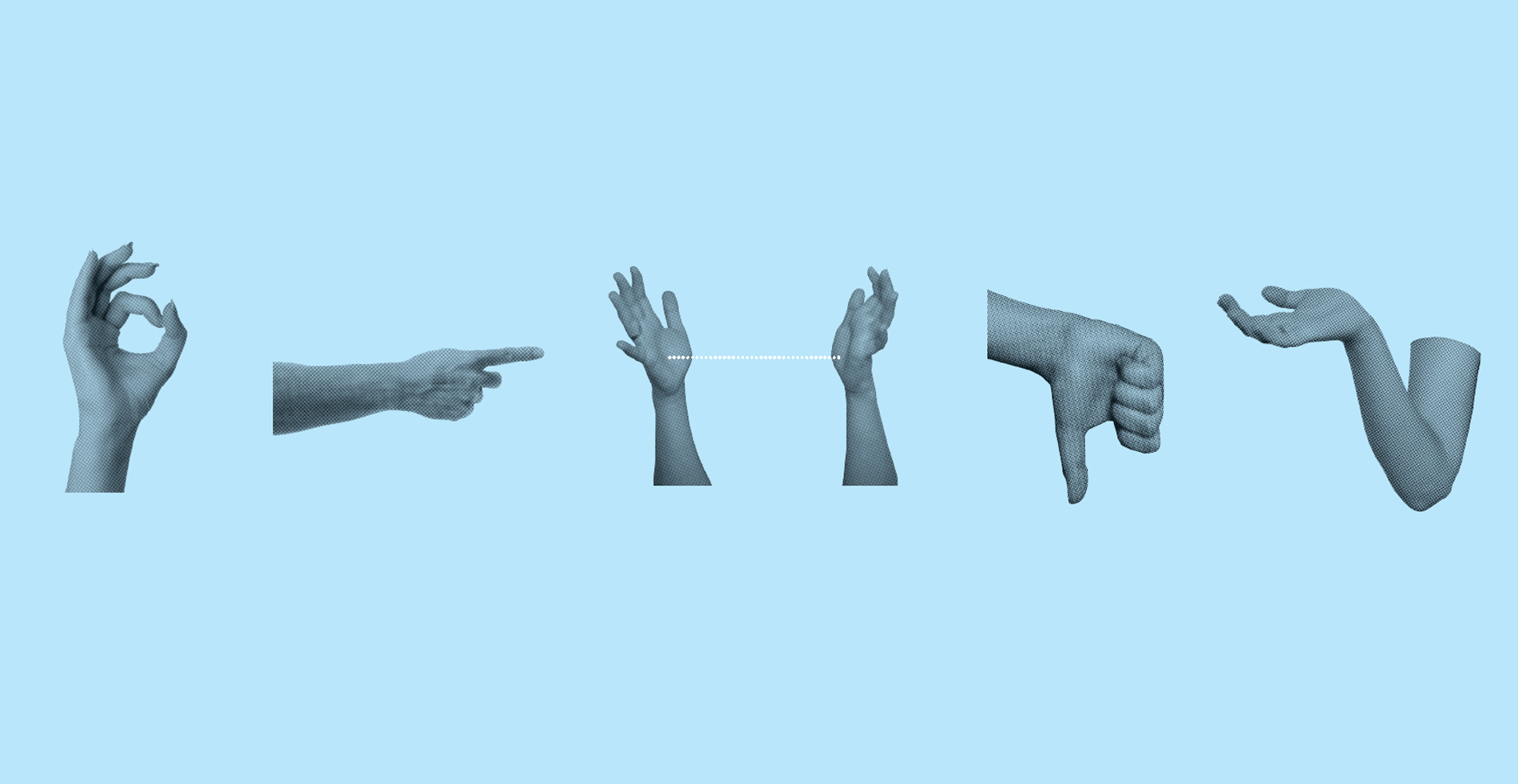
First, we gave pairs of people an idea, then we asked them to make a four-handed pose to express that idea.
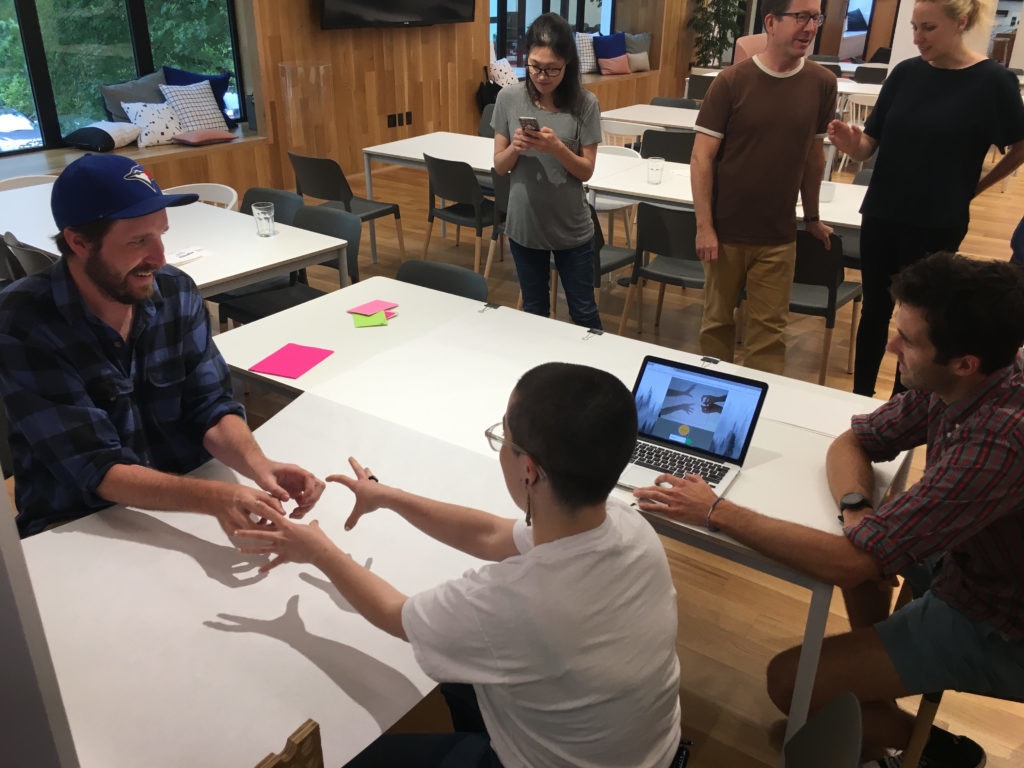
Then we recorded stories and tracked people’s hands using computer vision to study when we naturally deploy gestures to amplify emotion or explain a concept.
WATCH: Tracking how we gesticulate to bring stories to life.
WATCH: Ask a group of people to perform an action or request and you get some variation. The trick is finding gestures that are as universal as possible.
Lastly, we trained a neural network to recognize a small set of gestures, and used these to control a Philips HUE light set and a Spotify station to create an installation for the office.
WATCH: Using a set of gestures, we trained a few devices in our office to respond to our cues and adjust the lights and music.
In messing around with these exercises, we discovered that gestures need to be either sequential, like a sentence—noun then verb, object plus operation. For example, for “speaker, on,” one hand designates the noun, and the other the verb: You point to speaker with left hand and turn the volume up by raising right hand.
Another surprising insight: Gestures are generation-specific.
When asked to signal turning up the volume, a few people twisted an invisible knob, but most of the under 30s lifted a palm or made a pinching gesture with their fingers.
After analyzing our results, we boiled our thoughts down to four reasons to opt for gesture over voice or touch:
- Speed: If it needs to be fast, gestures are much quicker than speaking sentences.
- Distance: If you need to communicate from across the room, gesture is easier than dealing with volume.
- Limited lexicon: If you don't have a thousand things to say, gestures work well. The smaller the gesture set for a given context, the easier it is to remember. (Thumbs-up/thumbs-down, for example.)
- Expressiveness over precision: Gestures are well-suited to expressing emotional salience. A musical conductor communicates a downbeat and tempo, but also so much more: dolco, marcato, confidence, sadness, longing, and more.
It's exciting to imagine a whole new category of products that will take advantage of gesture’s subtlety, expressiveness, and speed.
How might we use gesture in unexpected ways? I’d love to hear your thoughts.
Many thanks to the rest of the team: Lisa Tacoronte, Todd Vanderlin, Jason Robinson, Danny DeRuntz, Brian Standeford, Eric Chan, and Ari Adler.
Since Siri was introduced in 2010, the world has been increasingly enamored with voice interfaces. When we need to adjust the thermostat, we ask Alexa. If we want to put on a movie, we ask the remote to search for it. According to some estimates, some 33 million voice-enabled devices reported for duty in American homes by the end of 2017.
The Life of David Kelley, According to His Shelves
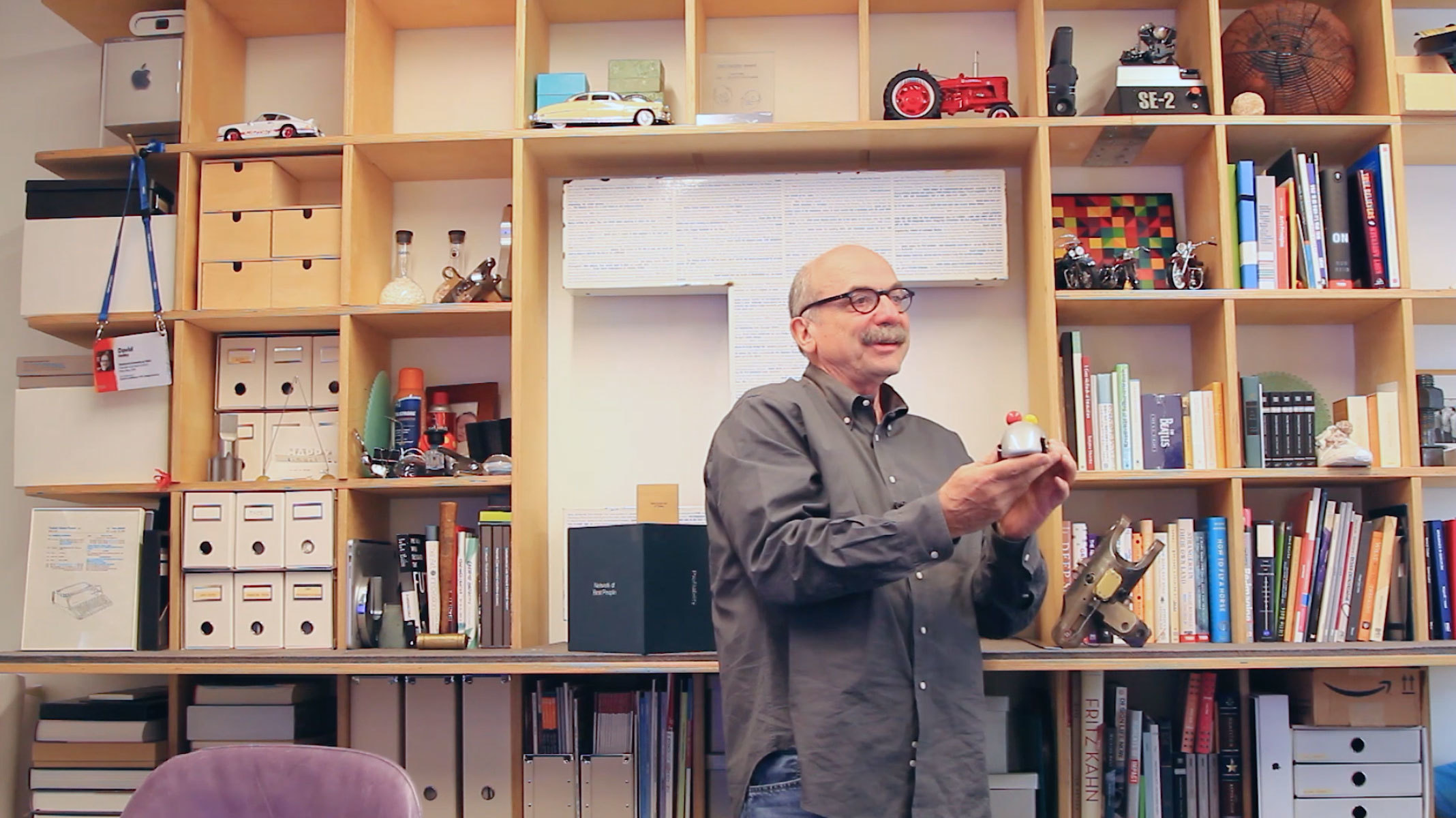
The first Apple mouse, the Jaminator, and other gems from the personal collection of IDEO's founder
“I don’t think of myself as a collector, I just keep the stuff that happens in my life," Kelley says. And what happens over the course of a life in design adds up.
Kelley, who founded IDEO 40 years ago and went on to launch Stanford's d.school, has a lot of stories to tell, and most of them are connected to stuff—stuff IDEO made, stuff given to him by other designers and architects like Ettore Sottsass (who also designed Kelley's house), stuff that unlocks memories and, not infrequently, gets him choked up. (SPOILER ALERT: skip to 1:54 where he points out a picture from his wedding. One of the guests is IDEO cofounder Bill Moggridge, the father of interaction design, who died in 2012.)
Take a tour of David Kelley's office shelves
The wall of wooden cubbies in Kelley's small Palo Alto office is crowded with prototypes, model automobiles (Kelley is also a car buff who owns about 20 vehicles, including a 1954 Chevy pickup), and other curios like a giant "I" that lights up and is inscribed with his life's story. His coworkers fabricated it for him in the company shop for his 50th birthday.
In fact, Kelley has a small museum of birthday keepsakes that IDEO designers have given him over the years: a giant spotlight, an old motorcycle, and one of those mechanical horses that costs a dime to ride, purchased from a grocery store.
Inspiration and materials for those gifts often came from University Art, the Palo Alto supply store down the street from the studio. "There was a guy named Jim, lovely white haired guy," Kelley says. Jim was the store manager, and when Kelley told him he was starting a new company down the street and would like to open an account, Jim replied that they'd have to charge $50 a month to qualify. Kelley admitted he didn't know if they'd be able to do that. "Fast forward a few years, Jim was still there and we had about 350 employees and we were charging $50 a minute. Jim would always remind me of that story..."
Kelley's collecting gene runs in his family. His mother used to call it "shopping in the basement." She'd go down to the first floor of the house and dig up something from Kelley's past and send it to him for his birthday.
"Things would show up in the mail: My leather pouch that I would keep my marbles in when I was a little boy; my boy scout uniform. I'm kind of in that same vein as my mother. I'm keeping things that are meaningful. When I am sitting around, I can look at the model we made of the first mouse or the Christmas card we made in 1993 and I just think, it's pleasurable now; it's going to be even more pleasurable as I get older."
Though IDEO still makes stuff, much of what we design, along with what we consume, has become less tangible. And it's a good thing—there's not much more room on Kelley's shelves.
It's not everyday that you see the first ever example of something you love. So, when David Kelley invited us into his office and pulled an early prototype of the Apple Mouse off his shelf, I let out an audible gasp.

Get to Know the Creator of Song Exploder
Graphic designer, musician, podcaster: Hrishikesh Hirway is a creative jack of all trades.
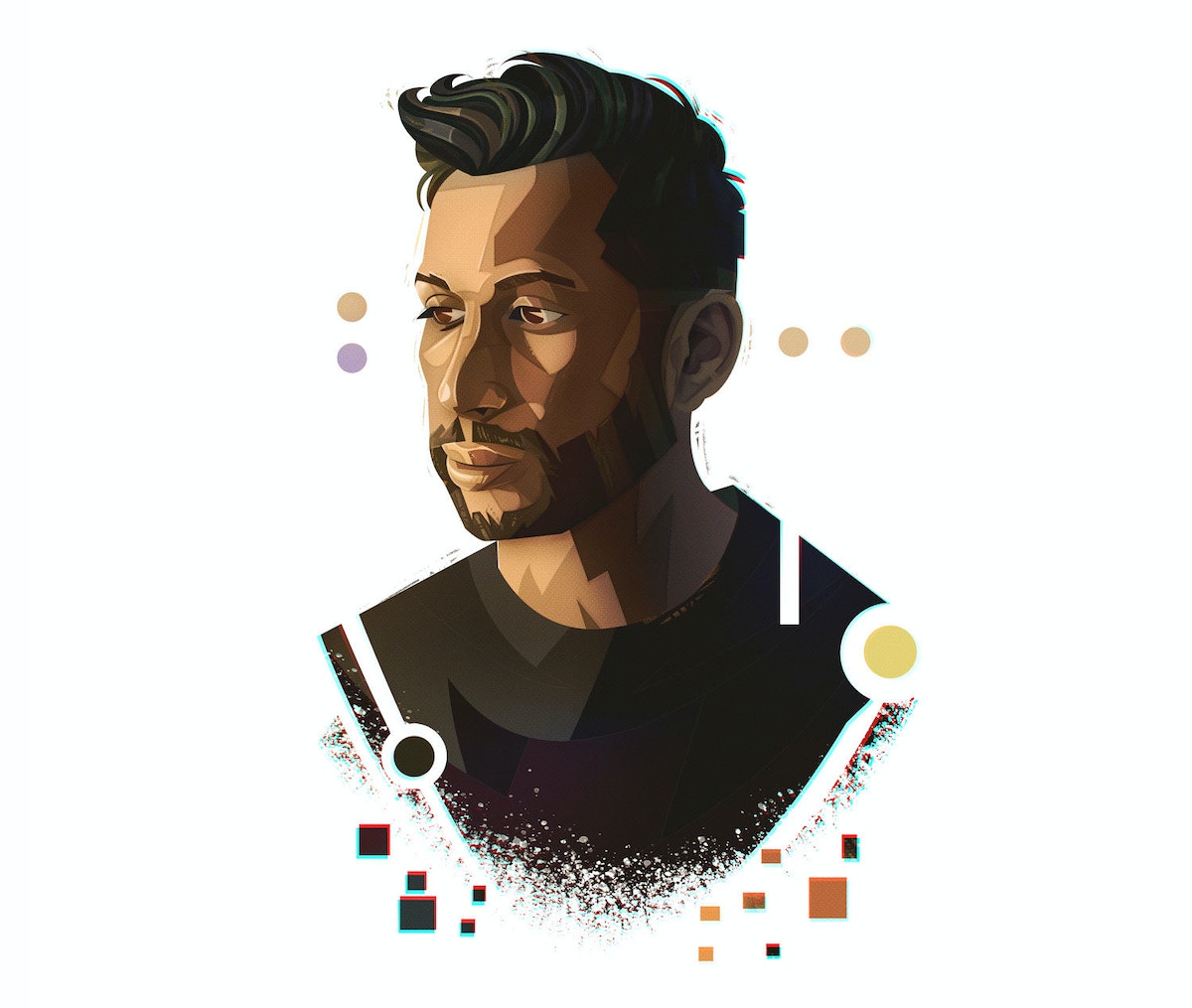
In one sentence, who are you?
I'm a creative jack of all trades, I guess, which can be useful but is often frustrating, especially because I'm surrounded by very talented people with a depth of skill and knowledge that always feels out of reach for me.
What do you do? How did you learn it?
These days, I mainly make music and podcasts. I write and sing songs under the name The One AM Radio, I've scored some film and TV, and I make beats in a project called Moors. The podcasts I make are called Song Exploder, in which musicians trace the creative decisions that went into a song of theirs, and The West Wing Weekly, in which the Aaron Sorkin TV series is discussed in detail. As far as how I learned—I studied graphic design in school and I think that had a big influence on how I think about things. With music, I mainly learned by listening to others talk about what they do. That became the basis for starting a podcast, too; Song Exploder is about listening closely.
3 favorite possessions?
- My computer (whatever it is at any given time, it's my way into everything)
- My custom Healy electric guitar (it looks and sounds beautiful, and it's the first time I'd ever had anything custom-made)
- My house (it's small but peaceful and cozy, it's where I live and work, and it feels like an extension of who I am).
What does a typical work session look like?
Part of the garage at my house was converted into an office, which I use as a makeshift recording studio. I have my computer, my piano, and my guitars in there. I sit in front of the computer, and usually work in two-hour bursts until my focus runs out. Then I pace around the backyard and in and out of the house for a while until my ears and my brain settle back down, and then get back to work. I usually start in the early afternoon and work until pretty late into the night.
How do you get over creative block?
I'll let you know once I figure it out. I started Song Exploder in part because of writer's block in my own songwriting…and I'm still not sure that I've gotten through it.
How do you see the world in 2078?
At this point, I'm just hoping there will still be a world left to see in 2078.
What’s your number one bucket list item?
One casualty of my dilettantism is that I don't have a a number one bucket list item. I have three items that might rank at number four, though: I'd like to produce a feature film, design my own house, and see all seven continents. But if none of them happened, I'd find something else.
Who are you creative crushin’ on lately?
I am in love with the music of Grouper and the prints of Phil Chang, who is pushing at the edge of what photography can be.
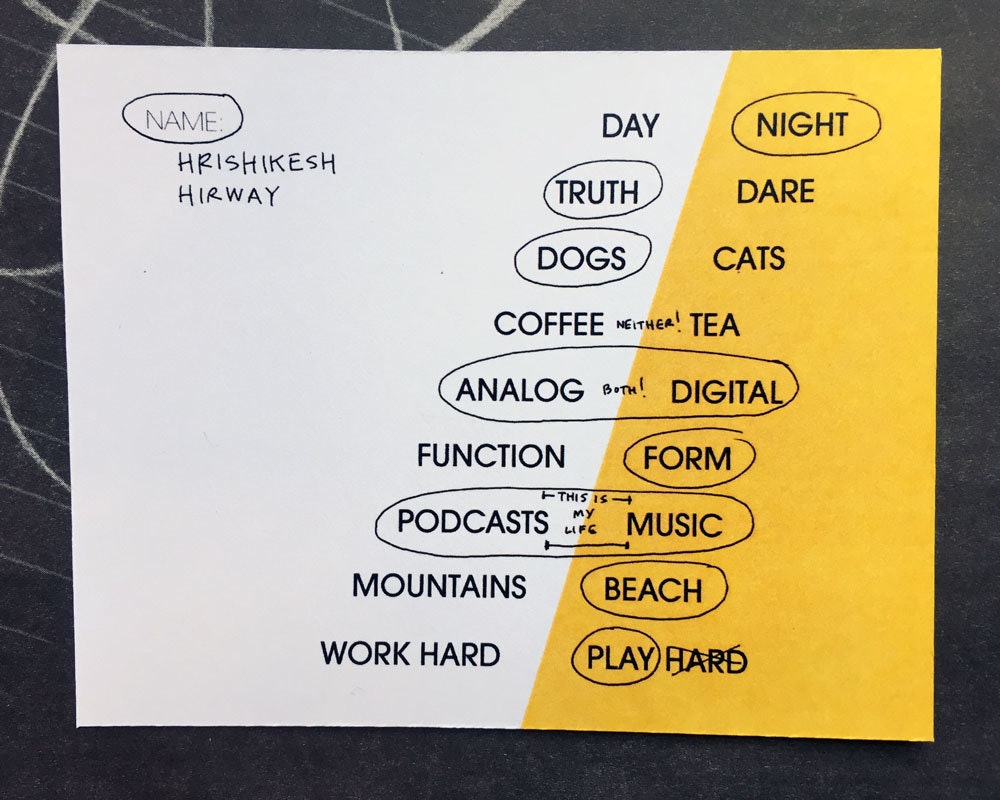
Podcasts are the most important medium of our time. That’s right. They provide a meritocratic platform, and the best of them verge on art. One such podcast, Song Exploder, introduced me to the creative talent of Hrishikesh Hirway about three years ago. Since then, Hrishi and I have kept in touch—he even gave a visiting lecture on the intersection of sound and graphic design at our San Francisco studio. Like all of us at IDEO, Hrishi approaches every project as a design problem. I was thrilled to again catch up with him in this installment of Creative Crushes.

Lindsey Turner
I’m passionate about building brands, products, and experiences that help organizations show up with meaning and momentum.
I help organizations cut through complexity by shaping how they show up, through brand strategy, identity, and storytelling.
Working at the intersection of brand and business, I bring an editorial eye and a bias toward making—turning ideas into tangible experiences that people can understand, trust, and believe in.
My work spans government, healthcare, financial services, media, and consumer goods, from launching Gen Z-focused ventures to building innovation labs and reimagining legacy brands. I relish moments of ambiguity and enjoy translating across teams, perspectives, and priorities to move ideas forward.
I started my career in editorial and digital design, shaping cross-platform experiences and identity systems in publishing and agency environments. That foundation still shapes how I work today: I’m detail-oriented, collaborative, and overreliant on the Oxford comma. I hold a BFA in Visual Communication from the School of the Art Institute of Chicago.

Rachel Young
My work helps organizations see who their products aren't working for—and build the will and the tools to do something about it
For 25 years, I've asked the same question: Who does this design exclude—and what are we going to do about it?
My work spans human-centered strategy, inclusive design, and qualitative research, with clients ranging from Microsoft, Google, and Verizon to the National Science Foundation, and San Francisco Unified School District.
Before IDEO, I taught elementary school in East Palo Alto and spent a decade doing design work with social service organizations—where I learned firsthand what it costs people when systems are built without them in mind.
I am currently writing User Error, a nonfiction book about digital access and the design decisions behind it. I live in Oakland, California.

Brian Pelsoh
I lead with craft, ensuring our work is creatively excellent: rooted in deep human insight and imagination, while also grounded in the realities of business and technology.
My expertise spans brand, communication, and product design across tech, education, the arts, and social impact.
I believe great work demands both high-level vision and obsessive attention to detail, and only happens through collaboration.
I bring an inclusive, hands-on approach and a deep understanding of business, which enables me to consistently deliver excellence while always asking why.
Before joining IDEO, I worked at the brand firms Pentagram and VSA Partners. I began my career as a designer, leading teams at the School of the Art Institute of Chicago and the Milwaukee Art Museum. I hold an MFA in graphic design from Maryland Institute College of Art and a BFA in communication design from the Milwaukee Institute of Art & Design, and have taught at some of the best design schools in the US.

Tony Wong
I am responsible for IDEO’s long-term success in China and working with clients to use design as a tool to enable growth.
I am responsible for IDEO’s long-term success in China and working with clients to use design as a tool to enable growth. Specifically, I have helped Chinese companies design holistic brand solutions through the development of their products, communication, services, and innovation teams, and I have helped multinationals expand their presence and influence in China.
I advise global leaders on developing China-led innovation and capabilities.
In over 15 years in IDEO Shanghai, I have worked on projects that use design to elevate the quality of the experience of healthcare products and services, streamline processes that increase productivity, create spaces and programs that promote and enable inclusive communities, and build next generation mobility solutions that are planet-positive.
Before joining IDEO, I worked at Philips Electronics and the Electrolux Group in Italy, the Netherlands, and Singapore on a number of breakthrough commercial products. I am a member of the Young President Organization in Shanghai.

How to use AI as an editor, not a writer
Ed White shares how he uses AI as an editor—not a writer—to sharpen storytelling, rehearse ideas, and preserve the productive friction that makes creative work better.
Ed White has a rule he's tested on his own writing: hold yourself as the writer, and let AI be your editor. Ed is a Senior Design Director at IDEO's London studio, where he co-leads the firm's AI portfolio across Europe. Before IDEO, he spent 12 years as a writer and editor at the Financial Times, Wired, and Contagious. So when he talks about when to use AI for storytelling and when not to, it comes from two decades of crafting his storytelling skills.
In this episode, Mina Seetharaman talks with Ed about two specific tools he uses to keep AI in an editor's seat: a "roasting agent" prompted to critique his drafts without any sugarcoating, and a simulated audience he rehearses pitches on before the real thing. They also get into what Ed is hearing from design leaders at Anthropic, Lovable, Shopify, and Google Creative Lab about how creative work is changing, and why he thinks the friction of writing something yourself is worth protecting rather than automating away.

Building a personal AI for the messiness of life: Sida Li
Becca Carroll talks with Cue co-founder Sida Li about designing a personal AI for the messiness of everyday life—not just work. They explore how Sida stays anchored to human needs while navigating fast-changing technology, product tradeoffs, business-model experimentation, and the realities of building an AI company today.
Most AI products today are built for work—a space with clear problems and established systems. One founder noticed a gap: personal life is messier, harder to systematize, and mostly left behind by the AI boom. So she built Cue, a personal AI that lives inside iMessage and group chats, to go where the other tools haven't.
In this episode, Becca Carroll, IDEO's Chief Strategy Officer, talks with Sida Li, co-founder and CEO of Shared Context Lab, about staying anchored to a human need while the technology around her keeps changing shape, why she treats her business model with the same rigor she'd bring to a product, and what it feels like to build a company at this particular, disorienting moment in AI.
The conversation also gets into how Sida makes design decisions: the language Cue uses to describe itself, the tradeoffs behind building inside iMessage instead of a new app, and a real story about a business idea that didn’t pan out.
This is the second in a two-part series profiling founders from IDEO's Startups-in-Residence program. The first conversation is with Johannes Seemann, founder of Sooner, on designing GenAI for the emotional side of money.

Designing GenAI for the emotional side of money: Johannes Seemann
Designing financial tools around the feelings that shape money decisions.
Most personal financial tools are built to run the numbers and optimize towards a budget. While that works for some, most people experience money as a lived relationship that does not neatly fit into a spreadsheet. Johannes Seemann and Becca Carroll discuss why money is emotional before it is mathematical, and what a human-centered approach to building a generative AI financial product looks like in practice.

The curious leader's edge in uncertainty: Scott Shigeoka
How genuine curiosity helps leaders navigate uncertainty with greater confidence.
Mina Seetharaman talks with Scott Shigeoka, author of Seek and Head of Curiosity Cultivation at the Eames Institute, about what distinguishes genuinely curious leadership from performative curiosity, how power dynamics shape curiosity, and why practicing curiosity can restore energy rather than drain it.
Looks like you might be in search of something very specific?
Or reset the filters above and try another angle.
Here’s some random inspiration

Podcasts about creative leadership

Articles about the power of prototyping