Designing a new vision for women’s healthcare
Introducing Cottage Women’s Health
Systemic transformation is not new to Cottage Health. Founded in 1888 by 50 forward-thinking women in Santa Barbara who wanted a hospital for their growing community, Cottage Health has since expanded to 3 hospitals and is quickly growing its outpatient services as well.
To understand the current Cottage Health experience, IDEO conducted dozens of in-depth interviews with patients, providers, caregivers, and staff. They also ran multi-week diary studies, engaged in inspirational research activities, and held events to hear from local women.
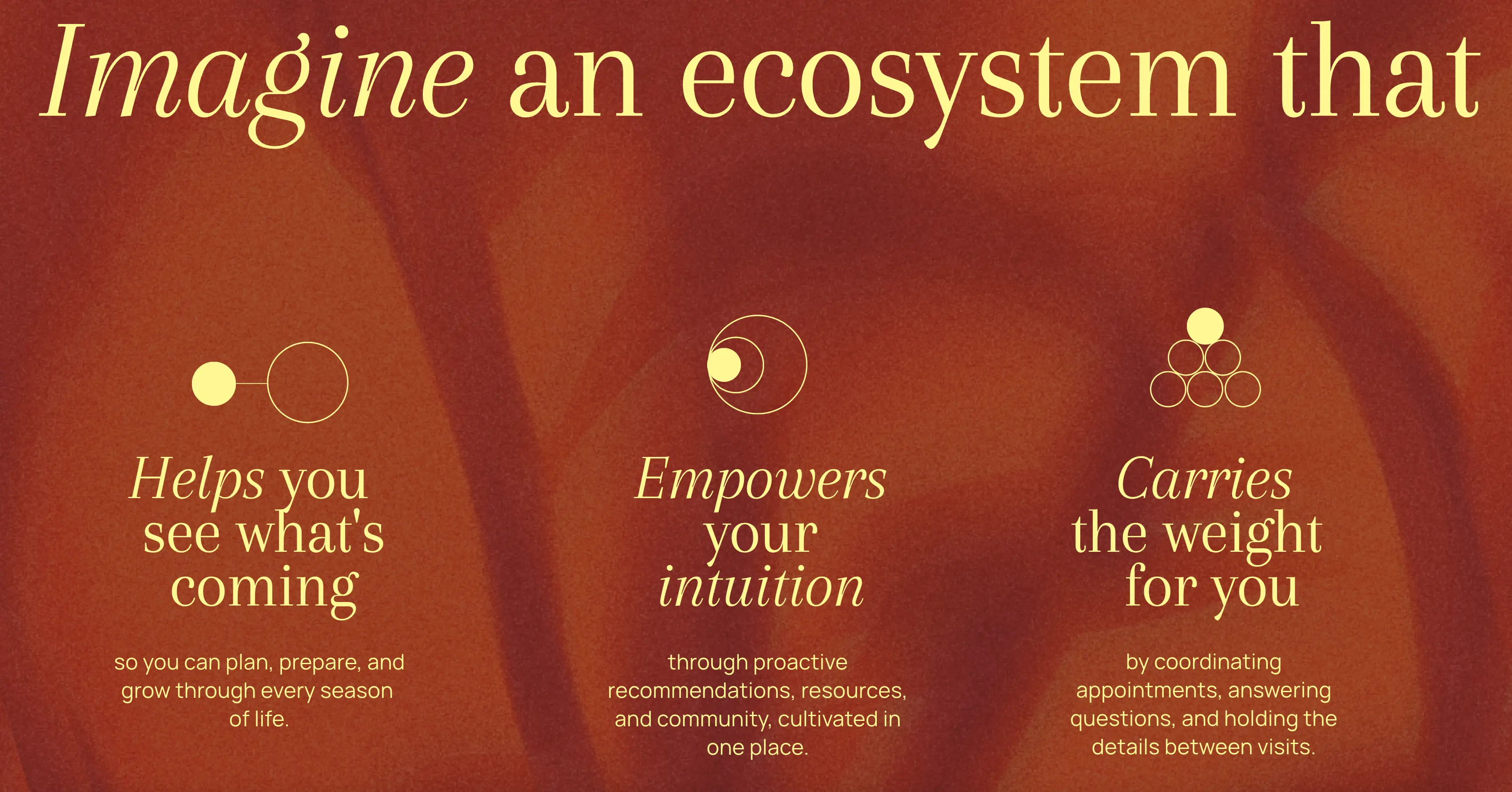
The qualitative research surfaced that women often carry the mental burden of repeatedly remembering, explaining, and advocating for themselves. Women’s pain is often minimized, which causes new providers to inherit mistrust from previous experiences, without having the tools to rebuild it. During significant life transitions, such as pregnancy or menopause, women may receive conflicting advice from health providers and seek additional outside support from informal networks. Access to quality care can sometimes depend on insider knowledge, private resources, or providers willing to go far beyond their job descriptions. And while providers make referrals, women must handle the time-consuming coordination required to make everything work, instead of focusing on healing. The bottom line: what women wanted most was to be seen, heard, believed, and supported in knowing what to do next.
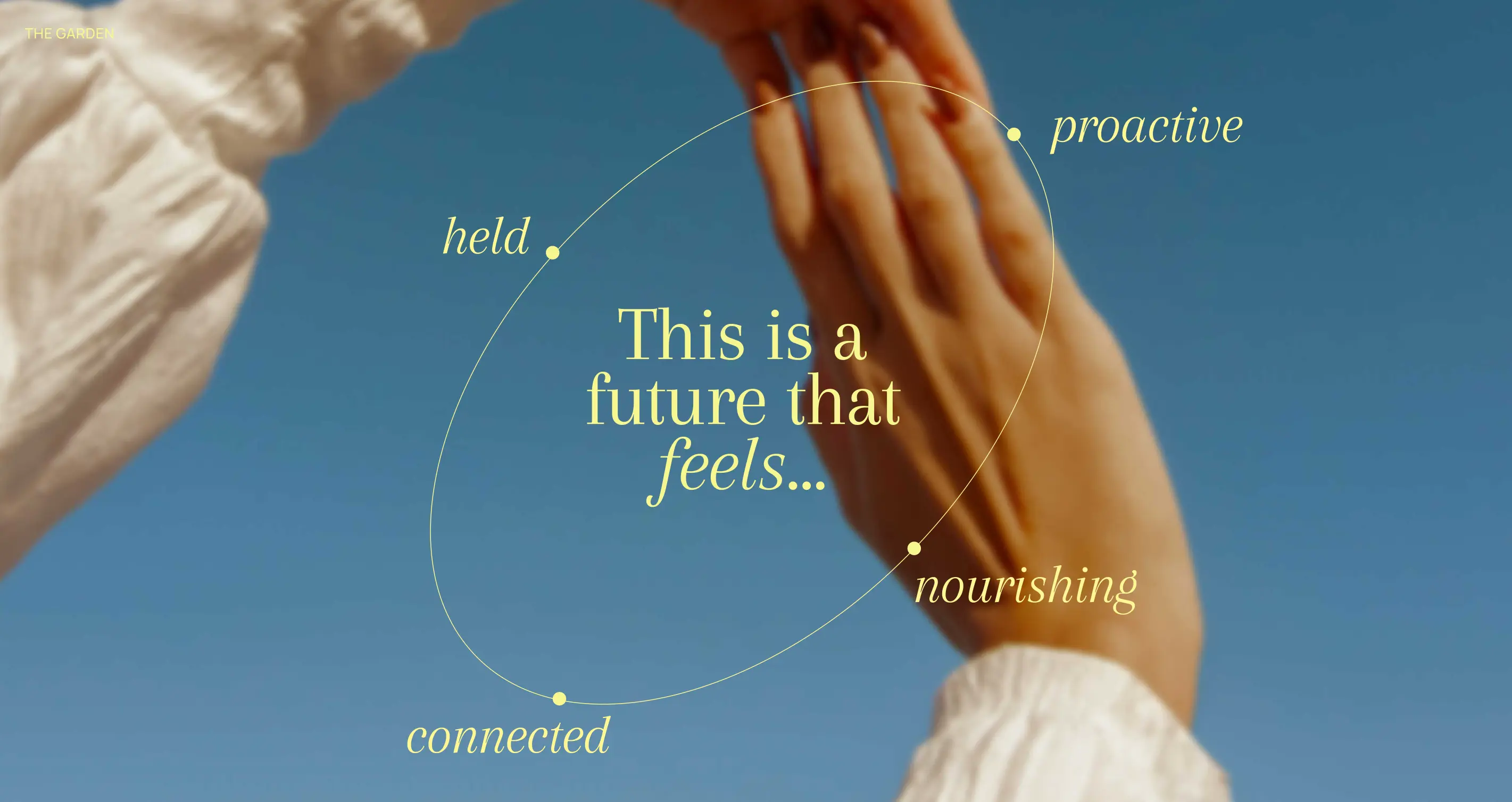
In order to address these challenges, IDEO proposed a new vision for women’s health, alongside design principles and concrete service shifts to guide future decision-making. Every interaction with Cottage Health should build on the information patients have already shared, demonstrating the system is listening. They should also guide women through life transitions by anticipating needs in future life phases, not just what’s happening now. Much like a community gathering, the Cottage Health experience should feel like a village, fostering belonging and shared care through warm, connected, human touchpoints.
Building on these design principles, IDEO developed three exploratory service concepts that represented potential pathways for future development, rather than finalized offerings: True North, Wellness Commons, and Care Circle.
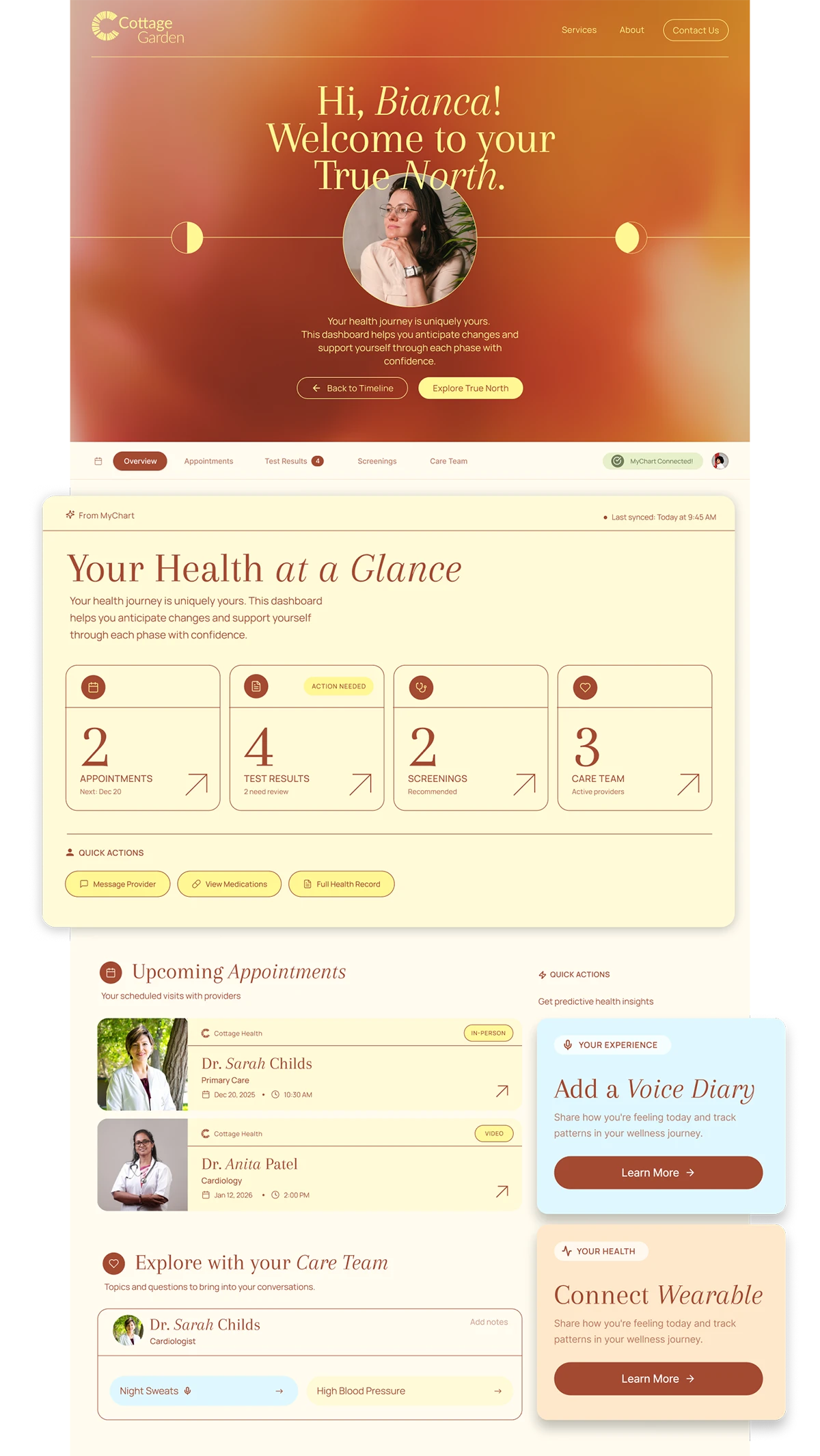
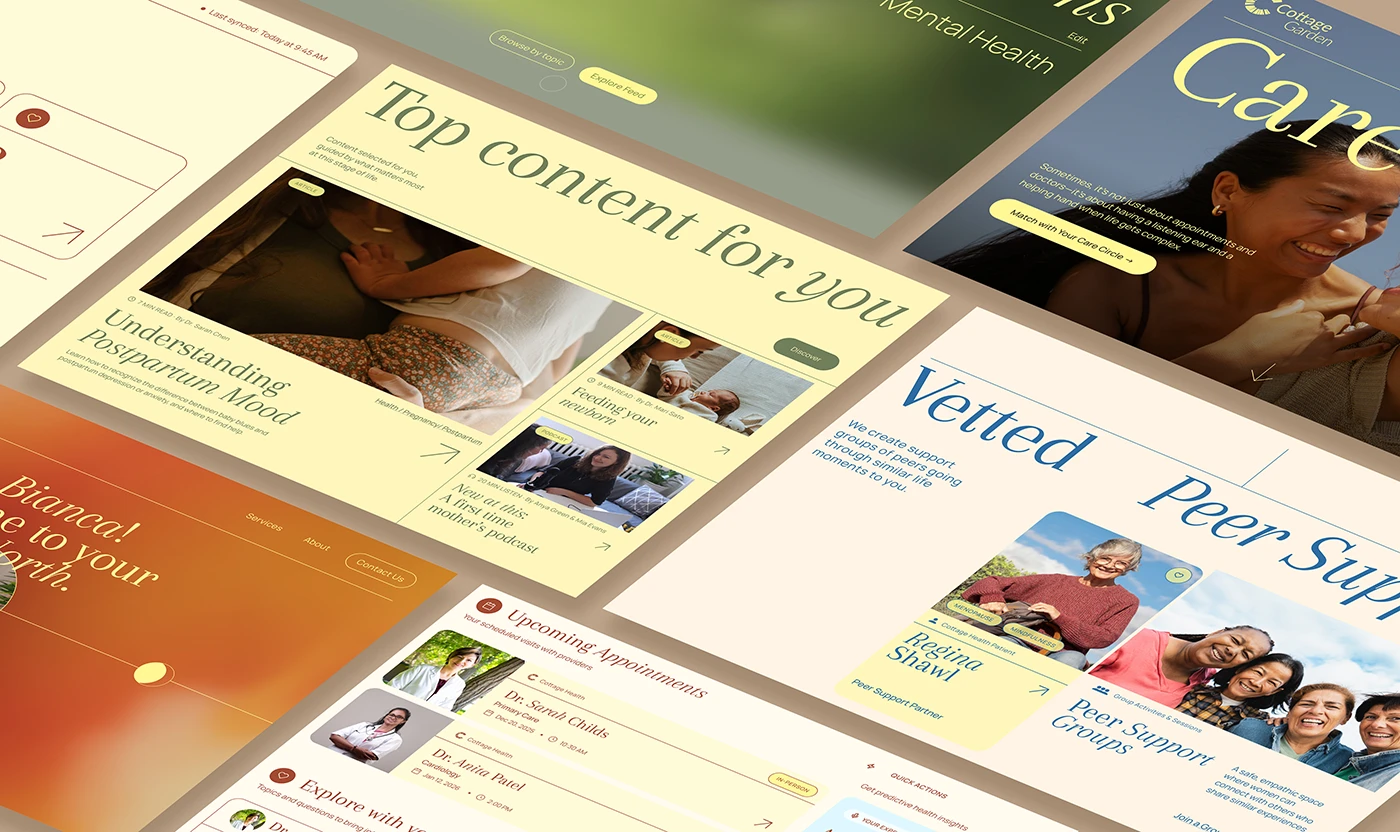
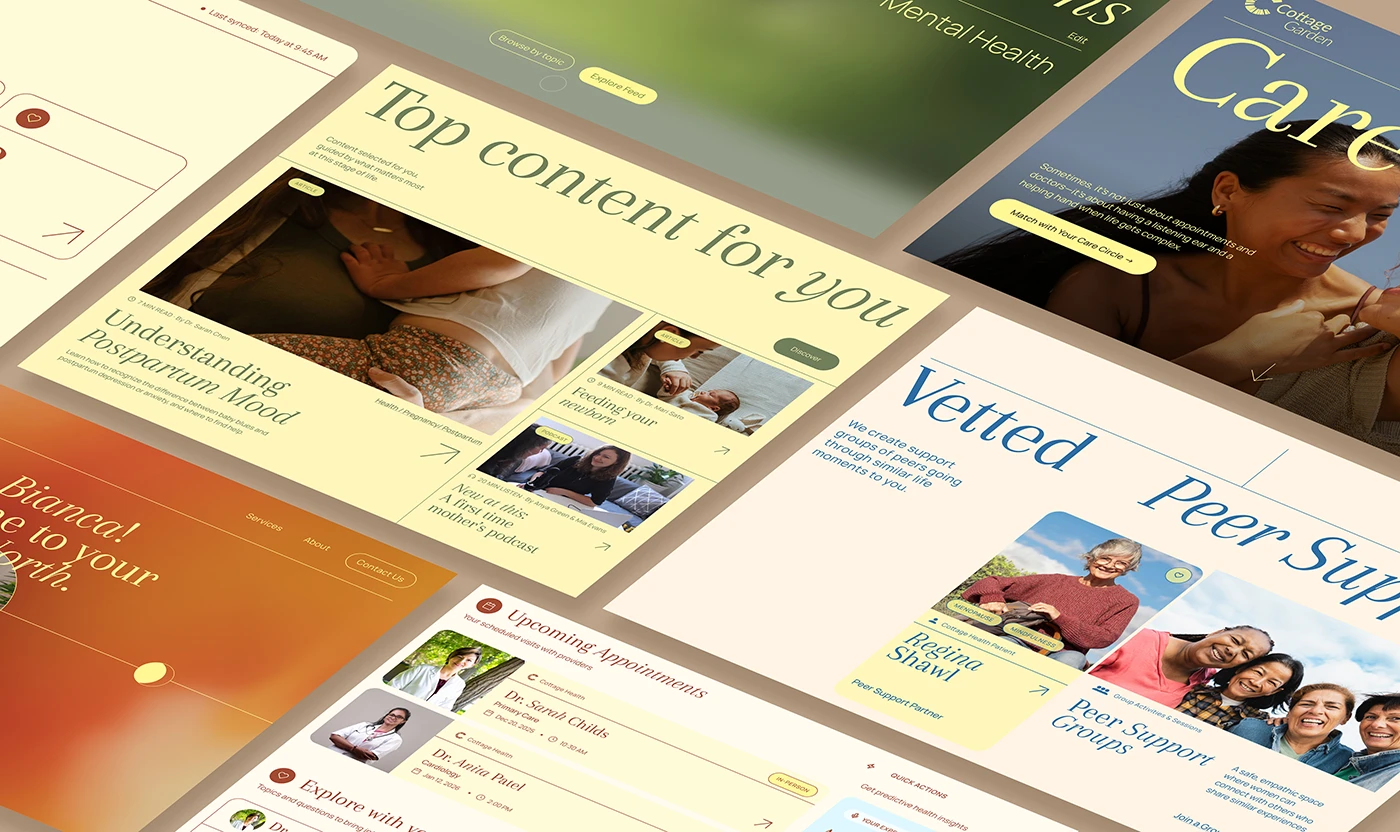
True North is a patient-facing tool that helps women see the long view of their health journey by integrating personal data, health goals, and reflections into a dynamic timeline they can share with their healthcare providers.
Wellness Commons serves as a digital front door, offering curated resources, including community events, discounted wellness programs, fitness classes, and trusted referrals, that help women navigate their well-being with clarity and agency.
Care Circle connects women to an extended support network inside and outside Cottage’s walls, including a hotline, health coaches, peer group support, and nurse navigators who can help patients manage complex care needs.
IDEO also provided Cottage Health with a multi-year roadmap building out the women’s health experience alongside continued pilot and implementation advisory. The roadmap included a comprehensive series of launch-to-learn pilots designed to test assumptions, reduce risks, and learn quickly, with IDEO stewarding the process. These pilots ranged from digital mockups and a curated community referral directory to a support line, a new nurse navigator role, and peer coaching services, among other experiments.
In July 2026, Cottage Health announced it was expanding its focus through a new Cottage Women’s Health Campus in Santa Barbara. Led by Dr. Jane Varner, Cottage Women's Health is projected to open in early 2028. It will encompass women’s health services across the lifespan, from puberty to menopause and beyond, including OB-GYN, pelvic floor health, women’s heart health, a menopause clinic, and a breast care center of excellence. It will also include supportive services, including trained nurse navigators to coordinate patients’ care journeys, giving women a single, trusted entry point for integrated care at every life stage. Cottage Women's Health is also exploring a new digital support system inspired by IDEO’s Wellness Commons concept.
Cottage Health had ambitious goals to expand its women’s health services and needed a partner to help it understand what women truly wanted from their healthcare and bring it to life.
7 months
from end of project to the announced launch of Cottage Women’s Health

From incremental change to breakthrough innovation
How Master Kong reinvented the instant noodle, from the inside out.
Looking to understand the role of instant noodles in middle-class Chinese life, the IDEO team conducted in-home research with consumers across a range of life stages and levels of attachment to noodle culture and convenience foods. The first finding was reassuring: Everyone kept instant noodles at home. The category still had a place in middle-class kitchens. But beneath that was a more complicated, emotional story—and an unmet need for convenience and quality to coexist in a single product.
The team discovered that instant noodles are more than just a quick, on-the-go meal; they are a nostalgic comfort food that evokes fond memories. But since their heyday, their role in daily life has evolved. Once a complete meal in itself, instant noodles now often function as a versatile flavor base or culinary accent in other dishes. Because they don’t align with the healthier, higher-quality, and more novel food choices that middle-class consumers aspire to, noodle shops, delivery noodles, or fresh-cooked instant options often win out. Yet, even these alternatives come with trade-offs. Delivered noodles lose texture during transport. Sit-down noodle shops preserve quality but offer limited flavors. Cooking from scratch meets the bar for both texture and flavor, but requires a significant time investment. As one young mother said, “If I could get the texture of fresh-cooked noodles without turning on the stove, I’d buy that instant noodle for sure.”
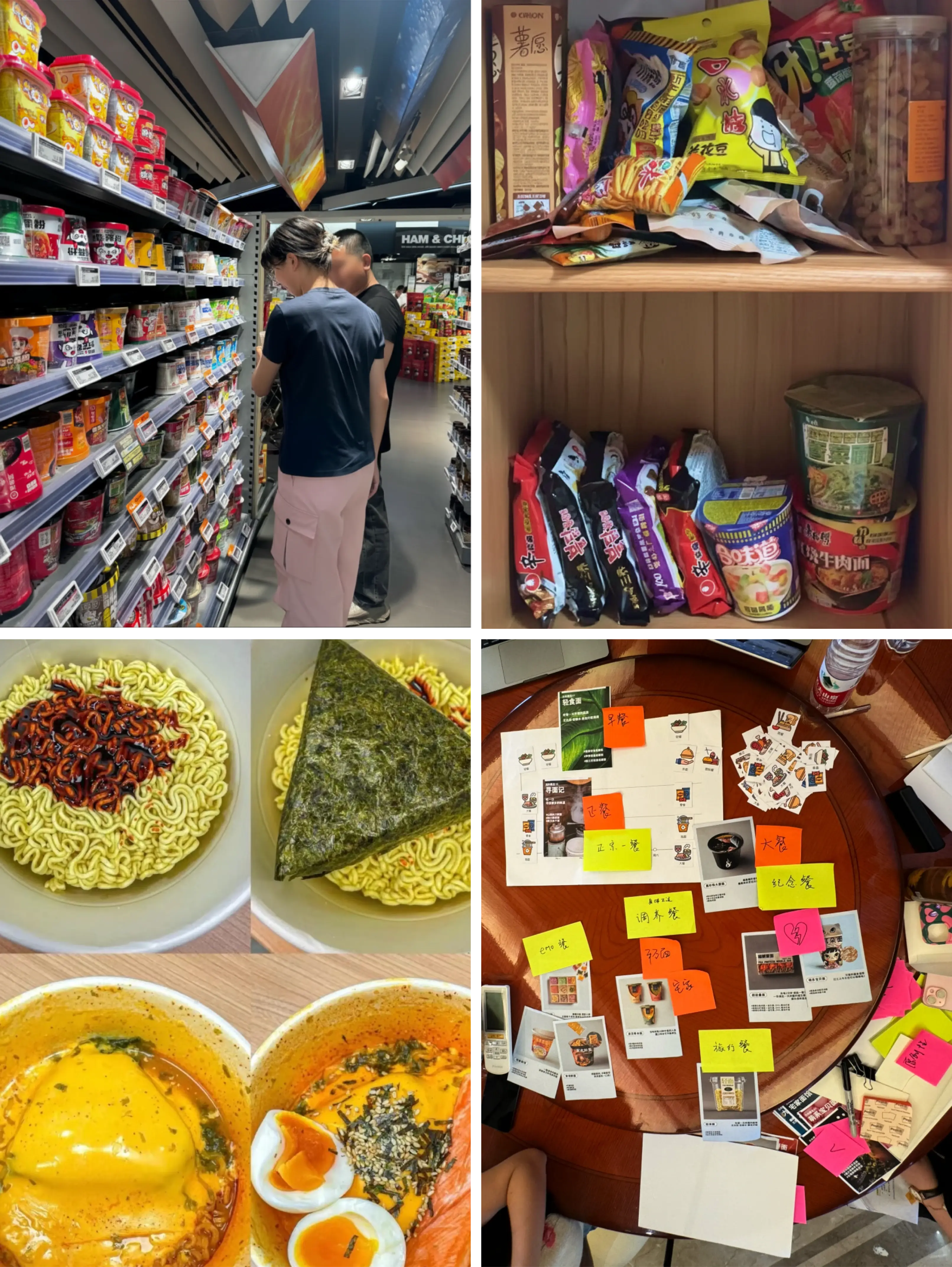
The research inspired the creation of a new category, which the team termed “fresh-brewed noodles.” More than just a noodle or broth upgrade, Master Kong’s fresh-brewed noodles would offer the speed of instant noodles with the quality of freshly cooked options, plus flavors not found in traditional noodle shops. The strategic positioning was clear. Executing it by making fresh-brewed noodles mass-producible, affordable, and eventually profitable presented a category-innovation challenge. To get there, IDEO designed a series of dual-track co-creation workshops with the Master Kong team and consumers.
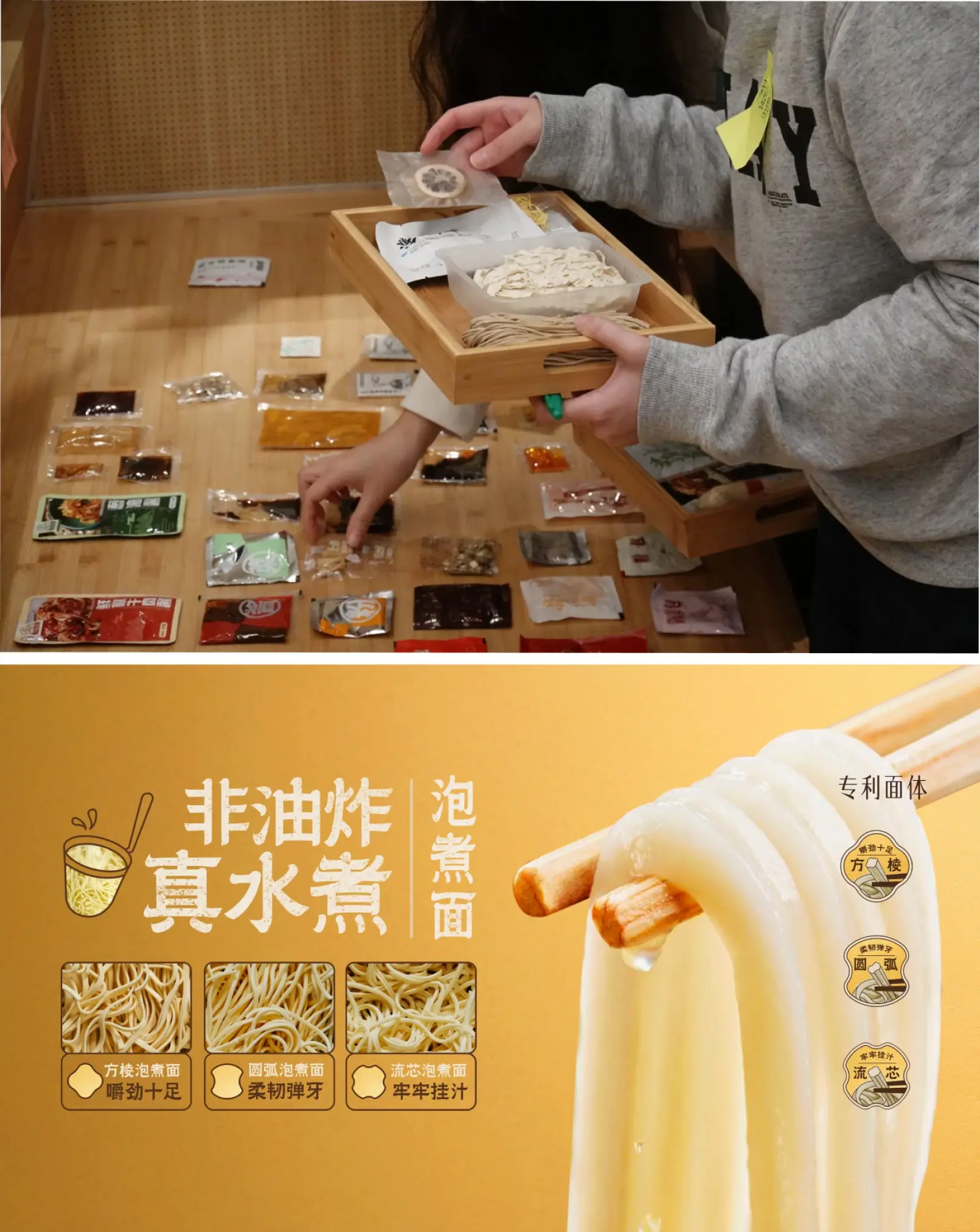
One track focused on prototyping the core product experience: noodles, broth, and toppings. IDEO and Master Kong’s R&D team began by studying the traditional craft of Chinese noodle-making, starting in Shanxi, a region renowned for its noodles. Through successive rounds of prototyping and consumer tasting, the team identified a critical insight: for “fresh-brewed noodles” to be convincing, the innovation had to be centered on the noodles themselves.
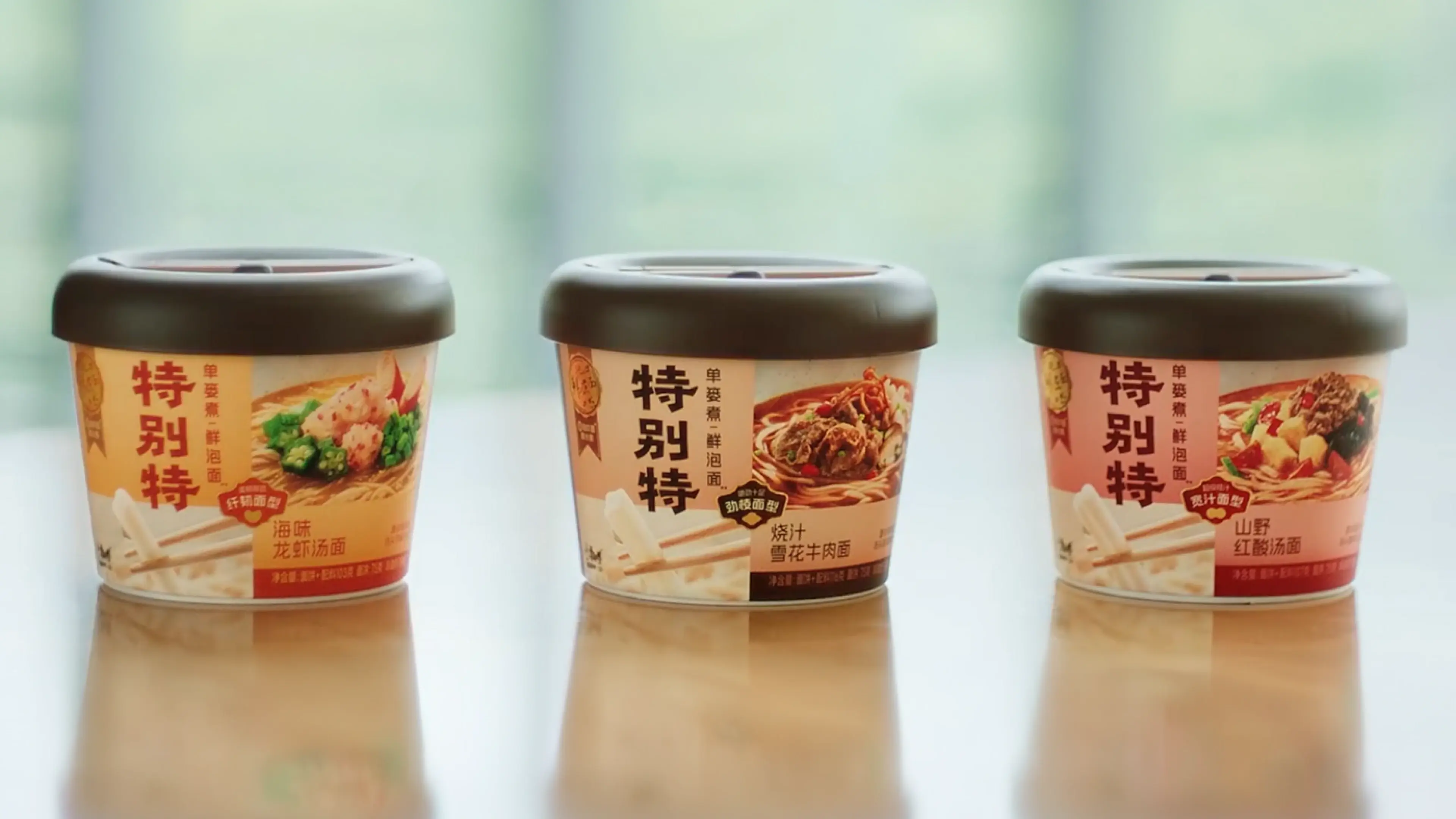
Texture alone was not enough. Consumers needed to see a meaningful difference before they tasted the product. IDEO translated this insight into a distinctive noodle profile: irregular, dimensional shapes designed to remain springy, hold sauce and broth, and mimic the resilience of freshly cooked noodles using only hot water. Because this visible shape represented the product’s core value proposition, it became a hero feature on the packaging. The graphic design made a bold visual statement about the noodle form, turning a technical R&D breakthrough into an immediately legible consumer promise: these are not ordinary instant noodles.
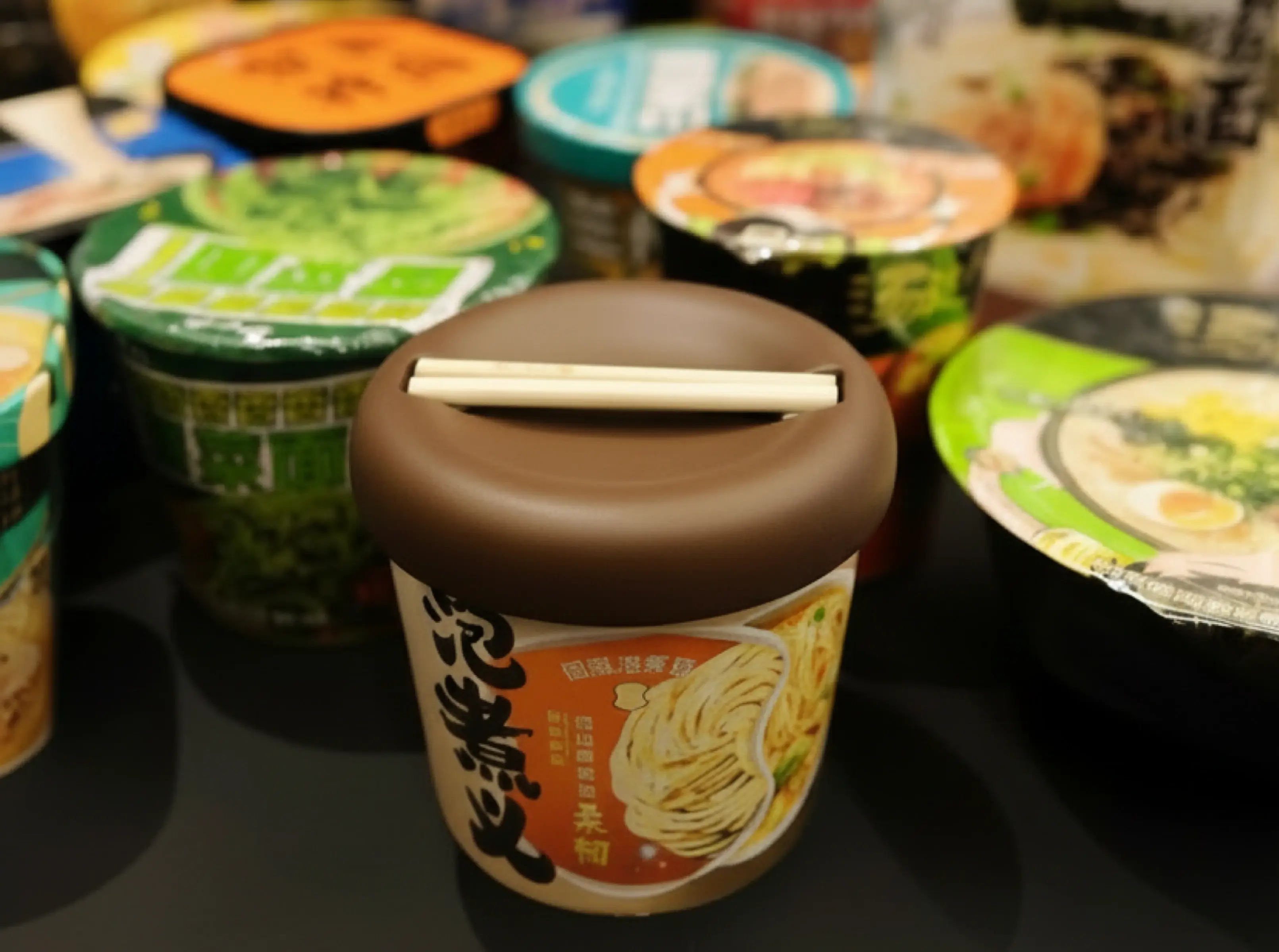
A parallel track explored the broader commercial experience: trend-forward and reimagined classic flavor profiles, light yet deeply satisfying broths, carefully selected toppings, and packaging that signals a new level of quality on store shelves. One key insight was that utensils carry meaning. Conventional instant noodles are often associated with disposable plastic forks, while higher-quality noodles are eaten with chopsticks. IDEO translated this cultural cue into the design of the bowl’s lid.
Instead of treating utensils as an afterthought, the team designed a solid, rounded, heat-retaining lid that embeds a pair of small wooden chopsticks. The gesture creates a small ritual of anticipation and reframes the product—not just a convenient instant meal, but a more considered noodle experience. Once opened, the product fulfills that promise with satisfyingly bouncy noodles, a rich liquid broth pouch that replaces the traditional oil-and-powder packet, and a vegetable packet reformulated with more premium whole ingredients.
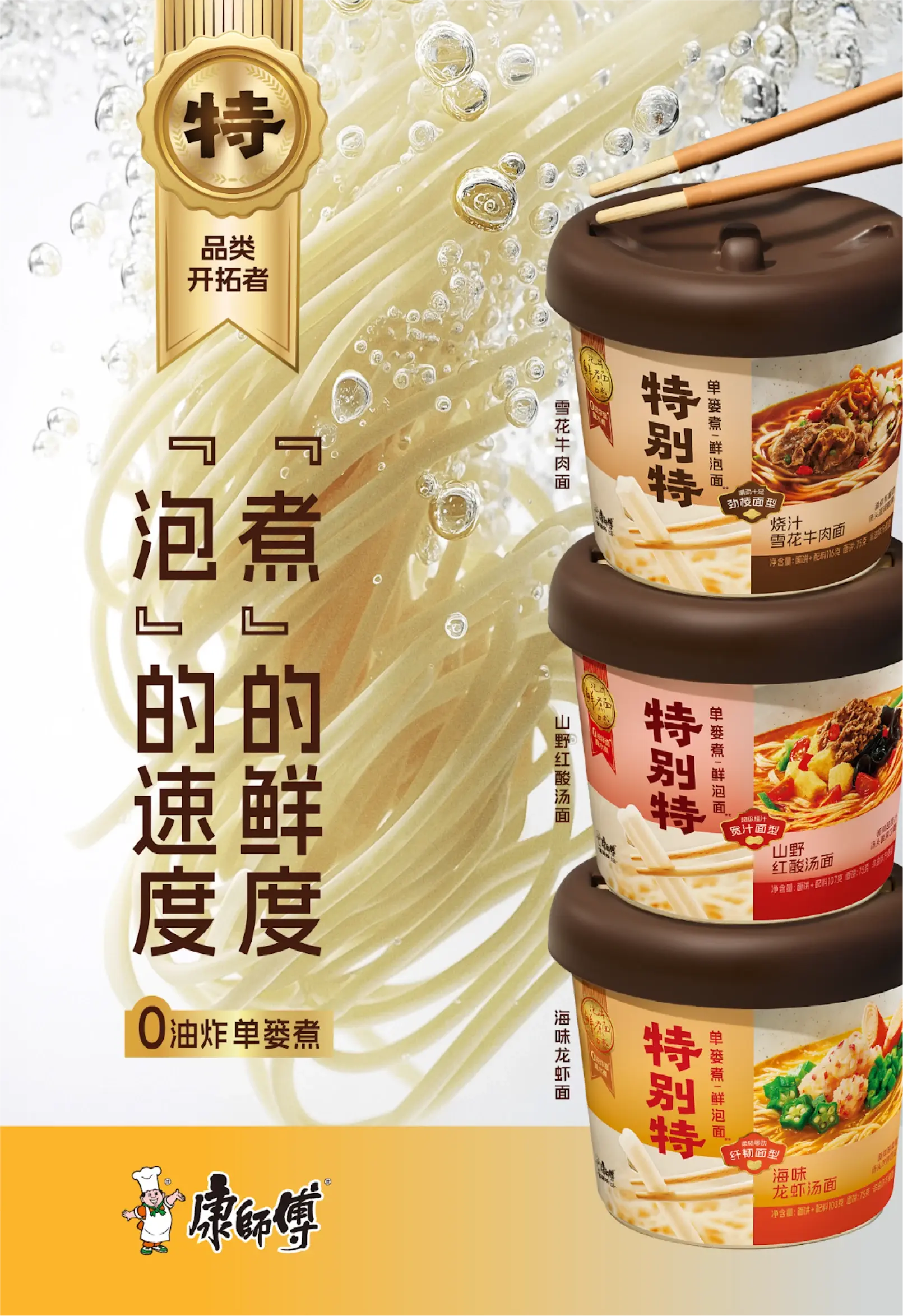
The first batch of “Te Bie Te” Fresh-Brewed Noodles—Chinese wordplay that emphasizes “special”—launched in August 2025 with three trendy and tried-and-true flavors. Within just three days, sales exceeded 100,000 bowls. Within a week, “Te Bie Te” topped the instant noodle category sales ranking on Douyin, China’s domestic counterpart to TikTok. The outcome was bigger than a product launch—it served as proof that a mature, declining category could be fundamentally reinvented to meet consumers’ real needs. For Master Kong, the project became a North Star and a model for internal category innovation in beverages, ready-to-eat foods, and beyond.
Once a popular, affordable staple, the instant noodle category in China has been declining rapidly due to shifting demographics, rising food delivery options, and increasing customer demand for healthier, more nutritious meals.
According to the World Instant Noodles Association, between 2020 and 2023, China’s instant noodle consumption fell by 4 billion packs.
100,000+
“Te Bie Te” bowls sold in the first 3 days on the market
#1
on Douyin’s instant noodle category ranking within one week of launch
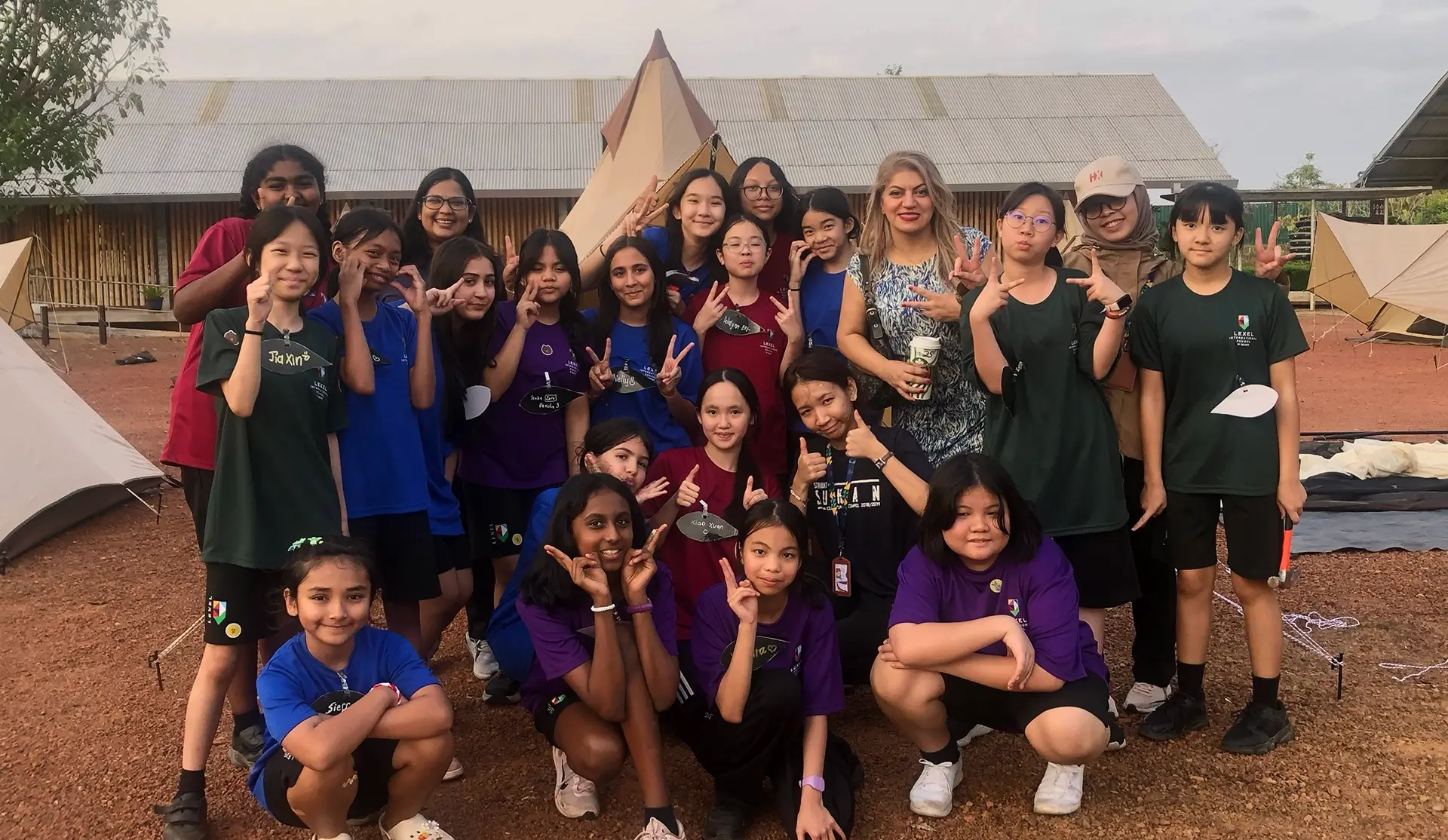
Making international education future-fit & affordable
Lexel brings world-class learning to Malaysia’s middle class.
Taylor’s legacy began in 1969 with the founding of Taylor’s College and soon expanded to include Taylor’s University, one of Southeast Asia’s top private universities, as well as many other institutions that serve 35,000 students per year. The family-owned group also operates Taylor’s International Schools, Garden International School, and Nexus International School for students ages 4 to 18. In Kuala Lumpur, Malaysia’s capital city, annual tuition at premium private schools like these ranges from about $10,000 to $25,000 USD. Taylor’s wanted to do something different: provide the same level of academic rigor and immersive learning experiences at one-third the cost.
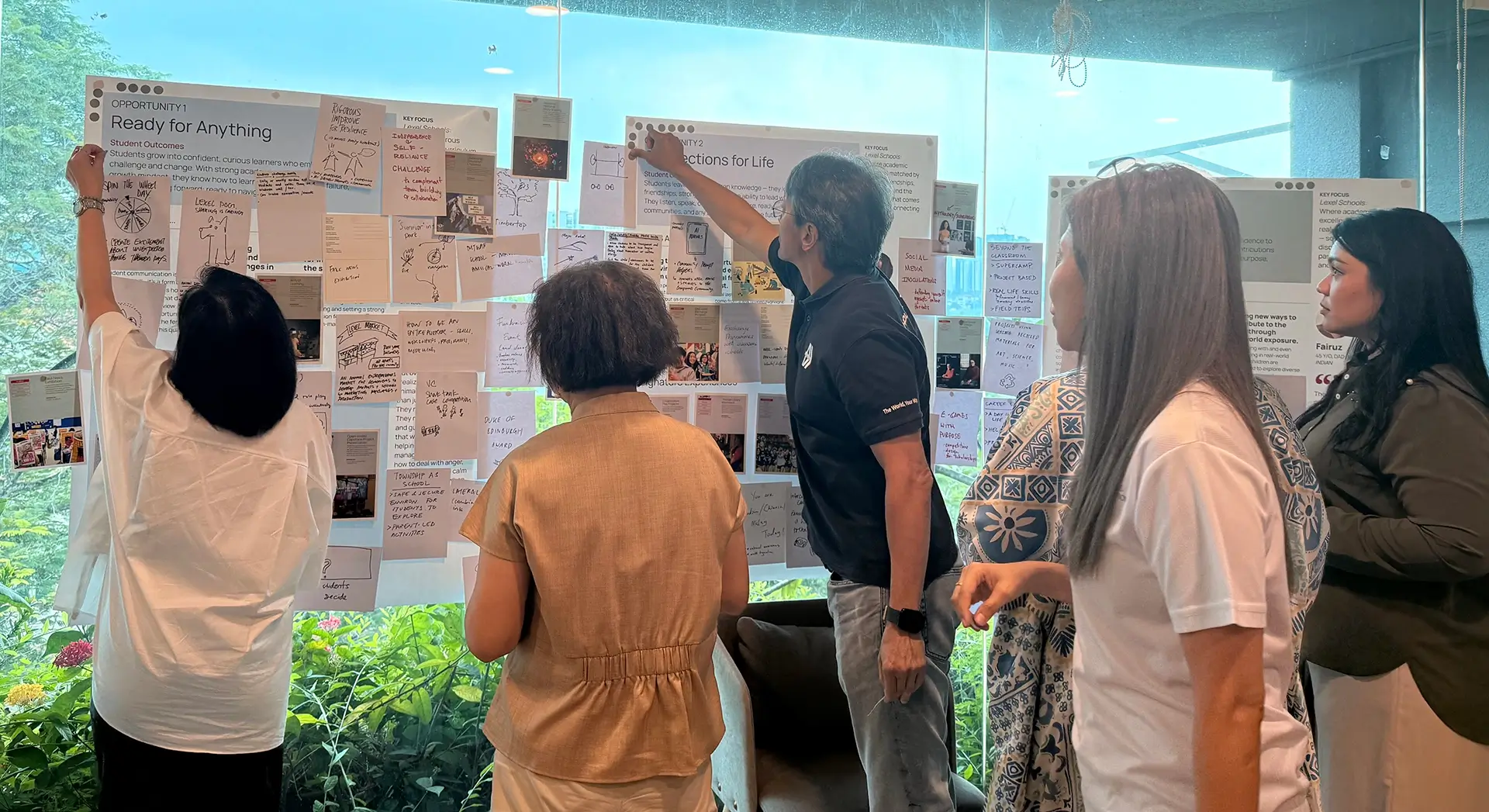
IDEO began by speaking with over three dozen students, parents, teachers, and experts across the capital to understand what was working, what wasn’t, and what was missing from such moderately priced international schools.
A few themes quickly emerged. Families, students, and teachers were worried about the stability of these new private schools, which tended to have higher-than-normal teacher turnover rates and were plagued by financial instability, negatively impacting talent attraction and retention, as well as student learning. Parents appreciated that the schools offered holistic learning experiences, such as field trips to rural areas, including jungles, but wished they were more consistently part of the curriculum. And now, the looming challenge of AI—how to use it, how to teach it, and how to teach with it—was in the background, a persistent cause for concern. The big unmet need? Reassurance that Taylor’s was thinking long-term and systematically about developing the skills, knowledge, and mindsets that would prepare students for an ever-changing world. Parents wanted a school that measured growth in academic, social, and character terms over generations, not just school semesters.
With these insights in hand, IDEO began developing a design Playbook for Taylor’s new brand—Lexel International Schools. A combination of “lexicon” and “excellence,” Lexel’s mission is “building what lasts, learning for life.”

The schools are centered around three key differentiators:
- Always Ahead: Lexel schools commit to staying current with the topics and subject matter they teach, as well as the tools they provide to students, parents, and teachers.s.
- Learning That Builds for Life: The schools ensure programmatic, systemic, and consistent learning experiences from Pre-K to Year 11. Interested students can even continue their post-secondary journey in partnership with Taylor’s University and other higher education institutions within the Taylor’s ecosystem.
- Educators for the Long Run: These schools commit to ongoing investments in professional growth opportunities for teachers and stable learning environments for students.
Four Lexel Literacies—AI, Digital, Financial, and Nutrition—integrated into the Cambridge Curriculum bring the school’s vision and mission to life.
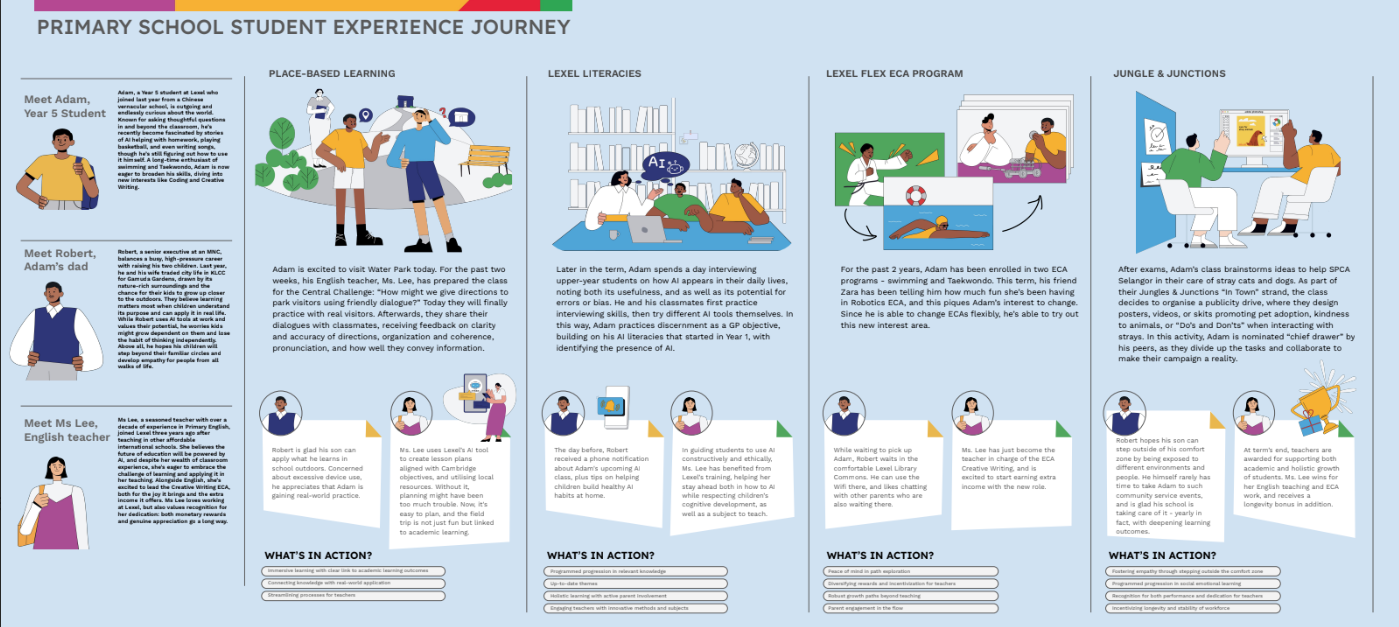
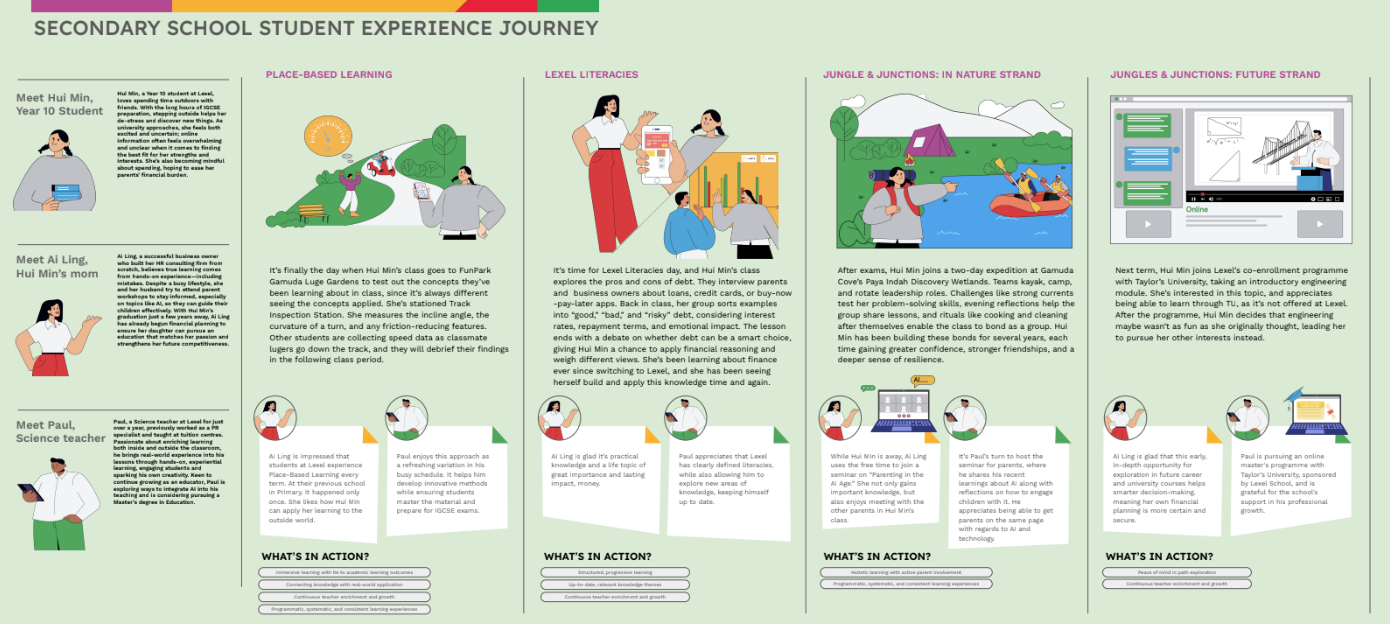
By systematically integrating AI literacy into its spiral education framework, in particular, an approach where major topics are revisited multiple times through a curriculum to build fluency over time, Lexel ensures parents that the school is thinking a decade ahead from Day One, setting the school apart. In addition to enhancing AI fluency, Lexel offers unique end-of-term experiences called Jungles & Junctions.
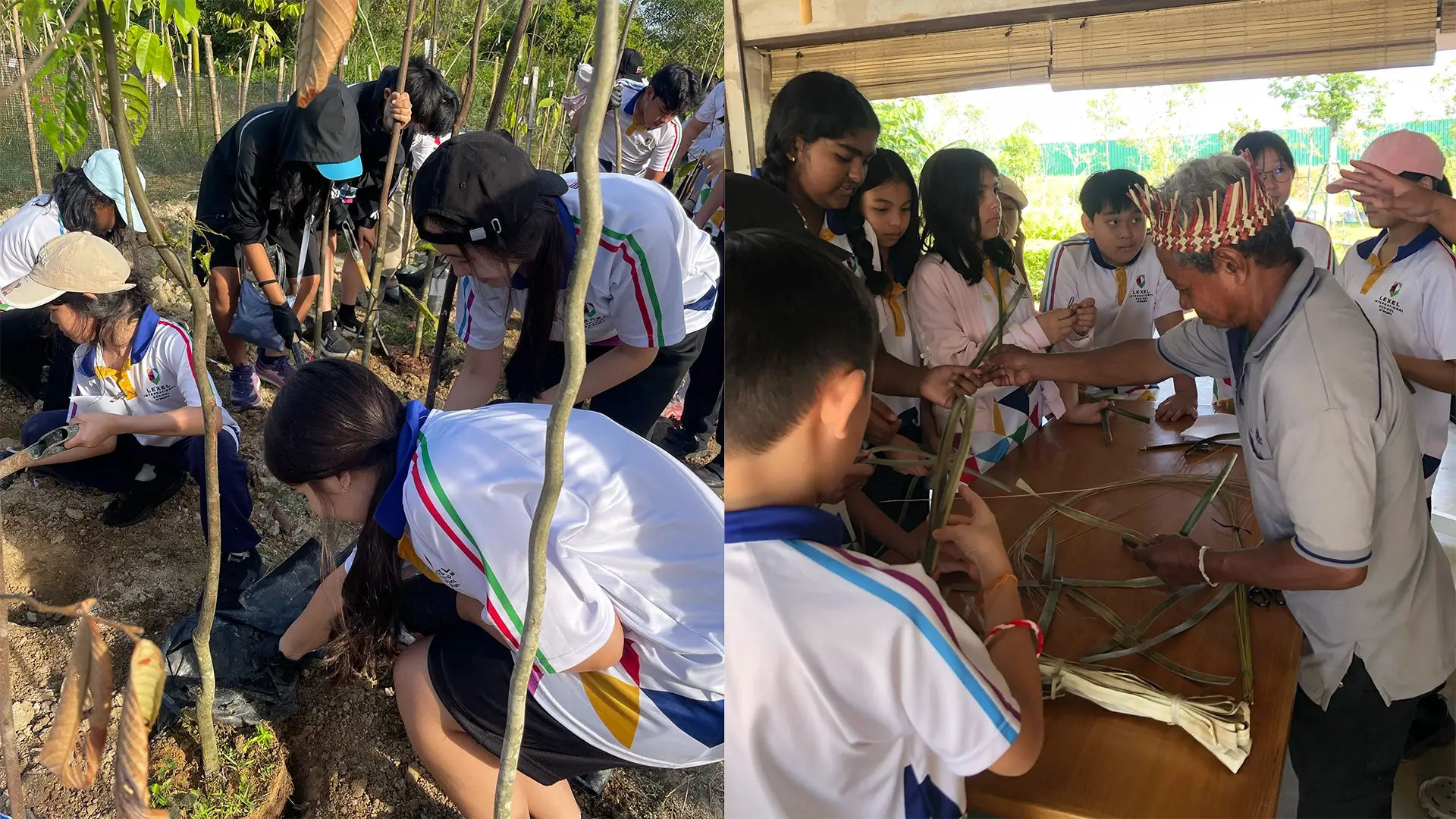
Combining three important strands of learning—community engagement, nature-based personal and interpersonal development, and career and university exploration—Jungles & Junctions leverages Taylor’s extended educational network and Lexel’s strategic founding campus within the Gamuda Gardens development in Selangor. Surrounded by tropical rainforests, the township’s residential neighborhoods, theme park, and various sports facilities, including an Olympic-length swimming pool, are transformed into an extended Lexel campus, with a GenAI-driven planner to help teachers streamline the organization of class outings. “The Township is Your Campus” became the tagline for this approach.
In September 2025, just months after IDEO’s collaboration ended, Taylor’s began classes at its first Lexel International School. By mid-year, the new school had achieved 115% of its year-one student enrollment target, with significant inbound demand for Year 2 already demonstrating the school’s market resonance.
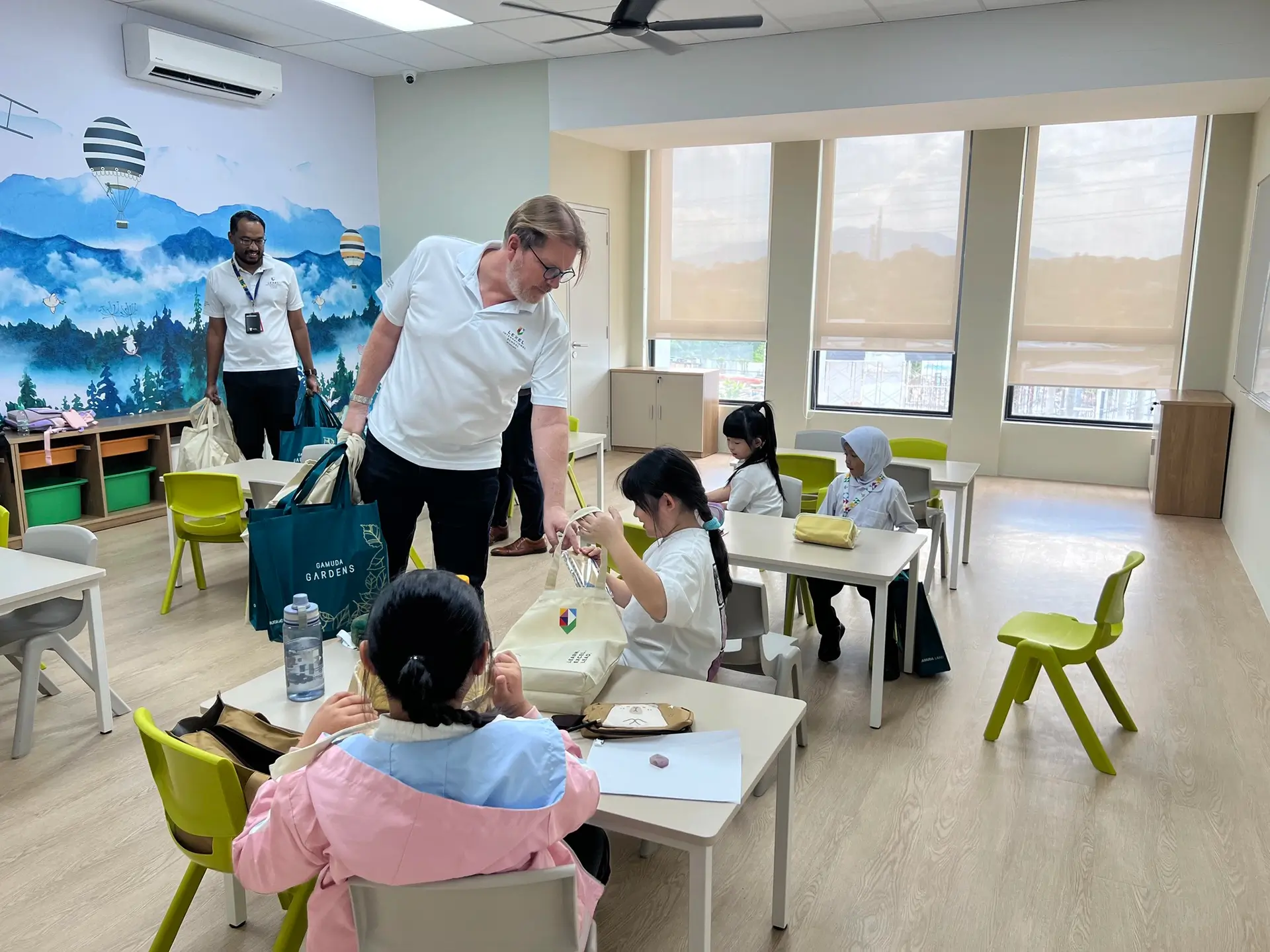
The modern campus features spacious classrooms, science and technology labs, a library, a multipurpose hall, and a canteen. Annual tuition ranges from about $2,800 USD for pre-K students to about $6,100 USD for secondary students.

Most importantly, by combining Taylor’s deep academic expertise, Gamuda Land’s development prowess, and IDEO’s innovative design Playbook, Lexel brings quality, affordable international education closer to home for Malaysian families. According to one parent, “My daughter looks forward to going to school every day … and has a lot of opportunities to express herself. On a scale of 1 to 10, I give [Lexel] an 11.” Based on the IDEO Playbook, a second flagship campus in the Southern Klang Valley, which is scheduled to open in September 2026, has already exceeded its year-one target enrollment expectations, with plans to continue extending the Lexel network to other parts of Malaysia and the wider Southeast Asian region in the near future.
Malaysia’s private international school sector has grown significantly as parents seek quality English-language education. However, high tuition fees and limited access to reputable schools are continual challenges for those in the emerging middle class.
115%
of Lexel’s student enrollment target reached during the launch year of its first campus
Year 1 enrollment target exceeded
at Lexel's second campus several months ahead of classes commencing
Delivering an unbiased news experience
Straight Arrow News transforms fact-based news consumption.
The American news industry has long been a competitive and saturated market. This has only intensified with the emergence of social media outlets and AI-generated news. Even so, SAN’s rigorously unbiased, fact-based reporting style and rich video storytelling had enabled the ambitious startup to rise above the media fray in just three short years.
With a strong foundation to build on, IDEO sought to further differentiate SAN’s cutting-edge news product and build deeper engagement with a wider audience through a new user experience.

Collaborating closely, IDEO and SAN began by delving deeply into media consumption habits. They met with early SAN superfans, news consumers who spent hours a day absorbing content from traditional outlets like Fox and USA Today, and those who looked to their Ring doorbell app or Reddit for news. The takeaways? People were tired of clickbait and clunky interfaces. They sought clear, factual news that was easily accessible, with additional context to help them interpret events and understand their significance. They craved more than one perspective on important topics, so stories felt balanced rather than polarized. They also valued having control over how they consumed news, so making it easy to switch between text, video, and audio formats was crucial.
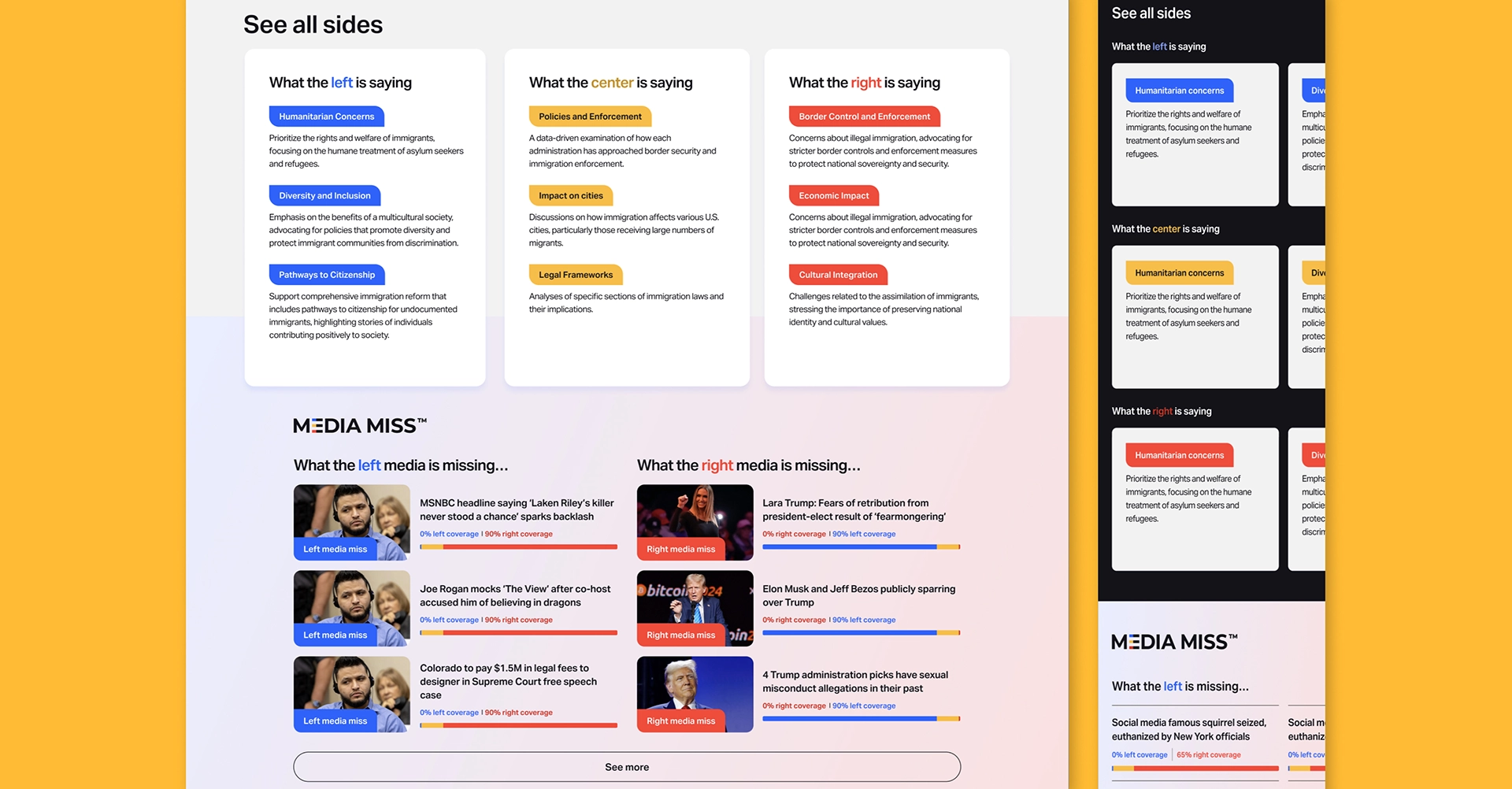
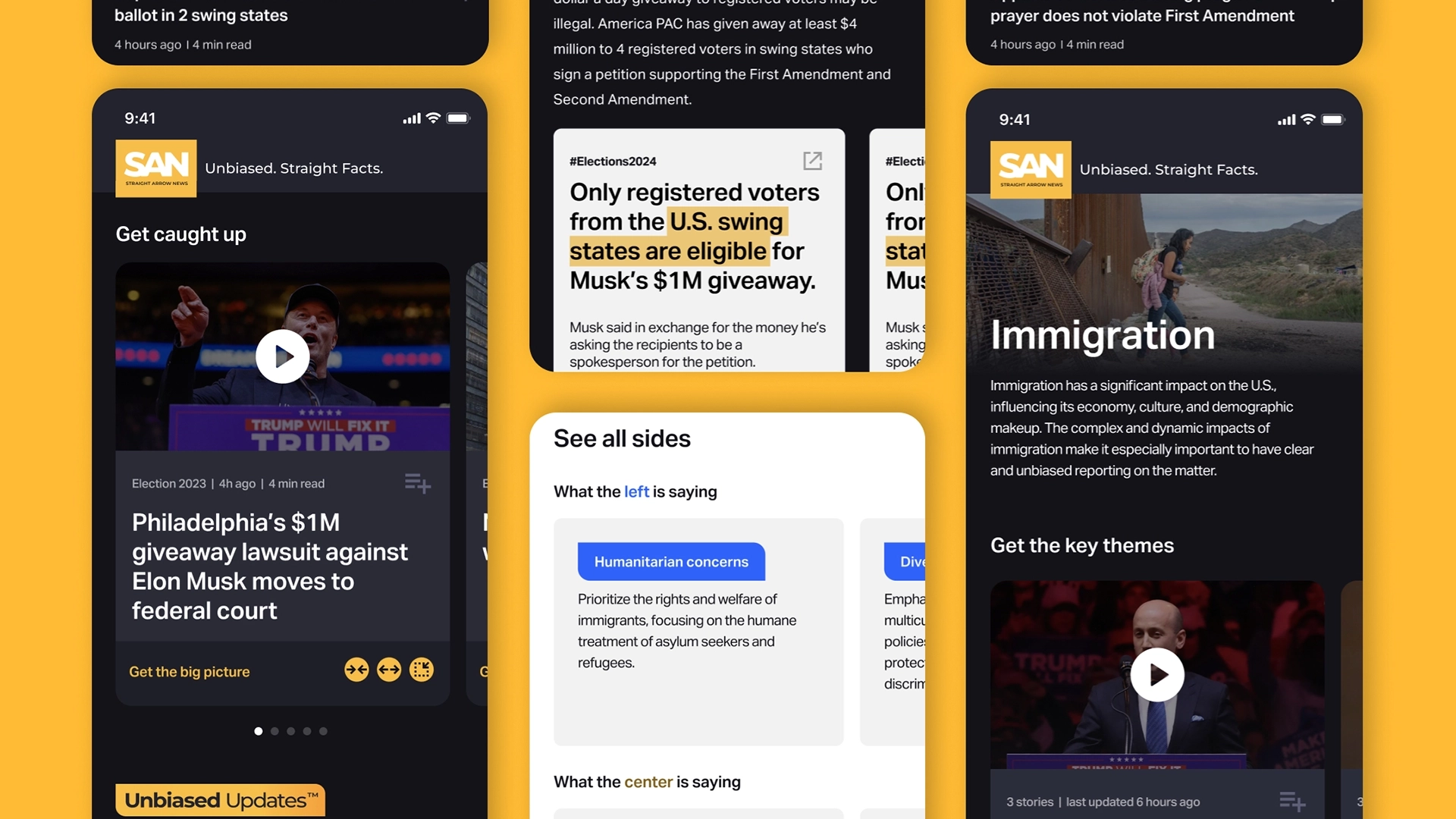
Together, IDEO and SAN created features across SAN’s website and app that put facts, trust, and transparency at the core of the product experience. Fact Cards distill key data points into clear, shareable units, while the Sources feature allows readers to trace information directly back to its original source. To make complex stories easier to grasp, Big Picture insights drill down into why events matter, surfacing underlying themes, historical parallels, differences in reporting, and common ground. The Why This Story Matters section provides readers with clear framing and sets the story within a broader context, while the Timeline illustrates how events unfold over days, months, or even years. An antidote to news polarization, See All Sides presents left, right, and center narratives for key topics side-by-side, and Media Landscape visualizations reveal how coverage varies across outlets. Finally, to ensure SAN fits seamlessly into readers’ daily lives, the redesigned Today Page is organized into three highly scannable sections: Latest News, Top Stories, and SAN Originals. The combined features create a balanced, clear, and non-polarizing news experience, making it easy for readers to delve deeper into the sources of their news.
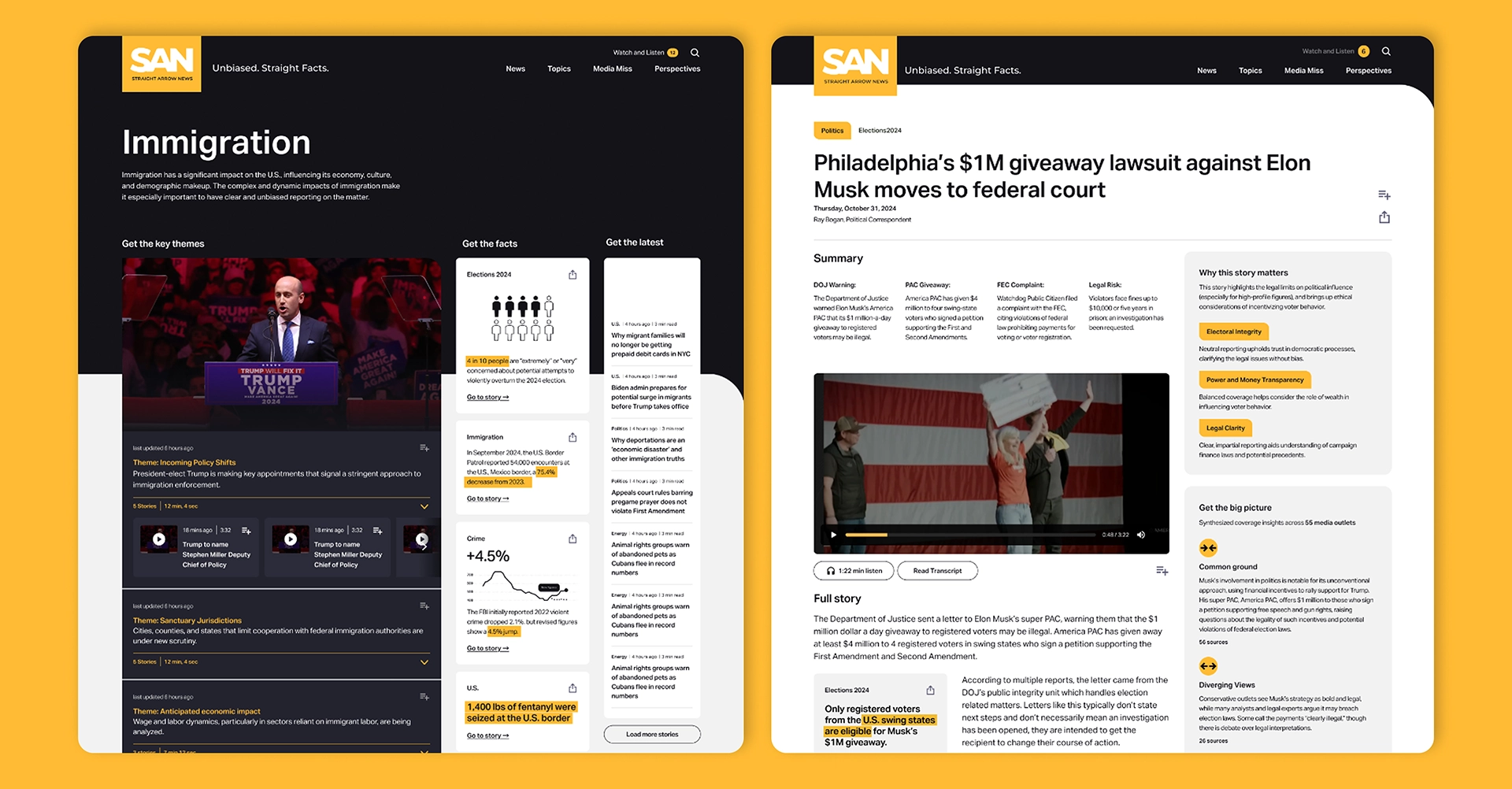
SAN now delivers a news experience as modern, dynamic, and trustworthy as its journalism. A month after its debut, the SAN app’s page views increased 1,170 percent year over year compared to June 2024, while active users rose 700 percent. Readers also give the updated mobile experience a 4.8 rating on the Apple App Store. “Our team is delivering reporting that’s both deeply factual and accessible,” said Derek Mead, SAN’s Chief Content Officer. “This redesign is pivotal to the direction journalism needs to take and the leadership role Straight Arrow News is taking on as we help guide the news industry into a brighter future.”
SAN built a loyal readership and gained recognition for its unbiased reporting. To expand and stand out from legacy media, SAN wanted a redesigned user experience that reflected its commitment to fact-based journalism.
1,170%
increase in app page views YoY
700%
increase in active users
4.8 rating
on the Apple App Store
8 designers' tips for better visual storytelling
IDEO designers and OpenIDEO community members share their words to work by
The human brain processes images 60,000 times faster than text, and 90 percent of information transmitted to the brain is visual. As designers, when we explore the craft of storytelling, visual language may be one of the most important languages of them all.
Earlier this year, OpenIDEO, in partnership with the Hewlett Foundation, launched our first Challenge on visual language. We called on visual creators from a multitude of mediums to join us in answering the following question: “How might we reimagine a more compelling and relatable visual language for cybersecurity?” With the close of the Challenge and announcement of five Top Ideas, we’re highlighting several visual design tips to get you inspired for your next project.The thrill—and challenge—of design is forging into uncharted territory to help make the abstract tangible, the overwhelming exciting, and the technical accessible. With the topic of cybersecurity, we navigated the ambiguity of doing just that. After learning from IDEO designers and Challenge participants across disciplines about how they use visual language to translate complex topics, we’ve curated some tips and tricks to share with you. Learn from IDEOers Felicia, May, Allison, and Erika, plus Challenge participants Abraham, Abrahma, Claudio, and John.

Felicia Chiao, industrial designer, IDEO San Francisco
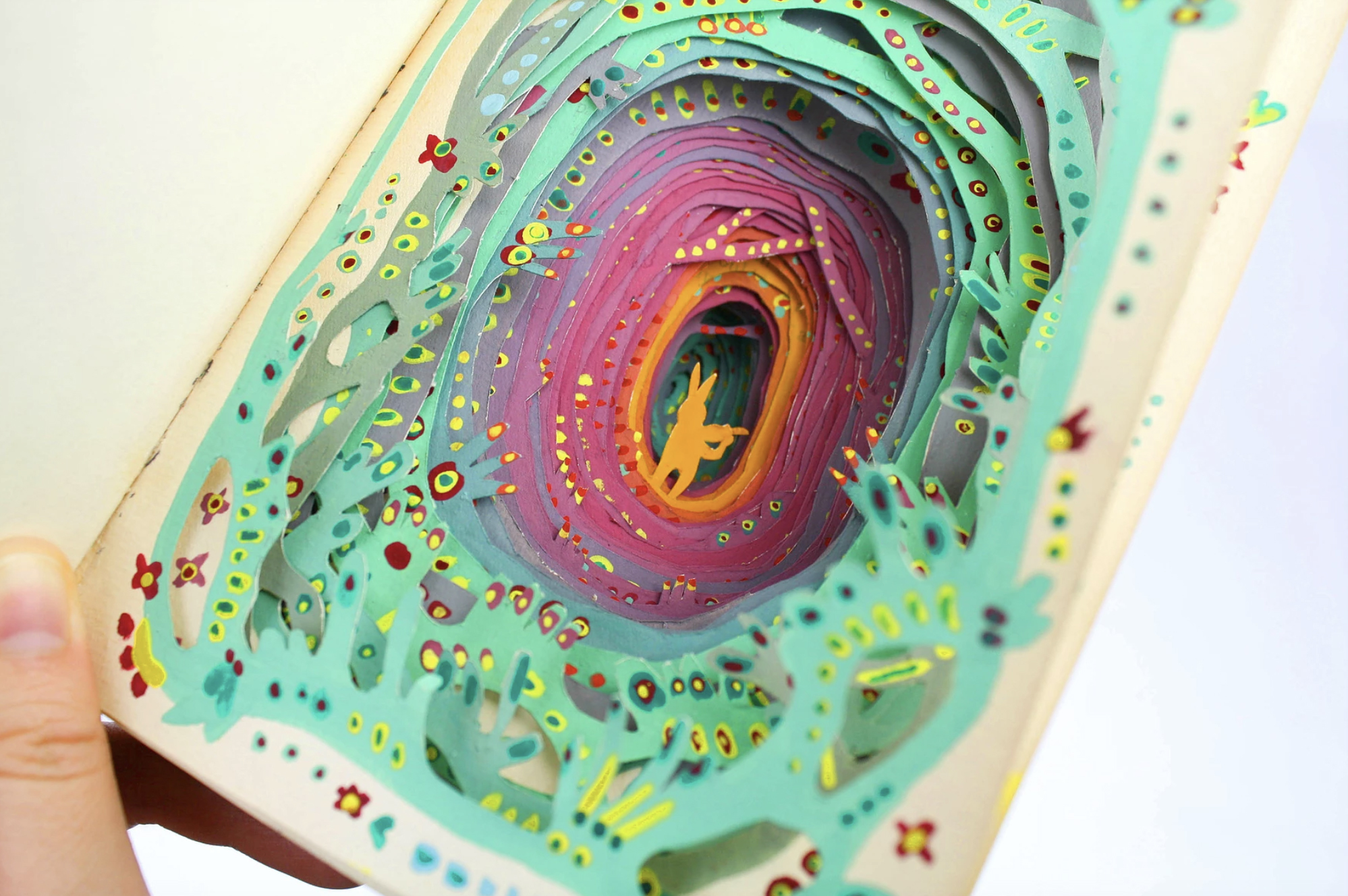
Felicia Chiao is a designer and illustrator based in San Francisco. By day, she works as an industrial designer for IDEO's food practice; at night she has been drawing in sketchbooks for over seven years, mostly for fun.
"When starting a composition, create an anchor first, then build around it. The anchor can be the focus of the piece (like an object/animal/person) or a setting (interior, beach, city, etc.) and the rest of the elements drawn in after should support it.
You don’t need to know what the whole drawing is going to look like when you start it. Start with what you know and build into it as you go. I work mostly with markers, which often limits my choice of colors for the color palette, but you can start with the colors you know you will use (a red apple, blue water, etc) and then looking at your palette, pick which other colors would go well with what you have.”
May Kodama, graphic designer, IDEO San Francisco
May is a true-crime-podcast-listening, plant caring, constantly eating, Japanese-American graphic designer at IDEO.
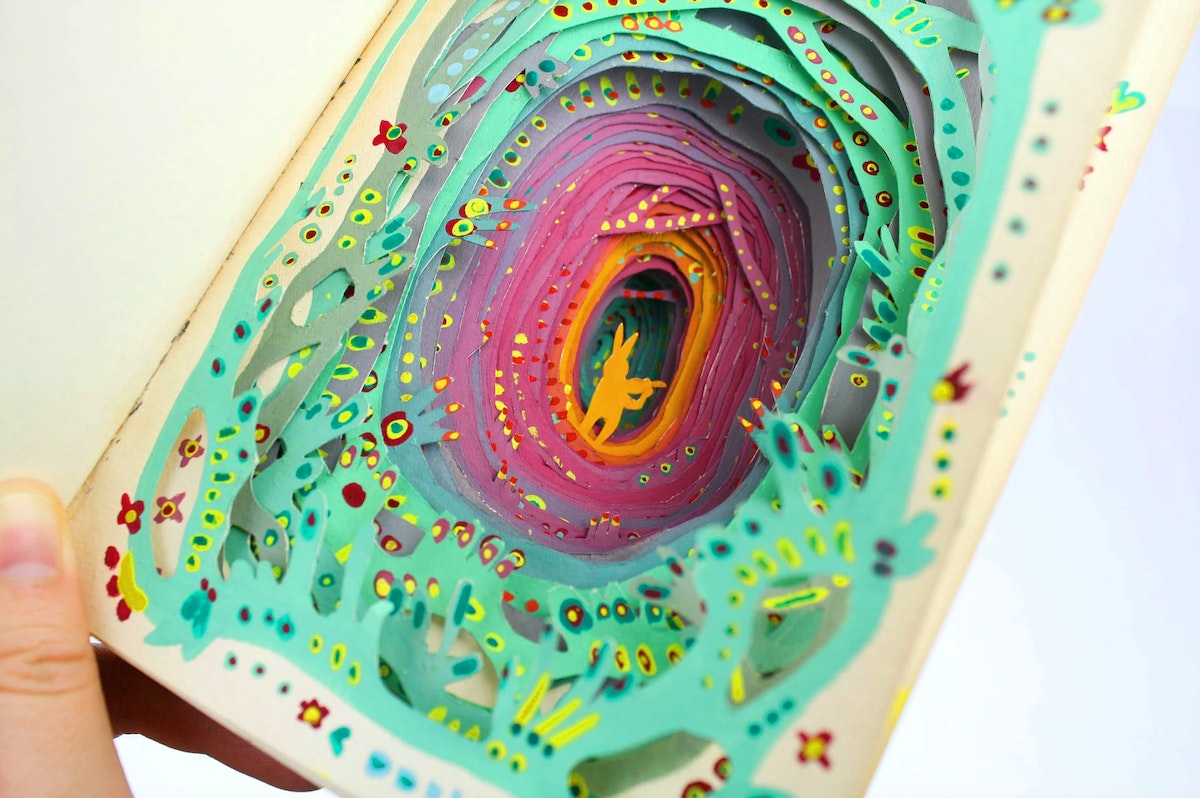
"Try limiting your color palette to 1-5 colors, and even limit the shades of those colors. Explore how simply you can communicate depth and perspective with the layering of the limited palette. You can start with monochrome in pure black and white before layering the additional complexity of color.
The thing that motivates me the most is experimentation and exploration. I find that as long as I'm constantly doing and learning something new, I stay inspired and excited about the work. However, don’t look at too much inspiration. Sometimes, I can get lost on the Pinterest train, clicking into link after link after link. Visual overload can crowd and push out your own ideas, so be careful to balance looking externally and looking internally. Always be hungry for discovery, but save space for your own creativity to flow.”
Allison Press, interaction designer, IDEO San Francisco
Allison is an interaction designer and strategist at IDEO on a mission to design for the public good. Whether it’s improving how public institutions serve their citizens, creating digital access to learning, or cultivating civic engagement, she is driven toward systems-level challenges.
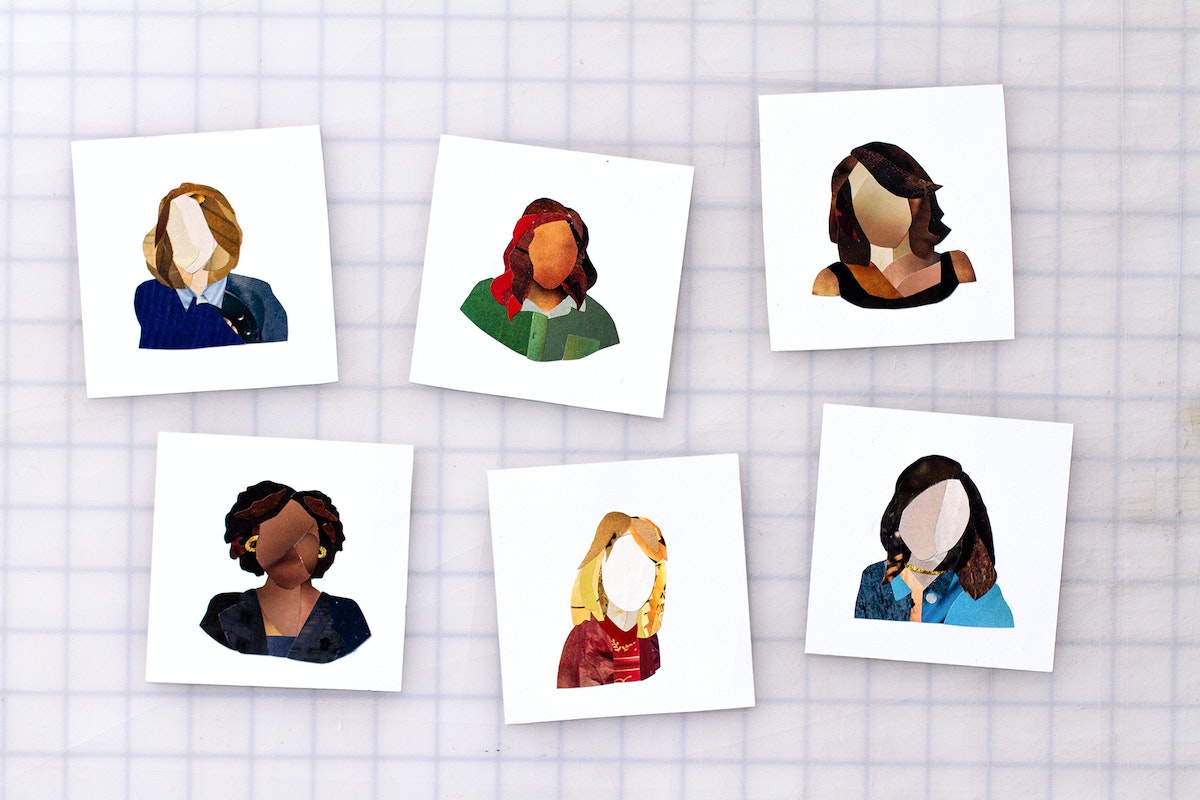
"A balanced composition has three things—a large element (like a colored background), a medium element (like the focal point), and a small element (to add visual texture). If you want to take your creation to the next level, adding a little bit of texture in digital illustrations goes a long way.”
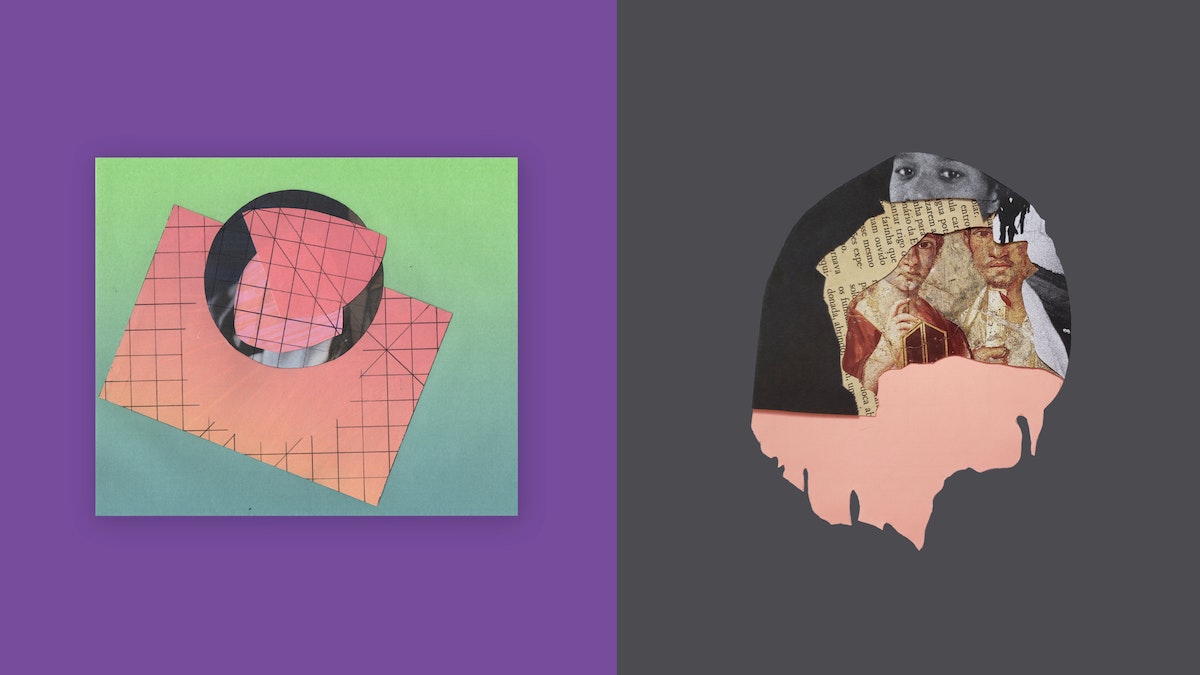
Erika Díaz Gómez, former OpenIDEO design fellow, Bógota, Colombia
Erika was born in Colombia and loves creating stories without words. She thinks that telenovelas are more interesting than science fiction.
"Create your own personal and technical rules; fail, win and be patient. Learn from yourself. Document, revisit and appreciate what you designed in the past. Explore your personal craft and celebrate your creator's identity. Make and repeat. Go analog, explore both your personal and craft's constraints, and don't let your commercial work take over. Art and side projects are the best teachers.”

Abraham Pena, Cybersecurity Visuals Challenge participant, Doral, Florida, USA
Abraham is a web designer and brand strategist dedicated to creating conceptual worlds for his clients through the use of metaphors and visual allegories.
- "Research a lot. The key to this process is to have clear concepts from the start. Then think of the final users: How would they understand what you want to say? Even a complex topic like cybersecurity can be translated into an easy-to-understand visual language, just by making the right connections with the visual references of the final user.
- Iterate like crazy. Your first idea is not always going to be the best.
- Interact with your community. Your peers and mentors can give you priceless feedback and they will let you see the design from an outside perspective."
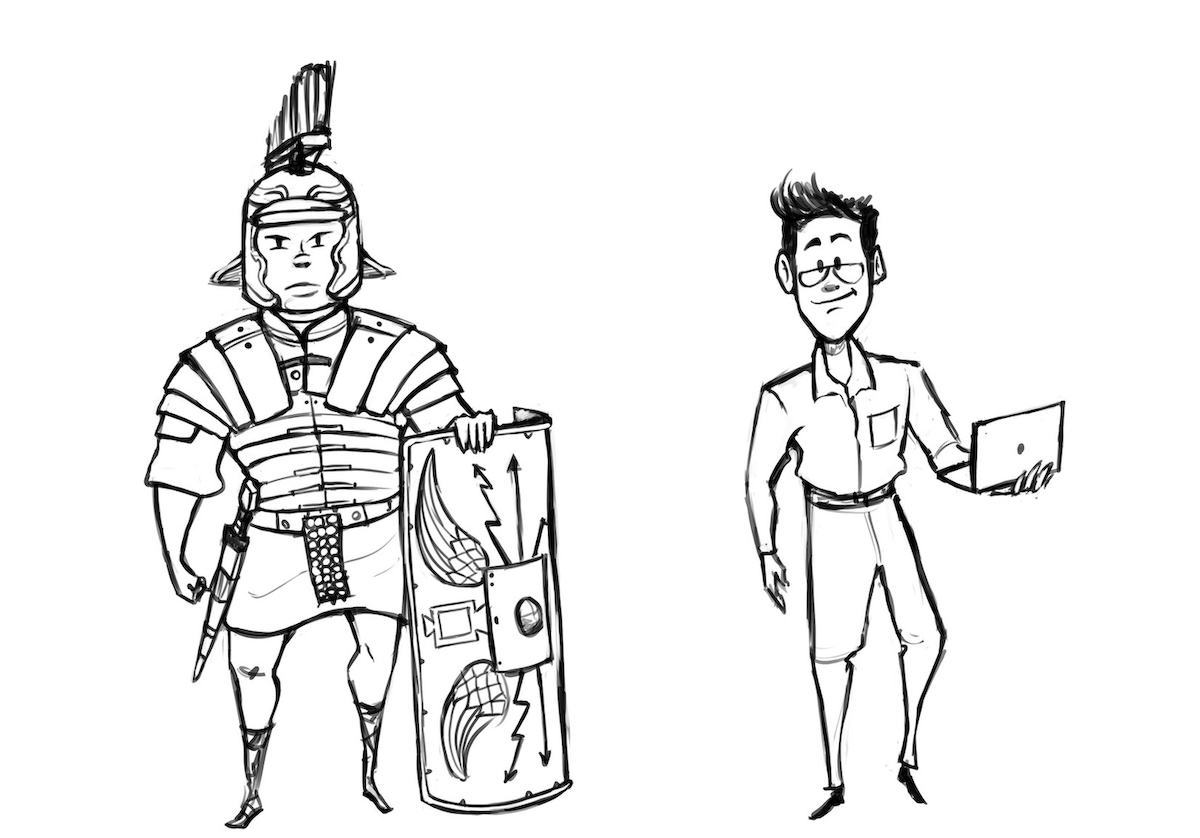
Abrahma Tansini, Cybersecurity Visuals Challenge participant, Pamplona, Spain
Abrahma is a passionate logo and identity designer with experience developing brands, advising enterprises internationally. Passionate about illustration, he has worked as a freelance illustrator on children’s book illustrator and also loves to make caricatures and cartoons.
“The best way to create images for a technical project is to know the concepts and ideas, plus have a broad knowledge of the subject, which in this case was cybersecurity. The mentorship and guidance from cybersecurity experts that we were paired with for this Challenge was important and necessary. As designers and illustrators, we are not necessarily familiar with the technical concepts of cybersecurity, but we do have the tools to transmit complex concepts through the power of visual images.”

Claudio Rousselon, Cybersecurity Visuals Challenge participant, Cuernavaca, Mexico
Claudio is a freelance artist focused on muralism, illustration and printmaking. He’s a creative that has always explored the themes of technology, sci-fi, aerospace, and energy sciences.
“Draw a lot! Sketching and mindstorming, writing things down, and reading lots. I believe in the power of instinct and how it expands with creativity. Inspiration comes to me mostly during work—the more you dig into it, the more things pop up in your head. It works for me to expand the ideas to the wall or a BIG table: getting a visual perspective of the concept helps a lot. Change your process and it will change your outcome. Also, never forget to embrace accidents and mistakes. Not all of them are useful and some can go beyond repair, but you can learn a lot from them. Plus, the feeling of being amazed by unexpected results is great.”
John Hurley, Cybersecurity Visuals Challenge participant, Boston, MA, USA
John is a product designer and art director with experience in UI/UX and visual design, creating wireframes and visual concepts for a range of platforms. As a designer, he enjoys solving complex problems by using a holistic design process with a focus on multi-disciplinary collaboration and rapid iteration.
“Collaborate. Reach out to as many people as you can. Everything from subject matter experts to co-workers, friends, and anything in between. Our final submission was the result of gathering opinions and exploring our topic in ways that are simply impossible to accomplish on your own.”
If you’re interested in learning more, you can browse the final portfolios of 23 shortlisted visual creators from the Challenge on the OpenIDEO platform.
Every story begins with the foundation of language. Oftentimes, when we think about language, our minds default to written text and spoken conversation. But language is more than words—it’s any way of communicating across mediums that brings an idea, topic, or conversation to life.
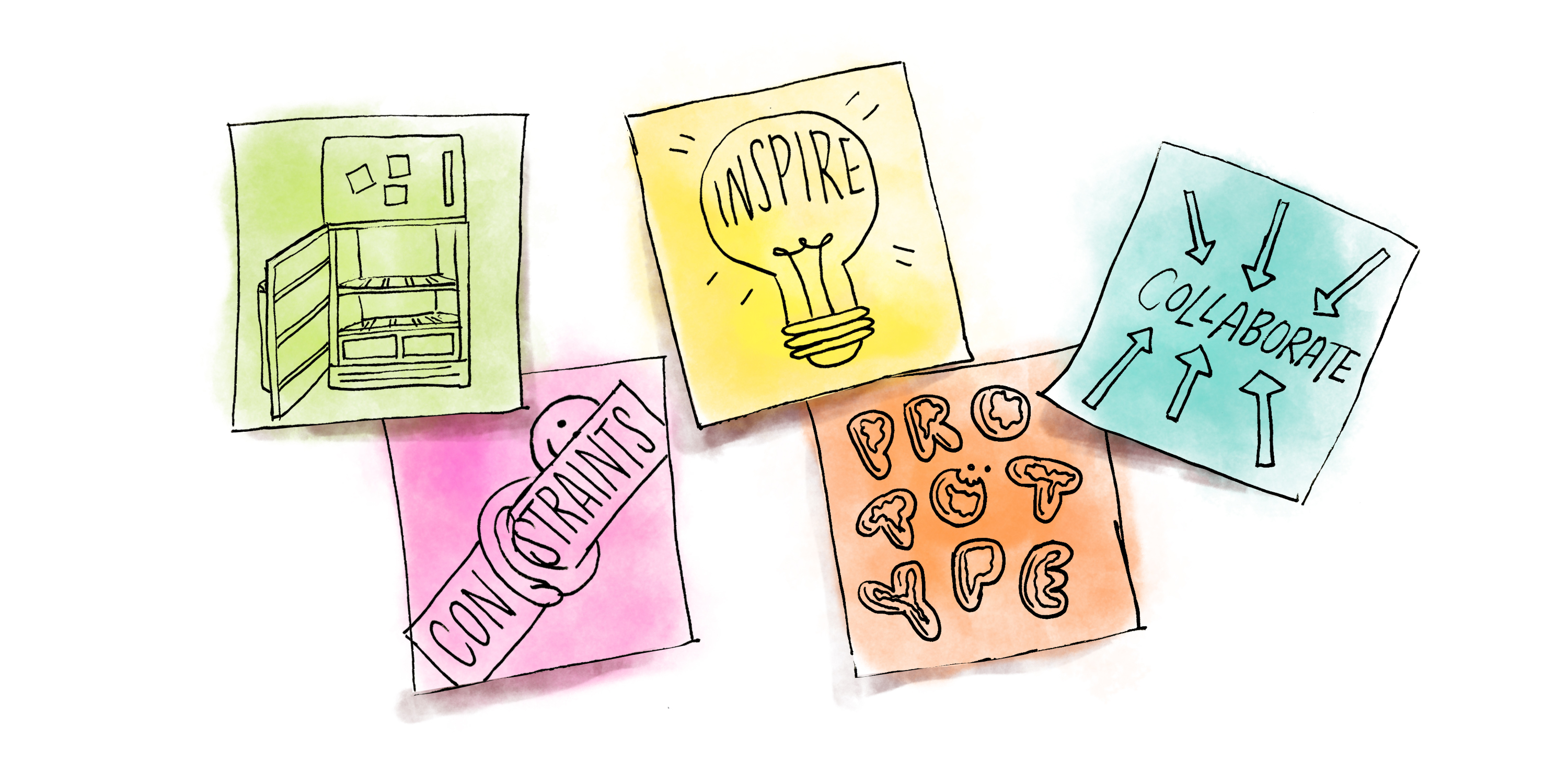
5 ways to address climate change from your own kitchen
Try design-thinking the contents of your fridge
There’s still a tremendous amount of change that needs to happen at the corporate level, but we now see some big food companies responding with greater transparency in sourcing, cleaner labels, and more natural ingredients.
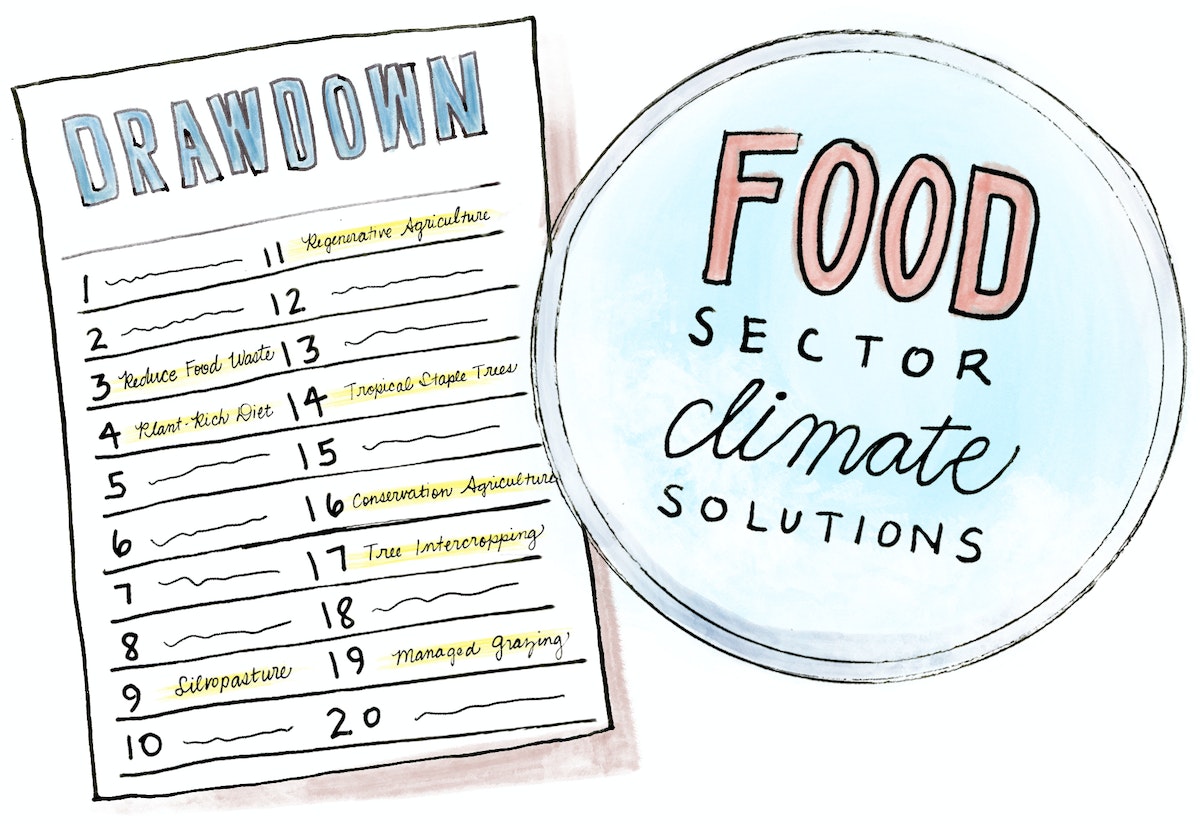
Project Drawdown, one of the most comprehensive and respected plans to reverse climate change, lists the top 100 solutions to reverse global warming. Eight of the top 20 are connected to the food system, including reducing food waste, adopting a plant-rich diet, and supporting regenerative agriculture.
For example, the food we waste is responsible for about eight percent of global emissions. And it turns out your own kitchen is ground zero for potential impact: US households account for 27 million tons of the 63 million tons of wasted food per year.
We use design thinking to help our clients run towards big challenges like food waste, but the same principles can make an impact in your own home. We can each prototype our way towards new practices in our kitchen. Food is, after all, one of the most forgiving materials, and even the most abject kitchen failure is usually edible.
Here are five simple ways to design think your way towards addressing climate change in your own kitchen.

1. Adopt an experimental mindset
I bet you've heard some of this before, but it bears repeating: If each of us replaced a third of the beef we eat with pork, chicken or legumes, the World Resources Institute reports that our food-related emissions would fall by around 13 percent. But adopting a more flexitarian, plant-rich diet is a serious behavior shift, and not an easy one.
What if we reframed “never eating steak again” as “experimenting with eating mostly plants”? Trine Hahnemann, a Danish culinary writer, tells a story about her family’s generational transition to a plant-rich diet. Her grandma’s recipe for a pork dish called for meat as the main ingredient. Later in the 1970s, her mom adjusted the recipe so it used only half the pork. Today, Hahnemann cooks the same family dish but with no pork at all.
The design challenge is crafting plant-based options that are so satisfying and enticing that you don’t miss the meat. Like Hahnemann, we can experiment our way there. Start slowly by removing meat from traditional recipes. My meat-free pozole soup was an experiment, and though it lacked the oily richness of the pork version, it was a satisfyingly rich broth with hearty beans—another edible prototype.
2. Buy less
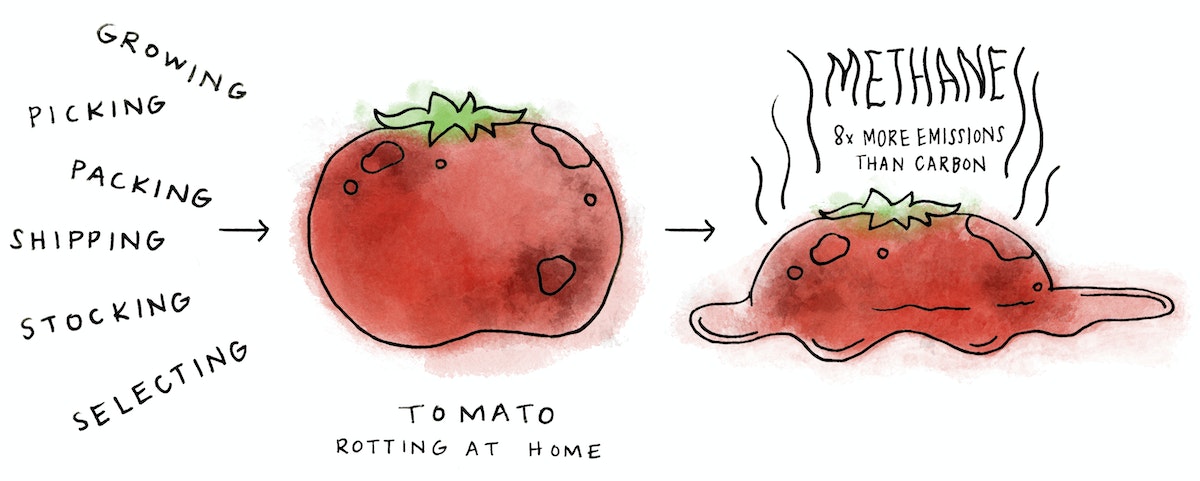
Not all food waste is created equal. That moldy tomato you never got around to eating used up more resources than a tomato left on the vine: Resources were used for it to be picked, packed, shipped to a grocery store, unpacked, stocked, selected, paid for, brought home, and now rotted. It takes two months for that tomato to decompose in the compost, during which time it releases methane into the atmosphere—which produces eight times more emissions than carbon.
When you head to the store or farmers market, simply bringing home less food will do wonders to cut down food waste. Embrace discomfort—a key design principle—by grabbing a smaller shopping basket to constrain your purchases, even though it might feel like you’re not buying enough.
Once you get home, use a Sharpie to date your food to remind yourself to enjoy it within a particular time frame. Place your “cook first” ingredients in the front so you’re more likely to reach for them.

3. Buy better
Design requires inspiration. To bring this to your food choices, make going to your local farmers market every week a habit. With each visit, you’ll get inspired by seasonal produce and begin to unlearn the mentality of having anything, anytime (and having it look perfect). Nature has constraints, and this is one of them.
Shopping at farmers markets also helps farmers and can promote sustainable soil practices, which is one of our only proven ways to sequester carbon. Not only is good farming beneficial for the soil, but it’s a bonus for your taste buds. Healthy soil helps farmers grow flavorful, nutrient-rich produce. Good flavor is often a proxy for good nutrients. If you buy an apple that was grown using regenerative agriculture techniques, you will taste the difference: It will be juicy and delicious, not to mention rich in nutrients. But an apple picked a year ago, shipped across the country or world, and kept in cold storage only offers you sugar and fiber—the nutrients died long ago. As Alice Waters put it, “You want aliveness in your food.”
4. Embrace constraints
Design constraints in the kitchen range from your cooking skills, to your work space, to your available equipment, to your budget, to the ingredients themselves. Whatever those constraints are, embrace them. Most chefs say quality salt, quality olive oil, and heat (whether a hot plate or six burner) are the only critical elements.
Culinary confidence in the kitchen—feeling like you have the skills to make something worth eating—can help you boldly embrace constraints. The good news is that culinary confidence is a muscle that grows stronger as you use it.
To build your culinary confidence, read Tamar Adler’s book, The Everlasting Meal. It’s made me give up on exactitude in the kitchen, and instead take delight in using a recipe as a jumping off point and improvising by cooking with what’s on hand. Her simple approaches to dealing with food that might otherwise go to waste—like smashing leftover garlicky beans on toast for an easy dinner—help us look at our fridges with a new sense of frugality and hope.
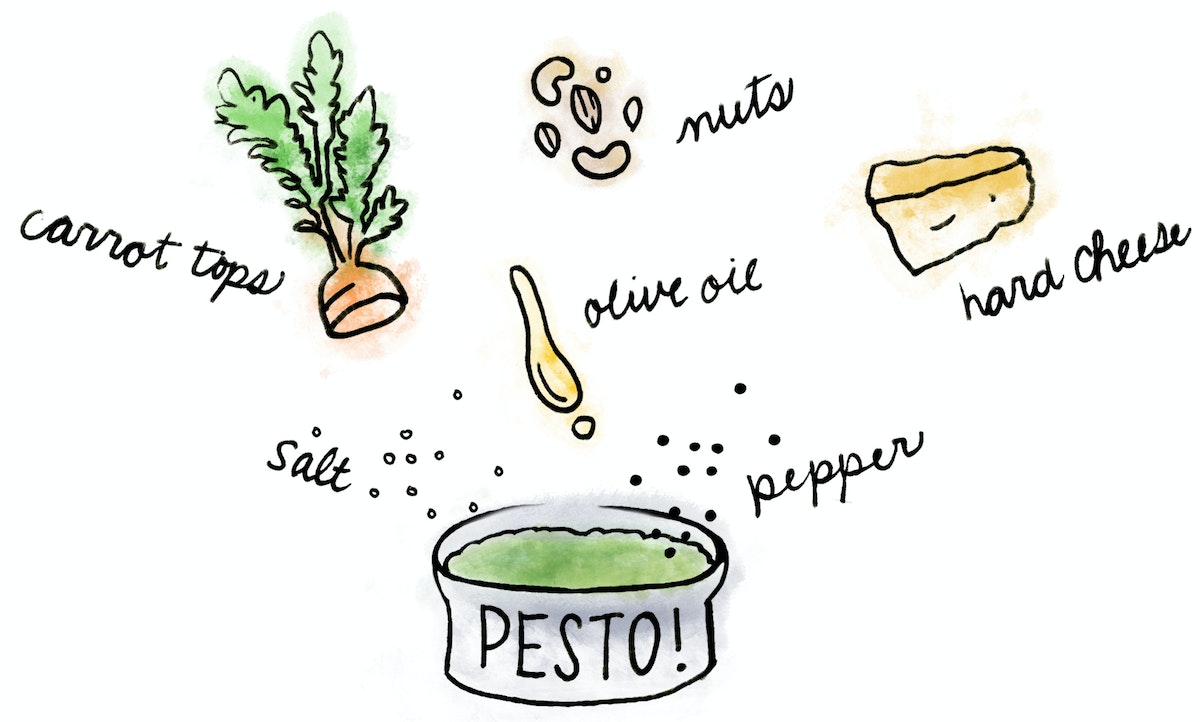
Try making pesto out of leafy greens (even carrot tops), nuts, and hard cheese you have around, rather than feeling like it has to be basil, pine nuts, and parm. There are no rules, just constraints that make you more creative.
5. Collaborate
At the United Nations Climate Summit last month, 16-year-old Greta Thunberg told a group of world leaders, “The world is waking up, and change is coming whether you like it or not.”
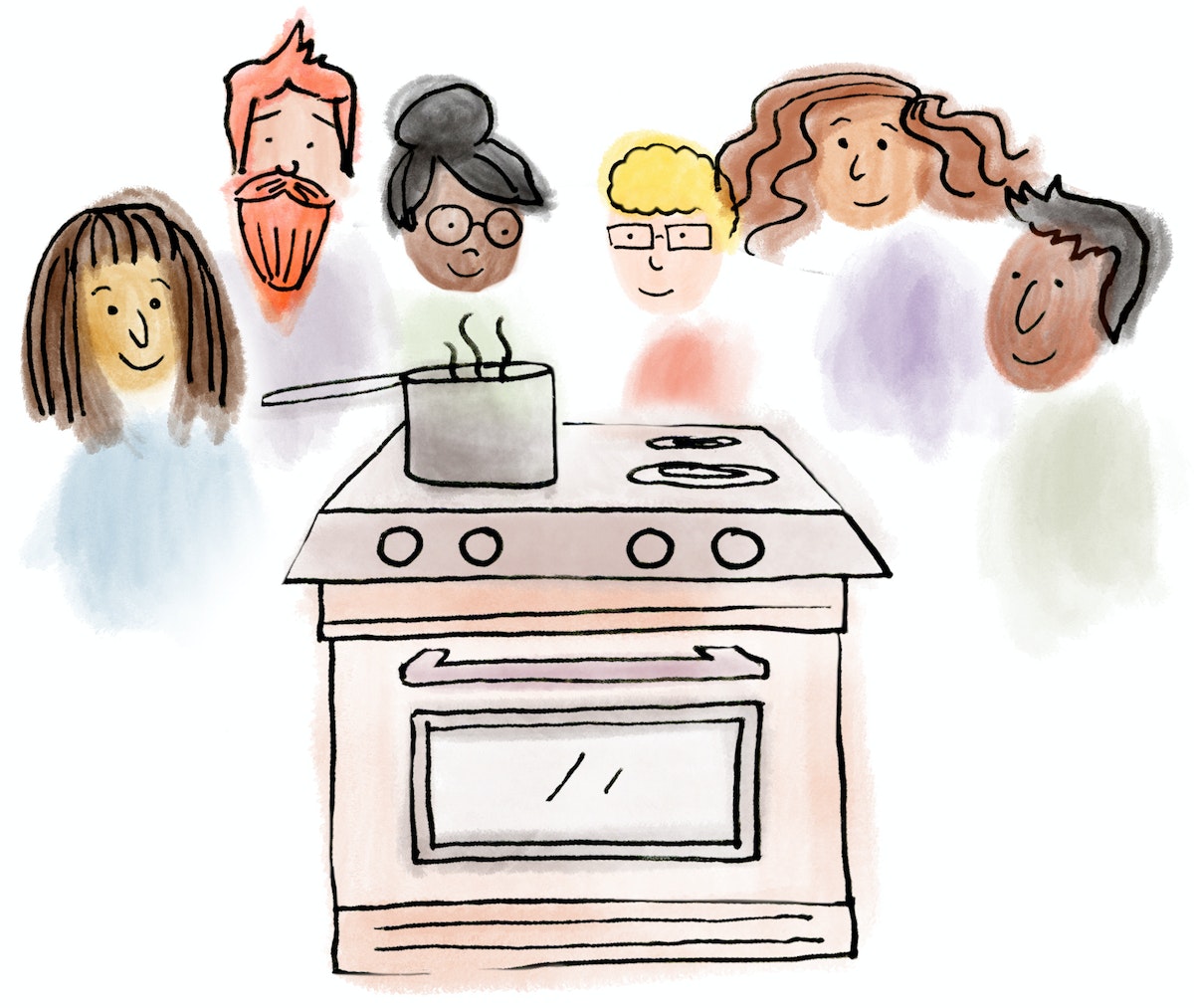
We’ve reached a tipping point, and change is coming. With your friends and family, let’s make time to cook and eat together. Let’s share a meal and talk about how to have a better life with less waste and more joy. And if there are leftovers, send your guests home with them, date them in your fridge, or use them to make soup tomorrow.
There have been some exciting changes in the food industry over the last decade. Our purchasing choices collectively forced food brands to rethink their offers and evolve their practices.

3 tips for exploring taboo topics through play
How to design playful moments to break the ice on sex, death, and everything else
Embracing conversations about taboo topics can help deepen understanding and empathy, and empower people to make better decisions about their health, finances, and careers. And since many taboos are related to serious global epidemics, like homelessness and segregation, talking about these issues is the first step toward taking action—and even affecting real change.
Thankfully, surfacing taboo topics doesn’t have to be as awkward or scary as it might seem.
Did you join millions of people to dump an ice bucket on your head to raise awareness for ALS, and suddenly find yourself discussing (and maybe even donating on behalf of) a disease you didn’t have a personal connection to? What if you walked into middle school health class, and your teacher was wearing tampon earrings or giving out anatomical cupcakes that made you laugh and made it easier to talk about periods?
Play has the power to translate fear and awkwardness into curiosity, with humor, storytelling, games, and interactive experiences that can help people feel comfortable (and even enjoy) diving into a tricky topic.
Here are three ways to start a conversation about anything—even the most taboo topics—through playful design.
1. Create an immersive experience
Death is terrifying. “Reimagine End of Life,” a city-wide exploration of life and death with creative workshops, performances, comedy shows, and reflections, makes it easier to wrap your head around. Last year in San Francisco, I joined 10 strangers in an interactive theatre experience inspired by the question, “What if facing our death allowed us to live more fully?”
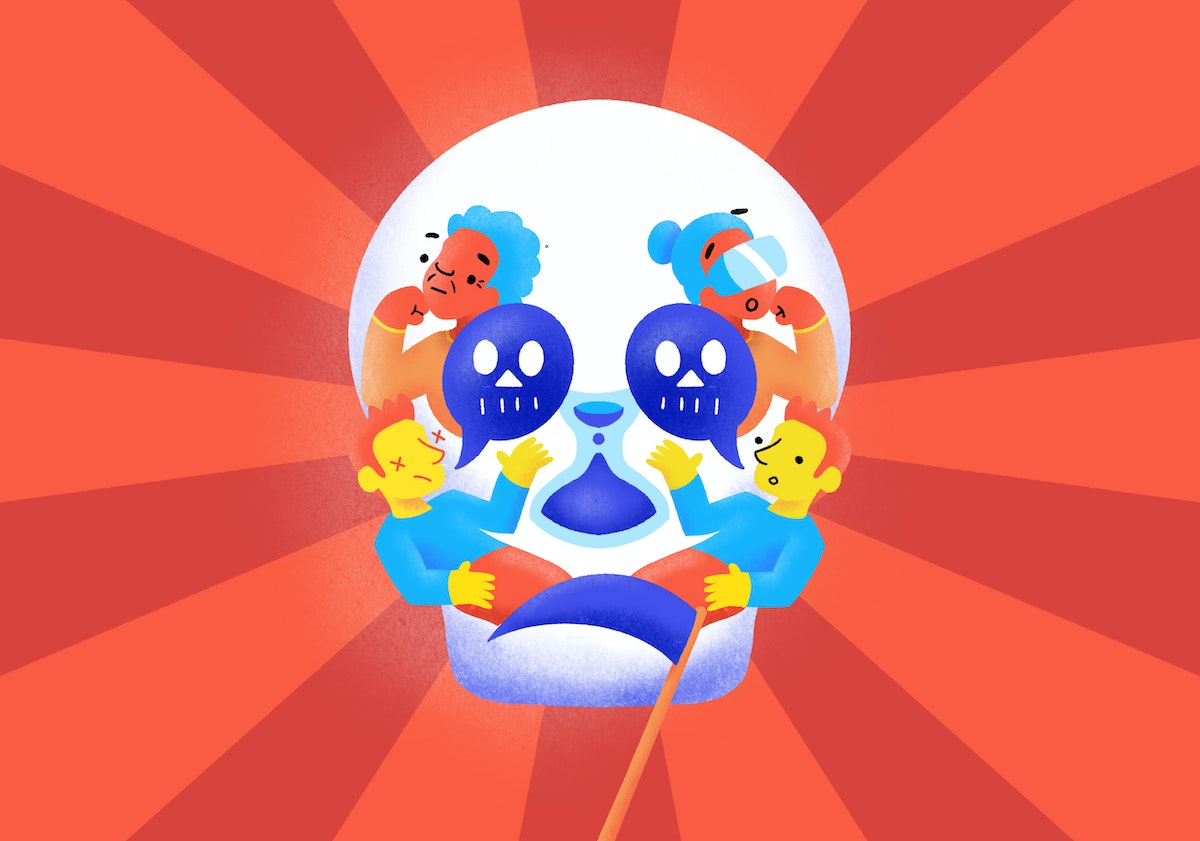
Through virtual reality simulations, eulogy readings, and a theatrical visit to purgatory (picture white curtains and costumed actors), the event immersed our group in a new world and guided us to face death together, one step at a time. A year later, I still find myself reflecting on this experience and sharing my hopes and fears about dying.
At your next event, try incorporating skits, role play, costumes, and themed decorations to fully immerse your group in the topic you’re discussing. These interactive elements can create a safe environment for people to really open up.
2. Meet people where they play
Sex and contraception can be intimidating and even embarrassing topics to discuss in many cultures, making it difficult for health experts to dispel myths and support youth as they make decisions about their bodies. But dance contests, magazines, nail salons, and fashion shows? Those teens can get behind.

In Zambia and Kenya, IDEO.org has brought playful experiences to life through The Diva Centers as well as through the upbeat Future Fab brand, which give teens and staff a space to connect and talk about anything—from glittery nails to IUDs. The IDEO.org team has also designed aspirational characters known as the Divine Divas to give the girls an opportunity to talk about their goals for the future—and how contraceptives might fit into them.
If you’re looking to tackle a taboo topic with a specific group of people, consider their natural gathering places. Do they go rock-climbing, cook, or hike? By meeting people where they feel most comfortable, you can make difficult conversations easier to navigate.
3. Forgo words altogether
For topics so complex that we don’t know where to begin—how about by translating words into motion? Creative Tensions is a “conversation that moves” developed by IDEO and the Sundance Institute Theatre Program, where participants reveal where they stand on an issue by where they physically stand and move in the room along a spectrum between two options. The exercise can help people explore polarizing topics by asking, for example, “What inhibits our sexual lives more—the government and society, or ourselves?” Participants can either share their perspective aloud in a facilitated conversation or express themselves silently through their movement alone. It’s a non-verbal way to start meaningful explorations of taboo topics that everyone can be a part of, simply by moving their feet.

To do something similar, try asking people to express their thoughts without words—through dance, music, drawing, photography, or building with LEGOs. These creative exercises can lower the barrier to entry and prompt even the most reticent to participate, and eventually, start talking.
With thoughtful design, breaking the ice on complex topics can be more playful than painful. Between comic books and board games about menstruation, superhero-themed summer camps about social issues, and ballot education parties, there are countless ways to help people navigate controversial topics.
What methods do you use to help get people talking? Send your ideas so we can work together to unlock meaningful conversations around the causes we care most about.
Cancer, sex, money, birth control, poverty—just a handful of topics on a list many of us might call Things I Want to Bring Up But Don’t Know How. But shying away from stigma keeps people from talking about the issues that really matter.

A not-quite-textbook definition of systems design
How a systems designer learned to explain what a systems designer is
When I started at IDEO six years ago, I had no idea what a systems designer was—only that I was one. Now, six years later, I have an answer, but I’m still perfecting the great-aunt-approved dinner table pitch.
The secret? It’s actually something you probably learned in your grade school language arts class: a good analogy.
If you’ve got approximately 10 minutes, I can tell you what I’ve learned about what I now proudly call my job—and how I’ve learned to explain it.
Systems and automobiles
An iPhone, the human body, buildings, cities, organizations, economies, the universe—all of those things count as systems, even though one can fit in your pocket and one is infinite. So what makes them all systems?
In a series of excellent lectures, Russell Ackoff, a pioneer in systems thinking, uses a simple analogy to explain systems: an automobile.
As Ackoff explains, a car needs to carry you from point A to point B. No individual part of a car can move you on its own—not the wheel, the axle, the seat, or the engine. But a car can. And if you take a car apart, you no longer have a car: you simply have the pieces, because “a system is not the sum of the behavior of its parts; it’s the product of their interactions.” That’s as true for a computer as it is for the universe—or any other system.
Systems design and architecture
Ackoff, a professor at Wharton Business School, criticized managers for focusing on business silos (marketing, operations, finance). He urged them to take a wider systems view—to think about the interactions that create the whole.
I couldn’t agree more. But if that’s systems thinking, what is systems design? What’s the difference?
Ackoff heralded one profession for understanding systems best: architecture. Architects begin with the needs of the client—bedroom, kitchen, living room, bathroom—but they don’t stop there. It wouldn’t make sense to design the rooms separately; they need certain adjacencies and sizes.
Importantly, Ackoff explains, the architect “will never modify the house to improve the quality of the room, unless the quality of the house is simultaneously improved.” To take this analogy a step further, think about it this way: you wouldn’t make the kitchen bigger if it meant getting rid of the bathroom. That would be a weird house.
Ahhh, so you're an architect?
Not exactly, although it’s no coincidence that I used to be a designer at an architecture firm. I think of myself as a “human-centered systems designer,” but that wouldn’t be the clearest thing to have on a business card.
IDEO is known for human-centered design, a process that takes inspiration from the needs and aspirations of people, most often end users. Human-centered systems design also starts with people, but requires looking at all the diverse stakeholders within a system—not just end users.
Let’s dive into another analogy: a school. If you’re designing a school, students are the end user. But the needs of teachers, parents, and administrators are equally important. For example, a few years ago we wanted to create a way for schools to change their culture. Since culture is intangible, it can’t be designed in and of itself. But you can design spaces, schedules, processes, roles, rituals, and incentives—tangible “levers for change” that help create culture. We zeroed in on the needs of school leaders, and developed School Retool, a professional development program that empowers principals to evolve their school culture.
When you’re designing a system with a lot of moving pieces, it’s hard to know where to start, and very easy to get lost in the “What if’s?” Design needs constraints, and focusing on human needs provides them.
But why human-centered systems design?
Let’s return to my man Russell Ackoff. He writes, “No problem ever exists in complete isolation. Every problem interacts with every other problem and is therefore part of a set of interrelated problems, a system of problems.” Ackoff even coined a term for systems of problems—he called them “messes.”
Indeed, our biggest problems—in education, health care, criminal justice, government—are systems challenges. And surprise: These are all human systems. When the parts of a system are made up of people, complexity is exponentially high because human feelings and needs are unpredictable and constantly changing. Despite good intentions, these important societal systems can be some of the least human-centered experiences we encounter today.
None of these problems can be solved in isolation, but it’s also easy to get a headache just thinking about tackling them.
Our most complex systems need human-centeredness the most. As a systems designer, I specialize in zooming in and out. I’m constantly jumping back and forth between the big picture and the details. I work with teams to bring the best of all disciplines together to design individual elements that form an integrated, cohesive experience for end-users. I ask questions like, “How might the environment support the new behaviors we’re trying to create? How might digital tools enable a new mindset?” I create intentional interactions between parts.
As the holidays creep closer and closer, I no longer dread the questions about work and career that come along with the appetizers. I finally have something my family is more likely to understand, thanks to the powerful and beloved literary device known as the analogy. Getting to this point feels like learning how to ride a bike—you pedal hard, gather speed, and finally crest the hill.
And if nothing else, I’ll just send all my family members a link to this piece. Hi, mom and dad!
Fall has arrived in the northern hemisphere, and you know what that means: cool weather, warm cider, and sitting around the holiday dinner table with my extended family, trying to explain to them what I do for a living as a systems designer.

Lindsey Turner
I’m passionate about building brands, products, and experiences that help organizations show up with meaning and momentum.
I help organizations cut through complexity by shaping how they show up, through brand strategy, identity, and storytelling.
Working at the intersection of brand and business, I bring an editorial eye and a bias toward making—turning ideas into tangible experiences that people can understand, trust, and believe in.
My work spans government, healthcare, financial services, media, and consumer goods, from launching Gen Z-focused ventures to building innovation labs and reimagining legacy brands. I relish moments of ambiguity and enjoy translating across teams, perspectives, and priorities to move ideas forward.
I started my career in editorial and digital design, shaping cross-platform experiences and identity systems in publishing and agency environments. That foundation still shapes how I work today: I’m detail-oriented, collaborative, and overreliant on the Oxford comma. I hold a BFA in Visual Communication from the School of the Art Institute of Chicago.

Rachel Young
My work helps organizations see who their products aren't working for—and build the will and the tools to do something about it
For 25 years, I've asked the same question: Who does this design exclude—and what are we going to do about it?
My work spans human-centered strategy, inclusive design, and qualitative research, with clients ranging from Microsoft, Google, and Verizon to the National Science Foundation, and San Francisco Unified School District.
Before IDEO, I taught elementary school in East Palo Alto and spent a decade doing design work with social service organizations—where I learned firsthand what it costs people when systems are built without them in mind.
I am currently writing User Error, a nonfiction book about digital access and the design decisions behind it. I live in Oakland, California.

Brian Pelsoh
I lead with craft, ensuring our work is creatively excellent: rooted in deep human insight and imagination, while also grounded in the realities of business and technology.
My expertise spans brand, communication, and product design across tech, education, the arts, and social impact.
I believe great work demands both high-level vision and obsessive attention to detail, and only happens through collaboration.
I bring an inclusive, hands-on approach and a deep understanding of business, which enables me to consistently deliver excellence while always asking why.
Before joining IDEO, I worked at the brand firms Pentagram and VSA Partners. I began my career as a designer, leading teams at the School of the Art Institute of Chicago and the Milwaukee Art Museum. I hold an MFA in graphic design from Maryland Institute College of Art and a BFA in communication design from the Milwaukee Institute of Art & Design, and have taught at some of the best design schools in the US.

Tony Wong
I am responsible for IDEO’s long-term success in China and working with clients to use design as a tool to enable growth.
I am responsible for IDEO’s long-term success in China and working with clients to use design as a tool to enable growth. Specifically, I have helped Chinese companies design holistic brand solutions through the development of their products, communication, services, and innovation teams, and I have helped multinationals expand their presence and influence in China.
I advise global leaders on developing China-led innovation and capabilities.
In over 15 years in IDEO Shanghai, I have worked on projects that use design to elevate the quality of the experience of healthcare products and services, streamline processes that increase productivity, create spaces and programs that promote and enable inclusive communities, and build next generation mobility solutions that are planet-positive.
Before joining IDEO, I worked at Philips Electronics and the Electrolux Group in Italy, the Netherlands, and Singapore on a number of breakthrough commercial products. I am a member of the Young President Organization in Shanghai.

How to use AI as an editor, not a writer
Ed White shares how he uses AI as an editor—not a writer—to sharpen storytelling, rehearse ideas, and preserve the productive friction that makes creative work better.
Ed White has a rule he's tested on his own writing: hold yourself as the writer, and let AI be your editor. Ed is a Senior Design Director at IDEO's London studio, where he co-leads the firm's AI portfolio across Europe. Before IDEO, he spent 12 years as a writer and editor at the Financial Times, Wired, and Contagious. So when he talks about when to use AI for storytelling and when not to, it comes from two decades of crafting his storytelling skills.
In this episode, Mina Seetharaman talks with Ed about two specific tools he uses to keep AI in an editor's seat: a "roasting agent" prompted to critique his drafts without any sugarcoating, and a simulated audience he rehearses pitches on before the real thing. They also get into what Ed is hearing from design leaders at Anthropic, Lovable, Shopify, and Google Creative Lab about how creative work is changing, and why he thinks the friction of writing something yourself is worth protecting rather than automating away.

Building a personal AI for the messiness of life: Sida Li
Becca Carroll talks with Cue co-founder Sida Li about designing a personal AI for the messiness of everyday life—not just work. They explore how Sida stays anchored to human needs while navigating fast-changing technology, product tradeoffs, business-model experimentation, and the realities of building an AI company today.
Most AI products today are built for work—a space with clear problems and established systems. One founder noticed a gap: personal life is messier, harder to systematize, and mostly left behind by the AI boom. So she built Cue, a personal AI that lives inside iMessage and group chats, to go where the other tools haven't.
In this episode, Becca Carroll, IDEO's Chief Strategy Officer, talks with Sida Li, co-founder and CEO of Shared Context Lab, about staying anchored to a human need while the technology around her keeps changing shape, why she treats her business model with the same rigor she'd bring to a product, and what it feels like to build a company at this particular, disorienting moment in AI.
The conversation also gets into how Sida makes design decisions: the language Cue uses to describe itself, the tradeoffs behind building inside iMessage instead of a new app, and a real story about a business idea that didn’t pan out.
This is the second in a two-part series profiling founders from IDEO's Startups-in-Residence program. The first conversation is with Johannes Seemann, founder of Sooner, on designing GenAI for the emotional side of money.

Designing GenAI for the emotional side of money: Johannes Seemann
Designing financial tools around the feelings that shape money decisions.
Most personal financial tools are built to run the numbers and optimize towards a budget. While that works for some, most people experience money as a lived relationship that does not neatly fit into a spreadsheet. Johannes Seemann and Becca Carroll discuss why money is emotional before it is mathematical, and what a human-centered approach to building a generative AI financial product looks like in practice.

The curious leader's edge in uncertainty: Scott Shigeoka
How genuine curiosity helps leaders navigate uncertainty with greater confidence.
Mina Seetharaman talks with Scott Shigeoka, author of Seek and Head of Curiosity Cultivation at the Eames Institute, about what distinguishes genuinely curious leadership from performative curiosity, how power dynamics shape curiosity, and why practicing curiosity can restore energy rather than drain it.
Looks like you might be in search of something very specific?
Or reset the filters above and try another angle.
Here’s some random inspiration

Podcasts about creative leadership

Articles about the power of prototyping