.svg)



Mattress designs that led to a cultural transformation
How the world’s largest mattress manufacturers transitioned from operations-centered to customer-centered.
Sealy and IDEO first collaborated in 2008, to rethink the design of its Stearns & Foster line. For years, Sealy, the largest mattress manufacturer in the world, had taken the standard industry approach to selling mattresses and watched market share and sales flatten; it knew something had to change. Stearns & Foster evolved from a single product design into a keystone for transforming the organization.
IDEO helped Sealy use actionable consumer insights to develop a scalable design methodology and new brand principles, which it applied to product design, operational and manufacturing decision-making processes, and sales and marketing strategy. This “brand-to-product” framework was subsequently used for three separate and consecutive product launches—Stearns & Foster, Embody, and Posturepedic—resulting in an overhaul of 85 percent of Sealy’s mattress portfolio.

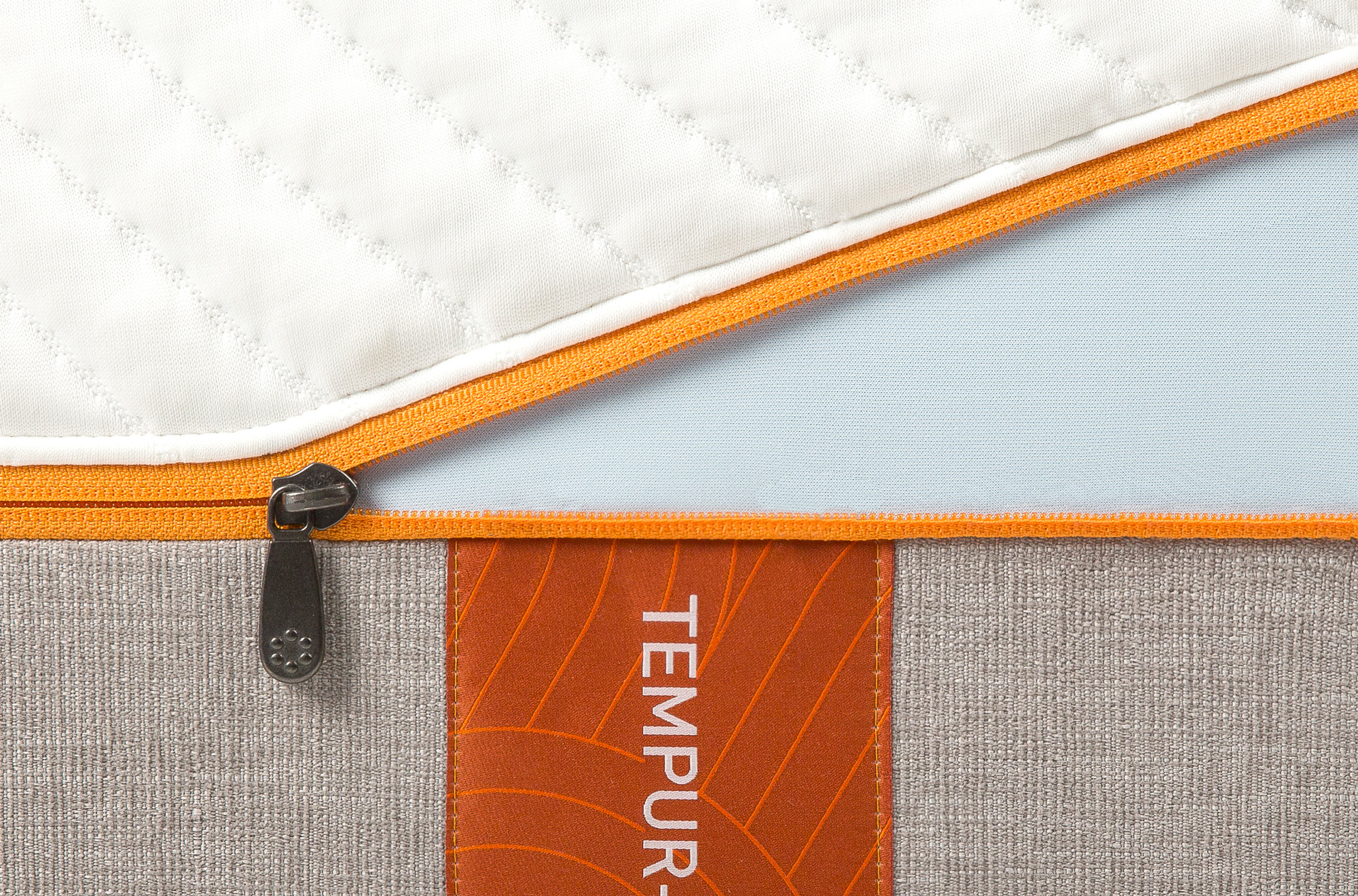
Tempur-Pedic was already working with IDEO on a new mattress design when it acquired Sealy in 2013. It was also interested in how design thinking and human-centered design could improve its business. Once solely focused on the technological elements of designing a mattress, together with IDEO, Tempur-Pedic redesigned the outer shells of its mattresses to reflect the quality on the inside. This design change led to the company to look at new ways to infuse design into their products.
“The initial project was to design the mattress,” said Thomas Overthun, associate partner and design director at IDEO. “But the second project was to create a whole design language from the mattress out to what it meant for any other product, from pillows to blankets and other accessories. It eventually became bigger than just the mattress.”
Working on the Tempur-Pedic/Sealy relationship has been gratifying, said IDEO partner and design director Michael Hendrix, because although home goods can be thought of as simply products, nothing could be further from the truth. IDEO and Tempur-Pedic/Sealy changed the course of the mattress company's business through the transformative power of designing where, and ultimately how, people sleep. And in the process, the organization itself changed as well, moving siloed departments to cross-functional teams, with the brand division central to their cooperation, which led to consistent and aligned decisions across the board.

Some of the projects include:
Stearns & Foster Luxury Mattress
Sealy teamed up with IDEO to develop a design language for Stearns & Foster mattresses that would reestablish what the brand stood for. Through redefining brand principles and rounds of prototypes that focused on evocative details, the new Stearns and Foster mattress was the highest rated in Sealy’s portfolio since it started keeping records, and initial retailer orders were three times what management projected.
Next-Generation Posturepedic
An icon in the mattress industry was brought into the 21st century by developing a new product that delivered on the long-running promise of the brand. Together, IDEO and Sealy designed a product that focused on holistic back health. In its earnings report, the company said US bedding sales for the quarter were up 10.6 percent, to $253.4 million, a figure driven by the new product line’s introduction. According to Sealy’s Q3 earnings report, the Posturepedic launch represented the largest and fastest rollout in the company’s history.
Embody by Sealy
The project began by defining the market opportunities for all-foam beds, and ended with the modern, streamlined Embody mattress as well as a simplified design language, free of industry jargon, to help retailers talk about the mattress to customers. “Sealy collaborated with IDEO to create an approachable and attractive mattress that delivers the simple, healthy rest consumers want with a selling story they can easily understand,” said Jodi Allen, Sealy’s Chief Marketing Officer.
Tempur-Pedic Sleep System
Best known for the revolutionary, NASA-proven Tempur material inside its mattresses, Tempur wanted to transform the exterior of its mattresses to match the caliber of innovation inside. Together with IDEO, Tempur created a new sleep system, including an easily removable and washable fabric mattress cover. “Tempur-Pedic was born of innovation, but we were never a design-driven company until we worked with IDEO,” said Patrice Varni, senior vice president of brand marketing, Tempur Sealy North America, LLC. “Seeing consumer need in a new way through IDEO’s eyes has transformed us. Our product design, our creative psyche, our brand are all fundamentally changed by this sharper focus. This collaboration has given us all a renewed sense of pride.”


Designing the future of urban farming
Helping a Berlin startup strengthen its offer of vertical farming products and services.
The challenge of how we’ll feed the exploding world population in the future—in a sustainable, cost-effective, and environmentally friendly way—is seeding an agricultural revolution in Europe.
In 2012, INFARM founders Erez, Guy Galonska, and Osnat Michaeli found that vertical farms could be a solution to urban self-sufficiency. These farms could allow people to grow vegetables and herbs in small spaces, with no soil and far less water.
An approach that’s captured the imagination of futurists for decades, vertical farming involves growing vegetables and herbs in stacked units or inclined surfaces, within which moisture, light, temperature, and nutrients are monitored, and controlled.
After creating their first vertical farming experiment in their apartment in Berlin, the founders brought together plant scientists and industrial designers to explore and develop vertical farming’s potential.
Since then, the startup has created custom growing systems for clients including Airbnb, Mercedes-Benz, and Weber. Most recently, INFARM installed a vertical farm growing herbs and vegetables at the Berlin branch of German supermarket chain Metro, the fourth-largest retail chain in the world, to sell to the public. It’s been profiled in Wired Germany, Süddeutsche Zeitung, The Guardian, and Zeit.

INFARM collaborated with IDEO to further explore their B2B offer, including concepts for the industrial design of the stackable, modular, climate-controlled units; the interaction design of an accompanying app to monitor and control the units, and its business model.
Urban farmers will sign up for “farming as a service,” comprising the units themselves, as well as a monthly subscription for seeds, cartridges filled with nutrients, and a pH regulator. Because they’re stackable, the modules can be scaled to suit anyone from a home grower to a restaurant chef or supermarket owner. And Erez claims a 1 square meter growing tray can yield four to six mature plants every day, 365 days a year, doubling that of state-of-the-art hydroponic greenhouses.
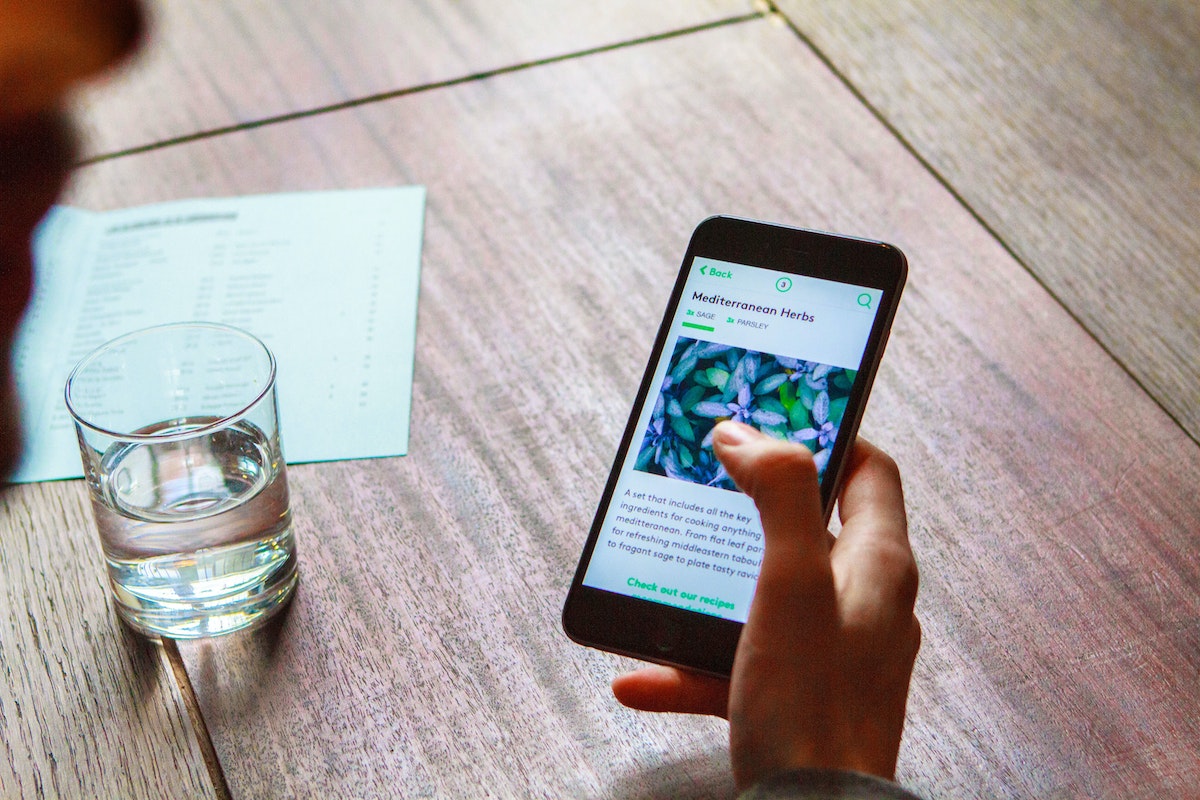
As well as remotely regulating each unit’s climate, the app will educate growers about new vegetables and herbs, selling packs of complementary seeds, with suggested recipes for them, and cooking instructions. Aiming to promote biodiversity, the firm will sell rare-breed and heirloom seeds too.
The startup has funding from the EU’s European Pioneers fund, and is now looking to secure investment to accelerate software development and ramp up their hardware production capabilities. Quite literally, it's growing its business.
Bringing beloved children's characters to a new platform
Sesame Street iPhone apps for Sesame Workshop.
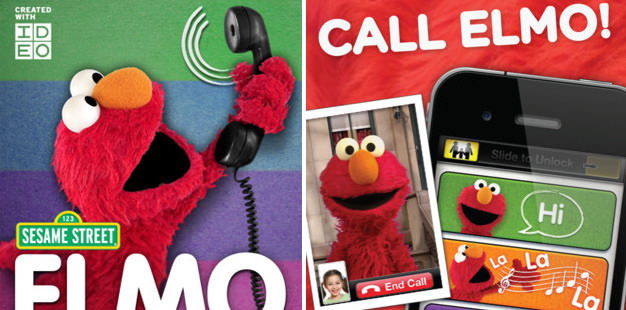
Sesame Workshop is the nonprofit educational group that revolutionized children’s television with the launch of the landmark Sesame Street program in 1969. The show, which has since become a household name, is now watched in more than 150 countries worldwide. The Workshop also creates educational content for new media platforms, and partnered with IDEO to design a line of Sesame Street–themed apps for Apple’s iPhone. The Elmo Calls app, which functions as a utility app for parents and as an entertaining behavioral-development app for kids, is now one of the Top 100 paid iPhone apps in the iTunes store.
The collaboration began with a mutual desire to bring the show’s beloved characters to the iPhone platform—and to do so using a human-centered design approach. Child-development experts, educators, toy and interaction designers, and even the Sesame Street puppeteers weighed in on the design decisions. The team also worked closely with families throughout the project—from initial concepts to early prototyping to the final development—in order to stay focused on how children actually use the iPhone for play. The games were designed accordingly. For example, the team omitted menus from the Sesame Street apps to keep the experiences simple, playful, and fun for a young child. And each game features exclusive new Sesame Street videos, allowing players to enjoy “lean back” moments along with interactive ones.
The resulting iPhone applications let children engage with the favorite Sesame Street characters in a whole new way. Kids touch, shake, swipe, and tilt their way through original games featuring Elmo, Grover, Bert, Rosita, and the Count.

The titles, all of which are available from iTunes, include:
- Elmo Calls: Engages 2- to 5-year-olds in listening-skills practice and active participation during everyday situations.
- Elmo’s Monster Maker: Allows kids to create unique monster friends that dance and play with Elmo.
- Sesame Street Video Maker: Lets kids star in their own music videos, mashing recordings of themselves with popular Sesame music videos and adding their own stamps and special effects.
- Sesame Street Makes Music: Helps kids explore an array of instruments as they contribute to new renditions of classic preschool tunes with their Sesame friends.
Nurturing a creative culture
How writing a book about our shared values helped articulate what it means to be successful at IDEO.
How do you know when you’re successful in your work? You can check off a list of technical skills and expertise you bring to the table. You can use a career development rubric to make sure you’re hitting the right goals. But often, it’s your behaviors—the intangibles that are the most difficult to articulate—that make the most impact. Things like your ability to stay optimistic or your willingness to adapt when there’s no roadmap.
Because of the nature of our work at IDEO, these intangibles are a big part of what defines the experience of working at the company. So in 2012, a global team of designers from our U.S., Europe, and Asia offices came together to codify these values and behaviors as part of a larger effort to evolve IDEO’s career development platform. More often than not, when IDEOers hit road bumps in their career, it was not about what they were doing, but how they were doing it.
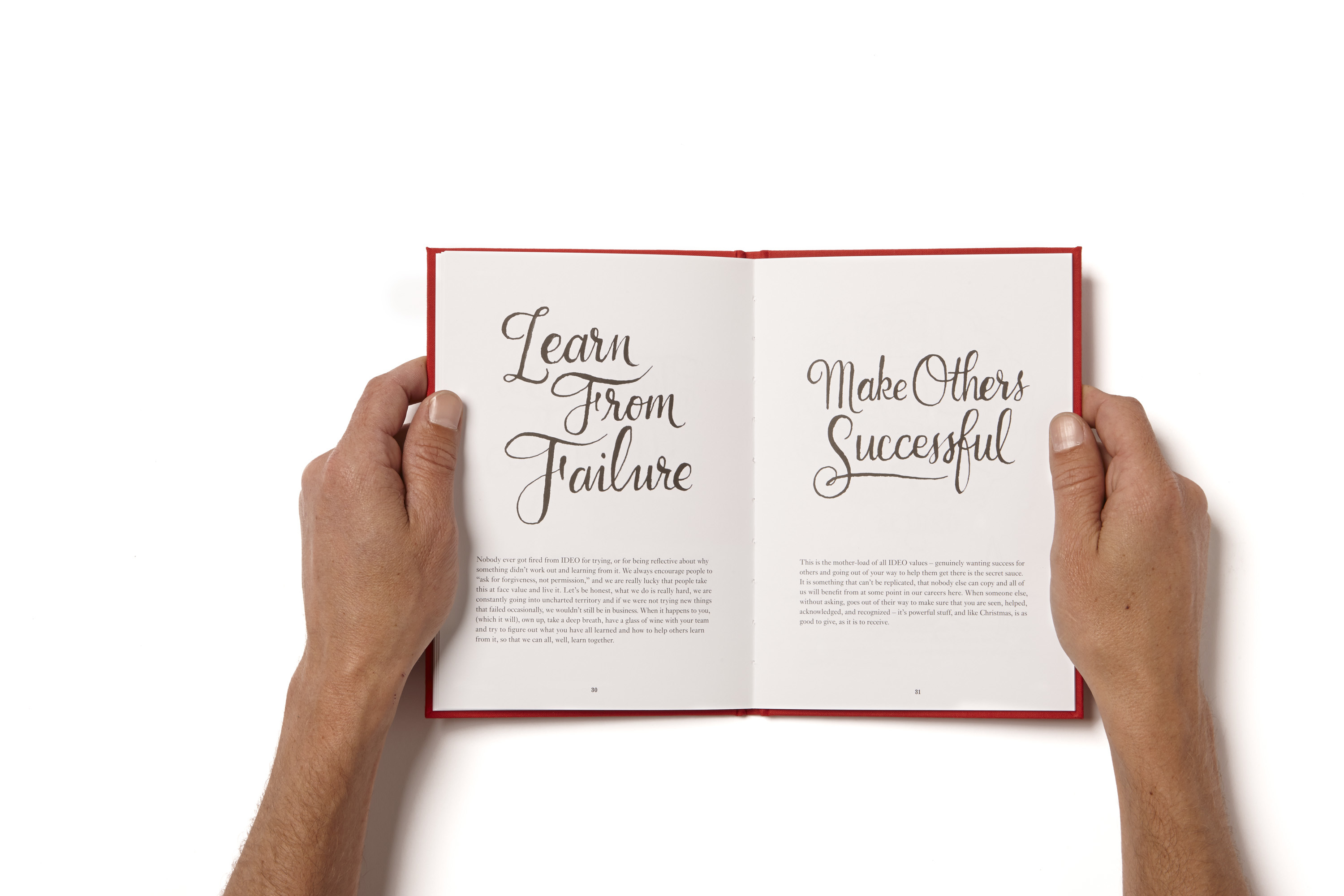
The team agreed that, in addition to identifying the technical requirements needed to progress through one’s career, it was just as crucial to give IDEOers the tools they need to navigate the complex culture. So they captured the values they believed were foundational to the culture and most strongly shared across the IDEO community, and put them to paper in The Little Book of IDEO. The title is meant to reflect its purpose for readers—a handbook that’s compact, useful, and free of any corporate jargon.

For IDEO-ers, this red cloth-bound guide provides a shared lexicon around both the hard and soft skills we need to succeed. It describes things like why IDEO is so loosely structured, where it comes from, and where it’s headed.
Most importantly, the book identifies the organization’s seven core values. These are by design specific, actionable, and integral to the kind of work we do and the environment in which we do it, going beyond common sense and general ethical practice. The intention: to foster meaningful conversations within the community about life at IDEO, and how to achieve success along the way. With each succinct expression comes a deeper explanation of why it matters, and how it shapes our experience at IDEO.
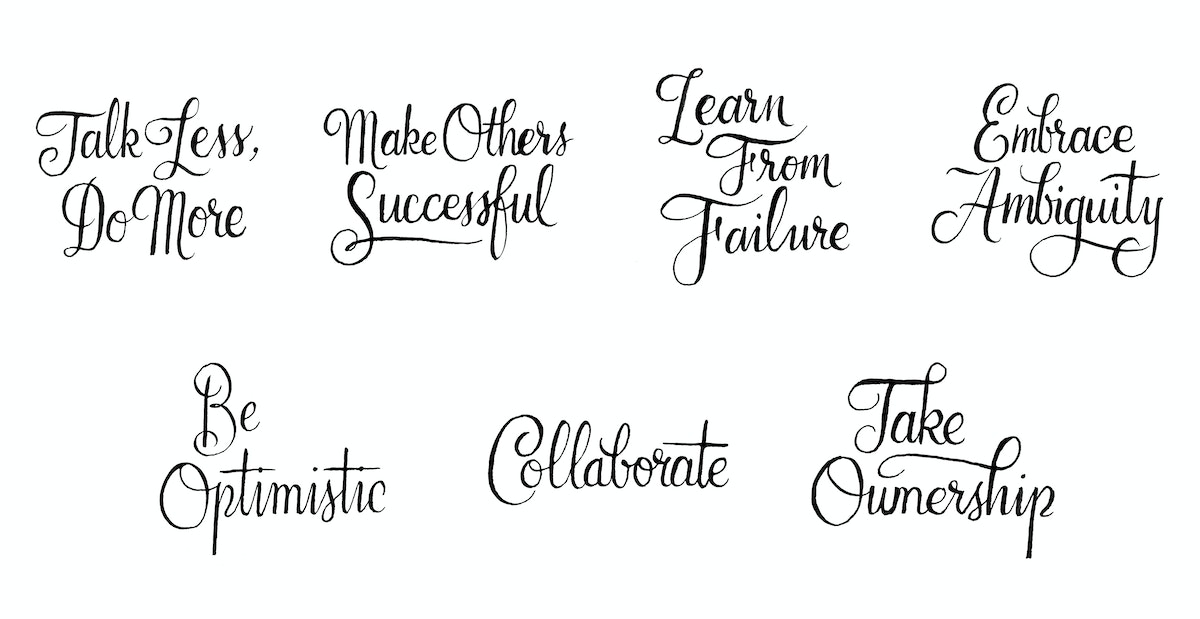
Over the years, the book has been roundly embraced by the IDEO community as an honest articulation of who we are, as opposed to what we aspire to be, and what we appreciate most about working together. When IDEOers first got their hands on it, a movement took shape to create videos that bring each of the core values to life. To depict the value of "Embracing Ambiguity," for example, New York-based designers built a makeshift cardboard rowboat, and while simulating a storm, navigated their way through uncharted territory with teamwork and optimism. San Francisco produced a Jacques Cousteau inspired look at the lifestyle and behaviors of designers in their natural collaborative habitat.
Through the process of making the videos, IDEOers came together to reflect on each of the values, talking through what resonated and what didn’t. It gave them a sense of ownership, and a platform through which to share their interpretations.
A Global Conversation
IDEO has a global presence—offices in two countries in Europe, two countries in Asia, and multiple locations across the U.S. As an organization that embraces a human-centered culture, it felt important to learn if the values resonated with the IDEO community in all of these locations, especially in a country like China, whose working culture is so different from the west. We saw the authenticity and resonance of the values as essential for attracting, motivating, and retaining local talent.
So how did The Little Book of IDEO land in Shanghai? Exploring this question would illuminate insights into how our own clients are often challenged to keep their company culture resonant within the global landscape.
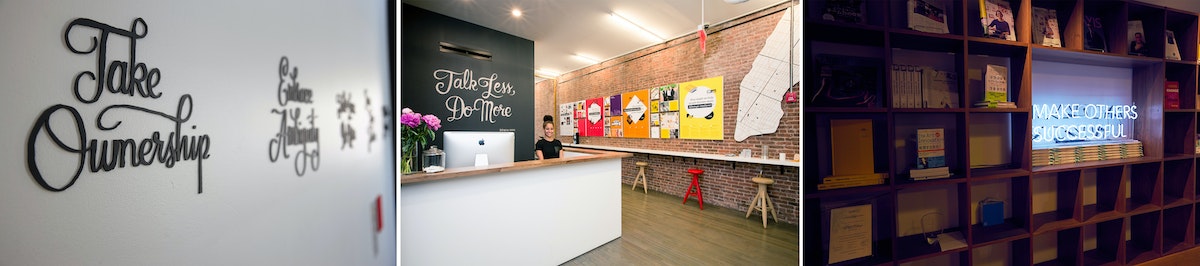
A team of IDEOers in our Shanghai office took on the challenge of exploring the meaning behind each of the values. They were surprised with what they discovered—that despite the firm’s Western origins, locals felt largely connected to the values. It even helped to further solidify their identity as a community, even if it may have been in tension with local working culture, because it was rooted in a set of shared beliefs.
In some instances, the Shanghai team built on the existing values in order to refine the meaning for the local context. For example, the core value "Be Optimistic" rings true, but could sound naive when translated directly to Chinese, implying "rose-tinted glasses.” So in the Mandarin edition, an extra phrase was added to convey the measuredness we mean when we talk about optimism at IDEO. The lesson here: The treatment of something as fundamental and nuanced as our values requires authenticity and emotional connection, and therefore more of a transcreation process than straight translation.
Lasting Power
As an organization, we are designed to be flexible. This means we’re always changing—even when it comes to how we are structured—so that we can respond to the kinds of challenges that clients come to us for. In the midst of our constant evolution, The Little Book of IDEO is as resonant today as it was when it was published.

Can digital therapeutics revolutionize medicine?
How technology will take treatment beyond pills and procedures
In the not-too-distant future, patients with chronic obstructive pulmonary disease could be equipped with a sensor that monitors their medication and inhaler use and prevents acute events. People suffering from clinical depression could be prescribed an app-based therapeutic program in place of a drug.
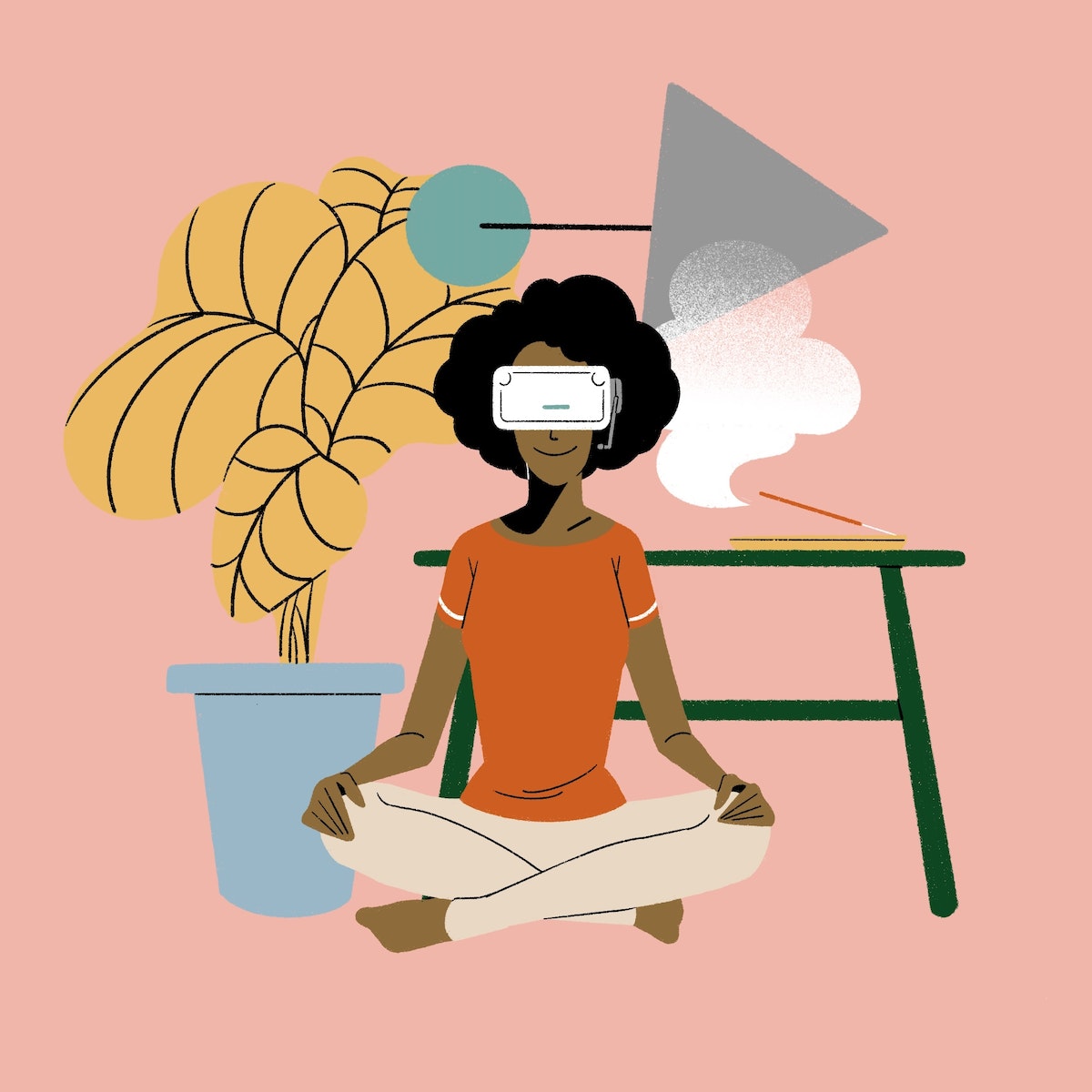
The digital therapeutics global market is estimated at $1.8 billion today, but predicted to reach $7.1 billion by 2025. Much of the growth is predicted to come through investment from traditional pharma, but there are several new players emerging from the tech and start-up worlds as well with the hopes of evolving into a digital therapeutic. Omada Health, which creates behavior change programs for managing chronic disease, makes its hundreds of thousands of patients feel seen and heard with personal coaching. Click Therapeutics develops software to support smoking cessation and address major depressive disorder in adults. The meditation app Headspace has convinced more than a million people to integrate meditation into their daily lives, with proven wellness benefits.
Companies like these are revealing transformative new approaches to helping patients tackle the thorny challenges at the core of chronic disease, mental health disorders, and a growing number of other diagnoses—and in the process, they’re creating and growing thriving markets where none existed before.
Might these digital products, one day soon, be prescribed by a physician who is concerned about her patients’ heart disease, diabetes, or weight? If Tesla released software that clinically validated reductions in car accidents, even for the most dangerous drivers, would that qualify as a digital therapeutic? We are just beginning to imagine and design the future of this industry.
But these products still face the age-old challenge: how to get people to actually use them. If patients don’t love and trust the experience enough to sustain engagement over long periods, many of these therapies—and products—will fail.
Any new approach needs to begin with the needs of real people, and to follow those needs toward products that are not only desirable, but also have viable business models behind them. Here are our four big takeaways drawn from IDEO’s experience working in this field, designing digital therapeutics that engage patients—and the market.
Put down the competitive landscape report
Innovations in science and health tend to be incremental, but by looking to other industries, it’s possible to identify opportunities for more radical change. Studying analogous experiences—services, products, and other offerings that deliver something tangentially related but not exactly the same—will clarify what kinds of experiences give patients a sense of meaning, delight and value.
A partner of ours in the biotech industry recently launched its first digital therapeutic, focused on helping patients manage diabetes. In piloting the experience, we encountered a big challenge: Patients were struggling to connect the at-home testing device to the bluetooth on their phones. Without it, the experience fell apart.
Instead of buying all of our competitors’ devices to look at their solutions, we brainstormed a list of organizations that were particularly good at helping people with a set of complex instructions—IKEA, ballroom dance instructors, piano teachers, NASA-to-spacecraft communications specialists, and others. We discovered that LEGO had made its first bluetooth-connected toy and—master of instruction that it is—had created instructions to guide even little kids through a simple series of steps. Inspired by LEGO, the team created a new set of instructions. Once they were integrated into the patient onboarding experience, nearly every patient was able to connect their medical device to their phones.

Prioritize the patient
It can be easy to fall into the trap of addressing the needs of payers and providers above the patients’. After all, if a digital therapeutic isn’t reimbursable, the underlying business may not be successful; and if a physician doesn’t know it well enough to prescribe it, a company can’t increase market share. These are critical pieces of the puzzle, but they need to come after the foundational concern of any new digital health venture: fitting your therapy into patients’ lives.
During early stages of design, we rely on user research to inspire countless possibilities, and revisit our insights when we need to refine (or flip) our ideas. User research informs the business model, helps define the path to market, and may also lead to other product features.
What does this look like in practice? Consider the digital mental health company Headspace. Headspace was designed to teach people the fundamentals of meditation, engaging them in an experience that might encourage practice and adherence over time. Initially, Headspace played with incentives like badges and friendly social competition, but it slowly came to understand that the most profound motivation was mental health itself. The company prompted meditators to remember why they meditate, and asked them who in their lives would be better off because they meditated. This consistent call for reflection and awareness led to higher overall engagement.
Headspace’s popularity has catapulted the company to $100M in annual revenue and more than a million subscribers. Once the company designed an experience that people loved, subscribers embraced the product and took it upon themselves to host Facebook groups, meet-ups, and events. Headspace then opened up partnerships within the formal health industry, adapting to the needs and requirements of providers, payers, and regulators. Today, Headspace is a benefit offered to employees of over 350 large companies worldwide, and providers and health systems across the globe offer it to their patients. If you design an effective product that patients love, players in the health system have incentive to offer access.
Design with and for your most extreme, hard-to-engage patients
Designing for extreme users illuminates the wide range of people who might use a product. In IDEO’s earlier days, we saw this most clearly when we designed physical products like ice cream scoopers and pizza slicers for older adults, people with arthritis, and children with limited motor skills. We ended up creating something those populations could use, but in doing so, we developed a universally easier user experience. The product design outshone its competitors and became a top consumer choice.
In the world of digital therapeutics, this approach might entail designing for patients with limited experience using digital technology, or focusing on patients living with multiple chronic conditions, or with profound barriers to accessing care. These patients can help shape a more equitable and inclusive therapeutic experience.
One of our most challenging digital therapeutic projects involved creating an app-based experience to combat depression. To engage with potential users, we traveled to the rural Rocky Mountains to an isolated community where we met Dan, a cowboy and rancher living 40 miles away from his closest neighbor. Dan had struggled with depression for most of his adult life. On a good day, it was hard for him to get out of bed. On a hard day, he struggled with suicidal thoughts.
Before talking to Dan, we considered all of the technological features that could encourage adherence, like enabling offline access and fast download speed in low-bandwidth contexts. But through talking to Dan, it became clear that the tactical challenges weren’t the biggest problem to solve. Even in more populated areas, depression itself can be isolating. Dan helped us co-design a digital tool that even he would be willing to come back to, day after day. One of the key features a digital therapeutic could offer would be connection to others—in real life—and a chance not only to receive help, but to give it. Informed by Dan’s story, we designed an experience that could connect people living with depression to each other and engage them as supporters, mentors, and advocates.
Launch a thousand prototypes
One of the biggest challenges facing health innovation today is the belief that you need to have a solution before you really grasp what people want and how they want it. That’s how the industry is constructed. You would never write a grant proposal without telling the funder exactly what you will deliver, nor allocate budget at a pharmaceutical company without a detailed plan and anticipated ROI.
For digital therapeutics, those constraints are blown wide open. Our task is to come up with as many ideas as we can and test what will actually stick. Prototypes pave the way to a solid, working product, and patient input on prototypes can be used in countless safe, thoughtful ways.
Recently, we worked on a digital therapeutic that helps people manage the tremors associated with motor disabilities such as Parkinson’s Disease. Instead of the typical treatment, which solely relies on an oral medication known to have serious side effects, we were tasked with working on a software and hardware system that delivers targeted electric pulses to the part of the brain that calms tremors. We began with a long list of open questions about what patients living with Parkinson’s would find acceptable, usable, and engaging.
When we went into the field to interview patients, we quickly realized that they had no idea what it might be like to rely every day on a digital device that’s crucial to their health. They were curious about the inner workings of the therapy, and asked questions about the technical, logistical, and philosophical implications.
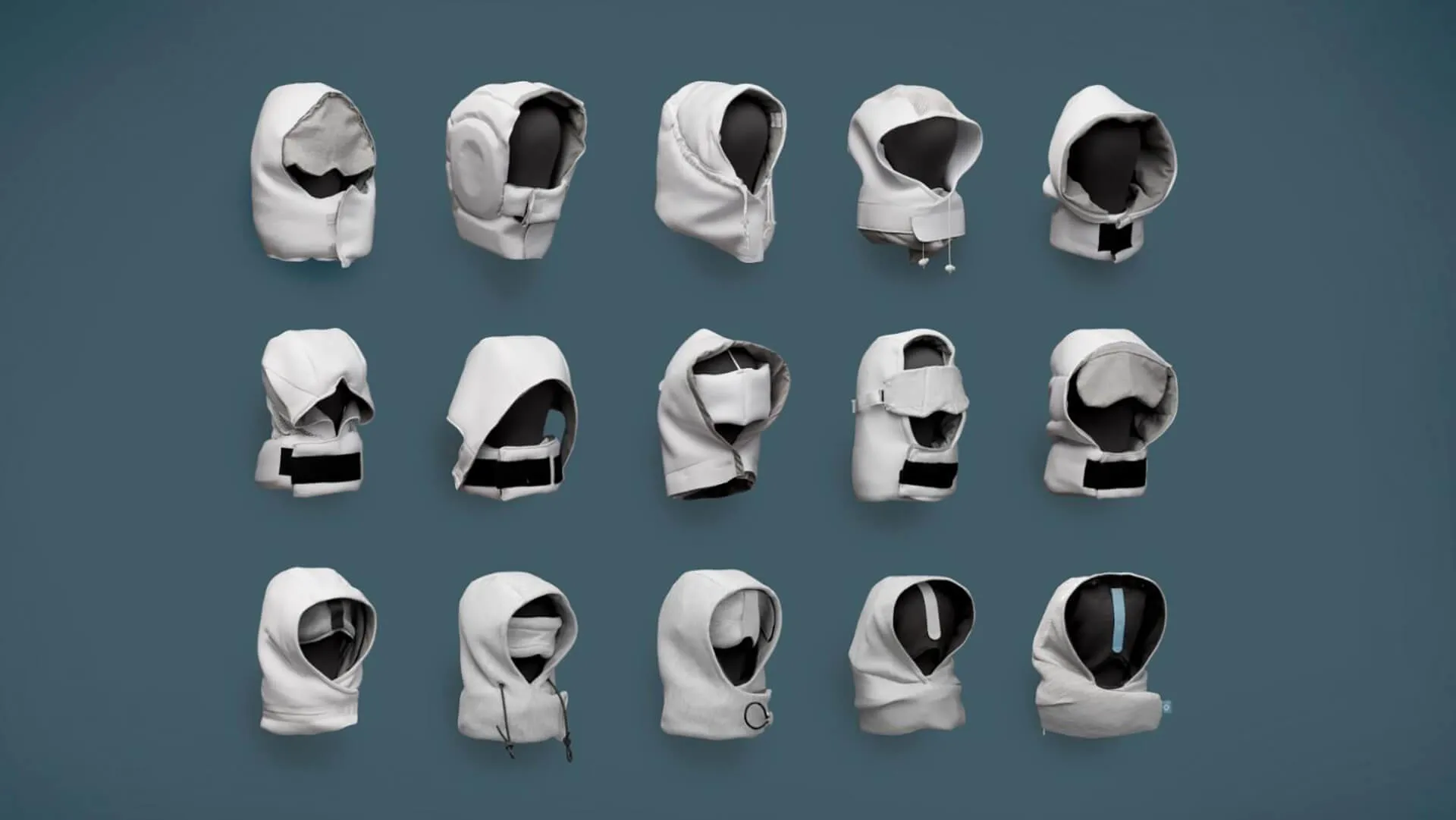
Our first prototypes included a dozen hats, headbands, or pillows that a patient might wear to charge the implanted device. We also prototyped many digital interactions, from Alexa add-ons to iPhone apps, that might guide them to administer digital medication. To take advantage of bio-monitoring data, we created numerous dashboards, exports, and communication portals that might help patients, providers, and caretakers make sense of what was happening neurologically.
A lot of those ideas were failures, but the things we learned were priceless. For example, it turns out that despite the growing number of retirees on Alexa, many of our patients didn’t trust a voice-controlled app with a task this important. It also turns out that the headgear a person needed to wear could easily make them feel embarrassed, unattractive, or emasculated. One of the most important discoveries was that faster charging is not better, if slower charging meant you could fold laundry, watch your favorite TV show, or weed the garden at the same time. At the end of the day, we designed a hundred prototypes before we landed on the key value propositions, features, and usability standards that would shape the experience.
Tying it all together
Breakthrough products and experiences like Click Therapeutics and Headspace all align with the framework outlined above. But to be clear: They aren’t successful because they have a silver bullet for engagement or the best theory of behavioral economics. They are market-movers because they focused on their users and designed their products around what they found. That led to creating something people love, and success quickly followed. It’s a formula you can apply to creating your own digital therapeutics—or any product you want users to love enough to use in their daily lives.
Illustrations by Nien-Ken Alec Lu.
The next era of digital health has arrived, and it’s booming.

Here's how to get started designing with data
Use these 4 steps to keep data scientists involved throughout the design process
But in practice, when we’re making something genuinely new, we often don’t have data to begin with, nor do we even know what kind of data we will need. We’re staring at a blank canvas, so the only way to dive in is to listen, observe, and sketch.
Making ideas real didn’t just mean collecting biometrics about patients and displaying the data in a smart way. It was much more important to use data to help experts and patients build and maintain a relationship, track progress, adjust course, and figure out next steps. These elements are all an integral part of how the service operates. And in the process, I came away with a few principles for data scientists to keep in mind when using data as a medium for design.
1. Be part of research
We needed to know what experts ask their patients to help support them in their journey to self-management, and what is reasonable to ask patients for. Is it fair to ask somebody who mainly eats at restaurants to accurately track the micronutrients of everything they eat? Probably not.

It’s critical to understand people’s real needs in their context to understand what data is meaningful and feasible to collect. Qualitative field research is key in the process of developing empathy for those we design for and for getting a feel for what life challenges might get into the way of data collection. Understanding when we can collect data—and when we can’t—provides valuable information.
2. Sketch by hand and share
Informed by research and armed with crayons, we created a variety of data visuals aimed at tracking patient progress in various aspects of their day-to-day lives—basically, sketches of the features that might be helpful. Drawing is much faster than writing code. We made the visuals a prominent part of the project room to serve as a catalyst for brainstorming and discussion with other members of the team who aren’t data scientists. We explored trends of activity and sleep over time, and played around with visual ways to track mood and to inform people of healthier food options without asking them to count calories and micronutrients.

This approach allowed us to make significant progress in two ways. One, showing our sketches to experts allowed us to narrow down which metrics were useful, and to start tracking down potential data sources. Sketching in crayon versus writing in code also helps us fail faster and narrow in on the right questions to ask.
And two, sharing our sketches with the broader team, which included designers from a broad spectrum of disciplines (communication, interaction, research, software, business), made our work more transparent and helped us establish a common language. It also sparked conversations, inspiring us and helping us to gather further feedback.
3. Gather up and agree on all your data
Once we identified useful visuals, algorithms, and interfaces, we began hunting for the data that could fill them in and move us to higher fidelity prototypes. In our case, data included the client’s historical data, simulated data, and team data. We simulated data about meals and snacks and plugged it into publicly available nutritional APIs. This exercise allowed us to identify the types of data that might be suitable as input for these APIs.

We also bought a bunch of trackers for the team to explore ways we might keep tabs on activity, which showed us where a tracker might go wrong (moving your arm in a circle might count as a step, when in actuality you’re not taking a step at all) and narrowed down the types of data that are meaningful to collect (for example, movement vs. steps). By diving in with our own data, we were able to fill our communcation, interaction, and software designers in on how we would approach collecting patient info.
4. Look to the future
As we were exploring data solutions for the various components of this service, we had to keep in mind that design and development take time and resources. For example, tracking micronutrients via nutritional APIs relies heavily on the assumption that patients are willing—or will even remember—to share their meals. In reality, we didn’t know what patients were willing to share about the foods they eat, nor did we know what food-related information experts need to track a patient's progress.

Redirecting the team’s effort to a lower-fidelity solution to track these behaviors (say, allowing patients to share a food journal) can save a lot of time and effort while still informing the future development of the service.
As a data scientist, starting with people and crayons rather than data and a keyboard felt uncomfortable at first, but it made the process of identifying what’s important and doable much more efficient. Making data science a visual part of the project space also helped the data scientists on the team become co-designers from the very beginning—meaning that we could contribute a lot more to the project. Hopefully, the tips above will empower you to do the same.
A big thank you to Mike Stringer for his help shaping this piece.
You might think the first thing data scientists do on a project is grab a bucket of data and run with it. And for good reason—that’s how many data scientists write about projects after the fact.
Prototype the future of your business with this 4-step design exercise
To envision your company’s next era, eliminate today's constraints
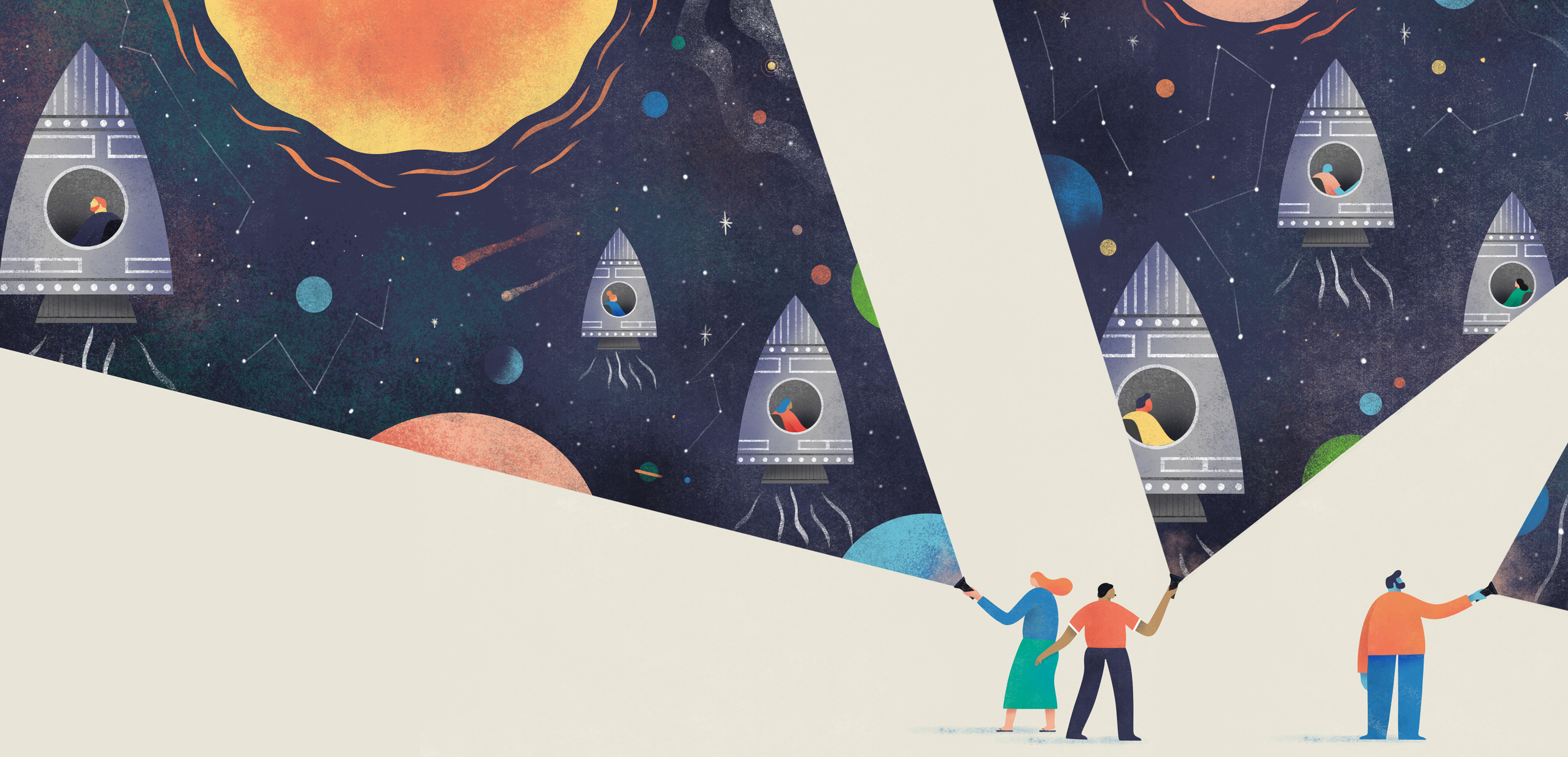
In business, new models and offers are further constrained by the need to satisfy current stakeholders and follow market trends. So how can you break free of present-day realities to envision a genuinely novel future?
In other words: Design can move us beyond the imagination-traps of our own experience to uncover truly new possibilities.
When I founded IDEO’s CoLab four years ago, one of our goals was to find new ways to catalyze visionary business leaders and to activate new models by assembling diverse perspectives from across industries. We frequently employ design fiction exercises with our partners to open up more exploratory approaches to tough problems—particularly the ever-changing nature and role of technology. The process helps connect the dots between an aspirational vision of the future and a business approach that can make that vision a reality.
How to apply design fiction to your business
The futures that we imagine are based on a few catalytic data or trends—“inevitables”—that serve as foundational elements of a future vision. By anchoring on these inevitable factors, we can then imagine the implications that ripple across a business, industry, or society. For example, five or 10 years ago, one might have assumed that smartphone ubiquity was inevitable and started to imagine the implications (good and bad) of everyone in the world having access to a super computer, the internet, a camera, and more. By extending from what’s already true to what might soon be true, it becomes possible to exert some agency in the way you move forward, even when you can’t know exactly what’s ahead.
The late Bill Moggridge (an IDEO founder who came up with the concept of a folding laptop) referred to this as “preferred futures.” In this view, rather than viewing the future as something that happens to you and can’t be controlled, you adopt the mindset that you can influence what happens, asking, “What future do we want to create? And how do we reverse engineer the pathway to get there?”
It sounds pretty heady—perhaps something to be left to experts—but the process of creating design fiction is actually accessible to most people by following a four-step process. This exercise is inspired by an activity from a class at UC Berkeley’s Haas School of Business called “Designing the Future” that I taught alongside two IDEO business designers, Becca Carroll and Sandeep Pahuja.
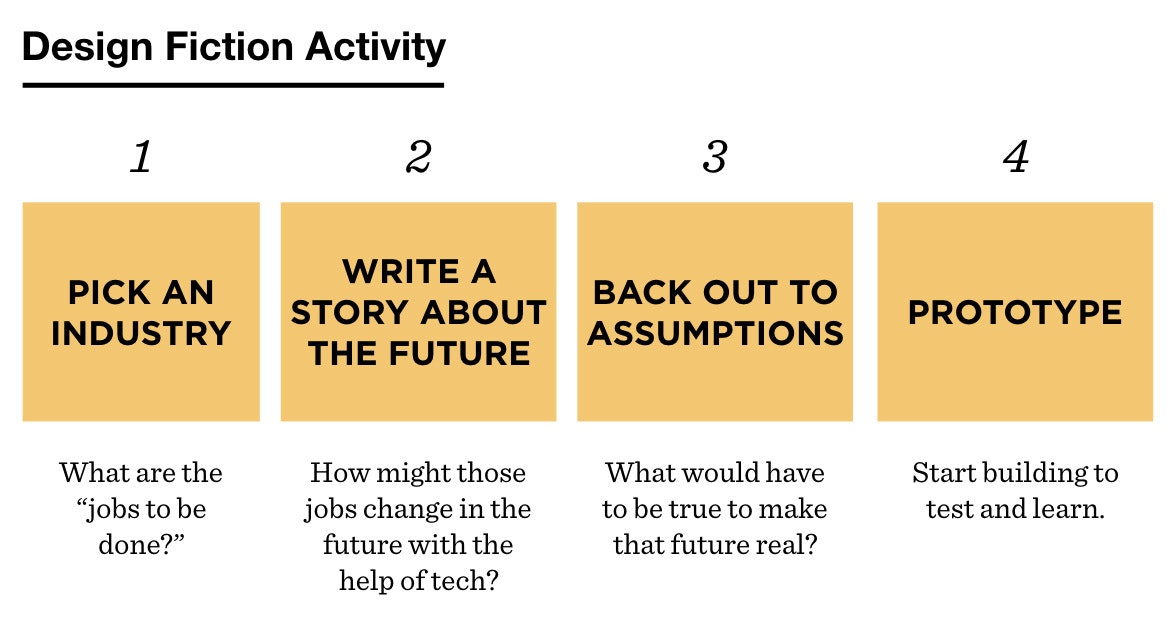
1. Pick an industry and describe its role in the consumer’s life
Let’s take insurance as an example. Insurance is a safety net for when something bad happens. But insurance customers don’t simply want protection—they also want to understand and manage risk, find the most agreeable policy to ensure support when they need it, and trust that their claims will be processed and paid. These criteria are often referred to as the “jobs to be done”—in short, they are the things the consumer has “hired” the product to do.
2. Write a story about the future, free from today’s constraints
If you focus on the “jobs to be done” (and don't get caught thinking about existing insurance companies and how they operate), you can begin to imagine new ways to do those jobs for customers with the help of new technologies and other shifts (behavioral, regulatory, etc.) we believe will be relevant in the future.
For example, if we take the job of understanding risk, there’s a story to be told about machine learning and the explosion of sensor data, which will allow us to create more sophisticated risk models. More sophisticated risk models could lead to a more personalized approach to assessing risk and ultimately the ability to provide more relevant products to customers. In this future, perhaps insurance companies shift from being the safety net after something happens to proactive behavior change coaches who help protect you before something happens.
When writing a story about the future, we continually ask, “What future do we want to create?” This helps us focus on the ultimate goal of creating value for people and preventing harmful consequences, not just creating new technical capabilities and hoping for the best. In this case, we answer it by imagining how the experience of insurance might take on an entirely new form and function when enabled by the tools of the near future.
3. Back out to the assumptions that would make this future real
Taking this vision of the future as possible, we can work backwards to uncover the assumptions need to be in place to support it coming to be. Our go-to provocation is inspired by Roger Martin and Jennifer Riel: What would have to be true to make this future a reality?
Asking what has to be true is a powerful tool to help you optimistically articulate the key assumptions implied by your story and connect them to your current offers and potential path forward. It’s easy to come up with a long list of reasons why something won’t work, and this often leads to risk aversion and incremental thinking. By surfacing the criteria for success you can pragmatically assess how realistic these assumptions are and design experiments or milestones to demonstrate if you’re on track. Invite your colleagues to get imaginative alongside you and uncover even more ideas.
Elon Musk famously published his master plan (and then a second) for Tesla that stepped through five key assumptions that would allow Tesla to move the automotive industry towards an electric future. These included making electric vehicles high performance and cool—a shift from the pervasive negative view of EVs’ aesthetics and functionality; and changing the notion that these cars are too expensive for average consumers, riding the scale/cost curve to reduce the price and range of vehicles, and making them more accessible to the mass market.
4. Prototype
So now you know what would have to be true. Are those things possible? Rather than speculate and debate, prototyping is your way to find out. Begin with scrappy, low-fidelity prototypes to test your assumptions and continually iterate forward, incorporating your learnings into higher-fidelity prototypes. Getting really clear on these key assumptions enables you to take an evidence-based approach to making investment decisions in risky innovation projects.
As quickly as possible, you’ll want to test your assumptions in the market. This is another sticky point where risk aversion and desire to jump to scale can grind progress to a halt. Designing in-market experiments that are right-sized and laser focused on testing key assumptions is an organizational skill that is difficult to cultivate. Successful startups often are forced to be quite scrappy in the market and increasingly, larger companies are building these capabilities. The founders of Airbnb famously tested their idea out by renting out air mattresses in their apartment during a conference. Established companies are getting into the act too, LEGO, Coca-Cola and General Electric have all market tested new products on crowdfunding site Indiegogo.
It’s unlikely that there’s only one viable solution to get to any preferred future—there are many avenues that may get you there and thus it’s important to diversify and have a number of bets. Many entrepreneurs will tell you that their current business is not exactly like their original business idea. Often, it’s pretty far from it. That’s because the steps required to go from idea to reality involve a lot of prototyping, experimentation, and openness to change along the way. Whether you work in the field of innovation, you’re an entrepreneur with a startup, or you have an idea for a business that you’re ready to explore, using the principles of design fiction and cross-organizational collaboration can help.
Hear more on design fiction and cross-organizational collaboration in this episode of IDEO U's Creative Confidence podcast.
Illustration by Mark Conlan.
There’s no such thing as a truly original idea, or so the saying goes. Even the most imaginative inventors and artists are limited by the boundaries of their own experience, and every fresh idea is derivative of something that came before.
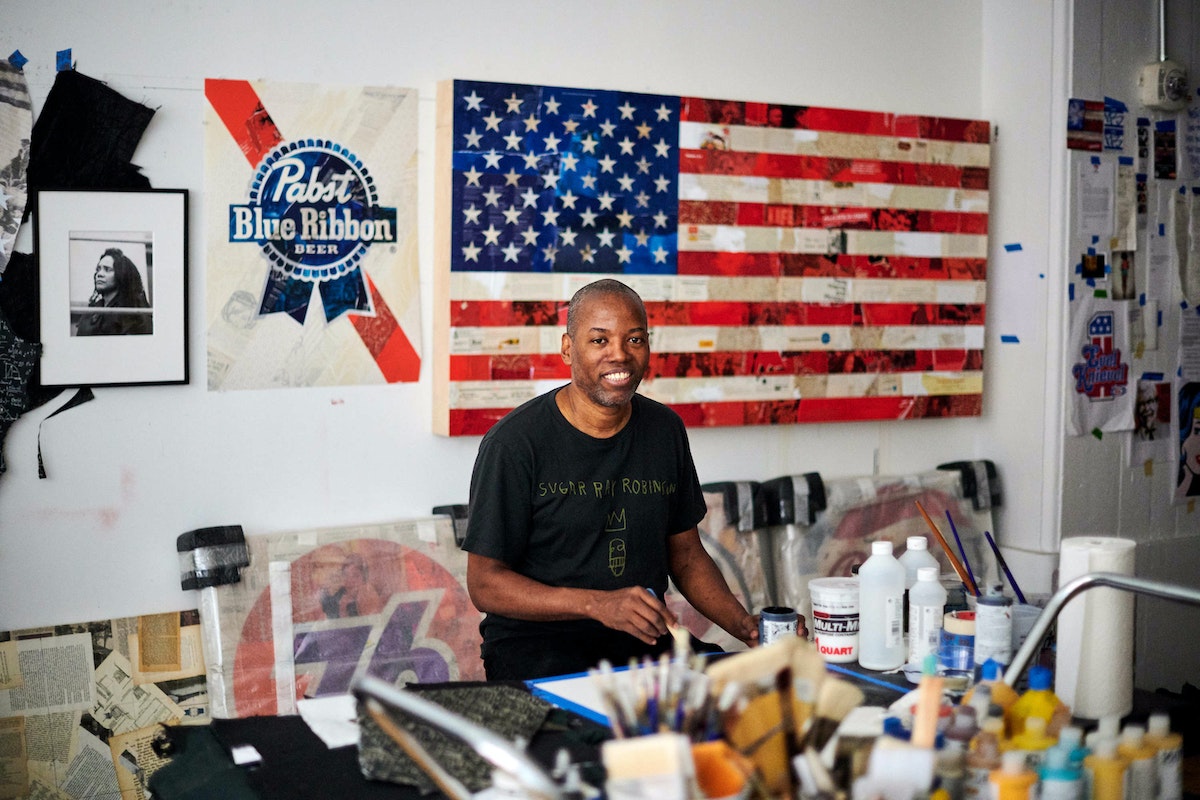
Meet the artist who went from New York graffiti legend to hip-hop graphic designer
From brand partnerships to collage, Cey Adams has done it all
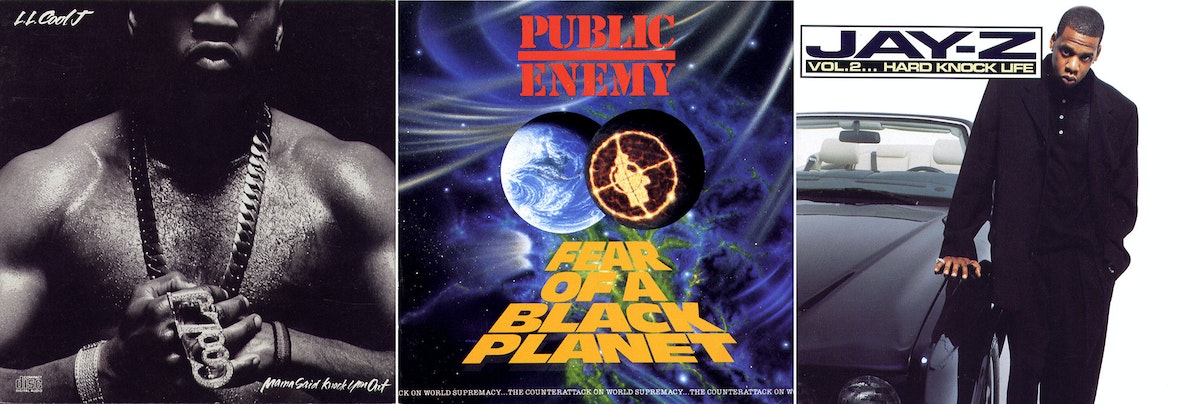
In the 70s and 80s, Cey’s earliest work was exhibited next to Jean-Michel Basquiat and Keith Haring; later, as the founding creative director of Def Jam Recordings, he developed the visual identities for the Beastie Boys, LL Cool J, and more. Recently, you may have also seen his collaboration with Pabst Blue Ribbon and Levi’s. He may not admit it—he's too humble—but Cey has definitively shaped hip-hop culture, design, and beyond.
When I met Cey through a mutual friend, I was immediately taken by his uniquely bold style and refreshingly humble spirit. I asked him if he’d work on a creative project at the IDEO New York office. After the completion of Revolution Solution, we sat down to talk about his creative journey, why he left and then returned to New York, and what it means to be, as he says, “an artist without a blueprint.”
Diana: Let’s start with how you got into hip-hop, working with Russell Simmons and Def Jam.
Cey: When I met Russell in the early 80s, the term hip-hop wasn’t even coined yet—it was just rap music. A photographer had given me Russell’s business card, and I went down to his office to show him my portfolio. All I had were photos of car washes and commercial walls I had painted. But he said, “Okay, we can find something for you to do.” There wasn’t a long-term contract, but to me it might as well have been one. I’m laughing now, but the best thing about being young is that you don’t know enough to feel empowered. You just know they’re not saying “no.”
Did your graffiti art influence your hip-hop design?
To me the responsibility was always how to transform a language everyone was familiar with into something else. You see graffiti on the subway, scrawled on the walls, but I knew it was bigger than that. My question was how to elevate graffiti and keep its integrity.
Was there a breakthrough moment when someone said, “Now I see the power of what you’re creating”?
You know what? I never really heard that. At the time, nobody had formal training so it wasn’t like they understood the power of graphic design. It wasn’t until LL Cool J’s record Mama Said Knock You Out hit number one that I felt that recognition. The album cover was a beautiful black and white photograph of LL shot by famed photographer Michel Comte, and that was when everyone finally saw it as art.
What are you most proud of from that chapter in your creative life?
I think about the artists more than the creative pieces. It’s a little embarrassing to say, but sometimes I’ll dream that it’s 1987 again and we’re on the Together Forever Tour with Run-D.M.C and the Beastie Boys. We’re reliving everything as adults, and we’re all so much more appreciative. Then I wake up and realize it’s just a dream, and Adam Yauch is gone and Jam Master Jay is gone, but I realize I was actually there. During that time I learned about the power I had that I didn’t even know I had.
You went on to art direct the book Hip-Hop: A Cultural Odyssey, which captures the essence of the hip-hop era. What came next?
That book is synonymous with hip-hop itself. The fact that the publishers were convinced to make a book so huge is wonderful! The design of that book was completely my vision, I got to experience every creative idea I’ve ever wanted in that book.
Around 9/11, I realized none of this stuff mattered in the same way anymore. I got disillusioned with the business and the misogyny. I knew I couldn’t change how everyone thought, but I could take myself out of the equation. By that time, I’d designed as many albums as I needed to and wanted to try something else.
After spending a few years in Hollywood doing film titles, I moved back to New York to get my hands dirty. I missed making things so I began painting again and learned silk screening. After I made a few pieces, Adidas commissioned me, Shepard Fairey, and a handful of others to make original works for a clothing collection celebrating the life of Muhammad Ali. Working with Adidas was my first major corporate partnership. That got me thinking, maybe partnering with major brands isn’t the worst thing in the world.
At the time, I was also teaching art to high school students at Brooklyn Academy of Music. Over a ten-week course, I had to create dozens of lesson plans. I came up with every possible creative scenario to challenge their notion of what art could and should be. I stumbled into working with collage then.
That was a small start of something big. Tell us more about your work with collage.
For one of my lessons, I cut out a giant letter and had each student pick a color and fill in a small area of collage. The letter was broken up so nobody knew what it spelled. At the end of the project, we’d have a family sharing moment and present the final piece. The students would line up holding letters that spelled “FREEDOM” or “JUSTICE.” It was such a powerful way to communicate. I realized that collage combined what I learned as a graffiti artist with my love for letterforms.
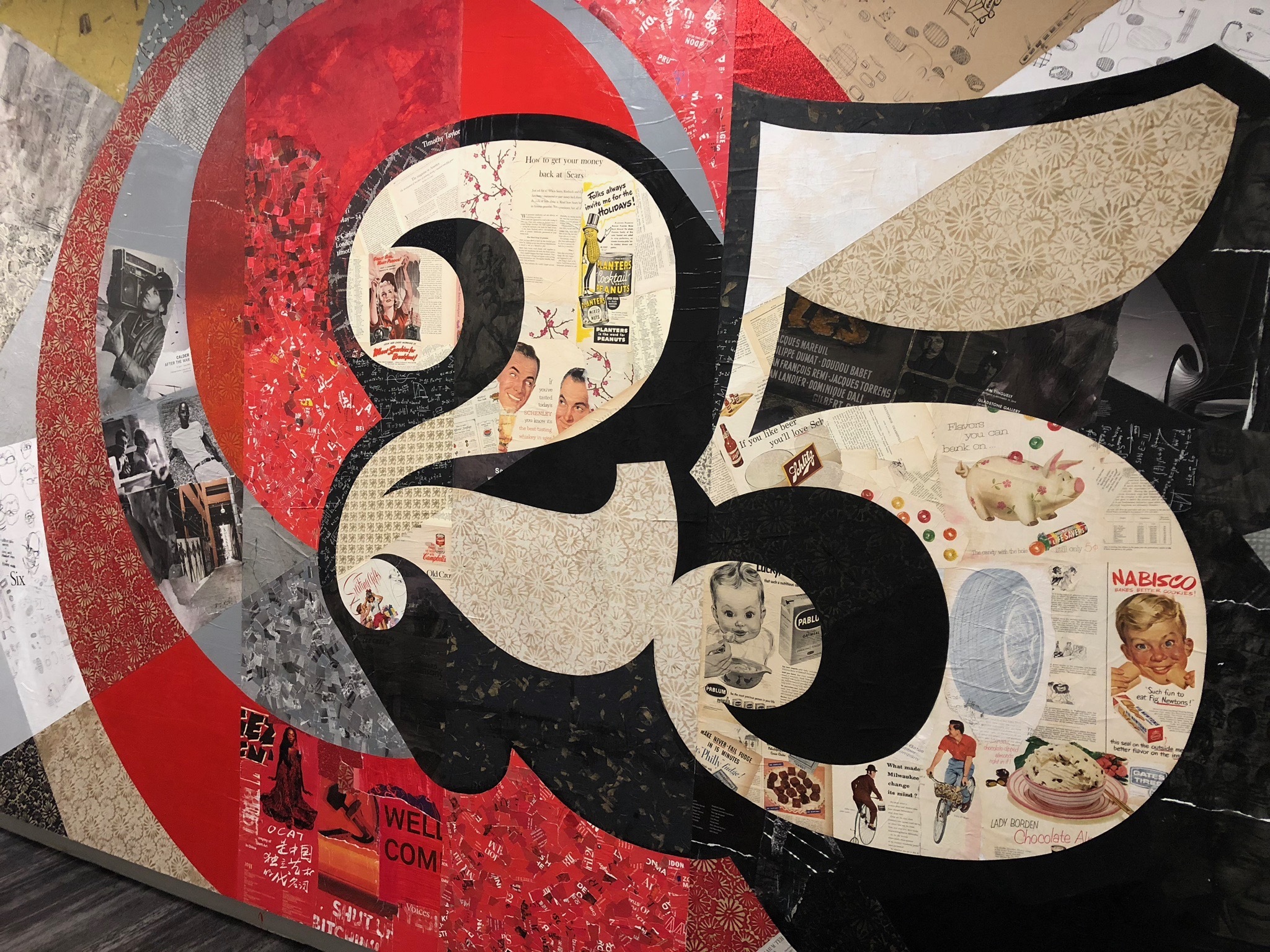
This makes me reflect on a conversation we had at the beginning of our collaboration when you decided to create the number “25” for the IDEO NY mural. We had lots of discussions around bravery and creativity. At one point, you quietly offered that “maybe it’s not about a word.” Tell us why letters and numbers are so important to you.
There’s a simplicity working with letters and numbers. They break down barriers. The process of making collage is so involved that I don’t want the design to get too busy. Letters and numbers let the design be bold and simple, but the execution is always complex.
Speaking of murals, can you tell us about the One Nation mural you created for the new National Museum of African American History and Culture?
When I was invited to make a piece for the ribbon-cutting ceremony with President Obama, I said yes immediately. The whole thing was surreal. Just the existence of the museum was something I’d been waiting a lifetime for. The only guidance they gave me was to make a piece of art that the community could contribute to. A collage was the perfect vehicle to do that. People could contribute to creating a piece that was bigger than themselves. That’s the beauty of collage.
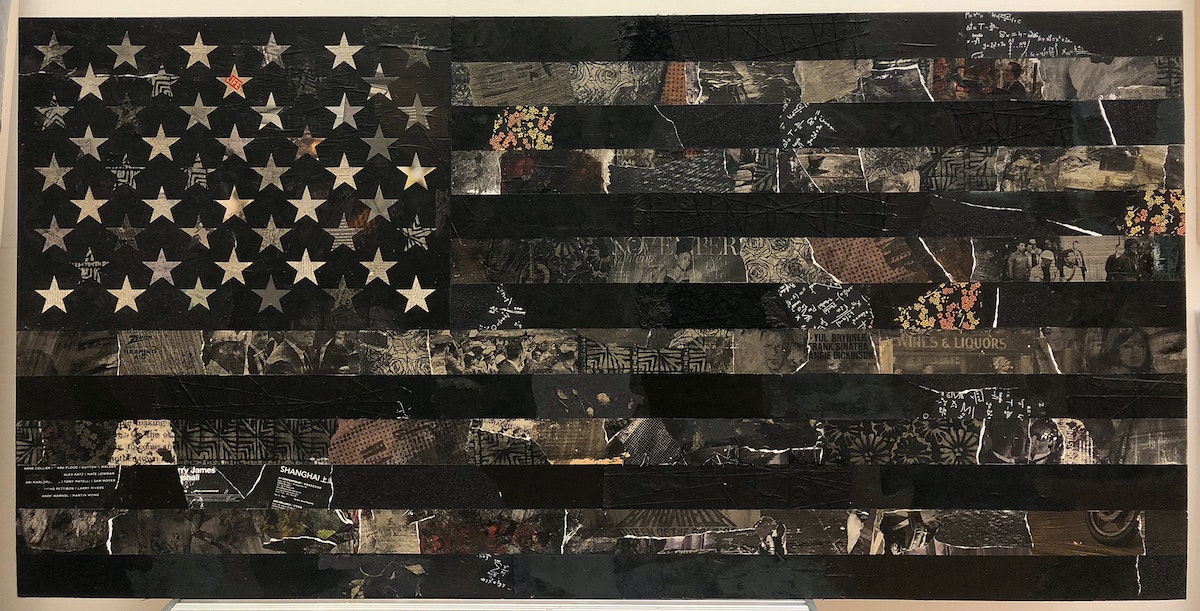
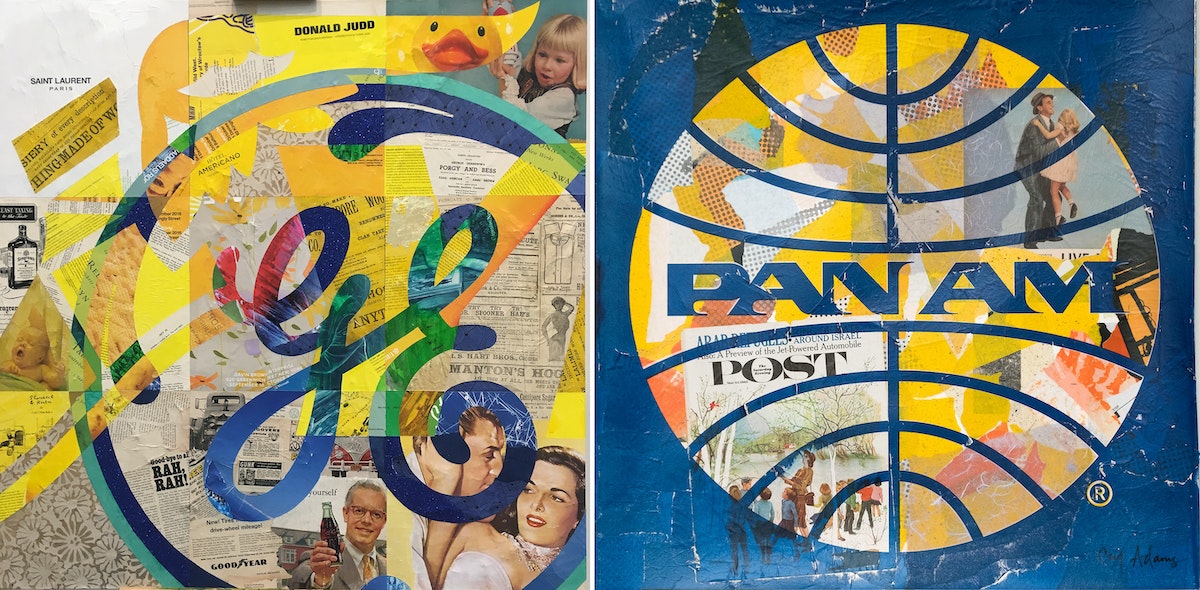
Trusted Brands came next, which brought together your graffiti work and your graphic design work. What inspired the series?
As a kid in the 60s and 70s, I loved seeing huge graphics like the 76 logo whizzing by on the highway—Trusted Brands was an homage to the symbols of that period in my life. As I was working with collage, I started wondering what the next thing was going to be. After doing letters and numbers, I wanted to do a project that nodded to my favorite brands.
Just recently, I partnered with Pabst Blue Ribbon to reimagine their signature 12oz can and launch National Mural Day. Like Trusted Brands, I wanted to pay tribute to the brand’s history and iconography.
Looking back on all of these chapters, is there a specific approach or ritual in your creative process that is the “Cey Adams secret”?
I always try to make work that is positive and uplifting. Even if it’s all black, I’m thinking about how to make something that will make someone feel good.
While you were creating the IDEO NY mural, we had three and a half months of your lovely presence in our studio. What was it like to be with us at IDEO?
One of the coolest things was creating in the lobby. I thought I’d be in a project space, but being in a community space that you can’t control was the best thing I could've done. Had I done it another way, I might've reached the same results visually, but I wouldn’t have had the same experience interacting with people in the moment.
I have such an appreciation that an organization like IDEO exists because it’s so nurturing to creative talent. Even at the age that I am now, I crave it so much! Not that I need to be patted on the back everyday, but it’s refreshing, that feeling of love and support is foreign to me.
A peek into Cey Adams' creative process. Video produced by Ian Gittler.
You might not have realized it in the moment, but you’ve seen Cey Adams’s art—on album covers, gallery walls, and the streets of New York City.

Lindsey Turner
I’m passionate about building brands, products, and experiences that help organizations show up with meaning and momentum.
I help organizations cut through complexity by shaping how they show up, through brand strategy, identity, and storytelling.
Working at the intersection of brand and business, I bring an editorial eye and a bias toward making—turning ideas into tangible experiences that people can understand, trust, and believe in.
My work spans government, healthcare, financial services, media, and consumer goods, from launching Gen Z-focused ventures to building innovation labs and reimagining legacy brands. I relish moments of ambiguity and enjoy translating across teams, perspectives, and priorities to move ideas forward.
I started my career in editorial and digital design, shaping cross-platform experiences and identity systems in publishing and agency environments. That foundation still shapes how I work today: I’m detail-oriented, collaborative, and overreliant on the Oxford comma. I hold a BFA in Visual Communication from the School of the Art Institute of Chicago.

Rachel Young
My work helps organizations see who their products aren't working for—and build the will and the tools to do something about it
For 25 years, I've asked the same question: Who does this design exclude—and what are we going to do about it?
My work spans human-centered strategy, inclusive design, and qualitative research, with clients ranging from Microsoft, Google, and Verizon to the National Science Foundation, and San Francisco Unified School District.
Before IDEO, I taught elementary school in East Palo Alto and spent a decade doing design work with social service organizations—where I learned firsthand what it costs people when systems are built without them in mind.
I am currently writing User Error, a nonfiction book about digital access and the design decisions behind it. I live in Oakland, California.

Brian Pelsoh
I lead with craft, ensuring our work is creatively excellent: rooted in deep human insight and imagination, while also grounded in the realities of business and technology.
My expertise spans brand, communication, and product design across tech, education, the arts, and social impact.
I believe great work demands both high-level vision and obsessive attention to detail, and only happens through collaboration.
I bring an inclusive, hands-on approach and a deep understanding of business, which enables me to consistently deliver excellence while always asking why.
Before joining IDEO, I worked at the brand firms Pentagram and VSA Partners. I began my career as a designer, leading teams at the School of the Art Institute of Chicago and the Milwaukee Art Museum. I hold an MFA in graphic design from Maryland Institute College of Art and a BFA in communication design from the Milwaukee Institute of Art & Design, and have taught at some of the best design schools in the US.

Tony Wong
I am responsible for IDEO’s long-term success in China and working with clients to use design as a tool to enable growth.
I am responsible for IDEO’s long-term success in China and working with clients to use design as a tool to enable growth. Specifically, I have helped Chinese companies design holistic brand solutions through the development of their products, communication, services, and innovation teams, and I have helped multinationals expand their presence and influence in China.
I advise global leaders on developing China-led innovation and capabilities.
In over 15 years in IDEO Shanghai, I have worked on projects that use design to elevate the quality of the experience of healthcare products and services, streamline processes that increase productivity, create spaces and programs that promote and enable inclusive communities, and build next generation mobility solutions that are planet-positive.
Before joining IDEO, I worked at Philips Electronics and the Electrolux Group in Italy, the Netherlands, and Singapore on a number of breakthrough commercial products. I am a member of the Young President Organization in Shanghai.

How to use AI as an editor, not a writer
Ed White shares how he uses AI as an editor—not a writer—to sharpen storytelling, rehearse ideas, and preserve the productive friction that makes creative work better.
Ed White has a rule he's tested on his own writing: hold yourself as the writer, and let AI be your editor. Ed is a Senior Design Director at IDEO's London studio, where he co-leads the firm's AI portfolio across Europe. Before IDEO, he spent 12 years as a writer and editor at the Financial Times, Wired, and Contagious. So when he talks about when to use AI for storytelling and when not to, it comes from two decades of crafting his storytelling skills.
In this episode, Mina Seetharaman talks with Ed about two specific tools he uses to keep AI in an editor's seat: a "roasting agent" prompted to critique his drafts without any sugarcoating, and a simulated audience he rehearses pitches on before the real thing. They also get into what Ed is hearing from design leaders at Anthropic, Lovable, Shopify, and Google Creative Lab about how creative work is changing, and why he thinks the friction of writing something yourself is worth protecting rather than automating away.

Building a personal AI for the messiness of life: Sida Li
Becca Carroll talks with Cue co-founder Sida Li about designing a personal AI for the messiness of everyday life—not just work. They explore how Sida stays anchored to human needs while navigating fast-changing technology, product tradeoffs, business-model experimentation, and the realities of building an AI company today.
Most AI products today are built for work—a space with clear problems and established systems. One founder noticed a gap: personal life is messier, harder to systematize, and mostly left behind by the AI boom. So she built Cue, a personal AI that lives inside iMessage and group chats, to go where the other tools haven't.
In this episode, Becca Carroll, IDEO's Chief Strategy Officer, talks with Sida Li, co-founder and CEO of Shared Context Lab, about staying anchored to a human need while the technology around her keeps changing shape, why she treats her business model with the same rigor she'd bring to a product, and what it feels like to build a company at this particular, disorienting moment in AI.
The conversation also gets into how Sida makes design decisions: the language Cue uses to describe itself, the tradeoffs behind building inside iMessage instead of a new app, and a real story about a business idea that didn’t pan out.
This is the second in a two-part series profiling founders from IDEO's Startups-in-Residence program. The first conversation is with Johannes Seemann, founder of Sooner, on designing GenAI for the emotional side of money.

Designing GenAI for the emotional side of money: Johannes Seemann
Designing financial tools around the feelings that shape money decisions.
Most personal financial tools are built to run the numbers and optimize towards a budget. While that works for some, most people experience money as a lived relationship that does not neatly fit into a spreadsheet. Johannes Seemann and Becca Carroll discuss why money is emotional before it is mathematical, and what a human-centered approach to building a generative AI financial product looks like in practice.

The curious leader's edge in uncertainty: Scott Shigeoka
How genuine curiosity helps leaders navigate uncertainty with greater confidence.
Mina Seetharaman talks with Scott Shigeoka, author of Seek and Head of Curiosity Cultivation at the Eames Institute, about what distinguishes genuinely curious leadership from performative curiosity, how power dynamics shape curiosity, and why practicing curiosity can restore energy rather than drain it.
Looks like you might be in search of something very specific?
Or reset the filters above and try another angle.
Here’s some random inspiration

Podcasts about creative leadership

Articles about the power of prototyping

.webp)


.webp)



.webp)



.webp)





.webp)
.webp)