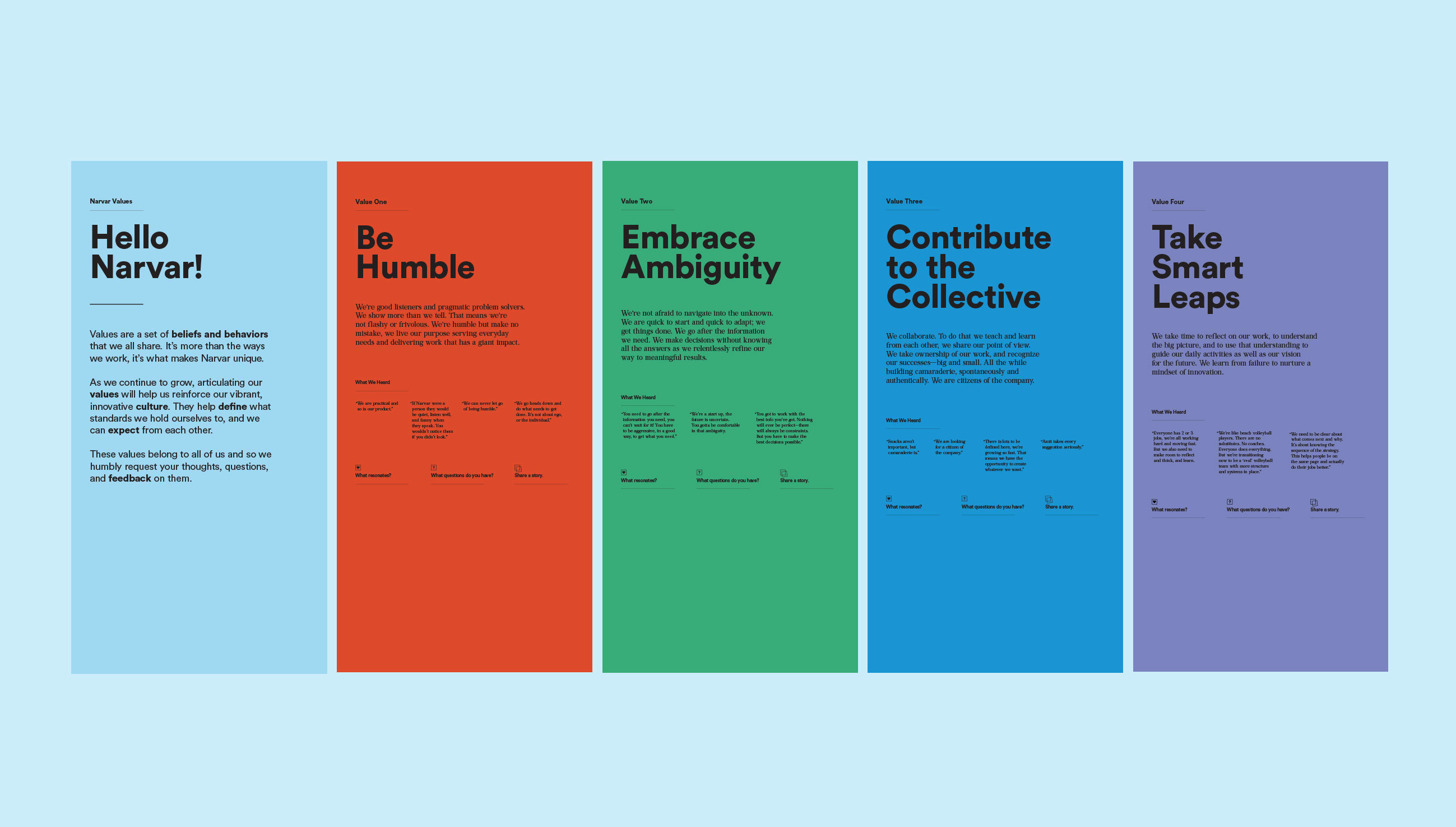

Defining values to set the stage for future growth
In helping a startup codify its values, IDEO prepared its team to scale—fast.
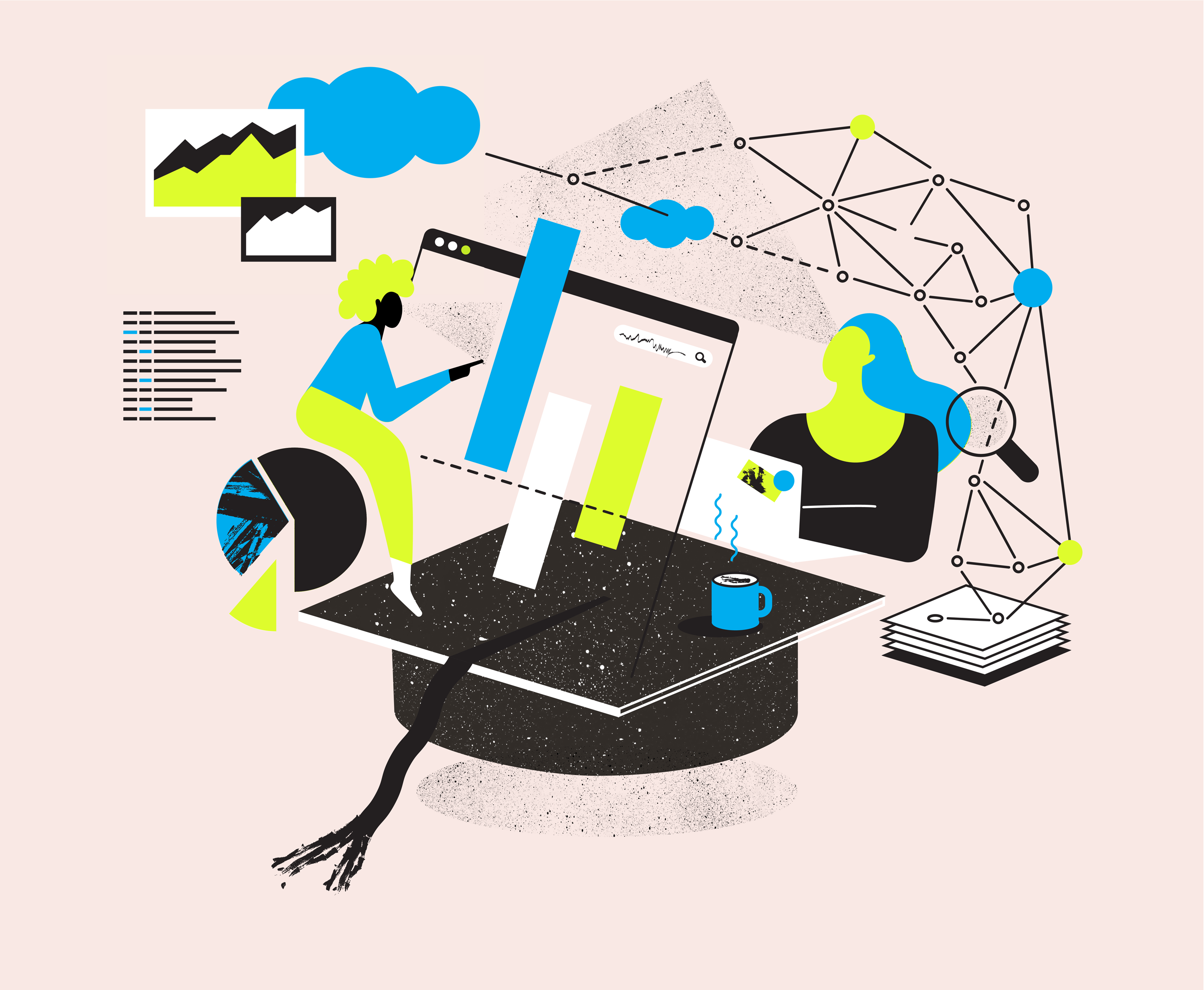
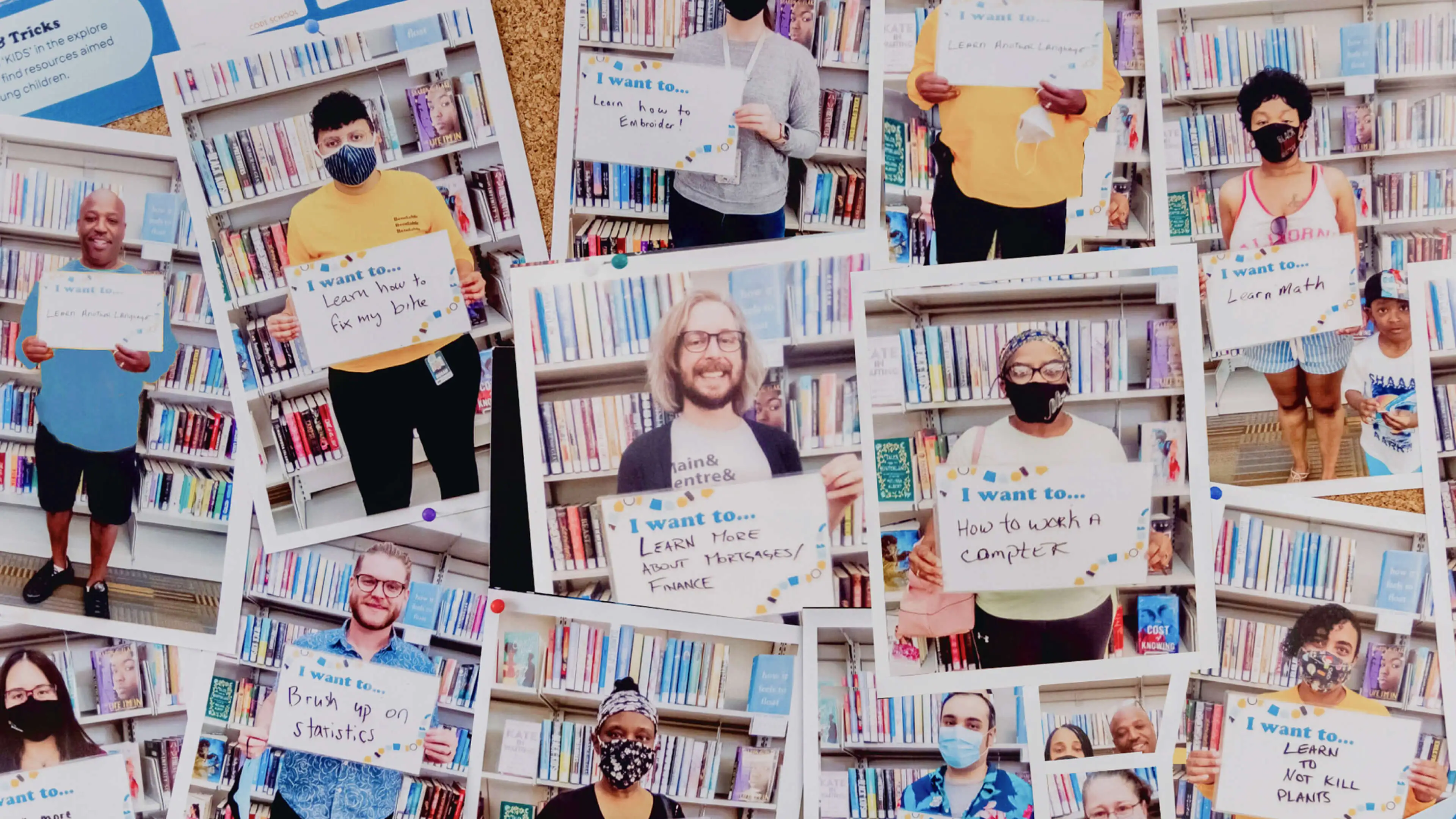
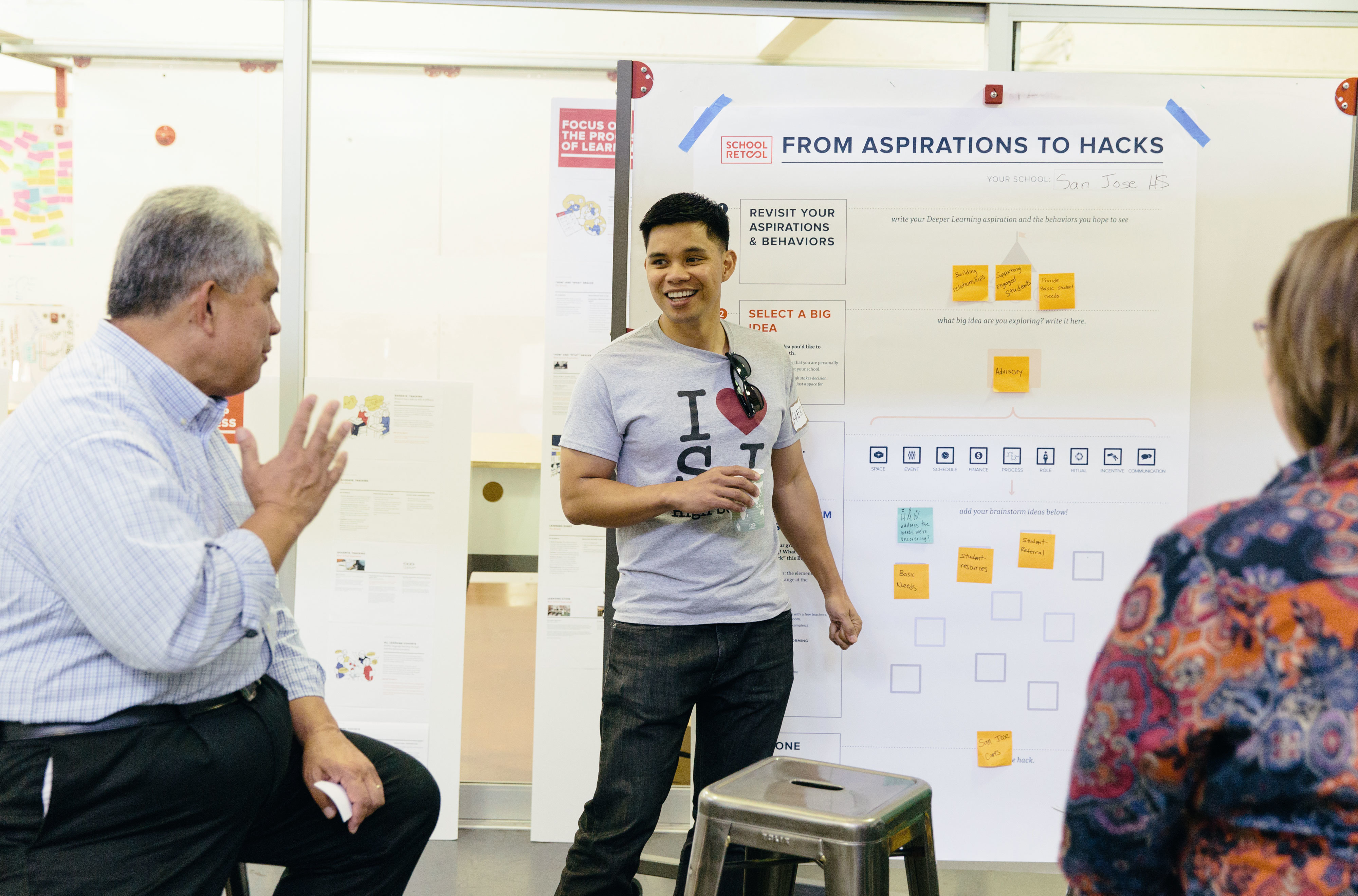
Narvar, a software-as-a-service startup that provides a post-purchase engagement platform for retail clients, was scaling fast. The company had grown from 20 to 90 employees, and was well on its way to reaching 300 over the next two years. As the company grew, its leaders wanted to make sure it could sustain its vibrant, innovative culture. Narvar came to IDEO for help identifying and defining its values in a way that would would scale with the organization.
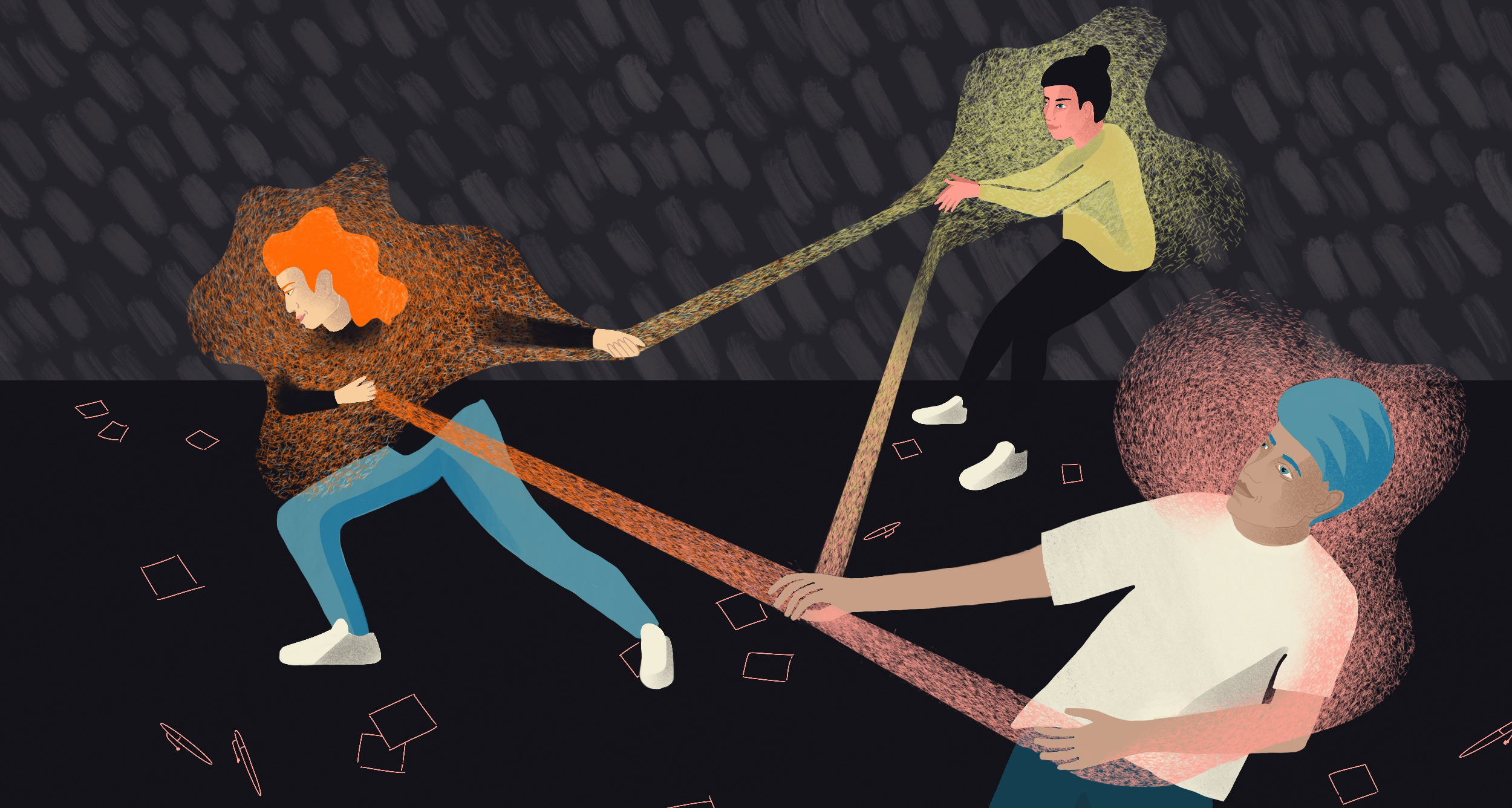
For the IDEO team, that meant articulating a system of values that supported existing behavior, reflected the company’s aspirations, and aided in evaluating new talent and development. The team started by interviewing key “culture carriers,” from the CEO to new hires, to learn what makes Narvar special. Based on this research, the team crafted a working set of values, then invited the entire company to share their feedback. In doing this work, IDEO was also able to surface organizational issues and tensions within the company for Narvar leaders to address.
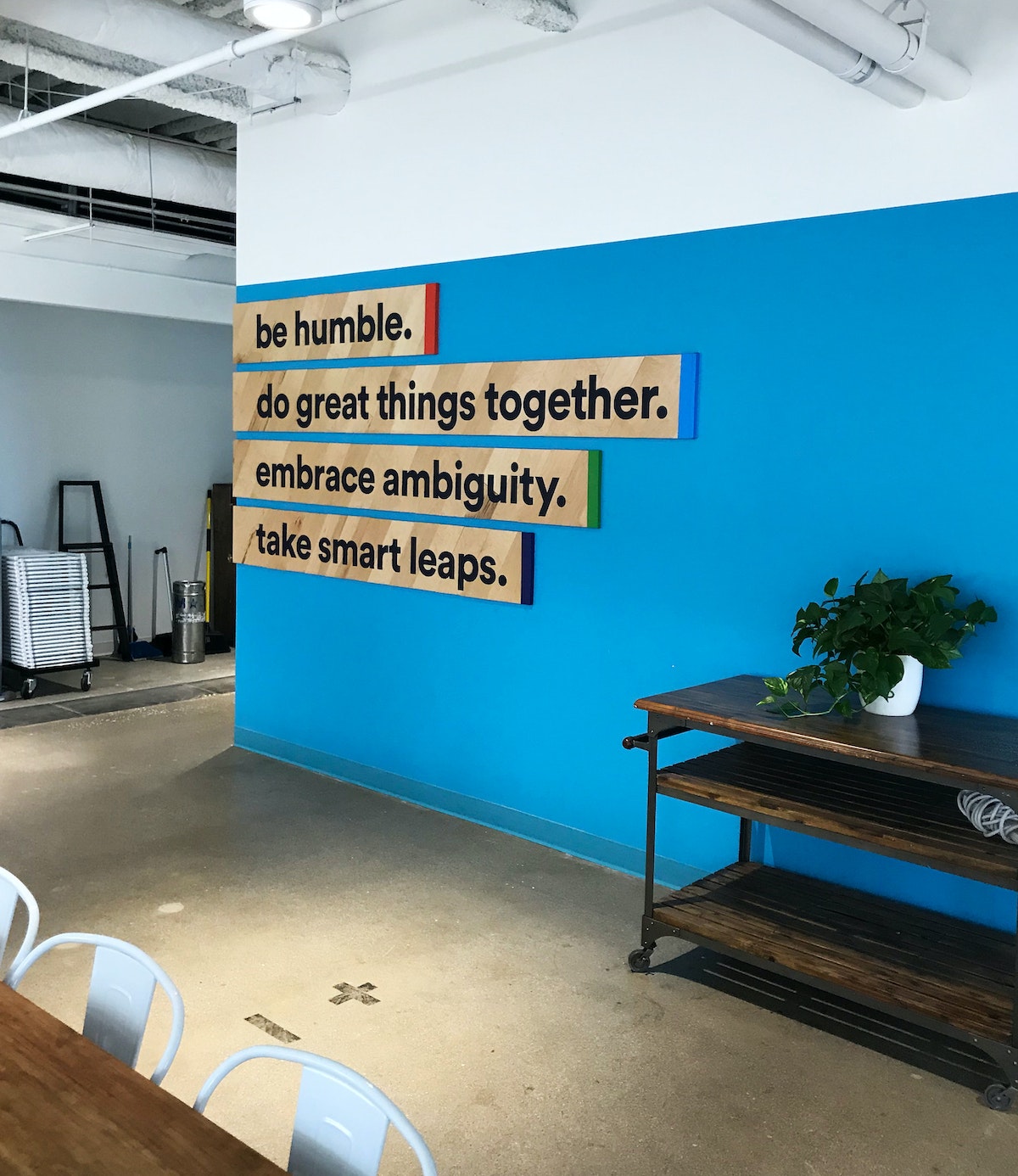
Now, Narvar lives its values every day. Team members use them during candidate interviews, employees see them daily on company walls, and managers reinforce them during performance reviews. Every quarter, leadership gives out a Narvar values award to reinforce their importance. Through this project, Narvar was able to not only capture its core values, but also use them as an active ingredient in the company’s growth.
“We engaged IDEO to really understand the challenges we faced as an organization, and IDEO helped us define and articulate our culture and values. I can honestly say that all the growth and success we’ve achieved in the past two years—we couldn’t have done that without the foundation from IDEO,” said Narvar CEO and founder Amit Sharma.
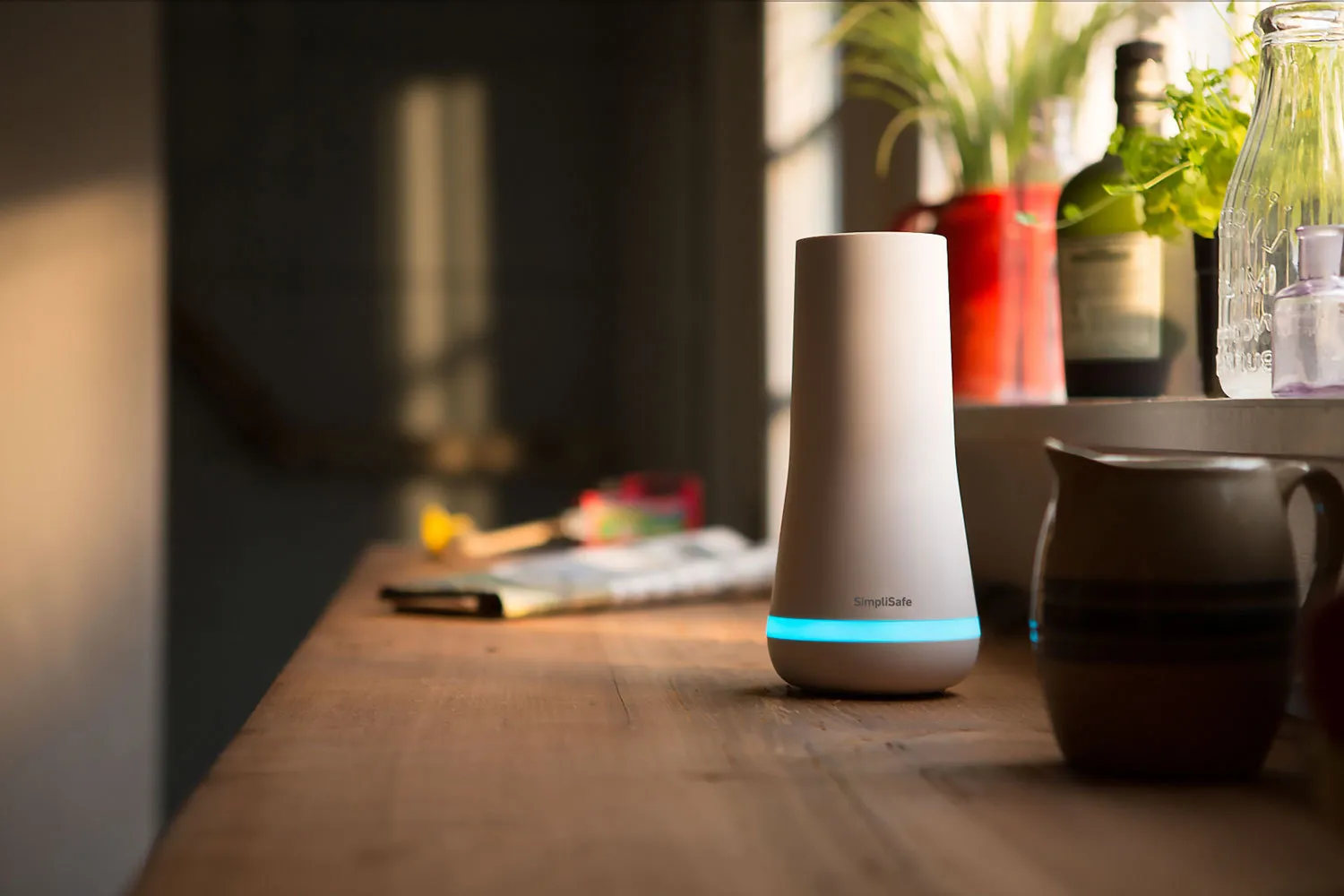
Designing for peace of mind with a leader in home security
Rethinking the hardware, experience, and interaction of connected products designed to protect you.
Only 20 percent of American homes are protected by security systems, and most of these systems are installed after a break-in.
Home security veteran SimpliSafe hoped to convince the other 80 percent of home-dwellers to invest in preventative technology so the break-in never happens. The company approached IDEO to refresh and simplify the look and feel of its connected products to reach this wider audience and help them feel safe.
Interviews with potential customers revealed insights that informed the new design. Families told the researchers that existing security systems are expensive, bulky, and hard to install and use. Instead, systems should be unobtrusive, but responsive to your needs. They should react appropriately in emergencies, while also protecting your privacy.
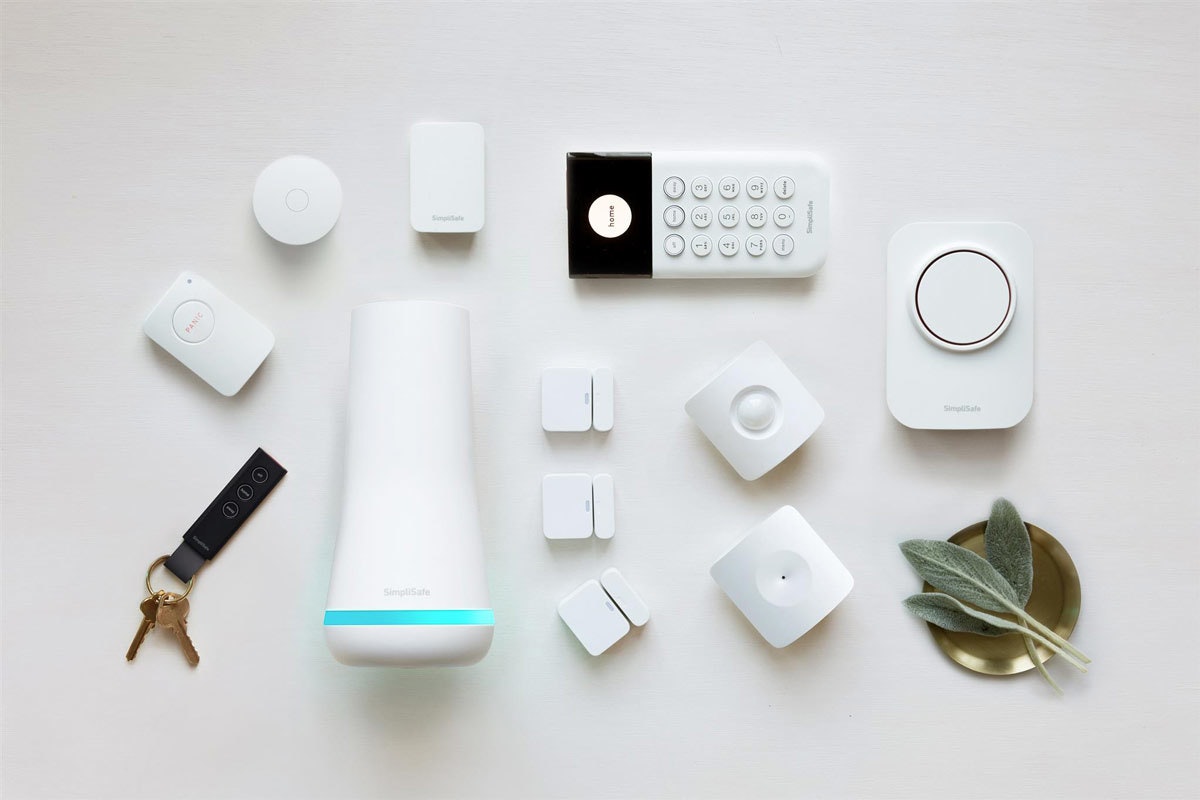
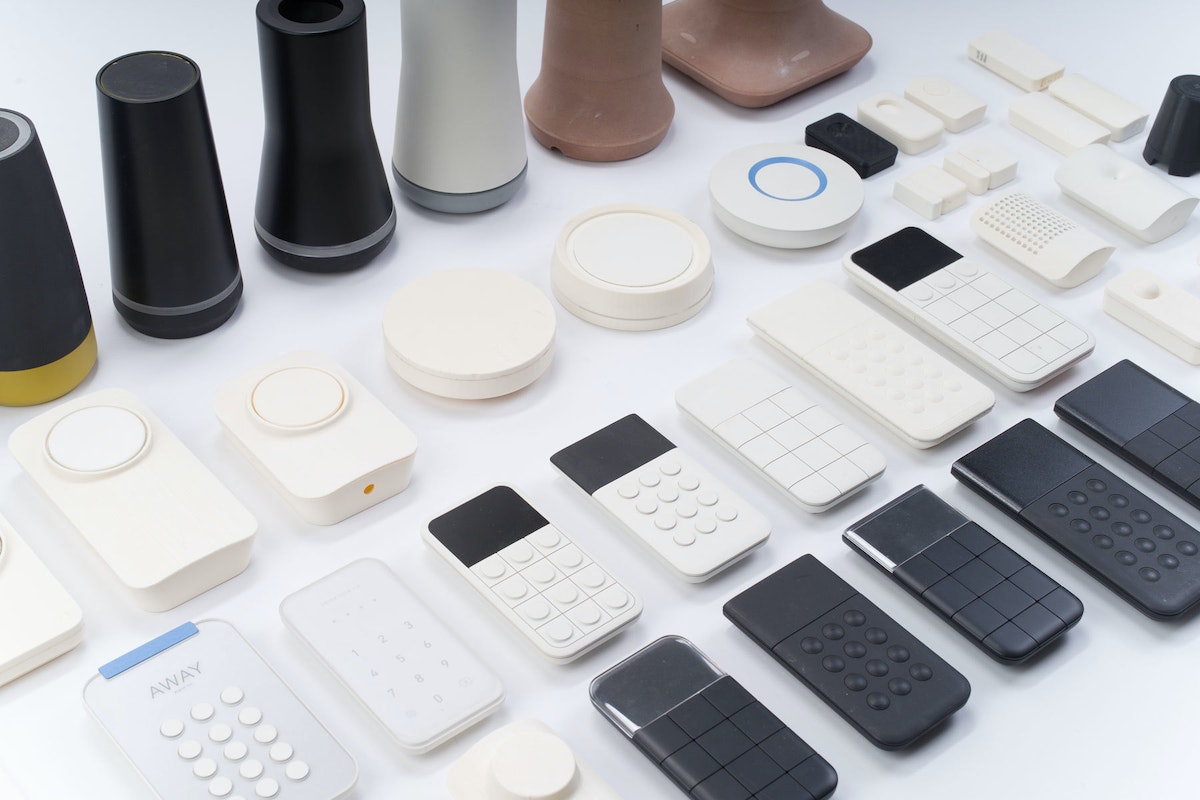
Responding to those requests, IDEO overhauled the design and interaction of more than a dozen SimpliSafe products, including a wireless, touch-to-wake keypad; easy to install sensors; and a smart home base that acts as the brains of the system. Additionally, IDEO designed SimpliSafe's first step outside of the home—a video doorbell that can be used in tandem with the namesake home security system or on its own. Making the system enjoyable and intuitive to use means families are more likely to use it consistently—and correctly.
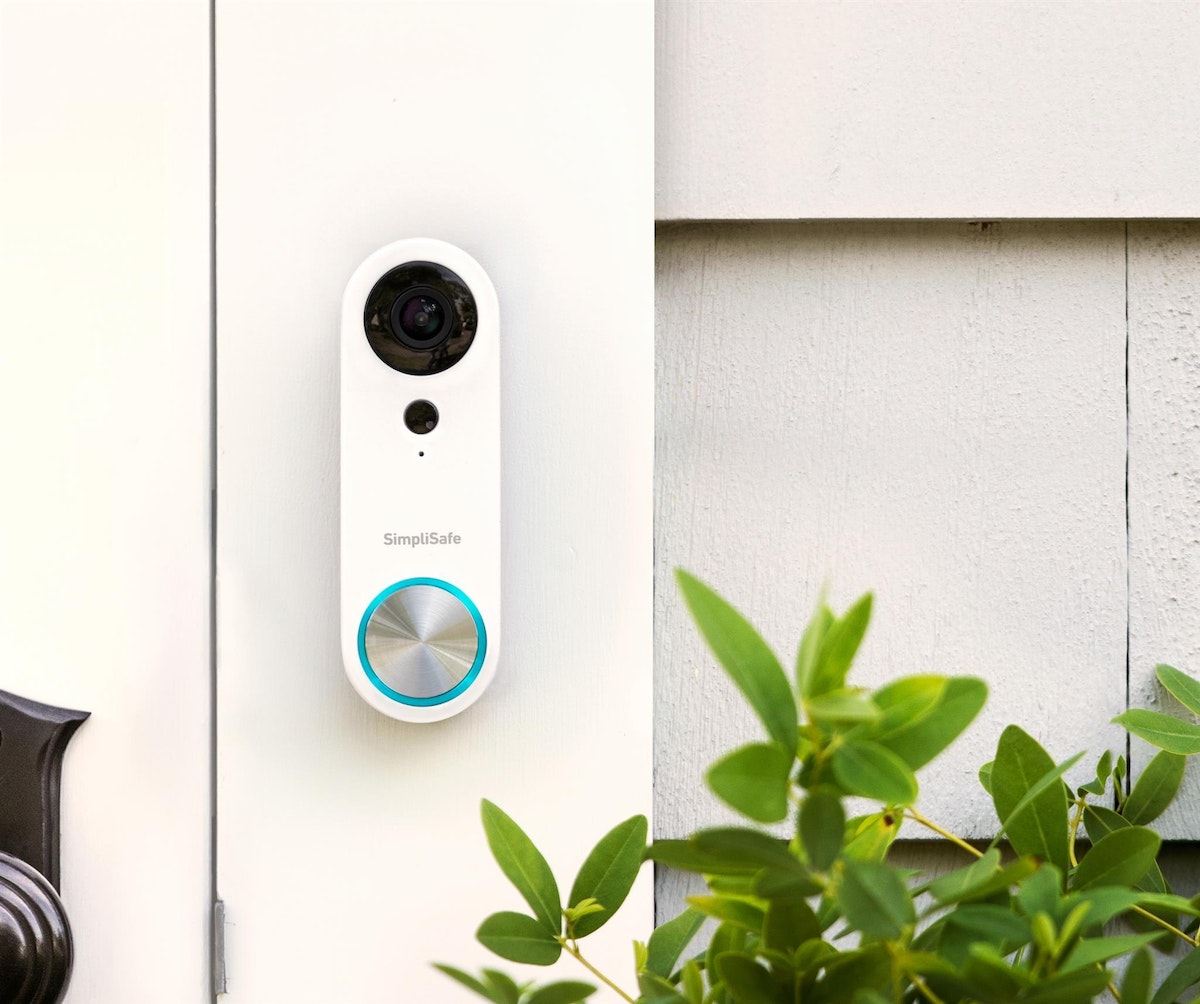
The team developed a consistent design language across SimpliSafe’s physical products, user interface, and digital presence. That clear visual language lets you know what each component does right out of the box; for example, the glass break sensor looks like a human eardrum that might actually hear a window shattering. The design also reduced the size of entry sensors by four times, while improving their range and battery life. Tapered backs and swept-front surfaces for all of these sensors help them blend into your home. The new system’s clean, understated appearance instills confidence without stoking fear of what could happen.
SimpliSafe’s keypad and base station guide you through setting up the system with voice feedback, while gentle LED lights and sound cues let you know at a glance that the system is armed correctly and you’re in safe hands. The system is also equipped with multiple layers of backup, so you don’t have to worry if the power or Internet goes down.
And the system responds intelligently, tailoring the way it reacts to match different scenarios. For instance, it sends a gentle reminder if a window is left open but a police response if a window is broken in. The design team also incorporated a first-of-its-kind privacy shutter on the system’s security camera so families can opt out of being recorded at home.
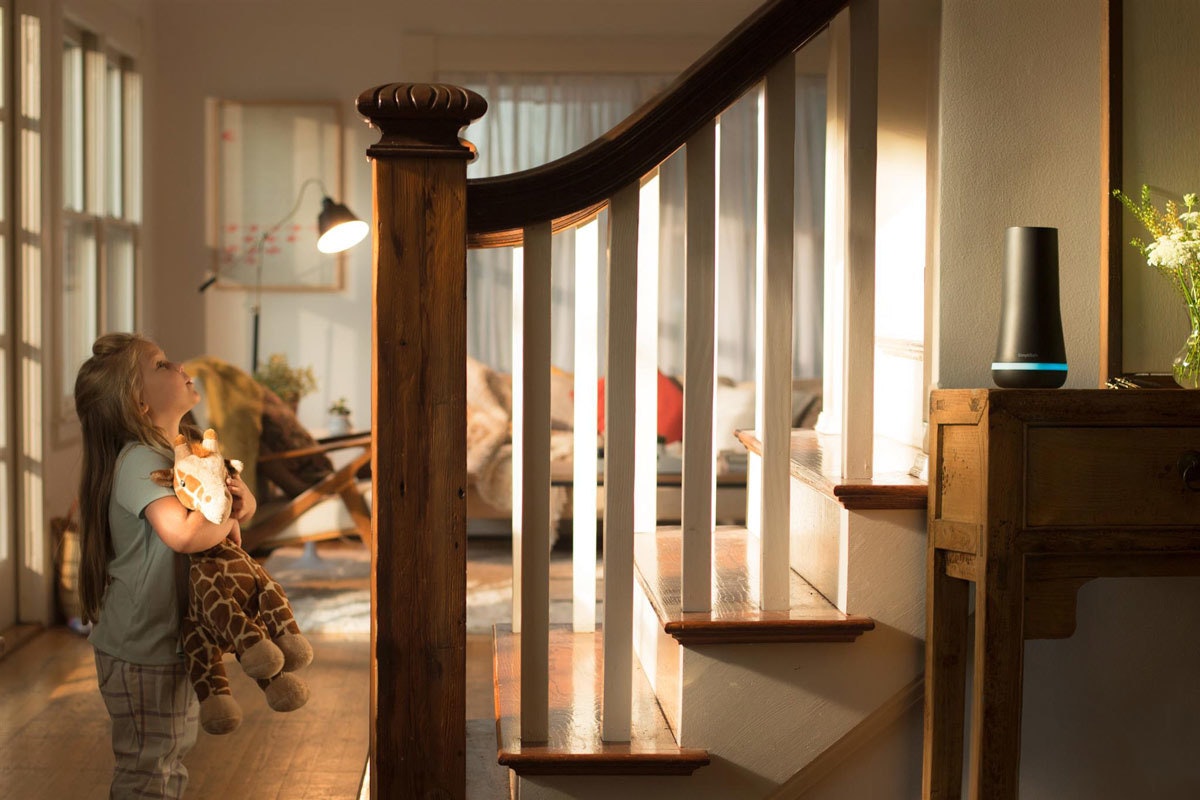
SimpliSafe launched its redesigned security system in early 2018, replacing the company’s two previous generations of products at the same price point. Already, the revamped system has cut the number of support calls from new customers.
In June 2018, venture fund and private equity firm Hellman & Friedman acquired SimpliSafe in a deal that valued the company at about $1 billion.

Rethinking college admissions
Designing a more efficient and inclusive way to read applications.
With a record number of applicants, stiff competition for top students, and a desire to make classes more diverse, college admissions teams are feeling the strain. Bowdoin College in Maine, one of the top liberal arts schools in the U.S., received more applications for the class of 2022 than for any other in its 224-year history.
Whitney Soule, Bowdoin’s Dean of Admissions and Student Aid, saw her staff at risk of burning out. On the advice of Bowdoin’s president, Clayton Rose, she invited IDEO to embed at the college and help design a new way of working. The IDEO team studied Bowdoin’s workflow and zeroed in on the application process as an area ripe for redesign.
By observing how Bowdoin counselors read applications, IDEO learned what drove their decisions. Mindful of how their choices could impact young people’s lives, counselors prioritized a meticulous reading of each application. But this thorough approach meant they often engaged in redundant work or delayed making final decisions.
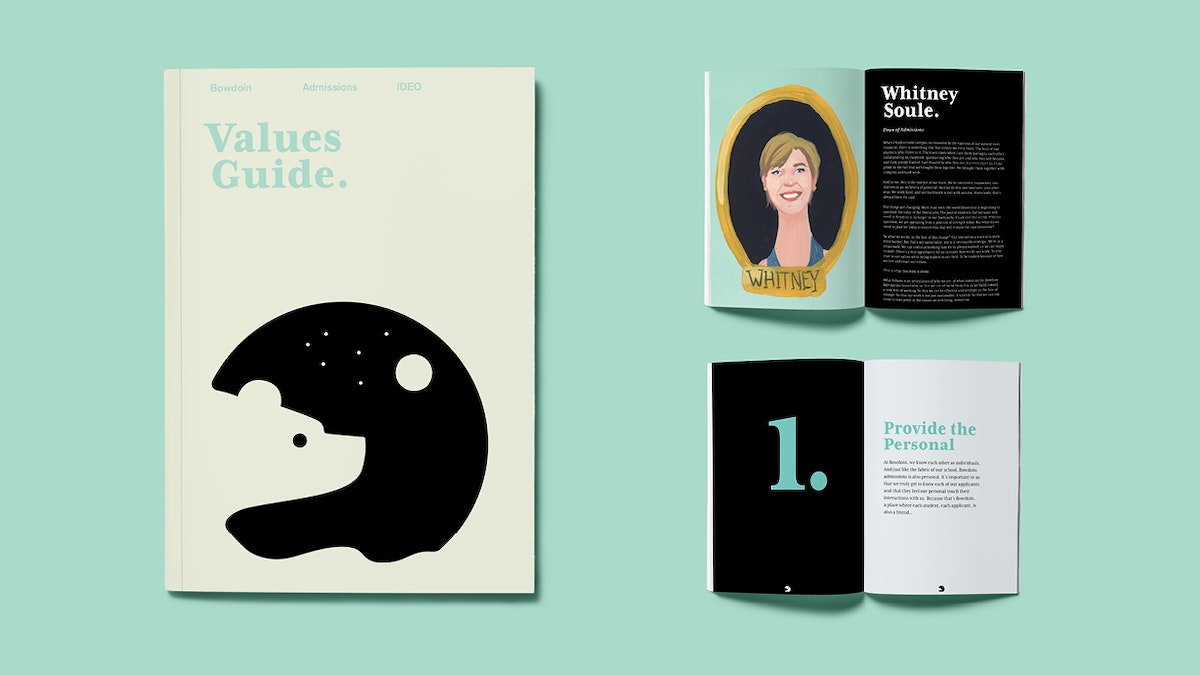
IDEO designers translated their insights into a book for staff, featuring watercolor portraits of the admissions team and a clear articulation of their values—from integrity to inclusion. The book was IDEO’s promise that introducing a new reading process wouldn’t mean sacrificing Bowdoin’s personal touch.
Then, the designers and counselors ran A/B tests using real applications from past years, unwinding long-held beliefs about how they “should” be read. Soule and her team experimented by adjusting timelines and other factors that determine when and how applications move from a first read to a second read to a committee discussion.
Soule gave her team explicit permission to toss their typical playbook. Seeing their own process with fresh eyes, counselors realized they could be more confident in their expertise and tweak their workflow to meet changing demands.
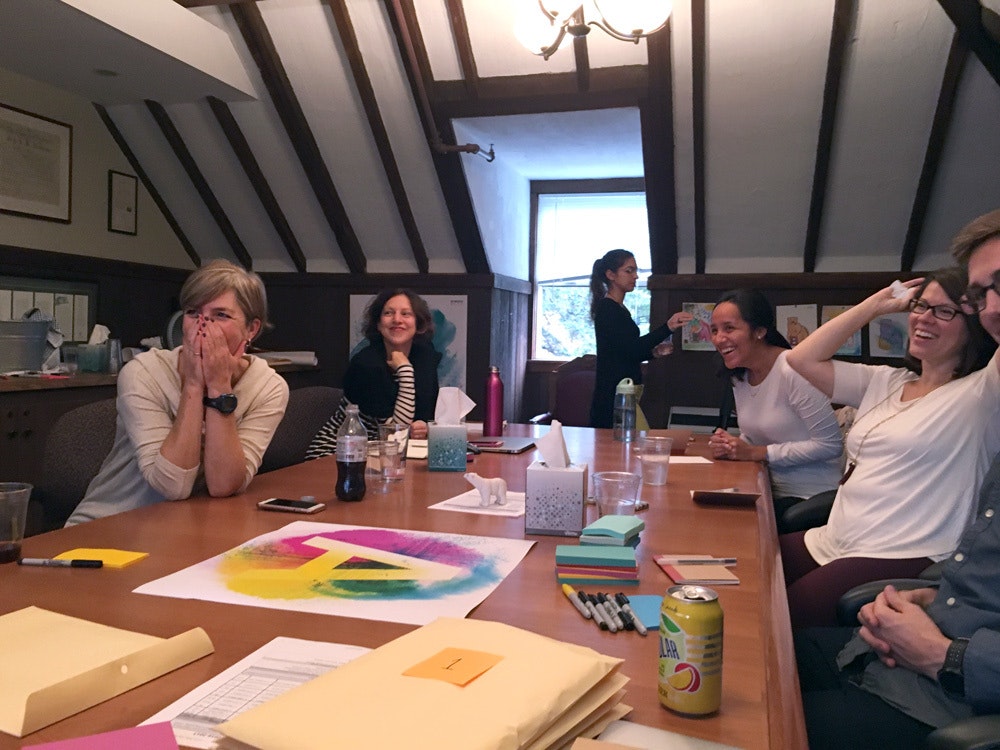
A/B testing proved that some variables had little effect on the team’s final admissions decisions. With that in mind, IDEO redesigned the reading process and included a system called “magic sort,” which helps parse groups of applications based on a new set of counselor assessments in order to route each to its next round of reviews more efficiently.
The IDEO-Bowdoin team put the revised technique to work right away, processing 300 new applications from the annual QuestBridge program for low-income students. Counselors found they were able to make equally valid decisions while cutting the amount of overlapping work they faced by 40 percent, compared to years past.
Working with IDEO challenged us to change the way we work together—and we learned a new method of problem solving that we continue to use. We are better equipped to elicit creativity, then channel it into the practical implementation of new solutions. It’s been transformative!
WHITNEY SOULE, DEAN OF ADMISSIONS AND STUDENT AID, BOWDOIN COLLEGE
The new reading method let staff cope with a growing volume of applications, while balancing the need to evaluate individual students with the need to think holistically about the makeup of Bowdoin’s student body. Counselors adapted the technique to the rest of the year’s admissions cycle, including early-decision, regular decision, and transfer applications.
To extend what her team learned to other departments, Soule has led several design thinking workshops across campus. Her success as a leader has mirrored the growth of her team and the college; by empowering staff with new tools and the freedom to experiment, Soule and Bowdoin are leading by example in the evolving world of higher education.
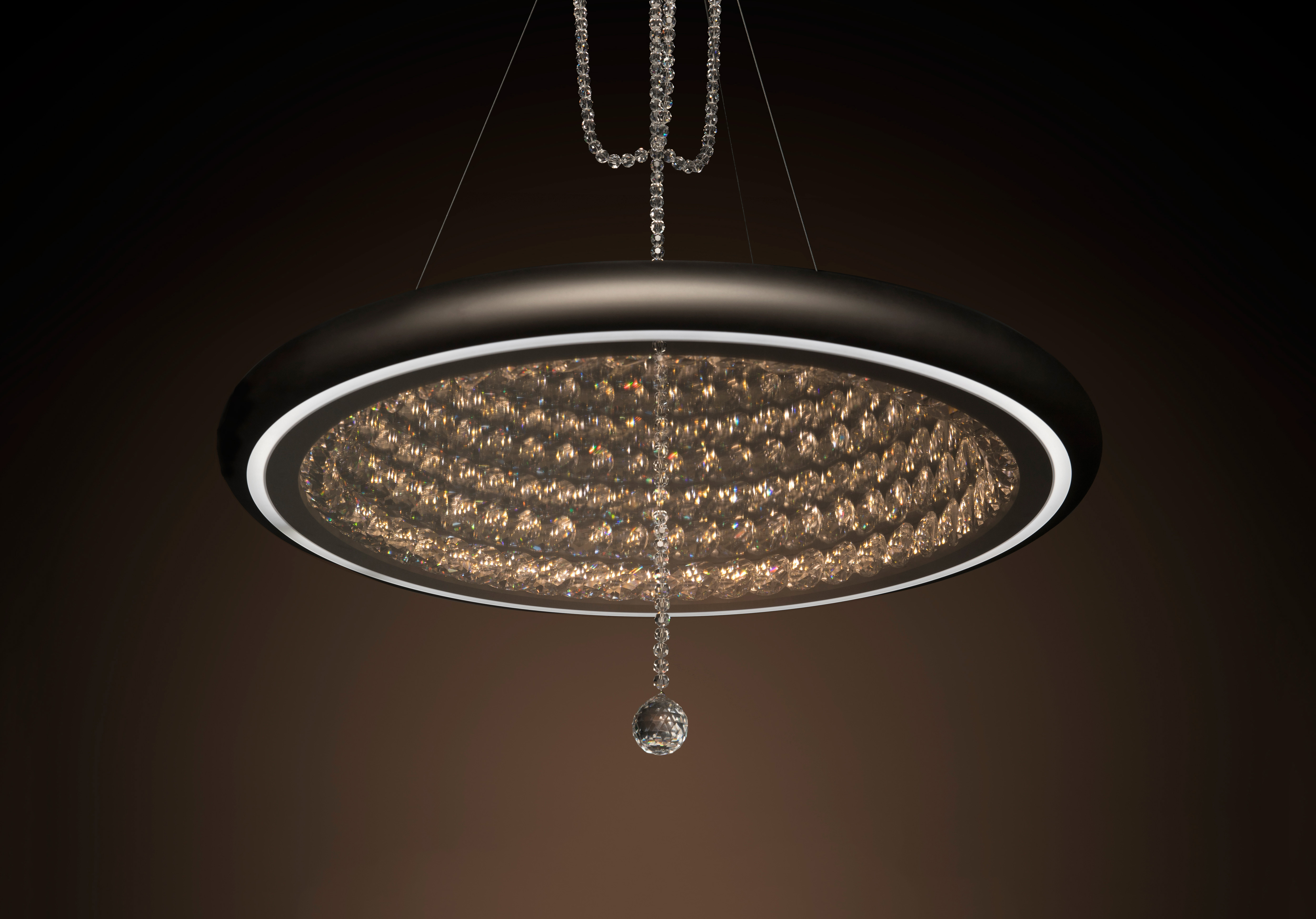
Reinventing the chandelier
Designing an elegant, modern lighting experience for an iconic brand.
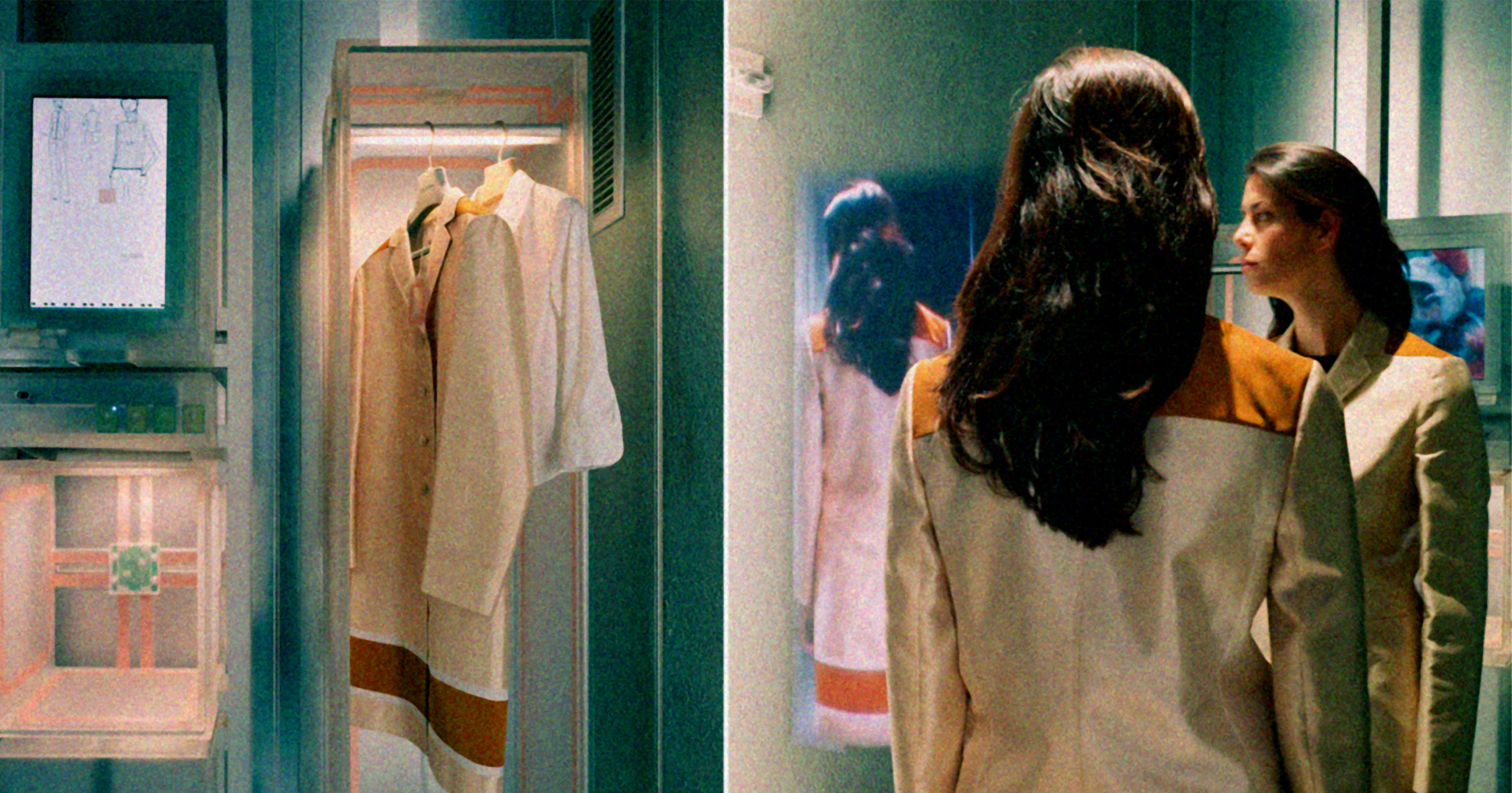
For half a century, Swarovski has crafted iconic chandeliers dripping with the brand’s signature crystals. With the rise of new interface technology, the company came to IDEO for help to design the chandelier of the future.
IDEO designers set out to create beautiful, emotional experiences by layering technology onto Swarovski’s lighting offerings. Whether it’s setting the tone for a sophisticated retail experience, creating subtle ambiance at a romantic dinner for two, or providing true quality light to read a book, the team considered how a chandelier can enrich personal moments throughout the day.
Swarovski and IDEO assembled a multidisciplinary group, including industrial and UX designers, brand experts, and engineers to quickly vet, build, test, and refine their ideas.
Designers from IDEO and Swarovski worked together to completely reimagine the crystal chandelier.
Together, the team designed a new tech-infused chandelier and family of other light fixtures. At first glance, the chandelier resembles a simple, sleek metal disc. But when you turn it on and peer inside, an endless number of crystals swirl far into the distance—an Infinite Aura.
The Infinite Aura collection also includes pendant and wall lights. The team developed a mobile app that proactively modifies light settings based on the time of day, and also lets users customize their experience—including adjusting brightness and color to set a personal mood, or “Aura.”
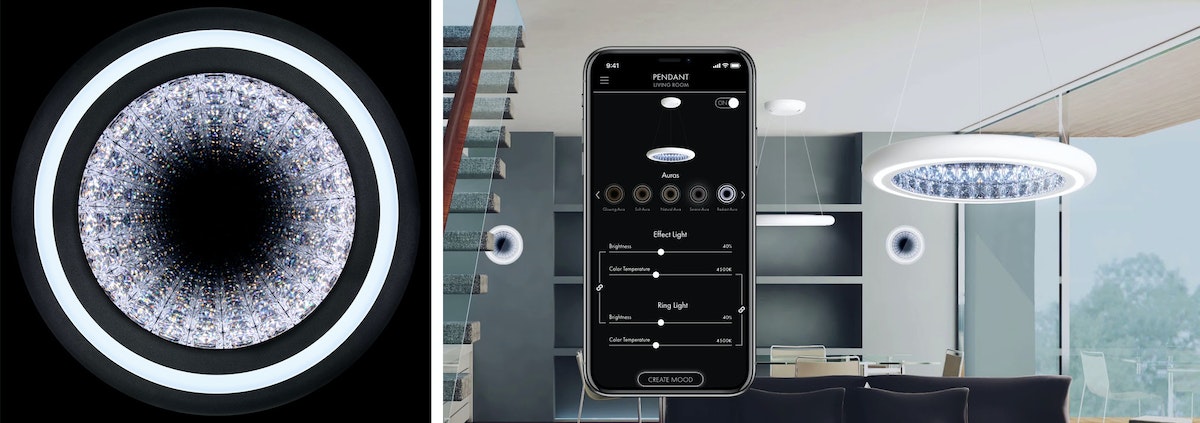
Unlike most fixtures, Infinite Aura doesn’t just give off ambient light; families can also benefit from high-quality functional light, directed downward to help them focus on a task or diffused upward and downward to create a subtle ambiance. In a similar way, the chandelier can expertly illuminate a library, hotel lobby, or concert hall.
The new lighting line adds greater functionality and emotional resonance to today’s smart buildings, while retaining Swarovski’s timeless elegance. Infinite Aura debuted in Frankfurt, Germany in March and will be available internationally in fall 2018.

How to Use Your iPhone to Create Frameable Art
How a design constraint helped me make art
Fast forward to fall of last year. Adobe announces an update to its Lightroom iOS app that allows users to capture RAW photos using their smartphone camera. Slowly, I began experimenting with on-the-go editing techniques similar to those I’ve developed over time using Lightroom on desktop. Could the iPhone, with its tiny image sensor, actually be the magic gadget I craved?

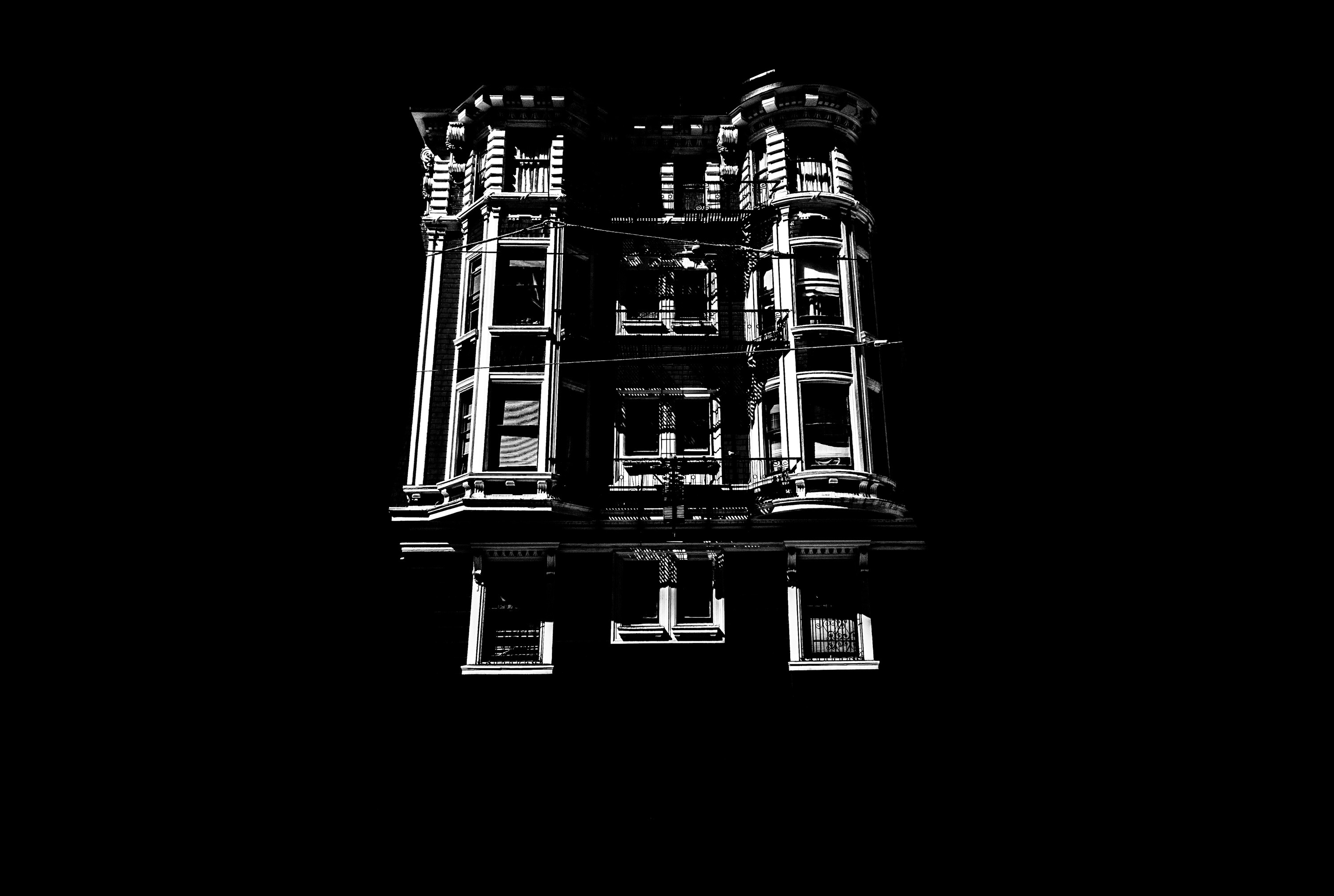
I’ve long wanted to do a project that celebrates the diverse architecture of my adoptive city, and my newly augmented smartphone camera provided just the opportunity. So, I set out to answer my own question with a specific aesthetic in mind and a simple design constraint in place: I would use my iPhone, alone, for both photos and edits.

I have now captured and shared more than 40 photos—one each day since April 1st—and will continue to do so until the series tops out at 100 images. The constraints I held myself to and the consistency of daily publishing have allowed me to quickly refine and iterate the technique—an accidental outcome as happy as it was unforeseen.

As designers, we often yearn for carte blanche freedom to explore and create as we see fit. What we forget is that our best solutions often come from imposing limits on that freedom, and seeing what comes of it.
How I did it: all photos in the series are captured using an iPhone 6S, and all edits were performed in roughly 60 seconds using some black and white alchemy in the Color tab of Adobe’s Lightroom Mobile app for iOS.

Want to see more of Burton’s work? Check out this, a NATO & G8 protest he attended in Chicago in May of 2012. And this, the stations of the Moscow Metro he captured during a visit in the fall of 2015.
When I first moved to San Francisco, I spent every free moment exploring my new locale, camera in hand, with a backpack full of lenses and a tripod. With time, however, the weight of my DSLR and pack felt more like an albatross than an accessory, and I adopted the usual photographer’s lament, yearning for a magical gadget that could output images of a quality inversely proportional to its bulk.
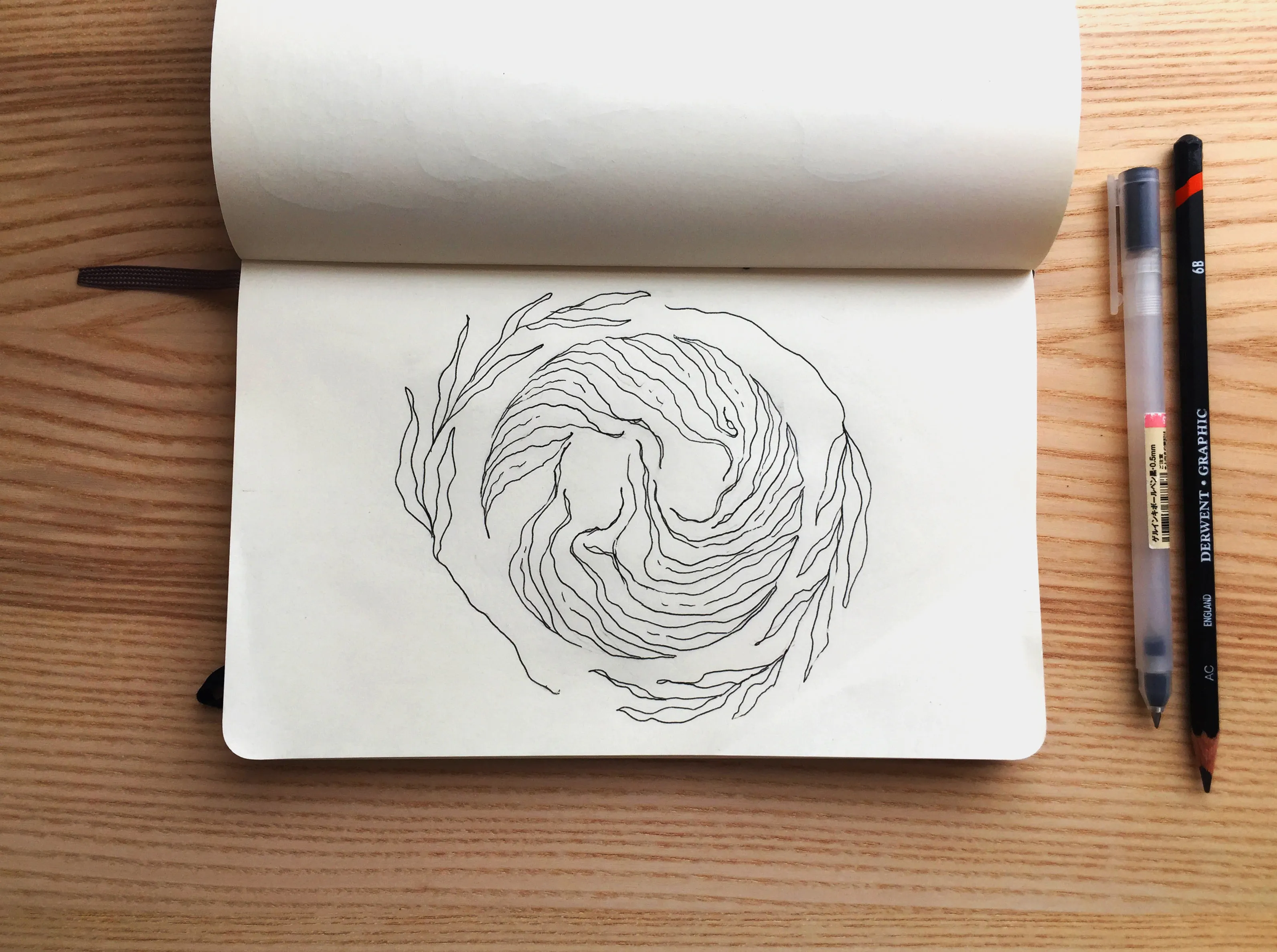
What’s in my Moleskine: Adam Cristobal
Take a peek into an interaction designer's sketchbook
These days, I frame my life less as a sensible narrative with a rise and fall, and more as a series of small, densely packed moments that leave sweet and sour aftertastes. These moments are the ones I choose to draw in my sketchbooks, usually several months after they’ve actually occurred. The unimportant things, I forget. What’s left for me to draw is what matters: moments of wisdom, aged by feelings that have grown more complex and multi-dimensional over time.
Here are a few moments that have stuck with me:
Blame it on the Boba
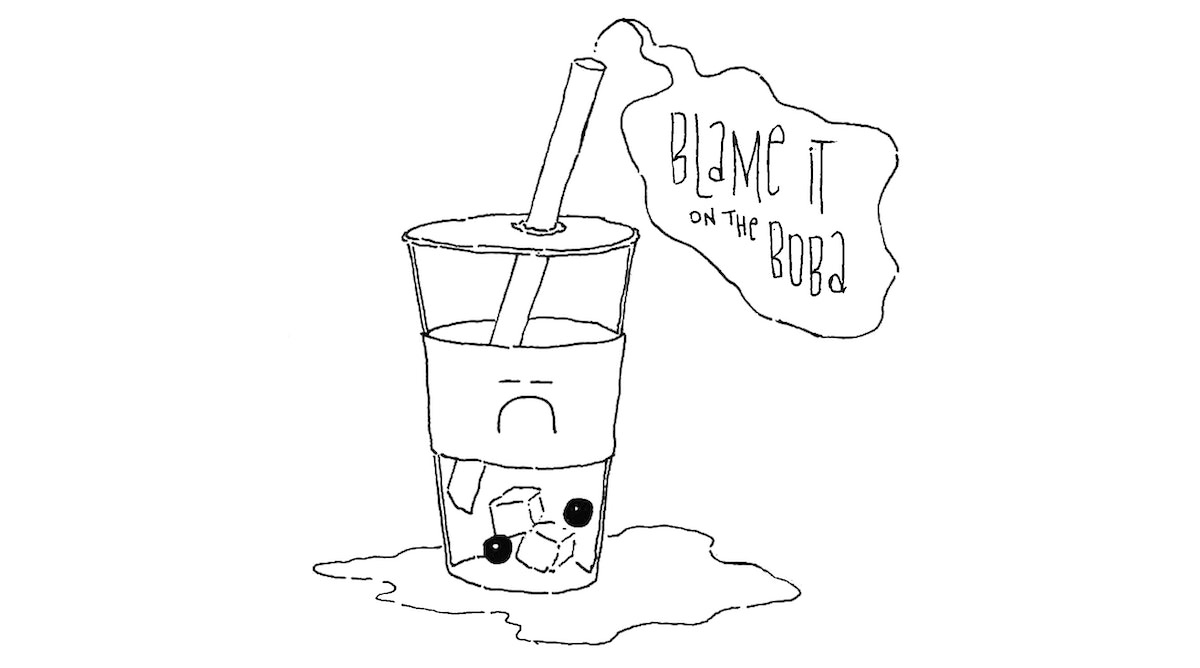
When I first moved to San Francisco, I started dating someone—less because it made sense to date him in particular, and more because I was enamored with the idea of christening my new city with a new relationship: new city, new boy, new me! Predictably, things didn’t work out, because that’s what happens when you rush into things for the wrong reasons.
Over a year after dumping me, however, he asked me out to boba. Somehow, we ended up seeing each other again. And again, predictably, things didn’t work out. Apparently, I saw things differently the second time around. I rarely drink alcohol, but that doesn’t stop me from attributing my poor life decisions to boys touting sweet beverages.
Most People are Terrible
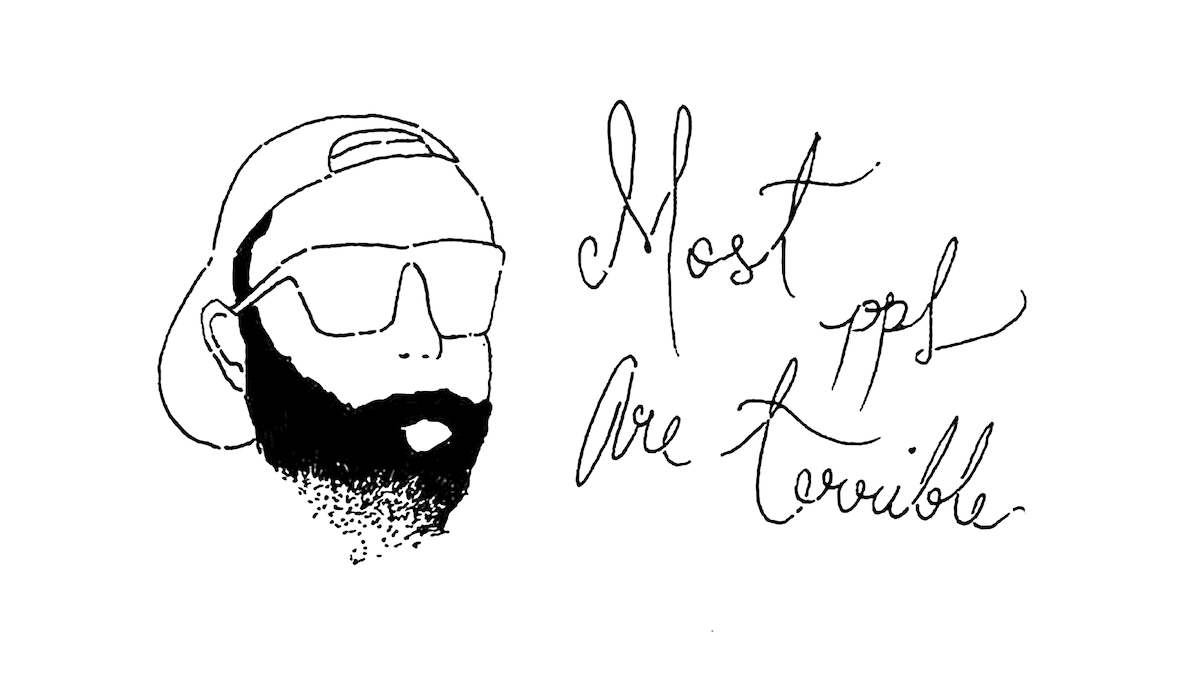
I met one of my best friends, Cory, over two years ago. Since meeting him, I’ve probably drawn him about ten times. A savvy reporter with a sharp tongue but a heart of gold, Cory has provided me with many invaluable nuggets of wisdom. One of the most memorable nuggets was a sobering reminder that I tend to assume the best in people too quickly.
In some cases, this just means that someone who I thought had excellent taste in clothes, music, books, or food actually doesn’t. In more serious cases, this means that I have a difficult time distinguishing charm from crazy. In any case, and particularly the latter, I keep this axiom close to my heart.
Not Assholes, Just Shibas
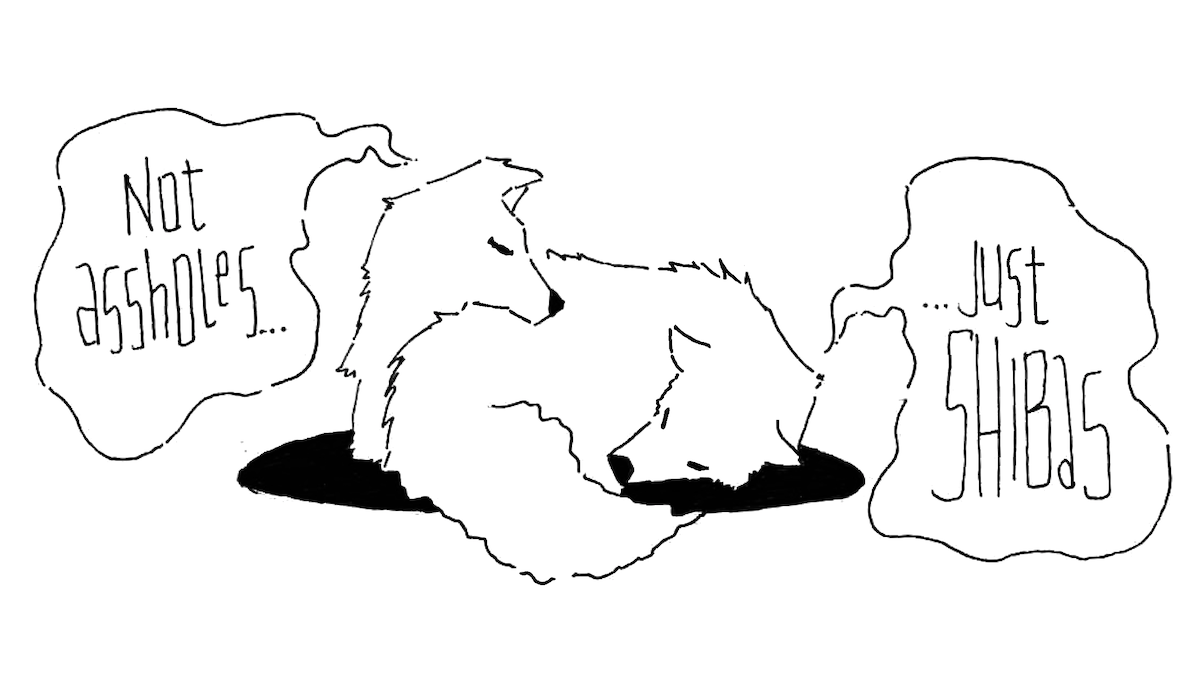
In 8th grade, I met a girl named Mira who is now one of my oldest and closest friends. Mira is much more charismatic and social than I am. During our younger years, I always thought were two sides of one coin: she was the outgoing and social one; I was the quiet and taciturn one.
However, a few years ago, she told me that she’s actually a total introvert. I realized two things: First, that our introversion was probably what brought us together in the first place. Second, that I had completely misunderstood one of my best friends. But that’s water under the bridge at this point. Lately, we’ve started characterizing ourselves as shiba inus, who aren’t exactly the cuddliest of dogs. But they’re not jerks, they’re just independent. Just like me and Mira.
At the end of the day, I use these moments to remind myself that I can always adapt when life doesn’t work out exactly as I expect. And if all else fails, finding humor in turbulent moments is the quickest solution for a bad day.
I’m a huge nerd. I grew up watching a lot of fantastical and post-apocalyptic anime, and I’m a former literary history student with a fondness for medieval poetry. Having spent enough time with Chaucer, Boccaccio, Satoshi Kon, and Hideaki Anno—most of whom tend to leave their audiences hanging or uncomfortable—I learned to appreciate stories with ambiguous endings. I’ve carried this same sentiment into my sketchbooks.
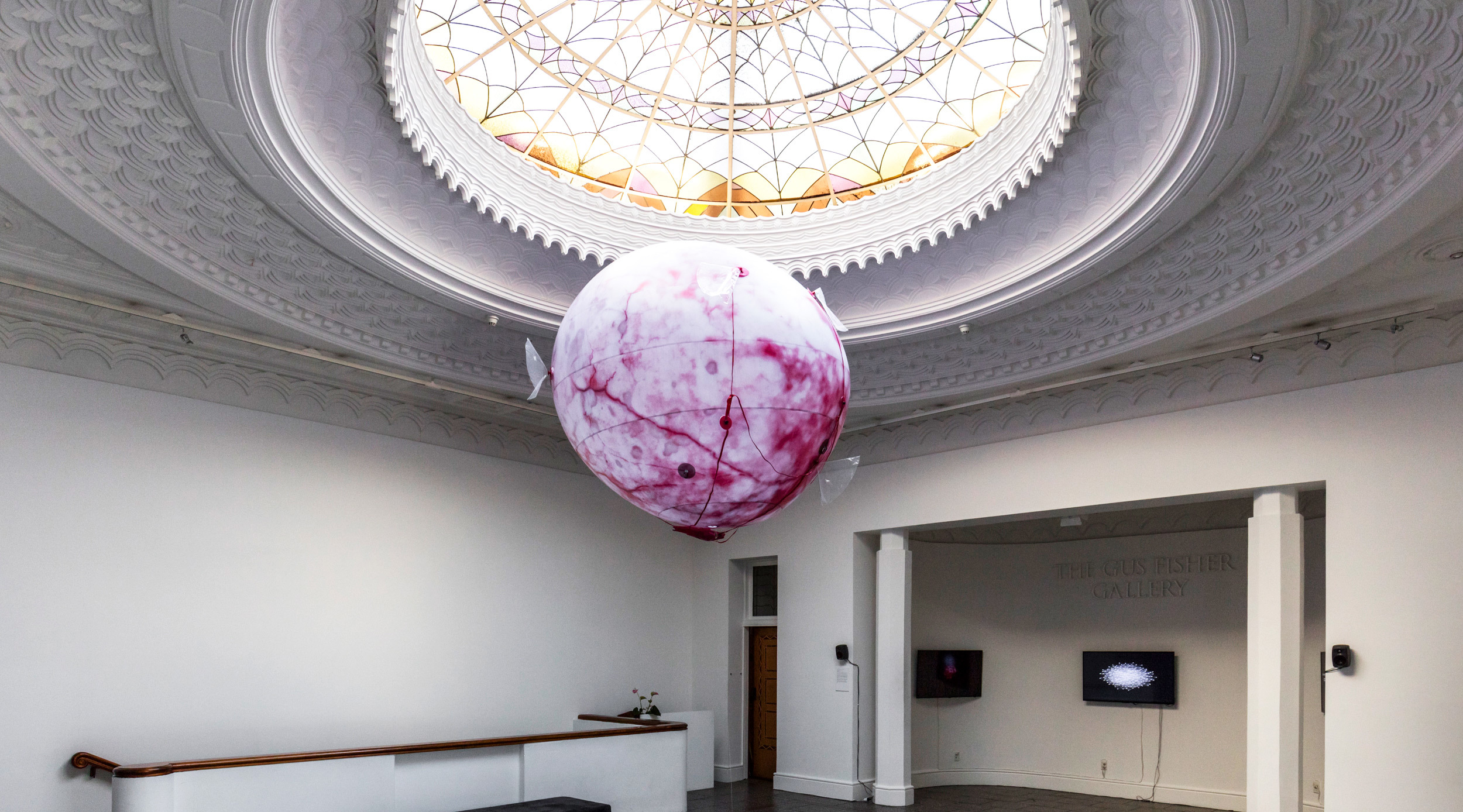
Your Body as An Art Project
How one young British artist is pushing the boundaries of bodily design
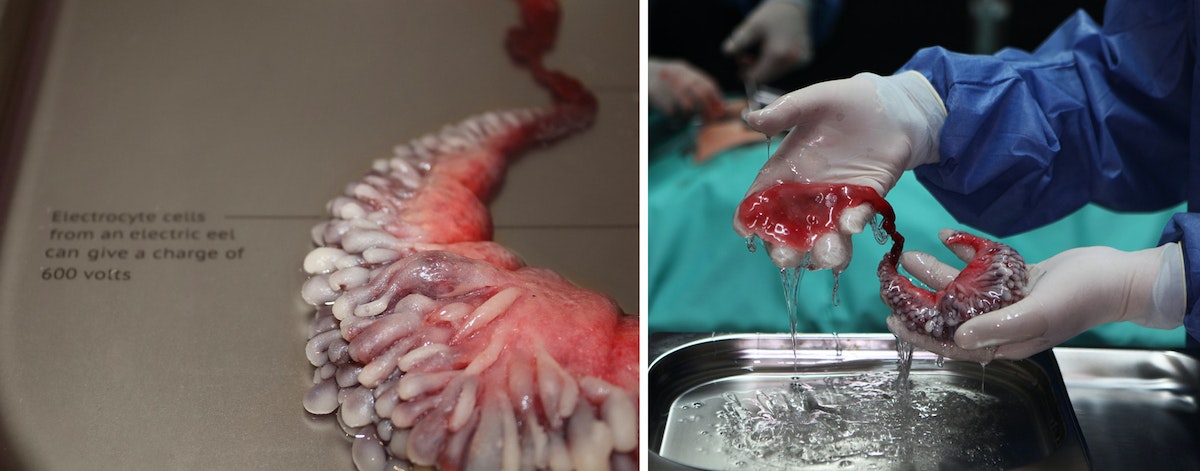
Imagine, for example, using parts from an eel to shock the human heart with current when it’s having a heart attack? In an exhibit called Domestic Futures at Nationalmuseum of design, Stockholm Haines showed exactly such a “product”. Goodbye defibrillating paddles, hello electric eel!
More recently, IDEO’s London studio collaborated with Haines for New Old, an exhibit at the Design Museum London. The result was “Spirit,” an AI assistant for the elderly. After working alongside Haines, we found ourselves intrigued, so we caught up with her to ask a few questions about what it means to be a budding biodesigner.
When did you first think about getting into design, and why?
When I was younger, I had many misconceptions about design that I think are still problematic today. You rarely get to see the messy, exhausting, and all-consuming guts of design work, but I think it is an incredibly engaging discipline. I got my masters in the Design Interactions department at the Royal College of Art, and am now undertaking PhD research at Transtechnology Research at Plymouth University.
Who are the designers, artists, writers, and thinkers that have influenced your work?
Noam Toran, my tutor on my MA course, offered many fascinating and unnerving threads of research, along with Tony Dunne and Fiona Raby, who promoted alternative ways of thinking. I also like Floris Kaayk (a bit of enjoyable grossness there!), who always seems to have something fascinating in progress; my close friend designer Soomi Park, who is highlighting sensitivity to emotion in artificially intelligent objects; and recently, I saw a great talk by Hyphen-labs, which probes some really important questions about design.
Tell us what you produced for the “New Old” Design Museum exhibit
For “Spirit,” I made some sculptures of potential body modifications—visualizing how a fictional company might improve sociability in the elderly. The IDEO team, including Ed White, Daniel Tauber, and Javier Soto Morras, had researched alterations that could be made to the body to send biological notifications. The work made me aware of the pressures and expectations on the elderly.
Tell us about three of your favorite projects
In 2013, I produced “Transfigurations”, which depicted babies with structural modifications. The work encouraged people to consider whether surgical procedures might offer solutions to future social and environmental problems. I think the cuteness of these sculptures made the work both disturbing and delightful. Another project, involved dissecting sculptures of anatomical parts, suggesting potential future procedures such as the removal of a cyst from a bionic eye implant. The tactile element helped this work to become a lightning rod for discussion regarding scientific research. Currently, I am developing “if you prick us do we not bleed?” about how we interact with humanoid robots by including bodily fluids. I was, of course, inspired by the famous Shylock monologue in the Merchant of Venice. “If you prick us, do we not bleed? If you tickle us, do we not laugh? If you poison us, do we not die? And if you wrong us, shall we not revenge?” .It's still a very powerful message about the mistreatment of those perceived as different.
What does it mean to use the body as a design medium?
All of my work is, of course, speculative. I don’t spend much time actually moving human material around, although I did once spend a very interesting day at a cadaver research laboratory! Instead I research the tools and materials that may have an impact on the body, or how we perceive the body. There are already disciplines that have to view the body as editable, and moving this way of thinking from a surgical or dental domain to a design or engineering one is where there is space for interesting interventions. There seems to be lots of interest in nanotechnology, and like many biotechnologies, this means there will be interactions with designs we can not see, but can perhaps feel, and maybe also artificial intelligence that may make design decisions for us.
Want to see more of Haines’ work? Find her current exhibits and talks here.
Agi Haines’ artwork isn’t easy on the eyes. But to her, it looks just like home. As the daughter of two South East London artists who met while working at Madame Tussauds wax museum, her childhood home was populated with wax heads, antique surgical tools, and sculpture scaffolds. Viewing the human body as raw material for design interventions wasn’t the stuff of some sci-fi future—it started as a family affair (her sister, Beatrice Haines caught the bug, too) and Haines has been working and speaking about it ever since.
Thoughtless Acts: Bespoke Belt Loop
Thoughtless Acts: Bespoke Belt Loop. The intuitive ways we adapt and react to things in our environments
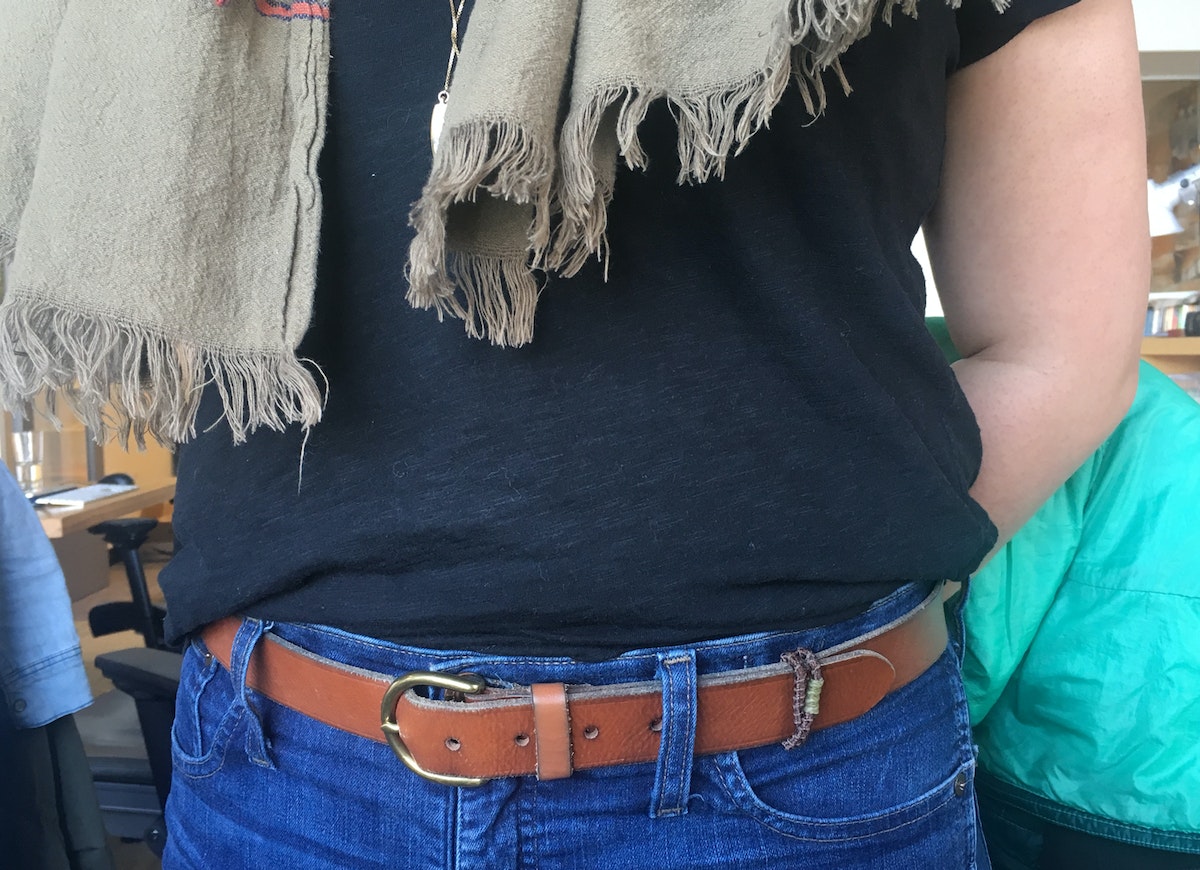
A few days ago, in the middle of an impromptu content brainstorm, I noticed that my colleague had her hair tie cleverly wrapped around her belt to keep the excess tail neatly in place.
Hair ties are something many of us wear on our wrists all the time. They’re inexpensive and, while essential for those of us with long hair, they're often under valued and under utilized. My colleague's back-up belt loop is by far the smartest and most delightful use of a hair tie I’ve ever seen.
I’m particularly inspired by this because I like to repurpose unloved objects in ways that exercise creativity and expand appreciation for junk. Recently, I took an old wine-stained summer dress and coiled it around my neck as a scarf. It now lives in the scarf section of my wardrobe.
Now, I'm thinking about ways I can repurpose all the brightly colored hair ties that I don’t like to wear against my black hair. Besides belt loop reinforcement, they might just be a new way to introduce a pop of color into an outfit.
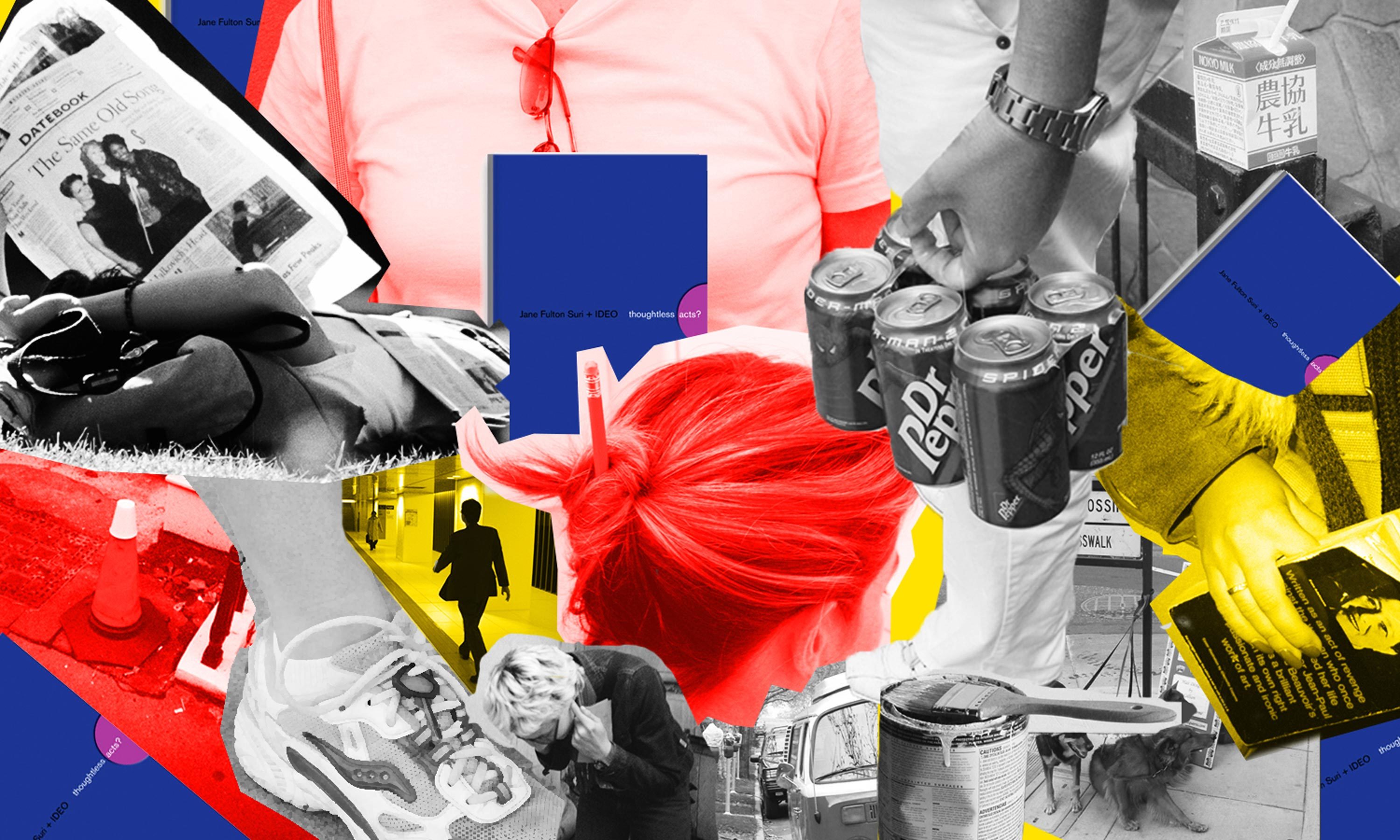
Human-centered design requires us to observe human behavior with beginner's eyes, so that we can spot the innate ways people interact with the world around them. We call these intuitive and unconscious reactions thoughtless acts, and IDEO designers collect photos of them to inspire their work.

Lindsey Turner
I’m passionate about building brands, products, and experiences that help organizations show up with meaning and momentum.
I help organizations cut through complexity by shaping how they show up, through brand strategy, identity, and storytelling.
Working at the intersection of brand and business, I bring an editorial eye and a bias toward making—turning ideas into tangible experiences that people can understand, trust, and believe in.
My work spans government, healthcare, financial services, media, and consumer goods, from launching Gen Z-focused ventures to building innovation labs and reimagining legacy brands. I relish moments of ambiguity and enjoy translating across teams, perspectives, and priorities to move ideas forward.
I started my career in editorial and digital design, shaping cross-platform experiences and identity systems in publishing and agency environments. That foundation still shapes how I work today: I’m detail-oriented, collaborative, and overreliant on the Oxford comma. I hold a BFA in Visual Communication from the School of the Art Institute of Chicago.

Rachel Young
My work helps organizations see who their products aren't working for—and build the will and the tools to do something about it
For 25 years, I've asked the same question: Who does this design exclude—and what are we going to do about it?
My work spans human-centered strategy, inclusive design, and qualitative research, with clients ranging from Microsoft, Google, and Verizon to the National Science Foundation, and San Francisco Unified School District.
Before IDEO, I taught elementary school in East Palo Alto and spent a decade doing design work with social service organizations—where I learned firsthand what it costs people when systems are built without them in mind.
I am currently writing User Error, a nonfiction book about digital access and the design decisions behind it. I live in Oakland, California.

Brian Pelsoh
I lead with craft, ensuring our work is creatively excellent: rooted in deep human insight and imagination, while also grounded in the realities of business and technology.
My expertise spans brand, communication, and product design across tech, education, the arts, and social impact.
I believe great work demands both high-level vision and obsessive attention to detail, and only happens through collaboration.
I bring an inclusive, hands-on approach and a deep understanding of business, which enables me to consistently deliver excellence while always asking why.
Before joining IDEO, I worked at the brand firms Pentagram and VSA Partners. I began my career as a designer, leading teams at the School of the Art Institute of Chicago and the Milwaukee Art Museum. I hold an MFA in graphic design from Maryland Institute College of Art and a BFA in communication design from the Milwaukee Institute of Art & Design, and have taught at some of the best design schools in the US.

Tony Wong
I am responsible for IDEO’s long-term success in China and working with clients to use design as a tool to enable growth.
I am responsible for IDEO’s long-term success in China and working with clients to use design as a tool to enable growth. Specifically, I have helped Chinese companies design holistic brand solutions through the development of their products, communication, services, and innovation teams, and I have helped multinationals expand their presence and influence in China.
I advise global leaders on developing China-led innovation and capabilities.
In over 15 years in IDEO Shanghai, I have worked on projects that use design to elevate the quality of the experience of healthcare products and services, streamline processes that increase productivity, create spaces and programs that promote and enable inclusive communities, and build next generation mobility solutions that are planet-positive.
Before joining IDEO, I worked at Philips Electronics and the Electrolux Group in Italy, the Netherlands, and Singapore on a number of breakthrough commercial products. I am a member of the Young President Organization in Shanghai.

How to use AI as an editor, not a writer
Ed White shares how he uses AI as an editor—not a writer—to sharpen storytelling, rehearse ideas, and preserve the productive friction that makes creative work better.
Ed White has a rule he's tested on his own writing: hold yourself as the writer, and let AI be your editor. Ed is a Senior Design Director at IDEO's London studio, where he co-leads the firm's AI portfolio across Europe. Before IDEO, he spent 12 years as a writer and editor at the Financial Times, Wired, and Contagious. So when he talks about when to use AI for storytelling and when not to, it comes from two decades of crafting his storytelling skills.
In this episode, Mina Seetharaman talks with Ed about two specific tools he uses to keep AI in an editor's seat: a "roasting agent" prompted to critique his drafts without any sugarcoating, and a simulated audience he rehearses pitches on before the real thing. They also get into what Ed is hearing from design leaders at Anthropic, Lovable, Shopify, and Google Creative Lab about how creative work is changing, and why he thinks the friction of writing something yourself is worth protecting rather than automating away.

Building a personal AI for the messiness of life: Sida Li
Becca Carroll talks with Cue co-founder Sida Li about designing a personal AI for the messiness of everyday life—not just work. They explore how Sida stays anchored to human needs while navigating fast-changing technology, product tradeoffs, business-model experimentation, and the realities of building an AI company today.
Most AI products today are built for work—a space with clear problems and established systems. One founder noticed a gap: personal life is messier, harder to systematize, and mostly left behind by the AI boom. So she built Cue, a personal AI that lives inside iMessage and group chats, to go where the other tools haven't.
In this episode, Becca Carroll, IDEO's Chief Strategy Officer, talks with Sida Li, co-founder and CEO of Shared Context Lab, about staying anchored to a human need while the technology around her keeps changing shape, why she treats her business model with the same rigor she'd bring to a product, and what it feels like to build a company at this particular, disorienting moment in AI.
The conversation also gets into how Sida makes design decisions: the language Cue uses to describe itself, the tradeoffs behind building inside iMessage instead of a new app, and a real story about a business idea that didn’t pan out.
This is the second in a two-part series profiling founders from IDEO's Startups-in-Residence program. The first conversation is with Johannes Seemann, founder of Sooner, on designing GenAI for the emotional side of money.

Designing GenAI for the emotional side of money: Johannes Seemann
Designing financial tools around the feelings that shape money decisions.
Most personal financial tools are built to run the numbers and optimize towards a budget. While that works for some, most people experience money as a lived relationship that does not neatly fit into a spreadsheet. Johannes Seemann and Becca Carroll discuss why money is emotional before it is mathematical, and what a human-centered approach to building a generative AI financial product looks like in practice.

The curious leader's edge in uncertainty: Scott Shigeoka
How genuine curiosity helps leaders navigate uncertainty with greater confidence.
Mina Seetharaman talks with Scott Shigeoka, author of Seek and Head of Curiosity Cultivation at the Eames Institute, about what distinguishes genuinely curious leadership from performative curiosity, how power dynamics shape curiosity, and why practicing curiosity can restore energy rather than drain it.
Looks like you might be in search of something very specific?
Or reset the filters above and try another angle.
Here’s some random inspiration

Podcasts about creative leadership

Articles about the power of prototyping