
.svg)


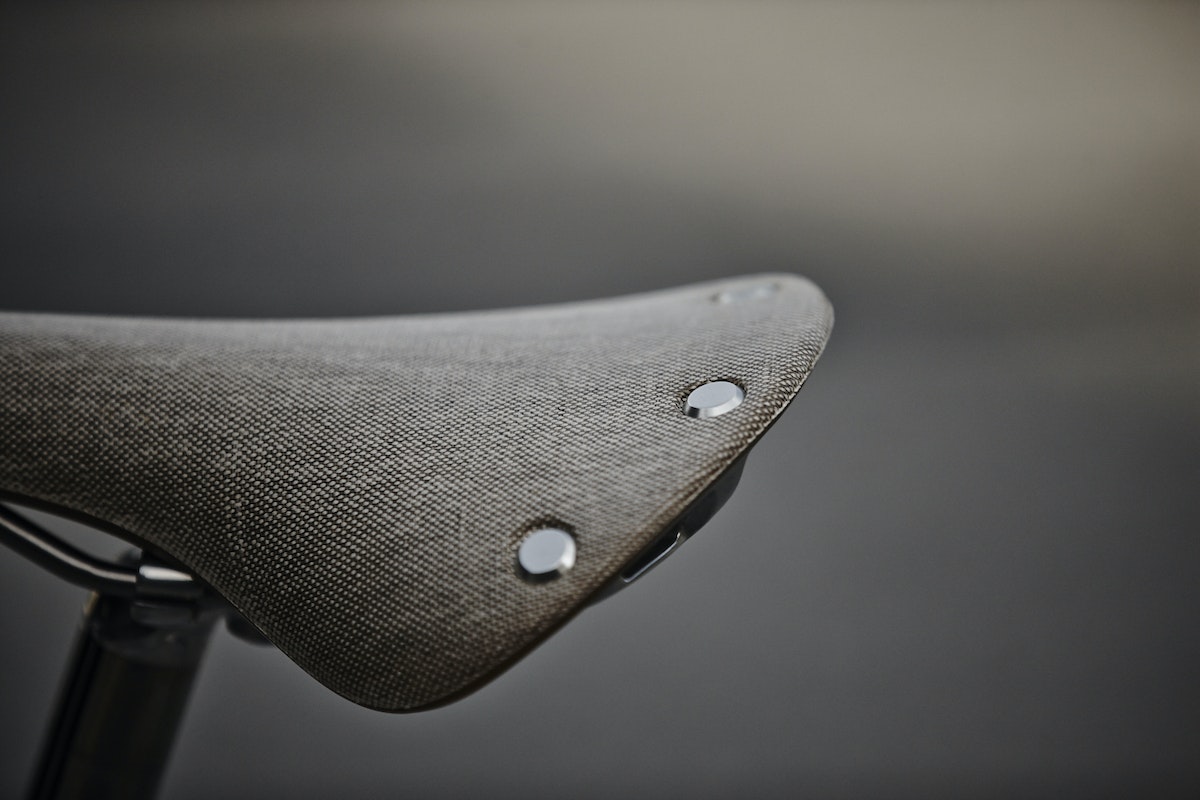
The next-generation bike saddle
A revolutionary new material that's instantly broken in.
When Brooks England decided to design its first new bike saddle in decades, it was essential that the design pay respect to the company’s heritage. Known for its craftsmanship, durable products, and quirky British insistence on doing things differently, Brooks has earned fierce loyalty from cyclists. But IDEO discovered a group of riders who were more in love with the idea of a Brooks saddle than the reality of having to earn a perfect fit on leather seats for your derriere over time.
Together, Brooks and IDEO created the Cambium C17, a seat that provides the same durability as traditional Brooks leather, but offers instant comfort and weather protection with a new material made of vulcanized natural rubber with a layer of woven organic cotton fused to the top. The winner of the Eurobike Gold Award upon launch in 2013, the C17 respects the essence of Brooks while reawakening the company's inventive spirit.
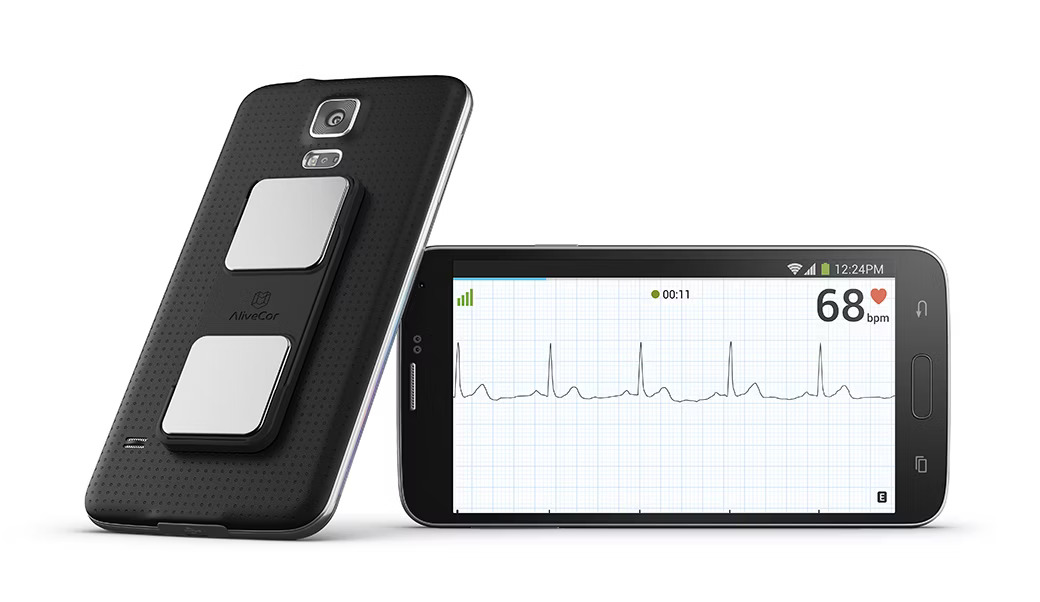
The next-generation heart monitor
Using mobile devices to help track heart health.
AliveCor asked IDEO to help design a monitor that fit into the user’s lifestyle and would make collecting information effortless.
The final result, the AliveCor Heart Monitor, is 50 percent thinner and 40 percent lighter than the earlier version, with all of the same medical-grade functionality. Today, patients use the monitor to record ECGs, detect AF and normal rhythms, and track a comprehensive list of symptoms, medications, and activities, putting their health and peace of mind into their own hands.
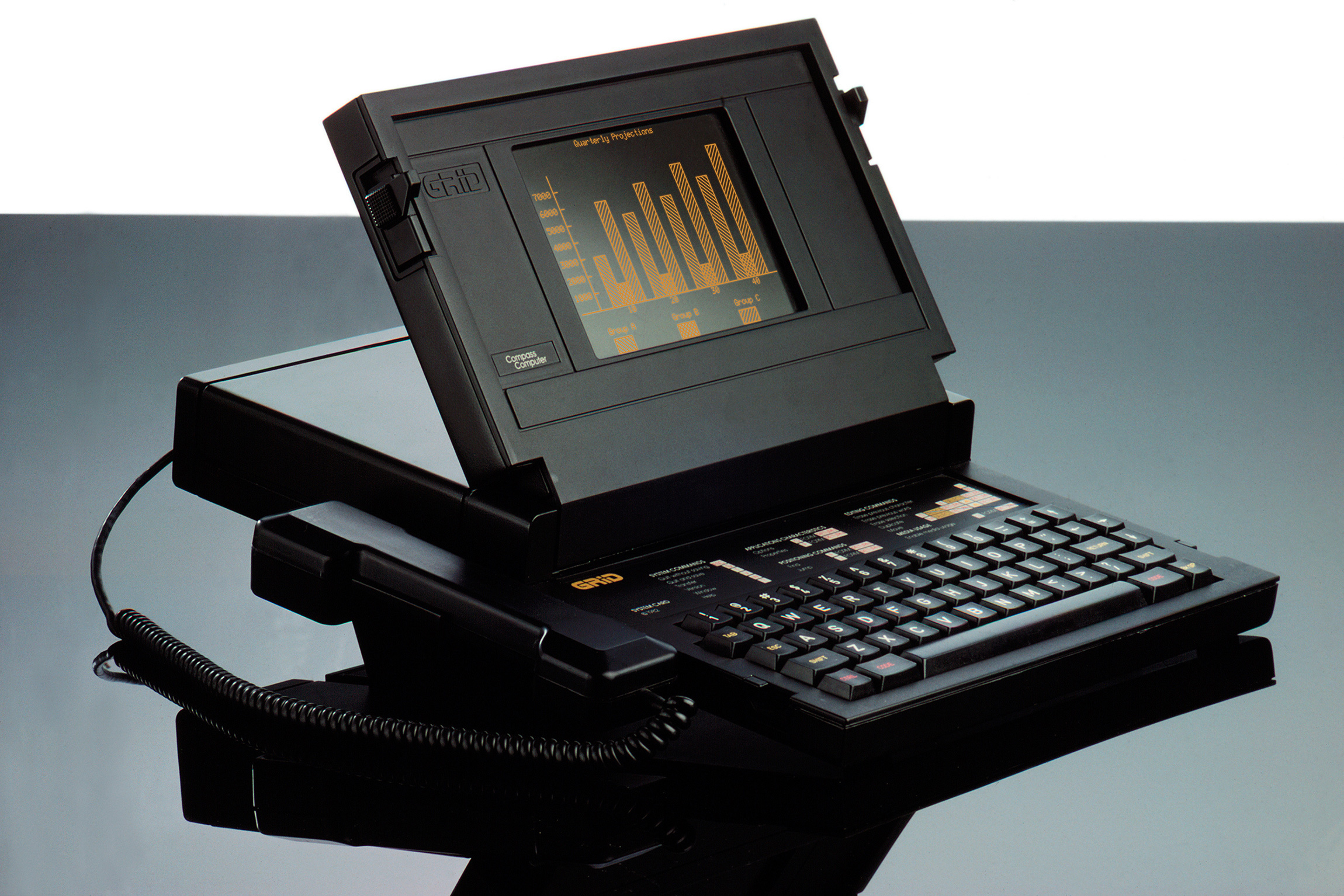
The first notebook-style computer
Turning bulky computers into businesslike laptop machines.
In the early 1980s, IDEO designed the first notebook-style computer for GRiD Systems, helping computers make the transition from bulky portable/transportable models to sleeker, more businesslike laptop machines.
In addition to sales revenues from the product, GRiD also received significant licensing revenues based on its ownership of the patented IDEO-designed configuration for laptops.
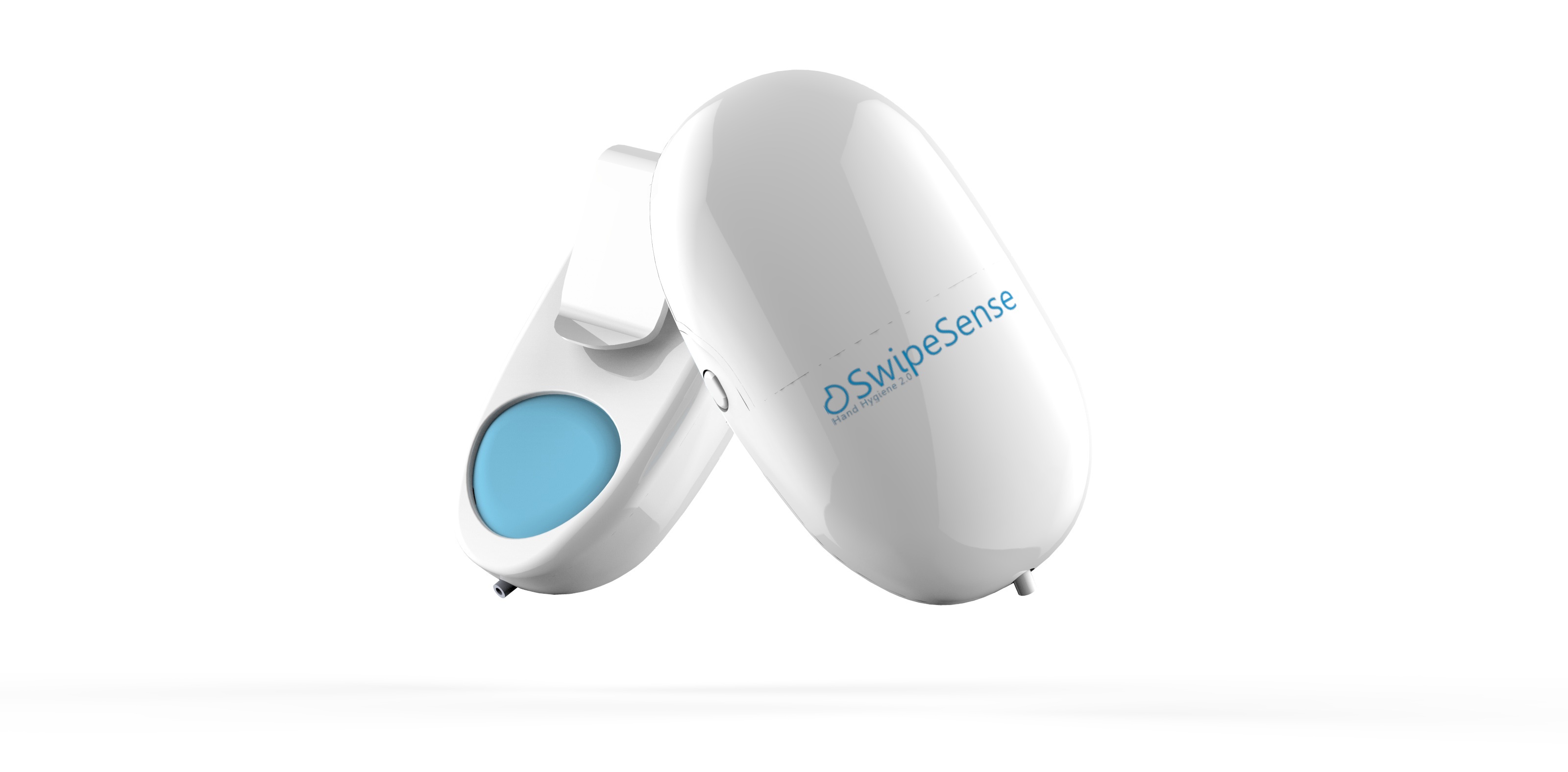
Stopping hospital infections in their tracks
Taking a personalized hand-sanitizing device to the next level.
Over 2 million Americans contract hospital-acquired infections (HAI), resulting in 100,000 deaths and over $30 billion in costs to the healthcare system per year. Experts agree: Simply improving staff hand-washing habits could prevent these needless infections.
SwipeSense, a healthcare startup founded by two Northwestern University graduates, aims to incentivize good hand-hygiene via smart, wearable alcohol-based gel dispensers that clip easily onto scrubs, with a web-based monitoring platform that records every time users disinfect their hands. Together with wall-mounted proximity sensors, the system wirelessly tracks hand-washing practices, allowing doctors and nurses to see and download daily, weekly, or monthly reports.
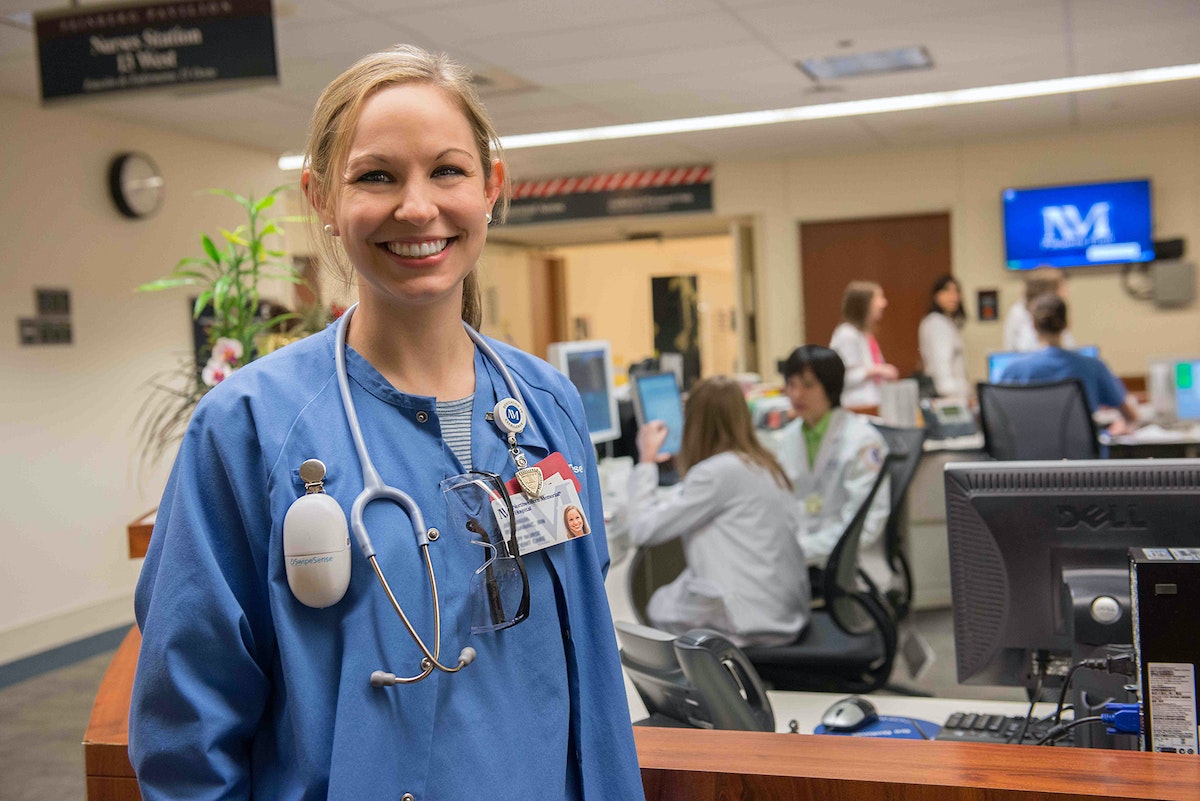
SwipeSense founders Iseri and Malina had developed a working prototype of the hand-sanitizing device and needed help pushing it to the next level. Together with IDEO, the teams evolved and refined the final physical and digital experience, and examined how an expanded data offering could provide added value to their business and the healthcare system at large.
After more than 70 design iterations, SwipeSense landed on the current sleek, modern, user-friendly design. The eventual goal: Make the patent-pending system ubiquitous in America’s 5,700 hospitals, much like wall-mounted hand-sanitizing devices are today—and save 100,000 lives each year.

Pursuit of the Cold
Wim Hof's freezing method isn't fun, but it unlocks superhuman potential
Then, about a year ago, I heard of Wim Hof. Hof holds world records for running barefoot marathons above the Arctic circle, for swimming under solid ice, and for climbing Mt Kilimanjaro in shorts. My small question became an obsession.
At IDEO, we look to extreme users to inspire the things we design, and Wim Hof seemed like the ultimate extreme user. I joined one of his workshops in the Pyrenees, Spain, and met folks from all over the world, who had come to find answers for their mental health, physical health, or athletic performance.
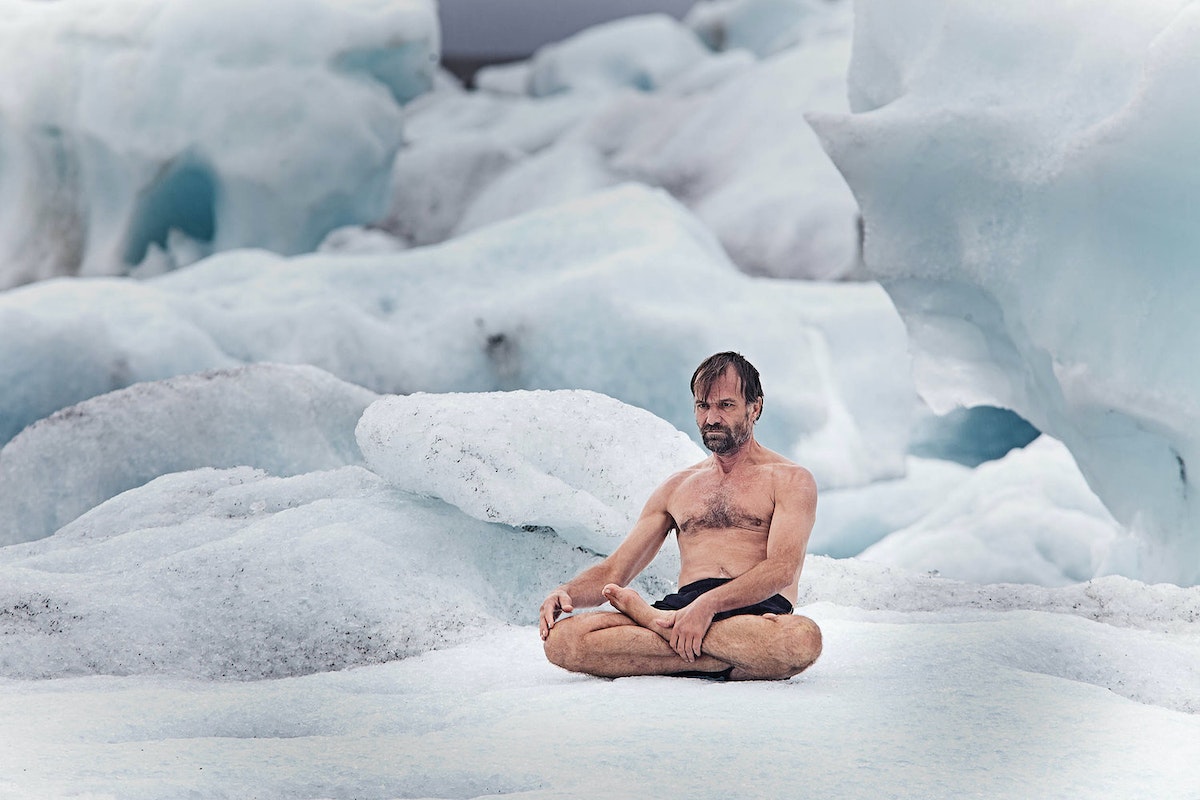
Hof is the cold fairy. He gives you permission to go into the cold, to enjoy it, to seek it. Cold has been his teacher, and breath-work his toolkit. He is happy to share his methods, and create the conditions for others to push their boundaries. Under his guidance, I took a 10 minute ice bath and did not shiver, during or after. I saw many new friends make breakthroughs that week. The cold was teaching us that we were in control and the decider of our own experiences: we could overcome pure pain.
Stanford Neuroscience Professor Andrew Huberman was invited by Hof to join our workshop, and we spoke about how to apply his Method, and about bringing Hof to California.
I began teaching my distillation of the Wim Hof Method to fellow IDEOers in Palo Alto, and to my surprise, over a third of our studio expressed interest in a mini-course. We got ready. We talked about how we stay warm—from shivering, to insulation, to mitochondrial chemical energy. We breathed, and observed the adrenaline-high cortisol-low effects of deep breath cycles with retentions.
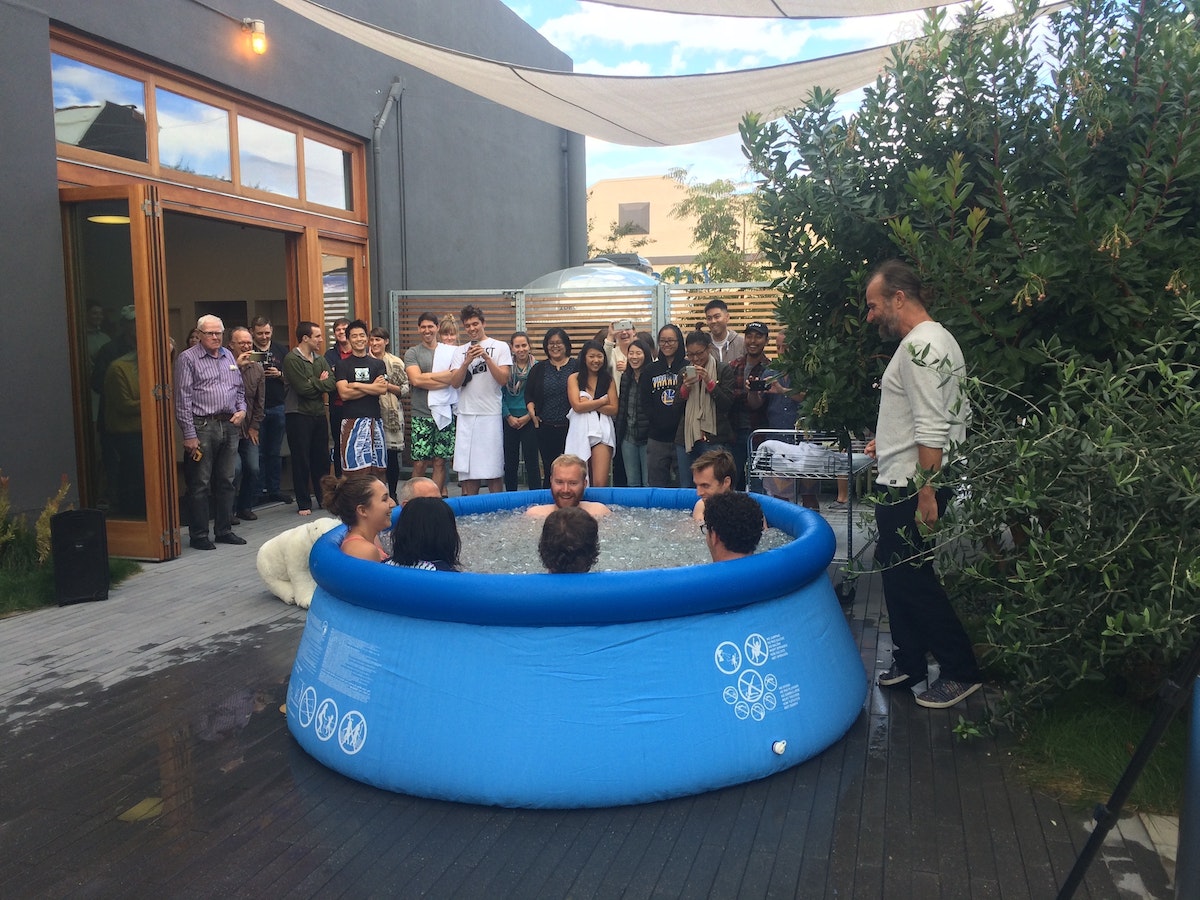
Then Wim Hof and Prof. Huberman joined us in person for an afternoon of ice baths and to present their talk, “The Mind Made Visible”. This led to a great discussion on the inner workings of the Hof Method, and about the science behind his approach. Scientists are intrigued by this case of the “extreme user” who can teach his methods to other people and show results immediately—in contrast with a pranayama guru who requires 20 years of study. A groundbreaking study has shown that participants trained in the Method can control their autonomic nervous systems and suppress immune response to an endotoxin injection (the introduction of bacteria, which can trigger many adverse physiological reactions in humans).
The Method involves several minutes of deep inhalation-driven breathing, followed by holding the breath on a full exhalation for as long as is comfortable. Beginners can hold their breath for a remarkable 1- 2 minutes. After extended practice people can reach 4+ minutes. During this process, the blood pH becomes alkaline and prevents you from passing out, while also serving to restore balance in the endocrine and immune systems. At around the 90 second mark, an adrenaline release is triggered. Unlike when adrenaline is pumped out if your life is in peril, low cortisol levels ensure that you remain calm, focused, and able to direct the superhuman power boost.
The cold and breath work go hand-in-hand—the breathing fortifies you for the cold, and the release of cold-shock proteins from sustained ice-water immersion amplifies the effects of the breathing. The practice, Hof says, resets insomnia/jet lag, reduces chronic pain, heads off depression, improves memory, and increases longevity. (Note: the breathing Method should be performed in advance of, not during, cold water immersion).

For me, the Method has been most helpful while mountaineering. By controlling my body's reactions to cold and over-indexing on oxygen, I stay comfortable in extreme conditions and acclimatize more effectively. After meeting Hof, I'm no longer asking, why are we afraid of the cold? But instead, how might we harness the cold to unlock our own potential?
In the New Hampshire winter of 2005, I gave up use of all jackets, sweaters, and warm layers for the season. Crossing between high school campus buildings in a t-shirt during snow and freezing rain, I received appalled looks from my peers and teachers, but felt invigorated and unconstrained. I began asking, why are we afraid of the cold? I later reverted to social norms, and by college, I was a lover of warmth. But the question stayed with me.
Why You Should Start a Foodstagram
It looks good, it smells good… and it gets a lot of likes
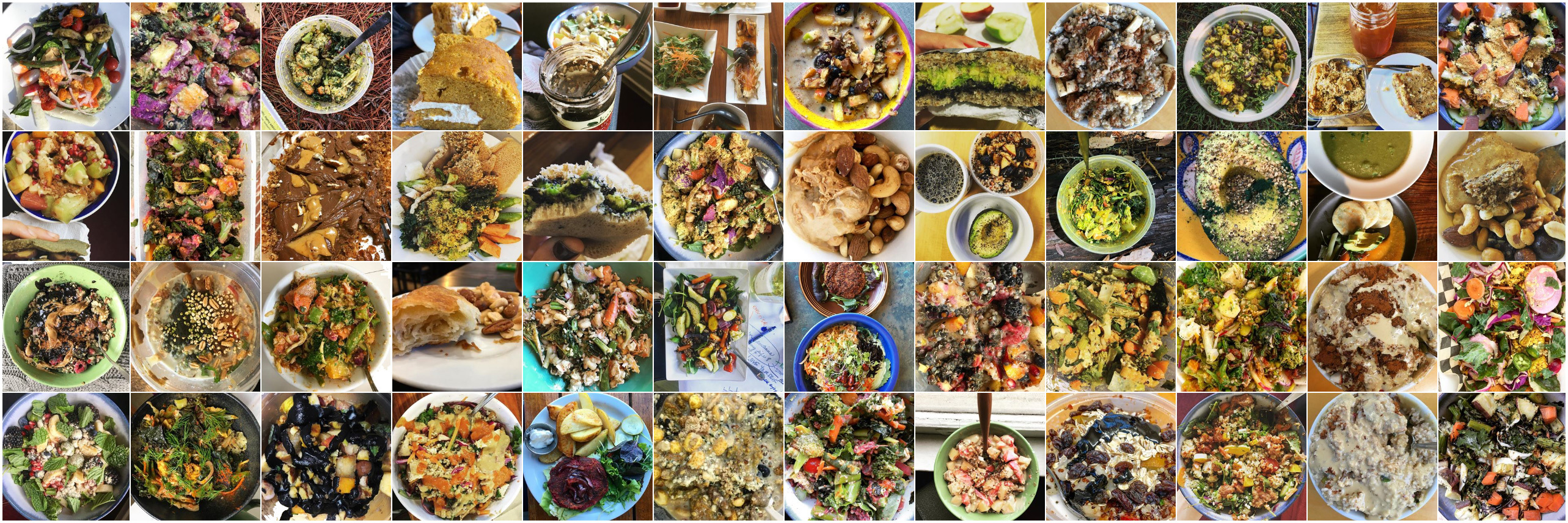
I don't snap pics of my lunch @plantbowls to brag about what I’ve made or ordered. I do it to take stock of what I’m about to eat, to appreciate it, and to build community around it—something I’m in the habit of doing as a coordinator for IDEO U.
Four years ago, I shifted to a plant-based diet. Going vegan turned out to be an easy move with the help of Instagram. Because I made it a habit to capture food in the best light, it started to look gorgeous. Focusing on plants might seem bland, or limited, but documenting them made me realize the glory of spices, vegetables, fruits, beans—the sheer variety of it all! I began to revere colorful jewels of fruit, to inhale the aroma of a tahini sauce before I dug in. I really noticed what was on my plate. I would take an extra beat to slice an avocado onto a bowl of veggies or drizzle nut butter on top of steaming oatmeal, both to make them look more appealing and add to their deliciousness.

Not long after I started foodstagramming, I read an article that explained why. It turns out that by taking pictures and waiting a little longer before we pick up our forks, we delay gratification, which makes the food seem more delectable. By holding off on eating for a beat or two, I was actually making it taste better.
And when I posted these dishes on Instagram later, I got to experience them again while trying to think up a clever caption or hashtag. Initially, it was just about sharing a beautiful image. But seeing others be surprised by the diversity of plant-based foods, and having them ask about recipes meant a lot to me. Maybe they'd get inspired to shift to a healthier diet, too.
We eat at least three times a day. Why not bring more joy to a basic necessity? It feels good, it smells good, it looks good… and it gets a lot of likes.
Here are some accounts I follow to get inspired:
- instagram.com/healthiecook
- instagram.com/panaceas_pantry
- instagram.com/feastingonfruit
- instagram.com/nathaliesader
- instagram.com/thefeedfeed.vegan
And here’s mine: instagram.com/plantbowls
It's easy to roll your eyes at the guy at the table next to you lurking over his food, phone in hand. I once considered foodstagramming to be a cliché, and certainly think spending much of our time with our faces planted in our phones is not a great evolutionary turn. Then I started my own foodstagram.
.jpeg)
Quick + Dirty Design Tips: After Effects
If you're looking for help with After Effects, today's your lucky day
After Effects is one of my favorite prototyping tools. I use it to animate web and mobile interactions, or to demonstrate physical interactions by augmenting UI and sound over video footage.
AE is super powerful, but has a deep and twisty interface with lots of corners to navigate. The timeline is one of its most daunting aspects. Things can escalate quickly, and before you know it, your project is a labyrinth of layers, expressions, effects, and comps. Here are a few tips to help you find your way.
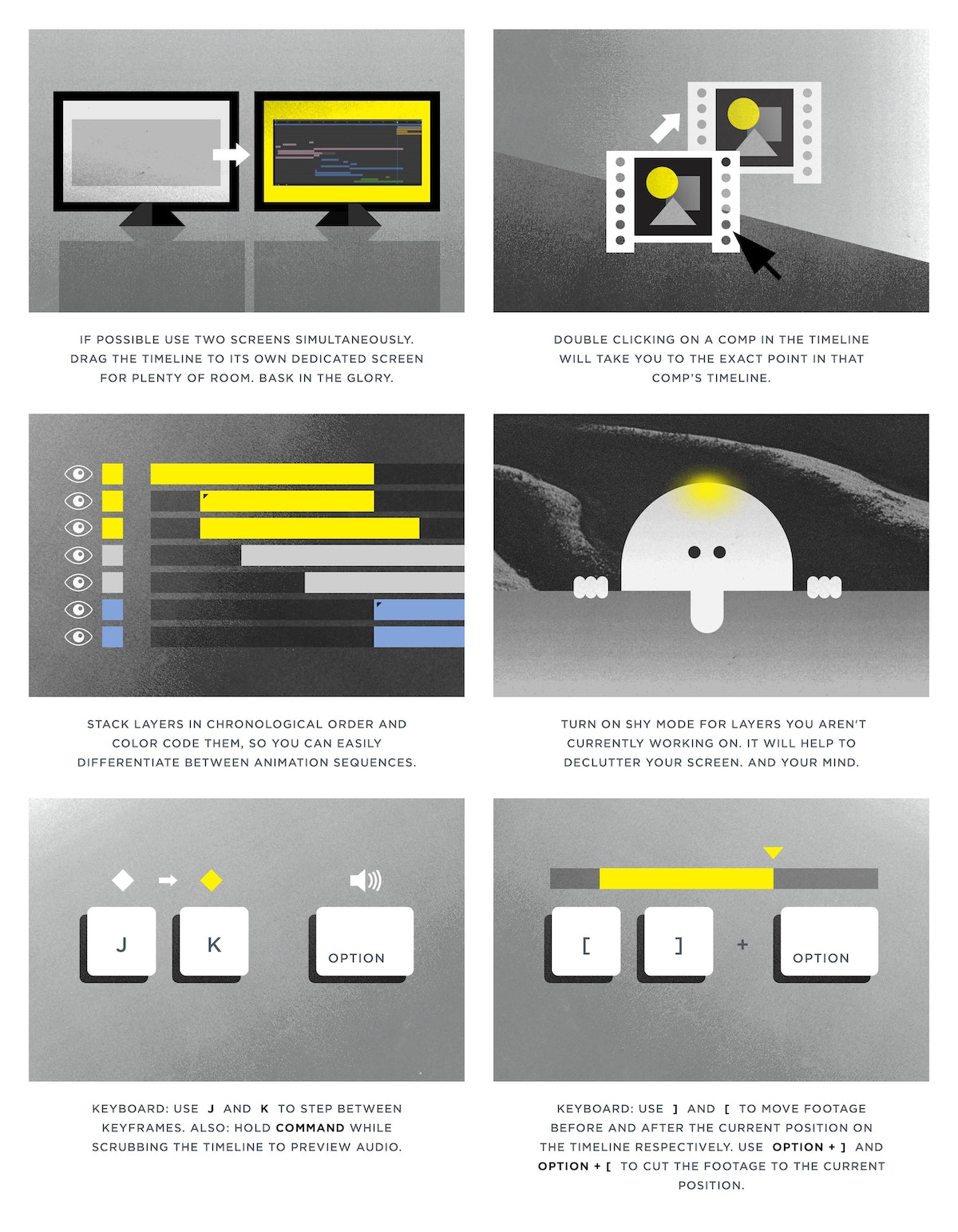
Sometimes you need to cut to the chase. A deadline is looming and there's no time to luxuriate in lessons from your go-to experts. You need bite-sized tutorials to beef up your skills, one morsel at a time. If you're looking for help with After Effects, today's your lucky day.
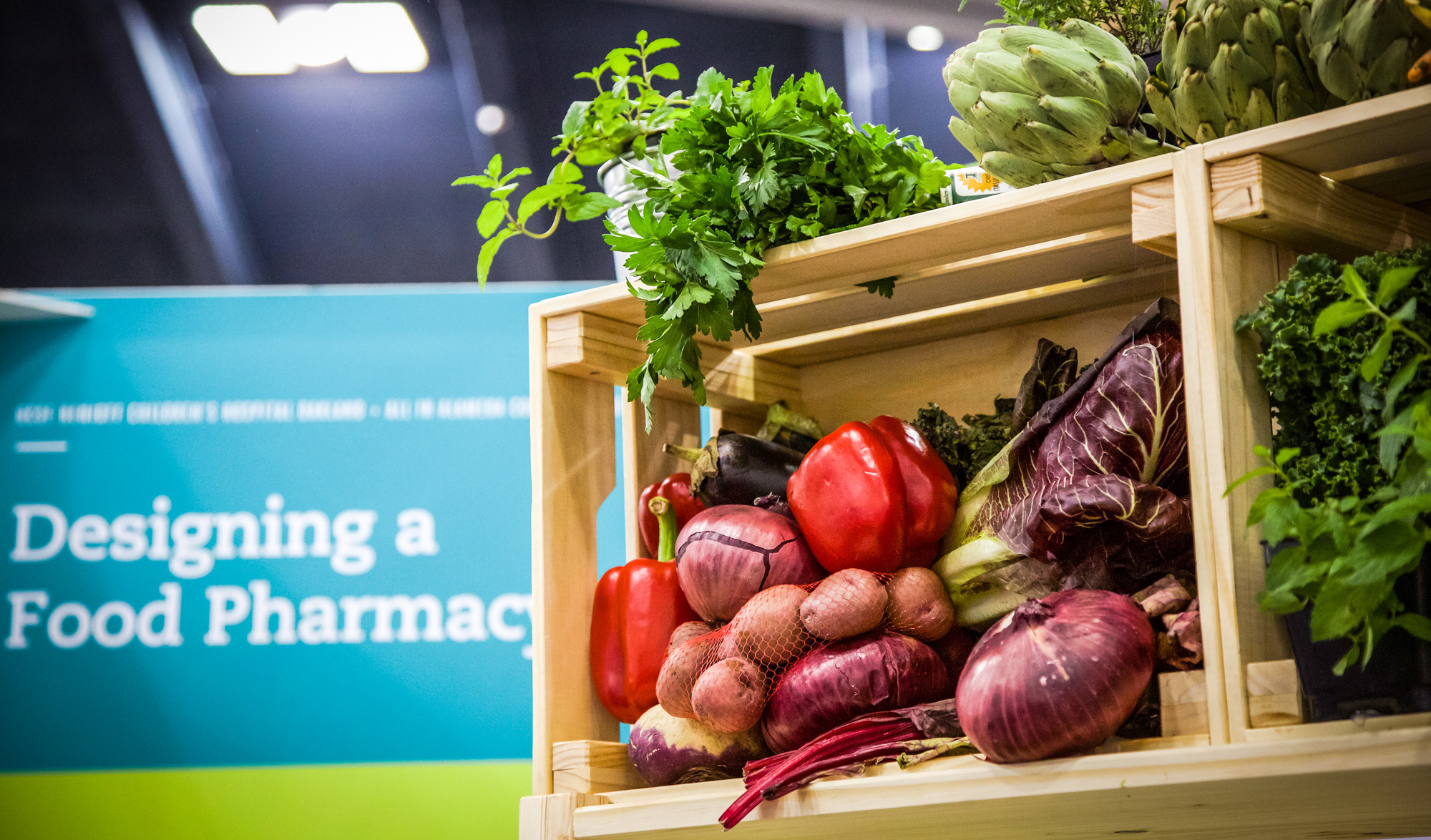
What If We Could Prescribe Food as Medicine?
Imagine walking into a pharmacy that looks more like a farmer's market, the open shelves stocked with vegetables, roots, and herbs
When we were invited to create a booth for the American Academy of Pediatrics conference, we had two weeks and limited resources. We sat down, sketched out a floor plan, and had lively discussions about how to bring families’ everyday struggles with healthy food to life.
It’s our nature to be makers, so we jumped into the prototyping shop with scrap wood, some cardboard, hot glue, and some farmer’s market produce. As we would soon learn, this was not the typical way one builds a booth for a conference like this.
But the important thing wasn’t the level of production, it was the message: healthcare has a huge opportunity to lead the conversation about food and health in a way that is compelling and accessible for everyone. What if doctors could prescribe food as part of a therapeutic care plan and make it possible for families to access food that will keep their loved ones well? What if we reimagined nutrition education with hands-on learning that emphasizes the joy of food rather than the restrictive messaging often associated with food and health? How could we transform healthcare and communities by promoting food as medicine?
Together with our collaborators—led by Supervisor Wilma Chan and her “ALL IN” Alameda County initiative to end poverty and UCSF Benioff Children’s Hospital Oakland along with Alameda County Public Health Department, Alameda County Community Food Bank and Dig Deep Farms—we synthesized input from doctors, nutritionists, policy makers, hospital administrators, and public health workers to create a vision of how people might use a Food Pharmacy. Through illustrations and personal stories we brought our collective vision to life, gave it a name, and designed recipes and cooking tools for our booth.
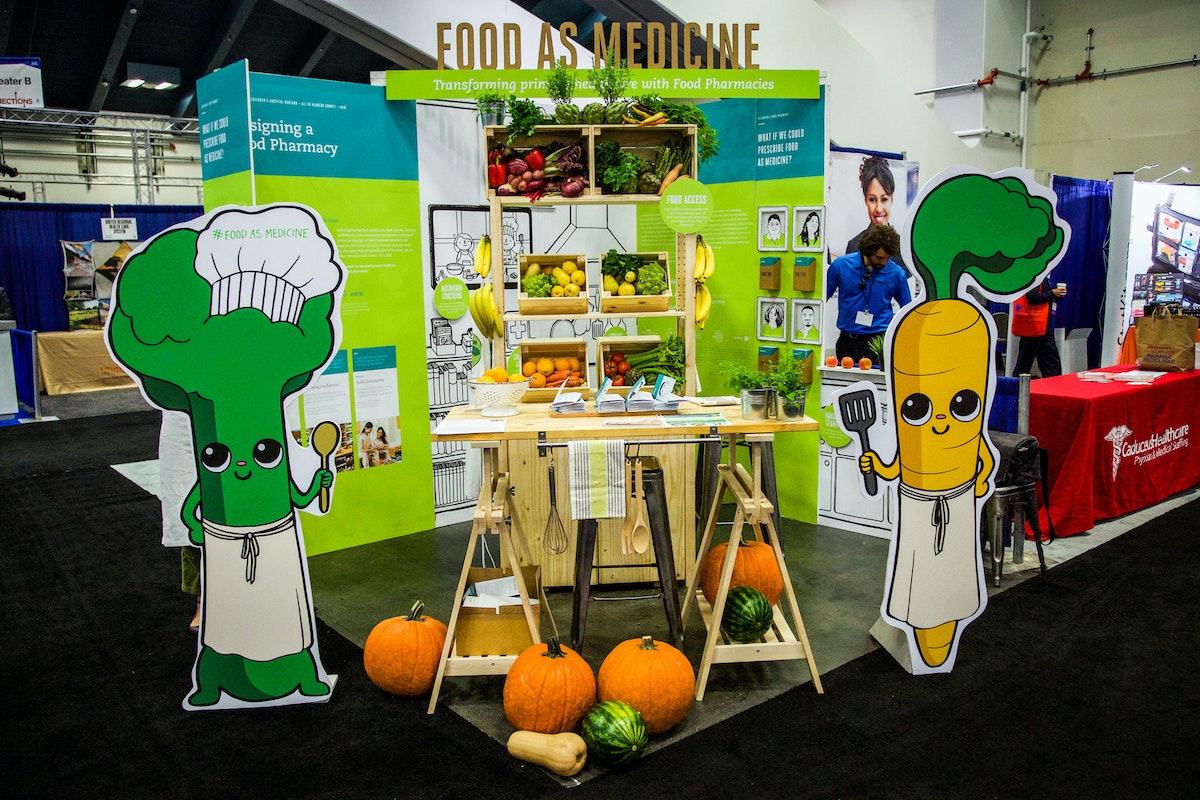
Our handmade booth with its bright colors and fresh produce stood out in the towering sea of sleek glowing structures. The focal point was a cornucopia of fresh fruits and vegetables, like kale, eggplant, imperfect apples, pumpkins, bananas, and hefty carrots still a bit dirty from the farm, all spilling out in an exuberant mess. It didn’t matter that we hacked together IKEA furniture and used leftover wood for the booth frame. It was rough. It was real. It matched our message that health care needs to meet people where they are. And because of this, it was a hit.
Some of the most pressing human-centered innovations—especially as they relate to health and food—can be prototyped in a much more humble way. Sometimes all it takes is an enthusiastic and collaborative team, a couple of glue guns, a pile of vegetables, and some imagination.
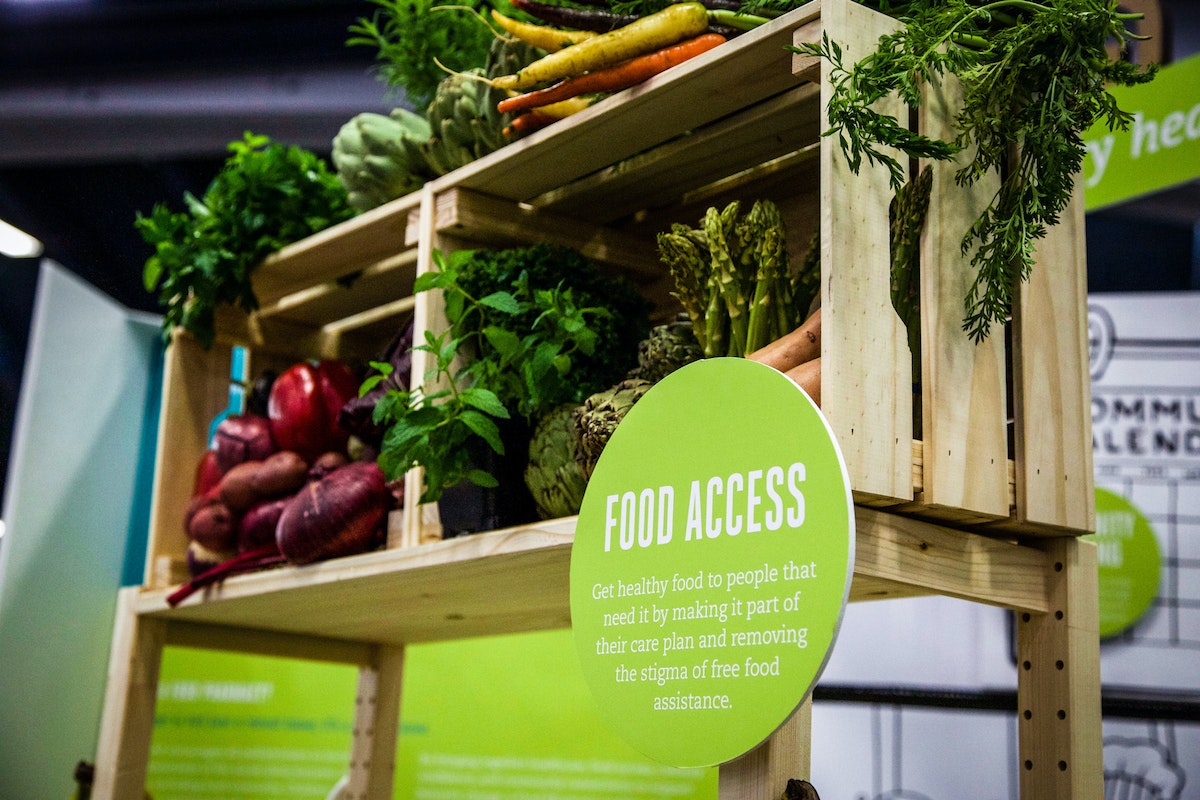
If you’re interested in joining the conversation, get in touch with us at vbarad@ideo.com.
Imagine walking into a pharmacy that looks more like a farmer's market, the open shelves stocked with vegetables, roots, and herbs. And instead of a dull waiting room there are interactive cooking classes and food sampling stations. Imagine a future in which food is seen as medicine.

Lindsey Turner
I’m passionate about building brands, products, and experiences that help organizations show up with meaning and momentum.
I help organizations cut through complexity by shaping how they show up, through brand strategy, identity, and storytelling.
Working at the intersection of brand and business, I bring an editorial eye and a bias toward making—turning ideas into tangible experiences that people can understand, trust, and believe in.
My work spans government, healthcare, financial services, media, and consumer goods, from launching Gen Z-focused ventures to building innovation labs and reimagining legacy brands. I relish moments of ambiguity and enjoy translating across teams, perspectives, and priorities to move ideas forward.
I started my career in editorial and digital design, shaping cross-platform experiences and identity systems in publishing and agency environments. That foundation still shapes how I work today: I’m detail-oriented, collaborative, and overreliant on the Oxford comma. I hold a BFA in Visual Communication from the School of the Art Institute of Chicago.

Rachel Young
My work helps organizations see who their products aren't working for—and build the will and the tools to do something about it
For 25 years, I've asked the same question: Who does this design exclude—and what are we going to do about it?
My work spans human-centered strategy, inclusive design, and qualitative research, with clients ranging from Microsoft, Google, and Verizon to the National Science Foundation, and San Francisco Unified School District.
Before IDEO, I taught elementary school in East Palo Alto and spent a decade doing design work with social service organizations—where I learned firsthand what it costs people when systems are built without them in mind.
I am currently writing User Error, a nonfiction book about digital access and the design decisions behind it. I live in Oakland, California.

Brian Pelsoh
I lead with craft, ensuring our work is creatively excellent: rooted in deep human insight and imagination, while also grounded in the realities of business and technology.
My expertise spans brand, communication, and product design across tech, education, the arts, and social impact.
I believe great work demands both high-level vision and obsessive attention to detail, and only happens through collaboration.
I bring an inclusive, hands-on approach and a deep understanding of business, which enables me to consistently deliver excellence while always asking why.
Before joining IDEO, I worked at the brand firms Pentagram and VSA Partners. I began my career as a designer, leading teams at the School of the Art Institute of Chicago and the Milwaukee Art Museum. I hold an MFA in graphic design from Maryland Institute College of Art and a BFA in communication design from the Milwaukee Institute of Art & Design, and have taught at some of the best design schools in the US.

Tony Wong
I am responsible for IDEO’s long-term success in China and working with clients to use design as a tool to enable growth.
I am responsible for IDEO’s long-term success in China and working with clients to use design as a tool to enable growth. Specifically, I have helped Chinese companies design holistic brand solutions through the development of their products, communication, services, and innovation teams, and I have helped multinationals expand their presence and influence in China.
I advise global leaders on developing China-led innovation and capabilities.
In over 15 years in IDEO Shanghai, I have worked on projects that use design to elevate the quality of the experience of healthcare products and services, streamline processes that increase productivity, create spaces and programs that promote and enable inclusive communities, and build next generation mobility solutions that are planet-positive.
Before joining IDEO, I worked at Philips Electronics and the Electrolux Group in Italy, the Netherlands, and Singapore on a number of breakthrough commercial products. I am a member of the Young President Organization in Shanghai.

Building a personal AI for the messiness of life: Sida Li
Most AI products today are built for work—a space with clear problems and established systems. One founder noticed a gap: personal life is messier, harder to systematize, and mostly left behind by the AI boom. So she built Cue, a personal AI that lives inside iMessage and group chats, to go where the other tools haven't.
In this episode, Becca Carroll, IDEO's Chief Strategy Officer, talks with Sida Li, co-founder and CEO of Shared Context Lab, about staying anchored to a human need while the technology around her keeps changing shape, why she treats her business model with the same rigor she'd bring to a product, and what it feels like to build a company at this particular, disorienting moment in AI.
The conversation also gets into how Sida makes design decisions: the language Cue uses to describe itself, the tradeoffs behind building inside iMessage instead of a new app, and a real story about a business idea that didn’t pan out.
This is the second in a two-part series profiling founders from IDEO's Startups-in-Residence program. The first conversation is with Johannes Seemann, founder of Sooner, on designing GenAI for the emotional side of money.

Designing GenAI for the emotional side of money: Johannes Seemann
Most personal financial tools are built to run the numbers and optimize towards a budget. While that works for some, most people experience money as a lived relationship that does not neatly fit into a spreadsheet. Johannes Seemann and Becca Carroll discuss why money is emotional before it is mathematical, and what a human-centered approach to building a generative AI financial product looks like in practice.

The curious leader's edge in uncertainty: Scott Shigeoka
Mina Seetharaman talks with Scott Shigeoka, author of Seek and Head of Curiosity Cultivation at the Eames Institute, about what distinguishes genuinely curious leadership from performative curiosity, how power dynamics shape curiosity, and why practicing curiosity can restore energy rather than drain it.

How constraints make us more creative: David Epstein
Mina Seetharaman talks with David Epstein, author of Inside the Box and Range, about why total freedom often produces average work, how leaders can design useful limits on purpose, and what organizations such as General Magic and Pixar reveal about the relationship between boundaries and creativity.
Looks like you might be in search of something very specific?
Or reset the filters above and try another angle.
Here’s some random inspiration

Podcasts about creative leadership

Articles about the power of prototyping
