
.svg)




Arming a 19th-century company with a 21st-century digital venture
Swell enabled values-driven consumers to make informed investment decisions.
For the socially-conscious, investing can be a tricky proposition. The same people who wish to vote with their wallets may find that their options for investment funds and 401K plans are rife with companies that violate causes they believe in. So far, there have been few options in the marketplace that give consumers the opportunity to put their money in financial products that not only cut out environmental and social offenders, but actually contribute to the well-being of the environment and society.
Dave Fanger, a financial professional, was determined to design a solution. He approached IDEO to help create a startup venture for socially-conscious investors. Pacific Life, a Fortune 500 financial services company and Fanger’s employer at the time, offered the resources to develop and launch the idea. The online impact investment platform gave consumers the opportunity to invest in high-growth industries that are addressing global, environmental, and social challenges. Swell rigorously screened companies for both impact and performance, so consumers could be confident that their investments were in line with their values.
A holistic approach
Embedded as core team members, IDEO designers worked alongside Swell’s founder to shape the company. In just one year, they went from an initial concept and prototype to an SEC-registered investment adviser with a fully developed business model, a digital platform with initial investors, and well-defined branding that set the look and feel of the values-driven company. The IDEO team helped to hire the initial team of employees, working to ensure that the fintech startup would have the creative talent it needed to operate post-launch, as well as a defined culture that would help it grow.
A new investment platform
From the outset, it was important for the team to build an innovative, digitally-fluent, and customer-centered platform to make it easy for investors to back causes they care about. Working in close collaboration with software development partner Carbon Five, Swell and IDEO committed to act nimbly, take risks, move fast, and ditch decks for prototypes. Understanding the motivations of the investor—their values and what drives their investment decisions—was key, so the team leveraged IDEO’s network to form a consumer council, which helped to quickly iterate and refine prototypes throughout the duration of the product development process. Having that core group involved every step of the way made it easy for the team to keep consumers at the center of the design and validate key decisions quickly.
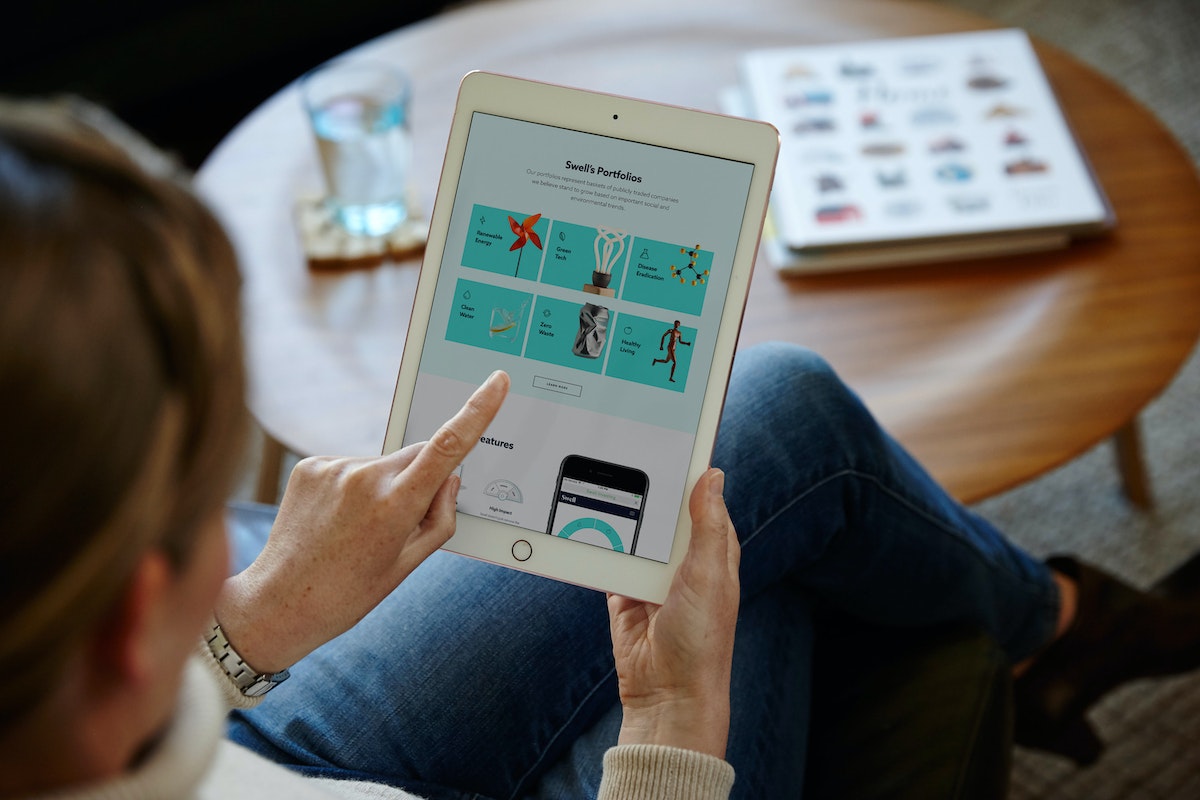
Swell offered consumers portfolios of companies that work to solve some of today's biggest challenges. The six impact portfolios offered were: green tech, renewable energy, zero waste, clean water, healthy living, and disease eradication.
As of June 2019, Swell had attracted over 15,000 investors—more than half under the age of 34—and $35 million AUM. Nearly 40 percent of investors were making investments on a recurring basis.

For kids, a new tactile way to learn coding
Helping Google design a set of blocks that can be arranged to code almost anything.
Learning to code isn’t just about knowing symbols and syntax—it can help unlock kids’ imagination by inspiring them to build new things and interact with everyday objects through discovery and play.
With that in mind, Google Creative Lab came to IDEO to help with user experience and product design on their new coding tool for children. The result of the collaboration, Project Bloks, is a simple and interactive experience that teaches kids how to code using physical blocks. This establishes a new paradigm for learning computer science: it takes a language typically only understood through screens and keyboards, and makes it tangible.
Project Bloks was also designed as an open hardware platform, enabling developers and educators to build tangible programming applications that are innovative, educational and fun.
Kid-centered design
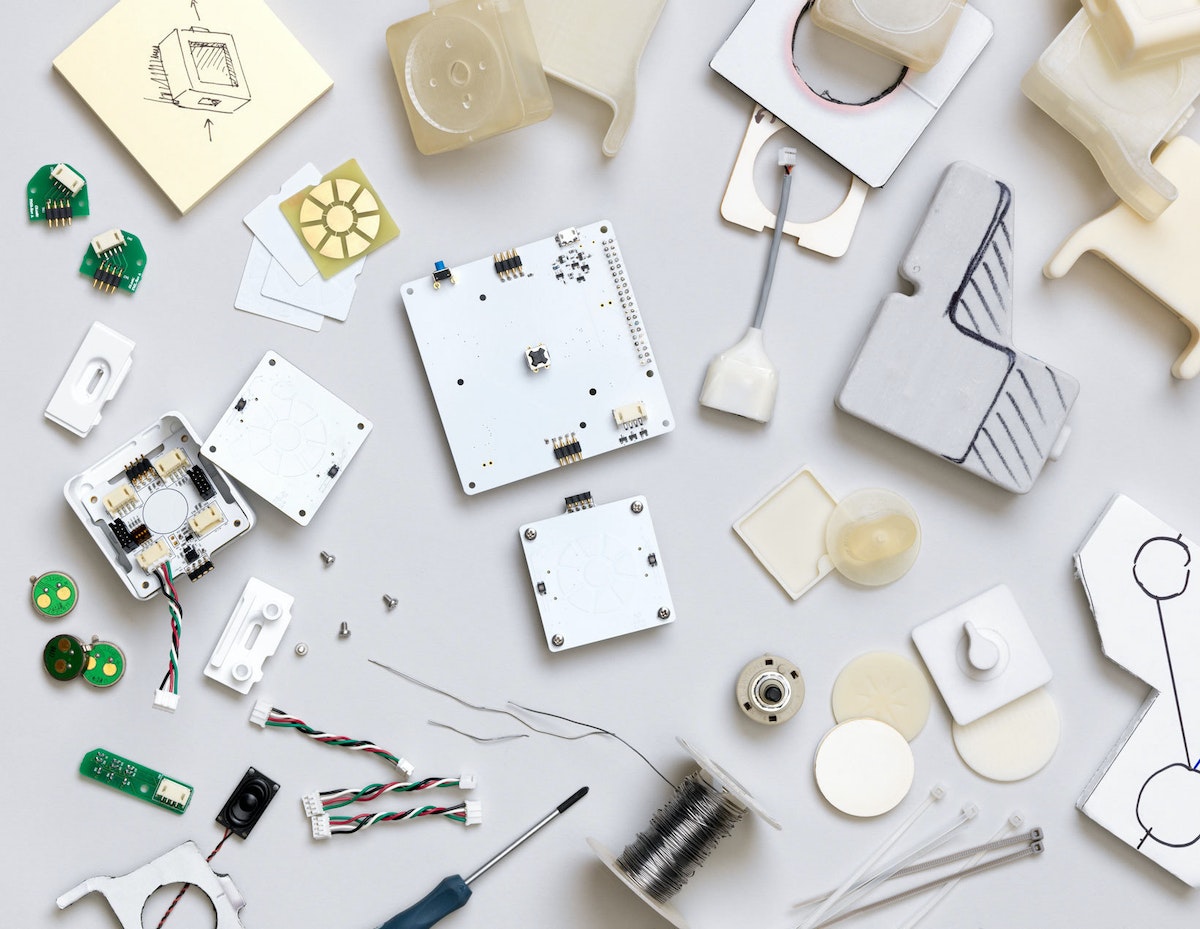
From the very beginning, how kids physically play and learn were at the center of the project. Designers quickly iterated using sketches, foam core, paper, Play-Doh, and 3D-printed models to see how slight changes informed children’s experiences. Understanding what deepened kids’ engagement, increased their curiosity and changed their behaviors drove the language, taxonomy, architecture, and physical form of Bloks.
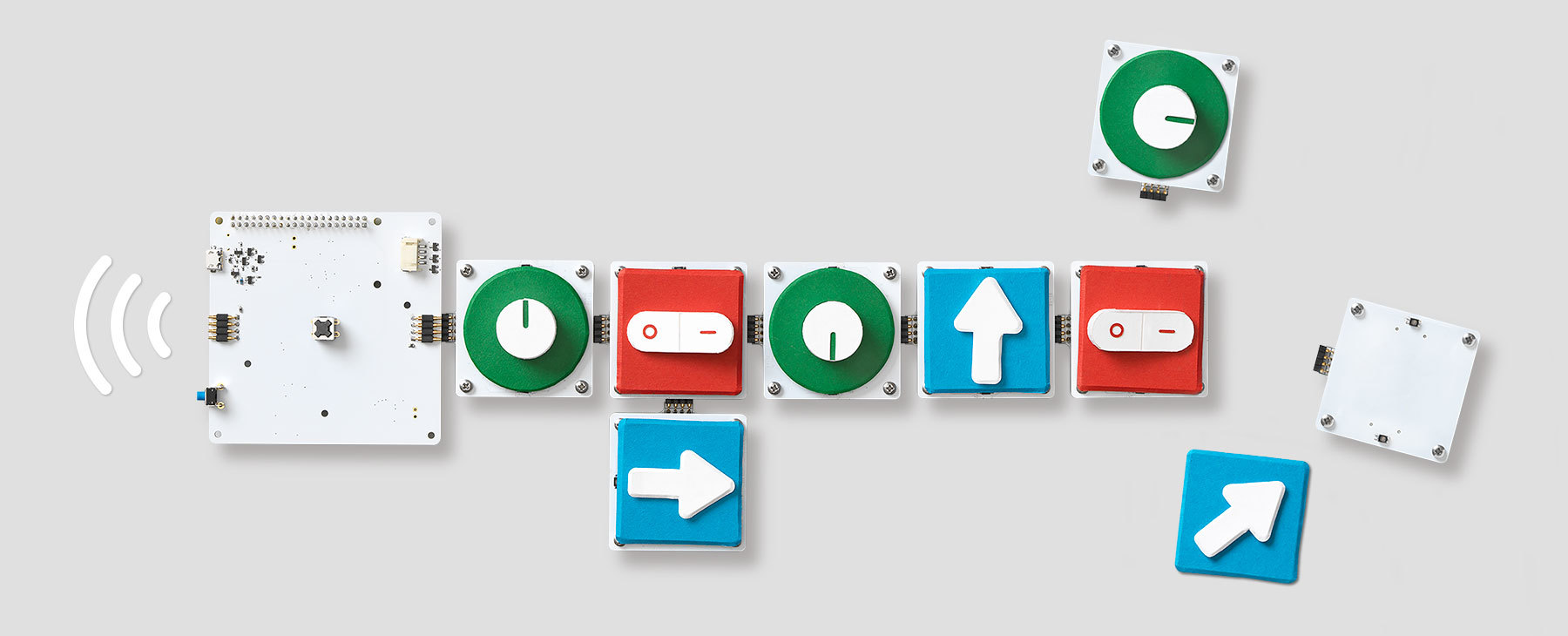
Because play and physical building is an important way in which many kids develop skills, designers began with a set of blocks and sought to help them discover coding through tangible objects. Each block was given a specific function and shape, guiding kids to arrange, combine, and rearrange the blocks to create commands and control things like robots or speakers in the real world. Children could also create block patterns together by physically building on each other’s ideas.
An inside look at the design process. Video by Google.
Designing for early learners also forced the team to rethink how a new language could be taught. An early version of the blocks was based on how programmers typically code, from top to bottom. However, the team quickly realized that the orientation had to be driven by the child’s natural instincts. Given young children are just learning to read from left to right, designers observed that the switch in directions was too confusing and changed the arrangement of Bloks commands to go left-right in addition to top-bottom.
The final outcome of Project Bloks was an interactive coding kit comprised of three key parts - pucks, baseboards and a brainboard. The puck is a critical component that controls a command, whether it’s an on/off switch or the ability to move in a particular direction. It’s the piece that enables children to move from words to the world of graphics and play. The puck is easy to produce and can take an unlimited range of forms and functions, enabling the Bloks system to scale.
The baseboard reads the puck’s instruction and is activated when a puck is placed on top. The brainboard provides the power and connectivity. When hooked up to a baseboard or a chain of baseboards, the brainboard sends the instructions—turn left, jump, get louder—to a connected object, like a rocket or a speaker.
The boards can be rearranged, sequenced, and packaged however kids like, opening up a vast realm of possibilities. Children can code anything from a toy robot drawing a shape on a piece of paper, to a sensor turning on a fan when the temperature gets too high.
Enabling innovation for education
Beyond a tangible coding kit, what makes Bloks unique is that it’s an open platform. Educators, developers, and designers can build on it to accelerate new ways of teaching and exploring tangible programming. The platform can fit into various curriculums around the world. The pucks can take on different shapes and graphics. The material used can be fabricated by 3D printing.
The Bloks platform is a new vernacular that allows kids to interact with the language of code in a way that’s less prescriptive and more open-form, like a sandbox. And the more kids play with Bloks, the more opportunities they discover for what they can create with a little bit of code.
Helping students navigate college and beyond
Creating a digital experience to support first-generation college students.
For students who are the first in their families to pursue higher education, navigating college can often feel like navigating a foreign country. Challenges like not having enough money or poor access to support services can make graduating an insurmountable hurdle. In fact, only 55% of these students in the United States end up completing their degrees.
To help change this statistic, IDEO partnered with Beyond 12, an organization that provides personalized, virtual coaching to first-generation college students to help them learn how to register for classes, apply for financial aid, and much more. The challenge was to scale Beyond 12’s successful coaching model using technology in order to benefit as many students as possible.
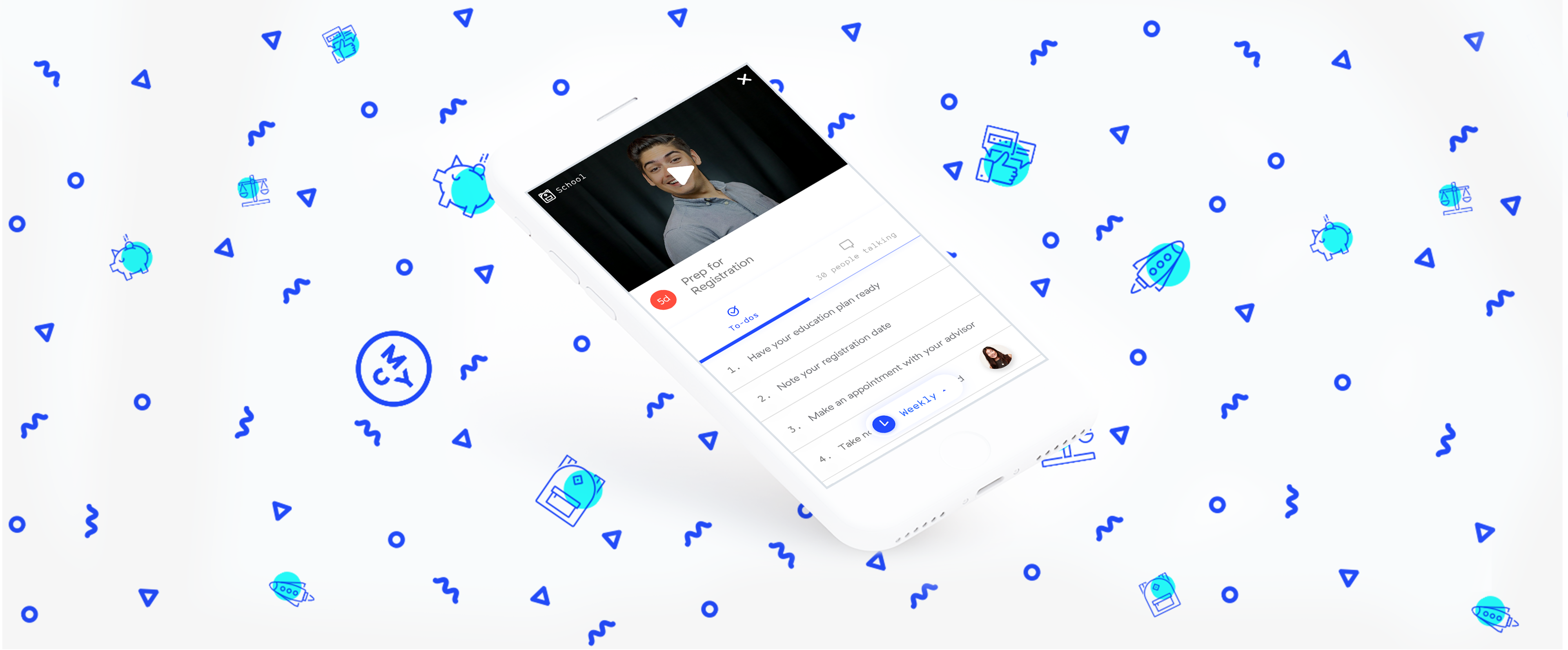
In 2014, IDEO designed the MyCoach app, with the goal of helping students take ownership of their education and feel in control of their future. After the early version of the app was named as a finalist in the prestigious Robin Hood Foundation College Success Prize, Beyond 12 piloted the product with 3,500 college students across the US. Following the pilot, Beyond 12 and IDEO went back to work, using the resulting insights and data to design the next evolution of MyCoach.
First and foremost, IDEO sought to develop a more flexible model for Beyond 12 to enable scalability of the offering. As some students need more support than others, a blended business model was envisioned to recognize the spectrum of students’ needs. Engaging in-app content forms a supportive layer that helps students get organized, stay on track, and learn the skills they need to stay in college, while students who need more hands-on assistance can connect directly with coaches. An invisible data layer works behind the scenes to assess student risk and dynamically tailor student support throughout the school year.
Once the app’s model was solidified, creating a user experience that compels students to use it became essential to its efficacy. Growing up with technology has reshaped how many students engage with the world, and tools like Snapchat have set a new dynamic for participation. Youth today are the masters of their own digital worlds, fluidly jumping between conversations, engaging with stimulating content and contributing their own perspectives. As a result, MyCoach needed to speak students’ language and to create content that was authentically youthful and effective in order to be effective. By drawing inspiration from popular social sites, digital experiences and games, the team designed a user experience that keeps pace with a digitally native state of mind.
IDEO Designer, Isabela Sá explains the approach that led to MyCoach’s design and content strategy, “We created an app that makes no distinction between content and utility. We borrowed the content-first approach of social apps like Snapchat and Instagram and used it to teach students the skills and strategies they need to graduate. With that, the digital experience became more human. The intricate system that we had designed to power the whole thing was hidden below the surface. For students, the app was just the means to learn how to help themselves and get in touch with a coach when they needed one.”
Development is underway for the next version of MyCoach, which will allow Beyond 12 to scale its offering to reach exponentially more students in need.
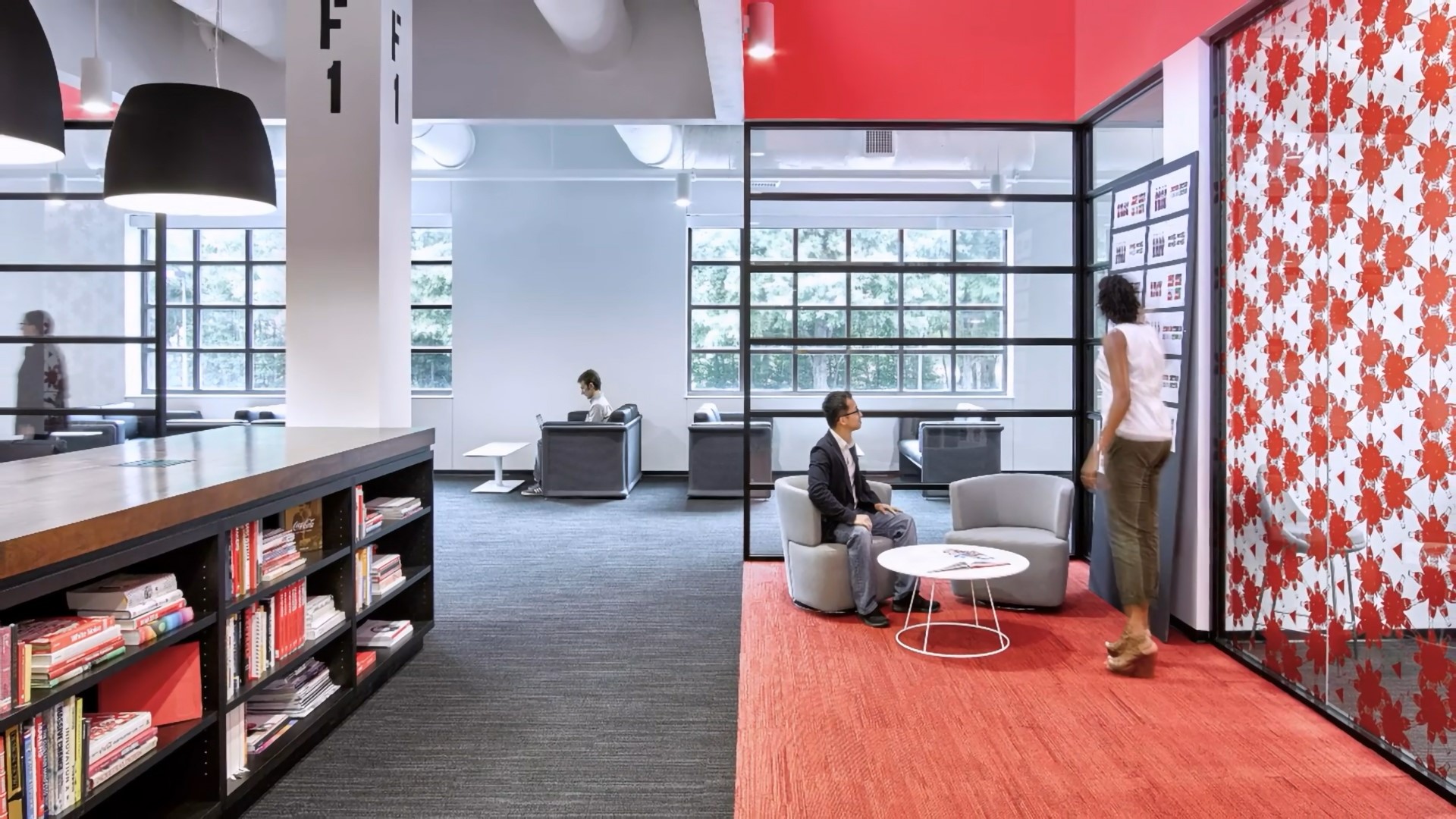
Redesigning how Coca-Cola works, plays, and profits
Designing for Coca-Cola’s 2020 vision strategy.
Coca-Cola is one of the world's most iconic brands. More than 5,000 people work at its global headquarters in Atlanta.
Back in 2010, Coca-Cola found itself at a major crossroads. As the company grew, it became clear that in order to stay competitive, any kind of campus renovation would have to take into account a vision of the future of how people work at Coca-Cola. Before the company hired architects, they came to IDEO to help design this important part of their 2020 vision strategy; ultimately the redesign would change the way the company works, plays, and profits.
Imagery courtesy of Coca-Cola, Gensler, and IDEO

Today’s Leaders Must Learn to Address a New Epidemic: Loneliness
Organizational health depends on human connection
What they found through their conversations took them a bit by surprise. There was a deeper malaise afflicting everyone they spoke to—something under the surface, under the symptoms.
Loneliness.
Months into a pandemic, the isolation that’s always been below the surface is even more extreme. It was in this context that I had the pleasure of talking with Dr. Murthy. We spoke about what leaders can do to facilitate connection, and why it is mission-critical for organizations to address loneliness and support relationship-building, even when we’re physically distant. Especially when we are physically distant.
I'm sharing some excerpts from our conversation here. I hope they inspire you and prompt useful explorations into the health of your communities.
Three types of loneliness
The feeling of being isolated from each other, Dr. Murthy discovered, is at the root of so many of our deepest ailments. He reminds us that we are social creatures, and that community heals us. Especially in these divided times, the way to a more happy and healthy society is both obvious and profound: human connection.
Connection in the workplace
Our professional lives—the experience of working and the quality of what we do—is heavily influenced by what’s going on in their rest of our lives. Yet there’s a hesitance to be vulnerable, share challenges, and ask for help. As a result, colleagues sometimes miss opportunities to help one another. It’s a loss, because through helping each other, we deepen our bonds. Empowering employees to help each other can be one of the most powerful ways for organizations to strengthen their teams.
The potential for something better
While our present moment lays bare how technology can isolate us and ideologies can divide us, it also shows us that new ways are possible now and in the future. My conversation with Dr. Murthy explored the role design can play in creating human-centered systems that make us all feel more connected—from the scale of individuals and teams, all the way up to systems, institutions and governments. We all have the power to design conditions that prevent loneliness, cultivate community, and foster good health.
The strain on our systems caused by COVID-19 reveals an opportunity to take new approaches to our work and our infrastructure— from how the government sets policies to how businesses empower employees. In rebuilding the world post-pandemic, we need to keep in mind the tangible benefits that human connection can support: mental health, physical wellbeing, academic and professional success. We can design policy to optimize human connection, ensuring our government recognizes these principles when thinking about housing, public health, or education, for instance. The question for leaders is, what changes are required to create connection and maintain cohesion, even as our structures and processes shift? The opportunity for leaders now is not to go back to how things were, but to imagine something better…and make a new “normal” built upon what supports us as, as Dr. Murthy points out, social creatures who need care and connection.
Original photograph by Meredith Nierman
There’s a story in Dr. Vivek Murthy’s book, Together: The Healing Power of Human Connection in a Sometimes Lonely World, about the tour he made across America in 2015, while he was U.S. Surgeon General. One of my colleagues at IDEO, Ann Kim, served as his Chief Design Officer and joined Dr. Murthy’s team as they set out to learn about the health crises gripping the nation—opioid addiction, chronic disease, violence—from the people who were suffering the most.
Designing a video game on a very, very small scale
How one designer built a pixel-sized video game controlled by a jeweler’s loupe.
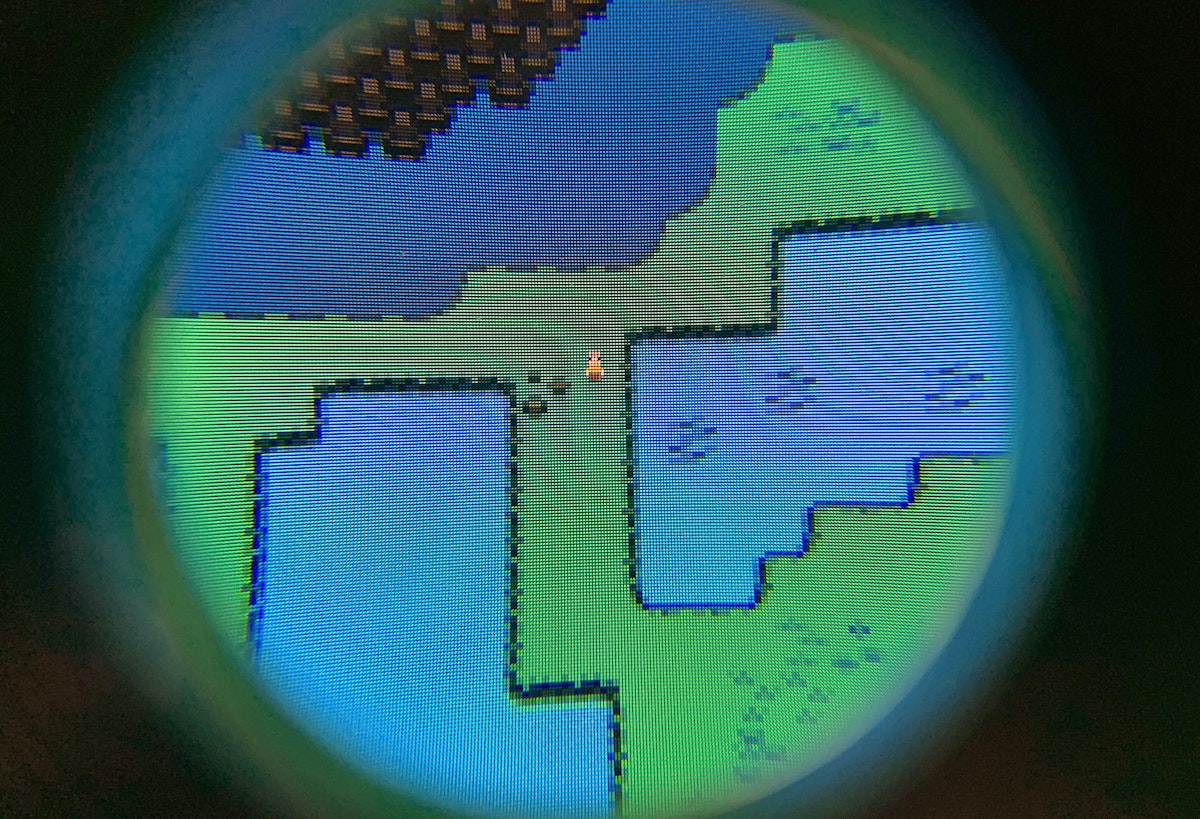
As pixels become a hidden quality, what would it be like to expose and celebrate this tiny landscape? Maybe it’s some sort of nostalgia for the pixel, but I thought it would be fun to prototype a game where part of the gameplay is uncovering this “hidden world” of pixels inside these new displays—and so the world’s smallest pixel art game was born.
Looking through the loupe
To start the project, I needed to see these tiny pixels up close. I bought a cheap jeweler’s loupe—basically a magnifying glass—and pressed it up against an iPad. Things looked promising with a 10x loupe. The level of magnification allows you to see the individual pixels, but still see a decent amount of the play area around the character. However, if your eye is pressed against the eyepiece of the loupe, it would make touch controls a challenge because you can’t see anything but the small area in the magnifying glass. To work with this constraint, I wondered if I could make the loupe itself the controller for the game.
The way iPads and most tablets sense touch is using a “capacitive touchscreen.” This type of display creates a grid of areas that hold electrical charge. When a fingertip touches the screen, the charge at and around the point of contact decreases, communicating where the finger is to the tablet. Electrically conductive gloves and styluses are able to work on these screens because they allow the properties of your finger to extend through the conductive material. So using the same idea as a conductive stylus, I put some aluminum tape on the loupe to transmit the capacitance from your fingers to the display. This allowed a player to move the loupe around the screen, and through doing so, interact with the game.
Exploring a tiny world
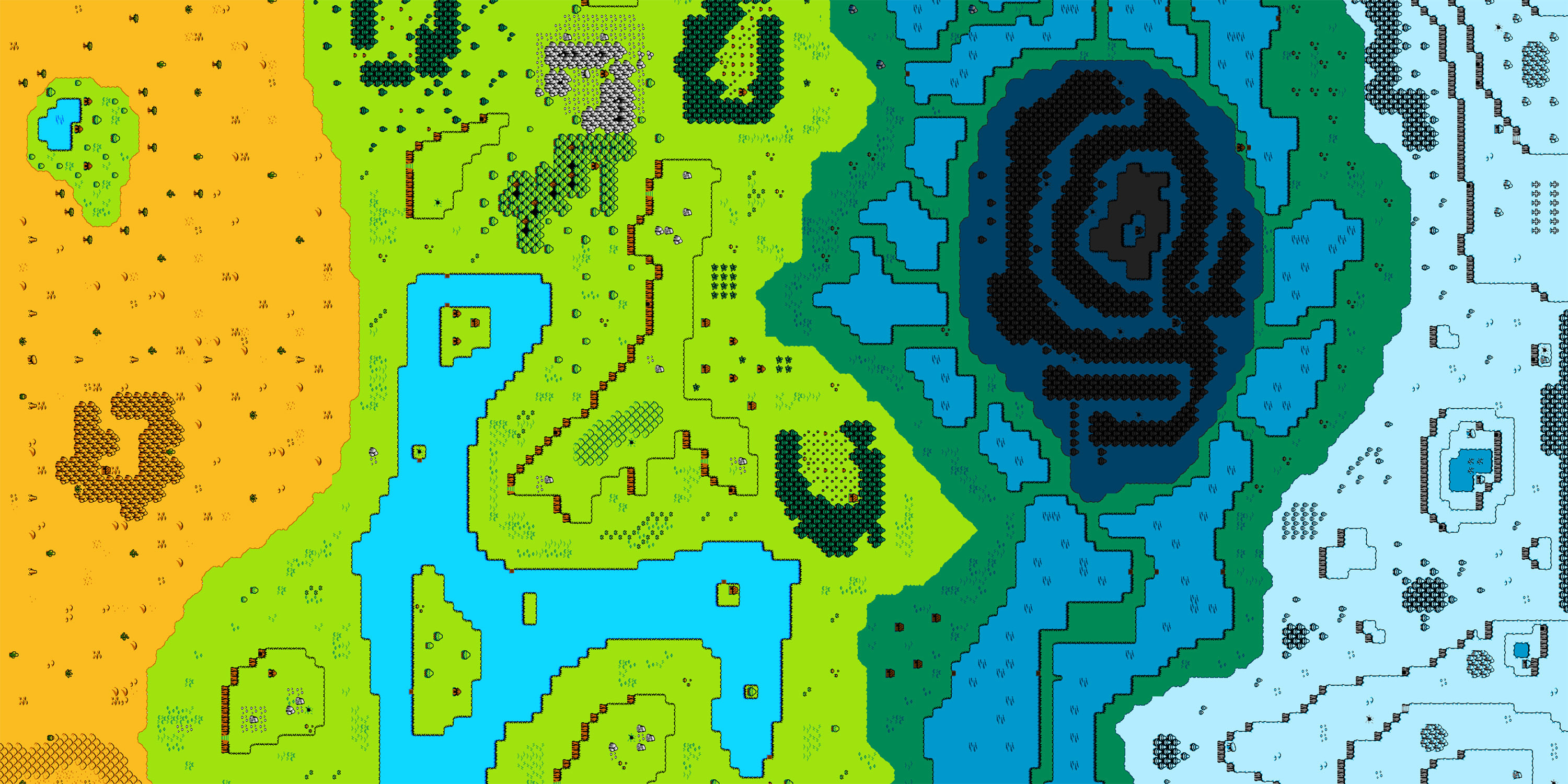
Next, I needed to develop the game. I borrowed from some of the classic role-playing-game tropes from games I played as a kid, building out a landscape that included many different climates—a desert, a lake, a forest, a deep forest, an ice tundra, and more. I created a tiny character that the player guided around the landscape by moving the loupe.
The idea is that the whole game is played on a single static overworld screen that never moves—you can explore an entire tiny world without ever moving more than a few inches. There are even a couple of fun ways the character interacts with the environment. For example, the player can force the character to fall into the lake, where he splashes around and quickly jumps out. I also created a hidden cave that shows how a game might work with inside and outside spaces that can be explored.
Overall, I’m pretty satisfied with the way the experiment turned out. There’s something about looking through the magnifying glass and into this new world that brings back some of the awe and wonder that came with exploring new worlds on my Nintendo when I was growing up—it just goes to show that screen technology doesn’t need to be pixel perfect to transport us.
Chart your own pixel territory
Want to try it for yourself? Here’s how to get your own version of this experiment up and running:
1. Build the loupe controller
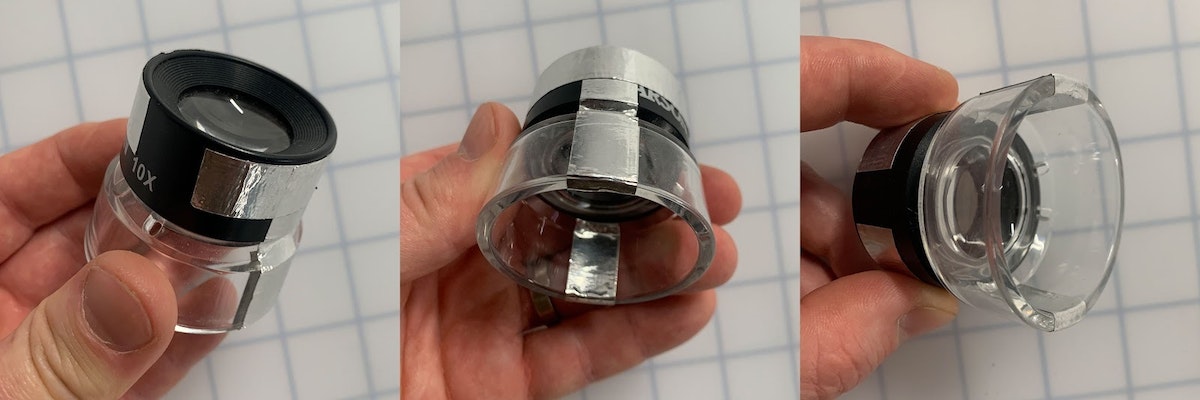
Get a loupe, and some aluminum tape. I made two separate “T” shaped pieces of tape, and wrapped them around the edge of the bottom of the loupe. This metal transmits the capacitance of your body down to the edges of the loupe, simulating two-finger touch.
2. Load the game
There are two ways to do this. First, make sure you have Unity, then download the project from Github. You’ll also want to install the Unity Remote app on your tablet.
To quickly test the project, you can plug the tablet into a USB port on your computer and open the Unity Remote app on the tablet. In Unity on the computer go to Edit > Project Settings > Editor and select the tablet. Then press the play button at the top of the main Unity window and the game will appear on your device. This will let you try things out but it will be very slow to react and move the character because it’s running on the computer and sending each screen as an image over the USB connection. More detailed instructions can be found on the Github project page.
Alternatively, if you want to run the application natively on a device at a reasonable speed, you will need to follow the directions on building for mobile to set up your device with Unity.
Either way, once you’ve gotten the game up and running, you’ll have a good sense of the game mechanics and can go into the project to edit it to create your own tiny world—changing things like the landscape and character actions, creating new characters and interactive objects, and even extending it into an actual game. Happy exploring!
A quick shoutout to some of the great resources I used to create this demo:
- Tiled: A fantastic tool for creating tiled backgrounds for 2D games. This was extremely helpful for putting together the overworld.
- Tiled2Unity: This tool helps bring the tiled data into Unity seamlessly.
- opengameart.org: A great repository for free to use game art assets. My main tiles were modified from surt’s Blowhard Chronicles.
- rm2kdev’s 2D Unity RPG Development series: A super helpful video series on developing 2D games in Unity.
When’s the last time you had to design for something as small as a pixel? In recent years, with the advance of retina displays on computers, tablets and phones, it’s easy to forget that pixels are still the building blocks for everything you see on the screen. (These new displays still use pixels; they’re just so small they can’t really be seen.) In the past, user interface designers had to build to pixel-perfect precision to avoid blurry aliasing effects and issues with displaying fonts on lower-resolution screens; today, this is all but a thing of the past.

What Cooking Dinner for Friends Taught Me About Prototyping
How a kitchen experiment took one designer down a prototyping rabbit hole
Designers prototype everyday. It’s an essential part of the design and development process that involves translating early ideas into tangible prototypes that we can test in real life with real users. Prototyping is about being able to understand a challenge or an opportunity and find creative ways to move toward a solution, step by step. Essentially homing in on “building the right thing,” before “building that thing right.”
But the prototyping process doesn’t have to be limited to what you do for work. In fact, bringing this approach to your everyday life has the magical effect of turning common challenges into moments of playful exploration. It’s not necessarily about finding the ultimate answer, but enjoying the opportunity to experiment, improve, and learn along the way. You can prototype anything as long as you have the right mindset and get creative with your tools.
Here’s what it looked like when a sous-vide experiment took me down a prototyping rabbit hole (and how it could take you down one too).
Step 1: Get inspired
Inspiration can come from many places, like frustration with tools or objects that are not easy to use or the simple joy of creative exploration. For me, the latter happened when I stumbled across a recipe that used sous-vide, the technique of slowly heating meat or fish to its perfect core temperature so it doesn’t become dry or overcooked.
I thought it would be fun to try out for a dinner party, but didn't want to invest in a professional sous-vide machine. A typical moment where my prototyping obsession kicks in…

Step 2: Start out low-fidelity
An essential step while prototyping is identifying the simplest way to obtain the intended result—to achieve more with less. Isn’t the sous-vide technology just slowly heating up ingredients and stabilizing the temperature over a long period of time? That seemed pretty simple. So I gathered my materials: heat-proof bags, an electric thermostat, and of course, a couple of beautiful steaks.
I sealed the steaks in the heat-resistant bags, put them into a pot of water and used my oven to heat them up to 53°C/127 °F (the perfect core temperature for a medium rare steak). Unfortunately, the thermostat of a regular kitchen oven is relatively inaccurate, with the actual temperature being ±10°C/18°F compared to what it shows! That can make the difference between your meat being bloody as hell and completely overcooked.
That meant I had to place myself in front of my oven for over two hours, staring at the tiny LCD display of my electric thermostat and manually balancing the inaccuracy of the oven by turning the temperature up and down.
Step 3: Analyze your results
The good news: the meal was perfect—the meat medium rare—and my friends were impressed. But sitting in front of my oven, watching a thermostat for multiple hours, was less than ideal. This was the perfect starting point for the next iteration—looking into ways to automate and refine the temperature stabilization and improve my personal user experience.
Step 4: Iterate on key features
That’s how I found myself on a Saturday afternoon hooking up a simple heating rod, my electronic thermostat, and a milk stirrer with an Arduino board.
I mounted my thermostat to the top of the pot and coded my Arduino board to activate the heating rod as long as the temperature of the water bath stayed below 53°C/127 °F. Triggering the milk stirrer every once in a while ensured that the temperature stayed consistent throughout the pot. My prototype ran this process every 10 seconds and freed me up to focus on other parts of the dinner preparation while delivering another round of perfectly cooked meat and fish.

Step 5: Repeat until satisfied—or pivot
Each iteration of a prototype will reveal more detailed feedback and help you get closer to an actual solution. That’s why prototyping is the best way to learn while moving forward, and to de-risk decisions on product innovation or bigger investments.
Using my sous-vide prototype several times helped me identify multiple opportunities to improve it, like how to make it as compact as possible for easy storage (a great design and prototyping task in itself!). But most importantly, by using the prototype, I realized that I missed the sensorial experience of cooking. Simply waiting for ingredients to reach their core temperature in the water bath felt like an artificial, chemical experiment and was not the rich sensory experience I was looking for when spending time in the kitchen on weekends.
So I decided to pivot. After not using the prototype for months, I disassembled it and freed up the components for my next prototyping rabbit hole. Even if the sous-vide prototype actually never made it into a final solution, it helped me better understand what I enjoy most about cooking, and taught me something that I’m sure will be applicable to a future experiment—because the prototyping obsessive’s job is never done. Now, on to the next project!
On a Saturday afternoon (pre-COVID), I found myself in my kitchen, hooking up an Arduino board to a heating rod with one hand, and handling an electronic thermometer and a milk-stirrer with the other. How did I end up here? A hunt for the perfectly-cooked steak—and a typical result of my obsession with prototyping.

Your Data Could Do More for You If You Learn How to Use It
3 strategies for unlocking business growth opportunities with AI
For years, I’ve watched smart companies buy into big data. Yet despite huge investments, some of them fail to reap the rewards. A 2017 MIT study revealed that 63% of executives expected to see a large impact on their offerings from AI in the next few years. But of the 14% of executives who reported already seeing a large impact, most cited examples in automation, decision-making support, and operational diagnostics for internal capabilities. Those kinds of advances can contribute to higher profits and short-term differentiation, but operational efficiencies do not generally help organizations grow beyond their peers. They also aren’t the deciding factor that will carry you through a yo-yoing economy. So how, exactly, do successful organizations unlock sustained and differentiated value in an AI-enabled world, at a time when immediate change may seem necessary just to survive?
It starts with experimenting and iterating with data—in a responsible way— to find your organization’s unique value proposition. Intentional experimentation mitigates the risks of failure by ensuring that you learn which data skillsets are critical to your organization, while at the same time identifying product-market fit. It’s a process that can happen before, during, or after a broader digital transformation, and there are three different ways to approach these intentional experiments: scaling internal offers, piloting to stretch, and purposeful venturing.

Scaling internal offers
In 2004, a web design company called 37signals needed a project management tool to keep all of its work streams on track. Initially, its solution—Basecamp—was meant to be a tool that would help the company be more efficient, and serve as a single source of truth for all its projects. But the more valuable it became internally, the more the company realized that it could be valuable externally. Eventually, Basecamp became 37signals’ core business; it adopted Basecamp as its name, and folded other offerings under the new brand.
Scaling internal offers is a smart way to create new revenue streams that can also help drive an organizational purpose. It’s a particularly good approach for companies that value creating internal capabilities and investing in their employees.
Another example comes from a liability insurance company that had recently gone through quarterly reviews. The company took a deep dive into large lawsuits, setting case direction and identifying where liability existed and standards had been breached. These observations were used to set financial reserves and, after months of manual curation, create risk-management training materials. While this company had already developed a technique for improving best practices, leveraging data to create a digital tool would give them an opportunity to scale up dramatically. The resulting in-house product allows the company’s claims and risk management representatives to rapidly identify new and emerging trends, as well as strategize case management on the portfolio level, saving thousands of human hours and much more in lawsuit expenses over the course of a year. With a bit more refinement, the firm could offer a version of its tool directly to policy owners, which could allow them to adopt best practices in real-time.

Piloting to stretch
A classic example of this approach comes from Netflix, which started offering streaming video services in 2007, alongside their penalty-free mail order DVD rentals. When the streaming service was born, it was a digital replica of the video store experience, browsing and selecting movies from a wall. But as Netflix accumulated ever more data about what people watched and their preferences, the streaming service became a data-driven way to personalize and recommend content, better fulfilling its purpose of “entertaining the world.” In fact, developing this data-driven capability in-house has given them sufficient insights into viewers’ preferences, which they are now using to create their own content, dramatically shifting the entire media landscape because of the data they own.
Piloting to stretch is a method of launching a new venture that brings in cash and stretches the organization to more intentionally fulfill its purpose. Often, that can require an entirely new business unit, with a new culture and team, so that it can grow without absorbing existing constraints. This approach is particularly appropriate for organizations that are seeking a new lever for growth, or are looking to disrupt their industry.
For Ascensia Diabetes Care, it was about recognizing a service gap for patients newly diagnosed with type 2 diabetes. Most people, shortly after receiving their diagnosis, are scheduled for a brief consultation with a certified diabetes educator (CDE) who helps them learn the basics of managing the disease. But the short time a CDE spends with a client isn't nearly enough to establish new habits and enable sustained lifestyle changes. Ascensia saw an opportunity to create a new remote care service that would allow people with diabetes to interact with CDEs over a prolonged period of time through a telehealth platform, helping them better acclimate to their condition. To design the right program and path for each patient, Ascensia created data-driven tools that would help CDEs know how and when to interact with users. Initially, the company piloted the app with 60 people, and early results showed that users were willing to adopt and adhere to the program. Only two participants failed to complete the study—a stunning success rate when adherence to therapy for chronic illnesses in developed countries averages around 50%.

Purposeful venturing
Google may have started as a search engine, but in 2015 Alphabet emerged as an umbrella organization that made space for Google to pursue other ventures, some that might seem far beyond the scope of the core business. Alphabet’s interests— everything from life science (Calico) to transportation (Waymo)—are all in service of doing the right thing, and separating Alphabet’s other ventures from Google kept them from getting mired in particulars of the Google organization. This nimbleness has allowed Alphabet to fulfill its broader purpose, even during the extreme uncertainty of a global pandemic; the company quickly launched one venture, Verily’s Project Baseline, to research COVID-19, while Google and Apple have partnered to develop an exposure notification system.
Purposeful venturing is a way for an organization to create new business lines that drive growth. These ventures operate independently, with their own teams and cultures, and may require dramatically different ways of working that would be distracting for the core business’ operations. It’s a good fit for companies that might have many different ways of achieving their purpose, or for firms that can create symbiotic effects with auxiliary offerings.
In practice, it can also look like this: A nimble venture firm called 1848 Ventures (a subsidiary of Westfield Insurance) recognized that staffing is one of the biggest uncertainties business owners grapple with. Over-staffing eats into their already razor-thin margins; under-staffing means long lines and lost revenue. By rooting their innovation efforts in their purpose—to help their customers mitigate risk and uncertainty—the firm saw an opportunity to create a service that would help small businesses better manage their expenses through a tool that combines large data sets and an intuitive interface to optimize operational decisions. This new product was piloted with restaurants to help them offset the thin margins they need to survive.
Regardless of whether you experiment by scaling internal offers, piloting to stretch, or purposeful venturing, there are ample opportunities to simultaneously unlock product-market fit while getting a better grasp of the capabilities your organization needs to grow. Design offers a way to mitigate the risk of missing product-market fit and improve your odds of success in a way that dovetails with your existing capabilities and long-term vision. So after you pick your path, get out there and start prototyping early and often with data products, just like you would with anything else. It’s the best way to make sure that your data investment will push you past operational efficiencies, to sustained and real growth.
Illustrations by Nate Kitch
Over the past six months, the pandemic and the economic uncertainty it ushered in have sent companies in every industry flailing; to survive, many have leapt to major digital transformations. Scrambling CEOs have bought into the hype around data and AI that has been swirling for the last decade, all in hopes of making it to the other side. It’s a smart move. Even in a moment as stark as this one, with no sure path to a return to normalcy, data has the potential to ethically deliver unprecedented value to consumers, organizations, and shareholders. But just because the potential is there doesn’t mean the full value of these investments is being realized.

Lindsey Turner
I’m passionate about building brands, products, and experiences that help organizations show up with meaning and momentum.
I help organizations cut through complexity by shaping how they show up, through brand strategy, identity, and storytelling.
Working at the intersection of brand and business, I bring an editorial eye and a bias toward making—turning ideas into tangible experiences that people can understand, trust, and believe in.
My work spans government, healthcare, financial services, media, and consumer goods, from launching Gen Z-focused ventures to building innovation labs and reimagining legacy brands. I relish moments of ambiguity and enjoy translating across teams, perspectives, and priorities to move ideas forward.
I started my career in editorial and digital design, shaping cross-platform experiences and identity systems in publishing and agency environments. That foundation still shapes how I work today: I’m detail-oriented, collaborative, and overreliant on the Oxford comma. I hold a BFA in Visual Communication from the School of the Art Institute of Chicago.

Rachel Young
My work helps organizations see who their products aren't working for—and build the will and the tools to do something about it
For 25 years, I've asked the same question: Who does this design exclude—and what are we going to do about it?
My work spans human-centered strategy, inclusive design, and qualitative research, with clients ranging from Microsoft, Google, and Verizon to the National Science Foundation, and San Francisco Unified School District.
Before IDEO, I taught elementary school in East Palo Alto and spent a decade doing design work with social service organizations—where I learned firsthand what it costs people when systems are built without them in mind.
I am currently writing User Error, a nonfiction book about digital access and the design decisions behind it. I live in Oakland, California.

Brian Pelsoh
I lead with craft, ensuring our work is creatively excellent: rooted in deep human insight and imagination, while also grounded in the realities of business and technology.
My expertise spans brand, communication, and product design across tech, education, the arts, and social impact.
I believe great work demands both high-level vision and obsessive attention to detail, and only happens through collaboration.
I bring an inclusive, hands-on approach and a deep understanding of business, which enables me to consistently deliver excellence while always asking why.
Before joining IDEO, I worked at the brand firms Pentagram and VSA Partners. I began my career as a designer, leading teams at the School of the Art Institute of Chicago and the Milwaukee Art Museum. I hold an MFA in graphic design from Maryland Institute College of Art and a BFA in communication design from the Milwaukee Institute of Art & Design, and have taught at some of the best design schools in the US.

Tony Wong
I am responsible for IDEO’s long-term success in China and working with clients to use design as a tool to enable growth.
I am responsible for IDEO’s long-term success in China and working with clients to use design as a tool to enable growth. Specifically, I have helped Chinese companies design holistic brand solutions through the development of their products, communication, services, and innovation teams, and I have helped multinationals expand their presence and influence in China.
I advise global leaders on developing China-led innovation and capabilities.
In over 15 years in IDEO Shanghai, I have worked on projects that use design to elevate the quality of the experience of healthcare products and services, streamline processes that increase productivity, create spaces and programs that promote and enable inclusive communities, and build next generation mobility solutions that are planet-positive.
Before joining IDEO, I worked at Philips Electronics and the Electrolux Group in Italy, the Netherlands, and Singapore on a number of breakthrough commercial products. I am a member of the Young President Organization in Shanghai.

Building a personal AI for the messiness of life: Sida Li
Most AI products today are built for work—a space with clear problems and established systems. One founder noticed a gap: personal life is messier, harder to systematize, and mostly left behind by the AI boom. So she built Cue, a personal AI that lives inside iMessage and group chats, to go where the other tools haven't.
In this episode, Becca Carroll, IDEO's Chief Strategy Officer, talks with Sida Li, co-founder and CEO of Shared Context Lab, about staying anchored to a human need while the technology around her keeps changing shape, why she treats her business model with the same rigor she'd bring to a product, and what it feels like to build a company at this particular, disorienting moment in AI.
The conversation also gets into how Sida makes design decisions: the language Cue uses to describe itself, the tradeoffs behind building inside iMessage instead of a new app, and a real story about a business idea that didn’t pan out.
This is the second in a two-part series profiling founders from IDEO's Startups-in-Residence program. The first conversation is with Johannes Seemann, founder of Sooner, on designing GenAI for the emotional side of money.

Designing GenAI for the emotional side of money: Johannes Seemann
Most personal financial tools are built to run the numbers and optimize towards a budget. While that works for some, most people experience money as a lived relationship that does not neatly fit into a spreadsheet. Johannes Seemann and Becca Carroll discuss why money is emotional before it is mathematical, and what a human-centered approach to building a generative AI financial product looks like in practice.

The curious leader's edge in uncertainty: Scott Shigeoka
Mina Seetharaman talks with Scott Shigeoka, author of Seek and Head of Curiosity Cultivation at the Eames Institute, about what distinguishes genuinely curious leadership from performative curiosity, how power dynamics shape curiosity, and why practicing curiosity can restore energy rather than drain it.

How constraints make us more creative: David Epstein
Mina Seetharaman talks with David Epstein, author of Inside the Box and Range, about why total freedom often produces average work, how leaders can design useful limits on purpose, and what organizations such as General Magic and Pixar reveal about the relationship between boundaries and creativity.
Looks like you might be in search of something very specific?
Or reset the filters above and try another angle.
Here’s some random inspiration

Podcasts about creative leadership

Articles about the power of prototyping
