.svg)



Better sales, less waste
H&M transforms its operations to cut excess inventory.
Globally, the European Commission reports, a truckload of textiles heads to landfills or is incinerated every single second.
The fashion industry accounts for some 10 percent of greenhouse gas emissions worldwide.
Less than 1 percent of the materials used to make clothing is recycled, according to a report by the Ellen MacArthur Foundation.
The best way to keep clothes out of a landfill? Don’t make them.
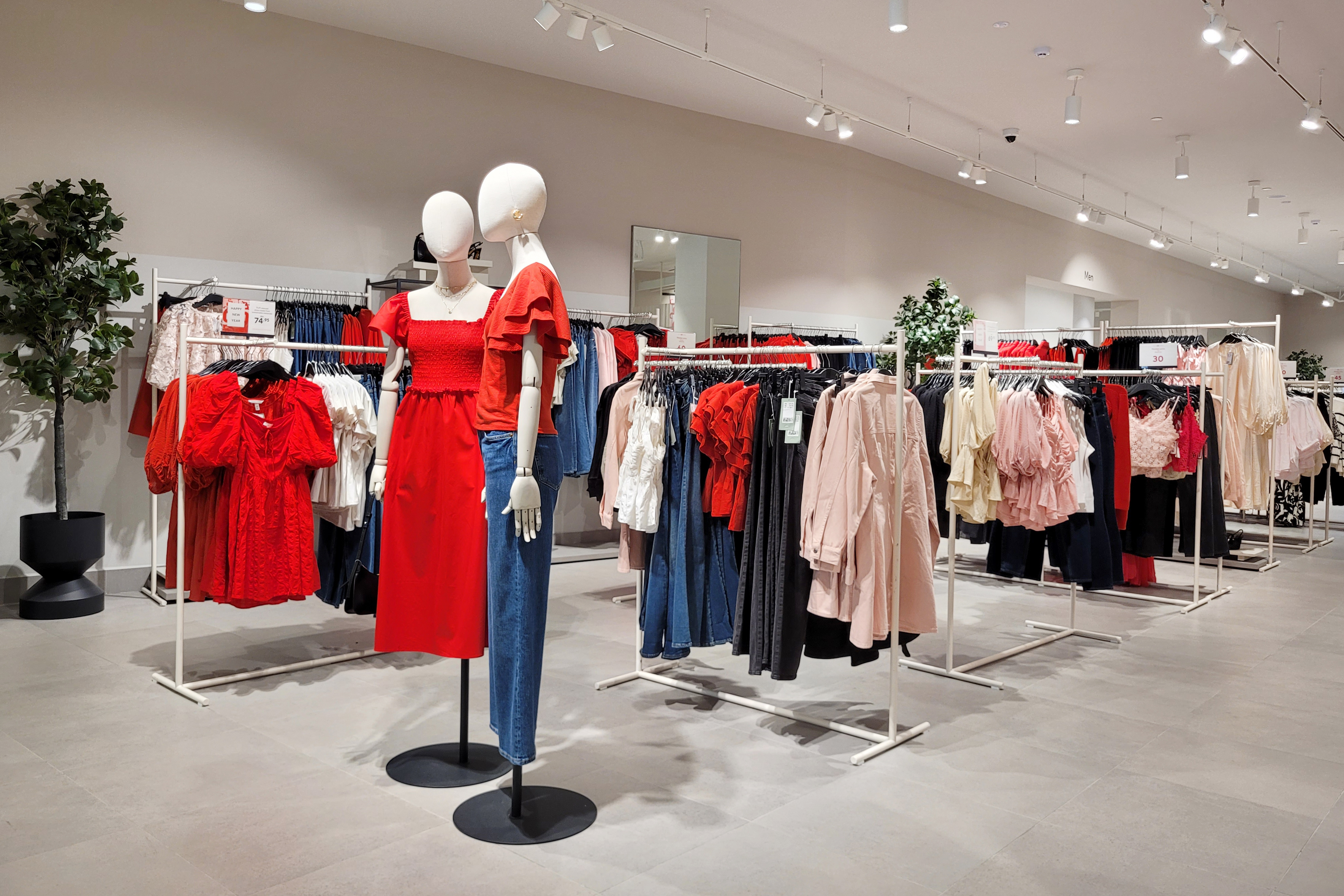
Picture this: Not long ago, it wasn’t unusual for a customer to walk into an H&M store and not be able to find a basic white t-shirt in their size. Why? Like most long-established retail operations, H&M was operating with a push model—placing seasonal bets on what the demand for a given item of clothing might be, locking orders far in advance, and hoping that they were able to sell out. Make a mistake in that kind of model, though, and you can end up with customers unable to find the basics they rely on, or excess inventory you can’t sell. That’s a problem for the business, but for the environment as well—and one that doesn’t fit H&M’s aggressive sustainability goals.
Though H&M had tried to tackle the problem before, the launch of the H&M Group Design Studio, co-created with IDEO, gave the retailer the confidence to go after it again. The team started out by mapping out the complex network of people that make up its supply chain across the globe, meeting with everyone from designers to garment suppliers, logistics managers, and even folks selling the final product in H&M stores.
They then created an algorithm for more precise ordering, as well as a tool that provides a shared view of information. Instead of placing orders, the new automated flow—dubbed “Cruise Control"—allows staff to work with a demand forecast that gives them more time to focus on customer-centric operations, like providing guidance and inspiration. It also makes it easier for H&M to follow the demands of the market, and place much more accurate bets on what consumers will want, when. Already, H&M has significantly increased sales while cutting excess inventory—a result that improves its bottom line, as well as its environmental impact.
Estimates project that by 2030, global apparel consumption will hit 102 million tons.
22%
reduction in stock during a pilot program
34%
increase in sales during a pilot program
Fueling innovation in Boston
How the Boston Society for Architecture is leveraging member expertise to increase its impact.
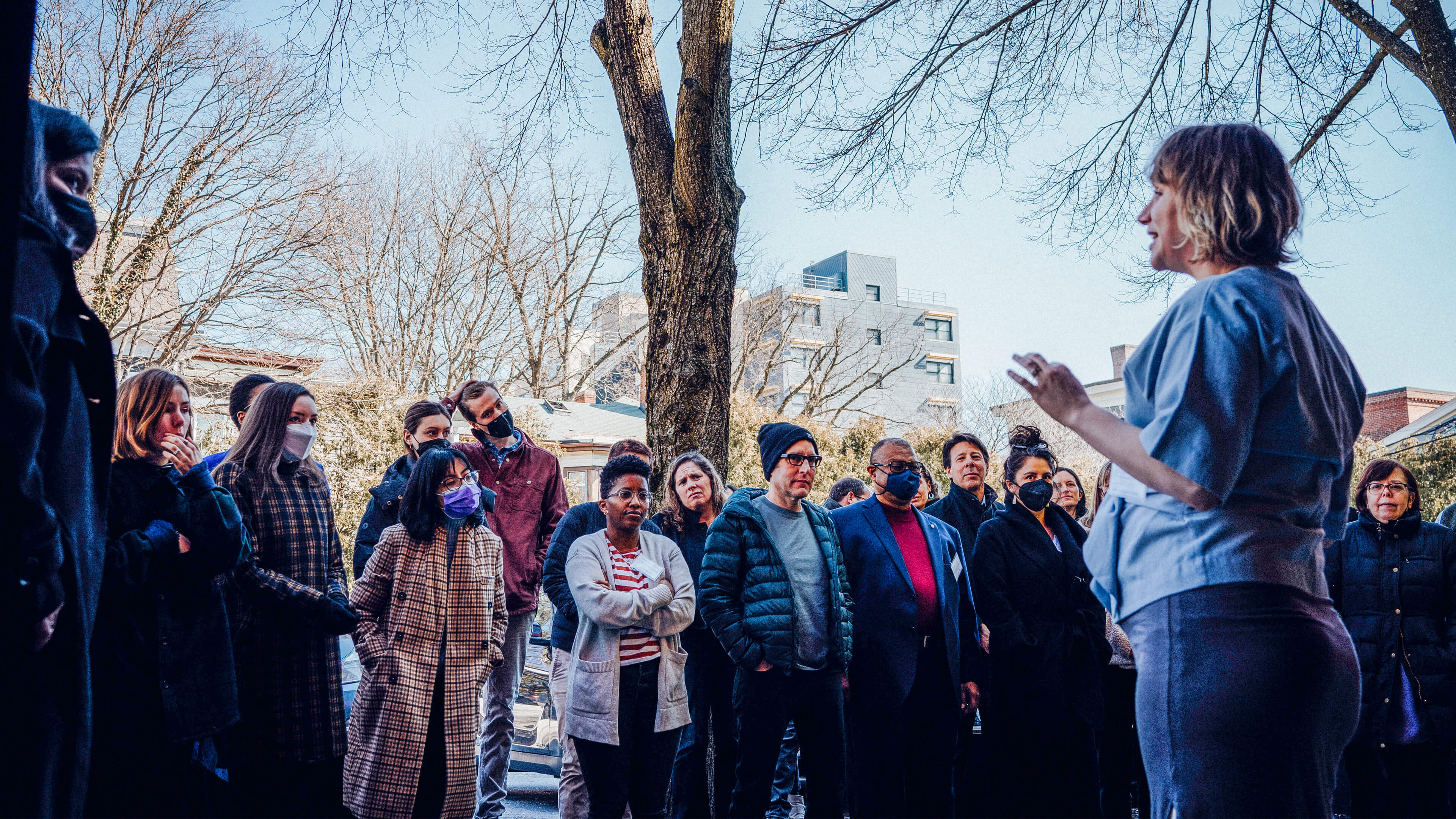
To foster creative projects that spoke to the needs of local communities and environments, the BSA began to engage its members in collaborative, user-led design. The organization launched its first-ever innovation challenge, putting out a call for all members to pitch their ideas for projects in the built environment.
The BSA expected those pitches to have dollar signs attached. To the organizer’s surprise, only one asked for funding. The rest requested less tangible, but equally meaningful support: advice, connections, specific expertise. Those are resources that the BSA has aplenty, but hadn’t learned how to leverage well.
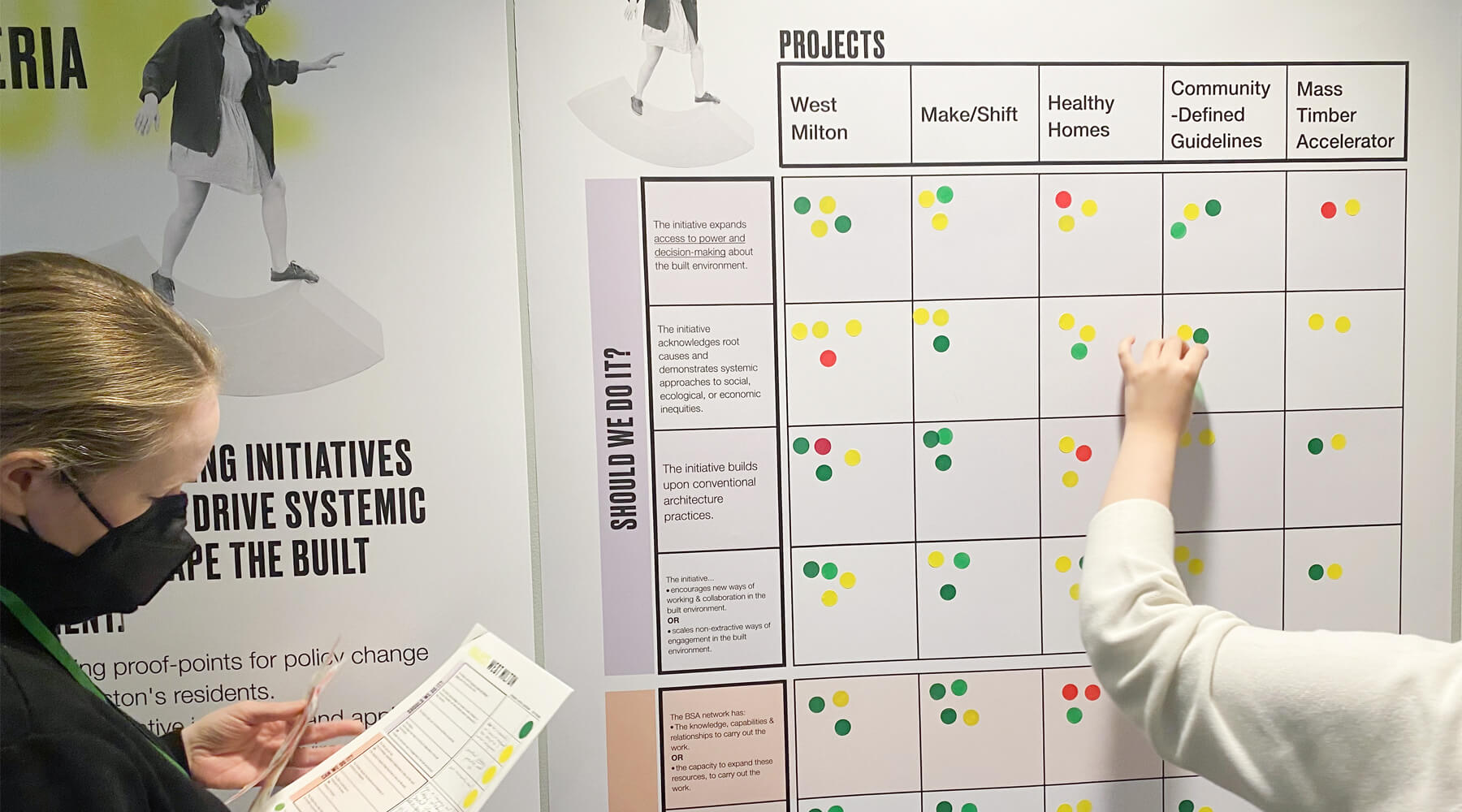
From that first go at an innovation challenge, the BSA learned how to better support its members. It also learned that to lead with purpose and make strategic choices, one must develop the confidence to say no. Instead of spreading itself thin across many projects, the organization decided to take small steps, focusing on one initiative at a time, so that it can deliver focused impact and stay true to its evolving mission.
With 36% of global energy going to buildings and 8% of global emissions caused by cement alone, the architectural community is inextricably intertwined with both the causes and solutions related to climate change.
According to a survey conducted by the AIA, the architecture profession in the US is less diverse than the population as a whole. This lack of diversity can contribute to a disconnect between architects and the communities they serve.
31
submissions received from innovators in the Boston region working on equity and sustainability challenges
5
innovation teams invited to pitch ideas
Student-centered solutions
How an organizational culture change is helping newbies at NYU navigate campus life.
The resources that NYU students needed were organized by administrative department, and buried on disparate websites and calendars. But students don’t think in terms of departments—they just need to know where their classes are.
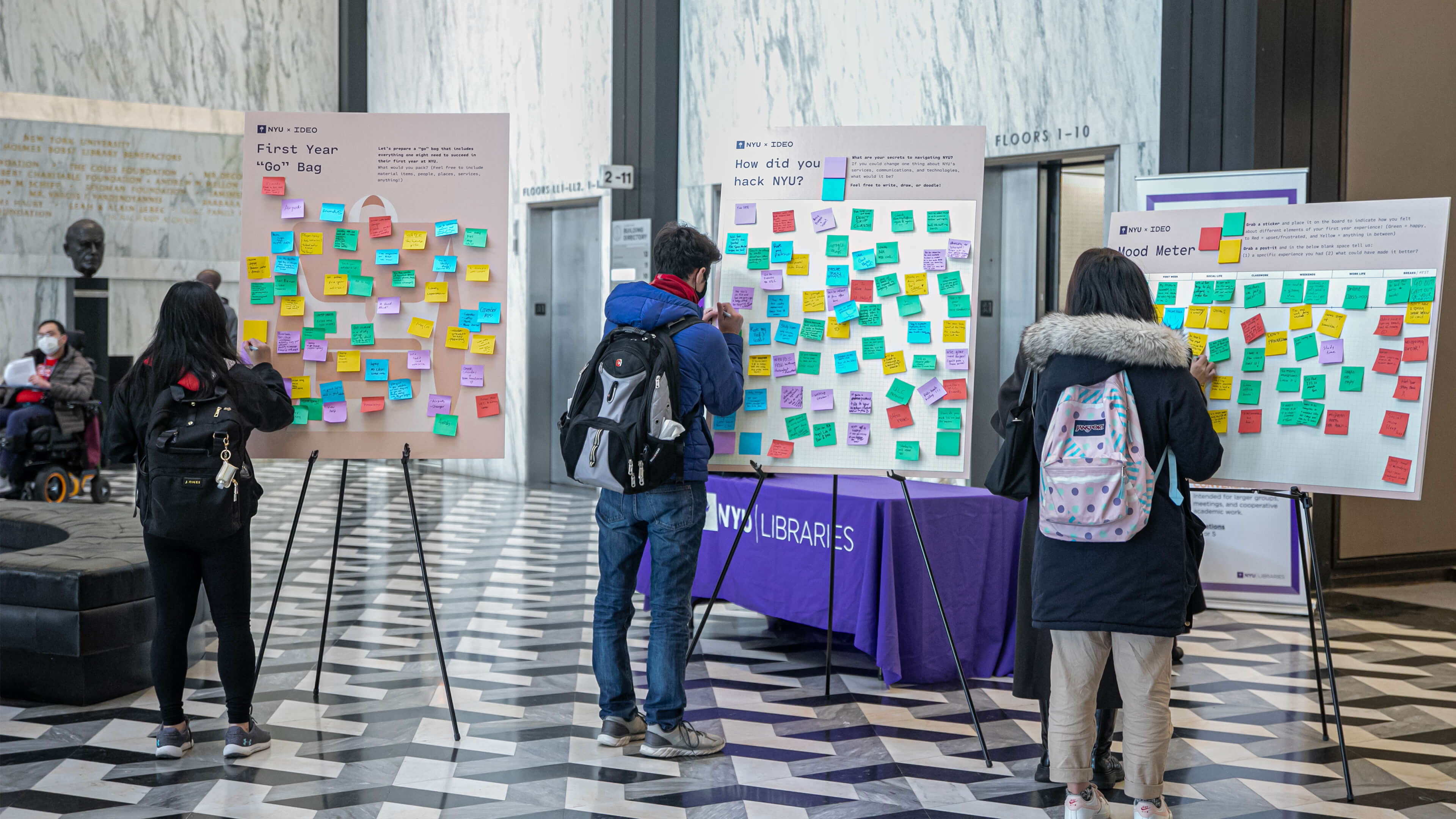
All of this became patently clear as IDEO shadowed students. Team members visited classrooms, walked with them through their days, and hosted pop-ups in highly trafficked areas to get ideas from passersby. That helped the team develop a common understanding of the overall student journey and grounded employees in the key moments that can either make or break a student’s experience. Visualizing their journey helped departments gain a shared understanding of the fractured communications challenge and develop possible solutions.
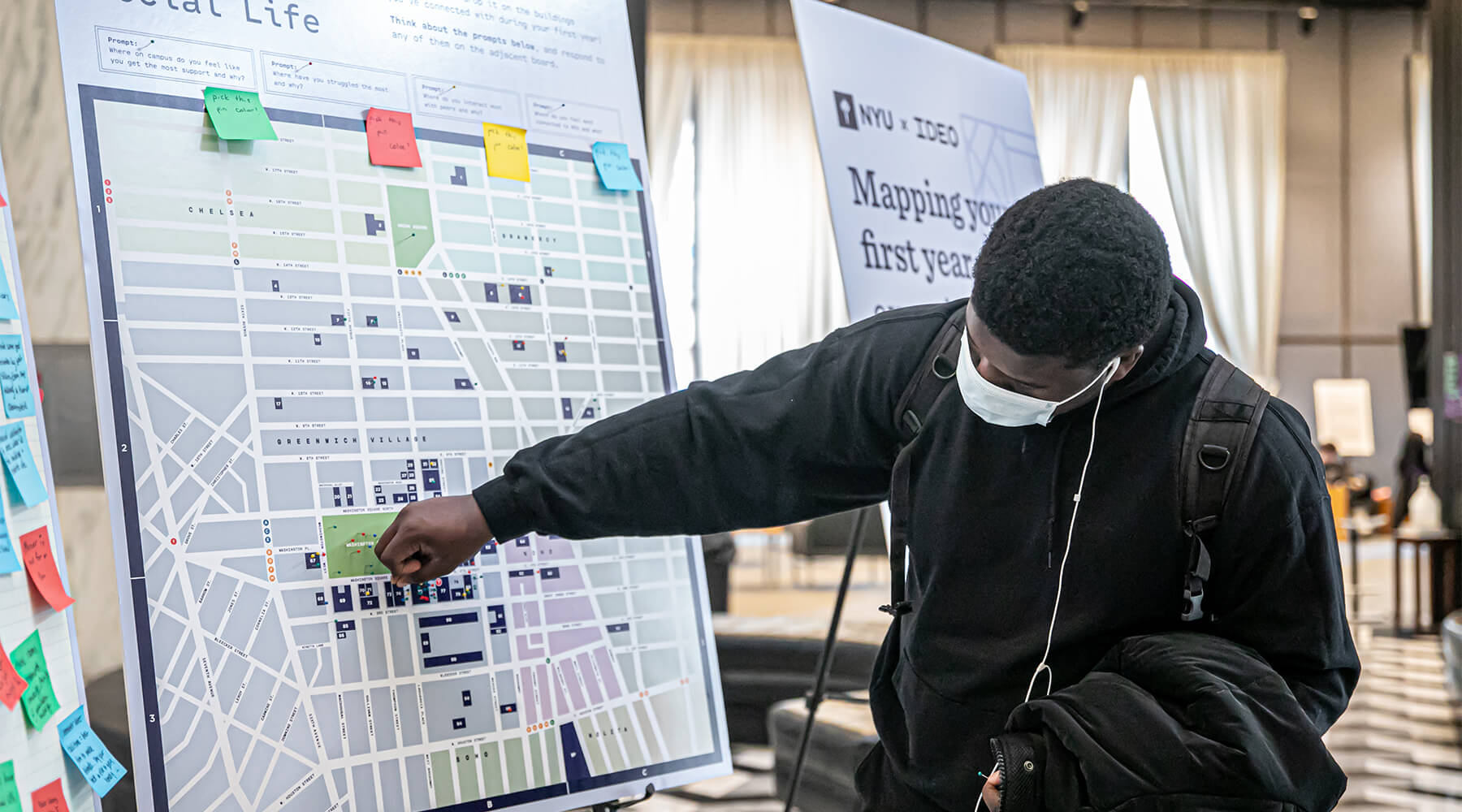
To synthesize those insights, we formed cross-functional action learning groups, challenging existing practices at the university and coming up with new ways of working. Participants came from a diverse set of departments, including enrollment management, student affairs, marketing and communications, IT, global inclusion, student services, the provost’s office, digital communications, and more. The cohorts sketched early hypotheses and got feedback from faculty, administrators, and students from all of NYU's undergraduate schools to refine initial concepts.
Collaborating with students gave staff a first-hand look at what students were struggling with and a way to engage students directly in addressing those challenges. Just as importantly, there was an overall culture shift at NYU: Administrators started with questions instead of agendas, came together around a table, and reached beyond their job descriptions to meet the needs of students.
First-year students reported receiving hundreds of paper forms, and email from more than 70 unique senders.
NYU needed to offer students the right resources at the right time—and collaborate to serve them as a unified administration.
New services
in-production include centralized calendars, dynamic campus mapping, and customized notifications
Design-thinking cohorts
now support the student experience

She knows best
A major athleisure brand passes the mic so women can define community for themselves.
Diversity alone isn’t enough—in marketing or any other facet of business. Today’s brands must authentically engage with and create the conditions for co-design with existing communities.
That sort of deep, meaningful engagement with customers doesn’t happen over Instagram. It requires a playbook, a prototype, and a healthy amount of trust. So, IDEO worked with Athleta and Gap to tap into the wisdom of a council of women who represent intersectional identities and lived experiences. The council surfaced powerful insights for the brand, like the fact that active women don’t need a brand to empower them—they already feel powerful.

After only a few weeks, Athleta experienced the difference between research and a truly reciprocal relationship. The way their brand engages with communities is adding depth, understanding, and authenticity to Athleta’s content, products, and experiences. And women can feel the difference.
76% of US adults say that the media promotes an unattainable body image for women.
Fewer than 1 in 10 businesses review for inclusion as part of product design and marketing campaigns.
>2X
user growth in 2022
13,000+
Athleta WellPro well-being providers active on the platform

“You’ve just got to get started!”
The conversation that fueled IDEO’s path towards Net Zero.
We were at a conference that IDEO was hosting in the Bay Area. We’d just been jamming on the approach Allbirds was taking to carbon labeling its products and he was chastising me for IDEO’s lack of visible progress in addressing the climate crisis.
His feedback stung. But isn’t that what friends are for—to call you on your BS?
I went home and dug into IDEO’s growing portfolio of work in the climate space. We had written a guide to circular design with the Ellen MacArthur Foundation, hosted open innovation challenges to redesign single-use cups and plastic bags with Closed Loop Partners, explored potential scenarios around the future of regenerative food systems, and had begun coaching many of our clients towards work that directly tackled climate change and sustainability. But in poring over our work, I realized that what we were doing so well for our clients, we were failing to do for ourselves. How could we expect our clients to partner with us on such important challenges when our own house wasn’t in order?
Luckily, I wasn’t alone in my desire to catalyze IDEO’s efforts around addressing climate change. Many of my colleagues were grappling with the same questions, including IDEO Partner, Dean Malmgren. As we dug into where we could and should take action, we began to grapple with the impact of Scope 3 emissions.
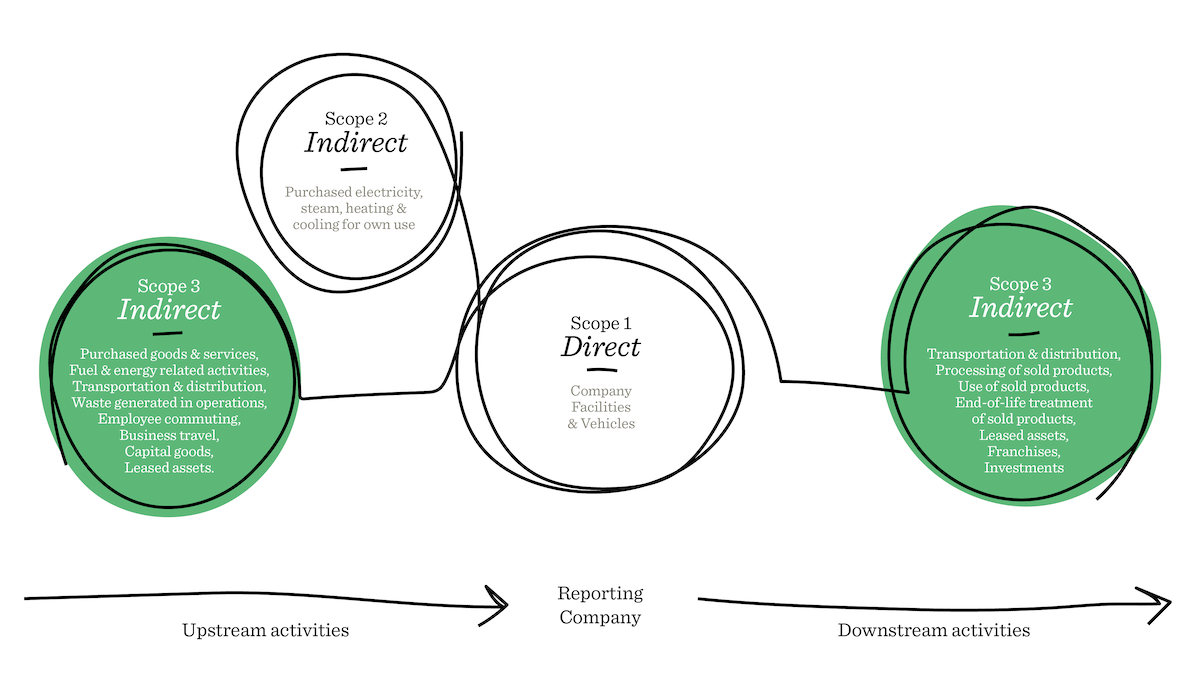
What are Scope 3 emissions? Greenhouse gas (GHG) emissions are categorized into three “scopes” according to the world’s most widely used accounting standard, the GHG Corporate Protocol. Scope 1 emissions cover direct emissions from sources an organization owns or controls. Scope 2 emissions include indirect emissions associated with the purchase of electricity, heat, steam, or cooling. Scope 3 emissions, or “value chain emissions,” are the result of activities from assets not owned or controlled by an organization. These indirect emissions occur outside of an organization’s operations—think business travel, commuting, or purchased goods.
Interestingly, 80-90% of an organization's carbon footprint comes from Scope 3 emissions—or from their upstream and downstream suppliers. So in order to reduce IDEO’s carbon footprint, we would need to carefully consider the suppliers with which we work and the impact of the work IDEO delivers.
At the same time, we’ve seen many of our clients wrestling with this challenge. While comforting to see, it also gave us a second, much needed, wake up call.
If our clients—many of whom have made public Net Zero commitments—were working on the same problem, they’d quickly arrive at a similar conclusion and start considering the climate impact of their business partners to manage-down their own footprint. We immediately saw the future: IDEO was going to increasingly be put under the microscope to understand whether we were the right partner for their business.
As we socialized this realization, we quickly learned that we’d already seen a steady uptick in clients and procurement partners requesting details about IDEO’s sustainability programs (and rightly so!). Not only are climate initiatives a moral imperative, but there was also a clear case for business risk associated with languishing. We were staring that business risk straight in the face.
And so Dean, I, and many others across IDEO made the decision to “just get started.” Because it’s the right thing to do for the planet. And because it’s the necessary thing to do for our business and for our clients’ businesses.
We made a commitment for IDEO to reduce our emissions in line with the Paris Agreement and to be Net Zero effective Jan 1, 2021. We estimated our carbon footprint. We purchased voluntary carbon offsets for our 2021 emissions. We switched to renewable energy across all of our locations globally. We experimented with addressing emissions offsets in our project plans and contracts. We offered more responsible investments in our 401(k). We have been regularly meeting with our sibling firms across kyu and the broader design consulting industry to share learnings and best practices for evolving our business model for the climate era. And many of IDEO’s locations have taken on a smorgasbord of initiatives to make their operations more climate-friendly as well, from switching to LED lighting, to serving local food and composting whatever we can.
We have made progress, but we are far from perfect. There’s much more work to do. And unfortunately, we are unlikely to be perfect any time soon. That’s where you, dear readers, come into play. Over the next few weeks, we’ll share some of the work we have done and the dilemmas that we have run into along the way. We’re hoping that this is the start of many conversations, ones that not only help us consider different perspectives and approaches, but also help others get started too.
To progress, together!
This article is part of a series detailing IDEO’s journey to becoming Net Zero, the lessons we’ve learned, and our continued commitments to addressing climate change.
Those were the words that Tim Brown, co-founder and co-CEO of Allbirds, uttered to me just before the pandemic began.

How play can lead the way to a sustainable future
Work, when accompanied by a playful mindset, can be highly effective, even joyful.
Picture the tower teetering and collapsing. Undeterred, you start over, stacking the blocks a little higher before the same thing happens again. With each attempt, your structure gets a little bit taller until you finally get the base just right, the balance just so and manage to build a magnificent tower that brings a big smile to your face.
How would you describe what just happened? Was this work or play? While one may initially see this as play, a deeper exploration surfaces what could actually be seen as an ideal work scenario. The child you imagined was focused, driven, and resilient as they worked towards achieving their vision.
When play is observed in this way, we understand that play and work aren't opposites. In fact, work—when accompanied by a playful mindset—can be highly effective, even joyful. So, instead of shunning play when taking on hard work, how might we embrace it? How might we take on today's toughest challenges—like the climate crisis—through play?
IDEO’s Play Lab has spent 25 years not only designing toys and games, but also developing deep expertise in understanding how play can shift consumer behaviors, overcome organizational blockers and empower us to take action—three important lessons that can help us make significant strides in transitioning our world to a circular economy.
Play is key for: Driving consumer behavior change
Changing consumer habits in support of a circular model can be an admittedly big ask. We’ve become all too comfortable with a linear economy model where the most intuitive path is to simply throw an object away after use. Knowing this, how might we convince consumers to choose new climate-friendly behaviors that may not be as familiar, easy or cheap as what they’re currently doing?
Telling people “the world is burning!” might catch someone’s attention. However, research has shown that fear-inducing appeals can actually be counterproductive in the long run, as audiences become overwhelmed or desensitized. Rather than sparking action, many climate messages are stoking climate anxiety and contributing to a growing mental health crisis that prompts despair, not action.
Fear isn’t an effective motivator, but what about play? Can we use play to tap into feelings of joy, satisfaction, achievement, and community to achieve long-term behavior change? Growing scientific evidence is demonstrating the benefits of positive psychology in supporting pro-environmental practices.
According to Barbara Fredrickson’s “broaden and build” theory, positive emotions promote growth and build human capacity to learn and gain skills, as opposed to negative emotions, which tend to narrow one’s thinking. When we can align with what brings people joy, it’s easier to ignite passion, and passion is what helps people carry through on their promises—even if those promises require tough trade-offs.
We sought to drive environmentally-minded behavioral change through the Beyond the Bag Challenge, which was launched by the Consortium to Reinvent the Retail Bag alongside the Managing Partner, Closed Loop Partners, and Founding Partners CVS Health, Target and Walmart. In reinventing the retail bag, we asked innovators to rethink the way consumers transport goods from store to home. It’s a mountain of a problem, both literally and figuratively, and replacing a wildly optimized plastic bag is no easy feat.
The nine challenge winners developed solutions ranging from a returnable system to a tag-and-app system that allows consumers to track environmental impact and earn rewards via the reusable bags they already own. Each of these solutions requires new behaviors, and aspects of play were leveraged to drive long-term engagement with the bag services.
For instance, customers could earn points for reusing bags and returning bags. We tested various ratios of points-to-reward to determine how we might motivate the desired behavior, while remaining financially sustainable. We had to determine what rewards (like being able to redeem points for coupons or carbon offsets) most resonated and what points system was easiest to understand, with a clear correlation between action and reward. Moreso, the reward system had to act as direct feedback for customers to see how their behaviors were aligning with intrinsic goals and feelings of pride and identity, versus falling into the all-too-common gamification trap of only serving up extrinsic rewards, which can often stop short of driving long-term motivation. Unless this system was designed with care, customers would lose trust and revert back to previous behaviors.
In addition to a thoughtful rewards system, we used narrative to align the program’s principles with customers’ personal values, reinforcing intrinsic motivation to encourage sustained behavior over time. A cohesive narrative can serve as a valuable frame of reference, validating the customer’s actions and reinforcing their decision to participate in a reuse program. With environmental efforts, customers often ask “why bother?” To answer this question, we discovered an opportunity to offer meaningful statistics in a way that feels relevant, human and tangible—for example, “If you commit to ditching the single use habit, you can save 72 plastic bags this year. If every adult in the US did the same, that would be a CO2 offset equivalent to shutting down a coal power plant for 7 years.”
Play is key for: Overcoming organizational blockers
The transition to being a more sustainably minded organization is not an easy one. As a manufacturing company, how do you convince your employees to buy into a circular economy, change work processes and contribute to new climate goals? How does the lone sustainability expert transform an organization that desperately clings to existing processes, even while facing pressure from impending government regulations and changing customer sentiment? It can be truly daunting to have built your business selling goods and now realize that the rules of the game have changed to require you to extract fewer resources from the Earth and produce less waste.
It’s natural to feel stuck. When faced with constraints of cost, optimized tooling and processes, existing manufacturing and transport partners, as well as consumer expectations for a rotating assortment of fresh, new products, how can one even think about doing anything that might upset this perfectly balanced machine?
Rather than be paralyzed by these constraints and the need to get it right from the start, adopting a playful mindset can help an organization reframe the move to a circular economy as an opportunity for innovation—a chance to try creative new approaches and processes that haven’t been evolved for decades.
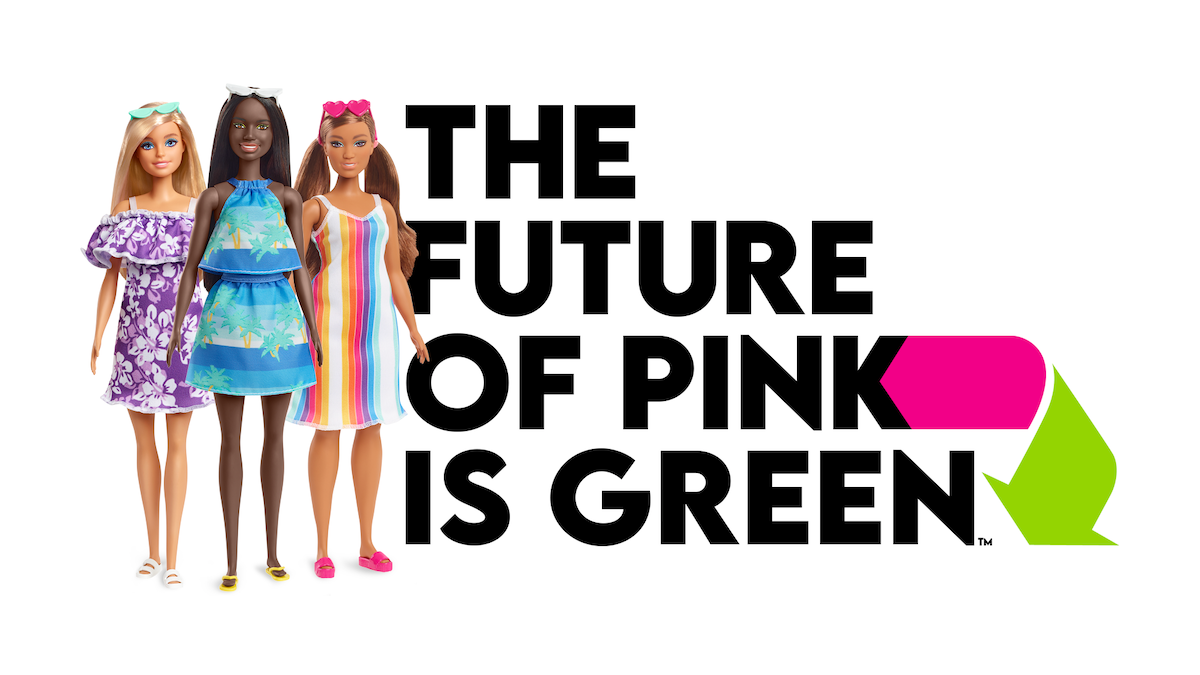
When Pam Alabaster, Mattel’s Head of Global Sustainability, joined forces with IDEO to develop a series of Circular Economy Workshops for the company, she came to us with an inspiring mantra of “Progress, not Perfection.” Through play, we could introduce circular design principles while creating a protected space insulated from real-world stakes, so that participants could temporarily put aside the constraints of their jobs, challenge assumptions and dream of new possibilities.
By imagining how they might battle the “villains” of a linear economy—like the Monstrous Hybrid, with multiple materials fused together, or Packagus Maximus, who is surrounded in excess packaging—designers from various departments at Mattel had permission to step out of long-held boundaries and experiment, while removing the heavy mantle of "this is overwhelming and impossible."
“Through education and a common understanding across the organization of what we can do together, we’re equipping our amazing group of talented and passionate people with the tools they need to not stand on the sidelines but be part of this transition and help move us forward,” says Alabaster.
Indeed, in polling the designers at the beginning and end of the workshops, we saw them grow increasingly confident in their company’s ability to achieve its sustainability goals. Many people entered feeling uncertain about what a more sustainable path might look like but left with practical tools and a mindset that made it seem possible.
Play is key for: Piloting and prototyping sustainable solutions quickly
When considering climate action there are many good intentions but there’s not always a lot of forward movement advancing solutions. Because the consequences of our actions don’t feel immediate, it can be easy to spend more time talking and strategizing than diving in to implement plans to see what might actually work.
Play, on the other hand, is active. This is obvious when you watch kids play. Rather than sit and read the directions, they’d much rather dive in and just start experimenting to see how a new toy might work. Often, because of this, they find ways to interact with products that the product’s designers never even imagined.
In Tom Wujec’s Spaghetti/Marshmallow Tower experiment, kindergarteners regularly outperform CEOs and recent business school grads because, when asked to build the tallest possible tower with the given supplies, the kindergarteners bias towards action, trying different configurations and iterating with each lesson learned. Younger children don’t stop to wonder what’s possible—or worse, what isn’t possible. They simply jump in and try. For them, failures aren’t seen as obstacles; they’re learning opportunities to fail fast and succeed sooner.
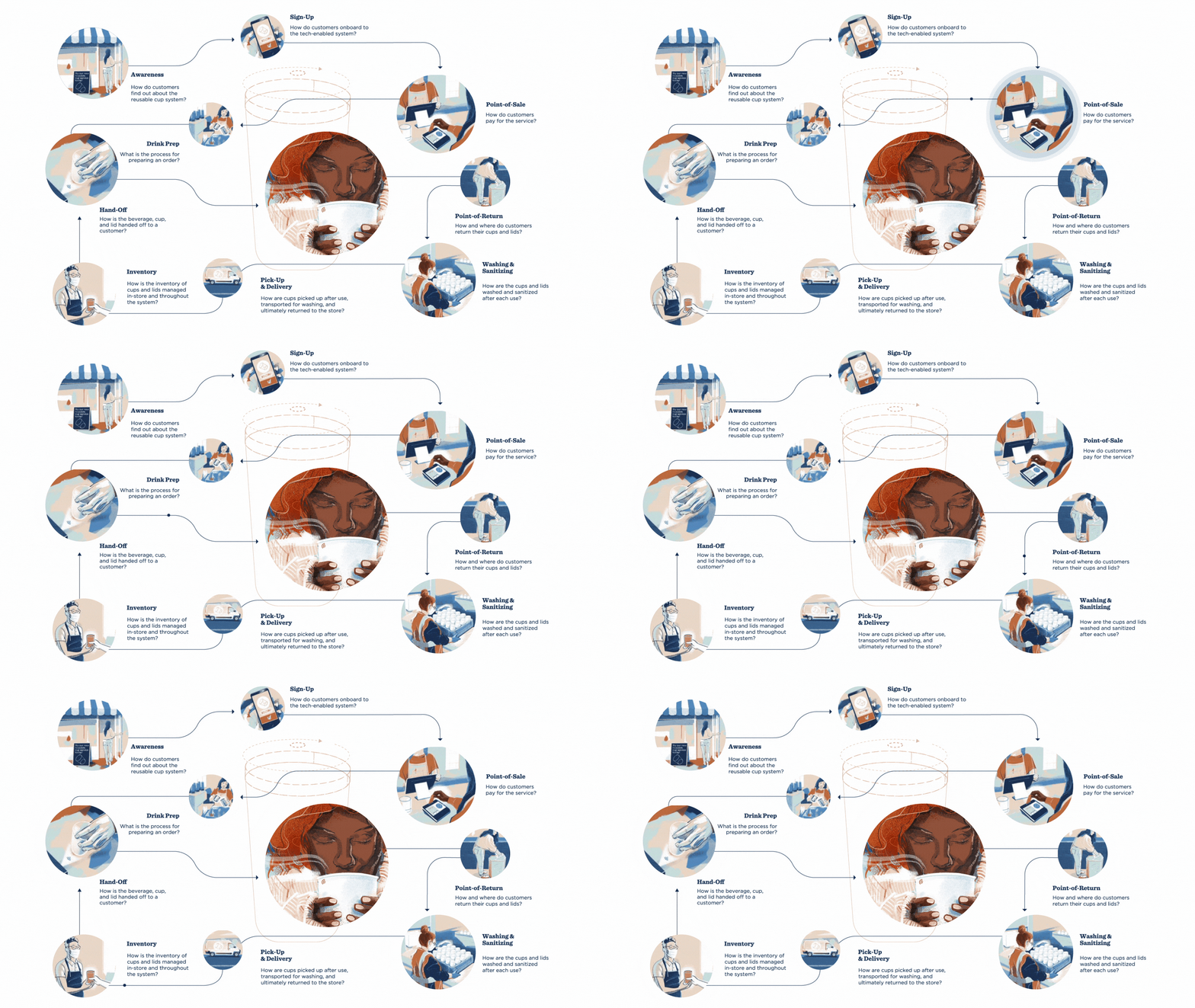
IDEO partnered with the NextGen Consortium, convened by Closed Loop Partners, to explore the question: “How might we design the next generation fiber cup to be recoverable on a global scale, while maintaining the performance standards we know and trust?” Tackling it meant creating innovation at a systems level and considering the entire cup ecosystem: brands, suppliers, municipalities, materials recovery facilities and mills, the general public, and more.
There’s the cup itself, and there’s also the way it’s used: changing how customers order, how baristas select and serve the cup, how customers dispose of or return the cup, and how the cup is washed or thrown out. The sheer scale can feel so big as to be immovable. Adopting a mindset of play helped us get moving quickly.
The NextGen Pilot Readiness Program was a series of live, in-market pilots in the San Francisco Bay Area to further test and refine promising reusable and single-use solutions in local cafes. As compared to a traditional retail pilot, we weren’t trying to validate the solutions but rather identify challenges and test solutions around those.
On the very first day, we engaged in role play activities to work out how the cashier would engage with the customer about the service. Every time we played through it, participants’ explanations of the service became clearer, and it became obvious how we could change the order of operations to run smoothly. It allowed us to arrive at a script we had confidence in sharing with the cashiers in the field.
This process is representative of our approach: start on a smaller scale in an environment with limited risk. From there, gather feedback to iterate, experiment and test. By prototyping not just at the end but throughout the process, we come to see how elements of the solution can readily be re-evaluated and evolved. When it comes to prototypes, very little is sacred. This is an opportunity to push wide, experiment, and learn in service of surfacing new ideas and approaches.
In the course of role playing, one of the participants told us they felt a little silly engaging in this way. The comment was unsurprising. As adults, we often regard play as fun and lighthearted, as something extracurricular to our working lives. We don’t always see the connection between play and progress, but it’s there. There may have been elements that felt a little silly in role play (we actually believe that laughter throughout the creative process is an indicator that it’s going well!), but this was also a very concrete first step. It started an important conversation, underpinned with excitement about innovation and problem solving.
These are the kinds of conversations that companies and organizations need to be having if we are to move the needle with sustainable solutions. Sustainability sounds good to just about everyone, but the process of getting there may be fraught with challenges. In order to overcome obstacles and change behaviors for a broad audience, we have to make sustainability feel good, and we have to make it easier to get started. Play can help get us there.
- A collaborative piece by IDEO Play Lab with special thanks to Takashi Wickes, Matt Callahan, Matt Hovde, Keren Wong and Michelle Lee
Try something with us: close your eyes and imagine yourself as a child stacking blocks higher and higher.

Why you should treat your DEI data with rigor and care
How do you measure how diverse or inclusive your workforce is? And—perhaps even more importantly—what should you do with that DEI data once you have it?
As head of IDEO’s global change management team, which focuses on belonging and equity, I’ve seen the importance of being rigorous with and thoughtful about the information we collect and how we share it.
Telling someone to handle data with care might suggest that it’s fragile or in danger of breaking. That’s not the way I view it. I see a responsibility to keep the data whole. It’s about integrity.
That applies from the very start: gathering and understanding your DEI data. Do so with rigor. The system, process, tools, and analysis method you’re using should stay consistent. Looking at the same factors the same way every time allows you to measure progress, and the uniformity will help people trust the data.
When it comes to data related to DEI (Harvard Business School Professor Frances Frei puts it nicely as “achievement” and “sentiment” data), the achievement part is fairly straightforward. It’s what the organization looks like across different levels of the employee life cycle in a number of demographics. There are the core metrics around representation in terms of race and gender, and some organizations also track sexuality, disability, and education. These metrics help us answer questions like: How diverse is our senior-most leadership level? Which groups are leaving the organization the fastest? Are we over- or under-recruiting certain identities? Are we promoting men faster than women?
The sentiment data is about bringing in the employee voice and getting at what it feels like to work at the organization. If the achievement data is the what, the sentiment data is the why. These are the questions around culture, about whether employees can say “I can be my authentic self at work” or “I have easy access to information.” These are the questions that help you get at whether the culture is too transactional, too cautious, whether people feel they can innovate. The achievement markers are the same across the board, but the sentiment questions tend to change by organization and can be shaped based on places you might have concerns about based on early hunches or focus groups.

Once you have collected the data, transparency is important. But pause first. The way forward is to proceed with care. Data and information can be a burden to people, especially if they don’t have the power to impact it, so it’s important to understand who holds the accountability. If you were to go out to the broader organization and say, “Hey everyone, we have a lot of evidence we’re failing on these metrics,” people will immediately want to know what you’re going to do about it. Building trust requires that you have thoughtfully considered possible interventions and solutions. There is responsibility that comes with transparency.
Design can be a powerful way to arrive at those interventions. Let the data first sit inside the group that is accountable for designing ways to prototype and pilot initiatives that might help improve future metrics. For example, if the sentiment data shows your people don’t feel like they belong upon initially joining the organization and don’t know where to get the information they need to do their job well, you likely have an onboarding problem. Maybe you’re putting a disproportionate amount of energy into recruiting but not ensuring those employees succeed once they are inside the organization.

With that insight, you can prototype interventions: What would it look like if we paired every new employee with someone from the same background or interest who is thriving in the organization? What if there was a two-week support circle for new employees every 60 days?
Once you have your interventions, you’ll want to test the ideas with a few groups of people and get their feedback: in the onboarding example, perhaps the ones who have been at your company for less than a year and the ones who the intervention might put a burden on. It's best practice to invite the employees at the margins of the organization (typically from a race and gender lens) to get their input on your recommendations—if they are willing and it’s not a burden to them—before sharing with leadership. If you’re able to design interventions that work for those most marginalized in the organization, the solutions will work for everyone.
Onboarding is something we’re working on at IDEO based on our last Culture survey. When we dug into the data we realized that as a creative organization, new hires want to tangibly contribute from day one. Great onboarding gives the security and confidence to do that, and so we have been piloting initiatives ranging from having two leaders dedicated full-time to onboarding within our talent organization to having new hires shadow a designer of the same craft on a project so they can start to understand how to create value from day one.

Once you’ve identified some potential interventions and soft-tested them with the right stakeholders, you are ready to share the data company-wide: “Here’s what we heard and learned and here are three to five things we’re going to prioritize as next steps.” You aren’t restricted to sharing shortcomings. Accentuate positive findings too, things you’re trying that are working or successes that you’re going to amplify going forward.
Especially with DEI data, remember that internal audiences are more important than external. A lot of companies capture this data and put it on their website as a recruiting and tracking tool, and that’s a great way for organizations to hold themselves accountable. However, the fastest way to break trust is to make employees feel like the data is only being captured for external purposes. Keep the emphasis on collecting and sharing data internally in service of improving employees’ experiences at the company and the effort will feel genuine.
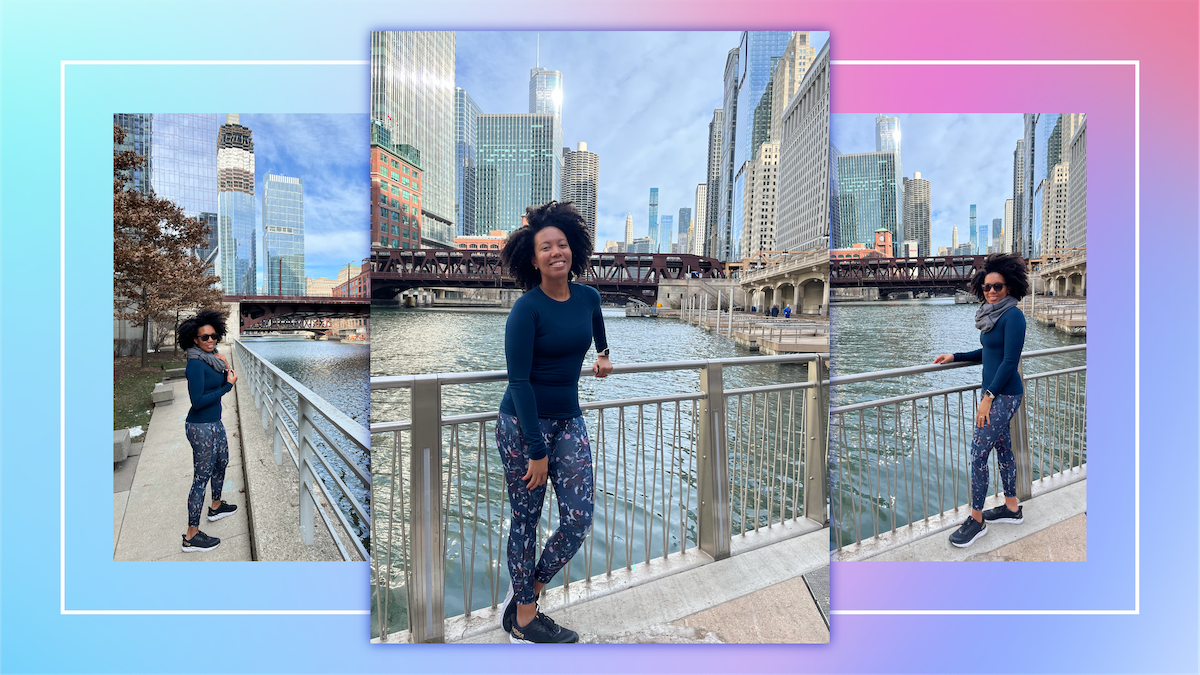
Regularly deep diving into achievement and sentiment data can be emotionally taxing. If you’re doing this work, be sure to give yourself a way to take a break from it. Last year I started walking every morning on Chicago’s riverwalk, because it grounds me and gives me perspective. It’s easy to get hyper-focused on the challenges or overwhelmed by the gaps we need to fix and inequalities we need to right. Taking a moment to get my body outside and walk around helps remind me there’s more beyond the problems I’m trying to solve and helps me be present for people while I am working. There’s something so inspiring and revitalizing about having fresh air hit my face every day. And even though I pretty much walk the same route, I notice something new every day, something I didn’t see the day before. I try to bring this same curiosity to my work. Even though the challenge may look the same from day to day, there’s always a new idea or potential solution just one step away.
Proceed with care. It’s some of the best advice I can give when it comes to diversity, equity, and inclusion data—how to best measure it and what to do with that data once you have it.
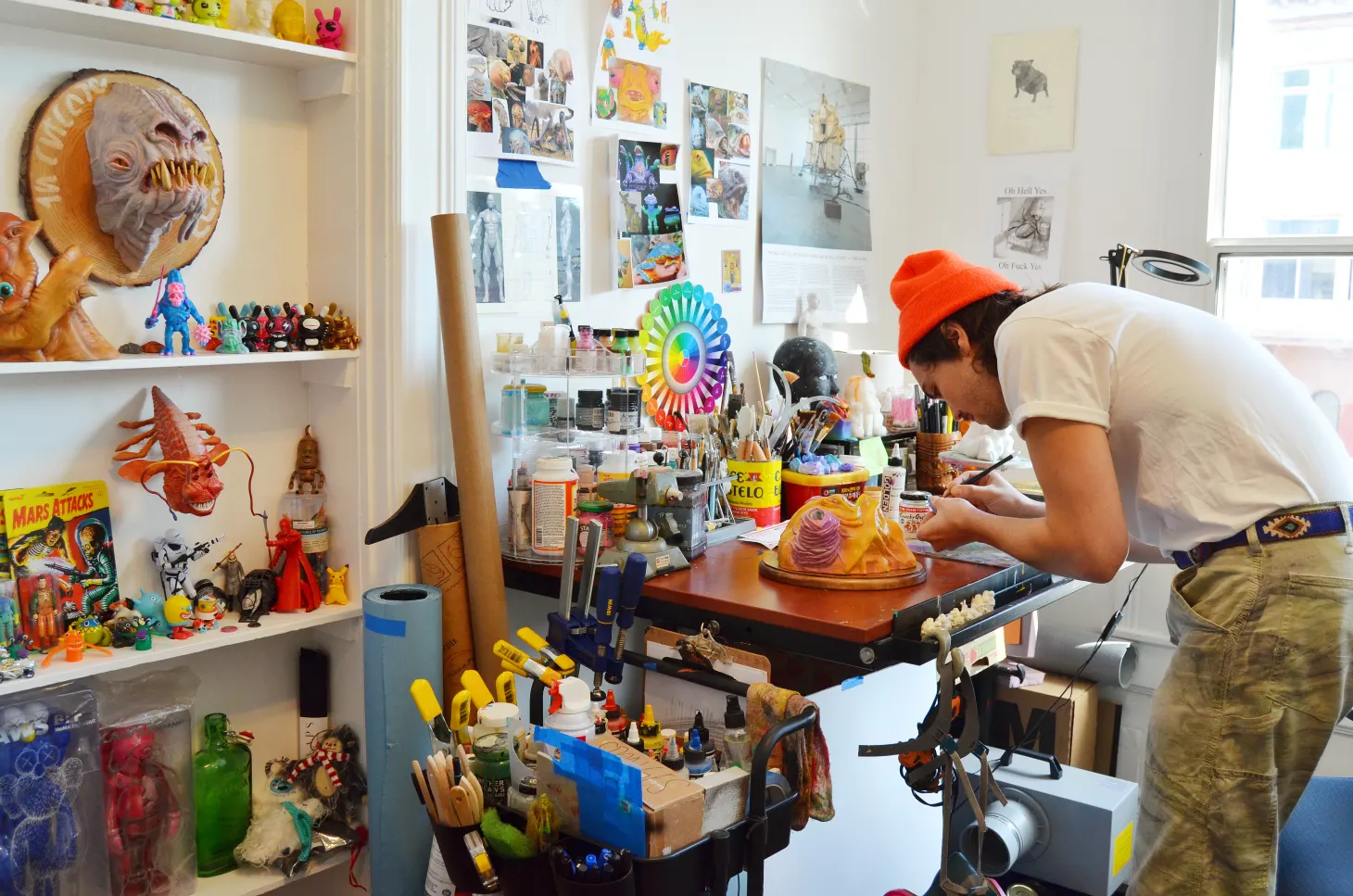
How curated clutter makes this designer’s home inspiring
In our work-from-home times, it’s a different way to think about your space.
Clutter has the opposite effect for me, but there’s a very specific twist. If the type of clutter that drags us down is disorganized clutter—stacks of papers, discarded shoes, and items with no home—I’ve cultivated the opposite: what I like to call “curated clutter.”
I’m an industrial designer who works as an IDEO Toy Inventor in the Play Lab. My job is exactly what it sounds like: I come up with new toy and game ideas based on market research and client asks and then design and prototype them.
Like so many of us, I have been exclusively working from home in San Francisco since March 2020, and the remote working space I’ve created for myself is different from what I’ve seen so many other designers create. Theirs tend to be sleek and very minimalist. That’s never been me, even dating back to design school, when I used a desk covered in astroturf.
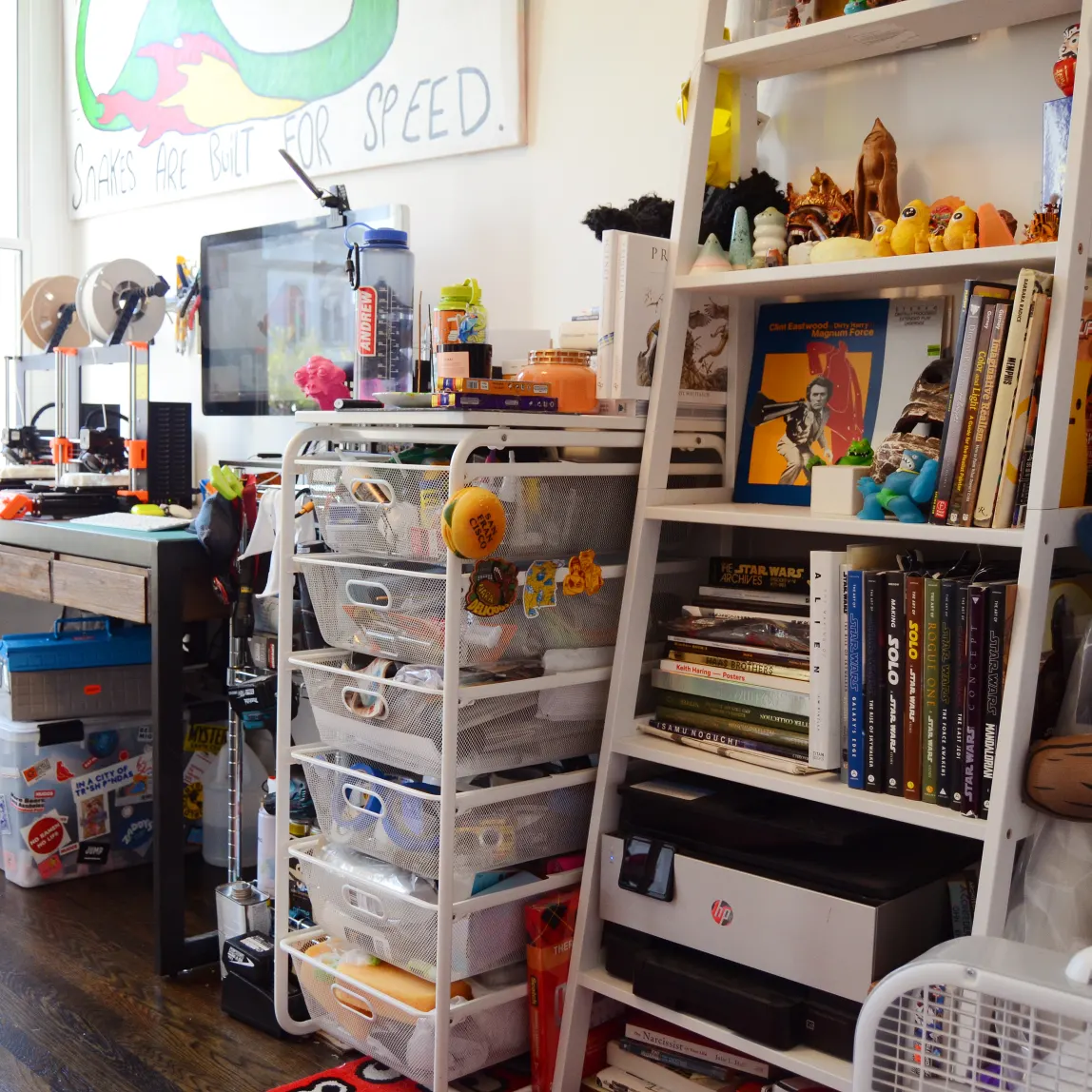
My workspace is an explosion of color, an arrangement of knick knacks on my desk and shelves that serve as pieces of inspiration. Some have been with me for more than 25 years. Others are recent additions, both things I’ve collected and gifts from friends and relatives who have spotted things they thought were special or entertaining and might fit well.
I don’t keep a journal, but my knick knacks function as sort of a substitute practice for that. They capture both some of the chronology of my life and the emotional state I was in when I received them. I have alien action figures from my childhood that remind me of how genuinely afraid I was of aliens as a kid and how far my thoughts and imagination could stray. But there are also items I’ve collected while dating my partner, like a meaningful piece of coral from my first trip to her home in Hawaii. It’s sort of like free-form scrapbooking, just not confined to a leather-bound tome that gathers dust. While nothing’s written down, that history is captured, and I get to scan and revisit it regularly.
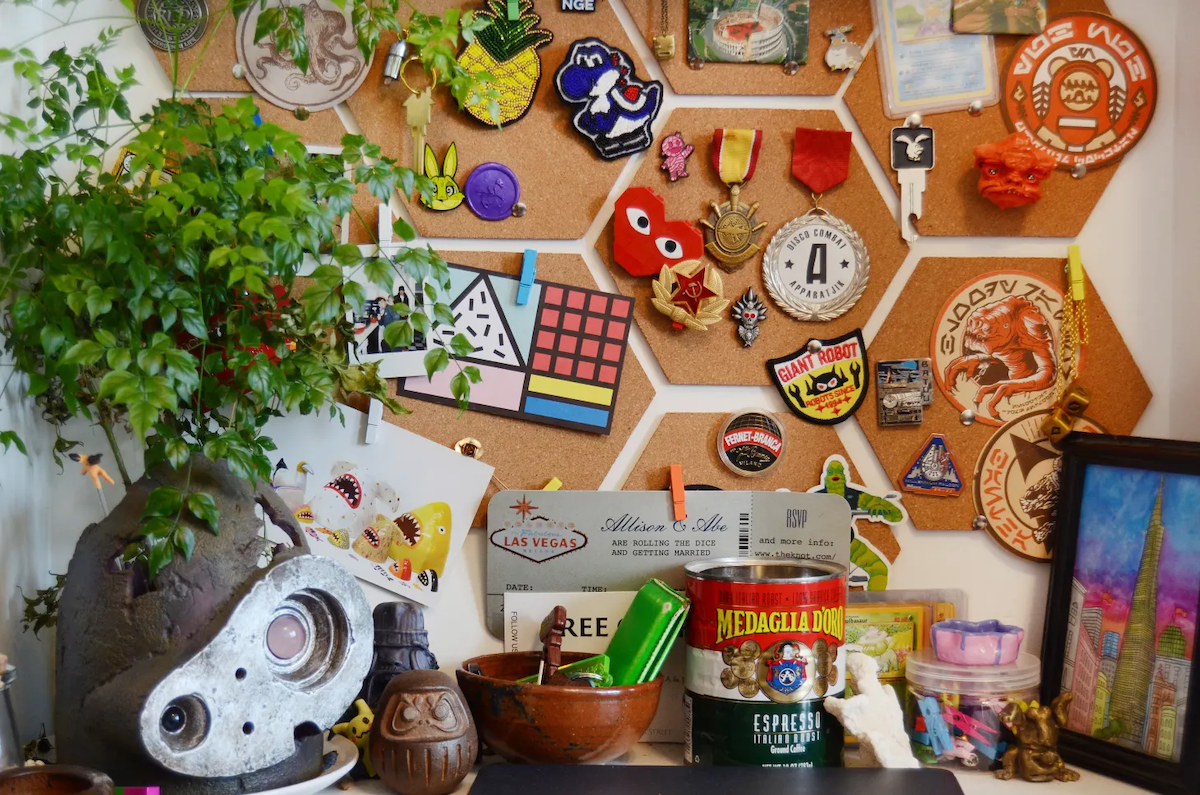
The clutter is curated but not fixed. I rotate the items, and that process is rejuvenating and refreshing. To keep things from straying toward hoarder territory, I stick to a couple rules: I only hang on to the things that have some kind of value to me, and if I can’t move something without knocking something else over, I need to reassess.
I live with my partner, who is adamant that she is not a fan of clutter, but our friends will laugh and say “What are you talking about?” Her approach is an even more curated and refined way of displaying objects, and I think it’s a good illustration of there not being one “right” way to do it. Your curated clutter could be five items or five hundred. Ultimately, if clutter is made up of the things that have no home, curated clutter is made up of the things that make your home.
For many people, designing their workspace or spaces in their home is a very purely aesthetic process, like, I like the way this lamp looks, or this pencil holder looks. That process can end up being devoid of emotion, which I think can result in a space that's not necessarily built to address our emotional well-being—a consideration that’s more important than ever these days.
I know incredible designers who project a very clean designer persona and have tasteful objects in their houses: walnut, leather, beautiful brass hardware. And then you look at their inspiration boards for work and they're wacky, and I don’t see the purpose in reining in that inspiration. Sometimes the idea of what is good taste causes people to censor their living space. That’s not for me. I’d much rather be in a place that’s overstimulating than understimulating.
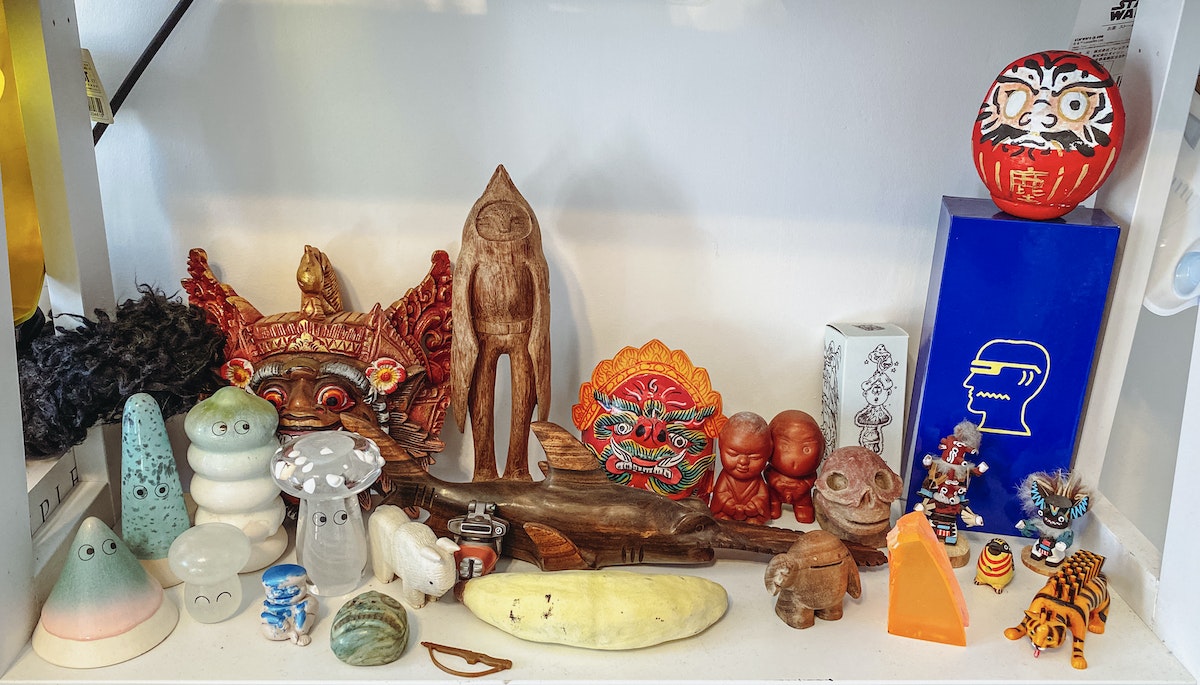
I would say almost every day I feel inspired by what surrounds me. It’s a library of thoughts and thought-beginners, especially my desk, which puts different textures and color combinations and parts and mechanisms in front of me. But above all else, my curated clutter provides a sense of comfort, which ends up supporting my emotional well-being. At times when I feel anxious or overwhelmed, it grounds me because it’s an extension of myself: a way of revisiting people and moments that matter. It’s like flipping through your journal to remind yourself where you come from, then feeling energized enough to flip to the next blank page and keep going.
Multiple studies have suggested that cluttered workspaces are no good for us, or even downright harmful. Connections have been made between clutter and procrastination, stress, and even life dissatisfaction.

Lindsey Turner
I’m passionate about building brands, products, and experiences that help organizations show up with meaning and momentum.
I help organizations cut through complexity by shaping how they show up, through brand strategy, identity, and storytelling.
Working at the intersection of brand and business, I bring an editorial eye and a bias toward making—turning ideas into tangible experiences that people can understand, trust, and believe in.
My work spans government, healthcare, financial services, media, and consumer goods, from launching Gen Z-focused ventures to building innovation labs and reimagining legacy brands. I relish moments of ambiguity and enjoy translating across teams, perspectives, and priorities to move ideas forward.
I started my career in editorial and digital design, shaping cross-platform experiences and identity systems in publishing and agency environments. That foundation still shapes how I work today: I’m detail-oriented, collaborative, and overreliant on the Oxford comma. I hold a BFA in Visual Communication from the School of the Art Institute of Chicago.

Rachel Young
My work helps organizations see who their products aren't working for—and build the will and the tools to do something about it
For 25 years, I've asked the same question: Who does this design exclude—and what are we going to do about it?
My work spans human-centered strategy, inclusive design, and qualitative research, with clients ranging from Microsoft, Google, and Verizon to the National Science Foundation, and San Francisco Unified School District.
Before IDEO, I taught elementary school in East Palo Alto and spent a decade doing design work with social service organizations—where I learned firsthand what it costs people when systems are built without them in mind.
I am currently writing User Error, a nonfiction book about digital access and the design decisions behind it. I live in Oakland, California.

Brian Pelsoh
I lead with craft, ensuring our work is creatively excellent: rooted in deep human insight and imagination, while also grounded in the realities of business and technology.
My expertise spans brand, communication, and product design across tech, education, the arts, and social impact.
I believe great work demands both high-level vision and obsessive attention to detail, and only happens through collaboration.
I bring an inclusive, hands-on approach and a deep understanding of business, which enables me to consistently deliver excellence while always asking why.
Before joining IDEO, I worked at the brand firms Pentagram and VSA Partners. I began my career as a designer, leading teams at the School of the Art Institute of Chicago and the Milwaukee Art Museum. I hold an MFA in graphic design from Maryland Institute College of Art and a BFA in communication design from the Milwaukee Institute of Art & Design, and have taught at some of the best design schools in the US.

Tony Wong
I am responsible for IDEO’s long-term success in China and working with clients to use design as a tool to enable growth.
I am responsible for IDEO’s long-term success in China and working with clients to use design as a tool to enable growth. Specifically, I have helped Chinese companies design holistic brand solutions through the development of their products, communication, services, and innovation teams, and I have helped multinationals expand their presence and influence in China.
I advise global leaders on developing China-led innovation and capabilities.
In over 15 years in IDEO Shanghai, I have worked on projects that use design to elevate the quality of the experience of healthcare products and services, streamline processes that increase productivity, create spaces and programs that promote and enable inclusive communities, and build next generation mobility solutions that are planet-positive.
Before joining IDEO, I worked at Philips Electronics and the Electrolux Group in Italy, the Netherlands, and Singapore on a number of breakthrough commercial products. I am a member of the Young President Organization in Shanghai.

How to use AI as an editor, not a writer
Ed White shares how he uses AI as an editor—not a writer—to sharpen storytelling, rehearse ideas, and preserve the productive friction that makes creative work better.
Ed White has a rule he's tested on his own writing: hold yourself as the writer, and let AI be your editor. Ed is a Senior Design Director at IDEO's London studio, where he co-leads the firm's AI portfolio across Europe. Before IDEO, he spent 12 years as a writer and editor at the Financial Times, Wired, and Contagious. So when he talks about when to use AI for storytelling and when not to, it comes from two decades of crafting his storytelling skills.
In this episode, Mina Seetharaman talks with Ed about two specific tools he uses to keep AI in an editor's seat: a "roasting agent" prompted to critique his drafts without any sugarcoating, and a simulated audience he rehearses pitches on before the real thing. They also get into what Ed is hearing from design leaders at Anthropic, Lovable, Shopify, and Google Creative Lab about how creative work is changing, and why he thinks the friction of writing something yourself is worth protecting rather than automating away.

Building a personal AI for the messiness of life: Sida Li
Becca Carroll talks with Cue co-founder Sida Li about designing a personal AI for the messiness of everyday life—not just work. They explore how Sida stays anchored to human needs while navigating fast-changing technology, product tradeoffs, business-model experimentation, and the realities of building an AI company today.
Most AI products today are built for work—a space with clear problems and established systems. One founder noticed a gap: personal life is messier, harder to systematize, and mostly left behind by the AI boom. So she built Cue, a personal AI that lives inside iMessage and group chats, to go where the other tools haven't.
In this episode, Becca Carroll, IDEO's Chief Strategy Officer, talks with Sida Li, co-founder and CEO of Shared Context Lab, about staying anchored to a human need while the technology around her keeps changing shape, why she treats her business model with the same rigor she'd bring to a product, and what it feels like to build a company at this particular, disorienting moment in AI.
The conversation also gets into how Sida makes design decisions: the language Cue uses to describe itself, the tradeoffs behind building inside iMessage instead of a new app, and a real story about a business idea that didn’t pan out.
This is the second in a two-part series profiling founders from IDEO's Startups-in-Residence program. The first conversation is with Johannes Seemann, founder of Sooner, on designing GenAI for the emotional side of money.

Designing GenAI for the emotional side of money: Johannes Seemann
Designing financial tools around the feelings that shape money decisions.
Most personal financial tools are built to run the numbers and optimize towards a budget. While that works for some, most people experience money as a lived relationship that does not neatly fit into a spreadsheet. Johannes Seemann and Becca Carroll discuss why money is emotional before it is mathematical, and what a human-centered approach to building a generative AI financial product looks like in practice.

The curious leader's edge in uncertainty: Scott Shigeoka
How genuine curiosity helps leaders navigate uncertainty with greater confidence.
Mina Seetharaman talks with Scott Shigeoka, author of Seek and Head of Curiosity Cultivation at the Eames Institute, about what distinguishes genuinely curious leadership from performative curiosity, how power dynamics shape curiosity, and why practicing curiosity can restore energy rather than drain it.
Looks like you might be in search of something very specific?
Or reset the filters above and try another angle.
Here’s some random inspiration

Podcasts about creative leadership

Articles about the power of prototyping