
.svg)


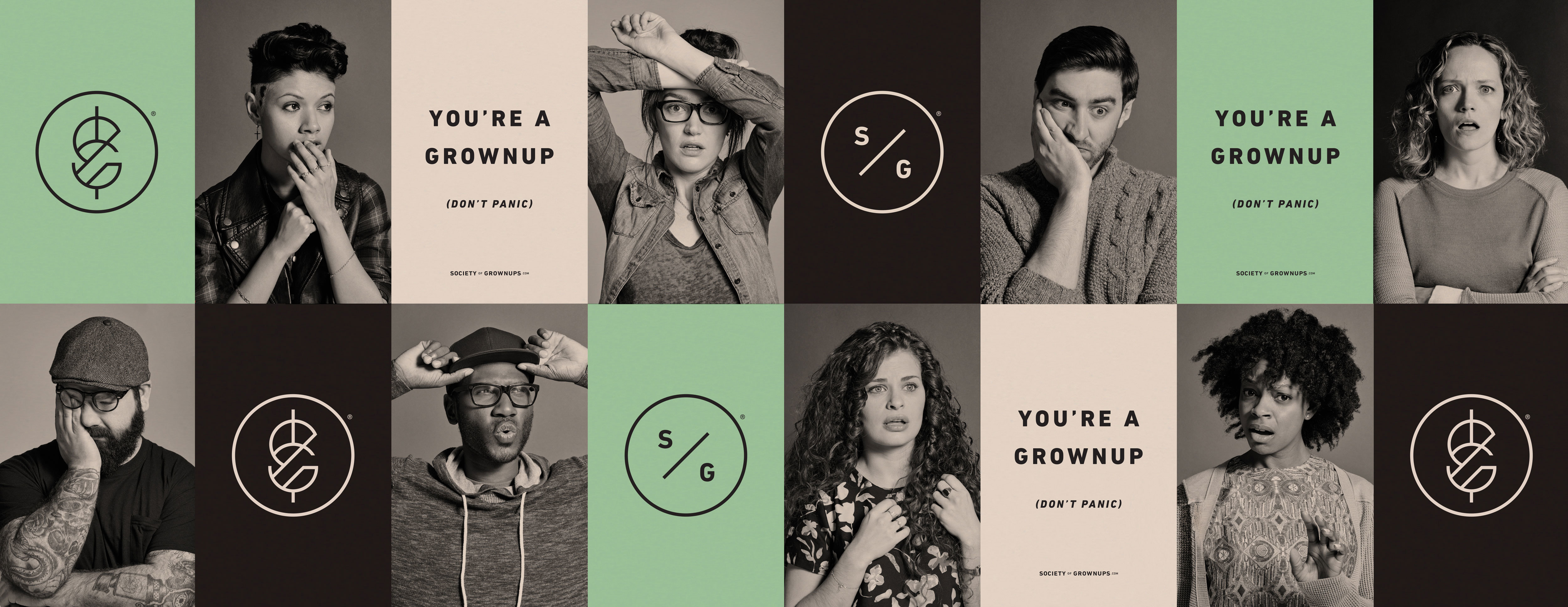

Helping young adults make smart money decisions
Society of Grownups offers financial advice to those who need it most.
When you’re under 40, buying a life insurance policy may seem about as practical as buying a Humvee. That makes insurance a tough sell for a 165-year-old company like MassMutual. To find a way to become relevant to this generation, MassMutual partnered with IDEO with a mission to get young people interested in their own spending habits.
Over the course of two years, the teams set out to learn about how people across the US spend and save their money, and they uncovered a simple theory: you either have a smart money mindset or you don’t. When it comes to being mature about financial issues—chipping away debt, saving to buy a car—it doesn’t always come naturally. If anything, many feel disconnected from money-related matters, even if it’s in their best interest to know more.
"I hate going to a bank and not really knowing what I am doing when it comes to money," said Simon Bowers, a 31-year-old who works in public relations, featured in an article in Fast Company about the MassMutual-IDEO collaboration. "They don’t seem to take into account that this might be scary for us."
So how to invite this wary demographic to the table? Design an accessible way to meet them wherever they are: online and on their phones. IDEO helped build the new venture from the ground up—designing a brand identity and experience focused on transparency, meeting users where they are, and helping people navigate complicated financial situations so they can live life on their own terms. It’s called Society of Grownups, and you can think of it as a sort of master’s program for adulthood. Each piece of the program builds on a common vision that continues to iterate every day.
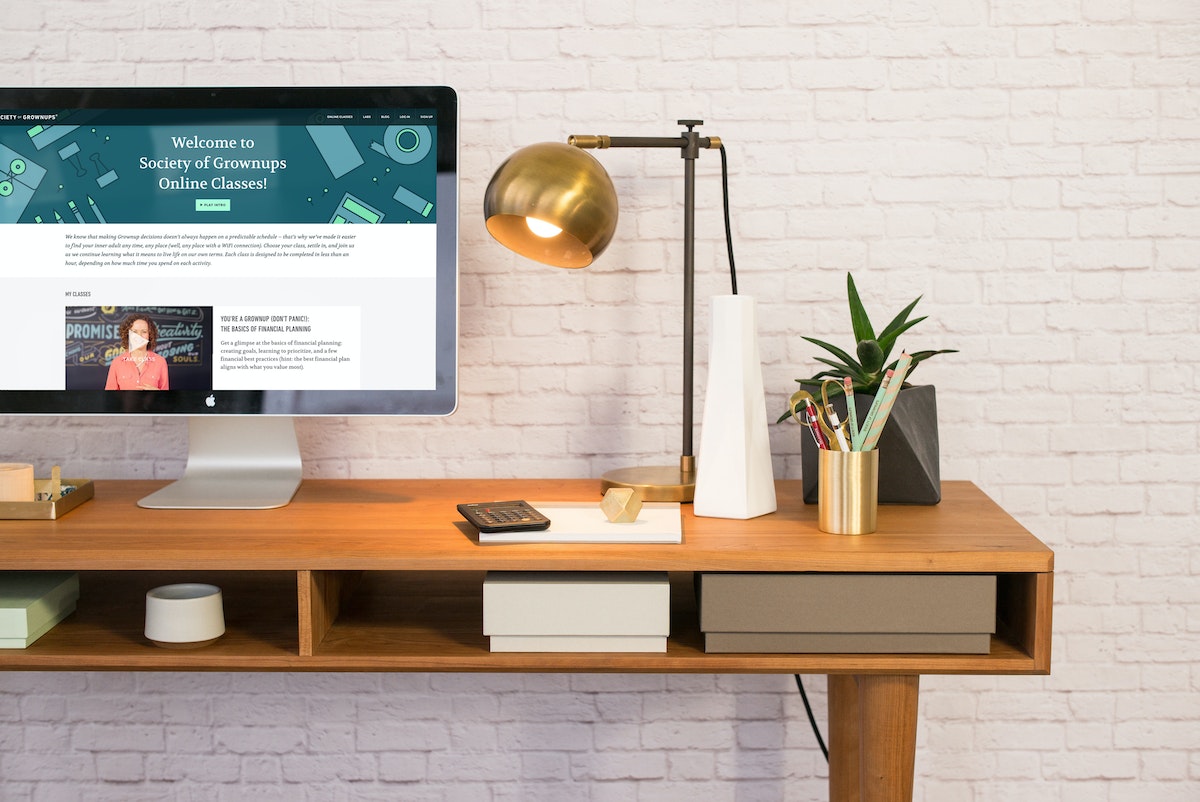
After building and testing full-scale, live prototypes, the brick-and-mortar Boston location opened in 2014 and operated much like a supper club—a warm, inviting space where young people could hang out, feast on delicious meals, attend talks, and learn about things like 401Ks, living on a budget, and how to pick good, cheap wine. After two years of continued prototyping, MassMutual recognized that the digital channel has the most potential to grow and closed the brick-and-mortar location to focus their investment in building out the bespoke online financial tools to reach more people across the nation.

Helping a digital healthcare startup to scale up
A redesign, a rebrand, and a new focus.
From leeches to gene therapy, how we treat sickness has changed beyond recognition over the centuries. But one question asked by ancient healers and modern doctors alike remains the same: “How are you feeling?”
“We’ve had the ‘quantified self’ for a number of years—sensors that measure steps, weight, blood pressure,” said Bruce Hellman, cofounder of UK-based digital health startup uMotif. “But by only focusing on the quantitative, we miss the whole picture of a person.”
Hellman cofounded uMotif in 2012, inspired by the self-awareness he gained when tracking his sleep after his baby was born. uMotif gives people the tools to record and track their mood, sleep, and clinically relevant symptoms like dizziness or breathlessness on their mobile phone app, and share the resulting data with their doctor and care team to better inform appointments, and treatment plans.
Named as one of 50 UK "scale-ups" that could grow to over £100m in revenue by not-for-profit organization Silicon Valley Comes to the UK, uMotif’s software and apps have been deployed in dozens of hospitals, and profiled in The Guardian, The Daily Telegraph, and The London Times. With a view to scaling strategically, Hellman applied to IDEO Europe’s first Startup in Residence, a three-month-long program to accelerate companies through design thinking. “We brought the whole of uMotif to IDEO: product, organization, branding, approach, and business model,” said Hellman. “We were keen to re-consider just about everything.”
During the residency, the uMotif team embedded with IDEO’s London studio to work closely with an eclectic team of interaction, business, and communication designers, and design researchers, to explore every aspect of the business.
The team found that although uMotif’s organic growth had reflected the rapidly expanding digital health market, the offer was somewhat fragmented as a result. In response, uMotif decided to tighten its sales focus from 14 branches of medicine to just two: oncology and cardiology (with mental health as an R&D area).
In-depth interviews with patients, nurses, doctors, and executives revealed a clear opportunity: “simple symptom tracking for people going through an acute or serious period in their health, to activate and extend the patient-care team relationship,” Hellman says. The focus switched from the Quantified Self to the Qualified Self, coined by the team to reference uMotif’s unique approach to measuring how people feel.
Designers set about reconfiguring and prototyping aspects of the brand, product, business, and organizational model for delivery. Whereas the original uMotif product had been designed with a single clinician in mind, the team designed a new dashboard catering for the reality of modern healthcare—multiple caregivers.
Ultimately, uMotif’s offer is not just about helping patients understand their own health; it’s about providing meaningful insights that enable them to have richer conversations with their care teams—allowing them to work together to improve care plans and outcomes.
“We are a much more focused, confident, and clear organization, truly prepared to scale sales, delivery and clinical impact,” says Hellman, referring to the impact of their participation in the Startup in Residence program. Now back in its own headquarters, the team takes with it a toolkit of IDEO systems and processes with which to run their business and to apply to new projects, products, and services.
“Health systems around the world are quickly adopting digital channels,” he said. “We aim to be at the forefront of this inevitable shift, using design thinking to put people at the centre of their care, improving quality of life, treatment outcomes, and healthcare experience.”
WATCH: uMotif: Sam's Story.

Helping kids make healthy choices
Three design concepts that help kids make healthier choices around food and exercise.
IDEO designers wanted to take on a challenge: How might we help kids make better decisions around food and being active?
Designers moved forward with three concepts that addressed this challenge from three completely different directions:
- Top Chops, a hands-on cooking adventure that builds kids’ confidence in the kitchen by working toward becoming a Top Chop “master chef.”
- Daredevils, a wearable device that measures the intensity of energy exerted, but doesn’t prescribe the activity, which kids can use to dare each other to reach activity goals.
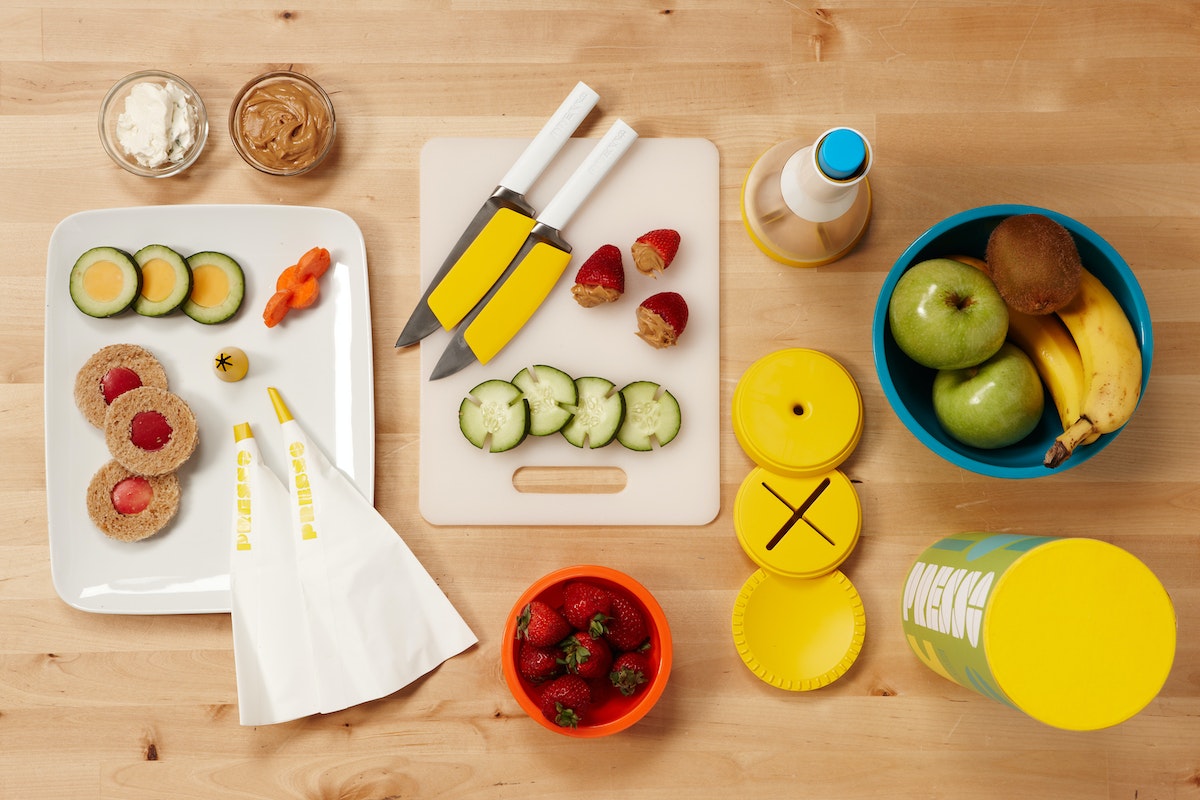
- Presso, a set of child-size kitchen tools that slice and dice fresh food in imaginative ways, making cooking fun and helping kids feel they have a role in making their own healthy food.
The design team behind this work was featured on 60 Minutes, and some of the resulting concepts were featured on CBS This Morning.

Handheld organizer becomes a sleek accessory
Redesigning a utilitarian tool to set it apart from imitators.
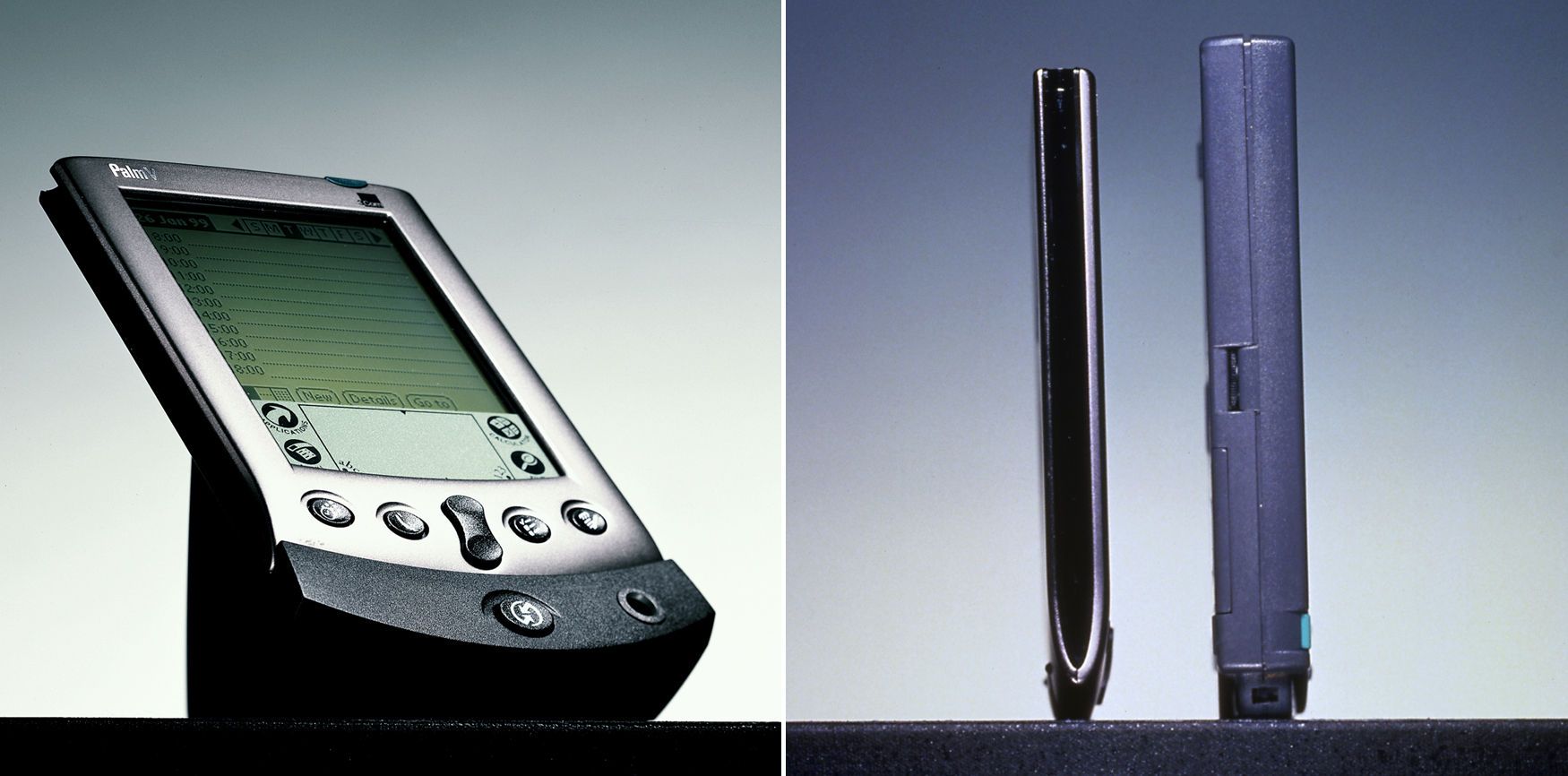
In updating the popular and industry-defining PalmPilot, Palm Computing wanted to reposition the next-generation Palm V as a high-design accessory to set it apart from its many imitators.
Together with IDEO, it crafted a sleek, elegant device, half the thickness of the original in an anodized aluminum housing. Incorporating an internal lithium-ion battery that recharges in the dock, the side rails act as an open architecture to provide attachment for a variety of styluses, cases, and other add-ons.
Perspectives, Practices, and Resources for Design Thinking
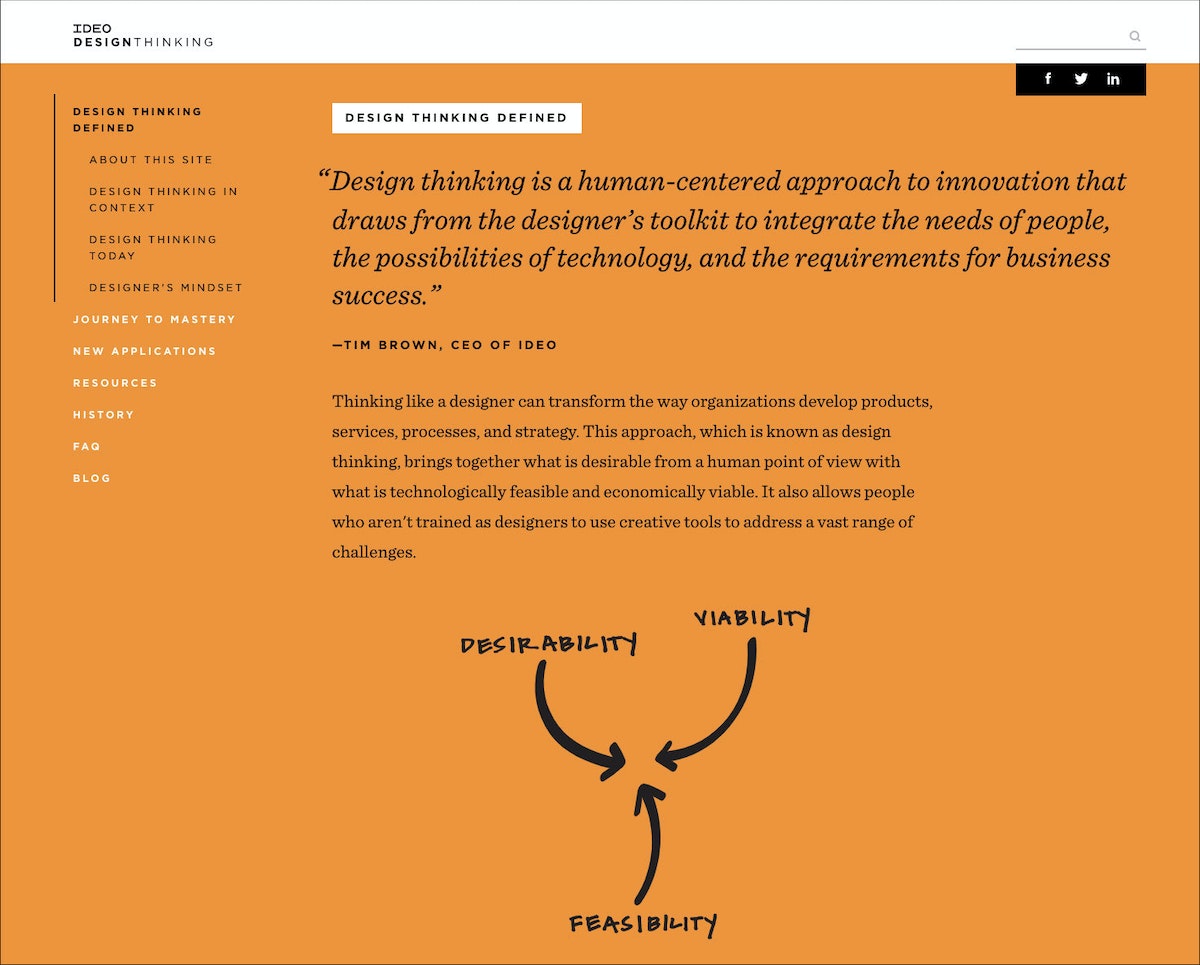
At IDEO, we’re often asked to share what we know about design thinking. We’ve developed designthinking.ideo.com in response to that request.
At IDEO, we’re often asked to share what we know about design thinking. We’ve developed designthinking.ideo.com in response to that request. On the site we introduce design thinking, how it came to be, how it is being used, and steps and tools for mastering it. You’ll find our particular take on design thinking, as well as the perspectives of others.
Build Your Creative Confidence: Nickname Warm-Up
While Speed Dating is useful in situations where people don’t know each other well, sometimes in group meetings you will encounter the opposite problem: a group where people know each other too well.
Creativity Challenge # 7: Eliminate hierarchy to improve idea flow.
While Speed Dating is useful in situations where people don’t know each other well, sometimes in group meetings you will encounter the opposite problem: a group where people know each other too well. Or, more specifically, a group in which hierarchy is so well established that the more junior members in the room self-edit and defer to the executives rather than putting their best ideas on the table.
To reduce hierarchy (which inhibits conversation) and self-censoring (which is equally limiting), the d.school has recently been experimenting with a “nickname warm-up.” Using a stack of colorful names the instructors have prepared in advance, the activity is a way to temporarily level out the organization during a creative working session. Each participant is given a persona to allow them to “try on” new behaviors.
Tool: Nickname Warm-up
Participants: Groups of 6-12 people per facilitator
Time: A few minutes per person
Supplies: Nametags for each person with the fake names written out. A hat and a ball for each facilitator.
Instructions
Step 1: Each participant reaches into the hat, draws out a name tag, and puts it on. Use names that lend themselves to humor and emotion. Teams tend to produce their best work when the group is having fun. Some of the monikers can imply a big dose of street credibility, while others suggest quirky personalities. For example: Dr. Fabulous, Squirt, Mr. Big Heart, The Clumsy Entertainer, or The Rooster.
Step 2: The facilitator gathers the group in a circle and tosses the ball. Whoever catches it introduces themselves using their new nickname and then tells a short story (created on the spot) about how they acquired this nickname as a child.
Step 3: After their self-introduction, they toss the ball to a new person, until everyone has had a chance to share their new name and story.
Step 4: The rule for the rest of the workshop—strictly enforced—is that everyone must use only these nicknames when referring to themselves or others.
Tips from the Field
Do the nametags work? Although this is a relatively new exercise, experience so far suggests that the answer is yes. At a recent management event, the CEO of a global hospitality company drew the “Squirt” nickname. There was a pregnant pause in the room as everyone waited to see how he would react. But he gamely played along through the rest of the workshop, and the organizers felt it contributed to an open environment in which people could speak freely.
The goal is to flatten out the hierarchy, so it’s important to get the senior people in the room to participate. Leading by example will naturally break some of the barriers to free-flowing collaboration.
This post was taken from Chapter 7 of Creative Confidence. Purchase the book for more on how to use creativity to solve problems, or read more from this series of creative exercises on the IDEO blog.
Everyone is creative. This belief runs through everything we do at IDEO, and in 2013, it led my brother David and me to write a book that would help others—even those who don’t think of themselves as “creative types”—to unleash their creative potential. Creative Confidence has inspired thousands of people to adopt a creative mindset and apply it to the diverse real-world challenges they face. In this series, we’ll share some exercises from the book that can help you approach your challenges from a new perspective.
4 Tips for Addressing—and Even Embracing—Tension
Focusing on differences can be challenging, but productive
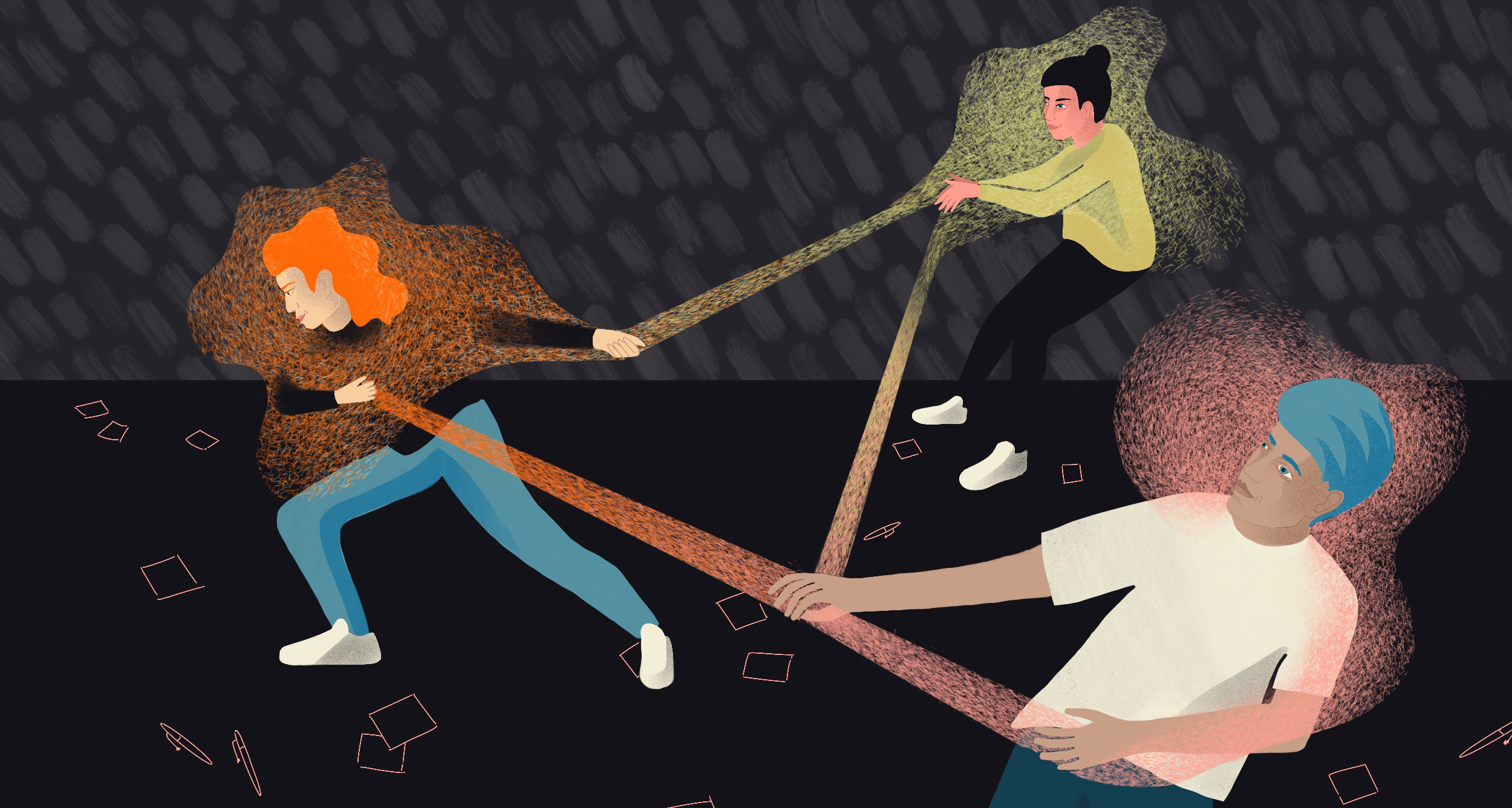
As leaders at the CoLab, IDEO’s platform for collaborative impact, we’re familiar with tension in all its forms. CoLab brings together organizations from across industries to focus on tough challenges, from designing for the circular economy to opening our financial systems. During design sprints, small teams build prototypes to explore new opportunities. Given that team members are often industry competitors with divergent approaches and ideas, tension tends to arise. We notice participants are often used to acting with the interests of their business first, rather than seeing the collaborative potential.
In order to create the impact we’re striving for at CoLab, we need to meet this tension head-on and create ways of moving forward. No matter what you’re designing or who you’re designing alongside—be it a colleague or another organization—here are four quick tips for adopting this mindset and productively addressing tension.
Observe the dynamic
Though tension can sometimes make us want to jump into action to resolve it, there’s value in sitting back, too. Try answering the following questions for yourself: What opinion is each team member pushing forward? Why might they have this view?
Paying attention helps you establish empathy. As designers, we use empathy not only to deeply understand the realities of the people we’re designing for, but also the realities of those we’re designing with. Even if you disagree, understanding why a teammate might have a certain opinion can help you create solutions that ultimately meet a need that you might not have noticed alone.
Give it a name
Once you’ve spent time observing, try naming the tension out loud or writing it down on a piece of paper. Saying or jotting down, “There’s tension around X right now,” or simply, “I’m feeling tension,” externalizes the tension. It’s is no longer this abstract, all-encompassing feeling. The tension is a named, tangible thing that the team can hear and see — not just feel — and therefore more objectively address through listening, dialogue, or compromise. In fact, mapping out seemingly conflicting interests or goals is a great tool for synthesis and identifying opportunities for design.

Just start making
Tension frequently arises when teams are trying to align on a shared vision or strategy. After all, when there are various stakeholders involved, they’ll likely have a variety of approaches. But it’s draining to debate things like your purpose or mission statement all day long. Reaching consensus can take hours, and may not even be useful at such an early stage before teams have had a chance to validate concepts through building.
It may seem counterintuitive, but to move teams through this tension, we recommend to just start doing. Whether it’s a whiteboard sketch or a model made of construction paper and glue, acts of making can offer clarity to subjective, “big picture” items. Shifting your mental focus from defining to doing has the power to shift a team’s dynamic.
Assume good intent
Though tension can sometimes feel like opposition, it often happens because teammates are passionate about the same thing. They may just want to apply or direct this shared passion in different ways. When things get tense, remember that you’re all working towards the same goal, and that the tension is likely not about you. Don’t take it personally.
Reinforce this “oneness” and good intent through language or actions. Try this: “I’m glad we’re in the same room solving this problem together.”
The next time things get tense, try not to jump into defense mode or sink down in your chair. Tension in team environments is inevitable because each of us bring a different set of experiences and perspectives to the table (so don’t crawl under it). As a team committed to collaboration across organizations that wouldn’t otherwise work together, we’ll keep embracing tension to get to the impact we all want to see in the world.
Tension in a team environment can make us nervously glance at the clock, play mediator, get defensive, or cling to the tried-and-true. But tension isn't always so bad (you can unclench your jaw now). In fact, we’ve found that some of our greatest work has come from embracing—even seeking out—these difficult moments.
A Cartography Nerd’s Guide to Mapping 100 Years of History
IDEO's resident mapmaker leverages a century-old resource to discover his neighborhood
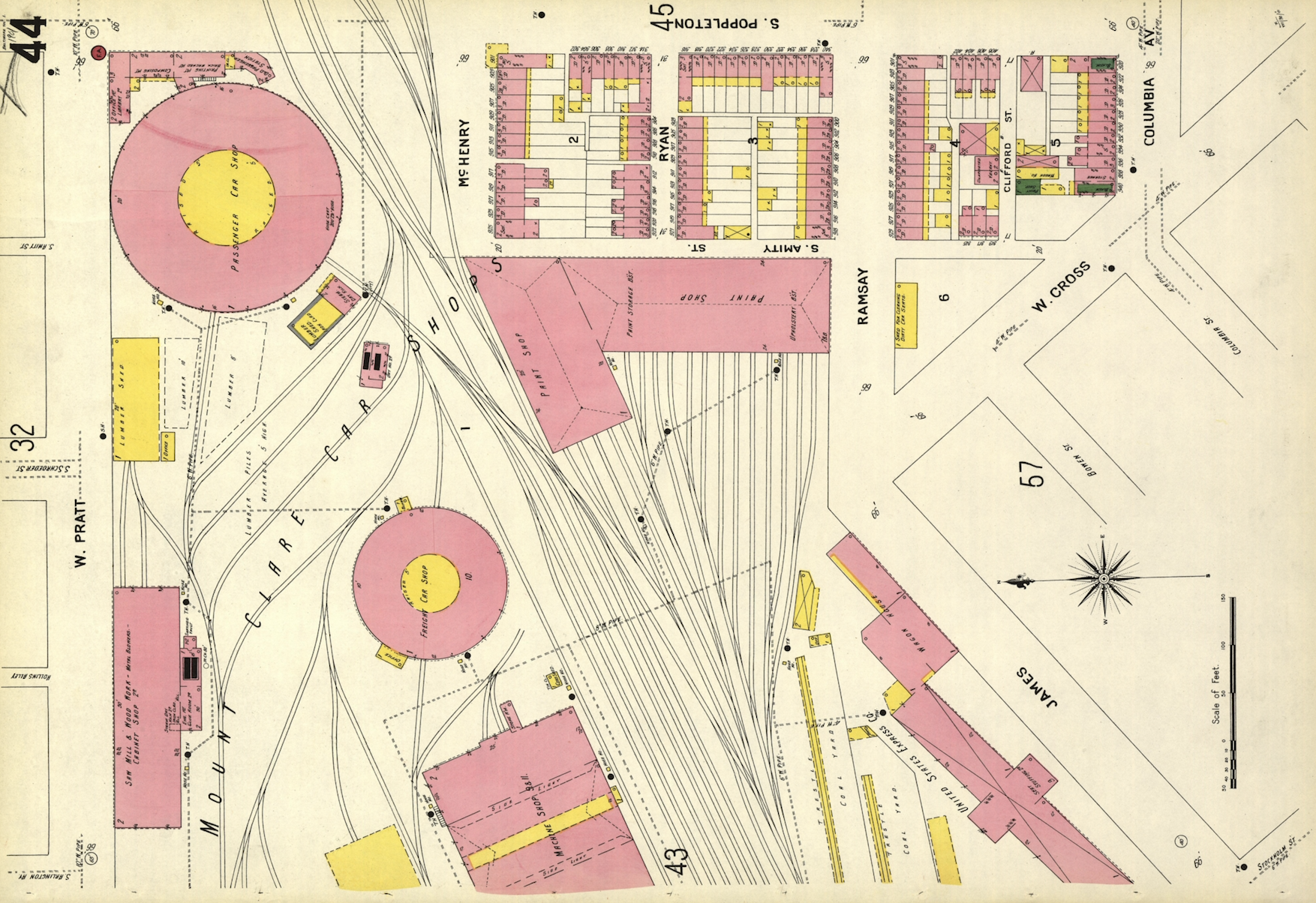
If you live in an American city, big or small, there's a decent chance that Sanborn had a map (or a hundred) of your town. And best of all, the entire collection is open-source and available for download in high-resolution images. The Library of Congress database isn't exactly the easiest in the world to search, but keep at it.
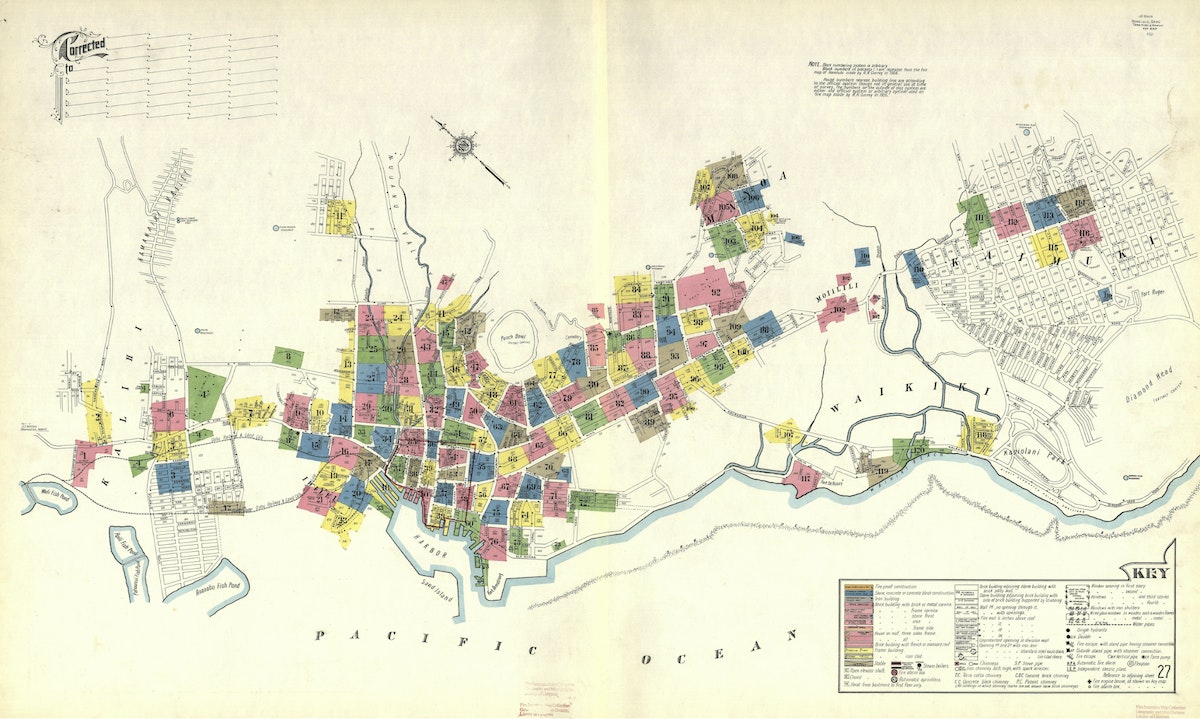
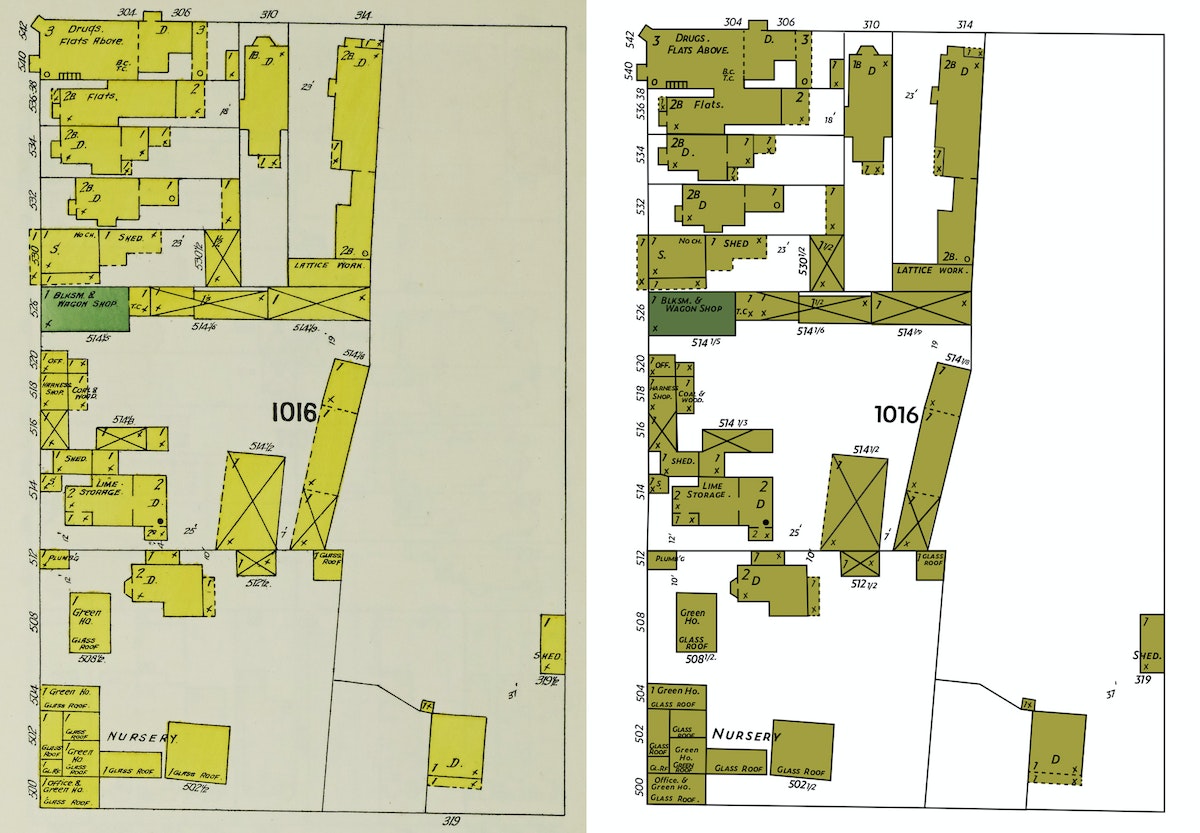
I live in San Francisco and was curious to see how my neighborhood was depicted by these amazingly-talented, fire insurance bureaucrats. I was delighted to find this map that shows my San Francisco neighborhood—the Lower Haight—in all of its 1899 glory. The colored rectangles form a grid, each pointing toward another map somewhere in the Sanborn collection that zooms in for much greater street-by-street detail.
I kept banging away at the rudimentary search function on the LOC website and eventually located Map 306, which visualizes my block in the year 1899.
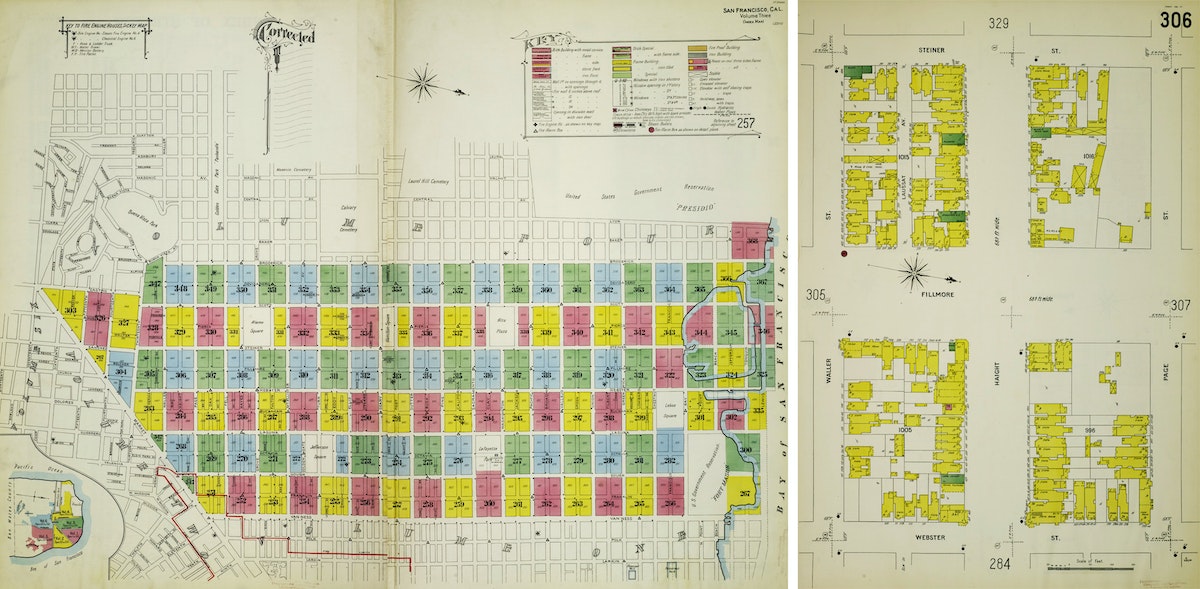
San Francisco is not the oldest of cities when it comes to architecture, and there was that little thing called the 1906 Earthquake (and subsequent fire), which destroyed a lot of the city as well. So I wasn't too surprised when I didn't recognize many of the buildings on my block. That said, it did get me curious: Were there any buildings that were visualized on the 1899 Sanborn map that are still present on my block in 2019? I decided to make a map to find out. See, being an ameteur cartographer is actually useful in 2019! Google Maps hasn’t ruined all of the fun.
First, I set about converting the Sanborn map of my block into a file that I could manipulate in Adobe Illustrator. The original map is a JPEG, which means that it contains pixels. But since I wanted to have the freedom to tweak the map as I saw fit, I needed to convert the map to a vector version of the file. Why? A vector file (which, instead of pixels, is all about math coordinates) can be scaled infinitely large. What's more, it's much easier to change the colors on a vector-based map or make other modifications that I might need to later.
I'd like to say that there was some fancy way that I converted the map. I could have tried a Live Trace, but with a map this detailed, I wasn't optimistic. So I just rebuilt the file by tracing over the Sanborn map layer with new lines and fills and strokes. Detail by detail. This was mostly an act of love and definitely not a fast process. I recently had a kid and this turned out to be a fantastic New Year's Eve activity as we counted down the tired hours till midnight.
One unique challenge I encountered — there's no clear font out there that replicates the Sanborn hand-lettering. I spent too much time with the Adobe Typekit database and landed on Zeitung. It's not an exact match by any means, but close enough to pass the squint test.
That’s the original map on the left, in all of its pixels glory. And that’s the vector file on the right, built from scratch. How'd I do?
Okay. With the Sanborn map from 1899 more or less created, I turned my attention to the 2019 version of the map. I needed a detailed lot-by-lot map of San Francisco. My first go-to in moments like this is the Stanford University Earthworks website. The search function works quite well, and it links to open source maps from lots of other universities (like Tufts). After a quick search, I located a lot-by-lot map for the Bay Area and opened it up in QGIS, everyone’s favorite free and open-source cartography tool! Here’s what I had.
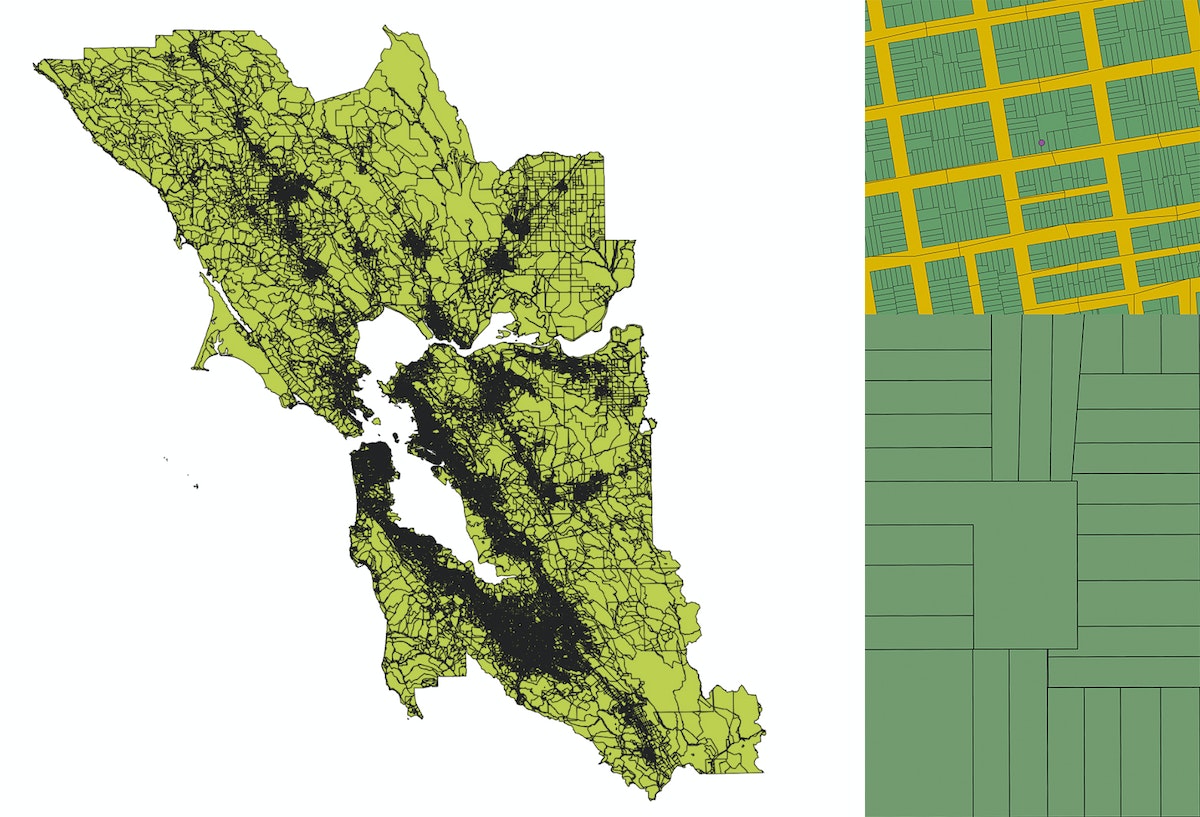
Totally overwhelming and, not surprisingly, it was actually quite tough to even find my block in all of that detail. So I loaded Google Maps, entered our home address, created a KML file with that single data point, and added it to the QGIS map. Once I zoomed way in, there was our block and our loft (represented by that little purple dot).
As I’ve mentioned before, QGIS is a wonderfully-powerful mapping tool, but mostly the pits when it comes to designing anything that would measure up to the esthetic standards of the average designer. So I zoomed way in to just our block, then exported the file as a vector file and opened it in our old friend Illustrator.
What I quickly realized is that this lot-by-lot map shows the property lines for each parcel on our block, but not the actual shapes of the buildings that sit inside each lot. Although I was getting close, I needed to go a step deeper to actually match the detail of the 1899 Sanborn map, which shows the outlines of individual buildings.
I opened Google Maps again and toggled to the satellite view of our block. If you zoom in as far as possible, you can see the outline of individual buildings. It's not perfect—shadows must get projected in weird ways when you snap photographs from orbit—but this was starting to get more interesting.
I snapped a fully zoomed-in screenshot of each building on the block, then traced them one-by-one using the Pen Tool in Illustrator. Once I had the outline of an individual building, I pasted it into the spot where it belonged inside the lot-by-lot map I’d exported over from QGIS. Then I repeated this process 31 times, for each of the buildings contained on my block.
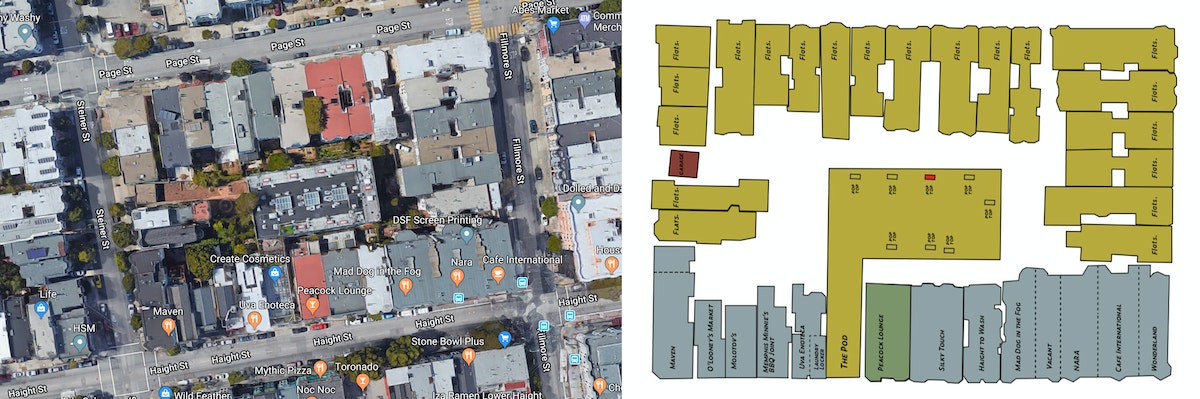
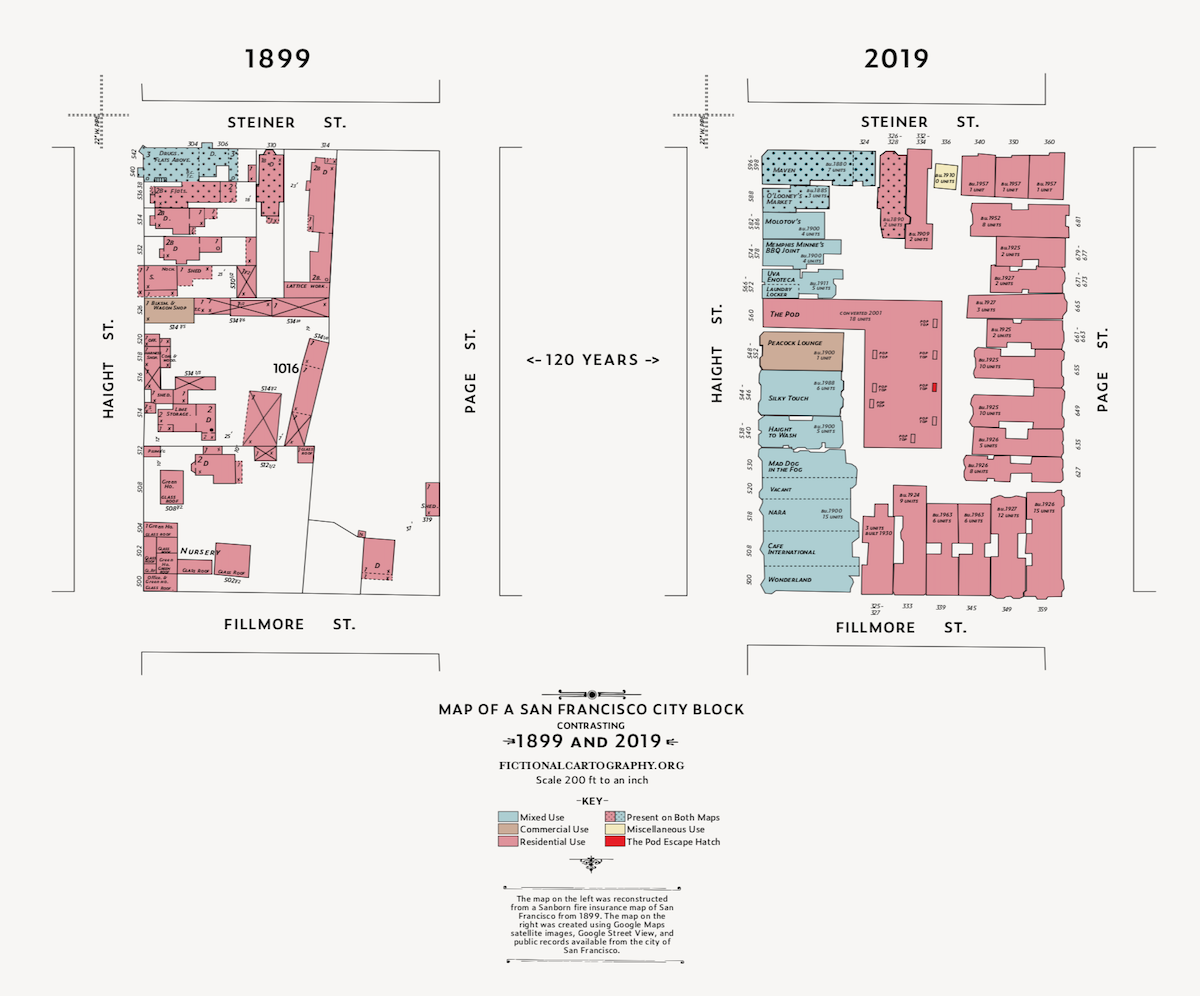
With the buildings in place, my next task was to figure out when they were built so that I could determine if any of them had been around back in 1899. After much poking around, I found this site from the San Francisco Planning Department that had exactly what I needed—the construction date for each of the 31 buildings on my block. Once I did the research, I discovered that three buildings can be found on the map in both 1899 and 2019, all of them clustered on the southwest corner of the block. One of them is my local bodega, home to Tiger the cat and famous (in the neighborhood) for the time that the Warriors eccentric three-point maestro Klay Thompson visited the bar to buy a bottle of Grey Goose. Super cool also to know that the building was built in 1890 and survived the 1906 Earthquake and Fire.
To finish up the map, I built out a key, borrowing inspiration from another Sanborn map visualizing neighborhoods in Honolulu, Hawaii.
Then I tweaked the colors, sticking to the Sanborn color palette, but borrowing some of the brighter colors found across the collection. I also added some polka dots to both maps to call attention to the three buildings that survived from 1899 to 2019. These last couple of tweaks are just two of the many benefits to working with vector files instead of pixels.
And voila, here is the final version of the map. What do you think? Now you can do the same for your city block.
Do you have a few hours on your hands and want to head down a wormhole of unbelievably striking maps? Mosey on over to the Sanborn map collection at the Library of Congress. Originally created as a means for issuing fire insurance across major American cities, the quality of hand-drawn detail in these maps and the color palette used by the cartographers are stunning.

Lindsey Turner
I’m passionate about building brands, products, and experiences that help organizations show up with meaning and momentum.
I help organizations cut through complexity by shaping how they show up, through brand strategy, identity, and storytelling.
Working at the intersection of brand and business, I bring an editorial eye and a bias toward making—turning ideas into tangible experiences that people can understand, trust, and believe in.
My work spans government, healthcare, financial services, media, and consumer goods, from launching Gen Z-focused ventures to building innovation labs and reimagining legacy brands. I relish moments of ambiguity and enjoy translating across teams, perspectives, and priorities to move ideas forward.
I started my career in editorial and digital design, shaping cross-platform experiences and identity systems in publishing and agency environments. That foundation still shapes how I work today: I’m detail-oriented, collaborative, and overreliant on the Oxford comma. I hold a BFA in Visual Communication from the School of the Art Institute of Chicago.

Rachel Young
My work helps organizations see who their products aren't working for—and build the will and the tools to do something about it
For 25 years, I've asked the same question: Who does this design exclude—and what are we going to do about it?
My work spans human-centered strategy, inclusive design, and qualitative research, with clients ranging from Microsoft, Google, and Verizon to the National Science Foundation, and San Francisco Unified School District.
Before IDEO, I taught elementary school in East Palo Alto and spent a decade doing design work with social service organizations—where I learned firsthand what it costs people when systems are built without them in mind.
I am currently writing User Error, a nonfiction book about digital access and the design decisions behind it. I live in Oakland, California.

Brian Pelsoh
I lead with craft, ensuring our work is creatively excellent: rooted in deep human insight and imagination, while also grounded in the realities of business and technology.
My expertise spans brand, communication, and product design across tech, education, the arts, and social impact.
I believe great work demands both high-level vision and obsessive attention to detail, and only happens through collaboration.
I bring an inclusive, hands-on approach and a deep understanding of business, which enables me to consistently deliver excellence while always asking why.
Before joining IDEO, I worked at the brand firms Pentagram and VSA Partners. I began my career as a designer, leading teams at the School of the Art Institute of Chicago and the Milwaukee Art Museum. I hold an MFA in graphic design from Maryland Institute College of Art and a BFA in communication design from the Milwaukee Institute of Art & Design, and have taught at some of the best design schools in the US.

Tony Wong
I am responsible for IDEO’s long-term success in China and working with clients to use design as a tool to enable growth.
I am responsible for IDEO’s long-term success in China and working with clients to use design as a tool to enable growth. Specifically, I have helped Chinese companies design holistic brand solutions through the development of their products, communication, services, and innovation teams, and I have helped multinationals expand their presence and influence in China.
I advise global leaders on developing China-led innovation and capabilities.
In over 15 years in IDEO Shanghai, I have worked on projects that use design to elevate the quality of the experience of healthcare products and services, streamline processes that increase productivity, create spaces and programs that promote and enable inclusive communities, and build next generation mobility solutions that are planet-positive.
Before joining IDEO, I worked at Philips Electronics and the Electrolux Group in Italy, the Netherlands, and Singapore on a number of breakthrough commercial products. I am a member of the Young President Organization in Shanghai.

Building a personal AI for the messiness of life: Sida Li
Most AI products today are built for work—a space with clear problems and established systems. One founder noticed a gap: personal life is messier, harder to systematize, and mostly left behind by the AI boom. So she built Cue, a personal AI that lives inside iMessage and group chats, to go where the other tools haven't.
In this episode, Becca Carroll, IDEO's Chief Strategy Officer, talks with Sida Li, co-founder and CEO of Shared Context Lab, about staying anchored to a human need while the technology around her keeps changing shape, why she treats her business model with the same rigor she'd bring to a product, and what it feels like to build a company at this particular, disorienting moment in AI.
The conversation also gets into how Sida makes design decisions: the language Cue uses to describe itself, the tradeoffs behind building inside iMessage instead of a new app, and a real story about a business idea that didn’t pan out.
This is the second in a two-part series profiling founders from IDEO's Startups-in-Residence program. The first conversation is with Johannes Seemann, founder of Sooner, on designing GenAI for the emotional side of money.

Designing GenAI for the emotional side of money: Johannes Seemann
Most personal financial tools are built to run the numbers and optimize towards a budget. While that works for some, most people experience money as a lived relationship that does not neatly fit into a spreadsheet. Johannes Seemann and Becca Carroll discuss why money is emotional before it is mathematical, and what a human-centered approach to building a generative AI financial product looks like in practice.

The curious leader's edge in uncertainty: Scott Shigeoka
Mina Seetharaman talks with Scott Shigeoka, author of Seek and Head of Curiosity Cultivation at the Eames Institute, about what distinguishes genuinely curious leadership from performative curiosity, how power dynamics shape curiosity, and why practicing curiosity can restore energy rather than drain it.

How constraints make us more creative: David Epstein
Mina Seetharaman talks with David Epstein, author of Inside the Box and Range, about why total freedom often produces average work, how leaders can design useful limits on purpose, and what organizations such as General Magic and Pixar reveal about the relationship between boundaries and creativity.
Looks like you might be in search of something very specific?
Or reset the filters above and try another angle.
Here’s some random inspiration

Podcasts about creative leadership

Articles about the power of prototyping
