
.svg)




Arming a 19th-century company with a 21st-century digital venture
Swell enabled values-driven consumers to make informed investment decisions.
For the socially-conscious, investing can be a tricky proposition. The same people who wish to vote with their wallets may find that their options for investment funds and 401K plans are rife with companies that violate causes they believe in. So far, there have been few options in the marketplace that give consumers the opportunity to put their money in financial products that not only cut out environmental and social offenders, but actually contribute to the well-being of the environment and society.
Dave Fanger, a financial professional, was determined to design a solution. He approached IDEO to help create a startup venture for socially-conscious investors. Pacific Life, a Fortune 500 financial services company and Fanger’s employer at the time, offered the resources to develop and launch the idea. The online impact investment platform gave consumers the opportunity to invest in high-growth industries that are addressing global, environmental, and social challenges. Swell rigorously screened companies for both impact and performance, so consumers could be confident that their investments were in line with their values.
A holistic approach
Embedded as core team members, IDEO designers worked alongside Swell’s founder to shape the company. In just one year, they went from an initial concept and prototype to an SEC-registered investment adviser with a fully developed business model, a digital platform with initial investors, and well-defined branding that set the look and feel of the values-driven company. The IDEO team helped to hire the initial team of employees, working to ensure that the fintech startup would have the creative talent it needed to operate post-launch, as well as a defined culture that would help it grow.
A new investment platform
From the outset, it was important for the team to build an innovative, digitally-fluent, and customer-centered platform to make it easy for investors to back causes they care about. Working in close collaboration with software development partner Carbon Five, Swell and IDEO committed to act nimbly, take risks, move fast, and ditch decks for prototypes. Understanding the motivations of the investor—their values and what drives their investment decisions—was key, so the team leveraged IDEO’s network to form a consumer council, which helped to quickly iterate and refine prototypes throughout the duration of the product development process. Having that core group involved every step of the way made it easy for the team to keep consumers at the center of the design and validate key decisions quickly.
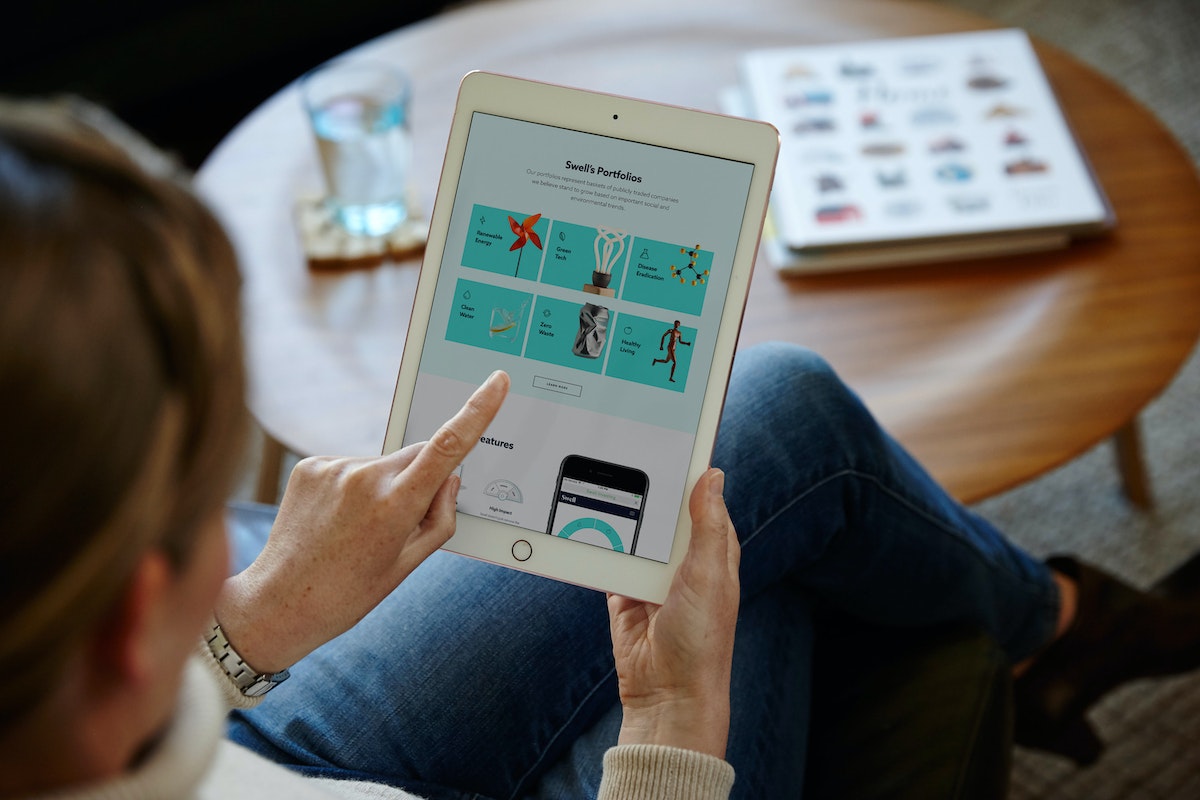
Swell offered consumers portfolios of companies that work to solve some of today's biggest challenges. The six impact portfolios offered were: green tech, renewable energy, zero waste, clean water, healthy living, and disease eradication.
As of June 2019, Swell had attracted over 15,000 investors—more than half under the age of 34—and $35 million AUM. Nearly 40 percent of investors were making investments on a recurring basis.

For kids, a new tactile way to learn coding
Helping Google design a set of blocks that can be arranged to code almost anything.
Learning to code isn’t just about knowing symbols and syntax—it can help unlock kids’ imagination by inspiring them to build new things and interact with everyday objects through discovery and play.
With that in mind, Google Creative Lab came to IDEO to help with user experience and product design on their new coding tool for children. The result of the collaboration, Project Bloks, is a simple and interactive experience that teaches kids how to code using physical blocks. This establishes a new paradigm for learning computer science: it takes a language typically only understood through screens and keyboards, and makes it tangible.
Project Bloks was also designed as an open hardware platform, enabling developers and educators to build tangible programming applications that are innovative, educational and fun.
Kid-centered design
From the very beginning, how kids physically play and learn were at the center of the project. Designers quickly iterated using sketches, foam core, paper, Play-Doh, and 3D-printed models to see how slight changes informed children’s experiences. Understanding what deepened kids’ engagement, increased their curiosity and changed their behaviors drove the language, taxonomy, architecture, and physical form of Bloks.
Because play and physical building is an important way in which many kids develop skills, designers began with a set of blocks and sought to help them discover coding through tangible objects. Each block was given a specific function and shape, guiding kids to arrange, combine, and rearrange the blocks to create commands and control things like robots or speakers in the real world. Children could also create block patterns together by physically building on each other’s ideas.
An inside look at the design process. Video by Google.
Designing for early learners also forced the team to rethink how a new language could be taught. An early version of the blocks was based on how programmers typically code, from top to bottom. However, the team quickly realized that the orientation had to be driven by the child’s natural instincts. Given young children are just learning to read from left to right, designers observed that the switch in directions was too confusing and changed the arrangement of Bloks commands to go left-right in addition to top-bottom.
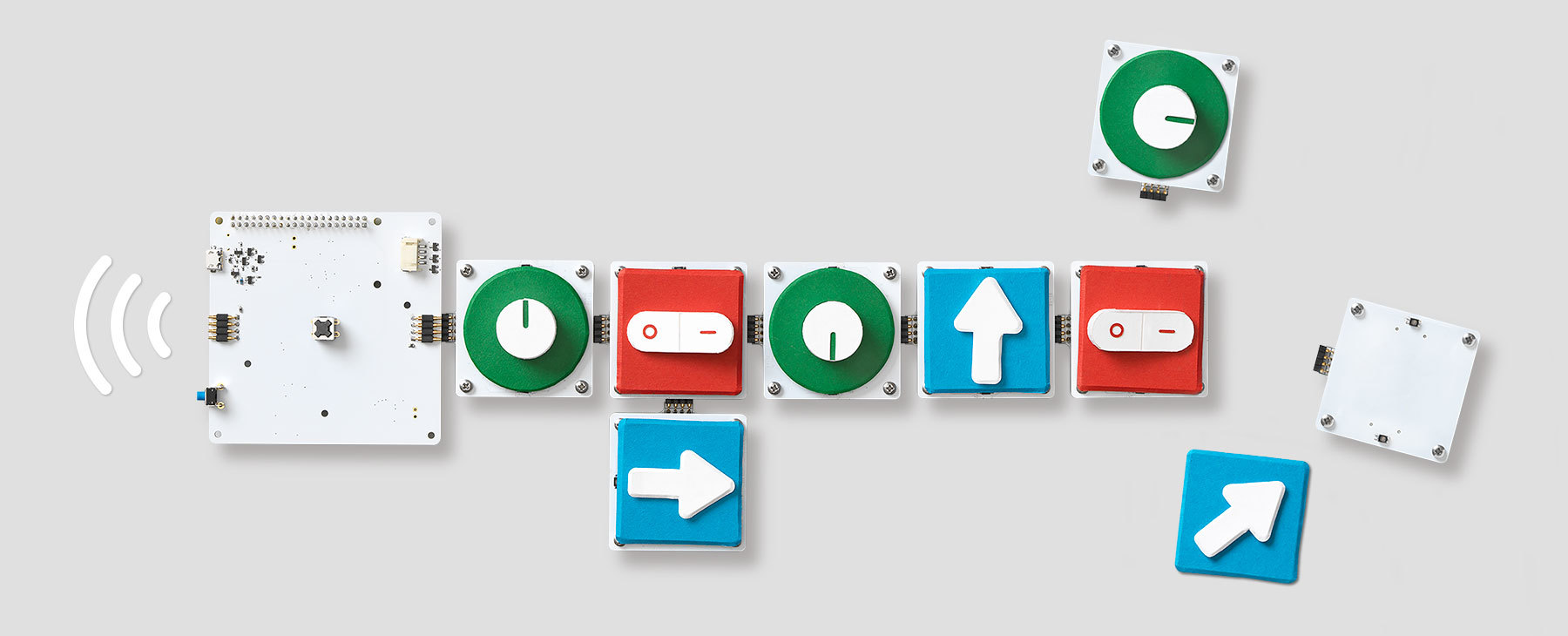
The final outcome of Project Bloks was an interactive coding kit comprised of three key parts - pucks, baseboards and a brainboard. The puck is a critical component that controls a command, whether it’s an on/off switch or the ability to move in a particular direction. It’s the piece that enables children to move from words to the world of graphics and play. The puck is easy to produce and can take an unlimited range of forms and functions, enabling the Bloks system to scale.
The baseboard reads the puck’s instruction and is activated when a puck is placed on top. The brainboard provides the power and connectivity. When hooked up to a baseboard or a chain of baseboards, the brainboard sends the instructions—turn left, jump, get louder—to a connected object, like a rocket or a speaker.
The boards can be rearranged, sequenced, and packaged however kids like, opening up a vast realm of possibilities. Children can code anything from a toy robot drawing a shape on a piece of paper, to a sensor turning on a fan when the temperature gets too high.

Enabling innovation for education
Beyond a tangible coding kit, what makes Bloks unique is that it’s an open platform. Educators, developers, and designers can build on it to accelerate new ways of teaching and exploring tangible programming. The platform can fit into various curriculums around the world. The pucks can take on different shapes and graphics. The material used can be fabricated by 3D printing.
The Bloks platform is a new vernacular that allows kids to interact with the language of code in a way that’s less prescriptive and more open-form, like a sandbox. And the more kids play with Bloks, the more opportunities they discover for what they can create with a little bit of code.
Helping students navigate college and beyond
Creating a digital experience to support first-generation college students.
For students who are the first in their families to pursue higher education, navigating college can often feel like navigating a foreign country. Challenges like not having enough money or poor access to support services can make graduating an insurmountable hurdle. In fact, only 55% of these students in the United States end up completing their degrees.
To help change this statistic, IDEO partnered with Beyond 12, an organization that provides personalized, virtual coaching to first-generation college students to help them learn how to register for classes, apply for financial aid, and much more. The challenge was to scale Beyond 12’s successful coaching model using technology in order to benefit as many students as possible.
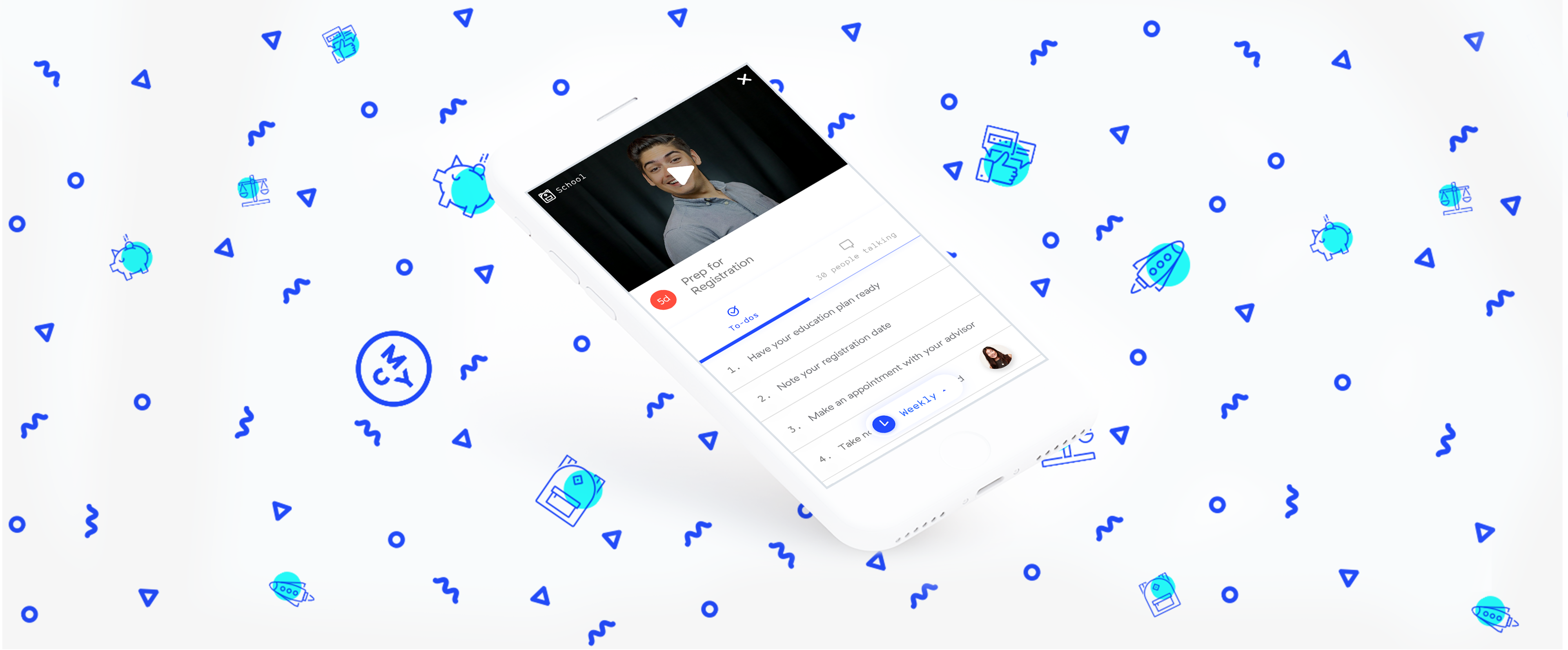
In 2014, IDEO designed the MyCoach app, with the goal of helping students take ownership of their education and feel in control of their future. After the early version of the app was named as a finalist in the prestigious Robin Hood Foundation College Success Prize, Beyond 12 piloted the product with 3,500 college students across the US. Following the pilot, Beyond 12 and IDEO went back to work, using the resulting insights and data to design the next evolution of MyCoach.
First and foremost, IDEO sought to develop a more flexible model for Beyond 12 to enable scalability of the offering. As some students need more support than others, a blended business model was envisioned to recognize the spectrum of students’ needs. Engaging in-app content forms a supportive layer that helps students get organized, stay on track, and learn the skills they need to stay in college, while students who need more hands-on assistance can connect directly with coaches. An invisible data layer works behind the scenes to assess student risk and dynamically tailor student support throughout the school year.
Once the app’s model was solidified, creating a user experience that compels students to use it became essential to its efficacy. Growing up with technology has reshaped how many students engage with the world, and tools like Snapchat have set a new dynamic for participation. Youth today are the masters of their own digital worlds, fluidly jumping between conversations, engaging with stimulating content and contributing their own perspectives. As a result, MyCoach needed to speak students’ language and to create content that was authentically youthful and effective in order to be effective. By drawing inspiration from popular social sites, digital experiences and games, the team designed a user experience that keeps pace with a digitally native state of mind.
IDEO Designer, Isabela Sá explains the approach that led to MyCoach’s design and content strategy, “We created an app that makes no distinction between content and utility. We borrowed the content-first approach of social apps like Snapchat and Instagram and used it to teach students the skills and strategies they need to graduate. With that, the digital experience became more human. The intricate system that we had designed to power the whole thing was hidden below the surface. For students, the app was just the means to learn how to help themselves and get in touch with a coach when they needed one.”
Development is underway for the next version of MyCoach, which will allow Beyond 12 to scale its offering to reach exponentially more students in need.

Redesigning how Coca-Cola works, plays, and profits
Designing for Coca-Cola’s 2020 vision strategy.
Coca-Cola is one of the world's most iconic brands. More than 5,000 people work at its global headquarters in Atlanta.
Back in 2010, Coca-Cola found itself at a major crossroads. As the company grew, it became clear that in order to stay competitive, any kind of campus renovation would have to take into account a vision of the future of how people work at Coca-Cola. Before the company hired architects, they came to IDEO to help design this important part of their 2020 vision strategy; ultimately the redesign would change the way the company works, plays, and profits.
Imagery courtesy of Coca-Cola, Gensler, and IDEO

Our toy inventors' top 18 picks for 2024
From princess play to clever puzzles and drinking games, here are some of our favorites.
At IDEO's Play Lab, we spend all year making and testing toys, games, and experiences for kids—and grown-ups who used to be kids. Here are some of our best recommendations for everything from storytime play to game night with your pals. Some come from our very own Play Lab, and others from toy and game makers we admire.
Ready to make it official? You can find a link to our store here. (Please note that IDEO makes a commission off of affiliate links.)

1. Incohearent Family Edition by Relatable
A hilarious party game guaranteed to get a laugh with the fam during the holiday season! Each turn, one player draws a card with a gibberish phrase on it (i.e. “sa male leaf heat”) and the rest of the players race to sound out the gibberish and be the first to guess the hidden message in the garble (in this case— “smelly feet”) and collect that card. First to 13 cards wins! Tons of content, quick to learn, and quick to play, this game will have your whole family shouting pure playful gibberish at each other in no time.
Who will love it: family and friends ages 10+, or check out the spicy version for cards with humor geared toward adults
—Matt Callahan
2. So Clover
In So Clover, you’re given four pairs of random words. Then you have to come up with clues connecting each pair for your friends to decipher and discover which words go with which. Imagine CodeNames, but nobody gets angry or upset at you for giving weird clues! While it has a competitive element to it, ultimately this is a super fun word association/logic game that I can’t get enough of.
Who will love it: Pretty much everyone, but for the adults, it’s extra fun as a drinking game
—Andrew Stewart
3. FreeSkates
Skateboarding is the perfect combo of athleticism and artistry. It has parents like me holding our breaths and hoping that our kids avoid injury, but there’s nothing like the magic of seeing your kid flying across the asphalt, building confidence to try bigger and better tricks. FreeSkates introduce a whole new challenge with a separate board for each foot, bringing a fresh elegance and rhythm as your feet glide independently of each other, snaking in and out underneath you. There’s a bit of a learning curve, but it’s worth the effort and the scrapes!
Who will love it: Adventurous kids of all ages, though the younger ones tend to heal faster…
—Michelle Lee
4. Flipslide
We bought our son a Rubik’s Cube, but it was just a little too monotonous for him to stick with it. Enter Flipslide! You have to flip, slide, and match the lights against the clock, and it’s wild how addictive it gets. It’s fast-paced, super portable, and great for challenging yourself or competing with one another to get the best time. Perfect for road trips or whenever you want a fun, screen free distraction.
Who will love it: Puzzle fans and anyone 8+ who loves quick reflex challenges
—Diana Tobey
5. Lights from Anywhere (Marvin’s Magic)
A classic, off-the-shelf illusion perfect for anyone getting into magic but looking for something beyond card tricks! Conjure magical lights between your hands, pulling them out of thin air and making them disappear in the blink of an eye. Without giving away any secrets, I can say this is a brilliant, timeless effect that deserves two thumbs up! 👍👍
Who will love it: Any kid interested in magic (it does require some dexterity), but also parents too! It’s the ultimate party trick.
—Neal Boyer

6. DC Comics Batman Ultimate Transforming Batmobile Playset
This one is for the little Batman fans in your life that love getting lost in their own storylines. One minute, you’re driving around Gotham; the next, the Batmobile opens up into a full-on Batcave with gadgets, a jail cell, and tons of cool spots for action figures. It’s the Batmobile that keeps giving.
Who will love it: Batman fans 4+ and any kid who loves action-packed play
—Elise Granata
7. Mantis
There are only two rules in this family board game for kids and adults. One, steal or score your way to victory by collecting matching cards. Two, the first player to reach 10 cards in their score pile is crowned the winner. The game is easy to learn and fast-paced. Ready for the emotional rollercoaster of stealing from your opponent—or being stolen from yourself?
Who will love it: Family, and friends age 7+
—Jeremy Chen
8. Sticker Wow! From Melissa and Doug
During our research talking to families with young kids, we discovered just how much they love stickers. But peeling and sticking can be hard for little fingers. So we came up with this super fun, fidgety way to stamp stickers. The best part? They stick tightly to activity books and paper, but are easily removable if kiddos stick them to other things. The stickers are refillable (and collectible), which means you never run out, and it’s not wasteful. All the kids we’ve seen play with this are instantly obsessed. (This toy is a patent-pending IDEO + Melissa and Doug invention.)
Who will love it: Kids age 3-7
—Vlasta Komorous-King
9. Story Time Chess
A way to teach kids (and adults!) how to play chess through fun, engaging stories. Each chess piece is turned into a unique character with a personality and movement pattern that aligns with that piece's actual rules in chess. For example, King Chomper can only move one step at a time because he loves to eat so much and his pockets are stuffed with food. The game comes with mini-games and workbooks to help kids practice specific skills as they get more advanced with their chess strategy and tactics. The perfect pick if you enjoyed The Queen’s Gambit and secretly aspire to raise your own chess prodigies—or better remember the rules yourself.
Who will love it: Any age will benefit from the memorable story and characters, but especially younger kids 3+
— Diana Tobey

10. DJ Bouncin' Beats
This toy knows how to PARTY! I have spent hours of my life hanging out with DJ Bouncin' Beats and my two-year-old niece as it sings us ABCs, counts with us, and plays back custom recordings of phrases or sounds we make. It’s a combination teacher, boombox, and dance partner. Maybe even better than having a sibling?
Who will love it: Kids 12-36 months
—Elise Granata
11. Disney Princess Carriage to Castle Playset
So much play value in one play set! With Carriage to Castle, kids can act out both magic princess vehicle play AND full castle doll house play with all their favorite princesses. This playset comes with four figures, tons of accessories, and an exciting transformation to help them story play. Parents will love that this castle can transform back down to a carriage size for easy storage.
Who will love it: Young kids that love princess play! Best for ages 3+
— Rikki Devlin
12. Drop Trivia
If you love some competition with your play, this game is perfect for a post-dinner or drinks moment with friends. The questions are a mix of pop culture, random facts, and fun surprises, so there’s something for everyone to shine at (or totally blank on). Think Trivial Pursuit with the countdown urgency of disassembling a bomb.
Who will love it: Trivia buffs ages 10+—and anyone who loves a good challenge
—Matt Callahan
13. Wild Flowers by Moose Toys
The ultimate chill board game! Wild Flowers features stunning graphics that transport you to a serene flower field. Players use tiles to grow and claim flowers, and complete task cards related to the flower board. Perfect for one to four players, it strikes the ideal balance between strategy and luck, making every game fun and engaging. The perfect way to end your day!
Who will love it: 8+
—Inna Yankelovich

14. Illusion
Illusion is a quick and fun card game where players test their perception of color and patterns by arranging cards in order of the percentage of a specific color they contain. Each turn, you can challenge the lineup if you think someone made a mistake—revealing dramatic surprises when the cards are checked. It’s a fast-paced mix of strategy, observation, and the thrill of calling someone out, making it perfect for parties or family game nights!
Who will love it: Kids 6+ (but it’s also great for adults)
—Sam Hobish
15. Scout
This card game is easy to pick up and learn with a ton of depth. Unique cards have different values on their top half and bottom half. At the start of each round, you can decide whether to play with the top set of numbers or flip your entire hand to play with the other set. But player beware, your hand is now fixed for the rest of the game. Play cards to make new combos or take another card to make your hand even stronger. To win, play a hand no one can beat or get rid of your hand.
Who will love it: kids (8+) and adults
—Weishan Liao
16. CoComelon Transforming School Time Bus
The perfect gift for any CoComelon lover, this classic school bus play set transforms into a tiny classroom and playground. Kids can drive around on the ground in school bus mode, then easily open up the bus to find tons of play inside. The chairs magically pivot into a classroom setting.
Who will love it: Kids 3-6, but also Cocomelon lovers of any age
—Weishan Liao

17. The Magic Puzzle Company
Think you’ve mastered all the puzzles out there? Welcome to the enchanting world of the Magic Puzzle Company. These puzzles are designed to challenge even the most seasoned puzzlers, with whimsical scenes, quirky characters, and a surprise twist that will leave you in awe. Packed with hidden Easter eggs and playful vignettes, every piece you place brings a touch of joy. With such captivating designs, it’s nearly impossible to step away. (And check out this puzzle by IDEO alum Felicia Chiao.)
Who will love it: Kids 15+ to adults
—Lauren Schreiber
18. Barbie Dog Duo With Wheelchair
This set offers such a sweet way to expand storytelling opportunities, with Barbie caring for her pup who’s using a wheelchair, bringing inclusion and creativity into playtime. The little accessories are a great touch, and it’s been a hit for sparking imaginative, heartwarming adventures.
Who will love it: Kids 3+
—Keren Wong
Stumped about which toys or games to add to your list this year? We’ve got you covered.

5 truths about the changing health landscape
What we heard on the ground at HLTH ‘24.
There are few parts of the industry we haven’t touched. Why? Because few sectors offer so many possibilities for making a positive impact in people’s lives, if we can ask the right questions, and innovate our way to the right solutions.
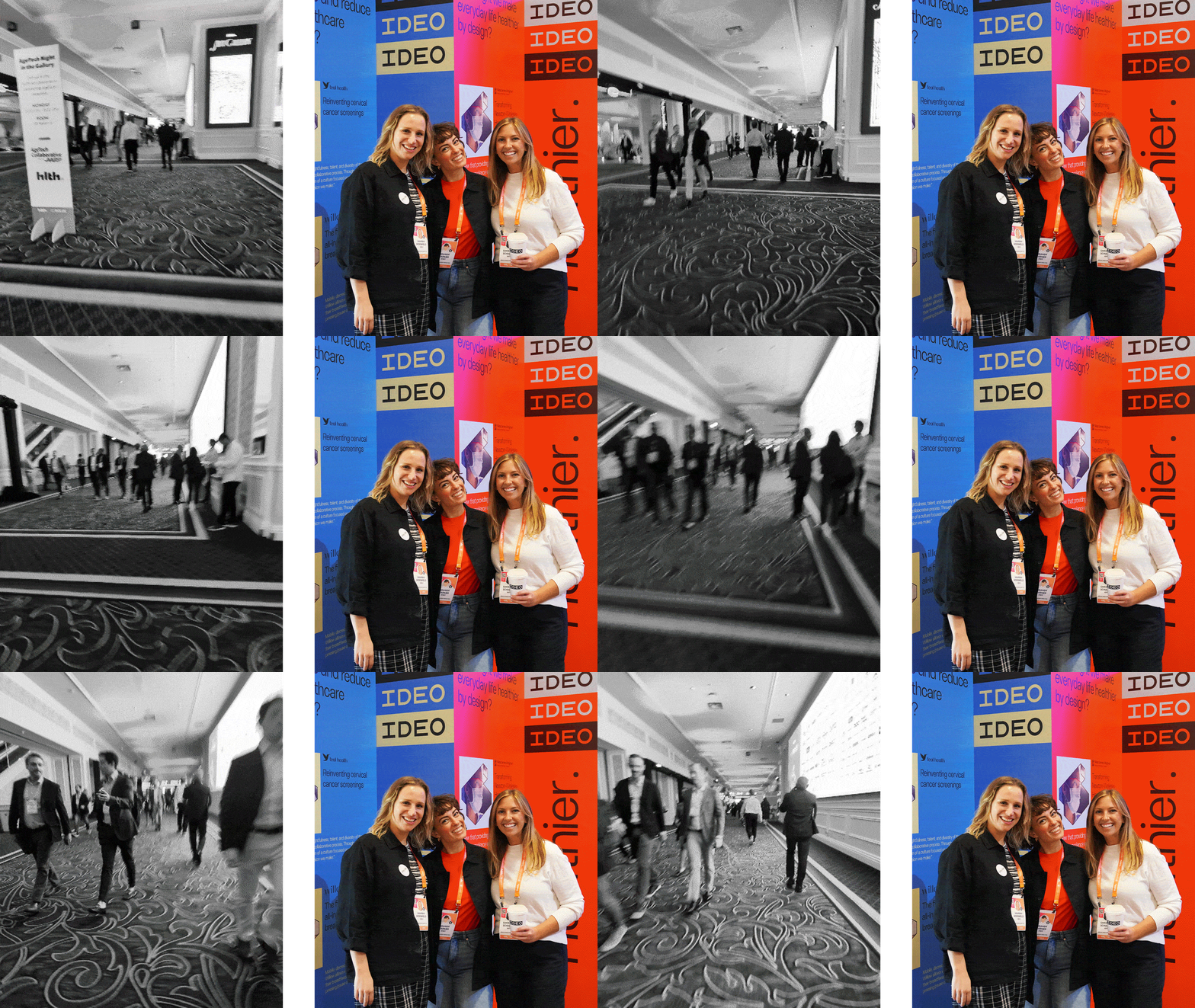
Last month, we headed to HLTH to learn more about the trends, hurdles, and paradigm shifts companies, hospitals, and other care organizations are coming up against in this space. Here are some of the things we took away from our time on the ground.
1. Design can help us move beyond point solutions
Right now, we’re seeing a lot of standalone digital platforms tailored for different diagnoses, different age groups, and different patient populations. While this approach can better align with the way payments work in the healthcare system and result in more easily-proven health outcomes, it often feels like we’re reinventing the wheel over and over. You see this especially in mental health—solutions for youth, solutions for kids, solutions for employees, etc. Larger organizations across payers, medtech, and pharma, are starting to ask, “What is actually generalizable here?” And, “Can a connected experience better fit the patient's needs?” “Does everything have to be custom-built for every drug, every piece of equipment, and interventions?” That’s costly, not only to operate but also to sustain. Why don’t we already have frameworks that are broad but adaptable? With all the research and data we have, we could create a shared understanding that we can tune to fit specific needs. Theoretically, we have the data; we know what works and what doesn’t. There are systemic reasons—proprietary systems and data hoarding come to mind. But still, if we could create a more universal approach, we could make an enormous difference.
2. We need to use AI to upskill healthcare workers, not replace responsibilities
The way we’re using them now, AI tools primarily aim to speed up workflows and improve operational efficiencies—whether it’s faster prior authorizations or streamlined documentation through AI scribes. But without careful implementation, these efficiencies could merely increase volume without enhancing care quality. Accelerating prior authorizations might lead to more requests and denials, rather than improved outcomes. Saving time on documentation might enable doctors to see more patients, but it doesn’t necessarily mean better patient interactions. We need to look beyond low-hanging fruit to achieve lasting impact. The industry must ask itself: Will widespread AI adoption genuinely drive health outcomes? And crucially, how do we encourage buy-in in a field where practitioners—trained over decades to rely on their own expertise—may resist technology-driven changes? At IDEO, we recently worked with a large payer organization to develop an internal AI strategy, focusing on how to foster acceptance across all employee levels. Building comfort with AI requires thoughtful design that respects existing expertise while gradually upskilling, rather than displacing, responsibilities.

3. “Practical innovation” may just be a buzzword
On the ground, we heard a lot about the challenge of sustaining innovation as budgets tighten across the healthcare landscape. Our conversations with people driving innovation at health systems and large organizations revealed not only budget cuts, but also a shift toward tactical, outcome-driven approaches. Organizations that we spoke with are increasingly looking to “practical innovation” to kick start their innovation cycle. Practical innovation in its original definition ensures a focus on commercial impact vs. innovation theater–a concept that we bring to each of the challenges we take on–but we shouldn’t allow the push for pragmatism to result in innovation falling into a trap. In this climate, innovation teams are expected to tie their work to key metrics prematurely, and reach scaled efficiency too quickly. This results in fewer bets, lower tolerance for risk, and a short runway to demonstrate outcome-focused results. Design has a crucial role to play in avoiding potential traps and increasing impact. For instance, by leaning into co-design and creating products alongside providers and patients, we can significantly de-risk innovative products and services. During our partnership with Kooth to create a mental healthcare app for youth in California, we worked directly with a youth council of 50 diverse young people to launch and validate a proof-of-concept, before then getting full investment for a state-wide launch.

4. Hospitals are recognizing their power as innovative forces in the healthcare ecosystem
Shaking off the antiquated image that they’re bureaucratic dinosaurs, hospitals across the country are setting their sights on innovation and beginning to think of themselves as engines of impact across the healthcare ecosystem. Whether that’s lending their space and access to incubate startups or giving their skilled medical talent the time and resources they need to conduct research and development activities, hospitals are eager to deploy their assets in new ways to unlock new value and drive exponential impact by improving healthcare experiences and outcomes.

5. The time for good health is (always) now
Every year, we see, hear, and feel a sense of urgency around solving large, intractable problems, and every year we feel the collective disappointment that we are falling short of the progress we hope to see. Over the course of our week in Las Vegas, we spoke to thousands of people from across the healthcare ecosystem about novel ideas, genuine patient needs, product innovation, and promising new therapies. Each and every person wants to make an impact to improve the lives of those we serve—and it is true that we are seeing some remarkable progress. But good health remains elusive for many. We are working with clients in every corner of the sector to make good health a reality—innovating patient care, supporting carers to deliver on the purpose that drove their choice in vocation, partnering with life science companies to deliver innovative care to patients, and digital health companies to make huge leaps in how we deliver care. Our goal? To make healthier human futures a reality of today, not the hope for tomorrow.
We dedicate a lot of our time to making healthier human futures, from working with healthcare providers to create a culture of innovation, partnering with pharmaceutical companies to create new drug delivery approaches, and co-creating new digital solutions with disrupters.
Why every company needs a futurist-in-residence
For companies looking to the near-term, it’s no longer a-nice-to-have.
This initiative, aimed at exploring what the next 10-15 years might bring, allowed me to leverage the full spectrum of a futurist's tools as well as those of an organizational designer—simultaneously exploring their design question while teaching and integrating foresight capabilities.
Being a futurist means spotting signals that may only be whispers today, but could become profound shifts tomorrow—shifts that companies will have to be prepared to navigate. When playing this role we use a mix of facilitative, creative, and analytical tools that not only identify emerging patterns, but also embed foresight into the organization itself, helping shape the culture to be more forward-facing. Our techniques range from examining historical patterns to scanning for signals of change to telling stories of multiple plausible futures—each designed to bring clarity to a complex environment and make emerging opportunities actionable for an organization as a whole.
What do those tools include?

Hunting for signals in the noise
Identifying and tracking signals of change is the primary activity of any foresight work. It’s focused on spotting glimpses of the future that exist in the world today. A signal might be a new idea, behavior, technology, social context, or business model that may seem insignificant now, but could redefine industries or the world at large if it scales. Recent examples I uncovered for clients include everything from the resurgence of “dumb” phones to the emergence of four-day work weeks to big tech’s greenhouse gas emissions surges fueled by the expansion of AI. Grasping these subtle shifts enables teams to broaden their perspectives and think beyond what’s currently happening.
Mapping drivers of change
Tracking and mapping broader trends and underlying drivers of change — like the climate crisis or the rapid rise of LLMs —gives further context to signals and reveals potential structural shifts influencing social, technical, environmental, economic and political systems—ultimately shaping how organizations adapt, innovate, and respond to emerging opportunities and risks in the future. Understanding the why behind these changes allows teams to build flexible strategies grounded in deep awareness of external forces.
Considering different futures
Imagining a range of possible futures challenges teams to consider different potential outcomes and to design tangible steps the company can take to either grab opportunity or avoid risk. Although it's important to imagine ideal or preferred future scenarios to create a transformative vision for the future, it's just as critical to explore potential futures with extreme uncertainty or disruption to stress-test ideas. Imagining “what if” scenarios like, “What if AI became the standard for all customer service?” or, “What if customers demand ownership of their data?”stretches a team's thinking to identify resilience strategies and become more nimble.
Preparing for disruption
Identifying and interpreting emerging paradigms helps organizations to anticipate market or strategic shifts before they disrupt, making it possible to proactively invest in nascent opportunities or manage the decline of legacy approaches or systems. It minimizes risks associated with abrupt change and encourages continuous innovation, ensuring the organization remains competitive and able to seize new growth opportunities as they arise. It’s all about building confidence in making strategic choices.
Creating artifacts from the future
A future news headline, a mock product, or an immersive experience can make abstract concepts concrete, spark discussion and inspire strategic actions that could be aligned with longer-term goals. Sometimes the most powerful stories or artifacts of the future are those that are the most mundane, like a job description or a transportation ticket set 15-20 years into the future. These visions bring the future to life, and enable teams to embed future-thinking into strategic choice making.

Given the scale of the organization I was working with, we expanded the traditional signals exploration, mapping everything from the future of work and retirement, to the rise of a digitally-native generation, to shifts in human decision-making related to a broad and rapid integration of AI. A collaborative team of consultants and internal staff updated this tool weekly, regularly identifying and tracking trends, drivers, and future scenarios across the tech industry. And we mapped paradigm shifts in critical areas of the company’s operations, spotlighting strategic opportunities to lead change in the space.
Additionally, we developed and deployed a futures-focused curriculum and a program to engage leadership and key cross-functional stakeholders, ensuring lasting impact and sustained capabilities across the organization. Not only did we prepare the organization to anticipate and navigate future shifts, we also embedded a lasting culture of foresight, empowering the organization to lead its industry with confidence and agility.

For companies like this one, having a futurist-in-residence is no longer a nice-to-have—it’s a strategic imperative. This role is critical for two reasons: preparation and opportunity. With so many variables at play—from technological advances to societal shifts—it’s critical to have someone who can filter through the signal noise, identify potential game-changing opportunities, and help those who guide the organization to adopt a more forward-thinking approach. The role can also foster a culture that challenges assumptions, encourages innovative and creative thinking, and equips teams to identify and interpret the forces that are shaping tomorrow.
In today’s volatile and complex world, companies need futurists not just as advisors, but as strategic enablers who build futures literacy across an organization. Investing in the future means investing in the people who can help organizations see a wide array of futures clearly and act on uncertainty with confidence, helping turn that uncertainty into strategic possibility.
As part of a client engagement, I recently stepped into a futurist-in-residence-style role for a major tech company that was eager to infuse futures thinking throughout an already innovative organization.

How AI personalities can transform the data experience
Emotional engagement is vital to making it actionable and relatable.
One of the ways they deliver this value is by being more approachable and responsive to a wide range of user behaviors. Or, seen another way, by being social and emotional by default. Designers of these tools can lean into the power of emotional engagement, or pretend it isn’t actually there at all. Count us on the side of emotional engagement: We believe that designers should understand and intentionally integrate emotion into data analysis tools.
Why does emotional engagement with data matter?
Data is at the heart of decision-making, driving everything from product development to customer service. Every presentation of data is ultimately telling a story, from a dry spreadsheet to Florence Nightingale’s famous casualty diagram. But how effective, impactful and, perhaps most importantly, intentional is that story? Emotional engagement is vital because it not only makes data more relatable, but also invites curiosity and deeper reflection. By intentionally crafting the personality of conversational AI systems, we can create experiences that enhance functionality through emotional connection.
Personality-driven AI interfaces help transform the process of making sense of data into an experience that can spark empathy, understanding, and even enjoyment. This approach offers a way to help AI systems humanize data, making the interaction with that data feel less transactional and more like a conversation.
The role of personality in AI systems
Integrating personality into data presentation systems is more than a party trick to add life to your pie charts. It’s about designing tools that can communicate with users in ways that reflect their mood, tone, and even sense of humor. Large Language Models (LLMs) make this not just possible, but accessible to everyone who needs to present data. By generating natural-sounding dialogue and infusing it with personality, LLMs allow for conversations that resonate emotionally—and at times playfully—rather than just delivering dry data. We believe all data tells a story, and LLMs can help you tell a better one.
What can that look like in practice?
During a recent workshop we hosted at HCI International 2024, we asked participants to design AI-enabled systems using an evolved version of the "Talking to Docs" framework. Our goal was to strip back the LLM interface as much as possible, until it contained just the elements we wanted to explore: a base prompt and a searchable vectorized document set. This simplification let our participants experience how setting intentions around personality and emotional framing through prompt engineering can recontextualize their unstructured data (held in the vectorized document set). Each participant took a unique approach to how their unstructured data could be presented in a more intentionally humanized way, blending functionality with personality. Here are some of our favorites.

1. Exploring Newton’s Principia Mathematica with an enthusiastic fitness coach
One participant created a conversational system to explain Newton’s Principia Mathematica in the style of an overly-enthusiastic fitness instructor. This personality is rooted in humor and contrast. Principia contains some of the most revolutionary ideas in physics, not to mention that it’s written in Latin–not an inviting combination. By choosing the framing of a fitness coach, the system immediately added a whole different set of cultural signifiers. But, the benefits went beyond style. The system actually framed its explanations of the ideas in the text as fitness metaphors, making them more relatable to a common human experience—like when it explained the concept of gravity.
"Just like your muscles build momentum during a run, gravity pulls that ball down the hill! Keep up the energy,—you’ve got this!"
This example shows how AI can make even the most challenging material feel dynamic and engaging and, perhaps most importantly, welcoming to audiences who might not be seen as the core one for a particular subject.
What could this mean in real-world applications? Imagine large multinational corporations creating engaging experiences for AI adoption and upskilling their workers; hospitals could explain complex medical treatments to patients in digestible ways, and schools and education companies could make tough subjects more fun and accessible to learners.
2. Demystifying Picasso’s Guernica for the curious
Another participant used a friendly, approachable art teacher personality to explain Picasso’s Guernica to younger audiences. By using relatable language and a conversational tone, the system helped break down the complex themes and techniques of the painting, making art more accessible as a patient teacher might:
"Picasso broke things apart and put them back together in strange ways to show the confusion and chaos of war. It’s like a giant puzzle, and you’re the detective figuring it out!"
LLMs can be prompted to use existing pedagogy techniques (for example, Socratic dialogue or reciprocal teaching) to deepen understanding of topics a user might normally just skim over. This approach could be used by art and fashion players like museums and brands to explain the backstories of their artifacts, or by travel companies to add greater context to a visitor’s experience of a new place. Or, even more provocatively, this technique could be used to create understanding, consent and trust when agreeing to data usage, especially in highly-sensitive but complex areas like genetic data and other personal information.
3. Adapting the approach to user behavior
A third participant introduced a humorous twist to the bureaucratic process of filling out tax forms by creating an interface that changes its entire persona based on the attitude of its user. If the system detects the user’s tone as positive and polite, it responds with the personality of a bubbly, cheerful government worker right at the start of their career. But if the system sees that the user is grumpy or rude, it replies with a sarcastic and grudging attitude, and adopts the persona of a government worker on their very last day on the job.
"Ugh, all right. You do not put your ITIN here. Grab a coffee and take a deep dive into section 4 of Pub. 15 if you really want to know more."
What happens when you no longer have to design your interface with an assumed user intent, but instead can dynamically adjust it based not just on explicitly gathered user preferences, but on their tone and attitude?
There are many applications where creating some intentional friction when users don’t behave as intended is desirable, from financial planning to medical treatment plan adherence. Instead of building these frictions on a one-size-fits all design, we can use LLMs to estimate user attitudes and create the right behavioral nudges at the right time. And maybe they can even manage to be funny while doing it.

The future of emotionally-engaged AI design
Designing AI-enabled systems isn’t just about efficiency and ease. It’s about creating meaningful interactions that leverage how humans think and feel to make data more accessible, relatable, and even enjoyable. With their ability to understand and transform human language, AI systems naturally evoke emotional responses that differ from those triggered by traditional software or hardware. Even the absence of a defined personality becomes a personality in itself. As designers of these systems, it’s our responsibility to think deeply about how they’ll relate to users, not just how technically accurate their responses will be. The applications of personality-driven, emotionally-infused AI interfaces can span sectors from technology to healthcare, culture, media, education, government, consumer products, and beyond, potentially making data more vital, relatable, and actionable in all of our everyday lives. It all depends on design.
As AI technology advances, so does the potential to reimagine how we experience data—where even the most abstract information can evoke curiosity, empathy, and engagement.
Try it for yourself
We created this process to make engaging with the fundamentals of AI tools more accessible to designers–and that means you too! If you’d like to try your hand at our personality crafting exercise you can find instructions here. We’d love to hear about what you make! And if you’d like to partner with us to help solve an AI problem of your own, get in touch.
AI data analysis tools are promising a lot: efficiency, adaptability—even enhanced comprehension.

Lindsey Turner
I’m passionate about building brands, products, and experiences that help organizations show up with meaning and momentum.
I help organizations cut through complexity by shaping how they show up, through brand strategy, identity, and storytelling.
Working at the intersection of brand and business, I bring an editorial eye and a bias toward making—turning ideas into tangible experiences that people can understand, trust, and believe in.
My work spans government, healthcare, financial services, media, and consumer goods, from launching Gen Z-focused ventures to building innovation labs and reimagining legacy brands. I relish moments of ambiguity and enjoy translating across teams, perspectives, and priorities to move ideas forward.
I started my career in editorial and digital design, shaping cross-platform experiences and identity systems in publishing and agency environments. That foundation still shapes how I work today: I’m detail-oriented, collaborative, and overreliant on the Oxford comma. I hold a BFA in Visual Communication from the School of the Art Institute of Chicago.

Rachel Young
My work helps organizations see who their products aren't working for—and build the will and the tools to do something about it
For 25 years, I've asked the same question: Who does this design exclude—and what are we going to do about it?
My work spans human-centered strategy, inclusive design, and qualitative research, with clients ranging from Microsoft, Google, and Verizon to the National Science Foundation, and San Francisco Unified School District.
Before IDEO, I taught elementary school in East Palo Alto and spent a decade doing design work with social service organizations—where I learned firsthand what it costs people when systems are built without them in mind.
I am currently writing User Error, a nonfiction book about digital access and the design decisions behind it. I live in Oakland, California.

Brian Pelsoh
I lead with craft, ensuring our work is creatively excellent: rooted in deep human insight and imagination, while also grounded in the realities of business and technology.
My expertise spans brand, communication, and product design across tech, education, the arts, and social impact.
I believe great work demands both high-level vision and obsessive attention to detail, and only happens through collaboration.
I bring an inclusive, hands-on approach and a deep understanding of business, which enables me to consistently deliver excellence while always asking why.
Before joining IDEO, I worked at the brand firms Pentagram and VSA Partners. I began my career as a designer, leading teams at the School of the Art Institute of Chicago and the Milwaukee Art Museum. I hold an MFA in graphic design from Maryland Institute College of Art and a BFA in communication design from the Milwaukee Institute of Art & Design, and have taught at some of the best design schools in the US.

Tony Wong
I am responsible for IDEO’s long-term success in China and working with clients to use design as a tool to enable growth.
I am responsible for IDEO’s long-term success in China and working with clients to use design as a tool to enable growth. Specifically, I have helped Chinese companies design holistic brand solutions through the development of their products, communication, services, and innovation teams, and I have helped multinationals expand their presence and influence in China.
I advise global leaders on developing China-led innovation and capabilities.
In over 15 years in IDEO Shanghai, I have worked on projects that use design to elevate the quality of the experience of healthcare products and services, streamline processes that increase productivity, create spaces and programs that promote and enable inclusive communities, and build next generation mobility solutions that are planet-positive.
Before joining IDEO, I worked at Philips Electronics and the Electrolux Group in Italy, the Netherlands, and Singapore on a number of breakthrough commercial products. I am a member of the Young President Organization in Shanghai.

Building a personal AI for the messiness of life: Sida Li
Most AI products today are built for work—a space with clear problems and established systems. One founder noticed a gap: personal life is messier, harder to systematize, and mostly left behind by the AI boom. So she built Cue, a personal AI that lives inside iMessage and group chats, to go where the other tools haven't.
In this episode, Becca Carroll, IDEO's Chief Strategy Officer, talks with Sida Li, co-founder and CEO of Shared Context Lab, about staying anchored to a human need while the technology around her keeps changing shape, why she treats her business model with the same rigor she'd bring to a product, and what it feels like to build a company at this particular, disorienting moment in AI.
The conversation also gets into how Sida makes design decisions: the language Cue uses to describe itself, the tradeoffs behind building inside iMessage instead of a new app, and a real story about a business idea that didn’t pan out.
This is the second in a two-part series profiling founders from IDEO's Startups-in-Residence program. The first conversation is with Johannes Seemann, founder of Sooner, on designing GenAI for the emotional side of money.

Designing GenAI for the emotional side of money: Johannes Seemann
Most personal financial tools are built to run the numbers and optimize towards a budget. While that works for some, most people experience money as a lived relationship that does not neatly fit into a spreadsheet. Johannes Seemann and Becca Carroll discuss why money is emotional before it is mathematical, and what a human-centered approach to building a generative AI financial product looks like in practice.

The curious leader's edge in uncertainty: Scott Shigeoka
Mina Seetharaman talks with Scott Shigeoka, author of Seek and Head of Curiosity Cultivation at the Eames Institute, about what distinguishes genuinely curious leadership from performative curiosity, how power dynamics shape curiosity, and why practicing curiosity can restore energy rather than drain it.

How constraints make us more creative: David Epstein
Mina Seetharaman talks with David Epstein, author of Inside the Box and Range, about why total freedom often produces average work, how leaders can design useful limits on purpose, and what organizations such as General Magic and Pixar reveal about the relationship between boundaries and creativity.
Looks like you might be in search of something very specific?
Or reset the filters above and try another angle.
Here’s some random inspiration

Podcasts about creative leadership

Articles about the power of prototyping
