
.svg)




Finding hidden talent
A social enterprise rewires America’s labor market through inclusive design.
American businesses are on notice: To be competitive in today’s market, you must diversify your workforce.
One way to widen the talent pool is to pay closer attention to people who have acquired their skills through alternative routes. Millions of Americans learn on the job, in community colleges, at boot camps, or through life experience. According to Opportunity@Work, more than 70 million Americans are overlooked because of degree requirements. Despite their abilities, these “STARs” (those who are skilled through alternative routes) find themselves stuck in jobs for which they’re overqualified and underpaid.
Opportunity@Work, an innovative social enterprise, reached out to IDEO to help collaborate with companies, talent developers, and STARs seeking career growth. To make this overlooked talent pool more visible, we created a campaign and video to rally companies. We also designed a data dashboard to help regional employer networks identify qualified talent and potential partnerships with skill-building programs. And to provide STARs with direct support, we scaffolded the job-seeking experience, focusing on key moments like the interview process.
It’s time for businesses searching for talent to open their eyes, look to the STARs, and see what they’re missing.
83% of HR professionals said they had difficulty finding suitable candidates in the past 12 months.
62% of Black people, 55% of Hispanic people, and 50% of non-Hispanic white people have become skilled through alternative routes, such as community college, workforce training, boot camps, certification programs, military service, or job experience.
Over the past 40 years, inflation-adjusted wages have increased 8% for college graduates with a bachelor’s degree while decreasing by 15% for people with only a high school degree.
Thousands
of state jobs in Maryland no longer require a four-year college degree
skills-based
The White House is adjusting educational requirements for I.T. professionals in favor of a skills-based approach
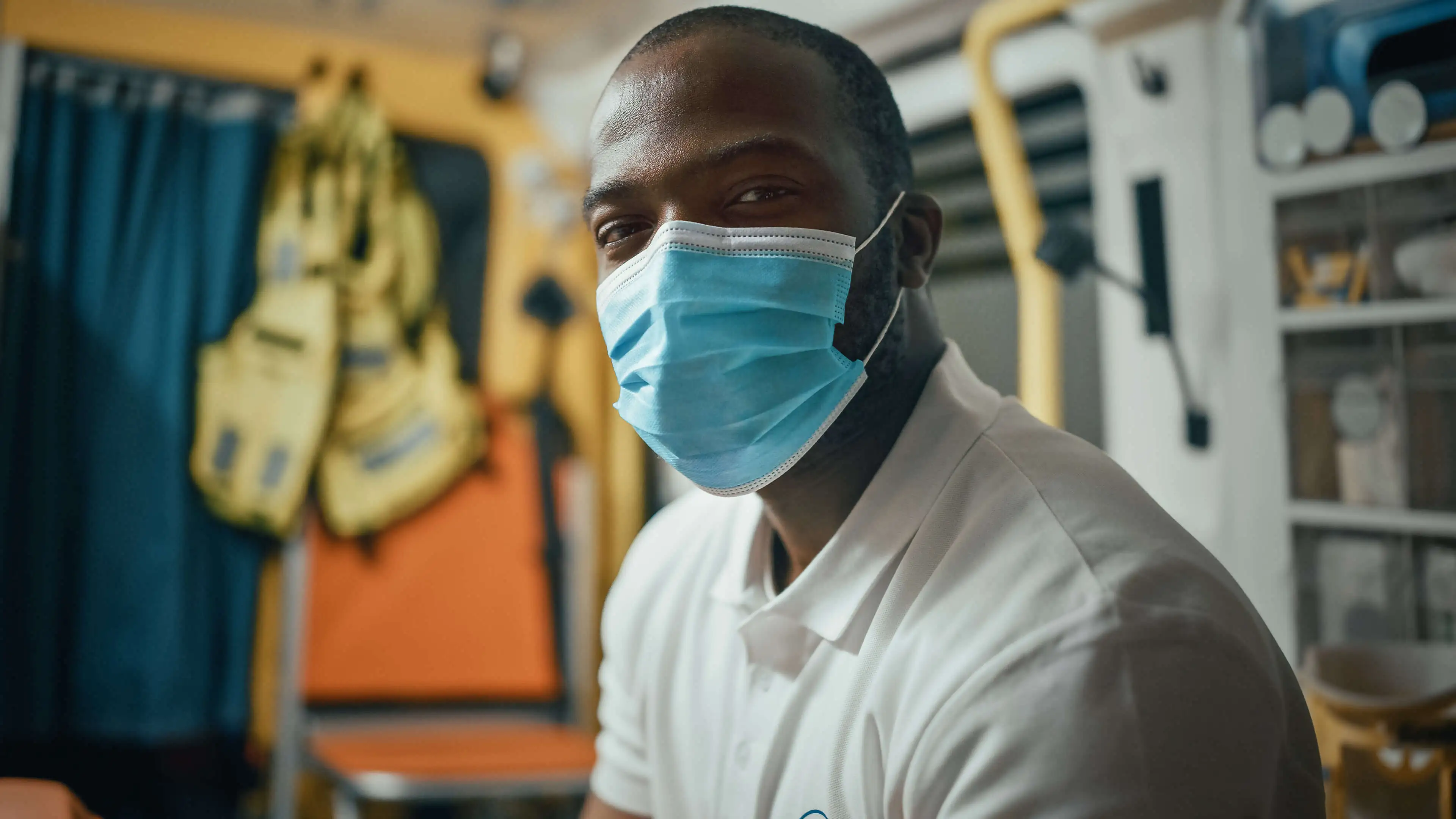
Experts on the front lines
Recognizing the power and creativity of essential workers.
For many organizations, frontline workers like grocery store clerks, nurses, hospitality workers, and transit employees are an essential part of doing business.
So much so that they continued to show up at the office throughout the COVID-19 pandemic even as everyone else went remote. As the point of contact with customers and key systems, these workers often know exactly when, where, and why things don’t work, and they come up with powerful hacks and workarounds to make things better. Yet these insights and innovations rarely make it to the corporate office. And that’s a problem: large organizations often hire design and innovation consulting firms while not taking advantage of a latent source of deep, in-house expertise. It’s equally discouraging to workers who would gladly share their ideas if they were only asked. No surprise, then, that frontline workers are quitting their jobs in droves.
What could companies learn by listening?
IDEO partnered with the Ford Foundation to create the Worker Voice Design Lab, where leaders from a port authority, an airline, and a health care provider worked alongside frontline workers. That led to the planting of a seed of innovation in each organization, with interventions designed with and by workers implemented operationally at the core of the business. In one case, a group of workers zeroed in on specific problems with such clarity that they were quickly able to develop a digital prototype for testing. No one was less surprised than the workers themselves, who simply said: Well, nobody ever asked us before. Sometimes the most innovative idea a leader can have is to listen, learn, and act on their employee’s smart ideas.
A large portion of the job churn since March 2020 has been concentrated in frontline services such as accommodation, food services, and retail.
Lack of career growth is the number one reason people leave their jobs according to more than 18,000 frontline workers across 150 companies.
2 pilot initiatives
being led by frontline workers in 2022
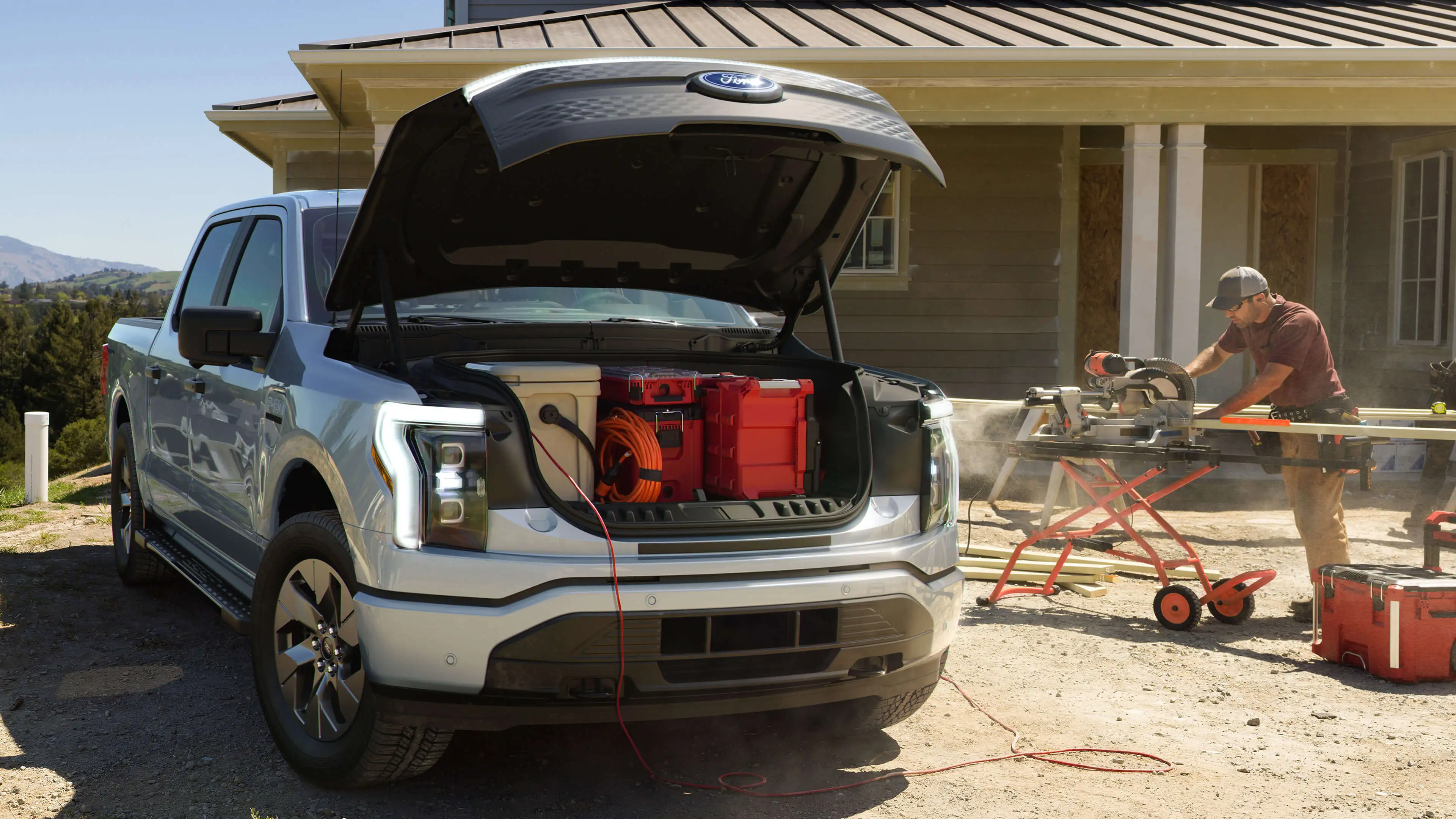
Customer powered
How Ford transformed itself to take on the future of mobility.
The climate era demands new offers and new ways of working.
Would you like to be able to plug your jigsaw into your truck? How about taking a fully reclined snooze after a long day of fishing? Questions like these led to quick prototypes that ended up in Ford’s new, electrified F-150 truck, which has more outlets than the average apartment and can power your entire home. This was no small update. The way Ford reimagined the truck experience from powertrain to power nap is emblematic of how much customer-centricity is now embedded in Ford’s culture.
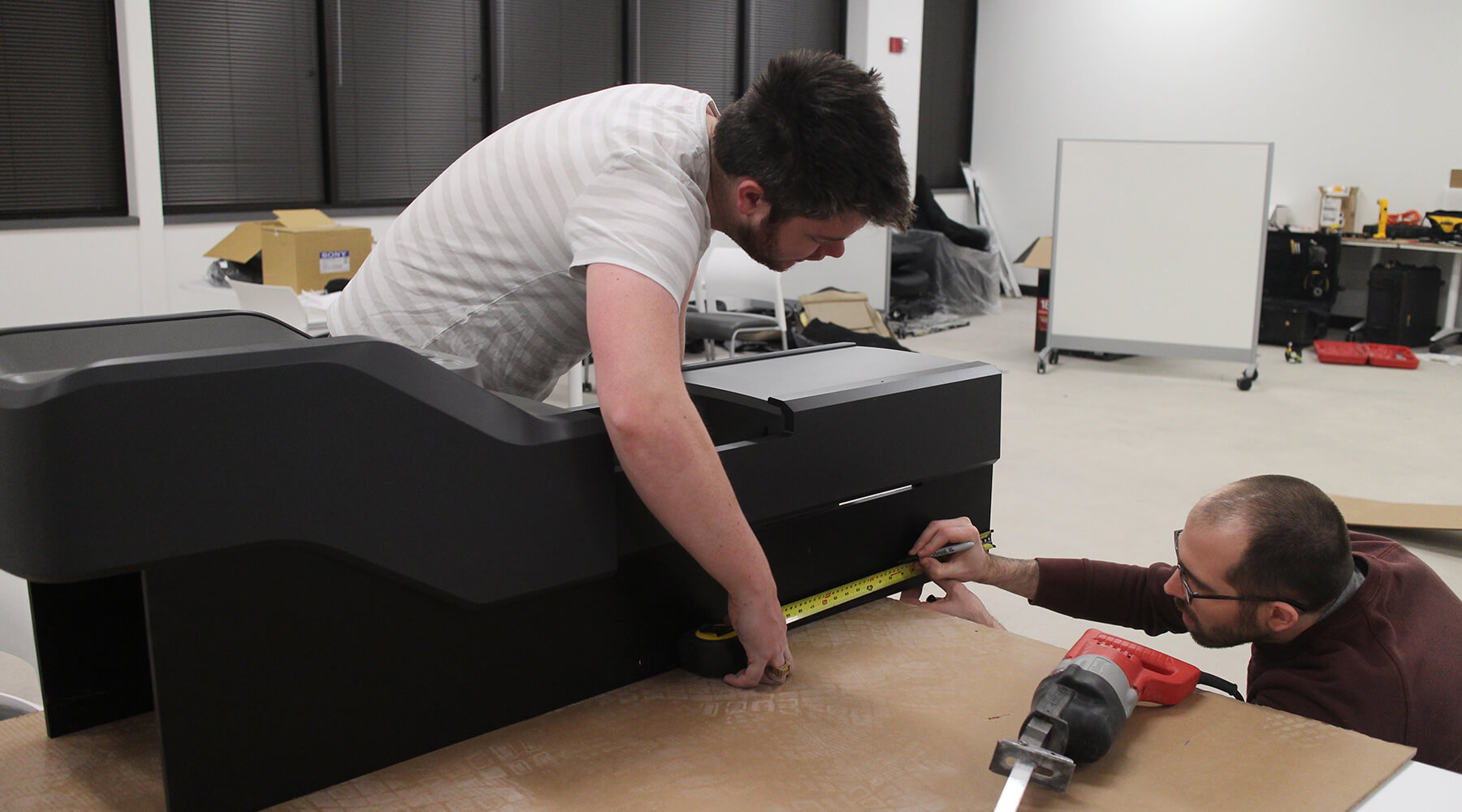
For well over a decade, we’ve partnered with Ford in the U.S., the EU, and China to help the organization bring to life a shared vision of the future of mobility. Together we scaled new capabilities throughout the company by running proof-of-concept “beacon” projects and, to embed this new customer-centric mindset, built a human-centered-design hub called D-Ford. This organization within the organization has become a magnet for talent and is spread across six global locations: London, Shanghai, Melbourne, São Paulo, Palo Alto, and Detroit. Ford’s commitment to serving the needs of people and the planet is what propelled the rethink of the F-150, the best-selling vehicle in the U.S. for over 40 years. It was a high-stakes move, and one that represents a major turning point for the automaker: For the first time, its primary profit source would be electric. The new Lightning is still built Ford tough, but also built for the future.
Passenger vehicles produced 41% of carbon dioxide emissions worldwide in 2020.
One in every 20 passenger vehicles sold in the United States is a Ford F-150.
Before going electric, the Ford F-150 emitted about 100 tons of CO2 over a 200,000-mile lifespan.
200,000
pre-orders of the electric F-150 truck, named one of Time's Best Inventions of 2021
Most Innovative Design Company of 2022
according to Fast Company
Beyond the bag
A coalition of retail leaders join forces to address single-use plastic-bag waste.
America’s leading retailers share a common goal—doing less harm to the planet.
The systemic challenges standing in the way require a bold new approach, and no single company can solve them alone. So Closed Loop Partners convened a group consisting of founding partners CVS Health, Target, and Walmart, along with 12 other leading retailers. As the innovation partner, IDEO helped launch a global search for breakthrough sustainable ideas that yielded more than 450 submissions from startups and entrepreneurs to reinvent the single-use plastic retail bag, with nine finalists entering a six-month accelerator.
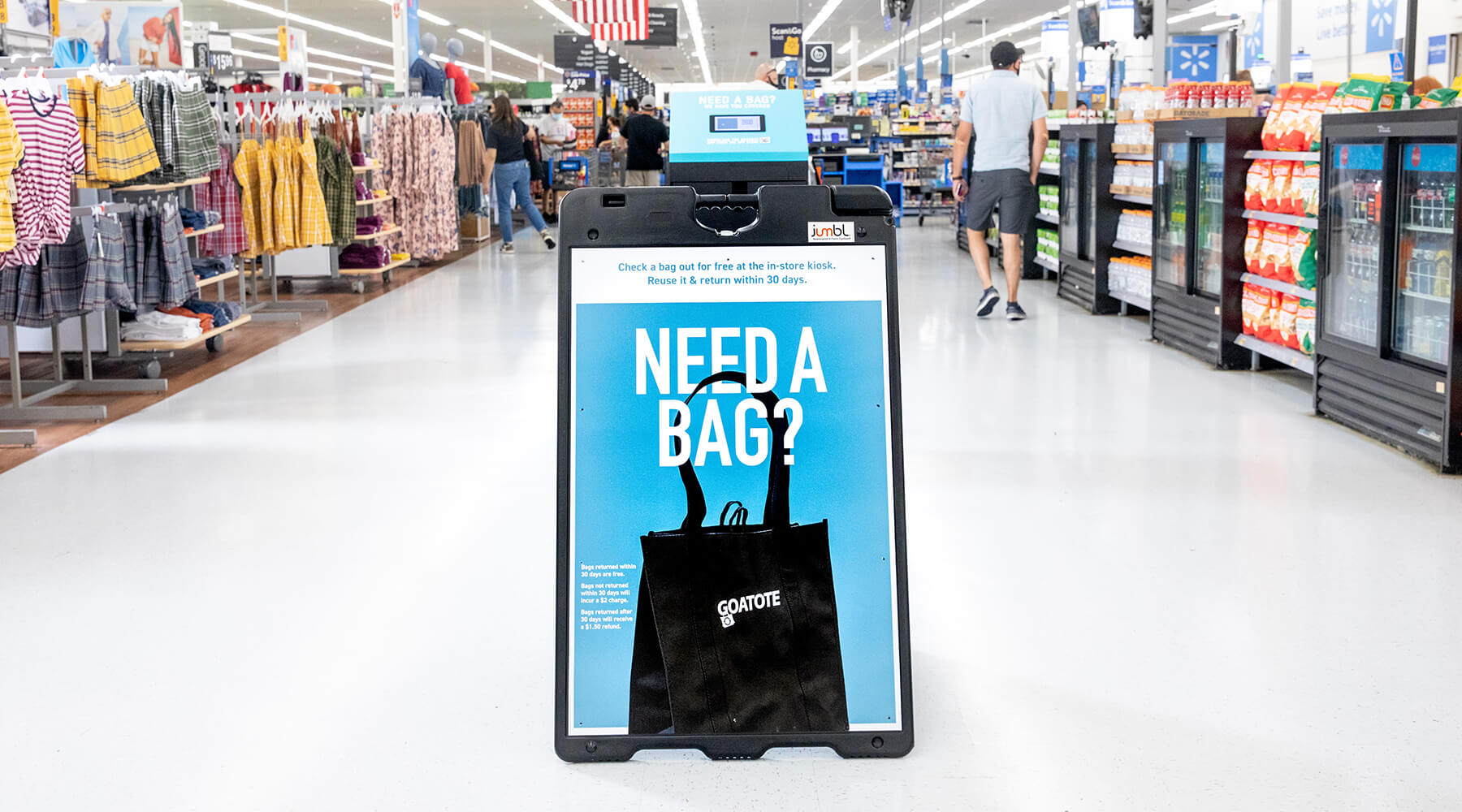
New alternatives ranged from biodegradable solutions to systems that kept reusable bags in rotation. IDEO teams not only facilitated collaboration between startups and sustainability leads from partner retailers, but also provided a boost of additional expertise from industrial, data, and business designers. In a matter of months, teams were able to launch prototypes in select CVS Health, Target, and Walmart stores in California and New Jersey.
Everyone involved in the consortium knew that replacing single-use plastic retail bags is a problem that won’t be solved quickly or easily. But the Beyond the Bag challenge helped them learn that designing for the policy and infrastructure of tomorrow requires tangible steps, taken together, today.
A hundred billion plastic bags are used in the US every year, and less than 10% of them are recycled.
Every year, plastic retail bags are among the top ten items found on beaches and waterways worldwide.
9
stores tested solutions across Northern California
Millions of dollars
raised by two startups
2
startups acknowledged by Fast Company's World Changing Ideas Awards
An IDEO Recruiter’s 5 Tips for Writing a Better Cover Letter
What we've learned from the best letters to come through IDEO
Practical is good. But when you are applying to your dream job, being practical is not enough. Cover letters may seem like an extra step, but for those of us on the other side, they’re a way to cut through the noise. I might see 300 applicants for a single job. A cover letter helps me understand the people behind these pieces of paper, and who might really make a difference in the role.
Maybe candidates feel too much pressure to write the perfect cover letter, so they skip it. To that I say, don’t let perfect be the enemy of great. And don’t miss an opportunity to show a company who you are and what you bring with you.
Here are five tips to help you write a compelling, well-crafted cover letter, with excerpts from real letters that helped IDEOers get in the door.
1. Explain why this position makes sense for you now in your career
If you’re shifting industries, or looking for a role with more responsibilities, your qualifications might not be obvious based on a resume or LinkedIn profile. Remember, this isn’t about selling yourself; this is about sharing yourself.
Here's a good example:
I am interested in the recruiting coordinator role because I believe that I have the best skillset and mindset to navigate the different elements of this position, and I am very interested in growing in a career in HR.
My experience in office coordination and operations management has taught me that my workplace passion is in people operations and support. My favorite phrase to dish out is, “Don’t worry about it, I got you.” My goal always is to set people — employees, visitors, friends, strangers — up for success. Whether that means labeling which drawer has paper clips and which has paper towels, or directing questions to people who have the answers, or ensuring that new hires have all they need and more waiting for them on their first day. I strive to be a bridge between teams to help members get what they need to get the job done well, and I am passionate about finding ways in which we can improve that entire interaction. I geek out over creating, improving, and discussing process and ways we can make interactions more human.

2. This is an introduction, not a manifesto
Aim for two paragraphs (if you end up with one or three it’s okay). There is no rule that says cover letters need to be lengthy to lend insight into your background and your interest in the role. On the flip side, the two sentences that state the obvious—you’re applying to such-and-such company and that you hope for an interview—aren’t really cover letters. If this is your go-to move, ask yourself why you’re applying to that role and if you are really interested in it or qualified for it? Because those are the same exact questions the recruiter is asking.
Here’s a pithy explanation of who a candidate is, and what she wants out of a career:
I’m half Scottish, half Chinese and have lived and worked across seven cities in three continents in the past 10 years. I have the unique ability to imagine the world from multiple perspectives. I’m a leader, a dot connector, and a storyteller. I’ve been looking for an opportunity that combines my unique interests in design research and education, and would look forward to hearing more about the team and projects and share how I can contribute.
3. Show some personality in your writing
Try to strike the right balance between being sincere and being authentic. A sincere cover letter gets the reaction, “Wow, they really mean everything they say.” An authentic cover letter gets the reaction, “Wow, they didn’t hold anything back.” Cover letters can have a blend of both—just remember that this is a first impression. When in doubt, stick with sincerity.
Here’s how one successful applicant explained his background, and his values:
So as I sit here in the airport terminal waiting to board, I wonder about the question of my own destination. After honing my expertise in insight-led branding, I want to bring it to a greater range of projects for a company that would allow me to make a positive difference in the world. I feel like my experience with junior designers, my advocacy for design as language, and my commitment to collaboration would help me to be an asset for a brand that shares these goals. After all, that’s what all of us are looking for, to invest our time in brands with which we share the same values.
4. Keep it focused
Sharing a portfolio or summary of past work is not the same as a cover letter. If you want to get visual with images, graphics, charts, and artwork that’s great, just make sure it is in service of communicating why this role, and why you.
This is the entirety of one successful cover letter:
I’m a scientist, a writer, an educator, an artist, and an avid autodidact. What makes me an effective educator is that I have a genuine and self-motivated thirst for learning and for sharing that information with others. My experiences create a design process that is equally as analytical as creative, as researched as inspired, and as concise as expressive. On my nightstand right now, I have The New York Times, Popular Mechanics, National Geographic, Rolling Stone, The Economist, and US! Weekly. It’s a mixed bag, but it’s the best way I can show you that very few things escape the reach of my curiosity. Welcome to my brain:
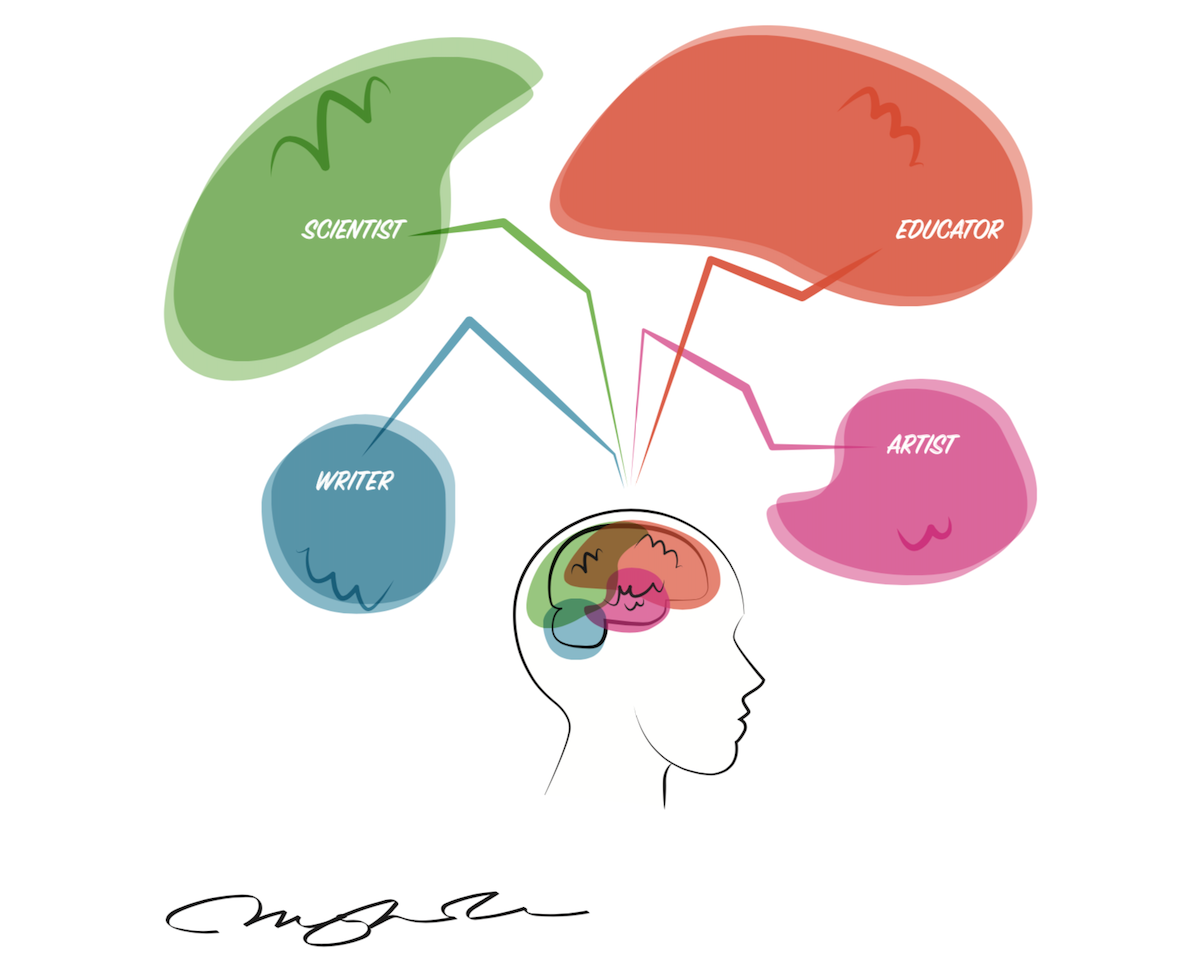
This image complemented the message of the above cover letter.
5. Address it to the correct company
Yes, this sounds basic, but—believe it or not—this mistake happens all the time. It’s perfectly normal to have a cover letter template you enjoy using—just make sure to tailor your cover letter to the role and organization. And always proofread. (For the companies and roles you’re most excited about, have two other people proofread.)
Here’s how one applicant showed us—in an opening sentence—that they knew a lot about IDEO and the work we do. (Creative Confidence is a book written by David and Tom Kelley, partners at IDEO).
Dear IDEO hiring team,
I put down Creative Confidence on a cold, March Toronto day with a profoundly different perspective on what it means to do meaningful work.
These are all important points to fold into your cover letter, but remember, what matters most is that you show a little personality. After all, we want to hire you, not your resume.
Let it be known, I love cover letters. For applicants, they’re the best way to express thoughtful excitement for a job. For recruiters like me, they’re the best way to learn about the motivations and aspirations behind an application. But much to my dismay, these days, there’s a common belief that cover letters are superfluous compared to the more practical resume or LinkedIn profile.
Build your creative confidence: Mindmaps
Actively engaging in exercises that foster divergent or unconventional thinking can encourage the generation of ideas. When you are searching for innovative solutions on your own, mindmaps can be a powerful way to come up with ideas or to gain clarity about a topic of exploration.
Creative Confidence has inspired thousands of people to adopt a creative mindset and apply it to the diverse real-world challenges they face. In this series, we’ll share some exercises from the book that can help you approach your challenges from a new perspective.
Creativity Challenge #1: Push yourself to think divergently and creatively
Actively engaging in exercises that foster divergent or unconventional thinking can encourage the generation of ideas. When you are searching for innovative solutions on your own, mindmaps can be a powerful way to come up with ideas or to gain clarity about a topic of exploration. They are extremely versatile, and we use them all the time. From coming up with ideas for a family vacation to identifying home projects to tackle over the weekend, mindmaps can be used for all sorts of problem solving. They help you chart the recesses of your mind surrounding one central idea. The further you get from the center of the map, the more hidden ideas you can uncover.
Tool: Mindmaps
Participants: This is usually a solo activity
Time: 15-60 minutes
Supplies: Paper (the bigger the better) and pen
Instructions
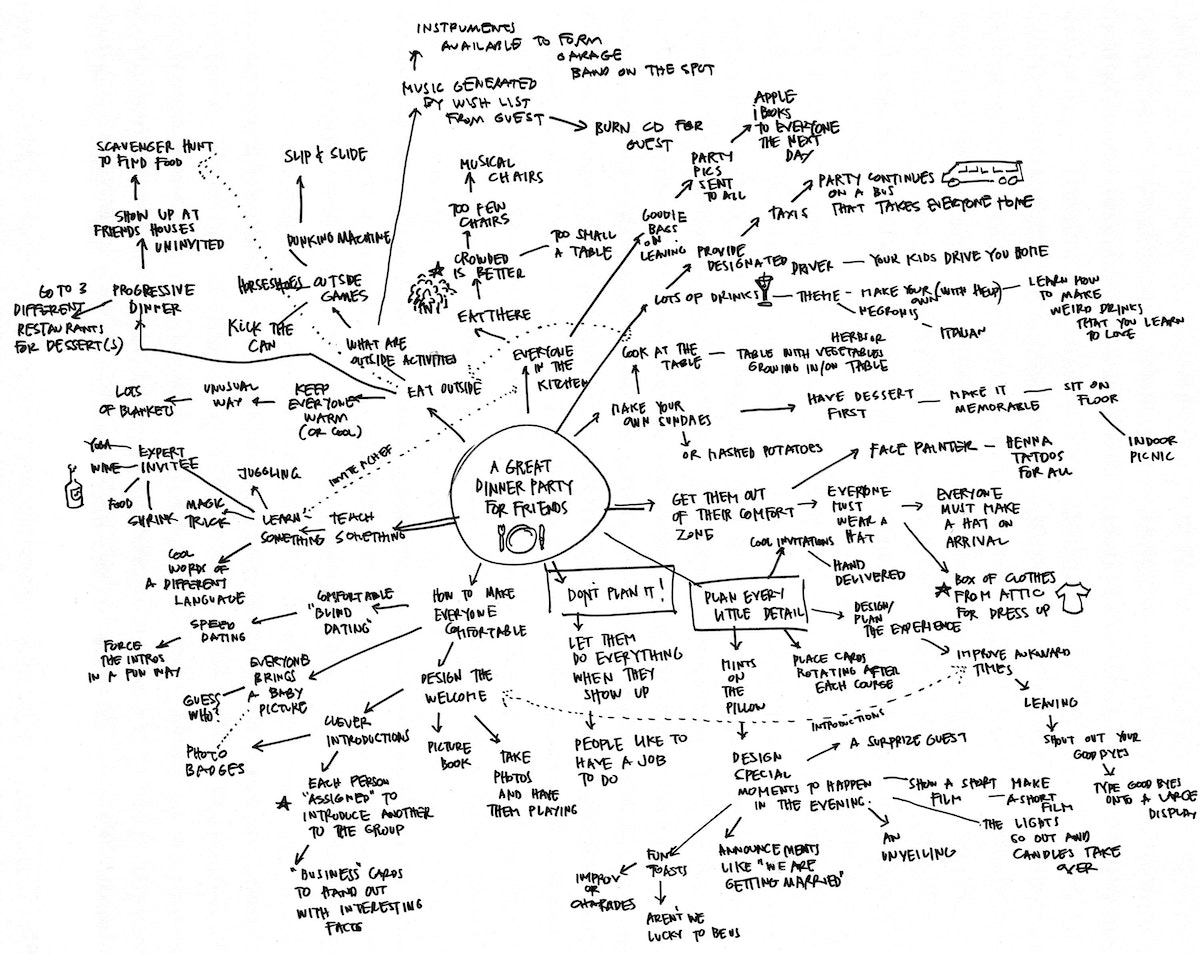
Step 1: On a large blank piece of paper, write your central topic or challenge in the middle of the paper and circle it. For example, you might write “A great dinner party for friends.”
Step 2: Make some connections to that main topic and write them down, branching out from the center as you go. Ask yourself, “What else can I add to the map that is related to this theme?” In the dinner party example, you might write down “everyone in the kitchen” and “make your own sundaes” as two avenues of thought. If you think one of your ideas will lead to a whole new cluster, draw a quick rectangle or oval around it to emphasize that it’s a hub.
Step 3: Use each connection to spur new ideas. For example, under “make your own sundaes,” you might write “have dessert first” or “cook at the table.”
Step 4: Keep going. You are done when the page fills or the ideas dwindle. If you are feeling warmed up but not finished, try to reframe the central topic and do another mindmap to get a fresh perspective. If you feel you’ve done enough, think about which ideas you would like to move forward with. After drawing the mindmap shown here, David threw a big dinner party in which guests changed tables after each course, enabling them to talk to everyone in the room. Each challenge presents an opportunity for innovation.
Tips from the field
Generally the first set of ideas that branch from the center will feel cliched or obvious. That happens to everyone. Those concepts were in your head and were just waiting to be captured on paper. As the map progresses, however, your mind will open up, and you’ll likely discover some wild, unpredictable, dissociative ideas.
As you experiment with mindmapping, you may find it valuable in all sorts of creative endeavors. As David’s former colleague Rolf Faste used to say, mindmapping can:
- Get you started and help you overcome your fear of the blank page.
- Help you look for patterns.
- Reveal the structure of a subject.
- Map your thought process and record the evolution of an idea. (You can trace it backwards later in search of new insights.)
- Communicate both the ideas and the processes to others, so that you can guide them on the same mental journey.
You may be wondering when a mindmap is better than an ordinary list. Lists are great at keeping track of things we don’t want to forget. But the to-do list assumes we know what we want to put on it, whereas, at the start of a mindmap, we don’t yet know where it’s going to lead us. Mindmaps are good at facilitating divergent or unconventional thinking; lists are good for capturing the best answers among the thoughts you already have. Mindmaps help to generate ideas. As such, mindmaps are particularly useful early in the creative process. Lists are better later on, when you want to capture the ideas you’ve generated and are looking for a best solution to pursue. Each of the chapters of Creative Confidence started as a mindmap. Later they evolved into lists of stories and ideas that we wanted to weave together. When you are trying to create something new, use mindmaps to generate ideas and lists to capture the best ones. Together, they can be a powerful combination.
This post is the first in a series of exercises taken from Chapter 7 of . Purchase the book for more on how to use creativity to solve problems.
Everyone is creative. This belief runs through everything we do at IDEO, and in 2013, it led my brother David and me to write a book that would help others—even those who don’t think of themselves as “creative types”—to unleash their creative potential.
6 ways we want to redesign cities
Visions for a more human-centered city
In our practice, we believe that cities are catalysts for innovation—every citizen and developer shares responsibility for the city in which they live, and equally shares the potential to bring positive change to that place. Here are six things we can’t stop thinking about redesigning, from the humble sidewalk, to the decentralized workplace, to the way we build our neighborhoods.
Bridging Physical and Digital
My smartphone upstaged my city. I no longer need to walk to the bank, stand in lines, wander through stores—I can do it all faster online. The majority of physical spaces we used to rely on have lost their initial purpose, become underutilized, abandoned and some—like the mall and big box stores—out of business. What should be located in these spaces? How should banks represent themselves in a physical world? What is the future of the service-based businesses?
I’d like to discover a way to reconnect physical and digital innovations, and make these obsolete spaces useful again with shared ownership models and disruptive technologies. I’d love to see more sustainable and flexible business models around “micro-leases,” square footage-based ownership, and so on. The digital era has opened a fantastic opportunity to reshape our relationship with physical spaces, collaborate more, and integrate the architectural world into the discourse around innovation.
— Kateryna Romanova
The Way We Create Buildings
The more cities I visit, the more I realize how similar most of them are—and not in a good way. As an architect, I always find the lack of variety disappointing. The problem begins with the way we construct buildings. Automation has been taking over the construction process, and although there are positive features of this new approach, it leaves out the nuance of human input, which is key to diversity and uniqueness in the built environment. As construction technology marches ahead, I would love to find a way to amplify the voices of the people who will eventually use those buildings, documenting their opinions and needs during the design process. If we can connect the two, then the resulting buildings will be as varied as the people they house.
— Matt Avallone

Sidewalks
Sidewalks are our doorstep to the city. They are a meeting ground for the public—they provide space for eating, exercise, and rest; they house wildlife, foliage, and even micro-businesses. As our cities evolve to be less car-centric and more people-oriented, I would like to envision a continually active role for this diverse strip of land we call the “sidewalk.” In the face of climate change, sidewalks could become permeable strips of land that enable more resilient flood response. They could become extensions of our cultural institutions and art museums, drawing them out of their building envelopes. Sidewalks turned into green belts could convert concrete jungles into urban oases and productive farms. Sidewalks are two-dimensional strips of democracy, and because of their scale, they can serve as a key variable in how we prototype our urban life.
— Nicholas Pajerski
Bringing the Future Forward
Despite the emergence of fast-moving technology that constantly challenges and changes the way we live in our environment, we still mostly design and build in the same old ways. We can dream up all the amazing spaces and experiences in the world, but if we don’t evolve how they truly come to life, we are bound to fail, and our designs will always be stuck in the “future.” If we could find a better way to close the gap between the conceptual ideas of designers and the reality of the user, we’d have a better chance of transforming the lived experience of urban environments.
— Haemi Chang
More Playful Cities and Streets
Play! In the last year, I have started chasing and capturing playful moments in the streets— from graffiti, to a group of kids playing in the water from a broken pipe, to lovers dancing on a street corner. This journey of capturing playfulness in the streets made me more aware and even obsessed with the idea of how we can design the right conditions for playfulness in the city. Why playfulness? Because playing means engaging, engagement brings care. If we are more caring and careful about the streets of the cities we live in, we might build stronger connections for healthier communities. Being playful on the streets requires courage, builds trust, allows for discovery, create communities. Playfulness is fundamental to our social nature, so it’s a useful framework for thinking through how we can build stronger cities and communities.
— Nazlican Goksu
The Car-Centric City
Cities are becoming denser than ever, yet while density forms the perfect conditions for alternative transport, cities are still designed primarily with automobiles as the top consideration. If we were to design first for walkability and safer cycling experiences, we could inspire and incentivize individuals to choose car-free options for getting around.
Designing walkable cities is not limited to creating more sidewalks—a paradigm that still puts drivers first. Walkability requires a serious reconsideration of an entire transportation and urban infrastructure, putting people first and cars second. We need to consider infrastructural changes at multiple scales and from multiple perspectives: creating denser, more mixed-use walkable neighborhoods; optimizing for green public spaces for gathering over sprawling parking lots; better integrating bike storage and building protected bicycle lanes; dispersing art and street lighting throughout major walkways to encourage people to walk more; and lowering speed limits in pedestrian-dense areas to ensure safer, more enjoyable walking and cycling experiences.
— Courtney Song
Members of the environments design team at IDEO are constantly thinking about the ways we shape cities, and the ways cities shape us. Innovating around established and out-of-date spaces, new forms of retail, the future of living, and mobility is part of our daily lives—and something we don’t turn off when we head home for the day, or even when we go on vacation.
Get inspired by these designers’ side gigs
Passion projects help us stay inspired, push our edges, and bring new ways of thinking to our day jobs
For one, creating keeps you inspired, giving you something to cling onto during those moments when the daily grind gets you down. It also forces you to push your edges—creatively, mentally, maybe even physically. By exploring your own creativity on your own terms, you’re bound to uncover new ways of thinking and working that will serve you in more ways than one.
Not sure where to start? Soak up some inspiration from IDEO designers whose side projects keep them sharp and creatively engaged.
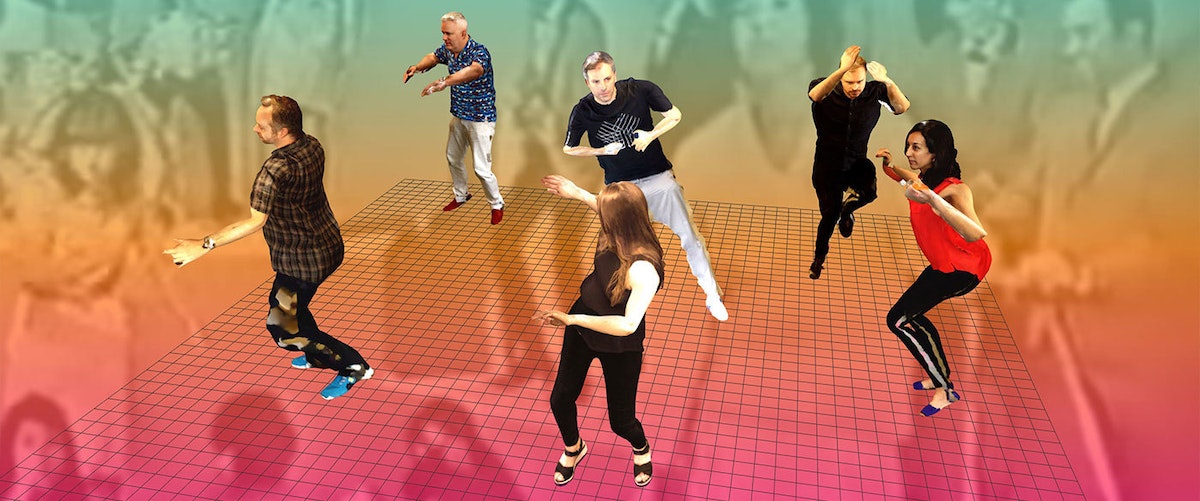
1. If you want to learn a new skill...
IDEO New York’s Alex S. calls himself a “digital alchemist”—in other words, he loves making weird stuff on his computer. When he decided to teach himself 3D coding, he embarked on a slightly unsettling but majorly entertaining side project to create an online, 3D dance floor for his virtual colleagues to get jiggy with it.
READ: How I Taught Myself to Code in 3D
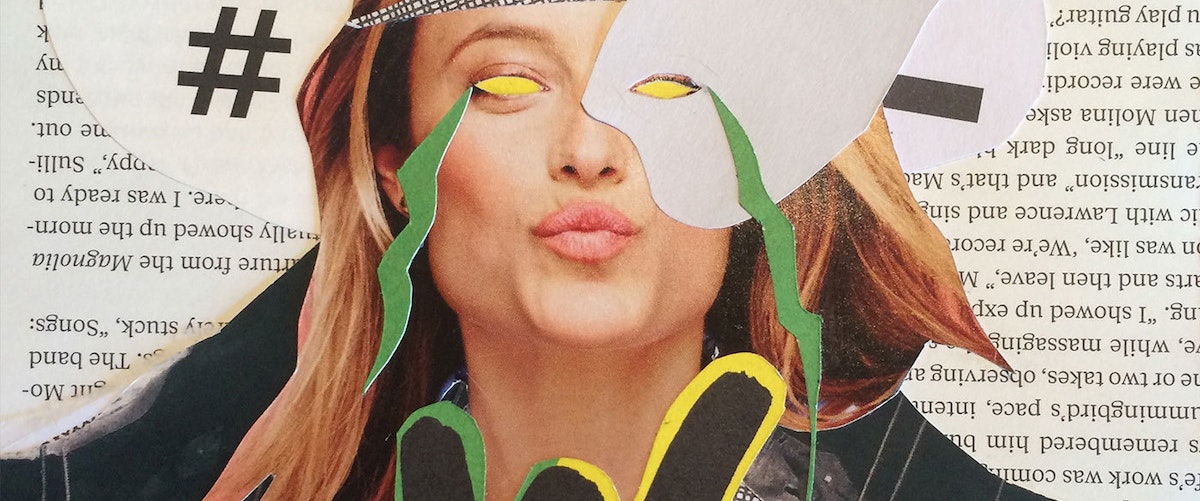
2. If you’re ready to roll up your sleeves and make something…
In his role as a design director at IDEO Cambridge, Michael Hendrix spends his days thinking big (and staring at screens). To keep his fingers nimble and his mind open, he started a simple yet satisfying side project: Making a paper collage every morning.
READ: I Chop Up Faces Every Morning and So Should You
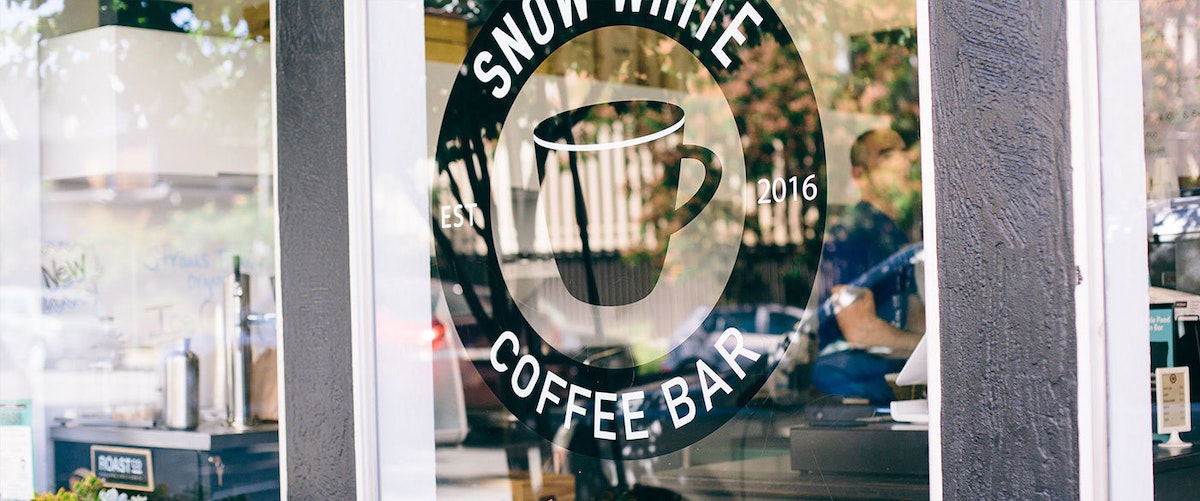
3. If you’re looking to start a business on the side…
Kim Powers spends her days designing the experience of working at IDEO San Francisco. Two years ago, Kim and her husband purchased an abandoned dry cleaners and transformed it into a coffee shop—and the journey turned out to be directly relevant to her work.
READ: Thinking About Starting a Side Business? Read This.
4. If you want to find a way to mash up your passions…
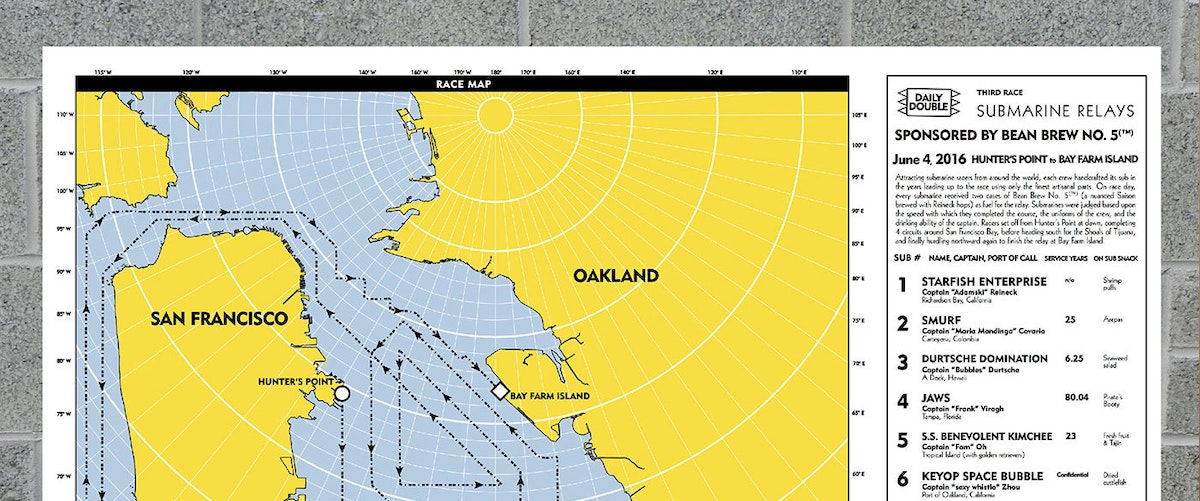
Legal designer Sean Hewens has a taste for the absurd. On one hand, he’s a fictional mapmaker, and on the other, he brews his own beer. Sean’s side project manages to combine those seemingly unrelated hobbies into what he calls “the ultimate beer drinking experience.”
READ: What Brewing Beer Taught Me About Design
5. If you'd like to build your kids something special…
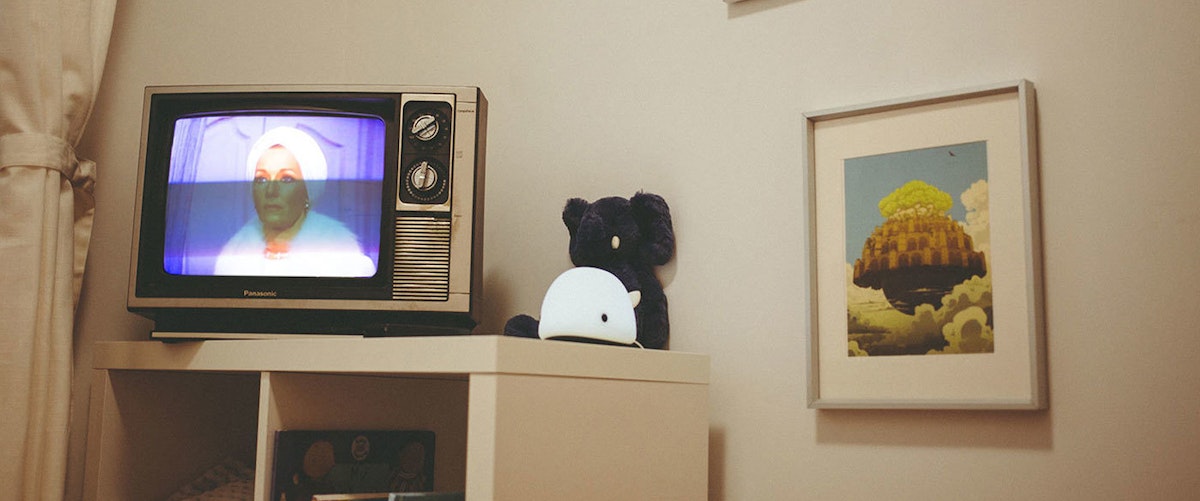
When she’s not designing software at IDEO Cambridge, Ashley Holtgraver is busy raising her newborn son. To help him grow up healthy and unscathed by the pressures of today’s digital world, she used her programming skills to build her son a “Slow TV.”
READ: Why I'm Building a TV For My Baby
6. If you want to get involved in your community…
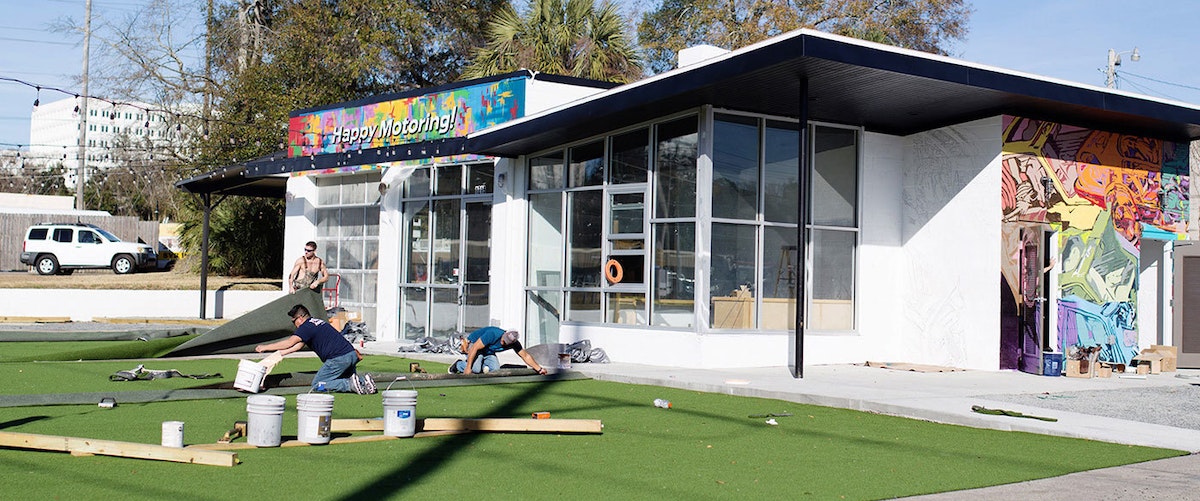
Jacob Waites spends his days designing for emerging tech with IDEO CoLab, but on the side, he’s a founding member of Foremost, a creative collective intent on bringing culture to small town Florida. Together, the collective gutted an old gas station and transformed it into a community art center.
READ: How We Turned an Old Gas Station into a Community Hot Spot
At IDEO, we’re passionate about our jobs—and everything else. Our writers, designers, and researchers spend their spare time going after everything from beer making to starting their own businesses, making toys to writing stories. Why? Because big, small, physical, digital, experimental—no matter what we create, we know it’s valuable.

Lindsey Turner
I’m passionate about building brands, products, and experiences that help organizations show up with meaning and momentum.
I help organizations cut through complexity by shaping how they show up, through brand strategy, identity, and storytelling.
Working at the intersection of brand and business, I bring an editorial eye and a bias toward making—turning ideas into tangible experiences that people can understand, trust, and believe in.
My work spans government, healthcare, financial services, media, and consumer goods, from launching Gen Z-focused ventures to building innovation labs and reimagining legacy brands. I relish moments of ambiguity and enjoy translating across teams, perspectives, and priorities to move ideas forward.
I started my career in editorial and digital design, shaping cross-platform experiences and identity systems in publishing and agency environments. That foundation still shapes how I work today: I’m detail-oriented, collaborative, and overreliant on the Oxford comma. I hold a BFA in Visual Communication from the School of the Art Institute of Chicago.

Rachel Young
My work helps organizations see who their products aren't working for—and build the will and the tools to do something about it
For 25 years, I've asked the same question: Who does this design exclude—and what are we going to do about it?
My work spans human-centered strategy, inclusive design, and qualitative research, with clients ranging from Microsoft, Google, and Verizon to the National Science Foundation, and San Francisco Unified School District.
Before IDEO, I taught elementary school in East Palo Alto and spent a decade doing design work with social service organizations—where I learned firsthand what it costs people when systems are built without them in mind.
I am currently writing User Error, a nonfiction book about digital access and the design decisions behind it. I live in Oakland, California.

Brian Pelsoh
I lead with craft, ensuring our work is creatively excellent: rooted in deep human insight and imagination, while also grounded in the realities of business and technology.
My expertise spans brand, communication, and product design across tech, education, the arts, and social impact.
I believe great work demands both high-level vision and obsessive attention to detail, and only happens through collaboration.
I bring an inclusive, hands-on approach and a deep understanding of business, which enables me to consistently deliver excellence while always asking why.
Before joining IDEO, I worked at the brand firms Pentagram and VSA Partners. I began my career as a designer, leading teams at the School of the Art Institute of Chicago and the Milwaukee Art Museum. I hold an MFA in graphic design from Maryland Institute College of Art and a BFA in communication design from the Milwaukee Institute of Art & Design, and have taught at some of the best design schools in the US.

Tony Wong
I am responsible for IDEO’s long-term success in China and working with clients to use design as a tool to enable growth.
I am responsible for IDEO’s long-term success in China and working with clients to use design as a tool to enable growth. Specifically, I have helped Chinese companies design holistic brand solutions through the development of their products, communication, services, and innovation teams, and I have helped multinationals expand their presence and influence in China.
I advise global leaders on developing China-led innovation and capabilities.
In over 15 years in IDEO Shanghai, I have worked on projects that use design to elevate the quality of the experience of healthcare products and services, streamline processes that increase productivity, create spaces and programs that promote and enable inclusive communities, and build next generation mobility solutions that are planet-positive.
Before joining IDEO, I worked at Philips Electronics and the Electrolux Group in Italy, the Netherlands, and Singapore on a number of breakthrough commercial products. I am a member of the Young President Organization in Shanghai.

Building a personal AI for the messiness of life: Sida Li
Most AI products today are built for work—a space with clear problems and established systems. One founder noticed a gap: personal life is messier, harder to systematize, and mostly left behind by the AI boom. So she built Cue, a personal AI that lives inside iMessage and group chats, to go where the other tools haven't.
In this episode, Becca Carroll, IDEO's Chief Strategy Officer, talks with Sida Li, co-founder and CEO of Shared Context Lab, about staying anchored to a human need while the technology around her keeps changing shape, why she treats her business model with the same rigor she'd bring to a product, and what it feels like to build a company at this particular, disorienting moment in AI.
The conversation also gets into how Sida makes design decisions: the language Cue uses to describe itself, the tradeoffs behind building inside iMessage instead of a new app, and a real story about a business idea that didn’t pan out.
This is the second in a two-part series profiling founders from IDEO's Startups-in-Residence program. The first conversation is with Johannes Seemann, founder of Sooner, on designing GenAI for the emotional side of money.

Designing GenAI for the emotional side of money: Johannes Seemann
Most personal financial tools are built to run the numbers and optimize towards a budget. While that works for some, most people experience money as a lived relationship that does not neatly fit into a spreadsheet. Johannes Seemann and Becca Carroll discuss why money is emotional before it is mathematical, and what a human-centered approach to building a generative AI financial product looks like in practice.

The curious leader's edge in uncertainty: Scott Shigeoka
Mina Seetharaman talks with Scott Shigeoka, author of Seek and Head of Curiosity Cultivation at the Eames Institute, about what distinguishes genuinely curious leadership from performative curiosity, how power dynamics shape curiosity, and why practicing curiosity can restore energy rather than drain it.

How constraints make us more creative: David Epstein
Mina Seetharaman talks with David Epstein, author of Inside the Box and Range, about why total freedom often produces average work, how leaders can design useful limits on purpose, and what organizations such as General Magic and Pixar reveal about the relationship between boundaries and creativity.
Looks like you might be in search of something very specific?
Or reset the filters above and try another angle.
Here’s some random inspiration

Podcasts about creative leadership

Articles about the power of prototyping
