
.svg)




Changing the way biotech innovates
Building a culture of user-centered innovation in the name of science.
Life Technologies, a global biotech company that supplies scientists with products and services, needed to grow big, from a $4 billion to a $10 billion enterprise. So it hired IDEO to help seed innovation across the company.
"When we started out, it was an R&D thing for driving innovation in new products. Now it’s not just R&D; user-centered innovation is a central part of our culture. It’s what we do throughout the organization," said Amy Cuneo, Associate Director, Customer Insights.
Over a three-year engagement, IDEO helped transform Life Technologies’ corporate culture through the introduction of User-Centered Innovation (UCI), an optimistic, experiential approach to problem-solving. Far outperforming its ambitious goal, Life Technologies is now a $13.6 billion company and uses UCI to inspire innovation throughout the 10,000-person organization.
After working with Life Technologies, IDEO designers came up with three products that have gone to market, including, a new bottle that showcases superior handling and storage, easier identification, and additional room for supplements. And Life Technologies has transformed from a company that aspires to focus on customers to one that truly does.


Building a birth control support network for women
A multimedia public service campaign as a vehicle to encourage smart choices.
Unplanned pregnancies are a big problem in the US, especially among unmarried 18- to 29-year-olds. Seven in 10 pregnancies in this demographic are unplanned, a statistic that applies to women of all ethnicities and socioeconomic levels. Complicating matters are the social tension between abstinence-only and contraception-inclusive education, and the difficulty and expense associated with obtaining prescription birth control.
Since 2009, IDEO has worked closely with the National Campaign to Prevent Teen and Unplanned Pregnancy, a nonprofit NGO, to address this pressing social challenge. One of the first insights on the project was identifying the need for comprehensive birth control support. Designers looked at ways to transform birth control from a prescription (a piece of paper that is handed to you by a doctor) into a subscription (a program that ensures you start using birth control, use it correctly, and migrate to more effective methods).
Given the complex and potentially overwhelming subject matter, the IDEO team interviewed women in the target demographic; talked with doctors, counselors, and other experts with varying opinions about birth control; and hosted roundtable discussions. They developed several concepts and scenarios that allowed members of the National Campaign to see sex and pregnancy through the eyes of the young women they’re working to reach.
Research and prototyping efforts led to the design of Bedsider, a multi-touchpoint birth control support system with a carefully crafted sex-positive brand, which is uncommon for the healthcare industry. Bedsider focuses on five key areas (awareness, motivational drivers, digital offerings, services, and loyalty) and acts as a vehicle for behavioral change that’s flexible, with room to grow into a much larger movement.
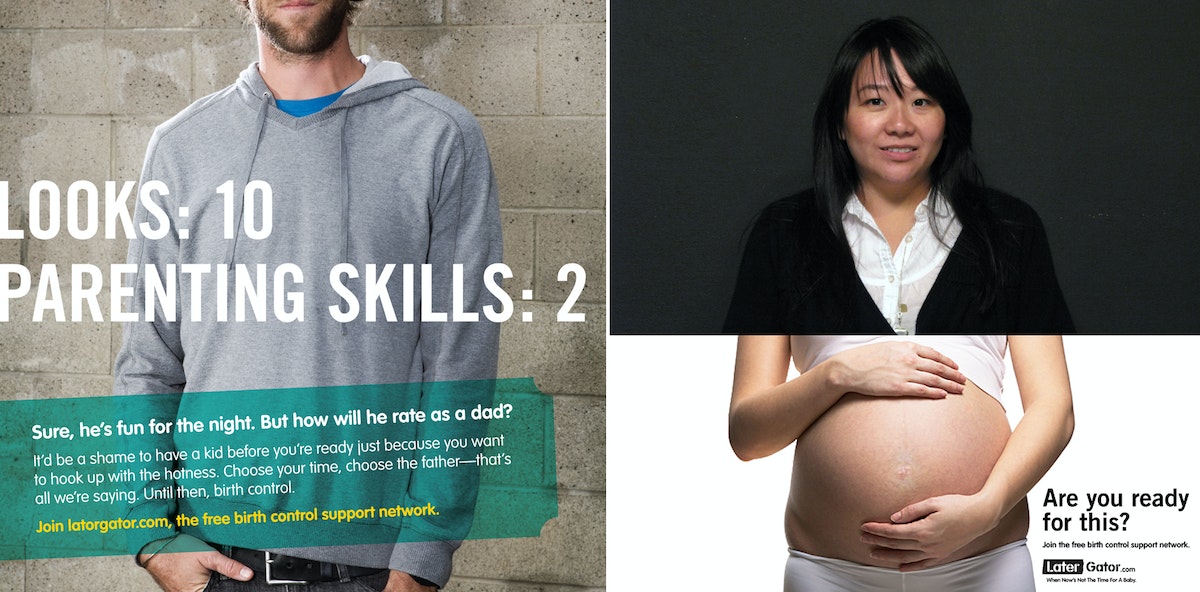
The Ad Council and the National Campaign debuted a multiyear, multimedia public service campaign in November 2011. The Bedsider website offers comprehensive education about existing birth control methods. This includes opt-in reminder services, personal stories from women across the country on why they chose a particular method, a phone service that provides information in both English and Spanish, features such as “Fact or Fiction” (hilarious animated clips debunking popular myths), a “Frisky Friday” newsletter, and more.
Bedsider has launched nationally with the help of an Ad Council campaign that drives sexually active women ages 18–24 to Bedsider.org. The multimedia Public Service Announcement effort includes television, radio, print, web, and nontraditional advertising, as well as an integrated social media program.
“We hope that Bedsider will be a useful tool for women to learn about their birth control options, better manage their birth control, and in the process avoid getting pregnant until they’re ready,” said Planned Parenthood of South Florida and the Treasure Coast in its monthly newsletter. Planned Parenthood and Philliber Research Associates joined forces with the National Campaign to Prevent Teen and Unplanned Pregnancy to help test and evaluate Bedsider.
Through a social media campaign called #ThxBirthControl, people are voicing their thoughts about what birth control has made possible for women, men, families, and society. It’s all part of Thanks, Birth Control Day, launched in November 2013 as part of a continuing initiative to encourage positive conversations and more consistent use of birth control by the National Campaign to Prevent Teen and Unplanned Pregnancy. To celebrate the movement, IDEO wrote, scored, and performed an animated musical featuring condoms and pill packs dancing the cancan.
According to an independent evaluation of the program, Bedsider is the first digital intervention in reproductive health in the U.S.—with adults as an audience—that has shown to prevent unplanned pregnancy. Turns out that when women and men have the ability to plan, prevent, or space pregnancies, they’re more likely to finish school, achieve their goals, and ultimately have healthier families, according to the nonprofit organization.
Bringing bikes to the streets of Chicago
Using the joy and freedom of cycling to brand Chicago’s bike-sharing initiative.
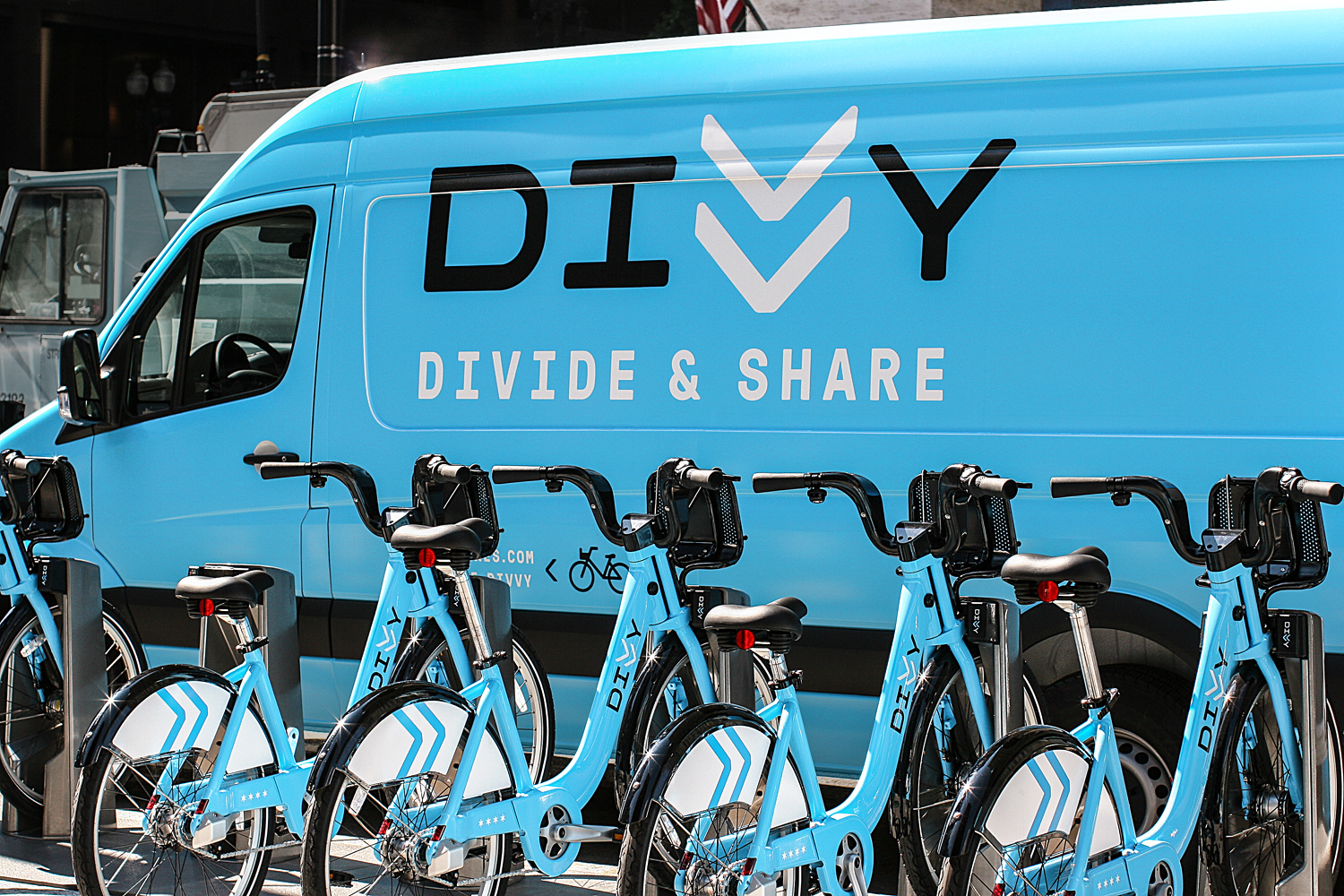
Chicago’s federally funded, citywide bike-sharing service, called Divvy, makes a fleet of bicycles available to commuters and tourists 24 hours a day. Alta Bicycle Share (which runs bike-sharing systems in Boston, the Bay Area, DC, and New York City) collaborated with IDEO to spread Divvy’s message, “Divide and Share!” to the cyclists and would-be cyclists of Chicago through the brand.
The new brand would appear on its bikes, stations, company vans, member fobs, and website—and it needed to be ready to hit the streets in just six months. IDEO partnered with local brand strategy studio Firebelly Design to collaborate on a solution. IDEO led the early research, conceptual brand development, and naming phase of the project; the Firebelly team led the visual design and developed the brand guidelines.
The brand has become a functional and fun part of Chicago’s transportation landscape and has been embraced by Chicago commuters. Just three weeks after it launched, the City of Chicago called the Divvy Bikes program the busiest bike-sharing system in the world. Six months into the service, enthusiastic cyclists have racked up over 780,000 trips and 1.7 million-plus miles, and over 12,000 Chicagoans have become members.
Bringing mass-market genetic testing to Japan
A Japanese mobile internet company quickly builds a genetic testing business.
After watching her husband suffer from cancer, Tomoko Namba, founder of Japan’s leading mobile internet company, DeNA, wanted to empower people with better health information to aid them in making medical decisions. DeNA partnered with IDEO to help with the design of a genetic test that had mass-market appeal.
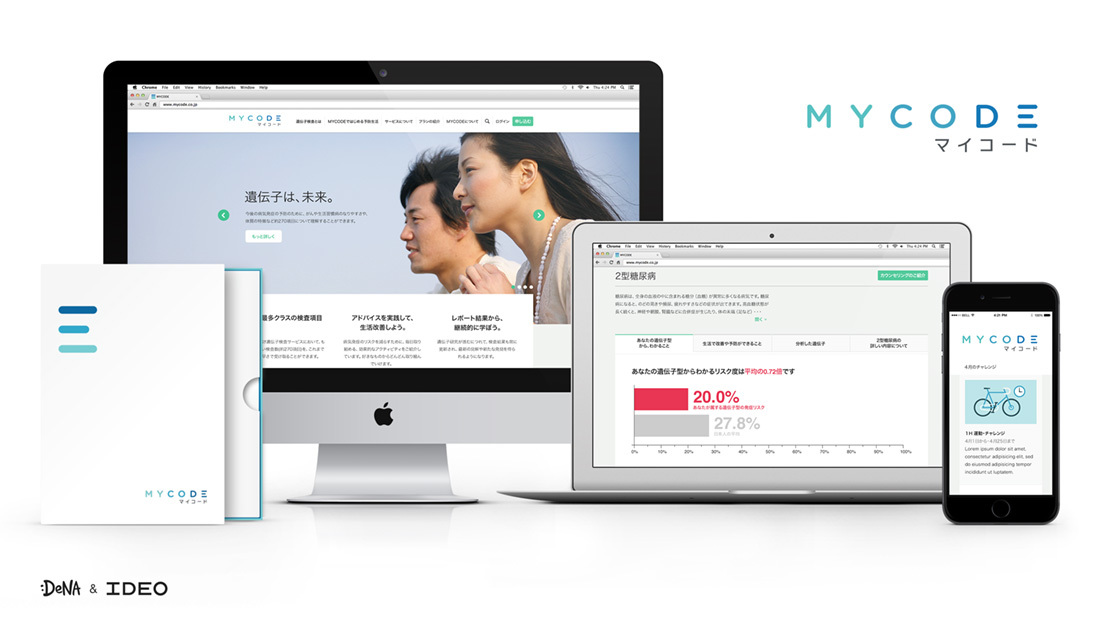
Together, IDEO and DeNA designed all the consumer touchpoints from the ground up for the expanding new business, called MYCODE. The aim was not only to create a functioning, usable product, but also to introduce the notion of genetic testing in a privacy-sensitive country that for the most part, hadn’t yet considered it an option. What would make MYCODE resonate with mass-market Japan? How could genetic testing results be shared in a way that was accurate but also actionable and motivating?
The team worked with doctors, nutritionists, medical governing bodies, and more, setting up fast, iterative cycles, and conceptualizing and prototyping almost every aspect of MYCODE in just 16 weeks. Data design, home testing experience, purchase flow, and how the service would be used over the long-term were all considered, along with traditional branding elements, like name, logo, and visual identity.
The result is a product that puts reliable genetic information into the hands of Japanese consumers, helping them to make more informed healthcare decisions. MYCODE went to market in August 2014, just nine months after the engagement with IDEO began. Not only did MYCODE fulfill Namba’s mission, it helped the company find new ways to grow: Upon announcement of the new service, DeNA’s share price jumped 6.7 percent.

How AI can help us solve the climate crisis
From talking jeans to Nature boardrooms, we’re stretching to meet the future.
Two of those shifts? Generative AI, and our rapidly changing climate.
Together, these two forces are moving both the people side of the equation—what we need and how we behave—and the how side of design: what’s possible.
Welcome to the Climate Era
A new age is upon us. Steam propelled the original Industrial Revolution; electricity powered the second; preliminary automation and machinery engineered the third; and cyberphysical systems—or AI-powered computers—are shaping the Fourth Industrial Revolution.
But the universal context is our climate. The Climate Era is our time-windowed opportunity to reverse the costs of the industrial and digital eras—creating a more abundant future for all. The way through it is to find ways to reinvent our economies, in part by turning necessary choices (like conservation and circularity) into desirable ones.
To the degree that the climate crisis can be solved, we already have solutions and technologies. The central question of the Climate Era is not can we do it? It’s will we do it?
Hello, generative AI
If the challenges of the Climate Era have been building up over centuries, the transformative power of generative AI seems to have hit the world in a flash.
And this is a critical moment to interrogate our relationship with technology. At IDEO we do that through the tools and habits of design: building to think, taking time to understand people deeply, investigating the farthest consequences we can imagine, and embracing new skills, disciplines, and ways of being in the world through experiments.
Combined forces
These two forces—AI and the Climate Era—have the potential to change everything for everyone. And in some ways, they already have. More often than not, AI and Climate thought live in different conversations. But what might happen when they’re brought together?
The pull of personality
Here’s an example of how AI might help us be climate-friendly manufacturers and consumers: It can help you get to know your clothes before you buy them.
We want and we need to build a circular economy. But its biggest challenge is scale: getting to the necessary infrastructure and processes, and—maybe the most challenging—getting enough people to participate.
There are signs of shifts at the policy level: You see it in Europe, for example, where the EU has a regulatory framework to promote (and require) circular behaviors from both businesses and consumers alike. And more and more people are participating in circular-like ways, such as thrifting. We see younger consumers pushing brands to become more active in developing and promoting sustainable versions of their products (so long as they’re not more expensive).
All that made us think about a pair of jeans.
Jeans lack the physical traits necessary for conversation. But, for an exhibit of speculative design at IDEO, we imagined them capable of communication.
For starters: We might ask the jeans about their (un)life story, what went into their creation, or how they like to be treated. We might learn about where they were manufactured, their previous owners, and how to fix them if they ripped. Knowing all this about your jeans would give you a much better sense of whether they were a good fit.
Through AI, all of us will soon be conversing regularly with non-humans. And what else might “speak” through AI? Vehicles that remind us that they’re happier when filled with passengers and bound for the carpool lane?
Speaking for the trees
Most of the sustainability problems we seek to fix were created in the design and strategy choices that were made early on in a product’s journey. The lifecycle analysis is a robust process. But it’s costly and generally retrospective, analyzing only those products and practices that already exist.
What about when we’re exploring different potential options and what could be, not what is?
AI can help us incorporate a real sense of the “true cost” of a product and give nature a seat at the table early on. AI that draws on scope 1,2, and 3 datasets could help protect nature’s best interests in the decision-making phase. To be credible and useful, such an AI would need to synthesize scientific data, cultural data, and archives of experiments. And it would need to have some ability to understand the ground truth of things: learning from both human and technical inputs how things really are, right now, in the soil, in the ocean, in the community, and on and on.
With such a nature-centered AI in play, deployed ethically, we can imagine it occupying different roles and settings. As an advocate in the boardroom (where it might pose strategic questions or even cast a vote), or as an inventor in the materials lab (where it might suggest radically more sustainable ways to use resources and optimize production).
Everything in play
When we talk about making great choices in the Climate Era, especially at the policy or regulatory level, we’re talking about something unbelievably complicated. There are so many factors to consider, in so many dimensions.
And AI can help us think systemically. Take something like fishing. To regulate it, we need to understand the immediate economic impact (such as business profit); the effect on communities and livelihoods; taxation and employment; the effect of granting more or fewer fishing licenses; how to balance production and protection of spawning areas); and biodiversity. AI can synthesize all of that information and data and make suggestions that expand our imagination about what’s possible.
Another thing artificial intelligence has a knack for is running simulations. What if AI could help you simulate the tradeoffs among biodiversity, job creation/local livelihoods, and business success?
We imagined this kind of thing in a piece of work with our friends at Conservation International.
A simulation is often quite technical, and AI is already great at that. But we can also imagine an AI pushing people to consider their choices in other ways. What if it could point you to the right humans, on island nations for example, to enrich your understanding of potential impacts, far beyond your own frames of reference?
The age of transformers
There are so many ways the Climate Era and AI, two transformative forces, might collide in service of building better futures. We picked out just three:
• Driving consumer adoption and adaptation by making things that are better
• Optimizing and reimagining production by giving nature a voice and a seat at the table
• Radically reworking how we make climate choices, especially at the largest scale
But, of course, they’re not the only transformers at work. We are, too. Especially those of us in positions of power and influence.
The Climate Era is here.
The Age of AI has arrived.
And it’s still our world to make and remake—for the better, if we choose.
This article is adapted from a session delivered by IDEO in NYC at the 2023 FastCo Innovation Festival. With editing support from Christina Drill.
The problems we’re being asked to solve are changing. It’s less about helping partners innovate in incremental ways, and more about big transformational shifts in how we live and work.

The illusion of knowing everything
To understand people’s needs, we must stretch beyond data.
In some cases, we knew nothing about the people we were trying to reach, so addressed them with the default direct marketing salutation, “Dear Valued Customer.” Finding the target audience was like being spun around blindfolded, then praying you were walking in the right direction.
Thirty-seven years later, we know virtually everything about everyone. Thanks to data mining and feeble privacy laws, we can pinpoint your exact location, health status, consumption habits, and, troublingly, what makes you laugh, cry—even think. All of that data is now being poured into the greased pan of generative AI where—we are promised—it will bake the most delicious cake, made just for us.
From direct marketing to AI-driven personalization, I’ve witnessed a transformation in how businesses reach their customers. We've never known so much about people, and yet we've rarely understood them less. In my view, using data alone to understand people has the same flattening effect as “Dear Valued Customer.”
But there is an antidote: Human-centered design.

Goodbye “Dear Valued Customer”
Once, at an international conference, I heard a speech by someone who worked for a large social media company. The premise of the talk was that a person’s “likes” could mirror their answers on a personality test. The more likes the social media company could analyze, the better they could predict a person’s personality—and to a level of accuracy that could beat what your friends knew of you; beat your family; and maybe know you better than you knew yourself.
With that kind of knowledge, companies are able to design user experiences that feel like intimate conversations. But are they, really? Or is it only the illusion of intimacy—the hackneyed output of a data-driven predictive power?
It made me wonder: Is how we appear online—even to ourselves—who we really are?
Of course not. People are not reducible to their preferences. People contain multitudes. People change their minds, regularly and often. They respond to things that feel authentic and responsive to their experiences and identity—especially if they have historically been written off, underrepresented, or marginalized.
The new customer, if we can imagine them in their infinite richness, has in recent times slogged through a global pandemic; discovered the unwelcome uplands of hiked interest rates and housing shortages; and likely contended with some form of professional burnout. Human lives are necessarily messy: You can’t rely on troves of data and canned messages to reach them, let alone persuade them. People can smell a door-to-door algorithm from a mile away.
The best organizations are able to stretch how they think about their customers. The most successful businesses are able to understand and reflect back to people things that they don’t even know about themselves.
The power of starting small
In China, a client once questioned IDEO’s decision to root an entire concept in the preferences and needs of a small group of people. But when the product was delivered, the client recognized a level of human understanding that data alone could not achieve.
My time at IDEO has shown me that understanding people requires research at depth. For us, that often means ethnography, and you don’t have to have thousands or hundreds or even 50 people in the room to do it. What you need is a small sample of people with a diversity of lived experiences whom you get to know very well.
Starting small requires designing with people and communities rather than for them, too. Innovation doesn’t spring from our heads as Athena from the forehead of Zeus; it's uncovered through the careful and considered use of tools, mindsets, and methods which we share with teams and communities.
Great organizations recognize that the work of understanding their customers is never complete. They continuously challenge themselves to listen and respond to what their customers are telling them, not only through data, but also by including them as co-designers.

The brutality of perfection
I once had a custom suit made for me for my wedding. To appear cool and unconventional, I asked for a red lining. The tailor wondered if I would still be fond of that red lining in 10 years. A simple question based on lots of experience. Upon a moment of honest self-reflection, my answer was, no, I would not. So, I followed his advice. I still wear that suit today; not once have I wished for a red lining. Of course, a company selling that same suit to me based on tracked preferences would’ve gladly hawked me any lining I wanted. But I am not sure I would trust that company again. I’d move on.
The organizations that will endure will be the ones that stretch their ability to deliver long-term, unexpected value to their customers.
I am thrilled by the possibilities of generative AI. IDEO’s experiments with emerging technology are as fervent today as they’ve ever been. And one of the qualities of which I’m most proud is our collective hunch that the most interesting opportunities lie in the messiest places.
That runs counter to the brutal attraction of data and AI in the current moment: an implied promise that an objectively “right” answer is within reach. Much of what we love in the world is so wrong it’s right. Perfect is not interesting, it’s not personal. In our pursuit of the spotless and ideal, we lose the essence that makes us human. The truth is, we value imperfection over perfection.

New customer, new organization, new baselines
I believe we’ve now reached an inflection point where many of us are experiencing a similar moment, only all at the same time. The last few years have changed how we work, how we socialize, how we spend our money, and how we think about our time. And we are being pushed to rethink how we do business, too.
One of the baselines affecting us all is the arrival of the Climate Era. The planet reminds us daily that we have entered into a new normal. July was the hottest month on human record, impacting anyone who works outside or without AC—such as the drivers and workers delivering boxes upon boxes to our doorsteps.
We can expect increased absenteeism and reduced efficiency, much more disruption to supply chains, and customers moving away from known polluters and toward brands that reward their conscience and their wallet. Climate regulation is coming too: The EU is working to impose tougher rules on production and consumption in fast fashion.
Yet, while two-thirds of businesses are affected by climate change, few are doing enough to prepare for it. If we’re to avoid catastrophe, we’re going to have to redesign everything. And, if we want people to adopt Climate Era behaviors, we’re going to have to make things that are irresistible to them.
That means creating sustainable products and services that are simply better than the competition. By stretching to meet new and emerging customer needs, organizations can create products that people love and that are fit for the Climate Era.
When the instinct is to contract, great leaders stretch
The SF adman Howard Gossage had this saying: “Nobody reads advertising. People read what interests them. And sometimes it’s an ad.” After 36 years as an advertising executive, I know better than anyone that we can’t always predict what will interest people.
But now, as the leader of an extraordinary community of designers, I know we have ways to help organizations figure it out. Creative, mind-bending ways that leaders and their teams can stretch to meet their markets and the new customer.
How? By continuously reassessing and expanding our understanding of what people want and need, with care, imagination, and sensitivity. We owe that to people, and we owe it to the planet all of us call home.
Because in the end, the things that make our time here on Earth worthwhile are the things no algorithm can come up with on its own, no matter how much of the internet it’s ingested. They’re the irreducible things that make us who we are.
Early in my career, I worked on direct marketing mailers for British Telecom’s high-value customers.
Billions of users are still coming online.
Here’s how to design for them.
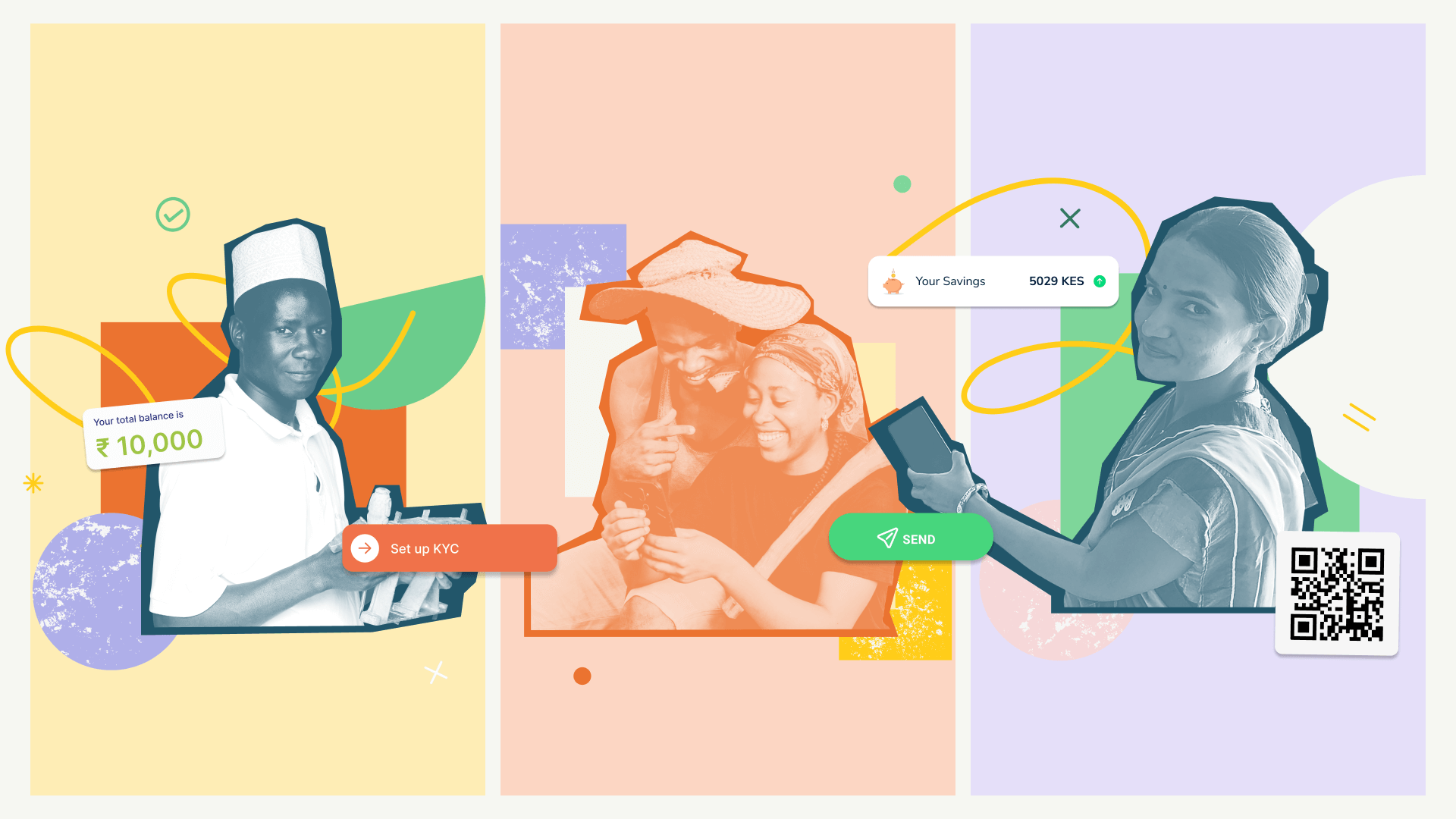
Every week, she makes a hefty interest payment to her suppliers without knowing how much of that loan she still has to pay off. She tried using smartphones to allow customers to pay her via QR code, but her uncertainty about the process and a few cases of fraud scared her off. Like many aspiring to a more prosperous future for their families, Swati dreams of expanding her shop and opening a factory. But due to limited formal banking history and lack of confidence navigating digital financial services, people in Swati’s position find their options limited.
And her story is the story of a billion others living in emerging markets.
Every week, around the world, millions come online for the first time. Of all the experiences these new users face, financial services are among the most complex and high-risk.
Pulling hard-earned wages out from under the mattress and putting them into an abstract financial app or virtual wallet is a daunting task for the 1.4 billion unbanked adults globally at the last mile of financial access. Mobile phones and data connectivity are reaching more of the poorest people, but a lack of digital financial confidence continues to hold them back.
“Last mile” refers to physically remote communities as well as traditionally excluded users who lack access to the digital economy, due to lack of internet and formal bank accounts. There’s a lot that can go wrong in trying to adapt services to reach and serve people at the last mile. To solve for the needs of last-mile users like Swati, who make up about 30 percent of adults around the world, we need to redesign our financial services to be not just accessible but also inclusive, valuable, and equitable for everyone.
But building for everyone means more than just airlifting in products that have worked in the West. Here are some key factors in designing products that help build financial confidence for everyone.

PLAIN LANGUAGE, NOT PERCENTAGES
In India, rural women often struggle with formal banking. Yet, the same women deftly manage family resources to ensure there’s money for weekly expenses as well as future goals. Ask one of these women how, and she might say, “I earn 50 Rupees for every 1,000 Rupees I put in my savings group. By the end of the year I’ll have enough to buy a TV.” Banking terms have never been in their vocabulary, but they’re experts of their finances in concrete terms.
Financial communication at the last mile needs to work differently, building on intuitive mental models people are used to, rather than expecting them to adopt new ones.
In Pakistan, the startup Finja offers credit in the plainest language possible: It shows credit terms in absolute numbers and the lending rate as a fee. Knowing some are skeptical, the startup offers a calculator to try out different terms. Finja illustrates how small shifts can make a complex financial product more aligned with people’s mental models and easier to trust: In its first year, 25,000 merchants signed up for Finja’s app, which served 16 million customers.

TYPE SHORTCUTS
For new digital users, smartphones can be intimidating: Screens are small, text is tough to read, and on-screen keyboards are hard to use. The fear of a typo in a financial transaction can stop them in their tracks.
Last-mile users have a range of textual and digital literacy, and products need to offer multiple ways for users to engage, based on their comfort and capability.
NOW, a digital-first bank in UAE, breaks the text-only interaction model for its low-income users who send money back home to their families, by offering data input via voice, 11 in-app languages, and photos of receipts, reducing time and errors, to help users send remittances confidently and securely.

HANDS-ON HELP
Many last-mile users need help using their accounts. Assistance often comes in the form of agents—local merchants who provide services from banks, startups, and other organizations. These agents also provide strategic guidance as trusted proxies to formal financial services.
Yet, most financial apps are designed for one user and one device only. What happens when a user needs to share their password with their agent because they forget their PIN? Or when a husband needs to review a financial decision with his wife? We need to design high-tech with high-touch moments of human support to truly include last-mile users.
In India, Haqdarshak made hands-on help a core feature. Knowing many were already sharing passwords and handing over their phones to strangers just to access emergency relief, Haqdarshak introduced a secure network of agents. They explain government benefits, run eligibility screenings, and help people make informed decisions. These agents opened up access to government benefits to millions of people through a hands-on, assisted experience, where a single-user experience would have failed.

BUILT-IN PAUSES
For last mile-users, speed can be the enemy of comprehension. App performance is often measured in the fewest taps in the fewest seconds to complete a task—making it easy to lose money or sign up for a product a user isn’t ready for.
For users with limited income, one wrong move can feel like a slip on a tightrope. Financial products need to give users moments of pause that help them regain balance when things start to feel shaky, and safety nets when a misstep does occur.
bKash and FiMoney are proving that slower is better. Their apps use “swipe to confirm” and “press and hold” to give users more control as they confirm a big financial decision. A few extra fractions of a second greatly increase a user’s sense of control in a new financial experience. For bKash, designing for financial confidence helped it grow into one of the largest mobile-money operators in the world, with 70 million users.

NO DARK PATTERNS
In Deceptive Patterns, Harry Brignull identifies the “dark patterns” that interlace today’s digital products, sometimes leading users to decisions they never meant to make.
Products with dark patterns can harm vulnerable users even when they are built with good intentions overall. Offering multiple credit options to unbanked people, for example, can land them in a vicious credit cycle that they are unable to maintain. But thoughtful design can help users explore the benefits and risks of new financial options, make informed decisions, and slowly build their financial capacity.
In Uganda, the startup Opareta has created a responsible loan-ladder model: It makes the first loan small in size, rewards payments made on-time (or early), and enables users who demonstrate responsible behavior to apply for bigger loans. Opareta embeds education along the way and helps customers understand the why behind each credit decision. This prevents users from taking on too much risk and Opareta from over-leveraging. Opareta trades short-term gains for long-term relationships with customers and paves the way for building financial literacy and confidence, one step at a time.
Connecting last-mile users to digital financial services takes many hands, so we put together a Financial Confidence Playbook to help any organization design products for this demographic. As for Swati, with the help of her local bank agent, and the right financial tools, she was able to double her sales and set up food stalls. She even bought her own phone, which she now uses with confidence. Actualizing her dream of a better future for her family no longer feels out of reach.
Reprinted with permission from Fast Co.
In a small town in India, Swati runs a popcorn and peanuts kiosk. She doesn’t trust banks, so she saves cash and buys supplies on credit.
A legal and ethical framework for gen AI
Paving the way for experimentation that aligns with our values.
“She” was supposed to serve as a 24-hour counselor for people dealing with eating disorders. Instead, psychologists and activists found Tessa was offering dieting tips.
In the me-first race to adopt AI and push new products out into the world, there are headlines everywhere that freak us out. Some 1,400 leading technologists are imploring companies in this technology arms race to pause. Sam Altman, CEO of ChatGPT maker OpenAI, has recommended the formation of a global consortium on the level of the International Atomic Energy Agency (IAEA) to avoid the catastrophic outcomes that could result from the misuse of AI.
All of us are wondering what our future is going to look like, and companies aren’t quite sure where to draw ethical and legal lines around how to use these very new technologies in their own operations and offerings. (Some organizations have placed an all out ban on them.) The decisions we make today will shape our world and have reverberating impacts for generations to come.
At IDEO, we know that tools aren’t inherently good or bad—it’s about how they are designed. Our designers have been using these tools for years, and our clients are already experimenting with them. Instead of distancing ourselves from AI, we knew we needed to set clear guidelines, to pave the way for experimentation that aligns with our values. Rather than waiting for our future with AI to be imposed upon us, we’re choosing to intentionally design it.
This isn’t new for us. For more than a decade, IDEO has integrated data science into our design process. Early on, we created the AI Ethics Cards as a foundational element of how we practice algorithmic and product design when it comes to AI systems. And through initiatives intended to help us become more inclusive, equitable, and responsible, like our Inclusive Design Collective and a workshop to break down the potential unintended consequences of our work (the psychological and human rights impact, for example), we work to help designers think through the ethical considerations of choices we make and artifacts we create.
With the proliferation of generative AI, it was time to create more tools to guide our exploration. We dove into design research to understand how generative AI was showing up in our work and how we might make it both legally compliant and caring—built for healthy individuals, healthy relationships, and healthy communities.
Knowing that the rules are yet to be written for much of the legal precedent in this domain, we relied heavily on our technologists and the Inclusive Design Collective for recommendations. Their research informed this set of considerations, which also anticipate potential future legislation.
Next, we did a go/no go exercise, vetting the most popular tools to decide which types of data can or cannot be used, for what reason, and at which stage of our design process. And finally, we made sure that our guidelines included everyone at IDEO, from early adopters to those who are opposed to using generative AI at all. Here’s where we landed:
Download a free PDF of the Gen AI Legal & Ethical Framework cards here.

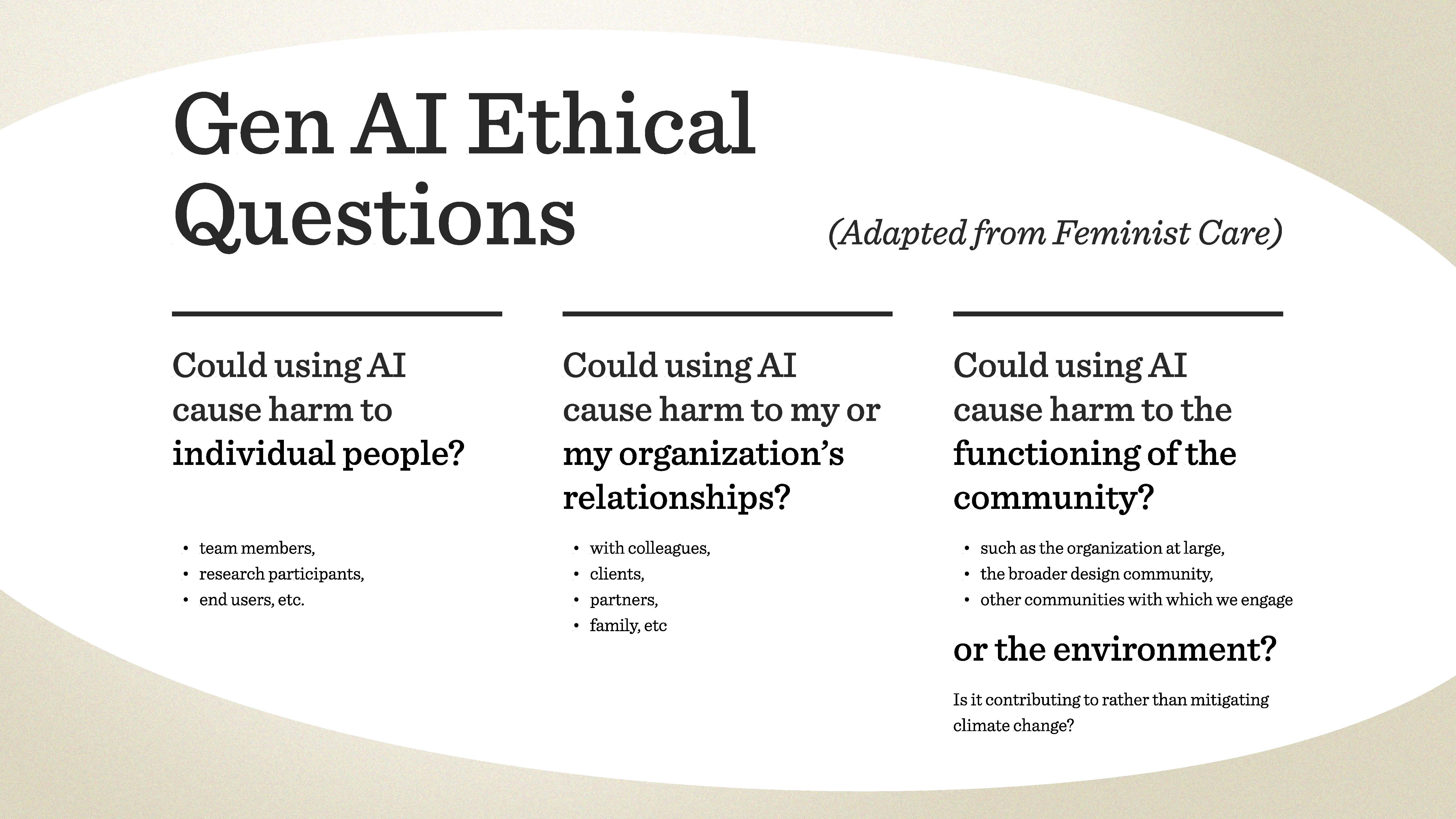
To make this line of questioning even more tangible, we offered some common ethical watchouts, and some ways that designers can offset negative effects.
For example:
Ethical Concern:
Images or content produced by AI might be mistakenly taken as factual or truthful and consequently cause unintended harm.
Mitigate with:
- Give credit when you are using AI-generated content, and put the prompt next to the artifact where appropriate.
- Validate factual information through a third-party source.
Guidelines for this rapidly-evolving technology are not a set-and-forget kind of exercise—they represent a snapshot in time. Likewise, it’s not possible to cover every scenario. We plan to regularly revisit and revise.
With these guidelines in place, we dug into the documentation of generative AI offerings from multiple companies. And to further mitigate risk, IDEO built its own “AI playground” tool to access a version of ChatGPT that complies with our policies and launched it to everyone in the firm—unleashing a tidal wave of AI-powered design that we’re using ourselves and bringing to clients.
Interested in testing out some of these tools and frameworks? We’d love to talk: ai@ideo.com
Download a free PDF of the Gen AI Legal & Ethical Framework cards here.
Thank you to: Esha Reddy, Evan Burton, Zoey Zhu, Graham Gardner, Jeremy Sallin, Jenna Fizel, Nohemy Stella, Tom Antony, Jeremy Chen, Alireza Karduni, Ilene Palacios, Kate Schnippering, and Bo Peng for your contributions to the guidelines.
The information provided in this article and on our toolkit cards does not, and is not intended to, constitute legal advice; instead, all information, content, and materials available on this site are for general informational purposes only. Information provided may not constitute the most up-to-date legal or other information. Readers should contact their attorney to obtain advice with respect to any particular legal matter. All liability with respect to actions taken or not taken based on the contents of this article are hereby expressly disclaimed. The posted content is provided "as is;" no representations are made that the content is error-free.
In June, the National Eating Disorders Association decided to shut down an AI-powered chatbot called Tessa.

Lindsey Turner
I’m passionate about building brands, products, and experiences that help organizations show up with meaning and momentum.
I help organizations cut through complexity by shaping how they show up, through brand strategy, identity, and storytelling.
Working at the intersection of brand and business, I bring an editorial eye and a bias toward making—turning ideas into tangible experiences that people can understand, trust, and believe in.
My work spans government, healthcare, financial services, media, and consumer goods, from launching Gen Z-focused ventures to building innovation labs and reimagining legacy brands. I relish moments of ambiguity and enjoy translating across teams, perspectives, and priorities to move ideas forward.
I started my career in editorial and digital design, shaping cross-platform experiences and identity systems in publishing and agency environments. That foundation still shapes how I work today: I’m detail-oriented, collaborative, and overreliant on the Oxford comma. I hold a BFA in Visual Communication from the School of the Art Institute of Chicago.

Rachel Young
My work helps organizations see who their products aren't working for—and build the will and the tools to do something about it
For 25 years, I've asked the same question: Who does this design exclude—and what are we going to do about it?
My work spans human-centered strategy, inclusive design, and qualitative research, with clients ranging from Microsoft, Google, and Verizon to the National Science Foundation, and San Francisco Unified School District.
Before IDEO, I taught elementary school in East Palo Alto and spent a decade doing design work with social service organizations—where I learned firsthand what it costs people when systems are built without them in mind.
I am currently writing User Error, a nonfiction book about digital access and the design decisions behind it. I live in Oakland, California.

Brian Pelsoh
I lead with craft, ensuring our work is creatively excellent: rooted in deep human insight and imagination, while also grounded in the realities of business and technology.
My expertise spans brand, communication, and product design across tech, education, the arts, and social impact.
I believe great work demands both high-level vision and obsessive attention to detail, and only happens through collaboration.
I bring an inclusive, hands-on approach and a deep understanding of business, which enables me to consistently deliver excellence while always asking why.
Before joining IDEO, I worked at the brand firms Pentagram and VSA Partners. I began my career as a designer, leading teams at the School of the Art Institute of Chicago and the Milwaukee Art Museum. I hold an MFA in graphic design from Maryland Institute College of Art and a BFA in communication design from the Milwaukee Institute of Art & Design, and have taught at some of the best design schools in the US.

Tony Wong
I am responsible for IDEO’s long-term success in China and working with clients to use design as a tool to enable growth.
I am responsible for IDEO’s long-term success in China and working with clients to use design as a tool to enable growth. Specifically, I have helped Chinese companies design holistic brand solutions through the development of their products, communication, services, and innovation teams, and I have helped multinationals expand their presence and influence in China.
I advise global leaders on developing China-led innovation and capabilities.
In over 15 years in IDEO Shanghai, I have worked on projects that use design to elevate the quality of the experience of healthcare products and services, streamline processes that increase productivity, create spaces and programs that promote and enable inclusive communities, and build next generation mobility solutions that are planet-positive.
Before joining IDEO, I worked at Philips Electronics and the Electrolux Group in Italy, the Netherlands, and Singapore on a number of breakthrough commercial products. I am a member of the Young President Organization in Shanghai.

How to use AI as an editor, not a writer
Ed White shares how he uses AI as an editor—not a writer—to sharpen storytelling, rehearse ideas, and preserve the productive friction that makes creative work better.
Ed White has a rule he's tested on his own writing: hold yourself as the writer, and let AI be your editor. Ed is a Senior Design Director at IDEO's London studio, where he co-leads the firm's AI portfolio across Europe. Before IDEO, he spent 12 years as a writer and editor at the Financial Times, Wired, and Contagious. So when he talks about when to use AI for storytelling and when not to, it comes from two decades of crafting his storytelling skills.
In this episode, Mina Seetharaman talks with Ed about two specific tools he uses to keep AI in an editor's seat: a "roasting agent" prompted to critique his drafts without any sugarcoating, and a simulated audience he rehearses pitches on before the real thing. They also get into what Ed is hearing from design leaders at Anthropic, Lovable, Shopify, and Google Creative Lab about how creative work is changing, and why he thinks the friction of writing something yourself is worth protecting rather than automating away.

Building a personal AI for the messiness of life: Sida Li
Becca Carroll talks with Cue co-founder Sida Li about designing a personal AI for the messiness of everyday life—not just work. They explore how Sida stays anchored to human needs while navigating fast-changing technology, product tradeoffs, business-model experimentation, and the realities of building an AI company today.
Most AI products today are built for work—a space with clear problems and established systems. One founder noticed a gap: personal life is messier, harder to systematize, and mostly left behind by the AI boom. So she built Cue, a personal AI that lives inside iMessage and group chats, to go where the other tools haven't.
In this episode, Becca Carroll, IDEO's Chief Strategy Officer, talks with Sida Li, co-founder and CEO of Shared Context Lab, about staying anchored to a human need while the technology around her keeps changing shape, why she treats her business model with the same rigor she'd bring to a product, and what it feels like to build a company at this particular, disorienting moment in AI.
The conversation also gets into how Sida makes design decisions: the language Cue uses to describe itself, the tradeoffs behind building inside iMessage instead of a new app, and a real story about a business idea that didn’t pan out.
This is the second in a two-part series profiling founders from IDEO's Startups-in-Residence program. The first conversation is with Johannes Seemann, founder of Sooner, on designing GenAI for the emotional side of money.

Designing GenAI for the emotional side of money: Johannes Seemann
Designing financial tools around the feelings that shape money decisions.
Most personal financial tools are built to run the numbers and optimize towards a budget. While that works for some, most people experience money as a lived relationship that does not neatly fit into a spreadsheet. Johannes Seemann and Becca Carroll discuss why money is emotional before it is mathematical, and what a human-centered approach to building a generative AI financial product looks like in practice.

The curious leader's edge in uncertainty: Scott Shigeoka
How genuine curiosity helps leaders navigate uncertainty with greater confidence.
Mina Seetharaman talks with Scott Shigeoka, author of Seek and Head of Curiosity Cultivation at the Eames Institute, about what distinguishes genuinely curious leadership from performative curiosity, how power dynamics shape curiosity, and why practicing curiosity can restore energy rather than drain it.
Looks like you might be in search of something very specific?
Or reset the filters above and try another angle.
Here’s some random inspiration

Podcasts about creative leadership

Articles about the power of prototyping
