
.svg)



Designing the connected future of diabetes management
Expanding IDEO's partnership with Ascensia to develop an engaging, internet-enabled blood glucose monitoring system.
Keeping diabetes in check isn’t easy. Between checking blood sugar multiple times a day, keeping a detailed activity record, and logging food intake, staying healthy can be daunting.
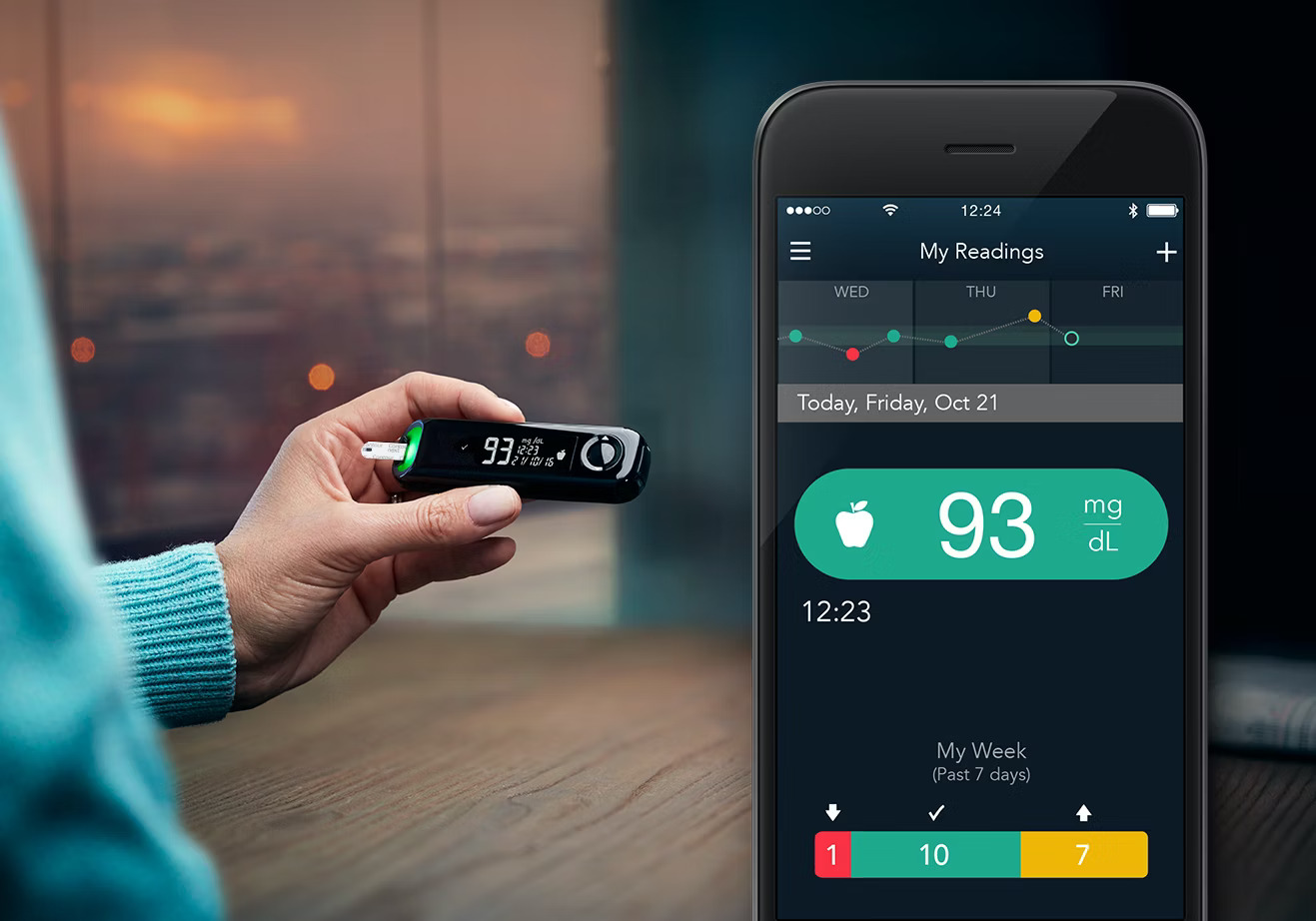
But a recent advance in smart diabetes management—Ascensia’s CONTOUR NEXT ONE blood glucose meter and the CONTOUR DIABETES app—can give patients more clarity and control.
The CONTOUR NEXT ONE is the latest product to spring from a multi-year collaboration between IDEO and Ascensia Diabetes Care (formerly Bayer Diabetes Care). In 2009, Ascensia and IDEO developed the award-winning CONTOUR USB blood glucose meter—the first meter to plug directly into a computer, providing patients and their doctors with instant access to blood sugar data and personal trend reports.
Buoyed by the success of the first collaboration, Ascensia asked IDEO to help design a next-generation diabetes management system (and the company’s first internet-connected device).
To help reduce the stigma of checking blood sugar in public, IDEO designed the CONTOUR NEXT ONE to look and behave like today’s modern tech devices. The highly simplified, seamless system allows patients to upload blood glucose readings automatically to the app, which helps guide informed, real-time decisions. The meter’s red, green, or yellow smartLIGHT feature gives instant feedback about whether blood sugar levels are below, within, or above the target range.
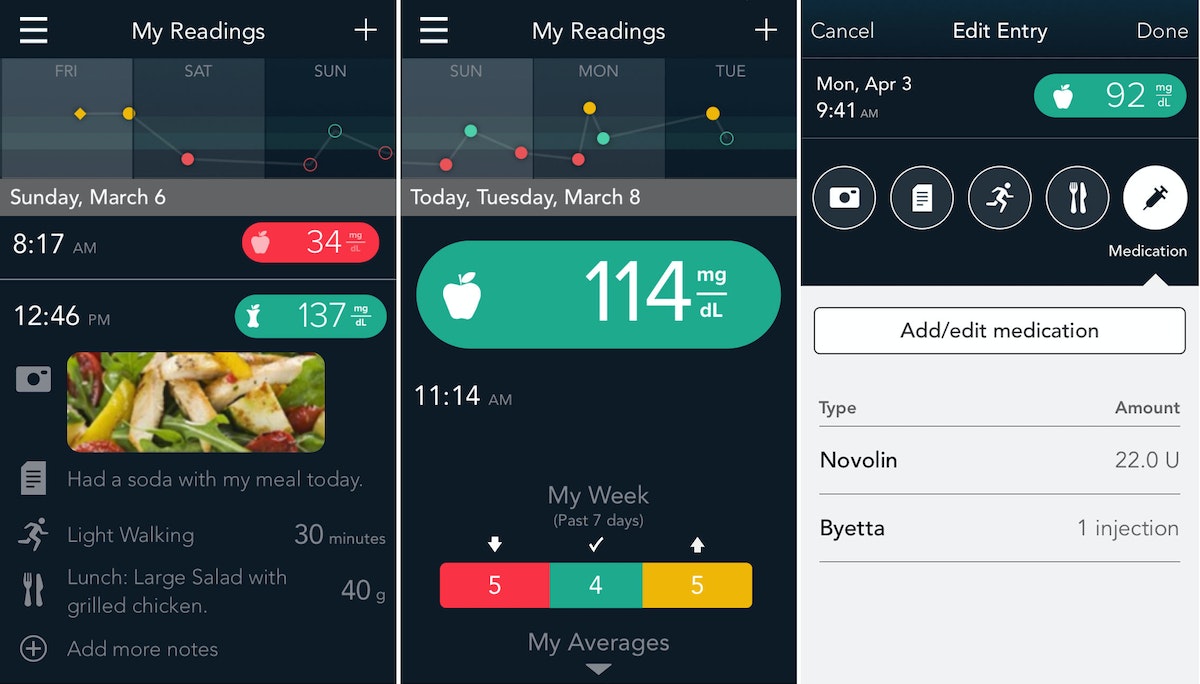
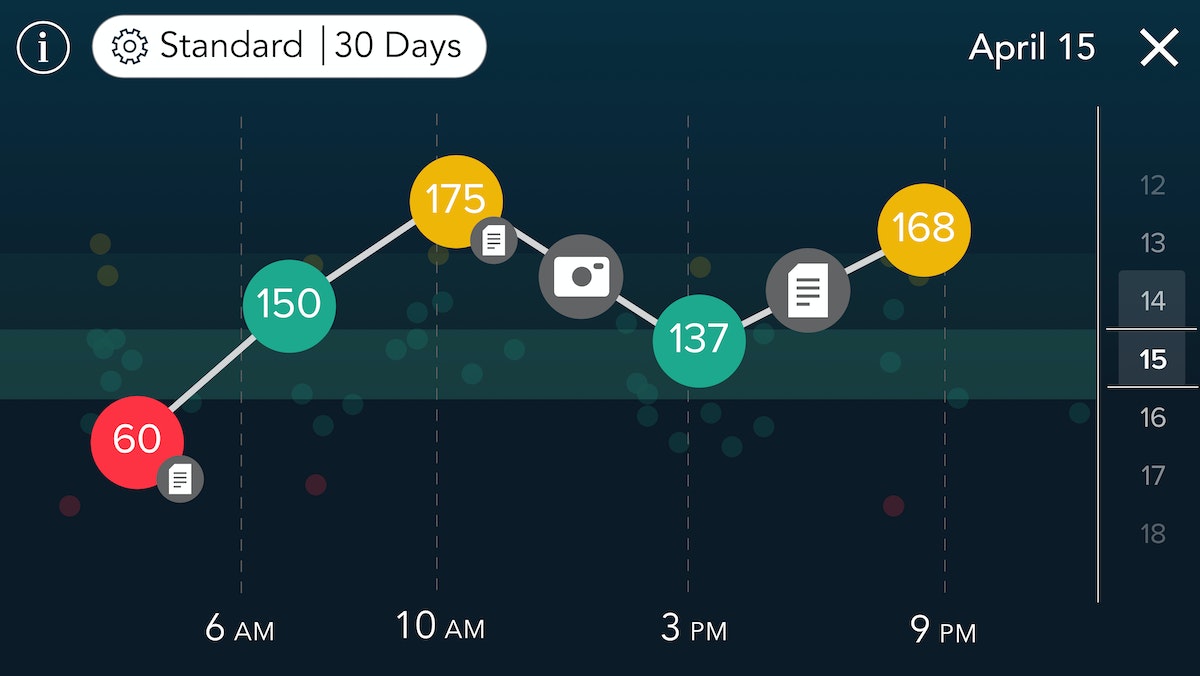
Seeing contextual data, which includes physical activity logs and photos of meals, paired with recent and historic blood sugar levels, nudges patients toward healthier lifestyle choices and better control of their condition.
For doctors, the accuracy and quantity of the data combined with the app’s easy-to-read pattern views invites more comprehensive, actionable conversations with patients.
The CONTOUR NEXT ONE hit shelves in Europe in 2016 and is now available in the U.S. Ascensia is poised to develop more products enabled by rich, personalized data to help people with diabetes live longer, healthier lives.
.jpeg)
Designing the city skies of tomorrow
Designing the city skies of tomorrow.
What if we could use the sky to provide alternative solutions to these problems, creating more space for living and transportation? What exciting future awaits us?
At JAXA’s Aeronautical Technology Directorate (ATD), researchers are conducting research and development on aviation science and technology for the future. They are working to affect positive impact through research like noise reduction of airframe and an integrated aircraft operation management system for disaster relief and crisis management.
Normally, JAXA begins their projects by examining the needs of the aircraft industry or comparing themselves against global technology standards. This approach often leads to ideas that are merely an extension of the current technology. JAXA needed a new approach in order to create radical ideas and real change.
The key question was: What solutions would emerge from prioritizing people’s needs over the most advanced technological possibility—taking a human-centered approach to tackling the most pressing societal challenges?
JAXA ATD voluntary partnered with IDEO to attempt to answer this question, identifying new research areas by envisioning people’s needs in the near future. Together, JAXA and IDEO developed four scenarios of future societies.
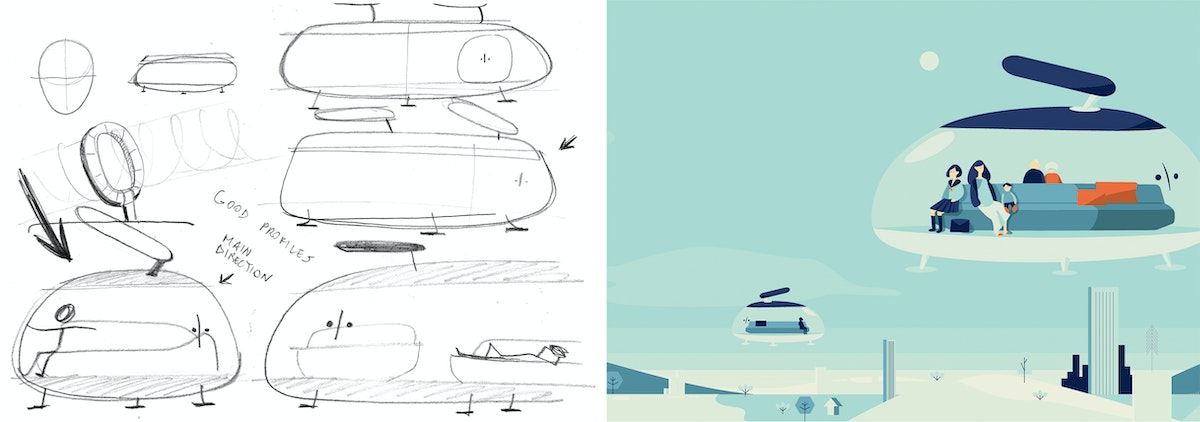
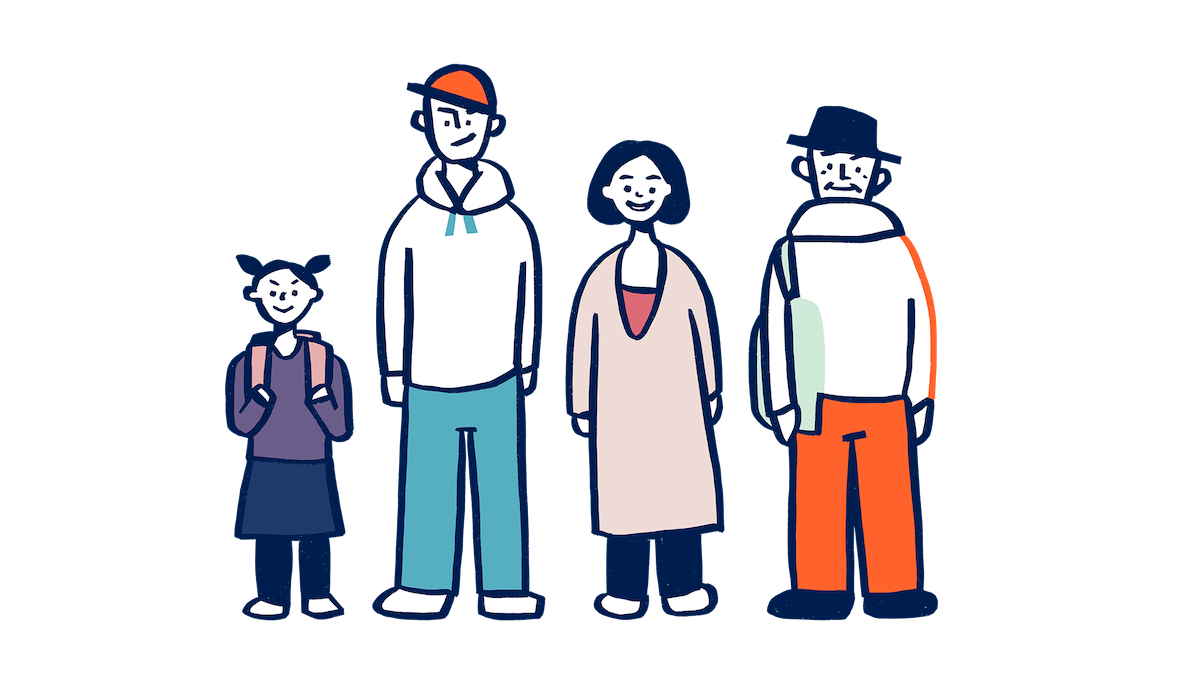
The scenarios do not necessarily focus on technologies. Rather, the focus is on telling stories that help readers put themselves in the shoes of the four personas. At the same time, the team worked with industrial designers to illustrate convincing demonstrations of the vehicles and machines of the future.
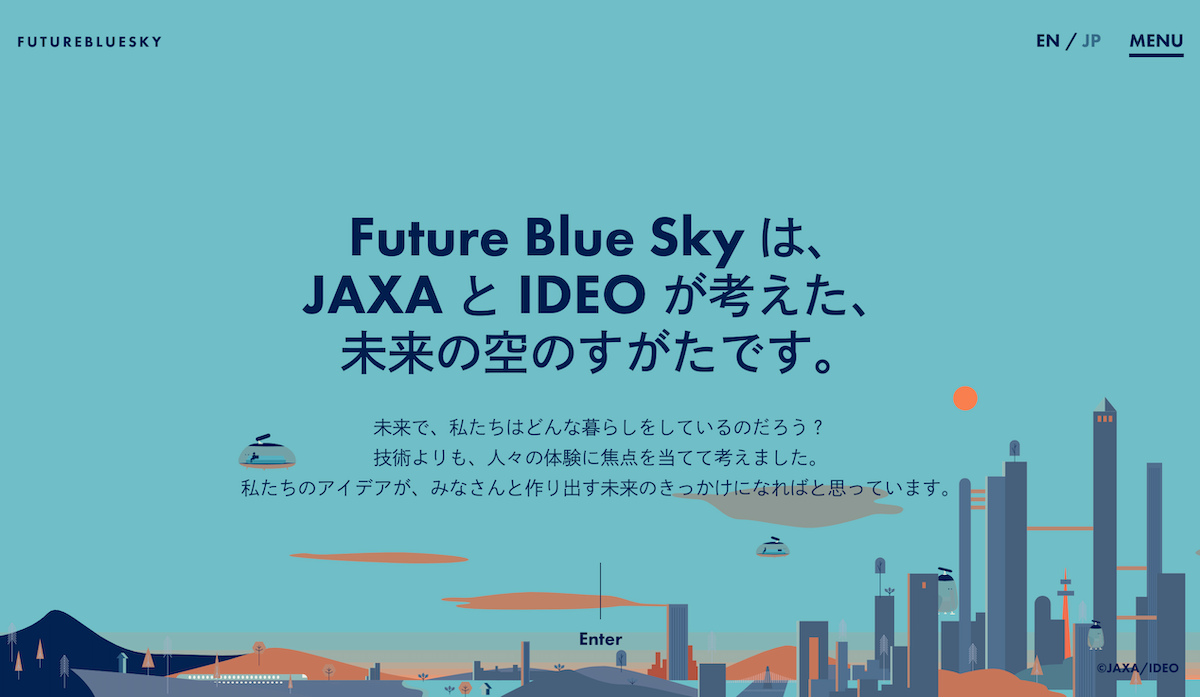
JAXA’s team embraces the belief that “technologies developed at JAXA should incorporate emotional aspects to blend seamlessly into people’s lives.” Driven by this philosophy, the visual design of the four scenarios used a friendly illustration style intended to be approachable and understandable for people of all ages.
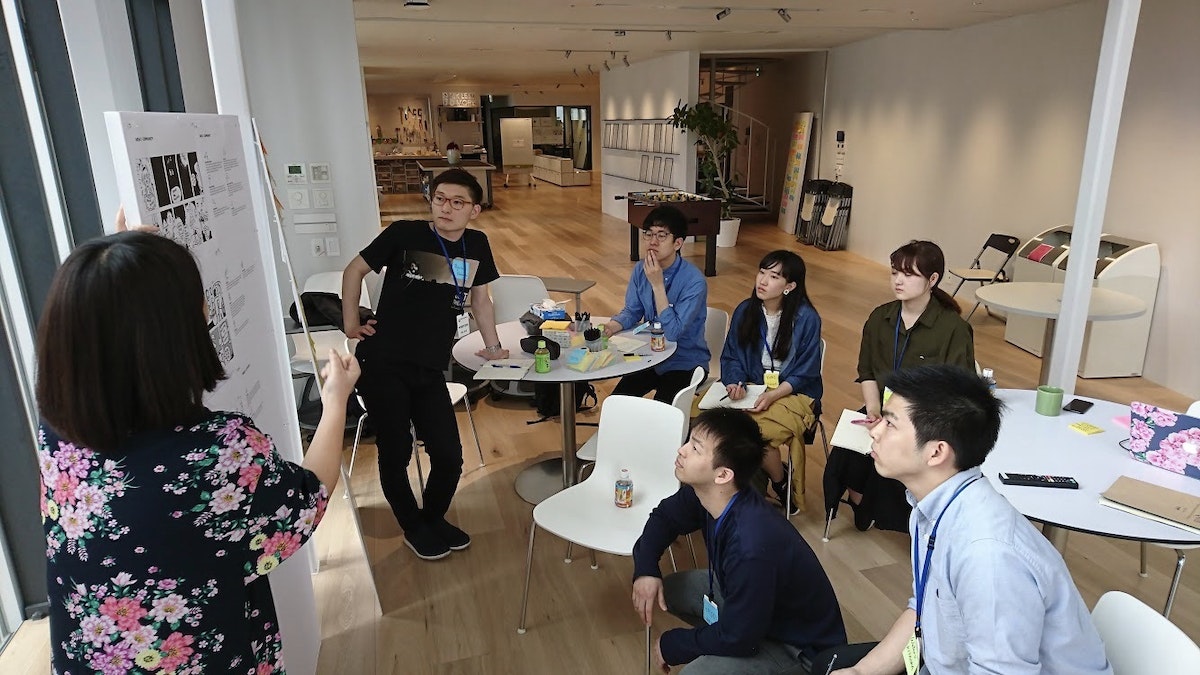
In order to develop human-centered concepts from scratch, the IDEO and JAXA team first undertook research and inspiration-gathering. They skydived, observed cities from above, brainstormed with students from the department of architecture at Waseda University. They interviewed airline employees, a former Judo world champion, skyscraper lovers, a business producer who focuses on new working styles. Throughout the research phase, the team explored the possibilities of the sky as a “living space,” not just a place for transportation.
The team was surprised and excited when they learned from a former fighter pilot that old cockpit designs were inspired by the Japanese tea room, highlighting a historic precedent for taking inspiration from real life to inform new technology designs.
The team synthesized their research and developed several concepts, each informed by a different social issue or pressing concern. Each issue was brought to life through a fictional personal narrative.
How might we relieve city congestion and pollution using the sky, while still keeping it clean and blue? Floating public lights, a skyway that regulates air traffic, camouflaged planes that keep the sky blue—concepts introduced in this scenario were the closest to the technologies already being researched at JAXA ATD. They show us how the sky could become an infrastructure that supports our daily lives. Meet Ayame, a girl from Gunma prefecture, ready to begin her college life in Osaka.
How might we make travel feel easy for people of all ages, no matter how far they need to go? While the researchers at JAXA ATD are working to improve the mobility of aircraft, like reducing air friction or increasing the engine efficiency of aircraft, this scenario explored how people could travel door-to-door through the sky with or without aircraft. A day-in-the-life of Naoto, a 72-year-old man who commutes twice a month from Tottori to Tokyo for medical checkups.
How might we leverage the sky as a resource for reusable energy and economic growth? One of the criteria of JAXA’s R&D activities is to improve the environment. While JAXA has been focusing on “protecting” the environment, this scenario focused on “creating” new environments. A day-in-the-life of Toshi, who runs a “sky-to-table” farming business.
How might we help people live with peace of mind, even during a disaster? JAXA’s disaster relief technologies have been extremely valuable in countries like Japan, which frequently suffers from natural disasters. In this scenario, we approached the problem from victims’ point of view while exploiting the potential of a network of aircrafts and other flying objects. Here's the story of Yuri, a victim of an earthquake in Tokyo who reunites with her family after evacuating to the sky.
The purpose of the project website is not to present answers, but to introduce new directions towards an exciting future. By presenting JAXA ATD’s vision through these four scenarios, the team invited people from all industries and of all ages to participate in co-creating the future.
Just like movies, cartoons, and novels from childhood stimulate the imagination, this project aims to spark new conversation and vision for a radically different, positive future.
By illustrating and communicating a more human-centered future to a wider audience, Japan’s top aeronautical technology development agency may already be changing the future of the sky for the better.
The speed and scale of change in our world are unprecedented. As more people relocate to cities, our lives are impacted by urbanization problems such as pollution, congestion, depopulation of rural areas, resource, and energy deficiencies.
Preparing an industrial leader for the digital future
Changing the culture, mindset, and way of working at a global manufacturing firm.
For factory operators, a smart valve is a game-changer. It gathers data on how smoothly the system is running and feeds it to an app, making it easier to troubleshoot from anywhere. And when things get overheated, it can automatically shut down the machinery, avoiding a meltdown.
Georg Fischer (GF), the Swiss-based, B2B industrial manufacturer collaborated with IDEO to design that valve, along with a system that adds value for generations of engineers to come.
And there were some surprises along the way. When the team set out to interview customers, they learned a lot about their real needs. “We showed a customer a sacrificial concept of a smart valve and asked, what do you think about this?” says Laura Barrabia, GF’s Head of Corporate Design Thinking. “The customer answered, we don’t want your valve to be smart, we want to be smart. If GF is providing a smart valve, where is my value?”
For GF Piping Systems, these insights helped shape initial prototypes and guided the direction of the design to something that would tie parts together into smart systems and more efficient industrial facilities—a competitive advantage.
Yves Serra, GF’s CEO, recognized early on that his company needed to strengthen its customer-centricity and digital capacity, so he approached IDEO to begin shifting GF’s culture from engineering-led and procedural to customer-focused, multidisciplinary, collaborative, and flexible. That kicked off a decade-long relationship that would help GF take a design-based approach.
Learn what it means to move from being technology-driven to being truly customer-centric.
To help GF identify clients’ pain points and address them with new digital offers, IDEO proposed three “lighthouse” projects, one for each of GF’s divisions: Piping Systems, Casting Solutions, and Machining Solutions. Lighthouse projects (also called “Beacons”) are proofs of concept that light the way for an organization and help it shift its way of working.
For example, GF Machining Solutions built a prototype for an application that uses real-time data to help customers identify and fix problems in the machines, laying the foundation for truly predictive maintenance. Making data streams more transparent for customers also simplified life for the GF service engineers, who keep the machines running.
Learn how Georg Fischer is moving from hardware offerings to digital solutions.
For GF Piping Systems, the design team developed the GF Digital Line, a set of products, apps, dashboards, and other services that help customers plan, install, and maintain water and chemical piping systems. GF teams went back to customers to test several prototypes and gather feedback on the Digital Line and make sure it addressed current and future needs. They also built internal capabilities to support product development, laying the groundwork for future innovation.
Lastly, IDEO helped GF Casting Solutions escape the “commodity trap” of competing with foreign automotive suppliers. To better understand the pressures car manufacturers face, the design team explored the development cycles of two car manufacturers. They learned how challenging it is to implement solutions to reduce vehicle weight—essential for cutting fuel consumption. As an expert in aluminum die casting, GF was well positioned to help manufacturers meet that challenge, not just with quality parts, but also with digital engineering to deliver cutting-edge lightweight casting solutions, which are harder to replicate.
By the end of these lighthouse projects, GF had rolled out a global design thinking training program that had touched more than 1000 employees. After the training, employees throughout the organization adopted a new way of working and became passionate ambassadors. The enthusiasm spread from the R&D department to HR to finance and many other departments.
Today, GF has permanent design thinking and digital teams to continue this work. All three divisions aim to launch the first releases of their lighthouse projects by early 2019. And with every project, GF’s business—and solutions—get smarter about how to meet the needs of a fast changing world.
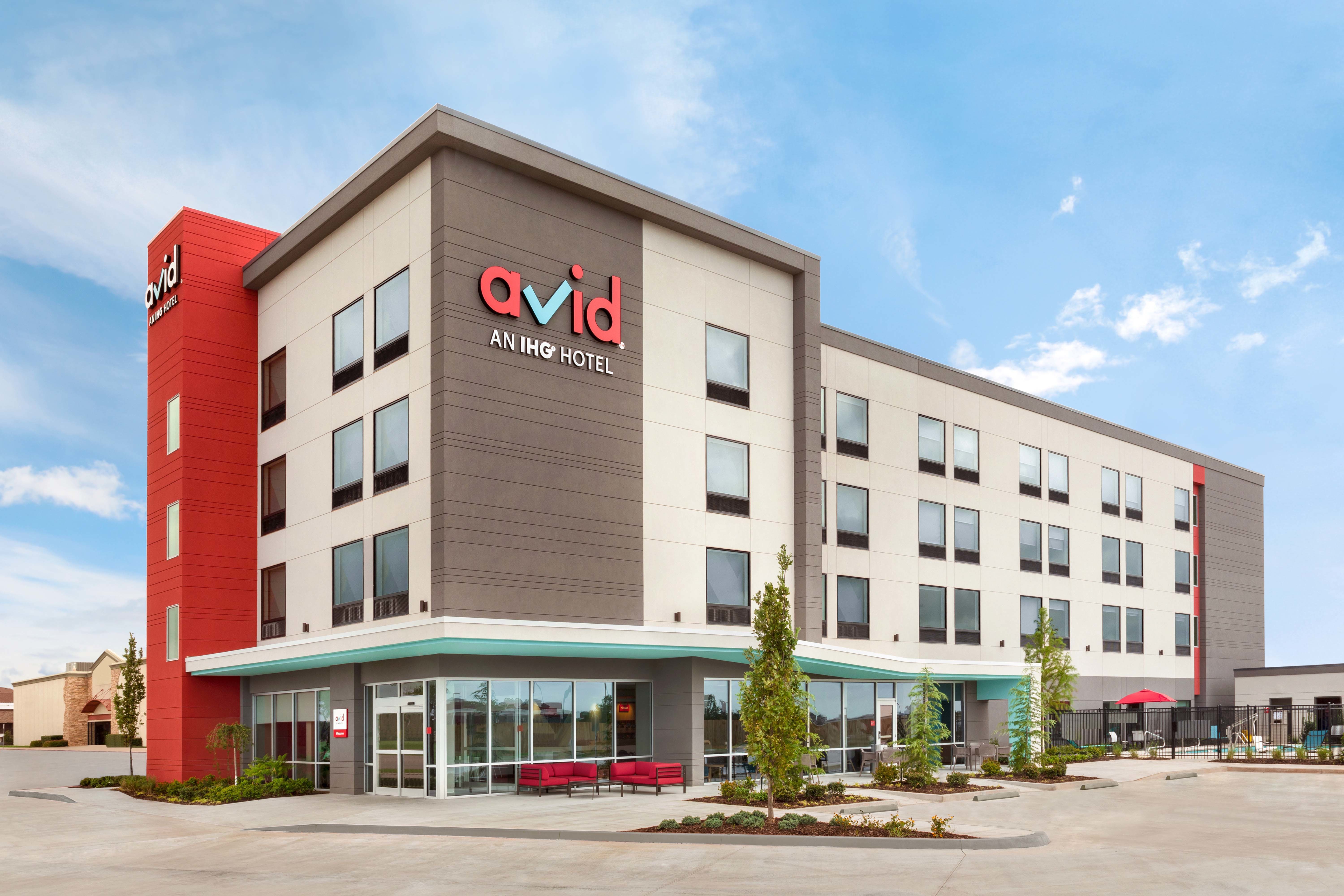
Reimagining everyday travel for America and beyond
Designing a new hotel experience that feels just right, every time.
IHG’s ambition is to grow in service of its guests around the world. IHG’s Atlanta-based team had identified a major opportunity for hotels in the midscale space—a market segment known for its inconsistency.
Alongside colleagues at London-based forpeople, IDEO was invited to help IHG shepherd that business opportunity into a human one, by asking how IHG might reimagine the everyday travel experience for people relying on this category of hotel. What kind of offer might resonate equally with guests and with the owner/operators who’d need to buy into a new brand and bring it to life?
IDEO began by talking to travelers to better understand their lives, values, and needs—travelers who spend one or two nights on the road a few times every year; travelers who regularly take short trips to small cities or away from city centers; and travelers who live on the road, moving from hotel to hotel. These included court stenographers, medical technicians, consultants, conference-goers, and more.
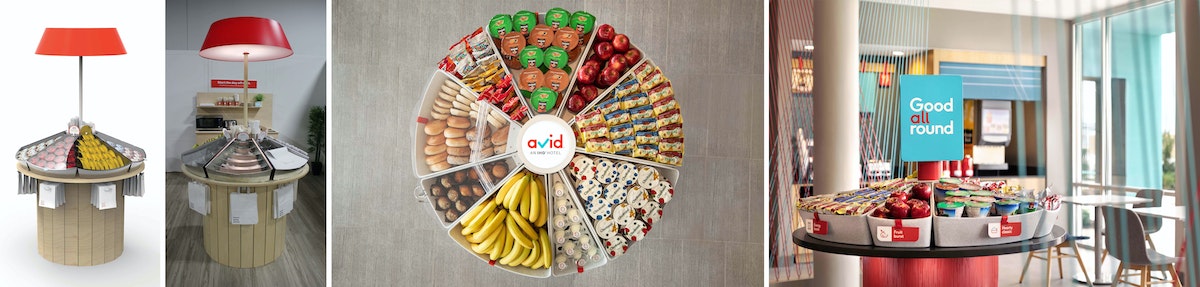
Early research insights evolved into two distinct concepts for a new hotel brand, which were built out into two full-scale physical prototypes at IHG’s design center in Atlanta. Over three weeks, IDEO and its IHG partners led potential guests and hotel owners through each model, gathering their feedback on new formats for breakfast offerings, service details, booking experiences, and overall tone.
The investment in prototyping paid off with surprising and actionable insights. Despite wide variation in occupation and income, these guests are sophisticated and self-reliant; they know what’s out there, and they know what’s reasonable to expect. In fact, many describe a syndrome IDEO dubbed “anticipation anxiety:” the sense of dread that comes from not knowing whether a lower-priced hotel is going to be clean or safe, or provide a bed that enables restful sleep. Many have so little confidence in the cleanliness of hotels in this price range that they travel with their own packs of wet wipes.
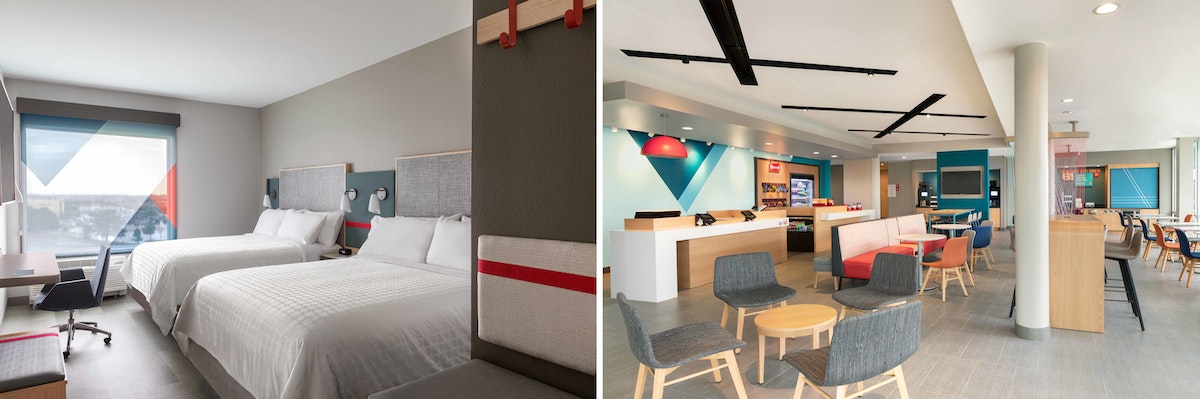
IDEO, along with the IHG team, recognized these behaviors as an unanswered cry in the market. The purpose of the new brand crystallized around extinguishing that anxiety and rewarding guests with something much better. avid hotels exceeds its competition by doubling down on quality in just a few select areas: an extraordinary mattress; rigorously high standards of cleanliness; a focused, high-quality, grab-and-go breakfast and coffee experience; and an overall tone of warmth and straightforwardness.
These guests made clear that for trips like this, they aren’t interested in bells and whistles, or communication that isn’t frank or to the point. That led to an insight that upends an industry truism: for these guests—and there are many of them—choosing a hotel is rarely only about the price of the room. avid guests can often afford to stay in a more expensive place for a honeymoon or a vacation or a trip with friends; they’ll spend more when they need more. But for functional stays of one or two nights, it just feels wasteful. It goes against their values and their principles.
IHG and IDEO heard a clear call for a sense of focus and affordability—but never at the expense of quality. Guests should be able to access a simple booking process, rooms designed for sound sleep, and a quality breakfast, all at a fair price. And hotel owners ought to be able to deliver that experience with confidence and consistency, at costs that build a compelling case for their own business.
That’s what avid hotels is designed to deliver, every single time. Early traveler reviews have been exceedingly positive and have noted specifically the unique differentiating offers avid brings to the market.
Within a year of partnering with IDEO, IHG had issued 150 avid hotels licenses to franchisees in the US, Mexico, and Canada, and announced a development deal for 15 avid hotel locations in Germany over the next five years—a scale of success that came at unprecedented speed for the industry. The collaborative, inclusive design process is now serving as a model for how to develop robust, guest-centered hospitality brands that deliver where it matters for people.
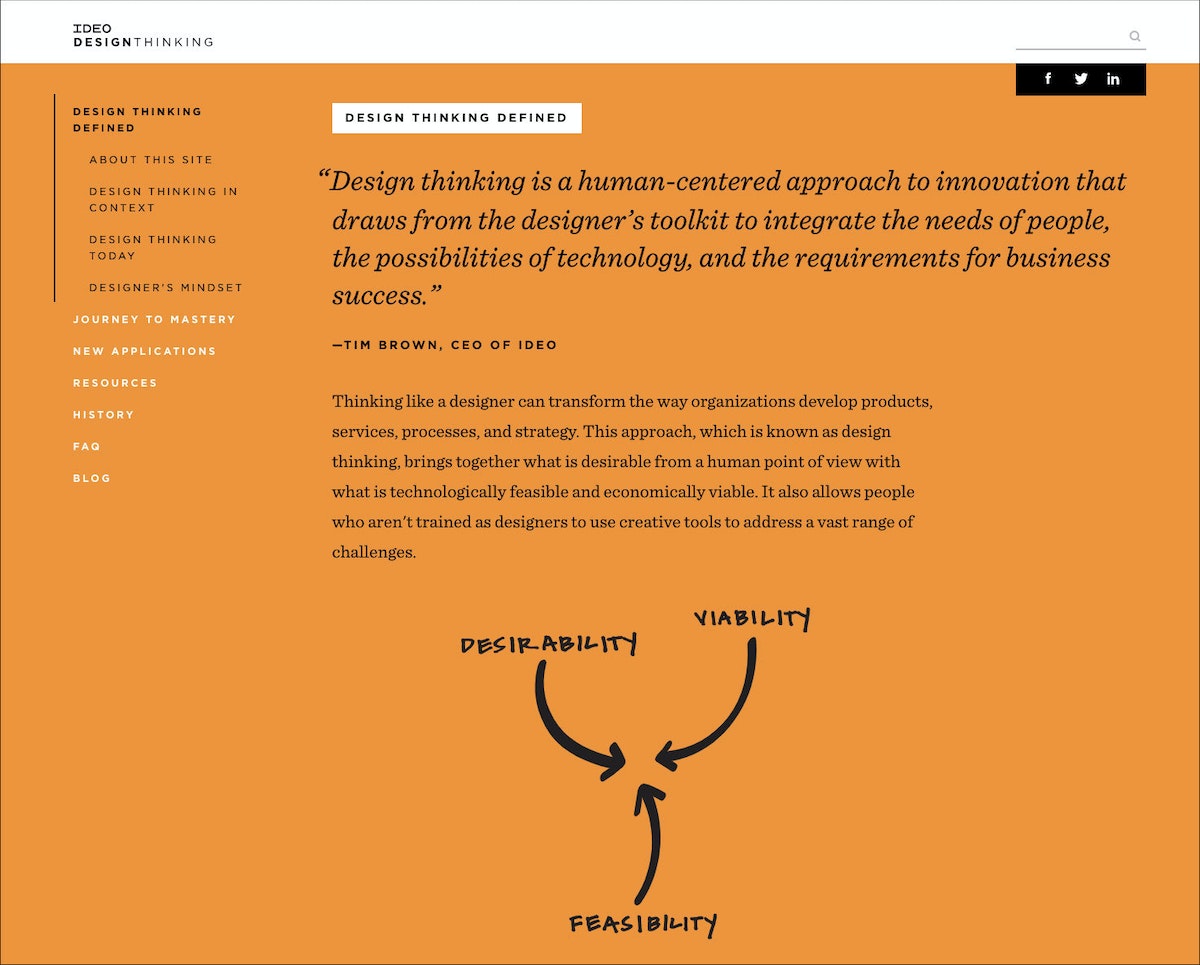
Perspectives, Practices, and Resources for Design Thinking
At IDEO, we’re often asked to share what we know about design thinking. We’ve developed designthinking.ideo.com in response to that request.
At IDEO, we’re often asked to share what we know about design thinking. We’ve developed designthinking.ideo.com in response to that request. On the site we introduce design thinking, how it came to be, how it is being used, and steps and tools for mastering it. You’ll find our particular take on design thinking, as well as the perspectives of others.
Build Your Creative Confidence: Nickname Warm-Up
While Speed Dating is useful in situations where people don’t know each other well, sometimes in group meetings you will encounter the opposite problem: a group where people know each other too well.
Creativity Challenge # 7: Eliminate hierarchy to improve idea flow.
While Speed Dating is useful in situations where people don’t know each other well, sometimes in group meetings you will encounter the opposite problem: a group where people know each other too well. Or, more specifically, a group in which hierarchy is so well established that the more junior members in the room self-edit and defer to the executives rather than putting their best ideas on the table.
To reduce hierarchy (which inhibits conversation) and self-censoring (which is equally limiting), the d.school has recently been experimenting with a “nickname warm-up.” Using a stack of colorful names the instructors have prepared in advance, the activity is a way to temporarily level out the organization during a creative working session. Each participant is given a persona to allow them to “try on” new behaviors.
Tool: Nickname Warm-up
Participants: Groups of 6-12 people per facilitator
Time: A few minutes per person
Supplies: Nametags for each person with the fake names written out. A hat and a ball for each facilitator.
Instructions
Step 1: Each participant reaches into the hat, draws out a name tag, and puts it on. Use names that lend themselves to humor and emotion. Teams tend to produce their best work when the group is having fun. Some of the monikers can imply a big dose of street credibility, while others suggest quirky personalities. For example: Dr. Fabulous, Squirt, Mr. Big Heart, The Clumsy Entertainer, or The Rooster.
Step 2: The facilitator gathers the group in a circle and tosses the ball. Whoever catches it introduces themselves using their new nickname and then tells a short story (created on the spot) about how they acquired this nickname as a child.
Step 3: After their self-introduction, they toss the ball to a new person, until everyone has had a chance to share their new name and story.
Step 4: The rule for the rest of the workshop—strictly enforced—is that everyone must use only these nicknames when referring to themselves or others.
Tips from the Field
Do the nametags work? Although this is a relatively new exercise, experience so far suggests that the answer is yes. At a recent management event, the CEO of a global hospitality company drew the “Squirt” nickname. There was a pregnant pause in the room as everyone waited to see how he would react. But he gamely played along through the rest of the workshop, and the organizers felt it contributed to an open environment in which people could speak freely.
The goal is to flatten out the hierarchy, so it’s important to get the senior people in the room to participate. Leading by example will naturally break some of the barriers to free-flowing collaboration.
This post was taken from Chapter 7 of Creative Confidence. Purchase the book for more on how to use creativity to solve problems, or read more from this series of creative exercises on the IDEO blog.
Everyone is creative. This belief runs through everything we do at IDEO, and in 2013, it led my brother David and me to write a book that would help others—even those who don’t think of themselves as “creative types”—to unleash their creative potential. Creative Confidence has inspired thousands of people to adopt a creative mindset and apply it to the diverse real-world challenges they face. In this series, we’ll share some exercises from the book that can help you approach your challenges from a new perspective.

4 Tips for Addressing—and Even Embracing—Tension
Focusing on differences can be challenging, but productive
As leaders at the CoLab, IDEO’s platform for collaborative impact, we’re familiar with tension in all its forms. CoLab brings together organizations from across industries to focus on tough challenges, from designing for the circular economy to opening our financial systems. During design sprints, small teams build prototypes to explore new opportunities. Given that team members are often industry competitors with divergent approaches and ideas, tension tends to arise. We notice participants are often used to acting with the interests of their business first, rather than seeing the collaborative potential.
In order to create the impact we’re striving for at CoLab, we need to meet this tension head-on and create ways of moving forward. No matter what you’re designing or who you’re designing alongside—be it a colleague or another organization—here are four quick tips for adopting this mindset and productively addressing tension.
Observe the dynamic
Though tension can sometimes make us want to jump into action to resolve it, there’s value in sitting back, too. Try answering the following questions for yourself: What opinion is each team member pushing forward? Why might they have this view?
Paying attention helps you establish empathy. As designers, we use empathy not only to deeply understand the realities of the people we’re designing for, but also the realities of those we’re designing with. Even if you disagree, understanding why a teammate might have a certain opinion can help you create solutions that ultimately meet a need that you might not have noticed alone.
Give it a name
Once you’ve spent time observing, try naming the tension out loud or writing it down on a piece of paper. Saying or jotting down, “There’s tension around X right now,” or simply, “I’m feeling tension,” externalizes the tension. It’s is no longer this abstract, all-encompassing feeling. The tension is a named, tangible thing that the team can hear and see — not just feel — and therefore more objectively address through listening, dialogue, or compromise. In fact, mapping out seemingly conflicting interests or goals is a great tool for synthesis and identifying opportunities for design.

Just start making
Tension frequently arises when teams are trying to align on a shared vision or strategy. After all, when there are various stakeholders involved, they’ll likely have a variety of approaches. But it’s draining to debate things like your purpose or mission statement all day long. Reaching consensus can take hours, and may not even be useful at such an early stage before teams have had a chance to validate concepts through building.
It may seem counterintuitive, but to move teams through this tension, we recommend to just start doing. Whether it’s a whiteboard sketch or a model made of construction paper and glue, acts of making can offer clarity to subjective, “big picture” items. Shifting your mental focus from defining to doing has the power to shift a team’s dynamic.
Assume good intent
Though tension can sometimes feel like opposition, it often happens because teammates are passionate about the same thing. They may just want to apply or direct this shared passion in different ways. When things get tense, remember that you’re all working towards the same goal, and that the tension is likely not about you. Don’t take it personally.
Reinforce this “oneness” and good intent through language or actions. Try this: “I’m glad we’re in the same room solving this problem together.”
The next time things get tense, try not to jump into defense mode or sink down in your chair. Tension in team environments is inevitable because each of us bring a different set of experiences and perspectives to the table (so don’t crawl under it). As a team committed to collaboration across organizations that wouldn’t otherwise work together, we’ll keep embracing tension to get to the impact we all want to see in the world.
Tension in a team environment can make us nervously glance at the clock, play mediator, get defensive, or cling to the tried-and-true. But tension isn't always so bad (you can unclench your jaw now). In fact, we’ve found that some of our greatest work has come from embracing—even seeking out—these difficult moments.
A Cartography Nerd’s Guide to Mapping 100 Years of History
IDEO's resident mapmaker leverages a century-old resource to discover his neighborhood
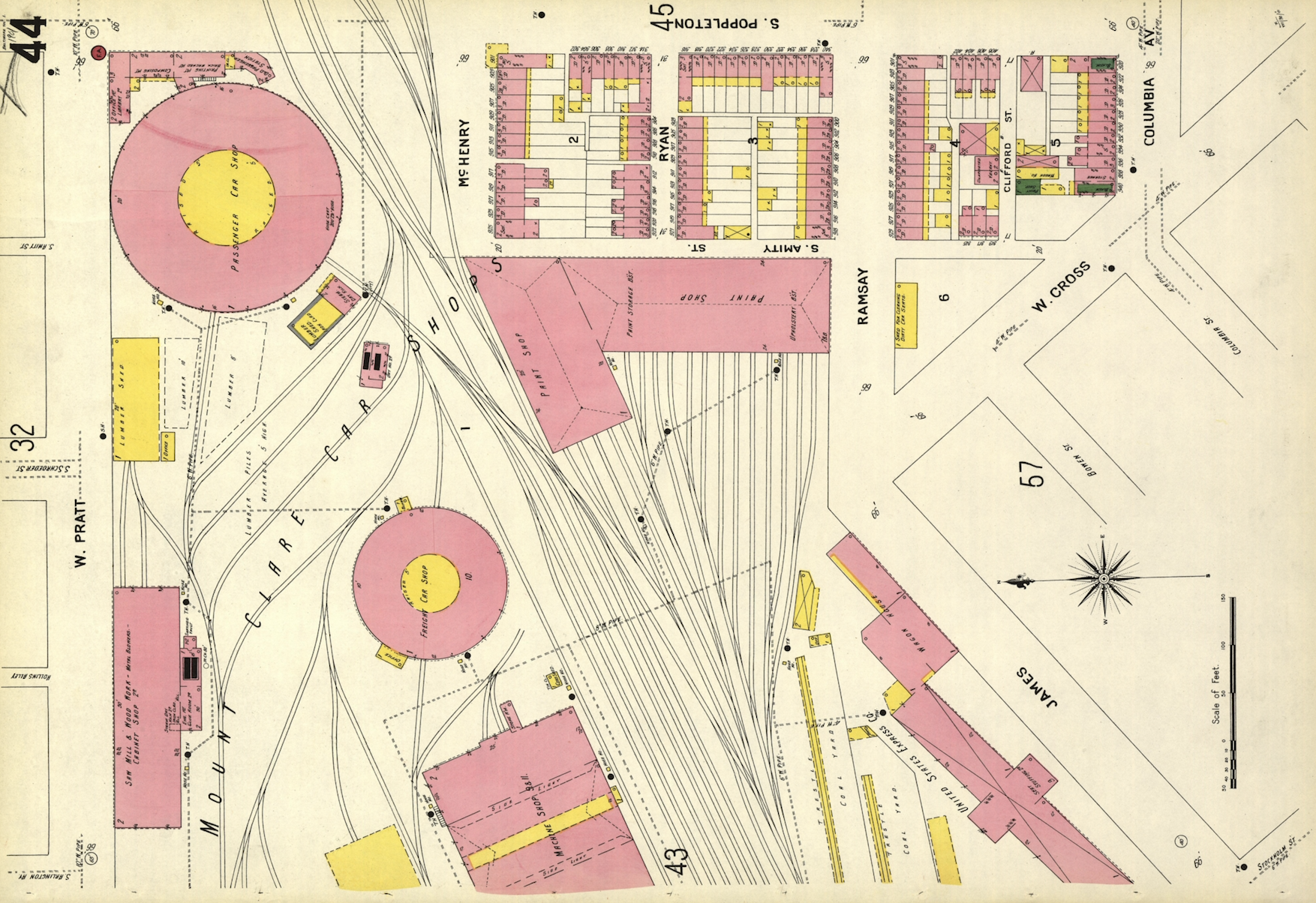
If you live in an American city, big or small, there's a decent chance that Sanborn had a map (or a hundred) of your town. And best of all, the entire collection is open-source and available for download in high-resolution images. The Library of Congress database isn't exactly the easiest in the world to search, but keep at it.
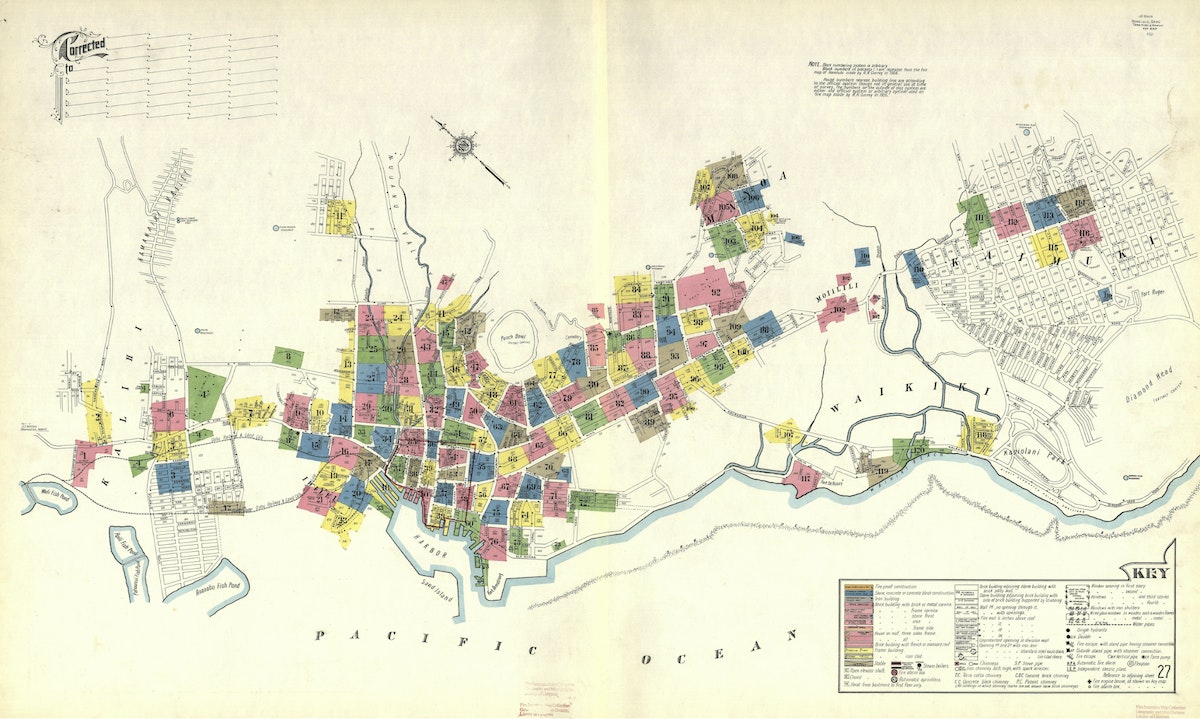
I live in San Francisco and was curious to see how my neighborhood was depicted by these amazingly-talented, fire insurance bureaucrats. I was delighted to find this map that shows my San Francisco neighborhood—the Lower Haight—in all of its 1899 glory. The colored rectangles form a grid, each pointing toward another map somewhere in the Sanborn collection that zooms in for much greater street-by-street detail.
I kept banging away at the rudimentary search function on the LOC website and eventually located Map 306, which visualizes my block in the year 1899.
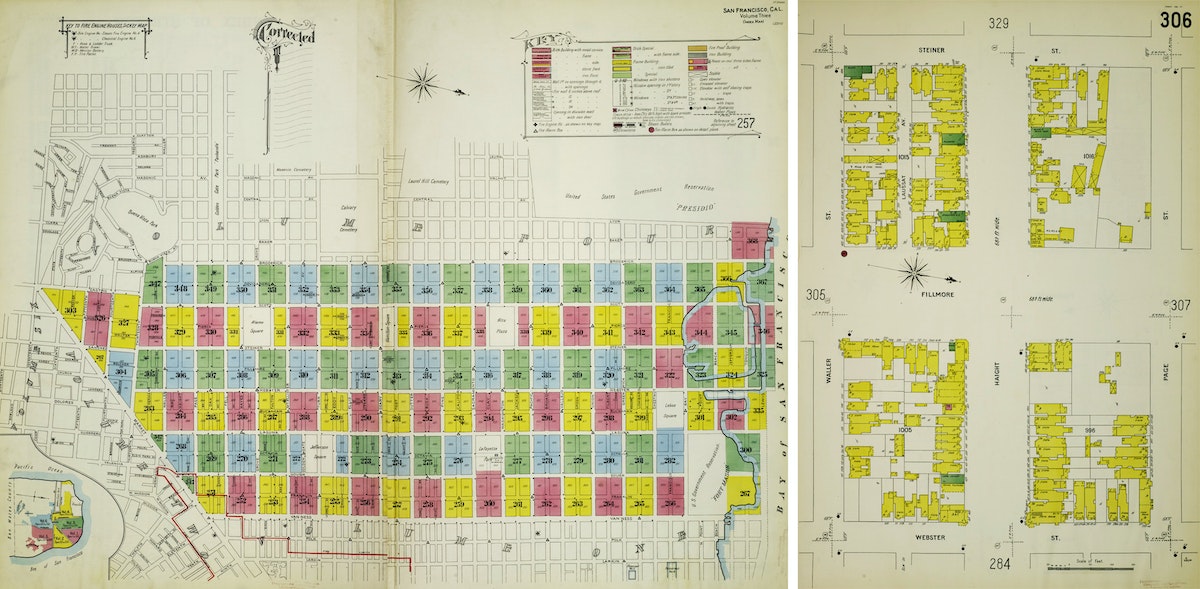
San Francisco is not the oldest of cities when it comes to architecture, and there was that little thing called the 1906 Earthquake (and subsequent fire), which destroyed a lot of the city as well. So I wasn't too surprised when I didn't recognize many of the buildings on my block. That said, it did get me curious: Were there any buildings that were visualized on the 1899 Sanborn map that are still present on my block in 2019? I decided to make a map to find out. See, being an ameteur cartographer is actually useful in 2019! Google Maps hasn’t ruined all of the fun.
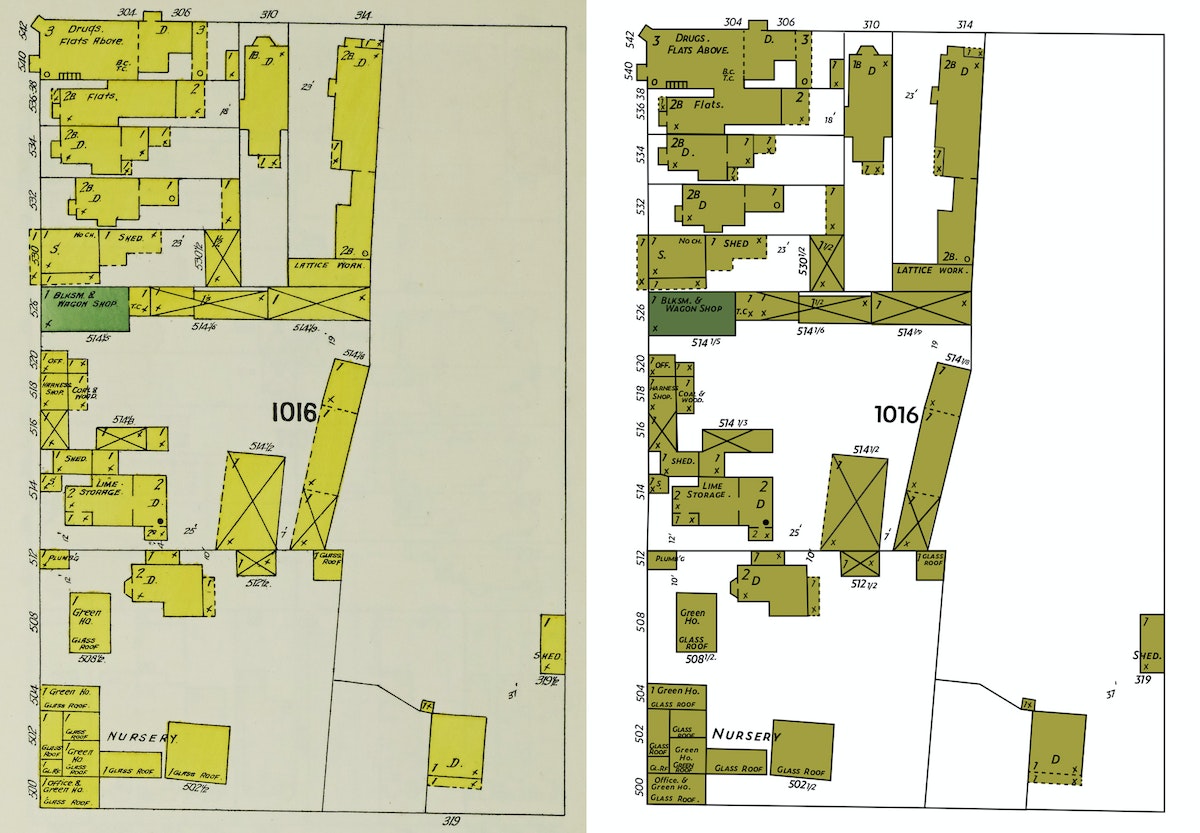
First, I set about converting the Sanborn map of my block into a file that I could manipulate in Adobe Illustrator. The original map is a JPEG, which means that it contains pixels. But since I wanted to have the freedom to tweak the map as I saw fit, I needed to convert the map to a vector version of the file. Why? A vector file (which, instead of pixels, is all about math coordinates) can be scaled infinitely large. What's more, it's much easier to change the colors on a vector-based map or make other modifications that I might need to later.
I'd like to say that there was some fancy way that I converted the map. I could have tried a Live Trace, but with a map this detailed, I wasn't optimistic. So I just rebuilt the file by tracing over the Sanborn map layer with new lines and fills and strokes. Detail by detail. This was mostly an act of love and definitely not a fast process. I recently had a kid and this turned out to be a fantastic New Year's Eve activity as we counted down the tired hours till midnight.
One unique challenge I encountered — there's no clear font out there that replicates the Sanborn hand-lettering. I spent too much time with the Adobe Typekit database and landed on Zeitung. It's not an exact match by any means, but close enough to pass the squint test.
That’s the original map on the left, in all of its pixels glory. And that’s the vector file on the right, built from scratch. How'd I do?
Okay. With the Sanborn map from 1899 more or less created, I turned my attention to the 2019 version of the map. I needed a detailed lot-by-lot map of San Francisco. My first go-to in moments like this is the Stanford University Earthworks website. The search function works quite well, and it links to open source maps from lots of other universities (like Tufts). After a quick search, I located a lot-by-lot map for the Bay Area and opened it up in QGIS, everyone’s favorite free and open-source cartography tool! Here’s what I had.
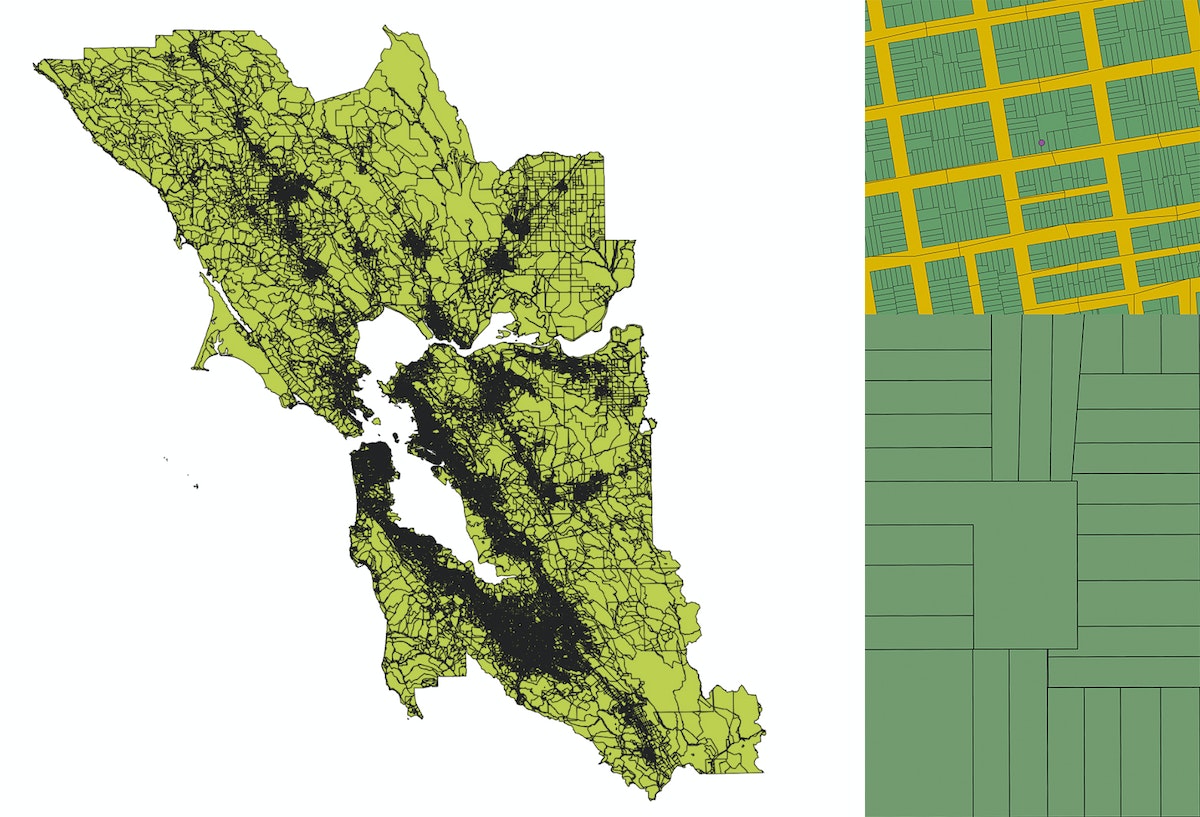
Totally overwhelming and, not surprisingly, it was actually quite tough to even find my block in all of that detail. So I loaded Google Maps, entered our home address, created a KML file with that single data point, and added it to the QGIS map. Once I zoomed way in, there was our block and our loft (represented by that little purple dot).
As I’ve mentioned before, QGIS is a wonderfully-powerful mapping tool, but mostly the pits when it comes to designing anything that would measure up to the esthetic standards of the average designer. So I zoomed way in to just our block, then exported the file as a vector file and opened it in our old friend Illustrator.
What I quickly realized is that this lot-by-lot map shows the property lines for each parcel on our block, but not the actual shapes of the buildings that sit inside each lot. Although I was getting close, I needed to go a step deeper to actually match the detail of the 1899 Sanborn map, which shows the outlines of individual buildings.
I opened Google Maps again and toggled to the satellite view of our block. If you zoom in as far as possible, you can see the outline of individual buildings. It's not perfect—shadows must get projected in weird ways when you snap photographs from orbit—but this was starting to get more interesting.
I snapped a fully zoomed-in screenshot of each building on the block, then traced them one-by-one using the Pen Tool in Illustrator. Once I had the outline of an individual building, I pasted it into the spot where it belonged inside the lot-by-lot map I’d exported over from QGIS. Then I repeated this process 31 times, for each of the buildings contained on my block.
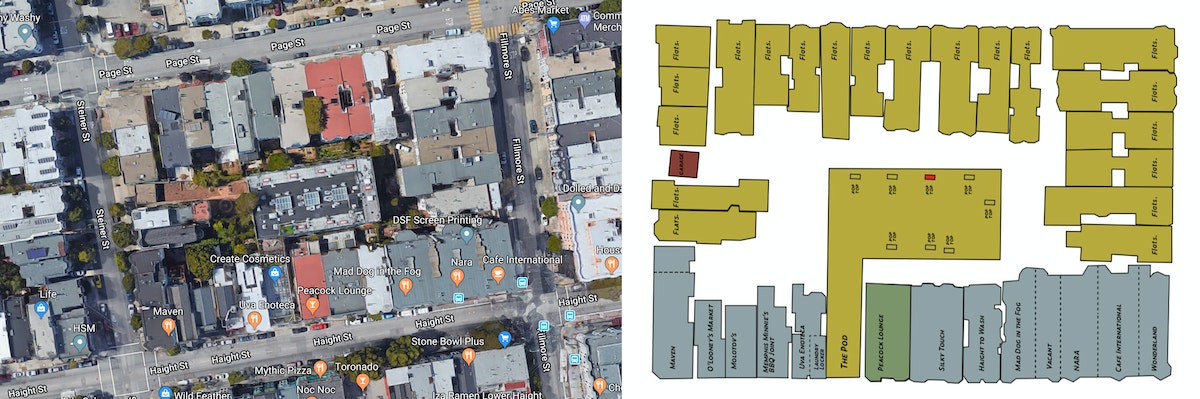
With the buildings in place, my next task was to figure out when they were built so that I could determine if any of them had been around back in 1899. After much poking around, I found this site from the San Francisco Planning Department that had exactly what I needed—the construction date for each of the 31 buildings on my block. Once I did the research, I discovered that three buildings can be found on the map in both 1899 and 2019, all of them clustered on the southwest corner of the block. One of them is my local bodega, home to Tiger the cat and famous (in the neighborhood) for the time that the Warriors eccentric three-point maestro Klay Thompson visited the bar to buy a bottle of Grey Goose. Super cool also to know that the building was built in 1890 and survived the 1906 Earthquake and Fire.
To finish up the map, I built out a key, borrowing inspiration from another Sanborn map visualizing neighborhoods in Honolulu, Hawaii.
Then I tweaked the colors, sticking to the Sanborn color palette, but borrowing some of the brighter colors found across the collection. I also added some polka dots to both maps to call attention to the three buildings that survived from 1899 to 2019. These last couple of tweaks are just two of the many benefits to working with vector files instead of pixels.
And voila, here is the final version of the map. What do you think? Now you can do the same for your city block.
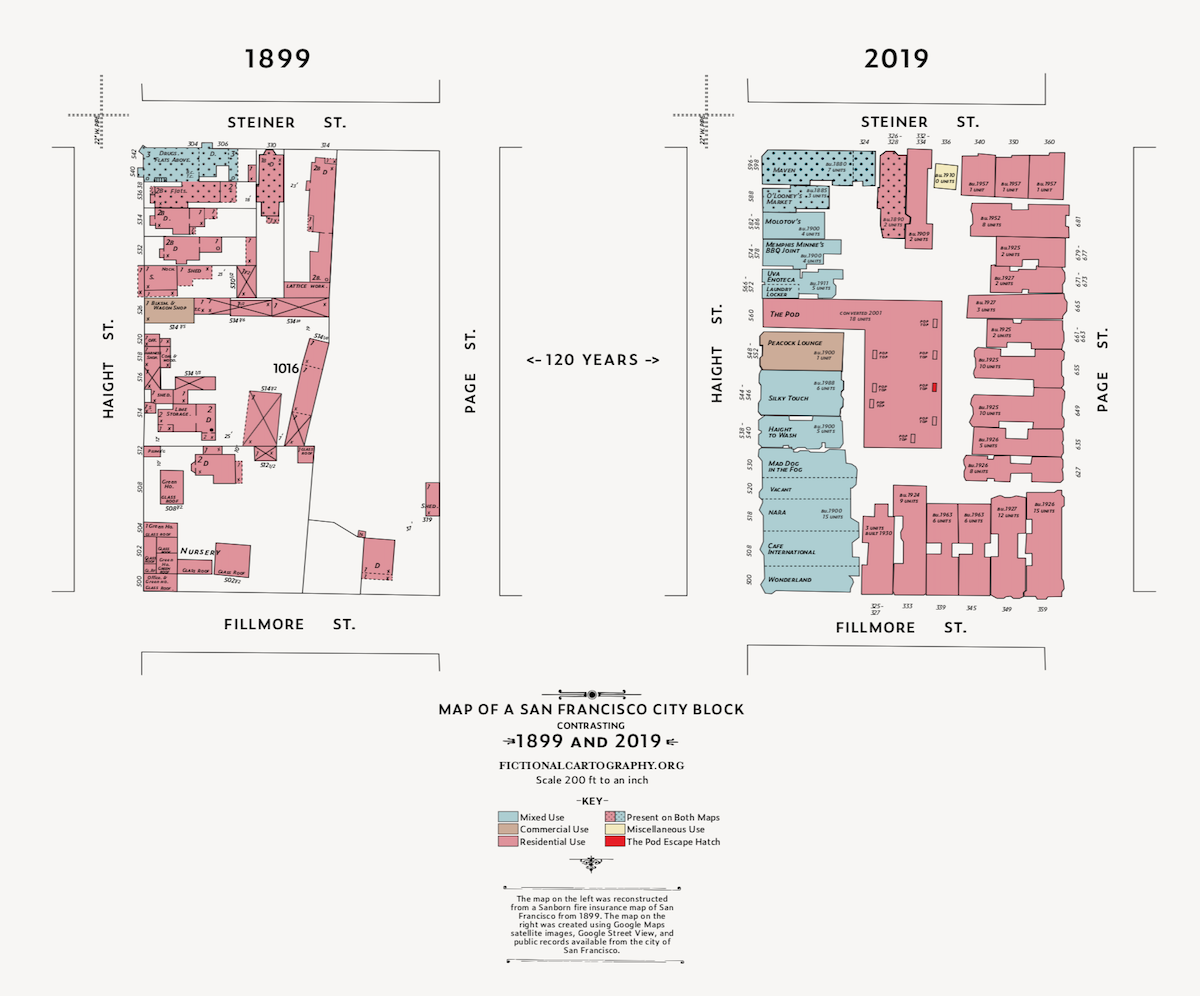
Do you have a few hours on your hands and want to head down a wormhole of unbelievably striking maps? Mosey on over to the Sanborn map collection at the Library of Congress. Originally created as a means for issuing fire insurance across major American cities, the quality of hand-drawn detail in these maps and the color palette used by the cartographers are stunning.

Lindsey Turner
I’m passionate about building brands, products, and experiences that help organizations show up with meaning and momentum.
I help organizations cut through complexity by shaping how they show up, through brand strategy, identity, and storytelling.
Working at the intersection of brand and business, I bring an editorial eye and a bias toward making—turning ideas into tangible experiences that people can understand, trust, and believe in.
My work spans government, healthcare, financial services, media, and consumer goods, from launching Gen Z-focused ventures to building innovation labs and reimagining legacy brands. I relish moments of ambiguity and enjoy translating across teams, perspectives, and priorities to move ideas forward.
I started my career in editorial and digital design, shaping cross-platform experiences and identity systems in publishing and agency environments. That foundation still shapes how I work today: I’m detail-oriented, collaborative, and overreliant on the Oxford comma. I hold a BFA in Visual Communication from the School of the Art Institute of Chicago.

Rachel Young
My work helps organizations see who their products aren't working for—and build the will and the tools to do something about it
For 25 years, I've asked the same question: Who does this design exclude—and what are we going to do about it?
My work spans human-centered strategy, inclusive design, and qualitative research, with clients ranging from Microsoft, Google, and Verizon to the National Science Foundation, and San Francisco Unified School District.
Before IDEO, I taught elementary school in East Palo Alto and spent a decade doing design work with social service organizations—where I learned firsthand what it costs people when systems are built without them in mind.
I am currently writing User Error, a nonfiction book about digital access and the design decisions behind it. I live in Oakland, California.

Brian Pelsoh
I lead with craft, ensuring our work is creatively excellent: rooted in deep human insight and imagination, while also grounded in the realities of business and technology.
My expertise spans brand, communication, and product design across tech, education, the arts, and social impact.
I believe great work demands both high-level vision and obsessive attention to detail, and only happens through collaboration.
I bring an inclusive, hands-on approach and a deep understanding of business, which enables me to consistently deliver excellence while always asking why.
Before joining IDEO, I worked at the brand firms Pentagram and VSA Partners. I began my career as a designer, leading teams at the School of the Art Institute of Chicago and the Milwaukee Art Museum. I hold an MFA in graphic design from Maryland Institute College of Art and a BFA in communication design from the Milwaukee Institute of Art & Design, and have taught at some of the best design schools in the US.

Tony Wong
I am responsible for IDEO’s long-term success in China and working with clients to use design as a tool to enable growth.
I am responsible for IDEO’s long-term success in China and working with clients to use design as a tool to enable growth. Specifically, I have helped Chinese companies design holistic brand solutions through the development of their products, communication, services, and innovation teams, and I have helped multinationals expand their presence and influence in China.
I advise global leaders on developing China-led innovation and capabilities.
In over 15 years in IDEO Shanghai, I have worked on projects that use design to elevate the quality of the experience of healthcare products and services, streamline processes that increase productivity, create spaces and programs that promote and enable inclusive communities, and build next generation mobility solutions that are planet-positive.
Before joining IDEO, I worked at Philips Electronics and the Electrolux Group in Italy, the Netherlands, and Singapore on a number of breakthrough commercial products. I am a member of the Young President Organization in Shanghai.

Building a personal AI for the messiness of life: Sida Li
Most AI products today are built for work—a space with clear problems and established systems. One founder noticed a gap: personal life is messier, harder to systematize, and mostly left behind by the AI boom. So she built Cue, a personal AI that lives inside iMessage and group chats, to go where the other tools haven't.
In this episode, Becca Carroll, IDEO's Chief Strategy Officer, talks with Sida Li, co-founder and CEO of Shared Context Lab, about staying anchored to a human need while the technology around her keeps changing shape, why she treats her business model with the same rigor she'd bring to a product, and what it feels like to build a company at this particular, disorienting moment in AI.
The conversation also gets into how Sida makes design decisions: the language Cue uses to describe itself, the tradeoffs behind building inside iMessage instead of a new app, and a real story about a business idea that didn’t pan out.
This is the second in a two-part series profiling founders from IDEO's Startups-in-Residence program. The first conversation is with Johannes Seemann, founder of Sooner, on designing GenAI for the emotional side of money.

Designing GenAI for the emotional side of money: Johannes Seemann
Most personal financial tools are built to run the numbers and optimize towards a budget. While that works for some, most people experience money as a lived relationship that does not neatly fit into a spreadsheet. Johannes Seemann and Becca Carroll discuss why money is emotional before it is mathematical, and what a human-centered approach to building a generative AI financial product looks like in practice.

The curious leader's edge in uncertainty: Scott Shigeoka
Mina Seetharaman talks with Scott Shigeoka, author of Seek and Head of Curiosity Cultivation at the Eames Institute, about what distinguishes genuinely curious leadership from performative curiosity, how power dynamics shape curiosity, and why practicing curiosity can restore energy rather than drain it.

How constraints make us more creative: David Epstein
Mina Seetharaman talks with David Epstein, author of Inside the Box and Range, about why total freedom often produces average work, how leaders can design useful limits on purpose, and what organizations such as General Magic and Pixar reveal about the relationship between boundaries and creativity.
Looks like you might be in search of something very specific?
Or reset the filters above and try another angle.
Here’s some random inspiration

Podcasts about creative leadership

Articles about the power of prototyping
