
.svg)


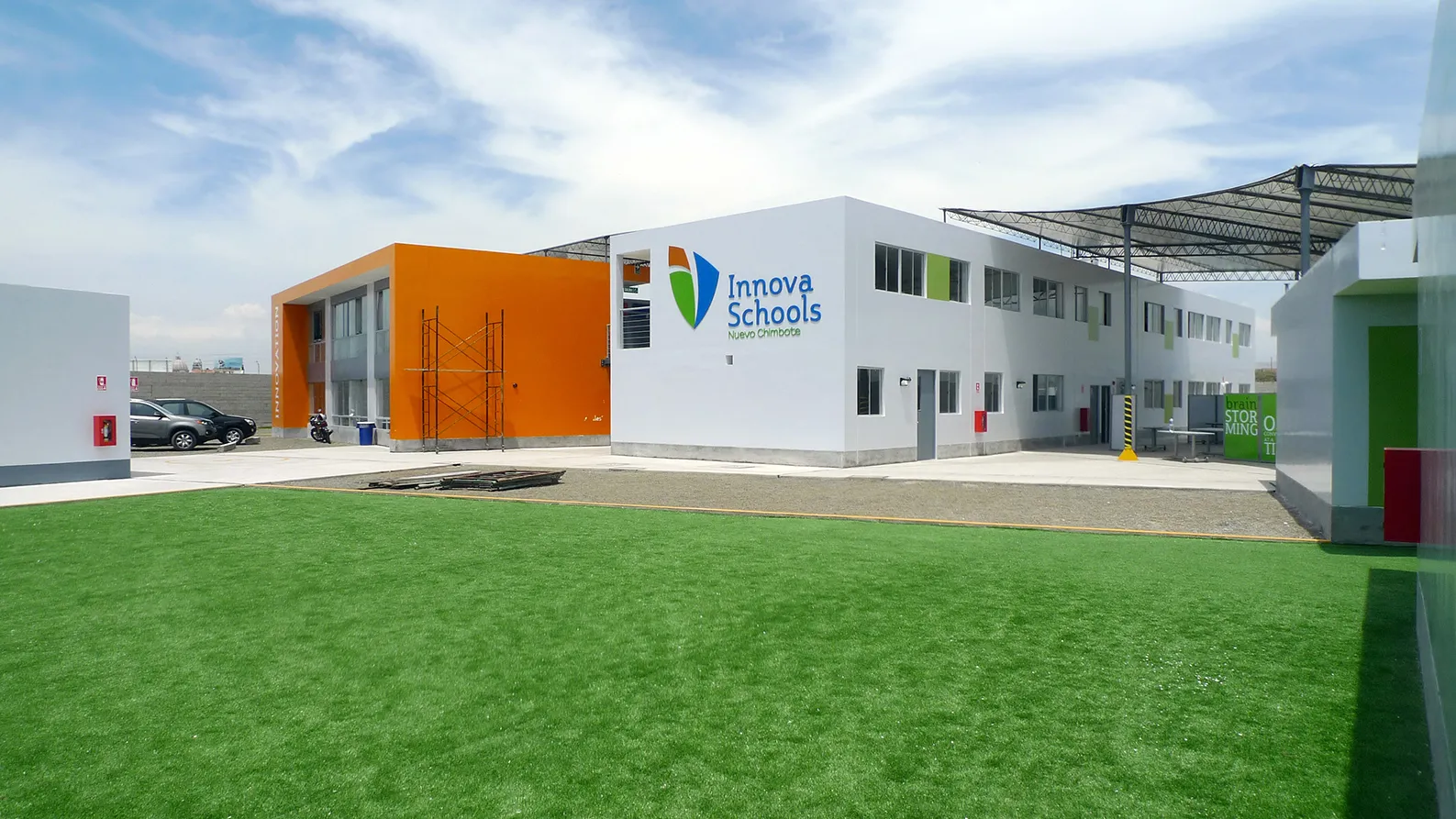

Designing a school system from the ground up
Scaling an entire network of schools for the growing Peruvian middle class.
How do you lift up the middle class in a developing country?
That was the challenge facing Peruvian entrepreneur Carlos Rodriguez-Pastor, who hired IDEO to build an entire network of schools powered by a progressive new learning model. IDEO’s mandate: to redesign Innova’s entire K–12 learning experience, from the curriculum to the teacher training to the school buildings, with an eye toward expansion and a goal to provide international-quality education at an affordable price—about $100 a month.
Innova Schools is a part of Intercorp, a family of 35 businesses that span everything from banks to retail stores and added schools to its portfolio. In 2010, the company had five existing schools but realized that its existing model could not grow. The shortage of well-trained, high-quality teachers in Peru, combined with rising land costs, meant the schools would need to radically change course to succeed.
To learn about scalable school models around the world, IDEO researchers visited inspirational schools and learning programs, and looked to analogous systems like retail, hospitality, and health care to understand their approaches to scale. Throughout the project, they collaborated with teachers, students, and the Innova Schools team in co-designing the work itself.
Together, Innova Schools and IDEO developed the curriculum, teaching strategies, buildings, operational plans, and underlying financial model to run the network of schools.
"I was blown away by Innova Schools," said Salman Khan, founder of Khan Academy. "It's inspiring to see such an affordable school deliver a quality of education that would rival schools in the richest countries."
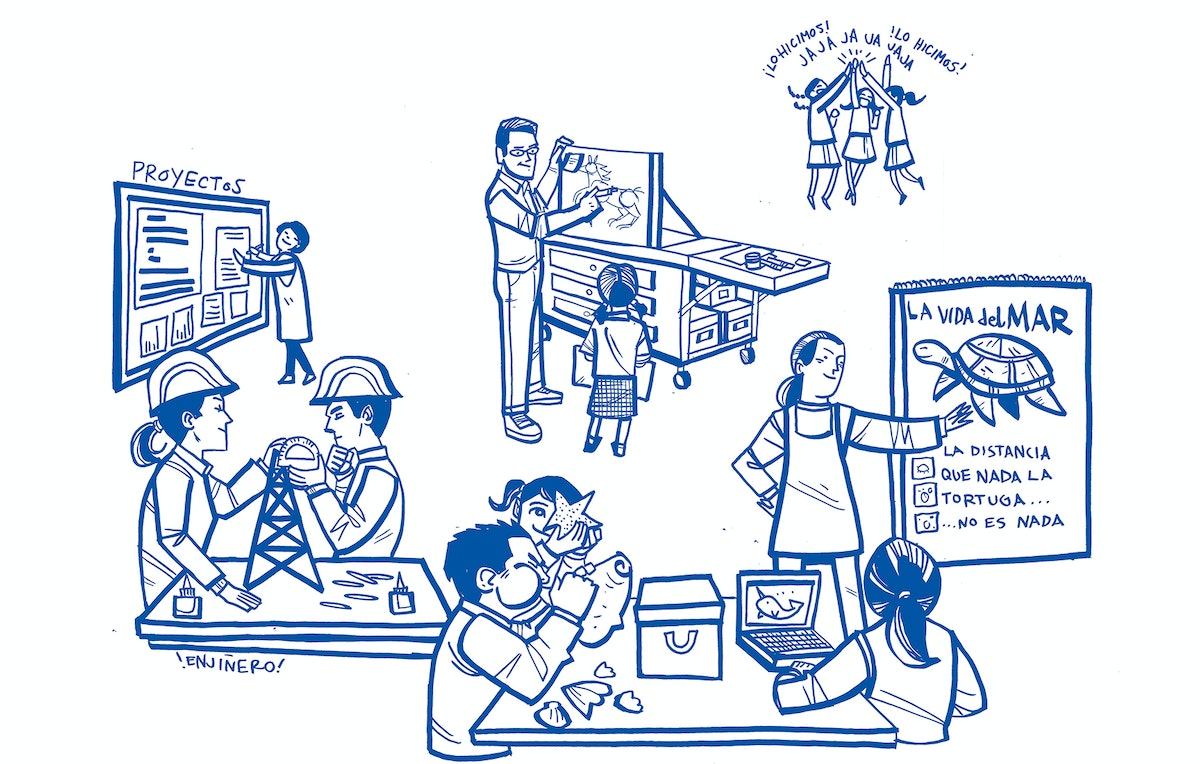
The new Innova Schools combine teacher-led, project-based learning in small groups with self-directed time using digital learning tools. Teachers monitor students’ work online and offer personalized guidance. Parents can view their children’s progress online as well.
Dynamic learning environments include community spaces, media labs, rooftop study areas, amphitheaters, and cafés that are optimized for flexibility: furniture on wheels, movable walls, and efficient uses of space to allow for different modes of learning.
An online Teacher Resource Center includes a database of more than 18,000 custom lesson plans based on a progressive new teaching approach. The center helps teachers learn their craft and gives them a chance to connect across the network.
The business model of Innova Schools was developed at the same time as the school experience. Designers leveraged the economies of scale that come from building a network of schools and centralized tools, such as data systems that allow all the schools to learn together.
The project has allowed Innova to open more schools at an affordable cost to families, ultimately giving more of Peru’s youth the chance to compete in the global economy. This comprehensive approach to system design ranks as one of Latin America’s most ambitious privately funded educational projects, and is on track to become the largest private school network in the region. To date, Innova has opened 63 schools in Peru that are serving more than 50,000 students.

A good system design doesn’t end with strategy. The work on Innova Schools also had a huge influence on the company, according to Rodriguez-Pastor. Through the creation of new roles and an aligned set of values, Innova’s central office has become a much more nimble and creative organization. They’re constantly scanning the world for inspiration in how to best educate their students, while building out the new innovations. They realize that design thinking can become an integrated part of their daily management of this growing network of schools.
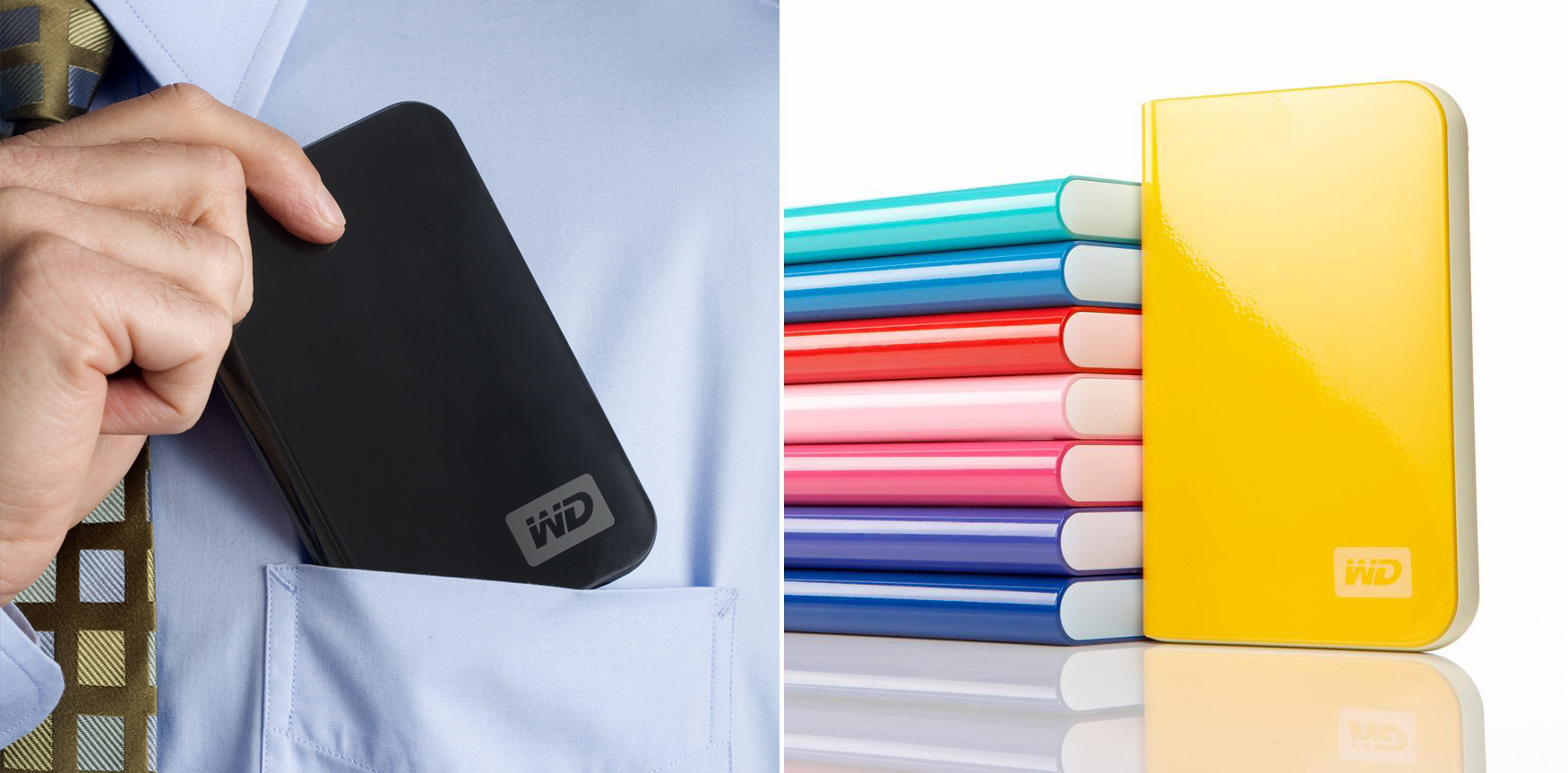
Designing a top-selling hard drive
Through a long-term collaboration, Western Digital and IDEO have created one of the world’s best-selling hard drives.
Western Digital, the leading provider of external digital-storage solutions and a pioneer in the field, and IDEO collaborated on a number of products that produced reliable, secure, high-performance hard drives for personal and professional use and have won numerous design awards.
The projects include:
- MyBook external hard drive: IDEO and Western collaborated to find a new design language for their external hard drive MyBook. In just six months, MyBook became the number-one hard drive in the Americas, and grew US market share by more than 50 percent.
- MyBook II: Looking to regain MyBook’s original number-one position in the hard drive market, IDEO and Western came together again to refresh the original design, finding ways to further differentiate the product and the brand, and winning a 2008 Spark Bronze Award.
- MyPassport: Western and IDEO designed the 320GB, ultra-portable USB-powered hard drive that appeals to the mobile user, which won both the 2008 IDEA Bronze Award from IDSA and BusinessWeek, and the 2009 iF Award.
- MyBook and MyPassport 3.0: Again, IDEO and Western collaborated on bringing the popular MyBook external hard drive to the next level in the hardware, the software, and the packaging. IDEO also created in-store merchandising, the graphics and information featured on product packaging (and the “out-of-box experience”).

Designing a city emergency plan
Helping cities prepare for emergencies with a resourceful toolkit.
The city of San Francisco wanted to help its people become better prepared in case of emergency. While no one feels totally prepared for a natural disaster, people who are most connected within a local network fare better in an emergency.
So the San Francisco Department of Emergency Management (SF DEM) and IDEO teamed up to create SF72, a revolutionary platform that helps to reach people where they are. In times of emergency, the city will need citizens to be self-supporting for 72 hours (or longer) before local services or outside help kicks in. With that in mind, IDEO developed an accessible platform to help people prepare for those 72 hours in simple ways that fit into their daily lives.
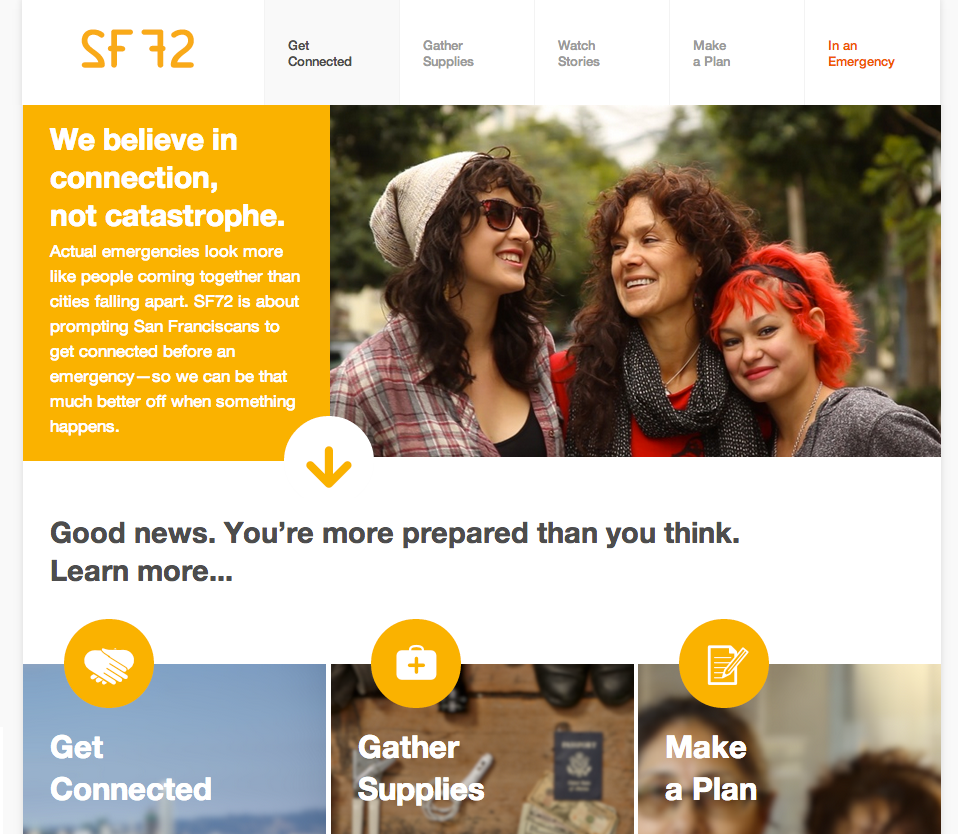
The SF72 website helps people with five important tasks: Get connected, gather supplies, watch stories, make a plan, and have access to an updated Google map. SF72’s content is hyperlocal, but IDEO and SF DEM also created an open-source toolkit for cities worldwide. From San Jose to Denver, other locales are using the simple toolkit to create a City72 platform of their own. Most recently, the city of Oakland collaborated with Code for America to develop its own platform. The City72 Toolkit enables SF72’s ethos of social connection for resilience to scale and grow—city by city.

Designing a global plan for disaster response
Creating a network that connects veterans across continents.
Team Rubicon, formed in 2010 as a response to the devastating earthquake in Haiti, is made up of former military veterans who swoop into help in times of disaster. The organization started with six vets in the US who were eager to transfer their battlefield readiness in to frontline relief efforts, and has grown to more than 28,000 volunteers across the world.
To explore its growing global effort and to shape the future of the organization’s venture, Team Rubicon approached IDEO for help. After an 11-week collaboration with government, military, and veteran groups, a vision for Team Rubicon Global emerged. Inspired by sources as diverse as TED and The Hell’s Angels, the three-tier model consisted of an anchor network to share best practices across the organization and two supporting platforms designed to help countries with varying capacity and needs.
Team Rubicon Global coordinated its first deployment in April 2015, when a quake struck Nepal, sending US and UK teams to double down on the rescue effort. According to Vince Moffit, Team Rubicon USA Incident Commander, that incident alone validated the network effect of IDEO’s work. “We couldn’t have done this without Team Rubicon UK,” he said.
And for the veterans who are part of Team Rubicon, the shared desire to serve—applying skills ideally suited for disaster response—creates a renewed sense of purpose, community, and leadership that helps reintegration to civilian life.

Why It's Important to Say Please and Thank You to Robots
One design researcher discovered that with AI, learning goes both ways
While Lotbot has started to calm down and find its rhythm, another story has emerged. It’s the story of how our studio has adapted to living with a robot. It’s a story about how the design of AI, no matter how small a role it might play in our lives, has implications beyond its intended use—and can even influence the culture of an entire organization.
As a researcher with a background studying and designing human-computer interaction, I was enamored by the social bot. I started observing Lotbot’s day to day operations, and over time, I noticed that while most people were interacting with the bot using commands that it was trained to understand (e.g. “spot today”), a small group of people were holding on to the social norms they’d typically use in interpersonal interactions. This made me think: What motivated people to use words like please and thank you, when they knew that the AI wouldn’t know the difference anyway? And what does this mean for future interactions with robot coworkers?

I launched a full-on design research project. With support from my colleague Justin Wan, I collected quantitative data from Lotbot’s Slack channel to understand how the studio’s language patterns had changed since the bot was introduced. I also conducted a series of surveys and qualitative interviews to understand what motivated people’s approach to interacting with Lotbot.
Here’s what I found—and what it means for how we consider the connection between AI and the culture of organizations.
Language has changed, but we're still holding on to something
Before reviewing the Slack data, I hypothesized that shorter messages of 15 characters or less (“Need spot today”) indicated that the user believed they were interacting with a “robot,” while longer messages (“I need a spot today, please”) aligned with a more human-to-human conversation style. I also looked at the change in frequency of polite language such as please and thank you to see how often people were holding on to human-to-human conversation styles.
It turns out that once Lotbot was introduced to the parking channel, the number of messages that had 15 characters or less increased significantly, while the percentage of total messages using polite language decreased significantly (from 30 percent to 10 percent).
As Danny DeRuntz, the creator of Lotbot, explains, the AI was trained to recognize the basic components of a request—the need (a parking spot) and the timeframe (tomorrow)— so it’s no surprise that our interactions in the channel had started to become more, well, robotic.
The survey data, on the other hand, revealed that some people thought about Lotbot as another member of the studio—they treated it with the same respect they would a human colleague. Others said that they based their interactions on the fact that they knew the rest of the studio was watching. People were conscious of how their commands came across to other human colleagues who do care about people’s attitude, even if the bot doesn’t.
The in-person interviews further supported what the survey highlighted. Those who continue to use polite language are motivated to do so because they feel that it’s important to show gratitude when you’re asking for a limited resource. As one of my colleagues put it, gratitude is an important part of the collaborative culture at IDEO, and that should not be lost just because there’s a robot among us—especially since that robot exists solely to help us do our jobs.
Learning goes both ways with AI
So what does it all mean? The prominent narrative about AI and robots is that they are learning to interact with humans, but this quick study highlights that the learning goes both ways. In the context of the parking Slack channel, the limits of Lotbot’s functionality trained the humans to interact in a different way. A way that, for some who resisted the changes, felt antithetical to our company culture.
A group of data scientists at IDEO recently published a set of AI design principles. One of these principles asks designers to consider how their designs can be sensitive to people’s context and culture. AI systems are designed to provide efficiency, but in some settings, that efficiency might compromise and conflict with other institutional and cultural priorities, like politeness and gratitude. A recent article in Fast Company echoes this concern, suggesting designers of social bots should consider emotional thinking, helping bots be better companions in their interactions with humans.
But what does this mean for the design of Lotbot? Should it be designed in a way that encourages expressions of gratitude? It wouldn’t hurt— but the stakes are low, and the occasional robotic conversation is overshadowed by a number of other rituals and activities that keep our culture feeling friendly and free.
But the question does bring up an interesting opportunity area for social robots and AI in the context of larger offices, especially those that haven’t scaled ritual and culture. As companies grow, corporate culture can be hard to maintain, and as automation becomes more common it could get harder. If social robots like Lotbot can draw attention to the social norms that matter to a company’s culture, we might be able to create and use them to support corporate culture at scale. Social robots may be able to serve as reminders of cultural practice and values.
The possibilities are endless, but one thing’s for sure—human-computer interactions are influenced first and foremost by humans, and the humans of IDEO have spoken. After sharing my research about changes in conversation style with the studio at a recent lunch meeting, my colleagues took to Lotbot’s Slack channel to declare their love and admiration for the tiny bot. In the weeks that followed, I observed an uptick in polite language as well. While I’m in no position to analyze the psychological motivations behind this outpouring of love, it did make me wonder if we all felt the need to make something more human after we found ourselves becoming more robotic.
In November, we shared the story of Lotbot, an AI Slack bot we built to manage parking spots at our Cambridge studio. Long story short: In building Lotbot, we utterly misjudged its personality and found ourselves on the wrong end of a tiny tyrant.

When Was the Last Time You Listened to an Album From Start to Finish?
How one designer is helping people reconnect to music
Growing up, I fell in love with the rituals I had to go through to listen to music. I’d flip through my growing collection of cassette tapes, assessing my options based purely on album artwork. Selecting a tape meant that I’d found the perfect companion of mood, time, and place for the present moment. As the music started playing, I’d follow along with the lyrics and analyze the liner notes so that I could try to understand just a little more about what it was I was hearing.
As preferences for personal music collections shifted from analog to digital, convenience overtook curation. Cassettes and CDs were dethroned by the $0.99 iTunes single and, eventually, the killer Spotify playlist. Today, I myself am a diehard Spotify user who eagerly awaits a fresh “Discover Weekly” playlist. But over time, something special was lost. For many, the act of listening to music was no longer reserved for a particular time and place. Now it was everywhere, on-demand, all the time.
This is how the idea for Art of Listening was born. I’d been reflecting on the fact that much of my time was spent with music playing in my ears. Whether during my commute, throughout the day, or simply as I was winding down at home, I had been using music as background filler. Artists hadn’t stopped making albums with deliberate progressions, so why had I chosen to stop listening to them that way?
I wanted to find a way for others to join me in honoring the full-length album as an art form. For each listening, I transform a casual gathering space into a fully curated experience. I put the album artwork on display so that guests see it upon arrival, preparing them for the coming event. Once inside, they’re greeted by a playlist of previous albums, former bands, collaborations, and b-sides from the artist. A screen alternates between quotes pulled from past interviews and snapshots from their social media lives, giving life and character to the people behind the sounds.
We sit and listen to the album all the way through, without any interruptions; after it's finished, people share their reactions as well as anything it may have prompted them to write or draw.

For the attendees, each event is just a short exercise in active listening. For me though, preparation includes several days of collecting and organizing all of the small things that will make up the event. The process isn’t unlike a design project—it can sometimes be all too easy to get wrapped up in the minutiae of day-to-day tasks as you’re working through them. Just as I’d been focused on individual songs rather than the album they were a part of, it’s important to take a step back from your work and try to look at the whole. Now, I try to keep an eye on the larger goal, and ask myself whether the things I’m diving into are in support of getting me there.

As I’ve continued developing Art of Listening, I’ve learned a few lessons that apply to other projects I’m working on:
1. Use subtle cues to guide behavior
By the time guests enter the space, seating has already been carefully arranged. I want to make sure there’s enough room for everyone, but I also want to encourage people to meet their neighbors.
2. People are human, leave room for the human stuff
At the first event, I was so excited for the listening that I didn’t leave room for a break before starting the music. Once the album finished, people ran out of the room, disrupting a key moment for discussion and reflection.
3. Build in opportunities for reflection and feedback
After the music had finished playing at the first event I was nervous to leave people sitting in silence. I resumed the ambient playlist from earlier in the night, only to find that it prevented people from freely sharing their reactions to what we had just heard.
4. Measure by more than just content alone
For me, Art of Listening is much more than just listening to an album in silence. It’s about the moments of surprise and delight as people learn more about the artist, and the connections that form when people physically come together in one space. I don’t measure a successful event by how good the album was, but by the experiences that people have.
5. See the forest from the trees
My goal with Art of Listening is to provide people an opportunity to pay attention and appreciate music in the format the artist had intended. To get there, I had to realize that the art form itself hadn’t changed, but that I had changed how I’d chosen to experience it.
A small group of people sit nestled together in a room. Some are concentrating, eyes closed; others are diligently writing or drawing in notebooks. A select few carefully bounce in place. Nobody speaks, but everyone is connected by a common thread—the music that fills the room. Together they are practicing the Art of Listening.
Build Your Creative Confidence: Customer Journey Map
One way to develop more empathy with—and gain new insights about—your customers is to look beyond the narrow definition of your offering and consider the customer’s total experience.
Creativity Challenge #8: Empathize with customers, employees, and other end users.
One way to develop more empathy with—and gain new insights about—your customers is to look beyond the narrow definition of your offering and consider the customer’s total experience. The more broadly you define the customer experience, the more opportunities you can identify for improvement through design.
Say, for example, you make interior house paint. You could focus narrowly on the characteristics of the product itself, on making the paint less drippy or making it cover a surface in a single coat. But you’ll find many more opportunities for innovation if you think about the arc of the customer experience. In something as simple as repainting a bedroom, there are probably a dozen steps (each one of which is a chance to innovate): from getting the customer to realize that it’s time to repaint, to helping them choose the color, to shortening the preparation and cleanup time, to keeping track of which colors are on which walls for future reference when it comes time for touch-up.
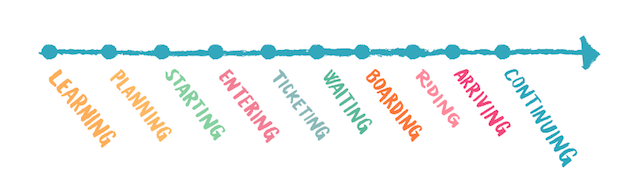
A journey map helps you think systematically through the steps your customers—internal or external—have when they interact with your product or service. We use maps to synthesize what we learn from interviews and observations. (Or, during field research, you can also try asking your end user to map out his or her own journey.)
Tool: Customer Journey Map
Participants: Solo or groups of two to six people
Time: 1-4 hours
Supplies: Whiteboard or Post-its
Instructions
Step 1: Choose a process or journey that you want to map.
Step 2: Write down the steps. Make sure to include even small steps that may seem trivial. The goal is to get you to consider the nuances of the experience that you may normally overlook.
Step 3: Organize the steps into a map. Usually we display the steps sequentially in a timeline. Your map may include branches to show alternative paths in the customer journey. You could also use a series of pictures or whatever method fits your data.
Step 4: Look for insights. What patterns emerge? Anything surprising or strange? Question why certain steps occur, the order they occur in, and so forth. Ask yourself how you might innovate each step.
Step 5: If possible, show the map to people familiar with the journey and ask them what you’ve overlooked or gotten out of sequence.
Tips from the Field
Here is an example using this method:
Think about a trip to the hospital’s emergency room. Of course the most important moment is at the point of care, when the doc is diagnosing the problem or delivering treatment. But when people complain about (or, less commonly, rave about) their emergency room experience, it’s not usually the skill of the doctor they are talking about. A simple version of the patient journey might include moments like these:
- Experience the pain or discover the symptom
- Consider home treatment versus going to the hospital: the go/no go decision
- Choose transportation to the hospital
- Arrive and park (or pay the taxi, etc.)
- Enter the hospital and find the emergency room
- See the triage nurse
- Fill out the insurance forms
- Wait. And wait some more.
- Get ushered to the treatment room
- Put on an uncomfortable hospital gown, and wait some more
- See multiple preliminary nurses and technicians
- See the doctor for an assessment and sometimes preliminary diagnosis
- Undergo additional blood tests, X-rays, and so forth
- Receive a firmer diagnosis, which can lead to getting: instructions for home care, an outpatient procedure, a prescription, a follow-up appointment with a general practitioner or specialist, or admission to the hospital
As you lay out every step, ask yourself how you might cost-effectively innovate and turn the ordinary experience into something extraordinary.
Because emergency healthcare is often high-anxiety, we’ve discovered that patients are calmer if you spell out the journey ahead. We sometimes call that “journifying” the journey—taking an amorphous or scary process and breaking it down into tangible, predictable steps. We’ve found “journifying” helps people not only in the emergency room, but in any number of healthcare situations: taking your newborn home from the hospital, going in for surgery, or beginning a new treatment regimen.
This post was taken from Chapter 7 of Creative Confidence. Purchase the book for more on how to use creativity to solve problems, or read more from this series of creative exercises on the IDEO blog.
Everyone is creative. This belief runs through everything we do at IDEO, and in 2013, it led my brother David and me to write a book that would help others—even those who don’t think of themselves as “creative types”—to unleash their creative potential. Creative Confidence has inspired thousands of people to adopt a creative mindset and apply it to the diverse real-world challenges they face. In this series, we’ll share some exercises from the book that can help you approach your challenges from a new perspective.

Training a Computer to Find Shapes in the Clouds
This IDEO software designer created an app that searches the sky
I spent my afternoons on a small wooden pier, relaxing and staring up at clouds, looking for shapes. That pursuit is an exploration of pareidolia, the psychological phenomenon in which the mind responds to a stimulus, usually an image or a sound, by perceiving a familiar pattern where none exists. It was in that leisure time, trying to make sense of the clouds, that I found the comfort that I’d been seeking.

Nine years later, I found myself back in America, interning at IDEO Chicago, where I had far less opportunity for leisurely cloud gazing. Without the spare time to hang out on a pier, I wondered if I could engineer the same kind of comfort. Could I design an experience that brought back those long dreamy pareidolia days with the help of an app?
After all, people in my age bracket, between 25-34 years old, only spend an average of 13 minutes per day relaxing, according to the American Use of Time Survey, and experts say that we need to acknowledge and accept that we’re leisure-limited. Maybe this could be a shortcut to that leisure we’re missing.
So I created “Pareidolia,” an app that searches the sky on my behalf. It’s my way of trying to keep a part of my mind exploring, even when I need to be inside, working. If the app thinks it sees something in the clouds, it pings me to take a look.

To create Pareidolia, I set up a Raspberry Pi and a camera on the terrace of our Chicago studio, and programmed it to look continuously at the sky, searching for interesting shapes. The project uses computer vision, tensorflow, and keras to perceive images in clouds, then snaps an image, generates a drawing of what it imagines it might look like, and shares them via Slack. (The code can be found and downloaded from this Github repo.) It tells us what it sees in the sky in real time and invites us to go out and look for it.

As I started to share Pareidolia with colleagues and friends, my creation was met with mixed reviews. Ross Weijer, a data scientist here at IDEO Chicago, thought that it created efficiency while offering a different perspective. “Technology is something that speeds up your life and, lets you do things quicker,” he said. “So I think it’s subversive and helpful to have the aim of this project be to spare your imagination. It’s saying, ‘Stop, stop, take a moment to consider this.’”
Others, though, felt that the payoff wasn’t seeing images in the clouds, but actually, the act of searching for them. “I look at the sky so little, that when I do it’s because I am looking for an escape,” said Kevin Matuszeski, regional director of business operations “There are very few places left without the presence of screens or where you have to read something. So the pure joy of staring at something just for its beauty should be respected."
In other words, for some people, the joy lays in the process, and Pareidolia seemed to eliminate that.
Pareidolia didn’t turn out to be quite the leisure fix that I hoped it would. And it didn’t quite prove to be an antidote to homesickness, either. But it did encourage me to get outside, take my eyes off a screen for a few minutes, and enjoy nature as much as I could from the concrete of my downtown Chicago office. And even if it wasn’t a total fix, it does brighten up my days.
I was only 16 when I moved across the Atlantic to Vancouver Island, Canada, thousands of miles away from my home in Spain. In this strange new world, I found myself struggling to find something that felt familiar, and could give me comforts of home.

Lindsey Turner
I’m passionate about building brands, products, and experiences that help organizations show up with meaning and momentum.
I help organizations cut through complexity by shaping how they show up, through brand strategy, identity, and storytelling.
Working at the intersection of brand and business, I bring an editorial eye and a bias toward making—turning ideas into tangible experiences that people can understand, trust, and believe in.
My work spans government, healthcare, financial services, media, and consumer goods, from launching Gen Z-focused ventures to building innovation labs and reimagining legacy brands. I relish moments of ambiguity and enjoy translating across teams, perspectives, and priorities to move ideas forward.
I started my career in editorial and digital design, shaping cross-platform experiences and identity systems in publishing and agency environments. That foundation still shapes how I work today: I’m detail-oriented, collaborative, and overreliant on the Oxford comma. I hold a BFA in Visual Communication from the School of the Art Institute of Chicago.

Rachel Young
My work helps organizations see who their products aren't working for—and build the will and the tools to do something about it
For 25 years, I've asked the same question: Who does this design exclude—and what are we going to do about it?
My work spans human-centered strategy, inclusive design, and qualitative research, with clients ranging from Microsoft, Google, and Verizon to the National Science Foundation, and San Francisco Unified School District.
Before IDEO, I taught elementary school in East Palo Alto and spent a decade doing design work with social service organizations—where I learned firsthand what it costs people when systems are built without them in mind.
I am currently writing User Error, a nonfiction book about digital access and the design decisions behind it. I live in Oakland, California.

Brian Pelsoh
I lead with craft, ensuring our work is creatively excellent: rooted in deep human insight and imagination, while also grounded in the realities of business and technology.
My expertise spans brand, communication, and product design across tech, education, the arts, and social impact.
I believe great work demands both high-level vision and obsessive attention to detail, and only happens through collaboration.
I bring an inclusive, hands-on approach and a deep understanding of business, which enables me to consistently deliver excellence while always asking why.
Before joining IDEO, I worked at the brand firms Pentagram and VSA Partners. I began my career as a designer, leading teams at the School of the Art Institute of Chicago and the Milwaukee Art Museum. I hold an MFA in graphic design from Maryland Institute College of Art and a BFA in communication design from the Milwaukee Institute of Art & Design, and have taught at some of the best design schools in the US.

Tony Wong
I am responsible for IDEO’s long-term success in China and working with clients to use design as a tool to enable growth.
I am responsible for IDEO’s long-term success in China and working with clients to use design as a tool to enable growth. Specifically, I have helped Chinese companies design holistic brand solutions through the development of their products, communication, services, and innovation teams, and I have helped multinationals expand their presence and influence in China.
I advise global leaders on developing China-led innovation and capabilities.
In over 15 years in IDEO Shanghai, I have worked on projects that use design to elevate the quality of the experience of healthcare products and services, streamline processes that increase productivity, create spaces and programs that promote and enable inclusive communities, and build next generation mobility solutions that are planet-positive.
Before joining IDEO, I worked at Philips Electronics and the Electrolux Group in Italy, the Netherlands, and Singapore on a number of breakthrough commercial products. I am a member of the Young President Organization in Shanghai.

How to use AI as an editor, not a writer
Ed White shares how he uses AI as an editor—not a writer—to sharpen storytelling, rehearse ideas, and preserve the productive friction that makes creative work better.
Ed White has a rule he's tested on his own writing: hold yourself as the writer, and let AI be your editor. Ed is a Senior Design Director at IDEO's London studio, where he co-leads the firm's AI portfolio across Europe. Before IDEO, he spent 12 years as a writer and editor at the Financial Times, Wired, and Contagious. So when he talks about when to use AI for storytelling and when not to, it comes from two decades of crafting his storytelling skills.
In this episode, Mina Seetharaman talks with Ed about two specific tools he uses to keep AI in an editor's seat: a "roasting agent" prompted to critique his drafts without any sugarcoating, and a simulated audience he rehearses pitches on before the real thing. They also get into what Ed is hearing from design leaders at Anthropic, Lovable, Shopify, and Google Creative Lab about how creative work is changing, and why he thinks the friction of writing something yourself is worth protecting rather than automating away.

Building a personal AI for the messiness of life: Sida Li
Becca Carroll talks with Cue co-founder Sida Li about designing a personal AI for the messiness of everyday life—not just work. They explore how Sida stays anchored to human needs while navigating fast-changing technology, product tradeoffs, business-model experimentation, and the realities of building an AI company today.
Most AI products today are built for work—a space with clear problems and established systems. One founder noticed a gap: personal life is messier, harder to systematize, and mostly left behind by the AI boom. So she built Cue, a personal AI that lives inside iMessage and group chats, to go where the other tools haven't.
In this episode, Becca Carroll, IDEO's Chief Strategy Officer, talks with Sida Li, co-founder and CEO of Shared Context Lab, about staying anchored to a human need while the technology around her keeps changing shape, why she treats her business model with the same rigor she'd bring to a product, and what it feels like to build a company at this particular, disorienting moment in AI.
The conversation also gets into how Sida makes design decisions: the language Cue uses to describe itself, the tradeoffs behind building inside iMessage instead of a new app, and a real story about a business idea that didn’t pan out.
This is the second in a two-part series profiling founders from IDEO's Startups-in-Residence program. The first conversation is with Johannes Seemann, founder of Sooner, on designing GenAI for the emotional side of money.

Designing GenAI for the emotional side of money: Johannes Seemann
Designing financial tools around the feelings that shape money decisions.
Most personal financial tools are built to run the numbers and optimize towards a budget. While that works for some, most people experience money as a lived relationship that does not neatly fit into a spreadsheet. Johannes Seemann and Becca Carroll discuss why money is emotional before it is mathematical, and what a human-centered approach to building a generative AI financial product looks like in practice.

The curious leader's edge in uncertainty: Scott Shigeoka
How genuine curiosity helps leaders navigate uncertainty with greater confidence.
Mina Seetharaman talks with Scott Shigeoka, author of Seek and Head of Curiosity Cultivation at the Eames Institute, about what distinguishes genuinely curious leadership from performative curiosity, how power dynamics shape curiosity, and why practicing curiosity can restore energy rather than drain it.
Looks like you might be in search of something very specific?
Or reset the filters above and try another angle.
Here’s some random inspiration

Podcasts about creative leadership

Articles about the power of prototyping
