.svg)



Sparking a conversation around policing in NYC
Helping the New York Civil Liberties Union activate a city-wide, nontraditional campaign centered on listening.
New Yorkers experience policing differently depending on who they are and where they live. Some communities are patrolled; others are profiled. When your neighbors’ experiences are starkly different from your own, it can be almost impossible to understand their perspective.
The New York Civil Liberties Union (NYCLU), a state branch of the ACLU, hoped to spark a dialogue around race and police tactics in over-policed communities, and to engage voters on this divisive issue before New York City’s mayoral election. But the NYCLU also understood that traditional slogans and billboards weren’t enough to foster deep personal conversations and effective political action—the city needed real talk.
The organization engaged IDEO to help create a city-wide, nontraditional campaign. In talking with New Yorkers, the NYCLU advocates and IDEO designers honed in on two simple truths: Transformative conversations happen only when people feel safe enough to listen—and to speak. And people become more compassionate listeners once they themselves feel heard. In a time of entrenched interests and growing social conflict, listening can be a radical act.
Together, IDEO and the NYCLU designed Listening NYC, a grassroots campaign to promote interpersonal listening, meaningful discussion, and collective action around policing.
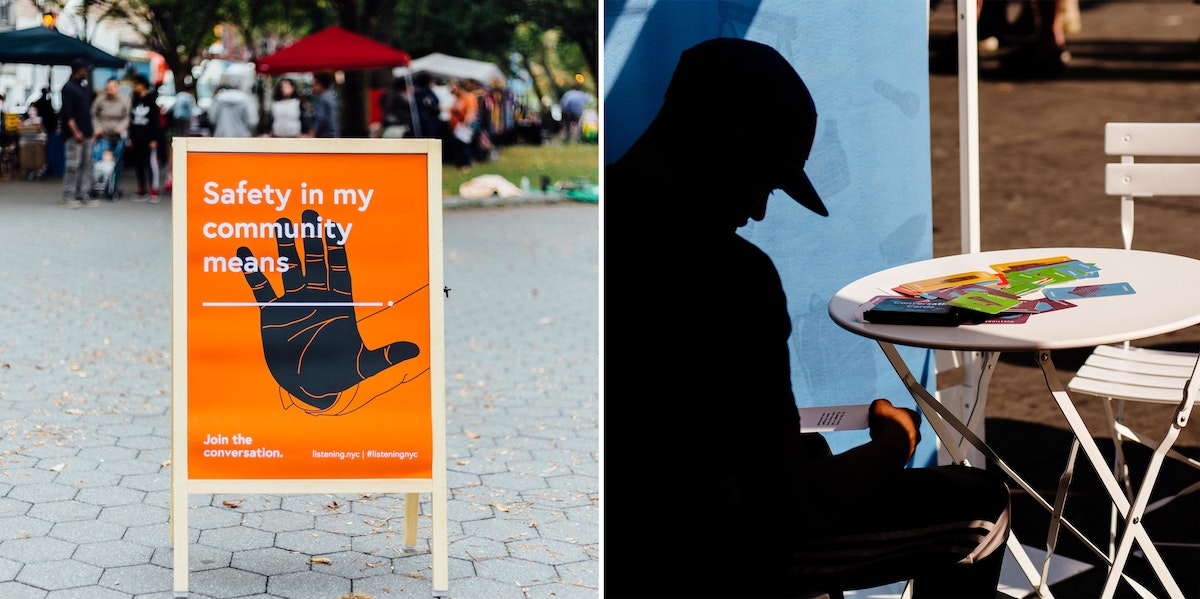
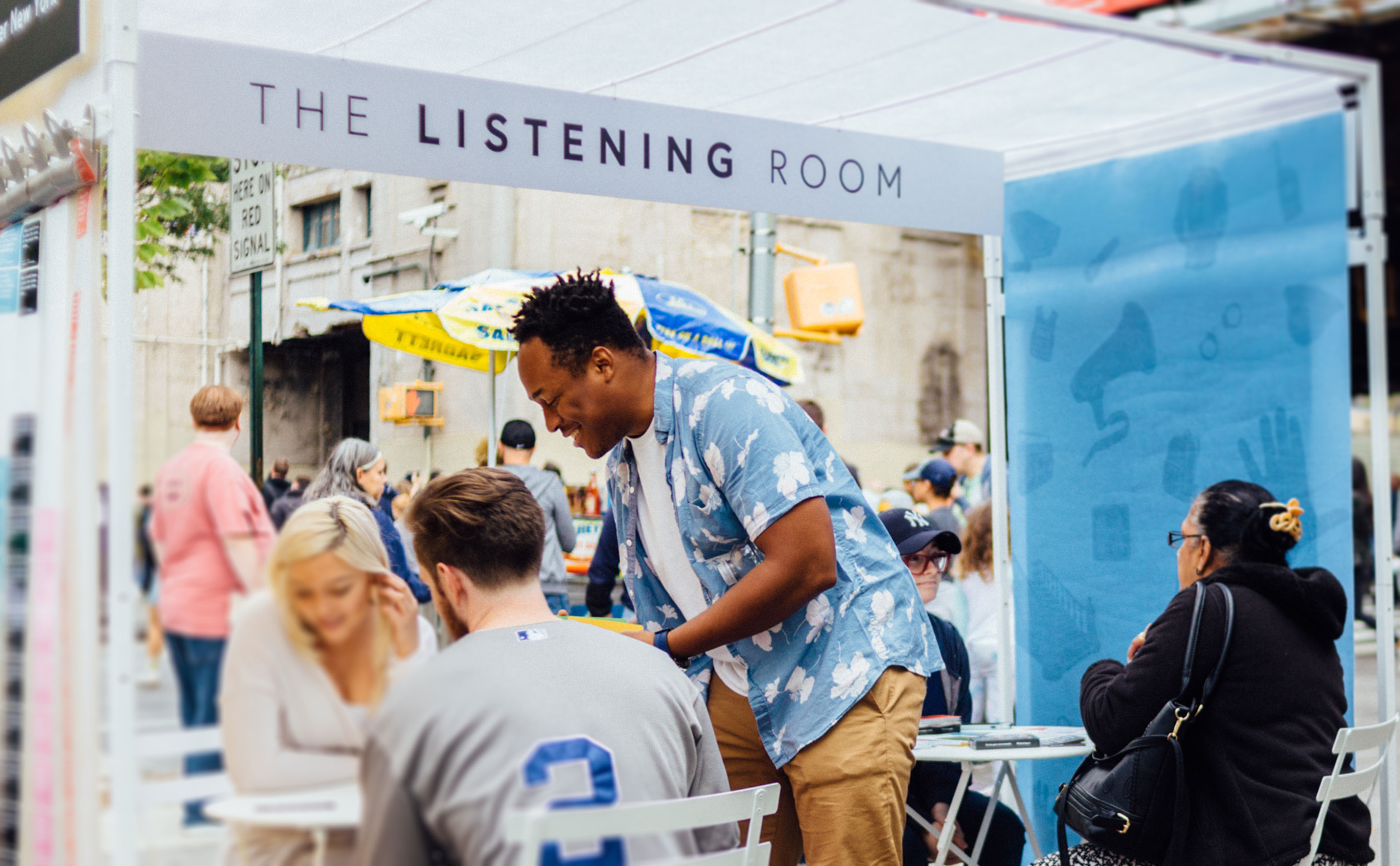
To get New Yorkers—famously brash and always bustling—to stop and listen to their neighbors, they created a pop-up installation called the Listening Room that travels through the city to catalyze one-on-one conversations. It’s a portable safe space, with tables, chairs, two walls that provide a degree of intimacy, and two sides left open for a feeling of psychological safety.
At the center of the experience is a deck of Conversation Cards that encourage New Yorkers to share their stories and hear those of others. Simple prompts like “I believe the role of police is to _____,” and questions like “A cop stops you in your neighborhood. What do you do?” empower people to find common ground. Through straightforward but structured activities like these, many New Yorkers who enter the Listening Room expecting to disagree instead find themselves sharing stories and opinions in ways they never imagined.
Beyond face-to-face dialogue, the Listening Room also features a radio loaded with stories from different neighborhoods across the city’s five boroughs. By turning the dial, visitors can learn about encounters with policing culture from fellow New Yorkers, including two NYPD officers.
To turn talk into action, visitors are invited to send a postcard to the mayor. People choose the policy proposals most important to them—from, “Police shouldn’t be disciplining kids in school” to, “If police want to read our emails, they should have to get a warrant”—and add them to a pre-stamped postcard dropped into a special “ballot box.” The NYCLU delivered more than 2,000 of these cards to Mayor Bill de Blasio upon his reelection in late 2017.
IDEO and the NYCLU also led an interactive campaign event at the Brooklyn Academy of Music. Residents, students, philanthropists, and police were led through an exercise called Creative Tensions, positioning themselves around the room according to their views on everything from surveillance technology to school safety. Experts helped guide the conversation including Sheriff Jerry Clayton, director Liesl Tommy, and NYCLU organizer Brandon Holmes. The process allowed participants to see how fluid people’s positions can be.
Listening NYC has now reached thousands of New Yorkers at more than 35 locations. Schools, from a public middle school to the John Jay College of Criminal Justice, have requested visits from the Listening Room, and the installation’s modular design has inspired new incarnations on topics including student safety and discipline.
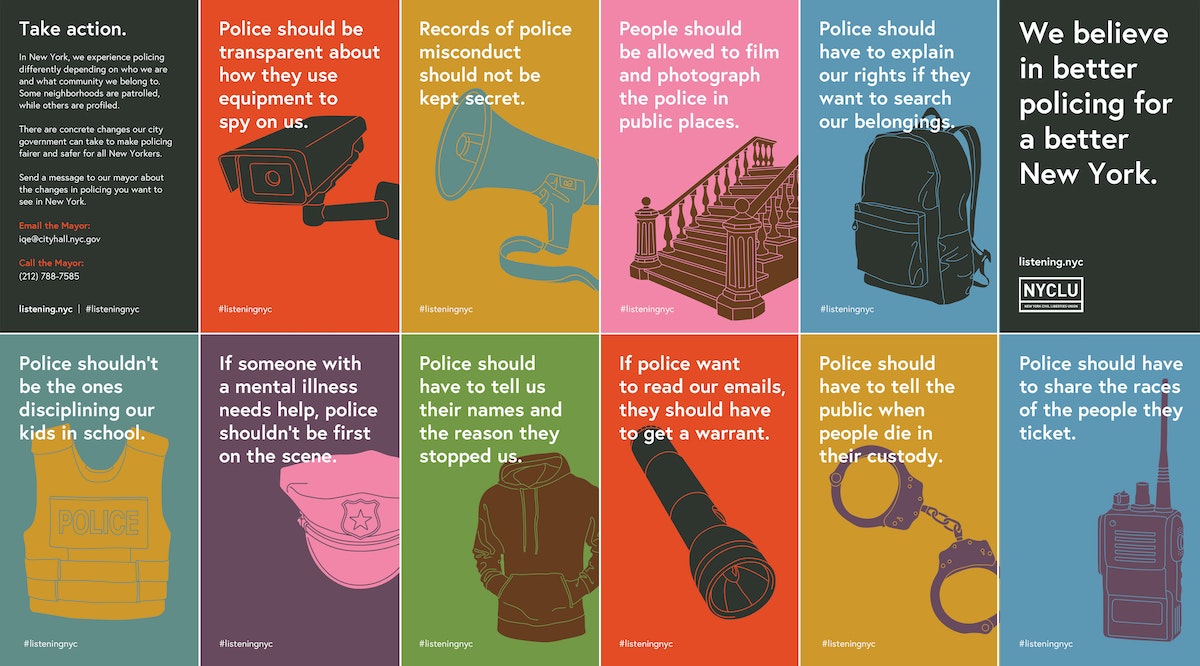
The NYCLU has sent Conversation Cards to celebrities, influencers, and every member of the New York City Council. Sending postcards to Mayor de Blasio and Conversation Cards to the city council led directly to passage of the Right to Know Act—legislation that incorporates some of the NYCLU’s proposals for police reform.
Today, the impact of Listening NYC has moved beyond city limits. The NYCLU’s Syracuse chapter is introducing the pop-up installation there, while in Boston, mayoral candidate Tito Jackson even promised a visit from the Listening Room if elected. To keep dialogue flowing, the ACLU plans to distribute Conversation Cards nationwide.
Driving growth at Europe’s largest online fashion retailer
How Zalando redesigned the way it works and saw profits soar.
Fashion thrives on reinvention. Now, digital platforms and tools are reinventing fashion. E-commerce has reshaped the shopping experience and social media has democratized the once-exclusive industry.
Amidst this furious whirl of change, the fashion platform Zalando, founded in 2008, has become one of Europe’s fastest-growing tech companies. Headcount has ballooned to 15,000 and revenues grew 23 percent year over year. More than €1 out of every €100 spent on clothing in Europe is spent at Zalando.
In 2014, Zalando’s co-founder and CEO Robert Gentz approached IDEO to help think about the organization’s future in the face of increasing competition. Gentz realized that building design thinking capabilities across the company would allow Zalando to make systemic business shifts, like building better experiences for customers, and balancing operational excellence and execution with innovation.
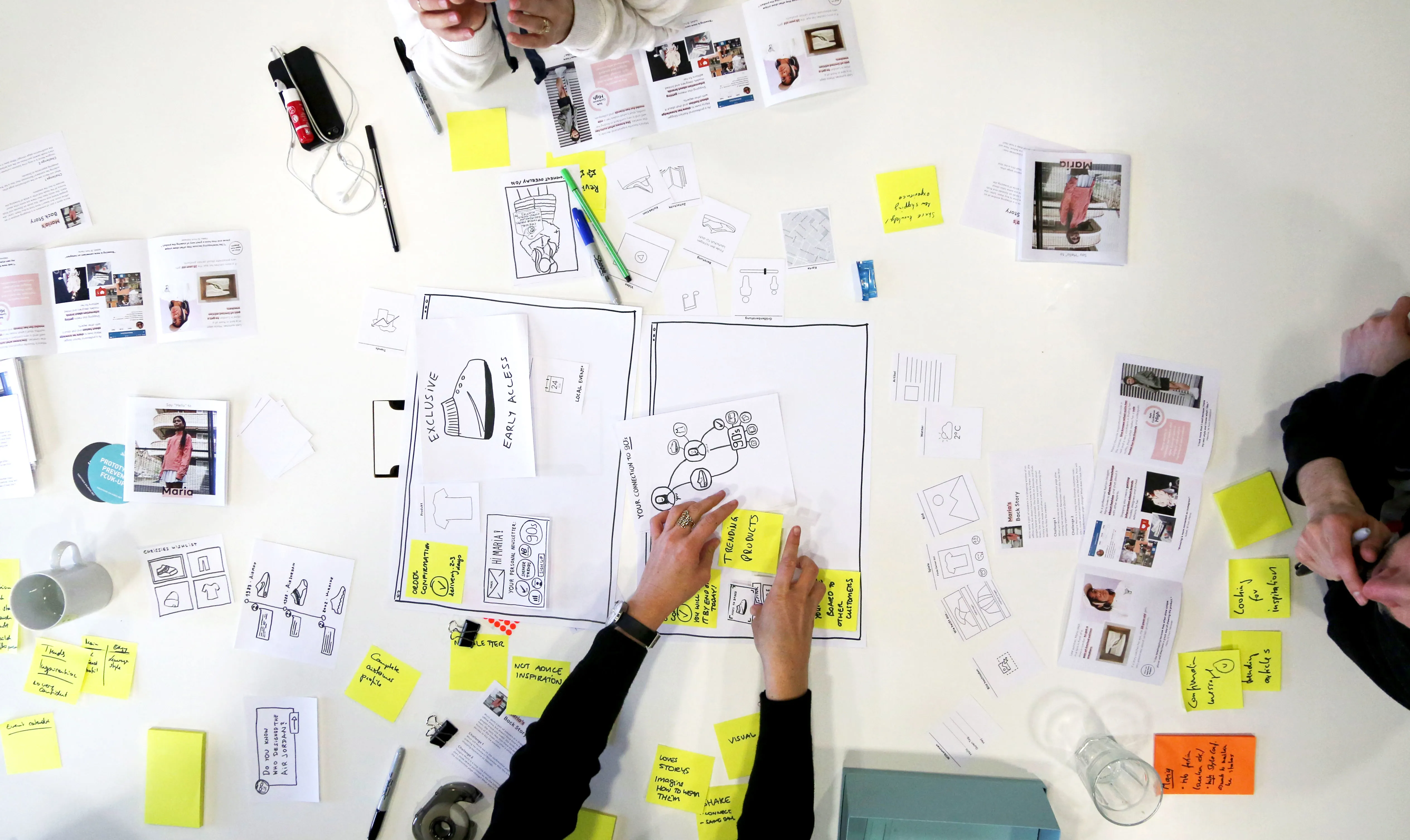
So, he invited a team of IDEO designers and Zalando employees to create an innovation lab in its Berlin headquarters. They called it The Studio, and in the three years since its launch, it has helped the company build new products, experiences, and modes of working that are powering a digital transformation across Zalando and in the broader fashion world.
Finding purpose
Gentz came to IDEO with a simple request: “I want my daughter to be proud of the company I created.” With that directive, the first order of business was to home in on the organization’s new strategy—to shift from an e-tailer to a full-blown fashion platform—and resurface purpose. After a series of interviews and workshops across the company, a unifying intent emerged:
Zalando exists to reimagine fashion, for the good of all.
To share that message, the team designed a five-day Festival of Purpose at the company’s Berlin headquarters and satellite locations, coupled with a long-term plan to help leaders and their teams weave that sense of purpose into everything they do.
WATCH: Learn how Zalando used purpose to mobilize its community
Building Innovation Capacity
With a shared purpose to rally around, Zalando started to design and build at a clip. The Studio experimented and prototyped, launching products like Seen At, a mobile app that allows members to upload street style photos, and a digital tool called Collabary that connects online fashion influencers with brands. Projects are enabling cross-disciplinary teams to get into the practice of aligning around joint goals, making fast decisions, and building with agility.
But just as important as identifying growth opportunities for the company has been The Studio’s role as a hub. Zalando employees from across business units cycled into the Studio, teaching IDEOers about their business and the company’s culture, while IDEOers helped them master the design thinking process so they could lead future projects.
Studio graduates ensure that anything prototyped there is implemented, and integrate what they’ve learned into their day jobs. Their experience makes them design ambassadors who spread the practice of experimentation, prototyping, and storytelling across the organization.
WATCH: Learn how Zalando pioneered a new innovation studio
Teaching Leaders How to Scale Change
It’s one thing to start working differently in a small innovation lab, but how do you scale change across an organization and determine how it will affect each major business unit—product, technology, commercial, and logistics? IDEO interviewed Zalando employees to better understand how to embed what we called new Ways of Working (WoW), a method that combines design thinking with lean and agile approaches. WoW was then deployed by a centralized team that ran workshops and coaching sessions to help leaders adopt it, measure its impact through OKRs, KPIs, and NPSs, and help their teams understand the new processes.
Today, the Ways of Working method is being rolled out across the entire organization, reaching all 15,000 employees.
Together, the relationship between IDEO and Zalando and their multi-year project of change is spurring double-digit growth, and making good on the company’s vision of reimagining fashion, for the good of all.
WATCH: Learn how Zalando scaled new ways of working across their organization
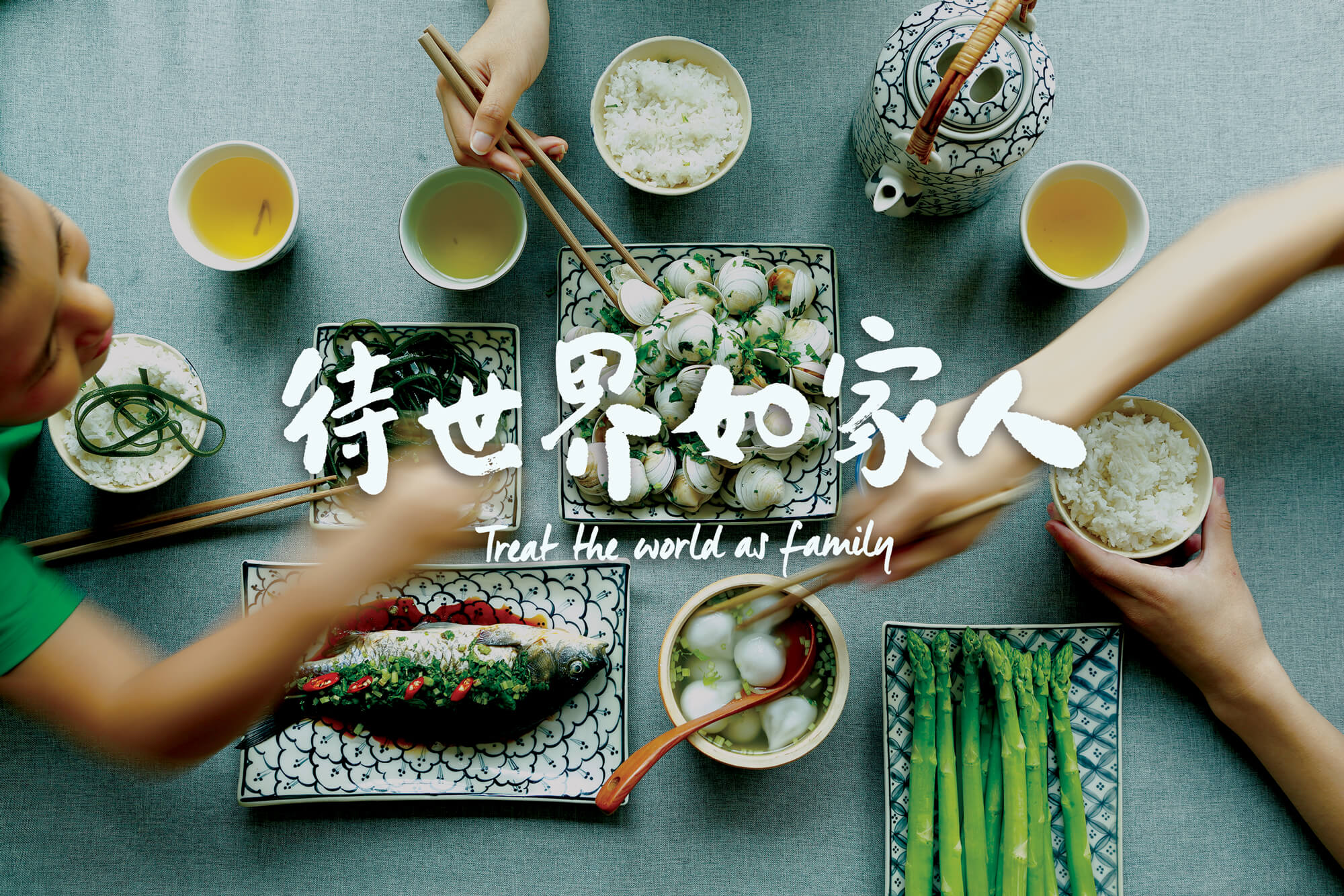
Elevating the craft of Chinese cuisine
Helping a packaged foods company in China define its purpose and take its place on the international stage.
IDEO helped position Shinho’s ingrained respect for food, family, and good health as a guiding principle for how the organization interacts with its employees and the wider world. The IDEO team integrated a new motto—“treat the world as family”—into every part of Shinho’s work, from sourcing and hiring to new ventures to the care employees take in handling each bottle of sauce destined for someone’s table.
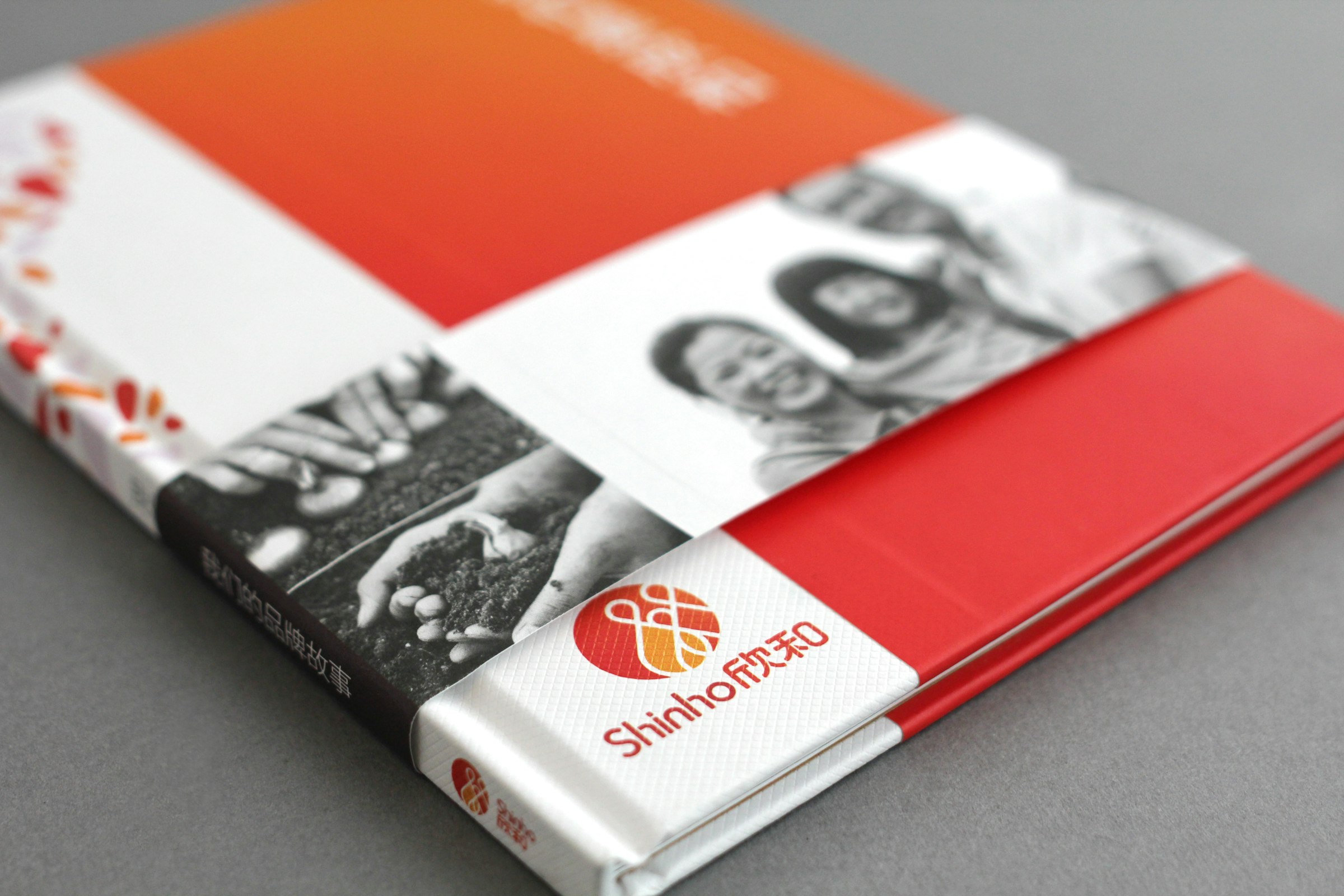
To help transform Shinho’s internal culture, the IDEO team also crafted a narrative to communicate the company’s beliefs to new staff and outside partners. The team expressed Shinho’s foundational story through a published brand book and film, reimagined logo, and codified employee values.
“My proudest moment was when we brought the brand identity IDEO developed to life, and interpreted Shinho’s mission and vision through that lens in front of 2,000 employees at our annual meeting,” said Hanzhong Dong, Shinho's Head of Product, “It made me feel that even though we’re a group of ordinary people, we’re working on a great and meaningful thing."
Shinho’s heightened confidence and focus on supporting families has empowered the company to expand beyond soy sauce and snacks and explore new offers, from culinary training to sustainable farming to food experiences.
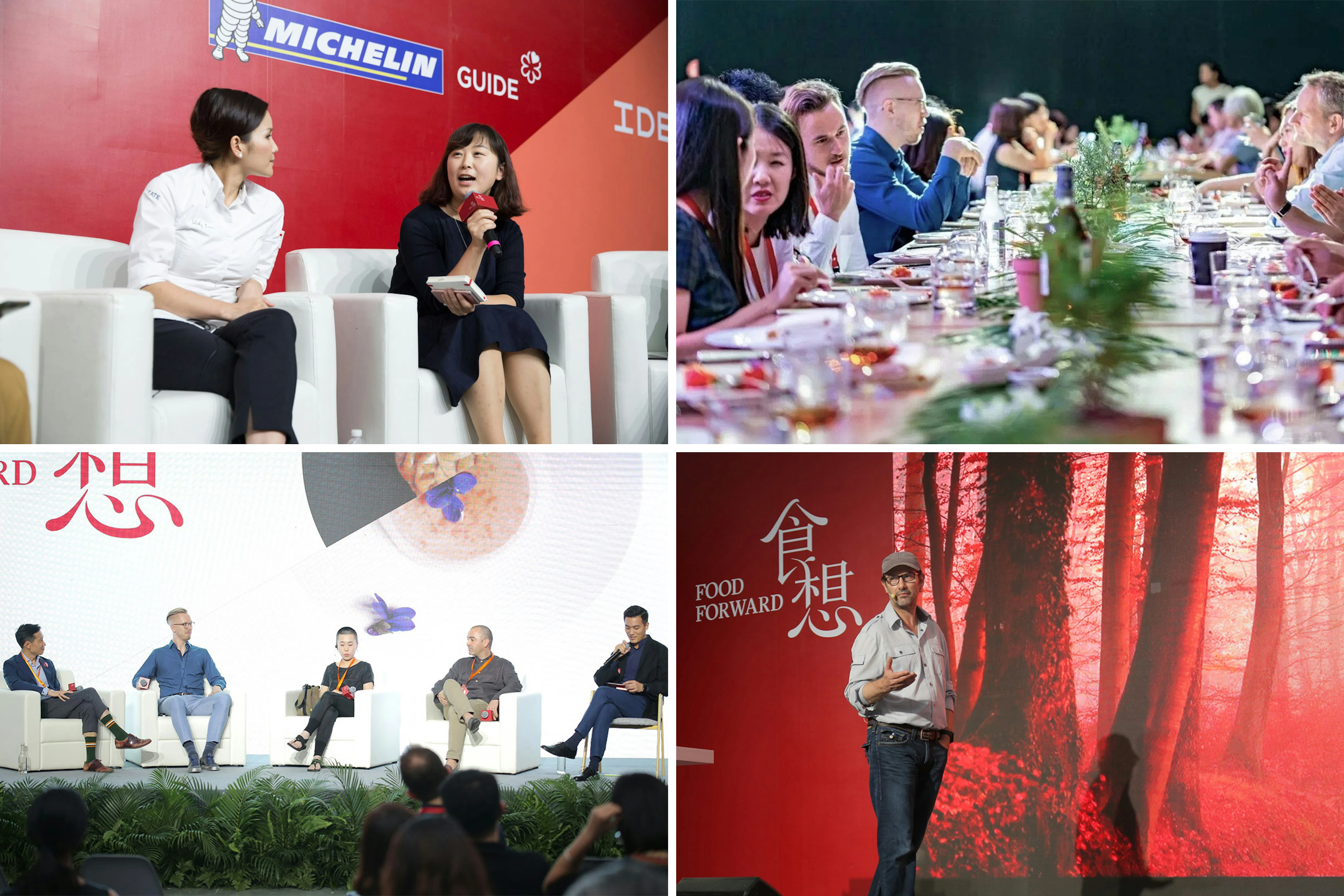
In July 2017, Shinho stepped onto the international stage as a tastemaker by participating in an event called Food Forward, hosted by the Michelin Guide and IDEO. Michelin-starred restaurants are synonymous with superb ingredients and service. Shinho crafts safe, organic, high-quality products that are staples for Chinese chefs, and the company shares the Michelin Guide’s aim to celebrate and expand the role of fine dining in China. IDEO brought all parties together with the shared goals of elevating China's culinary craft and culture, inspiring people around the future of food in China, and encouraging fruitful connections and partnerships.
IDEO and the Michelin Guide organized the day-long event, which included guest speakers, panel discussions, and tastings with four international, Michelin-starred restaurant chefs. Speakers and panelists discussed culinary education, inclusion, and the interplay between tradition and innovation in food. More than 200 people attended from across the food ecosystem: chefs, restaurateurs, journalists, investors, and educators. The event’s livestream garnered 30 million global views and 800,000 engagements.
Shinho’s products now reach 30 million families in 232 cities around the globe, driven by a cohesive mission and brand message. This kind of values-driven growth and hunger for new partnerships is setting the course for the future of food in China and throughout the region.
Despite the rapid growth of China's economy and increased access to a wider variety of food since the opening up, the market is saturated with unhealthy, processed snack foods. Consumers are increasingly seeking better-quality options, highlighting a significant gap in the food system.
30M families
purchase Shinho’s products
60 countries
around the globe offer Shinho products
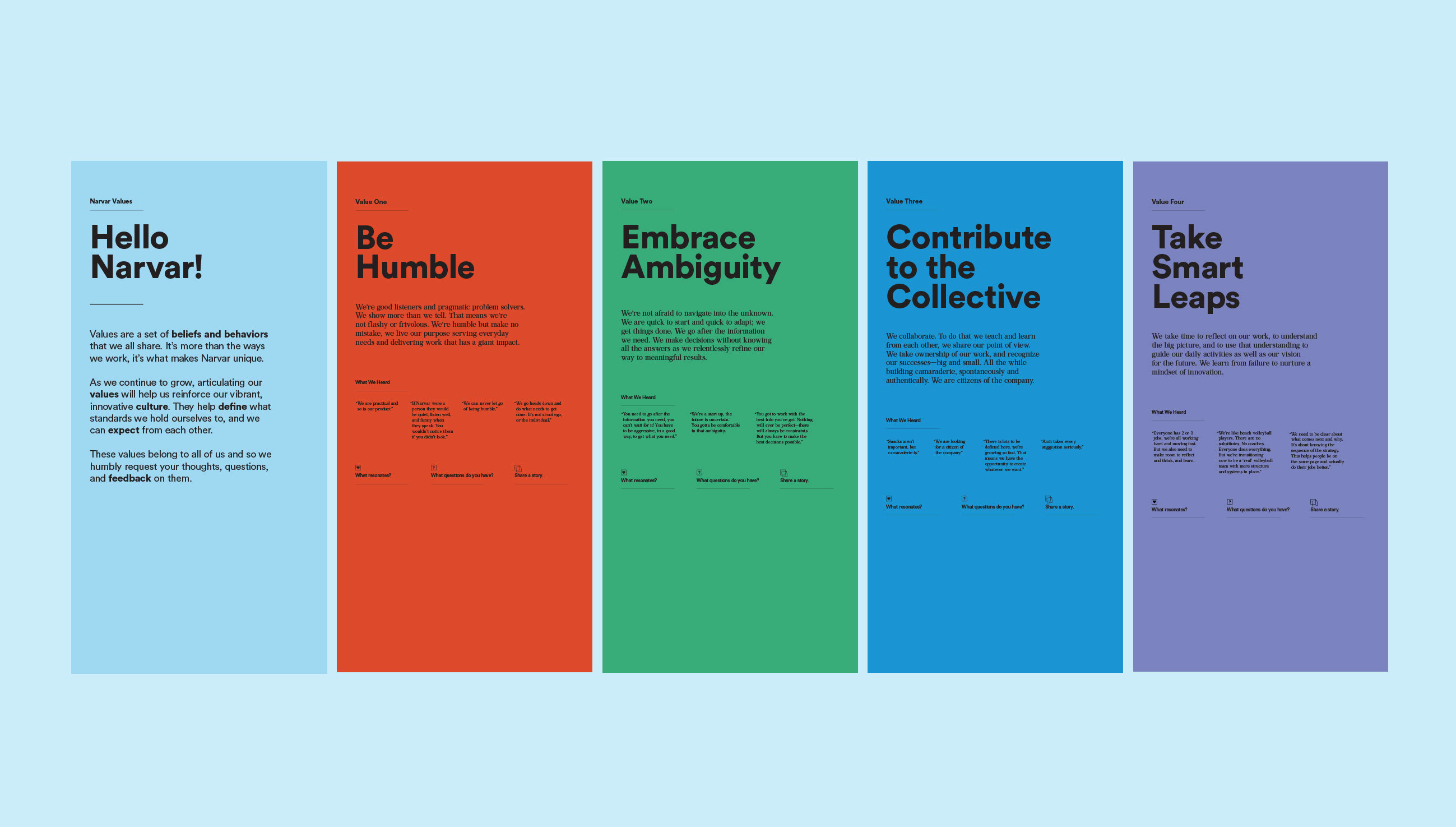
Defining values to set the stage for future growth
In helping a startup codify its values, IDEO prepared its team to scale—fast.
Narvar, a software-as-a-service startup that provides a post-purchase engagement platform for retail clients, was scaling fast. The company had grown from 20 to 90 employees, and was well on its way to reaching 300 over the next two years. As the company grew, its leaders wanted to make sure it could sustain its vibrant, innovative culture. Narvar came to IDEO for help identifying and defining its values in a way that would would scale with the organization.
For the IDEO team, that meant articulating a system of values that supported existing behavior, reflected the company’s aspirations, and aided in evaluating new talent and development. The team started by interviewing key “culture carriers,” from the CEO to new hires, to learn what makes Narvar special. Based on this research, the team crafted a working set of values, then invited the entire company to share their feedback. In doing this work, IDEO was also able to surface organizational issues and tensions within the company for Narvar leaders to address.
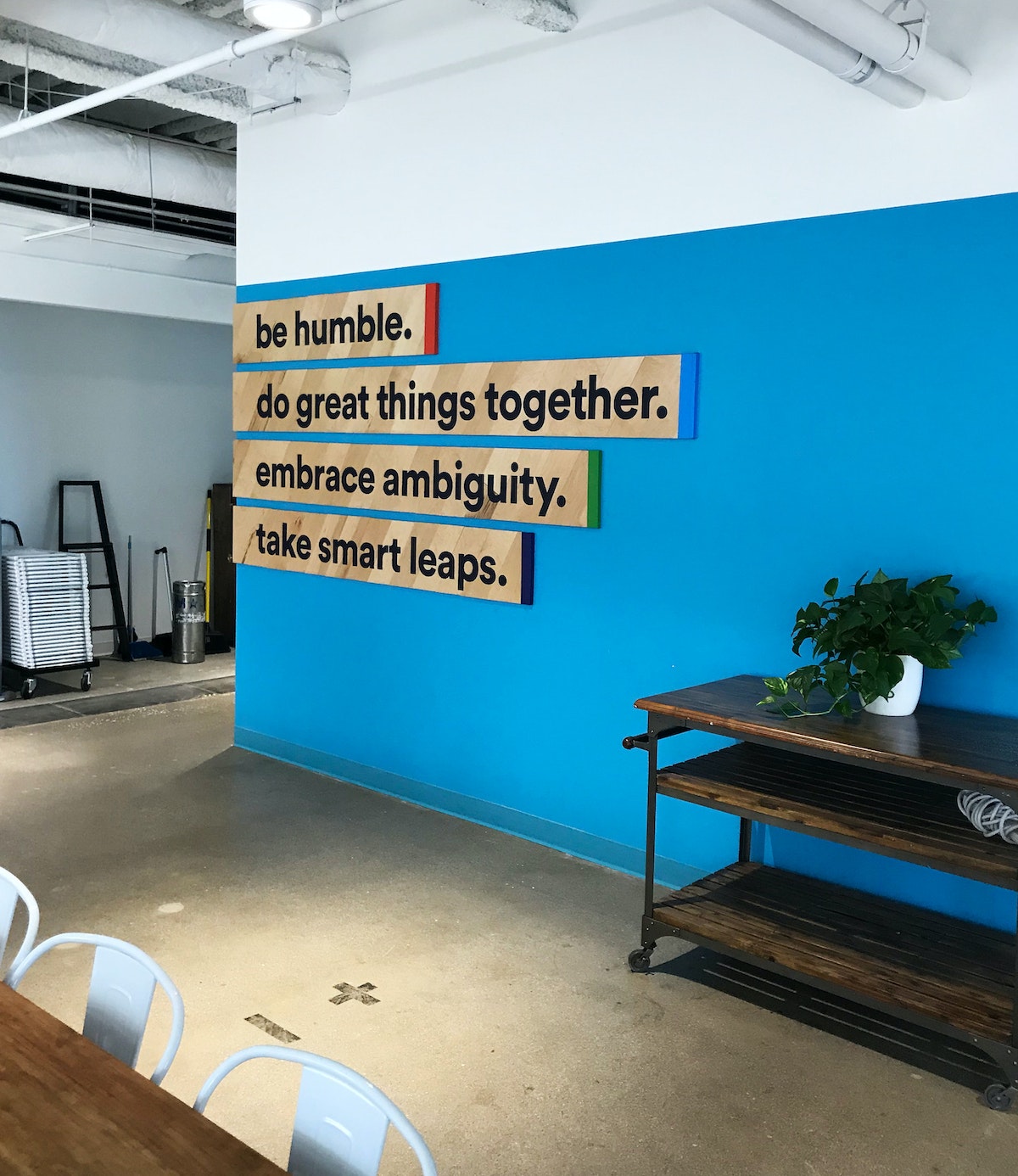
Now, Narvar lives its values every day. Team members use them during candidate interviews, employees see them daily on company walls, and managers reinforce them during performance reviews. Every quarter, leadership gives out a Narvar values award to reinforce their importance. Through this project, Narvar was able to not only capture its core values, but also use them as an active ingredient in the company’s growth.
“We engaged IDEO to really understand the challenges we faced as an organization, and IDEO helped us define and articulate our culture and values. I can honestly say that all the growth and success we’ve achieved in the past two years—we couldn’t have done that without the foundation from IDEO,” said Narvar CEO and founder Amit Sharma.
Build your creative confidence: 15 seconds of brilliance
Everyone is creative. This belief runs through everything we do at IDEO
Creative Confidence has inspired thousands of people to adopt a creative mindset and apply it to the diverse real-world challenges they face. In this series, we’ll share some exercises from the book that can help you approach your challenges from a new perspective.
Creativity Challenge # 2: Increase your creative output
Anyone who studies dreams will tell you that if you want to remember your dreams, you need a dream journal right beside the bed. The moment you wake up—whether it’s the middle of the night or in the morning—you should capture those dreams before they fade away. The same holds true with your waking “dreams,” your partially or fully formed ideas, your glimpses of possible futures. If you want to maximize your creative output, don’t rely on short-term memory.
Even if you never get to experience Andy Warhol’s fifteen minutes of fame, you’re likely to have your own moments of brilliance once in a while. When that happens, make an effort to capture those ideas right away, because your short-team memory only holds a thought for fifteen to thirty seconds. One simple way to have more ideas in your arsenal is to start keeping track of them as they occur.
Tool: 15 Seconds of Brilliance
Participants: This is a solo activity
Time: 10 minutes per day
Supplies: Paper and pen, or a digital means of keeping notes
Instructions
When you have an idea or observe something intriguing, take note of it. The actual means of capturing the idea doesn’t matter as much as having it with you at all times. Choose a method or a technology that fits with your lifestyle and your personality:
- Digital tools are great, but paper still works exceptionally well. I always have a pen and a simple folded piece of paper in my back pocket. I also keeps a small pad of paper on my bedside table, with a lighted pen that I can use to jot down an idea while reading or in the middle of the night without fear of waking up my wife.
- My brother David has a whiteboard marker in his shower, so he can write a passing idea before it disappears.
- IDEO partner Brendan Boyle has experimented with various forms of “idea wallets” designed specifically to record his thoughts.
- Mobile voice assistants will let you dictate a quick mental note.
- Your laptop or tablet has all kinds of notepad applications. But we think you’ll get more functionality out of purpose-built programs like Evernote, specifically designed to store such ideas.
So increase your odds in the war against lost ideas. You’ll be amazed at how many good ideas you end up with when you make an effort to jot down those sudden moments of insight. Our brains are constantly making connections and associations with other people, things, and ideas we come in contact with. Don’t let those serendipitous insights go to waste.
This post is the second in a series of exercises taken from Chapter 7 of Creative Confidence. Purchase the book for more on how to use creativity to solve problems. Read part one here.
Everyone is creative. This belief runs through everything we do at IDEO, and in 2013, it led my brother David and me to write a book that would help others—even those who don’t think of themselves as “creative types”—to unleash their creative potential.

4 models for handing off innovation projects
Tips to help you avoid the handoff trap
How do you prevent a handoff from becoming a drop-off? I recently wrote an article for Harvard Business Review that explores this very question. The following is an excerpt of that article.
How should you create a smoother handoff between teams? In short, you can avoid a drop-off by tailoring each handoff to the teams involved. In many companies, innovation teams tend to fall into three buckets: Explorers, Scalers, and Optimizers (with credit to Bud Caddell and Simon Wardley).
There are four basic models for the handoff, and dozens of hybrids. The right one for each part of your innovation portfolio will depend on how integrated your projects need to be with your core business.
1. The Owner’s Manual
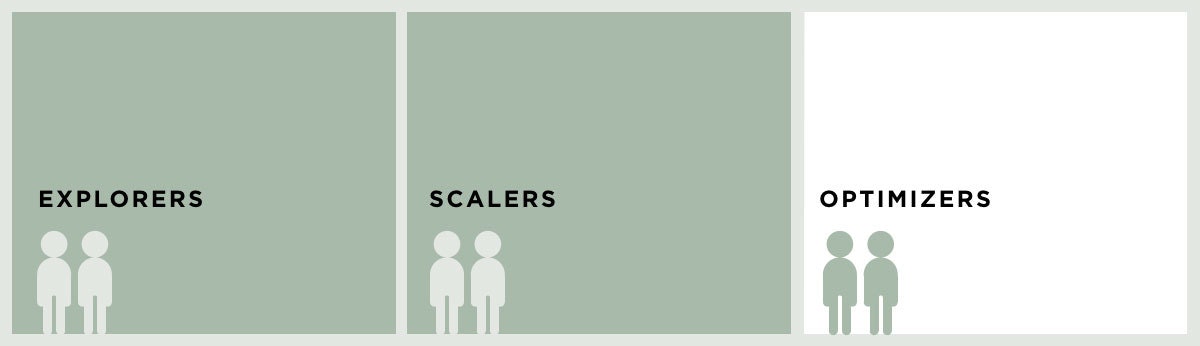
After months—sometimes years—of work, an innovation team extensively documents their work in hundreds of pages of slides, spreadsheets, and other files, and then hands all of that over to a new team to execute. When was the last time you read an Owner’s Manual? Exactly. The new team then risks moving on without absorbing the learning of their predecessors.
2. The Architect

The best way to avoid a drop-off is to eliminate the handoff. In this model, the future owner of the work embeds in the Explorer and Scaler teams. That person then acts as a connector, knowing all of the avenues already explored and all of the learning gained.
3. The Ambassadors
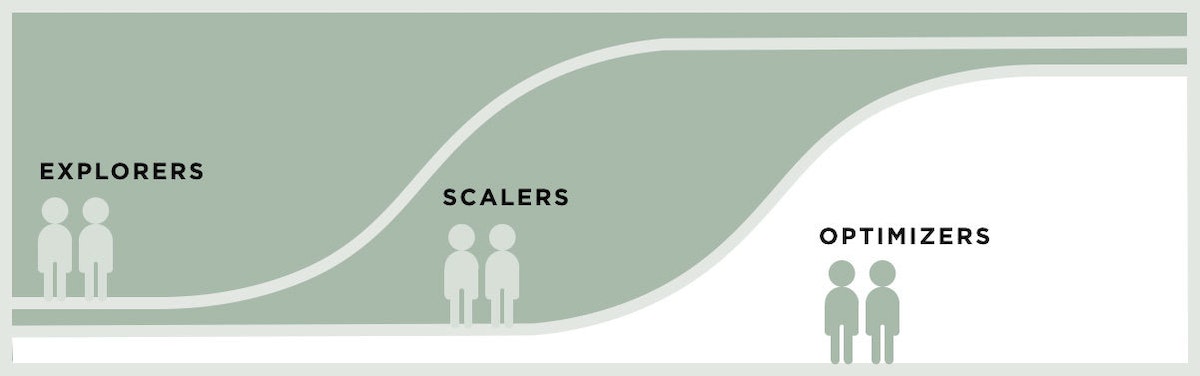
Similar to the previous model, in this model, members of the Explorer, Scaler, and Optimizer teams remain embedded in each phase of the project to ensure that no learning is lost and that each phase of work is designed to feed smoothly into the next. In addition, this model improves the future work of innovation teams by helping them build an awareness of what downstream teams need most.
4. The Hive
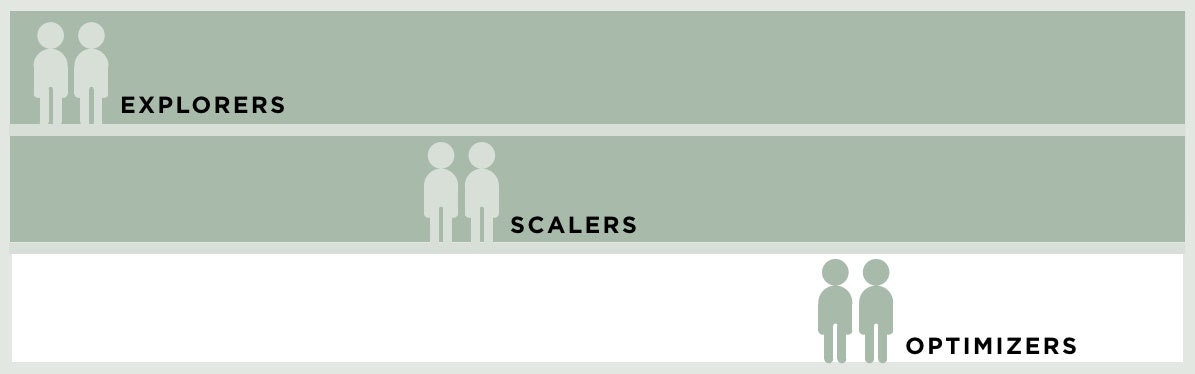
The difference here is that team members don't roll off the project—it remains a blended team from idea to implementation. This model improves the future work of innovation teams by helping them build an awareness of what downstream teams need most.
Want to dive deeper on innovation handoffs? Read my article in Harvard Business Review.
If innovation projects are going to succeed, they’ll need to survive a handoff from an innovation team to an execution team. And every time you create a handoff, you risk dropping the baton.

An IDEO Recruiter’s 5 Tips for Writing a Better Cover Letter
What we've learned from the best letters to come through IDEO
Practical is good. But when you are applying to your dream job, being practical is not enough. Cover letters may seem like an extra step, but for those of us on the other side, they’re a way to cut through the noise. I might see 300 applicants for a single job. A cover letter helps me understand the people behind these pieces of paper, and who might really make a difference in the role.
Maybe candidates feel too much pressure to write the perfect cover letter, so they skip it. To that I say, don’t let perfect be the enemy of great. And don’t miss an opportunity to show a company who you are and what you bring with you.
Here are five tips to help you write a compelling, well-crafted cover letter, with excerpts from real letters that helped IDEOers get in the door.
1. Explain why this position makes sense for you now in your career
If you’re shifting industries, or looking for a role with more responsibilities, your qualifications might not be obvious based on a resume or LinkedIn profile. Remember, this isn’t about selling yourself; this is about sharing yourself.
Here's a good example:
I am interested in the recruiting coordinator role because I believe that I have the best skillset and mindset to navigate the different elements of this position, and I am very interested in growing in a career in HR.
My experience in office coordination and operations management has taught me that my workplace passion is in people operations and support. My favorite phrase to dish out is, “Don’t worry about it, I got you.” My goal always is to set people — employees, visitors, friends, strangers — up for success. Whether that means labeling which drawer has paper clips and which has paper towels, or directing questions to people who have the answers, or ensuring that new hires have all they need and more waiting for them on their first day. I strive to be a bridge between teams to help members get what they need to get the job done well, and I am passionate about finding ways in which we can improve that entire interaction. I geek out over creating, improving, and discussing process and ways we can make interactions more human.

2. This is an introduction, not a manifesto
Aim for two paragraphs (if you end up with one or three it’s okay). There is no rule that says cover letters need to be lengthy to lend insight into your background and your interest in the role. On the flip side, the two sentences that state the obvious—you’re applying to such-and-such company and that you hope for an interview—aren’t really cover letters. If this is your go-to move, ask yourself why you’re applying to that role and if you are really interested in it or qualified for it? Because those are the same exact questions the recruiter is asking.
Here’s a pithy explanation of who a candidate is, and what she wants out of a career:
I’m half Scottish, half Chinese and have lived and worked across seven cities in three continents in the past 10 years. I have the unique ability to imagine the world from multiple perspectives. I’m a leader, a dot connector, and a storyteller. I’ve been looking for an opportunity that combines my unique interests in design research and education, and would look forward to hearing more about the team and projects and share how I can contribute.
3. Show some personality in your writing
Try to strike the right balance between being sincere and being authentic. A sincere cover letter gets the reaction, “Wow, they really mean everything they say.” An authentic cover letter gets the reaction, “Wow, they didn’t hold anything back.” Cover letters can have a blend of both—just remember that this is a first impression. When in doubt, stick with sincerity.
Here’s how one successful applicant explained his background, and his values:
So as I sit here in the airport terminal waiting to board, I wonder about the question of my own destination. After honing my expertise in insight-led branding, I want to bring it to a greater range of projects for a company that would allow me to make a positive difference in the world. I feel like my experience with junior designers, my advocacy for design as language, and my commitment to collaboration would help me to be an asset for a brand that shares these goals. After all, that’s what all of us are looking for, to invest our time in brands with which we share the same values.

4. Keep it focused
Sharing a portfolio or summary of past work is not the same as a cover letter. If you want to get visual with images, graphics, charts, and artwork that’s great, just make sure it is in service of communicating why this role, and why you.
This is the entirety of one successful cover letter:
I’m a scientist, a writer, an educator, an artist, and an avid autodidact. What makes me an effective educator is that I have a genuine and self-motivated thirst for learning and for sharing that information with others. My experiences create a design process that is equally as analytical as creative, as researched as inspired, and as concise as expressive. On my nightstand right now, I have The New York Times, Popular Mechanics, National Geographic, Rolling Stone, The Economist, and US! Weekly. It’s a mixed bag, but it’s the best way I can show you that very few things escape the reach of my curiosity. Welcome to my brain:
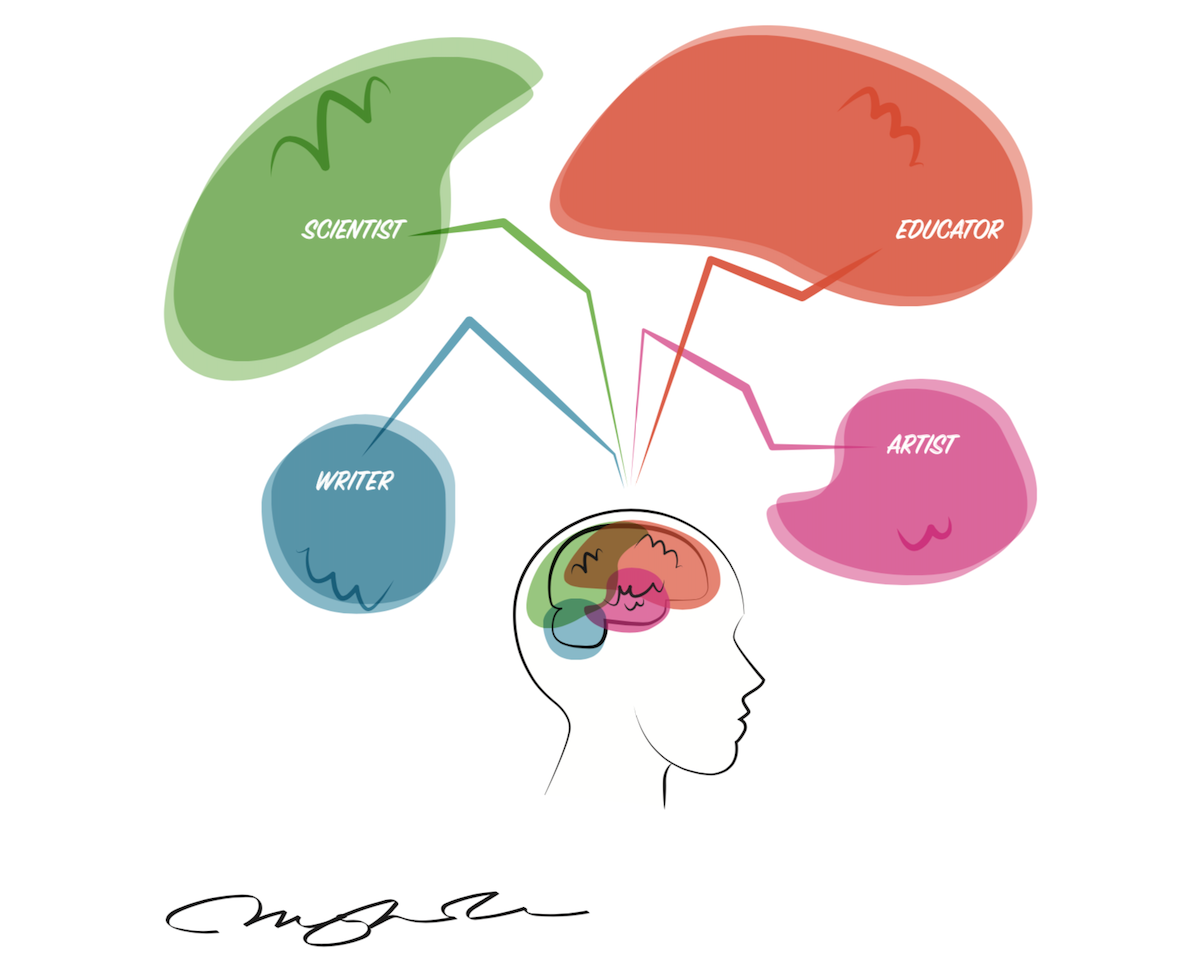
This image complemented the message of the above cover letter.
5. Address it to the correct company
Yes, this sounds basic, but—believe it or not—this mistake happens all the time. It’s perfectly normal to have a cover letter template you enjoy using—just make sure to tailor your cover letter to the role and organization. And always proofread. (For the companies and roles you’re most excited about, have two other people proofread.)
Here’s how one applicant showed us—in an opening sentence—that they knew a lot about IDEO and the work we do. (Creative Confidence is a book written by David and Tom Kelley, partners at IDEO).
Dear IDEO hiring team,
I put down Creative Confidence on a cold, March Toronto day with a profoundly different perspective on what it means to do meaningful work.
These are all important points to fold into your cover letter, but remember, what matters most is that you show a little personality. After all, we want to hire you, not your resume.
Let it be known, I love cover letters. For applicants, they’re the best way to express thoughtful excitement for a job. For recruiters like me, they’re the best way to learn about the motivations and aspirations behind an application. But much to my dismay, these days, there’s a common belief that cover letters are superfluous compared to the more practical resume or LinkedIn profile.
Build your creative confidence: Mindmaps
Actively engaging in exercises that foster divergent or unconventional thinking can encourage the generation of ideas. When you are searching for innovative solutions on your own, mindmaps can be a powerful way to come up with ideas or to gain clarity about a topic of exploration.
Creative Confidence has inspired thousands of people to adopt a creative mindset and apply it to the diverse real-world challenges they face. In this series, we’ll share some exercises from the book that can help you approach your challenges from a new perspective.
Creativity Challenge #1: Push yourself to think divergently and creatively
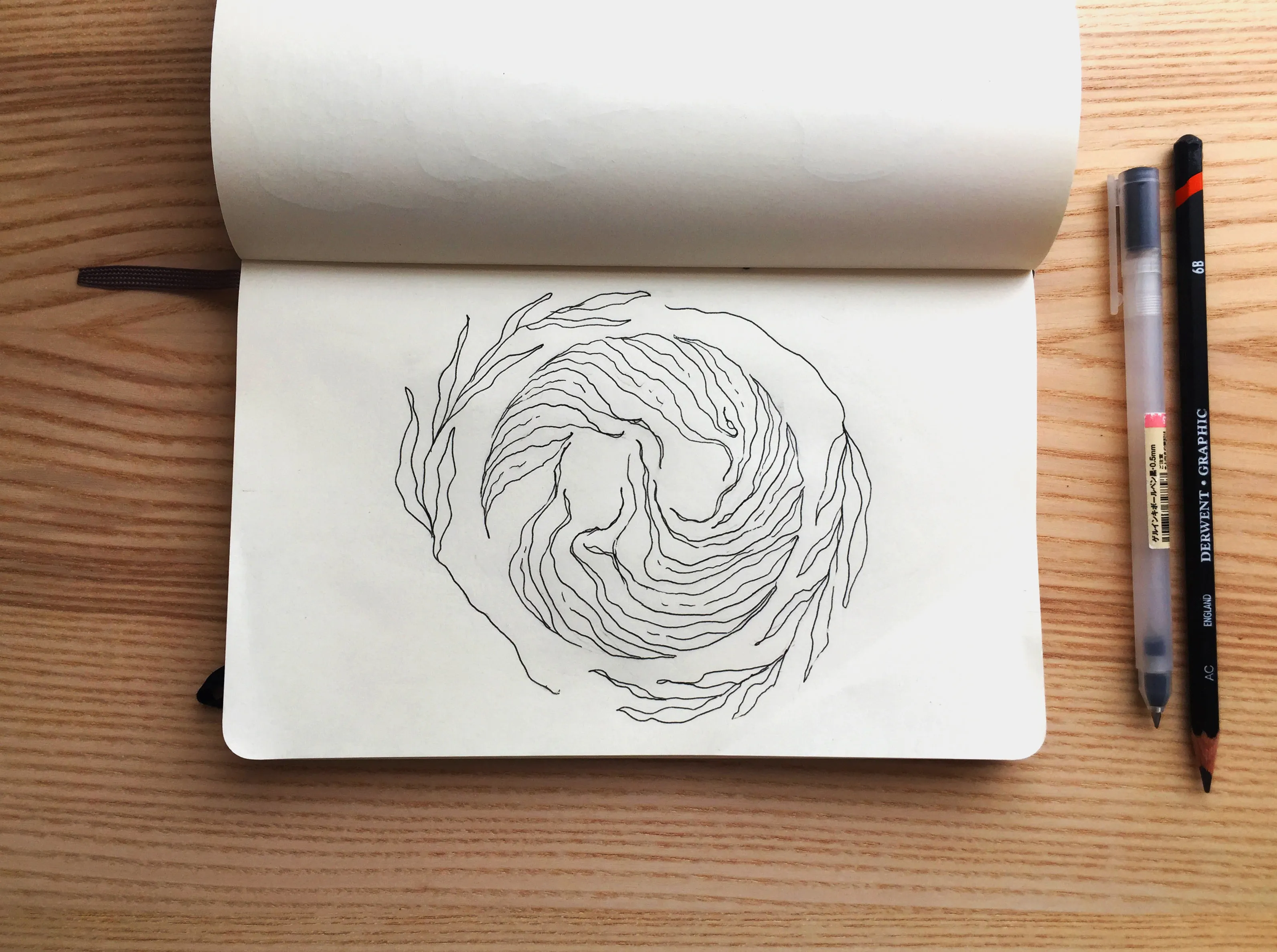
Actively engaging in exercises that foster divergent or unconventional thinking can encourage the generation of ideas. When you are searching for innovative solutions on your own, mindmaps can be a powerful way to come up with ideas or to gain clarity about a topic of exploration. They are extremely versatile, and we use them all the time. From coming up with ideas for a family vacation to identifying home projects to tackle over the weekend, mindmaps can be used for all sorts of problem solving. They help you chart the recesses of your mind surrounding one central idea. The further you get from the center of the map, the more hidden ideas you can uncover.
Tool: Mindmaps
Participants: This is usually a solo activity
Time: 15-60 minutes
Supplies: Paper (the bigger the better) and pen
Instructions
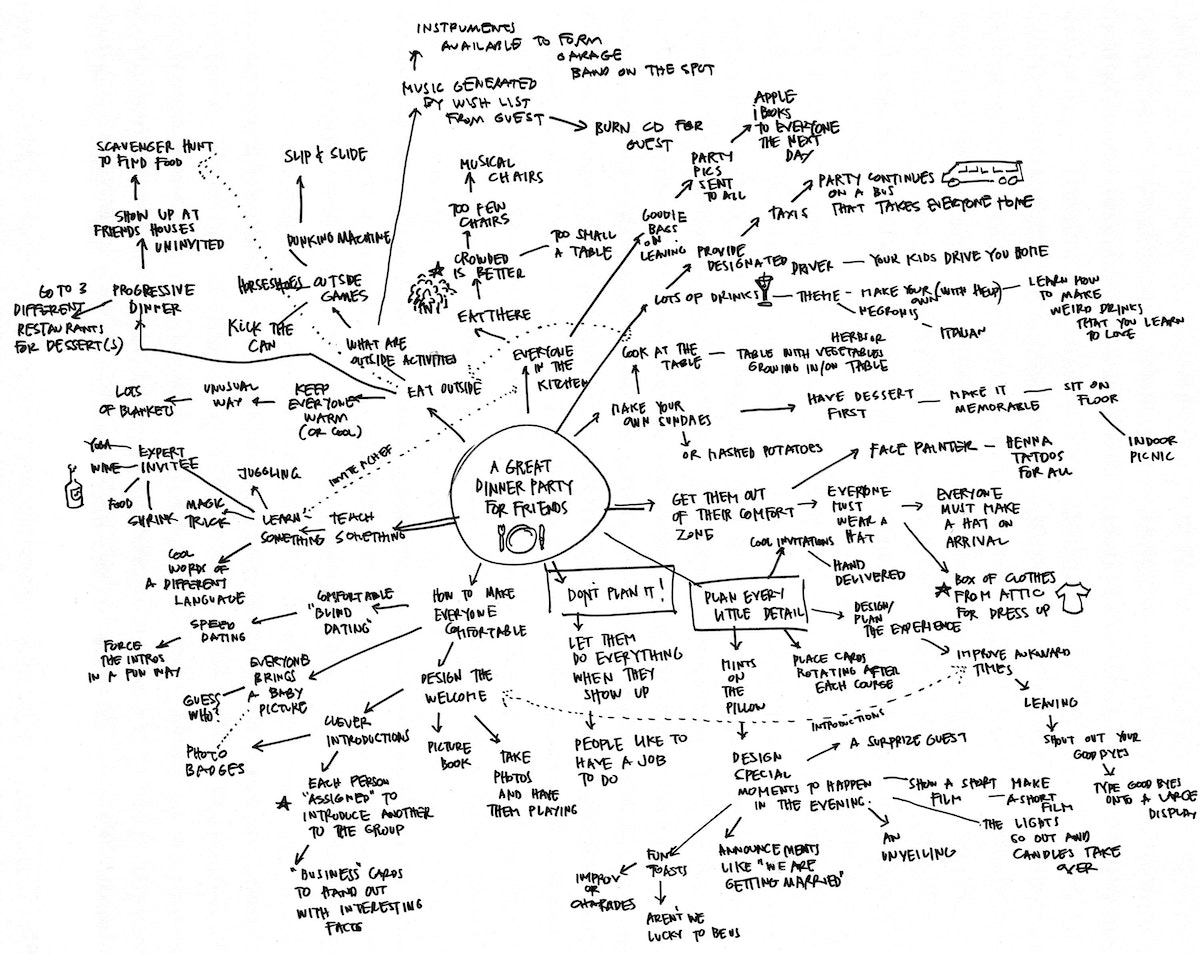
Step 1: On a large blank piece of paper, write your central topic or challenge in the middle of the paper and circle it. For example, you might write “A great dinner party for friends.”
Step 2: Make some connections to that main topic and write them down, branching out from the center as you go. Ask yourself, “What else can I add to the map that is related to this theme?” In the dinner party example, you might write down “everyone in the kitchen” and “make your own sundaes” as two avenues of thought. If you think one of your ideas will lead to a whole new cluster, draw a quick rectangle or oval around it to emphasize that it’s a hub.
Step 3: Use each connection to spur new ideas. For example, under “make your own sundaes,” you might write “have dessert first” or “cook at the table.”
Step 4: Keep going. You are done when the page fills or the ideas dwindle. If you are feeling warmed up but not finished, try to reframe the central topic and do another mindmap to get a fresh perspective. If you feel you’ve done enough, think about which ideas you would like to move forward with. After drawing the mindmap shown here, David threw a big dinner party in which guests changed tables after each course, enabling them to talk to everyone in the room. Each challenge presents an opportunity for innovation.
Tips from the field
Generally the first set of ideas that branch from the center will feel cliched or obvious. That happens to everyone. Those concepts were in your head and were just waiting to be captured on paper. As the map progresses, however, your mind will open up, and you’ll likely discover some wild, unpredictable, dissociative ideas.
As you experiment with mindmapping, you may find it valuable in all sorts of creative endeavors. As David’s former colleague Rolf Faste used to say, mindmapping can:
- Get you started and help you overcome your fear of the blank page.
- Help you look for patterns.
- Reveal the structure of a subject.
- Map your thought process and record the evolution of an idea. (You can trace it backwards later in search of new insights.)
- Communicate both the ideas and the processes to others, so that you can guide them on the same mental journey.
You may be wondering when a mindmap is better than an ordinary list. Lists are great at keeping track of things we don’t want to forget. But the to-do list assumes we know what we want to put on it, whereas, at the start of a mindmap, we don’t yet know where it’s going to lead us. Mindmaps are good at facilitating divergent or unconventional thinking; lists are good for capturing the best answers among the thoughts you already have. Mindmaps help to generate ideas. As such, mindmaps are particularly useful early in the creative process. Lists are better later on, when you want to capture the ideas you’ve generated and are looking for a best solution to pursue. Each of the chapters of Creative Confidence started as a mindmap. Later they evolved into lists of stories and ideas that we wanted to weave together. When you are trying to create something new, use mindmaps to generate ideas and lists to capture the best ones. Together, they can be a powerful combination.
This post is the first in a series of exercises taken from Chapter 7 of . Purchase the book for more on how to use creativity to solve problems.
Everyone is creative. This belief runs through everything we do at IDEO, and in 2013, it led my brother David and me to write a book that would help others—even those who don’t think of themselves as “creative types”—to unleash their creative potential.

Lindsey Turner
I’m passionate about building brands, products, and experiences that help organizations show up with meaning and momentum.
I help organizations cut through complexity by shaping how they show up, through brand strategy, identity, and storytelling.
Working at the intersection of brand and business, I bring an editorial eye and a bias toward making—turning ideas into tangible experiences that people can understand, trust, and believe in.
My work spans government, healthcare, financial services, media, and consumer goods, from launching Gen Z-focused ventures to building innovation labs and reimagining legacy brands. I relish moments of ambiguity and enjoy translating across teams, perspectives, and priorities to move ideas forward.
I started my career in editorial and digital design, shaping cross-platform experiences and identity systems in publishing and agency environments. That foundation still shapes how I work today: I’m detail-oriented, collaborative, and overreliant on the Oxford comma. I hold a BFA in Visual Communication from the School of the Art Institute of Chicago.

Rachel Young
My work helps organizations see who their products aren't working for—and build the will and the tools to do something about it
For 25 years, I've asked the same question: Who does this design exclude—and what are we going to do about it?
My work spans human-centered strategy, inclusive design, and qualitative research, with clients ranging from Microsoft, Google, and Verizon to the National Science Foundation, and San Francisco Unified School District.
Before IDEO, I taught elementary school in East Palo Alto and spent a decade doing design work with social service organizations—where I learned firsthand what it costs people when systems are built without them in mind.
I am currently writing User Error, a nonfiction book about digital access and the design decisions behind it. I live in Oakland, California.

Brian Pelsoh
I lead with craft, ensuring our work is creatively excellent: rooted in deep human insight and imagination, while also grounded in the realities of business and technology.
My expertise spans brand, communication, and product design across tech, education, the arts, and social impact.
I believe great work demands both high-level vision and obsessive attention to detail, and only happens through collaboration.
I bring an inclusive, hands-on approach and a deep understanding of business, which enables me to consistently deliver excellence while always asking why.
Before joining IDEO, I worked at the brand firms Pentagram and VSA Partners. I began my career as a designer, leading teams at the School of the Art Institute of Chicago and the Milwaukee Art Museum. I hold an MFA in graphic design from Maryland Institute College of Art and a BFA in communication design from the Milwaukee Institute of Art & Design, and have taught at some of the best design schools in the US.

Tony Wong
I am responsible for IDEO’s long-term success in China and working with clients to use design as a tool to enable growth.
I am responsible for IDEO’s long-term success in China and working with clients to use design as a tool to enable growth. Specifically, I have helped Chinese companies design holistic brand solutions through the development of their products, communication, services, and innovation teams, and I have helped multinationals expand their presence and influence in China.
I advise global leaders on developing China-led innovation and capabilities.
In over 15 years in IDEO Shanghai, I have worked on projects that use design to elevate the quality of the experience of healthcare products and services, streamline processes that increase productivity, create spaces and programs that promote and enable inclusive communities, and build next generation mobility solutions that are planet-positive.
Before joining IDEO, I worked at Philips Electronics and the Electrolux Group in Italy, the Netherlands, and Singapore on a number of breakthrough commercial products. I am a member of the Young President Organization in Shanghai.

How to use AI as an editor, not a writer
Ed White shares how he uses AI as an editor—not a writer—to sharpen storytelling, rehearse ideas, and preserve the productive friction that makes creative work better.
Ed White has a rule he's tested on his own writing: hold yourself as the writer, and let AI be your editor. Ed is a Senior Design Director at IDEO's London studio, where he co-leads the firm's AI portfolio across Europe. Before IDEO, he spent 12 years as a writer and editor at the Financial Times, Wired, and Contagious. So when he talks about when to use AI for storytelling and when not to, it comes from two decades of crafting his storytelling skills.
In this episode, Mina Seetharaman talks with Ed about two specific tools he uses to keep AI in an editor's seat: a "roasting agent" prompted to critique his drafts without any sugarcoating, and a simulated audience he rehearses pitches on before the real thing. They also get into what Ed is hearing from design leaders at Anthropic, Lovable, Shopify, and Google Creative Lab about how creative work is changing, and why he thinks the friction of writing something yourself is worth protecting rather than automating away.

Building a personal AI for the messiness of life: Sida Li
Becca Carroll talks with Cue co-founder Sida Li about designing a personal AI for the messiness of everyday life—not just work. They explore how Sida stays anchored to human needs while navigating fast-changing technology, product tradeoffs, business-model experimentation, and the realities of building an AI company today.
Most AI products today are built for work—a space with clear problems and established systems. One founder noticed a gap: personal life is messier, harder to systematize, and mostly left behind by the AI boom. So she built Cue, a personal AI that lives inside iMessage and group chats, to go where the other tools haven't.
In this episode, Becca Carroll, IDEO's Chief Strategy Officer, talks with Sida Li, co-founder and CEO of Shared Context Lab, about staying anchored to a human need while the technology around her keeps changing shape, why she treats her business model with the same rigor she'd bring to a product, and what it feels like to build a company at this particular, disorienting moment in AI.
The conversation also gets into how Sida makes design decisions: the language Cue uses to describe itself, the tradeoffs behind building inside iMessage instead of a new app, and a real story about a business idea that didn’t pan out.
This is the second in a two-part series profiling founders from IDEO's Startups-in-Residence program. The first conversation is with Johannes Seemann, founder of Sooner, on designing GenAI for the emotional side of money.

Designing GenAI for the emotional side of money: Johannes Seemann
Designing financial tools around the feelings that shape money decisions.
Most personal financial tools are built to run the numbers and optimize towards a budget. While that works for some, most people experience money as a lived relationship that does not neatly fit into a spreadsheet. Johannes Seemann and Becca Carroll discuss why money is emotional before it is mathematical, and what a human-centered approach to building a generative AI financial product looks like in practice.

The curious leader's edge in uncertainty: Scott Shigeoka
How genuine curiosity helps leaders navigate uncertainty with greater confidence.
Mina Seetharaman talks with Scott Shigeoka, author of Seek and Head of Curiosity Cultivation at the Eames Institute, about what distinguishes genuinely curious leadership from performative curiosity, how power dynamics shape curiosity, and why practicing curiosity can restore energy rather than drain it.
Looks like you might be in search of something very specific?
Or reset the filters above and try another angle.
Here’s some random inspiration

Podcasts about creative leadership

Articles about the power of prototyping