
.svg)


Climate action for SMBs
Leveraging data to help SMBs reach net zero.
For more than 40 years, Sage has helped businesses of all sizes navigate complex business environments. While many of its larger customers have the means and the structure to support climate initiatives, many of its smaller customers do not.
Sage wanted to help its SMB customers get ahead of future climate regulations and meet consumer expectations. And building carbon-footprint evaluation and mitigation tools would also dovetail nicely with Sage’s own climate aspirations: cutting its own emissions in half by 2030. Together, Sage and IDEO investigated how the company could leverage the data in its platform to calculate its customers’ emissions, both direct and indirect, and how that information could spur action as they aim to hit net zero.
To get started, the design team went deep with customers running all kinds of businesses—from a taxi company to a champagne bar to a falconry center. Business owners shared that their focus often has to be on the day-to-day, a series of small decisions that, when added together, lead to business success. For many, tackling a problem as complex as climate change felt overwhelming. IDEO and Sage synthesized those insights and began working across verticals and products, bringing together experts from marketing, technology, sustainability, and operations to build out new concepts. With the help of two carbon accountants, the team worked to figure out how existing data could inform customers about both their direct and indirect emissions, which can be harder to track. Given how tight SMBs’ margins are, they focused on how that knowledge could fuel emissions-cutting changes that also save money, giving businesses extra incentive to take action. Together, the team created a roadmap of customer outcomes and experience guidelines to help shape future products.
Sage has taken that work forward, launching Sage Earth, a platform that aims to help businesses measure, manage, and mitigate emissions—even across supply chains. With carbon accounting now built directly into all Sage Accounting and Sage for Accountants products in the UK, Sage has made climate action practical and accessible for millions of SMBs. By automating emissions measurement and reporting, Sage Earth removes barriers of cost and complexity, empowering business owners and their accountants to stay competitive in supply chains where up to 95 percent of emissions occur.
From co-developing the UK Voluntary SME Carbon Reporting Standard to launching a Carbon Accounting API, which gives banks, fintechs, and other platforms access to Sage’s Carbon Engine, Sage is embedding sustainability into the systems people already trust—helping hundreds of thousands (and rapidly increasing) small businesses turn climate ambition into everyday action.
Small- and medium-sized businesses—companies with fewer than 500 employees—make up about 90% of the world’s businesses, according to U.N.-backed SME Climate Hub.
Two thirds of small businesses don’t know how they’re going to reach net zero, and lack the resources to do so, according to a recent survey by SME Climate Hub. Still, the majority reported they want to act on climate, recognizing it can help them become a more resilient business.
Large companies may be the biggest emitters of greenhouse gasses, but an estimated 80% of those emissions come from supply chains—often made up of smaller enterprises.
Scaling rapidly
in the three years since the launch of Sage Earth, which is now being used by hundreds of thousands of businesses
World's 1st
open-source hybrid emissions factors dataset, Carbon Commons, led by Sage, helps SMBs calculate carbon footprints using existing data

Reframing menopause
QVC works to change the narrative, while meeting customer needs.
Menopause is much more than a biological transition—it is a profound shift that often arrives just when people experiencing it start to feel invisible. Because it has long been shrouded in darkness as an unmentionable female affliction, those going through menopause often feel unprepared and alone.
Recognizing that its customer demographic makes QVC uniquely positioned to surface conversations and provide support to those dealing with menopause, the video commerce retailer partnered with IDEO to figure out how it could not only meet customer needs, but also flip the conversation on midlife. To learn more, a team of female design researchers held in-depth interviews with folks experiencing it firsthand. The people they spoke to had limited information about what was going on with their bodies, and in some cases, it took years before they understood that symptoms they were experiencing were related to menopause. Respondents also reported that midlife brought a change in social status and the feeling of being boxed in by stereotypes.
QVC and IDEO worked together to design an integrated suite of offerings that could give customers a safe space to discover and share more about menopause. That included an on-air programming series called “Menopause Your Way,” where QVC could support those going through menopause in the privacy of their own homes, a digital landing page with useful solutions, and social media campaigns to help women share and learn more about each others’ experiences. Because people experience menopause and choose to manage it in many different ways, the team wanted to create an integrated ecosystem of content that women could access according to their unique journeys. The new offering helped QVC reach its core audience with solutions and relevant products, and created a space where menopause is out in the open and part of an ongoing conversation. And in the process, QVC evolved to become a more customer-centric company, putting its audience and their needs at the heart of its offerings.
9/10 of British menopausal women say society and brands overlook them.
1 in 2 women in the UK admitted they didn’t know what was happening to them during perimenopause.
Nearly 40% of menopausal women are being prescribed antidepressants to help manage their symptoms, despite 4 out of 5 describing the treatment as “inappropriate.”
Season 2
a series focused on menopause is now in its second season

Healthy youth
Improving digital tools to help practitioners deliver critical mental health support to children and young people.
Healthcare is a complex web of institutions, interaction, relationships, and services. In England, the National Health Service consists of thousands of separate organizations spread across the country. This fragmented structure means that rolling out digital tools and using them to their full potential can be difficult.
NHSX approached IDEO and Public Digital, IDEO’s sister company, for help designing user-centered resources that would empower Children and Young People’s Mental Health (CYPMH) practitioners to use digital tools more effectively, shifting service design from a reactive to a proactive process, and allowing each regional organization to create the best digital services for their children and young people.

The team took a human-centered approach, tapping into the perspectives, challenges and needs of NHS practitioners and leaders across the system over months of research. They then designed a set of accessible, straightforward online resources, courses, and templates that would enable a practitioner to start their own local service transformations. These included everything from practical advice on improving users’ experiences of CYPMH, to teaching methods for service design, to content focused on achieving digital transformation at scale.
The resources were easy to implement and replicate, allowing mental health practitioners across the country to seamlessly integrate physical and digital, create firebreaks in the system, and better bridge the gap between seeking care and receiving it. They were designed to evolve over time, and the work is replicable across the NHS, with the potential to touch millions of lives.
By empowering practitioners to utilize these digital tools to ease the burden of care, NHSX plans to create a positive ripple effect across the entire NHS, its partner organizations, and the country at large.
In a study undertaken in July 2020, the first summer of the COVID pandemic, the NHS found that clinically significant mental health conditions amongst children had risen by 50% compared to three years earlier.
More options, more access
digital resources are helping children and young people access more options for their mental health care

The future of air travel
Reinventing supersonic flight with Boom.
It’s not easy to shift the paradigm for an entire industry. But when a company comes along that promises to reinvent air travel, it opens up a blue sky of opportunities. That’s the flight path for Boom Supersonic, which is thinking big about how passengers arrive at their destination not only faster, but also with a greater sense of wellbeing.
To really comprehend the experience of flying in the unique contoured profile of this ultrafast jet, and to help Boom make key decisions about the design of the plane, the IDEO team believed that you had to go beyond algorithms and schematics—you needed to actually board it.
Using a “build-first” approach, the team quickly constructed a full-scale mockup of the fuselage from plywood and foam core. That became a prototyping platform to test multiple seating configurations, galley and lavatory size and placement, luggage storage solutions, and other concepts that would differentiate and add value to the passenger experience. For the first time, the Boom team was able to set foot in its own aircraft and truly understand the experience from the perspective of its clientele. The exercise allowed the Boom team to confidently make decisions by comparing multiple cabin configurations and options in full-scale.

Throughout the project, Boom and IDEO invited future travelers aboard to interact with the prototype and offer feedback. That input culminated in a more refined model, with augmented windows, moonroof, in-flight entertainment screens, and sound design—all further augmented by a Virtual Reality component to allow our future travelers to fully immerse in this new experience.
Together, Boom and IDEO brought a sneak peak to the Farnborough International Airshow, a biannual exhibition for the aerospace, aviation, and defense industries. The event was an opportunity to give the industry and potential customers a preview of Boom’s innovative new jet. In collaboration with the client, an exhibition architect, and a digital production agency, the team created an immersive environment designed to make the Overture experience feel tangible, eliciting the wonder of this revolutionary plane.
Boom’s presence at Farnborough not only underscored the Overture’s progress but provided an inspiring glimpse into the future of air travel. During the air show the company announced the production Overture design, a market-expanding alliance with Northrop Grumman, and agreements with tier one suppliers Collins Aerospace, Safran, and Eaton. Not long after, Boom received its largest order to date, this one from American Airlines.
The prospect of getting to London in time for dinner just got a little closer.
Boom plans for Overture to get from New York to Frankfurt in just over four hours instead of the eight hours spent on a commercial jet today.
The Overture supersonic jet has a cruising speed of Mach 1.7, about twice as fast as today’s commercial planes. Overture is built to fly on 100% sustainable aviation fuels (SAF).
20 Overture deposits
made by American Airlines, joining current customers United Airlines and Japan Airlines

28 things we’d love to redesign in 2024
From packaging to hold music to our relationship to time, we’ve got big ideas.
From the very, very big (our housing systems) to the very, very small (shower handle placement), our designers have a lot of thoughts about things they’d like to reimagine, if given the chance.
Here’s a look at what’s on their minds as we head into this new year.
PRODUCTS
- Why are shower handles directly in the blast zone of cold shower when you turn them on? —Conor Farese
- Can you imagine traveling by plane and needing to bring your own custom-sized seatbelt to carefully install in the cars you ride in? That’s essentially how we treat child car seats. It’s time to engineer a way to build them into cars. It’d be more sustainable, safe, and inclusive. —Rachel Young
- Clothes that shrink in the dryer because it's too cold outside or you don't have the space to hang dry them. WHY DO DRYERS STILL DAMAGE OUR CLOTHES? This may have just happened to me. —Alicia Duvall
- We need to redesign news around nuance and empathy instead of siloed points of view. —Sarah Asif
- Christmas trees! Not only are the needles impossible to keep up with, but there's still a pervasive myth that plastic trees are more environmentally friendly. Real Christmas trees are one of the best examples we have of capitalism working in favor of the environment. A big market creates demand for people to start tree farms, plant and sell trees, and repeat that cycle every year. If you have a plastic tree, keep it—but let's rebrand real Christmas trees as the environmentally responsible (and delicious-smelling) choice. —Becca Carroll
- Why do expensive, fancy face creams come in jars with hygiene and air seals that 10 percent of the product sticks to? I look at that cream stuck to the seal and see money, and then I either have to keep the weird seal and line it up to close the jar carefully, or scrape the cream off manually. Bleh. —Becca Carroll
- We have warming garments for everything but our mouths. This creates problems for the place I live, which is Massachusetts. Sometimes, in the winter, my mouth gets so cold and my jaw gets so tight it becomes hard to speak! A wintery vow of silence notwithstanding, I think we deserve socks for our tongues and warming pads for our cheeks. This would also prevent the tongue-on-frozen-pole problem that seems to have plagued humankind since we built metal poles. Lick all the poles you want! You’ve got a tongue sock! —Andy Reischling
- Paint samples. They should come in something more like a ketchup packet and less like a small can. —Rachel Young
- Repairs. Why does it require hours of Googling and watching shaky YouTube videos only to still get nowhere to learn how to fix your coffee machine or repair a hole in your clothes? —Anya Shapiro

SYSTEMS
- The American service industry, especially tipping culture. I’m newish to America and the idea of not paying people liveable wages is wild to me. I’d prefer if tax and tips were just included in the price of the service or meal. It’s also so hard to know what is appropriate to tip as the unwritten rules are different for taxis, takeaway food, a drink at a bar, dining at a restaurant, hairdressers, etc. Also, I don’t drink, and as soon as I ask for water only I seem to immediately put servers offside as drinks mean bigger tips. It makes for an uncomfortable dining experience. Surely we can design a way where people get paid fairly and customers have a pleasant experience without pressure. —Hannah Lewis
- How we reward and compensate people who make other work possible. Why does childcare cost more than college in 2/3 of states, and yet childcare workers make so little? Why does an IPO reward employees for the work they put in, but not the caregivers for their employees' families? Why can't we price and pay the true value of care work? —Becca Carroll
- Housing! Not only in the financial sense around the lack of affordability and equitable access, but also in terms of different models for home/land ownership. By rethinking both the architectural design of spaces and alternative financial/organizational structures, we can develop community-oriented, sustainable, and equitable housing models. Let’s learn from indigenous communities and cultures that prioritize multi-generational family systems. —Esha Reddy
- The cost of college. My 17 year-old daughter described the FAFSA application process as "Hunger Games for high school students" to become indentured servants of banks until they retire. —Vivian Barad
- The immigration and immigrant experience. Trying to obtain a visa, green card, or citizenship here is such a painful process. There are also so many restrictions that exclude noncitizens and visa holders from experiences like using investment platforms, participating in giveaways, going to school part-time, or doing contract work. —Deniz Cengiz
- Food systems! While there's often an emphasis on designing, buying, and receiving food as fast and easy as possible, I hope to see a world that prioritizes cooperative models: promoting direct, affordable access to fresh food while fostering sharing and more equitable distribution within communities. —Esha Reddy
- It boggles my mind that we have a set of broken systems that simultaneously create food deserts and massive amounts of food waste, just in different geographic locations. How have we not figured this out? With all of our resources and intelligence and technology in 2023, how is food insecurity still a thing? —Shannon Vossler

EXPERIENCES
- I would love to design a universal platform that lets patients and doctors simplify all the health insurance programs in the US. The interface and experience would be the same for everyone, no matter who their insurer may be or how their policies change, and would focus on radical ease. Let all the complexity of our healthcare system get sorted out by tech in the background. Sort of like how Square made payments so easy and unified for small businesses, there could be a way for people and providers to plug into just one insurance platform, so even when my plan changes, how I use it and get treated stays the same. —Ian Mathias
- Why is it that companies invest so much money in customer service and still play that horrid, staticky acoustic music that makes your phone speaker sound like it's an AM radio death rattle? Here's my idea: You still need a sign that you're on hold, so it can't be total silence, but why not experiment with different formats? What about a trivia quiz that moves you up in line the more you get right? What if you could connect your Spotify account and play your own hold music? What if you could do on-hold karaoke? So much of what passes for customer service is just what companies think is the blandest possible way to treat people. But by playing it so safe they create an experience that makes everyone equally miserable and bored. More courage, please! —Andy Reischling
- Public restrooms are unhygienic. Why does everything from door latches to paper towel dispensers require your hands or shitty sensors that don’t work? Our feet are awesome tools, and wildly under utilized in public spaces. My favorite: In the Charlotte airport, they have hand sensors for soap dispensers, but they all broke, so they’ve installed hand pump soap dispensers above the sinks. It takes most people 30-60 seconds to try all the automated dispensers before they notice the old school soap above. —Joe Brown
- Plus one to bathrooms, but more so thinking inclusivity: what does an actual great gender-neutral bathroom look and feel like? —Stuart Getty
- Performance management: Is anyone ever satisfied with a system of measuring human output? —Joe Brown
- Dying! But really, end-of-life care and advanced planning, especially for low-income folks and the sandwich generation who will care for their parents and younger generations. I've been an intermittent caregiver for a terminally ill parent this year and my goodness there are so many things I want to design to make this experience more human-centered, easier—and dare I say, joyful. —Jaz Henry
- The reboxing and the recycling experiences of physical products. And the whole recycling system. If we mean to live harmoniously alongside non-human life on this planet, we need to design better circular systems that help us use less raw material, and recycle what we've already made. —Conor Farese
- Breast cancer diagnosis and subsequent care, from the initial screenings and mammograms to sharing results, diagnoses, and treatments. I'd love to see a more holistic, human-centric approach to all cancers that doesn't require multiple systems working flawlessly in tandem to support individuals and their families in understanding and navigating a complex system. We need to design a system that helps ease the burden of those in medically vulnerable moments instead of leaving them with bureaucratic headaches. —Shannon Vossler
- Finding a therapist: Speaks for itself. —Anya Shapiro
- Ads (especially online). It is insane how many ads are shoved in our faces. —Deniz Cengiz
- Our relationship to time. We think in quarters, but organizations and people that will lead us into the next century will think in generations. Such deep time / long horizon thinking inevitably leads to new perspectives on consumption, (de)growth, and planet. For example: Norway's Minister for Future Generations, Patagonia's commitment to restore huge swaths of South America, hundreds of corporate net zero by 2050 plans, nations like Tuvalu that are planning to resettle populations sunk by the sea. It's why groups have been coming to IDEO for our futuring capabilities. —Natalia Vasquez
- I love running, a sport that seems super accessible—all you need are shoes. When in reality, those shoes are expensive. You also need time, a safe route, a secure starting and ending point that stores what you need before and after the run... not to mention the motivation, accountability, and education to make it habit. —Melissa Lobato
When you spend your life rethinking the built world, discovering things you’d love to overhaul is an occupational hazard.

Our toy Inventors share their 18 top picks for 2023
Toys and games designed for kids, and kids at heart.
Fortunately, IDEO’s Play Lab is filled with toy inventors, game designers, and tech wizards for whom play is a day job.
Here is our list of faves, for everyone from the littlest kids to kids at heart. Trust us and ready to shop? Here’s where you can buy them all. (Please note that IDEO makes a commission off of affiliate links.)
Snap Ships By PlayMonster
This has been my son's most-used toy for years! Each box comes with a bunch of modular pieces you can use to build all sorts of cool ships and mechs, plus minifigures to act out story play. There are 23 sets and we have them all! Now that he's older, he spends a lot of time building LEGO, but he still plays with his Snap Ships (which are much cheaper). His younger brother also loves them and has become an expert builder!
Who will love it: Kids who love building. It says it's for ages 8+, but my 3-and 6-year-old boys love these things!
—Josh Finkle
Steam Up: A Feast of Dim Sum
Named the very best board game of the year by Barnes and Noble, Steam Up lets players spend tokens to create their own dim sum feast. I like it for the adorable props, which give players an immersive experience. Another great feature: an unpredictable spinner that players can rotate 90 degrees to change up the dim sum steamers. Want to mess with your friends? Move their streamer away. With 12 different characters that have their own unique skills and scoring, you’ll never know who is going to come out on top.—Jeremy Chen
Who will love it: Kids 8 years and up, and family and friends who want to play a board game with them.
—Jeremy Chen
The Chameleon
One of our favorites to come out of our board game research, The Chameleon is a great contest of accusations and deception, where you have to catch the Chameleon before it’s too late. The mechanics are friendly to different levels of players, and there are lots of tactics for the Chameleon to keep themselves hidden. It has the right balance of challenge, clever clue-giving, and thrilling reveal moments.
Who will love it: Teens 14+ and adults. It’s also a great pick for a game night with friends.
—Takashi Wickes

Hues and Cues
This is one for the designer in your life. Players guess at an exact color out of the 480 color tiles with just one hint. Not many games vault you into heated debates about the exact hue of “Shrek green”, or “How pink is ‘salmon pink’?” A must for anyone on your list who takes color very seriously..
Who will love it: Kids 8+, families and future designers.
—Takashi Wickes
Settlers of Catan
Settlers are a studio favorite for a reason—it’s a regular feature of our “game night” research sprints. Klaus Teuber’s invention has so much to teach us about game mechanics, player dynamics, and more. There are entire courses and research papers dedicated to Catan. Thanks to an ever-changing board that introduces new tactics and strategy, it remains fresh even on frequent game nights. (And if you’re looking for a way to play remotely, there are great alternatives like Colonist and the official Catan Universe.)
Who will love it: Kids 10+, and families and friends looking for a game night classic.
—Takashi Wickes
Pikmin 4 (for Nintendo Switch)
Gardening becomes an extreme and alien sport in Pikmin 4. Grow an army of pintsized Pikmin and navigate the world from a miniature perspective as you battle bugs, furniture, and multi-tasking. Don’t be deceived by the adorable graphics or cute and calming sound design, Pikmin 4 is the kind of game you buy for your kid, then find yourself spending all night transforming a garden with your dog sidekick Oatchi.
Who will love it: Kids 10+, and parents and siblings who want to manage everything.
—Kezie Todd
Wavelength
Forget charades! Wavelength puts a new spin on cooperative guessing games, as you work together to figure out where an obtuse clue from one of your friends falls on a spectrum. Where does a hedgehog fall on the scale from round to spikey? It’s quick to learn and play, lights up a group with laughter, and has a free app version that’s a great assist for learning the rules or remote game sessions.
Who will love it: Kids 12+, and families and friends looking for a rapidfire way to make game nights easy.
—Kezie Todd

Taco Cat Goat Cheese Pizza
Fun for all ages, TCGCP is quick and easy to learn, with fast-paced gameplay. The illustrations are adorable and we’re always laughing by the end of a round. It’s also compact, so you can bring it along with you when you visit friends and family.
Who will love it: Kids 7+. A perfect game for families who want a quick round of fun without a lot of setup or rules.
—Diana Tobey
Dixit
This board game comes with a set of beautifully-illustrated cards that inspire imaginative storytelling. During each turn, a player picks a card from their hand and comes up with a clever headline for the image. Others then look for a card in their hand that matches the headline as closely as possible while confusing other players as they try to guess which card inspired the title. You’ll be amazed at how funny, poetic, and clever your fellow players are as they compete to win! The game also has an assortment of artist-made expansion packs.
Who will love it: Kids 8+, and families that appreciate cool art, storytelling, and witty game play.
—Michelle Lee
Tangrams
A timeless puzzle that is endlessly reusable, challenging, and deeply satisfying—once you’ve cracked the right shape arrangement. A great way to up the ante: Add a competitive element by making it a timed challenge between parents and kids!
Who will love it: Kids 3+ who love art and puzzles!
—Elise Granata
Cookies Makery Sweet Treats Oven Playset
Let’s start with the simple joy of a multistep unboxing experience that feels like you’re making your own pet! It begins with kitchen play with dough, then a magical reveal, and a cute plushie that pops out of the oven warm and smelling like cinnamon buns! My nephews loved exploring how it worked and kept returning to show others.
Who will love it: Kids 4-8
—Rikki Devlin

Shit Happens
Unsurprisingly, this is an adult party game. Players set out to organize cards from the worst thing that might ever happen to you to the least terrible. A good conversation- and laugh-starter.
Who will love it: All adults!
—Inna Yankelovich
Tonka 6182 Mighty Excavator
I’m not sure if you’ve noticed, but most plastic construction trucks are terrible for sandbox play. The wheels and mechanisms bind with sand, and they collect and return sand to your house in small doses forever after. This truck actually works really well in sand, and works beautifully as an “outside-only” toy.
Who will love it: Boys 2-5, or any kid who loves trucks and/or sandbox play.
—Adam Skaates
Blokus
We’ve loved this strategy game where you try to use up all your pieces while also walling off other players’ paths. It gets you thinking of different possibilities and lets you savor your win when your plan to capture an area works.
Who will love it: Strategy-oriented kids!
—Javier Reyna

Little Live Pets: Squirkies
These cute characters give kids multiple ways to fidget. Collect them all and discover what surprises each Squirky brings. One of the best mashups of fidgets and toys, each feature seamlessly and cleverly integrates into each animal.
Who will love it: Kids who love to fidget!
—Weishan Liao
Aerobie Sonic Bounce
Oddly-shaped rubber balls that are unexpectedly bouncy! Aerobies are fun to throw around, indoors or out. We dare you to see how high they’ll bounce. Think of them as a cooler tennis ball.
Who will love it: Kids 8+
—Weishan Liao
Planted
This is a competitive-lite board game where you buy plants and various supplies (terrariums, plant stands) to help them grow. And the more they thrive, the more points you get! There are lots of different strategies to grow your collection, and just as it is in nature, you can compete without having to actively be a jerk.
Who will love it: Kids 10+
—Jon Lung
Rat-a-tat Cat
A numbers-based card game that kids will grasp quickly while discovering satisfying strategies to win! There are a few clever interactions that we love—like being able to swap cards with someone. It’s also easy to come up with house rules (making high cards better than low ones or playing with five cards instead of four) for lots of replay value.
Who will love it: Kids 5+
—Matt Hovde
There’s an entire universe of toys and games out there, and if you’ve been adulting for a while, it can be hard to know which ones are most likely to make the kids in your life light up.

Inspired by 'Her': 7 AI interactions we'd like to see in the world
From Neverending Story Books to Tamaglitchi pets.
Take a look at ChatGPT or other generative AI systems, and you’ll notice they look a lot like a Google search bar.
We’re still in the awkward, early phases of AI, where the technology is so new, the only way people have figured out how to interact with it is a way they’re already familiar with—even if it doesn’t make the most of the new technology. (ChatGPT itself admits its interface wasn’t designed with users in mind.)

Given where we are in the evolution of the technology, we decided to imagine new models for how we would want to interact with A.I. We borrowed a little inspiration from the Joaquin Phoenix movie Her, about a man who falls in love with the operating system in his phone, and the concept of calm technology, which is unobtrusive and embedded in our everyday lives, to come up with seven ideas for AI interaction paradigms we’d like to see in the world. There was only one rule: no chatbots. (Spoiler: We broke the rule.)
Here’s what we came up with.
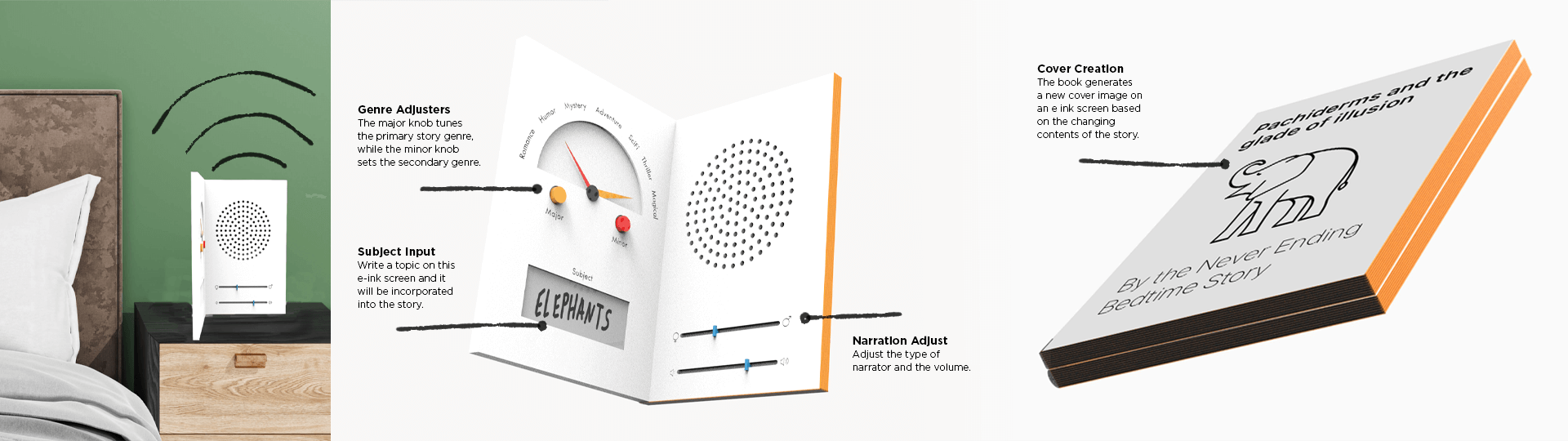
1. Neverending Story Book: AI-generated bedtime stories
This hardware device uses generative AI to always tell a new tale—and one that users can help shape. While some inputs are constrained, like the genre knobs, the subject matter open input box can accommodate as much creativity as the user can produce. This combination of constrained and flexible inputs provides guardrails for how users are meant to interact with the device, and by extension generative AI.
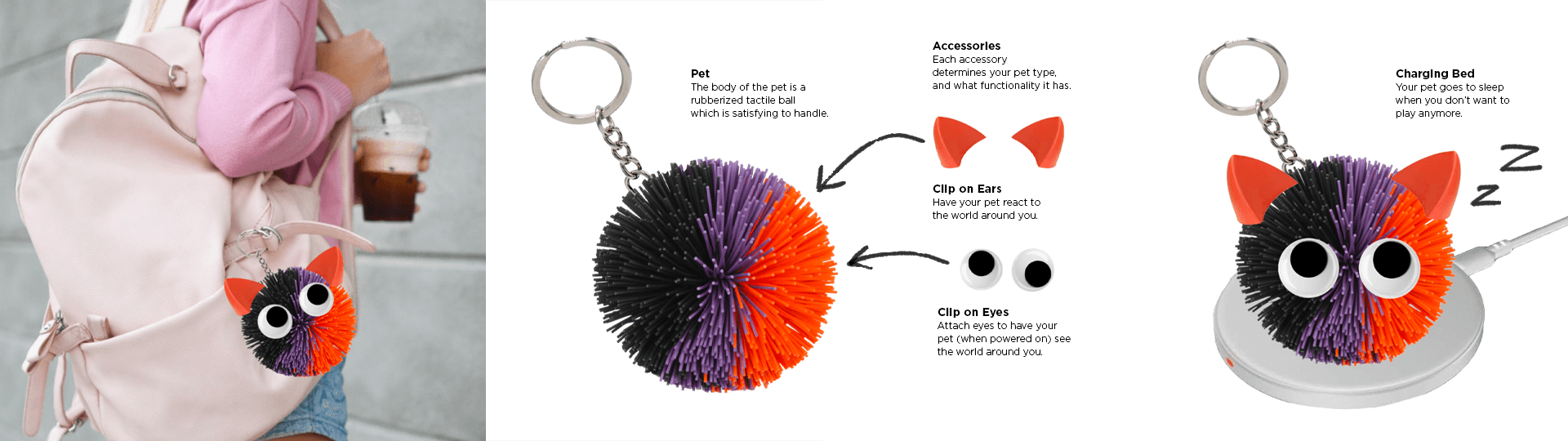
2. Tamaglitchi: An AI pet, embodied
It’s about time somebody made a pet with an off button. Tamaglitchi uses models trained on thousands of hours of dog and cat noises, behaviors, and interactions with humans to create an experience that is so close to having an actual pet, your parents can’t say no. (A prototype to meow at, via Character.AI.)
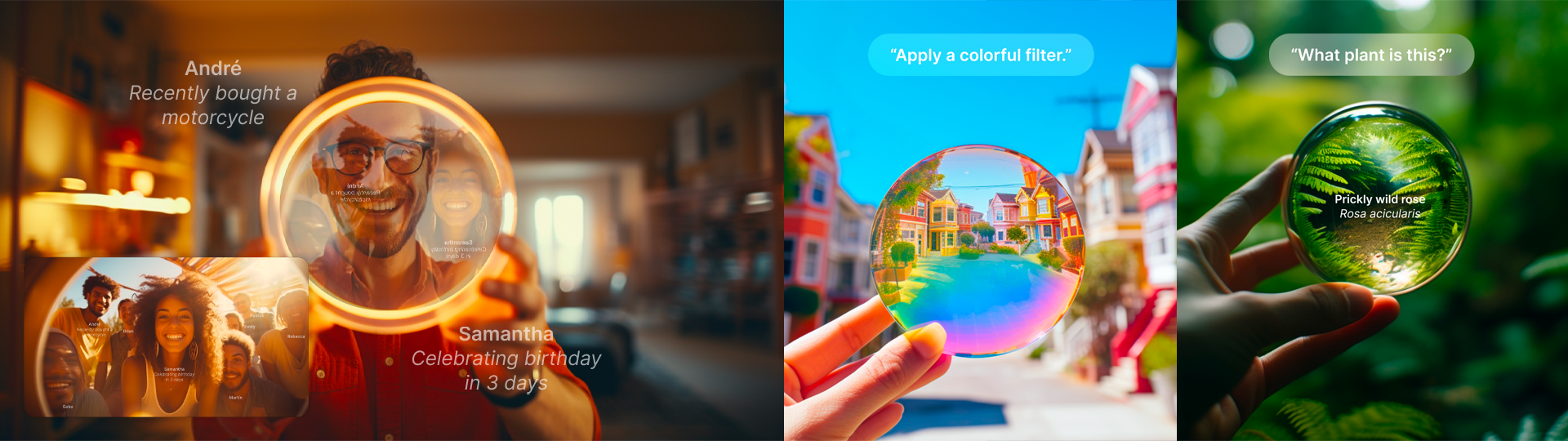
3. Portals: Handheld, AI-enabled circular lens that enhances connections
With so many devices that command our attention and pull us away from our physical environment, Portals are windows that allow us to refocus on the people in our lives and the natural world. Leaning into the passthrough quality of augmented reality, Portals allow users to capture memories and style inspiration in real time with minimal disruption to their field-of-view. Using machine learning models, Portals provide users with valuable social nudges and additional context to objects, people, and places in their environment.
4. RemixRemote: Custom entertainment content on demand
The future of personalized entertainment: When you have a specific amount of time available and an inkling of what you might like to watch, you can generate something that meets your specific needs. The RemixRemote uses generative AI to create unique content tailored to your taste and time availability. Collect ideas of what you’re interested in, then press down on the voice input dial to describe qualitative aspects of your inspiration. Pressed for time? Each turn of the dial cuts (or adds) 15 minutes to your content’s duration, making sure you can fit this into your schedule.
5. Collective Sentiment Mirror: An installation that summarizes conversations
This AI will gauge the conversations in a room and spatially map them in an installation in the ceiling. Each person is represented by a glowing dot, and as they interact with other people, interconnections between the dots grow. Opt-in poetry: The ceiling can also generate poetic summaries, picking up nouns or a single word based on the conversations happening in the space.
6. Scent Capture: Meet the eNose
eNoses digitize odors using a graph neural network. Once scent is recorded, scent capture will organize, tag, and combine smells to create AI-generated scents as unique as you. Relive your experiences by sending your custom scent profiles to be translated into physical forms like perfumes, candles, and essential oils.
And for the last one, we tossed out the rulebook, leaning into chatbots.
7. ArticulateGPT: An LLM that reduces articulation barriers
ArticulateGPT seeks to address one of the biggest issues users face today: their ability to translate their thoughts into words. It gives users options for what to say, so they don’t have to deal with the paralysis of a blank slate. But it’s not just to help with speech or written communication; users can flow between multiple media types, like text, code, imagery, video, audio, and even 3-D.
How do you want to interact with A.I.? We’d love to hear from you: ai@ideo.com
Special thanks to Grishma Rao, Neal Boyer, and Ceci Gomez for their work in coming up with these concepts.
When humans design paradigm-shifting technologies, they often create a similar interaction model as the technologies that came before.

Make something wonderful for the climate
Why we’re focused on desirability.
He made a plea: “I need your help. If you have looked at computers, they look like garbage. All the great product designers are off designing automobiles or buildings … People are going to spend more time interacting with these machines than they do interacting with automobiles today.”
Jobs foresaw a future where those machines—computers—would be central to our lives. But he also knew that if mass adoption was to happen, they’d need to make them more beautiful, intuitive, and delightful. In other words, more desirable.
So what does that have to do with the climate crisis?
Climate solutions already exist. Whether based in nature or in state-of-the-art technologies, we have the means to halve emissions in the next decade. But if we are to avoid the most dire consequences of climate change, these solutions must be adopted much faster, in more places, by many more governments, businesses, and people.
The climate crisis is a technology challenge, an investment challenge, and a regulatory challenge. But it is also a crisis of adoption, where we need to accelerate the uptake of climate strategies, solutions, and jobs. Fast.
The climate crisis is also a crisis of adoption.
Just as happened with computers in the 1980s, public interest in sustainable solutions is growing, but has not yet reached mass appeal. It makes sense: When was the last time you saw a house that looked better with the addition of solar panels? Or a community excited to install wind power in their backyard?
Desirability can help. What if regenerative agriculture could be a simpler business for farmers and a more affordable option for people? What if alternative meats tasted demonstrably better than a burger made of beef? What if repairing something you already have could be as much of a thrill as buying something new?
Since our early days, IDEO has centered people’s needs and desires—often hidden or latent—in how we think about design. Over time, that work has extended into helping the world’s leading companies make sustainability desirable, from designing electric cars with Ford, or removing waste from H&M’s supply chain, to helping Conservation International design strategies that protect natural resources.
We see three ways design can make the greatest impact toward accelerating and scaling effective climate action. Each supports our central thesis: The climate crisis is a human crisis. If we want businesses and people to make a climate-positive choice, make sure it’s a desirable choice.

1. Create compelling future visions, especially for leaders.
Nobody is willing to embrace the pain of change unless they see potential for a better future on the other side—including both new opportunities and ways to avoid loss. We see leaders experience a symphony of emotions over the course of climate-centered work, from denial to acceptance to purpose. That angst is the hallmark of a shifting mental model—from seeing sustainability as a business constraint to seeing it as an opportunity for growth. Futuring—the craft of creating informed and plausible visions of the future—is a key design tool to help that process along. When leaders explore potential futures, they realize they can’t opt out of the climate crisis, and start to see the extraordinary potential of the moment they’re in.
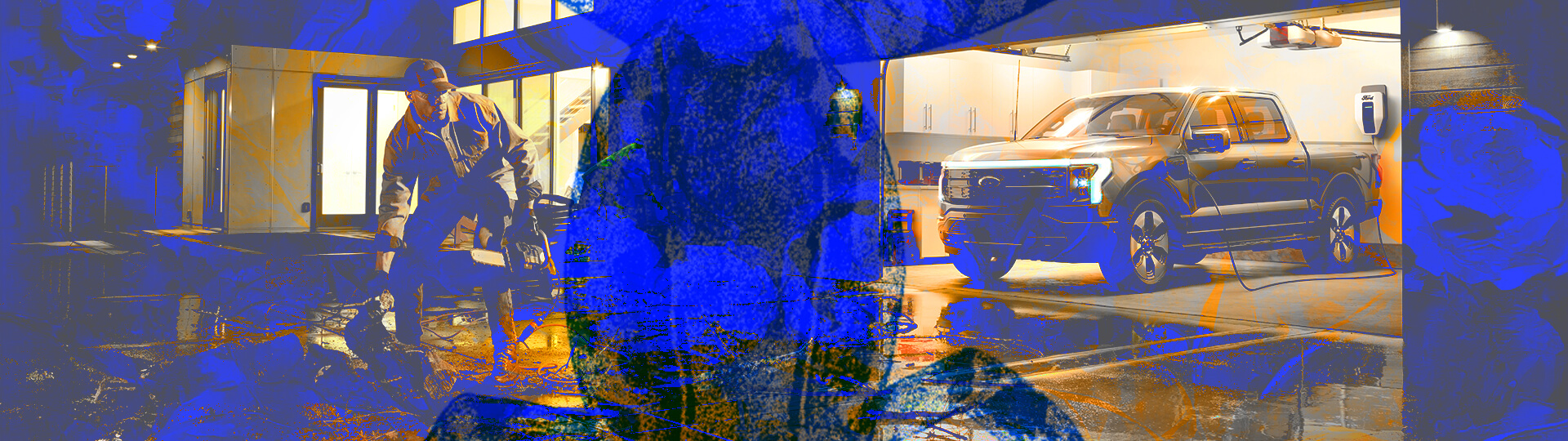
2. Design iconic products, services, and experiences, specifically for the Climate Era.
The competitive advantage of the future will be enjoyed by companies that thrive within planetary boundaries. The pressure is coming from constraints on resources, more stringent regulation, and shifts in public sentiment. But that’s an opportunity too: to make iconic things that could only be designed in, and for, the Climate Era.
One example: The Ford F-150 is currently America’s best-selling truck. IDEO helped Ford design its latest edition: the electric F-150 Lightning, which has been described as the best version of the truck. Here’s why: The Lightning has more power and torque than any of its predecessors and more electric sockets than the average apartment. When there’s an emergency, like the catastrophic storm that hit Texas a couple years ago, the F-150 saves the day by acting as an emergency power backup. There is also the “frunk” (a storage compartment where the internal combustion engine once was) that doubles as a cooler, and a tailgate that can be converted into a workbench for power tools, laptops, and more. Is it sustainable? For the truck owner, that’s not the point. The point is that it’s a better truck.
None of the F-150 Lightning features can be copied by a truck with an internal combustion engine. They are all creative affordances of the core technology behind the F-150 Lightning—electrification.
In other words, in the Climate Era the goal should not be to create a sustainable version of a given product. It should be to create a far better version of a product in ways made possible because it’s sustainable.
Ford’s F-150 Lightning is an example of an iconic Climate Era product, and it’s showing the way for the entire industry. The world needs many more.

3. Merge product innovation and sustainability into one team.
The vast majority of sustainability-related challenges begin at the design stage, yet most of today’s efforts are focused on compliance—reducing the negative impacts of things that are already in the market.
Transforming a business to operate within our planetary boundaries is an innovation challenge, not a reporting, marketing, or PR one. So nature-positive thinking needs to show up from the start, with innovators, designers, and technologists who are versed in sustainable strategies. Leading organizations are now hiring combined Heads of Innovation and Sustainability.
As the decade progresses, we foresee corporations transitioning from an umbrella, organizational level of accountability—“getting to Net Zero”—to requirements and norms that operate at the level of individual products. Allbirds’ net zero shoe, Apple’s net zero watch, and the regenerative packaging solutions created by Notpla serve as early examples. The teams behind those products will inspire others and be the engines of change for our economy—and they’ll attract funding, talent, and customers faster than anyone else.

One large grain of salt: Designing for desirability is one of the reasons why we’re in this mess.
Design has fuelled mass consumption of disposable goods. Can the force that helped create the problem be redirected to help solve it? We believe it can and it must.
Government policy and private and public investment create the conditions that push the adoption of climate solutions, but it’s desire that creates the pull. That’s why making climate solutions desirable is a critical piece of the climate action puzzle. Push and pull. We need both.
Back in 1984, Jobs closed his speech to designers with this:
"We at Apple feel that … we are at the right place at the right time to put something back. [M]ost of us didn’t make the clothes we’re wearing, and we didn’t cook or grow the food we eat … We are constantly taking.
The ability to put something back into the pool of human experience is extremely neat. I think that everyone knows that in the next ten years we have the chance to really do that. And we will look back and say ‘God, we were a part of that!’”
Especially in industrialized regions, like Europe and North America, we built our lives and economies around taking whatever we wanted from the planet.
It’s long past time to stop taking. We have to put something back. And that means redesigning much of our world to meet the demands of the Climate Era, and to do it within our lifetimes.
Change at such a scale can only happen fast if it’s what people want.
In other words, it’s time to make better things … because it’s a way we can make things better.
In Dubai for #COP28? Please join one or more of the IDEO Climate Lab sessions, where we’ll explore these questions in greater depth.
If you want to know more about IDEO’s climate-centered work, please get in touch: climate@ideo.com.
We stole this headline from Steve Jobs. In 1984, five months after Apple introduced the first Macintosh, Jobs spoke at the International Design Conference in Aspen.

Lindsey Turner
I’m passionate about building brands, products, and experiences that help organizations show up with meaning and momentum.
I help organizations cut through complexity by shaping how they show up, through brand strategy, identity, and storytelling.
Working at the intersection of brand and business, I bring an editorial eye and a bias toward making—turning ideas into tangible experiences that people can understand, trust, and believe in.
My work spans government, healthcare, financial services, media, and consumer goods, from launching Gen Z-focused ventures to building innovation labs and reimagining legacy brands. I relish moments of ambiguity and enjoy translating across teams, perspectives, and priorities to move ideas forward.
I started my career in editorial and digital design, shaping cross-platform experiences and identity systems in publishing and agency environments. That foundation still shapes how I work today: I’m detail-oriented, collaborative, and overreliant on the Oxford comma. I hold a BFA in Visual Communication from the School of the Art Institute of Chicago.

Rachel Young
My work helps organizations see who their products aren't working for—and build the will and the tools to do something about it
For 25 years, I've asked the same question: Who does this design exclude—and what are we going to do about it?
My work spans human-centered strategy, inclusive design, and qualitative research, with clients ranging from Microsoft, Google, and Verizon to the National Science Foundation, and San Francisco Unified School District.
Before IDEO, I taught elementary school in East Palo Alto and spent a decade doing design work with social service organizations—where I learned firsthand what it costs people when systems are built without them in mind.
I am currently writing User Error, a nonfiction book about digital access and the design decisions behind it. I live in Oakland, California.

Brian Pelsoh
I lead with craft, ensuring our work is creatively excellent: rooted in deep human insight and imagination, while also grounded in the realities of business and technology.
My expertise spans brand, communication, and product design across tech, education, the arts, and social impact.
I believe great work demands both high-level vision and obsessive attention to detail, and only happens through collaboration.
I bring an inclusive, hands-on approach and a deep understanding of business, which enables me to consistently deliver excellence while always asking why.
Before joining IDEO, I worked at the brand firms Pentagram and VSA Partners. I began my career as a designer, leading teams at the School of the Art Institute of Chicago and the Milwaukee Art Museum. I hold an MFA in graphic design from Maryland Institute College of Art and a BFA in communication design from the Milwaukee Institute of Art & Design, and have taught at some of the best design schools in the US.

Tony Wong
I am responsible for IDEO’s long-term success in China and working with clients to use design as a tool to enable growth.
I am responsible for IDEO’s long-term success in China and working with clients to use design as a tool to enable growth. Specifically, I have helped Chinese companies design holistic brand solutions through the development of their products, communication, services, and innovation teams, and I have helped multinationals expand their presence and influence in China.
I advise global leaders on developing China-led innovation and capabilities.
In over 15 years in IDEO Shanghai, I have worked on projects that use design to elevate the quality of the experience of healthcare products and services, streamline processes that increase productivity, create spaces and programs that promote and enable inclusive communities, and build next generation mobility solutions that are planet-positive.
Before joining IDEO, I worked at Philips Electronics and the Electrolux Group in Italy, the Netherlands, and Singapore on a number of breakthrough commercial products. I am a member of the Young President Organization in Shanghai.

How to use AI as an editor, not a writer
Ed White shares how he uses AI as an editor—not a writer—to sharpen storytelling, rehearse ideas, and preserve the productive friction that makes creative work better.
Ed White has a rule he's tested on his own writing: hold yourself as the writer, and let AI be your editor. Ed is a Senior Design Director at IDEO's London studio, where he co-leads the firm's AI portfolio across Europe. Before IDEO, he spent 12 years as a writer and editor at the Financial Times, Wired, and Contagious. So when he talks about when to use AI for storytelling and when not to, it comes from two decades of crafting his storytelling skills.
In this episode, Mina Seetharaman talks with Ed about two specific tools he uses to keep AI in an editor's seat: a "roasting agent" prompted to critique his drafts without any sugarcoating, and a simulated audience he rehearses pitches on before the real thing. They also get into what Ed is hearing from design leaders at Anthropic, Lovable, Shopify, and Google Creative Lab about how creative work is changing, and why he thinks the friction of writing something yourself is worth protecting rather than automating away.

Building a personal AI for the messiness of life: Sida Li
Becca Carroll talks with Cue co-founder Sida Li about designing a personal AI for the messiness of everyday life—not just work. They explore how Sida stays anchored to human needs while navigating fast-changing technology, product tradeoffs, business-model experimentation, and the realities of building an AI company today.
Most AI products today are built for work—a space with clear problems and established systems. One founder noticed a gap: personal life is messier, harder to systematize, and mostly left behind by the AI boom. So she built Cue, a personal AI that lives inside iMessage and group chats, to go where the other tools haven't.
In this episode, Becca Carroll, IDEO's Chief Strategy Officer, talks with Sida Li, co-founder and CEO of Shared Context Lab, about staying anchored to a human need while the technology around her keeps changing shape, why she treats her business model with the same rigor she'd bring to a product, and what it feels like to build a company at this particular, disorienting moment in AI.
The conversation also gets into how Sida makes design decisions: the language Cue uses to describe itself, the tradeoffs behind building inside iMessage instead of a new app, and a real story about a business idea that didn’t pan out.
This is the second in a two-part series profiling founders from IDEO's Startups-in-Residence program. The first conversation is with Johannes Seemann, founder of Sooner, on designing GenAI for the emotional side of money.

Designing GenAI for the emotional side of money: Johannes Seemann
Designing financial tools around the feelings that shape money decisions.
Most personal financial tools are built to run the numbers and optimize towards a budget. While that works for some, most people experience money as a lived relationship that does not neatly fit into a spreadsheet. Johannes Seemann and Becca Carroll discuss why money is emotional before it is mathematical, and what a human-centered approach to building a generative AI financial product looks like in practice.

The curious leader's edge in uncertainty: Scott Shigeoka
How genuine curiosity helps leaders navigate uncertainty with greater confidence.
Mina Seetharaman talks with Scott Shigeoka, author of Seek and Head of Curiosity Cultivation at the Eames Institute, about what distinguishes genuinely curious leadership from performative curiosity, how power dynamics shape curiosity, and why practicing curiosity can restore energy rather than drain it.
Looks like you might be in search of something very specific?
Or reset the filters above and try another angle.
Here’s some random inspiration

Podcasts about creative leadership

Articles about the power of prototyping
