
.svg)



Mental health, co-designed
Kooth partners with young people to create Soluna, a mental health resource for California youth.
Increasingly, digital spaces are proving detrimental to youth mental health. By co-designing with youth, Kooth and IDEO set out to flip the script, creating a positive digital space for young people to safely explore their mental wellbeing.
When Kooth, IDEO, and Blackbird, IDEO’s longtime development partner, first started working on the project, the window of opportunity was narrow, and the stakes were high. The group was up against a nine-week deadline to create a working proof of concept app. Also on the line: a $188 million contract with the Department of Health Care Services (DHCS)—one that would open an entirely new line of business for Kooth.
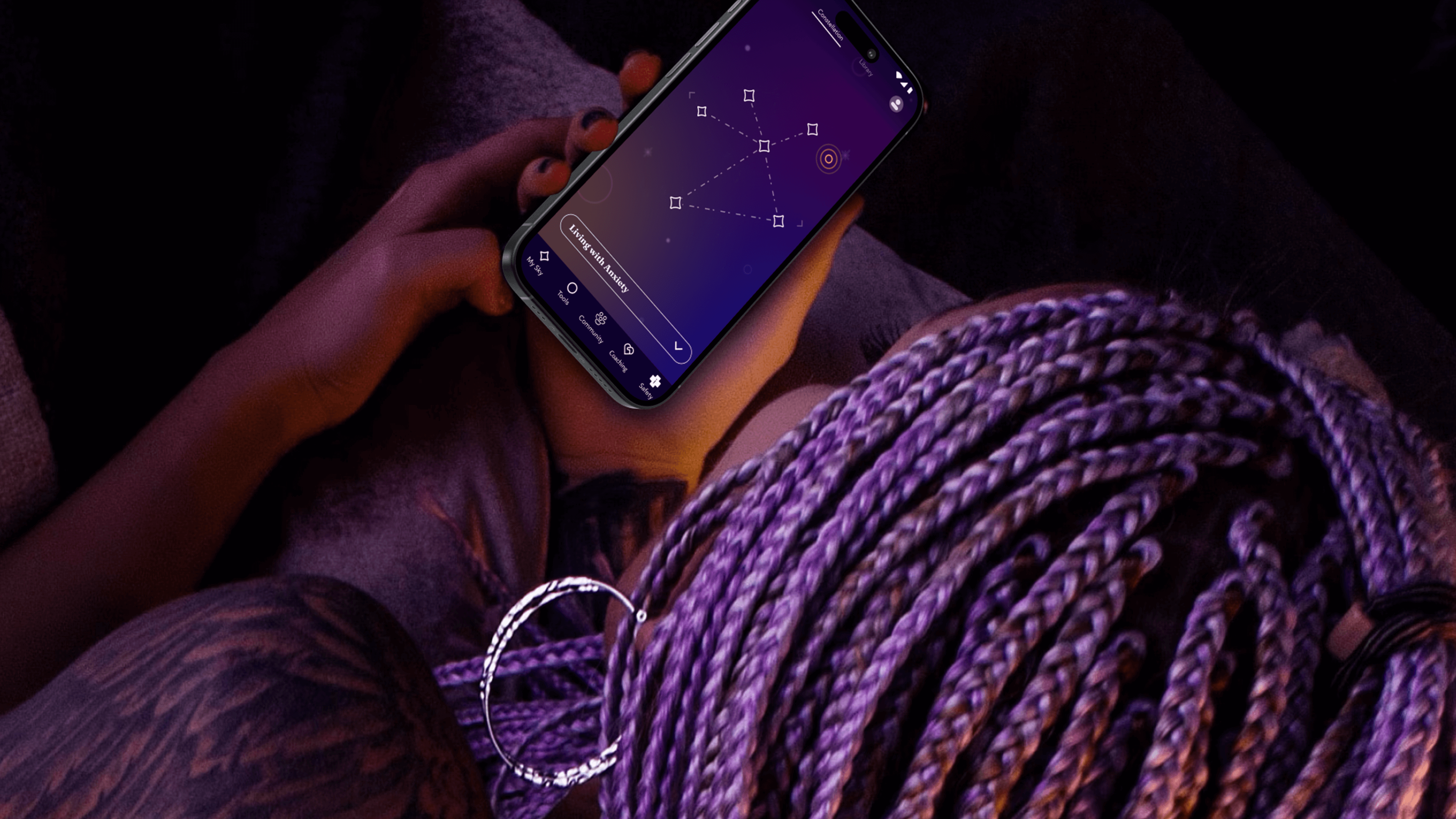
The app needed to do more than demonstrate functionality—it needed to prove its value. To ensure that they were creating an asset that truly fit the needs of young people, the team turned to an initial cohort of 13-25 year-old co-designers who explored early features, created video diaries, and shared their questions about and experiences with mental health. These young people often gravitated toward self-service tools that helped them take action based on their feelings. With their feedback, the team created new expressions of clinically-validated behavioral health tools like journaling, breathwork and white noise—and built novel tools, such as Starboard, an expressive drawing tool and a nod to art therapy.
The team took inspiration from content the co-designers liked to consume, such as story-driven video games that enable freedom of exploration, deepened by a unifying mythology. That led them to a constellation theme, which made the experience more intriguing and playful. The co-designers also recommended a dark color palette, because they preferred exploring the app at night.
With these insights, the team refined the proof of concept, and then conducted a one-week pilot with another 50 young people across California. Their positive feedback gave the State the confidence to invest in a $188 million, four-year contract for Kooth to bring the app to a platform at scale.
Over the next year, the team engaged another 150 young people to help design, shape, and test the app. At the same time, Kooth and IDEO created a clinical oversight group, which included a pediatrician, therapists, and other clinical specialists. This group anchored the platform in the practices of Acceptance and Commitment Therapy (ACT), cultivating psychological flexibility—the mindful acceptance of positive and negative emotions. Young people are invited to complete short reflections and surveys throughout their journey with the app, which includes rigorous, science-backed measurements to assess the therapeutic benefits.
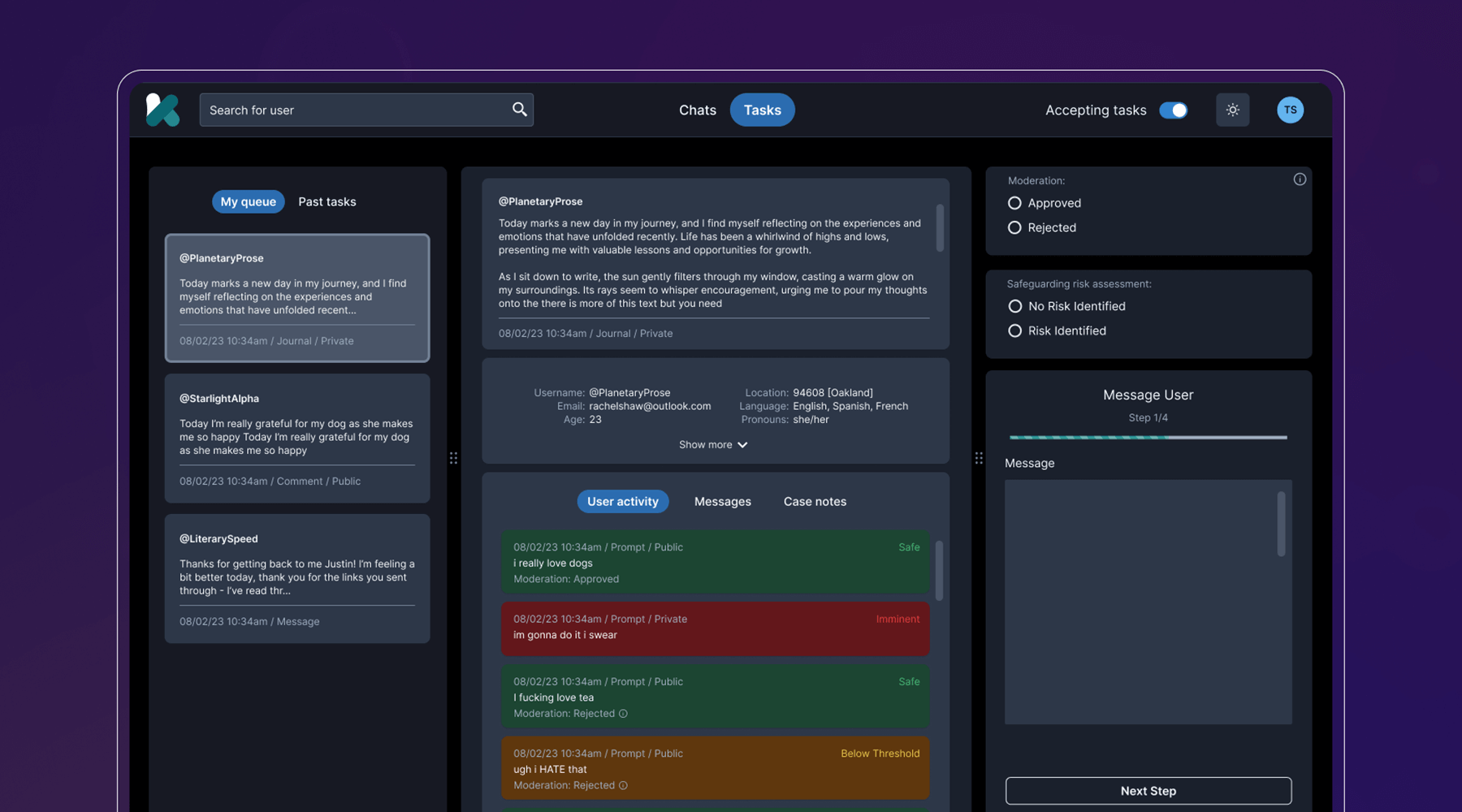
Behind the scenes, the team developed a clinical-facing service and digital platform that empowers Kooth’s peer specialists, social workers, community curators, and clinicians to support the youth experience, all while protecting privacy and confidentiality. They also navigated a complex landscape of state requirements and government legislation, ensuring that the platform could cover topics like substance abuse and gender identity, and that users could access coaching within 24 hours, and choose from a diverse set of experts.
The last step was to select a name that worked across multiple languages, trademarks, and competitor branding, and didn’t come off as a mental health service, something the youth co-designers believed was critical. IDEO and Kooth landed on Soluna, a name that alludes to the app’s presence in both the bright (“sol” for sun) and the dark times (“luna” for moon).
Now, Soluna is available for free to all youth in California, and the state has set ambitious targets for reaching all young people at scale. Soluna is a living platform that will continue to receive product and design updates for years to come, all deeply rooted in youth co-design.
The US Surgeon General named mental health “the defining public health crisis of our time,” and cited social media, online bullying, and the isolation exacerbated by the COVID-19 pandemic as major drivers that have significant negative outcomes for youth.
In California alone, more than 284,000 youth cope with major depression. 66% of kids with depression do not receive treatment. Between 2019-2020, the suicide rate for kids ages 10-18 increased by 20%.
In 2022, California Governor Gavin Newsom’s Master Plan for Kids’ Mental Health set aside $4.6 billion to increase access to mental health and substance abuse support, the largest commitment to youth mental health ever made by a state.
94%
of proof-of-concept app users would recommend the Soluna app to a friend, and believe that engaging with the app would be a positive addition to their daily/weekly routine
6 million
young people in California had access to Soluna at launch in January 2024
A more comfortable Pap smear
Teal Health creates a system for at-home cervical cancer screening.
Creating a better cervical cancer screening experience is an important mission, but also a challenging one. Not only would Teal have to address the regulations that face healthcare device companies, it would also need to build a comprehensive telehealth platform and a physical product—a wand that could easily collect an adequate cell sample, even in the hands of an untrained person.
The first challenge was to create the wand. The device would need to do a lot: It’s impossible for a person to see their own cervix, so the user would have to be able to find the cervix blind, collect the sample themselves, and remove the wand from their bodies without contaminating it on other parts of their anatomy. Because this is something users are likely to do in their bathrooms, where there is no space to lie down, they would need to be able to use the device while standing—and with one hand. From the beginning, the IDEO team set out to design functional, testable prototypes to make sure the idea was viable, and incorporate diverse voices into the research process, including trans, minority, and disabled women.
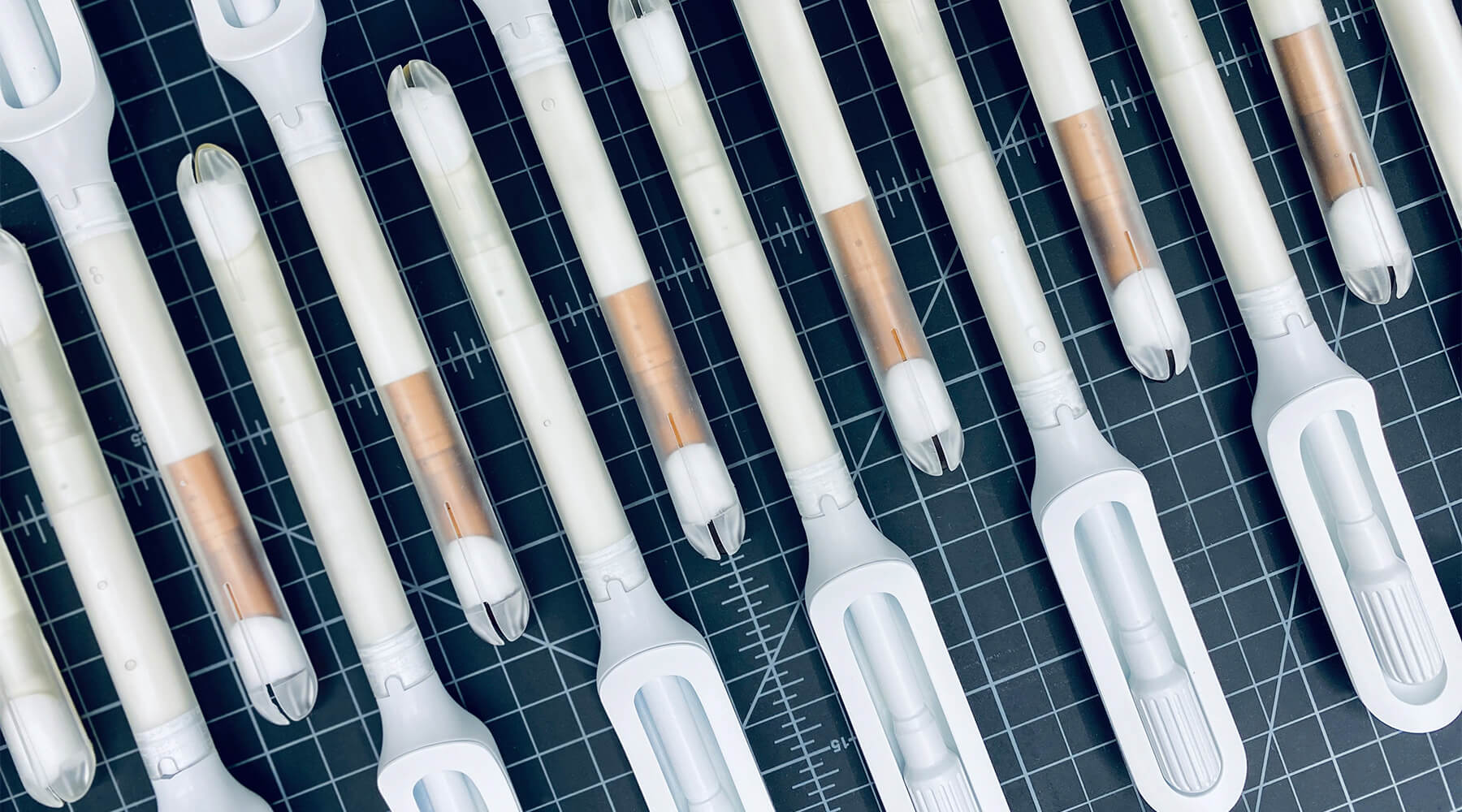
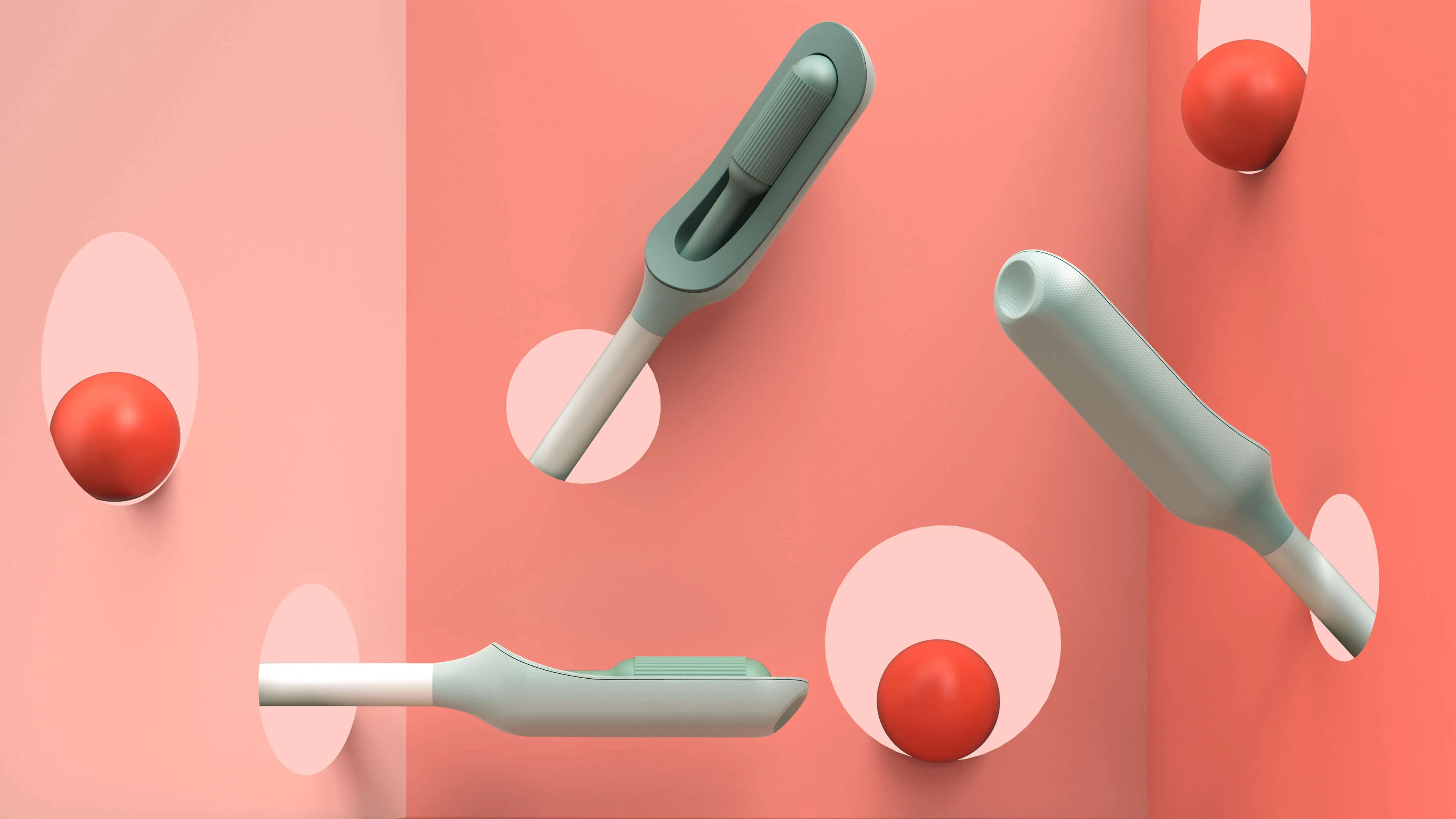
Because the product is meant for people who aren’t medical professionals, the team worked to design something as simple, intuitive, and unintimidating as possible. They used a 3-D printer to create multiples of every prototype, autoclaves to make sure that the designs they were creating were sterile, and leaned into shapes women are already used to, like the cylindrical shape of a tampon. The wand they created has that same basic form, but with a soft sponge that the user can deploy with the turn of a dial to collect the sample, then close to protect it from contamination on the way out of the body.
With working prototypes in hand, Teal set out to test their efficacy. In an initial study with 220 participants varying in age, race, socioeconomic status, and geography, Teal found that not only were participants able to successfully self-collect samples, they also preferred them over the speculum, the device doctors typically use during a screening. Some 92 percent said if they knew the results were equal they would prefer self-collection, while 87 percent reported they would stay current with screening if Teal Wand was an option. Self-collection took the vast majority under two minutes to complete, and 97% of study participants reported it was very easy or easy to use. The Teal Wand recently received a patent for its unique design.
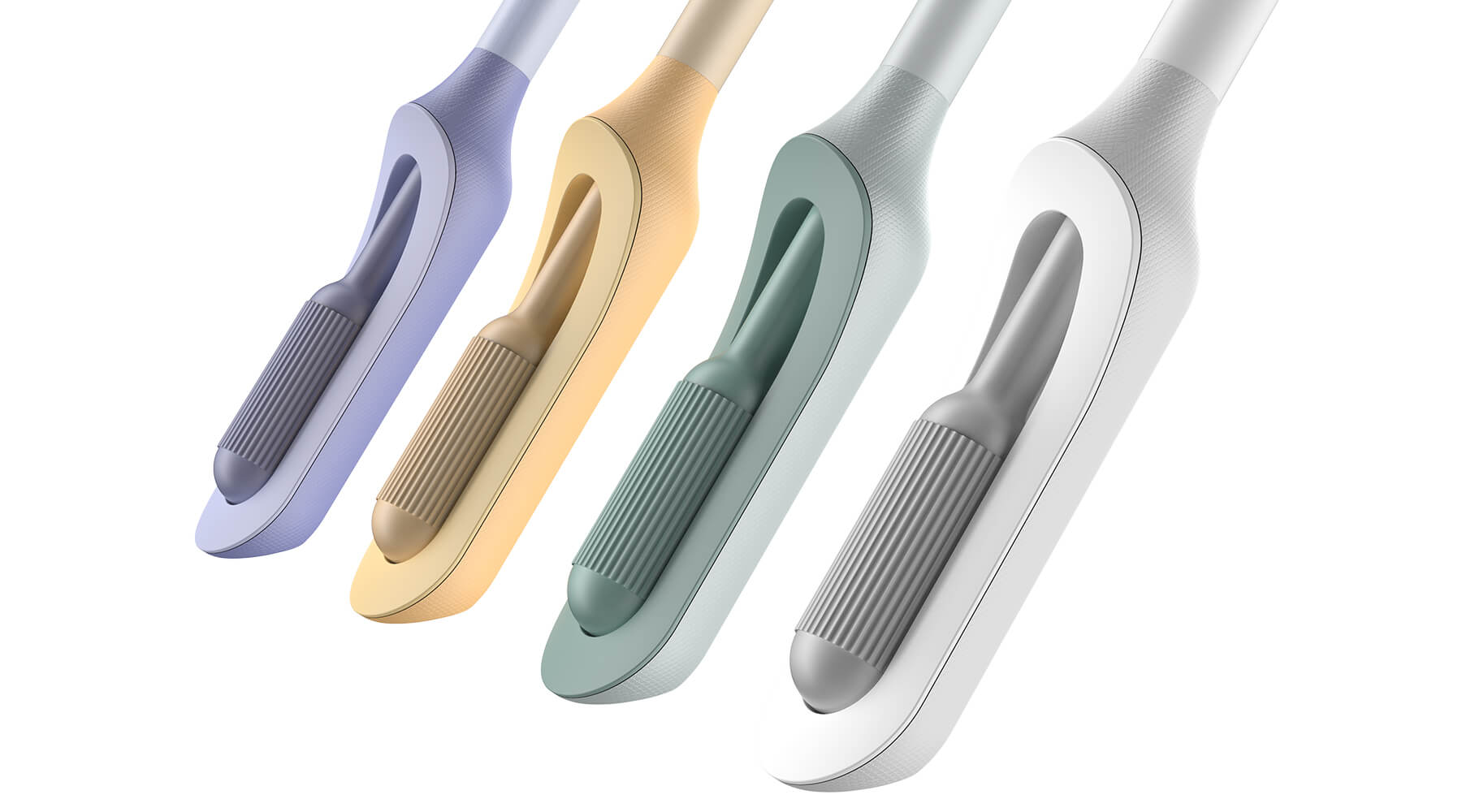
The IDEO team also worked on the packaging and unboxing experience, which plays an important role in supporting the user through the self-screening process. The team built in thoughtful design cues to give users reassurance that they are using the wand correctly, and to provide the same level of confidence they would have in the results of an in-clinic screening.
In January 2023, Teal raised an $8.8 million seed round from Serena Ventures, Emerson Collective, and Metrodora, and later that year, launched a nationwide clinical trial with leading health organizations including Johns Hopkins University, Yale University, the University of Colorado, Washington University, and others. In 2025, The Teal Wand became the first FDA-authorized device for at-home cervical cancer screening, with virtual medical provider support. Today, it's available in all 50 states. i’s an enormous step toward its North Star: catching cervical cancer earlier and saving lives.
Cervical cancer is nearly 100% preventable when it’s caught early, yet one in four women in the US are not up to date on their screenings.
More than 12,000 people in the US are being diagnosed with cervical cancer every year, and more than 4,000 people die of the disease, which disproportionately impacts Black, Asian, and Hispanic women.
More than half of cervical cancer cases are found in women that are not up-to-date on their screenings.
97%
of clinical study participants said the Teal Wand was very easy or easy to use.
87%
of participants said they would be more likely to stay current with screening guidelines if Teal Wand was an option.
94%
of participants said they would choose to collect their own sample from home rather than the current standard of care where a clinician collects it in-office.
2025
The Teal Wand becomes the first FDA authorized device for at-home cervical cancer screening, with virtual medical provider support.
Amplifying a movement
Cities United rebrands to create safe, healthy, hopeful communities for Black men and boys.
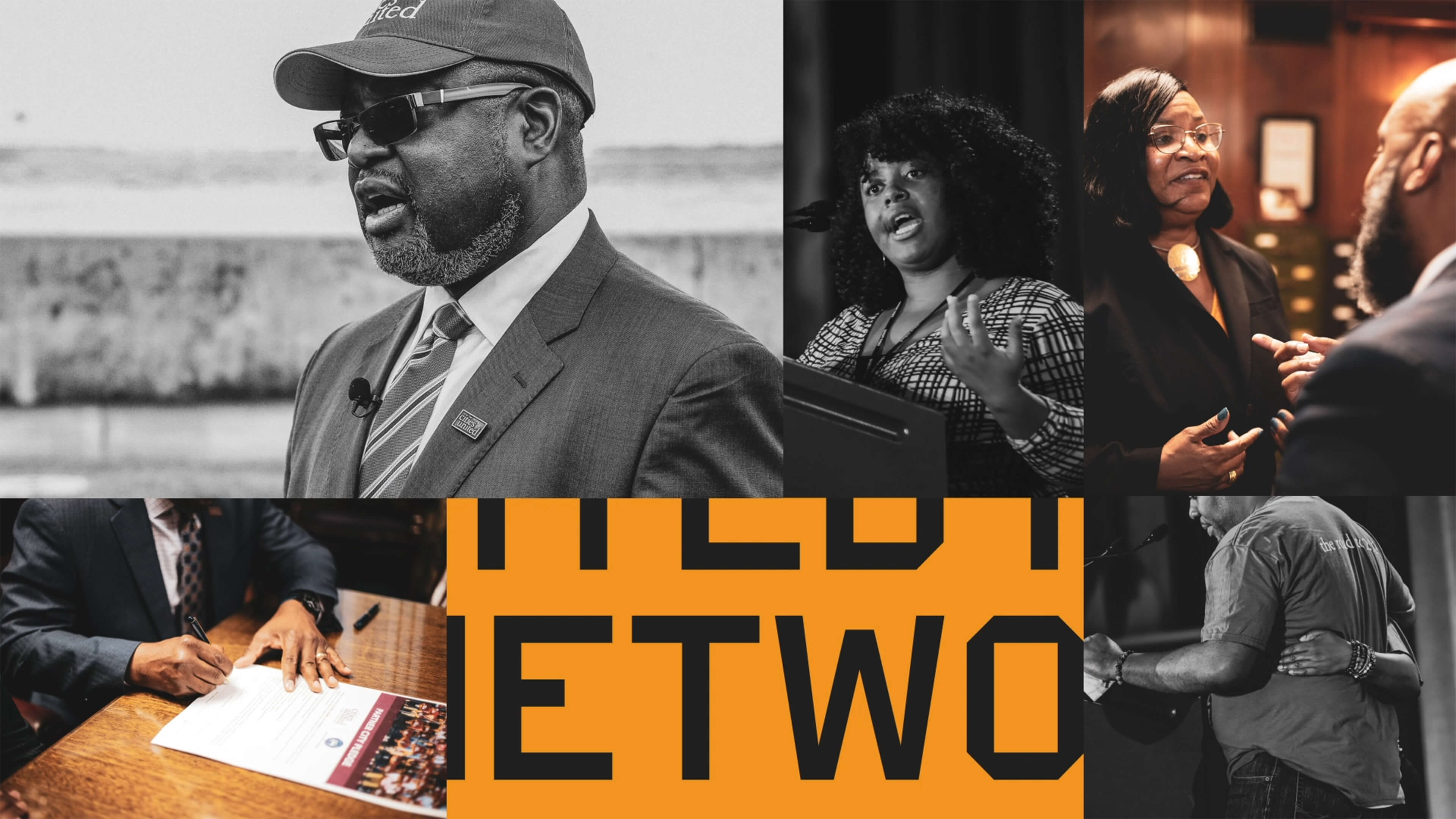
Cities United already had a strong foundation with its stated mission, vision, and values. IDEO brought those to life with a new visual and verbal brand identity system that celebrates Cities United’s inclusive approach to building relationships and reimagining public safety.
To help Cities United with its verbal identity, the IDEO team defined the organization's voice, tone, and key messages, making it easier to tell its story more consistently and clearly, a crucial step toward engaging stakeholders.
To define the new visual identity, the team created a new logo, a letter C composed of interwoven shapes that represent the three tenets of their vision—“safe, happy, and hopeful;” a new design language that references city grids; and a typographic system anchored by the typeface VTC DuBois, inspired by W.E.B. DuBois’s own custom lettering and designed by the Black-owned Vocal Type Co. The team also designed a color palette that embodies the textures of city life with hues reminiscent of asphalt, sunrise, and brick.
To amplify the refreshed branding, the team designed a new responsive website, citiesunited.org. The intuitive site shares the organization’s mission, resources, ongoing projects, and partner network, inviting stakeholders to join in their transformative work. IDEO also created a video to humanize Cities United’s mission and showcase its nationwide impact. It underscores the unity, resilience, and hope embodied by the organization through a chorus of voices.
This comprehensive rebranding widens Cities United’s reach and impact, helping the organization share its goal of creating safe, healthy, hopeful communities for young Black men, boys, and their families, and reintroduces the organization to a national audience.
The Cities United work was supported by IDEO’s Racial Justice Impact Fund, part of a commitment IDEO made in 2020 to address systemic racism and advance equity within our own organization, our client work, and beyond.
Cities United is committed to reducing the epidemic of homicides and shootings among young Black men and boys ages 14-to-24 by 50%.
Between 2009 and 2019, the number of Black children who “did not go to school at least one day in the past month because they felt unsafe at school or on their way to or from school” increased by 84%, according to Cities United.
Homicide is the leading cause of death for Black men and boys from birth to age 44, according to the Centers for Disease Control and Prevention.
2023 SF Design Week Award
In recognition of IDEO’s brand work with Citizens United

Balancing work and sleep
Somni’s personalized sleep program helps workers maintain their health.
Sleep is a critical resource for shift workers—and their employers, too. Together, IDEO and Somni worked directly with people with acute and chronic sleep challenges to create concepts that could support their sleep goals, and provide employers with the means to improve employee health.
When IDEO and Somni first partnered, the startup was an early-stage company, so the team started small, with focused sprints and workshops to redesign the core aspects of the company and product offerings. The team interviewed shift workers about their sleep patterns, which can vary quite a bit. Even when people keep to a specific schedule on work days, they often have to change their patterns on days off to spend time with family and friends, leading to a very disruptive sleep cycle. Research revealed that many third shift workers were dealing with sleep and health issues, but also a pervasive “machismo” culture, pressure to “tough it out,” and a reliance on energy drinks to deal with lack of sleep.
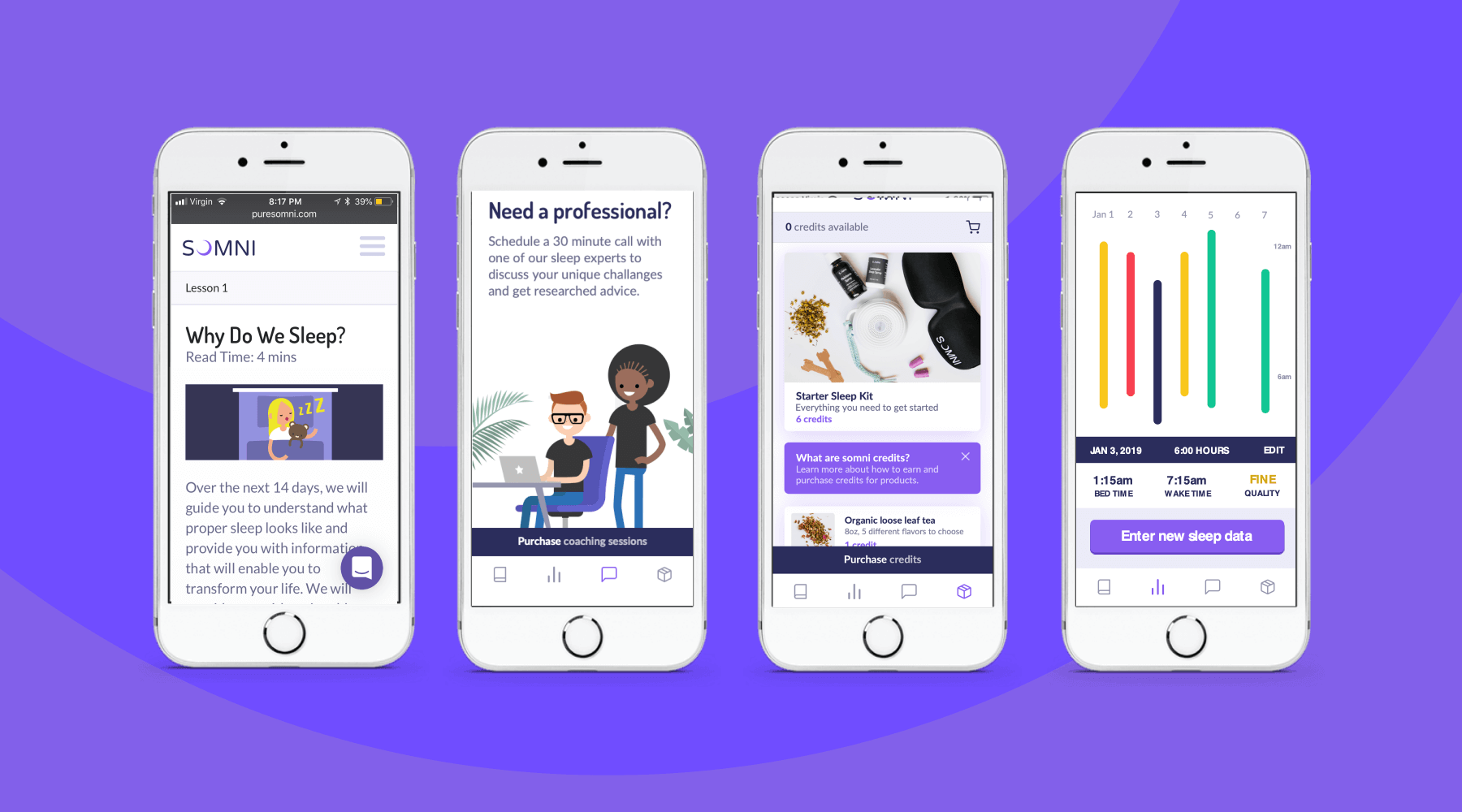
To address those issues, the team designed a digital experience for sleep cohorts, support groups where members could share their experiences and sleep strategies, and work with a coach and sponsor who already had been through the program. The platform analyzed workers’ data, and provided AI-enabled recommendations for improving their sleep. The big takeaway? Data by itself wasn’t necessarily helpful, and could be confusing for folks who were less digitally-fluent. Providing context, like a calendar that displayed sleep experiments at a glance, was crucial.
The IDEO team also created a new user experience for a genetic testing program that could uncover factors associated with sleep issues. Somni aims to use a saliva-based genetic test to monitor for DNA damage caused by circadian disruption, then leverage its sleep improvement program to prevent further damage. Because biomarker testing is a differentiating offer for Somni, it was extremely important that the team get it right, both to make sure that users could understand its utility, and for Somni to provide real value. The design challenge was unique—and not just because of data privacy concerns. Presenting data about DNA damage in a non-human-centered way could increase the anxiety workers had around their sleep.
At the end of the project, Somni leveraged the insights the IDEO team surfaced to improve products like its sleep coaching service, and to refine its biomarker testing offering. Based on this work, Somni has also created a pilot with a Fortune 100 company, which is currently in progress, as it works to mitigate the ill effects of disrupted sleep for employees and the companies they work for.
In the short-term, circadian rhythm disruption leads to an array of jet-lag-like symptoms, and in the long-run, it may contribute to weight gain, obesity, metabolic syndrome, type 2 diabetes, and cardiovascular disease.
It also impairs people’s ability to work, affecting productivity, creativity, and the overall work environment. Productivity loss can lead to employer baseline healthcare costs that are 26% higher, and over time, insomnia can result in an average cost of $4,267 more per employee per year.
In June 2019, the International Agency for Research on Cancer classified shift work as a probable carcinogen.
75%
user retention in Somni's sleep program
$2,450
savings per year per employee for users who complete the program
33%
improvement in sleep quality, and 41 more minutes per night
The Kitchen Designer Who Helped Women Get Out of the Kitchen
Ever heard of Margarete Schütte-Lihotzky? Her Frankfurt Kitchen changed women's work
Designers often have the biggest impact when they reimagine the relationship we have with everyday utilities, like those in the kitchen. Decisions as straightforward as the height of a stool can change the fabric of everyday life.
One great example is Austrian designer Margarete Schütte-Lihotzky, the woman who arguably had more impact on modern kitchen design than anyone in history. In celebration of International Women's Day and as an homage to my own grandmother, I wanted to tell her story.
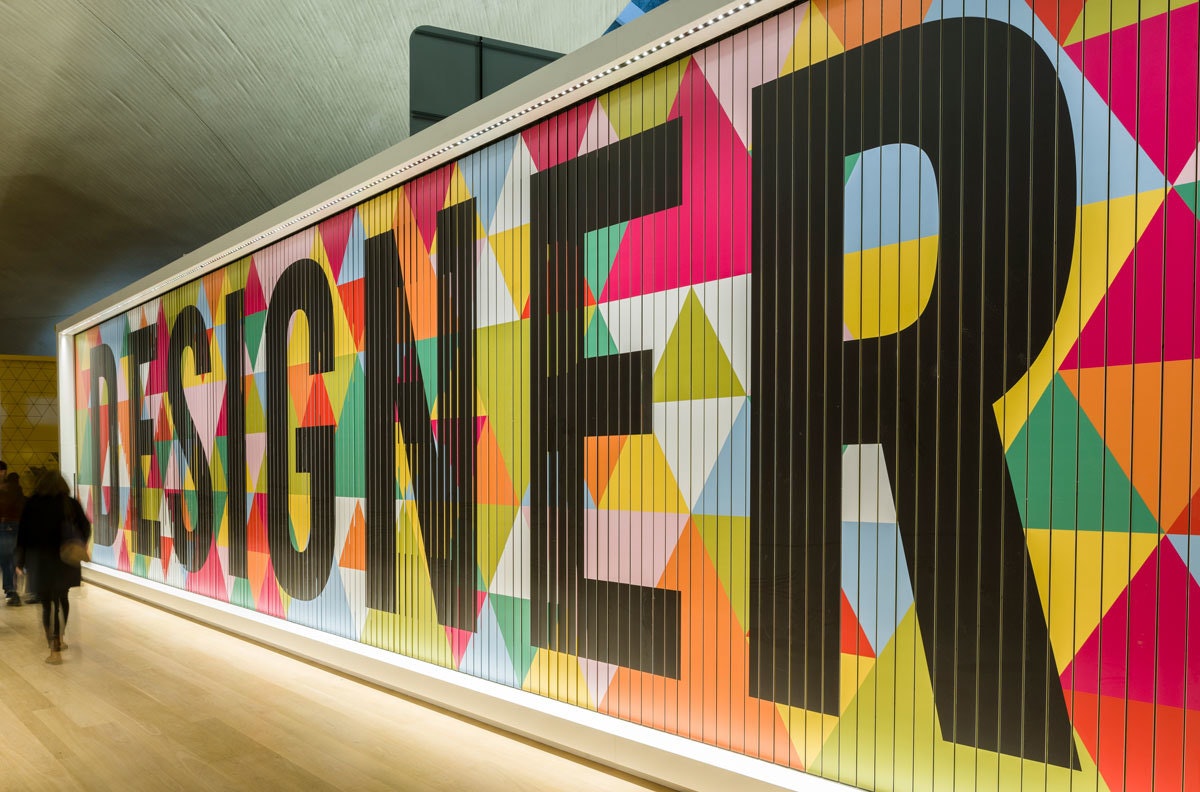
The “fitted” kitchen
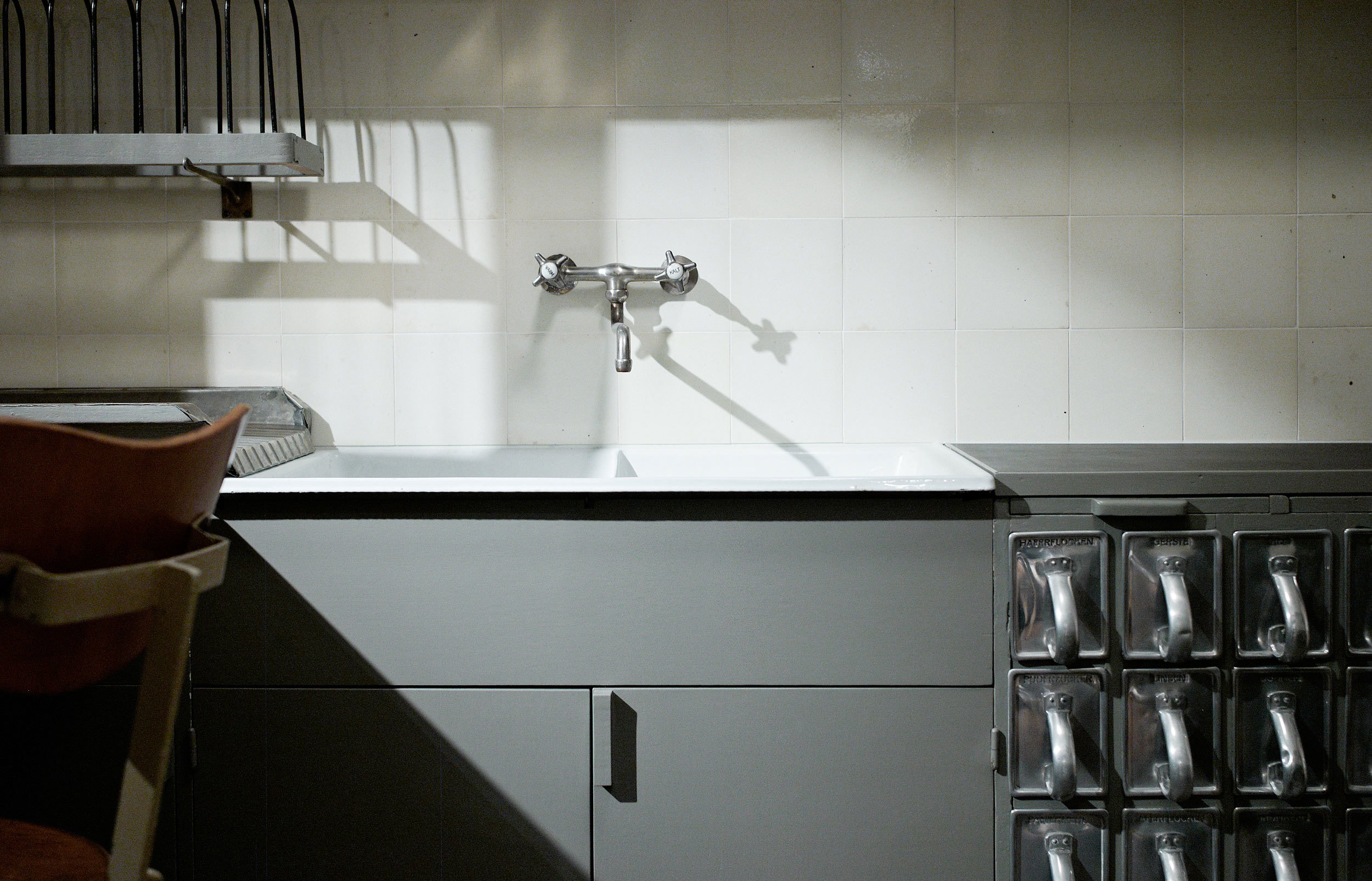
I discovered Schütte-Lihotzky on a recent visit to The Design Museum London, when I went to see the “Designer Maker User” exhibit. I'd never heard of her before, but she is credited with creating the first modern, efficient, "fitted" kitchen in 1926. A "fitted" space means that units are attached to a wall rather than free-floating. It was the first time someone thought to design for cooks instead of home builders.
Schütte-Lihotzky worked in the Municipal Building Department in Vienna, which controlled all aspects of housing, but as a newly-graduated architect, she had little experience with cooking. Instead of letting that naiveté hold her back, she embraced her beginner’s mindset and embarked on an early form of design research, interviewing and observing women in their homes and using film to conduct time-motion studies.
She found that women were spending their entire day preparing, cooking, and cleaning. This endurance activity started with trips to the local store, as fridges and storage units were not the norm and food would spoil within a day or so.
To add to the challenge, the stove, sink, and pantry were installed without any consideration for food prep workflow or the relationship between tasks, and work surfaces were installed at varying heights, putting strain on women’s bodies.
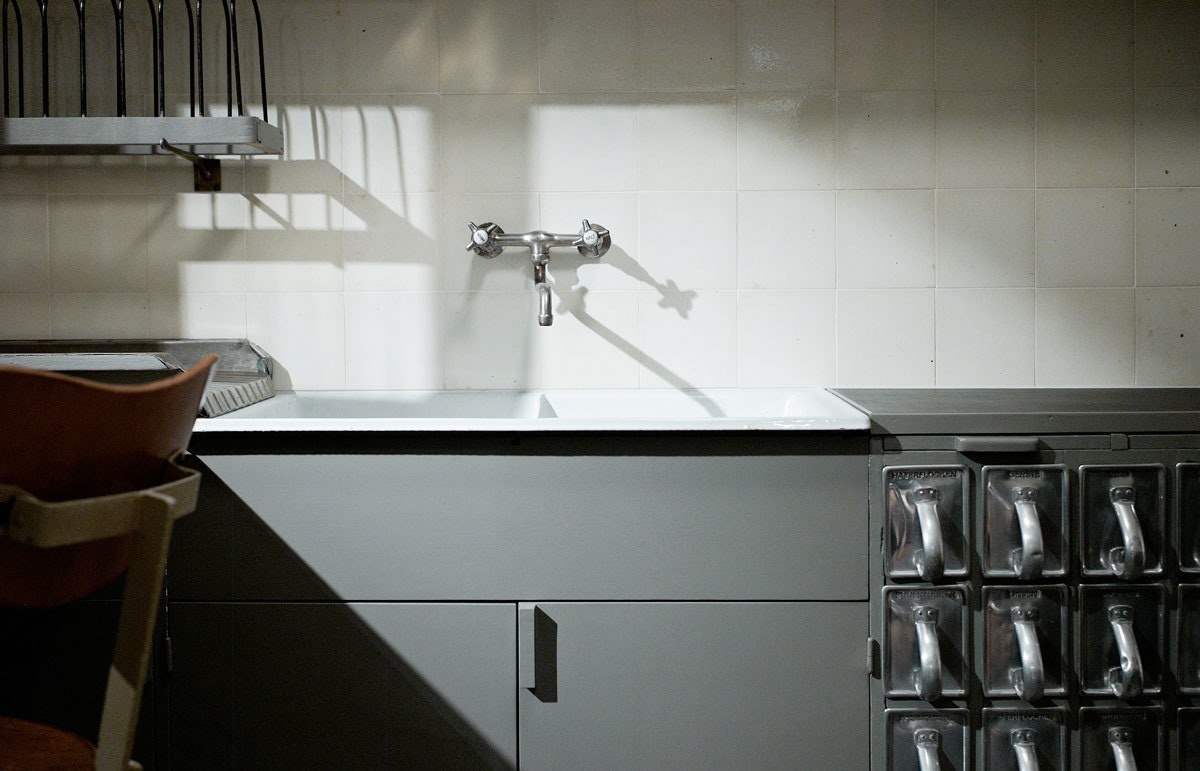
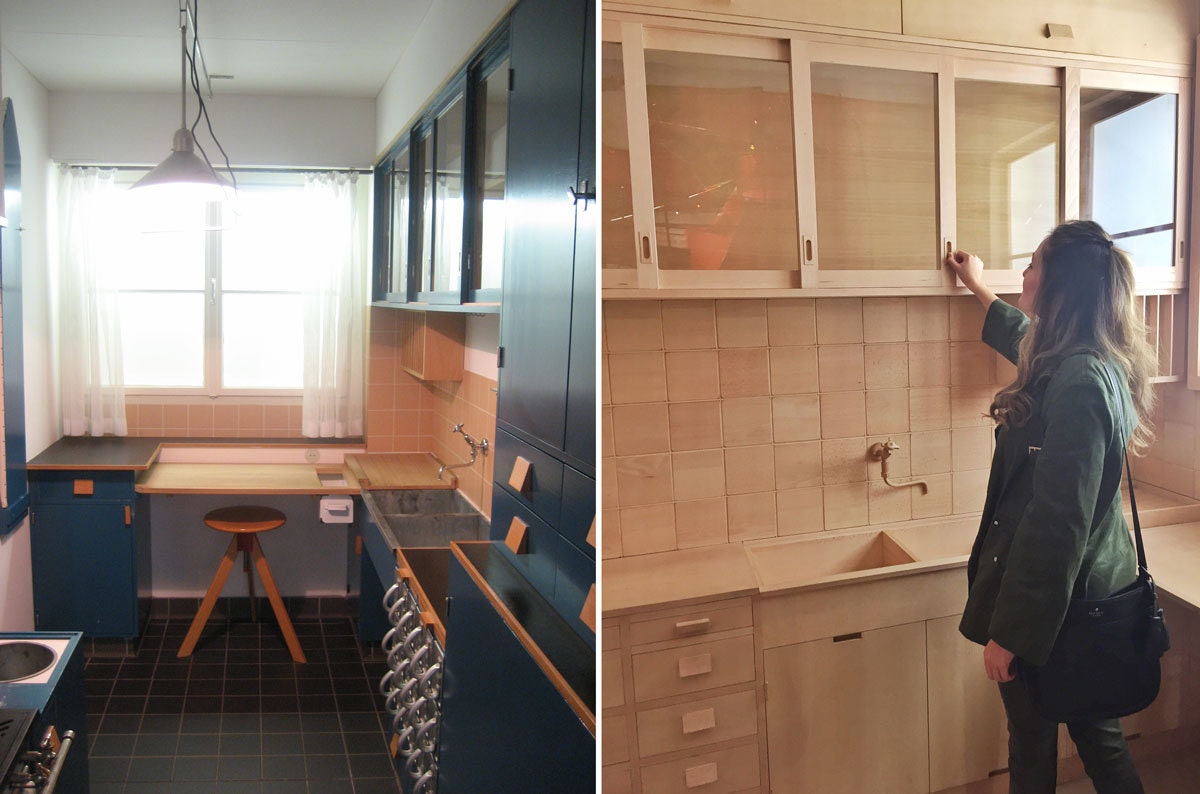
From her interactions with everyday cooks and the application of factory-line principles popularized by Henry Ford, Schütte-Lihotzky introduced her replicable, affordable, space-saving, and egalitarian “Frankfurt Kitchen,” named after the New Frankfurt initiative to address the city's shortage of public housing in the 1920s.
Each kitchen came with a swivel stool, a gas stove, built-in storage, a garbage drawer, and an ironing board. Schütte-Lihotzky used resilient materials like oak to repel critters from getting into perishables and installed aluminum storage bins for staples like sugar and flour. The main objective was to free up hours each day for women to devote to other pursuits.
Within a few years, 10,000 of Schütte-Lihotzky’s units were installed in apartment buildings across Frankfurt, and her design became the model for all subsequent Western kitchens. Her work reframed women’s relationship with cooking and set in motion a radical wave of change.
My grandmother, Ruth Kandel, who was born in Frankfurt just as Schütte-Lihotzky's work started getting acclaim, would often tell me about her upbringing—that her purpose in life was defined by “Kirche, Küche, Kinder” (church, kitchen, children.)
While she loved her husband and children dearly, she also dreamed of becoming a lawyer or a social worker and contributing to the world beyond her kitchen. I feel extremely blessed to have had women like Schütte-Lihotzky blaze the trail through design, freeing up my time so that I’m able to embody my grandmother’s desire to go forth and create.
Can the design of today’s food liberate us further?
Now that I’m at IDEO, I have the opportunity to carry Schütte-Lihotzky’s work forward. We partnered with IKEA to think about the future kitchen—how we might design it to be more efficient and use less energy while making it easier for home cooks to feel confident about preparing healthy food.
We also worked with a startup called INFARM to design modular, stackable units that use far less soil, water, and space to grow food at an optimal light and temperature. Because of the compact size of the units, you could install one in your own home kitchen, or stack them up to feed thousands of employees a day during winter months when produce typically has to be shipped in from far away. Good for cooks and good for the planet.
People used to say that a woman’s place was in the kitchen. Today, thanks to pioneers like Schütte-Lihotzky, a woman’s place is anywhere she wants to work.
As a designer who loves to cook, I’m intrigued by the way kitchen design has enabled me—and generations of women who came before me—to spend less time preparing and more time enjoying the food we make, so we can move on to other things.
How We Turned an Old Gas Station into a Community Hot Spot
Great design doesn't just happen in big cities
Small cities provide the character that comes from not having the world’s largest corporations on their hips. Communities are close-knit and form at a slower, more intimate pace. And cultural spaces in those locales are stronger for being able to bring people from diverse backgrounds together to have a dialogue that goes beyond a town hall meeting.
Designing a design community
After graduating from Florida State University and working professionally in Tallahassee, I started to realize that there were a lot of talented folks who were brought up in the community only to eventually light out for a larger zip code—taking their skills and passion with them. At the same time, I saw the community starting to rally around Domi Station, its growing co-working space and tech incubator,.
Wanting to pull those threads together, I quit my job at the large ad agency where I worked to form a creative collective called Foremost, which does international design work and supports local startups and events to help grow Tallahassee’s design community.
Today, when I’m not busy with my day job designing emerging technology at IDEO’s CoLab, I volunteer with Foremost. Our latest project, led locally by my business partners Jake Kiker, Lucas Lindsey, and Micah Widen, is a physical space created for the local community. We call it Happy Motoring.
Finding our station
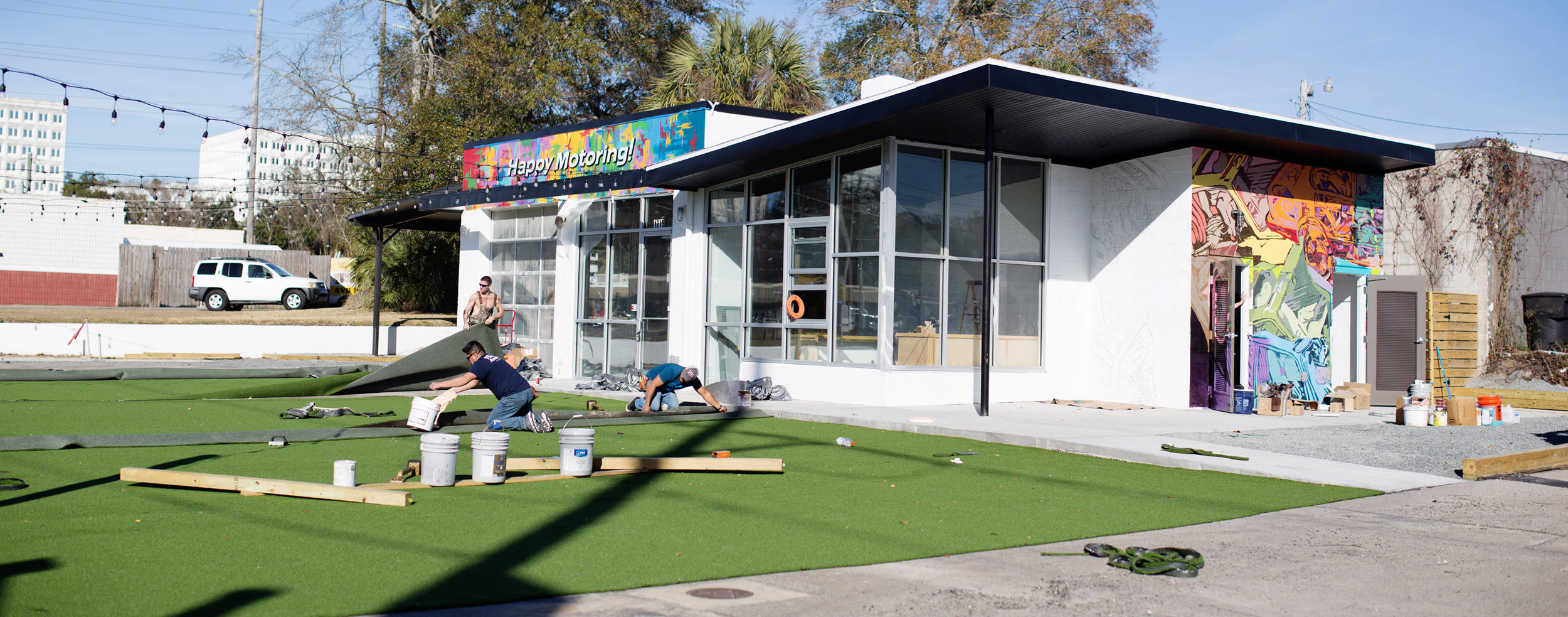
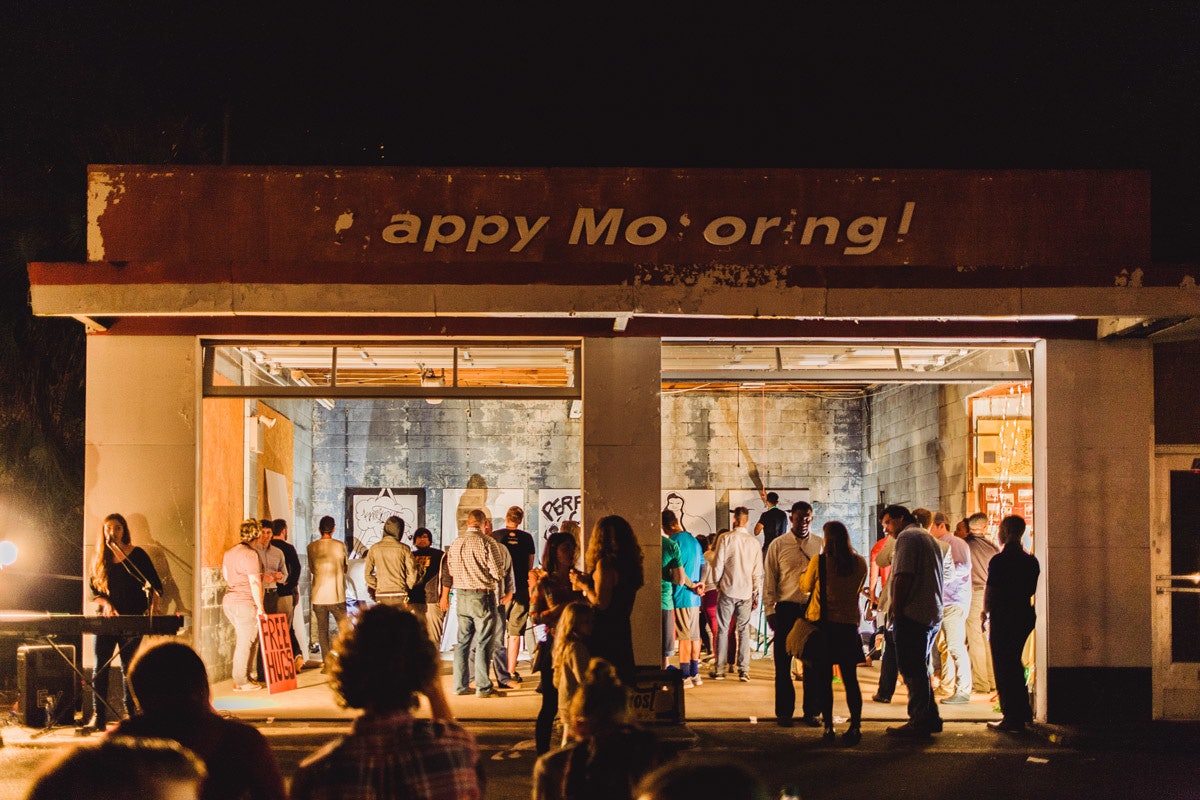
It all started with an abandoned Esso gas station on the Southside of Tallahassee. I was ecstatic when Foremost bought it in 2015 to create a community space. The mid-century design of the building was (and is) beautiful, something to be preserved, and we knew that creating something locals would get excited about meant bringing them in as co-creators.
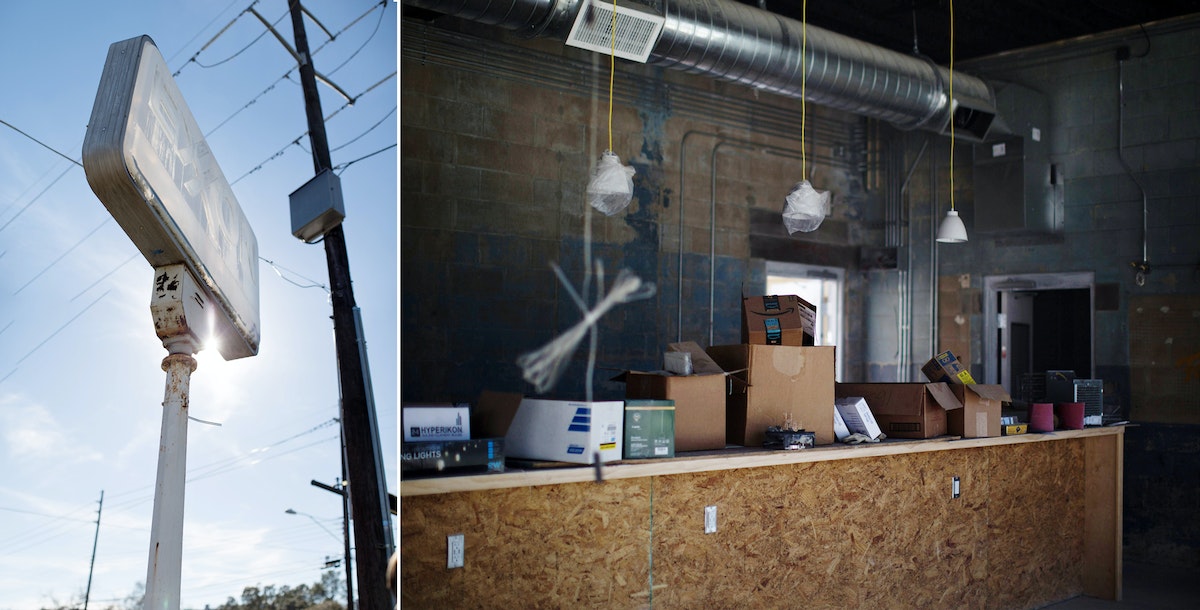
So we organized an event where Southside inhabitants could tell us what they wanted, inviting our friends at Street Art Tallahassee to put together a pop-up gallery and Juniors Roasted Coffee to host a campfire that would bring people together.
A shared vision
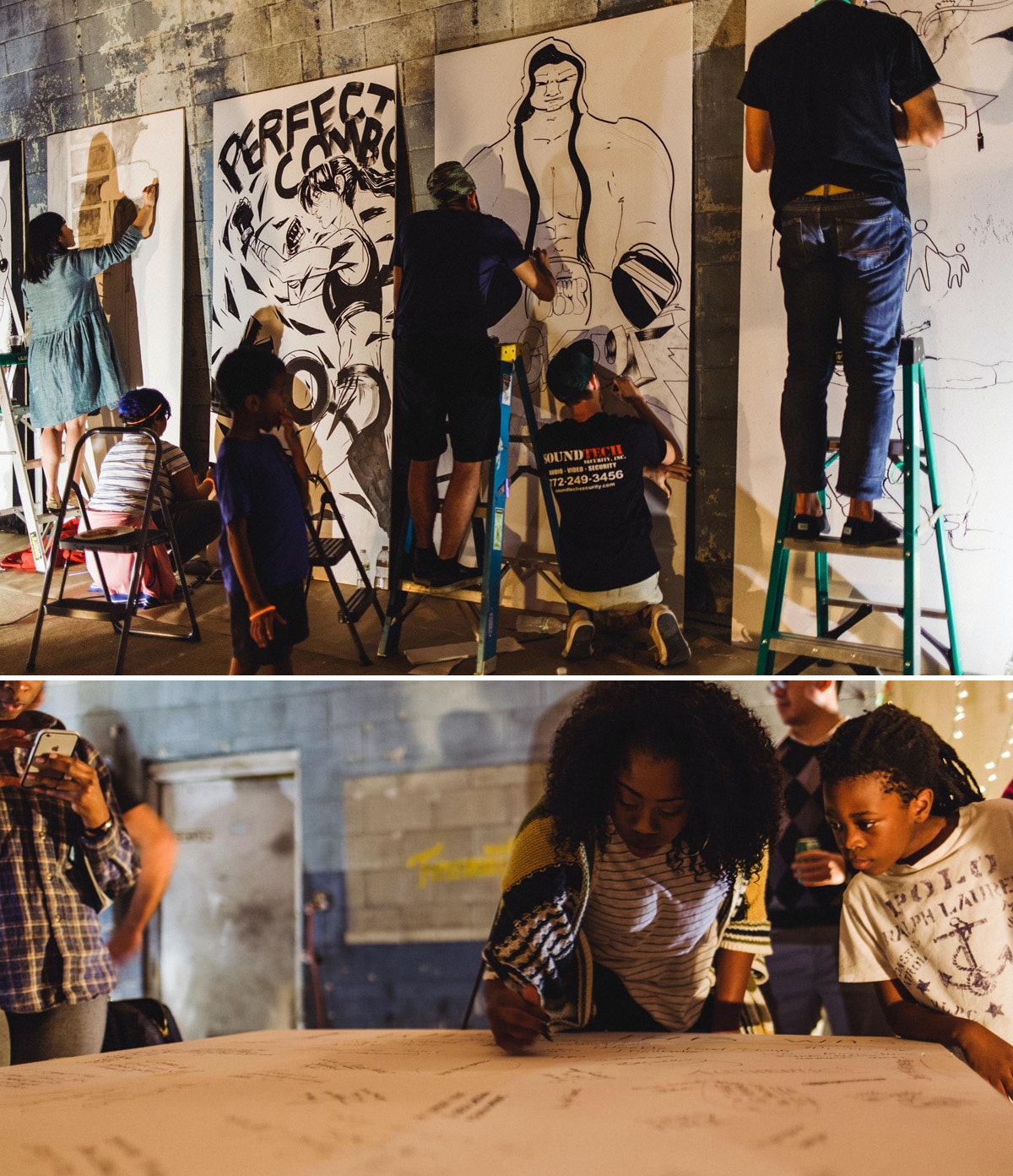
Part of what I wanted to do in creating Foremost was to show the city how many talented creatives live here. So, for the community event, I rallied five of the best young artists I knew in the illustration scene to battle it out in a Battle of the Boards (based on Ink Wars, an awesome event series put on every year in Georgia at Creative South.) The illustrators were each given an inspirational word and an hour and a half to fill an eight-foot board. The theme was "knockout."
We reserved two of the boards for the Southside community to write down their ideas—big, small, impossible, and plausible—about what the space might become.
Video by Conner Hill.
Building community comes from listening to diverse voices. Too often, we divide ourselves into bite-size neighborhoods or groups that lack a space for hearing each other out. We hope Happy Motoring will become that space—by giving everyone a chance to contribute, we’ll have all of the pieces we need to start building something local and real.
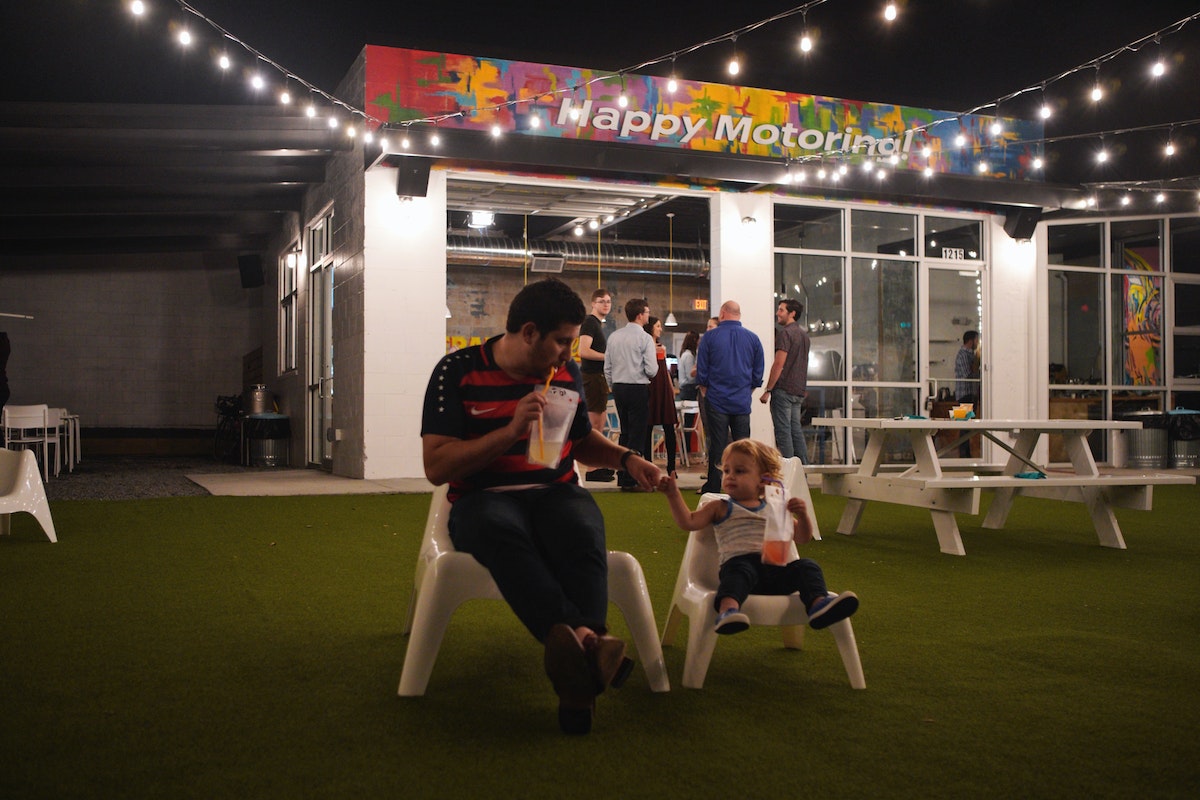
Want to do the same in your hood? It might be easier than you think. Organizations like the Knight Foundation fund grassroots urban innovation in cities. You can start small—create a meetup group, find someone with an empty lot and start a weekend market, or invite some food trucks and organize pop up events. Plant a community garden. Hold group bike rides. Whatever feels right to gain trust and start a dialogue in your hometown.
And if you’re interested in joining the next event in Tallahassee, be sure to follow our updates and join us for Happy Motoring Station’s official launch on March 8, 2018!
When you hear about “design hubs,” your mind may not instantly jump to Tallahassee. But small communities have just as much passion for design as larger metropolises—they just lack the resources to attract the same attention. Though I live in a big city now (Boston), I learned a lot about the importance of community from working and growing up in small towns in Florida.
A Cartography Nerd's Guide to Custom Map-Making
How to one designer used public data to create an interactive map of San Francisco tennis courts
Sure the game is fun (although neither of us is very good), but what interested us more were the distributed locations of the courts around the city. Spread out across the city like sprinkles on a hipster cupcake, these tennis courts would be a great new way to explore San Francisco. And it would keep us busy for at least the next couple of years of Saturdays.
There was only one problem. I couldn’t find a decent tennis map of San Francisco. I wanted a map that was useful, of course, but also one that was well designed. So I decided to make one myself and give it to my wife as a birthday gift, with the goal of making it attractive enough that she would agree to hang it on our wall, but also useful enough that we would actually make it a centerpiece of our new Saturday hobby. And lastly, I wanted to visualize the MUNI bus routes to each court (since—oddly—riding the bus is another avocation that my wife enjoys).
My starting point was the only map I could find—a fantastically unattractive google map that shows the tennis courts of San Francisco in 2003 graphic design glory.
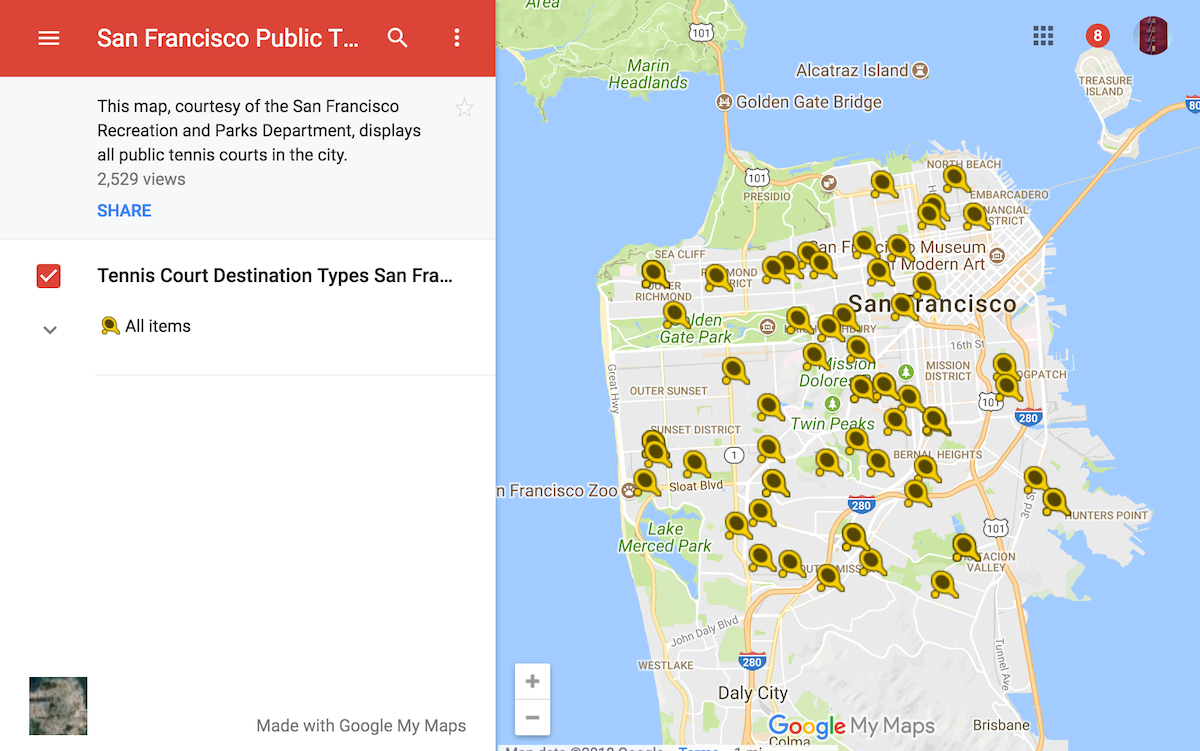
A tennis map of San Francisco in all its 2003 graphic design glory.
But this was a start! I downloaded it as a KML file. What’s a KML file? It stands for “Keyhole Markup Language” (I have no idea what this means), but what it does is important. With a KML file of the tennis courts, I could manipulate the data file in ArcGIS or QGIS, two enormously powerful pieces of cartography software. For anyone looking to get into amateur cartography, I strongly recommend GQIS. It works on a Mac (which ArcGIS doesn’t) and its cost (zero dollars!) outweighs its bugginess.
My next stop was DataSF.org, which has lots of great open source data, including maps of the city. What I was looking for here was something called a Shapefile, a geospatial data format that nerdy geographers use. I found one corresponding to San Francisco neighborhoods and another for San Francisco parks. Lastly, I found one for the MUNI bus routes of San Francisco.
Next it was off to QGIS to combine my various datasets into a single map.
First there were neighborhoods, then tennis courts, then parks, then bus lines.
With a couple of tweaks, I was able to label the tennis courts and isolate the MUNI bus lines according to route number, so that it looked less like a giant red spider web.
There are many a professional cartographer out there who would have kept playing in QGIS to make their map a bit prettier. But I’m a designer, and the sooner I’m able to get out out of QGIS and into the Adobe Creative Suite, the happier I feel (and the higher likelihood that the final design of the map will be something that someone is willing to hang on a wall). Luckily, QGIS has an option to export a file as an SVG file (a vector format that can be opened by Illustrator).
Post-export, the file looked like this.
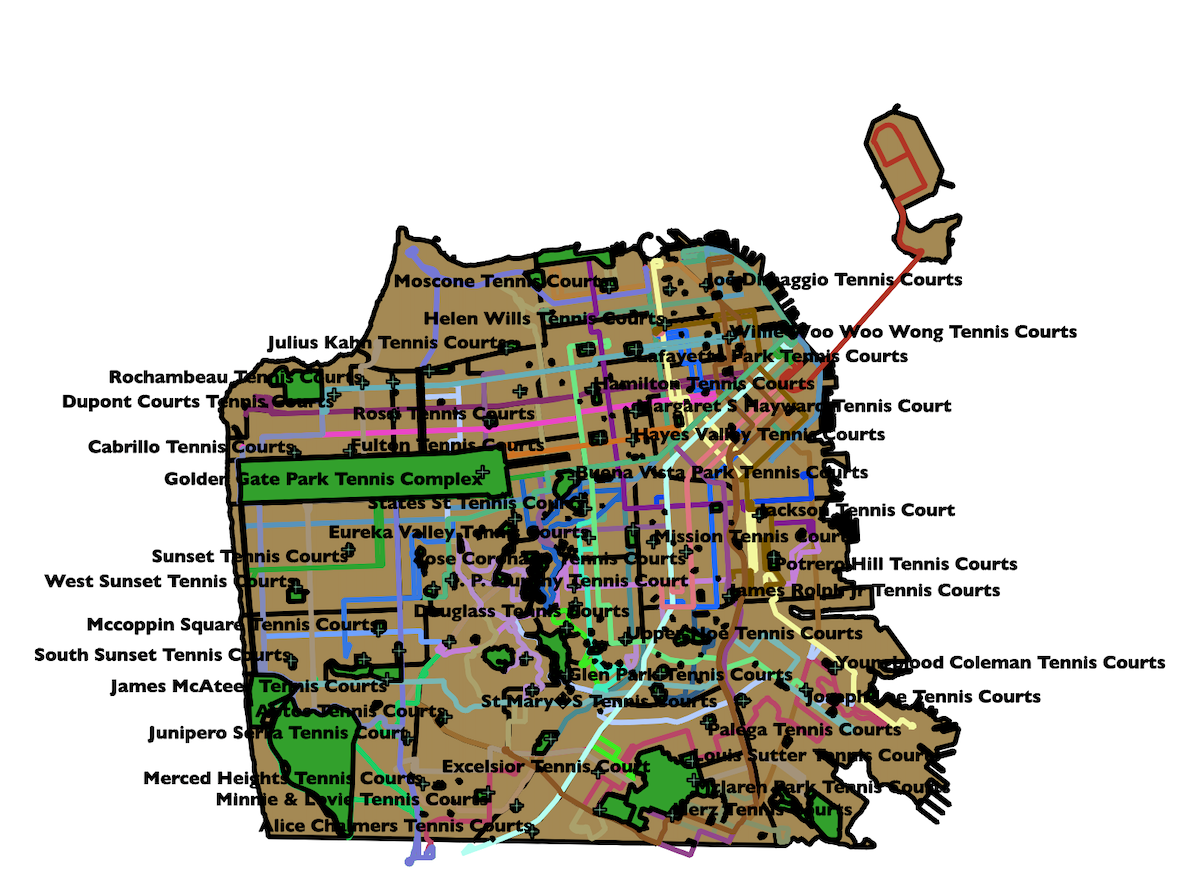
You wouldn't hang this baby on the wall?
Wait, what? Why does it look worse? Totally natural and easily fixable. I isolated each layer (parks, tennis courts, MUNI Lines, neighborhoods) and then got to work playing around with colors and stroke weight and other good stuff, all of it so much easier because I was working with a piece of software most designers are familiar with.
At some point during this process, my day job at IDEO led me to Amsterdam. While there, I was inspired by the fantastically-designed Dutch train maps and a pro tip from my graphic designer colleague (Anthony Stimola) that the Dutch font of choice is DIN. Back in front of my computer, I created a look and feel for the map inspired by my travels.
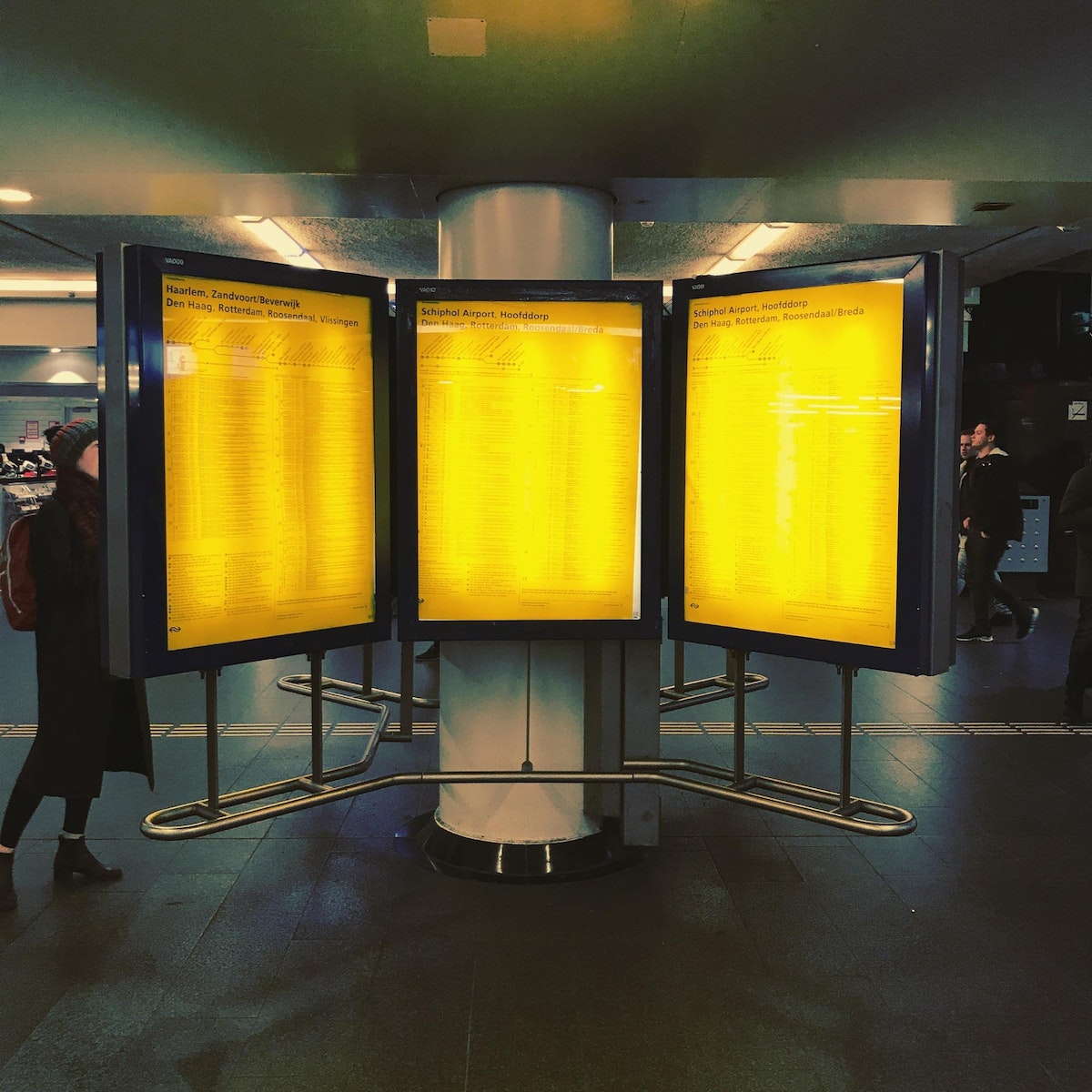
A trip to Amsterdam inspired the look and feel for the finished map.
Next up was the laborious process of determining which bus lines one could actually take to each tennis court. My approach was 100% analog, starting from the top of the alphabetical list of tennis courts (Alamo Square) and marching straight through to the end (Youngblood Coleman), noting all of the bus lines that had a stop within reasonable walking distance to a court. I discovered that Helen Wills court in North Beach takes the prize as most MUNI-accessible tennis court (it's served by nine bus lines!), while five tennis courts around the city are served only by a single bus line.
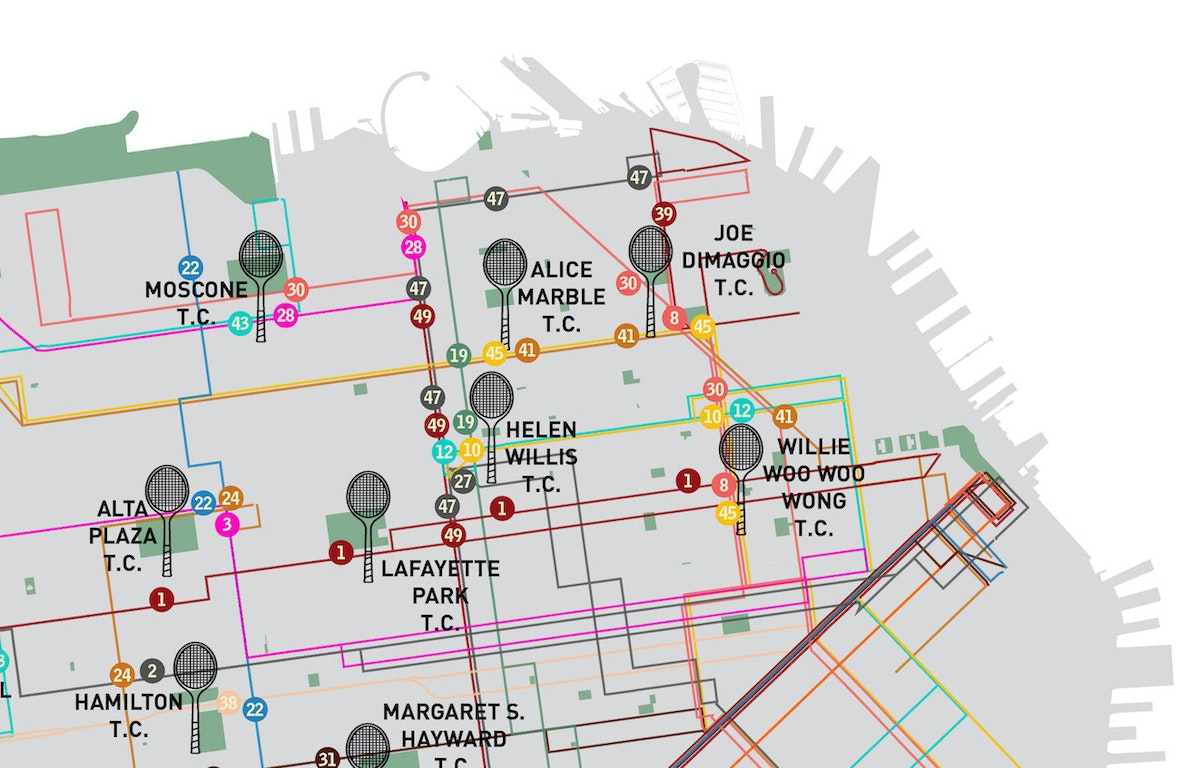
The painstaking work of manually matching tennis courts to nearby bus lines.
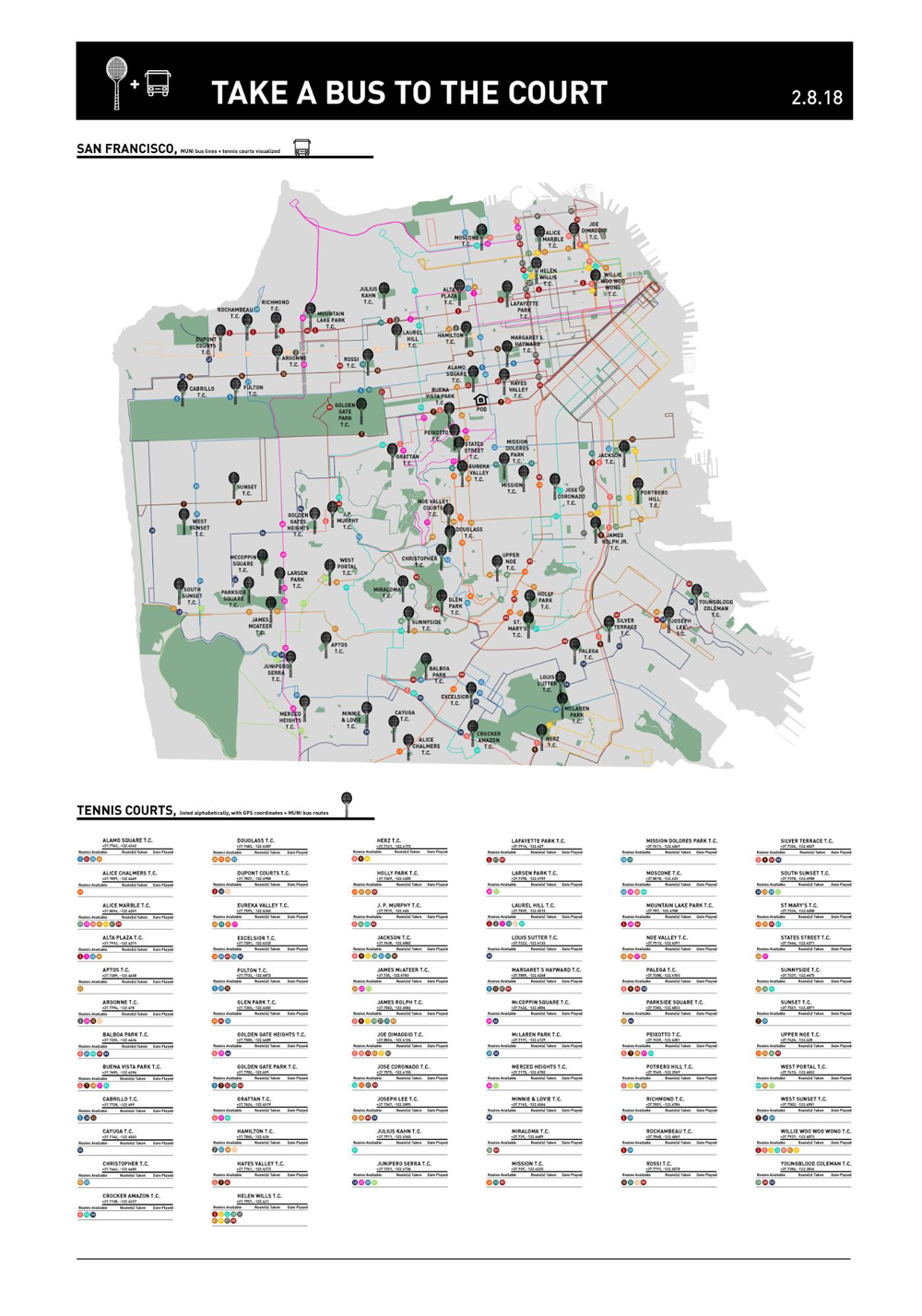
Lastly, I considered how this map would be used. Of course I was hoping that my wife (and others) would find it attractive enough to hang on a wall in full analog glory. But this is 2018, and in order to be useful, the map also needed some connection back to the digital world. I added GPS coordinates and a clickable URL link to a Google Maps location for each tennis court.

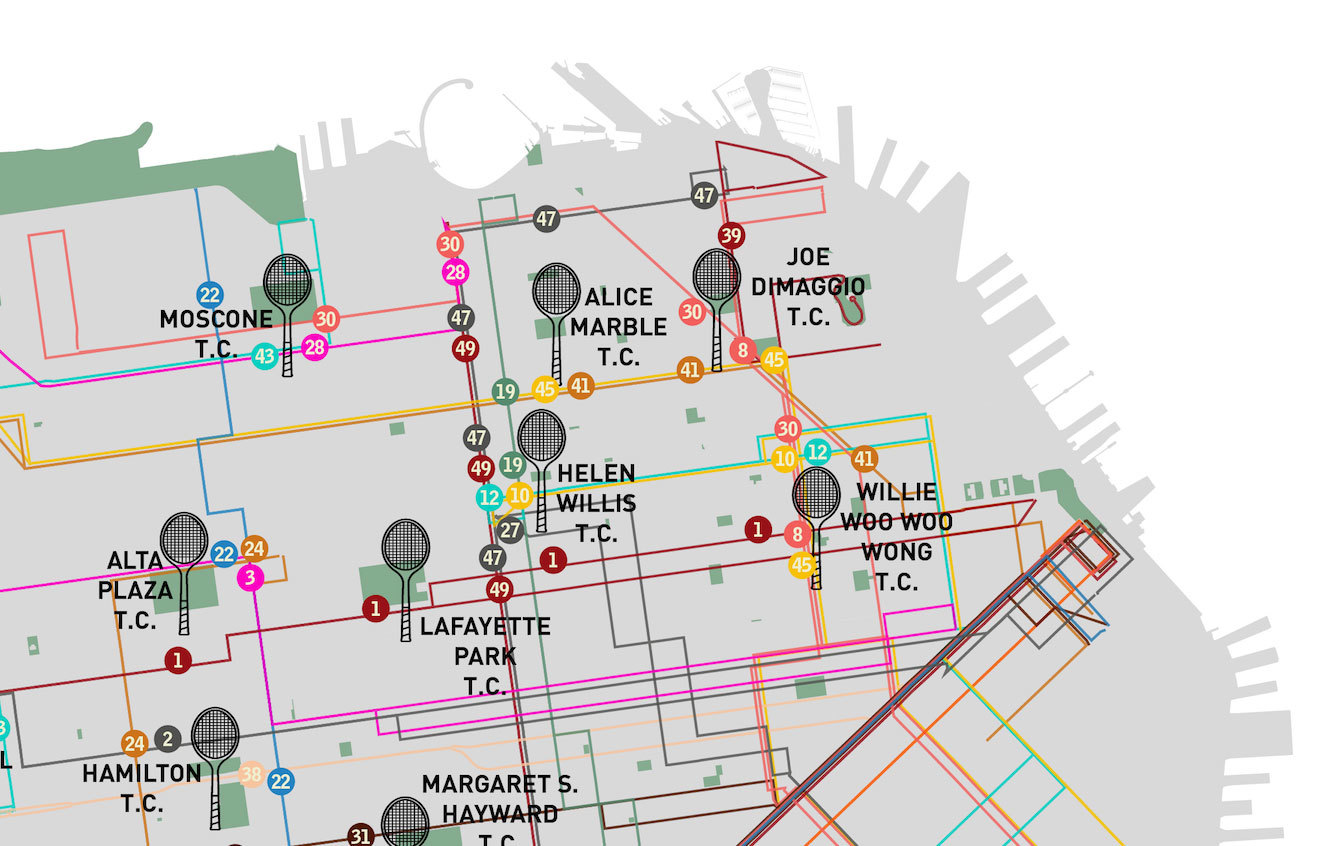
A detailed view of the court's location and the corresponding bus routes
That’s it! My wife was happy with her birthday gift, and agreed to hang it on our wall. This past weekend, we used our new map to find the McCoppin Square court in the Sunset neighborhood. A few minutes after we started playing, two women arrived. Unfortunately, they would need to wait until our 30 minute time limit had elapsed. Eager to play, they asked us if we knew of any other tennis courts in the area. In fact, we did. I texted her a PDF of my new map and off they went to a nearby court. Hooray for the power of a good map!
My wife and I are city people, and our only family car is a Vespa that is much too slow to cross any bridges. So most weekends, if it’s nice out, we’ll chart an urban hike through San Francisco, targeting a different neighborhood and a different park. This has kept us occupied for the last few years. But they don’t call it the 7x7 for nothing—San Francisco is actually a small city. So my wife and I have started to play tennis.
A Day in the Life of a Graphic Designer
Follow an IDEO designer through a day of research, prototyping, and inspiration
7:10 AM: A Reluctant Jog
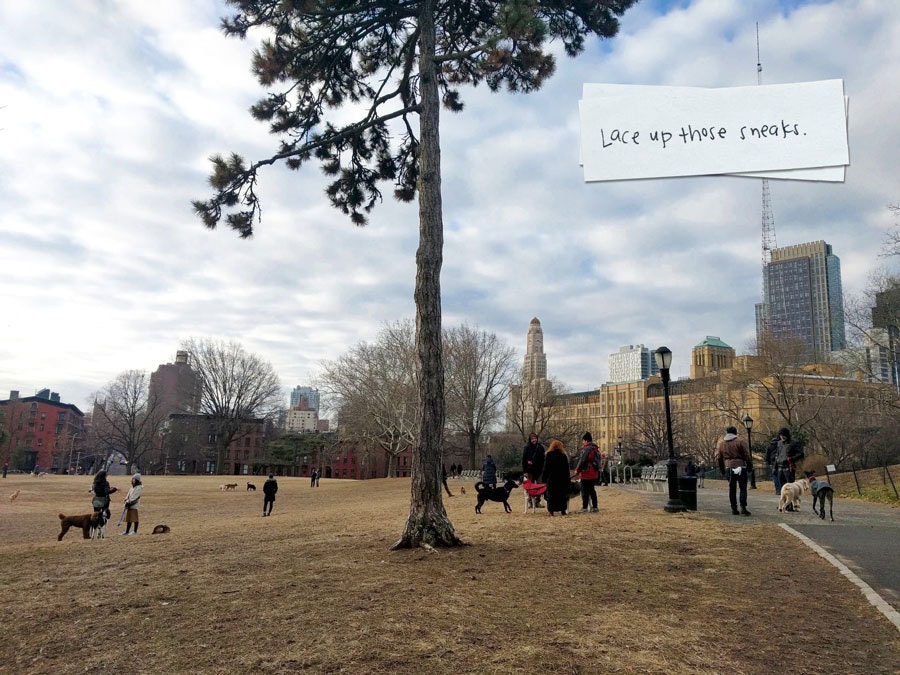
I run to Fort Greene Park, where I’m rewarded with a Seurat-like tableau of what seems like all the dogs in Brooklyn. I’m not a jogger, but I’m doing a six-week food-and-fitness challenge with coworkers. I'm grateful for the peer pressure, because it may be the only thing keeping me going.
7:45 AM: A Bristling Problem
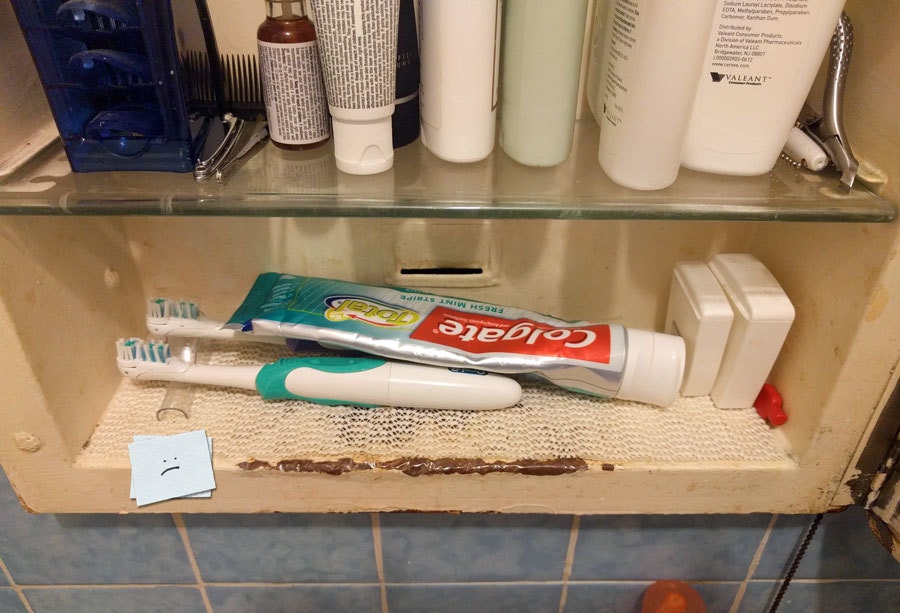
As I brush my teeth and stare into my rusty medicine cabinet, I decide it’s time do something about the crowding in there. Since the space is so small, I probably can’t find an off-the-shelf fix, but maybe I can come up with a bespoke solution.
8:35 AM: Swift Passage
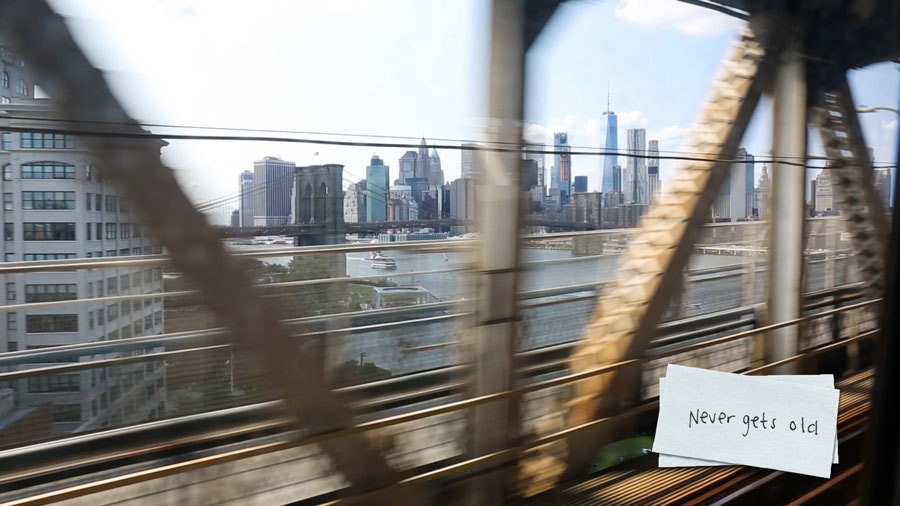
This sweeping view across the East River and the Manhattan skyline is my favorite part of the morning commute. It reminds me of the hope and excitement I felt when I first moved here 12 years ago. On the way, I steal some winter fashion ideas from my fellow commuters, noodle through a crossword on my phone, and listen to a podcast about the perils of multitasking.
9:10 AM: I Loaf This Place
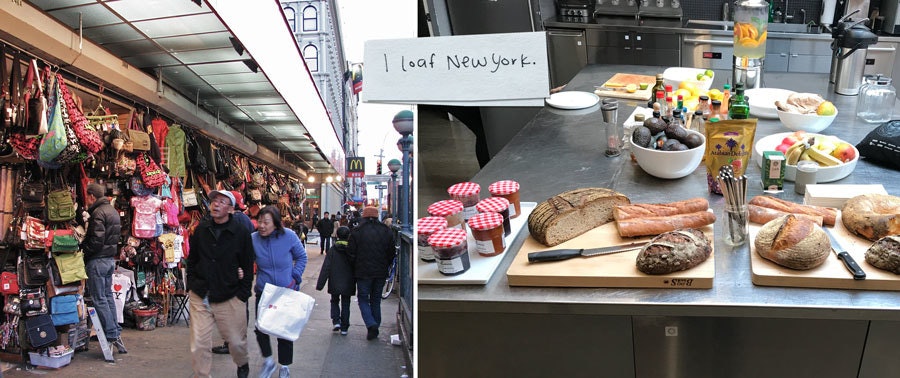
IDEO New York sits on an invigorating corner of the city where tourists, tchotchkes, and street food collide with colorful chaos. Upstairs in the studio, the best part of the week awaits: A selection of delicious, crusty bread and a variety of spreads. It’s Loaf Day! Bonus: Someone has scrawled on the kitchen chalkboard: “Might as well face it, you’re addicted to loaf.”
10:00 AM: Team Standup
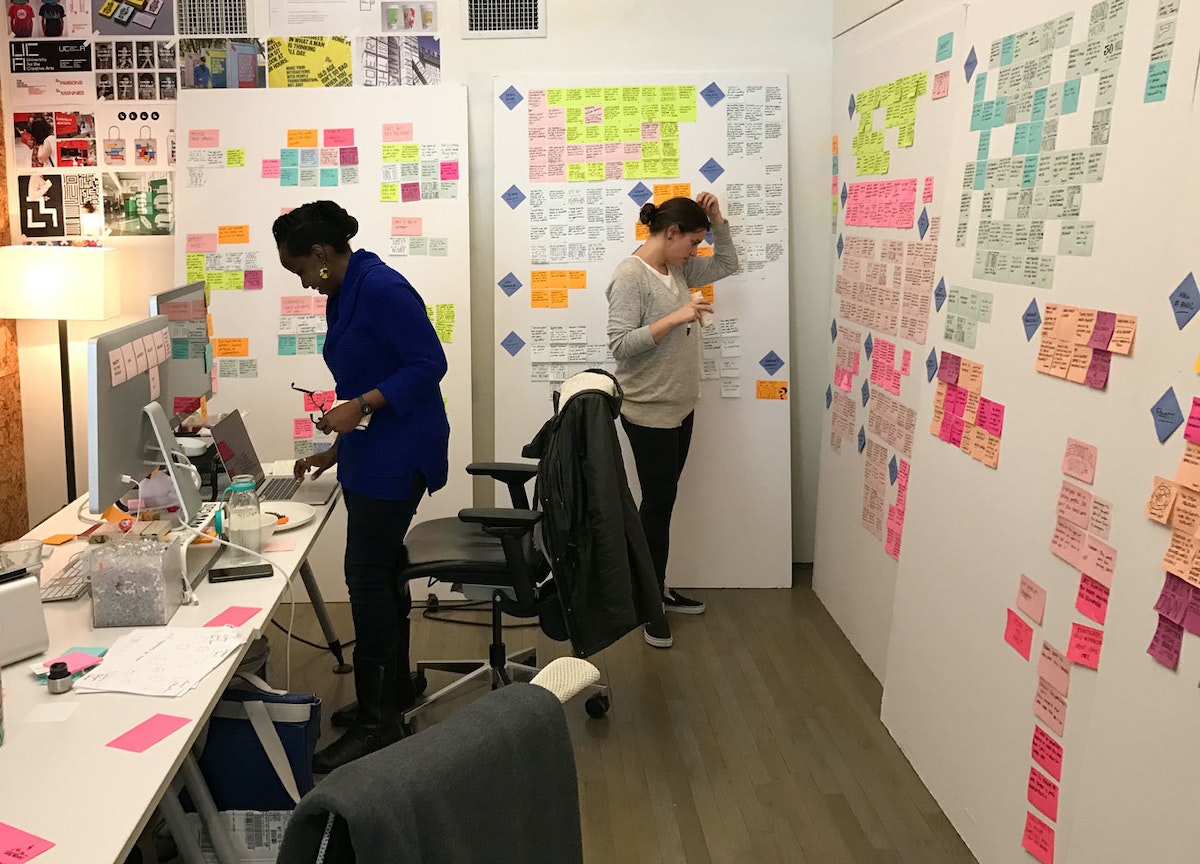
Our project is about investigating how cities and workplaces can support human potential and resilience. Today we’ve got a lot to do, including hosting some research participants in the afternoon. Deliberately coming together at the start of each day helps our team align and stay on track. In our project space, we take turns sharing our energy level on a scale of 1 to 10 and write a long punch list for the day.
10:30 AM: Download & Synthesis
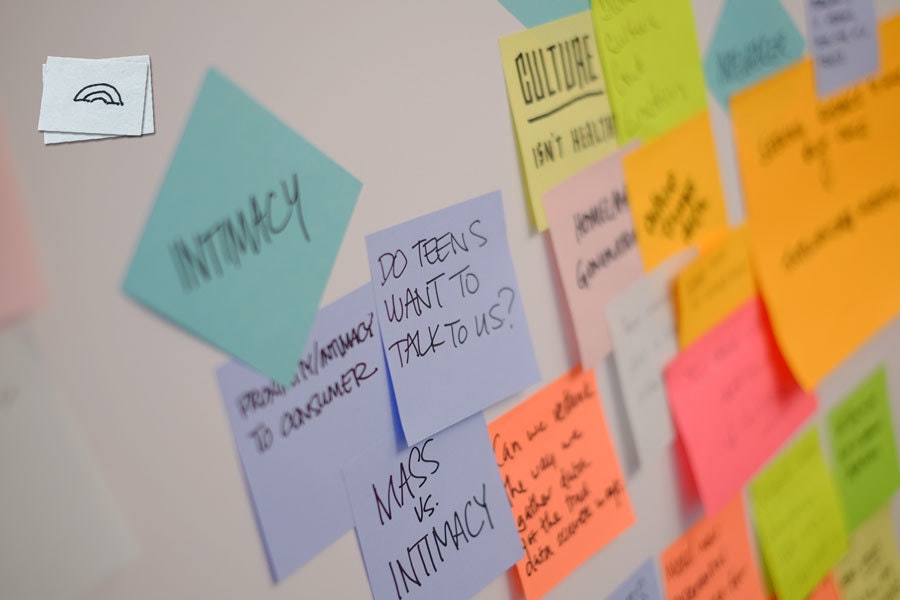
We’ve spent the last few days traveling for research and speaking to lots of people in the field. We transcribe the important things we’ve learned, filling Post-it notes and boards with quotes and observations. We start move things around into clusters, looking for patterns that will lead us to insights. One theme we're seeing is how hiring systems often overlook valuable skills that are hard to quantify, kicking qualified applicants out of the process early. “So much of the hiring process is gaming to get past the system,” reads one quote.
11:30 AM: Scrappy Prototyping
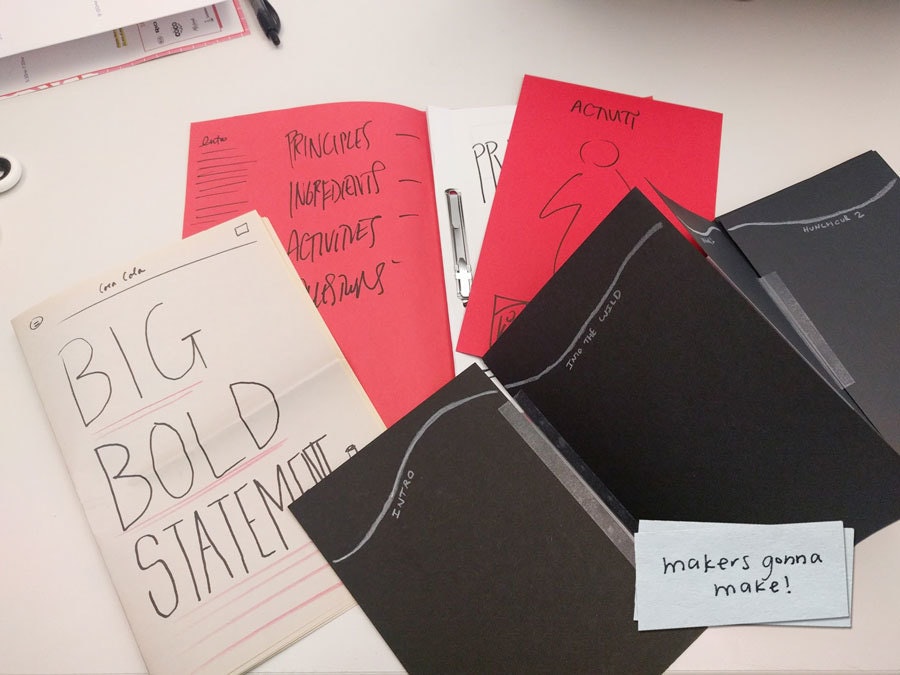
We take a break and head to the office makespace. We think we might want to make something printed, so we grab some construction paper and markers and each create some prototypes. Should we make a gallery walk of posters? A tabloid-size newspaper printed on pulp? Maybe a giant book with an accordion fold!
12:30 PM: Fun With Lasers
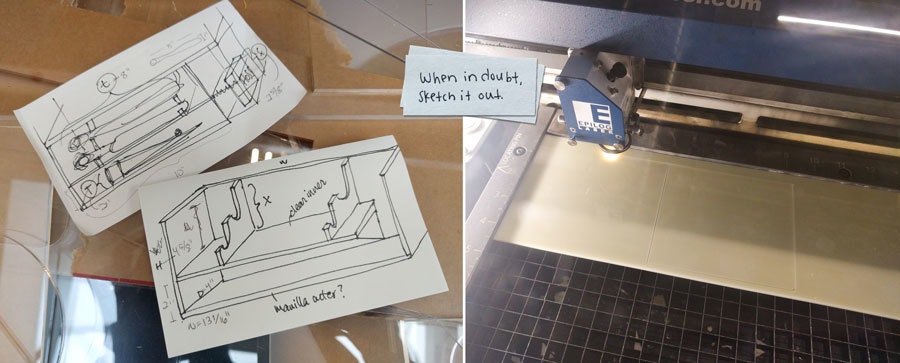
It's lunchtime and I can’t stop thinking about the toothbrush situation. I make some quick sketches of a slot-in shelf that would allow the toothbrushes and toothpaste to sit above the floor of the cabinet, still be easily accessible in the short vertical space, and cover up the unsightly rust. I transfer the specs to Adobe Illustrator, grab some spare acrylic, and fire up the laser cutter. A few minutes and a little glue later, I’ve got a prototype of a tiny shelf that I can take home and try out.
3:00 PM: Learning from Users
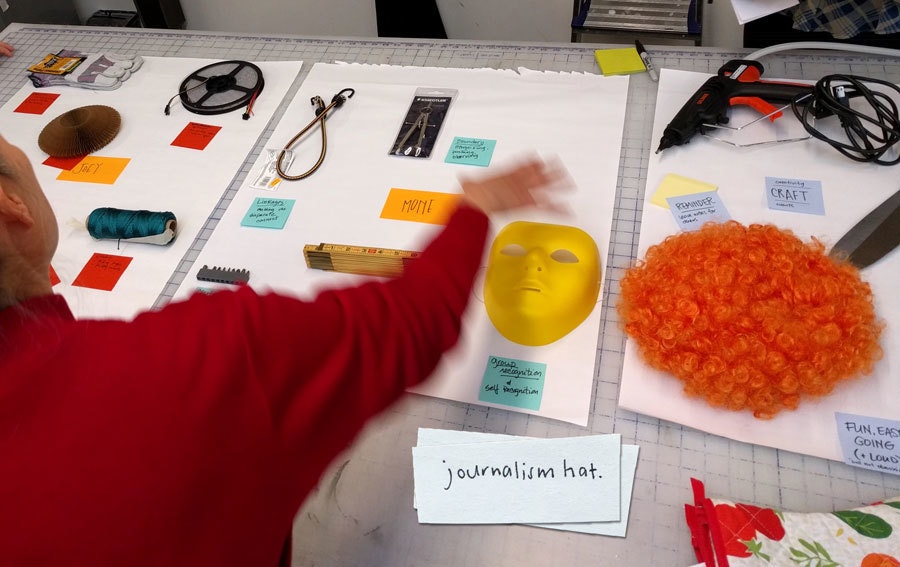
As part of our research, we’ve invited a few people into the studio to share how they think about themselves in relation to their jobs. We take them through a hands-on exercise, asking them to pick objects that represent the key attributes and skills they value in themselves. As they describe their collections, we begin to see a rich picture of their work-life experiences and connections.
4:30 PM: Moodmaking
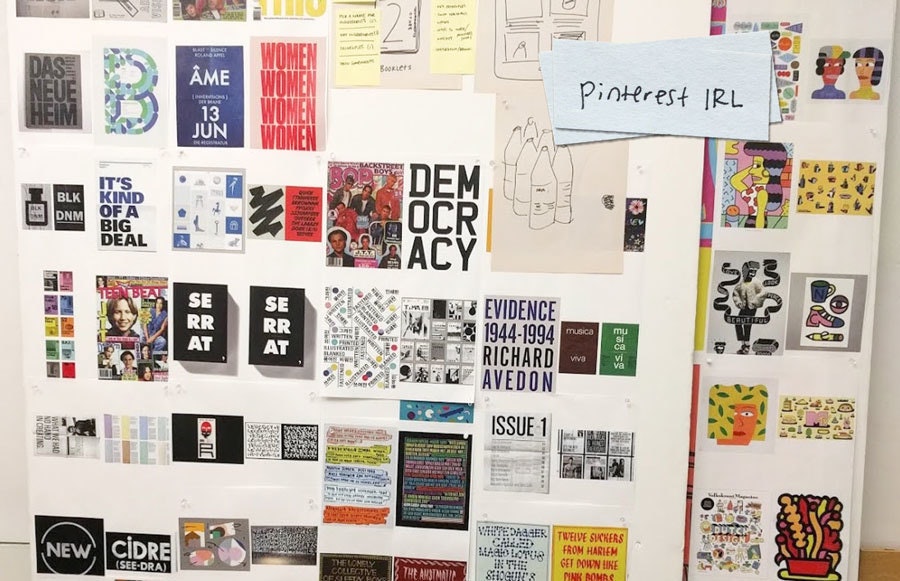
I gather visual inspiration for our deliverable. I troll design sites, look through books, and research brands and designers that have been on my radar recently. As I pin up images, I think about how the various elements of typography, color, photography, illustration, and scale could come together to create a unique look and feel for everything we’ll design for our client and the people they serve.
6:30 PM: A Melodic Exit
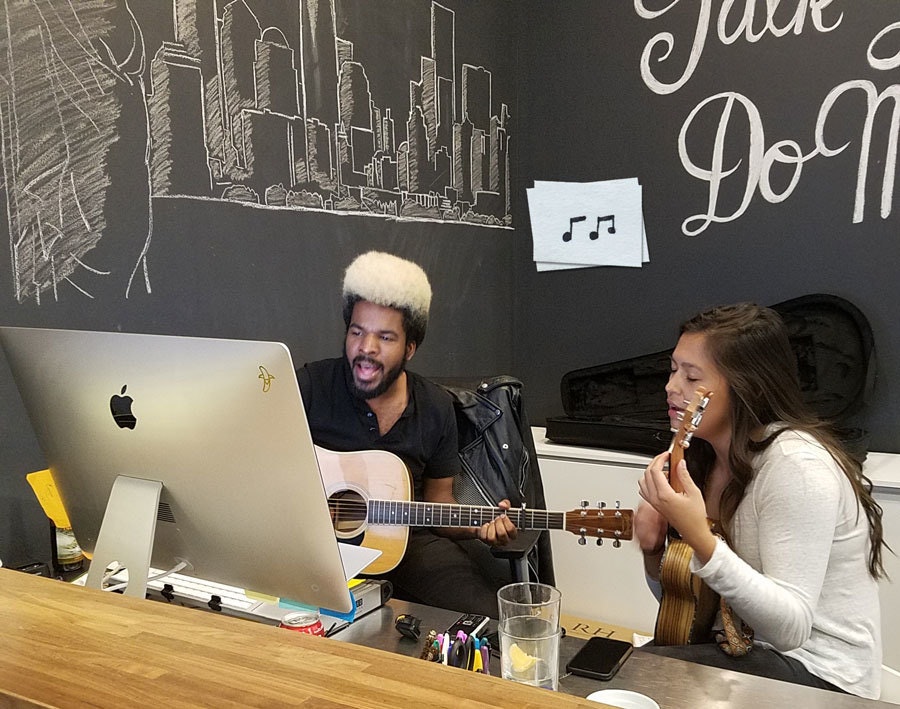
Time to head home. As he often does at the end of the day, Jared, our experience lead and sometime maestro, is slaying with some live guitar and singing. Today he’s accompanied by Kati on ukulele, and together they send us off down the elevator to the strains of "Wild Horses."
7:20 PM: Installation
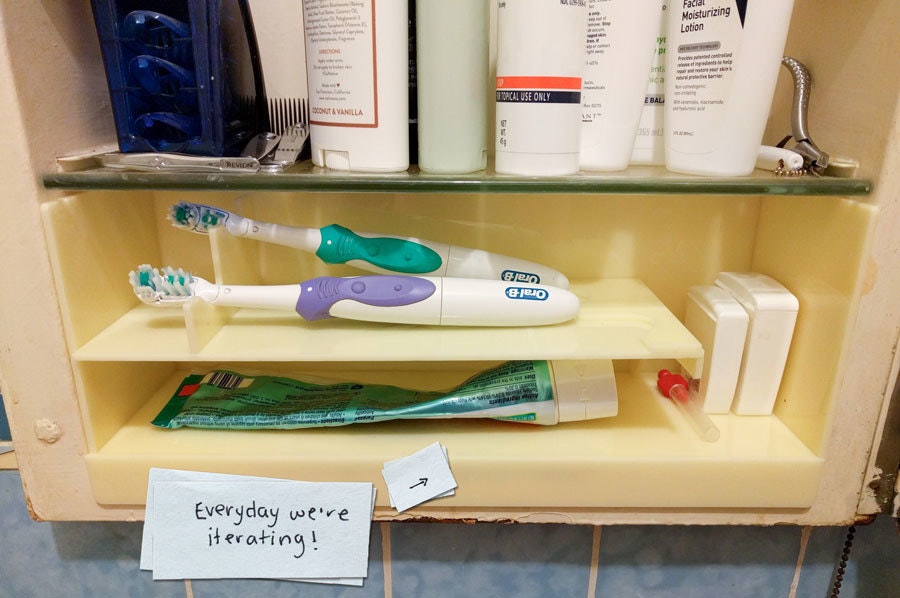
It’s in! The tiny shelf is a big improvement, but in practice it’s still a bit tough to reach the toothbrush in the back. Next iteration needs more simplicity and maybe some better color matching. It’s back to the sketchpad for tomorrow’s prototype.
When people ask me what I do for a living, what I really want to do is just show them. For me, graphic design is about finding the best way to bring ideas to life: posters, film, installation, animation, or even objects. So, a day at IDEO is following ideas wherever they may lead and getting distracted (I mean, inspired) along the way.

Lindsey Turner
I’m passionate about building brands, products, and experiences that help organizations show up with meaning and momentum.
I help organizations cut through complexity by shaping how they show up, through brand strategy, identity, and storytelling.
Working at the intersection of brand and business, I bring an editorial eye and a bias toward making—turning ideas into tangible experiences that people can understand, trust, and believe in.
My work spans government, healthcare, financial services, media, and consumer goods, from launching Gen Z-focused ventures to building innovation labs and reimagining legacy brands. I relish moments of ambiguity and enjoy translating across teams, perspectives, and priorities to move ideas forward.
I started my career in editorial and digital design, shaping cross-platform experiences and identity systems in publishing and agency environments. That foundation still shapes how I work today: I’m detail-oriented, collaborative, and overreliant on the Oxford comma. I hold a BFA in Visual Communication from the School of the Art Institute of Chicago.

Rachel Young
My work helps organizations see who their products aren't working for—and build the will and the tools to do something about it
For 25 years, I've asked the same question: Who does this design exclude—and what are we going to do about it?
My work spans human-centered strategy, inclusive design, and qualitative research, with clients ranging from Microsoft, Google, and Verizon to the National Science Foundation, and San Francisco Unified School District.
Before IDEO, I taught elementary school in East Palo Alto and spent a decade doing design work with social service organizations—where I learned firsthand what it costs people when systems are built without them in mind.
I am currently writing User Error, a nonfiction book about digital access and the design decisions behind it. I live in Oakland, California.

Brian Pelsoh
I lead with craft, ensuring our work is creatively excellent: rooted in deep human insight and imagination, while also grounded in the realities of business and technology.
My expertise spans brand, communication, and product design across tech, education, the arts, and social impact.
I believe great work demands both high-level vision and obsessive attention to detail, and only happens through collaboration.
I bring an inclusive, hands-on approach and a deep understanding of business, which enables me to consistently deliver excellence while always asking why.
Before joining IDEO, I worked at the brand firms Pentagram and VSA Partners. I began my career as a designer, leading teams at the School of the Art Institute of Chicago and the Milwaukee Art Museum. I hold an MFA in graphic design from Maryland Institute College of Art and a BFA in communication design from the Milwaukee Institute of Art & Design, and have taught at some of the best design schools in the US.

Tony Wong
I am responsible for IDEO’s long-term success in China and working with clients to use design as a tool to enable growth.
I am responsible for IDEO’s long-term success in China and working with clients to use design as a tool to enable growth. Specifically, I have helped Chinese companies design holistic brand solutions through the development of their products, communication, services, and innovation teams, and I have helped multinationals expand their presence and influence in China.
I advise global leaders on developing China-led innovation and capabilities.
In over 15 years in IDEO Shanghai, I have worked on projects that use design to elevate the quality of the experience of healthcare products and services, streamline processes that increase productivity, create spaces and programs that promote and enable inclusive communities, and build next generation mobility solutions that are planet-positive.
Before joining IDEO, I worked at Philips Electronics and the Electrolux Group in Italy, the Netherlands, and Singapore on a number of breakthrough commercial products. I am a member of the Young President Organization in Shanghai.

Building a personal AI for the messiness of life: Sida Li
Most AI products today are built for work—a space with clear problems and established systems. One founder noticed a gap: personal life is messier, harder to systematize, and mostly left behind by the AI boom. So she built Cue, a personal AI that lives inside iMessage and group chats, to go where the other tools haven't.
In this episode, Becca Carroll, IDEO's Chief Strategy Officer, talks with Sida Li, co-founder and CEO of Shared Context Lab, about staying anchored to a human need while the technology around her keeps changing shape, why she treats her business model with the same rigor she'd bring to a product, and what it feels like to build a company at this particular, disorienting moment in AI.
The conversation also gets into how Sida makes design decisions: the language Cue uses to describe itself, the tradeoffs behind building inside iMessage instead of a new app, and a real story about a business idea that didn’t pan out.
This is the second in a two-part series profiling founders from IDEO's Startups-in-Residence program. The first conversation is with Johannes Seemann, founder of Sooner, on designing GenAI for the emotional side of money.

Designing GenAI for the emotional side of money: Johannes Seemann
Most personal financial tools are built to run the numbers and optimize towards a budget. While that works for some, most people experience money as a lived relationship that does not neatly fit into a spreadsheet. Johannes Seemann and Becca Carroll discuss why money is emotional before it is mathematical, and what a human-centered approach to building a generative AI financial product looks like in practice.

The curious leader's edge in uncertainty: Scott Shigeoka
Mina Seetharaman talks with Scott Shigeoka, author of Seek and Head of Curiosity Cultivation at the Eames Institute, about what distinguishes genuinely curious leadership from performative curiosity, how power dynamics shape curiosity, and why practicing curiosity can restore energy rather than drain it.

How constraints make us more creative: David Epstein
Mina Seetharaman talks with David Epstein, author of Inside the Box and Range, about why total freedom often produces average work, how leaders can design useful limits on purpose, and what organizations such as General Magic and Pixar reveal about the relationship between boundaries and creativity.
Looks like you might be in search of something very specific?
Or reset the filters above and try another angle.
Here’s some random inspiration

Podcasts about creative leadership

Articles about the power of prototyping
