
.svg)




A return to simplicity with a bottled tea brand
Bringing the grounding and authenticity of tea culture into the rhythm of modern life.
Master Kong (known internationally as Tingyi Holding Corporation) is number one in market share in both instant noodles and ready-to-drink teas, with over $10 billion USD in annual revenue. While China has a rich tea culture, most sugar-free bottled tea on store shelves markets itself as “healthy” and “tasty.” Wanting to set itself apart from the competition by uncovering new consumer needs, Master Kong reached out to IDEO. Together, Master Kong and IDEO immersed themselves in modern Chinese tea culture and built a new, premium, sugar-free bottled tea brand that resonates deeply with contemporary tea drinkers.
During research, the combined IDEO/Master Kong team took a two-pronged approach to uncovering new opportunities: industry exploration and consumer research. The team visited various tea-related businesses, from traditional tea houses to modern beverage shops, as well as “third place” tea spaces outside of home or work. They also conducted in-depth, in-home interviews with consumers with various levels of interest in tea, delving deeply into their daily routines to better understand their lifestyles and any emotional or functional needs related to tea.
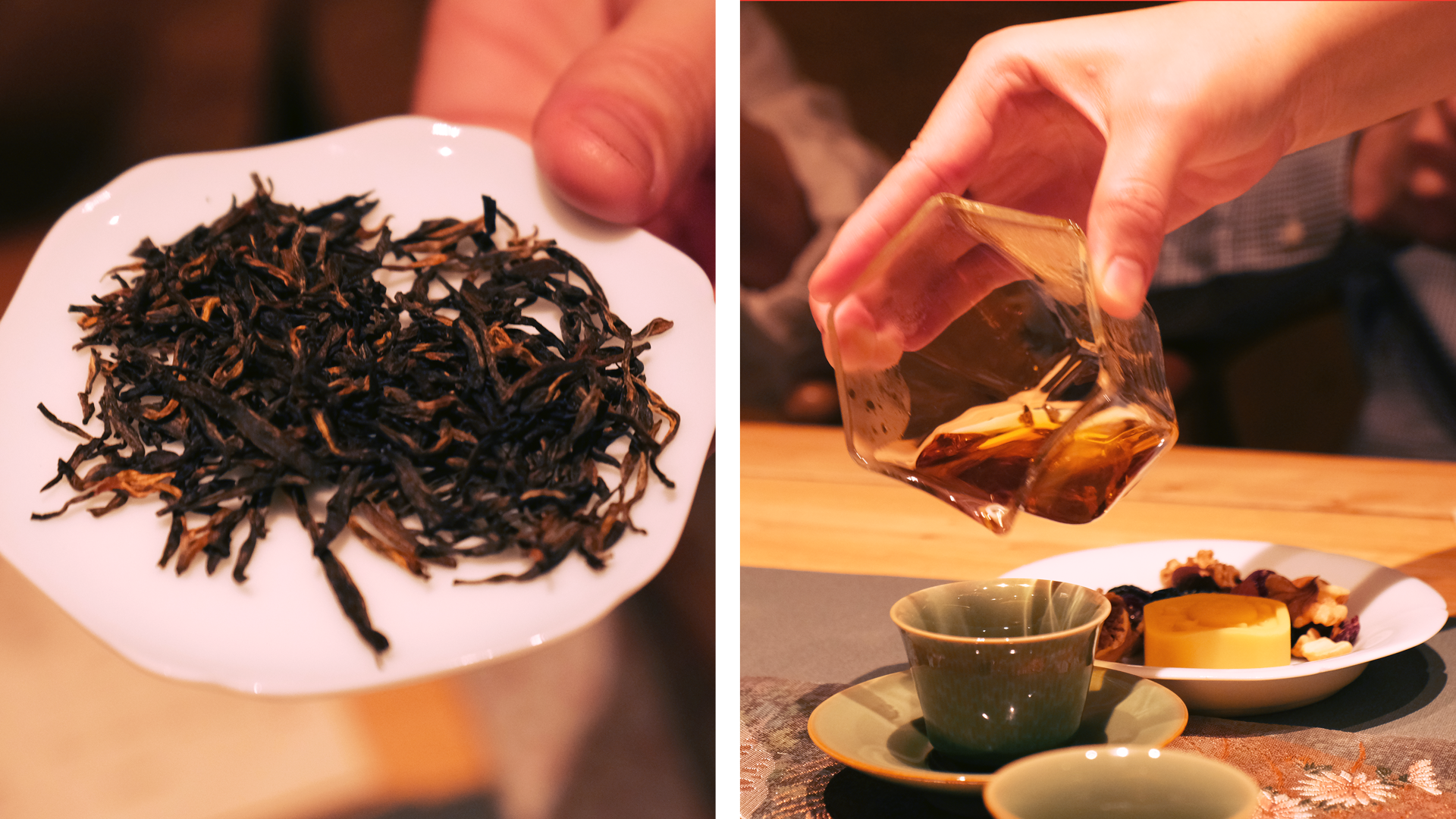
The team discovered that the essence of Chinese tea culture resonated with contemporary consumers’ longing for authenticity, simplicity, and physical rejuvenation in their fast-paced lives. This insight presented a unique opportunity for Master Kong. Instead of positioning its new sugar-free tea brand as merely a “healthy alternative” to other beverages, it could spark a meaningful connection to tea culture, seamlessly integrating into various moments of modern life.
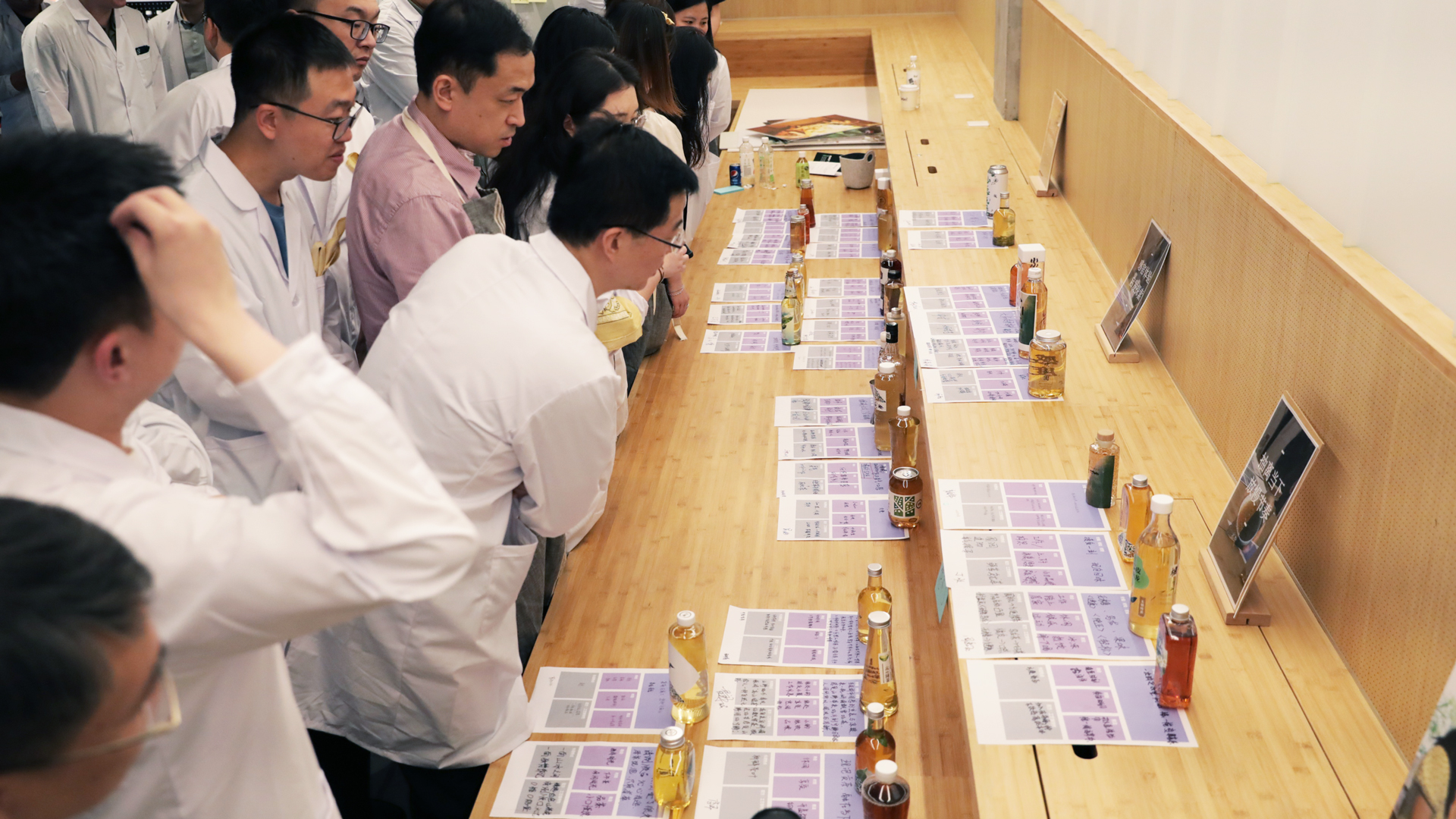
Armed with this insight, IDEO designers and dozens of Master Kong beverage team members participated in a series of immersive, hands-on tea innovation workshops. Teams of experts from R&D, marketing, supply chain, and other company departments temporarily set aside their job titles to explore, iterate, and refine dozens of new tea concepts that were commercially viable, feasible for mass production, and aligned with consumer needs. The cross-departmental collaboration allowed for a broad mix of perspectives, experiences, and expertise, enriching the innovation process.

The co-creation sessions led to a new sugar-free tea product and flagship brand called Cha De Chuan Ren (“Descendants of the Tea”), which celebrates fine, origin-sourced tea and the passion and dedication of tea farmers. The novel concept resonated strongly with consumers and was validated during subsequent rounds of quantitative market testing, ensuring its relevance and market potential.
Cha De Chuan Ren launched with two signature flavors: Tieguanyin (green tea) from Fujian and Pu’er (black tea) from Yunnan. The unique mottled bottle design pays tribute to traditional handcrafted glass containers and the handiwork of tea farmers. The tactile paper label, which features Jia Ma-inspired woodblock illustrations of local tea fields and tea farmers’ hands, nods to the artisanal craft of tea making and the source of the tea inside.
“Descendants of the Tea” debuted on Tmall in April 2024. It claimed the top spot on the commerce site’s Tea Beverage V-List in August and September. Offline, it launched in FamilyMart convenience stores in May and has since expanded nationwide. The new brand received a 2024 Red Dot Award for “Brands & Communication Design.”
“We are honored to collaborate with IDEO, a global leader in innovation, as our strategic partner. ‘Descendants of the Tea’ is not just an exceptional product but also a tribute to the rich heritage of tea culture. Only by continuously integrating culinary traditions with innovation can we sustainably meet consumers’ true needs.”
Richard Chen
CEO, Master Kong (Tingyi Holding Corporation)
“Innovation is incredibly fragile. If even one leader is unsupportive or hesitant, the culture of innovation can collapse. I always encourage my team to take risks, as long as they’re not high stakes. After all, what’s the worst that can happen? At the very least, we’ll have a fair chance at creating something new.”
Wei Hong-Chen
Chairman of Master Kong Beverage Holdings Co., Ltd.
Sugary bottled teas were once very popular in China. Today, rising consumer demand for healthier beverage options has expanded the market for sugar-free tea.
#1
on Tmall’s Tea Beverage V-List, August- September 2024
2024 Red Dot Award Winner
for Brands & Communication Design
A luxury water bottle takes precision engineering to the extreme
Elevating the everyday with next-level design.
Twenty years ago, carrying a single-use plastic water bottle was a status symbol—no more. Growing awareness of the negative environmental impact of plastic pollution, combined with the adoption of healthier lifestyles and social media influencer trends, has made reusable water bottles “it” accessories for on-the-go consumers. While brands such as Stanley, Yeti, S’well, and Hydro Flask own the under-$100 market, fashion brands such as Louis Vuitton, Chanel, Dior, and Prada have etched out a new and growing market for high-end bottles that appeal to discerning, trend-conscious young people looking to perfect their hydration habits.
Spotting an opportunity to disrupt the predominantly utilitarian water bottle market, Steinmann partnered closely with IDEO, tasking the team with developing an industrial design that perfected the tactile and sensory user experience, from drinking and carrying to disassembling and cleaning thoroughly. The collaboration deepened over time, with Steinmann and IDEO working together to develop the high-level engineering concept, the OKAPA logo mark, and packaging ideas.
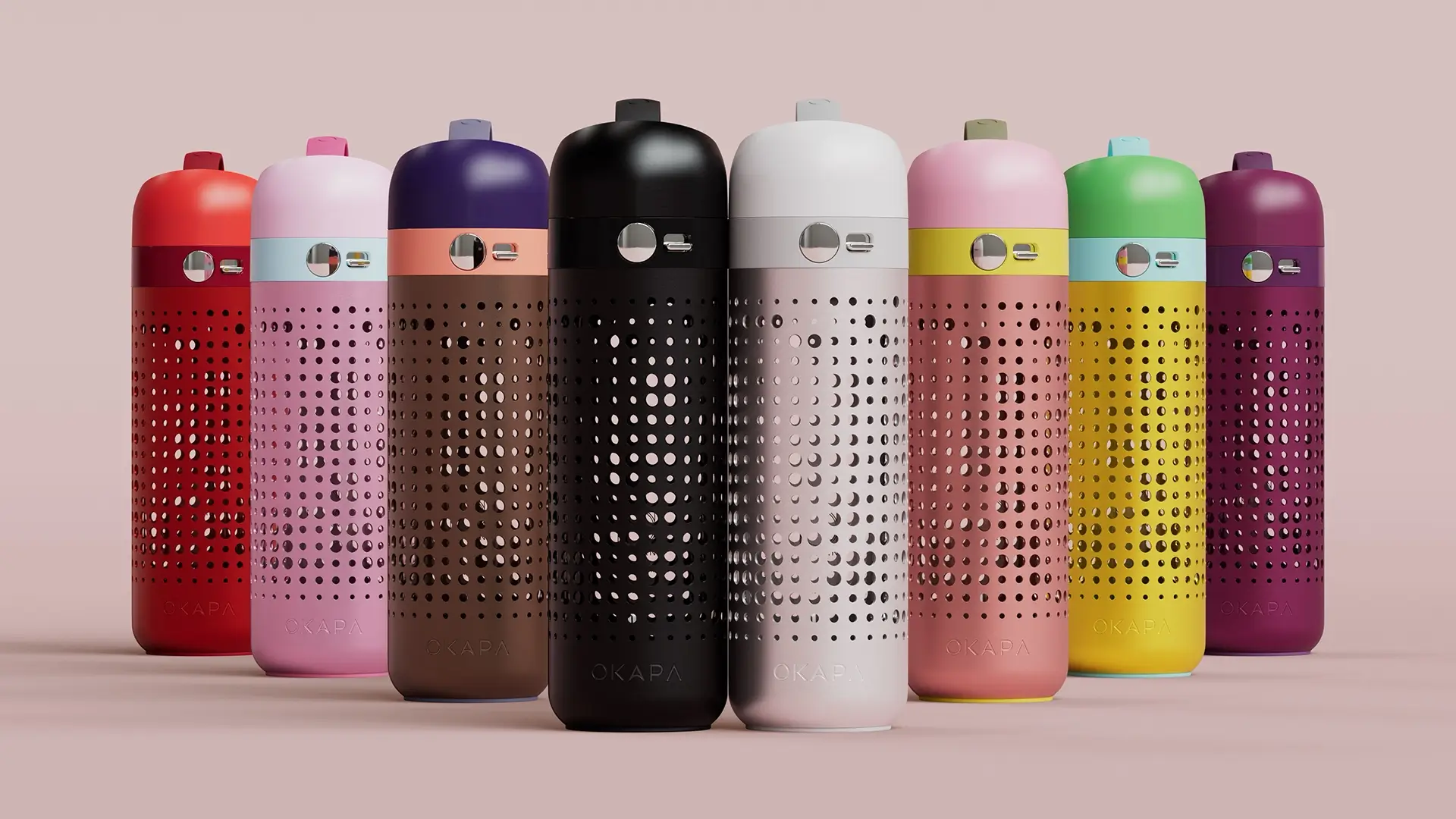
Key user-centered features of the OKAPA bottle include a medical-grade German borosilicate glass interior for superior taste of hot or cold beverages with no lingering odors; a Swiss-engineered thermoplastic lockable and leak-proof tilt cap that can be easily operated with one hand when driving or doing other activities; and an ergonomically shaped mouthpiece for a pleasurable drinking experience. Precision-engineered for maximum longevity, the inner glass bottle is suspended via a shock-absorbing system inside a bead-blasted, extruded, and anodized aluminum outer shell. Eight modular parts come apart easily for either a quick or thorough cleaning.
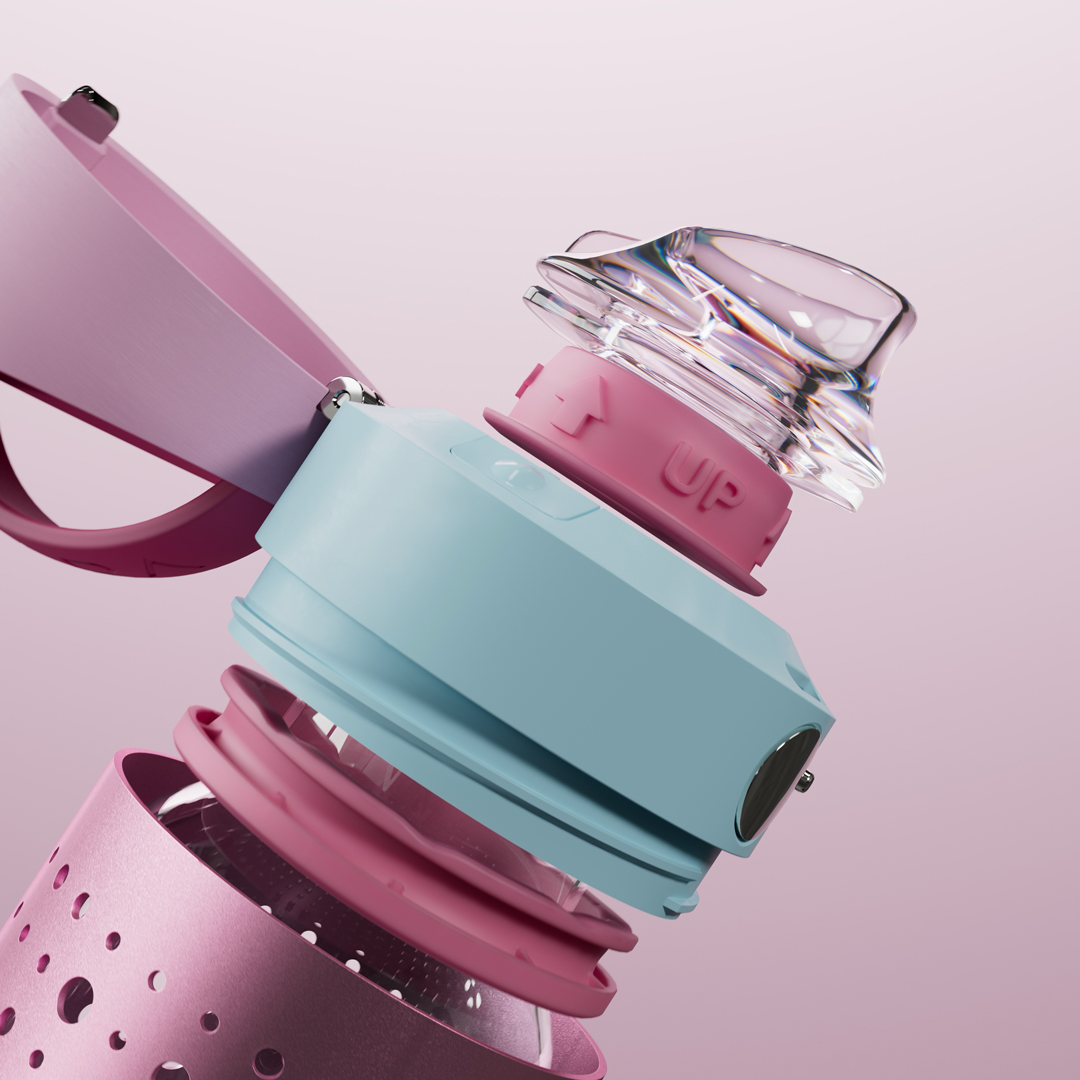
At its core, the OKAPA bottle elevates an everyday ritual through meticulous design and uncompromising engineering. Launched in January 2025, the new bottles are available in eight contemporary colorways curated by renowned color and materials specialist Beatrice Santiccioli (BSD), including Misti Pinku, Goldie Samba, and Fetishe Noir, among others.
In the US, the reusable water bottle market is estimated to increase from $10.2B in 2024 to $14.1B by 2031, with 69 percent of Gen Zers owning at least one. Customization trends, such as personalized design and branding, are anticipated to boost the market, ripe territory for disruptive startups such as OKAPA. (Persistence Market Research)
Once a practical accessory for hikers and outdoor enthusiasts, reusable water bottles have gone mainstream. Yet none check all the boxes in terms of purity of taste, hygiene, durability, functionality, and beauty.
8
modular pieces ensure hygienic cleaning is quick and easy
100%
recyclable materials in each bottle
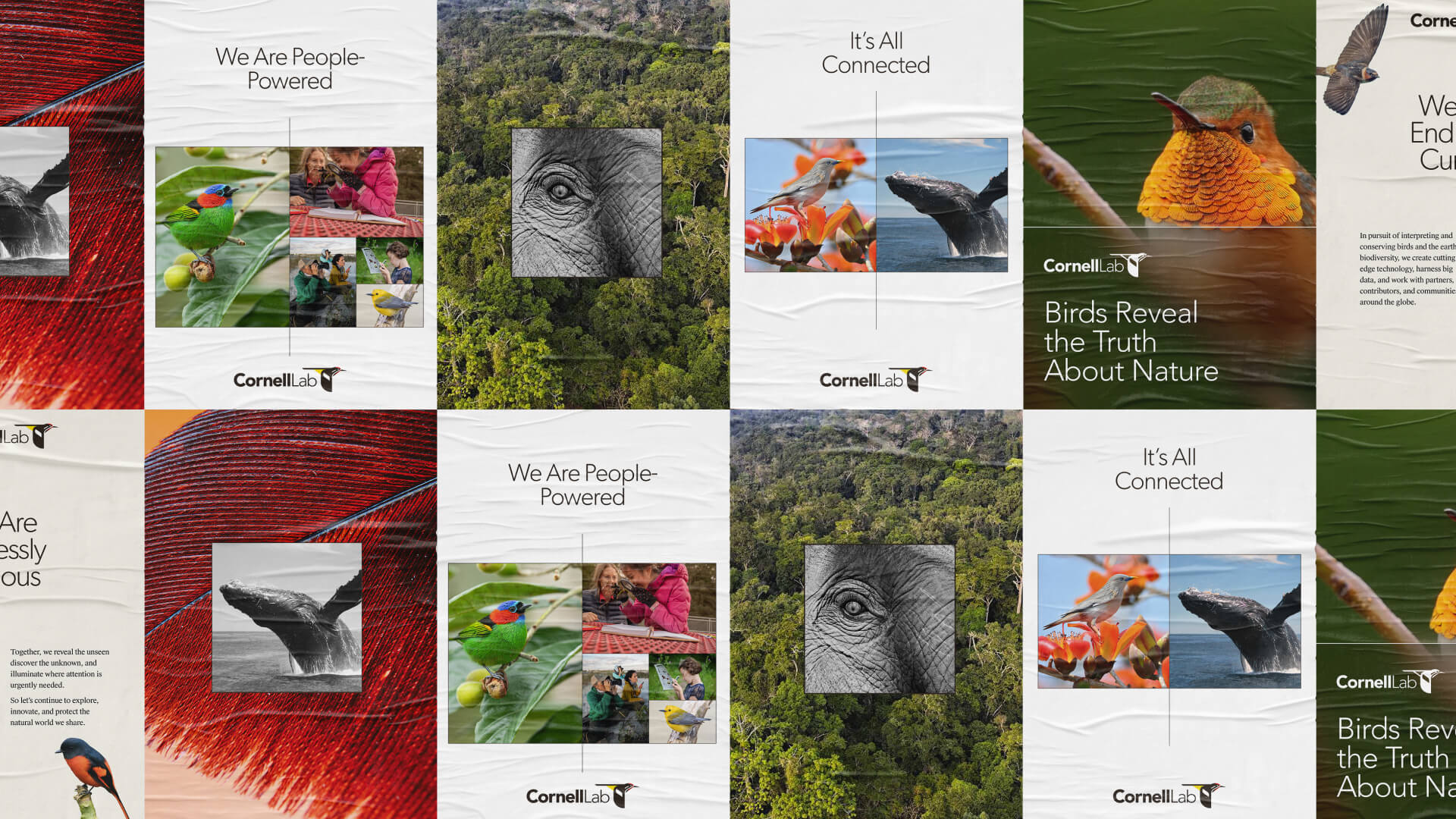
Brand as a conservation strategy
The Cornell Lab of Ornithology unites as “One Lab,” galvanizing a conservation movement.
The Cornell Lab of Ornithology’s mission is to interpret and conserve the earth’s biological diversity through research, education, and citizen science. Over its 110-plus-year history, its offerings grew to include everything from a quarterly magazine, popular websites and apps with millions of users (Merlin, eBird), partnerships with outside organizations, and the world’s largest database of photographs and audio recordings of birds. This abundance is a testament to the passionate enthusiasm of its employees. Still, it confused potential members and led to siloed internal efforts, preventing the Lab from advancing its urgent collective vision. “Birds and biodiversity are in peril,” said Executive Director Dr. Ian Owens. “We must take radical action with a coherent vision, united voice, and purpose.”
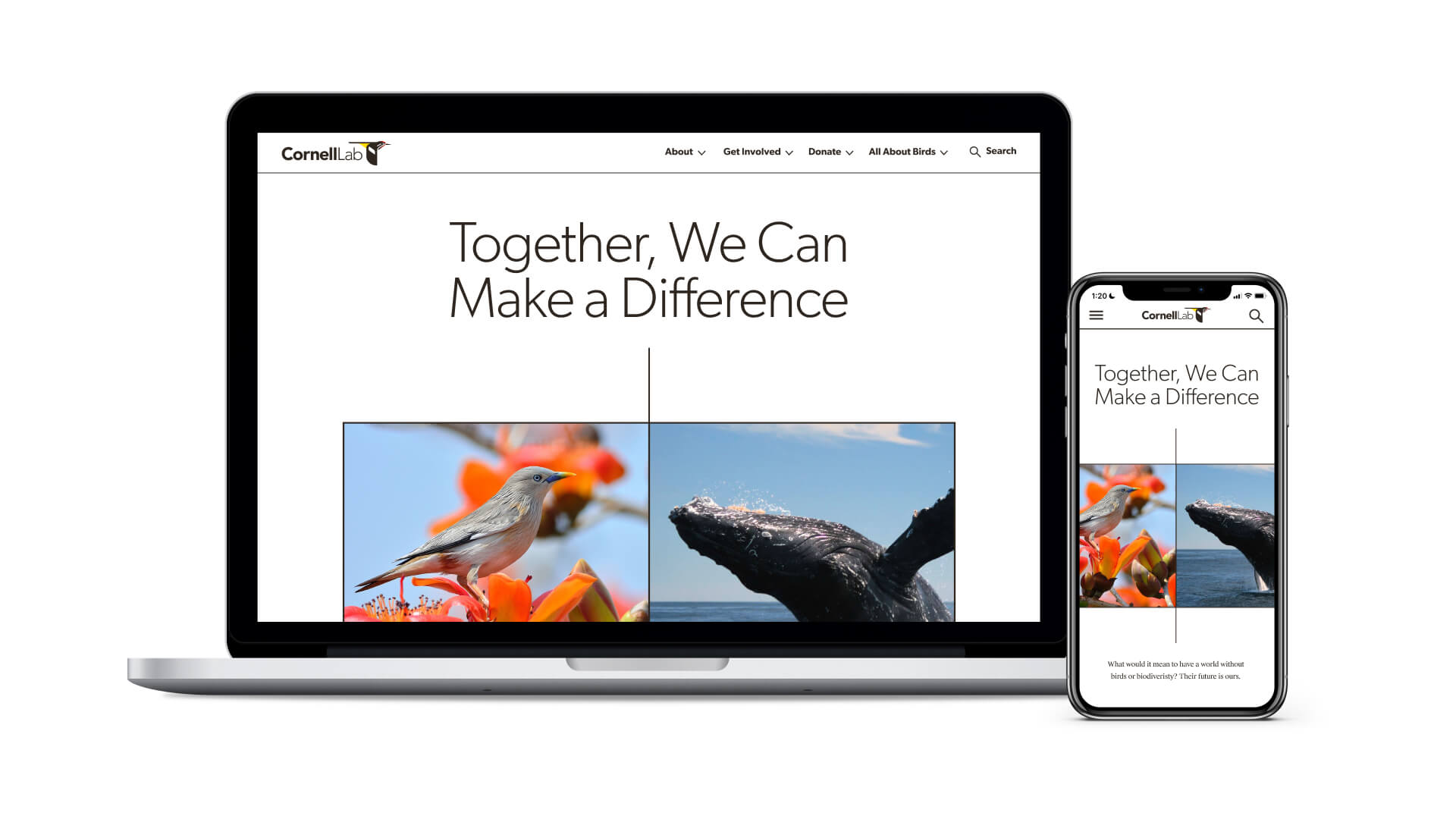
IDEO began by helping the Lab better define its audience. While primarily composed of people passionate about birds, IDEO discovered its larger audience was nature lovers interested in biodiversity, bioacoustics, conservation, and science. From there, IDEO created a brand strategy and architecture focused on helping the Lab streamline its efforts under the “One Lab” brand. The brand architecture visually articulated the relationship between Cornell University, the Cornell Lab of Ornithology, and the Lab’s many products and offerings. IDEO designed a comprehensive brand identity system to work across mediums, including a simplified logo system, new colors, type, graphic language, voice and tone, and key messaging.
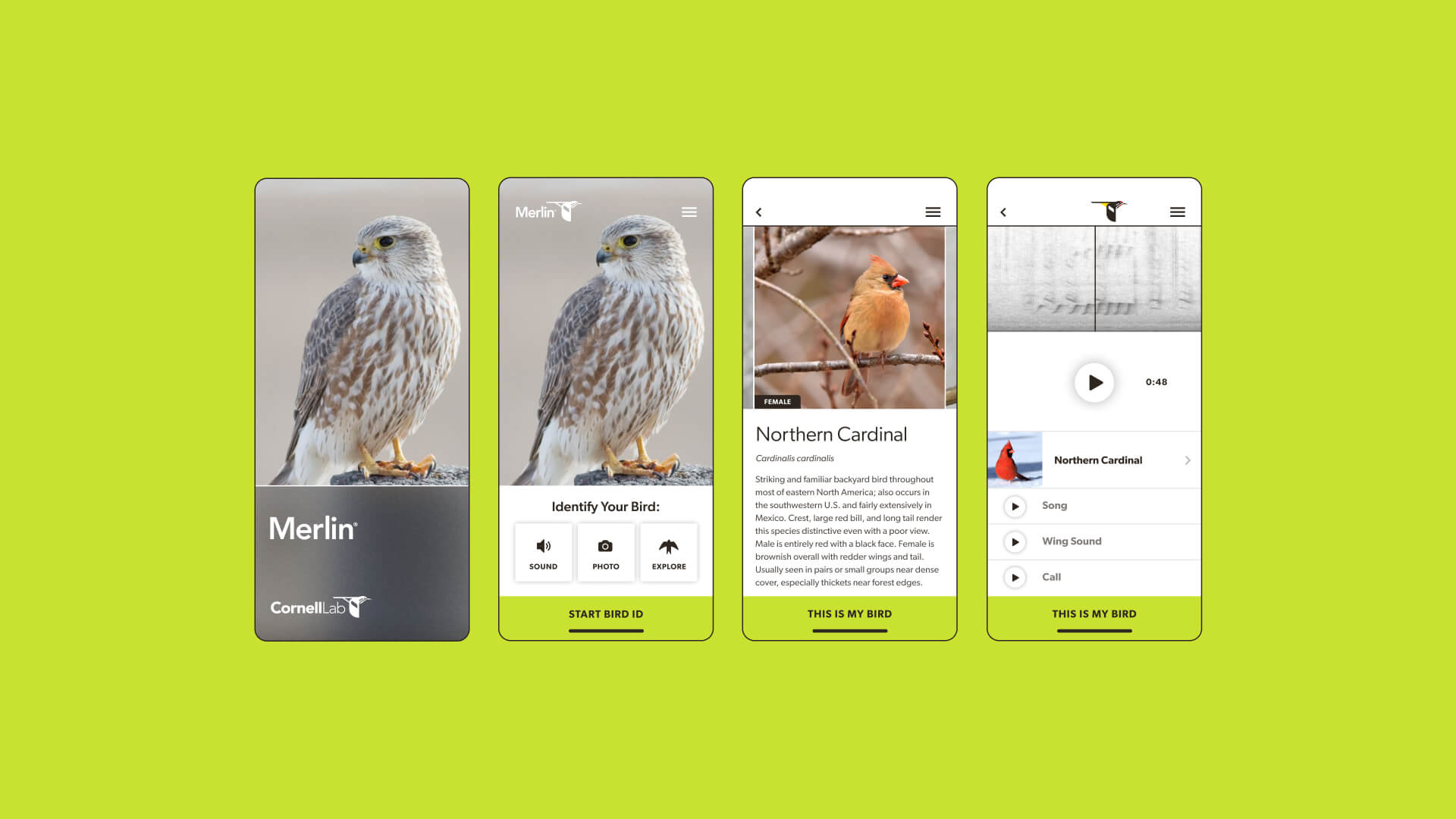
When the Lab’s design team began implementing the new branding elements across its website and many digital products, it became clear that the organization also needed IDEO’s help in creating tools to facilitate cross-department collaboration. To better understand the day-to-day nuances of the organization, IDEO designers worked out of the Lab, co-creating a brand activation playbook. The playbook, launched in 2023, contains recommendations for new cross-functional working groups (partnerships, visual identity, and brand voice), as well as exercises and interactive tools designed to build trusting relationships, gain alignment, foster collaboration, and manage change at scale.
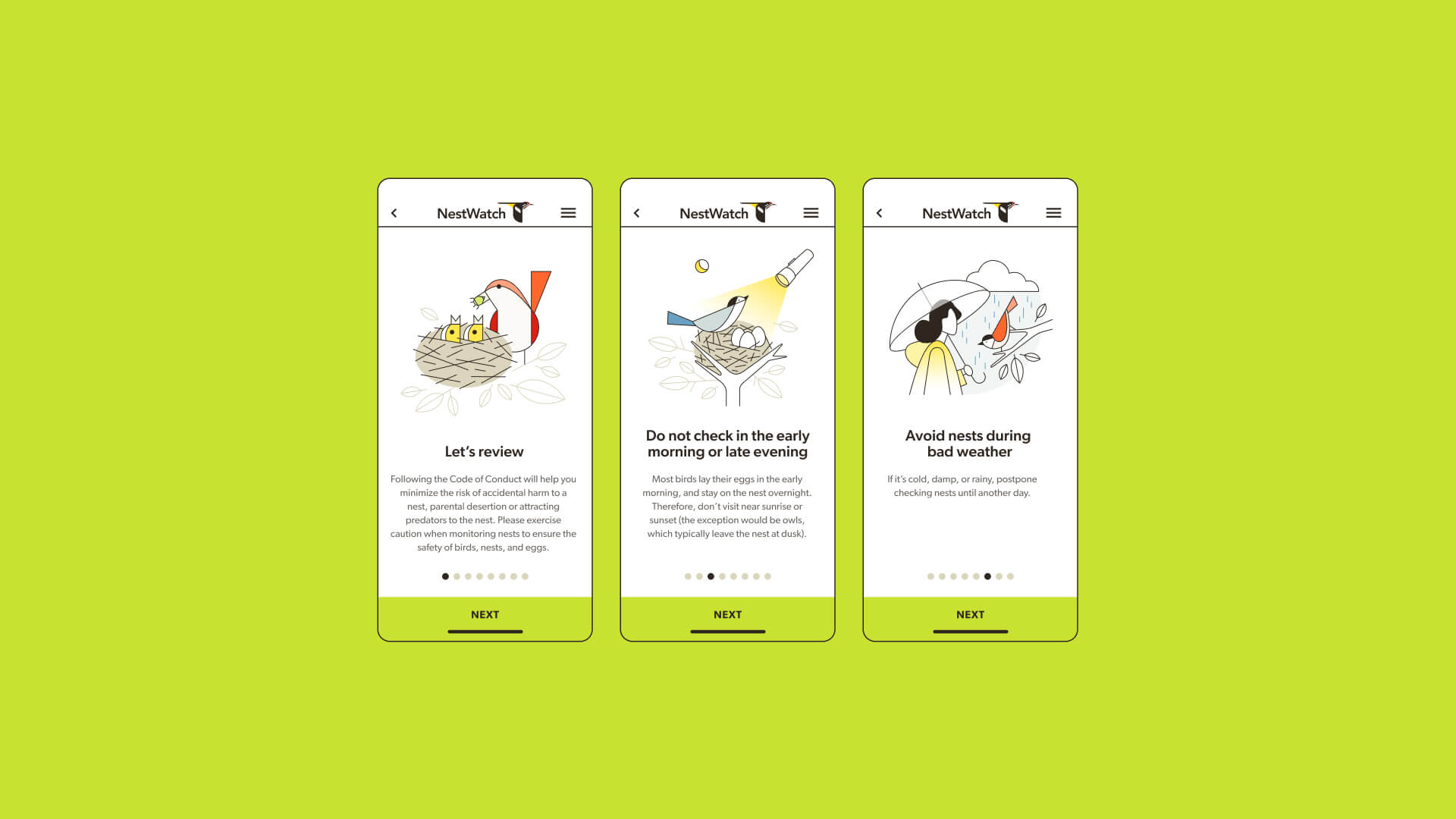
Post-collaboration, the Lab has applied the new brand across its website, apps including Merlin and eBird, Living Bird magazine, email and newsletter templates, and its line of merchandise. A new internal brand guidelines site has become central to employee onboarding, while new working groups are helping to bring down barriers between teams and spur collective action. Like a flock of birds, the Lab now sings one collective song.
The Cornell Lab’s 300+ scientists, professors, staff, and students were passionately dedicated to their individual team’s unique conservation projects, but segmented internal systems could stymie their collective impact.
1 brand
unifying 300+ employees and 8 departments

Charting a bold educational future
Ascend Public Charter Schools designs a “grown-up” vision for its young educational network.
Founded in 2008, Ascend Public Charter Network prides itself on providing “rich, joyful learning experiences that unlock lives of boundless choice” for its students, 93 percent of whom identify as Black or Latinx. The organization is also proud of being Black-led: 78 percent of staff and 80 percent of the executive team are people of color. Using co-design and joy, IDEO held a mirror up to Ascend’s core optimistic spirit during a moment of anxiety and change, helping its new CEO, staff, students, and parents reflect a dynamic, collectively imagined vision.
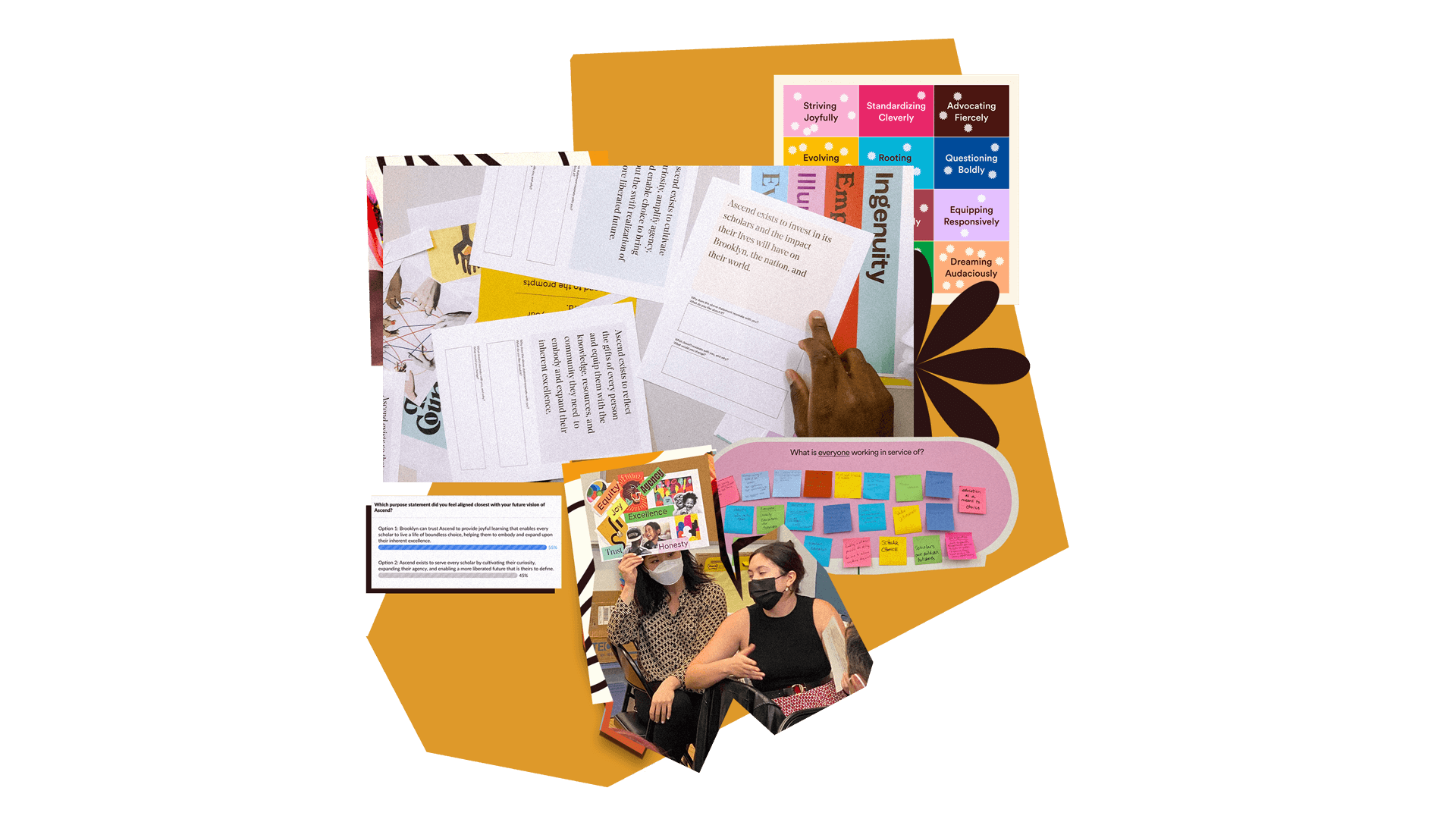
While the project’s goal was serious, the combined team centered the collaboration on bringing back fun, beauty, and imagination to those who could use it most: educators. Through engaging interactive activities, the IDEO team invited principals, PTA members, student council representatives, and board members to join “organizationally sanctioned play” moments like creating collaged vision boards and writing poems about Ascend’s impact. These interventions helped burned-out educators escape the day-to-day tasks of running schools and dream expansively about Ascend’s future. The team also solicited written, visual, and audio stories, asking community members to describe Ascend at its very best.
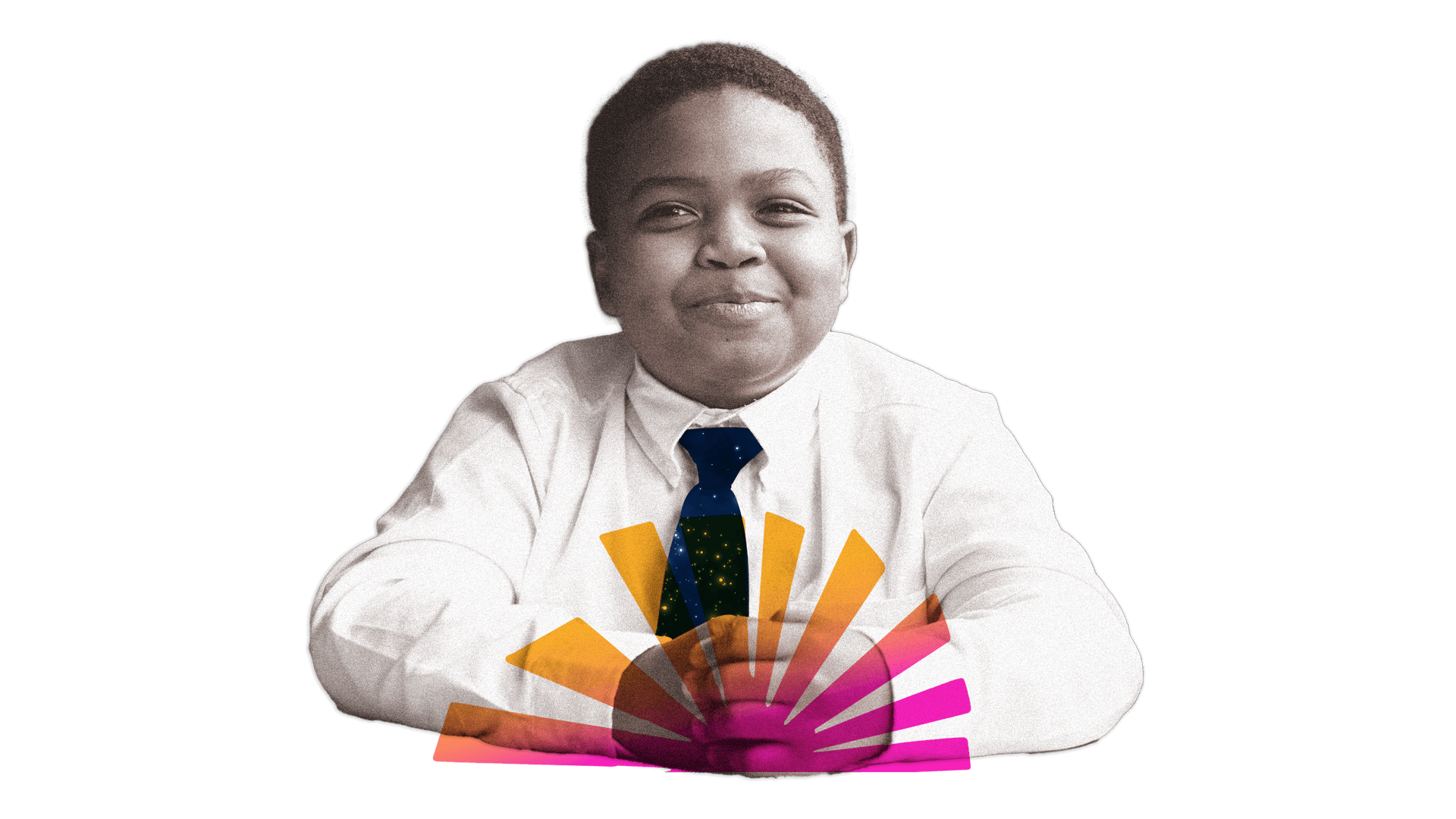
Stitching together submissions from 551 students, 75 parents, and 16 staff members, the co-design sessions resulted in a powerful new purpose, mission, and values, as well as a vibrant visual language and activation tools to bring Ascend’s vision of a “dope,” “unapologetically Brooklyn” charter network to life. The joyful, eye-catching visuals are embedded throughout its 17 Brooklyn schools, staff recruiting and training materials, and digital presence.
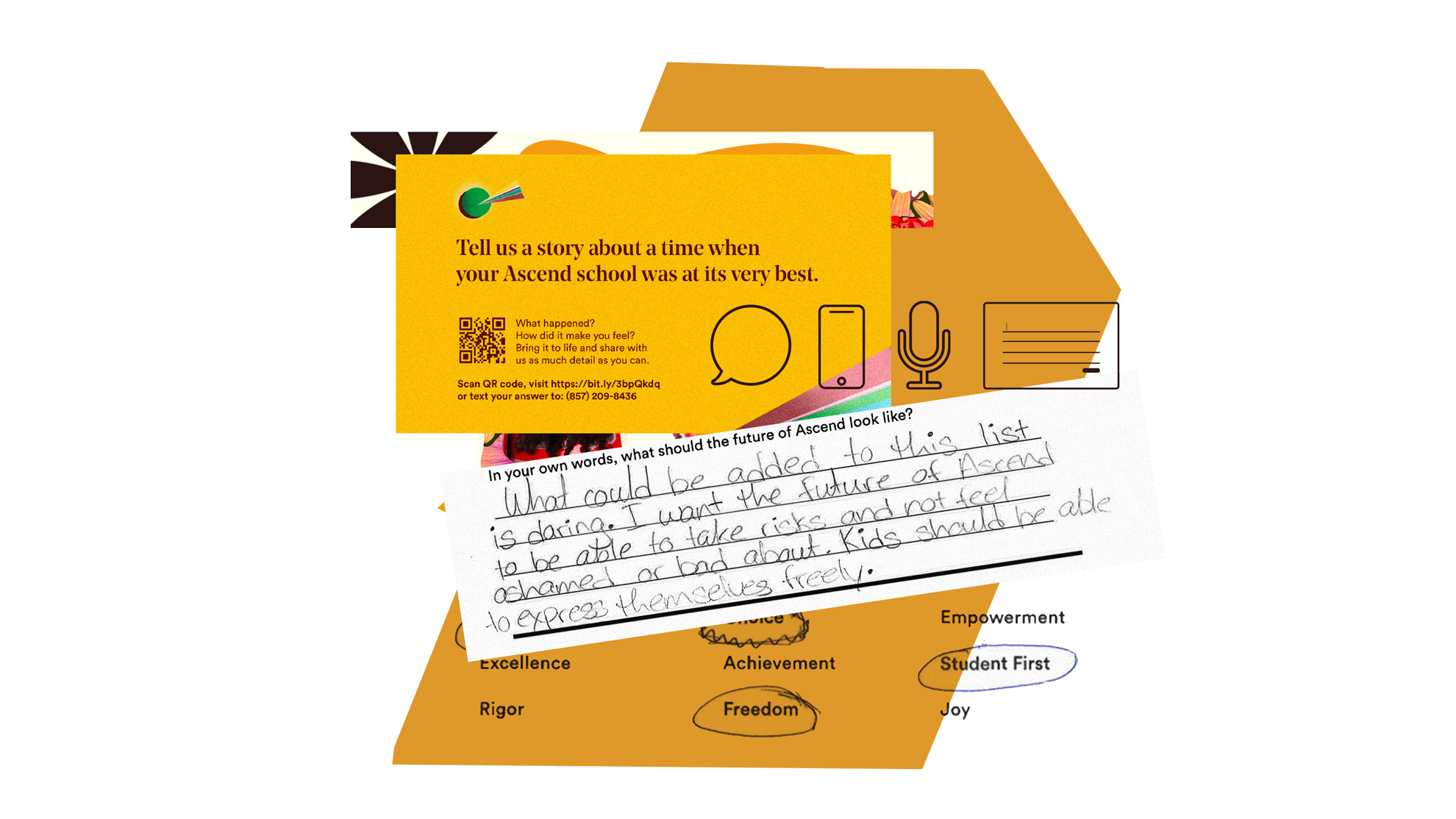
Shortly after the collaboration with IDEO, Ascend received an unsolicited $11 million donation from MacKenzie Scott's foundation, Yield Giving, the most significant gift the then-14-year-old institution had ever received. The pivotal funding will allow the organization, with its bold new “grown-up” vision, to focus on becoming the school of choice in Brooklyn by 2027.
In the summer of 2021, one in four K-12 teachers was ready to quit. Pandemic stressors and increased curriculum scrutiny were to blame, according to a 2021 Rand Survey.
In 2022, 44% of K-12 workers reported burnout, the most of any US professions the time, according to a Gallup Poll.
Pandemic exhaustion and leadership turnover left Ascend’s new CEO eager to align staff around an exciting new vision.
$11M grant
Ascend received an $11M grant from the MacKenzie Scott Foundation a few months after the collaboration
1 collective vision
to guide a network of 17 schools
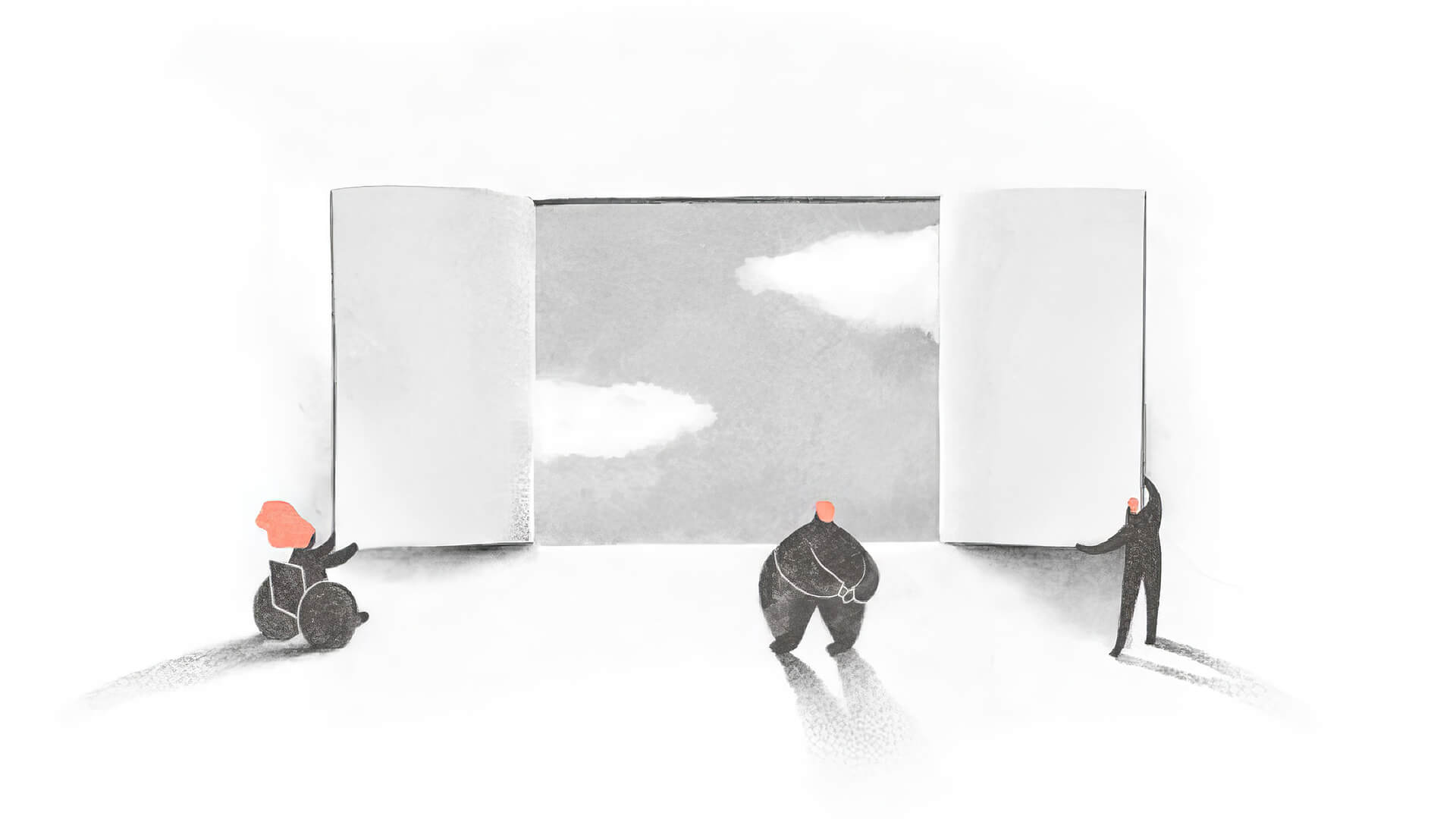
A new edition of the Little Book of Design Research Ethics
Updating the principles that guide our work.
Design Research—the practice of asking questions that help us understand users, their needs, and their context—is the foundation of our work at IDEO. The way we ask questions and what we do with the answers really matters. Our intake includes white papers, data sets, expert consultants, historical reviews, in-the-field interviews, contextual observation, and analogous research experiences. In all of those inputs, there is a lot that can get ethically murky.
To identify first principles and set some guardrails, we put together the Little Book of Design Research Ethics back in 2015. Yesterday’s guidelines were terrific for their moment, but they won’t cut it now.
Today’s world looks different.
So, we paused, sat down together, questioned our own practices, and wrote a second edition. In it, we’re making a new set of promises to ourselves and to one another about how we work ethically to benefit everyone. An evolution from the first edition, this version also tackles some tough questions and topics: research with minors, HIPAA compliance, affirming ongoing consent, and shared credit in participatory design practices.
We aspire for our design research approach to intentionally shift power from designers to those impacted by design. It is research that helps us better see, understand, and shape our collective future.
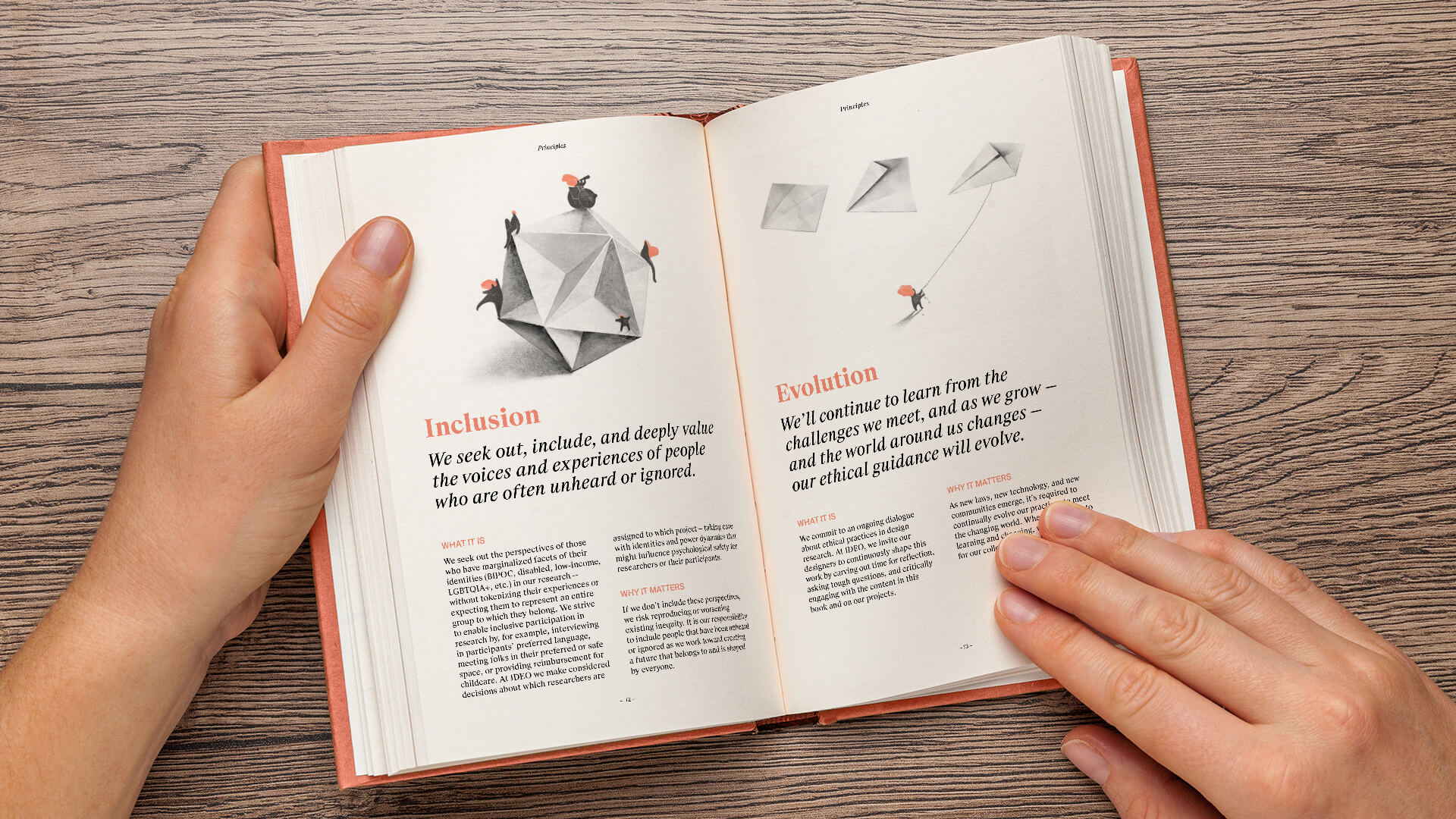
In this book, we outline the principles that guide all of our work: Respect, Responsibility, Honesty, Inclusion, and Evolution. That last one is critical, because we already know we won’t get it right. We commit to an ongoing dialogue about ethical practices in design research. As new laws, technologies, and communities emerge, we’ll continually evolve our practices to meet a changing world. We hope you’ll be part of that conversation, too.
Click here to download the Little Book of Design Research Ethics.
The secret to groundbreaking design isn’t found in the latest software, but in discovering untold stories and unheard voices.

The changing face of design
Celebrating and reflecting on 20 years of IDEO's innovation practice in China.
And for the past 20 years, our innovation practice in China has been on a journey to answer this question together with our clients and collaboration partners.
Our environment and the challenges we face are constantly changing. Design—whether you see it as visual expression, a way to solve problems, or a tool for innovation used by individuals, organisations, and even social systems—exists in that same frequency of change. The answer to what design can do is naturally and continuously evolving. It’s why we believe the question is worthy of exploration, and worth continuing to explore.
In this article, we share our current thinking on what design can do. It’s not a definitive answer: we know that as the challenges we tackle continue to change, and our expertise and experience continue to develop, new thinking will emerge.
Through a conversation with Tony Wong, Global Partner of IDEO and Remy Jauffret, Managing Director of IDEO Shanghai, we aim to show the changing face of design from four angles:
- How design is practiced.
- The outputs design delivers
- The value it brings
- The conditions necessary for success
As IDEO Shanghai celebrates its 20th anniversary, Tony and Remy mark their 15th and 10th years at IDEO respectively. In this dialogue, Tony and Remy, reflect on their work with clients and experience in the field, and share how these have evolved over time. They also imagine what new frontiers and challenges could lie ahead, and what the next 10-15 years of design might look like.
Q. Can each of you briefly recap your career paths, why you joined IDEO, and how your role as a designer has evolved along with the Chinese market over the years?
Tony:
I studied Industrial Design at Central St Martins in London and spent a number of years with Philips and the Electrolux group design teams in Europe and Asia, prior to joining IDEO in 2008. My time as a designer with these businesses gave me knowledge and insight into the role and value of design in these organisations. I was hungry to learn how external design consultants could possibly add more value to topics that we were thinking about every day. IDEO is known for creating solutions that disrupt industries with better solutions for answering unmet needs. I thought this would be the ultimate skill to learn and I was keen to acquire it.
2008 was a defining time for China, and I was curious about how the confluence of cultural and economic developments in China might influence design and innovation. Instead of moving to Palo Alto to join IDEO, I decided to move to Shanghai.
China has been a place that focuses on high growth and impact, and this has taught me, as a designer, to think much harder about the value of the work we are creating. As China shifts towards a richer and more competitive market, growth for businesses no longer relies heavily only on meeting demands, but now also on creating differentiated solutions that are tailored to the Chinese culture and way of living. As a designer, this has pushed me to deepen my knowledge about how economic conditions and demographics shifts might impact what are the right things to design, as opposed to only focus on how to design things right.
Remy:
Tony and I went to the same university even though we didn’t meet there. I was reading my Master’s degree at Central Saint Martins and did a Masters called Creative Practice for Narrative Environments. The premise for this course was to ask what happens when you bring a diverse set of creative people together to imagine impactful futures. I got to work alongside Curators, Product Designers, Artists, Writers, and Architects. It was wild and thrilling how much permission we had to collaborate and build a possible future. This created the desire to work on big messy complex things that people probably should not be working on alone, and this is where I first heard about IDEO.
China has seriously educated me on the value of perspectives. As a foreigner living and working here, I get to hold several, often radically different perspectives at any given time: how businesses are run, how leaders lead, how value is created, how systems are built. All of these aspects have matured significantly over the last 10 years and I think we are at a very intriguing moment where design—and the way that Tony and I get excited about it—has an abundance of new complex challenges to solve, significant opportunities to leverage, and meaningful outcomes to enable.
01 How design is practiced
Q. How have your years of experience of working with various types of clients in China influenced your views on what design can do?
Tony:
We have a very diverse set of clients in China. What design can do for an edgy Chinese start-up can be very different from what it can do for a corporation, a state-owned enterprise, or a multinational corporation (MNC).
Remy:
The sheer pragmatism and ambition of working with leaders in China leaves very little time for theoretical processes and so-called methodologies without results. It’s all about outcomes.
Tony:
And during my 15 years at IDEO China, I have seen how design has delivered for our clients new horizons and mindsets, stronger capabilities, deeper engagement with key stakeholders, and more sustainable and agile ways of doing things. Essentially, design has given businesses a robust set of returns on investment around purpose, people, planet, and profit.
But what I have learned most from China—which I believe is true everywhere, though perhaps more prominent in the Chinese business culture—is that trust needs to be built for design to be effective in adding value. When we design, we are delivering a point of view on a future our clients should make, and our clients need to trust that the design we are putting in front of them is the most informed choice to help them achieve their goals.
Trust is built through communications and shared experiences. Design has an unfair advantage in its ability to visualise potential futures, to create conversations and make opinions tangible, and to enable meaningful shares of perspectives before arriving at the most informed decisions. I believe design, when used in the right way, is a great tool to enable trust-building in business, not only between us and our clients, but also amongst the people in our clients organisations.
“Maple and IDEO have collaborated on multiple projects over three years. Each time, the IDEO team would discuss the market environment and the business positioning of the project with us rigorously, and validate the business strategy of the enterprise from different dimensions, to help us open up our thinking and transform our mindset. Throughout the project, we would have open discussions and even heated debates, and everyone involved would in this way reap the joy brought by continuous innovation.
Our mutual trust is gradually built up through this step-by-step practice, as well as our common desire for successful innovation. Our team members have benefited from our co-creations with IDEO and from their mentorship. One of the values that IDEO often cites is 'Making others successful,' and we are the actual beneficiaries of it."
- Jim Lu, Founder and CEO of Maple&CO
Q. What are the most notable changes in how IDEO practices design over the last 10-15 years?
Tony:
It’s important to acknowledge how much businesses have integrated and adopted the practice of design over the last couple of decades, thanks to the collective effort we all made in the design industry. IDEO as a partner to our clients will always be adding value through complementing our client’s capabilities, and not overlapping them.
Remy:
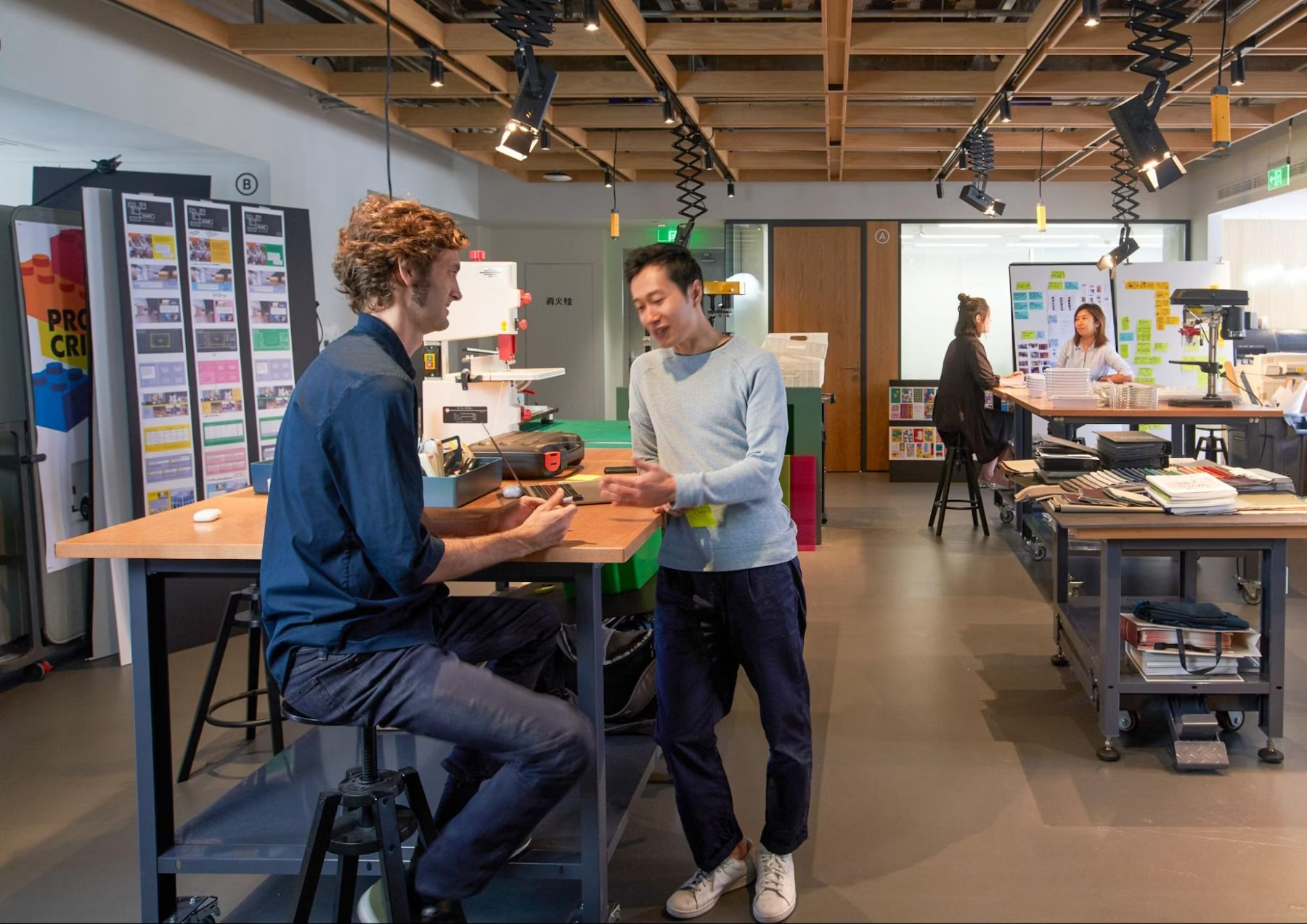
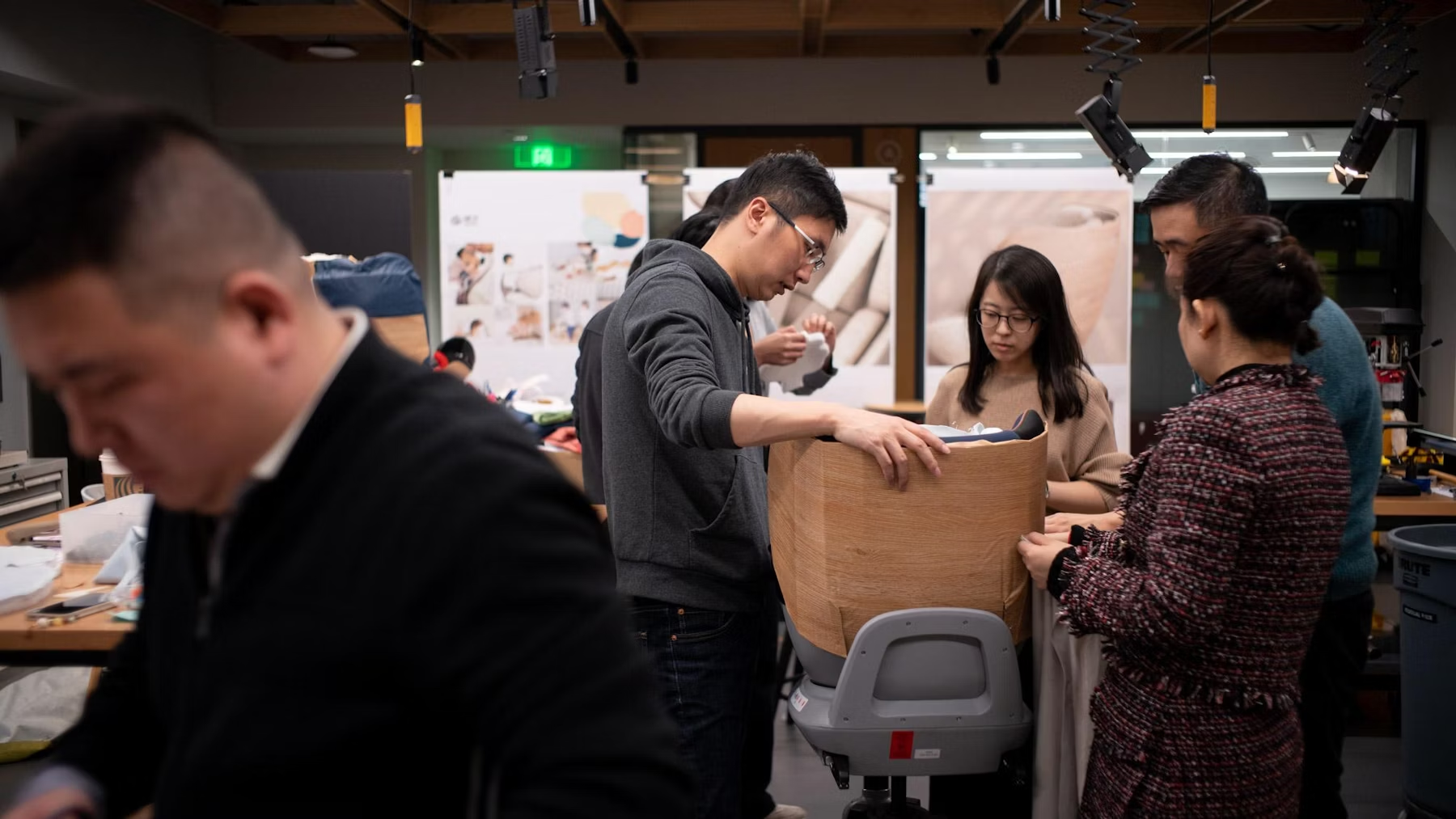
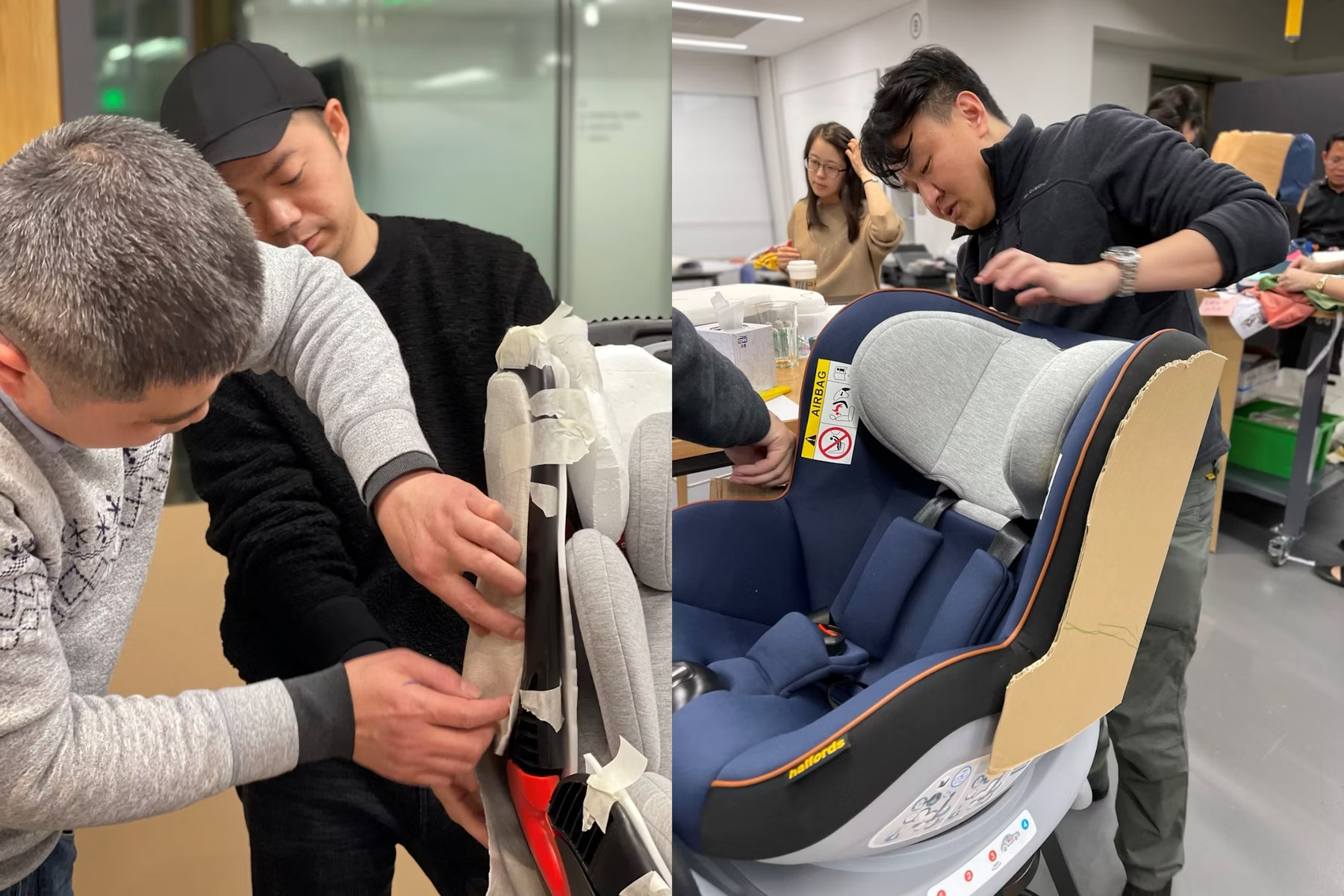
We have intentionally shifted to a deeper embedded approach with our clients, where rather than delivering work to them, we are doing work side by side with them. This way of working tends to spread out over multiple phases and modes of engagement and it requires a very different approach to design. It’s ultimately a more agile way of working, in that our team learns faster and in-situ with our client and, simultaneously, we are building buy-in, enabling decisions, and scaling execution on the client side as soon as the project starts, not at the end. It creates deeper empathy and consideration for how our clients run their businesses. What is their current company culture, how does that affect the decisions they make, and how do we calibrate our approach to deliver the best value within these constraints? This is really important because coming up with solutions without living and breathing the reality of what it takes to make it real is irresponsible.
Tony:
And as our clients become increasingly fluent in their own design capabilities, our roles and methodology in how we help have also changed and become more sophisticated.
For example, a decade ago, it was common for our engagements to be 6-12 weeks projects where our goal was to provide a fresh perspective for our clients. The output of these projects was often a set of provocations for these clients to illustrate how their sectors have changed, and tools to facilitate the level of change to realise the opportunities. As designers, we did not have permission to be part of these ‘boardroom’ decisions.
Today, our conversations with clients often start with a business goal rather than a design brief, and we spend a substantial amount of time understanding how our client’s teams are set up, and what might be the true challenges that are making it difficult for them to design innovative solutions. While there are occasions where the 6-12 weeks project format is the right path to enable the client to get to their goals, our ways of helping our clients design better solutions have become much more diverse, many of which are not measured by weeks.
For example, the work we are doing with IKEA’s North Asia product development team has approached a business challenge through a mix of accelerated, sustained, and punctuated project typologies, as well as co-working and coaching sessions with their designers on their other projects, where we offer fresh perspectives on the craft of design and engineering.
Remy:
We have gotten really good at becoming the most optimistic and generative versions of our clients. They see us as them, and we are there to push them and work side by side to get work done in ways that are faster, more collaborative, more generative, and bolder. We're very clear about the value we should be delivering and mindful of when we should step away.
Q. How do you arrive at decisions and choices in projects? Do you use consensus amongst client teams as the benchmark for making decisions? When does IDEO’s perspective come into play?
Tony:
At IDEO, we don’t just use design to share our thoughts on the ultimate solutions, we also use design to visualise potential futures that create conversations and make opinions tangible, from the views of both users and client organisations, all in service of enabling meaningful exchanges of perspectives before arriving at the most informed solutions.
To be clear, being informed by diverse perspectives does not equate to using consensus to make important design decisions.
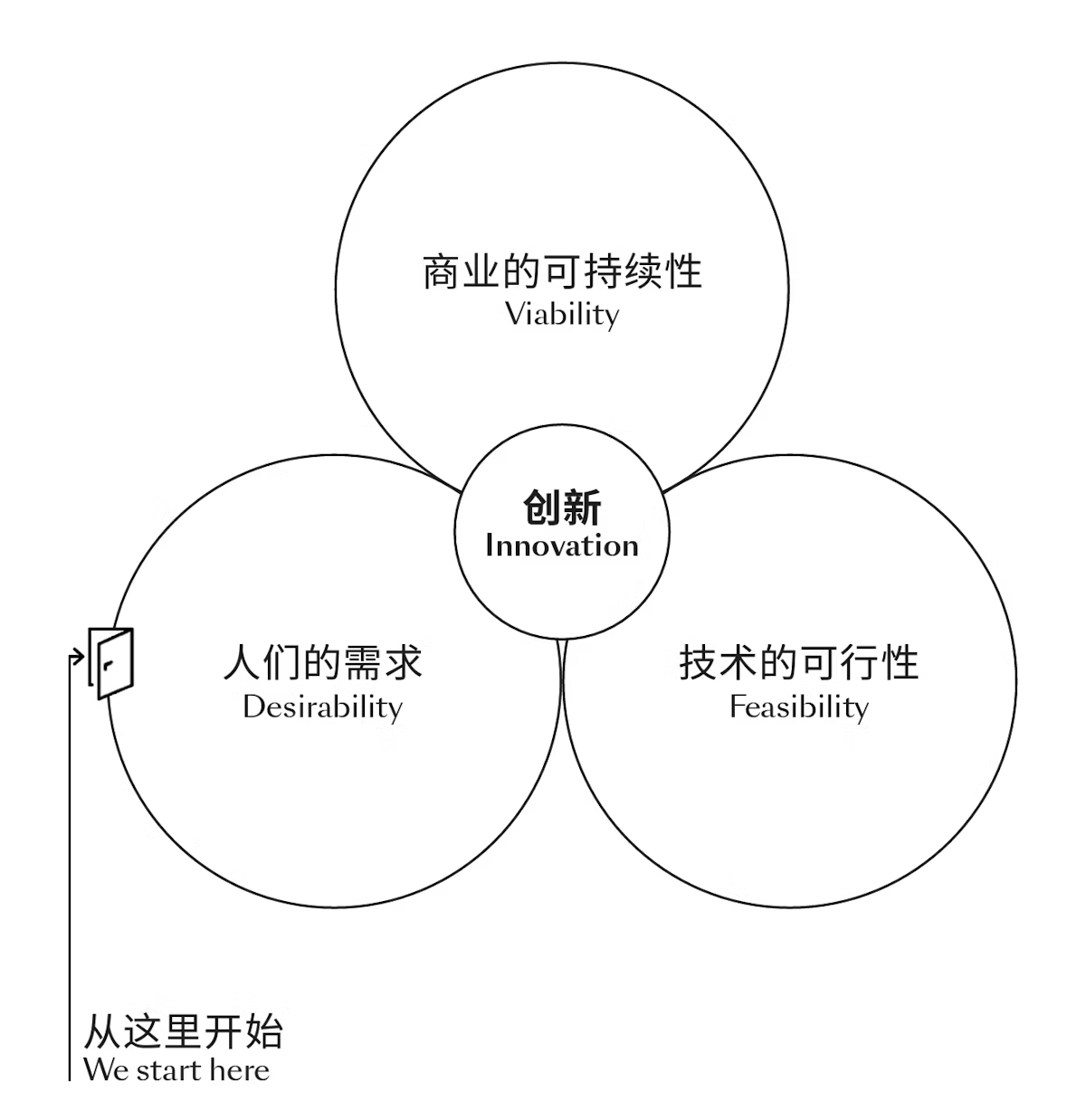
Business leaders we work with listen deeply before they respond with actions and decisions. IDEO’s role is to bring the desirability lens as the starting point for conversations about how best to balance desirability with feasibility and viability to enable great design innovation. This balance is about our ability to help client teams make the right trade-offs within their constraints, in service of achieving their business goals. It’s not about consensus that makes everyone happy.
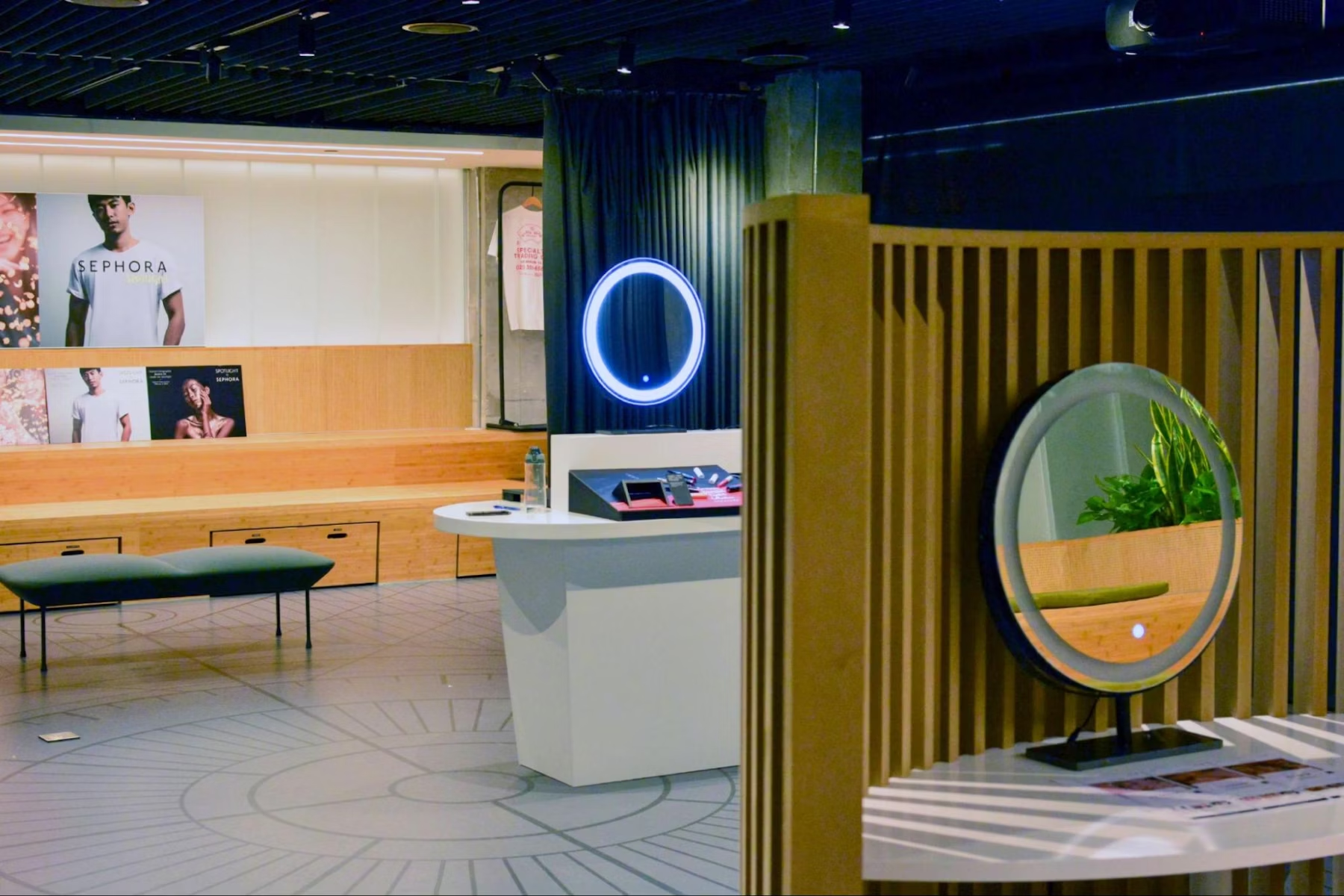
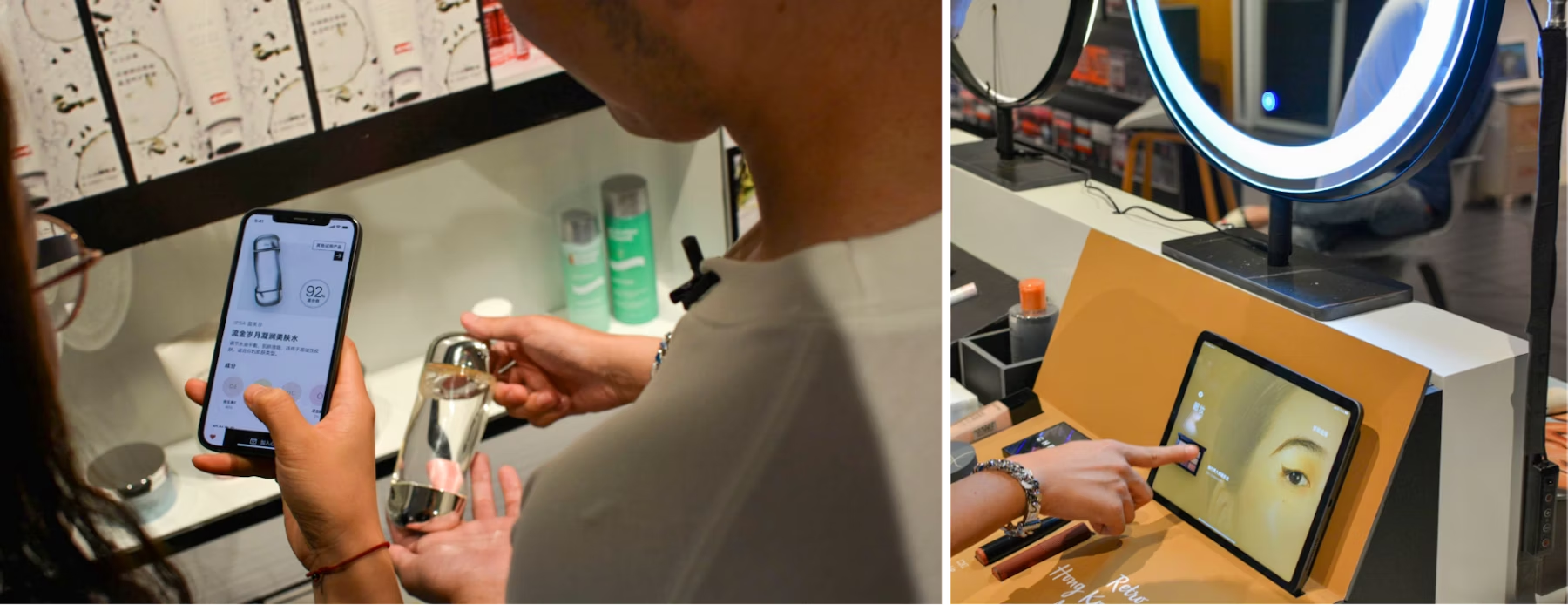
The work we did with Alia Gogi, the president of Sephora Asia, is a good example. Here is a leader using design as a tool to listen deeply to the different needs of her region, in order to find the right balance between meeting the needs of an evolving set of customers and the right level of stretch in their existing constraints to enable innovation.
02 Outputs of design
Q. How would you describe the nature of the outputs of your work in these years? Has IDEO’s work leaned predominantly into the area of strategy?
Tony:
Strategy is inherent in the work we do because design is a strategic act. The outputs of our work, as can be expected, are varied. From strategy blueprints to products to spaces, to work we’ve done for clients ranging from startups to corporations to state-owned enterprises, in industries from retail to health, to food—there is no sameness about any of our outputs.
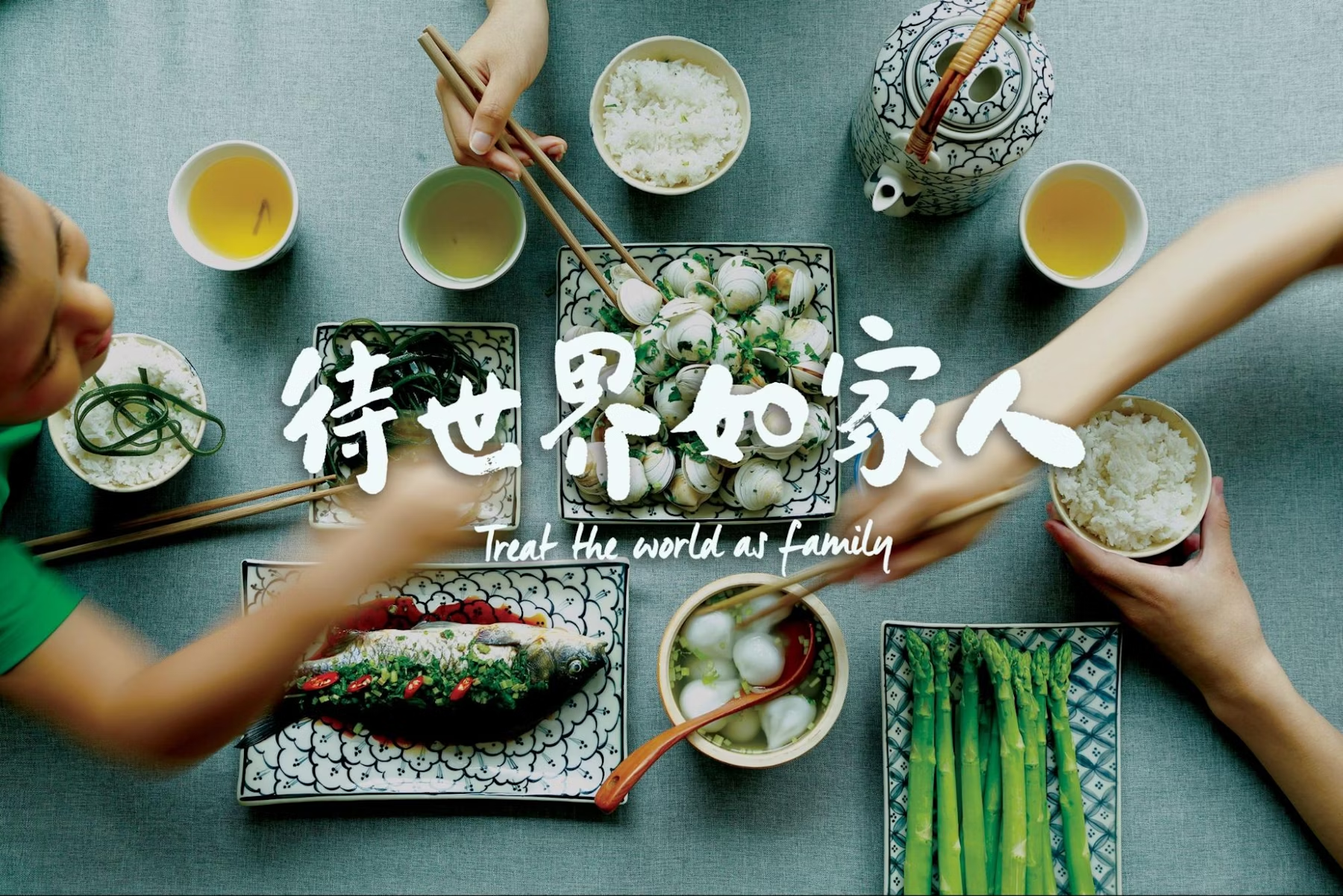
The near-decade-long relationship we have with the Shinho group is a good example of how we use design to inform their strategy and journey of transformation. We have designed from their purpose as an organisation to how they talk about themselves with a refreshed identity, to the event experiences they host with the Michelin Guide, to the most core of their condiment product innovations. There is a complex strategy we have helped design, but it is also the tangible manifestation in market outputs that makes the strategy real.
Remy:
Another example I’d like to add here is a piece of work I’ve been involved in over the last four years, which is still ongoing, where we are addressing a systems-level challenge within the logistics industry for a commercial vehicle original equipment manufacturer (OEM).
This is first and foremost a strategic question about what value an OEM could add in a future with greater automation, higher volumes of parcels, and deeper needs for integrated mobility solutions. The ability to rapidly build and stress test feasible prototypes, in real conditions, as a manifestation of that strategy, allowed the leadership of that organisation to consider very different paths for making that strategy real, while also understanding its implications.
From a design output perspective, we needed to illustrate very unusual business models for a traditional OEM. The design of an integrated user experience between hardware and software takes into consideration multiple users across multiple organisations in a high-volume, labor-intensive ecosystem that is evolving fast.
The fact that we built and ran these live experiments, together with our clients as one team, meant that strategy was informing design and design was informing strategy—constantly. The high level of tangibility meant we could move fast and identify the next big questions to solve. This was not about building the perfect solution, but using design to get to the right level of feasible, desirable and viable fidelity to inform a strategic decision.
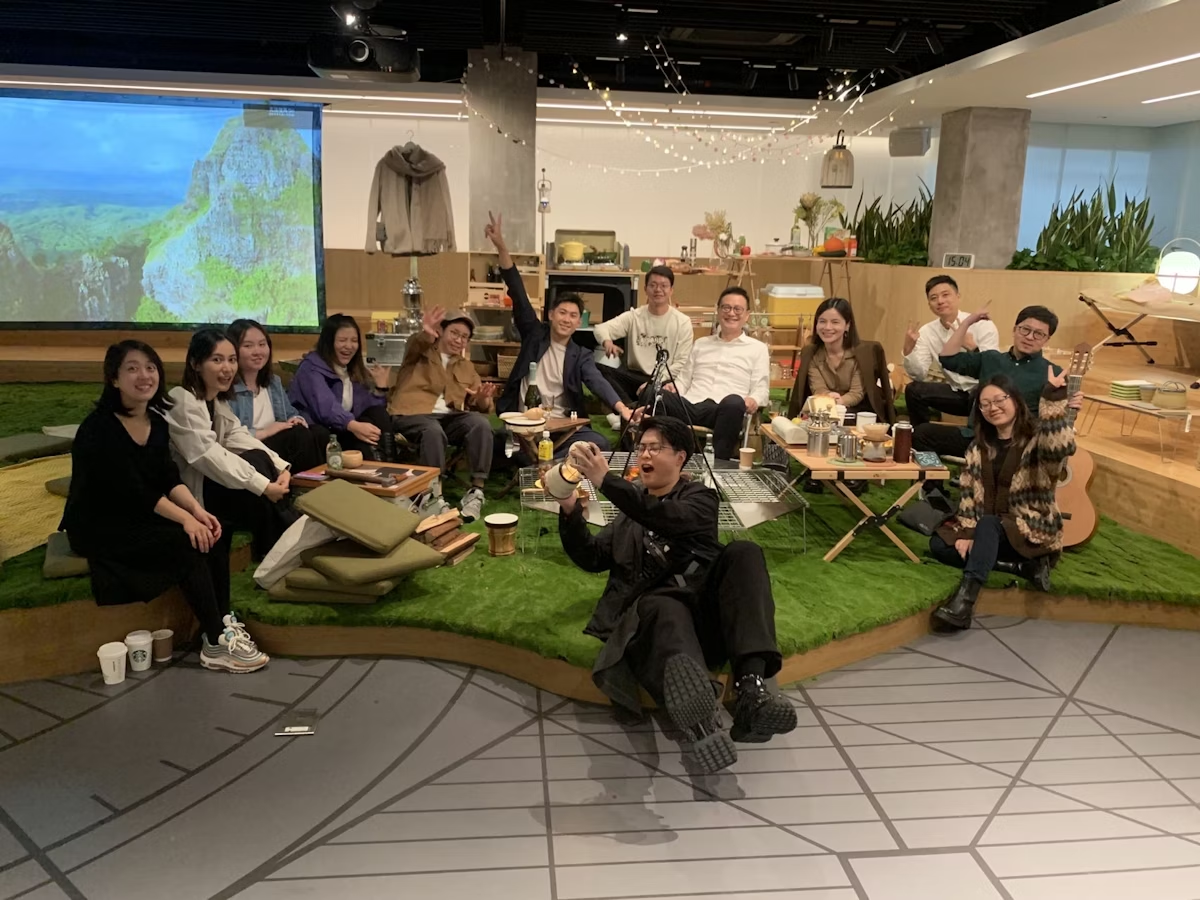
“The collaboration with IDEO has helped us to further understand the glamping category. Our team gained the confidence to move forward, and we began to invest in it without reservation, enriching the product line at a very fast pace. Some of the business, in fact, advances on forecasts, but because of the confidence, we were bolder in our forecasts and didn't hesitate to invest. I think this is the most valuable thing we gained."
- William Lu, Founder and Chairman of Mobi Garden
03 Value of design
Q. What, in your view, is the role and value of design thinking in business, and how has that changed?
Tony:
I find the debates about the relevance of design thinking over the last few years fascinating in how they highlight the gaps between understanding design thinking as a problem-solving approach and understanding it as a set of activities to follow. Some of the activities that are associated with design thinking are out of date, and perhaps successful applications are not quite as simplistic as following these sequential activities to guarantee success.
Remy:
Design thinking has been heralded within business circles as a methodology and process to get to innovation solutions. This is not wrong, but to talk about the process without talking about the conditions for design and clearly defined business outcomes can make it dangerous. People often misunderstand what value it should be delivering. In the context of business, design thinking is a tool that should be about enabling an organisation to learn fast, de-risk bold choices, and progressively grow confidence in the right decisions before executing on costly and potentially irrelevant solutions.
“Design thinking can strongly enhance the development or improvement of a process or program within an organization. For it to truly be successful, it must be accepted and desired by the people utilizing it. This is where the steps of design thinking to empathize and define are critical. When an organization takes this approach, it ensures that there is an initial deep understanding of what people really need and want. Through asking the right questions to assess these needs and interests, the most suitable design, or policy, can be developed. This becomes the core focus of the development of the design. Without such, substantial time and resources can be wasted, and the final design will not be successful."
- Lindsey Garito, Head of People & Culture, Westchester Country Club, in Forbes Magazine.
Tony:
I think this is more about understanding what value design can bring to businesses today, what role the designer’s approach plays in problem-solving, and how the skill of making can best be integrated into organisations. It is also as much about how businesses, societies, and technologies have changed, as it is about the changes in design.
Q. As you reflect on your 10 years and 15 years in China, why do you think it's still important to talk about design—a word that is so widely used and frequently mentioned in China now?
Tony:
The design discourse is important and especially relevant precisely because design is pervasive and widely practised. The more we discuss and debate, the more progress we will make with refining and advancing design as a tool for deepening understanding and solving problems, building belief and inspiring action, delivering results, and creating tangible value. The role of design and what it can do for China’s growth remains as important as ever.
Because of China’s economic opening in 1978, there are now many large Chinese organisations that are going through generational leadership succession, where the founders' ways of working have largely been top-down decision-making that enables efficiency. As these companies continue to grow with their new leaders, the increasing complexity will require that more voices be heard for these organisations to evolve and stay relevant. While there are transformation and change methodologies that need to be applied in this succession period, these methodologies can feel academic and mechanical, on occasion. I think design can offer a more transformative and practical take that creates inspiration and useful and usable tools for people in these companies to want to change, as opposed to being told they have to change.
We have been working with one of the largest beverage companies in China where their success has been built around efficiency and the great intuition of their founder. Our work has been to help the new leaders get closer to the voices of their customers, and to allow for all departments of the product creation chain to input their thoughts and expertise in the context of the desirability we have discovered in our research work. This collaborative muscle, enabled by the inspirational nature of design, is something that I believe is critical for some of these organisations if they are to be successful in their succession.
Remy:
Any company in the world that aspires to be a global company needs a China point of view. That need for clarity and strategic relevance will only increase as Chinese organisations challenge on all fronts, domestically as well as globally. Tony has shared what it means in the context of leadership transitions and transformation for domestic companies. I would add that multinational organisations also face challenges to remain relevant, and to build their muscles learning from the level of world-class excellence that we are experiencing here. I believe this is where design will have an increasing role to play: to inspire and communicate across functions and geographies about what can be the same, and what needs to be different, to create market-relevant value.
It is increasingly clear that foreign companies can no longer design a competitive solution for this market from a distance. The need to use locally relevant insights to define solutions is a must-have. We are working with a well-known international automotive company exploring the theme of sustainability and what that might mean in the definition of a future product for China. By looking at broader cultural signals, design helped articulate that sustainability is important to Chinese consumers, but the interpretation of this theme across geographies can and should lead to very different expressions on a brand and product level. In this instance, insights to design enabled a very different conversation for a China-driven vehicle program for a global brand.
04 Conditions for success
Q. What are the key conditions for success when using design or design thinking to tackle a complex challenge?
Tony:
Design thinking is a problem-solving approach. Design is a strategic act of making. Solving complex challenges often needs more than just the expertise of design, and design thinking is not a silver bullet.
As design thinking becomes more widely adopted amongst business communities, and more people begin the learning process, I think it is important to recognize the need for mastery in the application of the approach to meaningfully solve complex challenges. A good recipe does not make great meals without a seasoned chef. Having seasoned practitioners with practical experiences in the approach, and the skills to design and make as a way of inviting others outside the design discipline to collaborate, is an important condition for success.
Design thinking strives to understand why people do what they do, and to use the act of design to create, test, and iterate for better solutions. Finding challenges that are largely in need of human analysis tends to lead to a more effective use of the approach.
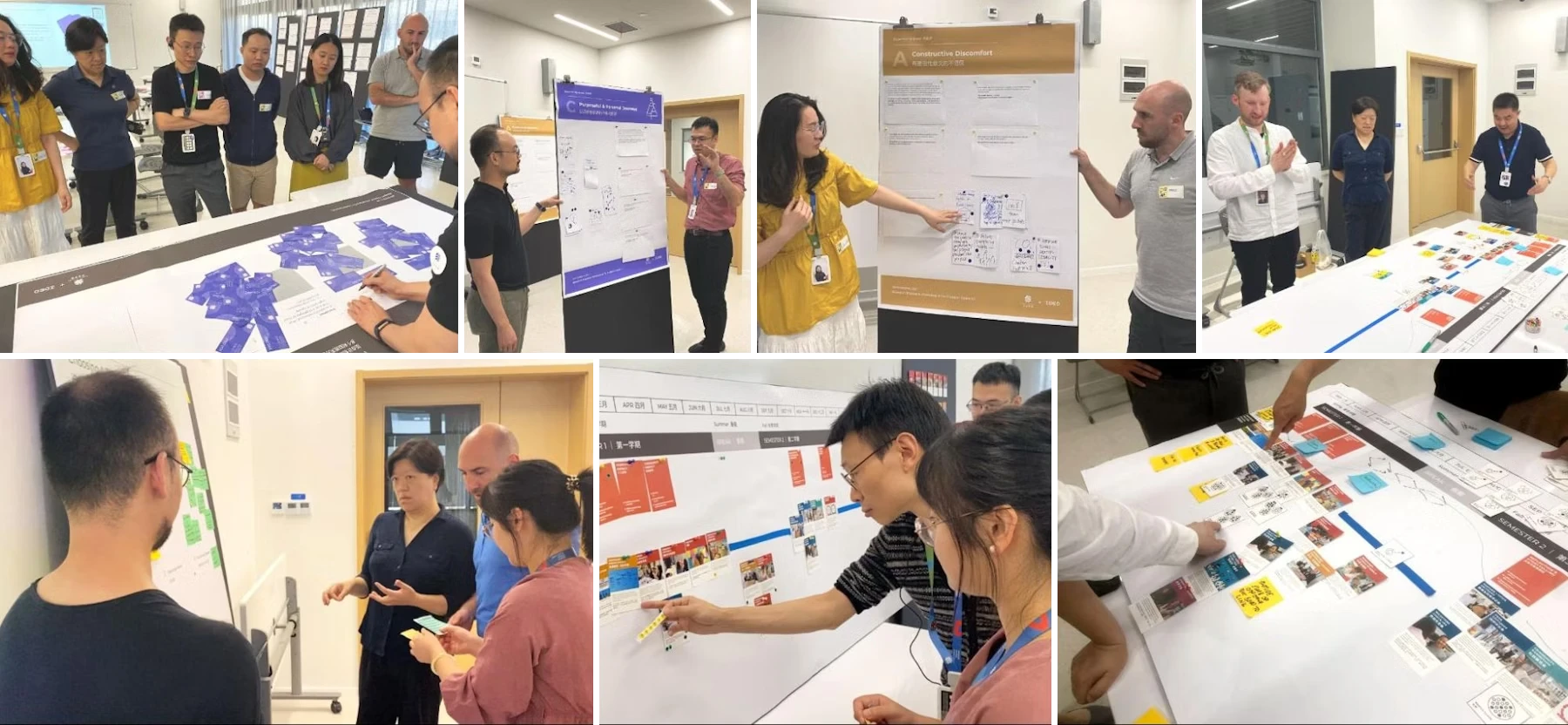
“An important aspect of IDEO's co-creation approach is to use design thinking as a tool to discern the real needs and existing perceptions of all stakeholders. If we hadn't carried out co-creation, the framework and details of the entire Capstone Program wouldn't be as clear... The overall quality improvement of the course through co-creation is also evident. We as teachers are the ultimate implementers of the course, and it is especially important for us to have comprehensive information and a grasp of how to land on the details."
- Zac Zou, Program Lead of the Capstone Program at Yungu High School
Remy:
I think what has definitely changed is using design thinking as a conduit to bring more voices into the room, consider broader and different perspectives, and to leverage its acute ability to synthesise these aspects and marry what is truly valuable to people (desirability), how these new conditions unlock what can be done (feasibility), and giving organisations the confidence that they can thrive in this complexity (viability).
A good example of this is our work in the healthcare industry, both internationally and in China. When working with multinational companies and local organisations we have to take into consideration the cultural attitudes and nuances towards healthcare that vary across different regions. We also consider factors such as funding mechanisms, KPIs for Hospital Directors, the regulatory environment, and distribution networks. By incorporating these perspectives in our work, solutions have a better chance of making it to market, and our clients are better equipped to anticipate and navigate challenges along the way together with us.
We don’t do this sequentially, but we use tangible design to ask questions about the reality of these complex systems, while learning and building towards something that must be truly different and valuable for caregivers and patients.
Future of design
Q. What does the the next 10 to 15 years of design look like to you?
Tony: Generative AI, Web3, climate change, and DE&I are just some obvious top-of-mind factors that are influencing businesses in their decision-making. Perhaps more importantly, these are complex, systemic challenges where I believe design can have a key role to play—not on its own, but alongside other disciplines such as data science, behavioural economics, architecture. It is time for design to become more porous, and more fluid. We are excited to explore with some of our trusted clients new methodologies, formats, and occasions for design. The future of design in China is bright, and we at IDEO have set our sights on the next horizon, where design will play a role in helping make boardroom decisions, deliver the multiplier effect, and achieve even higher order impact.
Remy:
The industry will change and tools will evolve, but design inherently brings an optimistic lens to problems and complexity. This is what has always nourished design and I see that still being true for the foreseeable future. The speed at which technology, society and the environment are changing will create unimaginable opportunities, but also unanticipated problems. I feel design will feed into those new cracks and continue to create new value. Some businesses will forge a path into the future and many will need to go through radical transformation to survive this next era. I’m hopeful that design, with its optimism, can lend a hand to some of these companies so they can find their next curve. That feels meaningful for me.
What can design do? This simple question is an ever-renewing source of motivation for us at IDEO.

28 things we’d love to redesign in 2024
From packaging to hold music to our relationship to time, we’ve got big ideas.
From the very, very big (our housing systems) to the very, very small (shower handle placement), our designers have a lot of thoughts about things they’d like to reimagine, if given the chance.
Here’s a look at what’s on their minds as we head into this new year.
PRODUCTS
- Why are shower handles directly in the blast zone of cold shower when you turn them on? —Conor Farese
- Can you imagine traveling by plane and needing to bring your own custom-sized seatbelt to carefully install in the cars you ride in? That’s essentially how we treat child car seats. It’s time to engineer a way to build them into cars. It’d be more sustainable, safe, and inclusive. —Rachel Young
- Clothes that shrink in the dryer because it's too cold outside or you don't have the space to hang dry them. WHY DO DRYERS STILL DAMAGE OUR CLOTHES? This may have just happened to me. —Alicia Duvall
- We need to redesign news around nuance and empathy instead of siloed points of view. —Sarah Asif
- Christmas trees! Not only are the needles impossible to keep up with, but there's still a pervasive myth that plastic trees are more environmentally friendly. Real Christmas trees are one of the best examples we have of capitalism working in favor of the environment. A big market creates demand for people to start tree farms, plant and sell trees, and repeat that cycle every year. If you have a plastic tree, keep it—but let's rebrand real Christmas trees as the environmentally responsible (and delicious-smelling) choice. —Becca Carroll
- Why do expensive, fancy face creams come in jars with hygiene and air seals that 10 percent of the product sticks to? I look at that cream stuck to the seal and see money, and then I either have to keep the weird seal and line it up to close the jar carefully, or scrape the cream off manually. Bleh. —Becca Carroll
- We have warming garments for everything but our mouths. This creates problems for the place I live, which is Massachusetts. Sometimes, in the winter, my mouth gets so cold and my jaw gets so tight it becomes hard to speak! A wintery vow of silence notwithstanding, I think we deserve socks for our tongues and warming pads for our cheeks. This would also prevent the tongue-on-frozen-pole problem that seems to have plagued humankind since we built metal poles. Lick all the poles you want! You’ve got a tongue sock! —Andy Reischling
- Paint samples. They should come in something more like a ketchup packet and less like a small can. —Rachel Young
- Repairs. Why does it require hours of Googling and watching shaky YouTube videos only to still get nowhere to learn how to fix your coffee machine or repair a hole in your clothes? —Anya Shapiro

SYSTEMS
- The American service industry, especially tipping culture. I’m newish to America and the idea of not paying people liveable wages is wild to me. I’d prefer if tax and tips were just included in the price of the service or meal. It’s also so hard to know what is appropriate to tip as the unwritten rules are different for taxis, takeaway food, a drink at a bar, dining at a restaurant, hairdressers, etc. Also, I don’t drink, and as soon as I ask for water only I seem to immediately put servers offside as drinks mean bigger tips. It makes for an uncomfortable dining experience. Surely we can design a way where people get paid fairly and customers have a pleasant experience without pressure. —Hannah Lewis
- How we reward and compensate people who make other work possible. Why does childcare cost more than college in 2/3 of states, and yet childcare workers make so little? Why does an IPO reward employees for the work they put in, but not the caregivers for their employees' families? Why can't we price and pay the true value of care work? —Becca Carroll
- Housing! Not only in the financial sense around the lack of affordability and equitable access, but also in terms of different models for home/land ownership. By rethinking both the architectural design of spaces and alternative financial/organizational structures, we can develop community-oriented, sustainable, and equitable housing models. Let’s learn from indigenous communities and cultures that prioritize multi-generational family systems. —Esha Reddy
- The cost of college. My 17 year-old daughter described the FAFSA application process as "Hunger Games for high school students" to become indentured servants of banks until they retire. —Vivian Barad
- The immigration and immigrant experience. Trying to obtain a visa, green card, or citizenship here is such a painful process. There are also so many restrictions that exclude noncitizens and visa holders from experiences like using investment platforms, participating in giveaways, going to school part-time, or doing contract work. —Deniz Cengiz
- Food systems! While there's often an emphasis on designing, buying, and receiving food as fast and easy as possible, I hope to see a world that prioritizes cooperative models: promoting direct, affordable access to fresh food while fostering sharing and more equitable distribution within communities. —Esha Reddy
- It boggles my mind that we have a set of broken systems that simultaneously create food deserts and massive amounts of food waste, just in different geographic locations. How have we not figured this out? With all of our resources and intelligence and technology in 2023, how is food insecurity still a thing? —Shannon Vossler

EXPERIENCES
- I would love to design a universal platform that lets patients and doctors simplify all the health insurance programs in the US. The interface and experience would be the same for everyone, no matter who their insurer may be or how their policies change, and would focus on radical ease. Let all the complexity of our healthcare system get sorted out by tech in the background. Sort of like how Square made payments so easy and unified for small businesses, there could be a way for people and providers to plug into just one insurance platform, so even when my plan changes, how I use it and get treated stays the same. —Ian Mathias
- Why is it that companies invest so much money in customer service and still play that horrid, staticky acoustic music that makes your phone speaker sound like it's an AM radio death rattle? Here's my idea: You still need a sign that you're on hold, so it can't be total silence, but why not experiment with different formats? What about a trivia quiz that moves you up in line the more you get right? What if you could connect your Spotify account and play your own hold music? What if you could do on-hold karaoke? So much of what passes for customer service is just what companies think is the blandest possible way to treat people. But by playing it so safe they create an experience that makes everyone equally miserable and bored. More courage, please! —Andy Reischling
- Public restrooms are unhygienic. Why does everything from door latches to paper towel dispensers require your hands or shitty sensors that don’t work? Our feet are awesome tools, and wildly under utilized in public spaces. My favorite: In the Charlotte airport, they have hand sensors for soap dispensers, but they all broke, so they’ve installed hand pump soap dispensers above the sinks. It takes most people 30-60 seconds to try all the automated dispensers before they notice the old school soap above. —Joe Brown
- Plus one to bathrooms, but more so thinking inclusivity: what does an actual great gender-neutral bathroom look and feel like? —Stuart Getty
- Performance management: Is anyone ever satisfied with a system of measuring human output? —Joe Brown
- Dying! But really, end-of-life care and advanced planning, especially for low-income folks and the sandwich generation who will care for their parents and younger generations. I've been an intermittent caregiver for a terminally ill parent this year and my goodness there are so many things I want to design to make this experience more human-centered, easier—and dare I say, joyful. —Jaz Henry
- The reboxing and the recycling experiences of physical products. And the whole recycling system. If we mean to live harmoniously alongside non-human life on this planet, we need to design better circular systems that help us use less raw material, and recycle what we've already made. —Conor Farese
- Breast cancer diagnosis and subsequent care, from the initial screenings and mammograms to sharing results, diagnoses, and treatments. I'd love to see a more holistic, human-centric approach to all cancers that doesn't require multiple systems working flawlessly in tandem to support individuals and their families in understanding and navigating a complex system. We need to design a system that helps ease the burden of those in medically vulnerable moments instead of leaving them with bureaucratic headaches. —Shannon Vossler
- Finding a therapist: Speaks for itself. —Anya Shapiro
- Ads (especially online). It is insane how many ads are shoved in our faces. —Deniz Cengiz
- Our relationship to time. We think in quarters, but organizations and people that will lead us into the next century will think in generations. Such deep time / long horizon thinking inevitably leads to new perspectives on consumption, (de)growth, and planet. For example: Norway's Minister for Future Generations, Patagonia's commitment to restore huge swaths of South America, hundreds of corporate net zero by 2050 plans, nations like Tuvalu that are planning to resettle populations sunk by the sea. It's why groups have been coming to IDEO for our futuring capabilities. —Natalia Vasquez
- I love running, a sport that seems super accessible—all you need are shoes. When in reality, those shoes are expensive. You also need time, a safe route, a secure starting and ending point that stores what you need before and after the run... not to mention the motivation, accountability, and education to make it habit. —Melissa Lobato
When you spend your life rethinking the built world, discovering things you’d love to overhaul is an occupational hazard.

Our toy Inventors share their 18 top picks for 2023
Toys and games designed for kids, and kids at heart.
Fortunately, IDEO’s Play Lab is filled with toy inventors, game designers, and tech wizards for whom play is a day job.
Here is our list of faves, for everyone from the littlest kids to kids at heart. Trust us and ready to shop? Here’s where you can buy them all. (Please note that IDEO makes a commission off of affiliate links.)
Snap Ships By PlayMonster
This has been my son's most-used toy for years! Each box comes with a bunch of modular pieces you can use to build all sorts of cool ships and mechs, plus minifigures to act out story play. There are 23 sets and we have them all! Now that he's older, he spends a lot of time building LEGO, but he still plays with his Snap Ships (which are much cheaper). His younger brother also loves them and has become an expert builder!
Who will love it: Kids who love building. It says it's for ages 8+, but my 3-and 6-year-old boys love these things!
—Josh Finkle
Steam Up: A Feast of Dim Sum
Named the very best board game of the year by Barnes and Noble, Steam Up lets players spend tokens to create their own dim sum feast. I like it for the adorable props, which give players an immersive experience. Another great feature: an unpredictable spinner that players can rotate 90 degrees to change up the dim sum steamers. Want to mess with your friends? Move their streamer away. With 12 different characters that have their own unique skills and scoring, you’ll never know who is going to come out on top.—Jeremy Chen
Who will love it: Kids 8 years and up, and family and friends who want to play a board game with them.
—Jeremy Chen
The Chameleon
One of our favorites to come out of our board game research, The Chameleon is a great contest of accusations and deception, where you have to catch the Chameleon before it’s too late. The mechanics are friendly to different levels of players, and there are lots of tactics for the Chameleon to keep themselves hidden. It has the right balance of challenge, clever clue-giving, and thrilling reveal moments.
Who will love it: Teens 14+ and adults. It’s also a great pick for a game night with friends.
—Takashi Wickes

Hues and Cues
This is one for the designer in your life. Players guess at an exact color out of the 480 color tiles with just one hint. Not many games vault you into heated debates about the exact hue of “Shrek green”, or “How pink is ‘salmon pink’?” A must for anyone on your list who takes color very seriously..
Who will love it: Kids 8+, families and future designers.
—Takashi Wickes
Settlers of Catan
Settlers are a studio favorite for a reason—it’s a regular feature of our “game night” research sprints. Klaus Teuber’s invention has so much to teach us about game mechanics, player dynamics, and more. There are entire courses and research papers dedicated to Catan. Thanks to an ever-changing board that introduces new tactics and strategy, it remains fresh even on frequent game nights. (And if you’re looking for a way to play remotely, there are great alternatives like Colonist and the official Catan Universe.)
Who will love it: Kids 10+, and families and friends looking for a game night classic.
—Takashi Wickes
Pikmin 4 (for Nintendo Switch)
Gardening becomes an extreme and alien sport in Pikmin 4. Grow an army of pintsized Pikmin and navigate the world from a miniature perspective as you battle bugs, furniture, and multi-tasking. Don’t be deceived by the adorable graphics or cute and calming sound design, Pikmin 4 is the kind of game you buy for your kid, then find yourself spending all night transforming a garden with your dog sidekick Oatchi.
Who will love it: Kids 10+, and parents and siblings who want to manage everything.
—Kezie Todd
Wavelength
Forget charades! Wavelength puts a new spin on cooperative guessing games, as you work together to figure out where an obtuse clue from one of your friends falls on a spectrum. Where does a hedgehog fall on the scale from round to spikey? It’s quick to learn and play, lights up a group with laughter, and has a free app version that’s a great assist for learning the rules or remote game sessions.
Who will love it: Kids 12+, and families and friends looking for a rapidfire way to make game nights easy.
—Kezie Todd

Taco Cat Goat Cheese Pizza
Fun for all ages, TCGCP is quick and easy to learn, with fast-paced gameplay. The illustrations are adorable and we’re always laughing by the end of a round. It’s also compact, so you can bring it along with you when you visit friends and family.
Who will love it: Kids 7+. A perfect game for families who want a quick round of fun without a lot of setup or rules.
—Diana Tobey
Dixit
This board game comes with a set of beautifully-illustrated cards that inspire imaginative storytelling. During each turn, a player picks a card from their hand and comes up with a clever headline for the image. Others then look for a card in their hand that matches the headline as closely as possible while confusing other players as they try to guess which card inspired the title. You’ll be amazed at how funny, poetic, and clever your fellow players are as they compete to win! The game also has an assortment of artist-made expansion packs.
Who will love it: Kids 8+, and families that appreciate cool art, storytelling, and witty game play.
—Michelle Lee
Tangrams
A timeless puzzle that is endlessly reusable, challenging, and deeply satisfying—once you’ve cracked the right shape arrangement. A great way to up the ante: Add a competitive element by making it a timed challenge between parents and kids!
Who will love it: Kids 3+ who love art and puzzles!
—Elise Granata
Cookies Makery Sweet Treats Oven Playset
Let’s start with the simple joy of a multistep unboxing experience that feels like you’re making your own pet! It begins with kitchen play with dough, then a magical reveal, and a cute plushie that pops out of the oven warm and smelling like cinnamon buns! My nephews loved exploring how it worked and kept returning to show others.
Who will love it: Kids 4-8
—Rikki Devlin

Shit Happens
Unsurprisingly, this is an adult party game. Players set out to organize cards from the worst thing that might ever happen to you to the least terrible. A good conversation- and laugh-starter.
Who will love it: All adults!
—Inna Yankelovich
Tonka 6182 Mighty Excavator
I’m not sure if you’ve noticed, but most plastic construction trucks are terrible for sandbox play. The wheels and mechanisms bind with sand, and they collect and return sand to your house in small doses forever after. This truck actually works really well in sand, and works beautifully as an “outside-only” toy.
Who will love it: Boys 2-5, or any kid who loves trucks and/or sandbox play.
—Adam Skaates
Blokus
We’ve loved this strategy game where you try to use up all your pieces while also walling off other players’ paths. It gets you thinking of different possibilities and lets you savor your win when your plan to capture an area works.
Who will love it: Strategy-oriented kids!
—Javier Reyna

Little Live Pets: Squirkies
These cute characters give kids multiple ways to fidget. Collect them all and discover what surprises each Squirky brings. One of the best mashups of fidgets and toys, each feature seamlessly and cleverly integrates into each animal.
Who will love it: Kids who love to fidget!
—Weishan Liao
Aerobie Sonic Bounce
Oddly-shaped rubber balls that are unexpectedly bouncy! Aerobies are fun to throw around, indoors or out. We dare you to see how high they’ll bounce. Think of them as a cooler tennis ball.
Who will love it: Kids 8+
—Weishan Liao
Planted
This is a competitive-lite board game where you buy plants and various supplies (terrariums, plant stands) to help them grow. And the more they thrive, the more points you get! There are lots of different strategies to grow your collection, and just as it is in nature, you can compete without having to actively be a jerk.
Who will love it: Kids 10+
—Jon Lung
Rat-a-tat Cat
A numbers-based card game that kids will grasp quickly while discovering satisfying strategies to win! There are a few clever interactions that we love—like being able to swap cards with someone. It’s also easy to come up with house rules (making high cards better than low ones or playing with five cards instead of four) for lots of replay value.
Who will love it: Kids 5+
—Matt Hovde
There’s an entire universe of toys and games out there, and if you’ve been adulting for a while, it can be hard to know which ones are most likely to make the kids in your life light up.

Lindsey Turner
I’m passionate about building brands, products, and experiences that help organizations show up with meaning and momentum.
I help organizations cut through complexity by shaping how they show up, through brand strategy, identity, and storytelling.
Working at the intersection of brand and business, I bring an editorial eye and a bias toward making—turning ideas into tangible experiences that people can understand, trust, and believe in.
My work spans government, healthcare, financial services, media, and consumer goods, from launching Gen Z-focused ventures to building innovation labs and reimagining legacy brands. I relish moments of ambiguity and enjoy translating across teams, perspectives, and priorities to move ideas forward.
I started my career in editorial and digital design, shaping cross-platform experiences and identity systems in publishing and agency environments. That foundation still shapes how I work today: I’m detail-oriented, collaborative, and overreliant on the Oxford comma. I hold a BFA in Visual Communication from the School of the Art Institute of Chicago.

Rachel Young
My work helps organizations see who their products aren't working for—and build the will and the tools to do something about it
For 25 years, I've asked the same question: Who does this design exclude—and what are we going to do about it?
My work spans human-centered strategy, inclusive design, and qualitative research, with clients ranging from Microsoft, Google, and Verizon to the National Science Foundation, and San Francisco Unified School District.
Before IDEO, I taught elementary school in East Palo Alto and spent a decade doing design work with social service organizations—where I learned firsthand what it costs people when systems are built without them in mind.
I am currently writing User Error, a nonfiction book about digital access and the design decisions behind it. I live in Oakland, California.

Brian Pelsoh
I lead with craft, ensuring our work is creatively excellent: rooted in deep human insight and imagination, while also grounded in the realities of business and technology.
My expertise spans brand, communication, and product design across tech, education, the arts, and social impact.
I believe great work demands both high-level vision and obsessive attention to detail, and only happens through collaboration.
I bring an inclusive, hands-on approach and a deep understanding of business, which enables me to consistently deliver excellence while always asking why.
Before joining IDEO, I worked at the brand firms Pentagram and VSA Partners. I began my career as a designer, leading teams at the School of the Art Institute of Chicago and the Milwaukee Art Museum. I hold an MFA in graphic design from Maryland Institute College of Art and a BFA in communication design from the Milwaukee Institute of Art & Design, and have taught at some of the best design schools in the US.

Tony Wong
I am responsible for IDEO’s long-term success in China and working with clients to use design as a tool to enable growth.
I am responsible for IDEO’s long-term success in China and working with clients to use design as a tool to enable growth. Specifically, I have helped Chinese companies design holistic brand solutions through the development of their products, communication, services, and innovation teams, and I have helped multinationals expand their presence and influence in China.
I advise global leaders on developing China-led innovation and capabilities.
In over 15 years in IDEO Shanghai, I have worked on projects that use design to elevate the quality of the experience of healthcare products and services, streamline processes that increase productivity, create spaces and programs that promote and enable inclusive communities, and build next generation mobility solutions that are planet-positive.
Before joining IDEO, I worked at Philips Electronics and the Electrolux Group in Italy, the Netherlands, and Singapore on a number of breakthrough commercial products. I am a member of the Young President Organization in Shanghai.

Building a personal AI for the messiness of life: Sida Li
Most AI products today are built for work—a space with clear problems and established systems. One founder noticed a gap: personal life is messier, harder to systematize, and mostly left behind by the AI boom. So she built Cue, a personal AI that lives inside iMessage and group chats, to go where the other tools haven't.
In this episode, Becca Carroll, IDEO's Chief Strategy Officer, talks with Sida Li, co-founder and CEO of Shared Context Lab, about staying anchored to a human need while the technology around her keeps changing shape, why she treats her business model with the same rigor she'd bring to a product, and what it feels like to build a company at this particular, disorienting moment in AI.
The conversation also gets into how Sida makes design decisions: the language Cue uses to describe itself, the tradeoffs behind building inside iMessage instead of a new app, and a real story about a business idea that didn’t pan out.
This is the second in a two-part series profiling founders from IDEO's Startups-in-Residence program. The first conversation is with Johannes Seemann, founder of Sooner, on designing GenAI for the emotional side of money.

Designing GenAI for the emotional side of money: Johannes Seemann
Most personal financial tools are built to run the numbers and optimize towards a budget. While that works for some, most people experience money as a lived relationship that does not neatly fit into a spreadsheet. Johannes Seemann and Becca Carroll discuss why money is emotional before it is mathematical, and what a human-centered approach to building a generative AI financial product looks like in practice.

The curious leader's edge in uncertainty: Scott Shigeoka
Mina Seetharaman talks with Scott Shigeoka, author of Seek and Head of Curiosity Cultivation at the Eames Institute, about what distinguishes genuinely curious leadership from performative curiosity, how power dynamics shape curiosity, and why practicing curiosity can restore energy rather than drain it.

How constraints make us more creative: David Epstein
Mina Seetharaman talks with David Epstein, author of Inside the Box and Range, about why total freedom often produces average work, how leaders can design useful limits on purpose, and what organizations such as General Magic and Pixar reveal about the relationship between boundaries and creativity.
Looks like you might be in search of something very specific?
Or reset the filters above and try another angle.
Here’s some random inspiration

Podcasts about creative leadership

Articles about the power of prototyping
