
.svg)


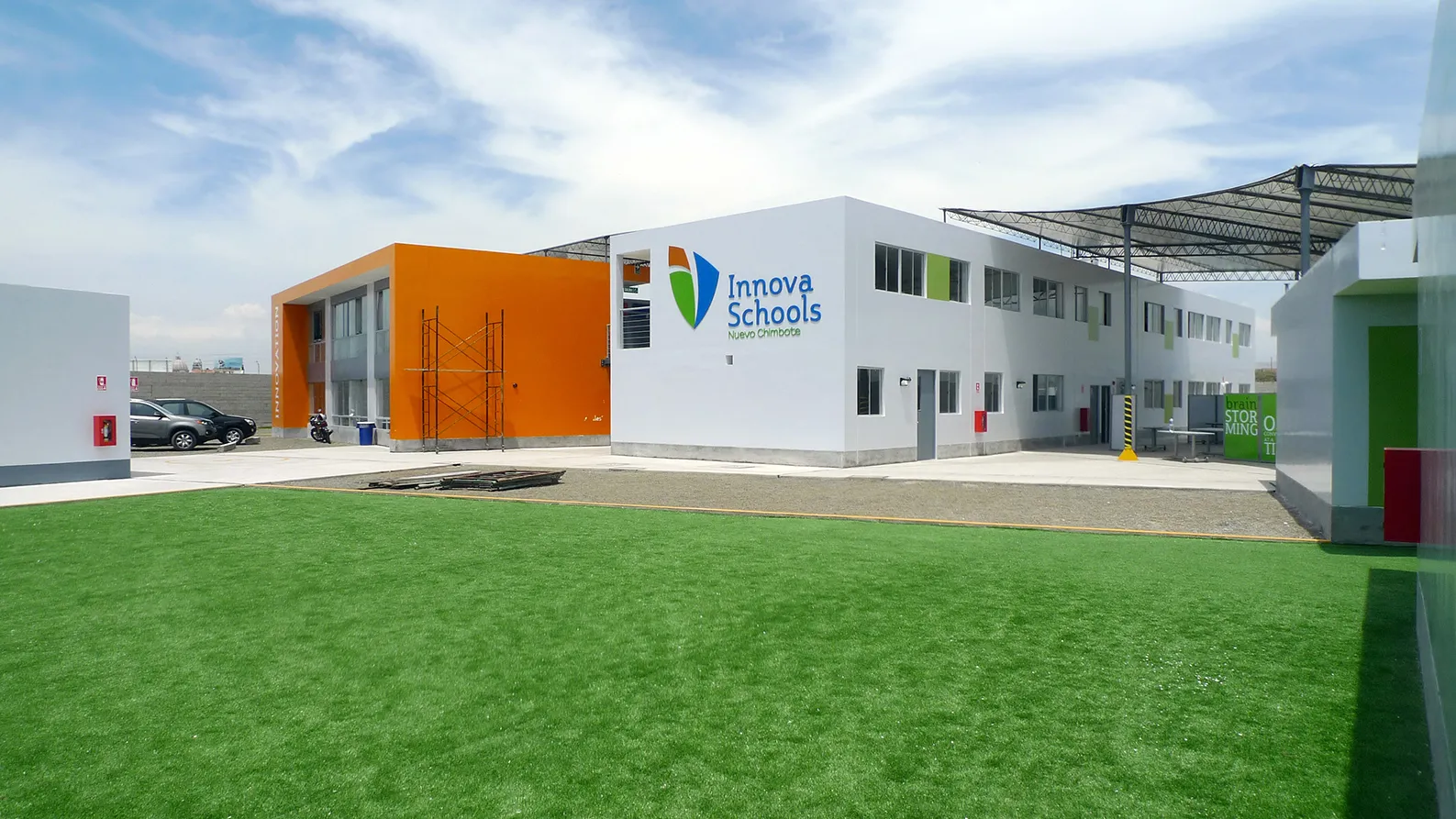

Designing a school system from the ground up
Scaling an entire network of schools for the growing Peruvian middle class.
How do you lift up the middle class in a developing country?
That was the challenge facing Peruvian entrepreneur Carlos Rodriguez-Pastor, who hired IDEO to build an entire network of schools powered by a progressive new learning model. IDEO’s mandate: to redesign Innova’s entire K–12 learning experience, from the curriculum to the teacher training to the school buildings, with an eye toward expansion and a goal to provide international-quality education at an affordable price—about $100 a month.
Innova Schools is a part of Intercorp, a family of 35 businesses that span everything from banks to retail stores and added schools to its portfolio. In 2010, the company had five existing schools but realized that its existing model could not grow. The shortage of well-trained, high-quality teachers in Peru, combined with rising land costs, meant the schools would need to radically change course to succeed.
To learn about scalable school models around the world, IDEO researchers visited inspirational schools and learning programs, and looked to analogous systems like retail, hospitality, and health care to understand their approaches to scale. Throughout the project, they collaborated with teachers, students, and the Innova Schools team in co-designing the work itself.
Together, Innova Schools and IDEO developed the curriculum, teaching strategies, buildings, operational plans, and underlying financial model to run the network of schools.
"I was blown away by Innova Schools," said Salman Khan, founder of Khan Academy. "It's inspiring to see such an affordable school deliver a quality of education that would rival schools in the richest countries."
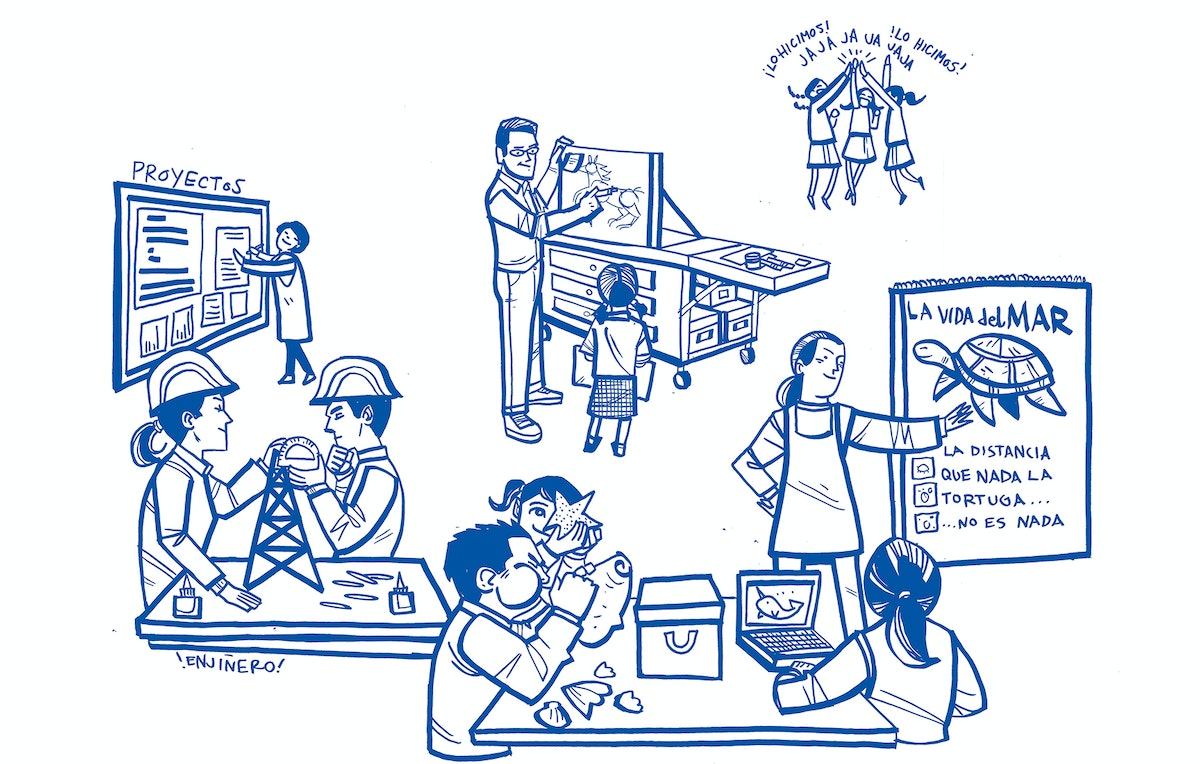
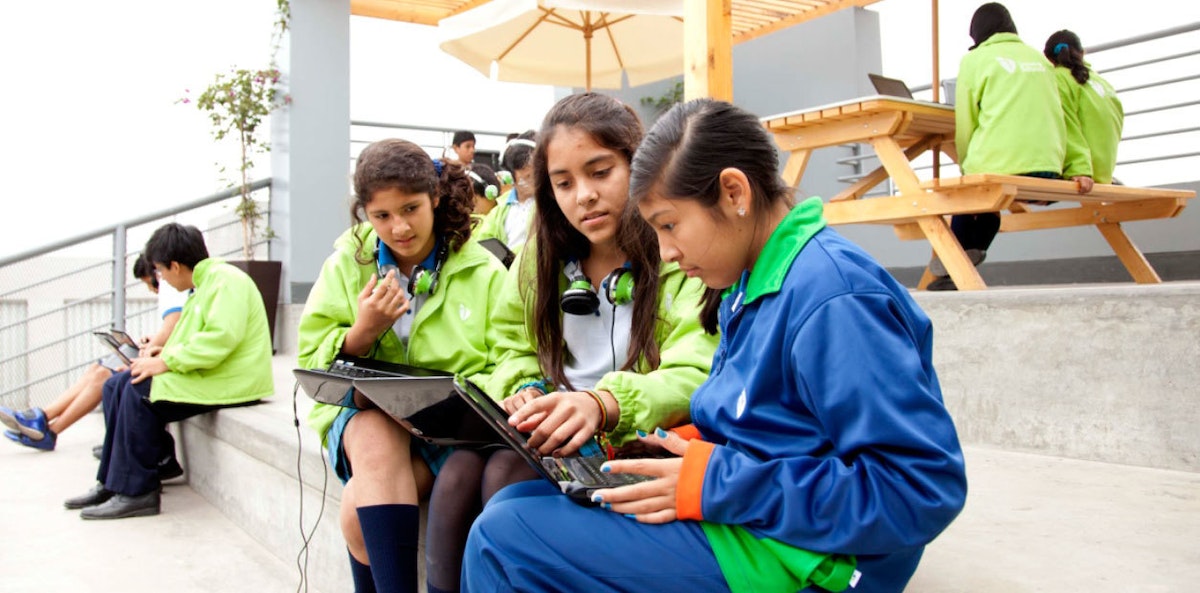
The new Innova Schools combine teacher-led, project-based learning in small groups with self-directed time using digital learning tools. Teachers monitor students’ work online and offer personalized guidance. Parents can view their children’s progress online as well.
Dynamic learning environments include community spaces, media labs, rooftop study areas, amphitheaters, and cafés that are optimized for flexibility: furniture on wheels, movable walls, and efficient uses of space to allow for different modes of learning.
An online Teacher Resource Center includes a database of more than 18,000 custom lesson plans based on a progressive new teaching approach. The center helps teachers learn their craft and gives them a chance to connect across the network.
The business model of Innova Schools was developed at the same time as the school experience. Designers leveraged the economies of scale that come from building a network of schools and centralized tools, such as data systems that allow all the schools to learn together.
The project has allowed Innova to open more schools at an affordable cost to families, ultimately giving more of Peru’s youth the chance to compete in the global economy. This comprehensive approach to system design ranks as one of Latin America’s most ambitious privately funded educational projects, and is on track to become the largest private school network in the region. To date, Innova has opened 63 schools in Peru that are serving more than 50,000 students.
A good system design doesn’t end with strategy. The work on Innova Schools also had a huge influence on the company, according to Rodriguez-Pastor. Through the creation of new roles and an aligned set of values, Innova’s central office has become a much more nimble and creative organization. They’re constantly scanning the world for inspiration in how to best educate their students, while building out the new innovations. They realize that design thinking can become an integrated part of their daily management of this growing network of schools.
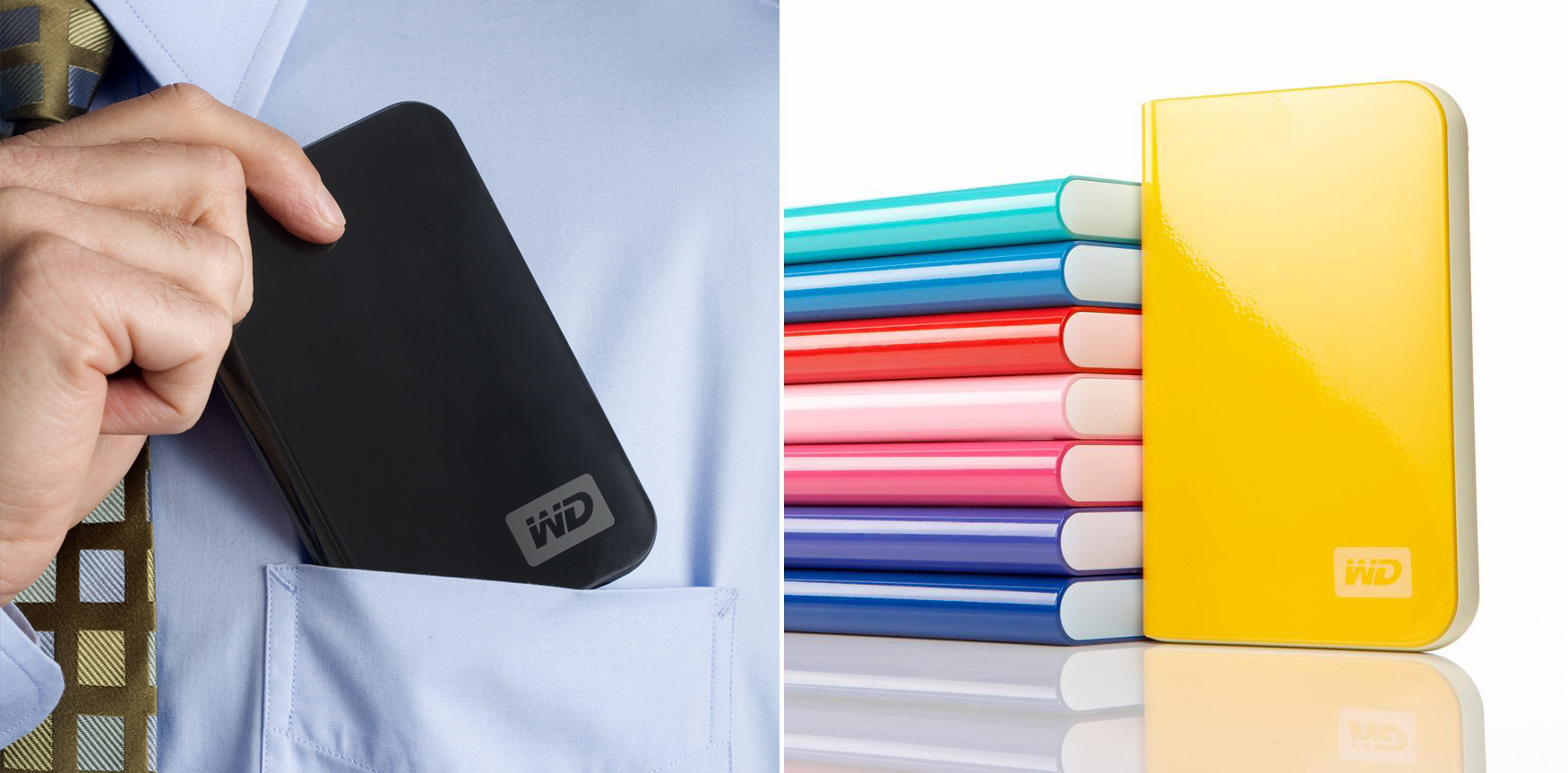
Designing a top-selling hard drive
Through a long-term collaboration, Western Digital and IDEO have created one of the world’s best-selling hard drives.
Western Digital, the leading provider of external digital-storage solutions and a pioneer in the field, and IDEO collaborated on a number of products that produced reliable, secure, high-performance hard drives for personal and professional use and have won numerous design awards.
The projects include:
- MyBook external hard drive: IDEO and Western collaborated to find a new design language for their external hard drive MyBook. In just six months, MyBook became the number-one hard drive in the Americas, and grew US market share by more than 50 percent.
- MyBook II: Looking to regain MyBook’s original number-one position in the hard drive market, IDEO and Western came together again to refresh the original design, finding ways to further differentiate the product and the brand, and winning a 2008 Spark Bronze Award.
- MyPassport: Western and IDEO designed the 320GB, ultra-portable USB-powered hard drive that appeals to the mobile user, which won both the 2008 IDEA Bronze Award from IDSA and BusinessWeek, and the 2009 iF Award.
- MyBook and MyPassport 3.0: Again, IDEO and Western collaborated on bringing the popular MyBook external hard drive to the next level in the hardware, the software, and the packaging. IDEO also created in-store merchandising, the graphics and information featured on product packaging (and the “out-of-box experience”).

Designing a city emergency plan
Helping cities prepare for emergencies with a resourceful toolkit.
The city of San Francisco wanted to help its people become better prepared in case of emergency. While no one feels totally prepared for a natural disaster, people who are most connected within a local network fare better in an emergency.
So the San Francisco Department of Emergency Management (SF DEM) and IDEO teamed up to create SF72, a revolutionary platform that helps to reach people where they are. In times of emergency, the city will need citizens to be self-supporting for 72 hours (or longer) before local services or outside help kicks in. With that in mind, IDEO developed an accessible platform to help people prepare for those 72 hours in simple ways that fit into their daily lives.
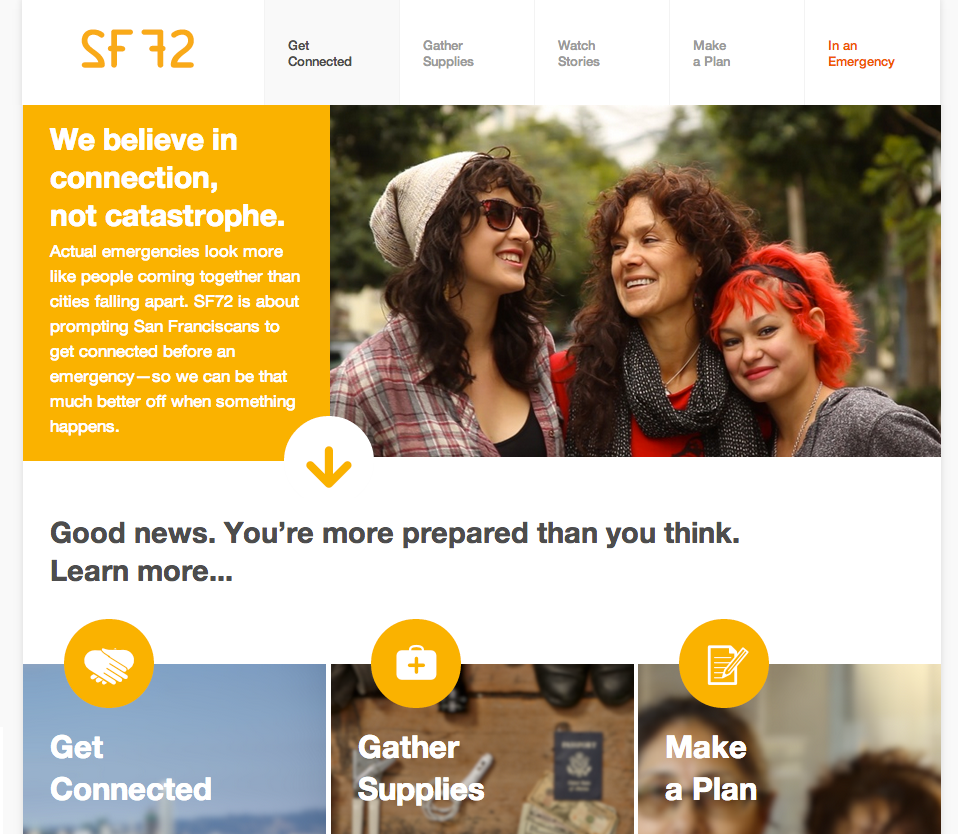
The SF72 website helps people with five important tasks: Get connected, gather supplies, watch stories, make a plan, and have access to an updated Google map. SF72’s content is hyperlocal, but IDEO and SF DEM also created an open-source toolkit for cities worldwide. From San Jose to Denver, other locales are using the simple toolkit to create a City72 platform of their own. Most recently, the city of Oakland collaborated with Code for America to develop its own platform. The City72 Toolkit enables SF72’s ethos of social connection for resilience to scale and grow—city by city.

Designing a global plan for disaster response
Creating a network that connects veterans across continents.
Team Rubicon, formed in 2010 as a response to the devastating earthquake in Haiti, is made up of former military veterans who swoop into help in times of disaster. The organization started with six vets in the US who were eager to transfer their battlefield readiness in to frontline relief efforts, and has grown to more than 28,000 volunteers across the world.
To explore its growing global effort and to shape the future of the organization’s venture, Team Rubicon approached IDEO for help. After an 11-week collaboration with government, military, and veteran groups, a vision for Team Rubicon Global emerged. Inspired by sources as diverse as TED and The Hell’s Angels, the three-tier model consisted of an anchor network to share best practices across the organization and two supporting platforms designed to help countries with varying capacity and needs.
Team Rubicon Global coordinated its first deployment in April 2015, when a quake struck Nepal, sending US and UK teams to double down on the rescue effort. According to Vince Moffit, Team Rubicon USA Incident Commander, that incident alone validated the network effect of IDEO’s work. “We couldn’t have done this without Team Rubicon UK,” he said.
And for the veterans who are part of Team Rubicon, the shared desire to serve—applying skills ideally suited for disaster response—creates a renewed sense of purpose, community, and leadership that helps reintegration to civilian life.
24 More Things We Want to Redesign
When was the last time you were annoyed by something small? Like the mean, angry noise a chip reader makes when it’s done with your card?
Those things drive us nuts too. But those tiny moments of frustration can become fodder for a totally new way of thinking. What if the card reader sung the ABCs? What if pen caps locked? What if water balloons tied themselves? (Luckily, someone has already put some time into solving that last one.)
At IDEO, we spend a lot of time rethinking everyday life, from tiny pen caps to the giant, bureaucratic process of applying for a visa. Like we said in 2017: This kind of thinking is our bread and butter. Back then, we asked the IDEO community what they were dying to redesign, and the answers were so provocative that we decided to do it again. Here are 24 more things we want to redesign, if only we had the chance.
Work
The timecard. With a little AI juice attached to email and calendar, there’s no reason that anyone should have to create a timecard: They just need to review it. —Joe Brown
Corporate training. Every organization needs the ability to grow new and adaptive capabilities. Those skills won’t be coming in from an external job board, and definitely not at scale. —Peter Hyer

I want to take a hack at reimagining the experience of identifying and applying for a job. At scale, it's currently a dry, massive vortex of duplicative job boards, cluttered search engine results, and mounting self-doubt and uncertainty. What if we had a universal tool that could help point a candidate to a strong-fit company, job family, industry, or job title based on a series of filters they could manipulate? Job security can prompt a domino effect with a host of other social issues, so let's put candidates back in the driver's seat and make the process of getting there more personal and human-centered. —Chloe Partelow
Networking. It's uncomfortable, awkward, daunting, and surface-level. No one wants to do it, but everyone feels like they need to. —Melissa Lobato
I spend a lot of time thinking about the future of the actual places where we work. I think the workplace should allow more flexibility and choice and generally be more global. I’d like to see deconstructed offices in neighborhoods where people live and like spending time. It will reduce commuting costs, improve productivity, lifestyle, geographical choice, create more diverse and dense neighborhoods, and allow for more creative collisions. —Kateryna Romanova
Education
College, especially a liberal arts education. Turn it into something much more relevant to close the skills gap in the marketplace, and make it much more about life-long learning. —Suzanne Gibbs Howard
Vocational school. I’m not sure that “everyone needs to (and can) go to college” is the right narrative. That’s the message I got growing up, and vocational schools or trades were either implicitly or explicitly judged. I think we are in a time when we need to take a good, hard look at alternative forms of education. —Meg Rice
The lower part of the k-12 education system. Why isn't it more globally aligned and translatable? Why does it assume that you live in one country for 12 years? —David Sjunnesson
Our approach to digital literacy. When our 70-plus year-old dads accidentally tweet a search query, we make fun of them instead of recognizing that behavior like that is indicative of large, looming societal problems between those who have tech know-how and those who don't. —Rachel Young
Cuddling
Cuddling. Seriously: what are you supposed to do with your bottom arm?!?! —Santiago Seira
Breakups
The breakup: Ow. It hurts. I don't know how to go about redesigning this, but I know there’s a lot of room for reflection and plenty of nuggets of truth to be gleaned from any moment that rips you apart. I have reflected on how to create a scaffolding for yourself that helps you walk out the other side with a sense of gratitude and growth—but still, ow! —Leah Jarrett
Breakups. And I’d start with an interesting provocation from Star Trek. —Lisa Tacoronte
Health
Electronic medical records (EMRs). Some doctors spend up to 50 percent of their days doing admin work, mostly in EMRs, and they are notoriously not user-friendly, not interoperable across companies, and even can cause medical errors. —Jessica Watterson
Single-Use Plastics
Unnecessarily one-time use and/or made of plastic: floss. Coffee cups. To-go containers. Toothbrushes. Plastic water bottles—or anything that holds water. Makeup packaging. Tampons. —Shuya Gong
Recycling How-Tos
Every single recycling/garbage/composting receptacle on the planet. I challenge you to find anyone who can understand and follow those rules. —Chioma Ume
Our Relationship With the Environment
How we make decisions that impact the environment. I'm inspired by seeing calories on food in restaurants, which helps me make informed choices. Why don't we have something similar for electronics, ordering on Amazon, food in the grocery store, to show the impact of a product on the environment? —Dean Malmgren
Time Itself
Time travel. It’s just too difficult currently. —Sean Hewens
Getting Towed
It’s scary, financially exploitative, and just generally terrible. —Tara Safaie
The News
I would like to redesign our concept of what news is. I’ve tried many different sources, and have found none to offer adequate choice, curation, or quality. Most of what passes as news is superficial, salacious, irrelevant, and/or extremely upsetting. I find I’m constantly disappointed. The news needs a total overhaul. —Betsy Fields Smith

Childcare
The process of finding childcare. Every parent seems to reinvent it all over again. —Annette Diefenthaler
Access to Capital
Women entrepreneurs receive about 2% of all venture capital dollars as compared to men. There's a lot of opportunity to reimagine the funding process so that it's more inclusive of women, people of color, and non-US nationals. —Sam Schulman
Winning and Losing
The definition of success. —Ramon Marc
Online Ticketing
You have the ticket price and another $20 in service fees, and sometimes you're required to print out a physical ticket that arrives digitally. Huh? —Miles Holenstein
Life Transitions
Post-job changes, post-move changes, post-high school changes, post-college changes, postpartum changes, post-divorce changes, post-(insert life change here). There’s no blueprint. Help. —Sue-Jean Sung
Hot Dogs
I want them to be healthy. —Michael Hendrix
If your organization would like to work with us to solve one of these problems, you can reach us at octopus@ideo.com.
Illustrations by Jenice Kim
When was the last time you were annoyed by something small? Like the mean, angry noise a chip reader makes when it’s done with your card? Or the mess a pen makes when the cap pops off in your back pocket? Or how deeply, achingly, frustratingly hard it is to tie a water balloon?

It’s Taken Decades for Social Innovation to Become Mainstream. We Can’t Take Decades More to Act.
The next era of social innovation will be defined by cross-sector collaboration, and your business has a role to play
Beyond CSR’s spectacular rise, several other indicators signal a growing belief in the role of business and innovation in addressing societal problems: 88% of millennials say they will only work for values-aligned companies, and Blackrock CEO Larry Fink demanded publicly in 2018 that companies be driven by purpose. Fink calls for a new model of corporate governance:
Society is demanding that companies, both public and private, serve a social purpose. To prosper over time, every company must not only deliver financial performance, but also show how it makes a positive contribution to society.
Larry Fink, Blackrock
That’s the CEO of a company managing $6.5 trillion in assets pushing for the same economic shift demanded by today’s youth: to ensure that innovation serves a social purpose. Mainstream box: check.
But experts are skeptical. In her opening presentation at last year’s Social Innovation Summit, Caroline Barlerin, former Global Head of Social Innovation at Eventbrite, asked, “Is the mainstreaming of social innovation something to celebrate? Is it enough?”
The answer is no. Not enough, not even close. While CSR reporting and growing social innovations are surely positive developments, they also reflect an insufficient response by the private sector, civil society, private philanthropy, and government to today’s global challenges.
Rather than count how many companies have begun to invest in CSR efforts, the real measure of progress is how we’re faring against the challenges of our time. Whether you focus on global climate change, the United Nations’ sustainable development goals, or the health and wellness of the fabric of our society, it’s clear that whatever “mainstream social innovation” is, it’s not enough.
As we enter 2020 and head toward momentous change in the US and the world, we also need to enter a new phase of social innovation. Three important changes will help us get there.
1. From innovations to ecosystems
Just as the complex biological system of a rainforest allows individual plants to flourish, so do complex entrepreneurial ecosystems work to help social innovators succeed. Healthy, diverse, and inclusive ecosystems allow talent, information, and resources to flow quickly. These networks can’t be bought, they have to be built. Andy Stoll, Kauffman Foundation
Today’s societal challenges require vibrant systems of diverse innovators attacking societal problems from many angles. Investment needs not only to support scaling, but also to create the conditions that allow entire fields of innovators to advance. As Managing Director of OpenIDEO—IDEO’s participatory, decentralized innovation platform—I’m inspired every day by the thousands of innovators who we support, a reminder that there’s never been more human energy and creativity directed toward global challenges. After years of leveraging open innovation to create a pipeline of promising concepts and ventures, OpenIDEO now strengthens entrepreneurial ecosystems to address pressing societal challenges collaboratively.
In 2016, OpenIDEO worked with a consortium of partners to introduce the Food Waste Challenge, a program that sought to address the 40% of food that goes to waste in the United States. Rather than selecting a small number of winners, we created the Food Waste Alliance, a virtual network of 80 organizations that proved pivotal to the development of several food waste startups still growing today. Realizing the potential for ecosystems to create greater impact over time, we designed OpenIDEO’s 2018 Early Childhood Innovation Prize to advance an entire sector of innovators in the early childhood development space. After 30 teams of entrepreneurs were selected and received a share of $1 million in grants, OpenIDEO and our partners at Gary Community Investments then launched a virtual accelerator and partner network, which brought together innovator teams and institutional partners to advance winning ideas.
The program eventually transitioned to two new accelerator networks fully dedicated to early childhood innovations, Promise Venture Studios and Futurebound—long-term, ecosystem-building initiatives sparked by the initial open innovation program.
To create breakthrough change, all of us must work together. That means platforms and tools like prizes or challenges that transparently support people to develop their best ideas and collaborate.
Steffanie Clothier, Gary Community Investments
2. From delivery to co-creation
Increasingly, funders and innovators alike are recognizing the need for solutions to be truly rooted in the needs of those they’re trying to serve. In their recent Stanford Social Innovation Review article, The New Practice of Public Problem Solving, Tara McGuiness and Anne-Marie Slaughter note this as one of four major trends:
The relentless focus on what users need and how they experience services brings people into the process of providing feedback for services where they have not traditionally had a voice.
Tara McGuiness and Anne-Marie Slaughter
While the growing interest in human-centered design is a positive step forward, the next chapter of social innovation will require another leap. Rather than just gathering user feedback on potential solutions, the people we design for will increasingly become part of design, implementation and evaluation. As technology makes it ever easier to be more inclusive, it will become unacceptable to exclude or overlook people affected by social innovations. True co-creation facilitates a greater sense of community ownership and more grassroots capacity building.
OpenIDEO has been learning about new ways to innovate alongside the communities we serve. Our 2019 BridgeBuilder Challenge—the third annual $1m social innovation prize offered in partnership with GHR Foundation—sought to better include a group that’s more often a recipient than an active participant of social innovations: displaced migrants and refugees.
We began by partnering with former BridgeBuilder Challenge winner NaTakallam to include people with relevant lived experience in creating the brief. Applicants were also expected to show evidence that the voice and perspective of a person currently or previously experiencing displacement was part of the ideation, process, and project. NaTakallam later helped us hire a group of mentors who have experienced displacement to provide feedback and mentorship for applicants, and to support the evaluation process.
3. From disengagement to connection
In 2016, a Gallup poll reported that employee engagement in the United States had returned to its highest level since 2000, when it began studying worker enthusiasm and interest. That high is disappointingly low: just 34% of our workforce feel engaged in their work. Meanwhile, according to research conducted by Opportunity Knocks in 2011, half of nonprofit workers reported either being burnt out or in danger of burn out. Taken together, these studies reflect a failure to create work that is both inspiring and reasonable. As today’s problems can only be solved by dedicating attention to them, this failure is tragic.
Social innovation can play a central role in better aligning talent to our needs by creating new jobs, helping employees become engaged in issues they care about, and fundamentally reshaping the culture of work. To make this true, a reasonable work-life balance is one obvious need. Less obvious, but perhaps just as important, is a sense of connection—both to purpose and to other people.
- Connection to Purpose: It’s important to remember that individual and organizational purpose are separate, and that understanding and supporting an individual’s purpose is as critical as encouraging focus on organizational purpose.
- Connection to People: Cultures of self-sacrifice, efficiency and competition often impede deep connection with potential allies within teams or sectors. It’s important to combat isolation and loneliness in order to maintain passion for the work.
Once or twice a year, the OpenIDEO team gets out of the office and away from our daily responsibilities for a team retreat. We use the time to look inward to better understand the aspirations bringing us all to work every day and how each of us is connected to a shared purpose.
While the challenges facing social innovators are serious, we have reason to be hopeful: today there are unprecedented levels of energy and creativity going toward improving the state of the world. That energy is humanity’s greatest resource, but it’s too often depleted by underinvesting in the ecosystems entrepreneurs need to thrive, ignoring the creative potential of people with lived experience, and failing to help employees connect to purpose and each other. Building the next chapter of social innovation will require new thinking, practices and tools. It'll take bold action and a continuous commitment to pushing boundaries, not settling for a place in the mainstream.
In 2020, OpenIDEO will continue to explore how the social sector can be advanced and adapted to tackle tomorrow’s challenges. Follow along and join the conversation.
Illustration by Antonio Sortino
The once radical notion of leveraging business to address societal problems has become mainstream. As of 2017, 85% of Fortune 500 companies reported their environmental and social impact—an astonishing 65% increase since 2012. By this metric, the notion of corporate social responsibility (CSR) is verging on ubiquitous.

Our Top 10 Stories of 2019
The stories our readers read and shared most this year
As we wrap up the year, we’re reflecting on the power of creativity to inspire change in ourselves, our work, and the world around us. We've pulled together The Octopus’s top ten most read stories of 2019, each of which offers tips, tools, and mindsets to help you cultivate creativity as a tool to navigate the constant ambiguity facing us in these turbulent times.
And as always, a heartfelt thanks from The Octopus team for stopping by. We can’t wait to see what 2020 has in store.
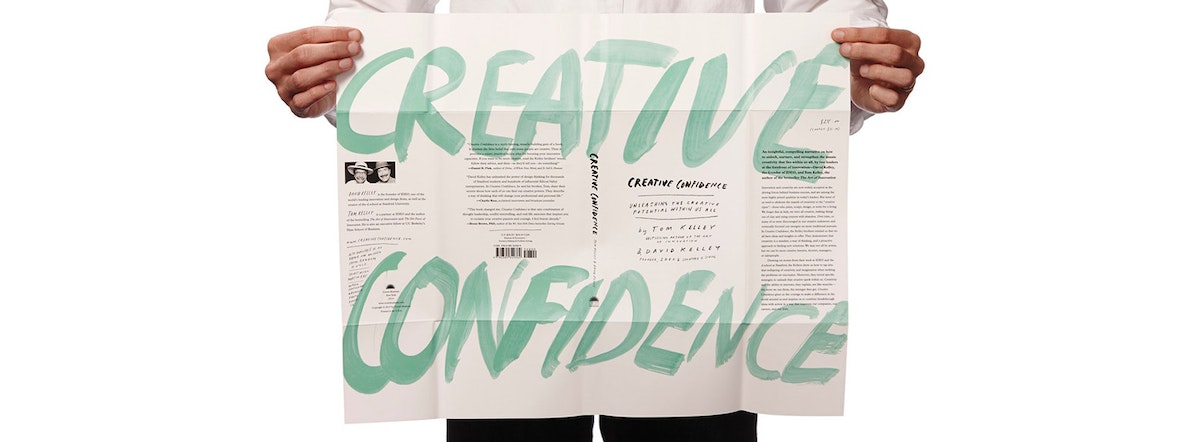
1. 10 Exercises to Build Your Creative Confidence
Creativity is like a muscle—it can be strengthened with practice. Try these activities from David Kelley & Tom Kelley’s book Creative Confidence to get started.
2. Corporate Innovation Needs a Shakeup. Here’s a Blueprint.
Innovative ideas don’t happen by accident. Check out these tips for creating an environment that fosters innovation from the team behind IDEO’s newest digital tool, Shape.
3. The 3 Mindsets of Great Interaction Designers
Being a successful interaction designer is about more than mastering digital tools—it’s about the soft skills that help you push your designs to the next level.
4. The Best Managers Understand Their Employees’ Emotions—And Their Own
There’s no denying it: your relationship with your boss makes or breaks your experience at work. Here’s how the best bosses create positive emotional environments for their employees.
5. Practice Your Prototyping Skills with These 4 Resources
An old IDEO proverb states, “If a picture is worth a thousand words, a prototype is worth a thousand meetings.” These resources from IDEO designers will help you prototype efficiently, effectively, and creatively.
6. 3 Creative Exercises to Make Change Stick in 2019
We kicked off 2019 with intention, sharing three activities to help you actually reach your New Years’ goals. So, how’d you do?
7. Turns Out Emotions Do Belong in the Workplace—Here’s Why
The definition of professionalism is changing. Here’s why organizations should invest in their “emotional culture” and allow employees to express feelings at work.
8. An IDEO Recruiter’s 3 Strategies for Writing a Better Resume
Planning to start off the new year with a new gig? Use these three tips to help you create a resume that stands out in a sea of sameness.

9. AI Needs an Ethical Compass. This Tool Can Help.
Artificial intelligence is the product of those who create it—biases included. That’s why IDEO data scientists created a tool to help teams design ethical AI solutions.

10. Design an Organization’s Purpose Statement With This Tool
Why does your company exist beyond making profit? IDEO organization designers built a colorful tool to help you arrive at an answer.
2019 was widely regarded as a year of tumult—politically, environmentally, societally. But in the face of it all, 2019 brought us unparalleled human advancement, from Greta Thunberg’s movement of youth-led climate activism to NASA’s first-ever image of a black hole. For better and worse, 2019 kept us on our toes.

How to Avoid the Tech Hype Trap
Because the newest tech isn't always the right solution
Unsurprisingly, this trend didn’t last long. Car companies gave up the schtick and went back to traditional approaches to notification. But the story of talking cars in the 1980s speaks to a classic move in industry: Companies are often eager to find a way to use the hottest technology, even if it’s not a fit for their team, their business model, or the problem they're trying to solve. It's a classic case of FOMO.
As designers committed to a human centered approach to developing new products and services, we look at things a little differently. We start by uncovering a need—for example, helping tired drivers stay awake and alert while at the wheel—and then search for the right technology to solve the problem. We relish the opportunity to take a journey away from the "tech hype" landscape and explore what problems, challenges, or needs the desired tech may help address. It’s about focusing on the people behind the problem before finding the right technological approach.
How, exactly, do we get ourselves in that mindset? We tapped our design research colleagues in our Cambridge and Chicago studios for their best tips on cutting through the tech hype. Here are three distinct strategies for a technology detox at the start of a project.
1. Start by taking the tech apart and exploring the value proposition, then make decisions
Design researcher Hannah Rosenfeld worked on a project where she had to dive into a potentially-disruptive, blockchain-based technology that could have serious applications in the fintech space. For some products, it was the perfect fit. She needed to figure out, though, if it was the right fit for what she was working on.
Throwing an existing, well-formed product that uses the tech in front of her team might have shifted the customer focus away from the big picture toward feedback about functionality and usability, questions that matter on the latter end of product development. Instead, she and her team unpacked the functional and emotional benefits of the technology—what blockchain could unlock for customers or allow them to do that they couldn’t before—and used these as the basis for their exploration. From there, she was able to develop early stage prototypes she could put in front of customers to test the resonance of potential benefits rather than the appeal of an ill-understood technology.
In doing so, Hannah was able to highlight for her clients the potential impact and inherent limits of the current technology as well as make recommendations for how they could evolve their offer to align with real world challenges.
2. Try on a few different options to find the right fit before committing
When a team from the Cambridge studio was working on a project to create an immersive, digital experience for a new flagship retail store, they needed to dive into the role tech would play.

To explore this question, Gabe adopted a Goldilocks approach, taking the team on an inspiration trip to three museums, each with contrasting approaches to using technology: a cautious museum that sticks to straightforward displays of content in the museum and online; a lavish techno-fantasy museum with touch screens in every corner; and museum with a more careful balance where physical artifacts are brought to life with additional layers of digital content.
From the museum with the more cautious approach, the team learned about its core values, and how it carefully leveraged digital technology by offering online access to its archives for audiences that might not otherwise come to the museum. At the tech-heavy museum, we saw best-in-class interfaces that were great at engaging one visitor at a time, but missed out on opportunities to connect people in shared activities. And at the museum that created a balanced approach to digital and analog displays, we saw how stories projected onto artifacts added a layer of depth to what we learned.
By taking the Goldilocks approach, Gabe and the team generated a shared set of design principles that articulated the role digital technology should play in their store and how it would be used strategically to tell the story of the brand.
3. Think of fantastical means to address concrete needs
When former IDEO design researcher Ovetta Sampson was working on a project about technology-enabled cabinets, her first question was, what human need would this technology serve? She could have started by having her team prototype a few different kinds of tech-enabled cabinets, but she needed to answer the question above first.

Short on time, Ovetta framed a brainstorming session around literature from cognitive scientific research and fantasy novels. She used the Max-Neef Fundamental Human Needs Scale, a human development matrix, to ground the team. Starting with a human need like freedom or identity, she asked team members to add a magical action to real-life objects to help focus on how it could meet a human need or motivation.
The team was inspired by fantasy novels where characters have magic objects that help them accomplish tasks (think Dorothy’s red slippers sending her home in The Wizard of Oz). By pairing research about real needs with a fantastical vision for how to address those needs, Ovetta and her team gave themselves the flexibility to dream up big technological solutions while staying grounded in the reality of human needs and motivations.
Businesses will always feel the pressure to maintain a competitive edge, and the allure of new technology will often present itself as the solution to staying ahead of the curve. Sharpening our skills as advocates and practitioners of human-centered design—and making sure we put user needs first—is critical. Whether you’re partnering with a client, or taking on a project of your own, resist the FOMO of new, shiny technology. Start with user needs, then search for the right solution. Shift the conversation from tech-first to humans-first.
Special thanks to IDEO alumna Ovetta Sampson, who contributed to this article. Illustrations by Katie Kirk.
Believe it or not, KITT the talking car on Knight Rider had some real-life counterparts in the 1980s. They may not have had grappling hooks or turbo boosters, but for a short time, talking cars were trendy. Almost out of gas? Don't look at the fuel gauge; the car can tell you you’re low on fuel. Forget to buckle up? No need for that annoying dinging sound—the car just asks you politely to buckle your seat belt.

Lindsey Turner
I’m passionate about building brands, products, and experiences that help organizations show up with meaning and momentum.
I help organizations cut through complexity by shaping how they show up, through brand strategy, identity, and storytelling.
Working at the intersection of brand and business, I bring an editorial eye and a bias toward making—turning ideas into tangible experiences that people can understand, trust, and believe in.
My work spans government, healthcare, financial services, media, and consumer goods, from launching Gen Z-focused ventures to building innovation labs and reimagining legacy brands. I relish moments of ambiguity and enjoy translating across teams, perspectives, and priorities to move ideas forward.
I started my career in editorial and digital design, shaping cross-platform experiences and identity systems in publishing and agency environments. That foundation still shapes how I work today: I’m detail-oriented, collaborative, and overreliant on the Oxford comma. I hold a BFA in Visual Communication from the School of the Art Institute of Chicago.

Rachel Young
My work helps organizations see who their products aren't working for—and build the will and the tools to do something about it
For 25 years, I've asked the same question: Who does this design exclude—and what are we going to do about it?
My work spans human-centered strategy, inclusive design, and qualitative research, with clients ranging from Microsoft, Google, and Verizon to the National Science Foundation, and San Francisco Unified School District.
Before IDEO, I taught elementary school in East Palo Alto and spent a decade doing design work with social service organizations—where I learned firsthand what it costs people when systems are built without them in mind.
I am currently writing User Error, a nonfiction book about digital access and the design decisions behind it. I live in Oakland, California.

Brian Pelsoh
I lead with craft, ensuring our work is creatively excellent: rooted in deep human insight and imagination, while also grounded in the realities of business and technology.
My expertise spans brand, communication, and product design across tech, education, the arts, and social impact.
I believe great work demands both high-level vision and obsessive attention to detail, and only happens through collaboration.
I bring an inclusive, hands-on approach and a deep understanding of business, which enables me to consistently deliver excellence while always asking why.
Before joining IDEO, I worked at the brand firms Pentagram and VSA Partners. I began my career as a designer, leading teams at the School of the Art Institute of Chicago and the Milwaukee Art Museum. I hold an MFA in graphic design from Maryland Institute College of Art and a BFA in communication design from the Milwaukee Institute of Art & Design, and have taught at some of the best design schools in the US.

Tony Wong
I am responsible for IDEO’s long-term success in China and working with clients to use design as a tool to enable growth.
I am responsible for IDEO’s long-term success in China and working with clients to use design as a tool to enable growth. Specifically, I have helped Chinese companies design holistic brand solutions through the development of their products, communication, services, and innovation teams, and I have helped multinationals expand their presence and influence in China.
I advise global leaders on developing China-led innovation and capabilities.
In over 15 years in IDEO Shanghai, I have worked on projects that use design to elevate the quality of the experience of healthcare products and services, streamline processes that increase productivity, create spaces and programs that promote and enable inclusive communities, and build next generation mobility solutions that are planet-positive.
Before joining IDEO, I worked at Philips Electronics and the Electrolux Group in Italy, the Netherlands, and Singapore on a number of breakthrough commercial products. I am a member of the Young President Organization in Shanghai.

Building a personal AI for the messiness of life: Sida Li
Most AI products today are built for work—a space with clear problems and established systems. One founder noticed a gap: personal life is messier, harder to systematize, and mostly left behind by the AI boom. So she built Cue, a personal AI that lives inside iMessage and group chats, to go where the other tools haven't.
In this episode, Becca Carroll, IDEO's Chief Strategy Officer, talks with Sida Li, co-founder and CEO of Shared Context Lab, about staying anchored to a human need while the technology around her keeps changing shape, why she treats her business model with the same rigor she'd bring to a product, and what it feels like to build a company at this particular, disorienting moment in AI.
The conversation also gets into how Sida makes design decisions: the language Cue uses to describe itself, the tradeoffs behind building inside iMessage instead of a new app, and a real story about a business idea that didn’t pan out.
This is the second in a two-part series profiling founders from IDEO's Startups-in-Residence program. The first conversation is with Johannes Seemann, founder of Sooner, on designing GenAI for the emotional side of money.

Designing GenAI for the emotional side of money: Johannes Seemann
Most personal financial tools are built to run the numbers and optimize towards a budget. While that works for some, most people experience money as a lived relationship that does not neatly fit into a spreadsheet. Johannes Seemann and Becca Carroll discuss why money is emotional before it is mathematical, and what a human-centered approach to building a generative AI financial product looks like in practice.

The curious leader's edge in uncertainty: Scott Shigeoka
Mina Seetharaman talks with Scott Shigeoka, author of Seek and Head of Curiosity Cultivation at the Eames Institute, about what distinguishes genuinely curious leadership from performative curiosity, how power dynamics shape curiosity, and why practicing curiosity can restore energy rather than drain it.

How constraints make us more creative: David Epstein
Mina Seetharaman talks with David Epstein, author of Inside the Box and Range, about why total freedom often produces average work, how leaders can design useful limits on purpose, and what organizations such as General Magic and Pixar reveal about the relationship between boundaries and creativity.
Looks like you might be in search of something very specific?
Or reset the filters above and try another angle.
Here’s some random inspiration

Podcasts about creative leadership

Articles about the power of prototyping
