
.svg)



Mattress designs that led to a cultural transformation
How the world’s largest mattress manufacturers transitioned from operations-centered to customer-centered.
Sealy and IDEO first collaborated in 2008, to rethink the design of its Stearns & Foster line. For years, Sealy, the largest mattress manufacturer in the world, had taken the standard industry approach to selling mattresses and watched market share and sales flatten; it knew something had to change. Stearns & Foster evolved from a single product design into a keystone for transforming the organization.
IDEO helped Sealy use actionable consumer insights to develop a scalable design methodology and new brand principles, which it applied to product design, operational and manufacturing decision-making processes, and sales and marketing strategy. This “brand-to-product” framework was subsequently used for three separate and consecutive product launches—Stearns & Foster, Embody, and Posturepedic—resulting in an overhaul of 85 percent of Sealy’s mattress portfolio.

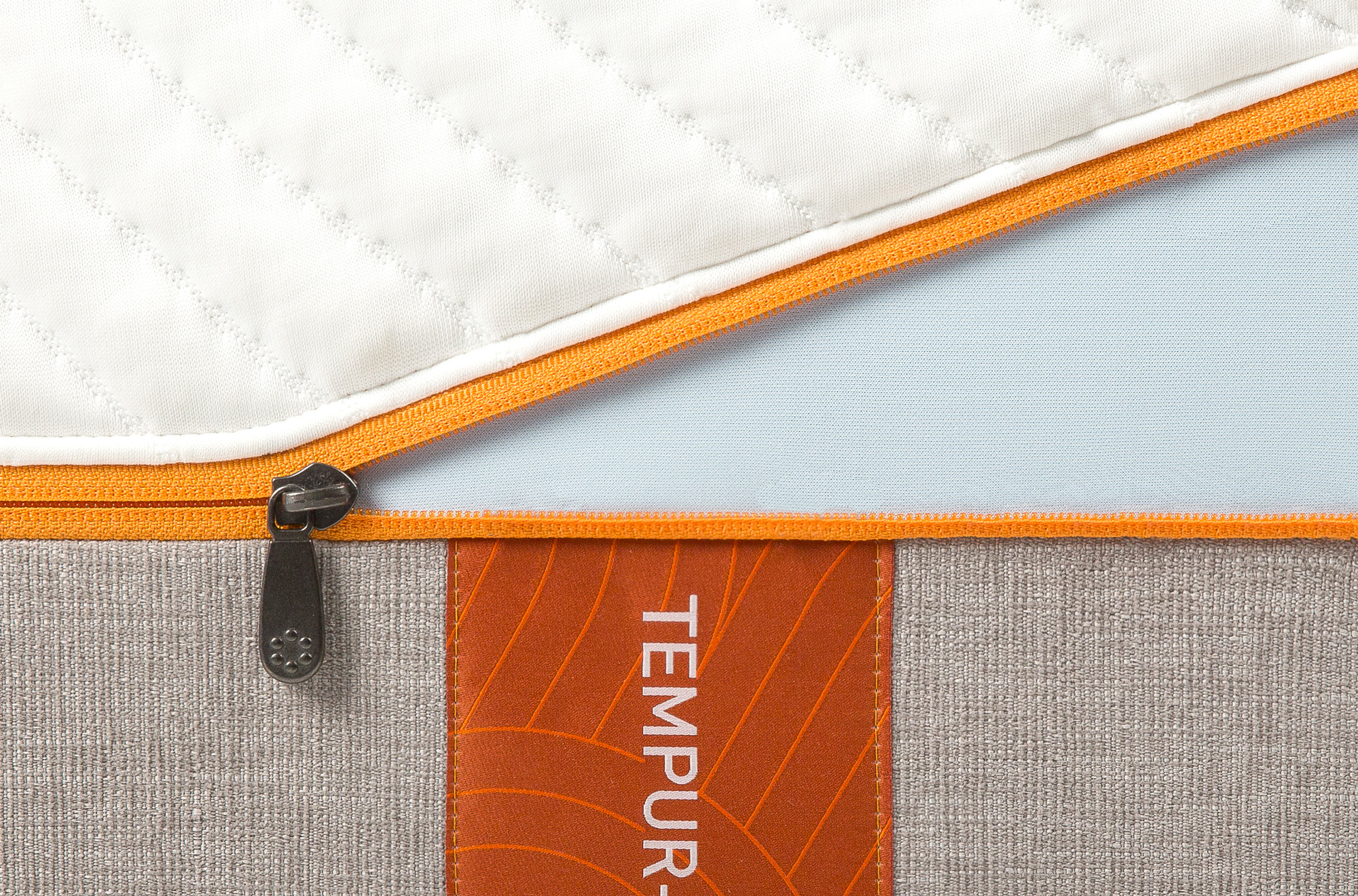
Tempur-Pedic was already working with IDEO on a new mattress design when it acquired Sealy in 2013. It was also interested in how design thinking and human-centered design could improve its business. Once solely focused on the technological elements of designing a mattress, together with IDEO, Tempur-Pedic redesigned the outer shells of its mattresses to reflect the quality on the inside. This design change led to the company to look at new ways to infuse design into their products.
“The initial project was to design the mattress,” said Thomas Overthun, associate partner and design director at IDEO. “But the second project was to create a whole design language from the mattress out to what it meant for any other product, from pillows to blankets and other accessories. It eventually became bigger than just the mattress.”
Working on the Tempur-Pedic/Sealy relationship has been gratifying, said IDEO partner and design director Michael Hendrix, because although home goods can be thought of as simply products, nothing could be further from the truth. IDEO and Tempur-Pedic/Sealy changed the course of the mattress company's business through the transformative power of designing where, and ultimately how, people sleep. And in the process, the organization itself changed as well, moving siloed departments to cross-functional teams, with the brand division central to their cooperation, which led to consistent and aligned decisions across the board.

Some of the projects include:
Stearns & Foster Luxury Mattress
Sealy teamed up with IDEO to develop a design language for Stearns & Foster mattresses that would reestablish what the brand stood for. Through redefining brand principles and rounds of prototypes that focused on evocative details, the new Stearns and Foster mattress was the highest rated in Sealy’s portfolio since it started keeping records, and initial retailer orders were three times what management projected.
Next-Generation Posturepedic
An icon in the mattress industry was brought into the 21st century by developing a new product that delivered on the long-running promise of the brand. Together, IDEO and Sealy designed a product that focused on holistic back health. In its earnings report, the company said US bedding sales for the quarter were up 10.6 percent, to $253.4 million, a figure driven by the new product line’s introduction. According to Sealy’s Q3 earnings report, the Posturepedic launch represented the largest and fastest rollout in the company’s history.
Embody by Sealy
The project began by defining the market opportunities for all-foam beds, and ended with the modern, streamlined Embody mattress as well as a simplified design language, free of industry jargon, to help retailers talk about the mattress to customers. “Sealy collaborated with IDEO to create an approachable and attractive mattress that delivers the simple, healthy rest consumers want with a selling story they can easily understand,” said Jodi Allen, Sealy’s Chief Marketing Officer.
Tempur-Pedic Sleep System
Best known for the revolutionary, NASA-proven Tempur material inside its mattresses, Tempur wanted to transform the exterior of its mattresses to match the caliber of innovation inside. Together with IDEO, Tempur created a new sleep system, including an easily removable and washable fabric mattress cover. “Tempur-Pedic was born of innovation, but we were never a design-driven company until we worked with IDEO,” said Patrice Varni, senior vice president of brand marketing, Tempur Sealy North America, LLC. “Seeing consumer need in a new way through IDEO’s eyes has transformed us. Our product design, our creative psyche, our brand are all fundamentally changed by this sharper focus. This collaboration has given us all a renewed sense of pride.”


Designing the future of urban farming
Helping a Berlin startup strengthen its offer of vertical farming products and services.
The challenge of how we’ll feed the exploding world population in the future—in a sustainable, cost-effective, and environmentally friendly way—is seeding an agricultural revolution in Europe.
In 2012, INFARM founders Erez, Guy Galonska, and Osnat Michaeli found that vertical farms could be a solution to urban self-sufficiency. These farms could allow people to grow vegetables and herbs in small spaces, with no soil and far less water.
An approach that’s captured the imagination of futurists for decades, vertical farming involves growing vegetables and herbs in stacked units or inclined surfaces, within which moisture, light, temperature, and nutrients are monitored, and controlled.
After creating their first vertical farming experiment in their apartment in Berlin, the founders brought together plant scientists and industrial designers to explore and develop vertical farming’s potential.
Since then, the startup has created custom growing systems for clients including Airbnb, Mercedes-Benz, and Weber. Most recently, INFARM installed a vertical farm growing herbs and vegetables at the Berlin branch of German supermarket chain Metro, the fourth-largest retail chain in the world, to sell to the public. It’s been profiled in Wired Germany, Süddeutsche Zeitung, The Guardian, and Zeit.

INFARM collaborated with IDEO to further explore their B2B offer, including concepts for the industrial design of the stackable, modular, climate-controlled units; the interaction design of an accompanying app to monitor and control the units, and its business model.
Urban farmers will sign up for “farming as a service,” comprising the units themselves, as well as a monthly subscription for seeds, cartridges filled with nutrients, and a pH regulator. Because they’re stackable, the modules can be scaled to suit anyone from a home grower to a restaurant chef or supermarket owner. And Erez claims a 1 square meter growing tray can yield four to six mature plants every day, 365 days a year, doubling that of state-of-the-art hydroponic greenhouses.
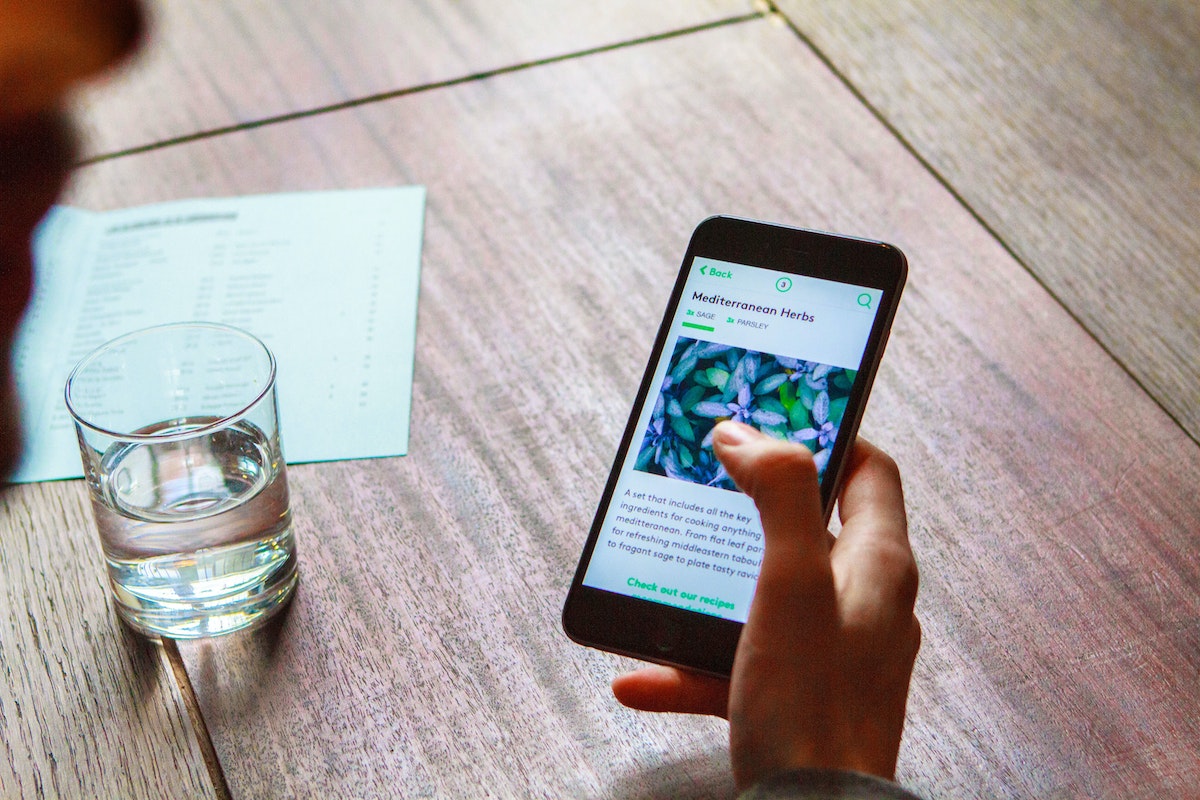
As well as remotely regulating each unit’s climate, the app will educate growers about new vegetables and herbs, selling packs of complementary seeds, with suggested recipes for them, and cooking instructions. Aiming to promote biodiversity, the firm will sell rare-breed and heirloom seeds too.
The startup has funding from the EU’s European Pioneers fund, and is now looking to secure investment to accelerate software development and ramp up their hardware production capabilities. Quite literally, it's growing its business.

Bringing beloved children's characters to a new platform
Sesame Street iPhone apps for Sesame Workshop.
Sesame Workshop is the nonprofit educational group that revolutionized children’s television with the launch of the landmark Sesame Street program in 1969. The show, which has since become a household name, is now watched in more than 150 countries worldwide. The Workshop also creates educational content for new media platforms, and partnered with IDEO to design a line of Sesame Street–themed apps for Apple’s iPhone. The Elmo Calls app, which functions as a utility app for parents and as an entertaining behavioral-development app for kids, is now one of the Top 100 paid iPhone apps in the iTunes store.
The collaboration began with a mutual desire to bring the show’s beloved characters to the iPhone platform—and to do so using a human-centered design approach. Child-development experts, educators, toy and interaction designers, and even the Sesame Street puppeteers weighed in on the design decisions. The team also worked closely with families throughout the project—from initial concepts to early prototyping to the final development—in order to stay focused on how children actually use the iPhone for play. The games were designed accordingly. For example, the team omitted menus from the Sesame Street apps to keep the experiences simple, playful, and fun for a young child. And each game features exclusive new Sesame Street videos, allowing players to enjoy “lean back” moments along with interactive ones.
The resulting iPhone applications let children engage with the favorite Sesame Street characters in a whole new way. Kids touch, shake, swipe, and tilt their way through original games featuring Elmo, Grover, Bert, Rosita, and the Count.

The titles, all of which are available from iTunes, include:
- Elmo Calls: Engages 2- to 5-year-olds in listening-skills practice and active participation during everyday situations.
- Elmo’s Monster Maker: Allows kids to create unique monster friends that dance and play with Elmo.
- Sesame Street Video Maker: Lets kids star in their own music videos, mashing recordings of themselves with popular Sesame music videos and adding their own stamps and special effects.
- Sesame Street Makes Music: Helps kids explore an array of instruments as they contribute to new renditions of classic preschool tunes with their Sesame friends.
Nurturing a creative culture
How writing a book about our shared values helped articulate what it means to be successful at IDEO.
How do you know when you’re successful in your work? You can check off a list of technical skills and expertise you bring to the table. You can use a career development rubric to make sure you’re hitting the right goals. But often, it’s your behaviors—the intangibles that are the most difficult to articulate—that make the most impact. Things like your ability to stay optimistic or your willingness to adapt when there’s no roadmap.
Because of the nature of our work at IDEO, these intangibles are a big part of what defines the experience of working at the company. So in 2012, a global team of designers from our U.S., Europe, and Asia offices came together to codify these values and behaviors as part of a larger effort to evolve IDEO’s career development platform. More often than not, when IDEOers hit road bumps in their career, it was not about what they were doing, but how they were doing it.
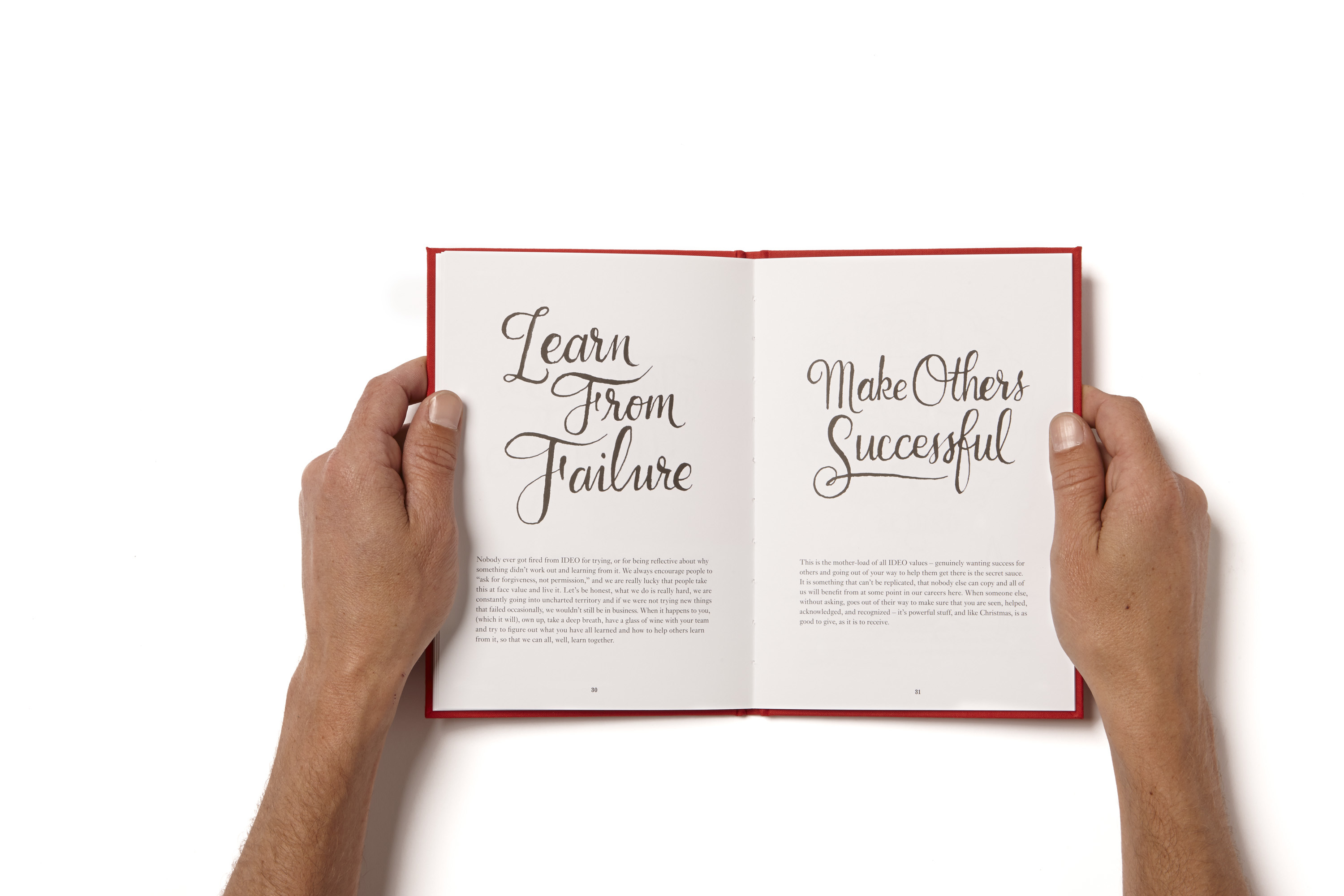
The team agreed that, in addition to identifying the technical requirements needed to progress through one’s career, it was just as crucial to give IDEOers the tools they need to navigate the complex culture. So they captured the values they believed were foundational to the culture and most strongly shared across the IDEO community, and put them to paper in The Little Book of IDEO. The title is meant to reflect its purpose for readers—a handbook that’s compact, useful, and free of any corporate jargon.

For IDEO-ers, this red cloth-bound guide provides a shared lexicon around both the hard and soft skills we need to succeed. It describes things like why IDEO is so loosely structured, where it comes from, and where it’s headed.
Most importantly, the book identifies the organization’s seven core values. These are by design specific, actionable, and integral to the kind of work we do and the environment in which we do it, going beyond common sense and general ethical practice. The intention: to foster meaningful conversations within the community about life at IDEO, and how to achieve success along the way. With each succinct expression comes a deeper explanation of why it matters, and how it shapes our experience at IDEO.
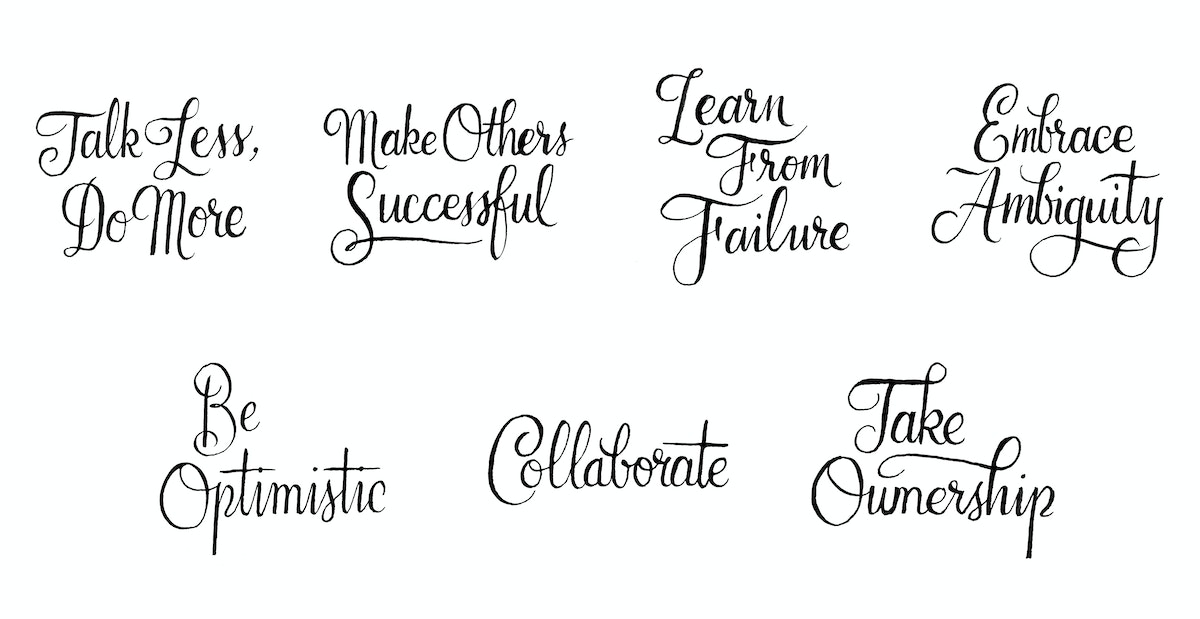
Over the years, the book has been roundly embraced by the IDEO community as an honest articulation of who we are, as opposed to what we aspire to be, and what we appreciate most about working together. When IDEOers first got their hands on it, a movement took shape to create videos that bring each of the core values to life. To depict the value of "Embracing Ambiguity," for example, New York-based designers built a makeshift cardboard rowboat, and while simulating a storm, navigated their way through uncharted territory with teamwork and optimism. San Francisco produced a Jacques Cousteau inspired look at the lifestyle and behaviors of designers in their natural collaborative habitat.
Through the process of making the videos, IDEOers came together to reflect on each of the values, talking through what resonated and what didn’t. It gave them a sense of ownership, and a platform through which to share their interpretations.
A Global Conversation
IDEO has a global presence—offices in two countries in Europe, two countries in Asia, and multiple locations across the U.S. As an organization that embraces a human-centered culture, it felt important to learn if the values resonated with the IDEO community in all of these locations, especially in a country like China, whose working culture is so different from the west. We saw the authenticity and resonance of the values as essential for attracting, motivating, and retaining local talent.
So how did The Little Book of IDEO land in Shanghai? Exploring this question would illuminate insights into how our own clients are often challenged to keep their company culture resonant within the global landscape.
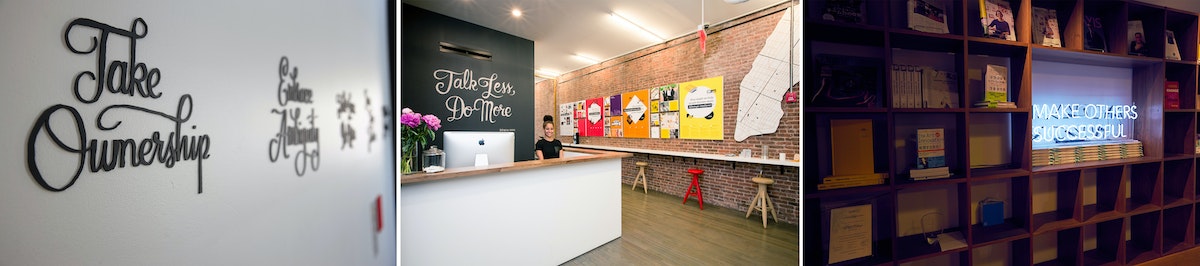
A team of IDEOers in our Shanghai office took on the challenge of exploring the meaning behind each of the values. They were surprised with what they discovered—that despite the firm’s Western origins, locals felt largely connected to the values. It even helped to further solidify their identity as a community, even if it may have been in tension with local working culture, because it was rooted in a set of shared beliefs.
In some instances, the Shanghai team built on the existing values in order to refine the meaning for the local context. For example, the core value "Be Optimistic" rings true, but could sound naive when translated directly to Chinese, implying "rose-tinted glasses.” So in the Mandarin edition, an extra phrase was added to convey the measuredness we mean when we talk about optimism at IDEO. The lesson here: The treatment of something as fundamental and nuanced as our values requires authenticity and emotional connection, and therefore more of a transcreation process than straight translation.
Lasting Power
As an organization, we are designed to be flexible. This means we’re always changing—even when it comes to how we are structured—so that we can respond to the kinds of challenges that clients come to us for. In the midst of our constant evolution, The Little Book of IDEO is as resonant today as it was when it was published.
Why You Should Get to Know Your Creative Alter Ego
How one designer's aha! moment helped him discover his bold signature style
Having already used acrylics, oil paints, graphite, and finally moving on to digital art, there was not much left to experiment with to broaden my artistic arsenal.
Or so I thought.
It was 25th of September, 2016, when my artistic alter ego was born. During that period of my life, I was searching for a way forward, having just returned from university without a job. I spent most of my time ideating and planning my next move.
That afternoon, I sat down to take a break and illustrate my state of mind. I started what was meant to be a 20-minute drawing session with a 0.5mm fine liner. That pen, plus an old notebook that I had used back in university, became my weapon of creativity.
When I was done, I had a character that I named “the relentless dreamer”—a tiny figure with a peculiar helmet that shielded his wandering heart from reality as he knew it, granting him the ability to see far beyond the clutches of a life he deemed to be limited. This tiny figure reminds me that it is crucial to be idealistic, ambitious, and forever creative.
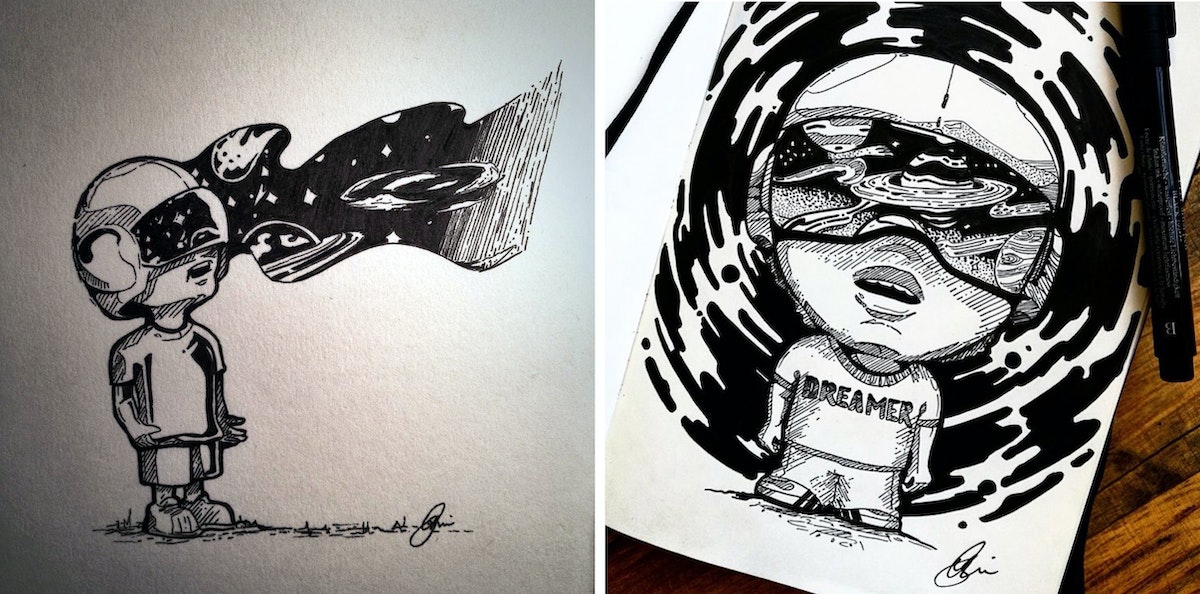
Drawing this character gave me an emotional release unlike anything I had experienced before through art. Though I was often plagued with a sense of anxiety around what my drawings would mean or stand for, this time, I felt weightless.
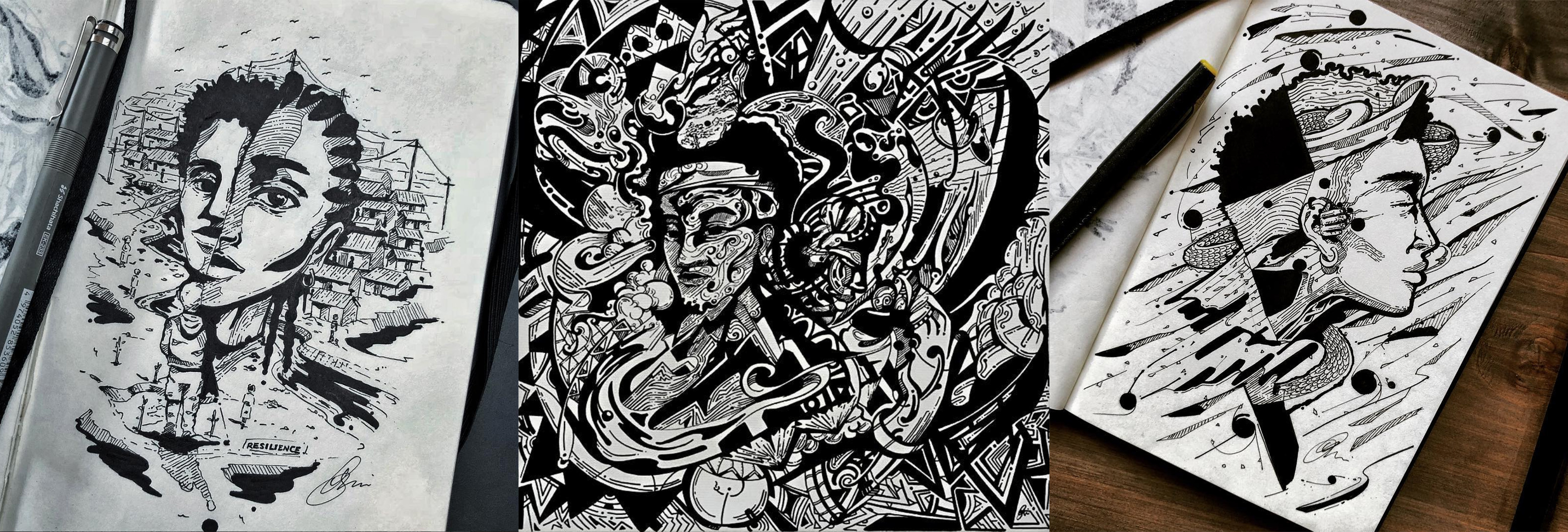
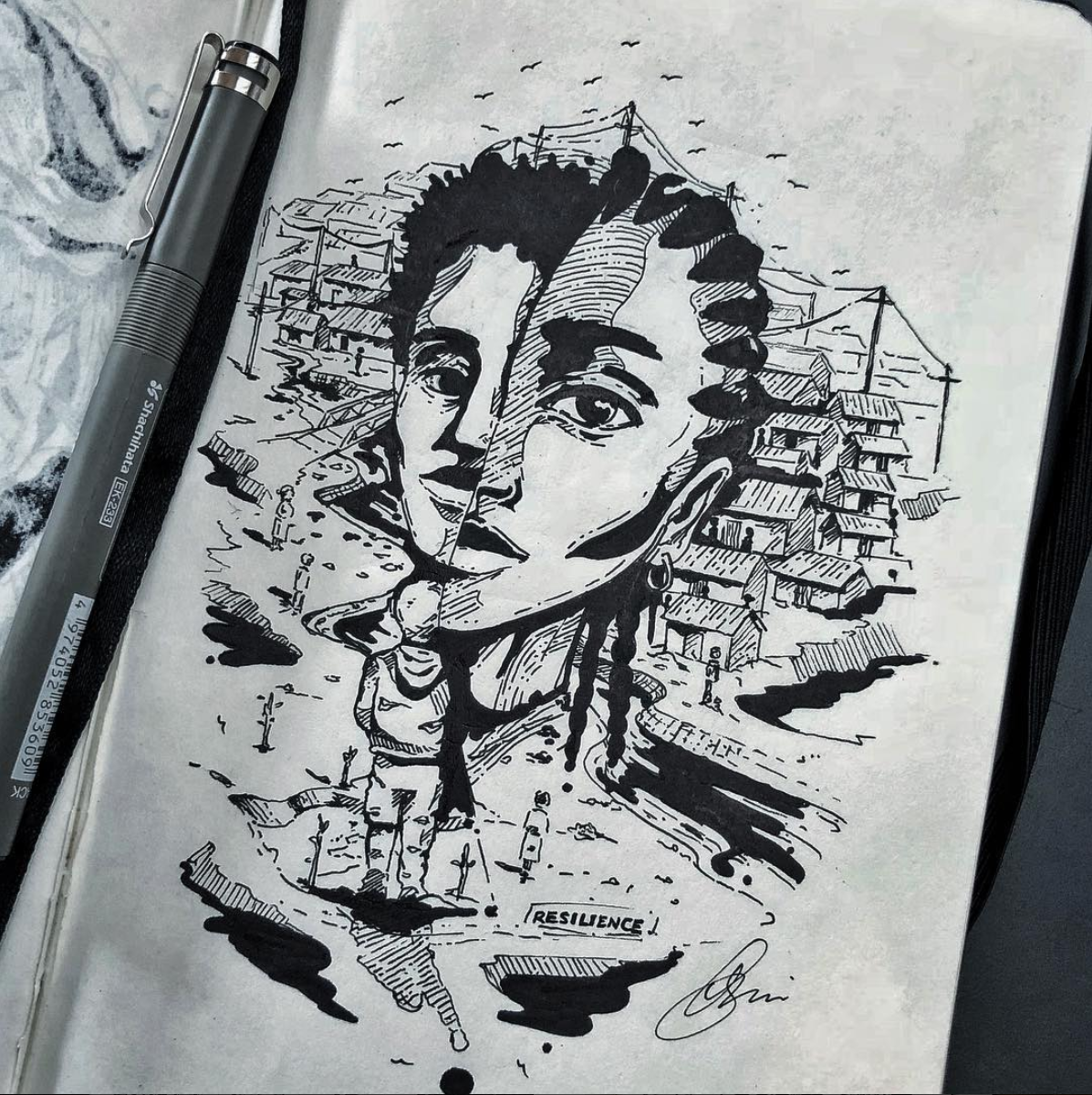
I began focusing on these black and white ink drawings, and the experience was cathartic. Each one entwined with the stories that brought them to life. Even though most of the figures I drew were imaginary, I was taking my life and experiences and expressing them through my illustration. I would envision part of the figure in my mind and let the rest appear.
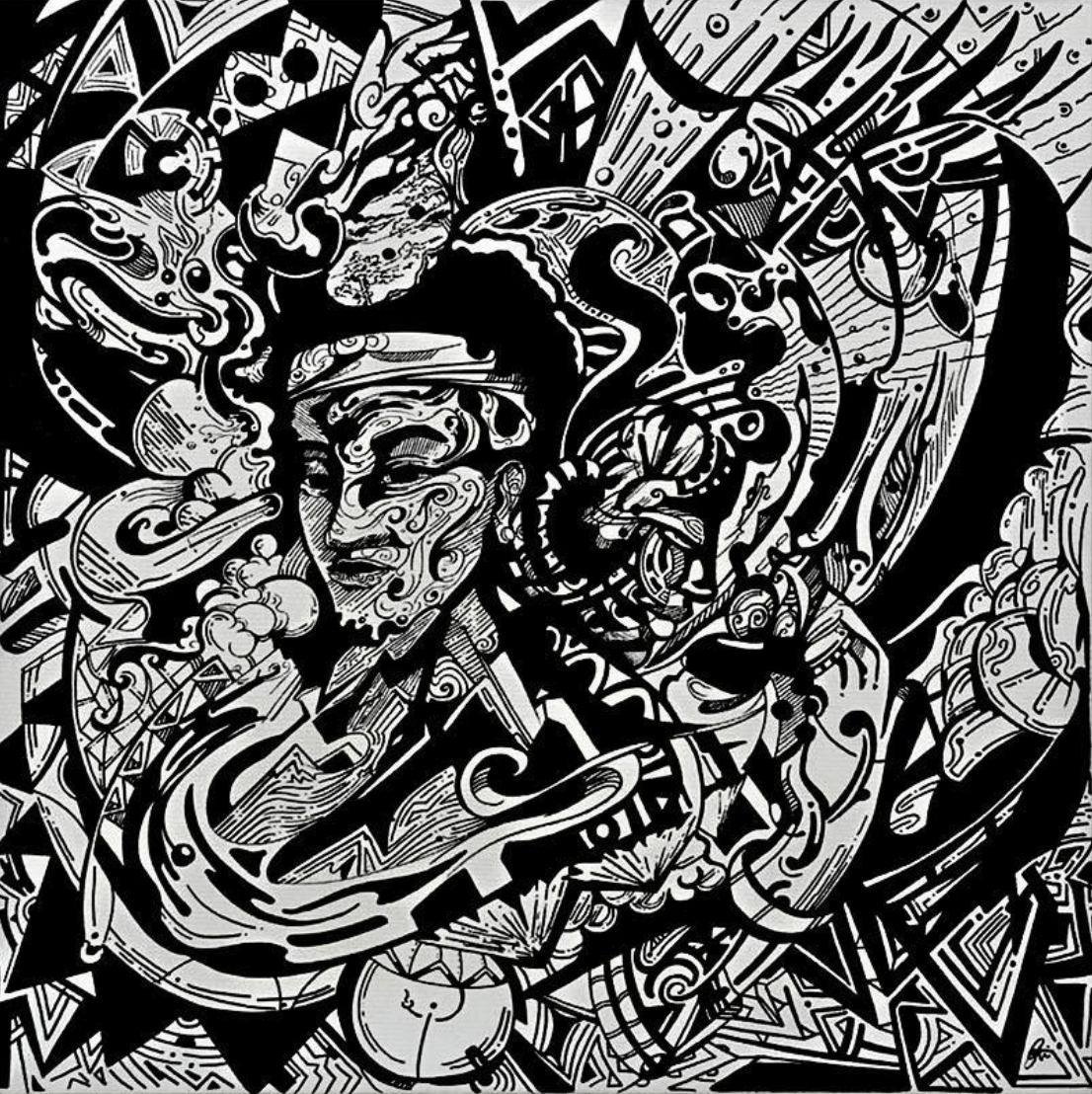
My intention was for viewers to move their eyes constantly as they looked for meaning in the drawing or simply made out the shapes.
Some of my work is dark, some full of mystery—a mystery I hoped that others would try solve as they navigate the intricacies of the line work.
Amidst all the visual chaos, there was one constant: A human element. The figures would serve as my connection to the pieces, and I hoped they would resonate with the audience, too.
These days, you will probably find me seated in the corner of a cafe with a fine liner pen. To many, I am just an artist, ardently sketching away. But what I’m actually doing is getting a little dose of sanity, as I move the images in my mind onto the pages of my book.
And in that very moment, I am dreaming… relentlessly.
Want to see what other IDEOers are drawing and doodling? Take a peek inside more designers' notebooks.
Two years ago, after spending most of my life mimicking artwork that appealed to me, I assumed that I had reached my artistic peak. I had been drawing since 1999. I still enjoyed working on portraits and surrealist compositions, but creatively, I felt stuck. After starting university, my product design work proved to be quite fulfilling, but my personal work was feeling uninspired.
Build Your Creative Confidence: Speed Dating
Creativity thrives amidst free-flowing social discourse. To get a roomful of strangers to innovate, you may want to begin by breaking down some social barriers.
Creativity Challenge # 6: Warm up a group
Creativity thrives amidst free-flowing social discourse. To get a roomful of strangers to innovate, you may want to begin by breaking down some social barriers. When this exercise is done right, the room will be abuzz with chatter and laughter, and participants will be more open to what comes next.
Tool: Speed Dating
Participants: Pairs in groups of any size
Time: 15-20 minutes total, 3 minutes per round
Supplies: Paper printed with a set of questions for each participant. Several different sets of questions will be needed to accommodate the entire group.
Instructions
Step 1: Give each person a list of open-ended questions. Several different sets of questions should be spread throughout tables in the room so that people aren’t continually being asked the same questions.
Examples of possible questions:
- How would your closest family members describe you?
- If you had a million Euros to spend in a way that benefits humanity, what would you do?
- What do you wish your parents had told you?
- What was a live performance or show you really loved, and why?
Step 2: Ask each person in the room to pair up with someone they don’t know very well or have never met. This may involve getting up and moving seats.
Step 3: Have one person in each pair ask a question from the list. Allow three minutes for the other person to answer.
Step 4: Have each pair switch roles and repeat, asking a different question on the list
Step 5: Tell everyone to find a new partner and repeat the process for a couple more rounds.
Tips from the field
You want to keep people moving to create a well-orchestrated round-robin. Be proactive about timekeeping. Assign someone to be a facilitator or timekeeper. To add a little fun, use a buzzer or gong to announce that time is up.
Depending on the nature of the working session that will follow the Speed Dating exercise, you can tailor some of the open-ended questions to be inspirational and loosely related to your topic. For example, if the objective of the meeting is to discuss the future of workspace for the organization, one of the prompts may be, “Describe an inspiring space you have worked in.”
Give a little thought to the type of questions you use. Meaning-of-life questions and superlative questions (the most, the best, the worst) can cause people to stall out or draw a blank. The whole purpose is interaction. So if your question stumps your partner for even a handful of seconds, it’s not quite right. Try the questions out on someone before you use them in a group setting.
If your group might be uncomfortable with an activity that includes the word “dating” in the title, call it Speed Meeting—which we have found works with Nobel laureates.
This post was taken from Chapter 7 of Creative Confidence. Purchase the book for more on how to use creativity to solve problems, or view more from this series of creative exercises on the IDEO blog.
Everyone is creative. This belief runs through everything we do at IDEO, and in 2013, it led my brother David and me to write a book that would help others—even those who don’t think of themselves as “creative types”—to unleash their creative potential. Creative Confidence has inspired thousands of people to adopt a creative mindset and apply it to the diverse real-world challenges they face. In this series, we’ll share some exercises from the book that can help you approach your challenges from a new perspective.
3 Ways Design Can Help Tackle 2019's Big Challenges
IDEO leaders share forecasts on prospective trends in design and tech
1. Design for human capabilities
We are in an uncomfortable place at the moment. Technology has connected us all more than ever, but we are feeling less substantive connection with one another. Human interaction has been reduced to lowest common denominators. Unhappy people click more. Now technology is starting to displace us. In the next few years, deep learning-based AI will take over human activities, from driving to medical diagnosis. The discomfort is increasing as society faces mass redundancy, increased inequality and a crisis of meaning. We can all feel it coming. Design can help.
The amazing thing about good design is that it looks at ambiguity and disruption and sees fertile ground. There is huge opportunity when we focus on things that humans are uniquely equipped to do—empathy, creativity, care, love.
If we do it right, we can conceive and shape new roles for humans in a layer on top of the efficiencies that machines can achieve. We can use those uniquely human traits to re-find and enhance community and depth in our relationships with each other. We can go from Artificial Intelligence to Augmented Intelligence.
—David Webster, Partner, IDEO Palo Alto

2. Design for emotional wellness
The uncertain state of the world is having clear consequences for individual health. You see it in the headlines everyday: Kids paralyzed by anxiety. Suicides by gun. Addiction to opioids. We live in the most technologically connected times, yet our rates of loneliness are increasing. If you dig deep, the common root is an absence of emotional and mental well-being.
I’m not talking about the well-being that’s branded through luxury experiences, like wellness retreats. I’m talking about what Maslow missed at the very bottom of his hierarchy: that sense of inner well-being that is absolutely necessary for our survival as humans.
What’s exciting about our moment now is that science has surfaced the myriad ways we can cultivate emotional and mental well-being—all of which are new channels for design.
Designing ways to get better sleep is also a way of designing for resilience to stress and better ability to manage our emotions. Tackling loneliness and designing for meaningful social connection is also a way of designing for a stronger immune system and brain protection. (Conversely, enabling chronic loneliness is as bad as smoking 15 cigarettes a day.) Designing ways to help people find their sense of purpose and meaning in life is an incredibly powerful way to design for healthier mind and bodies.
More and more, designers will realize their superpowers. Doctors and nurses are key players in facilitating wellness, but let's not forget that designers can be healers, too.
—Ann Kim, Portfolio Director, IDEO Cambridge
[This portion was also featured in Fast Company.]

3. Design for circularity
While it's easy these days to lament the state of the environment and the need for change, there's some hope to be found in the increased momentum towards a more circular economy. Collaborations between industry and design have yielded smart, feasible ideas for redirecting waste streams and reconnecting key stakeholders.
Businesses are investigating new product and packaging design that enables materials to be used again and again; they're asking how to leverage logistics in more efficient ways; and they're conceiving of new ownership models that could extend the lifecycle of the products they make.
The next questions on the horizon revolve around the economic systems that need to be in place to support these circular innovations. For example, we can design buildings so that they can be deconstructed—a circular engineering idea—but the cost of labor makes that reality prohibitive. In 2019, it's time for more applied circularity, leveraging emerging technology, organizational design, human insights, and social networks to create the conditions for the circular economy to take hold.
—Lauren Yarmuth, Portfolio Director, IDEO New York
With 2018 fading into the distance, we're looking with hopeful eyes toward what the next year may bring. Our ongoing projects and client work help us hold up a mirror to reflect on what’s been happening and make informed predictions about what’s to come. Here are a few forecasts from IDEO leaders on prospective trends in design and tech.
Don’t Wait for a Crisis to Change Your Business
Strange as it sounds, the main challenge for some people today is that their business isn’t in crisis
If you know what we’re talking about, you could well be one of the world’s frustrated changemakers. You can see that change is essential, but you’re struggling to light the spark because your business’s indicators are all annoyingly positive. If this is you, what can you do? Should you hope for—or, even, engineer—a crisis?
This was one of the questions a group of business transformation leaders took on recently, at our Make Change Happen event in Munich, Germany.
“It would be a lie to say that a good crisis or a good disruption doesn’t help,” said Roman Lentz, Chief Digital Transformation Officer at global building materials firm Heidelberg Cement. “Because if you honestly look at organizations that change the fastest, they’re the ones with their backs most strongly against the wall… And frankly, that’s my challenge, because we’re not in crisis. We’re producing healthy margins. We’re not seeing cement being disrupted any time soon.”
Sandra Schiller, Head of Product Management for Valves and Automation at Georg Fischer Piping Systems, agreed. A crisis, Schiller noted, “can force through faster changes.”
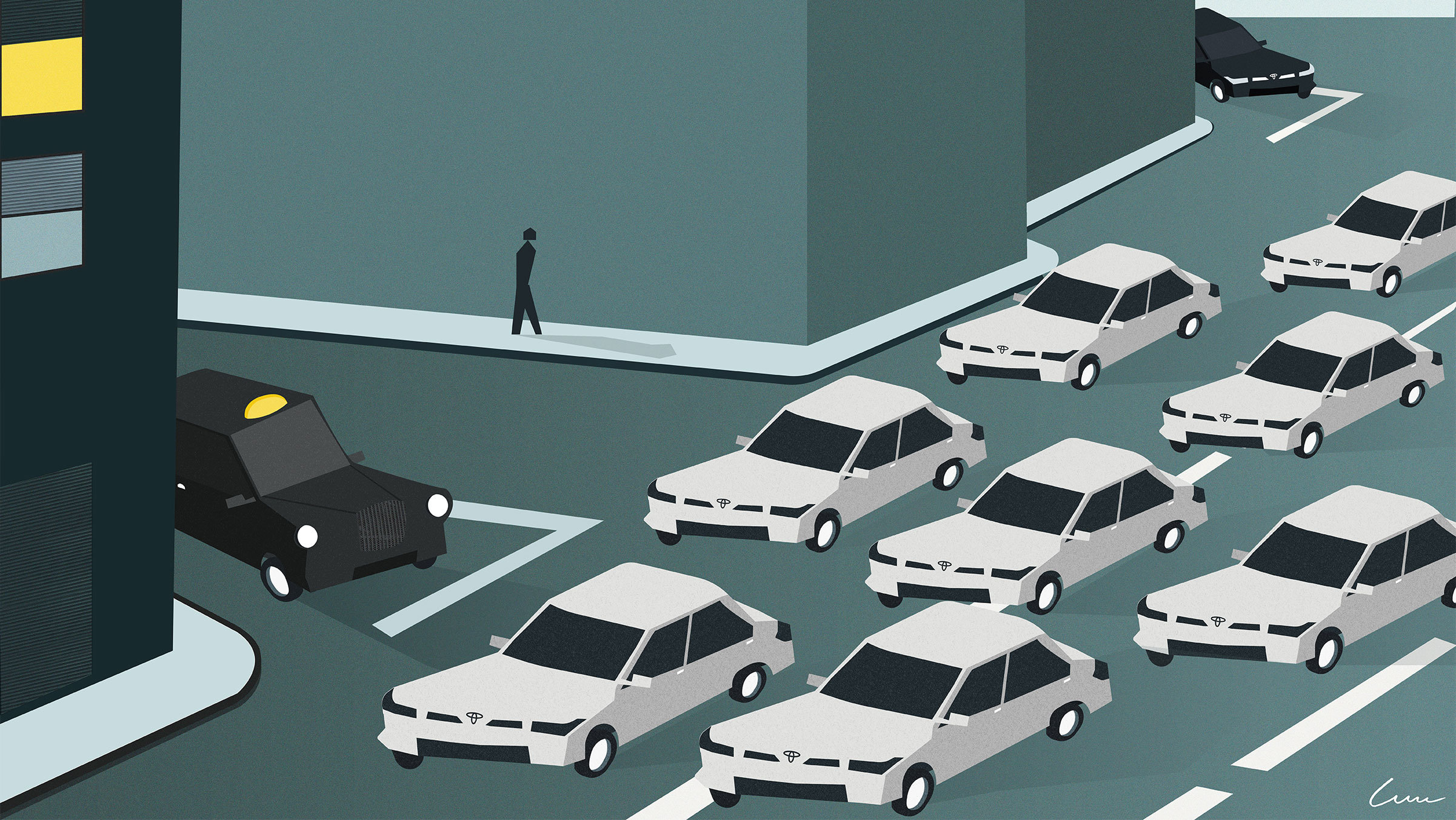
But this doesn’t mean you should wait for a crisis, as London’s black taxis discovered, a few years too late.
“Black taxis were untouchable,” said Ben Terrett, CEO of Public Digital, a firm that partners with IDEO and specializes in digital transformation. “So untouchable that some of their services and ways of operating were protected by regulation. They have special parking spaces in London, special streets only they can go down… certain roads only they can pick up from.”
But then wave after wave of digital disruption flooded in as they sat behind the wheel, watching their dominion ebb away. First, GPS meant that the traditional cab drivers’ knowledge of London’s labyrinthine streets was no longer the golden ticket it had once been.
Then Uber arrived, and its bookable, predictable, low-cost rides started to eat into the black taxi business. So how did London’s cabbies respond?
“Their defense has ended up being reputation,” said Terrett. “That’s basically their only defense: ‘But we’re the black cabs!’”
Turns out customers weren’t as attached to the reputation of London’s cabs as cabbies were—and they couldn’t compete with the convenience and cost-cutting of on-demand services. Now the London Taxi Drivers Association (LTDA) wants to sue Uber for the earnings its 25,000 members lost in the first five years they were operating in the city. The LTDA estimates that cabbies lost £10,000 each per year, and has been taking legal advice to sue for £1.25 billion.

It didn’t have to come to this.
“What’s interesting is that people have been trying to help them—by building services on top of their service,” said James Higgs, Executive Director for Digital Transformation at IDEO London.
In 2011, the year before Uber launched in London—Hailo, now MyTaxi, tried to bring the predictability of a booking app to the black cabs.
“Taxi drivers didn’t even want that,” Higgs said. “They would charge you an outrageous minimum fare… they even resisted companies trying to help them deliver a better service!”
We don’t want to pick on London’s iconic cabs and their drivers. They’re not even employees of a centralized company that one could point a finger at—they’re self-employed. But we think there are lessons here for us all.
“The black cabs are a good analogy for a lot of businesses,” said Terrett. “I can see lots of industrial-era companies who, when digital organizations go after their market, their defense is ‘well, we’re us, we’re the number one brand in this market.’ That’s no longer a good enough defense.”
Here are three key takeaways for businesses looking to inoculate themselves for potential disruption:
1. Don’t wait for a crisis
Just as you shouldn’t wish for a crisis to happen, so you shouldn’t wait for a crisis to happen before you change.
“It’s really nice if you start in a safe environment in order to secure your future business,” says Georg Fischer’s Schiller. “It’s not about securing your business tomorrow, it’s about the business for the next few years. And as we are a 200-year-old company, we really would like to be around for another 200 years: And so we have to start working now.”
2. There’s an Uber for your industry, too
The leaders of large industrial companies like Heidelberg Cement and Georg Fischer are investing in digital transformation programs now—because, while there may be no Uber for cement or pipes or any of their other product lines yet, there’s probably an entrepreneur somewhere pitching an idea that sounds something like that to an investor right now.
And because, however unlikely it might seem to some today, it’s certain that digital transformation—defined by Tom Loosemore, a partner at Public Digital, as “applying the culture, practices, processes, and technologies of the internet era to respond to people’s raised expectations”—is going to disrupt every industry, including the one you work in.
3. Digital is your friend
Instead of thinking of digital disruption as a threat—you’re better off picturing it as a friend.
OK, so it’s a friend who needs a lot of hand holding at first. But as long as you’re prepared to invest the time and approach it from a human-centered point of view, digital transformation will make many things a whole lot better. It will increase your productivity, your pace of innovation, your rate of learning, and your customers’ expectations—and it’ll help you deliver on them.
When Georg Fischer’s design teams, for instance, began creating digital prototypes, so they learned new, more flexible, agile ways of working. And they started producing a new, digitally-enabled ‘smart part’ that alerts machine operators to problems in the system, so their customers now have more control over operations.
So, don’t sit by the curbside, your legacy engine idling, as you wait—hope even—for a crisis to come. Instead of clinging to what is, use digital to prepare for what might be. Welcome change in now, from a position of safety, and maybe you can secure your business’s long-term future—and save a cool £1.25 billion.
Strange as it sounds, the main challenge for some people today is that their business isn’t in crisis. No blockchain or platform or AI startup is threatening to disrupt their market—yet.

Lindsey Turner
I’m passionate about building brands, products, and experiences that help organizations show up with meaning and momentum.
I help organizations cut through complexity by shaping how they show up, through brand strategy, identity, and storytelling.
Working at the intersection of brand and business, I bring an editorial eye and a bias toward making—turning ideas into tangible experiences that people can understand, trust, and believe in.
My work spans government, healthcare, financial services, media, and consumer goods, from launching Gen Z-focused ventures to building innovation labs and reimagining legacy brands. I relish moments of ambiguity and enjoy translating across teams, perspectives, and priorities to move ideas forward.
I started my career in editorial and digital design, shaping cross-platform experiences and identity systems in publishing and agency environments. That foundation still shapes how I work today: I’m detail-oriented, collaborative, and overreliant on the Oxford comma. I hold a BFA in Visual Communication from the School of the Art Institute of Chicago.

Rachel Young
My work helps organizations see who their products aren't working for—and build the will and the tools to do something about it
For 25 years, I've asked the same question: Who does this design exclude—and what are we going to do about it?
My work spans human-centered strategy, inclusive design, and qualitative research, with clients ranging from Microsoft, Google, and Verizon to the National Science Foundation, and San Francisco Unified School District.
Before IDEO, I taught elementary school in East Palo Alto and spent a decade doing design work with social service organizations—where I learned firsthand what it costs people when systems are built without them in mind.
I am currently writing User Error, a nonfiction book about digital access and the design decisions behind it. I live in Oakland, California.

Brian Pelsoh
I lead with craft, ensuring our work is creatively excellent: rooted in deep human insight and imagination, while also grounded in the realities of business and technology.
My expertise spans brand, communication, and product design across tech, education, the arts, and social impact.
I believe great work demands both high-level vision and obsessive attention to detail, and only happens through collaboration.
I bring an inclusive, hands-on approach and a deep understanding of business, which enables me to consistently deliver excellence while always asking why.
Before joining IDEO, I worked at the brand firms Pentagram and VSA Partners. I began my career as a designer, leading teams at the School of the Art Institute of Chicago and the Milwaukee Art Museum. I hold an MFA in graphic design from Maryland Institute College of Art and a BFA in communication design from the Milwaukee Institute of Art & Design, and have taught at some of the best design schools in the US.

Tony Wong
I am responsible for IDEO’s long-term success in China and working with clients to use design as a tool to enable growth.
I am responsible for IDEO’s long-term success in China and working with clients to use design as a tool to enable growth. Specifically, I have helped Chinese companies design holistic brand solutions through the development of their products, communication, services, and innovation teams, and I have helped multinationals expand their presence and influence in China.
I advise global leaders on developing China-led innovation and capabilities.
In over 15 years in IDEO Shanghai, I have worked on projects that use design to elevate the quality of the experience of healthcare products and services, streamline processes that increase productivity, create spaces and programs that promote and enable inclusive communities, and build next generation mobility solutions that are planet-positive.
Before joining IDEO, I worked at Philips Electronics and the Electrolux Group in Italy, the Netherlands, and Singapore on a number of breakthrough commercial products. I am a member of the Young President Organization in Shanghai.

Building a personal AI for the messiness of life: Sida Li
Most AI products today are built for work—a space with clear problems and established systems. One founder noticed a gap: personal life is messier, harder to systematize, and mostly left behind by the AI boom. So she built Cue, a personal AI that lives inside iMessage and group chats, to go where the other tools haven't.
In this episode, Becca Carroll, IDEO's Chief Strategy Officer, talks with Sida Li, co-founder and CEO of Shared Context Lab, about staying anchored to a human need while the technology around her keeps changing shape, why she treats her business model with the same rigor she'd bring to a product, and what it feels like to build a company at this particular, disorienting moment in AI.
The conversation also gets into how Sida makes design decisions: the language Cue uses to describe itself, the tradeoffs behind building inside iMessage instead of a new app, and a real story about a business idea that didn’t pan out.
This is the second in a two-part series profiling founders from IDEO's Startups-in-Residence program. The first conversation is with Johannes Seemann, founder of Sooner, on designing GenAI for the emotional side of money.

Designing GenAI for the emotional side of money: Johannes Seemann
Most personal financial tools are built to run the numbers and optimize towards a budget. While that works for some, most people experience money as a lived relationship that does not neatly fit into a spreadsheet. Johannes Seemann and Becca Carroll discuss why money is emotional before it is mathematical, and what a human-centered approach to building a generative AI financial product looks like in practice.

The curious leader's edge in uncertainty: Scott Shigeoka
Mina Seetharaman talks with Scott Shigeoka, author of Seek and Head of Curiosity Cultivation at the Eames Institute, about what distinguishes genuinely curious leadership from performative curiosity, how power dynamics shape curiosity, and why practicing curiosity can restore energy rather than drain it.

How constraints make us more creative: David Epstein
Mina Seetharaman talks with David Epstein, author of Inside the Box and Range, about why total freedom often produces average work, how leaders can design useful limits on purpose, and what organizations such as General Magic and Pixar reveal about the relationship between boundaries and creativity.
Looks like you might be in search of something very specific?
Or reset the filters above and try another angle.
Here’s some random inspiration

Podcasts about creative leadership

Articles about the power of prototyping
