
.svg)



Designing the first all-in-one, wearable breast pump
Collaborating with the startup team at Willow that reimagined the breast pumping experience.
All moms want to give their babies the best start in life, and for many, that means nourishing their babies with breastmilk. However, breast pumping is often inconvenient and uncomfortable. Tethered to the wall, undressed, and surrounded by cords and dangling bottles, most mothers who pump are interacting with technology that hasn’t fundamentally changed in more than 25 years.
Passionate about solving this challenge, the startup Willow set out to completely re-imagine the breast pumping experience. The team at Willow envisioned a “dream pump” that would deliver what moms want most: mobility and discretion.
The Willow team approached IDEO to be a close partner in bringing their product to life. As a cross-disciplinary team of researchers, industrial designers, and mechanical engineers, IDEO, Willow, and Function Engineering worked together seamlessly to identify mothers’ unmet needs and resolve engineering complexities with a simple and elegant design.
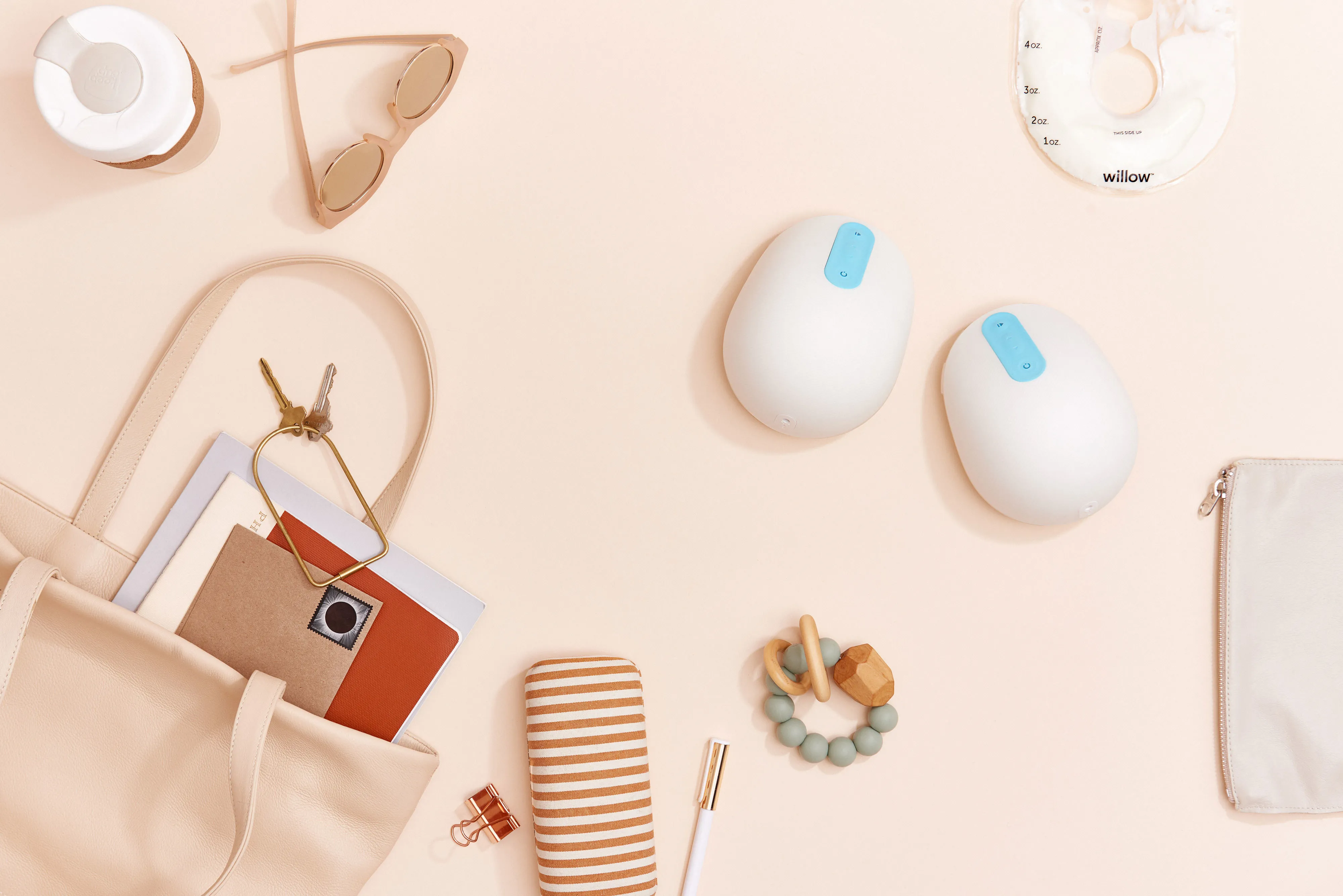
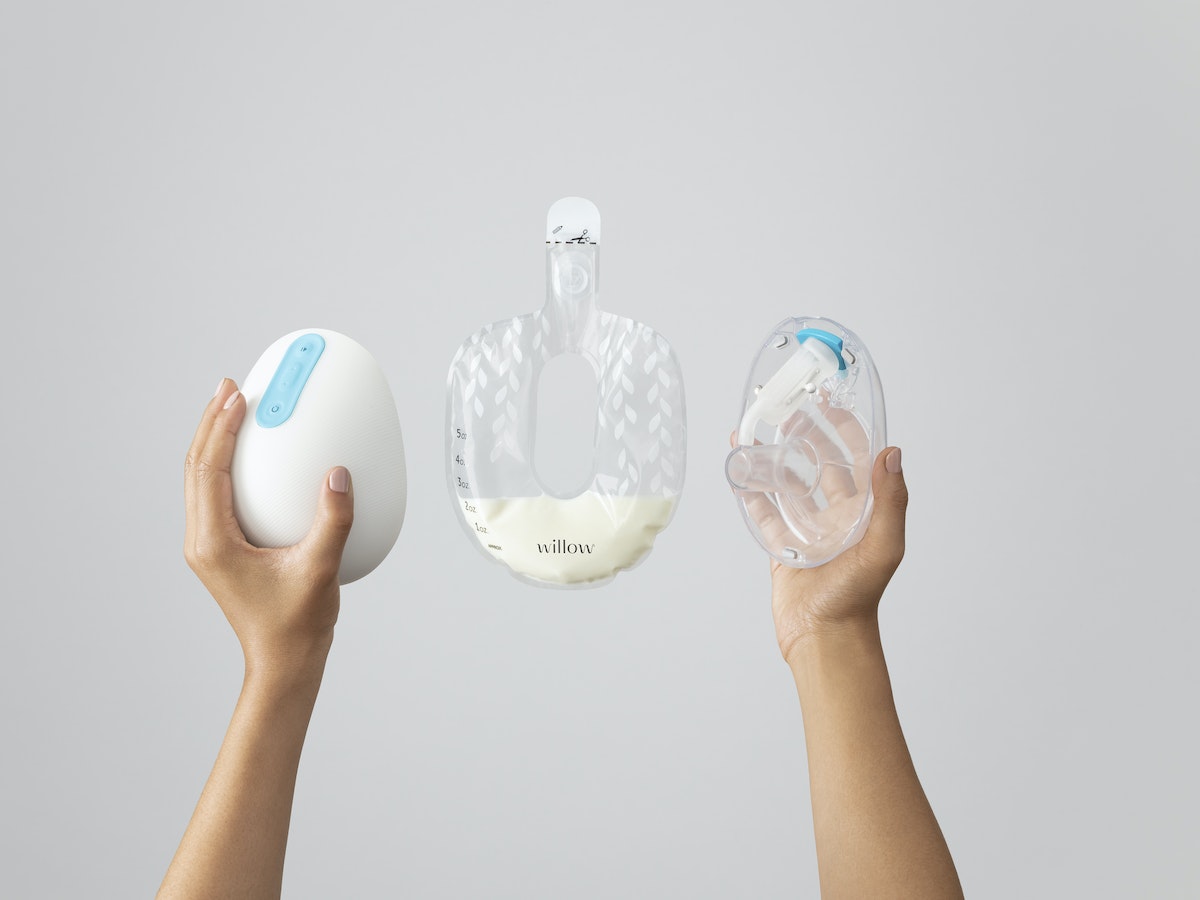
The resulting product, Willow, is the first all-in-one, wearable breast pump that cuts the cords, ditches the mess of bottles, and fits easily inside a bra. Mobile, discreet, and hands-free, Willow allows women to achieve their breastfeeding goals without pressing pause on their own lives.

The final design of Willow was informed by research and in-person interviews with dozens of mothers, ranging from first-time to experienced pumpers. Insights about their personal routines, challenges, and workarounds guided the design team as they built more than 60 physical prototypes to understand how Willow could best fit into mothers’ lives. Learnings from those prototypes helped the team to define the size, shape, color, and materials of Willow, as well as each step in the pumping process.
One key design element that emerged from this iterative process was the simplicity of Willow’s architecture, which makes the pump easy to use, assemble, and clean. The pump contains just a few basic parts that snap together, and only two parts that need to be cleaned (both are dishwasher-safe).
Considering how personal the breast pumping experience is, the team aimed to help the pump feel less like a stark, mechanical device and more like a considered, modern, and personal accessory—a goal ultimately achieved through the pump’s colors, texture, and finish.
Because of Willow, mothers no longer need to plan their lives around pumping—it can happen anywhere, at anytime. Willow gives moms back their time and freedom and gives them choice; now moms can play with an older child, work, or enjoy precious relaxation time at home. With Willow, pumping breastmilk finally fits seamlessly into women’s active everyday lives.
Improving quality of life for young adults with schizophrenia
Designing a digital platform that continually motivates and engages patients.
More than 50 million people worldwide suffer from schizophrenia, yet only half receive psychiatric treatment. When they do, it usually involves medication and one-on-one therapy to treat the most visible symptoms, including hallucinations and paranoia. But the disease can also cause debilitating symptoms that medication can’t easily treat, such as social anxiety and isolation, lack of motivation, and memory deficits.
For people living with these symptoms, what might seem like simple activities—socializing, spending time outdoors, exercising—can sometimes feel overwhelming. And if patients aren’t given effective care, they can become even more isolated, and their physical health and quality of life suffer. They’re far more likely to let the rest of their treatment regimen slip, skipping medication or therapy sessions.
To help address these challenges, a digital health research group at the University of California, San Francisco (UCSF) approached IDEO with an idea to supplement the longstanding medication-and-therapy model with a tool to alleviate hard-to-treat symptoms, and more importantly, improve patients’ quality of life. It would require identifying unmet needs among patients and determining which kinds of interactions could have the greatest impact on young people with mental illness.
The outcome of that collaboration is PRIME, or Personalized Real-time Intervention for Motivational Enhancement, a digital platform that empowers young people with schizophrenia with the tools, motivation, and community of support they need to achieve their goals.
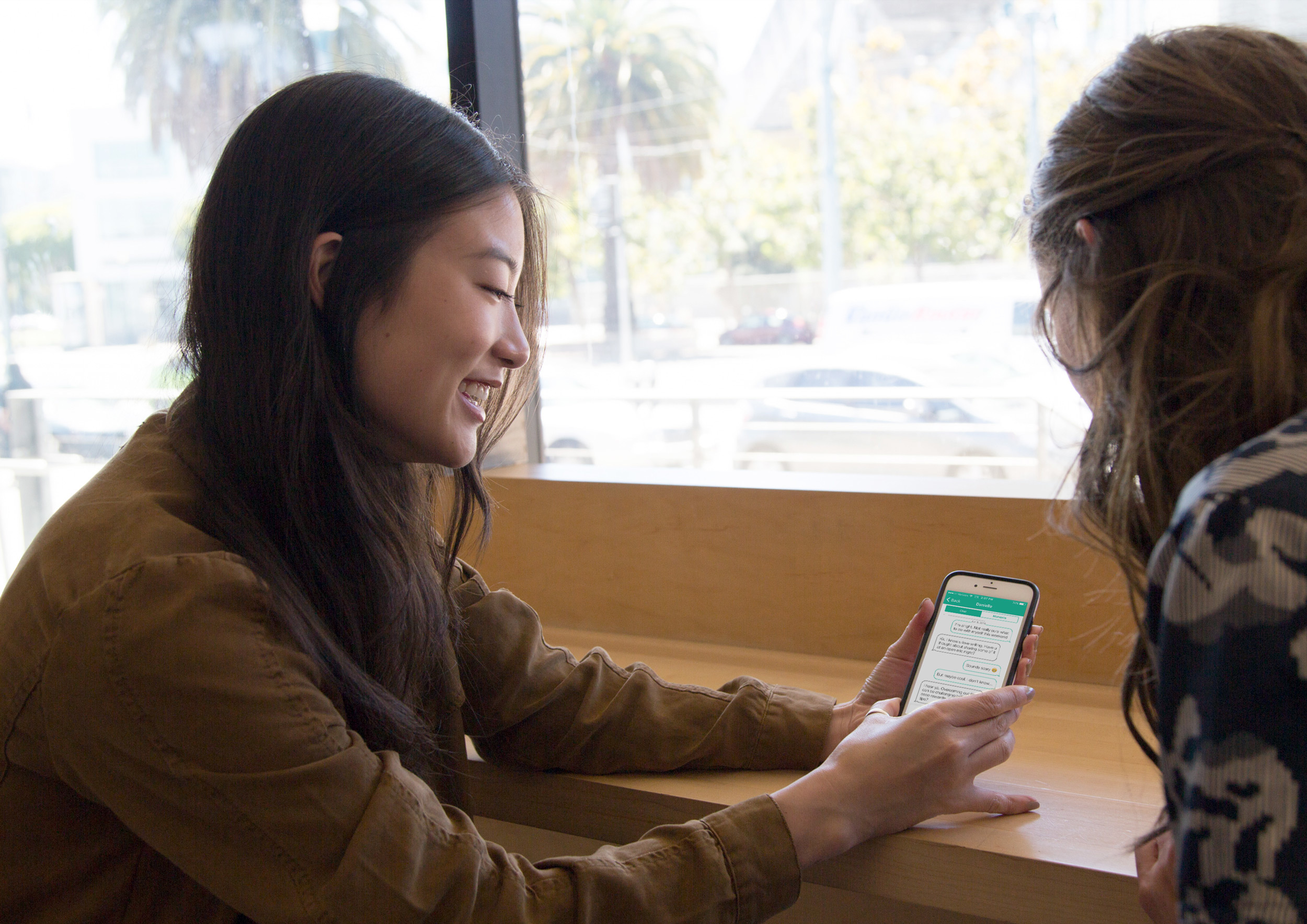
The simplicity of PRIME belies its deep functionality. The easy-to-use mobile app helps patients stay motivated to stick with behaviors that boost their health, social skills, and productivity, and it provides motivational coaching from trusted professionals and social connections with other patients.
How It Works
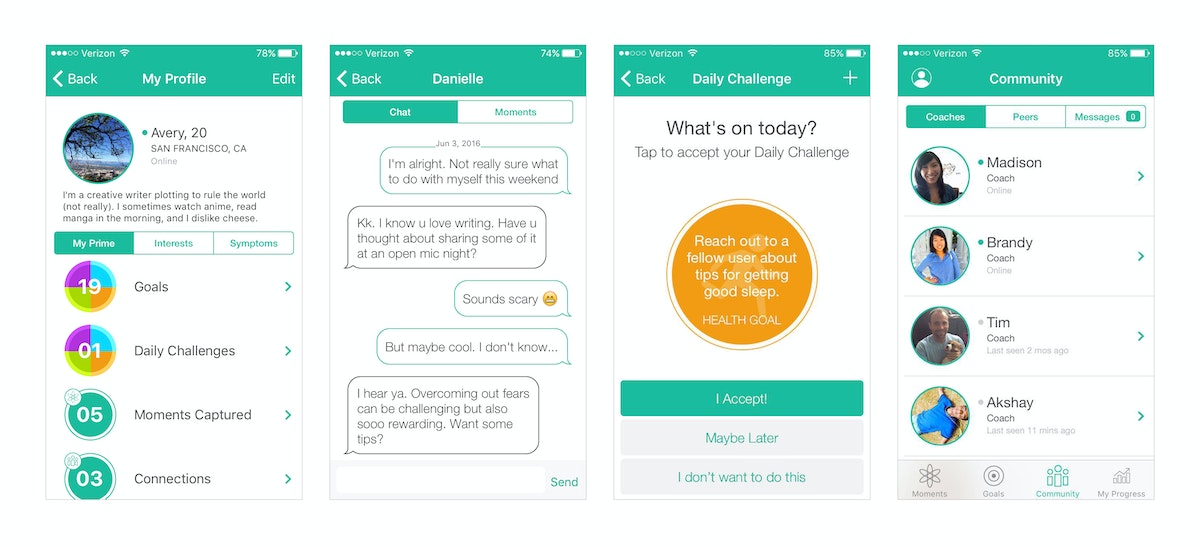
The PRIME app lets users set daily goals based on their particular needs. There are more than 500 small challenges to try—from inviting a friend to play basketball to spending time with a family member—and users can see their progress tracked through incremental successes over time.
Whenever users need help, trained motivational coaches are on hand to provide cognitive behavioral therapy coaching, encourage patients to achieve their goals (and to push beyond their comfort zones), and support their interactions with other users.
Tapping into its vibrant social network to help patients feel less isolated, PRIME prompts users to snap photos of happy moments, highlight important events in their lives, and share challenges they’re proud to have accomplished. Unlike Facebook, which can be overwhelming for some patients with schizophrenia, PRIME is a closed community where users can talk freely about their challenges with others who are just like them.
Click above to hear our audio story, or listen on SoundCloud.
To measure the efficacy of PRIME, UCSF and IDEO combined traditional metrics, such as Patient Health Questionnaire scores and time spent in the app, with new metrics evaluating patients’ quality of life. For example, they studied the pictures of things that made users happy before and while using the app, and measured the frequency, depth, and quality of patients’ social interactions in the app based on word choice and punctuation.
Learnings from these human-centered metrics helped the team iterate further on PRIME’s design, so that the platform would generate even higher levels of engagement and stronger improvements in patients’ motivation and social functioning. In this 2016 peer-reviewed, clinical study, 80 percent of patients with schizophrenia achieved their daily goals, and users logged into the app an average of 4.5 times a week, far more than the expected rate of once a week.
PRIME has also made an impact on patients and their families on a personal level. The mother of one research participant was thrilled with the results. She told IDEO, “I wish you could have witnessed my daughter’s first response to seeing the faces and profiles on her phone. She looked at me, smiled, and said, ‘Everyone looks normal. Everyone looks like people you see every day.’ It was as if she looked into a mirror that reflected possibility and hope.”
Human-Centered Design
The PRIME platform is an example of how the human-centered design process can lead to first-of-its-kind innovations in the field of mental health care. PRIME designers conducted comprehensive interviews that led to a deep understanding of patients as whole people, not just conditions or sets of symptoms.
For Dr. Danielle Schlosser, lead researcher on the PRIME project at UCSF, collaborating with IDEO and applying design thinking to her research on mental health was illuminating. "[It] showed us that in order to engage our users, we needed to provide a safe and supportive community that directly catered to their needs. The insights we gained enabled us to create an experience that inspires patients to improve their quality of life by emphasizing their strengths. Working with IDEO helped us make powerful, creative leaps in our process, and build a digital health platform that’s already deeply impacting patients’ lives.”
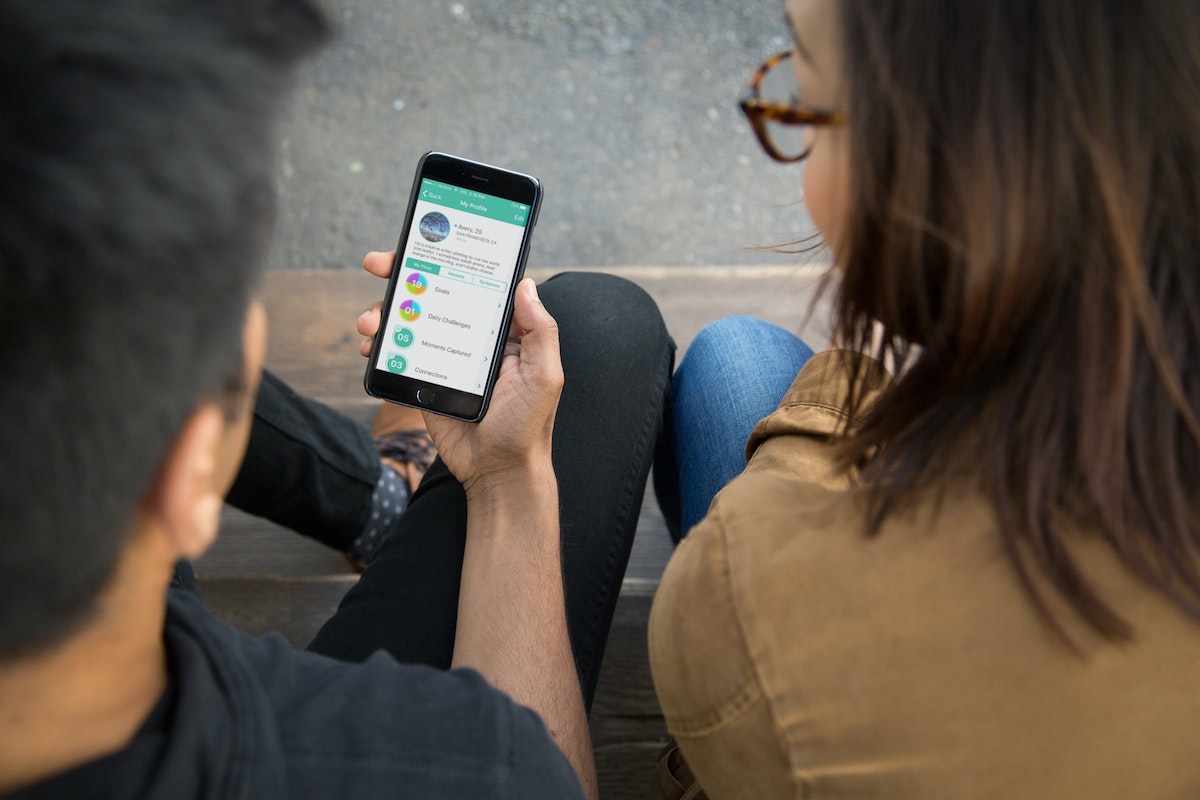
The success of PRIME in treating schizophrenia has led to additional federal research funding, and the platform is now being expanded to treat a wider range of mental health conditions.
For example, in this recent, peer-reviewed study, PRIME helped patients with moderately severe depression experience a 50 percent reduction in symptoms, with a noticeable difference in just two weeks—far faster than the average of four to six weeks it takes for traditional medication and therapy to yield improvements. By the end of the depression study, 90 percent of participants said they had achieved their treatment goals, such as to “become happier” or to “feel less lonely.”
Numerous patients with schizophrenia and depression have already benefitted from PRIME’s unique offering, and the team is exploring ways to commercialize and scale PRIME to reach more people with mental health conditions.

Preparing New Yorkers for future flooding
Helping homeowners understand how to protect their future amid shifting flood zone policy and climate change.
New Yorkers are a tough lot, but damaging coastal storms will continue to test their resilience. More than 400,000 people live within the city’s floodplain and are at physical and economic risk. In the face of both natural and manmade challenges—from superstorms to confusing insurance regulations—many New Yorkers are not aware of their flood risk, or even that they should be thinking about it at all.
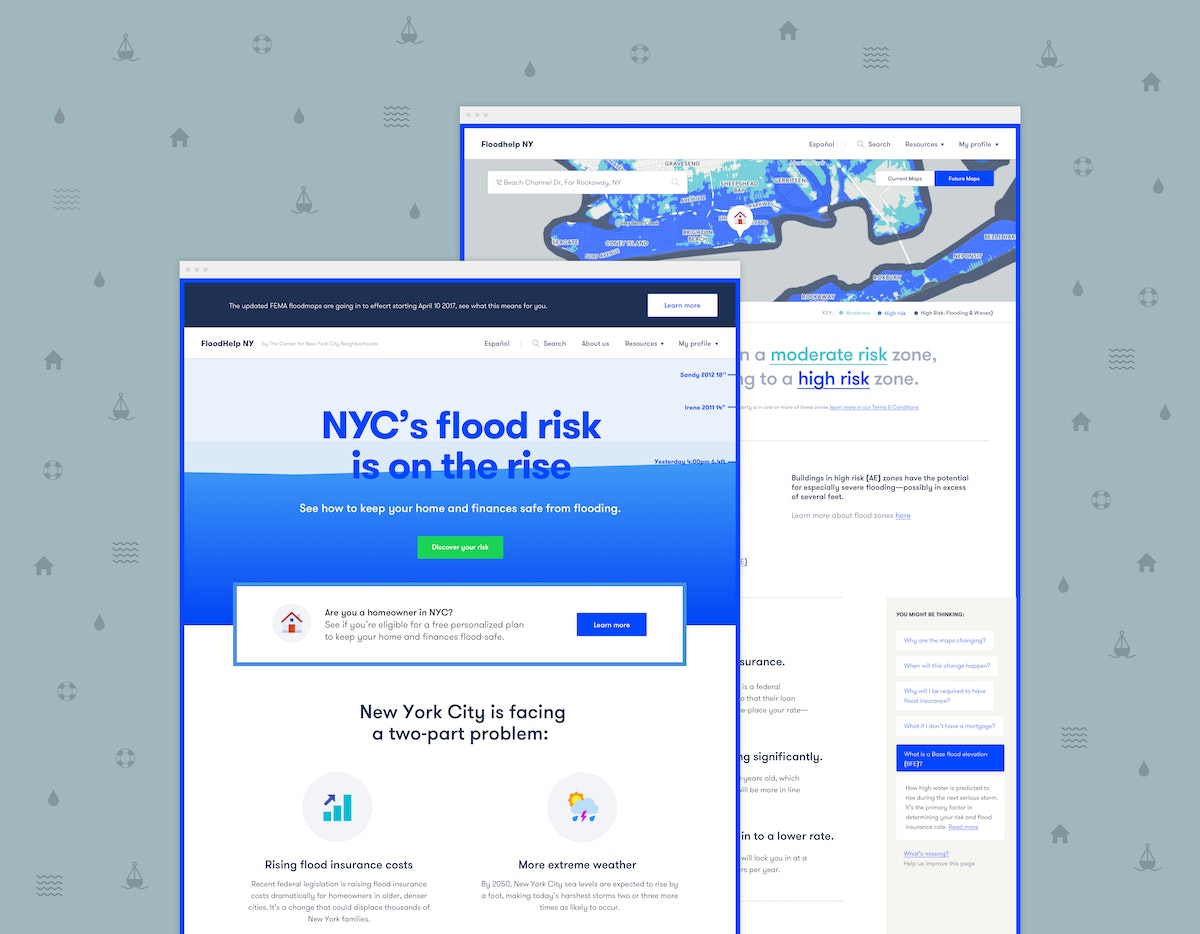
The Center for NYC Neighborhoods‚ a nonprofit that champions affordable homeownership for middle- and working-class families and communities, engaged IDEO to create a resource that could help New Yorkers keep their homes and finances safe. Launched in September 2016 with funding from New York State's Governor's Office of Storm Recovery, FloodHelpNY is an expansive platform that dismantles the complexity surrounding flood insurance and gives homeowners clear and simple guidance for assessing their flood risk and taking action toward resiliency.
Facing the complexities of insurance policy, shifting flood regulations, climate change, and citizen engagement, the design team began by engaging two vastly different groups of New Yorkers—those who had been battered by past storms and those not yet affected. Homeowners in the first camp were angry and frustrated by a system that had let them down after Superstorm Sandy. Homeowners in the second camp were simply unaware of their risk and had little idea of what might happen. The right design solution needed to encourage both groups to take action and learn about flood risk and insurance regulations, while also addressing divergent levels of need and preparedness.
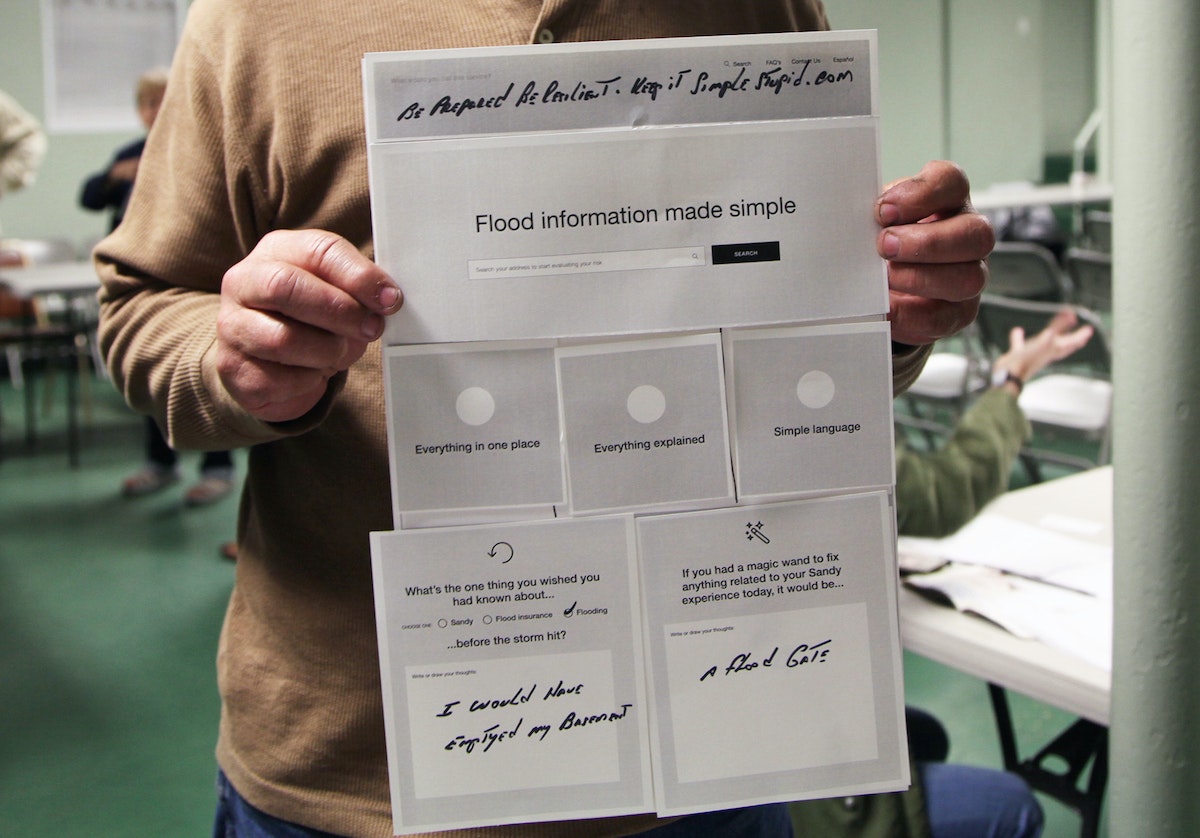
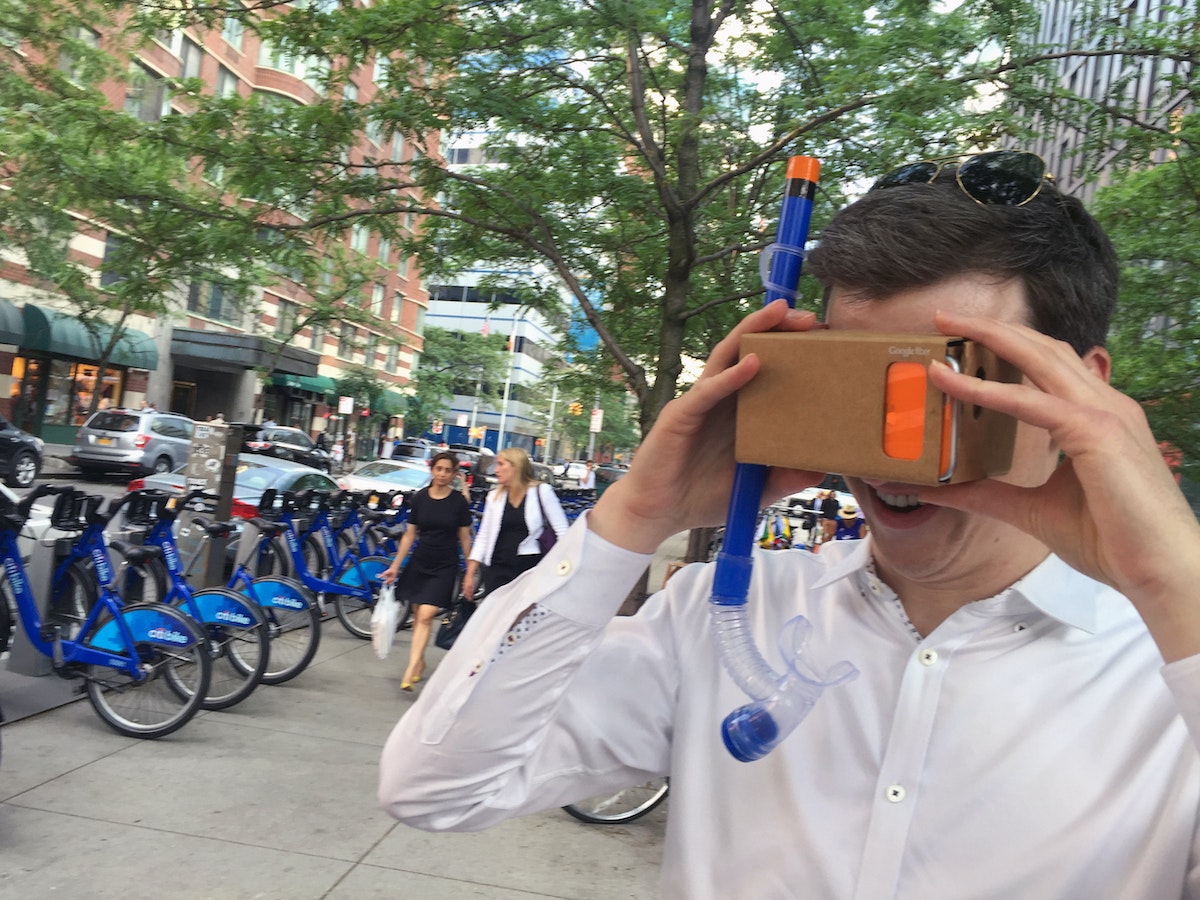
To co-design solutions with homeowners, IDEO set up pop-up stations at neighborhood meetings in Canarsie, Red Hook, and Gerritsen Beach, and had flood-affected residents create paper prototypes of the resources they wanted in place the next time a storm hit. The team learned how residents contextualized their individual risk, which information they prioritized, and how their frustration could inform a better outcome. In Lower Manhattan, where residents are less aware of flood risk, the team set up a pop-up station with virtual reality viewers that simulated water rushing into the surrounding streets, a visceral wake up call that got them talking about flood recovery.
Less than a month after launch, FEMA began promoting FloodHelpNY as a key resource for building flood resilience. The platform helps all New Yorkers learn what flood zone they’re in, or will be in, how that affects their insurance rates, and what steps they can take to mitigate their risk. It features a first-of-its-kind flood insurance rate calculator that can help homeowners get a rough idea of the costs they could face as insurance prices go up. It is also the main conduit to apply for the Home Resiliency Audit, a New York State-funded program that equips at-risk homeowners with vital documentation valued at over $800 that confirms their actual elevation and insurance costs—all with the personalized assistance of an engineer and housing counselor team. In the coming months, FloodHelpNY will expand further to offer homeowners free backflow valves that reduce the chance of sewers backing up during flooding, as well as access to more existing benefits for resiliency.
The New York City floodplain, which is expected to grow as tides continue to rise, threatens neighborhoods that are among New York’s oldest and most historic. The people who live there make the city work: teachers, police officers, subway operators. Many of these homeowners will watch their flood insurance premiums surge, year over year. It’s a troubling future, but one that FloodHelpNY is designed to help New Yorkers face, by guiding them toward greater resilience and assuring them that they aren’t alone.
A game-changing approach to sleep for athletes
Helping Rise Science, a sleep analytics startup, optimize its customer experience and scale the business.
Athletes looking to score big on game day could hit the gym, but they’d probably be better off hitting the sheets instead, according to Rise Science, a sleep analytics startup. Harnessing the latest sleep science, Rise helps players significantly improve reaction time and decrease false starts, lapses, and injuries, among other benefits.
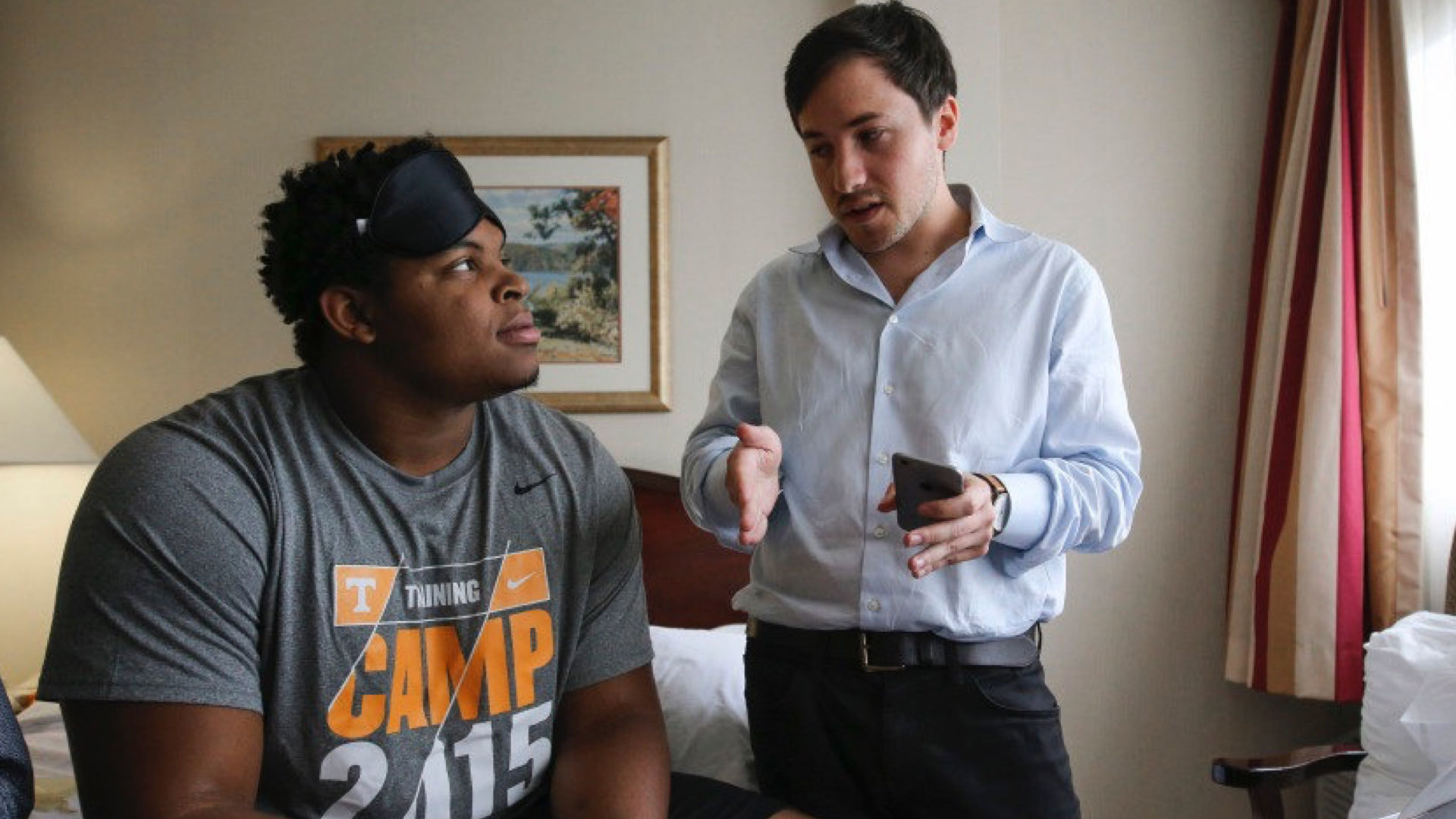
While attending Northwestern University, the co-founders of Rise Science created a simple sleep app and light-touch coaching service, which they prototyped on the school’s Big Ten football team with positive results. They came to IDEO to optimize their customer experience and scale the business, and joined IDEO’s Startup in Residence program.
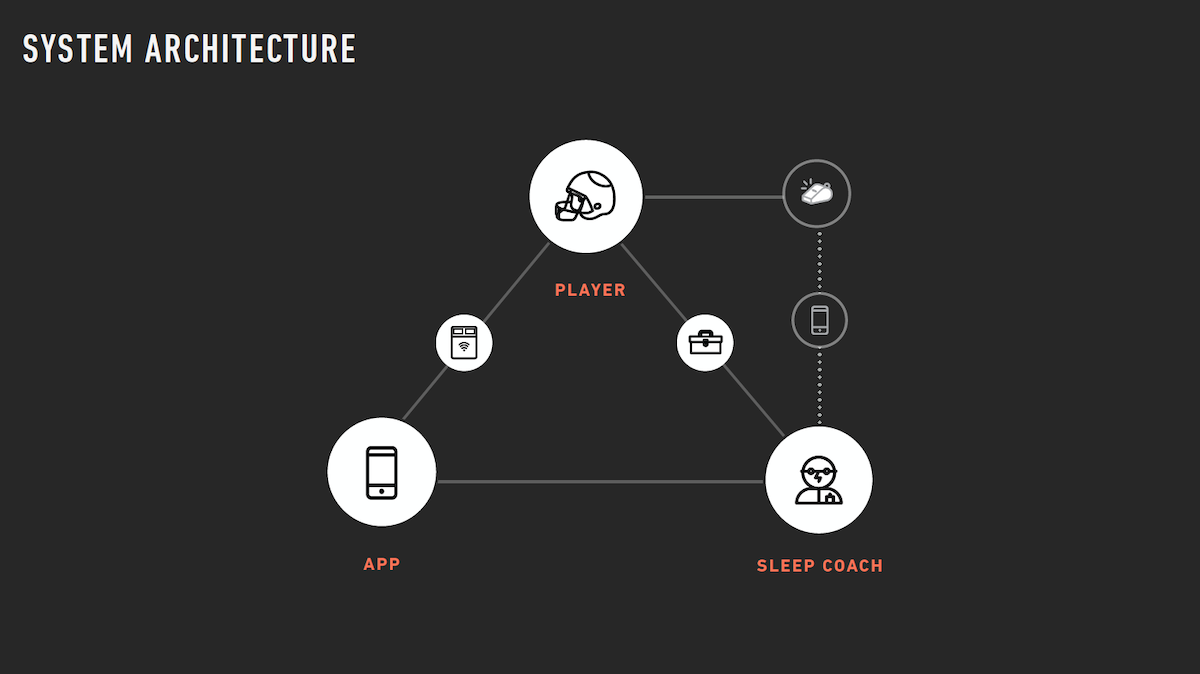
While observing coaches and players using Rise, IDEO saw the opportunity to better integrate the digital and hardware experiences and design a more robust, intuitive, and service-heavy on-boarding experience during the first few weeks using the system, when breaking old habits and incorporating new ones are most challenging.
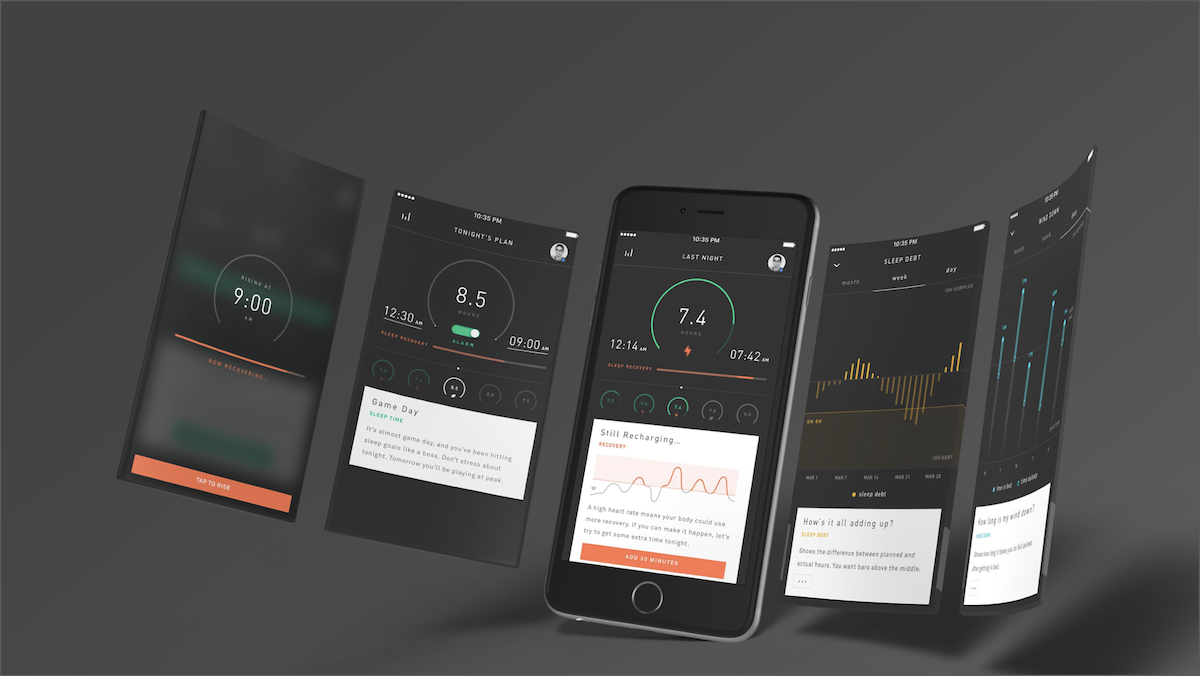
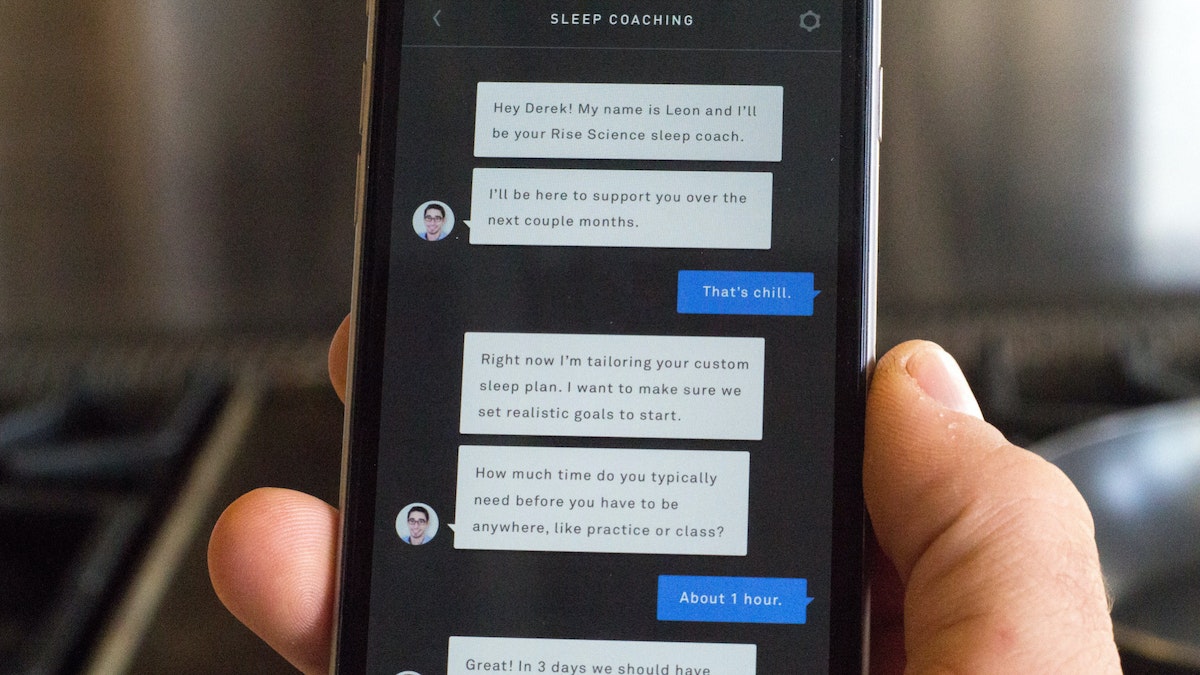
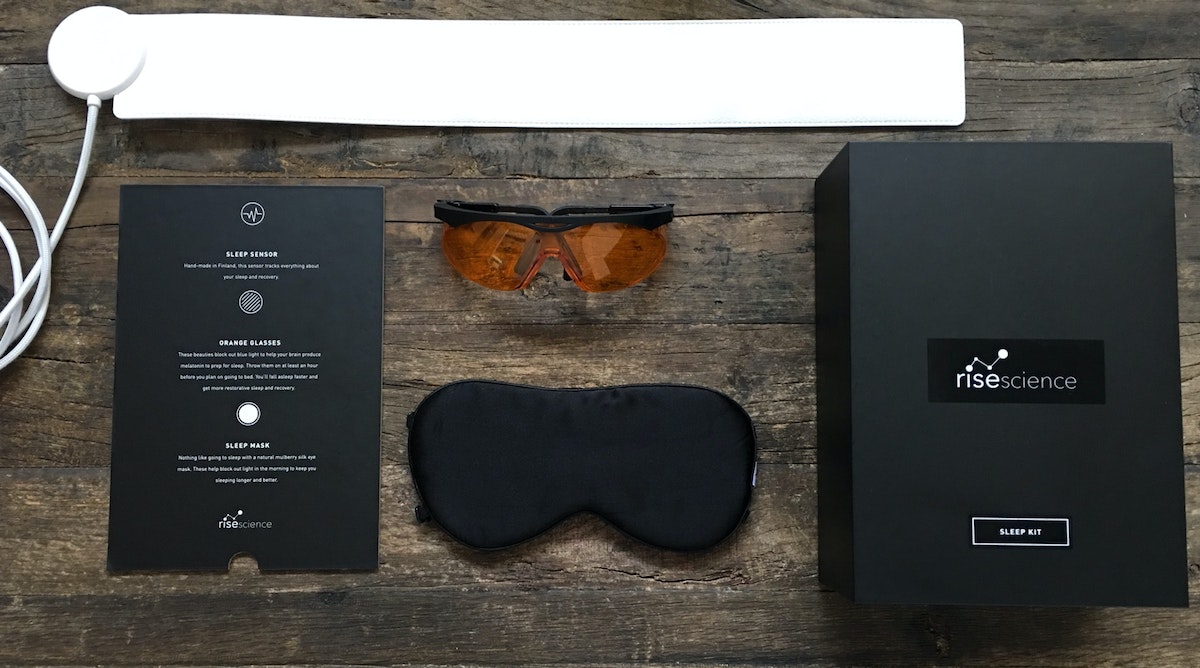
At the end of the residence program, Rise left IDEO with a rebranded and optimized sleep training system. Here’s how it works: Players and coaches receive a short, in-person introduction to sleep coaching by a Rise employee. Players who opt in to the service receive a sleep-training kit that includes the Rise Coaching App; adaptive sleep plans tailored to their chronotype, age, game schedule, and training load; a part-human, part-machine sleep coach that continuously supports each player, monitors progress, and gives timely feedback; in-context education that provides daily and weekly sleep insights; and products like UV glasses, sleep mask, and bed sensor. In just a week of using Rise’s full sleep program, 97 percent of players report getting 54 more restorative minutes of sleep per night.
Recently, Rise Science added the Chicago Bulls, Miami Dolphins, and the University of West Virginia to their sleep-training roster, enhancing their performance, one good night’s sleep at a time.
“Coming into IDEO, we knew our service was letting customers down. When we left, we had the blueprint for the next version of Rise. We were able to solve and optimize sleep at a much larger scale,” said Jeff Kahn, co-founder and CEO of Rise Science.
Can an Interaction Designer Survive Without a Smartphone?
What I learned during a month unplugged
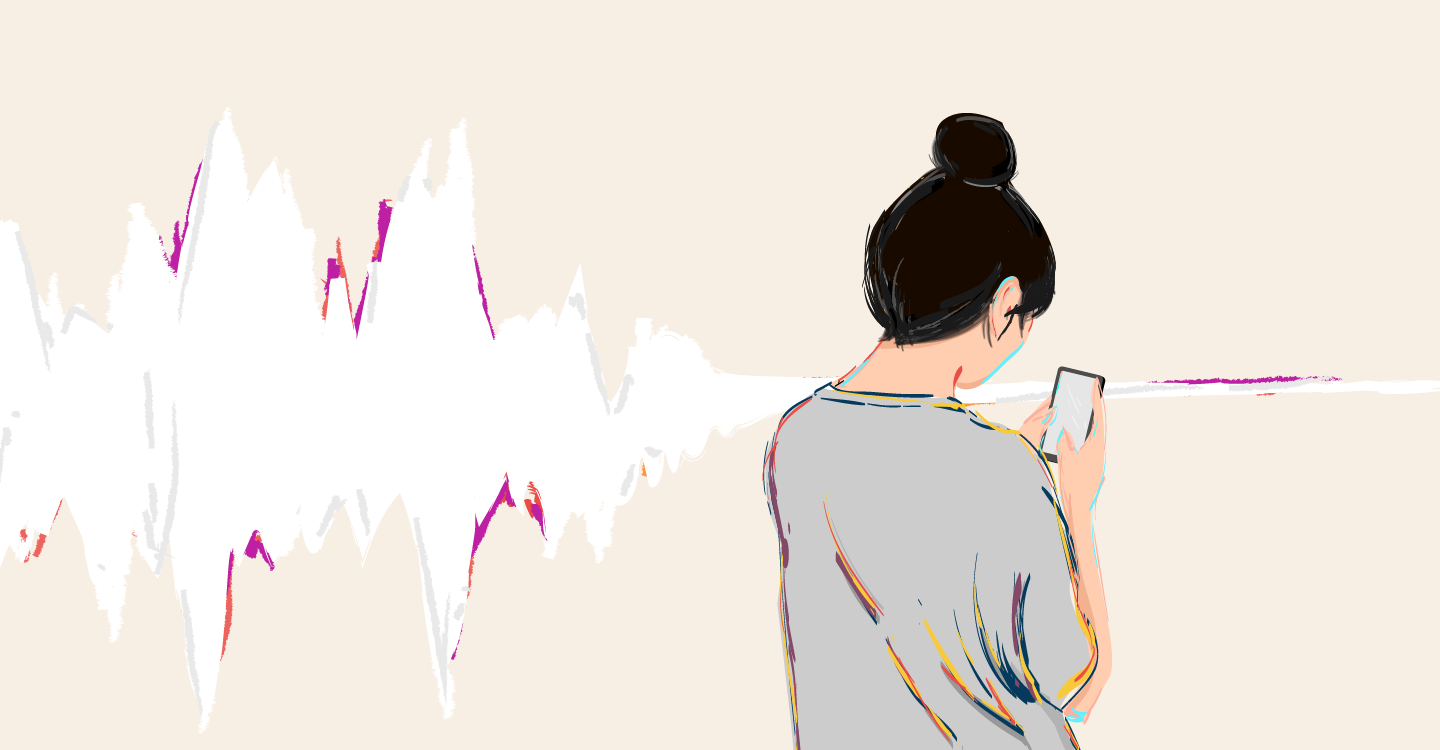
First came the jolt of panic, followed by furious digging through my bag, and slapping my pockets, the whole time chanting, “Please say I didn’t forget my phone!” There I was, standing just past the airport security checkpoint on my way to catch my connecting flight home from Japan, totally empty-handed. Bye, phone.
Once I stopped hyperventilating, I had a few hours strapped to an airplane seat to consider the following: What would it feel like to live without a smartphone?
Since I was already stuck without one, I decided to turn my predicament into a personal experiment: one month, no smart devices of any kind. Here’s what those 30 days taught me—and how the experiment made me rethink the way I approach design.
Less might be more
My first observation was that I was suddenly fully engaged with everything—my surroundings, the people around me, even that TV show that I thought I liked, but really just glanced at between text messages. I was pleased to find that conversations suddenly became much more meaningful. When I had my phone in hand, I was always subconsciously waiting for a buzz, and partially disengaged from the people in front of me. And when the buzz happened, I stopped listening to them completely. Without the added distraction, interactions became much more fulfilling.
As an interaction designer, I spend a lot of time creating user-friendly interfaces, but this experience made me wonder exactly how accessible things should be. Now I ask myself, are there elements that are competing with instead of enhancing an experience? Would a user benefit from something just a little less sticky?
Lose the escape hatch
Some of you may remember a time when you couldn’t just text your friend to say that you’re running late or *cough*cough* aren’t feeling well and can’t make it. We’re all guilty of it. The beauty of not having a phone was that it forced me and my flaky friends and family to pre-plan and be on time*. By removing the option to be late or back out, there’s much less to think about besides showing up and enjoying each other’s company.
When we’re designing technology, do we always need a back or undo button? How does that affect outcome and behavior, and can we use it to our advantage? For instance, with questionnaires, how do answers vary if there’s no way to change them?
*side note: Do look up where you are going ahead of time, because no phone = no maps.

It really, truly can wait
At the beginning of the experiment, I had a few phantom limb moments where I went to grab my phone to check tomorrow’s weather, or look up the definition of apocryphal, or text that random gif to a friend. In most situations, my first instinct was to whip out my phone. Not having access to everything forced me to slow my pace, and made my world feel a whole lot smaller, and, in some ways, less overwhelming.
In an era where you can shop for a pair of pants online and have it delivered to you within the hour, are there moments that can be enhanced by building in pause? What can a little friendly friction do to help slow things down to enhance and experience?
Automation isn't always rewarding
There’s no question that the smartphone affords us many conveniences—I’ve undoubtedly plundered every mobile subscription, delivery, and transaction possible. But streamlining every aspect of my life left me longing for those small moments of accomplishment that I used to get from figuring it out on my own. For instance, without access to ridesharing services, I found myself walking or taking public transit everywhere. Great for my lungs, the environment, and my wallet. The same goes for social sharing: Much of the reason we share online, is for the reactions we get in return. And by moving from an asynchronous share to a synchronous share, you’re rewarded by actually seeing someone laugh instead of an emoji reply posted 34 minutes later. Mic drop.
Just because we can automate, doesn’t always mean we should. The unpredictability of human behaviors is what makes the mundane more interesting, after all. How can we integrate these real life moments into the designs we create?
Since the big experiment, I’ve rejoined the flock and am now wielding a shiny, new phone with a notch in it. But I haven’t forgotten the lessons I learned—or how important it is for designers to get out of their comfort zone. And next time I need a little inspiration, I may just leave it at home.
As an interaction designer, I have a love-hate relationship with my phone. On one hand, my job requires instant access to apps, prototypes, Slack... the list goes on. On the other, tech addiction is real. Even if I might try to ignore the invisible handcuffs that tie me to my phone, I was always reaching for it.
Until, of course, I lost it.

Thoughtless Acts: Driving in Style
Thoughtless Acts: Driving in Style. The intuitive ways we adapt and react to things in our environments
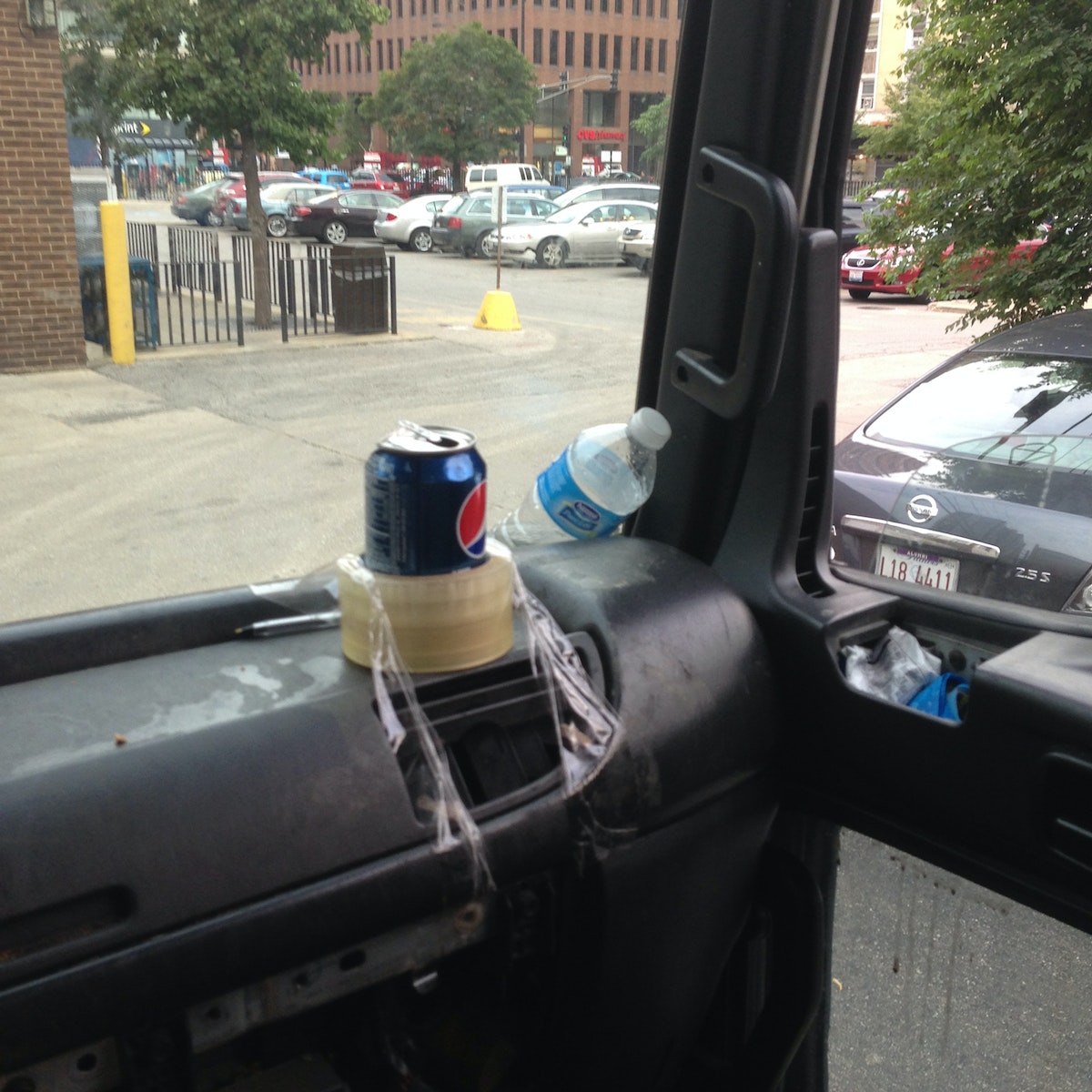
Moving trucks aren’t always built for convenience. After all, they’re meant for hauling cargo, not a luxurious drive. But they are chock full of packing tape. When I hopped in the front of our mover’s truck to pick up some furniture at the storage unit, I smiled to see this ingenious workaround. A cup holder for your soda pop using a roll of packing tape, secured with—what else—packing tape.
Human-centered design requires us to observe human behavior with beginner's eyes, so that we can spot the innate ways people interact with the world around them. We call these intuitive and unconscious reactions Thoughtless Acts, and IDEO designers collect photos of them to inspire their work.

Why I’m Building a TV For My Baby
I am making a TV for my future son. It’s nearly finished, though I’m still working out a few kinks in the scheduling API, and I need to solder the hardware channel switcher. It’s a side project that’s been simmering for several months now that I plan to release soon—not unlike my baby.
The idea came to me on a Saturday in June, before I had told anyone I was pregnant. I was flopped out on a sandy couch with my niece and nephew after a day at the beach, their level of post-sun exhaustion matching my first trimester fatigue. Their mom, my sister-in-law, recognized an opportunity to steal away for a shower, and put on an early 80s episode of Mr. Rogers’ Neighborhood. Both of these kids have been raised mostly screen-free, and their mom was just starting to let them watch what she called “slow TV”: mostly nature documentaries, the occasional Aquanauts episode, and of course, Mr. Rogers.
This particular episode began with Fred Rogers trying to fix a leaky faucet with a new rubber washer. But he didn’t have the right size washer, so he goes to visit a local handyman. Rogers asks some questions about a shovel the handyman is fixing, and then is shown a wide selection of washers, and takes his time picking out one of the correct size. This takes place over the course of roughly 10 minutes, in real time. It’s a prime example of “slow.”
My niece and nephew were transfixed, mouths open. Seeing Mr. Rogers select a piece of kitchen hardware appeared to be the most incredible thing they had ever witnessed.
I want the same thing for my son.
I’m a software designer with a background in web development and computer science. I grew up loving computers and the internet. We had an Apple IIE for as long as I can remember, and my engineer dad taught me BASIC as soon as I could read. My first introduction to the internet was when our family got a CompuServe subscription in 1994. I couldn’t do a whole lot on it, but I’d jump into chat rooms and talk about the X-Files and Monty Python. Technology was always a part of my life.
But when I look back on all this, I realize how lucky it was that I got to grow up in this particular moment of technological disruption. I wasn’t plopped into a world governed by technology—the internet’s control over the world grew right along with my own.
Now, though, I keep reading articles about the ways the internet is changing our brains. Social networking is making us more isolated and risk-averse. The current generation of teens growing up, digital natives all, are the safest and the most depressed yet. And I worry about what it will mean for my child, born into a world moving at the speed of Twitter. This anxiety has become more real and intense every week of the 39 I’ve been pregnant. I assume it will let up sometime in the next three or four decades.
Lately, I’ve been thinking a lot about calm technology—a term coined by Mark Weiser and John Seely Brown of Xerox PARC in a 1995 white paper, researched further and developed into a book by Amber Case. Here are the Cliffs Notes: Calm technology should require the smallest amount of attention possible from the user; it stays at the periphery rather than being center stage; and it should “amplify the best of technology and the best of humanity.” It’s that last one that stuck with me.
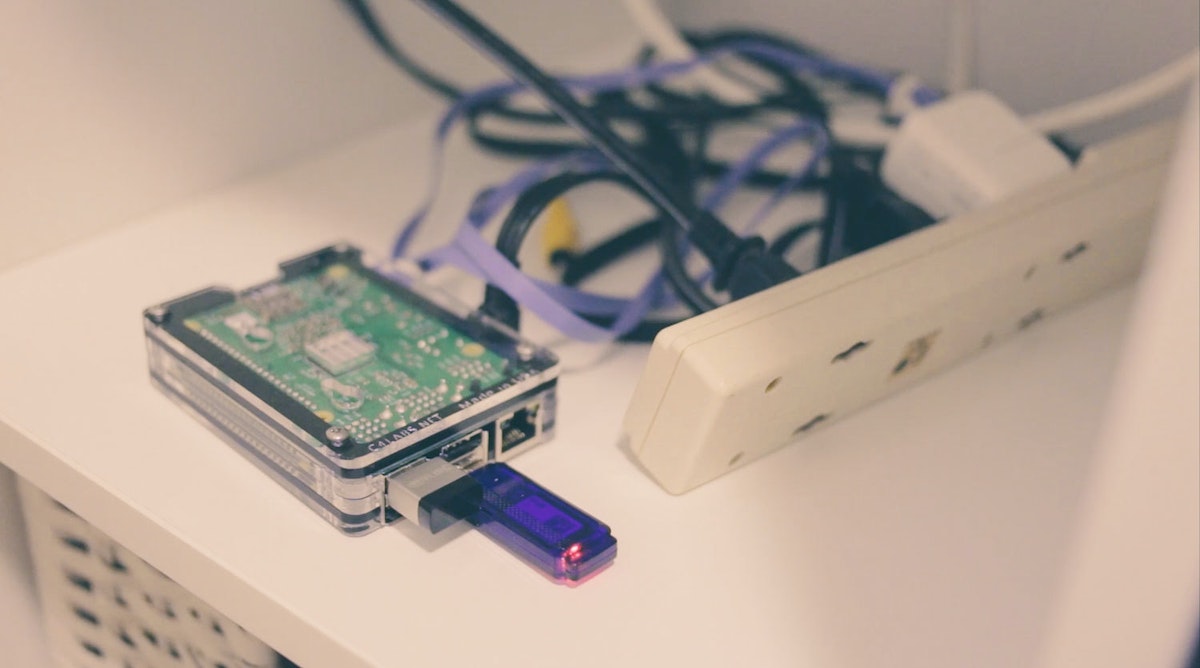
I don’t have to be a luddite to protect my child—I can use my skills as a technologist, including basic hardware hacking, to moderate the world I want my child to live in. By creating this TV, I can give him the calm environment I was lucky to grow up in. While he’s small, his TV will be a 30-pound, wood-paneled monster that I found the on the street, with a dial and 12 channels he can flip between—no more, no less—all programmed by me. So far, none of the content goes above a PG-rating, and one channel is all Mr. Rogers, pleasantly chatting with his handyman neighbor, carefully choosing just the right washer.
Eventually, my son will know about Netflix and binge-watching. He will know about YouTube and those bizarre AI-generated children’s shows. He will know about games that have been designed by the best minds of our generation to be more addictive than the cigarettes I hope he’ll avoid when he’s older. He will know about so much more that I can’t begin to predict. But for a while, he’ll be blissfully unaware, able to grow and think and develop at a child’s pace.
I am making a TV for my future son. It’s nearly finished, though I’m still working out a few kinks in the scheduling API, and I need to solder the hardware channel switcher. It’s a side project that’s been simmering for several months now that I plan to release soon—not unlike my baby.
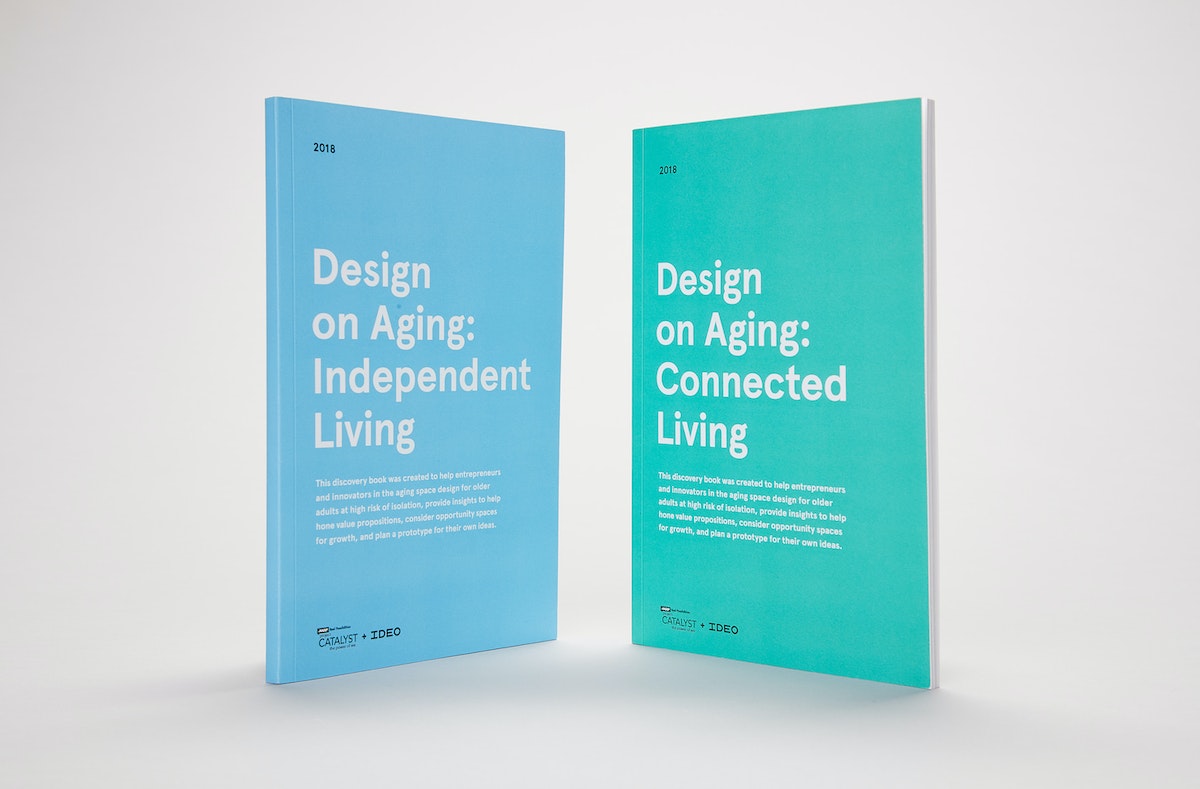
Tools and Insights for Enhancing the Lives of Older Adults
The Design on Aging booklets give entrepreneurs and organizations tools for designing human-centered products and services for older adults.
The Design on Aging booklets give entrepreneurs and organizations tools for designing human-centered products and services for older adults. The two publications, Connected Living and Independent Living, explore how design can help older adults stay socially connected and physically mobile as they age. Presented alongside 4 distinct profiles representing the behaviors and mindsets of people over 50 years old at high risk of isolation, the booklets provide practical frameworks and design exercises to help organizations generate impactful solutions.
IDEO developed the Design on Aging booklets with Project Catalyst—a pioneering research collaboration between AARP, UnitedHealthcare, Pfizer, and MedStar Health.
Download the books on Independent Living and Connected Living.

Lindsey Turner
I’m passionate about building brands, products, and experiences that help organizations show up with meaning and momentum.
I help organizations cut through complexity by shaping how they show up, through brand strategy, identity, and storytelling.
Working at the intersection of brand and business, I bring an editorial eye and a bias toward making—turning ideas into tangible experiences that people can understand, trust, and believe in.
My work spans government, healthcare, financial services, media, and consumer goods, from launching Gen Z-focused ventures to building innovation labs and reimagining legacy brands. I relish moments of ambiguity and enjoy translating across teams, perspectives, and priorities to move ideas forward.
I started my career in editorial and digital design, shaping cross-platform experiences and identity systems in publishing and agency environments. That foundation still shapes how I work today: I’m detail-oriented, collaborative, and overreliant on the Oxford comma. I hold a BFA in Visual Communication from the School of the Art Institute of Chicago.

Rachel Young
My work helps organizations see who their products aren't working for—and build the will and the tools to do something about it
For 25 years, I've asked the same question: Who does this design exclude—and what are we going to do about it?
My work spans human-centered strategy, inclusive design, and qualitative research, with clients ranging from Microsoft, Google, and Verizon to the National Science Foundation, and San Francisco Unified School District.
Before IDEO, I taught elementary school in East Palo Alto and spent a decade doing design work with social service organizations—where I learned firsthand what it costs people when systems are built without them in mind.
I am currently writing User Error, a nonfiction book about digital access and the design decisions behind it. I live in Oakland, California.

Brian Pelsoh
I lead with craft, ensuring our work is creatively excellent: rooted in deep human insight and imagination, while also grounded in the realities of business and technology.
My expertise spans brand, communication, and product design across tech, education, the arts, and social impact.
I believe great work demands both high-level vision and obsessive attention to detail, and only happens through collaboration.
I bring an inclusive, hands-on approach and a deep understanding of business, which enables me to consistently deliver excellence while always asking why.
Before joining IDEO, I worked at the brand firms Pentagram and VSA Partners. I began my career as a designer, leading teams at the School of the Art Institute of Chicago and the Milwaukee Art Museum. I hold an MFA in graphic design from Maryland Institute College of Art and a BFA in communication design from the Milwaukee Institute of Art & Design, and have taught at some of the best design schools in the US.

Tony Wong
I am responsible for IDEO’s long-term success in China and working with clients to use design as a tool to enable growth.
I am responsible for IDEO’s long-term success in China and working with clients to use design as a tool to enable growth. Specifically, I have helped Chinese companies design holistic brand solutions through the development of their products, communication, services, and innovation teams, and I have helped multinationals expand their presence and influence in China.
I advise global leaders on developing China-led innovation and capabilities.
In over 15 years in IDEO Shanghai, I have worked on projects that use design to elevate the quality of the experience of healthcare products and services, streamline processes that increase productivity, create spaces and programs that promote and enable inclusive communities, and build next generation mobility solutions that are planet-positive.
Before joining IDEO, I worked at Philips Electronics and the Electrolux Group in Italy, the Netherlands, and Singapore on a number of breakthrough commercial products. I am a member of the Young President Organization in Shanghai.

Building a personal AI for the messiness of life: Sida Li
Most AI products today are built for work—a space with clear problems and established systems. One founder noticed a gap: personal life is messier, harder to systematize, and mostly left behind by the AI boom. So she built Cue, a personal AI that lives inside iMessage and group chats, to go where the other tools haven't.
In this episode, Becca Carroll, IDEO's Chief Strategy Officer, talks with Sida Li, co-founder and CEO of Shared Context Lab, about staying anchored to a human need while the technology around her keeps changing shape, why she treats her business model with the same rigor she'd bring to a product, and what it feels like to build a company at this particular, disorienting moment in AI.
The conversation also gets into how Sida makes design decisions: the language Cue uses to describe itself, the tradeoffs behind building inside iMessage instead of a new app, and a real story about a business idea that didn’t pan out.
This is the second in a two-part series profiling founders from IDEO's Startups-in-Residence program. The first conversation is with Johannes Seemann, founder of Sooner, on designing GenAI for the emotional side of money.

Designing GenAI for the emotional side of money: Johannes Seemann
Most personal financial tools are built to run the numbers and optimize towards a budget. While that works for some, most people experience money as a lived relationship that does not neatly fit into a spreadsheet. Johannes Seemann and Becca Carroll discuss why money is emotional before it is mathematical, and what a human-centered approach to building a generative AI financial product looks like in practice.

The curious leader's edge in uncertainty: Scott Shigeoka
Mina Seetharaman talks with Scott Shigeoka, author of Seek and Head of Curiosity Cultivation at the Eames Institute, about what distinguishes genuinely curious leadership from performative curiosity, how power dynamics shape curiosity, and why practicing curiosity can restore energy rather than drain it.

How constraints make us more creative: David Epstein
Mina Seetharaman talks with David Epstein, author of Inside the Box and Range, about why total freedom often produces average work, how leaders can design useful limits on purpose, and what organizations such as General Magic and Pixar reveal about the relationship between boundaries and creativity.
Looks like you might be in search of something very specific?
Or reset the filters above and try another angle.
Here’s some random inspiration

Podcasts about creative leadership

Articles about the power of prototyping
