
.svg)


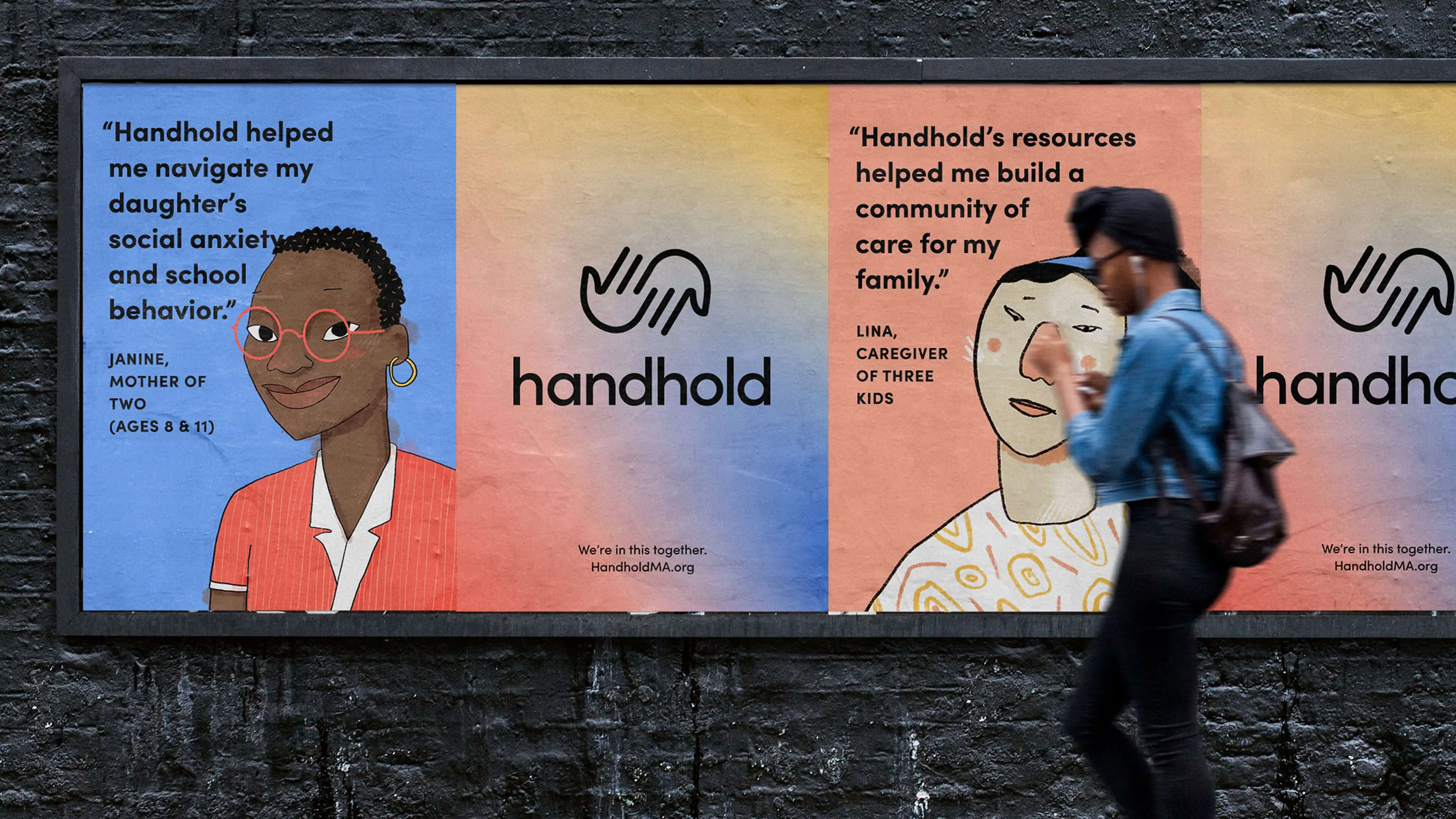

A helping hand
Massachusetts puts families at the heart of mental health.
The urgency of attending to our children’s mental health cannot be overstated.
Concern about their well-being was already on the rise in the decade prior to the pandemic. Alongside social inequity, the COVID era has seen soaring rates of depression, anxiety, trauma, loneliness, and suicidal thoughts. Knowing that mental health is influenced by numerous systemic factors, we met with families of all income levels and heard from practitioners throughout Massachusetts. In some communities, mental health is candidly discussed, in others it remains a taboo subject. Through these conversations, we learned that mental health requires both individuals and their families to be educated, supported, and empowered.
HandholdMA.org helps families find services that work for them and gives them easy access to information on a range of mental health topics. It allows parents to learn from and support one another as they navigate the landscape of mental health together. We took special care to make resources feel approachable for those in communities of color, and curated new resources for everyone from preschoolers to teens—because mental health challenges do not discriminate.
In 2020, a coalition of the nation’s leading experts in pediatric health issued an urgent warning that the mental health crisis among children had become a national emergency.
The percentage of emergency department visits for mental health crises rose by 24% for children between the ages of 5 and 11, and 31% for those 12 to 17, compared with 2019.
87,000
site visits to to HandholdMA.org since launch
223,000
people reached in bilingual social media campaign

Evolving to meet young consumers
Accelerating vivo’s transformation journey to connect with China’s young consumer.
To help shift vivo’s thinking from a focus on products to a focus on brand-building, IDEO set out to help the company understand how young consumers experience fun—a core tenet of the vivo brand. The new concept store needed to convey joy and fun in a meaningful and memorable way. The project was about more than just designing the space; it was also about piloting into vivo’s future brand systems.
To kick off the project, the IDEO team conducted user research in four different cities in China, then shared the stories of young Chinese consumers with the vivo team. Their interviews revealed that young people value experiences that enrich their lives and create a feeling of positive personal transformation. They seek opportunities to discover new experiences, express themselves in different ways, expand and deepen their social connections, and build knowledge and skills. By leaning on this definition of “enjoyment,” IDEO helped vivo identify the value proposition of the concept store, helping consumers express themselves in new and different ways. The store would allow every visitor to see something unique and find a fresh perspective.
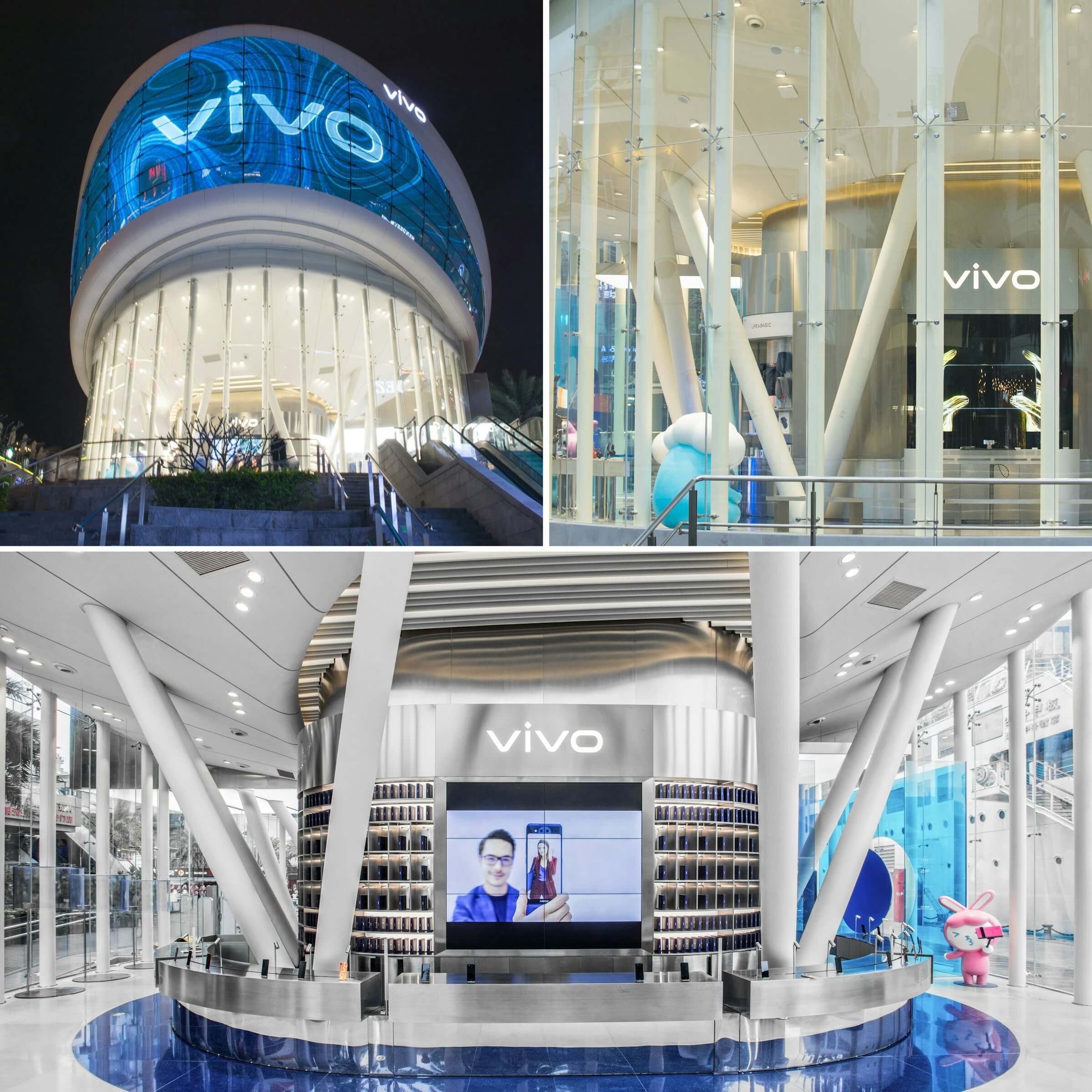
The vivo team took that value proposition into a design brief and later built out the space and interactive experiences. The second floor of the store is dedicated entirely to interactive experiences using photo booths, sound recording, and lighting technology, designed to provide consumers with the kind of enjoyment they seek. vivo launched the concept store in Shenzhen on March 22, 2019, marking an important milestone in vivo’s transformation from a smartphone maker to a consumer brand.
China consumes roughly 30% of the world’s smartphones—which presents a tremendous market opportunity for brands looking to capture young consumers’ loyalty.
Top 1
in China's smartphone market, topping both shipments (sale-in) and retail sales (sale-out), in the first half of 2024
260M active users
within two years of vivo Lab's official opening, with 70% of them young users
Transformation through creative leadership
Tsinghua University launches China’s first leadership course focused on design thinking.
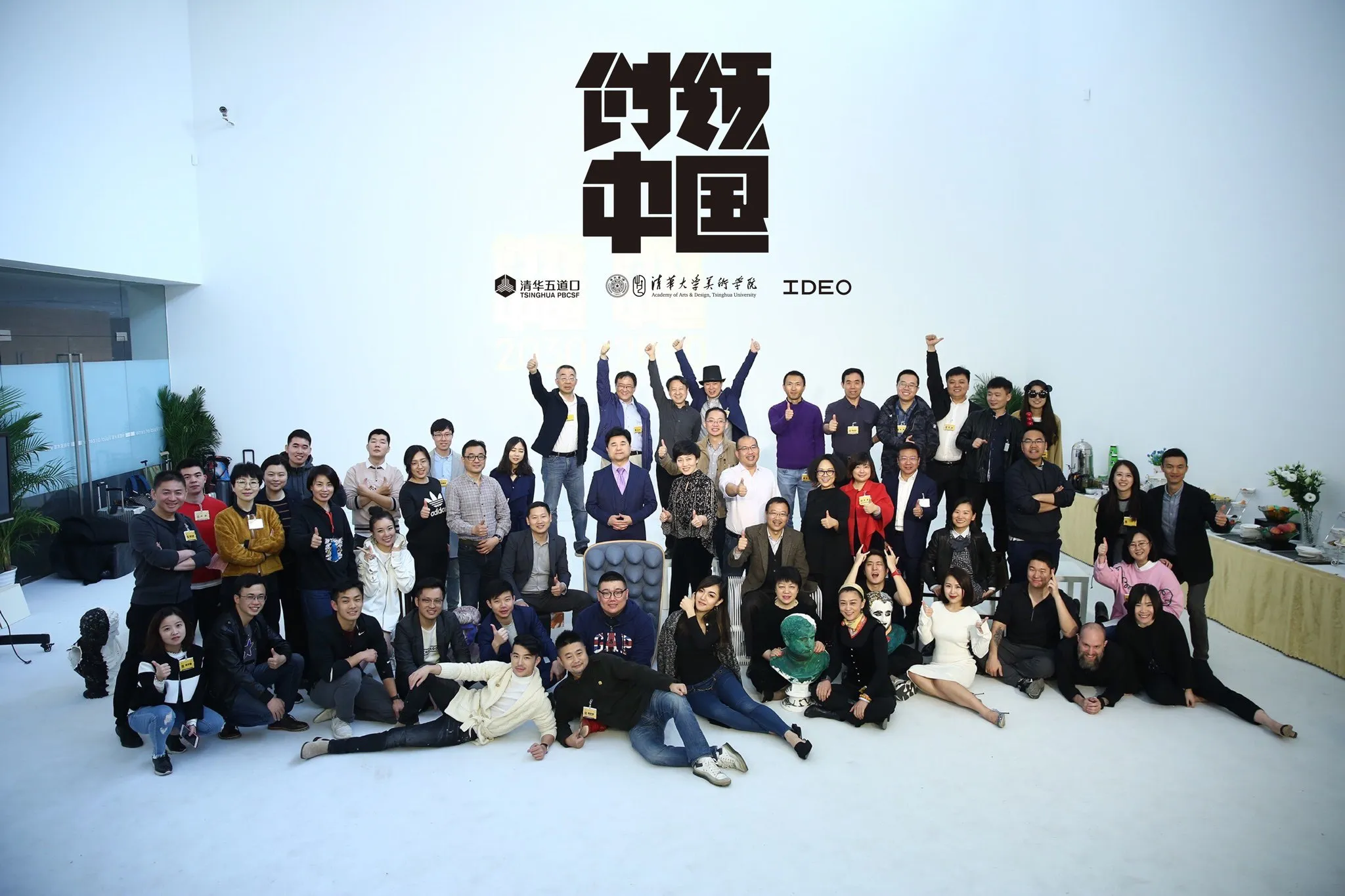
The program Tsinghua and IDEO created together consisted of six modules focused on creative leadership: Rediscover Design, Build Design as a Core Competency, Creating the Conditions for Creativity, The Financial Levers for Innovation, Designing for the Fourth Industrial Revolution, and Leading for Tomorrow. 73 Chinese and foreign experts helped teach the modules, including former Forbidden City Palace Museum director Shan Jixiang, the father of Japanese industrial design, Masayuki Kurokawa, and Jake Knapp, author of the book Sprint.
The program’s first cohort included more than 30 entrepreneurs from 20 different industries across nine cities. Participants completed the courses throughout the year, taking full advantage of holistic, interactive teaching and the opportunity to share their own practical experiences. Their feedback consistently demonstrated how the course had given them fresh approaches to problems their companies faced, whether improving internal communication or helping them see the clients they serve from a new perspective.
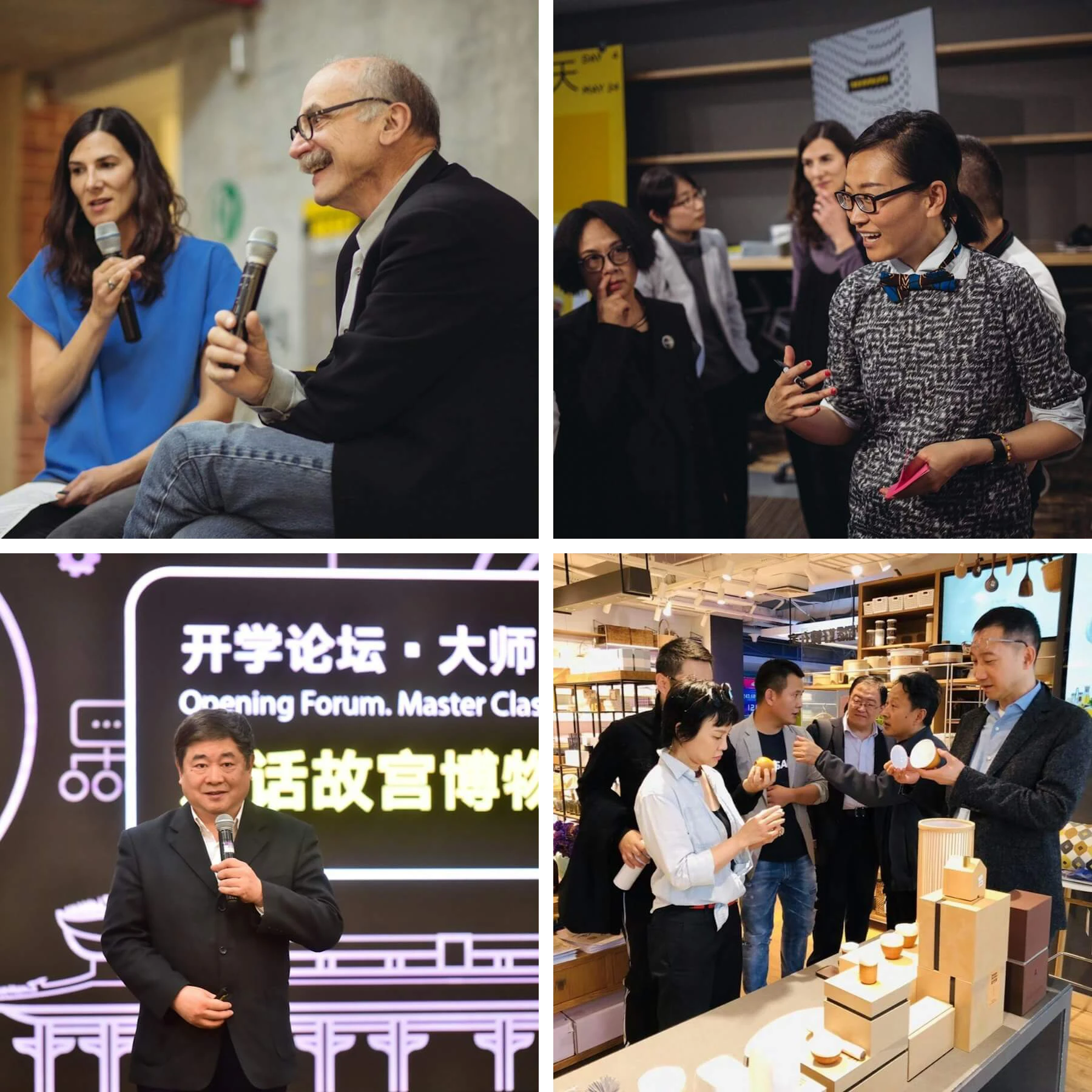
Liu Feng, the founder of a fast growing tourism development company, was particularly inspired by the Creating the Conditions for Creativity module’s six pillars of corporate transformation concept. Using these pillars, he not only refined the mission and value of his company, but also launched a series of measures to improve all aspects of its operations, from customer service to annual company gatherings. With a newly empowered team, he significantly increased the agility of the organization.
Ting Zhihong, the chairwoman of China’s leading logistics technology company, managed to double its profit during the course. She said her biggest takeaway from the course was how important it is to empower the team. Her company has now set up several platforms that give employees more room to experiment, create, and take part in frontline decision-making, bringing them closer to the company’s management.
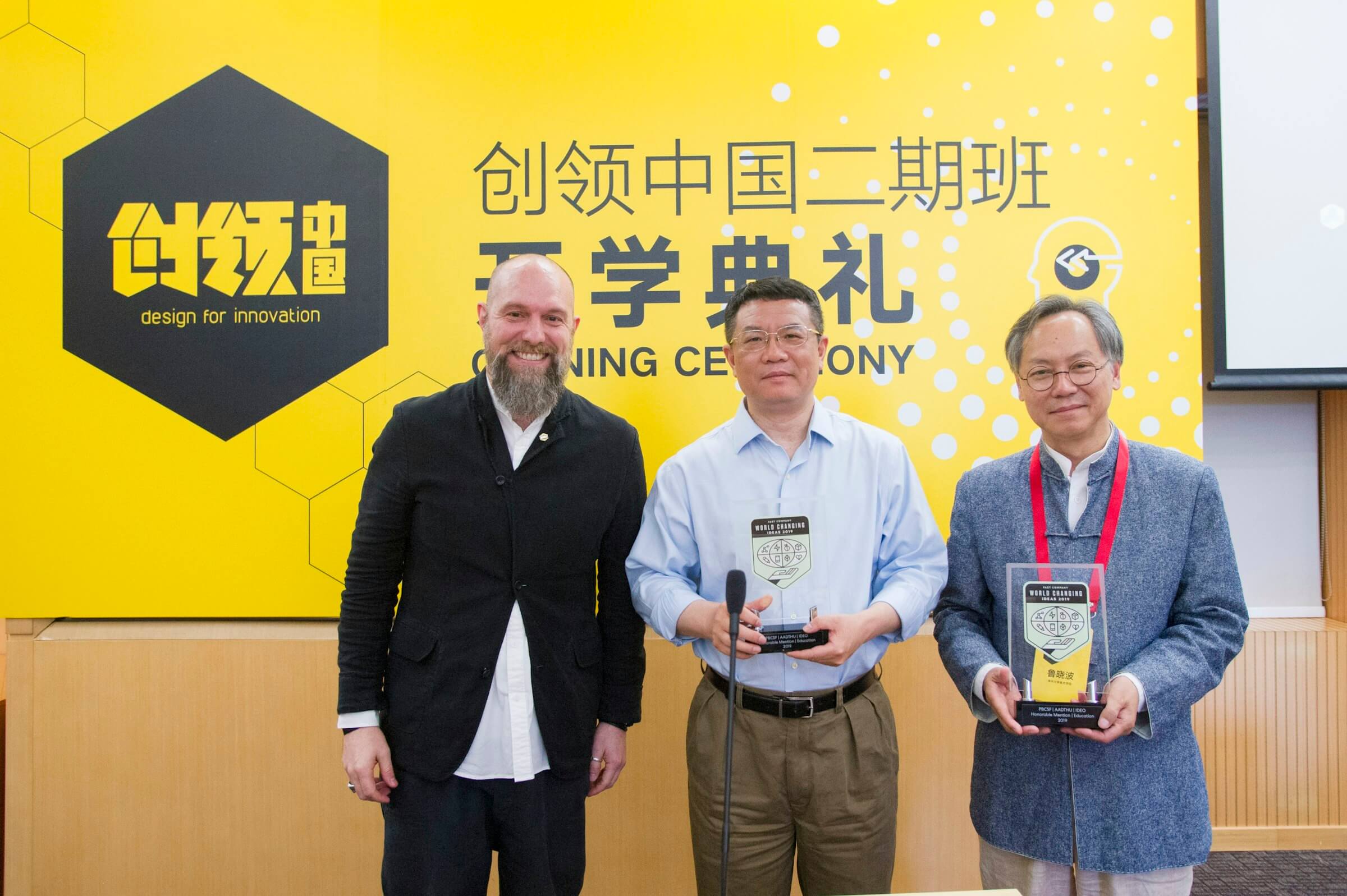
Hu Chao, founder and CEO of China’s largest e-commerce platform for childcare goods, found that while other executive courses simply teach knowledge, Lead a Creative China taught him the importance of placing people at the center of what his company is doing.
The first cohort of the program graduated in December 2018. On April 8th, 2019, the Lead a Creative China program received an honorable mention in the education category as part of Fast Company’s 2019 World Changing Ideas Awards, becoming the only award-winning Chinese project in the category.
After 40 years of rapid change, China has reached a pivotal point in its growth trajectory. Across the globe, traditional drivers of economic growth have slowed down, creating opportunity define the new economy.
The Chinese government has laid out a wide range of ambitious policy plans to ensure that China successfully manages this transition, and that the country continues to grow and lead.
Honorable Mention
education category, Fast Company’s 2019 World Changing Ideas Awards
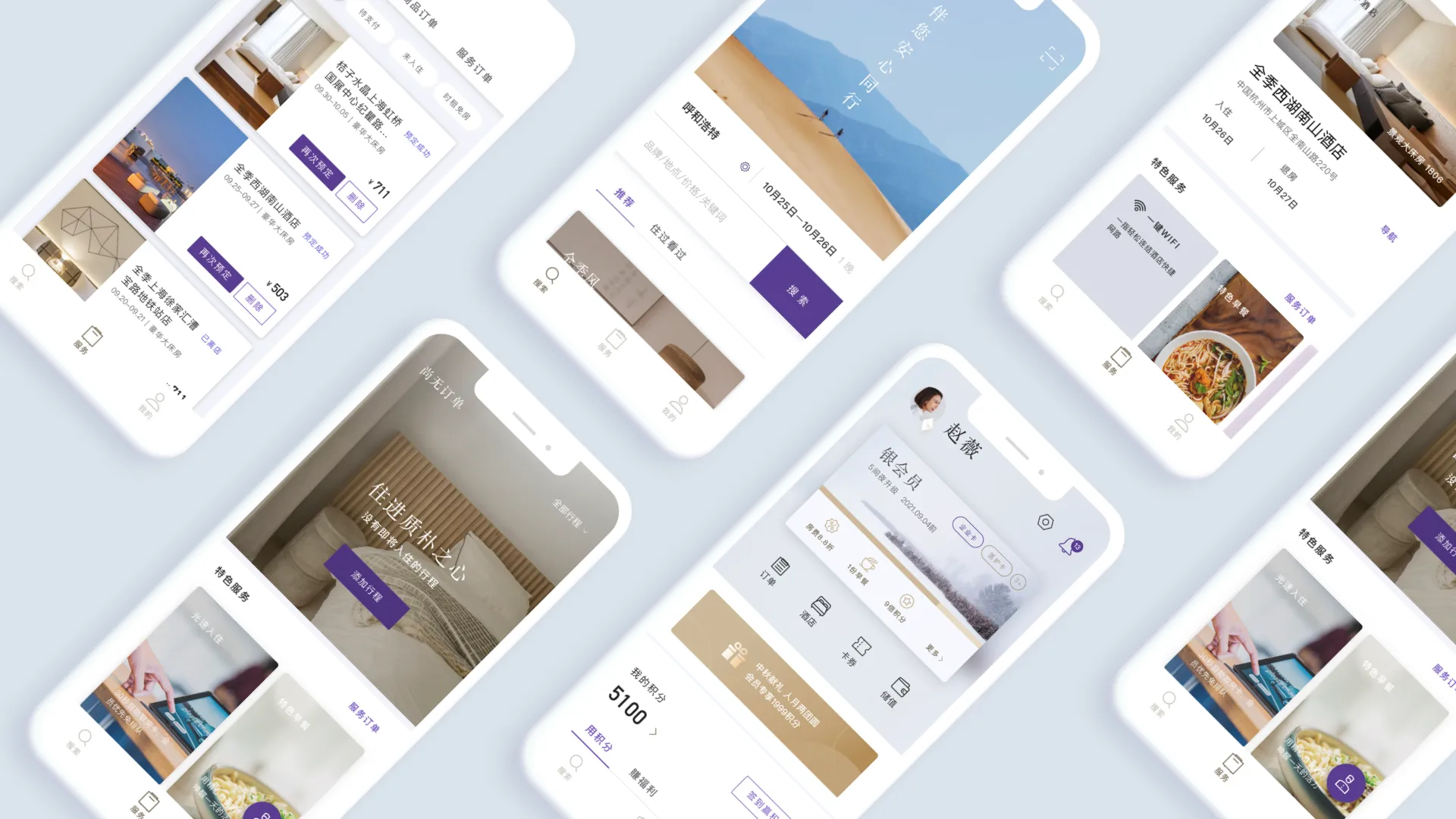
Human-centered hospitality via a tech-forward app
Huazhu Hotels Group translates its renowned hospitality brand into a seamless digital ecosystem for guests.
China’s digital landscape is dominated by highly integrated mobile apps like WeChat and Alipay that seamlessly combine messaging, shopping, bill payment, and finance management. This shift toward digital-first interactions that are hyper-convenient, personalized, and intuitive has significantly shaped consumer expectations for experiences like finding, booking, and staying in a hotel. To stay competitive and meet—or exceed—young guests’ expectations, Huazhu needed to redesign its Membership App 3.0 to prioritize guest needs across all touchpoints of the hotel journey.
Through in-depth research and member feedback, IDEO discovered the true pain point the Huazhu membership app needed to address: seamlessly integrating the hotel brand’s online and offline experiences. The Huazhu Membership App 3.0 adopted “simple, stable, and real” design principles, simplifying user operations, optimizing the interface, fixing lingering experience issues, maximizing page load speed, and reducing crash rates.

The IDEO team discovered users have different functional needs. Sometimes, users want to search for hotel information quickly. Other times, they prefer to explore and browse content slowly. To meet both needs, the app needed to be optimized for efficiency and exploration. So, the IDEO team upgraded the interface of the Huazhu Membership App, adding quick operation modules and information blocks on the main page, as well as a downward scrolling interface that gradually slows the experience, offering channels for detailed exploration.
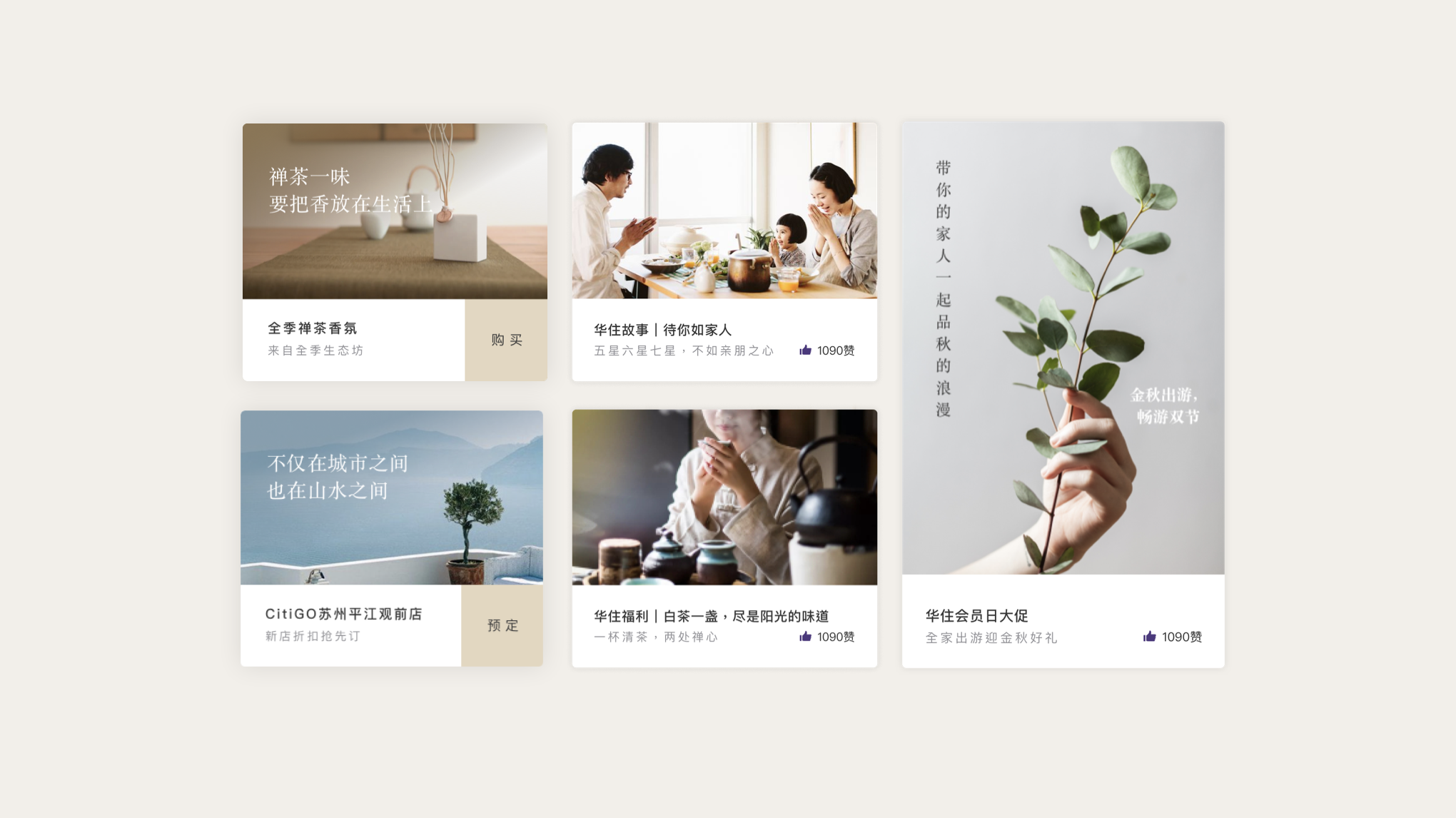
Customers also had different needs at different points in their travel journey: before, during, and after their stays. IDEO designed the language and user interface to provide personalized service information for each stage, from booking to post-stay. The app’s content adapts to the user’s travel phase, showing the most relevant service experiences at each point. The content displayed on the app also changes based on user habits, helping the app flex to meet their needs. The design aligns with the Huazhu Hotels Group’s mission to provide personalized service to a diverse clientele.

The team also worked to inject Huazhu’s brand characteristics by offering an upgraded experience in booking, stay, dining, and member benefits and adding features like a 30-second, automatic check-in experience. These thoughtful, personalized updates integrate Huazhu Hotels Group’s meticulous service philosophy, providing customers with a welcoming, human-centered hospitality experience. The updated Huazhu Membership App 3.0 is now available in major app stores, shaping a new generation of user experiences for Huazhu Hotels Group.
Young travelers in China expect the first touchpoint with a hotel brand to be digital.
5% increase
in monthly active users after the launch of the App's 2.0 version in 2021

Inspired by 'Her': 7 AI interactions we'd like to see in the world
From Neverending Story Books to Tamaglitchi pets.
Take a look at ChatGPT or other generative AI systems, and you’ll notice they look a lot like a Google search bar.
We’re still in the awkward, early phases of AI, where the technology is so new, the only way people have figured out how to interact with it is a way they’re already familiar with—even if it doesn’t make the most of the new technology. (ChatGPT itself admits its interface wasn’t designed with users in mind.)

Given where we are in the evolution of the technology, we decided to imagine new models for how we would want to interact with A.I. We borrowed a little inspiration from the Joaquin Phoenix movie Her, about a man who falls in love with the operating system in his phone, and the concept of calm technology, which is unobtrusive and embedded in our everyday lives, to come up with seven ideas for AI interaction paradigms we’d like to see in the world. There was only one rule: no chatbots. (Spoiler: We broke the rule.)
Here’s what we came up with.
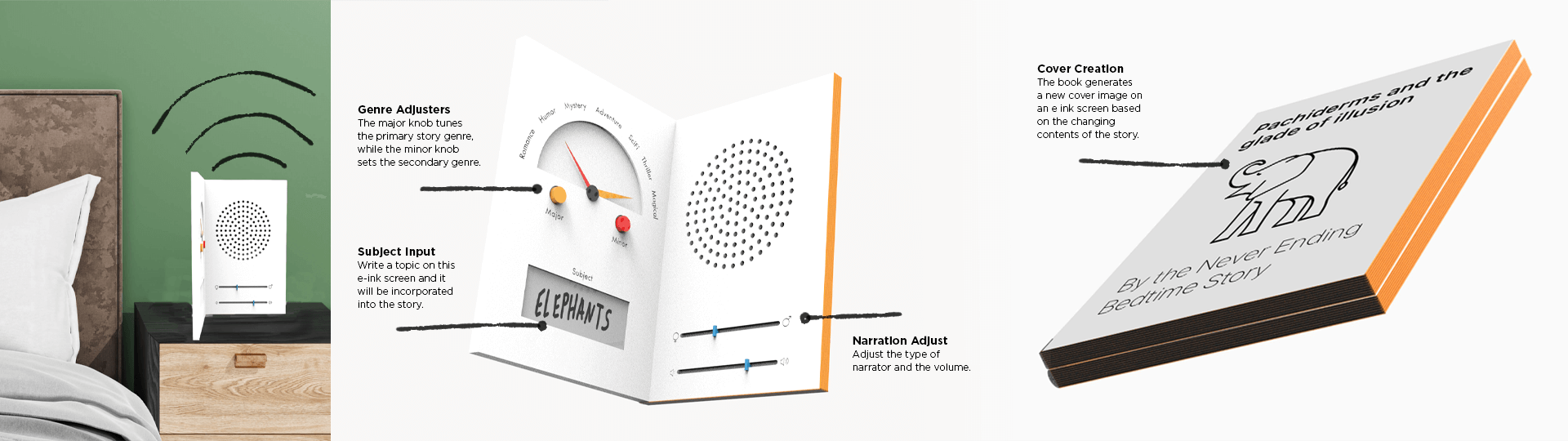
1. Neverending Story Book: AI-generated bedtime stories
This hardware device uses generative AI to always tell a new tale—and one that users can help shape. While some inputs are constrained, like the genre knobs, the subject matter open input box can accommodate as much creativity as the user can produce. This combination of constrained and flexible inputs provides guardrails for how users are meant to interact with the device, and by extension generative AI.

2. Tamaglitchi: An AI pet, embodied
It’s about time somebody made a pet with an off button. Tamaglitchi uses models trained on thousands of hours of dog and cat noises, behaviors, and interactions with humans to create an experience that is so close to having an actual pet, your parents can’t say no. (A prototype to meow at, via Character.AI.)
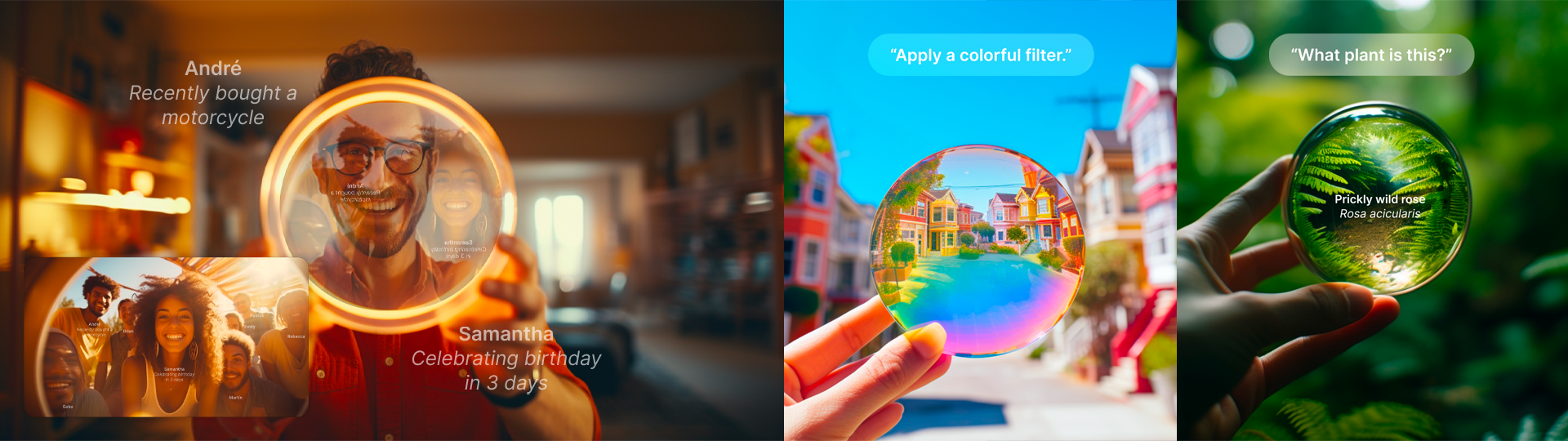
3. Portals: Handheld, AI-enabled circular lens that enhances connections
With so many devices that command our attention and pull us away from our physical environment, Portals are windows that allow us to refocus on the people in our lives and the natural world. Leaning into the passthrough quality of augmented reality, Portals allow users to capture memories and style inspiration in real time with minimal disruption to their field-of-view. Using machine learning models, Portals provide users with valuable social nudges and additional context to objects, people, and places in their environment.
4. RemixRemote: Custom entertainment content on demand
The future of personalized entertainment: When you have a specific amount of time available and an inkling of what you might like to watch, you can generate something that meets your specific needs. The RemixRemote uses generative AI to create unique content tailored to your taste and time availability. Collect ideas of what you’re interested in, then press down on the voice input dial to describe qualitative aspects of your inspiration. Pressed for time? Each turn of the dial cuts (or adds) 15 minutes to your content’s duration, making sure you can fit this into your schedule.
5. Collective Sentiment Mirror: An installation that summarizes conversations
This AI will gauge the conversations in a room and spatially map them in an installation in the ceiling. Each person is represented by a glowing dot, and as they interact with other people, interconnections between the dots grow. Opt-in poetry: The ceiling can also generate poetic summaries, picking up nouns or a single word based on the conversations happening in the space.
6. Scent Capture: Meet the eNose
eNoses digitize odors using a graph neural network. Once scent is recorded, scent capture will organize, tag, and combine smells to create AI-generated scents as unique as you. Relive your experiences by sending your custom scent profiles to be translated into physical forms like perfumes, candles, and essential oils.
And for the last one, we tossed out the rulebook, leaning into chatbots.
7. ArticulateGPT: An LLM that reduces articulation barriers
ArticulateGPT seeks to address one of the biggest issues users face today: their ability to translate their thoughts into words. It gives users options for what to say, so they don’t have to deal with the paralysis of a blank slate. But it’s not just to help with speech or written communication; users can flow between multiple media types, like text, code, imagery, video, audio, and even 3-D.
How do you want to interact with A.I.? We’d love to hear from you: ai@ideo.com
Special thanks to Grishma Rao, Neal Boyer, and Ceci Gomez for their work in coming up with these concepts.
When humans design paradigm-shifting technologies, they often create a similar interaction model as the technologies that came before.

Make something wonderful for the climate
Why we’re focused on desirability.
He made a plea: “I need your help. If you have looked at computers, they look like garbage. All the great product designers are off designing automobiles or buildings … People are going to spend more time interacting with these machines than they do interacting with automobiles today.”
Jobs foresaw a future where those machines—computers—would be central to our lives. But he also knew that if mass adoption was to happen, they’d need to make them more beautiful, intuitive, and delightful. In other words, more desirable.
So what does that have to do with the climate crisis?
Climate solutions already exist. Whether based in nature or in state-of-the-art technologies, we have the means to halve emissions in the next decade. But if we are to avoid the most dire consequences of climate change, these solutions must be adopted much faster, in more places, by many more governments, businesses, and people.
The climate crisis is a technology challenge, an investment challenge, and a regulatory challenge. But it is also a crisis of adoption, where we need to accelerate the uptake of climate strategies, solutions, and jobs. Fast.
The climate crisis is also a crisis of adoption.
Just as happened with computers in the 1980s, public interest in sustainable solutions is growing, but has not yet reached mass appeal. It makes sense: When was the last time you saw a house that looked better with the addition of solar panels? Or a community excited to install wind power in their backyard?
Desirability can help. What if regenerative agriculture could be a simpler business for farmers and a more affordable option for people? What if alternative meats tasted demonstrably better than a burger made of beef? What if repairing something you already have could be as much of a thrill as buying something new?
Since our early days, IDEO has centered people’s needs and desires—often hidden or latent—in how we think about design. Over time, that work has extended into helping the world’s leading companies make sustainability desirable, from designing electric cars with Ford, or removing waste from H&M’s supply chain, to helping Conservation International design strategies that protect natural resources.
We see three ways design can make the greatest impact toward accelerating and scaling effective climate action. Each supports our central thesis: The climate crisis is a human crisis. If we want businesses and people to make a climate-positive choice, make sure it’s a desirable choice.

1. Create compelling future visions, especially for leaders.
Nobody is willing to embrace the pain of change unless they see potential for a better future on the other side—including both new opportunities and ways to avoid loss. We see leaders experience a symphony of emotions over the course of climate-centered work, from denial to acceptance to purpose. That angst is the hallmark of a shifting mental model—from seeing sustainability as a business constraint to seeing it as an opportunity for growth. Futuring—the craft of creating informed and plausible visions of the future—is a key design tool to help that process along. When leaders explore potential futures, they realize they can’t opt out of the climate crisis, and start to see the extraordinary potential of the moment they’re in.

2. Design iconic products, services, and experiences, specifically for the Climate Era.
The competitive advantage of the future will be enjoyed by companies that thrive within planetary boundaries. The pressure is coming from constraints on resources, more stringent regulation, and shifts in public sentiment. But that’s an opportunity too: to make iconic things that could only be designed in, and for, the Climate Era.
One example: The Ford F-150 is currently America’s best-selling truck. IDEO helped Ford design its latest edition: the electric F-150 Lightning, which has been described as the best version of the truck. Here’s why: The Lightning has more power and torque than any of its predecessors and more electric sockets than the average apartment. When there’s an emergency, like the catastrophic storm that hit Texas a couple years ago, the F-150 saves the day by acting as an emergency power backup. There is also the “frunk” (a storage compartment where the internal combustion engine once was) that doubles as a cooler, and a tailgate that can be converted into a workbench for power tools, laptops, and more. Is it sustainable? For the truck owner, that’s not the point. The point is that it’s a better truck.
None of the F-150 Lightning features can be copied by a truck with an internal combustion engine. They are all creative affordances of the core technology behind the F-150 Lightning—electrification.
In other words, in the Climate Era the goal should not be to create a sustainable version of a given product. It should be to create a far better version of a product in ways made possible because it’s sustainable.
Ford’s F-150 Lightning is an example of an iconic Climate Era product, and it’s showing the way for the entire industry. The world needs many more.

3. Merge product innovation and sustainability into one team.
The vast majority of sustainability-related challenges begin at the design stage, yet most of today’s efforts are focused on compliance—reducing the negative impacts of things that are already in the market.
Transforming a business to operate within our planetary boundaries is an innovation challenge, not a reporting, marketing, or PR one. So nature-positive thinking needs to show up from the start, with innovators, designers, and technologists who are versed in sustainable strategies. Leading organizations are now hiring combined Heads of Innovation and Sustainability.
As the decade progresses, we foresee corporations transitioning from an umbrella, organizational level of accountability—“getting to Net Zero”—to requirements and norms that operate at the level of individual products. Allbirds’ net zero shoe, Apple’s net zero watch, and the regenerative packaging solutions created by Notpla serve as early examples. The teams behind those products will inspire others and be the engines of change for our economy—and they’ll attract funding, talent, and customers faster than anyone else.

One large grain of salt: Designing for desirability is one of the reasons why we’re in this mess.
Design has fuelled mass consumption of disposable goods. Can the force that helped create the problem be redirected to help solve it? We believe it can and it must.
Government policy and private and public investment create the conditions that push the adoption of climate solutions, but it’s desire that creates the pull. That’s why making climate solutions desirable is a critical piece of the climate action puzzle. Push and pull. We need both.
Back in 1984, Jobs closed his speech to designers with this:
"We at Apple feel that … we are at the right place at the right time to put something back. [M]ost of us didn’t make the clothes we’re wearing, and we didn’t cook or grow the food we eat … We are constantly taking.
The ability to put something back into the pool of human experience is extremely neat. I think that everyone knows that in the next ten years we have the chance to really do that. And we will look back and say ‘God, we were a part of that!’”
Especially in industrialized regions, like Europe and North America, we built our lives and economies around taking whatever we wanted from the planet.
It’s long past time to stop taking. We have to put something back. And that means redesigning much of our world to meet the demands of the Climate Era, and to do it within our lifetimes.
Change at such a scale can only happen fast if it’s what people want.
In other words, it’s time to make better things … because it’s a way we can make things better.
In Dubai for #COP28? Please join one or more of the IDEO Climate Lab sessions, where we’ll explore these questions in greater depth.
If you want to know more about IDEO’s climate-centered work, please get in touch: climate@ideo.com.
We stole this headline from Steve Jobs. In 1984, five months after Apple introduced the first Macintosh, Jobs spoke at the International Design Conference in Aspen.
IDEO Founder David Kelley shares design lessons from the Stanford d.school
A new collection of guide books to help us peer into the collective future.
Founding Stanford’s Hasso Plattner Institute of Design, known to most as the d.school, was a big part of that. The goal of the d.school has always been to bring diverse disciplines together to solve problems, and to help people gain creative confidence.
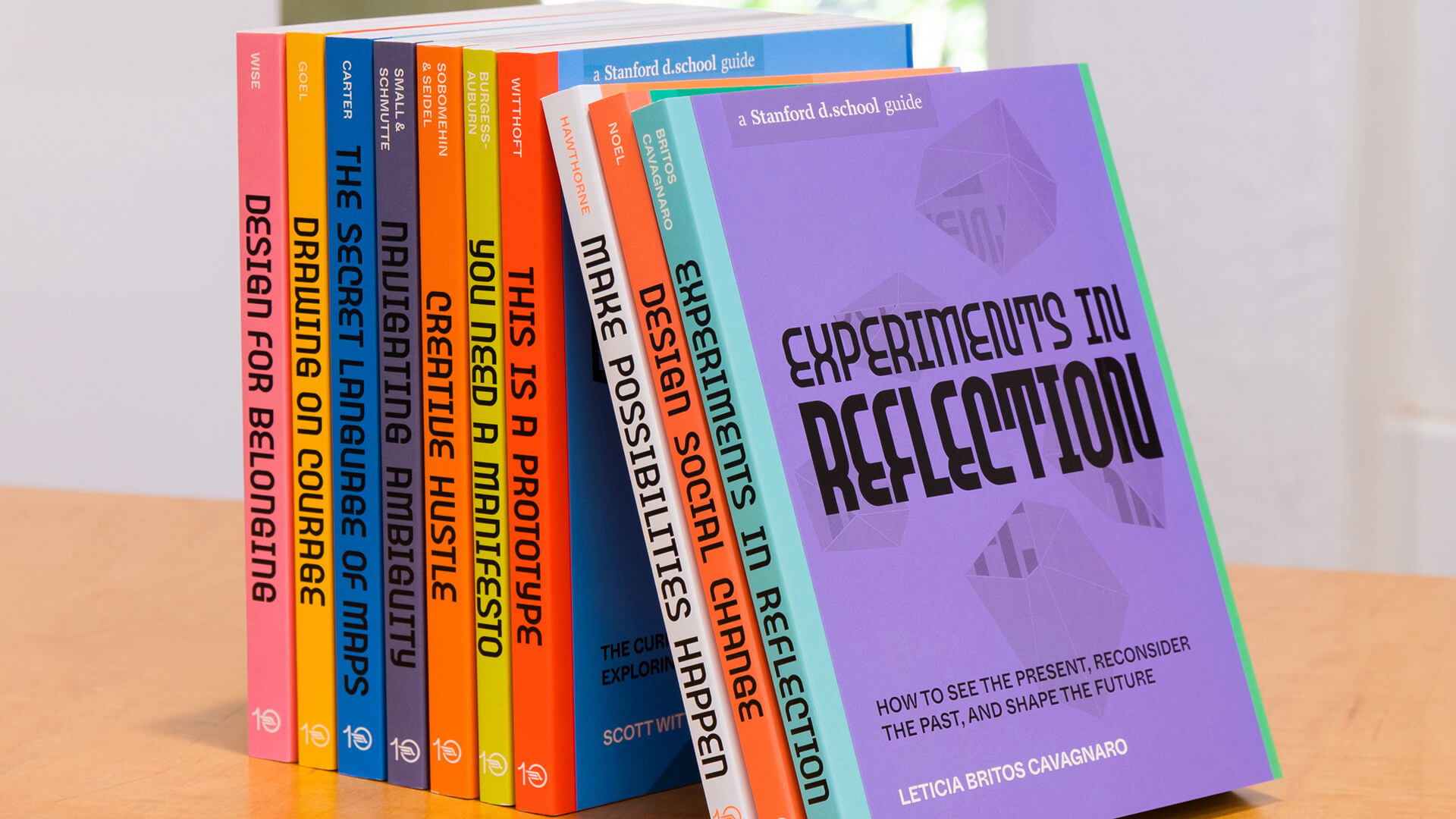
But we’ve never wanted our methods and capabilities to be siloed within our walls. That’s why I’m so proud to share the collection of design guide books the d.school has published, written by colleagues and friends with whom I’ve had the opportunity to work and teach. To give you a sense of what you can find in them, I’ve asked the editors at IDEO to spotlight some of the things they particularly liked, so that we could have the pleasure of sharing them with the broader community. I am giving them as holiday gifts this year and our friends at Porchlight Books are offering a special discount if you want to do the same. Enjoy!
—David Kelley
The Secret Language of Maps by Carissa Carter
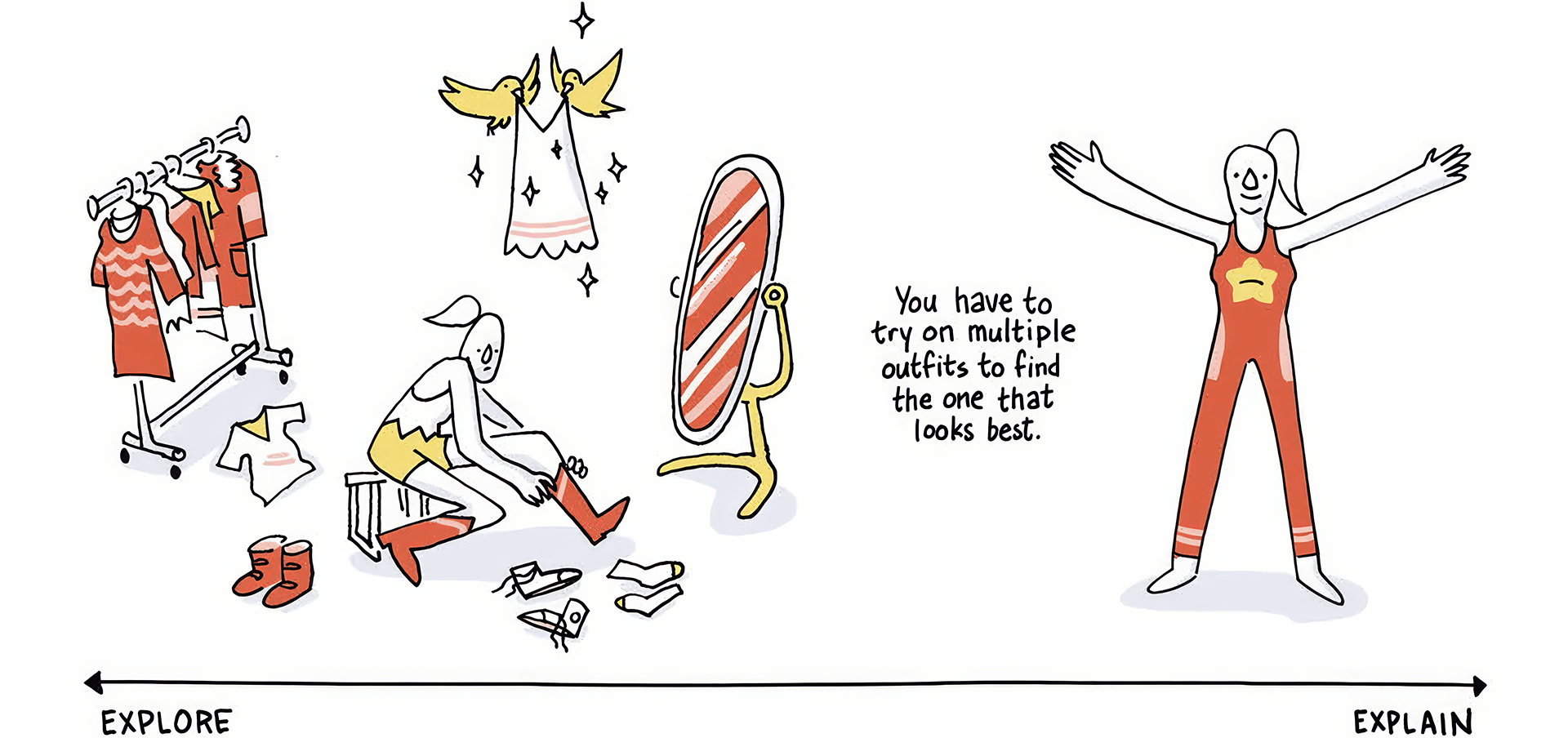
Whatever you think this book might look like, get ready for a surprise. Instead of a dry how-to, Carissa Carter, the academic director at the d.school, opens her book with the first chapter of a murder mystery, using a set of clues to illustrate a lesson on the wide range of forms that maps can take. Cartographic formats, data exploration, and methods are woven in between the chapters, drawing on the clues and themes to not only help you solve the mystery, but also expand your definition and understanding of what maps can be, and how you can craft your own. More than a clever manual that is useful for anyone making maps or graphs, The Secret Language of Maps breaks ground on an entirely new genre of instructional storytelling.
Design for Belonging by Susie Wise and Design Social Change by Lesley-Ann Noel
Together, these two books offer paths to help navigate building a more inclusive world.
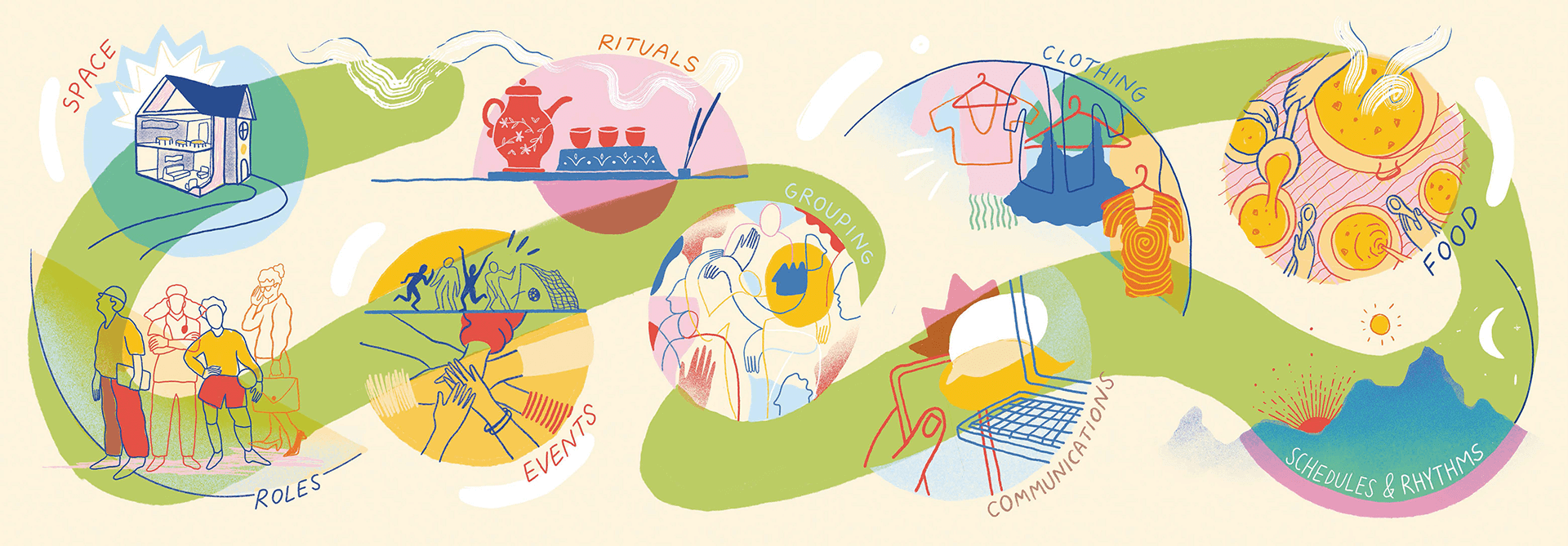
Dr. Susie Wise, the founder and former director of the K12 Lab Network at the d.school, breaks down Design for Belonging into three chunks: the feeling of belonging, the moments during which belonging occurs, and the process of shaping your context so that belonging can emerge. The first chunk has exercises to help designers uncover what it really feels like to belong, while the second invites you to deconstruct belonging in your own life and the systems you dwell in—from the experience of entering a place of work to shopping in a grocery store, to how you share invitations with others. The final third details the design levers you can pull to engender inclusivity, from the spaces you meet in to the rituals and groupings you create—even what you choose to wear. “When people feel like they belong, they are able to be their best and do their best,” she writes.
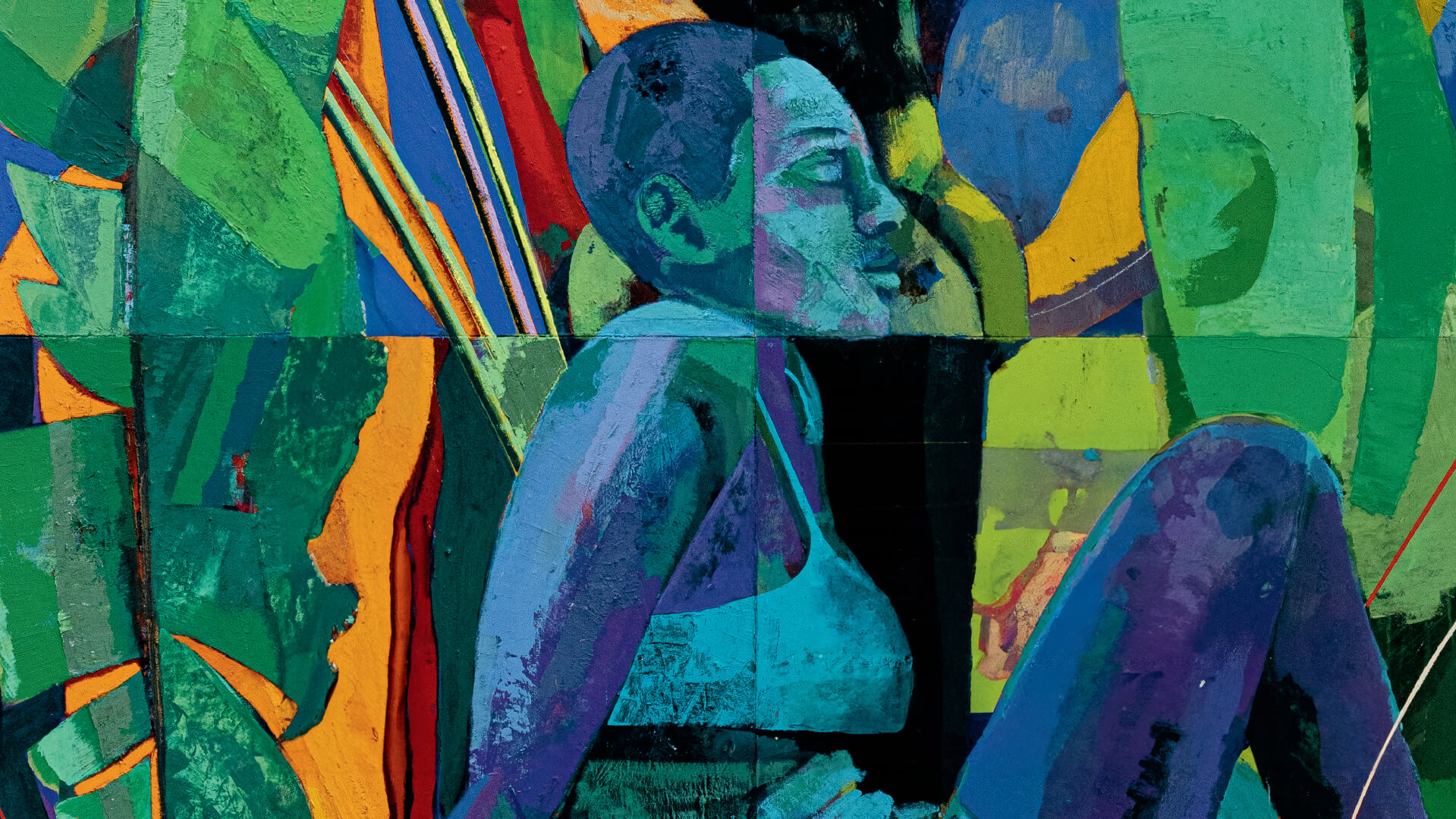
In Design Social Change, author Lesley-Ann Noel offers a roadmap for transforming social norms, structures, and behaviors. The book includes a process guide that lays out all the steps of social change, from building a team to generating ideas and refining prototypes, but also opportunities to look inward, raise critical awareness, and understand the different types of oppression in the world around you. The “Checklist for Equity in the Design Process” is a particularly useful tool for designers to check their assumptions, ensure that they’ve considered all the stakeholders, and think through the consequences of their designs, while “Strategies for Thriving in the Face of Hostility” offers helpful methods for anyone trying to dismantle systems of oppression.
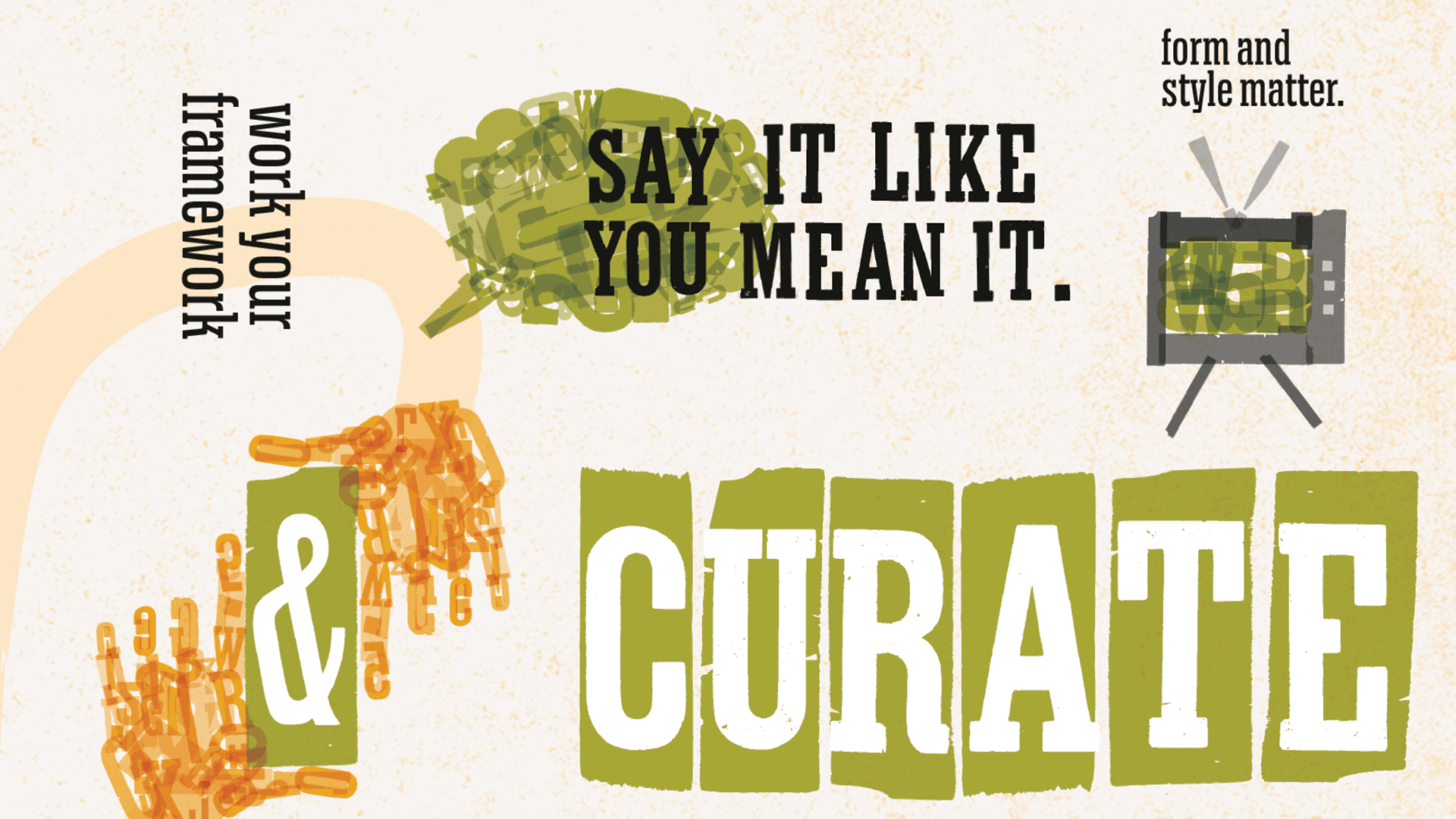
You Need a Manifesto by Charlotte Burgess-Auburn
Why do you need a manifesto, you ask? “In this age, where it seems like everyone is being recruited by everyone else every moment of the day, you need a way to recruit yourself to your own cause, a method for collecting and considering your own power to create and to make positive change in a world that sorely needs it,” writes Charlotte Burgess-Auburn, director of community at the Stanford d.school. What follows is a guide to composing your own manifesto, with recommendations for sources of inspiration and wisdom, thoughts on 21st Century design ethics, and even how to spread the word. Figure out what to say yes and no to, and what you want to go after by following this helpful guide.
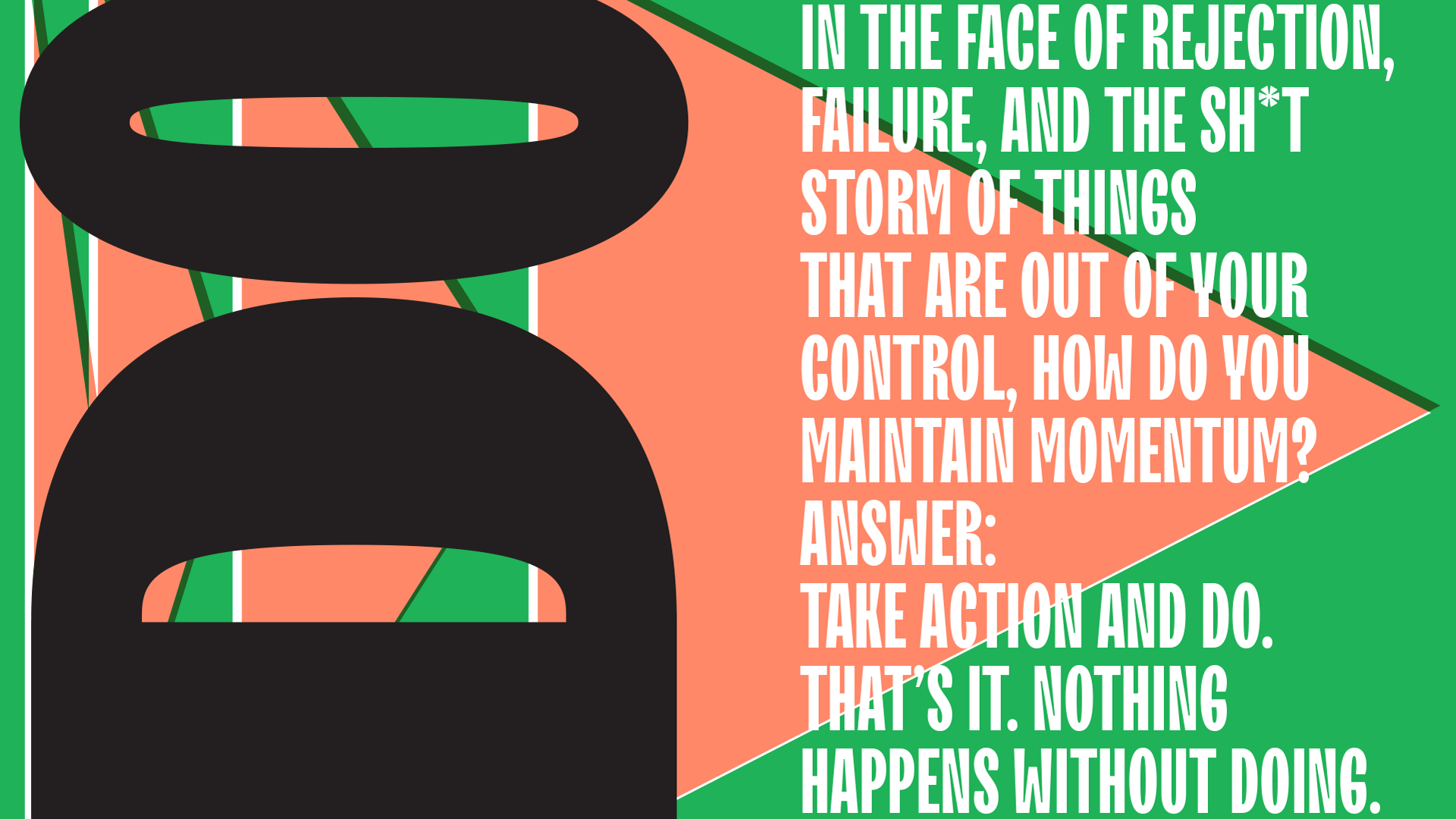
Make Possibilities Happen by Grace Hawthorne
The first page of this book declares it an “operator’s manual for you and your wits!” That includes a long list of activities to help you activate your ideas and creativity, including Duchamp-inspired exercises and visualizations, a guide to focusing on the things in your project you can actually control, and help crafting a pitch of your idea. Both a kick in the pants and a hand to hold, this book is great for folks looking to get their creativity into the world.
The full collection also includes: Drawing on Courage by Ashish Goel; Navigating Ambiguity by Andrea Small and Kelly Schmutte; This Is a Prototype by Scott Witthoft; Creative Hustle by Olatunde Sobomehin and sam seidel; and Experiments in Reflection by Leticia Britos Cavagnaro.
At some point in my career, I shifted from being the guy designing the thing, to the guy building the stage for others to do the work.

Gift guide: IDEO’s favorite things for 2023
Our best ideas for the design-savvy on your list.

To make gifting a little easier, we’ve pulled together a list of IDEOers’ favorite things, from the best pens for drawing to our favorite pottery, and even a superior garbage can. We asked our Play Lab to weigh in on their favorite toys, too. So make your list, check it twice, and take a stroll through our 2023 Gift Guide.
FOR THE CRAFT
Pentel Sign Pens, $8 for a box of 12
Offering amazing ink flow with tips smaller than Sharpies, these pens are one of our designers’ favorite drawing tools.
Culture Hustle: Black 4.0, $49.99
According to the company, it’s the blackest black paint “in the known universe.”
Stanford d.school Book Collection, $128
We’re big fans of this collection of 10 design guide books, which is “designed to help you adapt to change, see things in new ways, work well with others, and peer into our collective future.” Give the whole set, or break them up—You Need a Manifesto is helpful for anyone navigating change, or running their own practice, while Design Social Change is a great guide to meeting the current moment.
Envisioning Emotional Epistemological Information by David Byrne, $98
EEEI not only shows that PowerPoint can be art, it contains one of our designers’ favorite definition of knowledge management
Manufactum Notebooks, $18
These are small enough to fit in a pocket, but with enough pages to last you for months.

FOR THE KIDS ON YOUR LIST
Magformers, $54
The fun, fidgety way these building blocks snap together makes them perfect for kids of all ages to build all sorts of things with—and of course, smash apart! Magna-Tiles may be more popular, but we prefer Magformers with their rounded edges.
Books from Ashay by the Bay
This black-owned bookstore specializes in African-American and multicultural kids books, from baby board books all the way up to novels written for teens. It’s based in Vallejo, California, but ships across the country and to Canada.
Bitzee, $25
This interactive Tamagotchi—like toy with a techie twist includes 15 cute little pets for kids to discover, nurture, evolve, and play with.
COOKEEZ MAKERY Cinnamon Treatz Oven, $51
Mix the ingredients into dough, mold it into a pet, pretend to bake it in the oven, and surprise! Out pops a plush pet. The trick here is finding it—it’s incredibly popular, and comes highly recommended by the Toy Lab.
Twister Air, $15
The one toy on our list that we helped make, Twister Air is an active, digital take on the classic game. Challenge your friends to move their hands and feet to the beat—or play solo! For an app-based game, it’s a great way to get moving.

FOR SOMETHING MORE PERSONAL
Block Shop Textiles, $145-$195
The Southern California textile, art, and design studio run by two sisters has such big fans at IDEO, we actually interviewed them to learn more about their craft. Gift ideas range from a bandana printing kit to beautifully patterned bathrobes.
Monastery Skincare, $48-$293
This brand is a big favorite in IDEO’s skincare lovers’ Slack channel. Fans love it for its beautiful, luxurious texture and scent.
Anecdote Candles, $26-34
An IDEO alum is behind these scented candles that also “spark a conversation.”
Casio Men's Casual Classic Digital Bracelet Watch, $22
Missing the features of a smart watch, sure, but this Casio is a classic favorite that won’t have your emails popping up on your wrist.
Concha Coin Purse, $7
A sweet gift with a sweeter price point, this coin purse would make a great stocking stuffer. But if you’re looking for something bigger, Chicago’s Mestiza focuses on Latinx artisanal products, and ships around the country.

FOR THE KITCHEN
Sichuan Chili Crisp, $17
At this point, Fly By Jing’s perfectly savory, spicy, crispy condiment needs no introduction from us, so consider this a gentle reminder that delicious gifts make the best gifts.
Yes, Chef Gift Box, $46
Thrill fans of The Bear with four of Oaktown Spice Shop’s favorites, vadouvan, urfa biber, umami sea salt, and kampot peppercorns. Bay Areans can visit the store in Oakland or Albany, but it ships across the country, too.
Kinto’s Travel Tumbler, $34
One IDEOer is a big fan of Kinto’s minimalist and refined design aesthetic, and the tumbler in particular, which has held up over the years with just a few dings and dents. “ As a product designer, you really can’t argue with any detail on those products,” he says.
Mill, $33-$45 per month
Composting. Great for the planet, not always great for the smell in our kitchens. Mill is something different, a bin that dehydrates and shrinks your food scraps, and a service that picks them up. One of our designers calls it “life-changing.”

FOR THE HOME
Herringbone Outdoor Scraper Door Mat, $31
This doormat is a serious defender of the cleanliness of your floors, and won’t cause a wood deck to discolor or rot.
Rubbermaid Defenders Step-On Trash Can, $217
If it’s good enough for infectious waste, hopefully it can handle whatever is going on at your house. One IDEOer recommends these garbage cans for their clean, classic lines, robust construction that can handle kids and dogs, and their ability to contain smells.
Daxue Folding Garden Lounge Chairs, $265 for two
Folding chairs aren’t known for their looks, but these wooden numbers have an attractive design, don’t hold water, and are easy for kids to climb on.
East Fork Pottery, $40-$94
The Asheville, N.C.-based ceramics company makes pottery with clays from the American Southeast, crafting everything from mugs and plates to vessels that hold candles. Check out gifts under $100, like a four-pack of bowls in panna cotta, or a mug in Henri’s red.

FOR SOMETHING DIFFERENT
AI Against Humanity, $40
Made by a former IDEOer, this dystopian take on Cards Against Humanity puts the future of the world in your hands. It comes complete with 200 cards of technological turmoil and venture capitalist wild cards. “Get ready for a dystopian deck where Silicon Valley fantasy gets a reality-check.”
Session Bong, $185
IDEO alum Vinh Pho’s Session Goods has created award-winning glass bongs and other smoking essentials for the well-curated home.
Actually Curious Cards, $25
The original version is less a party game than a deck of cards with questions that are designed to spark conversations that help people get to know each other better. Want something more light-hearted? Go for the Happy Hour edition.
Pluto Pillow, $160
Part travel pillow, part sensory deprivation tank, this product IDEO helped design will get you to your destination as well rested as anyone on a plane can be.
Wondering what to get the design-obsessed in your life this holiday season? We’ve been there.

Lindsey Turner
I’m passionate about building brands, products, and experiences that help organizations show up with meaning and momentum.
I help organizations cut through complexity by shaping how they show up, through brand strategy, identity, and storytelling.
Working at the intersection of brand and business, I bring an editorial eye and a bias toward making—turning ideas into tangible experiences that people can understand, trust, and believe in.
My work spans government, healthcare, financial services, media, and consumer goods, from launching Gen Z-focused ventures to building innovation labs and reimagining legacy brands. I relish moments of ambiguity and enjoy translating across teams, perspectives, and priorities to move ideas forward.
I started my career in editorial and digital design, shaping cross-platform experiences and identity systems in publishing and agency environments. That foundation still shapes how I work today: I’m detail-oriented, collaborative, and overreliant on the Oxford comma. I hold a BFA in Visual Communication from the School of the Art Institute of Chicago.

Rachel Young
My work helps organizations see who their products aren't working for—and build the will and the tools to do something about it
For 25 years, I've asked the same question: Who does this design exclude—and what are we going to do about it?
My work spans human-centered strategy, inclusive design, and qualitative research, with clients ranging from Microsoft, Google, and Verizon to the National Science Foundation, and San Francisco Unified School District.
Before IDEO, I taught elementary school in East Palo Alto and spent a decade doing design work with social service organizations—where I learned firsthand what it costs people when systems are built without them in mind.
I am currently writing User Error, a nonfiction book about digital access and the design decisions behind it. I live in Oakland, California.

Brian Pelsoh
I lead with craft, ensuring our work is creatively excellent: rooted in deep human insight and imagination, while also grounded in the realities of business and technology.
My expertise spans brand, communication, and product design across tech, education, the arts, and social impact.
I believe great work demands both high-level vision and obsessive attention to detail, and only happens through collaboration.
I bring an inclusive, hands-on approach and a deep understanding of business, which enables me to consistently deliver excellence while always asking why.
Before joining IDEO, I worked at the brand firms Pentagram and VSA Partners. I began my career as a designer, leading teams at the School of the Art Institute of Chicago and the Milwaukee Art Museum. I hold an MFA in graphic design from Maryland Institute College of Art and a BFA in communication design from the Milwaukee Institute of Art & Design, and have taught at some of the best design schools in the US.

Tony Wong
I am responsible for IDEO’s long-term success in China and working with clients to use design as a tool to enable growth.
I am responsible for IDEO’s long-term success in China and working with clients to use design as a tool to enable growth. Specifically, I have helped Chinese companies design holistic brand solutions through the development of their products, communication, services, and innovation teams, and I have helped multinationals expand their presence and influence in China.
I advise global leaders on developing China-led innovation and capabilities.
In over 15 years in IDEO Shanghai, I have worked on projects that use design to elevate the quality of the experience of healthcare products and services, streamline processes that increase productivity, create spaces and programs that promote and enable inclusive communities, and build next generation mobility solutions that are planet-positive.
Before joining IDEO, I worked at Philips Electronics and the Electrolux Group in Italy, the Netherlands, and Singapore on a number of breakthrough commercial products. I am a member of the Young President Organization in Shanghai.

Building a personal AI for the messiness of life: Sida Li
Most AI products today are built for work—a space with clear problems and established systems. One founder noticed a gap: personal life is messier, harder to systematize, and mostly left behind by the AI boom. So she built Cue, a personal AI that lives inside iMessage and group chats, to go where the other tools haven't.
In this episode, Becca Carroll, IDEO's Chief Strategy Officer, talks with Sida Li, co-founder and CEO of Shared Context Lab, about staying anchored to a human need while the technology around her keeps changing shape, why she treats her business model with the same rigor she'd bring to a product, and what it feels like to build a company at this particular, disorienting moment in AI.
The conversation also gets into how Sida makes design decisions: the language Cue uses to describe itself, the tradeoffs behind building inside iMessage instead of a new app, and a real story about a business idea that didn’t pan out.
This is the second in a two-part series profiling founders from IDEO's Startups-in-Residence program. The first conversation is with Johannes Seemann, founder of Sooner, on designing GenAI for the emotional side of money.

Designing GenAI for the emotional side of money: Johannes Seemann
Most personal financial tools are built to run the numbers and optimize towards a budget. While that works for some, most people experience money as a lived relationship that does not neatly fit into a spreadsheet. Johannes Seemann and Becca Carroll discuss why money is emotional before it is mathematical, and what a human-centered approach to building a generative AI financial product looks like in practice.

The curious leader's edge in uncertainty: Scott Shigeoka
Mina Seetharaman talks with Scott Shigeoka, author of Seek and Head of Curiosity Cultivation at the Eames Institute, about what distinguishes genuinely curious leadership from performative curiosity, how power dynamics shape curiosity, and why practicing curiosity can restore energy rather than drain it.

How constraints make us more creative: David Epstein
Mina Seetharaman talks with David Epstein, author of Inside the Box and Range, about why total freedom often produces average work, how leaders can design useful limits on purpose, and what organizations such as General Magic and Pixar reveal about the relationship between boundaries and creativity.
Looks like you might be in search of something very specific?
Or reset the filters above and try another angle.
Here’s some random inspiration

Podcasts about creative leadership

Articles about the power of prototyping
