
.svg)




Better sales, less waste
H&M transforms its operations to cut excess inventory.
Globally, the European Commission reports, a truckload of textiles heads to landfills or is incinerated every single second.
The fashion industry accounts for some 10 percent of greenhouse gas emissions worldwide.
Less than 1 percent of the materials used to make clothing is recycled, according to a report by the Ellen MacArthur Foundation.
The best way to keep clothes out of a landfill? Don’t make them.
Picture this: Not long ago, it wasn’t unusual for a customer to walk into an H&M store and not be able to find a basic white t-shirt in their size. Why? Like most long-established retail operations, H&M was operating with a push model—placing seasonal bets on what the demand for a given item of clothing might be, locking orders far in advance, and hoping that they were able to sell out. Make a mistake in that kind of model, though, and you can end up with customers unable to find the basics they rely on, or excess inventory you can’t sell. That’s a problem for the business, but for the environment as well—and one that doesn’t fit H&M’s aggressive sustainability goals.
Though H&M had tried to tackle the problem before, the launch of the H&M Group Design Studio, co-created with IDEO, gave the retailer the confidence to go after it again. The team started out by mapping out the complex network of people that make up its supply chain across the globe, meeting with everyone from designers to garment suppliers, logistics managers, and even folks selling the final product in H&M stores.
They then created an algorithm for more precise ordering, as well as a tool that provides a shared view of information. Instead of placing orders, the new automated flow—dubbed “Cruise Control"—allows staff to work with a demand forecast that gives them more time to focus on customer-centric operations, like providing guidance and inspiration. It also makes it easier for H&M to follow the demands of the market, and place much more accurate bets on what consumers will want, when. Already, H&M has significantly increased sales while cutting excess inventory—a result that improves its bottom line, as well as its environmental impact.
Estimates project that by 2030, global apparel consumption will hit 102 million tons.
22%
reduction in stock during a pilot program
34%
increase in sales during a pilot program
Fueling innovation in Boston
How the Boston Society for Architecture is leveraging member expertise to increase its impact.
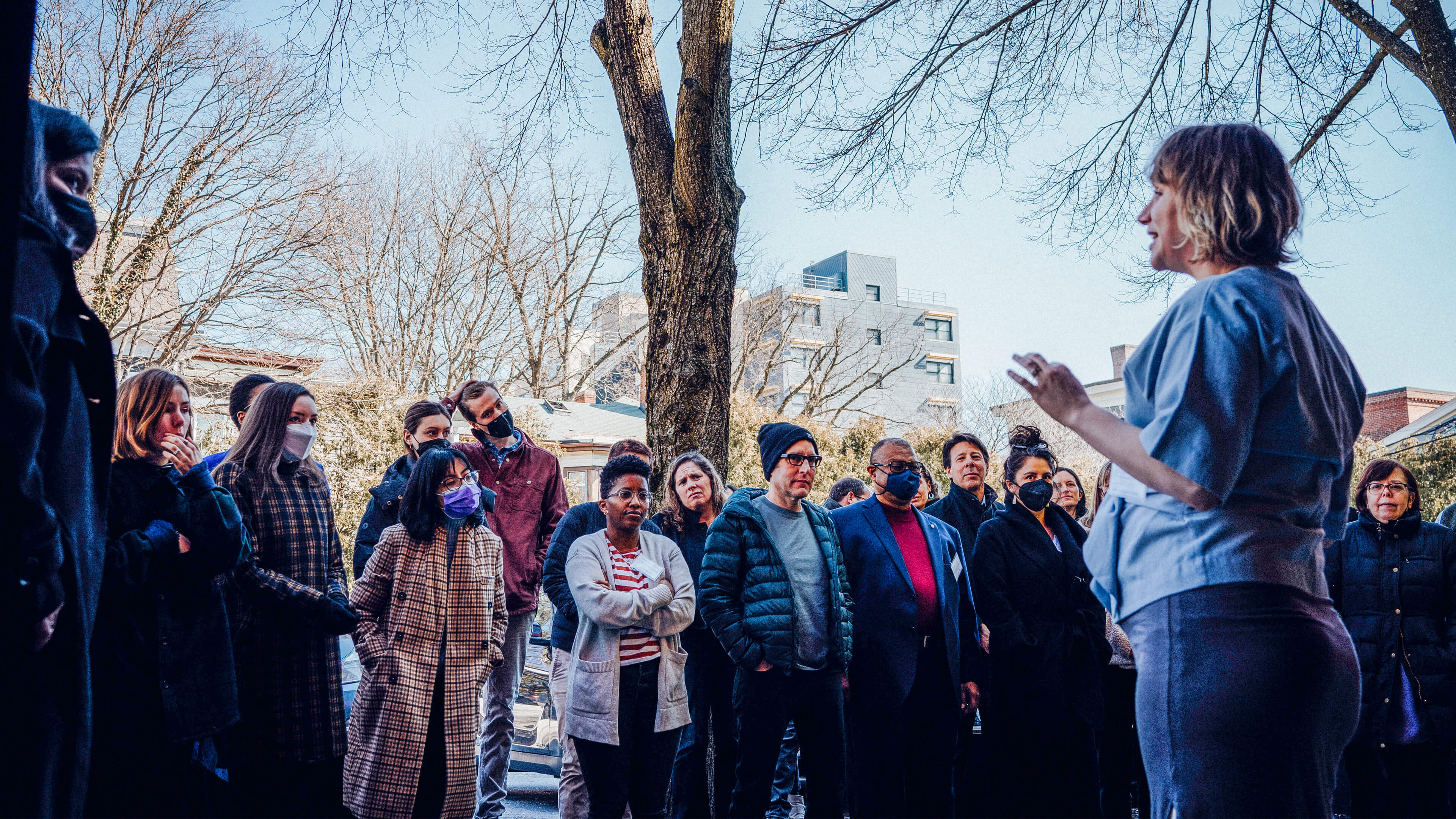
To foster creative projects that spoke to the needs of local communities and environments, the BSA began to engage its members in collaborative, user-led design. The organization launched its first-ever innovation challenge, putting out a call for all members to pitch their ideas for projects in the built environment.
The BSA expected those pitches to have dollar signs attached. To the organizer’s surprise, only one asked for funding. The rest requested less tangible, but equally meaningful support: advice, connections, specific expertise. Those are resources that the BSA has aplenty, but hadn’t learned how to leverage well.
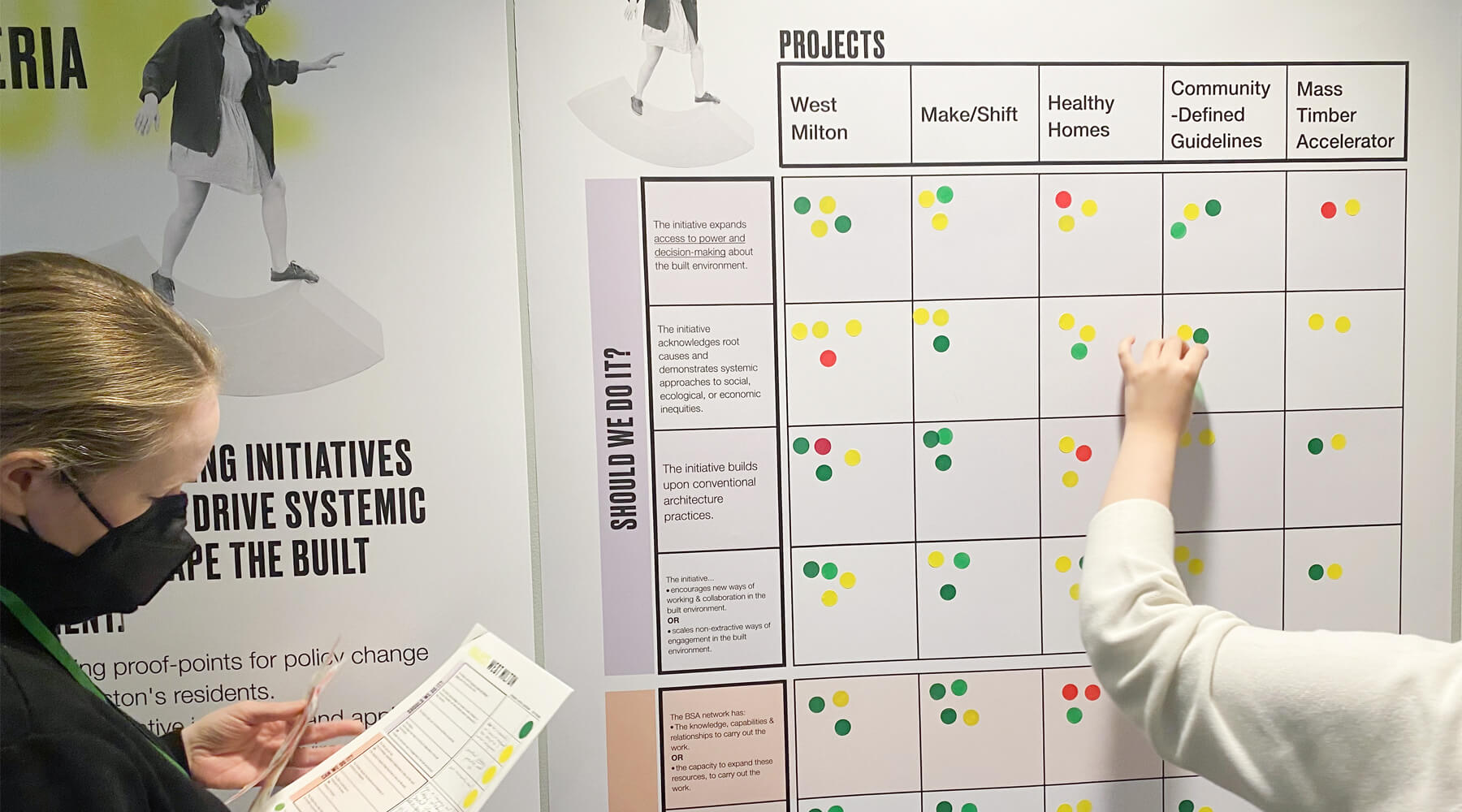
From that first go at an innovation challenge, the BSA learned how to better support its members. It also learned that to lead with purpose and make strategic choices, one must develop the confidence to say no. Instead of spreading itself thin across many projects, the organization decided to take small steps, focusing on one initiative at a time, so that it can deliver focused impact and stay true to its evolving mission.
With 36% of global energy going to buildings and 8% of global emissions caused by cement alone, the architectural community is inextricably intertwined with both the causes and solutions related to climate change.
According to a survey conducted by the AIA, the architecture profession in the US is less diverse than the population as a whole. This lack of diversity can contribute to a disconnect between architects and the communities they serve.
31
submissions received from innovators in the Boston region working on equity and sustainability challenges
5
innovation teams invited to pitch ideas
Student-centered solutions
How an organizational culture change is helping newbies at NYU navigate campus life.
The resources that NYU students needed were organized by administrative department, and buried on disparate websites and calendars. But students don’t think in terms of departments—they just need to know where their classes are.
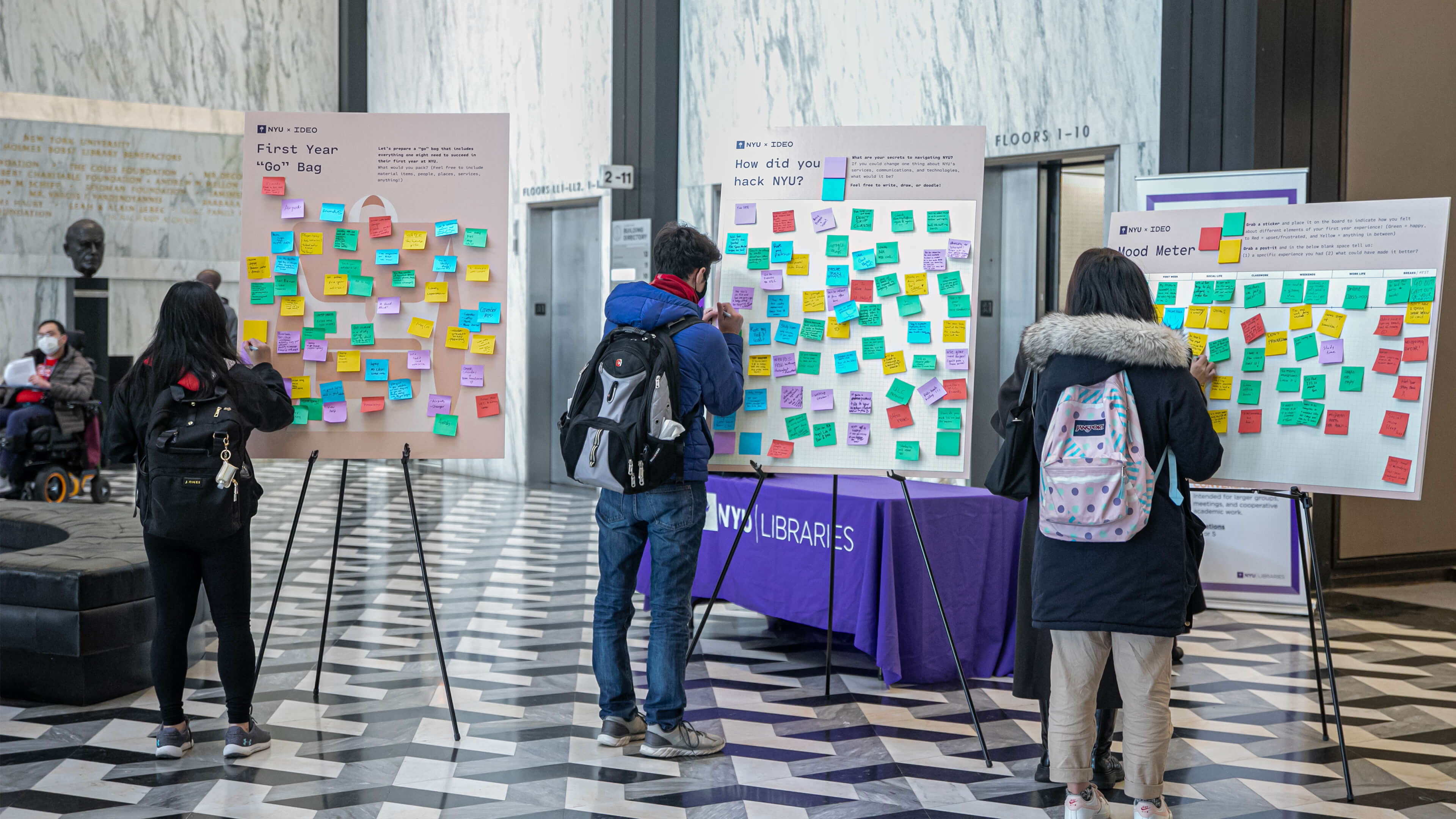
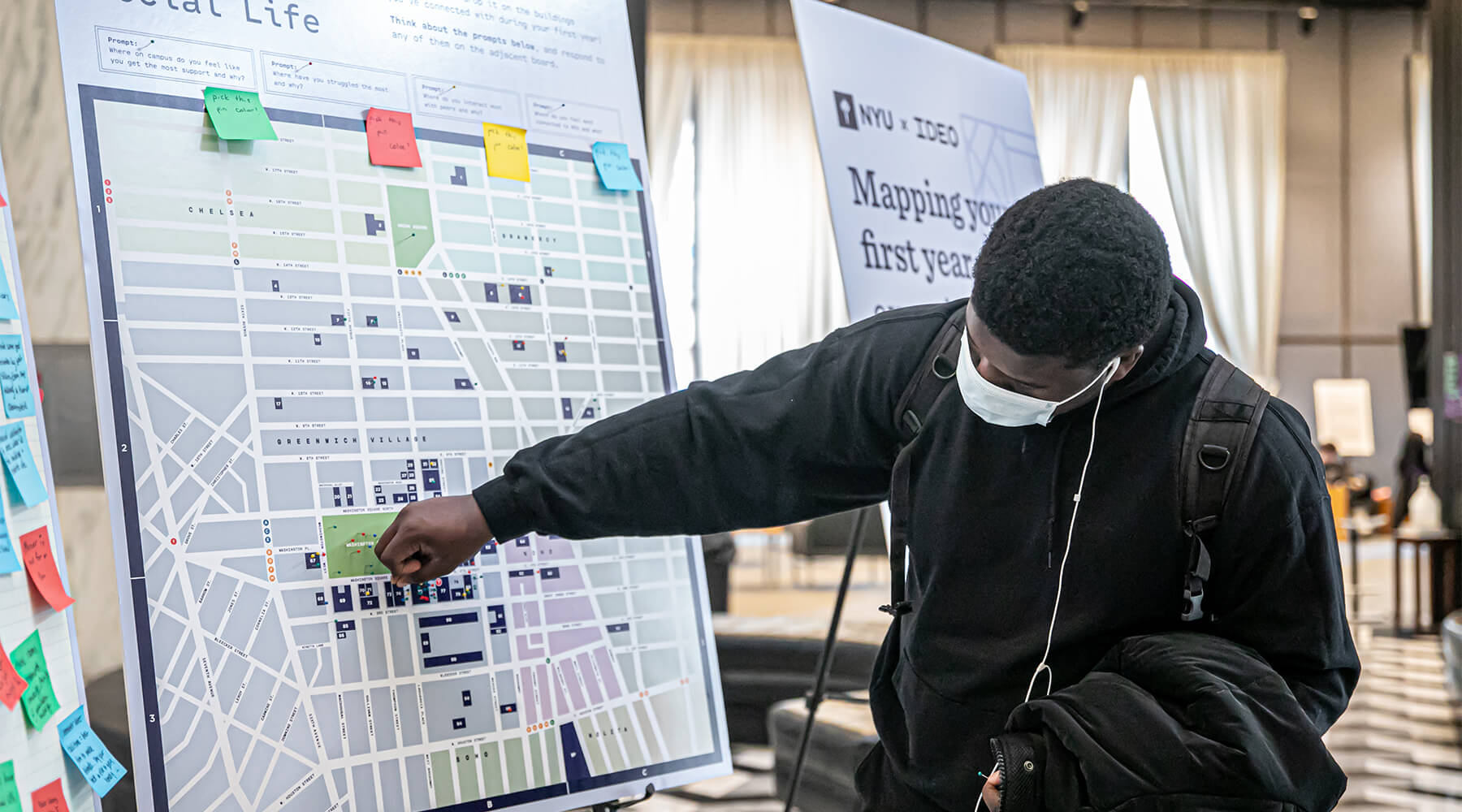
All of this became patently clear as IDEO shadowed students. Team members visited classrooms, walked with them through their days, and hosted pop-ups in highly trafficked areas to get ideas from passersby. That helped the team develop a common understanding of the overall student journey and grounded employees in the key moments that can either make or break a student’s experience. Visualizing their journey helped departments gain a shared understanding of the fractured communications challenge and develop possible solutions.
To synthesize those insights, we formed cross-functional action learning groups, challenging existing practices at the university and coming up with new ways of working. Participants came from a diverse set of departments, including enrollment management, student affairs, marketing and communications, IT, global inclusion, student services, the provost’s office, digital communications, and more. The cohorts sketched early hypotheses and got feedback from faculty, administrators, and students from all of NYU's undergraduate schools to refine initial concepts.
Collaborating with students gave staff a first-hand look at what students were struggling with and a way to engage students directly in addressing those challenges. Just as importantly, there was an overall culture shift at NYU: Administrators started with questions instead of agendas, came together around a table, and reached beyond their job descriptions to meet the needs of students.
First-year students reported receiving hundreds of paper forms, and email from more than 70 unique senders.
NYU needed to offer students the right resources at the right time—and collaborate to serve them as a unified administration.
New services
in-production include centralized calendars, dynamic campus mapping, and customized notifications
Design-thinking cohorts
now support the student experience
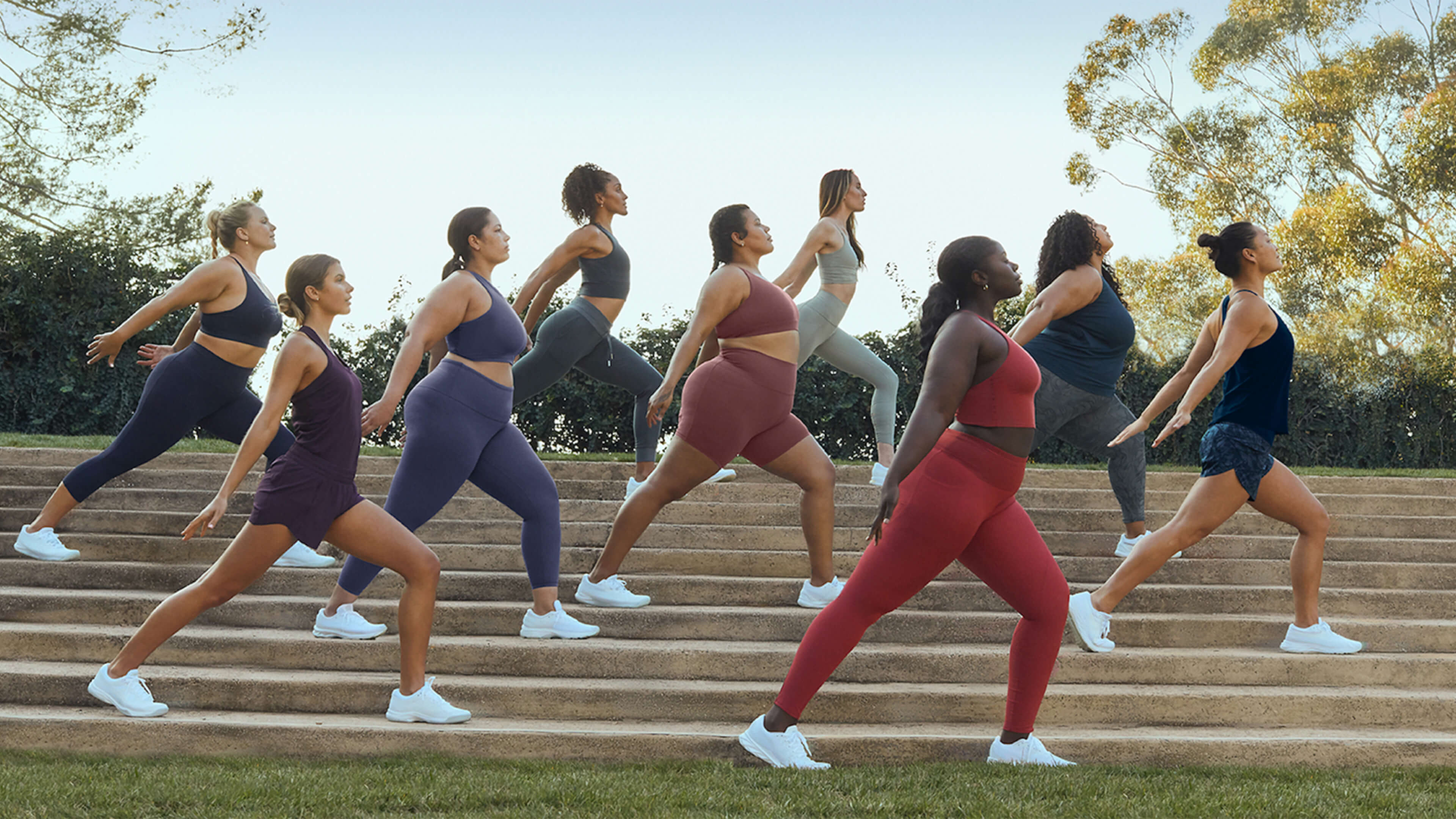
She knows best
A major athleisure brand passes the mic so women can define community for themselves.
Diversity alone isn’t enough—in marketing or any other facet of business. Today’s brands must authentically engage with and create the conditions for co-design with existing communities.
That sort of deep, meaningful engagement with customers doesn’t happen over Instagram. It requires a playbook, a prototype, and a healthy amount of trust. So, IDEO worked with Athleta and Gap to tap into the wisdom of a council of women who represent intersectional identities and lived experiences. The council surfaced powerful insights for the brand, like the fact that active women don’t need a brand to empower them—they already feel powerful.

After only a few weeks, Athleta experienced the difference between research and a truly reciprocal relationship. The way their brand engages with communities is adding depth, understanding, and authenticity to Athleta’s content, products, and experiences. And women can feel the difference.
76% of US adults say that the media promotes an unattainable body image for women.
Fewer than 1 in 10 businesses review for inclusion as part of product design and marketing campaigns.
>2X
user growth in 2022
13,000+
Athleta WellPro well-being providers active on the platform

33 things we’d love to redesign in 2025
From crossing signals to patient portals and oh-so-much more.
As we move through the world in 2025, we have a long list of things we’d love to rethink, if only we had the chance. Here’s what’s risen to the top of our list this year.
PRODUCTS:
1. LED headlights make driving at night painful—and dangerous. Am I getting older and cranky? Yes! But that doesn’t change the fact that headlight brightness has doubled in the past 10 years, and the last time I checked, roads have not gotten darker. There are ways to keep ourselves safe on the road without blinding our fellow travelers.
—Will Notini, Chicago
2. Food storage lids and containers always seem to get separated, leaving mismatched pieces that feel impossible to pair. Containers rarely stack efficiently, taking up more space than they should, and any attempt at maintaining an organized and sustainable system seems destined to fail. How might we redesign everyday kitchen organization to turn common pain points into seamless experiences?
—Sindhura Sonnathi, San Francisco
3. Same. In addition to them getting separated and inefficient stacking, food containers never come out of the dishwasher completely dry. I’m constantly having to dry them with a towel and needing to get in those nooks and crannies to get all of the water out. The glass, ceramic, and metal dishes don’t do this. It’s just a nuisance. Let’s fix it!
—Shavon Gervasi, Cambridge
4. Assuming you’ve figured out what app the show you want to watch is in, you now get the joy of having to scroll through TV interfaces with long, flat horizontal “trays” down long flat horizontal pages. Sometimes there’s a bit of variation (Rectangles! Squares! Larger rectangles and squares!) but it’s easy to get lost, and hard to flip back and forth between things you’re interested in. I don’t miss my cable subscription, but I really do miss some of the things cable figured out how to do well.
—Dan Perkel, San Francisco
5. There must be a better solution than our current umbrellas. They're so inefficient and cumbersome to carry around. I always put off using one until I absolutely can't avoid it, and by that point, it often ends up breaking due to the wind anyway.
—Rita Nicolau, London
6. Many (most?) new cars have all of their radio functionality accessible only via touchscreen, which is 1) dangerous and 2) extremely inconvenient for your passenger DJ. Well-intentioned safety measures block smartphone syncing while the car is in motion (even when a passenger is doing the syncing instead of the driver), and many touchscreens require the user to navigate away from a map app in order to operate the music app or radio. Forcing all functionality to route through a screen is clunky and makes for a poor roadtrip experience.
—Meridith Halsey, Chicago

7. Compostable straws are better for the Earth than plastic straws! But, they get all mushy and disintegrate half-way through your drink. We can make something better.
—Nina Lampert, London
8. Why do white plastic fences exist? They’re a larger version of the white plastic bag. They are not good for the environment, they do not weather well, and you really can’t repair them like you can a wooden fence.
—Christina Abele, Cambridge
9. This might be more of a revival than a redesign, but I’d love to build a version of The Whole Earth Catalog (WEC) updated for 2025. First published in 1968, the original WEC was a compendium of product listings, how-to guides, and educational tools for those in the back-to-the-land movement, shaped by thinkers like Buckminster Fuller. We need a new version of that radical spirit. Whatever form it takes, a new WEC could offer practical resources, forward-thinking education, and hands-on toolkits with an eye toward sustainable living and ecological literacy.
—Beth Holzer, San Francisco
10. For so many people, financial decisions like planning, budgeting, etc., are group decisions—made with roommates, loved ones, spouses (former spouses!), parents, kids, and others. And yet due to a combination of regulations, conventions, and perhaps a bit of laziness, almost every financial product, service, or brand is oriented around a one-to-one relationship that people then have to hack or modify to truly use in a collaborative, group-first way. Does it really have to be this way?
—Dan Perkel, San Francisco
11. Streaming services don’t financially benefit most artists. How can we create more equitable, scalable systems for artists to make living wages?
—Ceci Gomez, San Francisco
12. When I was little we went to the store to buy a dishwasher and the display models all had glass fronts. I came BURSTING in the door to tell my mom that we were getting a dishwasher with a window. The disappointment I felt when it came with a metal front is an understatement. Why don’t they have clear glass doors?
—Molly Rolig, San Francisco
13. Flexible Spending Accounts (FSA) are tax-advantaged accounts that allow employees to set aside pre-tax money to pay for eligible medical expenses. And my bi-yearly dental cleaning is solidly within the eligibility guidelines. However, after every dental cleaning, my FSA provider tracks me down asking for an itemized receipt to “prove” that the visit was covered—even though there’s nothing at the dentist’s office that I can purchase that is outside of that coverage. This doesn’t happen with any other eligible medical expense I incur; how is it still the case that paying for dental care gets constantly flagged as potential fraud? It’s a friction point that makes me not want to deal with FSAs at all. If FSAs are meant to promote preventative care, they should be designed to promote as seamless an experience as possible for the employee.
—Meridith Halsey, Chicago
14. Shower curtains are hard to clean, the metal rusts, the little hooks fall off, they make noise, they are annoying to take down and put back up, and they aren’t easy to change out to suit your mood or time of day. Staying clean while keeping the rest of the bathroom dry could use some innovation.
—Dan Perkel, San Francisco

SYSTEMS:
15. Currently, the shareholder model of corporate governance requires the maximization of shareholder wealth, which has contributed to wage disparity, corporate greed, lowered local tax payments, lack of corporate social accountability, and inappropriate corporate influence on government legislation and policy. This could be redesigned so that, one, shareholder wealth is only a part of the corporate mandate; two, corporate “freedom of speech” is curtailed; three, corporations have less influence over government; and four, corporations contribute more to their local communities and economies.
—Jeremy Sallin, San Francisco
16. In Capitalism, we have a system that is rewarding greed and nonstop growth, while that growth is now killing our planet. Something’s gotta give, y’all.
—Stuart Getty, San Francisco
17. Why are pedestrians, who are the most vulnerable participants in traffic systems, often deprioritized by cities and our infrastructure? Especially here in the U.S. At times when traffic is light (at night, for example), pedestrian crossing signals are red by default, while the signal for main thoroughfare for cars is green. What if all pedestrian crossing had a default state of “cross” instead? Also why do pedestrians need to request the right to pass by pressing a button? I’d want our cities to shift from car-first systems, to people-first and would love traffic lights to lead the way.
—Juho Parviainen, San Francisco
18. Why do I need to install a new medical app on my phone, every time I go see a doctor? Why must every practice have their own portal, their own system, their own login info, and their own interface? Even my doctor sometimes struggles to pull all of the inputs into a single place where they can see everything and give an accurate assessment and advice. How might we streamline the use of patient data into a format that’s truly efficient for physicians and patients alike?
—Shannon Vossler, Chicago
19. As cities face more extreme and frequent heat waves, our built environment is failing to protect residents—especially vulnerable populations like the elderly, outdoor workers, and low-income communities who often lack access to cooling. Temporary cooling centers and emergency response plans are reactive band-aids that don't address systemic issues in heat resilience. Traditional infrastructure (dark pavement, lack of shade, heat-trapping buildings) actively makes the problem worse. The complex interplay between urban design, social equity, and climate science demands innovative thinking beyond just adding more AC units.
—Nazlican Goksu, San Francisco

EXPERIENCES:
20. Meetings are the backbone of how teams align, make decisions, and move work forward—but too often, they’re baaaaad. Unstructured, dominated by a few voices, or overly reliant on agendas that prioritize activities over outcomes. This leads to wasted time, drained energy, and frustrated participants. By applying a designer’s mindset—clarifying objectives, prototyping small changes, and making discussions tangible—meetings can become opportunities for collaboration, alignment, and momentum instead of sources of friction.
—Matt Cooper-Wright, London
21. The behavior we let people get away with under the guise of “the customer is always right” never ceases to shock me. We subject service workers, in-store employees, and more to the worst side of human behavior all because we decided—what?—that paying money at a store lets you say whatever you want to the people who work there? I am a customer of various places, and I am rarely ever right (although you don’t see me screaming about it)! I’d love to see our executive class stick their neck out for their employees, who are their most valuable asset, and set stricter public standards for customers’ treatment of their staff.
—Andy Reischling, Cambridge
22. People used to associate travel with wonder and adventure. Now, people grit their teeth and steel themselves when making their way to and through an airport. Airports should not be malls full of stuff that no one really wants. Instead of having overpriced corner shops, what if we had libraries for books and items? Instead of a mall food court, what if we had places to recharge, refresh, and have a free healthy snack?
—Dave Kim, San Francisco
23. Why is there so much beeping in hospitals? As a patient it is overwhelming. I am impressed that hospital employees can decipher all the beeps, emergency vs. non emergency.
—Christina Abele, Cambridge

24. Commercial flights have been around for about 110 years, and we still have to be there two hours in advance for a flight that is in the air for the same amount of time. The boarding process where you’re forced to stand in an even smaller space for 40 minutes before they open the plane doors deserves a human-centered takeover.
—Justine Syen, London
25. While people come to the emergency department for a whole range of reasons, they tend to have two things in common: they are nervous (for themselves or a loved one) and they have no idea how long they’ll be there. Instead of uncomfortable chairs, a single TV blaring the news on high volume, and a sad nearly-empty vending machine, there are so many opportunities to design an environment that better accommodates the feelings of stress and uncertainty in the air. A little privacy would be nice, too!
—Jen Halls, Cambridge
26. Can we all admit we made a mistake and just get rid of self-checkout? Where I live, in Watertown, MA, there are several stores that have gotten rid of most of their staff in favor of self-checkout machines and, simultaneously, put crucial items (like toothpaste) behind a locked door. Because the store is so understaffed, you might be waiting—and I timed this—15 minutes for someone to come unlock the toothpaste for you. And the machines themselves! We are all human here. We sometimes make mistakes with machinery that we are unfamiliar with. This just slows everything down and we end up calling for help in the end, anyway.
—Andy Reischling, Cambridge
27. Why does renting a car at an airport still feel like traveling back in time to the early ‘90s? Surely we can do better now. I want a better rental experience and 100 percent electric fleet.
—Juho Parviainen, San Francisco
28. There’s nothing like a good road trip. It’s an opportunity to get to know the U.S. and the people you’re traveling with in a new way. Improved ground transportation between cities is associated with greater employment opportunities for working professionals and economic growth for smaller towns. As autonomous and electric vehicle technologies improve, I’d love to design an intercity public transportation service run by electric, autonomous vehicles to promote travel between cities, towns, far-flung national parks, and more in a way that is fun and adventurous while also promoting stronger personal bonds and broader economic growth.
—Natasha Alani, Cambridge
29. With skyrocketing costs for labor and delivery as well as growing concerns around maternity mortality rates (particularly for people of color), it’s time to redesign the end-to-end experience for maternity care! I’d love to explore the rise of maternity care deserts especially in the shadow of recent changes in reproductive policy.
—Diana Tobey, Play Lab
30. There are so many reasons to redesign American elementary education, but ultimately kids need more movement and active learning. There are pockets of teachers that do this. But this doesn’t work for everyone and in my experience as a parent, I see and hear about kids who are not thriving in traditional classrooms. Certainly works for some, but not all, so let’s rethink it.
—Christina Abele, Cambridge
31. There’s so much anxiety, opaqueness, searching, follow-ups, making impossible decisions in the process of finding daycare for children. Why do parents get minimal notice (hours to days) on making day care acceptance decisions when providers can force families to commit thousands to secure spots and provide multiple months notice to leave? The equation doesn’t stack up fairly. How might we design transparent, fair, confidence-building methods to seek, select and find care for our children?
—Uvini Lokuge, San Francisco
32. Why does open enrollment have to be so confusing? I feel like I have to do advanced scenario analyses to compare healthcare plans and still honestly have no idea what my total health costs for the year will be. Can there be fewer options? Fewer acronyms? Some sort of feedback loop to tell you at the end of the year if you made the right enrollment decision?
—Jen Halls, Cambridge
33. I cannot praise our teachers and faculty enough for all they do—but the emails are hard to keep up with. The important information is often buried in the body of the emails, and because they’re often titled something like “week one” or “week two” they’re hard to search. Also—plot twist —some information comes home on a print out and isn’t mirrored in emails, so don’t throw anything away! How can we help redesign school communication so that our beloved teachers can easily share a window into our children's lives that we can keep track of?
—Kristin Boer, Chicago
Need help redesigning a product, system, or experience of your own? Get in touch.
When you spend your life designing products, experiences, and systems, everything you interact with is an invitation to wonder, “what if…”

Your AI questions, answered
The Emerging Tech Lab responds to some of the biggest queries from our Creative Confidence podcast.
Many of our listeners wrote to us sharing their own questions about AI and how it can shape the future, and we wanted to answer them. Jenna Fizel and Savannah Kunovsky, Managing Directors of IDEO’s Emerging Technology Lab, sat down to provide answers.
How can we design for the futures we want to build?
Savannah Kunovsky: The most important thing is to take a step back outside of the hustle of how we are currently creating technology and think about what it is that you really are trying to accomplish. Then, it’s crucial to work alongside people who will be influenced or impacted by it, so that what you’re making is truly beneficial to those people.
Jenna Fizel: The current crop of AI tools are truly about being able to ask the right question in the right way, and you have to be very specific about your intention. I wonder if that new habit that we are all going to have to cultivate might change how we think about the future and how we define our present.
Do you think generative AI will enhance our collaboration, or replace it?
JF: A great question. There's a lot of inherent tension in collaboration, particularly in the way knowledge workers connect today, remotely and across time zones. We're already being pressured to work asynchronously, and that can be really challenging. Sometimes, understanding how to move forward without the input of my colleagues can feel scary or impossible. AI tools do provide the possibility of creative companionship. They offer a way to move forward not just more quickly, but more deeply, if they can take on the perspectives and skill sets of your colleagues. Now, of course, that can also go super wrong. The lack of reliability in a lot of these tools could be catastrophic. But I'm interested in finding ways for these tools to keep us connected even in logistically challenging circumstances.
SK: I hear a lot of people saying, “AI will never replace us,” or “AI is definitely going to replace this thing.” But there's actually just a lot of gray area, including partial automation or augmentation and just an evolution of the work that we are doing. All of that gray area is where I think the majority of our work is going to lie. It’s a much more nuanced conversation.
For the most part, the changes to how we work are not going to happen overnight just because a new tool comes out. Often, the change is actually a lot more gradual. In our practice, it's been incredibly important that we stay on top of new tools and understand how we might use them for our workflows and collaboration.

Can you speak about the relationship between AI usage and the perception of human expression as a key source of value creation?
SK: The ultimate question is, what will there be demand for? Will there be demand for quick-hit creative experiences – i.e. fast food creativity? Will there be demand for hand-crafted, human-made creativity? In my opinion, there always has been and always will be a need for both.
We might see that some lower-barrier forms of creativity become more accessible to more people, and advanced use of AI tools become more of a craft, pulling together multiple types of emerging technologies. So far, that’s the way I’ve seen a lot of artists use emerging technologies, by incorporating them as a new creative and provocative element to what they do.
JF: To me, creativity becomes how you can use and push the tools. The very obvious analogy is the adoption of the camera and photography, which set the groundwork for Impressionism and future versions of less or non-representative art.
But there’s also the creativity of the toolmaker. One of the things that really excites me about very large machine learning models is the design and the math behind how they work—a hugely creative endeavor.
So the idea that creativity is no longer valuable because AI can draw a picture or write a sonnet really sells short the concept of what creativity really is. Creativity is what enabled any of the tools that made those things to come into being to begin with. The idea that you would not value that kind of creativity, and therefore potentially miss out on new forms of technology, seems quite short-sighted. That would be like 25 years ago saying, “Our phones are great. We never need to invest in making new cell phones ever again.” And then none of us would have these small computers that we carry around in our pockets every day.

What can leaders or teams do now to steer their organization towards the AI tools and integration that make sense to them?
JF: One of the key steps is figuring out, what does actually make sense? And trying to do that in a way that isn't motivated by existing processes and power structures. And that's really challenging, right? Because these technologies are seen by a lot of people as a threat to the way that they currently do things—and potentially the way that they make money. And that is not to be dismissed.
So, the question is less about getting people to adopt new processes and tools than, how do we get people to actually see the potential upsides of new processes and tools? It's important to spend quite a bit of time on that question, involving as much of your organization from as many different levels of seniority and technical or non-technical expertise as you can.
SK: Some of our client work has focused on setting really good foundations for experimentation and adoption of new tools. When ChatGPT came out, we saw a lot of business leaders say that because there are big legal and ethical unknowns with it, nobody inside of the organization should use it until we figure out what it is.
We approached it differently, applying our human-centered design process to our own organization. We went to a bunch of different colleagues and asked them how they wanted these tools to fit into their work and what their ethical questions were. And then we created our guidelines. We actually have a full scorecard to help explain, legally, which tools you can use in which part of the design process, and with which types of data to keep everything secure.
We also created ethical frameworks, broadly educated the company on how to use them, and gave people the option to not use AI if they don’t feel ethically aligned. All of this is important, because whether or not you as a leader are proactively supporting the use of these tools, your employees are most definitely using them. And so it's better for you to support the evolution of your business than for you to say no, and then find out that it's happening anyway.

How do you keep up with emerging technology? What sources do you lean on, and how do you discover new trends?
JF: There are a few creators at the lay person level that I really love and that I think are full of value no matter your level of technical expertise: AI for Humans, which is a quite entertaining podcast, and The Neuron. If you want to look a little further into the research end of things, I really like this YouTube channel called Two Minute Papers. It’s focused more on visuals and simulation. There's also the AI hub, newsletter roundup of academic publications. I think it's also really important to keep an eye more broadly on what's happening in science and technology. One of my favorite accessible sources is Sean Carroll's podcast, Mindscape. He has scientists and researchers that span physics, biology, sociology, and philosophy. He features a real diversity of voices that bring up really interesting ideas that are currently in research and may impact our daily lives in the near future.
SK: The one thing that I would add is the thing I’ll get pushback for saying: I would also pay attention to sources that are not experts. These technologies have such potential to have large scale-impact. Lay people also have good, important, valid opinions about where technology might take us and how we've seen things like this play out in the past. So keep paying attention to the trusted sources, but also look around to discover the ways non-experts are using them.
Trying to figure out how to adopt AI tools to create the future of your organization? Get in touch. We’d love to help.
Late last year, IDEO U’s Creative Confidence podcast took a deep dive into the role of human-centered leadership in the age of AI.

Putting purpose into action
Tips on turning the corner from purpose to strategy.
But a purpose statement alone is not enough to guide your brand, organization, or team when you are making day-to-day decisions. You need a strategy to define your future and the path to get there.
Too often, we see organizations work tirelessly to fine-tune a single, perfect purpose statement, only to discover that when they roll it out, their teams don’t understand the choices necessary to fulfill the newly-minted purpose. Or, they jump straight from a lofty purpose into the nuts and bolts of annual planning and resource allocation without aligning on the key tenets that will direct their future.
Strategy is this essential middle step that gives purpose clarity, direction, and intention. If purpose is your grand, evergreen, motivating inspiration, your strategy is what helps you make daily decisions in service of that purpose. In other words, if purpose is your North Star, strategy is the trail up the mountain that gets you closer and closer to reaching it.
Whether you’re adjusting your strategy in response to a new purpose, or aligning a new strategy with your existing purpose, a design-led approach clarifies choices, increases stakeholder buy-in, and reveals opportunities. Here are three tips to help you get started:

Co-create to surface organizational wisdom
When you’re engaging stakeholders across the organization to help bring your purpose to life in strategy, it’s critical to adopt a mindset of exploration and empathy. How are teams already living this purpose? What choices are colleagues already making that exemplify this purpose? How might this new purpose align with employees’ own goals and aspirations, and how could it help to fully unlock their collective potential? By engaging in collaborative interviews and co-design early and often, you’re tapping into existing internal wisdom and building connections that aid the adoption of the new strategy.
Recently, we collaborated with the leadership of an education organization to craft an innovation strategy. A new generation of senior leaders were excited about exploring opportunities for growth, while other leaders feared a new strategy would stray from their founder’s purpose. So, we took a three-pronged approach: First, we sat down with individual leaders to hear different perspectives, aspirations, and tensions. Then, we gathered the whole leadership group for a series of structured workshops. Each session started by reading the purpose statement, and using it as a guidepost for brainstorming and evaluating strategic directions. Finally, we enlisted small teams of executives to build, test, and iterate key elements of the strategy. By doing all three, we were able to help build equity that made it possible to implement the new strategy.

Evaluate the choices you made under your old strategy
Before you craft a new strategy, articulate the existing strategy using a framework like Roger Martin’s Playing To Win cascade. Looking at your organization’s past and present, think about when and where your organization has placed bets on a new market, audience, or offer. How have you historically created an advantage with your customers, and against your competitors? Then, with your new purpose in hand, re-examine these choices: What is aligned or misaligned? What is sustainable and what is vulnerable to growing competition?
We used this method when we were working with a specialty products conglomerate, helping them develop a purpose and strategy to embrace the needs of the climate era. This was a big undertaking that took several years of close collaboration across business units and executive leadership. To kick things off, and help everyone understand the status quo, we gave leaders 10 minutes, a blank Playing To Win cascade and a pen, and asked them to write down the major choices the company had made to get them to where they are today. Then we held a group discussion, assessing which parts of their current strategy and portfolio most aligned with their new climate-forward purpose—and which fell short. This exercise quickly exposed what needed to change and revealed new opportunities for the company to embrace its climate commitments, invest in its future growth, and live up to its purpose.

Visualize future possibilities to test your strategic choices
IDEO COO Jennifer Riel often says, “The best way to face the future is to create it.” Start by trying to tease apart the ramifications of potential choices by creating stories of the future: quasi-fictional scenarios of short-term and long-term success where your organization is truly living its purpose. If you invest your time and effort in different places, what are potential growth trajectories your company might take? What are you seeing in the market or industry that you might need to adapt to overcome? What trends inside (or outside) your organization might continue to grow, and what transformational power might they have on your future?
When we were helping an international pharmaceutical company unify its many divisions under a single, focused purpose, we needed to illustrate the potential outcomes of different choices. So, our team crafted four different stories of the future, each focused on a different strategic bet. What if they decided to double-down on new drug discovery—what might the next five years look like? What if they chose to go all-in on a single area of historic expertise? By looking across the four different potential futures, their senior leadership was able to compare and contrast, discussing what felt most feasible, inspiring, and aligned to their purpose, leading to a single future they were excited to build together.
Purpose and strategy have to work hand-in-hand. One without the other could lead to stagnation or confused paralysis across the organization. Together, they offer inspiration, intention, and a clear path to tangible choices.
Congratulations! You have a purpose statement—or something kinda-sorta-close, you think.

Calling for brave leadership in the climate era
It’s time to design new courageous futures.
Most captains today are choosing to rearrange the deck chairs, and draft strongly worded memos about maritime safety. Meanwhile, the iceberg looms.
Let's be clear: Changing course isn't easy. The crew is comfortable with their routines, the shareholders expect their smooth-sailing dividends, and frankly, it's hard to be the captain who ruins dinner. But we know what happens to ships that prioritize temporary comfort over necessary action.
The environmental challenges we face—from biodiversity collapse to climate injustice—aren't distant threats on the horizon anymore. They're here; we are living it. Yet in many boardrooms across the globe, the response remains painfully predictable: another strategy document, another net-zero pledge, another set of targets conveniently set for 2030, 2050, and beyond.
Yes, we have global treaties in place. Yes, we have ESG goals. And yes, humankind has the technological prowess to get us to net zero. But let's face it—what's holding us back isn't a lack of solutions. It's a lack of decisions. Decisions that can only come from bold, brave leaders.
We need leaders daring enough to plot an entirely new course, challenge the fundamental assumptions of modern business, and pioneer ways of creating value that serve both planet and profit. We need leaders who have the courage to turn the ship now, even if they are the first captain to break formation.
An uncomfortable truth
Today, most sustainability initiatives fail not because of a lack of technology or resources, but because of leadership paralysis. We're witnessing three critical traps that keep organizations stuck.
The first is the quarterly trap, where even well-intentioned leaders find themselves caught between climate commitments and earnings expectations. Watch any earnings call, and you'll hear the tension: ambitious sustainability goals carefully balanced against short-term financial targets. It's like trying to change course while keeping everyone's champagne glasses from spilling; this balancing act keeps us frozen in place.
Then there's innovation theater, where organizations launch sustainability programs that look transformative, but stop short of making fundamental change. The bottled water industry is a perfect example; it highlights recycled plastic bottles and "eco-friendly" packaging, but doesn't address the fundamental waste of bottling and shipping water globally when most developed nations have clean tap water. It's like tying down those deck chairs while avoiding the bigger conversation.
Finally, there's delegation delusion. Over the past year, I've met dozens of brilliant CSOs with ambitious plans, but sustainability can't be delegated to a department, no matter how capable its leader. Imagine trying to digitally transform a company by creating a "digital department," while everyone else works on paper. Real transformation requires sustainability to be woven into every decision, from the boardroom to the factory floor.

The new leadership imperative
Despite all these traps, change is happening. There are brave leaders out there—few, but growing—who are making incredible impact. At IDEO, we're fortunate to partner, work, and be friends with some of these pioneers, and I've noticed distinct patterns in how they lead. Here's what brave climate leadership looks like:
1. Embracing discomfort
When Allbirds stamped all of its products with their carbon footprint—like a nutrition label for the planet—the company made their environmental impact as visible as their price tag. This radical transparency forced the company to completely rethink its design and manufacturing, leading to the world's first carbon-negative EVA foam in footwear. And Allbirds didn't stop there. The company open-sourced its carbon footprint tools to other companies, making it possible for other companies to share their impact.
2. Reinventing the core business
Recently, I sat down with a leader from a world-leading consumer technology company who told me, "The future I see looks nothing like our current product line. And I'm ready to build that future, even if it means dismantling what drives our profits today." This willingness to reimagine the company’s foundation extends to how it operates. Smart leaders are putting sustainability targets on equal footing with financial ones in executive compensation—because real change happens when missing a climate goal hurts as much as missing a profit target.
3. Creating better products that happen to be sustainable
Method's concentrated cleaning products show how sustainability can drive innovation. By removing the water (which consumers have at home, anyway), the company created products that save money through reduced shipping and storage costs, while simultaneously cutting carbon emissions from transportation and using less packaging material. Customers choose their products because they're simply better, and they happen to use less water and plastic. There’s no compromise—only added benefit.
4. Making bold bets on the future
Let's be honest—it's daunting to reinvent an entire supply chain or revamp your existing infrastructure to become sustainable . But when CVS Health, Target, and Walmart decided to create the "Beyond the Bag" challenge, aimed at eliminating plastic bags, they showed the entire retail industry what's possible. But taking bold bets isn't just about changing your own operations. Over the past years, I've met incredible young female leaders like Dr. Anne Schauer-Gimenez from Mango Materials and Julia Marsh from Sway, who are revolutionizing how we think about materials. Smart leaders aren't waiting for these solutions to be proven at scale—they're actively investing in and scaling them themselves. Because one day soon, the choice won't be whether to change, but whether you still can.
5. Having fun doing It
Look at Rewiring America's approach to electrification. Instead of another doom-and-gloom climate message or boring, beige-colored Times New Roman ESG reports, they're making home electrification feel electric. Their tools—including an easy-to-use calculator and a personal electrification planner—don't just show carbon savings—they show families how much money they'll save by switching to heat pumps and induction stoves. When I recently connected with their VP of Product Tom Mercer, his energy about electrifying millions of low-income houses was contagious. And it's no accident that the company's head of marketing cofounded Upworthy and served as managing editor of The Onion—this fresh perspective brings wit and humor to what could be a dry technical topic. Sometimes saving the planet is fun.
6. Listen to customers—for real
As a design director at IDEO, I spend countless hours supporting our design teams in research sessions, listening to people talk about their everyday choices. And let me tell you—the narrative that "people don't care about sustainability" is not just wrong, it's dangerous business thinking. The next generation isn't just asking for better options—they're demanding them. They're reading labels, questioning materials, and calling out greenwashing on social media. Deloitte's 2024 research shows 64 percent of Gen Z will pay more for sustainable products, and 25 percent have cut ties with businesses over unsustainable practices. This isn't about a small group of eco-warriors anymore—this is mainstream consumer behavior shifting before our eyes. Miss these signals, and you'll miss the future of your market. Just ask the fashion brands being called out daily on social media, or the consumer goods companies watching their market share shift to sustainable alternatives.

The real work starts now
It's inspiring to hear about startups and innovators blazing new trails. But the real challenge—and opportunity—lies in transforming century-old organizations. We don't need more sustainability strategies. We need leaders from every industry to become the brave new captains of the climate era
The climate crisis offers a stark choice for leaders: Be brave enough to transform your organization now, or watch it become irrelevant in a world that's already changing. At IDEO, we're energized by leaders ready to make this transformation. If you're ready to design solutions that will define the next era of business, we'd love to work with you to bring that vision to life. Let's create meaningful change together.
Imagine you're the captain of a massive ship. You've spotted dangerous waters ahead, but changing course means disrupting your passengers' champagne dinner.

Lindsey Turner
I’m passionate about building brands, products, and experiences that help organizations show up with meaning and momentum.
I help organizations cut through complexity by shaping how they show up, through brand strategy, identity, and storytelling.
Working at the intersection of brand and business, I bring an editorial eye and a bias toward making—turning ideas into tangible experiences that people can understand, trust, and believe in.
My work spans government, healthcare, financial services, media, and consumer goods, from launching Gen Z-focused ventures to building innovation labs and reimagining legacy brands. I relish moments of ambiguity and enjoy translating across teams, perspectives, and priorities to move ideas forward.
I started my career in editorial and digital design, shaping cross-platform experiences and identity systems in publishing and agency environments. That foundation still shapes how I work today: I’m detail-oriented, collaborative, and overreliant on the Oxford comma. I hold a BFA in Visual Communication from the School of the Art Institute of Chicago.

Rachel Young
My work helps organizations see who their products aren't working for—and build the will and the tools to do something about it
For 25 years, I've asked the same question: Who does this design exclude—and what are we going to do about it?
My work spans human-centered strategy, inclusive design, and qualitative research, with clients ranging from Microsoft, Google, and Verizon to the National Science Foundation, and San Francisco Unified School District.
Before IDEO, I taught elementary school in East Palo Alto and spent a decade doing design work with social service organizations—where I learned firsthand what it costs people when systems are built without them in mind.
I am currently writing User Error, a nonfiction book about digital access and the design decisions behind it. I live in Oakland, California.

Brian Pelsoh
I lead with craft, ensuring our work is creatively excellent: rooted in deep human insight and imagination, while also grounded in the realities of business and technology.
My expertise spans brand, communication, and product design across tech, education, the arts, and social impact.
I believe great work demands both high-level vision and obsessive attention to detail, and only happens through collaboration.
I bring an inclusive, hands-on approach and a deep understanding of business, which enables me to consistently deliver excellence while always asking why.
Before joining IDEO, I worked at the brand firms Pentagram and VSA Partners. I began my career as a designer, leading teams at the School of the Art Institute of Chicago and the Milwaukee Art Museum. I hold an MFA in graphic design from Maryland Institute College of Art and a BFA in communication design from the Milwaukee Institute of Art & Design, and have taught at some of the best design schools in the US.

Tony Wong
I am responsible for IDEO’s long-term success in China and working with clients to use design as a tool to enable growth.
I am responsible for IDEO’s long-term success in China and working with clients to use design as a tool to enable growth. Specifically, I have helped Chinese companies design holistic brand solutions through the development of their products, communication, services, and innovation teams, and I have helped multinationals expand their presence and influence in China.
I advise global leaders on developing China-led innovation and capabilities.
In over 15 years in IDEO Shanghai, I have worked on projects that use design to elevate the quality of the experience of healthcare products and services, streamline processes that increase productivity, create spaces and programs that promote and enable inclusive communities, and build next generation mobility solutions that are planet-positive.
Before joining IDEO, I worked at Philips Electronics and the Electrolux Group in Italy, the Netherlands, and Singapore on a number of breakthrough commercial products. I am a member of the Young President Organization in Shanghai.

Building a personal AI for the messiness of life: Sida Li
Most AI products today are built for work—a space with clear problems and established systems. One founder noticed a gap: personal life is messier, harder to systematize, and mostly left behind by the AI boom. So she built Cue, a personal AI that lives inside iMessage and group chats, to go where the other tools haven't.
In this episode, Becca Carroll, IDEO's Chief Strategy Officer, talks with Sida Li, co-founder and CEO of Shared Context Lab, about staying anchored to a human need while the technology around her keeps changing shape, why she treats her business model with the same rigor she'd bring to a product, and what it feels like to build a company at this particular, disorienting moment in AI.
The conversation also gets into how Sida makes design decisions: the language Cue uses to describe itself, the tradeoffs behind building inside iMessage instead of a new app, and a real story about a business idea that didn’t pan out.
This is the second in a two-part series profiling founders from IDEO's Startups-in-Residence program. The first conversation is with Johannes Seemann, founder of Sooner, on designing GenAI for the emotional side of money.

Designing GenAI for the emotional side of money: Johannes Seemann
Most personal financial tools are built to run the numbers and optimize towards a budget. While that works for some, most people experience money as a lived relationship that does not neatly fit into a spreadsheet. Johannes Seemann and Becca Carroll discuss why money is emotional before it is mathematical, and what a human-centered approach to building a generative AI financial product looks like in practice.

The curious leader's edge in uncertainty: Scott Shigeoka
Mina Seetharaman talks with Scott Shigeoka, author of Seek and Head of Curiosity Cultivation at the Eames Institute, about what distinguishes genuinely curious leadership from performative curiosity, how power dynamics shape curiosity, and why practicing curiosity can restore energy rather than drain it.

How constraints make us more creative: David Epstein
Mina Seetharaman talks with David Epstein, author of Inside the Box and Range, about why total freedom often produces average work, how leaders can design useful limits on purpose, and what organizations such as General Magic and Pixar reveal about the relationship between boundaries and creativity.
Looks like you might be in search of something very specific?
Or reset the filters above and try another angle.
Here’s some random inspiration

Podcasts about creative leadership

Articles about the power of prototyping
