
.svg)




Using design thinking to create a better car
A legacy car brand embraces design thinking and collaboration to develop the luxury crossover Lincoln MKC.
Designing a new car takes years and requires strong collaboration between thousands of people. So when the Lincoln Motor Company began developing the luxury crossover Lincoln MKC, they invited IDEO to share key design-thinking methods to employees and departments to improve the process and to land on a better product.
IDEO built a pop-up studio inside an old manufacturing bay at the company’s Dearborn, Michigan, headquarters, and organized a collaboration between IDEO designers-in-residence and Lincoln employees from different departments. During the six-month collaboration, the IDEO team built a full-scale interactive car prototype to make various in- and out-of-car experiences tangible, and collected user feedback along the way. And they shared key design-thinking methods, which helped galvanize action across different teams, and sped up understanding of design thinking.
The MKC is credited with helping the Lincoln brand outpace growth in the luxury segment by more than two-to-one over competitors. Next up is turning the heads of luxury customers in China, where Lincoln plans to open 60 stores in 50 cities by 2016.
"By bringing together all our key internal stakeholders, the MKC meets and exceeds customer expectation," said Scott Tobin, Director, Lincoln Product Development.
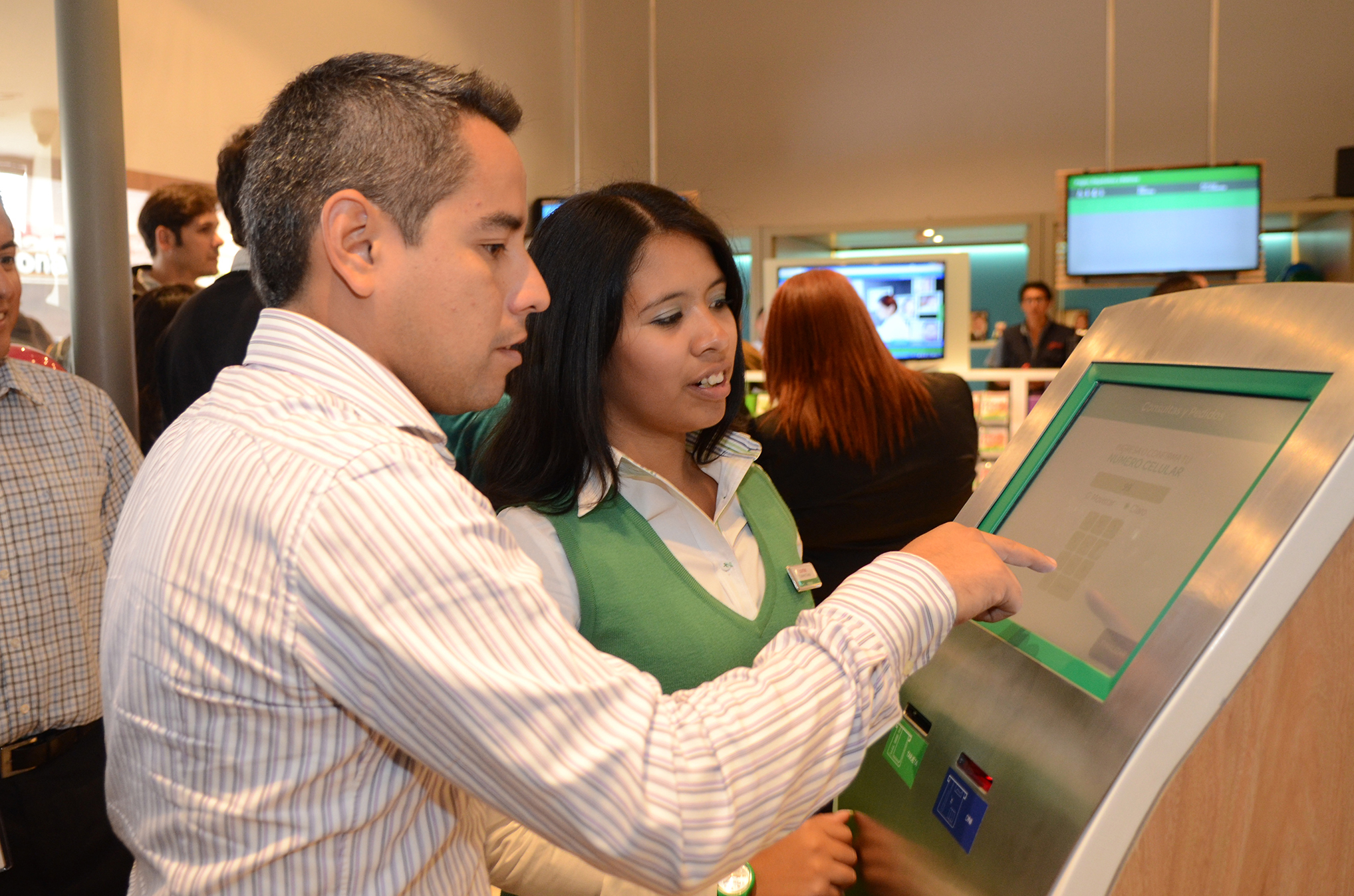
Transforming the banking experience
A Peruvian bank creates a more welcoming environment for customers.
Despite recent advances in Peru's banking infrastructure, the Peruvian public remains largely disengaged with its country’s banks. About 75 to 80 percent of the population lacks a bank account, preferring to safeguard cash at home versus entrust it to any institution. This represents a huge challenge—and opportunity—for Interbank, one of Peru’s largest financial-services firms.
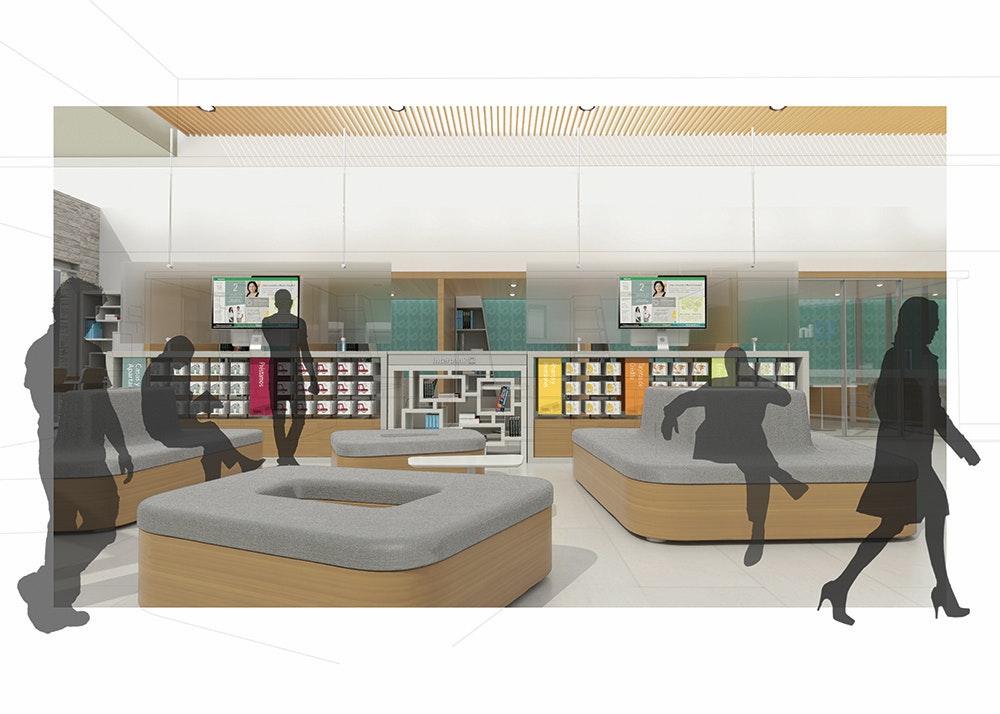
Interbank and IDEO designed a customer experience that would differentiate the Interbank brand and capture a larger share of market. The result, an experimental space called Interbank Explora, is intended to serve as an “innovation lab,” where the company can continue to try the most advanced financial service offerings and get feedback from clients.
This fun and expressive environment—designed for customers, with customers—provides a sharp contrast to competing banks in Peru, which tend to be sterile, formal places that look like hospitals and have long lines. In its initial 60 days of operation, Explora exceeded expectations: Sales more than doubled overall, customer satisfaction rates improved from 33 to 84 percent, and profitability grew, including a 138 percent gain in non-interest-income activities.
The next-generation hotel experience
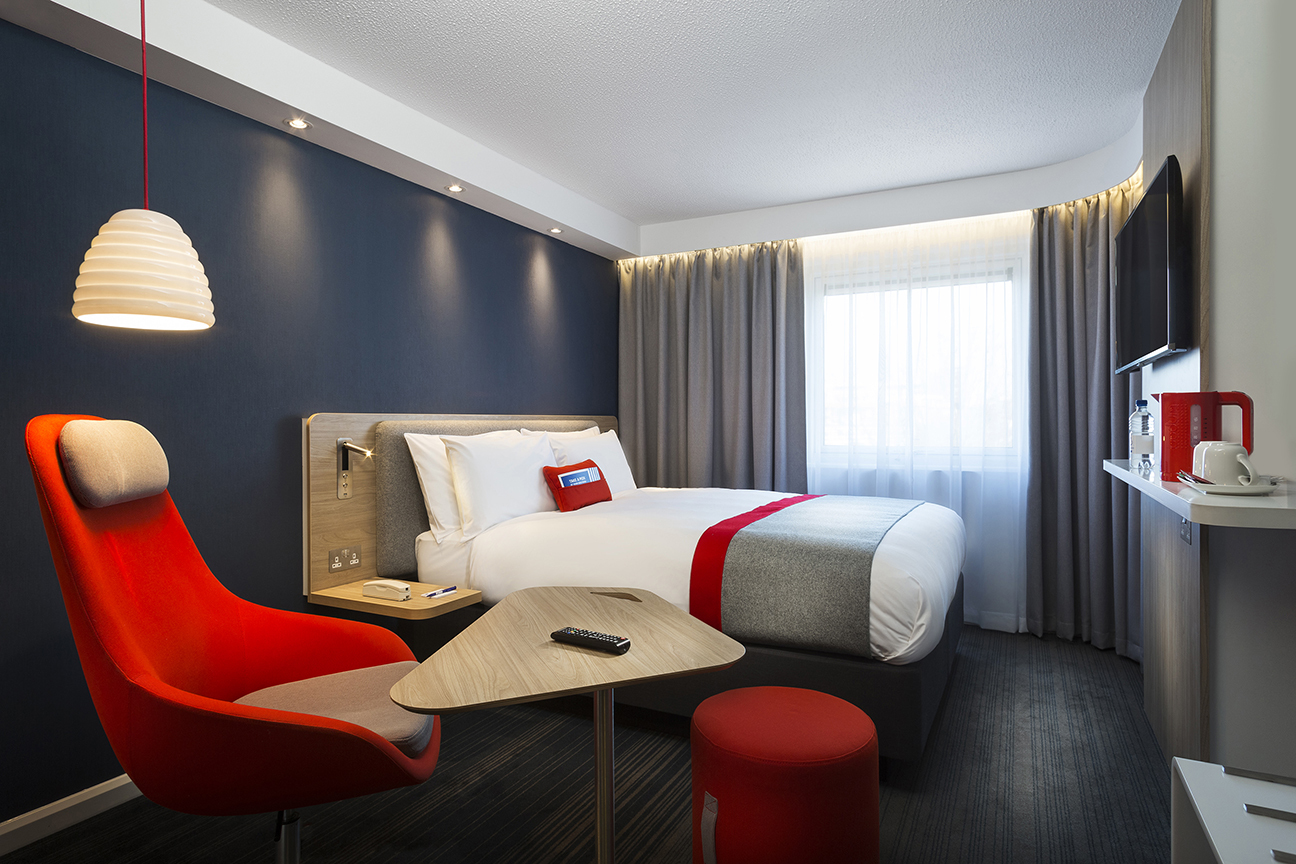
Getting the details right to improve travelers' stays.
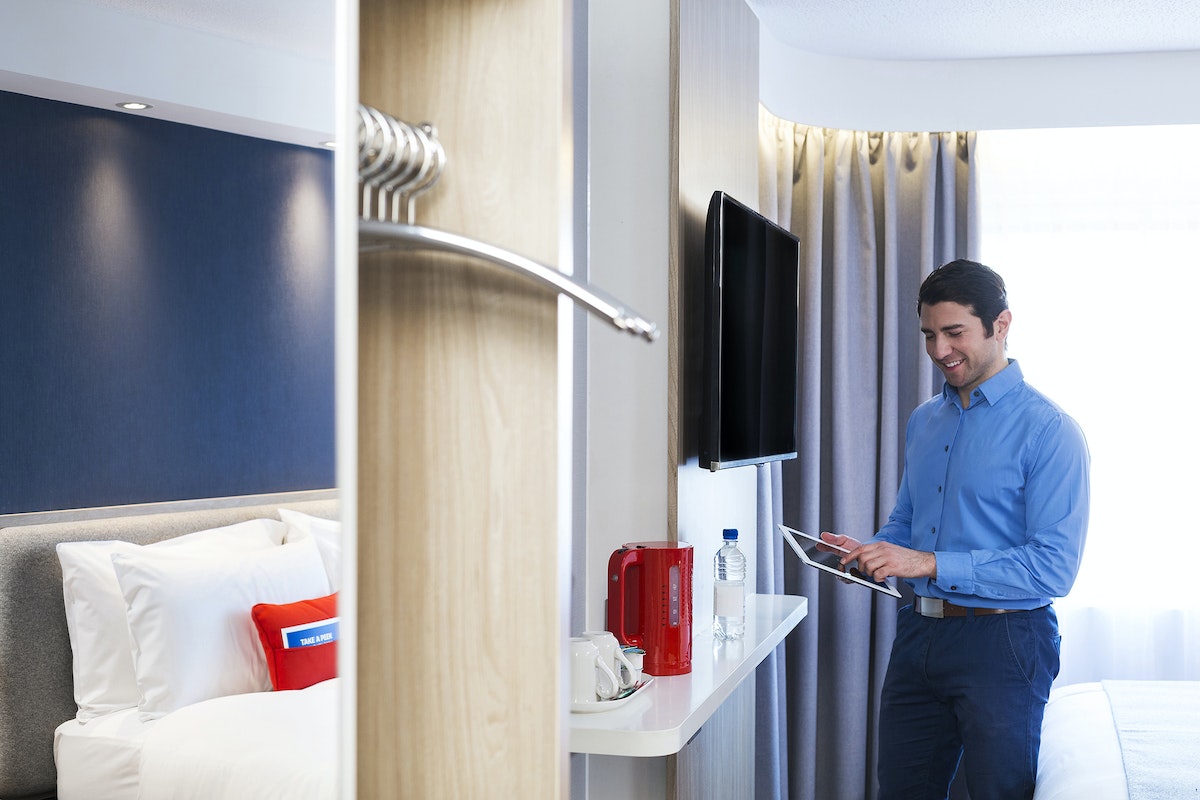
Whether it’s the receptionist’s smile at check-in, the tasty snack at the bar, the thoughtfully designed lobby, or an easy-to-use mobile app, a hotel is no longer just a place to sleep—every detail plays a part in how much customers enjoy their stay.
Multinational hotel company IHG asked IDEO to help revamp its Holiday Inn Express brand in Europe—everything from public spaces to food and beverage, digital, and guest room interiors. Through their research, designers learned that the brand’s guests are independent and value-conscious, and appreciate a human touch. And yes, they prize good design.
Designers created a series of principles that informed every part of the hotel chain’s next-generation experience—things like a to-go concept for breakfast, an easy way for guests to stream their own media through their room’s TV, and assigned quiet floors for business-weary travelers.
As IHG rolls out the next-generation guest experience in the UK and across Europe, smart travelers can expect to check in to a high-touch, well-designed hotel.
“A hotel room is no longer just a place to sleep. This investment in guest insight and innovation is enabling us to stay ahead of the game,” said Mike Greenup, Vice President, Brand Management, Holiday Inn Brand Family, Europe.
This startup revolutionized an industry through design
Launching a nationwide venture that redefines and simplifies how customers engage with their pharmacy.
Dealing with medication can often be a bigger pain than the ailment itself. Standing in long lines at the pharmacy, keeping up with expiration dates, making sure you take this medicine with food and that one on an empty stomach—it can be overwhelming.
An online pharmacy called PillPack had a mission to make it easier. PillPack worked to build a prescription home-delivery system that takes the pain out of the whole process. The venture brought their business to IDEO’s Cambridge office as a startup-in-residence, and worked with designers to fine-tune their offer and showcase it to the world.
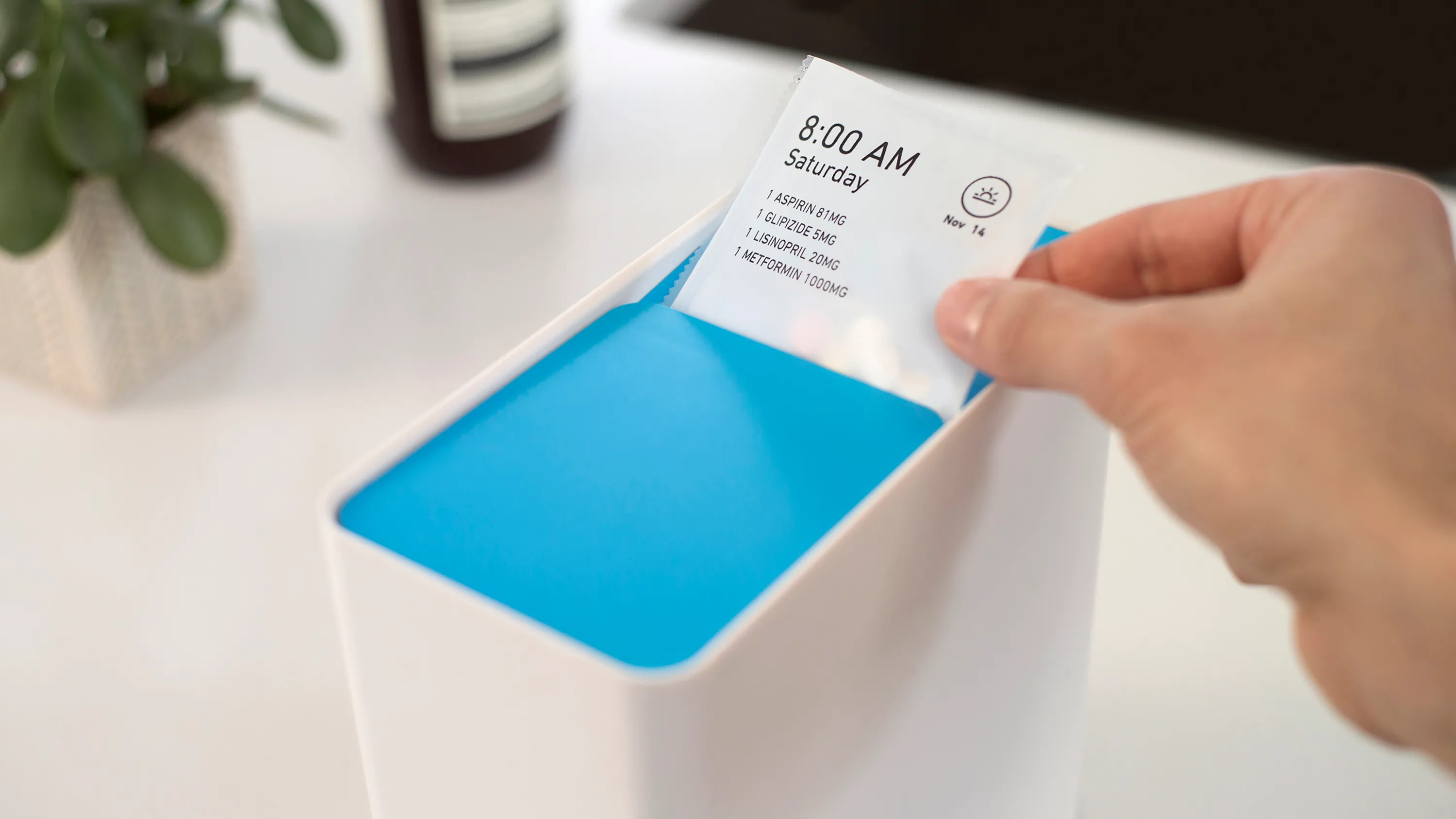
Here’s how it works: Your doctor sends your prescriptions straight to the pharmacists at PillPack, who organize the medications—including refills, over-the-counter drugs, vitamins, and supplements—into presorted, personalized packets. These tidy little packets are labeled by date and time and delivered to your doorstep. Every 14-day supply of medication fits neatly into an IDEO-designed durable dispenser that is meant to become part of customers’ routines and fit seamlessly into their homes. IDEO also designed a travel pouch that makes taking medicine on-the-go simple and discreet. For those who need a human to talk to, pharmacists at PillPack's pharmacies are available anytime via phone or email to answer questions.
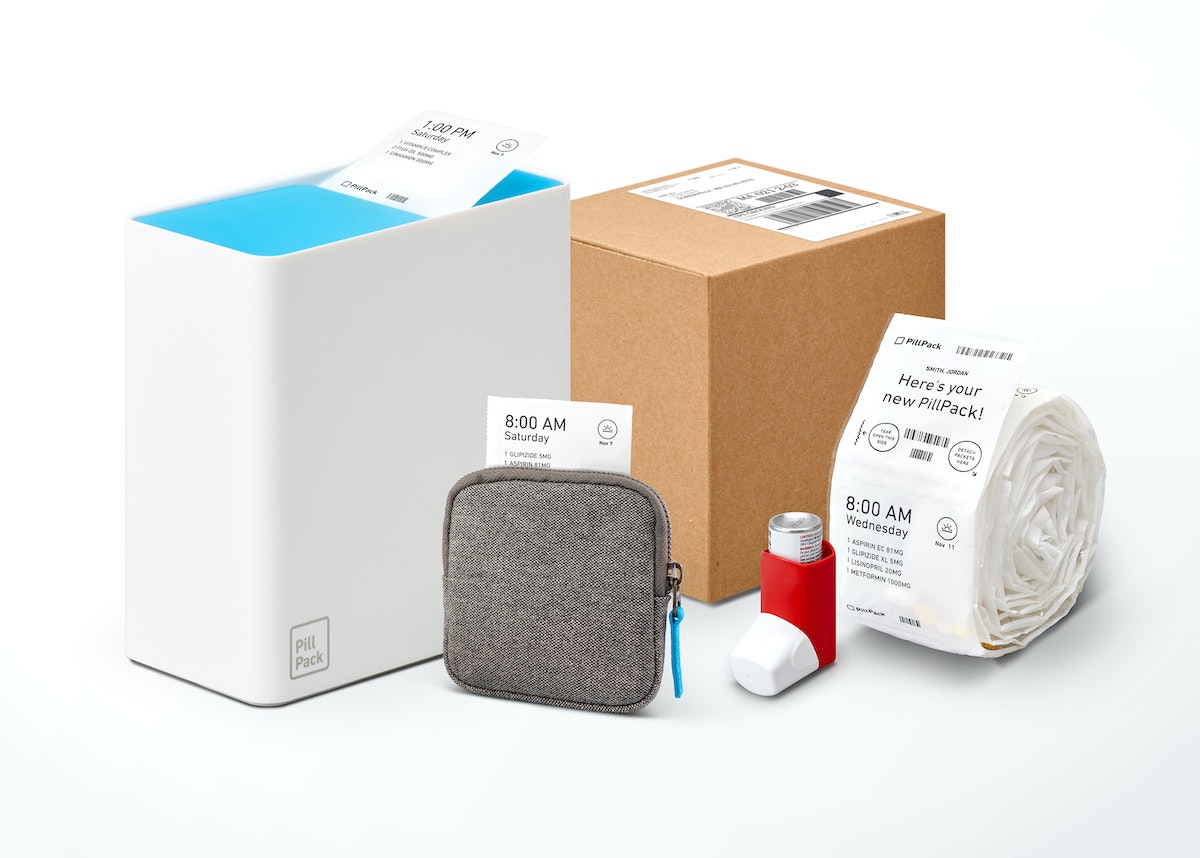
PillPack was the second startup-in-residence to work with IDEO Cambridge. Company founders Elliot Cohen and TJ Parker joined forces with the design team to redefine how consumers engage with their pharmacy. During the three-month residency, the teams focused on making sure that every customer interaction with PillPack—from signing up for the service online to using its product daily—was straightforward and reassuring.
Designers worked to refine the company’s brand vision, strategy, and identity across channels, and used this framework to completely redesign PillPack’s website, as well as a private dashboard for customers and a suite of physical products.
The result was a set of tools that reflected a true understanding of PillPack’s customers, a well-articulated product and service, and a human-centered approach. PillPack is still the only independent pharmacy in the U.S. that serves customers nationwide.
“PillPack has revealed the massive potential of combining design thinking and the drug market... This simple innovation makes life easier for seniors who can be a bit forgetful and have difficulty with bottles,” Wired wrote in an article about the company. “Younger patients with active lifestyles and chronic diseases can just pull as many packets as they need and go. All told, PillPack means you’ll never have to help your grandma sort pills into a tacky day-of-the-week organizer again.”
In June 2018, Amazon outbid other retailers to acquire PillPack for $1 billion.
Build Your Creative Confidence: The Dream/Gripe Session
Innovators often face the task of which challenge to focus on, or how to frame a challenge they are given. At IDEO, we use the term “Phase 0” to describe all the activities that take place before the problem is fully defined.
Creativity Challenge #9: Define a problem to work on.
Innovators often face the task of which challenge to focus on, or how to frame a challenge they are given. At IDEO, we use the term “Phase 0” to describe all the activities that take place before the problem is fully defined.
Talking about problems doesn’t necessarily inspire ideas, or energize you to act on them. Nor does wishful thinking. The Dream/Gripe Session helps you translate those discussions into creative thinking challenges you can start to tackle. This tool was adapted from an exercise in the Design Thinking for Educators Toolkit, developed by IDEO in partnership with Riverdale Country School.
Tool: The Dream/Gripe Session
Participants: Pairs in groups of any size
Time: 15-30 minutes
Supplies: Pen and paper
Instructions
Step 1: Decide on a topic for discussion. The dreams and gripes may relate to internal matters like the culture of the organization or external ones like interactions with customers.
Step 2: Pair up with another person and select one person to go first (Partner 1).
Step 3: Partner 1 airs their dreams and gripes for five to seven minutes, while Partner 2 listens and takes notes.
For example:
DREAM: “I wish we could get our customers to read the instructions.”
GRIPE: “It’s so noisy around here that I have trouble concentrating.”
Step 4: Partner 2 reframes the dreams and gripes into open-ended questions that make for good innovation challenges. We usually start with the phrase “How might we...?” A good “How Might We” question should not be so narrow that it suggests a solution (even if it’s a good idea). Initially, you're just trying to capture the problem, not jump to possible solutions. It should also not be so broad that it stymies the flow of ideas (rather than generates them). A good “How Might We” question should allow someone to easily come up with 10 different ideas.
Partner 2 should aim for three to five well-framed innovation challenges and share them with Partner 1.
For example:
GRIPE: It’s so noisy around here I have trouble concentrating.
Challenge that’s too similar: How might we reduce noise so you don’t have trouble focusing?
Challenge that’s too narrow: How might we create more private offices so employees can concentrate better?
Challenge that’s too broad: How might we help people focus?
Challenge that’s just right: How might we design the space to accommodate a range of working styles?
DREAM: I wish our staff got their expense reports in on time.
Challenge that’s too similar: How might we get people to be more timely with their expense reporting?
Challenge that’s too narrow: How might we use a smartphone app to speed expense reporting?
Challenge that’s too broad: How might we get people to have more respect for deadlines?
Challenge that's just right (with empathy for the employee): How might we simplify the expense reporting process so that people can complete it more quickly?
Step 5: Switch roles and have Partner 2 air dreams and gripes while Partner 1 listens and then offers “How Might We” innovation challenges.
Step 6 (optional): If you are doing this in a group setting, compare lists of all of the innovation challenges across the pairs. Look for patterns, themes, and common issues. This should help focus the discussion and suggest an opportunity for what innovation challenge to take on next.
This post was taken from Chapter 7 of Creative Confidence. Purchase the book for more on how to use creativity to solve problems, or read more from this series of creative exercises on the IDEO blog.
Everyone is creative. This belief runs through everything we do at IDEO, and in 2013, it led my brother David and me to write a book that would help others—even those who don’t think of themselves as “creative types”—to unleash their creative potential. Creative Confidence has inspired thousands of people to adopt a creative mindset and apply it to the diverse real-world challenges they face. In this series, we’ll share some exercises from the book that can help you approach your challenges from a new perspective.

Welcome to The IDEO Journal
Introducing our new, digital publication featuring stories from leading voices at the intersection of design and business.
It would be decades before design would become widely understood as a practice beyond decorative arts. In fact, the interviewer asked, “How would you define yourself with respect to a decorator?” And Eames replied succinctly: “I wouldn’t.”
It’s rare to find such a concise encapsulation of design’s power and potential, but Eames summed it up with admirable simplicity. There are no boundaries to the problems we face, of course; but there’s also no end to the ingenuity we can bring to bear in our pursuit of solutions.
Framed this way, it’s easy to see why design—as a creative approach to solving problems—is such an effective tool for business. In a highly interconnected world transforming at unparalleled speed, business leaders must attend to an ever widening set of concerns. Threats and opportunities come from unexpected places, and it can be hard to see through the fog. Design helps us navigate that ambiguity. It provides a framework for making decisions, identifying needs, devising solutions, and articulating values.
At IDEO, we know the magic that can result from combining design thinking, business acumen, and the possibilities of new technologies. We see it every day with our clients and teams, and we hear stories from our network of partners and collaborators.
Now, we have a place to share those stories: The IDEO Journal, a new digital publication featuring insights, inspiration, provocations, and lessons from the world of design-led business.
Today we are thrilled to launch this publication on IDEO.com and through a biweekly email newsletter. We begin with four perspectives: Lawrence Abrahamson, Senior Design Director at IDEO New York, shares an insight he had while chatting with a facilities manager for a large real estate corporation—recognizing new ways to unlock value in the work space of the future. Deborah de Vries, Senior Portfolio Director at IDEO San Francisco, shares the four key pillars to building an innovation lab that successfully shepherds its parent organization into the next era of its business. Senior Portfolio Director Hailey Brewer presents a thought exercise on the language we use when we talk about business—and how changing our words might change our outcomes. And Owen Sanderson, a business designer, alongside Maura Cass, a design research lead in our Cambridge studio, share an example of how looking outside your own industry can be the best way to inspire change within it.
Forthcoming stories will include a case for embracing friction when starting a new corporate venture; and an interview with Dawn Laguens, the former Executive Vice President of Planned Parenthood who now sits with us as expert-in-residence at IDEO. We’ll have explorations of creative leadership, digital transformation, entrepreneurship, and much more.
The convergence of design and business has followed a long trajectory from the early business consulting work of Charles and Ray Eames. It would have been hard to imagine in 1969 just how widely design could be applied. Even IDEO co-founder David Kelley, looking back on our firm’s 40 years, remarked: “And to think, when we started I thought we were going to forever be designing plastic parts for Silicon Valley computers and that would be enough to be fulfilled.”
Computers themselves once seemed like one of the most complex and interesting problems design could tackle. Now, of course, the physical components are just an interface for whole realms of experience nobody foresaw. While we can never predict the future, we can equip ourselves to respond to it with creativity and intelligence. By applying design and business—together—to the problems of our time, we expand the boundaries of possible solutions.
In a 1969 interview, the legendary designer Charles Eames was asked, “What are the boundaries of design?” Without skipping a beat, he turned the question around and asked, “What are the boundaries of problems?”

What Comes After Open Offices?
It doesn’t matter, as long as culture comes first. Start seeing your work space as an opportunity to create value rather than cut costs
They were right, of course. At IDEO, we’ve seen time and again how environments design can create a more appealing, nimble, and resilient workplace. But we’ve also learned that a more profound change—and higher returns—can come when we look beyond the “hardware” of floor plans and furniture to the “software” of human relationships, activities, and work habits.
We began a series of site visits, meeting with people across different roles and observing how they used their workspaces, from executive offices to call centers. At one location our guide was a “floor manager,” as they called him. Technically, he was responsible for the upkeep of the physical environment, but he quickly revealed himself to be far more than that. He remembered birthdays and anniversaries. He knew when teams had completed a big project and how best to celebrate it. He was also an astute observer of the quirks of human behavior in space, like the routes people paced when they needed privacy on a personal call. He was invaluable for our learning process, and we realized he was invaluable for the bank too. He bridged some of the work of a receptionist, human resources specialist, custodian, and audiovisual tech. Above all, he helped people connect personally to their environment, and in doing so he made it better and their work easier to do.
But, as in so many organizations, his job was in jeopardy. Rather than see the value of his dedicated attention and accumulated cultural knowledge, the bank had decided that it no longer needed a manager for each floor. His role was seen as expendable, and his presence a cost burden. His “hard” tasks could still get done in a more administrative capacity, but the “softer” work would disappear.
This was a moment of insight for us. Amid the inconsistency of changing workplace conditions and mobile employees, this floor manager was a constant for the community. Far from being an unnecessary expense in a lean workplace, he was what allowed a lean workplace to thrive. He embodied its culture and created returns that couldn’t be easily captured on spreadsheets. We started to think of him like the starter in a sourdough recipe—the little bit that carries the unique flavor and texture of the organization forward.
The case of the big bank floor manager is indicative of larger trends that I have seen evolve over the last decade. For many years, facilities professionals, just by doing their jobs, enabled huge returns for their companies. They brought value by modernizing space, boosting technological efficiency, and cutting square footage. But when there is little left to cut, returns must be generated in other ways. In order to unlock new value, the realm of facilities must expand to encompass not only visible details of design and culture, but also less visible organizational factors like strategy, structure, process, incentives, and talent. In turn, the role of the facilities manager evolves from someone who optimizes for today, to someone who helps cultivate tomorrow.

In searching for more ROI, some organizations are choosing to locate their teams in white-label workspaces that offer glossy services and amenities, while alleviating some of the ambiguity inherent in preparing for the future. However, these places can be more like interchangeable hotel rooms than permanent homes. The occupants are connected by proximity, but not by a shared purpose.
At IDEO, we consider that sense of common purpose to be an essential part of the software that makes the workplace—and the organization—thrive. Our challenge is to better program that software—to think not only in one-off designs, but about the broader life and behaviors in an environment. In a project for Planned Parenthood, for example, we suggested shifting the role of receptionist from a stationary processing officer to a responsive guide—someone who could assess patients’ particular needs and help them navigate the space accordingly. The furniture and floor plan changed, too, to improve the patient experience; but it was in the use of human services that the overall design was activated. The people inside would play just as important a role as the walls and furniture. The outcome was both a strengthening of internal culture and relationships, and a more favorable outside perception of the brand as one that foregrounds human relationships. It showed what can happen when we consider people and interactions as part of the design.
In a very different type of project—the redesign of a hedge fund’s trading floor—we similarly looked at the interaction between human activity and physical environment. The client’s hunch was that more portfolio managers talking with each other and exchanging their expertise and research would produce different, better scenarios to trade on. Their teams had been siloed and hierarchical, with minimal interaction between fiefdoms. We quickly realized that while the brief asked for “the trading floor of the future,” we were undertaking a cultural change project. You can’t get people to exchange ideas if they don’t even address each other in passing.
We designed a space that had teams sharing amenities like conference rooms, call booths, and support service stations, and we also left room for spontaneous interactions and conversations away from the desk. The physical environment was enriched by the design of programmatic experiences like learning and development opportunities that brought diverse employee groups together; as well as intentional consideration of teams’ internal language and communication. At first, those at the top of the hierarchy resisted organic interaction with those lower down the ranks. But in the end, the value of cultural cohesion was clear. And data supports the experiential finding: Teams and organizations that collaborate across different functions on a daily basis are 38% more successful than organizations that do not. The best workspaces function like a sliding puzzle: there has to be a little extra to move into, otherwise everyone gets stuck in place. They consider the container as well as the contained.

The two projects were certainly different, but both were emblematic of doing more with less, by focusing on the people in the space. We helped both organizations and their real estate teams steward a shift from merely managing their workspaces to cultivating the activity that goes on inside them. We studied unique human behaviors and then, through testing and prototyping, moved forward with elements tailored to each organization’s culture and its individuals. That process differs from what environments design typically entails. But we know that the software of a workspace still has a lot to give us all, in a way that’s complementary to the pressures many organizations are feeling.
I recently got back in touch with my client at that international bank. She told me they’re now adding floor managers—renamed “experience managers”—to their sites across the globe. That’s a small thing, but it underscored a more profound change in her role developing the bank’s myriad facilities. If before she was a value saver, now she sees the possibilities in being a value creator. Rather than working behind the scenes, she is an active player in her organization’s success. “It’s not just furniture,” she said. “It’s about how employees feel about the way they are spending time. Are they in an environment that supports their flow, their work style, and their work type? What can we do to make their work easier? How can I make them more successful?”
Those are profound questions for any organization, let alone for the professional field of real estate that is shifting from simply building the walls to enabling the activities that happen inside of them. When I think about the future of facilities, I think about all the potential we can unlock by holding the cultural and emotional components of work alongside legacy approaches to productivity and architecture. Our challenge—and our interest—is weaving those parts into a greater whole.
Unless otherwise specified, all statistics came from Creative Difference, a digital tool to assess, guide, and track the development of creative and innovative teams.
Visuals by Marina Muun.
A few years ago, a major international bank approached IDEO and asked our team to rethink their workspaces. They had a new CEO, a new mission statement, and a hunch that the physical design of their facilities could foster behavior changes in the organization.

To Transform Your Industry, Look at Someone Else’s
What a team of surgeons learned from a field trip to the airport
Analogous research is a form of exploration that takes a team outside of its industry to find inspiration in the ways others have tackled similar challenges. These immersive experiences allow us to move beyond our expertise to see challenges with fresh eyes. In these moments, we build new levels of understanding and empathy that help us unlock aha! moments and generate ideas that we can ultimately bring to our own design challenges.
A few weeks into a project focused on redesigning the patient surgical experience with Newton-Wellesley Hospital (NWH), we saw an opportunity for analogous inspiration. Our client aimed to disrupt its industry by creating a service that focused not just on clinical outcomes but on the entire patient experience–from check-in to check-out. We assembled a team of surgeons, anesthesiologists, nurses, and hospital executives to help us design a better experience for patients. About halfway through the project, it became clear that they needed inspiration from outside the healthcare industry.
So we headed to the airport. Why? Because, like performing surgery, taking to the skies isn’t a simple process. It involves lots of regulation, moving parts, and coordination. While an airline’s mission is to deliver a passenger from A to B, its purpose is to deliver a seamless, customer-centric travel experience. Airlines have invested in products and services to create that kind of experience, but many surgical departments haven’t considered the entire patient journey–beyond what happens clinically under the bright lights of the OR.
We brought the hospital staff to Boston Logan Airport for a morning with JetBlue—an airline known for great customer service. When the docs on our team first caught wind of the trip, they were a bit skeptical. It’s not easy to convince a bunch of highly-trained surgeons to scrub out of the OR and go on a field trip. But they piled into cars and headed to Logan.

We started at check-in. The hospital team was issued mock boarding passes and asked to check-in for their upcoming flights. They had the option of using a kiosk, their phone, or speaking to a real, live person.
Almost immediately the team began to discover parallels between the patient experience and the traveler experience. The surgeons on the team quickly noted how many different pathways there were for customers—options for families, those with disabilities, and frequent fliers. “We only have one option for our patients, but patients aren’t all the same,” one surgeon said.
The lessons continued as we cleared security. The group stopped by the Just Ask counter, JetBlue’s customer service desk. Staffed with friendly crew members, Just Ask is exactly that—a place where customers can ask JetBlue anything. That includes getting directions to the bathroom, finding out the score of the Red Sox game, or asking to rebook a flight. JetBlue crew members are empowered to help passengers—even beyond their standard job descriptions. A pre-op nurse on our team suggested having something similar in the hospital–a place where patients and their loved ones could get the support they need. “I bet it’d be easy to prototype this type of service, and it would help us learn what patients really want,” she said.
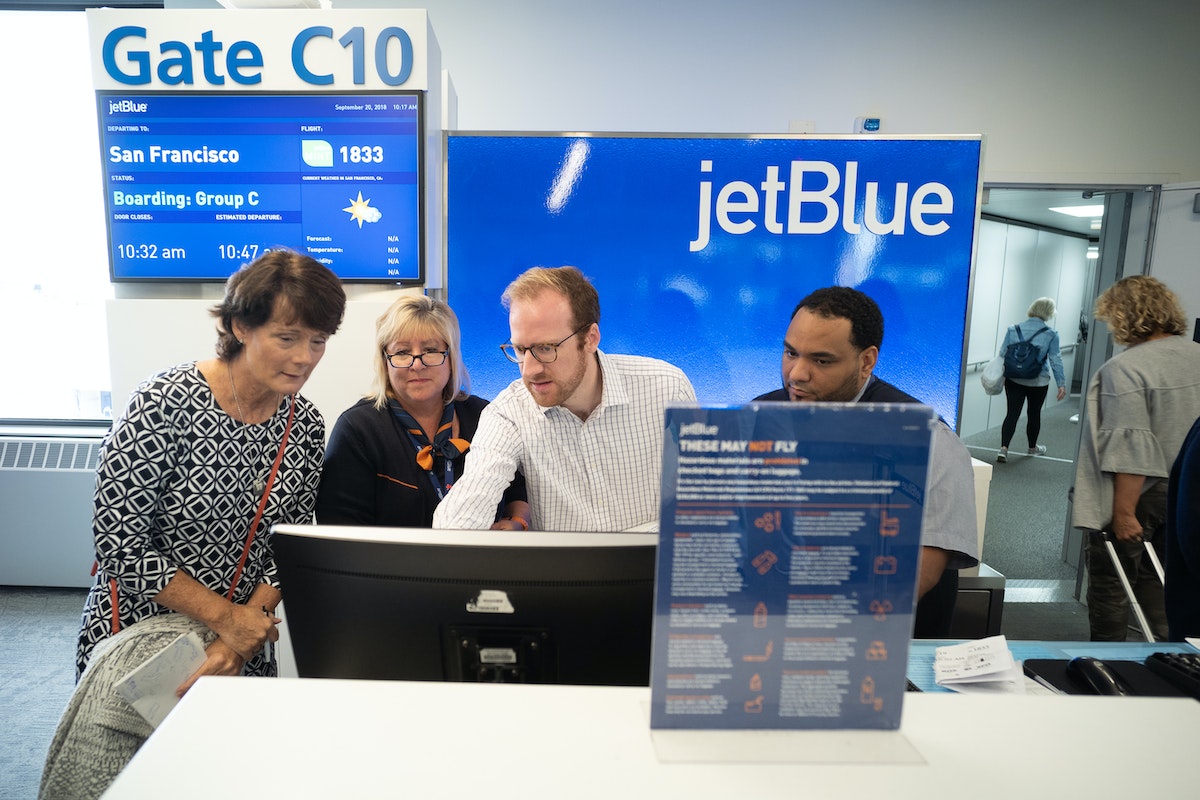
The group ended its day at JetBlue’s operations center and crew lounge. Here, the two teams met to discuss the day’s takeaways. “It starts by building a united team,” said the manager of onboard service and hospitality standards at JetBlue. “Sure, we can launch programs like the Blue Cafe to provide complimentary snacks to delayed customers or hand out pilot wings to young travelers. Of course, we do these little things–but what really matters is working together to create a consistent experience across a customer’s travel journey.”
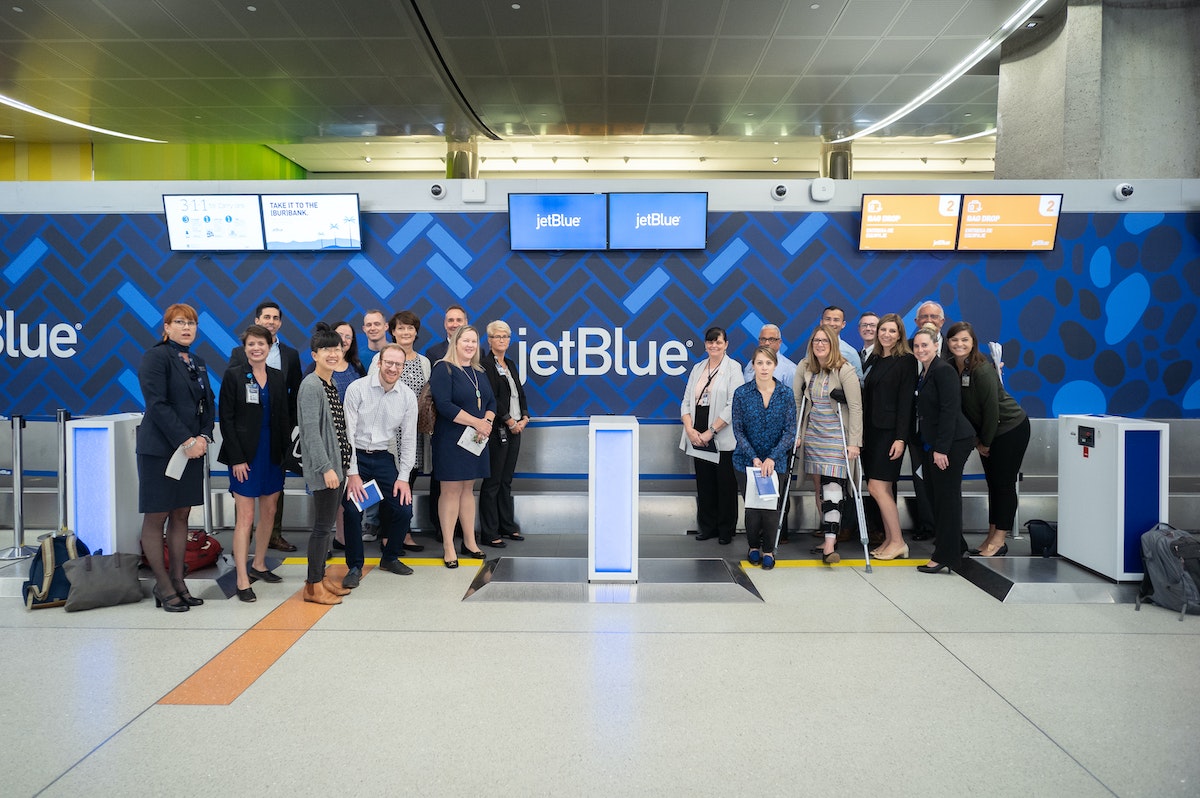
When the NWH team circled up later that week, it was clear something had changed. The team was buzzing. Catalyzed by the analogous field trip, the doctors and nurses were ready to get to work. They mapped out a handful of prototypes to test at the hospital, including a redesigned lobby experience, and a way to engage with patients with different levels of confidence and familiarity with the hospital system.
At IDEO, we treasure these moments of cross-industry learning. Sometimes all it takes is for leaders and frontline workers to get out from beyond their desks and see things from a new perspective.
So, next time you’re feeling stuck, seek inspiration outside of your comfort zone. Consider how others have solved unique but similar problems. It might just be the change in perspective your team needs to recharge and think differently.
At first glance, surgery and airline travel don’t appear to be very similar. But if you dig deeper, you’ll find overlapping themes in the work experiences of surgeons and airline employees—stress, a high-pressure environment, a lot of team coordination. Actually, these industries have a lot to learn from each other. We at IDEO call this analogous research.

Lindsey Turner
I’m passionate about building brands, products, and experiences that help organizations show up with meaning and momentum.
I help organizations cut through complexity by shaping how they show up, through brand strategy, identity, and storytelling.
Working at the intersection of brand and business, I bring an editorial eye and a bias toward making—turning ideas into tangible experiences that people can understand, trust, and believe in.
My work spans government, healthcare, financial services, media, and consumer goods, from launching Gen Z-focused ventures to building innovation labs and reimagining legacy brands. I relish moments of ambiguity and enjoy translating across teams, perspectives, and priorities to move ideas forward.
I started my career in editorial and digital design, shaping cross-platform experiences and identity systems in publishing and agency environments. That foundation still shapes how I work today: I’m detail-oriented, collaborative, and overreliant on the Oxford comma. I hold a BFA in Visual Communication from the School of the Art Institute of Chicago.

Rachel Young
My work helps organizations see who their products aren't working for—and build the will and the tools to do something about it
For 25 years, I've asked the same question: Who does this design exclude—and what are we going to do about it?
My work spans human-centered strategy, inclusive design, and qualitative research, with clients ranging from Microsoft, Google, and Verizon to the National Science Foundation, and San Francisco Unified School District.
Before IDEO, I taught elementary school in East Palo Alto and spent a decade doing design work with social service organizations—where I learned firsthand what it costs people when systems are built without them in mind.
I am currently writing User Error, a nonfiction book about digital access and the design decisions behind it. I live in Oakland, California.

Brian Pelsoh
I lead with craft, ensuring our work is creatively excellent: rooted in deep human insight and imagination, while also grounded in the realities of business and technology.
My expertise spans brand, communication, and product design across tech, education, the arts, and social impact.
I believe great work demands both high-level vision and obsessive attention to detail, and only happens through collaboration.
I bring an inclusive, hands-on approach and a deep understanding of business, which enables me to consistently deliver excellence while always asking why.
Before joining IDEO, I worked at the brand firms Pentagram and VSA Partners. I began my career as a designer, leading teams at the School of the Art Institute of Chicago and the Milwaukee Art Museum. I hold an MFA in graphic design from Maryland Institute College of Art and a BFA in communication design from the Milwaukee Institute of Art & Design, and have taught at some of the best design schools in the US.

Tony Wong
I am responsible for IDEO’s long-term success in China and working with clients to use design as a tool to enable growth.
I am responsible for IDEO’s long-term success in China and working with clients to use design as a tool to enable growth. Specifically, I have helped Chinese companies design holistic brand solutions through the development of their products, communication, services, and innovation teams, and I have helped multinationals expand their presence and influence in China.
I advise global leaders on developing China-led innovation and capabilities.
In over 15 years in IDEO Shanghai, I have worked on projects that use design to elevate the quality of the experience of healthcare products and services, streamline processes that increase productivity, create spaces and programs that promote and enable inclusive communities, and build next generation mobility solutions that are planet-positive.
Before joining IDEO, I worked at Philips Electronics and the Electrolux Group in Italy, the Netherlands, and Singapore on a number of breakthrough commercial products. I am a member of the Young President Organization in Shanghai.

Building a personal AI for the messiness of life: Sida Li
Most AI products today are built for work—a space with clear problems and established systems. One founder noticed a gap: personal life is messier, harder to systematize, and mostly left behind by the AI boom. So she built Cue, a personal AI that lives inside iMessage and group chats, to go where the other tools haven't.
In this episode, Becca Carroll, IDEO's Chief Strategy Officer, talks with Sida Li, co-founder and CEO of Shared Context Lab, about staying anchored to a human need while the technology around her keeps changing shape, why she treats her business model with the same rigor she'd bring to a product, and what it feels like to build a company at this particular, disorienting moment in AI.
The conversation also gets into how Sida makes design decisions: the language Cue uses to describe itself, the tradeoffs behind building inside iMessage instead of a new app, and a real story about a business idea that didn’t pan out.
This is the second in a two-part series profiling founders from IDEO's Startups-in-Residence program. The first conversation is with Johannes Seemann, founder of Sooner, on designing GenAI for the emotional side of money.

Designing GenAI for the emotional side of money: Johannes Seemann
Most personal financial tools are built to run the numbers and optimize towards a budget. While that works for some, most people experience money as a lived relationship that does not neatly fit into a spreadsheet. Johannes Seemann and Becca Carroll discuss why money is emotional before it is mathematical, and what a human-centered approach to building a generative AI financial product looks like in practice.

The curious leader's edge in uncertainty: Scott Shigeoka
Mina Seetharaman talks with Scott Shigeoka, author of Seek and Head of Curiosity Cultivation at the Eames Institute, about what distinguishes genuinely curious leadership from performative curiosity, how power dynamics shape curiosity, and why practicing curiosity can restore energy rather than drain it.

How constraints make us more creative: David Epstein
Mina Seetharaman talks with David Epstein, author of Inside the Box and Range, about why total freedom often produces average work, how leaders can design useful limits on purpose, and what organizations such as General Magic and Pixar reveal about the relationship between boundaries and creativity.
Looks like you might be in search of something very specific?
Or reset the filters above and try another angle.
Here’s some random inspiration

Podcasts about creative leadership

Articles about the power of prototyping
