
.svg)


The future guest experience
Designing new guest and employee journeys that deliver on the promise of an iconic brand.
kate spade new york has been an iconic fashion brand since the early 90s, when its handbags first stormed the Manhattan fashion scene. Since then, the company has expanded and evolved into a global lifestyle brand.
With e-commerce reshaping the retail landscape and redefining the role of brick and mortar stores in recent years, kate spade new york leadership asked: How can we make the kate spade new york specialty store experience, well, more special?
kate spade new york already held the key to a new way of thinking about a multichannel customer experience: a brand promise “to inspire her to lead an interesting life.” Hoping to bring that promise to life in store, they engaged IDEO to help make it happen. The solution was for kate spade new york to take the brand message from words to action in the form of a customized guest journey. The team created more than 100 design concepts and strategies for building a retail experience that rewards curiosity and sparks artistic and literary exploration.
“In partnership with IDEO, we spoke extensively with our customers and associates to better understand how we can provide the most engaging and fulfilling in-store experience,” said Mary Beech, Executive Vice President and Chief Marketing Officer at Kate Spade & Company. “The new store elements that we introduced speak to our customer’s personality and appetite for adventure while aiming to enhance engagement with new and existing customers.”
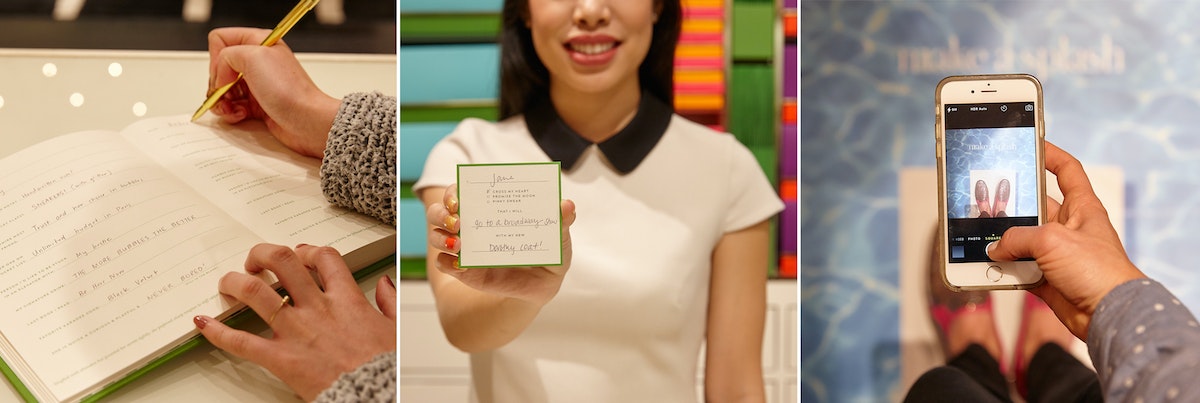
The team knew that striking the right balance of digital tools in in-store interactions was pivotal in allowing two people to have a more rich and collaborative face-to-face connection. The concepts include things like “pack a purse” to test drive how many everyday items can fit in different style handbags, cheeky “dare cards” that challenge customers to go on an exciting adventure with their new purchase, and digital moments like the “shoe selfie” platform that would allow a guest to share “I’m thinking about them” heels or just-purchased flats with her social network. IDEO live-prototyped a selection of concepts in stores around the country and saw a high correlation between customers’ positive reactions and their subsequent purchasing decisions.
“At kate spade new york, our brand promise is to inspire women to live a more interesting life,” said Jenica Myszkowski, Vice President of Stores at Kate Spade & Company. “Our new and improved guest journey experience puts our customers at the center, allowing us to more fully deliver on our brand promise in our retail stores with a stronger vision and purpose for our stores and our store teams.”
To deliver the newly envisioned guest service experience, the role of the sales associates needed to be redesigned, as well. The kate spade new york and IDEO team created a new role: the Muse, whose job is to live the brand promise of an interesting life and to inspire customers to do the same. The reimagined role ultimately shifted the focus in specialty stores from selling to inspiring and building long-lasting relationships with guests.

Two kinds of athletes, one strong brand
Designing a brand that served both elite athletes and everyday fitness enthusiasts.
Athletes’ Performance and its subsidiary, Core Performance, were both founded on a single mission: to enhance human performance through a holistic approach to mindset, nutrition, movement, and recovery. Athletes’ Performance focused on elite professional athletes, and Core Performance provided corporate fitness programs and workouts for employees hoping to lead more healthful lives, and both found a footing in the competitive health and fitness market.
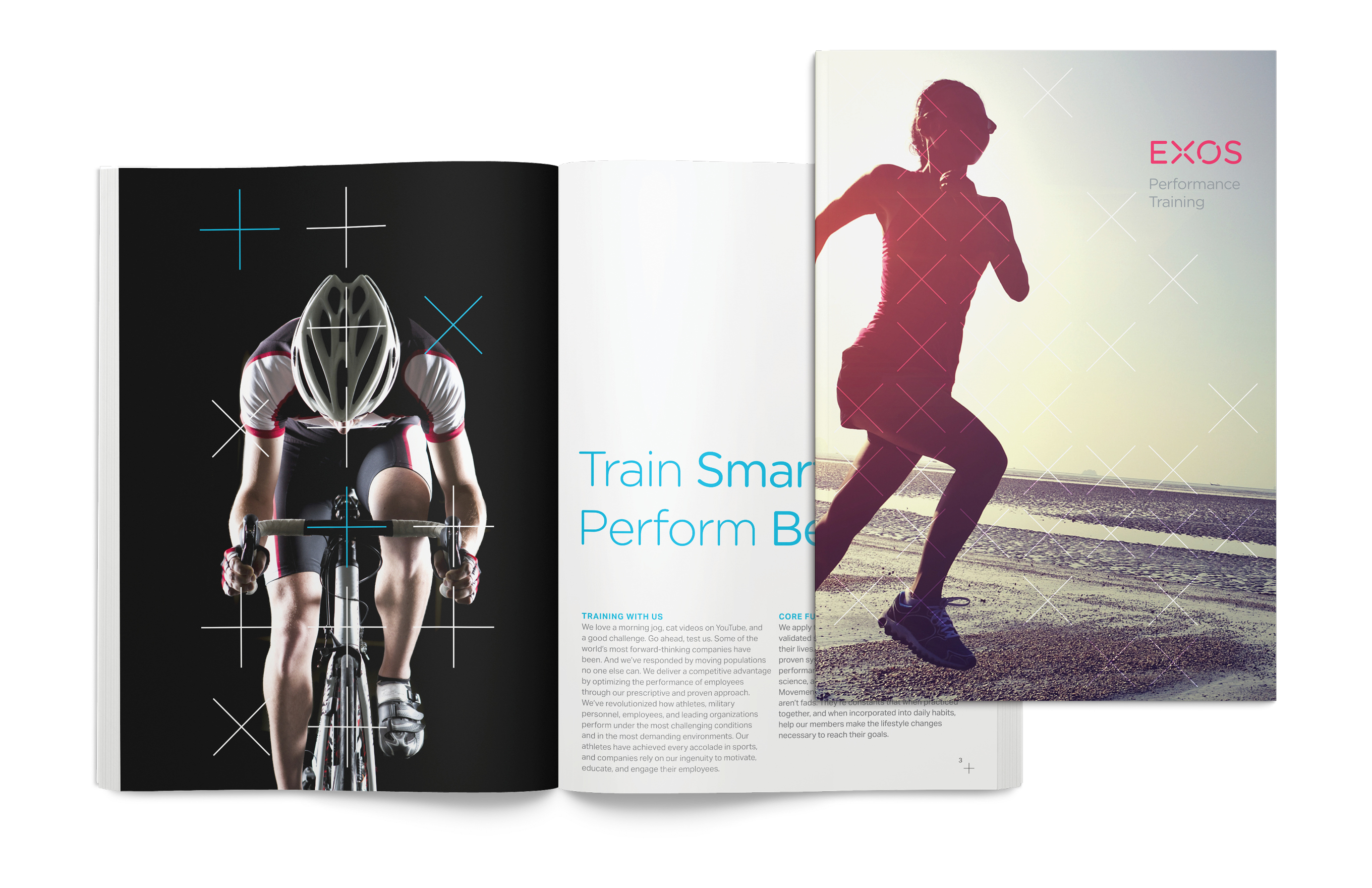
Faced with a challenge to redefine the brands, IDEO designers collaborated with the founder and integrated marketing team to unite Athletes’ Performance and Core Performance under one name that would cut across the health, fitness, and wellness markets to reach a full breadth of audiences and partners. Under a new name, EXOS, the teams created a brand identity system unified by its founding mission and focus on human performance.
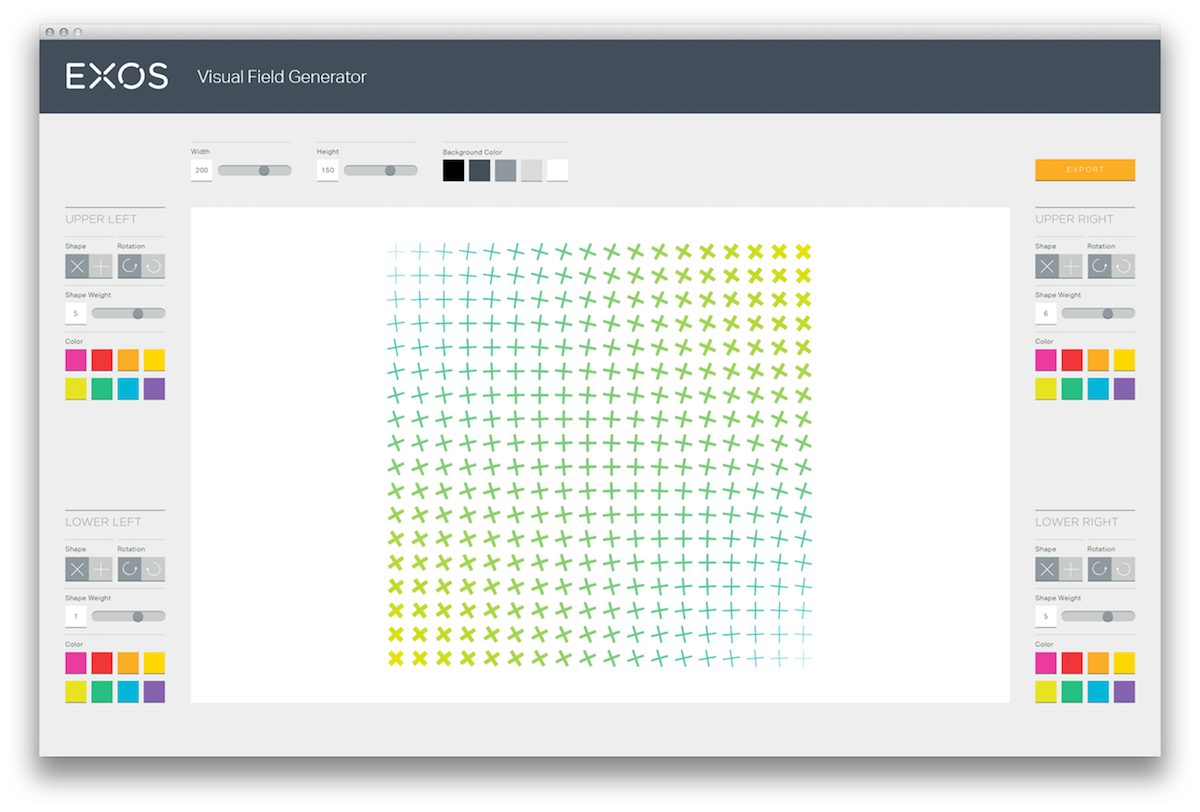
For the new EXOS brand, IDEO designers created a visual language using “x” and “+” to highlight the progress from goals to achievement, as well as a system of interaction for athletes of all performance levels. The team also created a bespoke digital tool, outfitted with custom software, which gave designers both guidance within the brand guidelines and creativity to explore new products and contexts.
Making sure a bank stays great as it grows
Designing digital tools and brand concepts for Umpqua Bank.
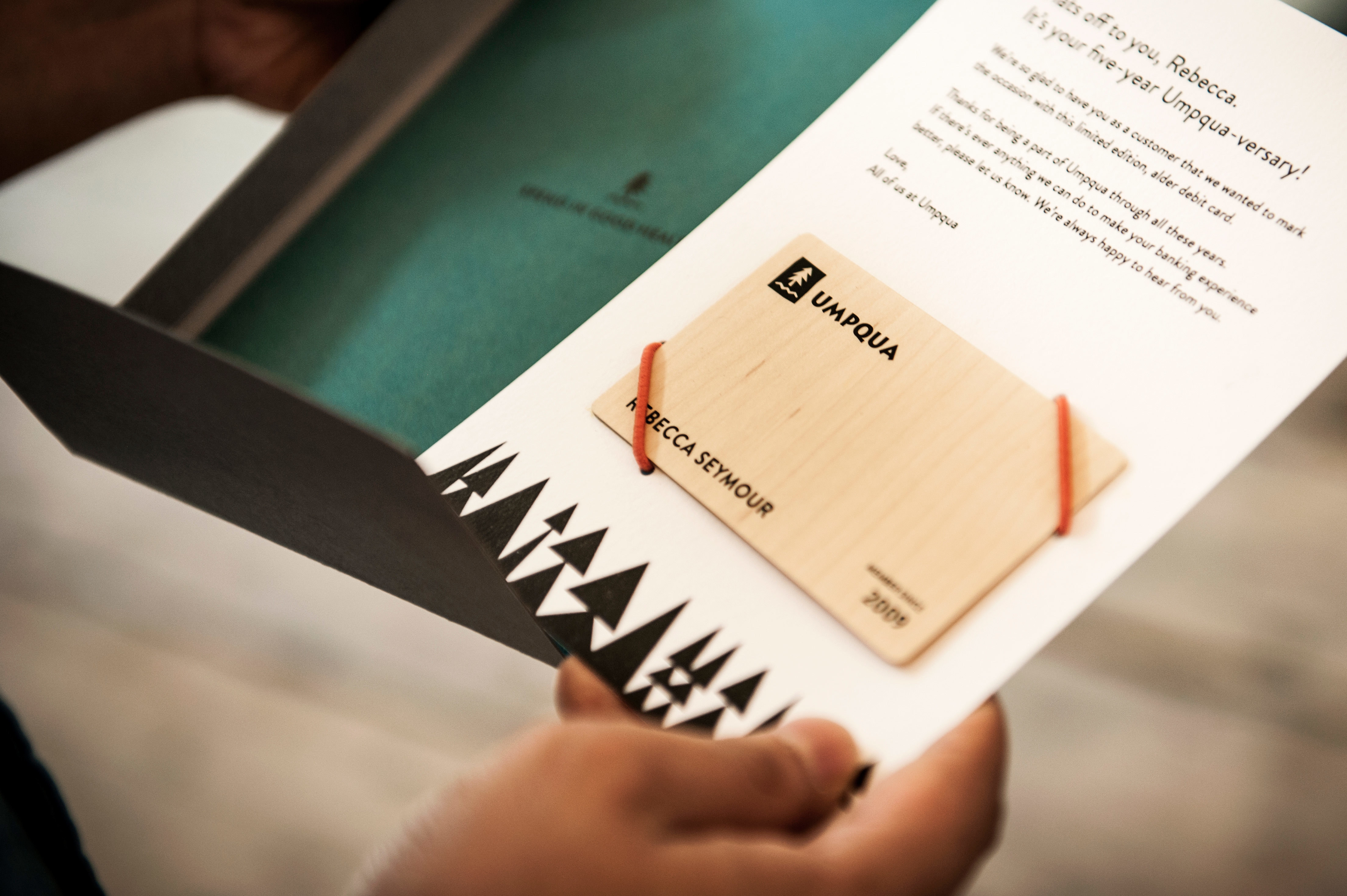
Imagine this: Your company has just gone through a $2 billion merger. You show up at work to find an invitation from the CEO asking you to help shape the bank’s future. This is what happened when Umpqua acquired Sterling Financial Corporation in 2014, doubling its size and resulting in the creation of the West Coast’s largest community bank overnight. With a mission to be “the world’s greatest bank,” CEO Ray Davis seized the moment to reinvest in design across the organization.
Umpqua asked IDEO to help examine the brand they had and take it to a new level. They wanted to find out: how can we leverage our strength and reputation by activating the brand in new ways to deepen employee and customer engagement and foster continued growth?
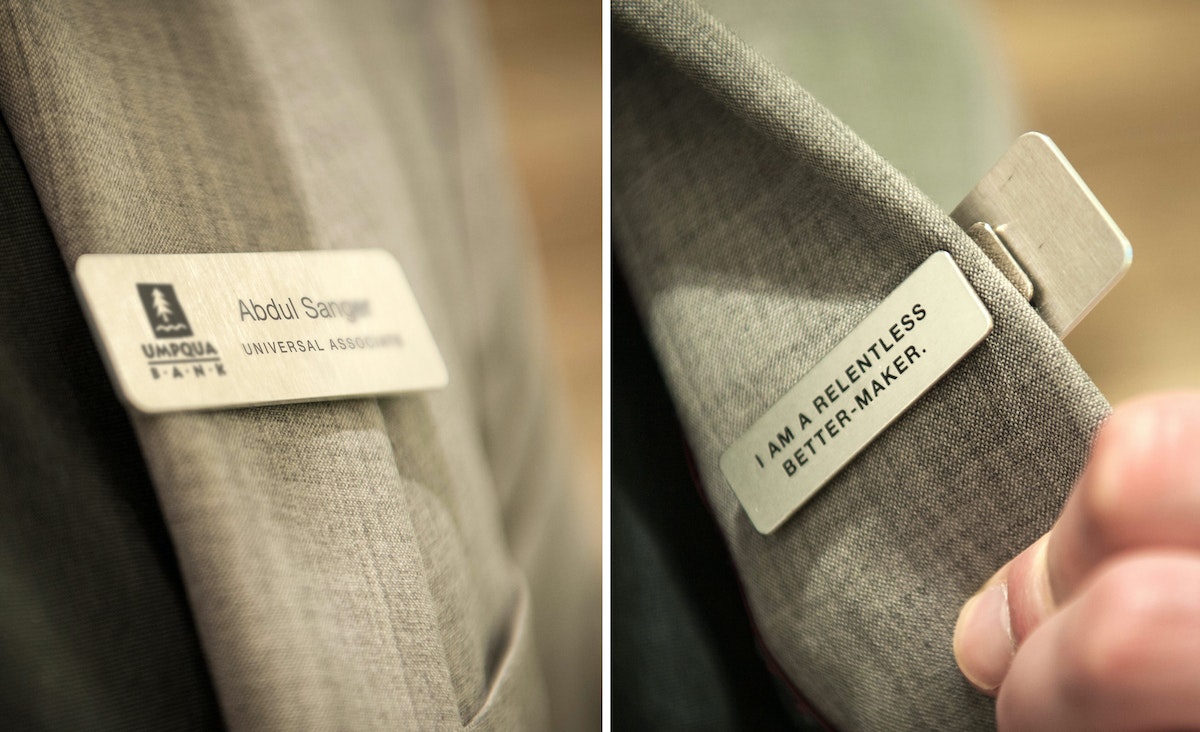
IDEO identified three core brand opportunities and a newly articulated purpose statement that became a launch pad for more than 15 different concepts to express the brand internally and externally.
Inside Umpqua, company evangelists handed out notebooks with tips on “how to be better-makers,” and associates now participate in collaborative design challenges through an internal tool built on IDEO’s OI Engine, software that fosters open innovation. The design challenges are drawing unprecedented participation of 84 percent among employees and are having a real impact on the organization. Of the five they’ve run in two years, the company has implemented three winning ideas including a buddy program for new hires or transferees that upwards of 1,000 associates could experience over the next year.
WATCH: Umpqua Bank on using the OI Engine platform
IDEO also worked with Umpqua’s team to conceive digital products including a new digital app called Raindrop that lets people bank in the way that they think about saving and spending, not the way a bank does. It’s due for release in 2016.
To introduce all of this work, IDEO set up an immersive exhibition at Umpqua’s headquarters in Portland. Teams large and small, including the executive and associates from across the company, walked through the exhibit and witnessed how the brand impacts every aspect of their business, from employee engagement to product development. It was signed on the spot by Davis, who invited employees to sign their names, too.

Jade-infused jeans for sweltering summers
Repositioning Lee's brand through the launch of a breakthrough denim product.
The sweltering summers in China can be insufferable—especially for people who like to wear jeans.
Lee Jeans, in its quest to boost its brand differentiation among an expanding market of apparel brands that also use fabric performance as their unique selling point, like Uniqlo and Levi’s, developed denim that’s cooler to wear during hot weather. It found a novel solution in an ancient material: jade. When woven into denim, crushed jade particles maintain the coolest temperature and, alongside other technological enhancements made to the fabric, pull sweat away from the body. The fabric dries quickly, creating a refreshing cooling sensation.
The immense popularity of jade in China makes the denim a natural fit for Lee’s Asian market, and although Lee’s jade-infused fabric was entirely unique, the company needed to differentiate its inventive new product from a rapidly expanding market of high-tech fabric alternatives made specifically for hot weather.
Lee and its parent company, VF Corporation, saw an opportunity to create a new product that helps position the company not just as a premium brand, but one that leads with innovation. Lee came to IDEO to help design the go-to-market and launch strategy for the new line of jade-infused fabric. Looking for insight, designers conducted research in multiple cities in China and India, seeking out those who were committed to wearing jeans despite the most extreme circumstances—the denim-clad bicyclists pedaling through sweltry city streets, the basketball players on the court, commuters who stripped to their underwear while driving and wriggled back into their jeans upon arrival. The common thread: They were all steadfast in their preference for thick, heavy denim, no matter how hot it got.
The resulting strategy for product launch: positioning jade—a traditional material that has strong cultural and spiritual meaning—as a high-tech solution for the contemporary lifestyle of young people. IDEO helped Lee name the new line JadeFusion and created a system of messaging to communicate that these aren’t just jeans—they’re jeans with a fascinating narrative woven within; a hierarchy of messaging that blends jade’s exotic premium significance with a very modern technical story. Lee salespeople learned how to share the story with customers, encouraging them to talk about jade-cooling technology at work, on the streets, and even on the basketball court.
The JadeFusion line sold out within seven weeks of its debut. The launch, which was originally limited to mainland China and Hong Kong, was expanded to India, Malaysia, and Thailand, and sales orders doubled for the following year. Along the way, Lee developed a new understanding of how to incorporate customers’ input and be open to discovery and inspiration from the very start of planning a product launch.

Thoughtless Acts: Lovers’ Quarrel
Thoughtless Acts: Lovers’ Quarrel. The intuitive ways we adapt and react to things in our environments

Have you ever experienced one of those mornings when you are in the middle of an argument with your partner at home, but you’re late for work and you can't make peace? This was one of those days.
On my bike ride home, I get a text from her: Buy paper towels, please.
When your partner breaks the silence for something like this, you are either screwed or she is giving you a chance to reconcile. I already had in my head this image of the two of us, speaking words of love while wiping the kitchen counter with the newly bought Scottex roll.
So I enter the corner store down the road and find it. As I walk to the counter I see a bunch of red roses. Come on, cliche? I think to myself.
"I'll take them!" I say out loud. But how do I hold the roses on my last mile home?
It's then that I realize I have the perfect solution. I stab my bunch of roses through the hole of the paper roll so I can hold them under my arm, but no spike can sting me.
You might wonder if I made peace with her when home. I did. And I had also found an approach to conflict resolution. When in doubt, wrap your thorns in something soft.
Human-centered design requires us to observe human behavior with beginner's eyes, so that we can spot the innate ways people interact with the world around them. We call these intuitive and unconscious reactions Thoughtless Acts, and IDEO designers collect photos of them to inspire their work.
5 Tips for Better Design Research Recruiting
To solve real problems for real people, we need to learn from real experiences
This requires finding people who are willing to share personal stories that can inspire and inform us as we design solutions. We call this Design Research Recruiting.
It’s a process that requires great trust and great responsibility. We know that if people are willing to let us into their lives, our most important job is protecting their stories and confidentiality. And without speaking with the right people, we can’t do our jobs.
So how exactly do we do this? How do we get vulnerable people just like us—or totally unlike us—to open up their lives and even their homes to us? And how do we protect their confidentiality as we do it?
Successful design research recruiting is equal parts knowing who to speak with and how to reach them. Here are five practical tips for recruiting people for your very own design research interviews.
Make screening surveys real conversations
Screening surveys are a useful tool and an important first step in figuring out whether or not someone is a good fit for your project. But they aren’t always the best way to make someone feel comfortable talking about themselves.
I don’t want screening surveys to feel like a standardized test, so I make sure to structure them like a conversation. I dive straight into gathering stories and perspectives and save the typical stuff, like collecting email addresses, for later.
Ask one or two thoughtful, open-ended questions that get applicants thinking creatively about the topic at hand, such as, “What gets you excited or frustrated about your commute?” Or, “What are some key ways you take care of your health and wellness?” Questions like these make the survey feel more personal from the get-go, and they enable you to understand whether a potential interviewee has opinions or experiences that might benefit your research.

Get the word out on social
IDEO's Design Research Facebook page is our go-to channel for sharing our interview opportunities. People can follow the page and apply for interviews that interest them directly, or share research opportunities with their friends.
These "warm connections"—people who've been referred by friends who feel they'd be a good fit—are key to ensuring interesting and qualified people are signing up to share their stories. Cultivating a strong social media presence and making use of these platforms' built-in advertising tools are powerful ways to reach the right audience.
Give interviewees a preview of what's to come
An on-point questionnaire isn’t enough to ensure you’ve found the person to talk to. Hopping on the phone for a 10- to 15-minute phone chat is the finishing touch to ensure you've recruited articulate folks who are just the right fit. It also helps them have a better sense of your mission and what you’re looking for.
I start the conversation by giving participants an overview of IDEO and the project they've signed up for, then answering any questions they have. This establishes some trust and familiarity before I start asking more about them.
The phone call is also an important opportunity to make sure recruits feel comfortable with what's in store for them—it’s never our goal to just get them to talk to us; we want them to be comfortable sharing their lives, and to feel assured that their confidentiality will be protected.
Keep it confidential
We have to be certain the personal stories people share with us—which can sometimes include intimate details about their lives, like health struggles or the loss of a loved one—are kept confidential and used for design research purposes only, never for marketing or promotional uses. In fact, IDEO is so serious about it that we have a whole book dedicated to the practice.

When I’ve recruited folks to discuss potentially sensitive topics, like experiences getting emergency contraception, I make sure to reassure them that we’ll never share their information. I also send a copy of our consent and confidentiality form ahead of time for participants to review, so they can familiarize themselves with our privacy practices and ask questions ahead of the interview.
Prioritize quality, not quantity
When I first started as a design research recruiter, I was obsessed with hitting target interview numbers. If a team requested eight participants for a group discussion, I felt obligated to recruit exactly that amount. What I didn't grasp is that numbers don't count for much if the group isn't filled with thoughtful, articulate people who can participate meaningfully in a conversation. Worse, a group dynamic can be ruined by one person who hogs the conversation or creates an uncomfortable atmosphere.
The latter once happened during a group discussion on an intimate topic: personal lubricants. Because I wanted to hit the target number, I ended up recruiting someone I wasn’t sure would be a good fit. I figured that they'd be fine in a group setting, but they ended up making comments that made the other participants uncomfortable. The project lead ended up dismissing the participant early, and I learned a powerful lesson that it’s not about quantity. Giving yourself enough advance time to recruit will ensure that you have time to weed out anyone you feel skeptical about.
There are multitudes of interesting people with rich stories ready to delight, surprise, and most of all, inform you. I hope these tips will help you find them.
As designers, it's our job to solve real problems for real people. To fulfill that mission, we first have to understand what is and isn't working well about a product, service, or even experience—anything from wearing a football helmet to paying a hospital bill to optimizing commutes.

Why It's Important to Say Please and Thank You to Robots
One design researcher discovered that with AI, learning goes both ways
While Lotbot has started to calm down and find its rhythm, another story has emerged. It’s the story of how our studio has adapted to living with a robot. It’s a story about how the design of AI, no matter how small a role it might play in our lives, has implications beyond its intended use—and can even influence the culture of an entire organization.
As a researcher with a background studying and designing human-computer interaction, I was enamored by the social bot. I started observing Lotbot’s day to day operations, and over time, I noticed that while most people were interacting with the bot using commands that it was trained to understand (e.g. “spot today”), a small group of people were holding on to the social norms they’d typically use in interpersonal interactions. This made me think: What motivated people to use words like please and thank you, when they knew that the AI wouldn’t know the difference anyway? And what does this mean for future interactions with robot coworkers?

I launched a full-on design research project. With support from my colleague Justin Wan, I collected quantitative data from Lotbot’s Slack channel to understand how the studio’s language patterns had changed since the bot was introduced. I also conducted a series of surveys and qualitative interviews to understand what motivated people’s approach to interacting with Lotbot.
Here’s what I found—and what it means for how we consider the connection between AI and the culture of organizations.
Language has changed, but we're still holding on to something
Before reviewing the Slack data, I hypothesized that shorter messages of 15 characters or less (“Need spot today”) indicated that the user believed they were interacting with a “robot,” while longer messages (“I need a spot today, please”) aligned with a more human-to-human conversation style. I also looked at the change in frequency of polite language such as please and thank you to see how often people were holding on to human-to-human conversation styles.
It turns out that once Lotbot was introduced to the parking channel, the number of messages that had 15 characters or less increased significantly, while the percentage of total messages using polite language decreased significantly (from 30 percent to 10 percent).
As Danny DeRuntz, the creator of Lotbot, explains, the AI was trained to recognize the basic components of a request—the need (a parking spot) and the timeframe (tomorrow)— so it’s no surprise that our interactions in the channel had started to become more, well, robotic.
The survey data, on the other hand, revealed that some people thought about Lotbot as another member of the studio—they treated it with the same respect they would a human colleague. Others said that they based their interactions on the fact that they knew the rest of the studio was watching. People were conscious of how their commands came across to other human colleagues who do care about people’s attitude, even if the bot doesn’t.
The in-person interviews further supported what the survey highlighted. Those who continue to use polite language are motivated to do so because they feel that it’s important to show gratitude when you’re asking for a limited resource. As one of my colleagues put it, gratitude is an important part of the collaborative culture at IDEO, and that should not be lost just because there’s a robot among us—especially since that robot exists solely to help us do our jobs.
Learning goes both ways with AI
So what does it all mean? The prominent narrative about AI and robots is that they are learning to interact with humans, but this quick study highlights that the learning goes both ways. In the context of the parking Slack channel, the limits of Lotbot’s functionality trained the humans to interact in a different way. A way that, for some who resisted the changes, felt antithetical to our company culture.
A group of data scientists at IDEO recently published a set of AI design principles. One of these principles asks designers to consider how their designs can be sensitive to people’s context and culture. AI systems are designed to provide efficiency, but in some settings, that efficiency might compromise and conflict with other institutional and cultural priorities, like politeness and gratitude. A recent article in Fast Company echoes this concern, suggesting designers of social bots should consider emotional thinking, helping bots be better companions in their interactions with humans.
But what does this mean for the design of Lotbot? Should it be designed in a way that encourages expressions of gratitude? It wouldn’t hurt— but the stakes are low, and the occasional robotic conversation is overshadowed by a number of other rituals and activities that keep our culture feeling friendly and free.
But the question does bring up an interesting opportunity area for social robots and AI in the context of larger offices, especially those that haven’t scaled ritual and culture. As companies grow, corporate culture can be hard to maintain, and as automation becomes more common it could get harder. If social robots like Lotbot can draw attention to the social norms that matter to a company’s culture, we might be able to create and use them to support corporate culture at scale. Social robots may be able to serve as reminders of cultural practice and values.
The possibilities are endless, but one thing’s for sure—human-computer interactions are influenced first and foremost by humans, and the humans of IDEO have spoken. After sharing my research about changes in conversation style with the studio at a recent lunch meeting, my colleagues took to Lotbot’s Slack channel to declare their love and admiration for the tiny bot. In the weeks that followed, I observed an uptick in polite language as well. While I’m in no position to analyze the psychological motivations behind this outpouring of love, it did make me wonder if we all felt the need to make something more human after we found ourselves becoming more robotic.
In November, we shared the story of Lotbot, an AI Slack bot we built to manage parking spots at our Cambridge studio. Long story short: In building Lotbot, we utterly misjudged its personality and found ourselves on the wrong end of a tiny tyrant.

When Was the Last Time You Listened to an Album From Start to Finish?
How one designer is helping people reconnect to music
Growing up, I fell in love with the rituals I had to go through to listen to music. I’d flip through my growing collection of cassette tapes, assessing my options based purely on album artwork. Selecting a tape meant that I’d found the perfect companion of mood, time, and place for the present moment. As the music started playing, I’d follow along with the lyrics and analyze the liner notes so that I could try to understand just a little more about what it was I was hearing.
As preferences for personal music collections shifted from analog to digital, convenience overtook curation. Cassettes and CDs were dethroned by the $0.99 iTunes single and, eventually, the killer Spotify playlist. Today, I myself am a diehard Spotify user who eagerly awaits a fresh “Discover Weekly” playlist. But over time, something special was lost. For many, the act of listening to music was no longer reserved for a particular time and place. Now it was everywhere, on-demand, all the time.
This is how the idea for Art of Listening was born. I’d been reflecting on the fact that much of my time was spent with music playing in my ears. Whether during my commute, throughout the day, or simply as I was winding down at home, I had been using music as background filler. Artists hadn’t stopped making albums with deliberate progressions, so why had I chosen to stop listening to them that way?
I wanted to find a way for others to join me in honoring the full-length album as an art form. For each listening, I transform a casual gathering space into a fully curated experience. I put the album artwork on display so that guests see it upon arrival, preparing them for the coming event. Once inside, they’re greeted by a playlist of previous albums, former bands, collaborations, and b-sides from the artist. A screen alternates between quotes pulled from past interviews and snapshots from their social media lives, giving life and character to the people behind the sounds.
We sit and listen to the album all the way through, without any interruptions; after it's finished, people share their reactions as well as anything it may have prompted them to write or draw.
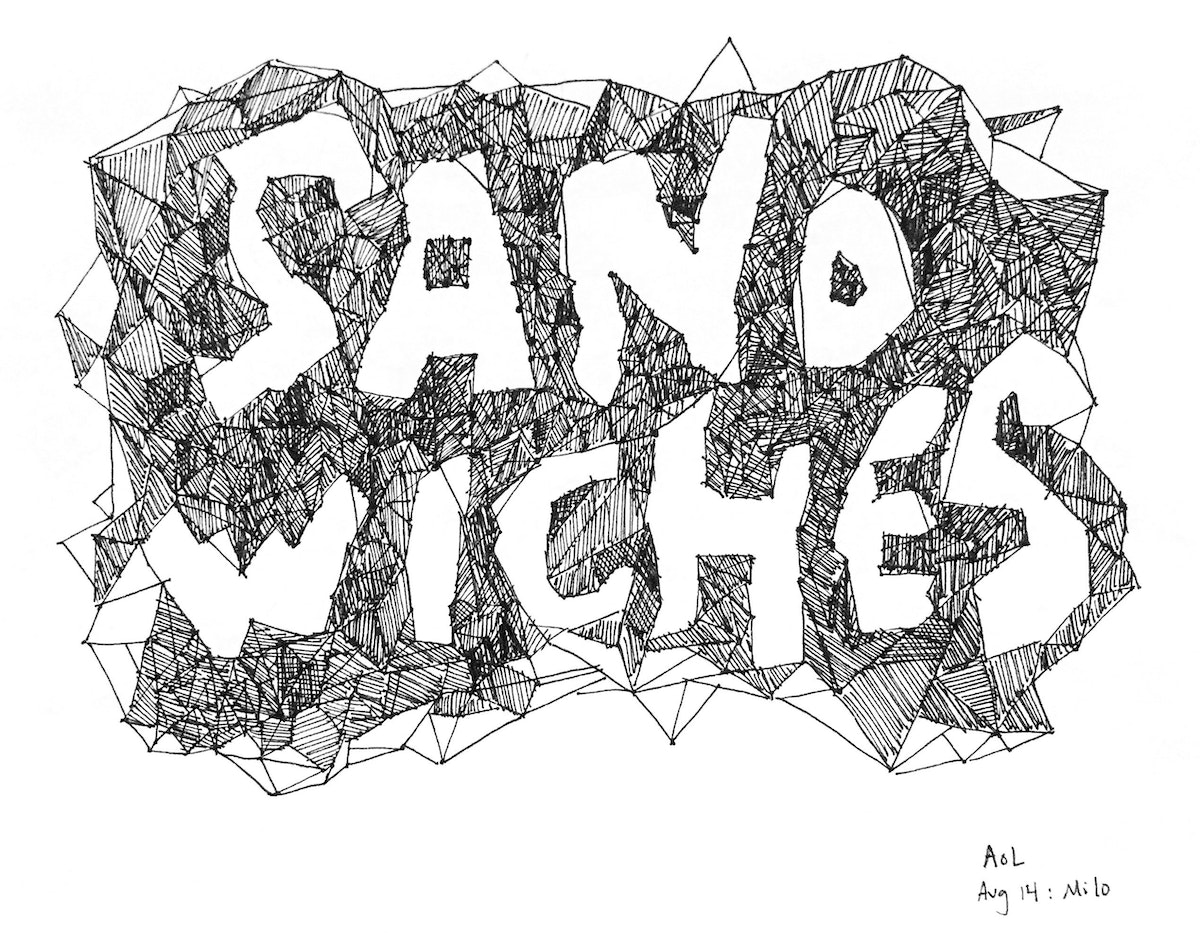

For the attendees, each event is just a short exercise in active listening. For me though, preparation includes several days of collecting and organizing all of the small things that will make up the event. The process isn’t unlike a design project—it can sometimes be all too easy to get wrapped up in the minutiae of day-to-day tasks as you’re working through them. Just as I’d been focused on individual songs rather than the album they were a part of, it’s important to take a step back from your work and try to look at the whole. Now, I try to keep an eye on the larger goal, and ask myself whether the things I’m diving into are in support of getting me there.

As I’ve continued developing Art of Listening, I’ve learned a few lessons that apply to other projects I’m working on:
1. Use subtle cues to guide behavior
By the time guests enter the space, seating has already been carefully arranged. I want to make sure there’s enough room for everyone, but I also want to encourage people to meet their neighbors.
2. People are human, leave room for the human stuff
At the first event, I was so excited for the listening that I didn’t leave room for a break before starting the music. Once the album finished, people ran out of the room, disrupting a key moment for discussion and reflection.
3. Build in opportunities for reflection and feedback
After the music had finished playing at the first event I was nervous to leave people sitting in silence. I resumed the ambient playlist from earlier in the night, only to find that it prevented people from freely sharing their reactions to what we had just heard.
4. Measure by more than just content alone
For me, Art of Listening is much more than just listening to an album in silence. It’s about the moments of surprise and delight as people learn more about the artist, and the connections that form when people physically come together in one space. I don’t measure a successful event by how good the album was, but by the experiences that people have.
5. See the forest from the trees
My goal with Art of Listening is to provide people an opportunity to pay attention and appreciate music in the format the artist had intended. To get there, I had to realize that the art form itself hadn’t changed, but that I had changed how I’d chosen to experience it.
A small group of people sit nestled together in a room. Some are concentrating, eyes closed; others are diligently writing or drawing in notebooks. A select few carefully bounce in place. Nobody speaks, but everyone is connected by a common thread—the music that fills the room. Together they are practicing the Art of Listening.

Lindsey Turner
I’m passionate about building brands, products, and experiences that help organizations show up with meaning and momentum.
I help organizations cut through complexity by shaping how they show up, through brand strategy, identity, and storytelling.
Working at the intersection of brand and business, I bring an editorial eye and a bias toward making—turning ideas into tangible experiences that people can understand, trust, and believe in.
My work spans government, healthcare, financial services, media, and consumer goods, from launching Gen Z-focused ventures to building innovation labs and reimagining legacy brands. I relish moments of ambiguity and enjoy translating across teams, perspectives, and priorities to move ideas forward.
I started my career in editorial and digital design, shaping cross-platform experiences and identity systems in publishing and agency environments. That foundation still shapes how I work today: I’m detail-oriented, collaborative, and overreliant on the Oxford comma. I hold a BFA in Visual Communication from the School of the Art Institute of Chicago.

Rachel Young
My work helps organizations see who their products aren't working for—and build the will and the tools to do something about it
For 25 years, I've asked the same question: Who does this design exclude—and what are we going to do about it?
My work spans human-centered strategy, inclusive design, and qualitative research, with clients ranging from Microsoft, Google, and Verizon to the National Science Foundation, and San Francisco Unified School District.
Before IDEO, I taught elementary school in East Palo Alto and spent a decade doing design work with social service organizations—where I learned firsthand what it costs people when systems are built without them in mind.
I am currently writing User Error, a nonfiction book about digital access and the design decisions behind it. I live in Oakland, California.

Brian Pelsoh
I lead with craft, ensuring our work is creatively excellent: rooted in deep human insight and imagination, while also grounded in the realities of business and technology.
My expertise spans brand, communication, and product design across tech, education, the arts, and social impact.
I believe great work demands both high-level vision and obsessive attention to detail, and only happens through collaboration.
I bring an inclusive, hands-on approach and a deep understanding of business, which enables me to consistently deliver excellence while always asking why.
Before joining IDEO, I worked at the brand firms Pentagram and VSA Partners. I began my career as a designer, leading teams at the School of the Art Institute of Chicago and the Milwaukee Art Museum. I hold an MFA in graphic design from Maryland Institute College of Art and a BFA in communication design from the Milwaukee Institute of Art & Design, and have taught at some of the best design schools in the US.

Tony Wong
I am responsible for IDEO’s long-term success in China and working with clients to use design as a tool to enable growth.
I am responsible for IDEO’s long-term success in China and working with clients to use design as a tool to enable growth. Specifically, I have helped Chinese companies design holistic brand solutions through the development of their products, communication, services, and innovation teams, and I have helped multinationals expand their presence and influence in China.
I advise global leaders on developing China-led innovation and capabilities.
In over 15 years in IDEO Shanghai, I have worked on projects that use design to elevate the quality of the experience of healthcare products and services, streamline processes that increase productivity, create spaces and programs that promote and enable inclusive communities, and build next generation mobility solutions that are planet-positive.
Before joining IDEO, I worked at Philips Electronics and the Electrolux Group in Italy, the Netherlands, and Singapore on a number of breakthrough commercial products. I am a member of the Young President Organization in Shanghai.

Building a personal AI for the messiness of life: Sida Li
Most AI products today are built for work—a space with clear problems and established systems. One founder noticed a gap: personal life is messier, harder to systematize, and mostly left behind by the AI boom. So she built Cue, a personal AI that lives inside iMessage and group chats, to go where the other tools haven't.
In this episode, Becca Carroll, IDEO's Chief Strategy Officer, talks with Sida Li, co-founder and CEO of Shared Context Lab, about staying anchored to a human need while the technology around her keeps changing shape, why she treats her business model with the same rigor she'd bring to a product, and what it feels like to build a company at this particular, disorienting moment in AI.
The conversation also gets into how Sida makes design decisions: the language Cue uses to describe itself, the tradeoffs behind building inside iMessage instead of a new app, and a real story about a business idea that didn’t pan out.
This is the second in a two-part series profiling founders from IDEO's Startups-in-Residence program. The first conversation is with Johannes Seemann, founder of Sooner, on designing GenAI for the emotional side of money.

Designing GenAI for the emotional side of money: Johannes Seemann
Most personal financial tools are built to run the numbers and optimize towards a budget. While that works for some, most people experience money as a lived relationship that does not neatly fit into a spreadsheet. Johannes Seemann and Becca Carroll discuss why money is emotional before it is mathematical, and what a human-centered approach to building a generative AI financial product looks like in practice.

The curious leader's edge in uncertainty: Scott Shigeoka
Mina Seetharaman talks with Scott Shigeoka, author of Seek and Head of Curiosity Cultivation at the Eames Institute, about what distinguishes genuinely curious leadership from performative curiosity, how power dynamics shape curiosity, and why practicing curiosity can restore energy rather than drain it.

How constraints make us more creative: David Epstein
Mina Seetharaman talks with David Epstein, author of Inside the Box and Range, about why total freedom often produces average work, how leaders can design useful limits on purpose, and what organizations such as General Magic and Pixar reveal about the relationship between boundaries and creativity.
Looks like you might be in search of something very specific?
Or reset the filters above and try another angle.
Here’s some random inspiration

Podcasts about creative leadership

Articles about the power of prototyping
