
.svg)




Connecting the underserved to the digital economy
Designing inclusive digital financial services for the last mile.
Money works differently in communities traditionally excluded from formal banking, which makes designing products that really serve their needs a very different kind of challenge. People who live in the last mile often prefer cash because it’s physical. They can see it, touch it, and access it at any time.
While digital money offers many benefits, such as securely sending money over long distances and accessing new forms of credit, many don’t trust it because the places where they can access digital currency have often been too far away.

In 2017, over 500 million adults lived more than three miles from a financial access point in eight emerging markets studied by the Gates Foundation. This may not sound like much of a barrier, but for those living in the last mile, it means having to close their shops, lose a day of earnings, arrange family care, and pay for travel, which can be time-consuming and difficult, especially during rainy seasons. For low-income people, the inaccessibility of financial services has been a deal-breaker for adopting digital money. On the flip side, banks, telecoms, and other companies struggled to reach these customers because their products were not inclusively designed for them, and their distribution models failed to scale in rural areas.

Amid these myriad challenges, IDEO and the Gates Foundation saw an opportunity to introduce innovative ways to provide access to digital financial services even in the most remote areas of the world. And to make bold new bets: Could we design new digital experiences centered around the financial needs of people in the last mile? What would happen if we mobilized hundreds of actors to develop new ways to address financial access at the last mile? What if we took the most exciting financial innovations that worked in East Africa and piloted them in South Asia—and vice versa?
Working with more than 70 partners, including local startups, corporations, including Google, Unilever, Telenor, Standard Chartered, and BNI, as well as IDEO.org’s Women & Money program, LMM adopted a collaborative, ecosystem approach to drive and scale new digital financial products and systems.
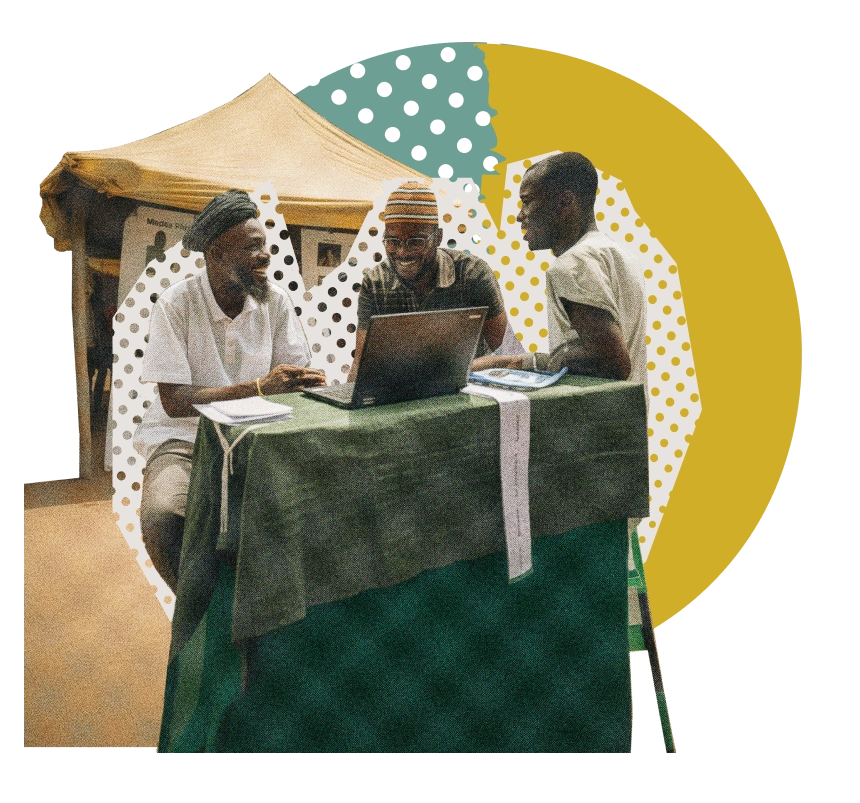
A few of the life-changing innovations launched by LMM and its partners include:
- Finja’s intuitive small-business app that helps micro-merchants in Pakistan access flexible, interest-avoiding Islamic credit to order products from fast-moving consumer goods companies like Unilever. Finja now serves 45,000 merchants and reaches 10.2 million customers.
- Accessing government benefits can be a challenge, especially when it’s through a mobile phone, so IDEO helped Indian startup Haqdarshak develop a robust digital experience for its 52,000 community agents to facilitate access for low-income people. The agent network—70 percent of whom are women—now serves more than 7.6 million families and has unlocked $2.2 billion in social benefits for those who need it most.
- Making micro-credit nearly instantaneous was a solution that startup Kuunda offered to financial agents in Tanzania. IDEO helped adapt the product to deliver working capital for merchants in Pakistan. Today, Kuunda continues to grow across markets in Africa, totaling 6.1 million active users and distributing $1.1 billion in loans globally.
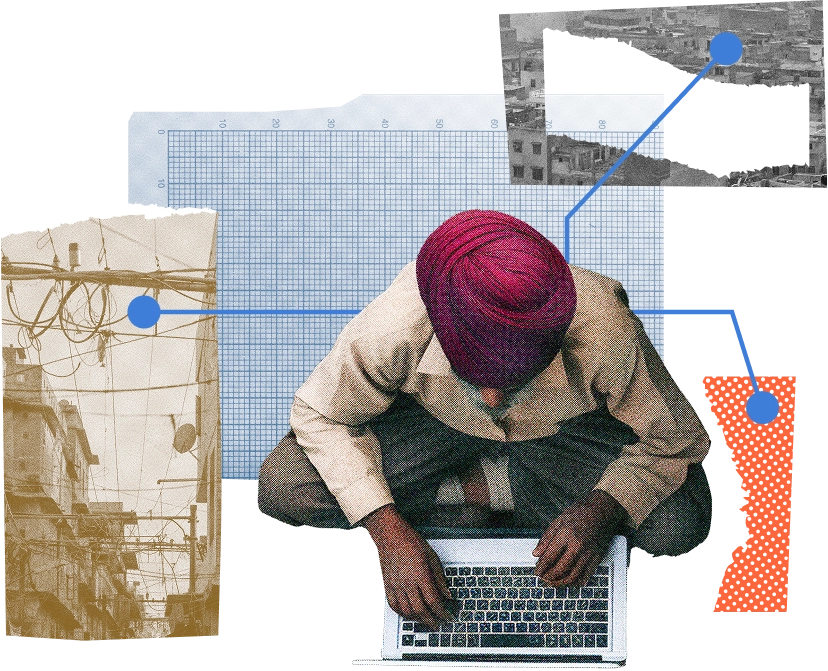
While the LMM program officially concluded in 2024, lessons, tools, and case studies from the program are accessible on IDEO’s Financial Futures website. Those looking to catalyze equity and inclusion in digital financial services for the last mile can consult LMM’s Financial Confidence Playbook, the open-source Digital Confidence Toolkit (created in collaboration with Google), or the Gender Evaluation Framework, among other helpful resources.
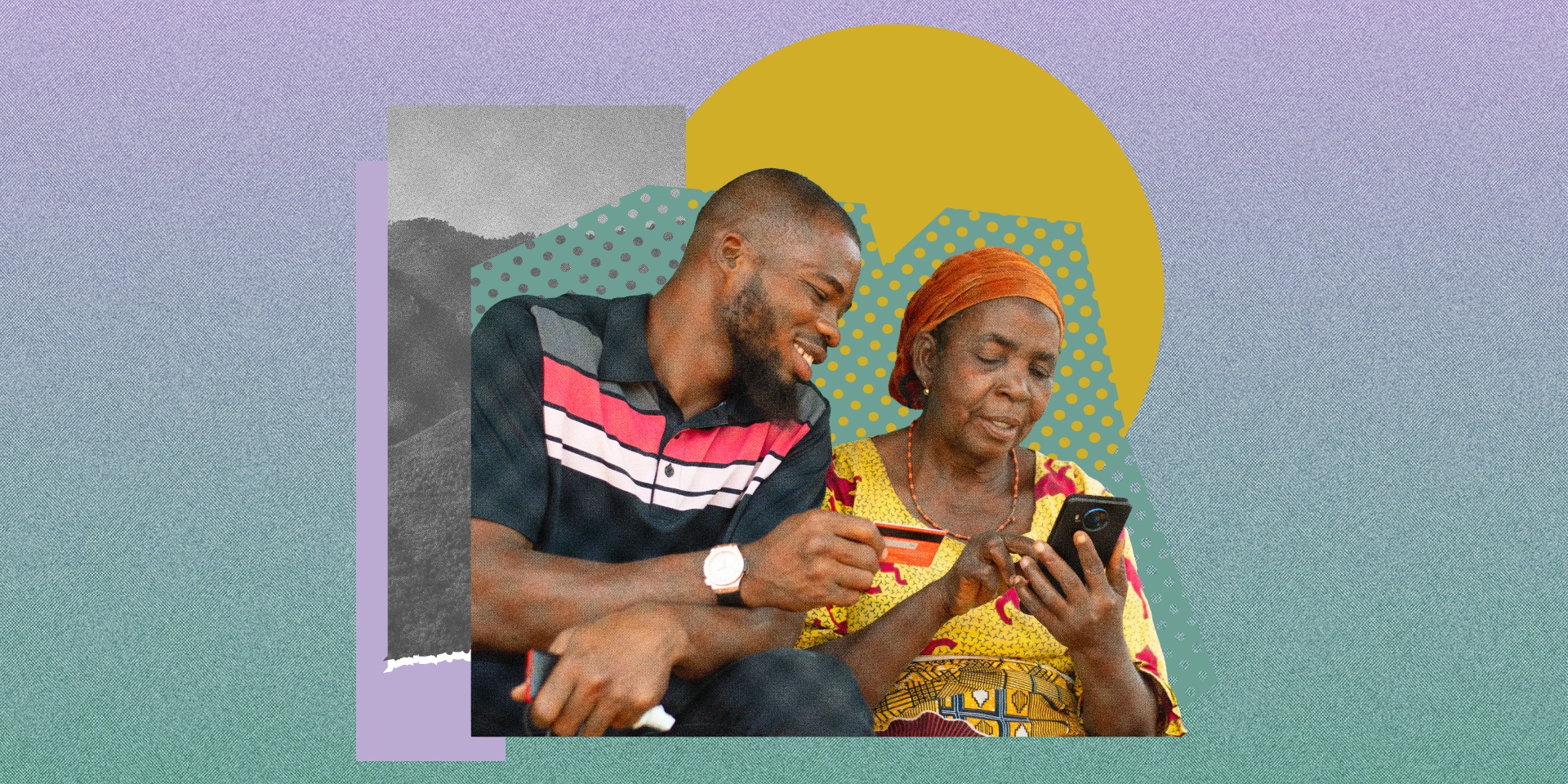
Over 1.3 billion people worldwide in poor and rural areas are excluded from formal financial services, including savings accounts, credit lines, and insurance, making it harder for them to move out of poverty.
34M
underserved users reached by 100+ new financial products, pilots, and prototypes
70+ LMM partners
including Google, Unilever, Grab, Standard Chartered, Cargill, Airtel, Celo Foundation, and BNI

Disrupting the beauty goliaths
How a new Peruvian brand overcame the odds—by design.
Multinational CPGs excel at creating popular, mass-market products for large countries. When they enter smaller countries like Peru, they often parachute their brands onto store shelves and skip consumer product testing altogether, largely relying on brand recognition to drive sales. This oversight presented Alicorp and IDEO with an opportunity: flip the script and invite young Peruvian women to work together with them to create a new hair care brand from scratch. Over the course of a four-year transformational journey, IDEO worked closely with Alicorp, adopting a “learn by doing” approach to foster a culture of innovation, launch a new brand, and drive growth for the company through consumer-centric design.
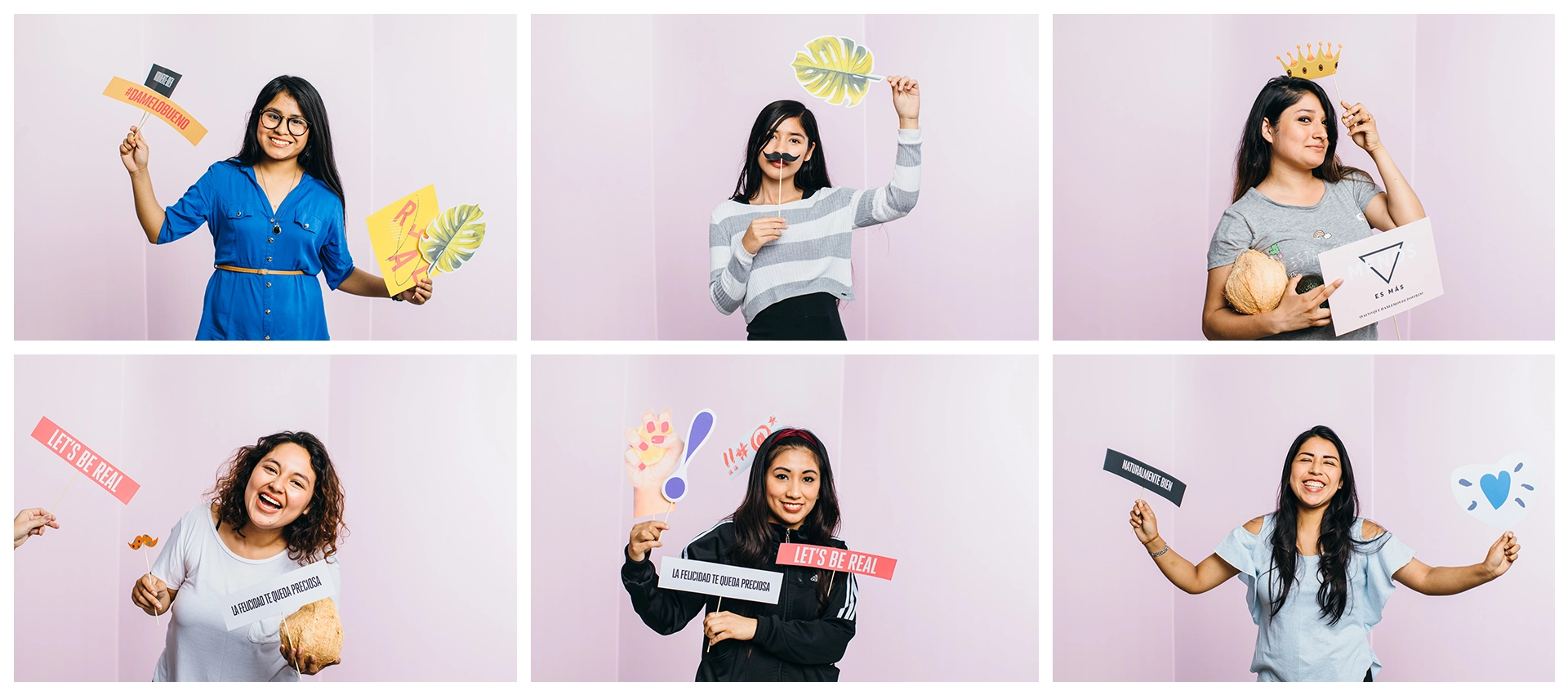
The collaboration began with an inspirational trip 10,000 miles away to Seoul, South Korea, the epicenter of global beauty trends. To expand their thinking, the Alicorp/IDEO team received K-Pop glow-ups and explored other cutting-edge beauty experiences. They were inspired by the Korean market’s unwavering focus on meeting the particular hair care and skin needs of Korean women.
Back in Peru, the team conducted multiple rounds of in-depth interviews with young women, teenagers, beauty influencers, and experts across the country. They learned about their beauty goals, personal care routines, and “mixto” hair texture. They heard about women’s struggles with regional weather—the Andean region’s extreme dryness versus Lima’s humidity and the city’s hard water. The research revealed that Peruvian women wanted natural products that worked hard, wouldn’t harm their hair, and celebrated what made them unique. They wanted a brand that spoke to them honestly and authentically. That represented and empowered them. That didn’t overpromise, underdeliver, or hold up European and American beauty ideals that didn't resonate with Latin American women like the multinationals did.
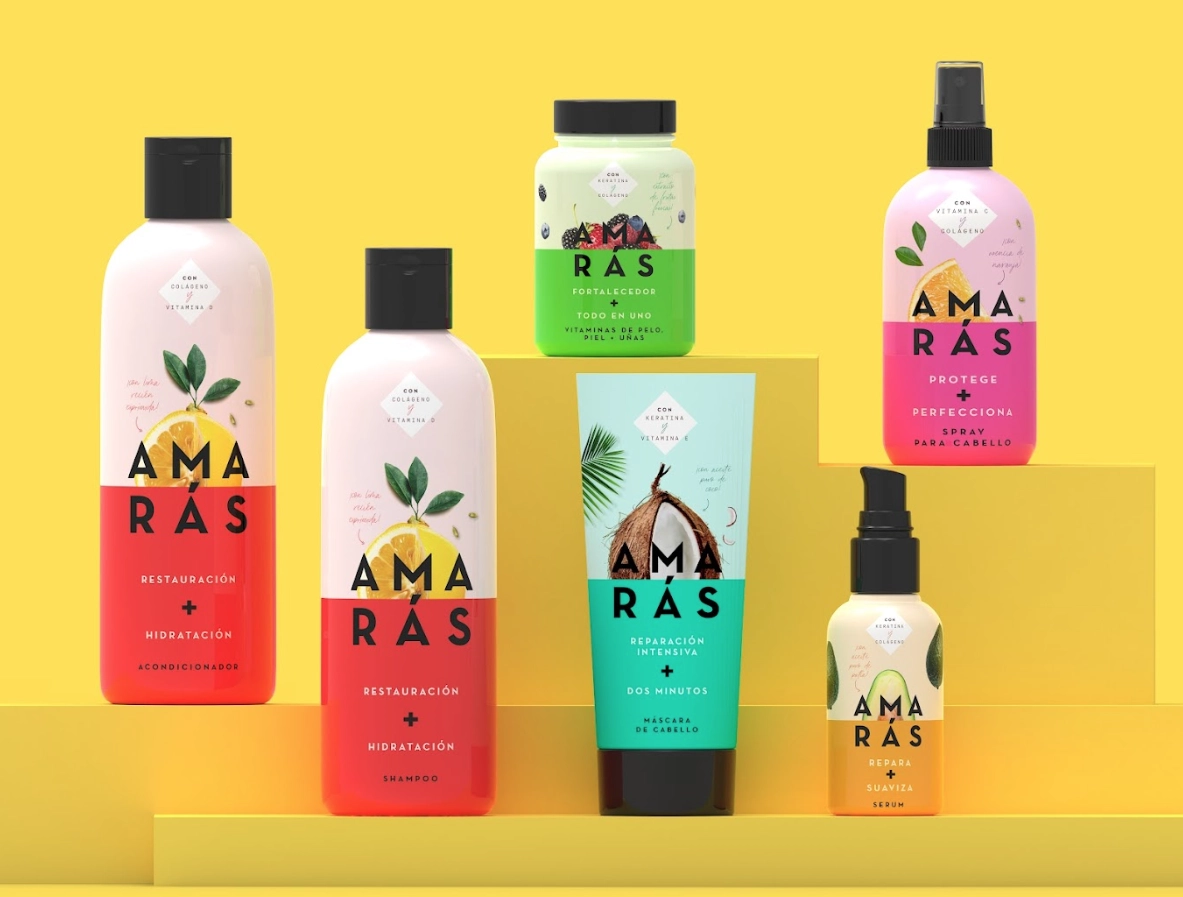
Armed with these insights, the Alicorp/IDEO team developed tangible brand prototypes for women to respond to during successive rounds of user research, including in a beauty pop-up store in Lima. The team shared various bottle types, ingredient mixtures, and brand positioning options. Should the new brand’s personality be an outspoken feminist or a gal pal? Au naturel or sophisticated? The iterative feedback cycles informed everything from brand strategy and ingredient recommendations to product line-up, brand and product naming, launch strategy, and digital activations.
The final design, Amarás (“you will love”), is a personal care line that centers the needs and aspirations of Peruvian women. Hitting shelves in 2022, its shampoos and conditioners feature local, bio-diverse ingredients, including mangoes, macadamia nuts, and goldenberries, that help address the specific hair texture needs of women in LATAM and the climate realities of the Andean region. The brand’s launch campaign included TV and print ads featuring Peruvian models from every region as well as commissioned murals celebrating local beauty by artists across Peru. Most notably, the unapologetically authentic Peruvian hair care brand became a TikTok sensation, garnering over seven million organic views and more than 300 viral videos from enthusiastic new fans.
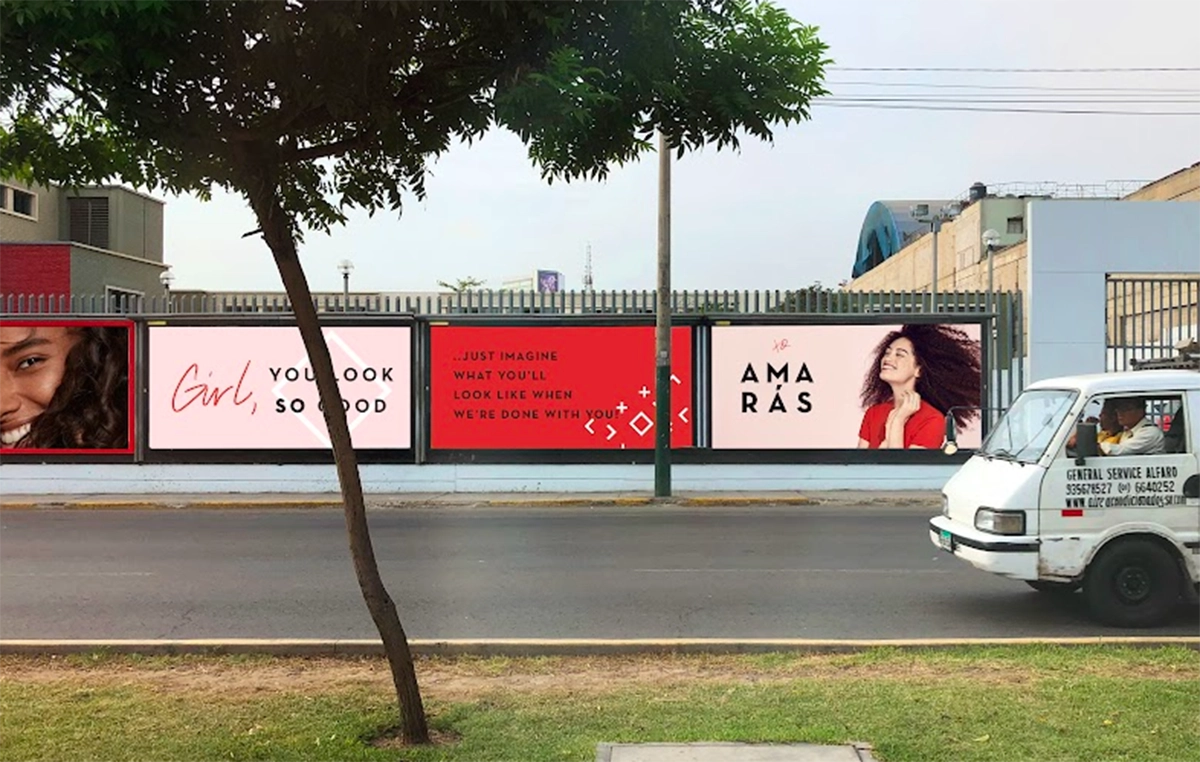
Three months after its launch, Amarás seized a 7.5 percent share of the personal care aisle—a remarkable goal it had set for year three.Since then, Alicorp has continued to expand its creative capabilities, designing personal care products tailored to the cultural and beauty needs of Latin American consumers.

Alicorp launched numerous successful brand extensions across its food and home care categories, but was unable to crack the $340M USD hair care product market in its home country of Peru.
7.5%
Amarás’ share of the Peruvian hair care market 3 months after launch—a goal Alicorp had set for year 3
7M+ organic views and 300+ organic fan videos
created on TikTok during Amarás’ launch campaign
Enhancing garment worker well-being with AI
Introducing Aitu, “Smart Machines, Uplifting People.”
Thirty years ago, China-based Jack Technology started as a home sewing machine manufacturer. A decade ago, the innovative global leader began investing in robotics and exploring AI, a decision that positioned it well to address today’s urgent need for smarter manufacturing solutions.
Believing that a new, strategically positioned sub-brand could draw in larger, more premium global manufacturing customers, Jack Technology and IDEO set out to understand their needs. IDEO began by visiting more than a dozen garment factories across China, Vietnam, and Bangladesh, conducting in-depth interviews with factory managers, industrial engineers, pattern-making leaders, and frontline workers. It soon became clear: the apparel manufacturing industry is at a critical juncture. The way apparel manufacturers navigate the promises of intelligent technology—while addressing deep-rooted structural issues like labor shortages and working conditions—will shape the industry's development for years to come.
For premium clothing brands, garment factory compliance and worker well-being are priorities when selecting production partners, so many owners proudly showcased their improvement efforts. They discussed investing in quieter machines and air conditioning, enhancing lighting, adding greenery, and implementing no-overtime policies. Amid rows of identical sewing stations, the IDEO team noticed small human gestures, such as a small vase of flowers. As one operator said, “I just want to uplift myself during work.”
The research helped IDEO identify a core opportunity for differentiation. Create human-centered products and services that further enhance working conditions in large apparel factories, strengthen their ability to attract and retain talent, and drive the industry toward a more sustainable future. Through multiple rounds of co-creation with the Jack Technology team and key apparel-sector stakeholders, a clear brand direction for Aitu began to take shape: “Smart Machines, Uplifting People.”
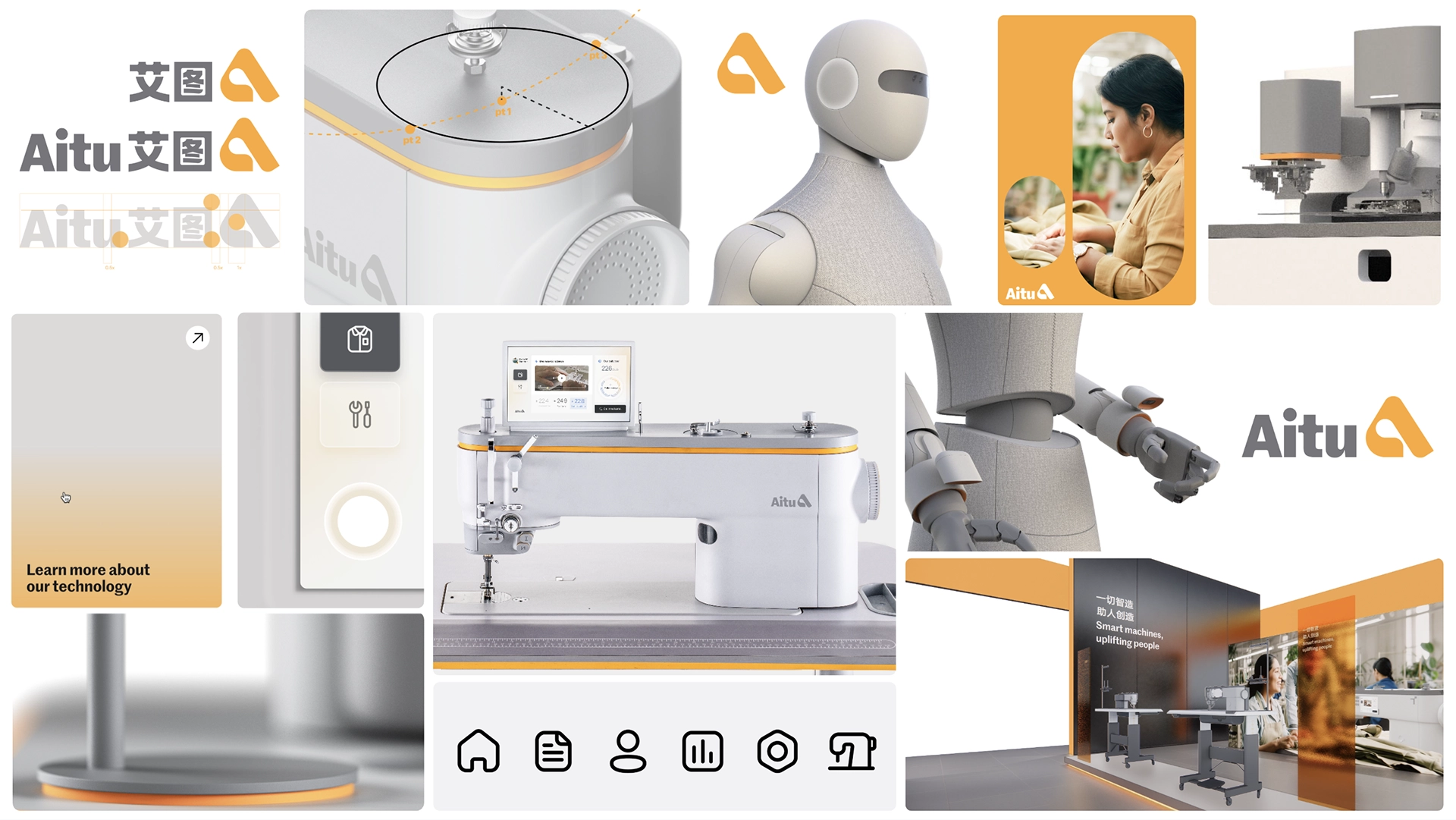
Guided by this human-centered ethos, IDEO helped build a comprehensive brand system for Aitu. The idea of “uplifting people” and showcasing garment workers’ professionalism and skill is expressed throughout all brand communications, the industrial design of its smart sewing machines, and the interaction and industrial design of a humanoid sewing robot.
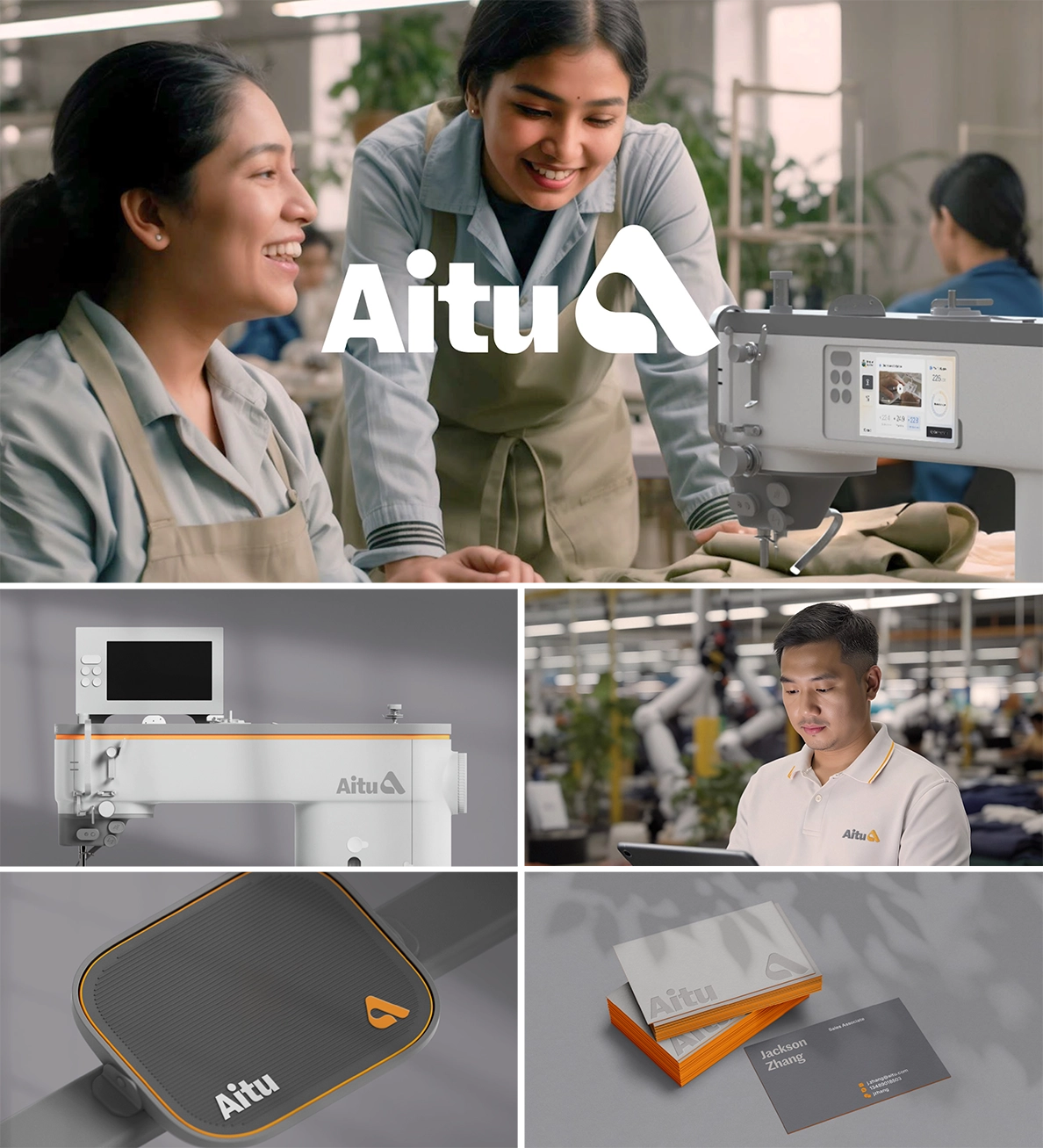
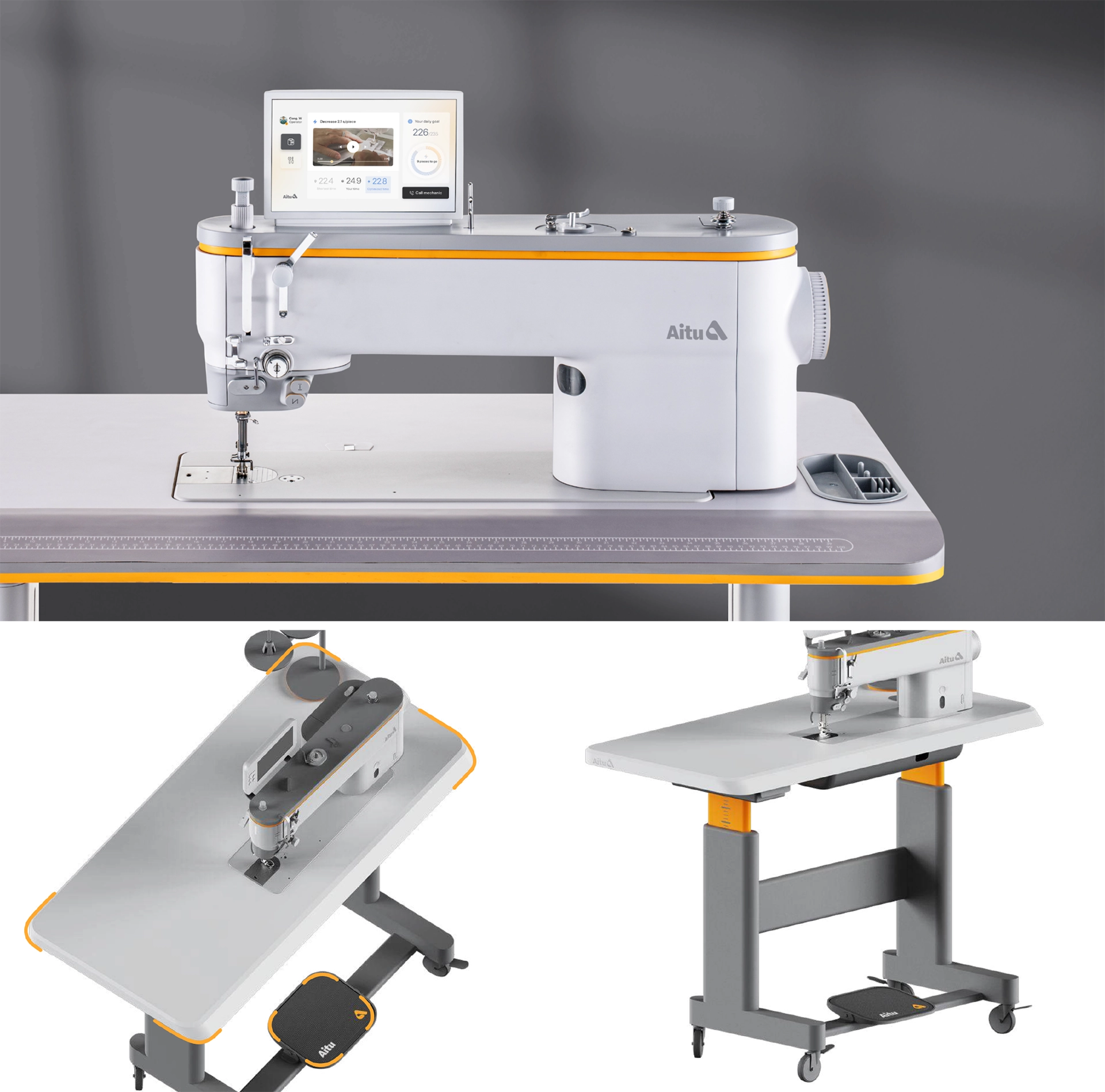
In the eyes of factory workers, this is the new work experience Aitu brings to life. Compared with traditional bulky industrial machinery, the clean lines and soft edges of Aitu’s new AI-powered sewing machines feel more like the professional office tools found in bright, organized workplaces. Concave surfaces and soft materials diffuse glare from overhead lighting, reducing eye strain, while clear interaction logic and icon-based visuals accommodate operators with varying levels of skill and education. AI technology, seamlessly embedded in the machine’s core functions, automatically adjusts parameters for different fabrics and tasks, allowing operators to achieve high-precision results with less effort. A soft halo-like light glows whenever the AI-assisted function is active, fostering users’ trust in both the technology and the AI-powered sewing machine as a whole. When hundreds or thousands of Aitu machines are arranged together in a factory, the overall effect is a modern, professional, and high-end work environment.
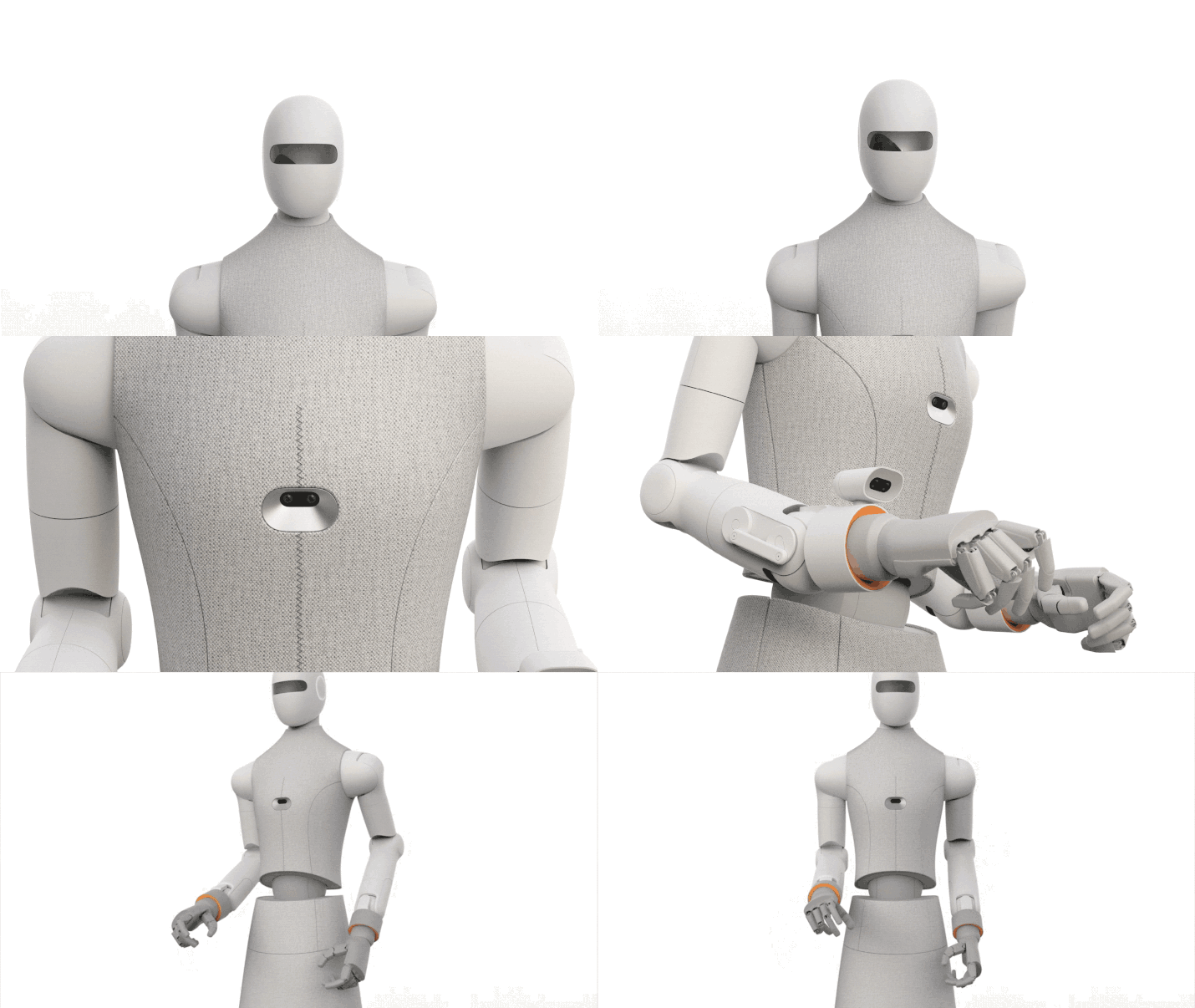
Working closely with Aitu’s robotics team, IDEO’s final design challenge was to bring a human-machine collaboration to life through a full-scale AI robot, AI10. The robot has an elegant, biomimetic silhouette. Its fabric-like outer finish features design elements commonly found in garment making, such as cutting and stitching lines, giving the robot the approachable look and the feel of a skilled tailor companion who can assist with simple, repetitive tasks. When AI10 is in operation, a circular light ring gently pulses at the sides of the robot’s ears as well as on the paired sewing machine’s display screen, clearly signaling the robot’s activity to its human co-workers.

In September 2025, Jack Technology debuted its new Aitu brand, along with its first AI sewing machine and a humanoid robot prototype, at a launch event at Shanghai Tower and at the China International Sewing Machine & Accessories Show. IFA Berlin, Europe’s largest trade show for consumer electronics, honored Aitu with a Gold Award for AI Product Innovation for seamlessly integrating AI technology and industrial design. Jack Technology’s humanoid robot is expected to go into full-scale production in 2026.
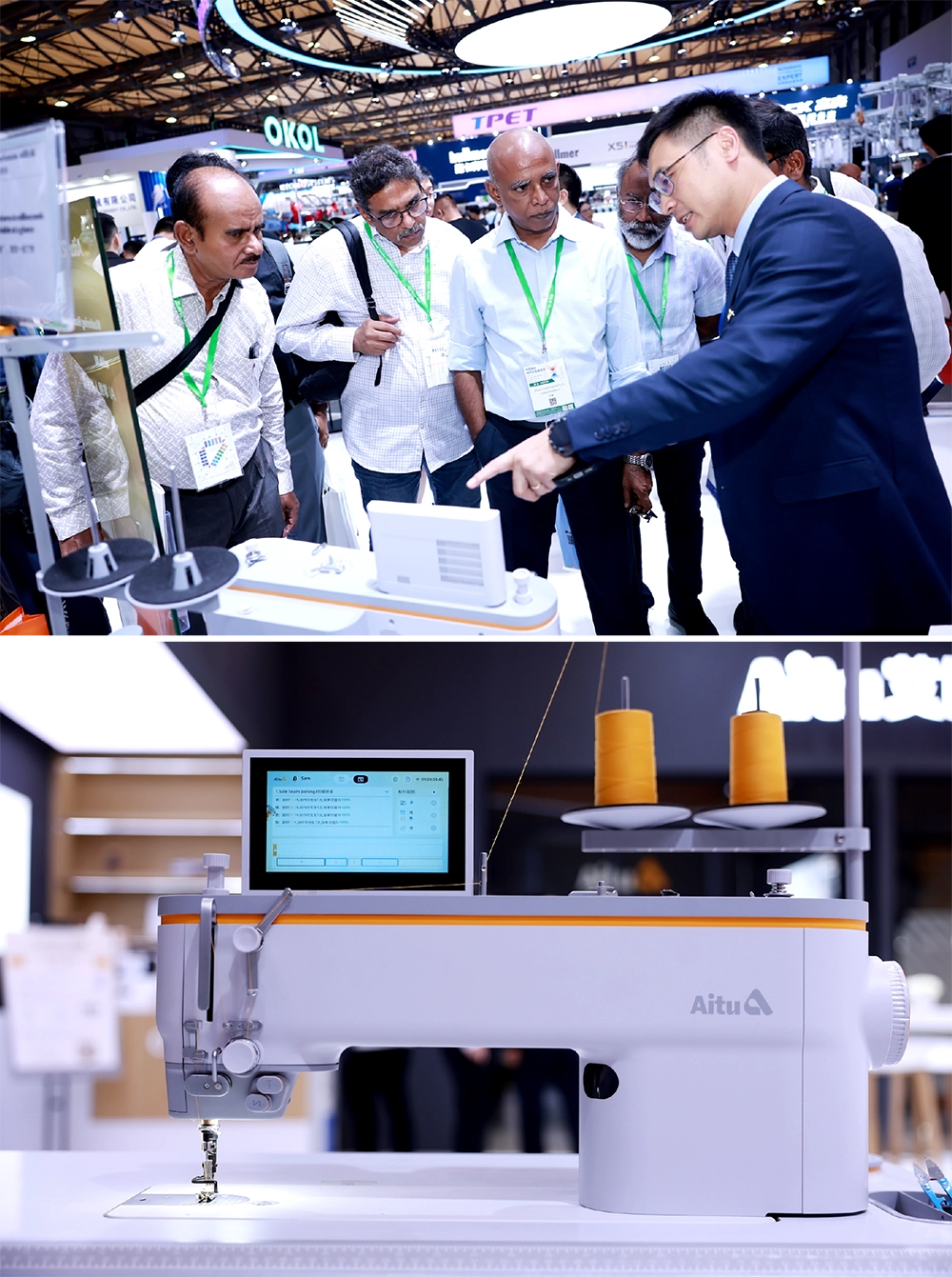
Before AI, the apparel manufacturing industry had experienced little fundamental change since the invention of the lockstitch sewing machine nearly two centuries ago.
2025 Gold Award for AI Product Innovation
from IFA, the world’s largest home and consumer tech event
Helping Peru’s top hot sauce find US success
Introducing Tari, a flavorful new kick for everyday American foods.
Alicorp has direct operations in Peru, Bolivia, Ecuador, and Chile, manages export operations in more than 30 countries, and oversees over 150 brands. While its AlaCena sauces are ubiquitous in South America, the brand’s North American market primarily consisted of purchases made via Amazon by Peruvians living abroad. To help the CPG giant expand meaningfully and sustainably onto US grocery shelves—and achieve its ambitious $50 million retail sales goal in five years—Alicorp and IDEO collaborated on multiple projects over a two-year period. The partnership began in early 2020 with consumer research and product strategy, ultimately leading to the development of initial product branding, positioning for launch, and an in-market pilot in late 2021.
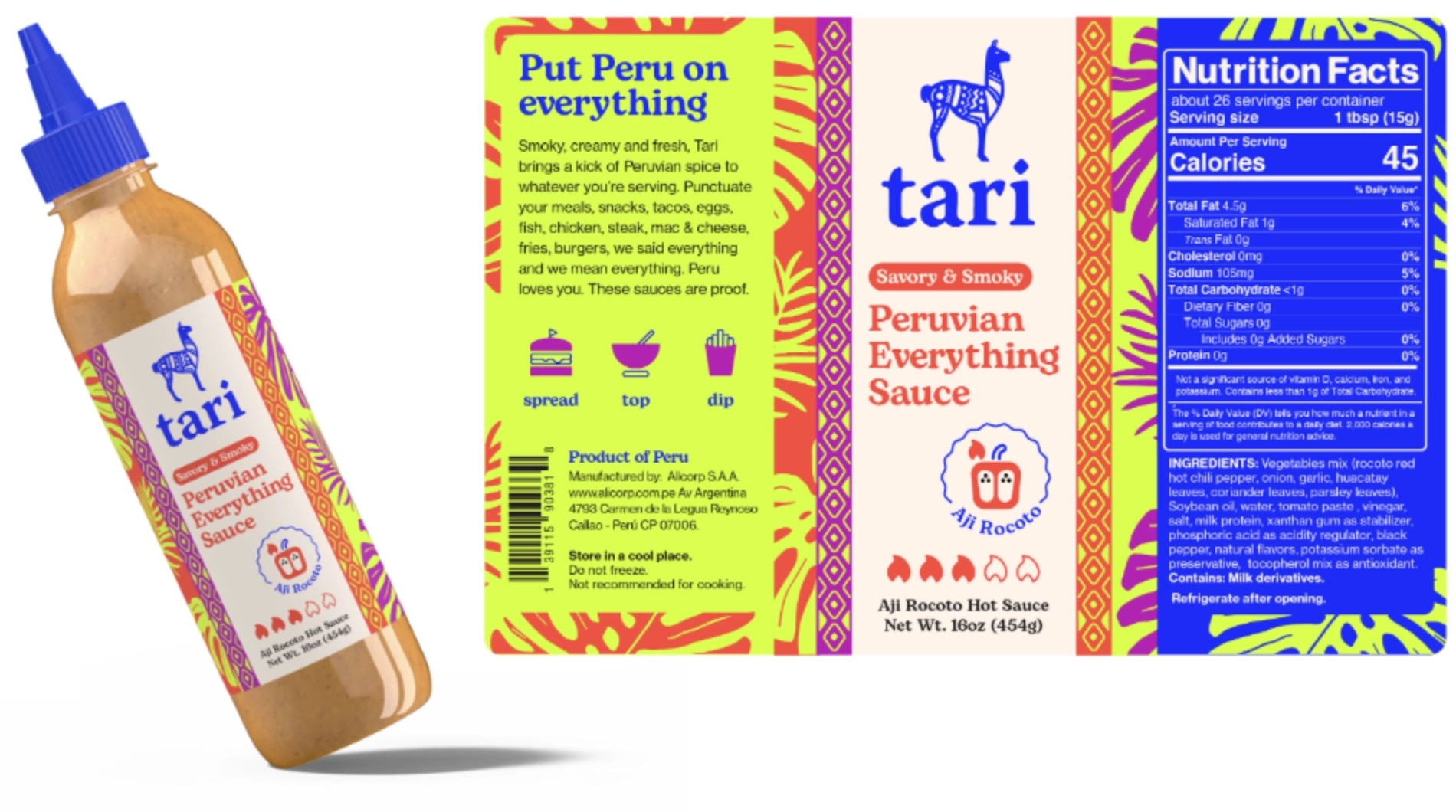
Through a combination of large-scale digital surveys and in-depth, in-person and remote research interviews, IDEO discovered that AlaCena’s Tari and Uchucuta’s hot sauce recipes resonated the most with US consumers. Made from native Aji Amarillo and Rocoto chili peppers ground using a traditional Andean “batán” technique, consumers appreciated their complex flavors and enjoyed how they enhanced, not overpowered, everyday foods like burgers and fries. The sauces’ authentic Peruvian culinary roots were also a key differentiator. In addition to consumers, IDEO consulted with industry experts—including executives from large-scale grocery chains and chief merchants of leading big-box stores—to explore retail and marketing trends and identify potential innovation partners for Alicorp in the US.
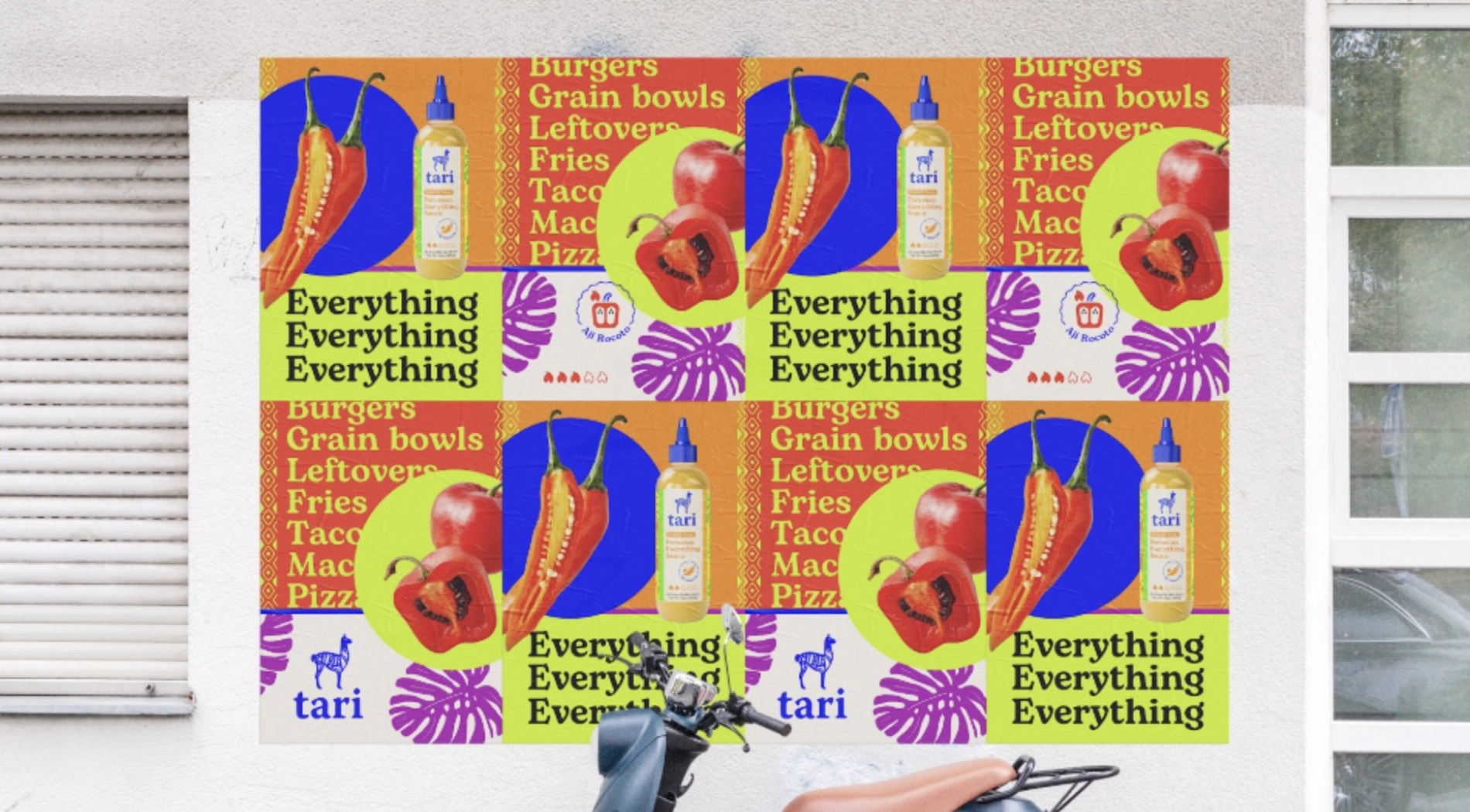
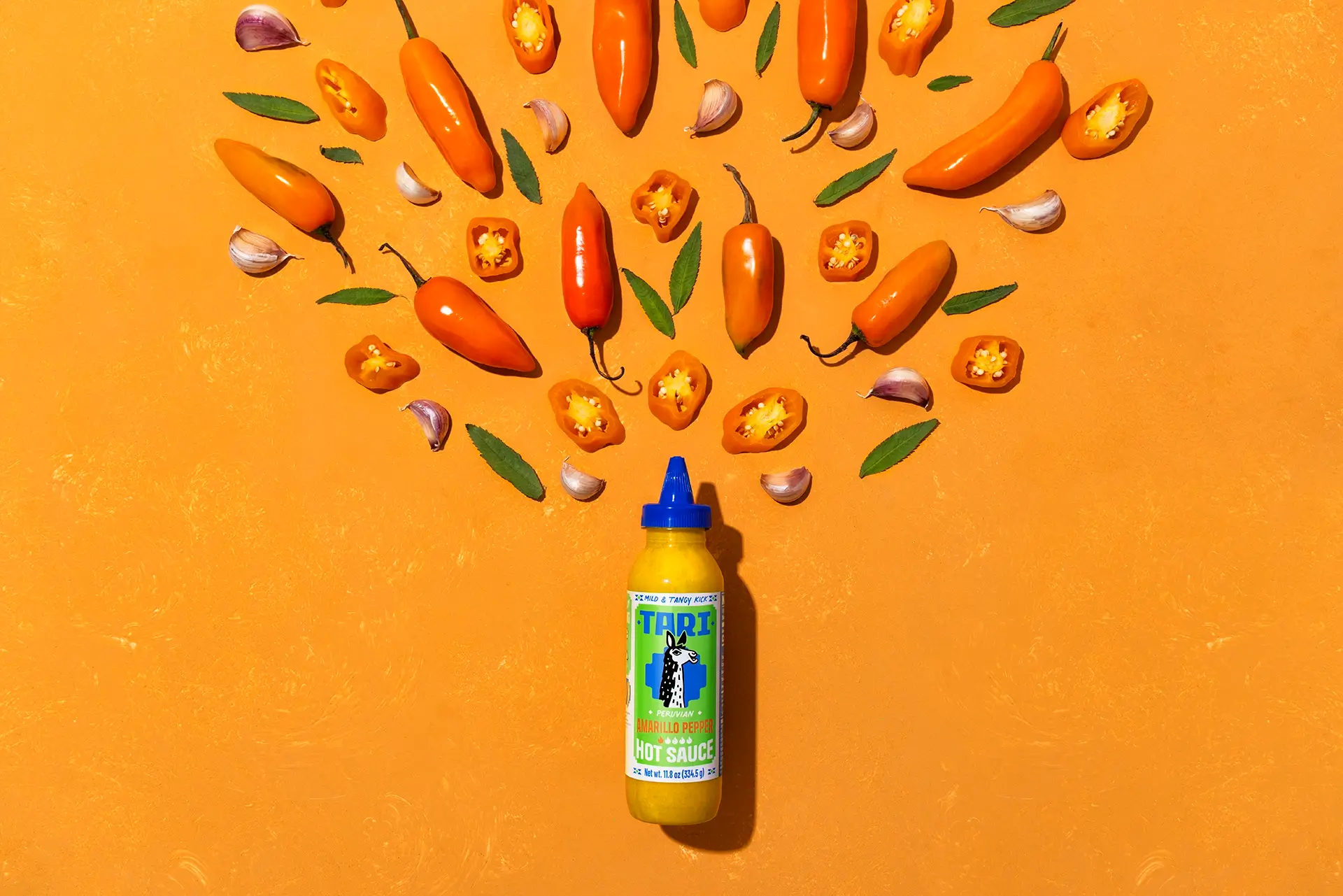
Based on the research, IDEO recommended a few changes to ensure a successful launch: Lead with the Tari brand, which was the most memorable and easiest to pronounce, and position it as an “everything sauce.” Change the packaging from a large plastic pouch to a smaller squeeze bottle to better align with consumers’ expectations and stand out on the inside of refrigerator doors. Adjust the product formulation to appeal to mainstream consumers looking for cleaner labels. And visually celebrate Tari’s Peruvian roots through bright colors, traditional textiles, and a llama, an animal closely associated with the Andes Mountains. In addition to these recommendations, IDEO provided a comprehensive go-to-market retail strategy that included potential US regions for launch, retail brokers, distributors, manufacturers, and R&D and pilot retail lab partners, as well as job descriptions for a new North American-based sales team.
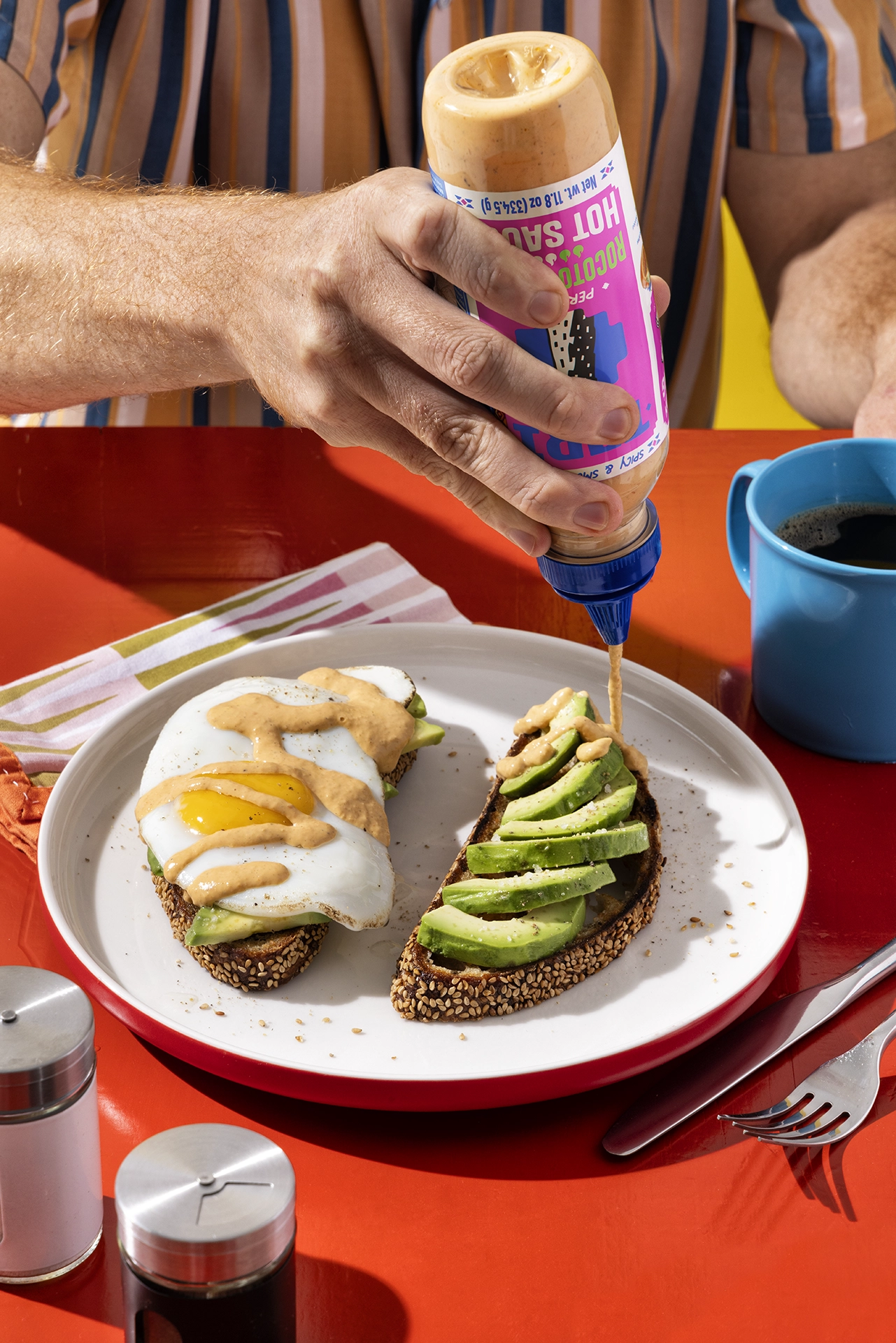
While Alicorp worked on reformulation and packaging strategies, IDEO refined Tari’s initial branding strategy. Steeped in Peruvian aesthetics, the brand’s new look and feel featured a vibrant color palette, geometric patterns, and—of course—a friendly llama icon, which could also be found on all in-store point-of-sale items IDEO designed for Tari's pilot launch in late 2021.
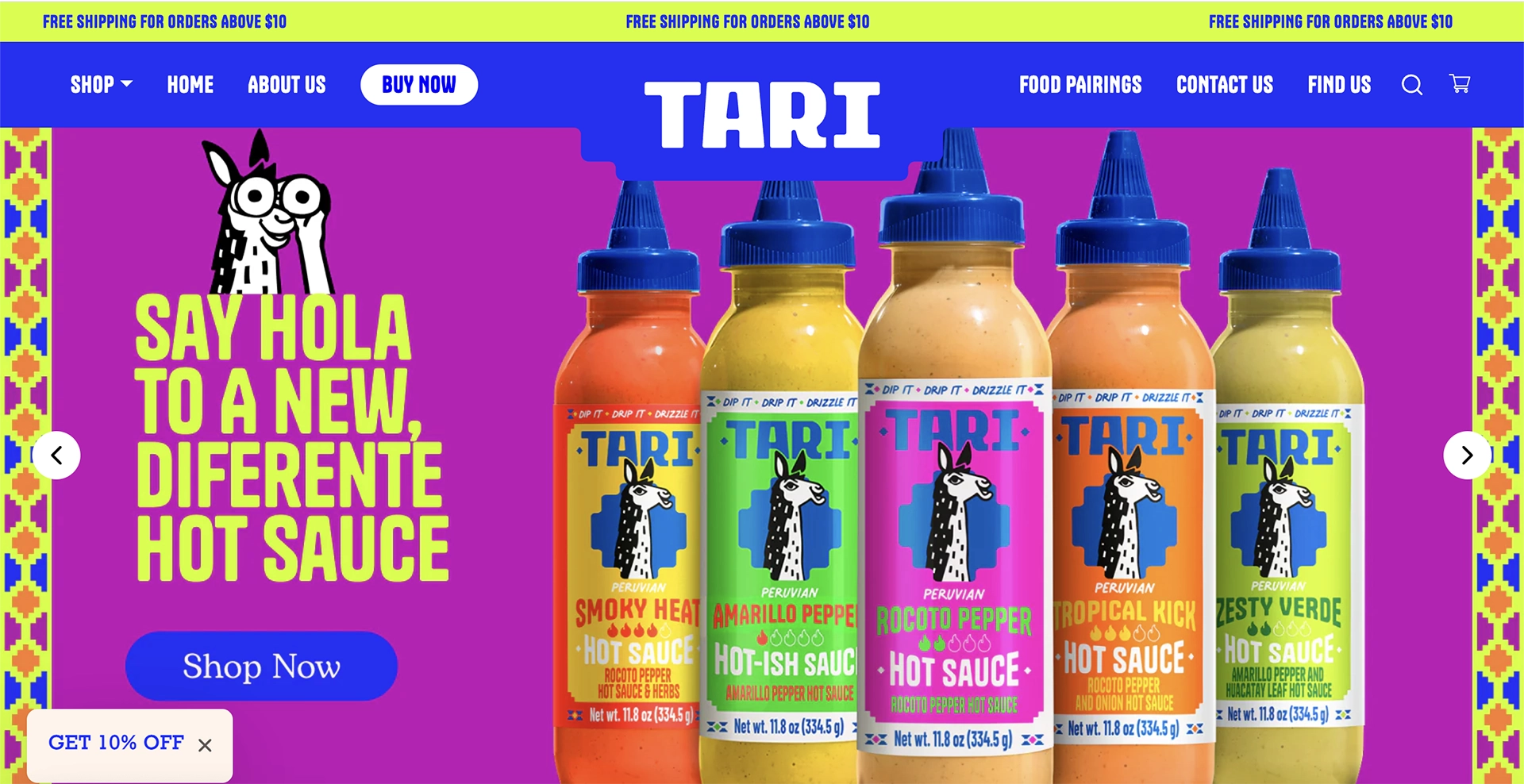
The successful 12-week in-market pilot in Tom Thumb grocery stores gave Alicorp the confidence to have its in-house design team make the brand even bolder and more eye catching, and to launch two flavors, Amarillo Pepper and Rocoto Pepper, on Amazon and in over 50 retail stores in late 2024.
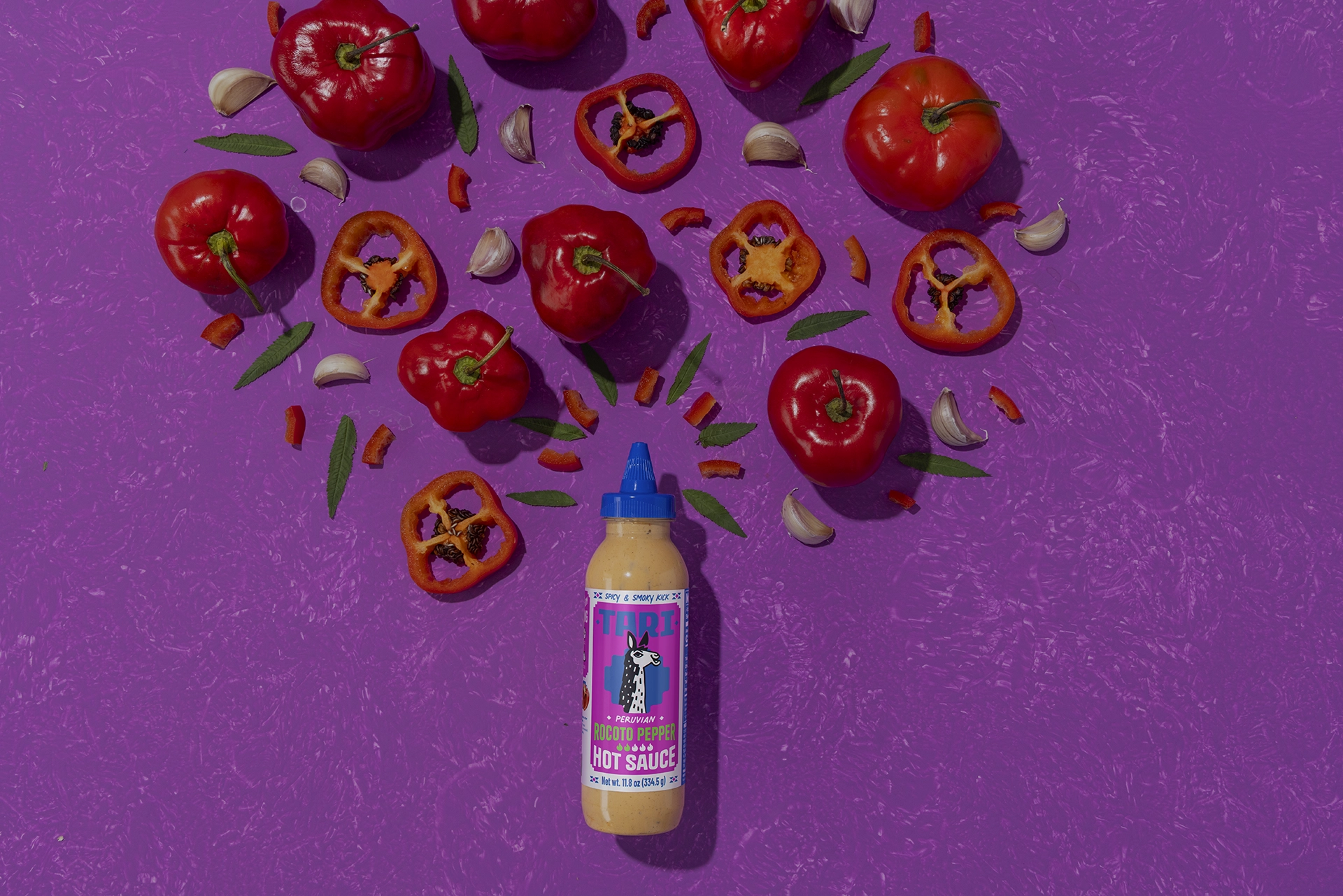
Since then, the popular sauces consistently rank among the top 50 percent of the fastest-selling products on US shelves, with 80 percent of sales revenue representing new business. In 2025, Tari expanded its offerings with three additional flavors: Zesty Verde, Tropical Kick, and Smoky Heat. Today, Tari is in transit to 3,000 major grocery stores, including Wegmans, Meijer, Central Market, and The Fresh Market, as well as available for purchase on Amazon.
Alicorp had a vision to expand its beloved and delicious hot sauces to the US market, but needed help fine-tuning the brand and product for an American audience.
3,000
major US grocers, including Wegmans and Meijer, have signed on to sell Tari hot sauces
80%
of Tari’s sales revenue represents new business, a significant expansion of the overall category
Ranked in the top 50%
of the fastest-selling products on US grocery shelves
Designing a kitchen-leftovers spy cam
An experimental office prototype makes sure we never miss out on a snack.
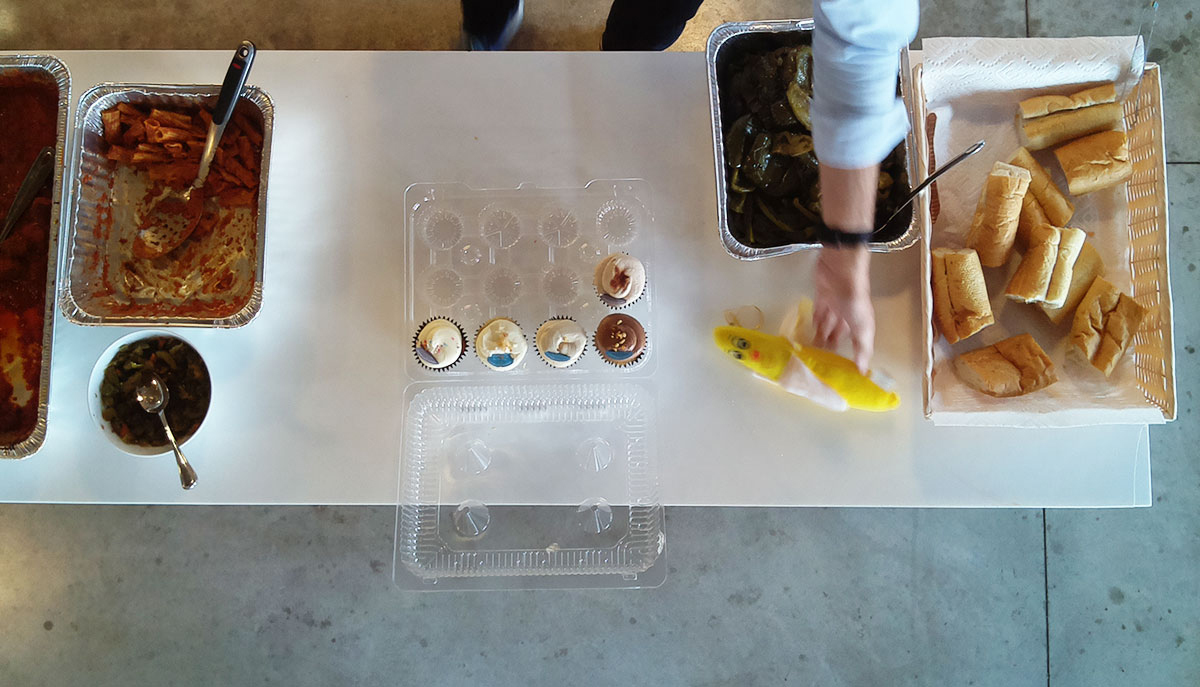
So why not have a camera provide a live feed of the spot where food is left when it’s up for grabs, so everybody can know when it’s time to raid the kitchen? Having recently worked on a project that explored embedding sensors and technology into living and working spaces, I was inspired by the Food Cam. I was also itching to learn how to prototype using a Raspberry Pi, so when I returned to IDEO Chicago, I hacked together a very similar version to install in our kitchen, with the addition of a fun little twist to make it our own.
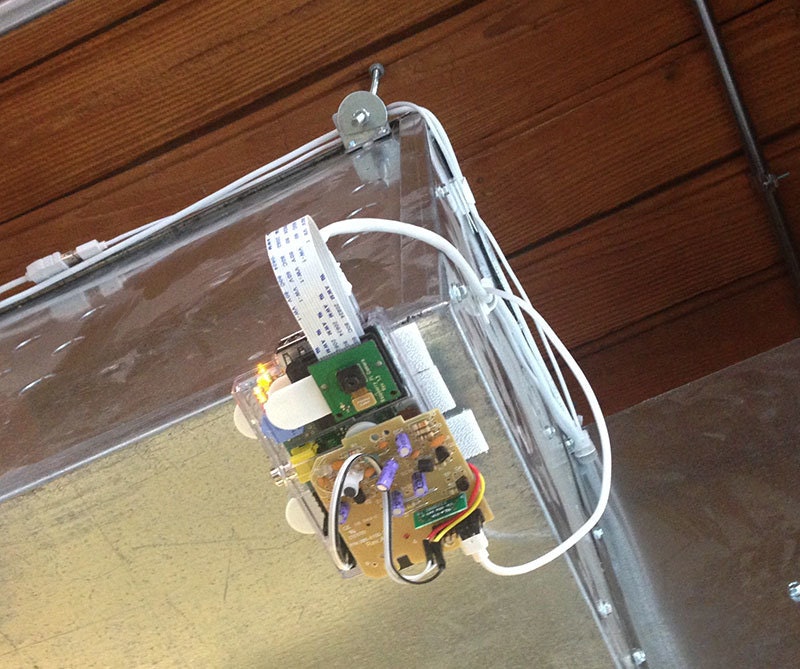
I took a Raspberry Pi with a camera module and Velcro-ed it right above the kitchen counter where we typically put leftover food. I cobbled together some Python code from various examples I found online so that with the push of a button, the camera takes an image of whatever is on the counter and emails the photo to the whole office.
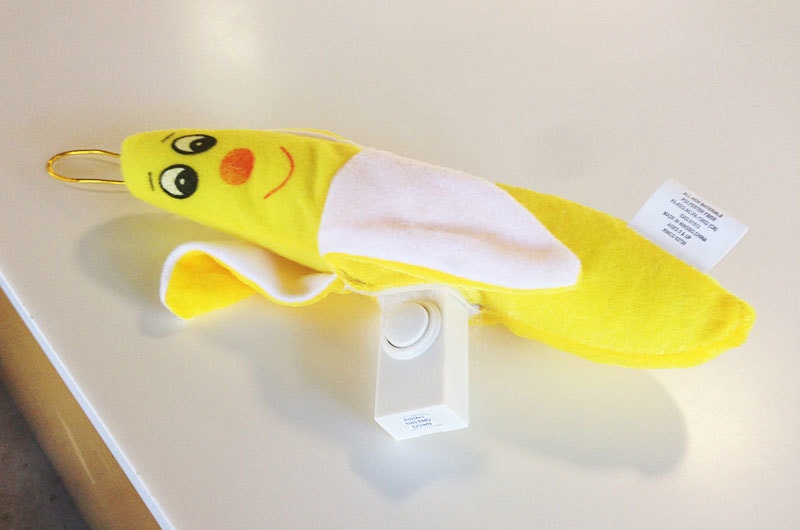
The signature twist was making the button wireless by hacking a remote doorbell chime I picked up at the hardware store. Then, in order to give this prototype some personality, I bought a stuffed banana and sewed the remote doorbell button into it. Behold, the BananaCam! Now, whenever someone leaves leftovers out in the kitchen, they can just squeeze the banana and let the office know exactly what’s on offer. It’s our version of ringing the dinner bell.
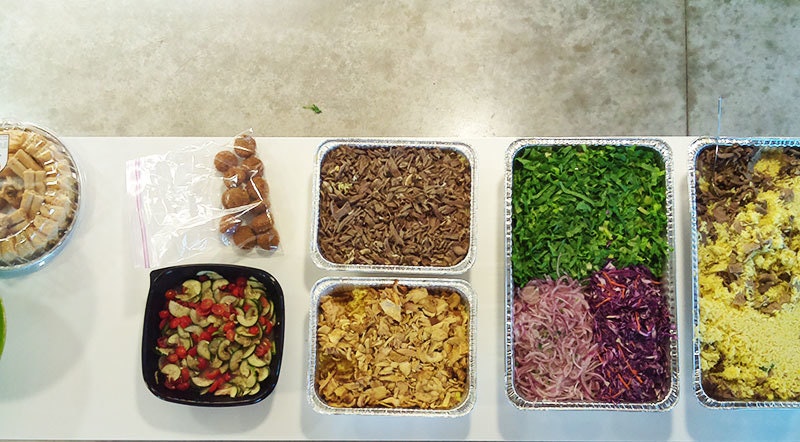

The best part about this was building something in the office just for fun, to see if people would like it enough to use it. As with any prototype, if people like using it, it will stick around. If it’s not that interesting or useful, it will collect dust, parts of it will get lost, and eventually, it will be taken down. We’ll see what happens with the BananaCam.
Everyone here likes to build things, and it's important that we don't see the office environment as too precious to tinker with. That's why we're always experimenting with new technologies and encouraging people to play around and see how they work.
Thanks to my BananaCam collaborators Garrett Winther, Emily Lam, and Julia Nacsa!
On a recent recruiting trip to MIT, I took a tour of the Media Lab. There’s no shortage of cool things to see there, but what caught my eye was their Food Cam. The idea is simple: there are leftovers in the kitchen all the time, but people only notice them if they happen to wander past or if they see a colleague eating something tasty.
The Best Way to Complain is to Make Things
How my unwavering insistence upon Internet privacy led me to create my first Chrome extension
To guard against tracking and malvertising, I use quite a few Chrome extensions:
- uBlock
- Collusion for Chrome
- Disconnect
- Facebook AdBlock
- Facebook Ads Remover
- HTTPS Everywhere
- IBA Opt-out (by Google)
- Keep My Opt-Outs
- Privacy Badger
- ScrewAds Plus for YouTube
The issue with many of these extensions, however, is that they tend to be a touch overzealous about what they block webpages from serving. For the average user, this can be a regular nuisance; as a developer, it's anathema to your workflow.
An interim resolution, hardly a solution
Unless explicitly specified in chrome://extensions/ via the “allow in incognito” option, extensions are, by default, disabled in Chrome's incognito mode. As a result, a series of five key commands had become nothing short of a reflex action for me whenever it appeared as though content might be missing from a page:
- ⌘ + L (highlight the current URL in the omnibar)
- ⌘ + C (copy URL to clipboard)
- ⌘ + shift + N (open new incognito window)
- ⌘ + V (paste URL from clipboard)
- enter (load URL in incognito window)
As a developer and no stranger to the command line, I use keyboard commands and shortcuts whenever possible. Because of this, I had become pretty quick at performing the above sequence. But when you've clicked within a video or any such action that shifts keyboard focus from the browser to a plugin, the sequence can no longer be quickly performed.
Moreover, as a product designer, I knew I wanted a better user experience for this set of actions; specifically, I wanted a one-step process. As my desire for a solution mounted, so did the frequency with which I complained about this broken workflow to my colleagues.
Stop critiquing, start creating
Recently, my wonderfully talented colleague and friend, Simon King, wrote a piece with the above title about an iOS app he created called News Now. In the article, he explains how his frustration with the irregular listening experience of the official NPR app led him to create News Now. He also includes a quote from LCD Soundsystem's venerable frontman, which every designer should take on as a personal mantra:
The best way to complain is to make things.
James Murphy
With the above mantra in mind, along with a suggestion from Simon himself that I might explore a browser extension as a solution, I set out to solve my problem. A quick perusal of the developer documentation for Chrome extensions led me to chrome.window.create—a method that accepts an optional incognito parameter — and I knew I was good to go.
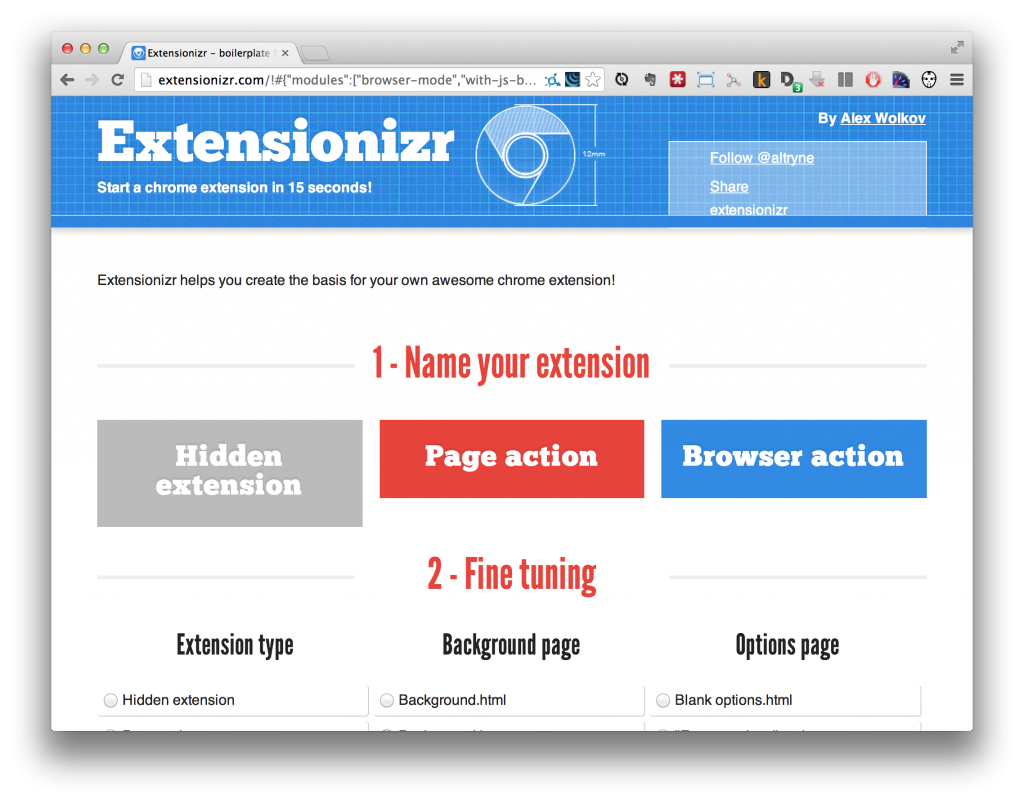
Next step: How to create an extension? My research immediately led me to the excellent Extensionizr, an open-source boilerplate generator for Chrome extensions. Through helpful tooltips for each of the many options, I learned I needed a browser action, background.js event page, permissions to access the browser's open tabs, and no options, overrides, content scripts, or add-ons.
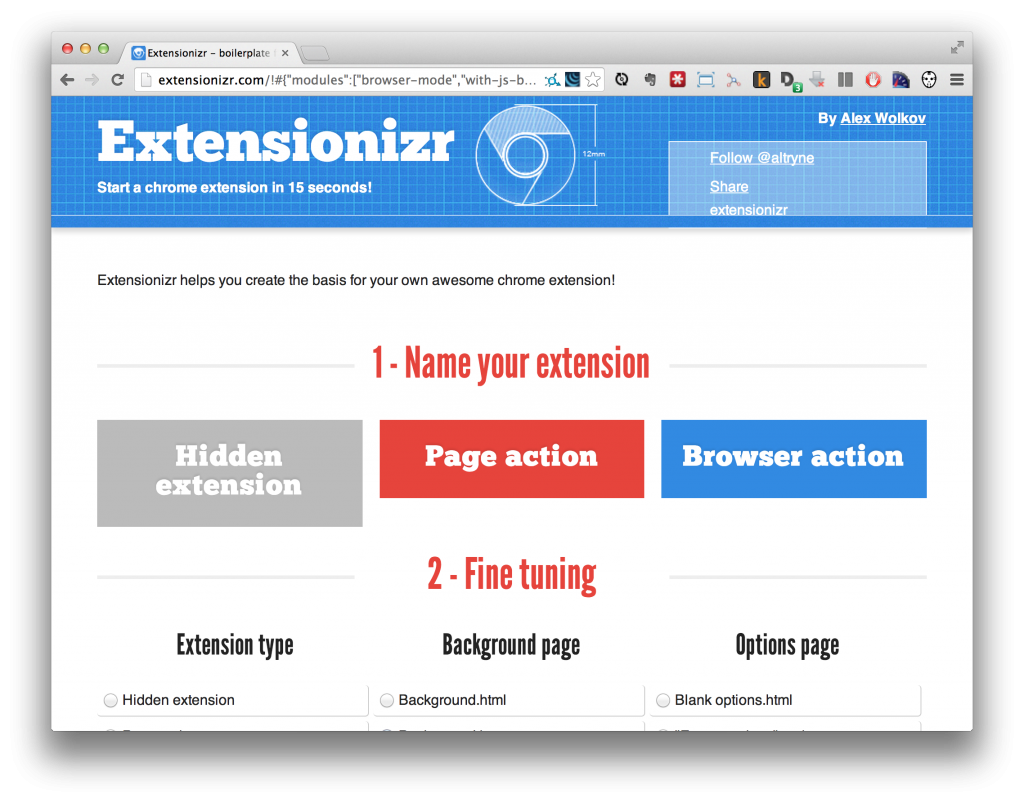
A press of the “Download it!“ button and a few lines of JavaScript later, my issue was solved and I had written my first Chrome extension. All that was left was to follow Google's instructions on packaging and uploading, and a few minutes later, my work was live in the Chrome Web Store:

A happy accident
As it turns out, opening a page in incognito mode initiates a new browser session in which you are logged out of every account. This enables you to quickly browse a site outside of your filter bubble and compare it to the page you see when logged in.
Shoutouts
It goes without saying that I owe a huge thanks to Simon both for his inspiration and his suggestions.
Thanks also to Alex Wolkov, the developer behind the awesome Extensionizr. If ever you're writing a Chrome extension, this boilerplate generator will save you quite a lot of time.
In need of an icon for my extension, I turned to the excellent Noun Project. I knew I wanted to use a mask icon to visually reference Chrome's incognito mode, and the Noun Project has no shortage of options. But when I saw Jason Voorhees of Friday the 13th franchise fame, the choice was an instant and obvious one. Jason comes from the amazing Icons8.
Open In Incognito is available on the chrome web store here. The project's source code is available on GitHub.
The issue of Internet privacy is a challenging one. No one wants their every click and page view tracked, catalogued and shared across countless databases of the thousands of advertising partners working to serve the most targeted marketing efforts that have ever existed.
How We Did It: Project Edison
A dynamic lighting installation captures the spirit of Silicon Valley
The process culminated with the creation of Edison, a dynamic, interactive lighting installation for the hotel’s entrance. It’s a permanent architectural element that physically represents the networking and trafficking of data that’s happening all around us, especially in Silicon Valley—the hidden stuff that makes this place what it is.
Edison is a moving sculpture controlled by open-source code in which 100 light bulbs continually change position and brightness to visualize different data flows. The idea started half-jokingly: we were kidding around about the idea of attaching a light bulb to a system of pulleys so it would follow you through the lobby and alight above your head, glowing like a bright idea—the Epiphany, get it? After the cheesiness of that idea subsided, it led to a more serious exploration of the possibilities of the light bulb and ways to modernize the old, inefficient technology with hyper-efficient LEDs. The re-engineered bulbs would represent the idea of Silicon Valley standing on the shoulders of past inventors, and would also simply be beautiful to look at. From there, we mapped out how to make the bulbs live, move, and respond to the space.
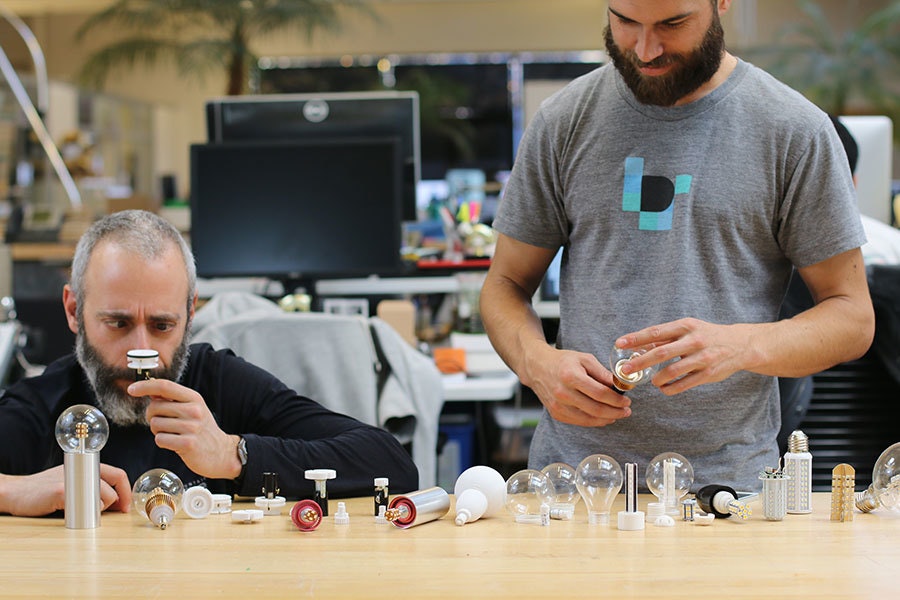
Once we had all agreed on the concept, we launched into an entirely atypical design and engineering process, which I would loosely describe as, “OK… go!” We needed to make certain elements: a bulb that hung on a wire, a spool that rotated to move the bulb up and down, a motor to power the spool. But the design specifications of each of those elements were interconnected: for example, the weight of the bulb would dictate how powerful the motor would have to be, the motor would dictate the spool design, the spool design would dictate the motor controller needed to achieve the motion, and the motor controller would dictate the power supply we would need. But the design of the light bulb, and likewise every other part, was pretty nebulous at the beginning.
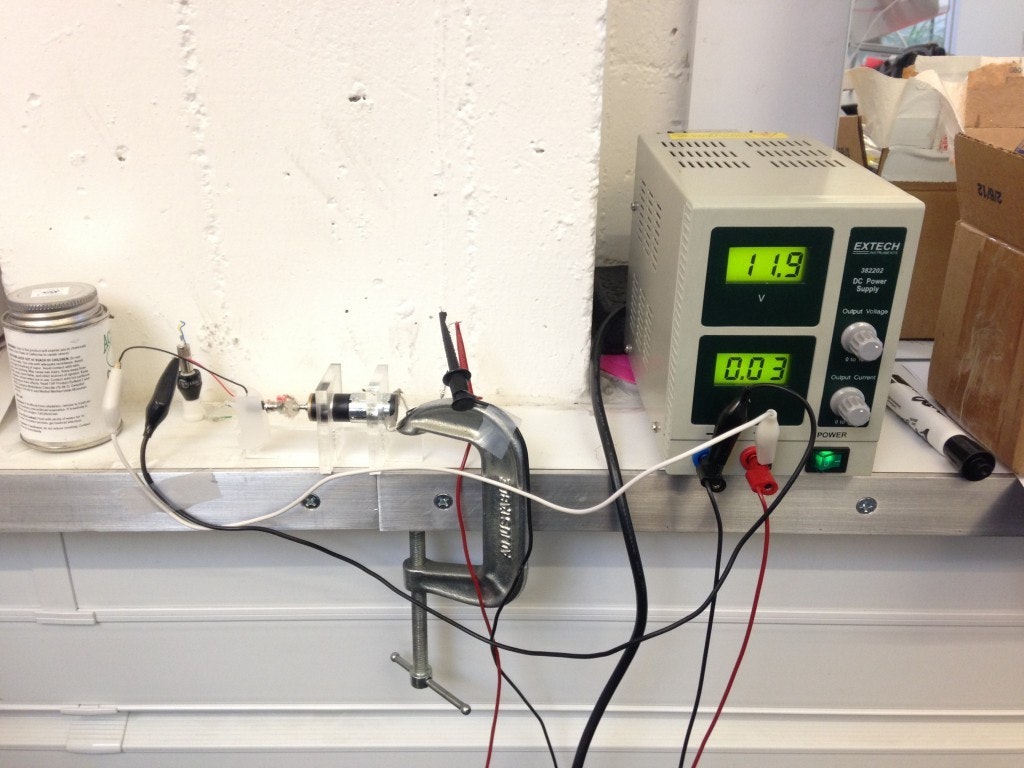
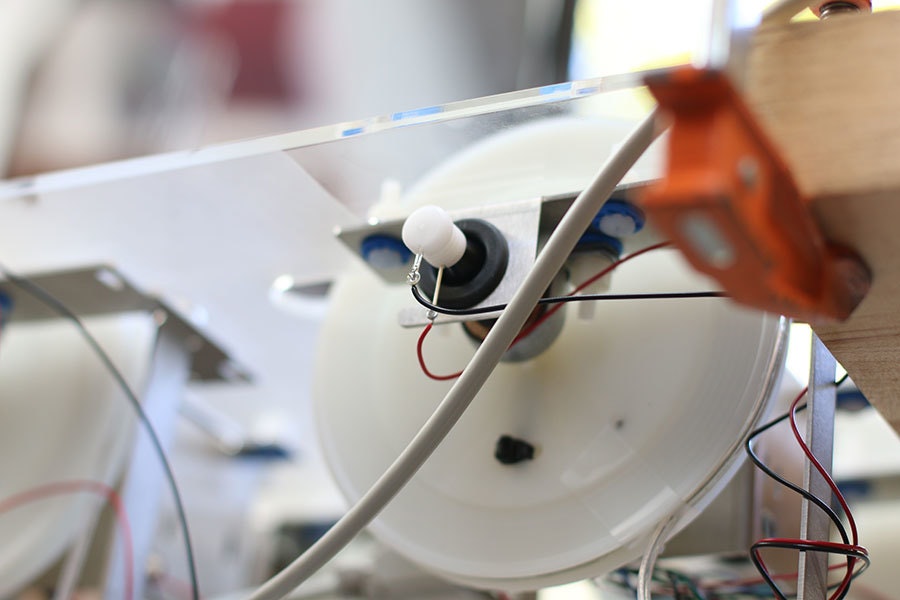
So we separated out what we did know: we’d have to transfer power from the spool to the wire, which is constantly rotating, in order to illuminate the bulb. We could begin to solve that problem (slideshow above), but we had to design the solution to be adaptable to integrate with a constantly evolving spool design. Likewise, we specified capabilities for the spool (slideshow below), knowing that whatever we created would have to be able to adapt to different motors and different bulb designs, depending on what kind of bulb we ended up using and how fast we wanted it to move.
The same went for the software and electrical elements. We didn’t know what exact motor controller we were going to use, but we knew it was going to have to process position and velocity commands and acceleration rates (slideshow below). From these basic starting points, the entire team began working in parallel, keeping each element as modular as possible so elements and features could be switched out as needed while still being able to integrate with one another.
This kind of parallel process is not all that unusual with software development, which is why we have version control software like GitHub, which lets you continually push the most recent iteration to a central place so everyone stays updated. Unfortunately, there is no equivalent system for a process that spans electrical, mechanical, and software engineering, three totally unique domains, each with its own tools and protocols. So our interface was literally face-to-face: “I think this thing I made will work; will it work with the thing you made?” We would make sure whatever we were making would integrate with the current state of what everyone else was making, and then we’d all go off and figure out a few more things. Every time one piece of the puzzle was locked into place, other elements became more defined.
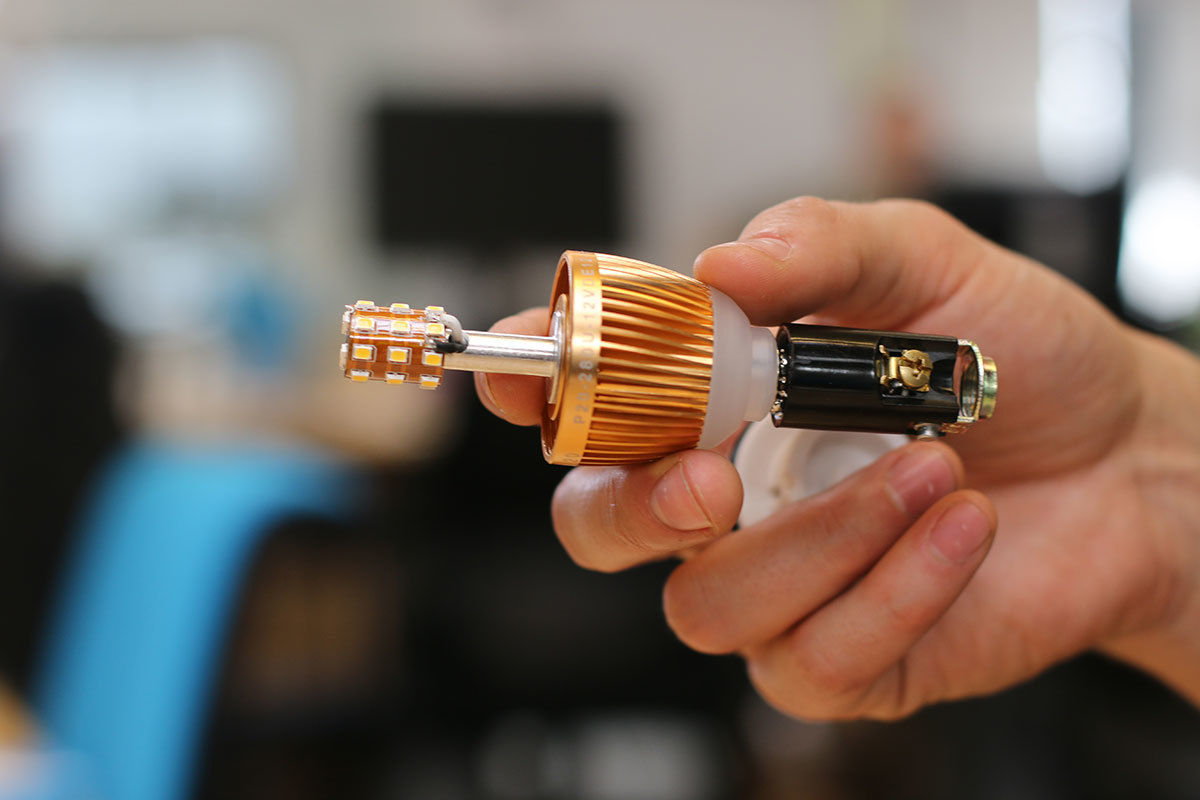
Central to the aesthetic and effect of Edison is the bulb, which was both a technical and visual challenge. We wanted to give a nod to the original Edison bulbs but use modern LED technology. We tried—and scrapped—countless prototypes made by repurposing off-the-shelf components (bulbs rummaged from Marine supply stores, bulbs imported from Europe and Australia, even a ready-made glass shell in which we placed our own custom-designed PCB, which used a clear solder mask to create the warm copper color of the original Edison filament bulb). Fortunately, we were introduced to EfficientNow, a local LED startup that worked with us to co-design a variant of their AC bulb that operates on DC power, which is a less expensive and more efficient choice for programmatically controlled dimming. As a finishing touch, we dressed the bulb assembly in a machined aluminum housing that reflects the other lights around it and helps create the warmth and effect we wanted.
Edison’s defining feature is its ability to dynamically respond, meaning the movements and the animations do not need to be preset but can be generated on the fly.
This lets people engage with the installation on different levels. You can understand and appreciate that it moves in response to data, or you can simply enjoy it on a purely visual level, without knowing anything else about it. Eventually you’ll even be able to direct its motion by typing in a few lines of code. We designed Edison to be able to respond to you and change the tone of the room, to make the space feel alive. I’m hesitant to use the word “magical” because it sounds cliche, but it describes a really meaningful experience of seeing something captivating and knowing that even though it looks effortless, there must be a world of complexity behind it, and yet the captivation halts your brain from diving into the “how” of it. That’s the experience I hope we achieved with Edison. You don’t really want to pick apart how it’s done; you just want to experience it.
Read more about Project Edison here.
It’s easy to rely on cliche and buzzwords when describing Silicon Valley, but expressing an authentic sense of place is a much more nuanced task. IDEO began working with Joie de Vivre hotels on their new Silicon Valley location before the building was even constructed, figuring out how to communicate the innovation and idealism of the valley through the building’s architecture
.jpeg)
Planting an Interactive Flower Garden in the Middle of the Desert
Or, as we liked to call it, botanical engineering

The Ha-Ori shelter was inspired by the folded leaves of the Hornbeam tree, which are lightweight and strong. People kept telling me that it was perfect for Burning Man, in both look and function. But what they didn’t know was that I hadn’t figured out how to add a good ventilation system for hot climates, so the shelter would actually have been way too hot for the desert. I vowed that I would only go to Burning Man if I brought a new iteration of the shelter with me, specifically designed for the desert weather. It took me a few years, but eventually I got together with a few other IDEO designers and we built a cool, shady Burning Man yurt. We’ve since brought the yurt to three “burns” and it still stands like a rock and is fully functional.
The idea for Blumen Lumen came up during one of those trips to the Black Rock desert. For most of the year, the Burning Man site is lifeless. The soil is dry and alkaline, so nothing grows there, and in the arid summer season, no animals ever cross it. It occurred to us that bringing flowers out there would bring a little bit of life, beauty, and love to the desert, which is a big part of what people are looking for at Burning Man. And we could use the same lightweight, folded construction that we had proven to be efficient and durable with the yurt.
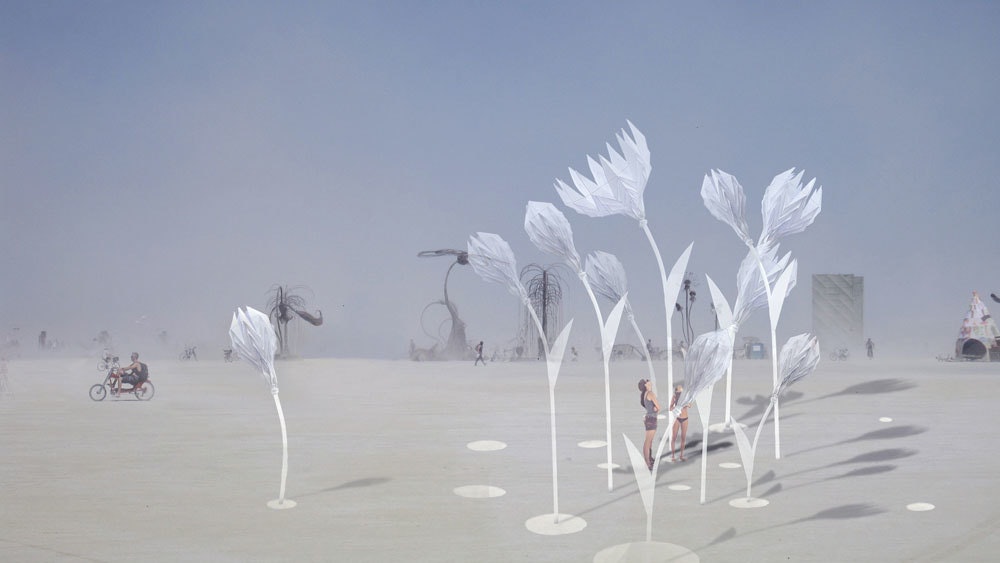
The idea is for the installation to appear like a mirage in the barren, hostile desert. Seeing the flowers on the horizon, you’ll have little idea of their scale, but as you get closer, you’ll realize that it’s a true oasis: a gigantic garden of flowers up to 20 feet tall.
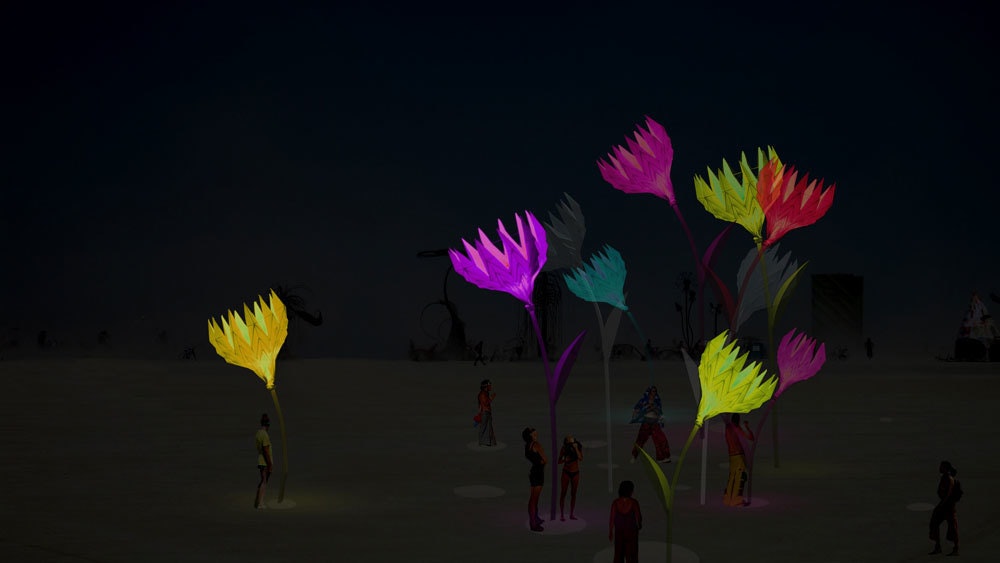
And then you’ll see that the flowers are discovering you as well: The blossoms open and close when they sense that people are nearby, and Arduino-controlled LED strips hidden inside the flower buds change color and intensity in response to movement and sound. The flowers contain infrared and ultrasonic sensors that detect a person’s approach, and a central computer parses inputs from the sensors and wirelessly controls and coordinates the individual blooms.
The opening and closing of the flowers is not only a beautiful motion, it is also an essential safety measure so the flowers can withstand the high winds in the desert, which can reach more than 60 miles an hour. Making the flower strong enough has been one of the biggest engineering challenges of the project.
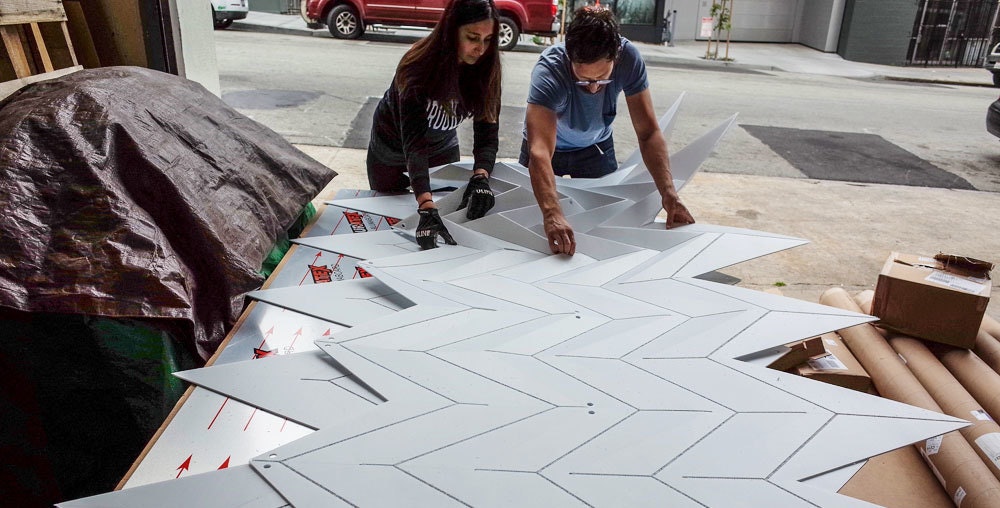
The flower buds are made from two sheets of 5-by-10-foot corrugated polypropylene, which is very strong for its weight. We rout out lines on both sides of the sheet to create fold guides that determine where and in which direction the sheet should fold. (We learned when building the yurt that this process is very time-intensive when done by hand, so this time we outsourced it.) The sheets are then folded and welded together on both sides.
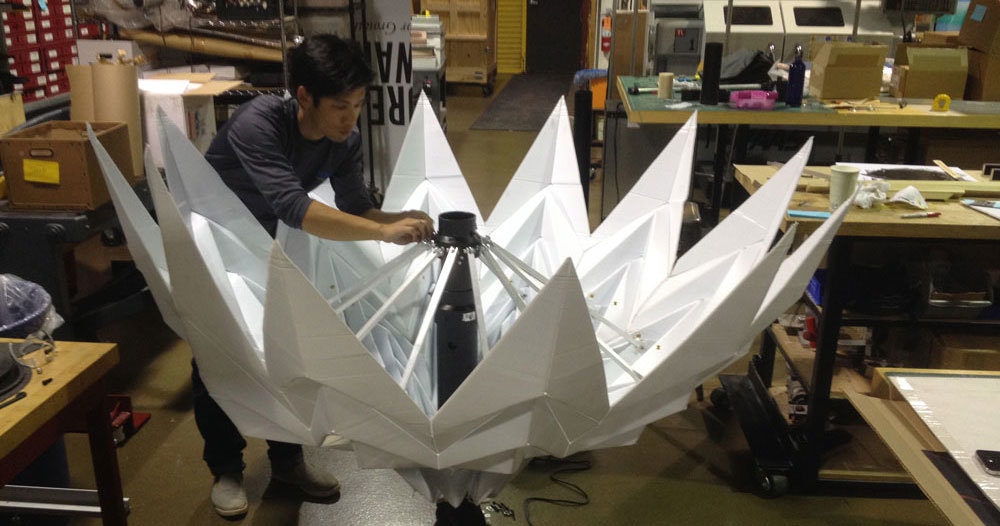
For the opening and closing mechanism, we built a telescoping “stamen” out of PVC pipe and connected it to 12 aluminum struts, which are then attached to the origami structure of the petals. The mechanism works like an upside-down parasol, which is lovely, but it means that we are fighting gravity, so we had to create a lot of force in order to close the flower. We experimented with pneumatic pistons, but bringing compressed air to the desert seemed impractical, and we felt we wouldn’t achieve an elegant enough motion. We’ve since gone through three different iterations of actuators, and we ended up with a 150lb, 18-inch linear actuator with a worm drive. It’s a lot slower than other actuators we tried, but it’s also cheaper, and it provides a lot of force in a small package. Best of all, it cannot be back-driven, which means we don’t need any electricity to keep the flowers shut.
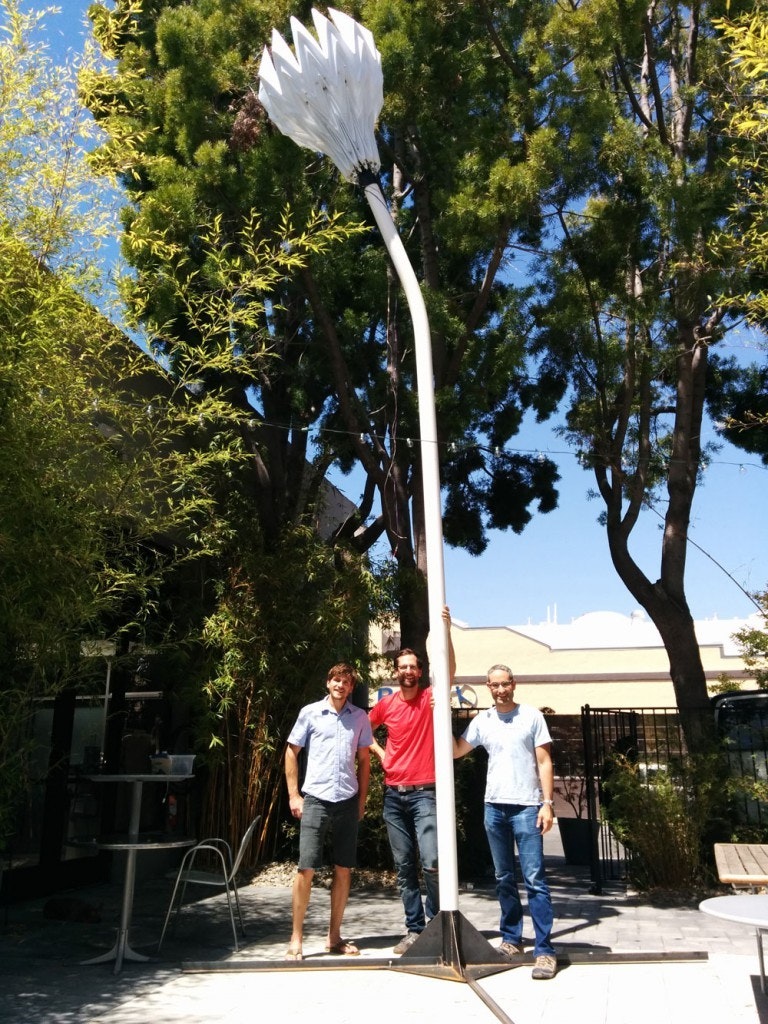
The stem is made from a 4-inch PVC pipe, which slides over a 10-foot-long steel pipe that is screwed into a base in the ground. The base is also made of steel and is dug three feet into the earth, with four 4-foot outriggers that reach out horizontally and are also buried underground. We wanted the stem to have a graceful, natural curve, but we found out that bending 4” PVC pipes is not easy. We ended up using a weed burner to soften the PVC and then bending it over a curved wooden template. To make sure the tube doesn’t collapse, we capped it on both sides and slightly pressurized it.
The diverse challenges of this project required a whole team of industrial and interaction designers as well as mechanical and digital engineers, all passionate (crazy?) enough to spend many nights and nearly every weekend for months making this surreal flower garden a reality. As you might have guessed, every person on the team either works at IDEO now or has in the past. Where else would you find such talented wackos?
You’ll be able to check out Blumen Lumen even if you don’t make it out to Burning Man—we received an initial grant of $6,000 from the Black Rock Art Foundation to show the piece in public spaces around San Francisco. The grant facilitated the exploration and prototyping phase, but to fulfill our complete vision of the project, we are now trying to raise $10,000 on Kickstarter to build the rest of the flowers and buy four solar panels, batteries, and a small generator. Chip in, and come see us in the desert!
The core team for Blumen Lumen includes Beau Trincia, Jesse Silver, Jimmy Chion, Remy Pieron, Nivi Ramesh, and Joerg Student; we had big contributions from Chris Glaister, Steve Moore, and Marco Triverio.
When I moved to the Bay Area to join IDEO, I had never even heard of Burning Man. But once I got here, it came up almost every time I showed someone my Ha-Ori shelter, a collapsible origami structure I designed and built while studying at the Royal College of Art in London.

Lindsey Turner
I’m passionate about building brands, products, and experiences that help organizations show up with meaning and momentum.
I help organizations cut through complexity by shaping how they show up, through brand strategy, identity, and storytelling.
Working at the intersection of brand and business, I bring an editorial eye and a bias toward making—turning ideas into tangible experiences that people can understand, trust, and believe in.
My work spans government, healthcare, financial services, media, and consumer goods, from launching Gen Z-focused ventures to building innovation labs and reimagining legacy brands. I relish moments of ambiguity and enjoy translating across teams, perspectives, and priorities to move ideas forward.
I started my career in editorial and digital design, shaping cross-platform experiences and identity systems in publishing and agency environments. That foundation still shapes how I work today: I’m detail-oriented, collaborative, and overreliant on the Oxford comma. I hold a BFA in Visual Communication from the School of the Art Institute of Chicago.

Rachel Young
My work helps organizations see who their products aren't working for—and build the will and the tools to do something about it
For 25 years, I've asked the same question: Who does this design exclude—and what are we going to do about it?
My work spans human-centered strategy, inclusive design, and qualitative research, with clients ranging from Microsoft, Google, and Verizon to the National Science Foundation, and San Francisco Unified School District.
Before IDEO, I taught elementary school in East Palo Alto and spent a decade doing design work with social service organizations—where I learned firsthand what it costs people when systems are built without them in mind.
I am currently writing User Error, a nonfiction book about digital access and the design decisions behind it. I live in Oakland, California.

Brian Pelsoh
I lead with craft, ensuring our work is creatively excellent: rooted in deep human insight and imagination, while also grounded in the realities of business and technology.
My expertise spans brand, communication, and product design across tech, education, the arts, and social impact.
I believe great work demands both high-level vision and obsessive attention to detail, and only happens through collaboration.
I bring an inclusive, hands-on approach and a deep understanding of business, which enables me to consistently deliver excellence while always asking why.
Before joining IDEO, I worked at the brand firms Pentagram and VSA Partners. I began my career as a designer, leading teams at the School of the Art Institute of Chicago and the Milwaukee Art Museum. I hold an MFA in graphic design from Maryland Institute College of Art and a BFA in communication design from the Milwaukee Institute of Art & Design, and have taught at some of the best design schools in the US.

Tony Wong
I am responsible for IDEO’s long-term success in China and working with clients to use design as a tool to enable growth.
I am responsible for IDEO’s long-term success in China and working with clients to use design as a tool to enable growth. Specifically, I have helped Chinese companies design holistic brand solutions through the development of their products, communication, services, and innovation teams, and I have helped multinationals expand their presence and influence in China.
I advise global leaders on developing China-led innovation and capabilities.
In over 15 years in IDEO Shanghai, I have worked on projects that use design to elevate the quality of the experience of healthcare products and services, streamline processes that increase productivity, create spaces and programs that promote and enable inclusive communities, and build next generation mobility solutions that are planet-positive.
Before joining IDEO, I worked at Philips Electronics and the Electrolux Group in Italy, the Netherlands, and Singapore on a number of breakthrough commercial products. I am a member of the Young President Organization in Shanghai.

Building a personal AI for the messiness of life: Sida Li
Most AI products today are built for work—a space with clear problems and established systems. One founder noticed a gap: personal life is messier, harder to systematize, and mostly left behind by the AI boom. So she built Cue, a personal AI that lives inside iMessage and group chats, to go where the other tools haven't.
In this episode, Becca Carroll, IDEO's Chief Strategy Officer, talks with Sida Li, co-founder and CEO of Shared Context Lab, about staying anchored to a human need while the technology around her keeps changing shape, why she treats her business model with the same rigor she'd bring to a product, and what it feels like to build a company at this particular, disorienting moment in AI.
The conversation also gets into how Sida makes design decisions: the language Cue uses to describe itself, the tradeoffs behind building inside iMessage instead of a new app, and a real story about a business idea that didn’t pan out.
This is the second in a two-part series profiling founders from IDEO's Startups-in-Residence program. The first conversation is with Johannes Seemann, founder of Sooner, on designing GenAI for the emotional side of money.

Designing GenAI for the emotional side of money: Johannes Seemann
Most personal financial tools are built to run the numbers and optimize towards a budget. While that works for some, most people experience money as a lived relationship that does not neatly fit into a spreadsheet. Johannes Seemann and Becca Carroll discuss why money is emotional before it is mathematical, and what a human-centered approach to building a generative AI financial product looks like in practice.

The curious leader's edge in uncertainty: Scott Shigeoka
Mina Seetharaman talks with Scott Shigeoka, author of Seek and Head of Curiosity Cultivation at the Eames Institute, about what distinguishes genuinely curious leadership from performative curiosity, how power dynamics shape curiosity, and why practicing curiosity can restore energy rather than drain it.

How constraints make us more creative: David Epstein
Mina Seetharaman talks with David Epstein, author of Inside the Box and Range, about why total freedom often produces average work, how leaders can design useful limits on purpose, and what organizations such as General Magic and Pixar reveal about the relationship between boundaries and creativity.
Looks like you might be in search of something very specific?
Or reset the filters above and try another angle.
Here’s some random inspiration

Podcasts about creative leadership

Articles about the power of prototyping
