
.svg)


Peripheral vision
A consumer electronics giant becomes a climate-era leader.
IDEO’s partnership with Logitech is a case study in bringing together the power of imagination and the rigor of business.
As much as we love to lead with creativity, it’s difficult to develop a business plan off ideas alone. So when Logitech asked the IDEO team to investigate a broad array of possible futures and report back, we brought our findings to life by inventing a board game. Instead of a dry presentation on circular solutions, our designers created a story about a mouse that turned into a webcam.
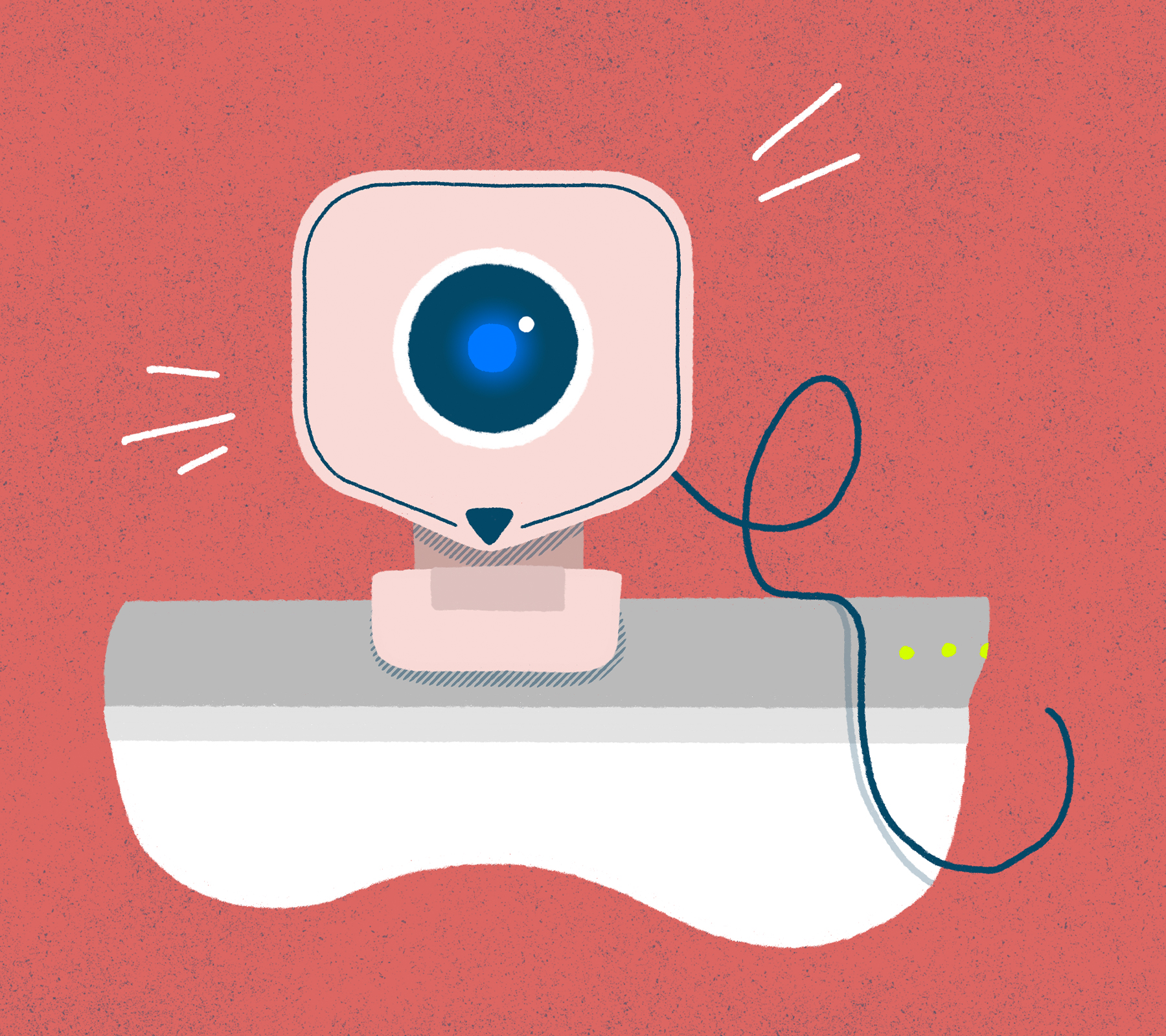
That imagination mattered. It fueled an exploration into expertise we collected from researching with people already living in futures destined to expand. And our rigor helped us hold more possibilities, and identify intersectionalities. Combined, they redefined what it means for ideas to be viable in business; they focused us on long-term sustainability; and they pushed us past immediate technical feasibility to ask if new ideas would be feasible for entire systems.
Our partnership with Logitech revealed that imaginative dreaming and business rigor aren’t opposing forces, but rather complementary tools in opening up new directions into a future demanding bold decisions.
As of 2019, e-waste was the fastest-growing waste stream globally, and only 20% of the 48.5+ million tonnes is disposed of properly.
Global emissions must be cut in half by 2030 to avert the worst impacts of climate change.
By 2030
Logitech has committed to becoming climate positive and removing more carbon than they create
The whole package
A global fashion brand pairs sustainability and growth.
Fast fashion keeps getting faster. But if the industry is to meet its climate commitments, its use of plastics has to slow down.
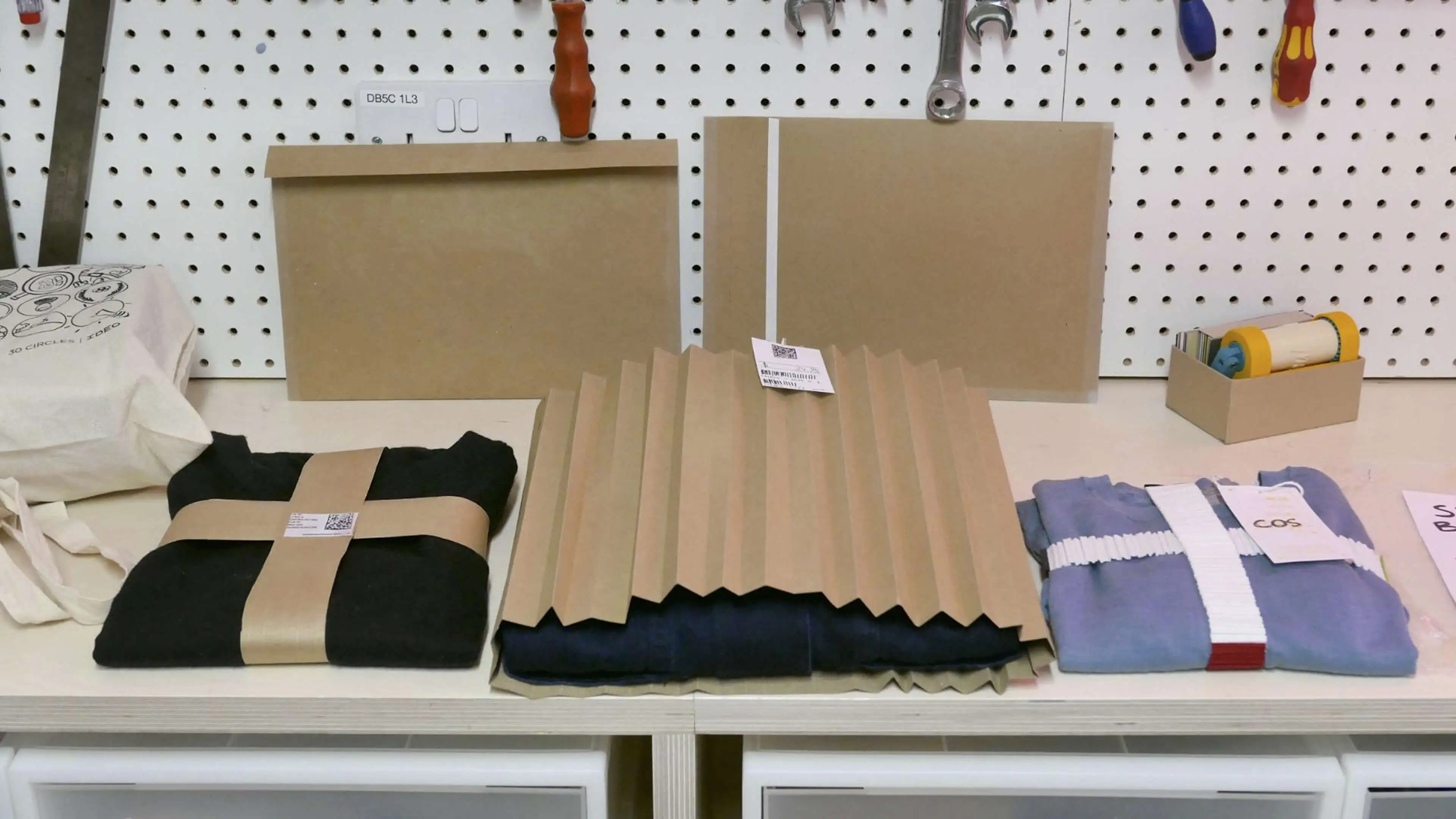
H&M chief executive Helena Helmersson set ambitious sustainability goals when she stepped into her role. She wanted to reduce the fashion giant’s impact on the environment and enable meaningful growth. But change is tough for any company, let alone one with eight brands operating across 74 markets. Together IDEO and the H&M Group created new plastic-free packaging, rallying around a more sustainable packaging solution that’s easily customizable.
By applying a design-led approach that went far beyond hiring a sustainability consultant, the H&M Group managed to reduce its use of plastic. But it didn’t stop there. A small team called Design Studio took what it learned and grew into an established strategic capability that pioneers new ways of working in the organization, tackling complex challenges in circularity, inclusion, supply chain, and customer experience. Sustainability isn’t a passing trend for H&M. It’s moving fashion forward.
Packaging accounts for 26% of plastics produced globally every year.
Fashion e-commerce is estimated to grow by 10% annually through 2024, requiring even more packaging.
100M
plastic-free packages shipped in 2022
2,000 tons
of plastic eliminated from H&M operations
The everywhere chair
In Japan, a mother works to build an inclusive child seat that closes the gap between children with and without disabilities.
For children with physical disabilities and their families, mobility is freedom. But in Japan, there are barriers to that freedom of movement.
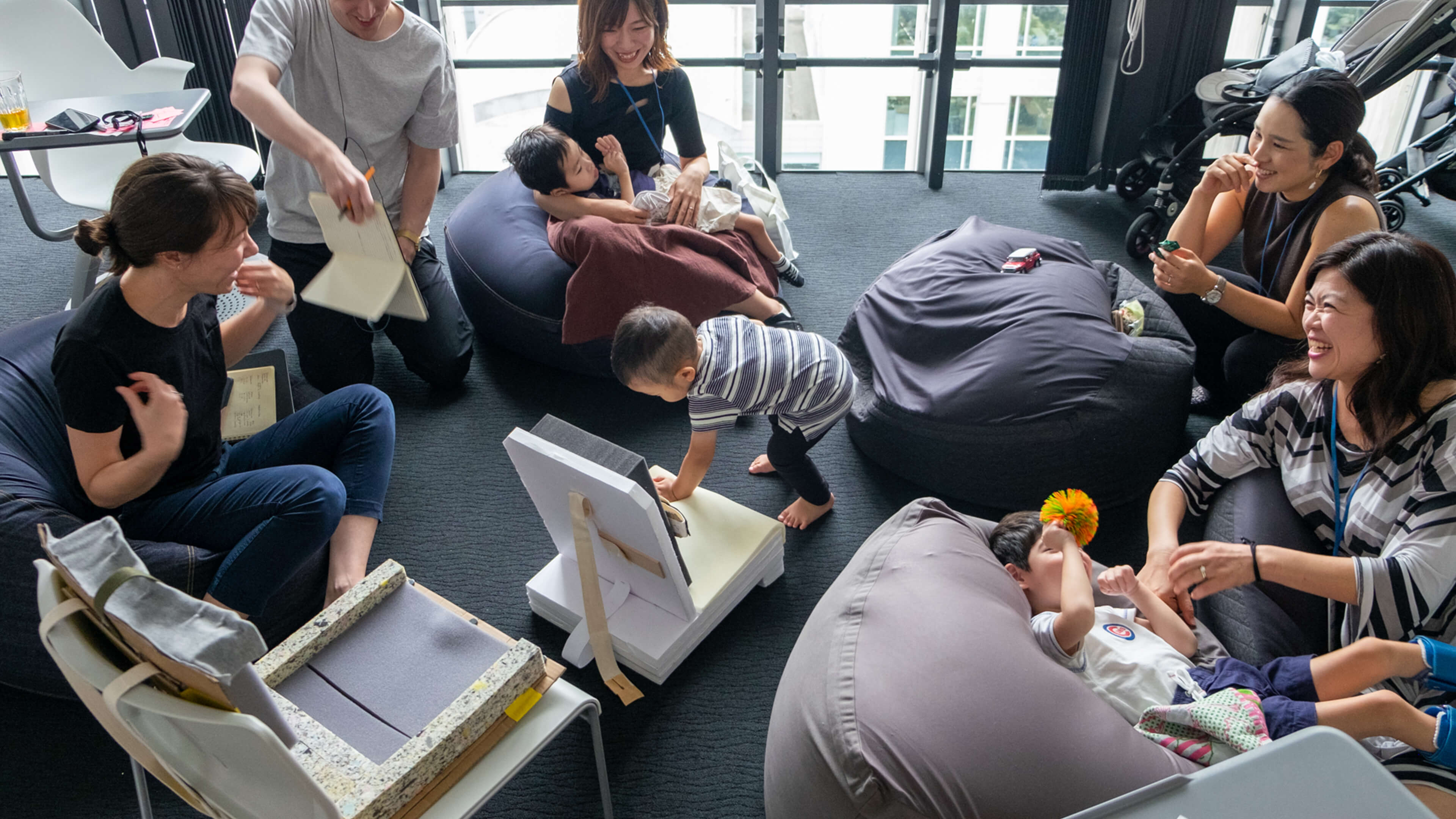
In raising a child with cerebral palsy, Yuri Matsumoto found that her son was separated from other kids during everyday activities. In Japan, children’s products are divided into two categories: those for children with disabilities and those for children without. Matsumoto aspired to close this gap with a product that would allow children of all abilities to use the same chair and be included in the same activities. To realize her idea, Matsumoto needed a strategic design company to refine the chair design, create a compelling visual identity, and arrive at a product road map to help set the business up for long-term success.
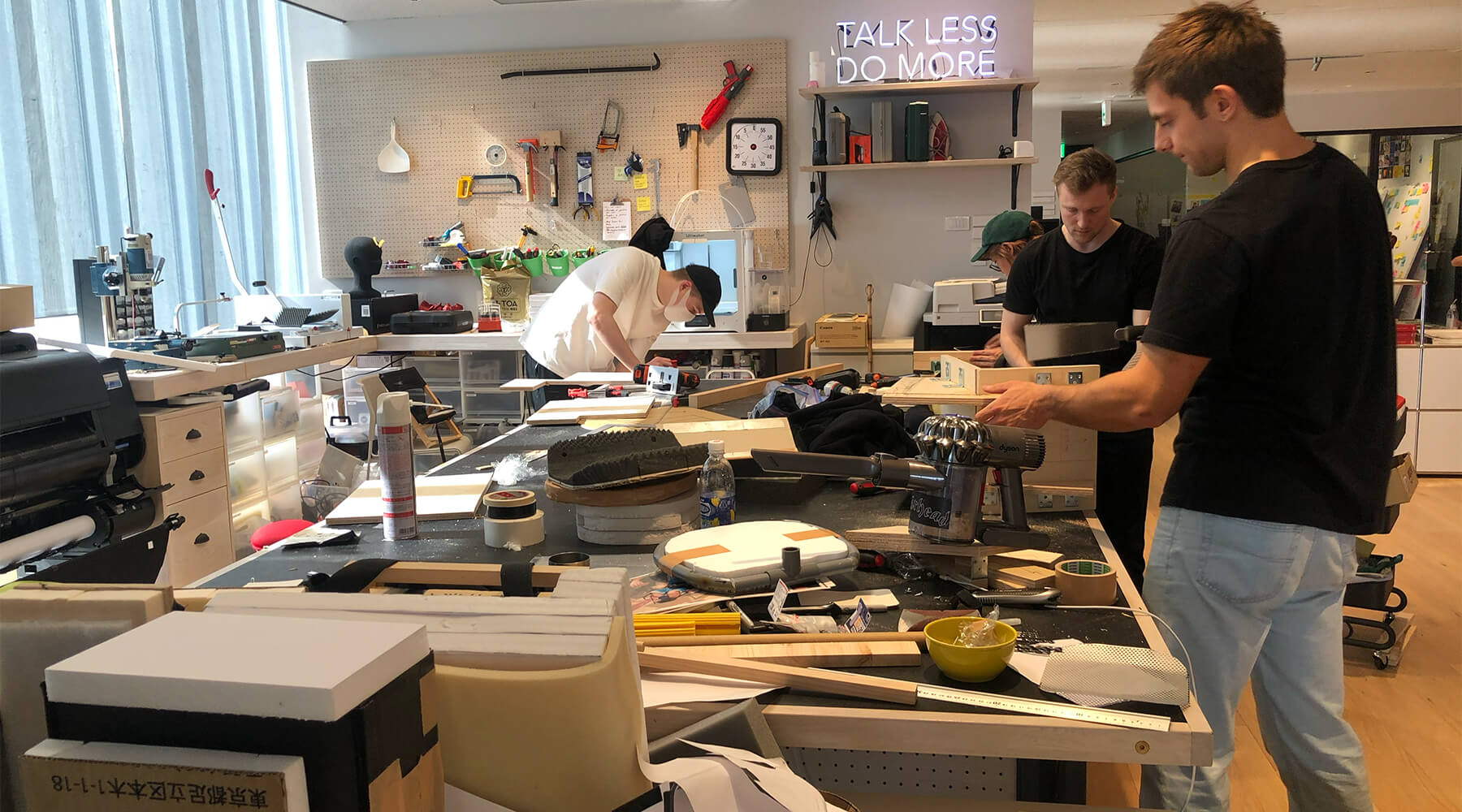
The result: a breakthrough product and supporting business that provides access for all kids, both for at-home activities like studying and eating, and also for family outings to restaurants, to the park, and to play with friends. Around the world, there are people like Matsumoto who see the need for better products in a very personal way. IDEO’s role is to help them realize their vision for a more inclusive future.
The Japanese health ministry categorizes 9.6 million people as disabled.
In Japan, children with disabilities are largely excluded from mainstream classrooms. Government subsidized support chairs are designed for posture and stability. Their bulk and rigidity make venturing out with them challenging.
Japanese children have fewer opportunities to learn about what it’s like to live with a disability than in the US.
Launched
officially in April 2022
5
restaurants and cafés in Tokyo are currently piloting the chair
Serving families first
One organization transforms health care, education, finance, retail, and itself to meet the expectations of the people it serves.
There can be no growth for business if peoples’ basic needs aren’t met.
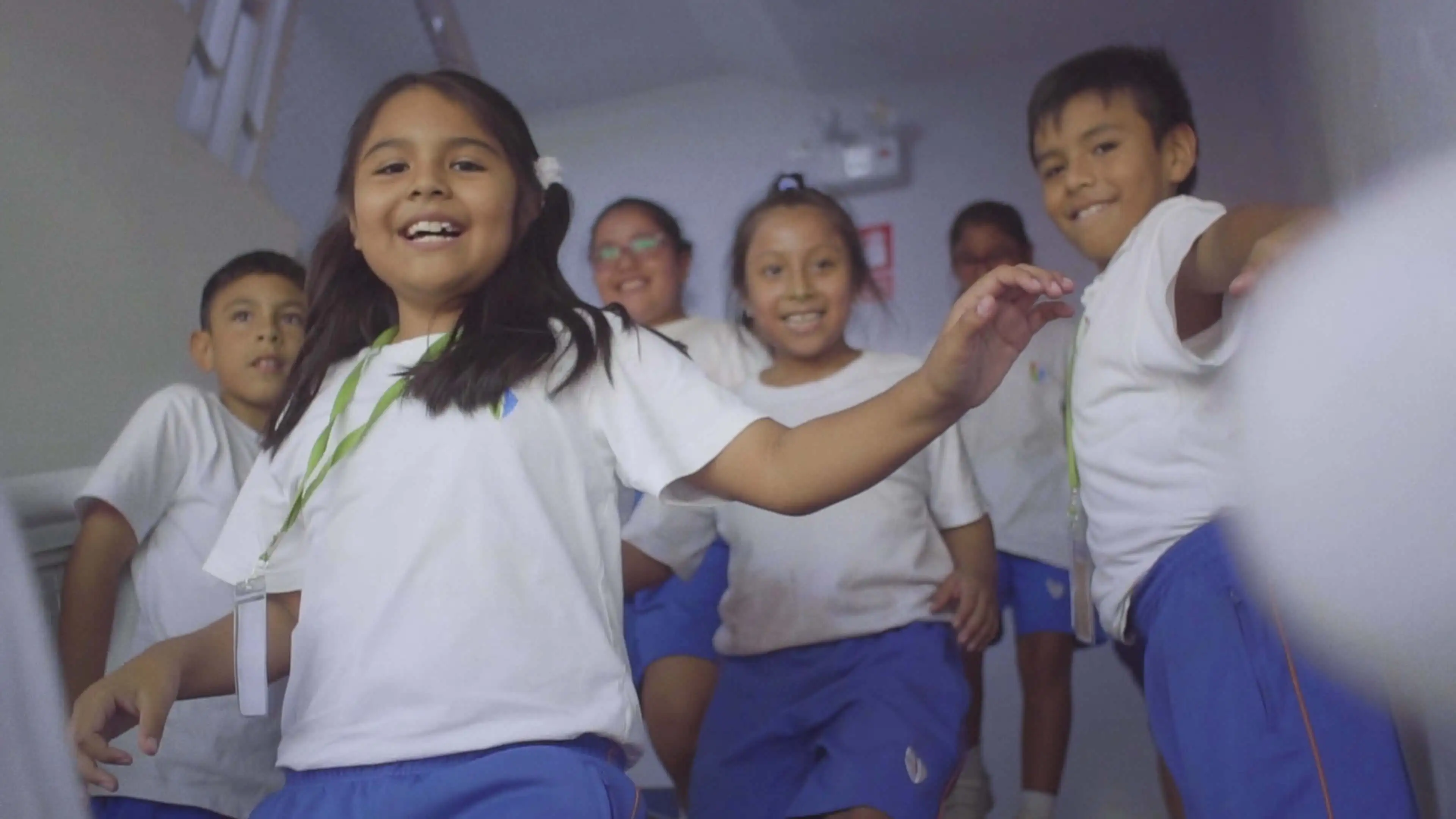
Carlos Rodríguez-Pastor, CEO of Intercorp, came to IDEO with an audacious goal: to address the most fundamental needs of his country’s people and grow his business at the same time. He’d been introduced to IDEO while attending business school in the U.S. and explained that he waited until he had a challenge that felt big enough to knock on our door. Together we built a high-quality school system that would cost just $100 per month—affordable for the middle class. That project convinced Rodríguez-Pastor and his colleagues of the power of human-centered design. Our blended teams launched an innovation hub to introduce new ways of working with the conglomerate’s 90,000 employees. And as we collaborated with Intercorp’s businesses in finance, retail, health care, and education, we learned more about how to serve the everyday needs of Peruvian families. Somewhere along the way, the ultimate design project became the organization itself.
And while Rodríguez-Pastor’s company has grown dramatically, he’s not one to rest on laurels. Instead, the company is becoming more ambitious: upskilling the country’s workforce through an online platform, and fulfilling its climate strategy by investing in Peru’s green economy. (The coastal nation is the world’s third most vulnerable to the effects of climate change.) While the pandemic dealt a blow to Peru’s economy, Intercorp remains steadfast in its commitment to supporting businesses that help the middle class thrive.
Peru’s PISA score of educational quality has grown by 10% in the past decade but still ranks in the bottom 10 worldwide.
In 2020, approximately 68% of the total employed population was in some form of informal employment—jobs that offered no protection and in which workers paid no taxes. Although that percentage decreased over the previous decade, Peru has one of the highest levels of informal employment in Latin America.
55,000
students enrolled across 68 locations in Peru, Mexico, and Colombia
2.5x
increase in revenue from $2.9 billion in 2011 to $8.5 billion in revenue in 2021

5 takeaways from TED AI 2024
Hint: They all reinforce a human-centered approach.
That was a key message we took from our time at the second annual TED AI conference, hosted in our own backyard of San Francisco. Two days full of panel sessions, robot demos, and classic TED Talks had us considering the nature of time, the power of language, and transcending human cognitive limitations. The biggest theme: The urgency for bringing human centered-design to AI is only getting stronger.
Here are five key takeaways from our time on the ground.

1. Beware the black box
The black box approach to AI’s foundational models are the root cause of issues around ownership, copyright, credit—and in the case of certain industries like healthcare—exclusion of entire userbases.
Not knowing what the training data was, where it came from, or who it originally belonged to, means that:
- We’re not able to give credit or reimbursement to the original creators of that data.
- There are unknowable but impending legal ramifications from a copyright perspective.
- Healthcare professionals are unable to use models such as ChatGPT, because without being able to verify or validate the training data, they’re unable to confidently (or even legally) use the answers the models provide.
Already, though, some companies are pioneering more transparent and more widely-usable data sets and model developers. HOPPR, for example, is building the first multimodal AI foundation model for medical imaging and radiology, while the non-profit Fairly Trained is based on the belief that that many consumers and companies “would prefer to work with generative AI companies who train on data provided with the consent of its creators.”
The concept of designing for transparency is reflective of a lot of research we have done in the past with users and data. Our 2019 work with Mozilla exploring more ethical and user-centered solutions to the Surveillance Economy highlighted the pitfalls of data collection, and the opportunities for tech companies to build value by handling user data in more human-centered ways. Combine that with our blockchain work at IDEO CoLab, and there are lots of interesting spaces to explore and draw inspiration from—including individual and collective control, consent, and value generation.

2. Consider the human consequences
A lot of industry specialists are focused on the near-future of the technology, as opposed to the mid-term opportunities and AI’s long-term effects on humanity. Some speakers were concerned that we're spending too much time worrying about what the technology will do for us, while others think we're too concerned about what it will do to us. There was a lot of focus (for better or worse) on the productivity benefits, but relatively few people were thinking about the consequences for humans.
Eugenia Kuyda, founder and CEO of Replika, noted that we should “stop designing for productivity, and start designing for joy,” which is a lovely provocation. We don’t need to forsake one for the other, but designing for joyous experiences can make productivity far more desirable. Our work with Ethiqly around integrating AI and writing exercises in schools focused not on the power of the technology or how many more essays kids could write, but on making the process of getting your creativity on to paper more joyful and rewarding, and focusing on the relationship between teacher and student.
There were also several conversations around the idea that technology will free up time for us to spend with our families instead of working. As romantic as this sounds, it’s not realistic. Organizations will simply reduce headcount, and then increase the other workloads for employees. Articles like this one from the BBC hint at a workforce feeling more burnt out due to AI implementation, showing a glimpse of the human consequences we should be designing for at the application layer.

3. Embrace quality over quantity
Several people spoke about the exponential growth of investment in computing power for large language models (LLMs). Currently, 70 cents of every dollar invested in AI models goes into crunching the data.
As an alternative to this massive use of resources, several speakers brought up the concept of small language models. SLMs are literally smaller models, trained on just 1 billion tokens. (LLMs can require upwards of 1 trillion tokens.) These SLMs can be created with a fraction of the time and energy, and offer great specific utility. Consider the example of the telecom call center. Its model doesn’t need to be exposed to the nuances of Shakespearean sonnets; it just needs to know the words and phrases needed to operate a call center, so you can spend less time, money, and energy on creating your model.
With the tens and hundreds of millions of dollars we’re spending to train LLMs, how much are we willing—or is financially feasible—to spend on models? If we continue down this path, the financial / physical / electrical requirements are going to become unsustainable. One panelist mentioned that “we should be feeding the machine the right information vs. all the information.”
The potential futures for more intentional and nimble SLMs seems much more approachable and both financially and ethically feasible.

4. Spoken language is irreplaceable
One of our favorite speakers was Jessica Coon, the linguist who consulted on the movie Arrival. She argued that human language is rich, nuanced, and endowed with the histories of our cultures. An input text box attached to a keyboard populated with Roman characters is never going to be able to express a fraction of it.
Rikin Gandhi, the co-founder of Digital Green, a company using AI to provide agricultural information and guidance, spoke about the company’s work with farmers in rural India, where illiteracy and nuanced local dialects and translations make-text based offers unviable. But AI models’ abilities to understand spoken language, locational context, and nuances of a given agroecology and a given time of the year means those farmers can interact through images, video, and spoken word.
This perspective shines a spotlight on the potential for more diverse and inclusive design principles, and our spoken language is a key part of that future.

5. Discover a new impetus for responsible design
We also heard from Pratyusha Sharma, a leading researcher and member of Project Ceti, who shed light on how we might be able to leverage generative AI to understand the unsolved mysteries of the ecological world.
Sperm whales communicate through clicks, or codas. While researchers for decades have understood that this is the primary communication pattern by which this social species coordinated, it had been impossible to untangle the spoken language and what it meant. Sharma spoke about a novel use of generative AI—using a generative adversarial network, or GAN, to surface both the alphabetic principle and deeper understanding of coda meanings. With this technology, not only could we hear the sperm whales’ communication—we can understand what it means and predict from their communications what they might do next, whether that’s diving for food or coordinating childcare.
As AI tools become more and more powerful in helping us understand the language of the world around us, the impetus for responsible design will become clearer and clearer. If we can start to interpret the language plants, animals and earth use to communicate, how can they not be a stakeholder in everything we design?
Curious how human-centered design could help you make more desirable AI products? We’d love to chat.
We need to start pulling the human signals from the technological noise, and weaving them together.
Methods for defining your organization's purpose
Get out of your head and embrace your heart with these 3 activities.
A good purpose statement articulates a passion to boldly make an impact. It can differentiate you from competitors, grounding your work in deeper meaning. It can serve as a beacon to draw like-minded individuals to your company—as consumers or employees. And it can align and motivate leaders, guiding strategic choices.
To do all that, a good purpose has to make you FEEL something.
But too often in crafting a purpose statement, marketing and business jargon sneaks in, adding extra bloat. Or conversely, the language gets watered down to the point where it doesn’t mean anything anymore. The emotional gets sacrificed for the intellectual.
If you feel yourself or your team starting to slip into the weeds—or floating too high above the clouds—here are three ways to re-inspire and re-calibrate your thinking around purpose.

1. Get out of your own head: Collect love letters.
If you’re feeling lost at where to even begin, start with some on-the-ground research. Approach employees, end users, stakeholders—whoever interacts with your brand or company—and ask them to write a love letter to your organization, talking about what they’re most proud of, or what they appreciate most.
How we’ve used it: Last year, we were working with the team at Dartmouth Library to develop its strategy, starting with a clear articulation of its purpose. As part of a series of co-design workshops with faculty, staff, and students, we asked participants to write a letter to their library: What did they treasure most? How did it make them feel? While the stories we gathered covered a broad range—encompassing everything from intellectual exploration to belonging—they revealed the deep connections people had with their library, an attachment that was central to both its purpose and strategy.

2. Push past “what” and “how” to uncover your “why.”
If you’re feeling like your purpose is stuck in details and logistics, try the classic Golden Circle from Simon Sinek. Draw three concentric circles: the biggest should be WHAT you do; the next, HOW you do it; and the center WHY you do it. Brainstorm your answers to each and put them in the appropriate sphere. Focus on what landed in your center circle—your whys start to articulate your purpose.
How we’ve used it: The Boston Society for Architecture reached out to us to help the organization shift from being program-driven to being impact-driven. In a series of collaborative workshops, we had stakeholders list all the practical and emotional benefits for member architects, partners, community leaders, and students. Together, the team mapped these examples on the Golden Circle, setting aside functional positioning statements to focus on elevating the why—the emotional purpose that the organization could rally around.

3. Fast forward to the future to ground purpose in greater context.
If you’re struggling to make your purpose feel more aspirational and evergreen, consider taking an imaginative journey five, 10, or 15 years into the future. Spend a few minutes generating as many future signals as possible: What are things you observe in your industry, your customers, or your organization today that might indicate bigger trends over time? How might you evolve your purpose to stay relevant amid these changes?
How we’ve used it: In the earliest days of the pandemic, we were working with a large consumer electronics company to design a bold new strategy for the organization. To kick off the work, we spent a couple of hours with the core team generating signals. Even though we had no idea what the impacts of the pandemic would ultimately be, we were looking to uncover and better understand trends that were already starting to emerge in the world around us. These explorations into themes like hybrid work, climate resilience, equity (and more!) helped us paint a picture of the future that gave us a context for defining a purpose that could fit the company for years to come.
Articulating a bold and inspirational purpose is hard. It requires creativity, empathy, and constant iteration. And in the swirl of “are we there yet?” it can be easy to sacrifice the emotion, chopping the “feeling” in favor of generic language that—if said with enough oomph—sounds smart enough. But it’s not worth it.
Finding the right “why” can help give your purpose the power it needs to inspire leaders and employees to work in service of something greater. And when you bring it to life, a great purpose can signal your company’s core ethos to consumers, acting like a beacon to those who seek what you have to offer.
For organizations and brands, discovering purpose always starts with a question: “Why do you exist, beyond profit?”

The business case for responsible design
From Gen Z customers to impending regulation, 5 reasons it’s a critical part of the work.
But where is “here” exactly? Here is a tense political environment amidst a divisive battle over “woke” values. It’s a challenging business climate with companies deprioritizing DEIB budgets and sometimes removing entire teams. It’s a design community questioning when and where to push on inclusive practices, in service of moving all of us forward.
Even amidst these hurdles, many of us are still seeking a world where our commercial systems reinforce the world we want to live in. That’s our “there.” To those who believe, the path to more inclusive design practices is not some cherry-on-top afterthought; it’s an imperative facet of our evolving global culture. And for some designers, it’s why we wake up and go to work every day.
Responsible design (or inclusive design, ethical design, or even respectful design, as design leader Dr. Dori Tunstall has dubbed it) has been an emerging focus of design for decades, most often helmed by BIPOC and marginalized folks at design-led organizations. At IDEO, it’s been a movement most recently organized by the Inclusive Design Collective (IDC), a fast-growing crew that meets regularly to discuss design, interrogate our processes, and consider the potential consequences of our work, socially and environmentally.
The IDC has been experimenting with design tools and resources to use throughout the design thinking process (many of these interventions build on tools and best practices from across the worlds of design, engineering, and business). Most of the tools we’ve developed and adopted make space in the project journey to question privilege, power dynamics, biases, and access—all to unlock better outcomes for people and the planet.
Meanwhile, we can feel business shifting. Not all decisions are being driven by profit and shareholder value anymore. We see in our research and in our client work that commerce is becoming more values- and responsibility-driven choice-making. (And in many cases, it’s already there.) Here are five reasons we believe centering inclusive practices in design is the way things are going:

1. Inclusive design is at the heart of global scaling
Capitalism is built on a premise of continual growth. Increasingly, businesses are looking globally to find that growth—but doing so requires that we design thoughtfully and inclusively for consumers and producers in those new markets. For decades now, emerging markets have produced goods for the world, leading to a wave of consumerism. The internet accelerated this change in consumption and exacerbated a trade imbalance that does not serve the needs of people in emerging markets.
But now, we're seeing a shift, especially as historically marginalized countries are experiencing population and economic gains that far outpace the rate of change in other markets. Companies have begun trying to sell products and services to people in emerging markets, delivering to an entirely new set of customers with different values, systems, cultures, needs, and motivations. The businesses that will win—as always—are the ones that deeply understand their customers and how the products they deliver meet those customers’ needs. That means the businesses that will win will be the ones who design alongside them.
We’ve seen this firsthand. Our Last Mile Money program, funded by the Gates Foundation, was a great use case for responsible design. Our work focused on helping companies launch more inclusive products and greater financial access in emerging markets at what is called “the last mile”—underserved women, people in rural areas, and others facing barriers like literacy and internet access. Even companies that were committed to designing for underrepresented users were facing a challenge: Products were often designed with urban, tech-savvy, mostly-male users in mind. Despite pouring money into marketing, promotions, and rebrands, new users weren't adopting their wares. To unlock real growth, these companies needed to expand far beyond their existing users.
In response to these challenges, IDEO developed tools like Designing for Digital Confidence, the Gender Evaluation Framework, and the Financial Confidence Playbook. We centered underserved users throughout the design process, constantly going back to them for feedback to help product teams understand a range of barriers that have kept many people from using and benefiting from digital products. We listened and then took action, redesigning and improving products for needs that have often been ignored.
In India, major e-commerce platform FlipKart (owned by Walmart) redesigned its app to be more intuitive for first-time internet users, helping them serve hundreds of millions of customers. In Kenya, a startup called Leja streamlined its product’s onboarding experience for female small-business owners, leading to 30 percent more sign-ups, and more than quintupling transaction growth. We're seeing many more companies integrate responsible design into how they operate, not just because it’s the right thing to do—but because their own future growth depends on it.

2. Gen Z won’t mess with anything that’s not inclusive—no cap
The number of Gen Z workers—those born between 1997 and 2012—is projected to grow to 51 million by 2030 (overtaking Boomers, who had long reigned as the largest generation of full-time workers, from the late 1970s-2011). Gen Zers are digital natives who grew up in the era of rapid technology development, possess a unique set of skills and perspectives, and are the most diverse generation of our time. Gen Z's strong sense of social awareness and values-driven choice-making guides everything they do. It now has begun to guide business. Companies are shifting their calculus—lack of inclusivity means fewer customers. And businesses who don’t heed this may go the way of Crystal Pepsi.
Meanwhile, external signals reflect a similar sentiment, like the rise in demand for environmental, social, and corporate governance-related investment (82 percent of Gen Z have exposure to ESG investments, and 40 percent say their investment decisions are driven by companies with purpose), or the way Gen Z has redefined consumption from ownership to access, show that they're demanding more from the companies, products, and technologies they adopt. Gen Zers hate labels, love “slow fashion,” and more than half of them identify as “not straight.” For them, DEIB needs to be built in, and authentic, and their loyalty will follow.
As many companies are scrambling to build AI products as quickly as possible, we took a different approach: working directly with Gen Zers to learn more about what they really want from AI. As we tested and prototyped product concepts, they sent us a clear message: They only want products that align with their values. Too many of us assumed that as digital natives, they would take to all-new tech like ducks to water; instead their preferences have many folks really considering the ethical and climate consequences of emerging technology.

3. In many sectors, responsible design won’t be a choice—it will be an obligation
We all know that businesses today are not nearly as motivated as they need to be to make the changes our planet will need. When we worked with H&M’s CEO at the time, the company had made aggressive sustainability goals, driven by their own aspirations for the business. However, they were also aligned with global regulations, calling for less plastic and less waste in manufacturing processes, and placed them ahead of the market in this transition by streamlining their supply chain, and cutting excess inventory, and producing less waste.
It’s too early for this latest AI growth spurt to have spurred much regulation—but it is coming. IDEO’s Emerging Tech Lab is putting ethics first and sees AI and climate at an intersection, ripe with opportunity for designing more responsibly—for the good of the world, but also because one day, companies simply won’t have a choice.

4. Consumer preferences are changing, and businesses that only care about shareholder growth may be penalized
Values-based consumption is not just having a moment—it has redefined consumption. More people are choosing to support companies that align with their values. In fact, in a McKinsey survey, 70 percent of Gen Z respondents said they try to purchase products from companies they consider ethical. Nielsen tells us that 75 percent of Millennials are so eco-conscious, they’ll change their buying habits to favor environmentally-friendly products.
Consider Patagonia. With an estimated value of about $3 billion dollars, and $1 billion in annual revenue, the outdoor company announced in 2022 that Mother Earth would be its only shareholder, and “every dollar that is not reinvested … will be distributed as dividends to protect the planet.” Patagonia has made a name for itself with aggressive environmental goals, like completely eliminating virgin petroleum material in its products by 2025, and becoming net zero by 2040. Patagonia products aren’t cheap, yet sales have quadrupled over the past decade, and it has also expanded offerings into food. The company is a great example of how a brand can be very clear about what it stands for, and still find that people will pay for quality—even at a time when consumers are feeling the pain of inflation. Meanwhile, fast fashion, which offers customers lower quality goods at a much cheaper price point, has seen a steady decline in sales. If businesses continue to only value cost savings, they may learn: Cheap isn’t cheap when it loses you a customer.

5. Responsible design creates better products
We're big admirers of the healthtech startup Kasha, which has leaned into responsible design to unlock pent-up demand with healthtech. Founder Joanna Bichsel saw that millions of women lacked access to health products in Rwanda. So, Kasha listened to customers’ needs and pain points, and it designed a service that delivered tampons, contraceptives, and other women’s products in accessible and responsible ways. Kasha tapped into massive demand by offering unprecedented product choice, high quality, and perhaps most importantly, confidentiality to its customers, who are 65 percent low-income women. Kasha has seen 10 times revenue growth, and has now expanded to multiple markets across Africa. The woman-led startup isn’t stopping there: It’s adding pharmaceuticals, telehealth, and credit services—all to help women better access quality health care. Kasha learned that centering the unmet needs of the voices that are so often unheard was not just the path to more inclusivity, but also to create products specifically tailored for their customers, and succeed as a company.
The opportunities ahead
Whether it’s the values-based consumption habits of the next generation, new opportunities in growth markets, a coming wave of regulations in climate and Gen AI—Bob Dylan said it best—“the times, they are a-changin.”
Companies that plan for this future, this “there,” with value-loving consumers, more diverse needs, more access, more expansive geographies—will not only get “there,” they will reap the benefits, too. If you’re trying to make it through this tough, ever-changing market—inclusive design might be the best way to survive, and we’d love to help.
(The figure for Patagonia's annual revenue has been updated for accuracy.)
We won’t get “there” by doing what got us “here.”
3 methods for igniting culture change at scale
Get ready to experiment.
The question was a daily prompt, an experiment to help teams to have more candid conversations and increase their ability to collaborate with each other. Instead, an awkward silence followed.
The exercise was part of a partnership exploring the power of making with a global healthcare company. Together, we were designing for the organizational culture the company wants to have to achieve their strategic ambitions. This team’s role was to instill new ways of working for the whole company. They wrote the culture code. But they couldn’t quite articulate how they themselves were living it. Yet.
Their trouble answering the question wasn’t a failure—this work is hard. And it requires changing ingrained behaviors every day. So together, we worked with the team to make culture change tangible through real-world experiments (not just decks and frameworks) that helped ignite new behaviors through actions, not words.
What does that mean, exactly? As Roger L. Martin, strategy advisor to some of the world’s most successful organizations, explains, “The truth about culture is that the only way you can change it is by changing the way individuals work with one another. If you can change that, then you will find the culture has changed.” Changing how individuals work takes more than words, or artifacts, or processes (although those things definitely have a role to play). It requires action. That’s where design comes in. And that’s where our team started, by making a series of cultural experiments.
The goal was to learn about how we can change people’s behaviors and enable them to work differently. We collaborated with key teams and people who identified themselves as culture ambassadors. Together, we created tools and activities that would inspire action, and teach us how to change culture in this specific environment, because every org is different.
Here are some of the experiments we used to ignite action.
Unblocking decisions and flex support styles with a card deck
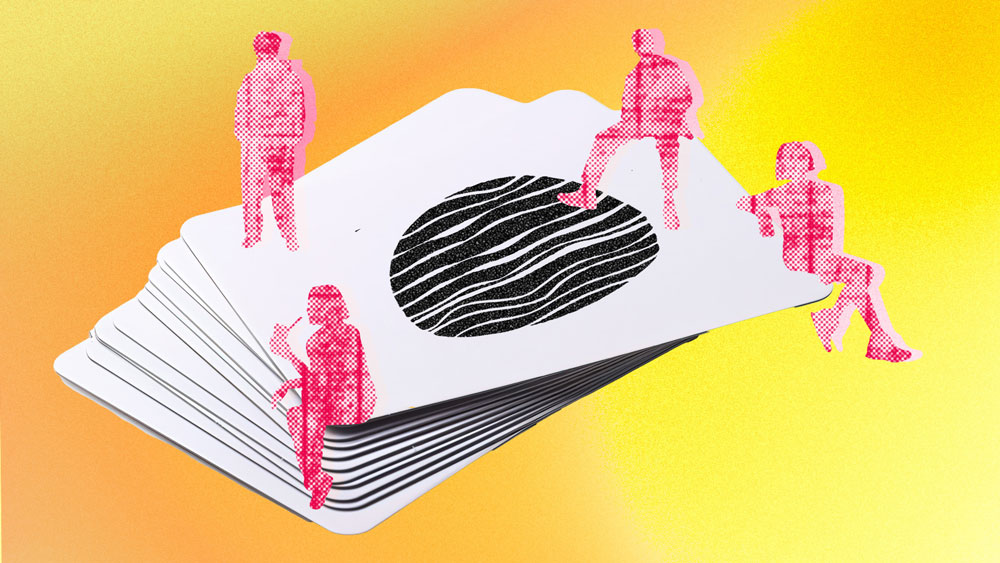
The organization wanted to become “networked”— meaning people would work more autonomously, with high accountability and clear communication between teams and their leaders (rather than linear, siloed teams). But if communication is lacking, and accountability isn’t clear, decisions in a network are made by consensus, and people don’t feel empowered to take ownership and use their ingenuity to solve problems. So we created two sets of cards to prompt better conversations between people and their managers.
One set of cards focused on unblocking decisions, by sharing questions (Is there psychological safety within the team making decisions?) and assigning clear roles that defined the level of involvement people have in making different decisions. Is someone supposed to drive a decision, or simply consult on it?
The other set of cards helped people articulate the type of support they need from their managers in a given moment, like coaching vs. problem solving—facilitating more open conversation about the type of leadership they need to thrive. These cards empowered managers to better support their teams, while empowering teams to be clear about what they need to drive good outcomes. They also proved that specific structure and language could prompt desired behaviors at scale.
One participant shared that after an initial conversation where she told her boss she was looking for a coach, he helped her strategize to draw on her strengths to achieve her goals. And when she wanted to share her “value with a broader group outside of customer-facing work and my immediate team,” she felt empowered to put that into action, which “would've never happened if it weren't for the initial coaching.”

Implementing a daily ritual to prompt collective reflection and candor
One of the most critical behaviors for creating a collaborative culture is regular, honest feedback between people. Done well, it builds trust and psychological safety among teams, leading to better performance. In this organization, teams rarely found time and space to give or gather informal feedback on the way they work. When it was positioned as a mandatory, formal task, it could feel exhausting.
Intead, we wanted to prompt small, regular conversations about collaboration. So we created a fun reflective tool based on a spin-the-wheel format:, an online generator that surfaces topical questions (like the one at the beginning of this article) to prompt candid chats. The questions run the gamut from silly to serious, and taught us the importance of making something fun if you want teams to build it into their existing routines. Questions like, “When has a new perspective helped you make a decision recently?” encouraged people to feel safe in opening up and reflecting on their behavior as a group.
Over time, reflection moments became something teams looked forward to. The questions changed the narrative so that employees could surface issues without fear of consequence, and resolve issues before they became problems. As one participant told us, “The energy was palpable in our group. It got to five minutes before the end of the session, and they still wanted to talk. Everyone wanted to do it again. It’s turning into something wonderful that we needed.”

Introducing an action journal to increase leaders’ self awareness
Many leaders recognize the importance of regular reflection and feedback sessions, but competing priorities get in the way.
To address that need, we designed a personalized action journal that fit into leaders’ daily work flow. The goal was to learn whether a tool that prompts regular self-reflection will result in an increase in leaders' self-awareness, helping them identify how they want to grow, and prompting them to seek more support.
Through this simple experiment, we were able to learn that creating dedicated space and time for reflective practices not only boosts leaders’ confidence, it models the value of continual learning and growth for others. One participant told us, “I've found it a nice and simple way to reflect on the things I've been doing, and connect that back to conversations with my own manager.”
Each of these experiments made new behaviors tangible by giving form, fun, and structure to otherwise abstract concepts. They helped people experience the potential value of new ways of working for themselves, demonstrating their function, and connecting theoretical culture change concepts with day-to-day work.
Culture change at any scale requires more than words; it requires action and application in people’s everyday experiences. Making change tangible through experiments is the quickest way to surface stories, build belief, and gather the evidence to support change at scale. Not every organization is trying to solve the same problem, and the same experiments won’t work everywhere. But for every culture problem at every company, there are tangible ways to drive change.
In a recent meeting with a new client, we asked the team, “What smart risks have you or your team taken recently?”

Lindsey Turner
I’m passionate about building brands, products, and experiences that help organizations show up with meaning and momentum.
I help organizations cut through complexity by shaping how they show up, through brand strategy, identity, and storytelling.
Working at the intersection of brand and business, I bring an editorial eye and a bias toward making—turning ideas into tangible experiences that people can understand, trust, and believe in.
My work spans government, healthcare, financial services, media, and consumer goods, from launching Gen Z-focused ventures to building innovation labs and reimagining legacy brands. I relish moments of ambiguity and enjoy translating across teams, perspectives, and priorities to move ideas forward.
I started my career in editorial and digital design, shaping cross-platform experiences and identity systems in publishing and agency environments. That foundation still shapes how I work today: I’m detail-oriented, collaborative, and overreliant on the Oxford comma. I hold a BFA in Visual Communication from the School of the Art Institute of Chicago.

Rachel Young
My work helps organizations see who their products aren't working for—and build the will and the tools to do something about it
For 25 years, I've asked the same question: Who does this design exclude—and what are we going to do about it?
My work spans human-centered strategy, inclusive design, and qualitative research, with clients ranging from Microsoft, Google, and Verizon to the National Science Foundation, and San Francisco Unified School District.
Before IDEO, I taught elementary school in East Palo Alto and spent a decade doing design work with social service organizations—where I learned firsthand what it costs people when systems are built without them in mind.
I am currently writing User Error, a nonfiction book about digital access and the design decisions behind it. I live in Oakland, California.

Brian Pelsoh
I lead with craft, ensuring our work is creatively excellent: rooted in deep human insight and imagination, while also grounded in the realities of business and technology.
My expertise spans brand, communication, and product design across tech, education, the arts, and social impact.
I believe great work demands both high-level vision and obsessive attention to detail, and only happens through collaboration.
I bring an inclusive, hands-on approach and a deep understanding of business, which enables me to consistently deliver excellence while always asking why.
Before joining IDEO, I worked at the brand firms Pentagram and VSA Partners. I began my career as a designer, leading teams at the School of the Art Institute of Chicago and the Milwaukee Art Museum. I hold an MFA in graphic design from Maryland Institute College of Art and a BFA in communication design from the Milwaukee Institute of Art & Design, and have taught at some of the best design schools in the US.

Tony Wong
I am responsible for IDEO’s long-term success in China and working with clients to use design as a tool to enable growth.
I am responsible for IDEO’s long-term success in China and working with clients to use design as a tool to enable growth. Specifically, I have helped Chinese companies design holistic brand solutions through the development of their products, communication, services, and innovation teams, and I have helped multinationals expand their presence and influence in China.
I advise global leaders on developing China-led innovation and capabilities.
In over 15 years in IDEO Shanghai, I have worked on projects that use design to elevate the quality of the experience of healthcare products and services, streamline processes that increase productivity, create spaces and programs that promote and enable inclusive communities, and build next generation mobility solutions that are planet-positive.
Before joining IDEO, I worked at Philips Electronics and the Electrolux Group in Italy, the Netherlands, and Singapore on a number of breakthrough commercial products. I am a member of the Young President Organization in Shanghai.

Building a personal AI for the messiness of life: Sida Li
Most AI products today are built for work—a space with clear problems and established systems. One founder noticed a gap: personal life is messier, harder to systematize, and mostly left behind by the AI boom. So she built Cue, a personal AI that lives inside iMessage and group chats, to go where the other tools haven't.
In this episode, Becca Carroll, IDEO's Chief Strategy Officer, talks with Sida Li, co-founder and CEO of Shared Context Lab, about staying anchored to a human need while the technology around her keeps changing shape, why she treats her business model with the same rigor she'd bring to a product, and what it feels like to build a company at this particular, disorienting moment in AI.
The conversation also gets into how Sida makes design decisions: the language Cue uses to describe itself, the tradeoffs behind building inside iMessage instead of a new app, and a real story about a business idea that didn’t pan out.
This is the second in a two-part series profiling founders from IDEO's Startups-in-Residence program. The first conversation is with Johannes Seemann, founder of Sooner, on designing GenAI for the emotional side of money.

Designing GenAI for the emotional side of money: Johannes Seemann
Most personal financial tools are built to run the numbers and optimize towards a budget. While that works for some, most people experience money as a lived relationship that does not neatly fit into a spreadsheet. Johannes Seemann and Becca Carroll discuss why money is emotional before it is mathematical, and what a human-centered approach to building a generative AI financial product looks like in practice.

The curious leader's edge in uncertainty: Scott Shigeoka
Mina Seetharaman talks with Scott Shigeoka, author of Seek and Head of Curiosity Cultivation at the Eames Institute, about what distinguishes genuinely curious leadership from performative curiosity, how power dynamics shape curiosity, and why practicing curiosity can restore energy rather than drain it.

How constraints make us more creative: David Epstein
Mina Seetharaman talks with David Epstein, author of Inside the Box and Range, about why total freedom often produces average work, how leaders can design useful limits on purpose, and what organizations such as General Magic and Pixar reveal about the relationship between boundaries and creativity.
Looks like you might be in search of something very specific?
Or reset the filters above and try another angle.
Here’s some random inspiration

Podcasts about creative leadership

Articles about the power of prototyping
