
.svg)


The luxury brand reimagining the future of e-commerce
.webp)
“We want human beings at the helm, steering the boat. However, if there are tools that can help people steering the boat make better decisions, we are ready to embrace them."
Founded in 2021, Callimacus is a small collective of mathematicians, engineers, artists, and philosophers exploring how new technologies can rewrite the web experience. Their guiding principle, “human artificial intelligence,” emphasizes designing systems that complement human values, highlight emotional nuance, and enhance human presence.
So far, so San-Francisco-based-start-up, you might say. But, in fact, Callimacus swaps the hills of the Bay for the slopes of Solomeo, a medieval village in Perugia, Italy. Instead of a tech billionaire, its patron is a titan of luxury fashion: Brunello Cucinelli.
As unexpected as that might sound, Cucinelli himself has been a passionate advocate of what he’s called the “humanistic enterprise,” born of his deep interest in philosophy. So while Callimacus might be pioneering a radical rethinking of e-commerce by challenging traditional established web and user experience norms, that’s firmly grounded in the brand’s human-centered DNA.
.webp)
Callimacus's first product is an AI-native software development kit aptly called Callimacus, which powers Brunello Cucinelli’s new digital experience. Named after the ancient Greek poet and curator of the Great Library of Alexandria, Callimacus uses custom AI agents to dynamically generate the user experience based on user intent. For instance, the site’s agents can determine that a visitor is looking to learn about the story behind the brand (and serve them content, accordingly) or that they’re here to see the latest collection. It’s a custom experience very different from a traditional page-and-container website structure.
I spoke with Francesco Bottigliero, Brunello Cucinelli’s Chief of Humanistic Technology and the CEO of Callimacus, to understand why the brand created the start-up, the importance of keeping humans at the heart of innovation, and reimagining UX and engineering for the AI era.
Ed White (EW): What was the inspiration behind Callimacus?
Francesco Bottigliero (FB): The French philosopher Voltaire once said, “Doubt is not an agreeable condition, but certainty is an absurd one.” This led us to think, “Our friends from Silicon Valley believe AI will be a game-changer, so let’s take the time to understand it.”
At Brunello Cucinelli, we’re focused on learning and staying current in our industry, rather than simply following trends. We choose technologies that align with our values, ensuring we don’t compromise the craftsmanship and brand positioning we’ve built over more than 40 years. In our boutiques, we aim to make technology invisible so there’s no barrier between sales associates and customers.
We’re investing heavily in our brick-and-mortar distribution to stand out and nurture our brand identity, while also enhancing and developing our online identity.

EW: Callimacus emphasizes “human artificial intelligence.” Can you explain what you mean by that?
FB: We view technology as a companion of humanity. We want human beings at the helm, steering the boat. However, if there are tools that can help people steering the boat make better decisions, we are ready to embrace them.
EW: You recently launched an AI-driven web experience for Brunello Cucinelli using the Callimacus software development kit, which enables brands to create AI-native web experiences. Where did the idea for that come from?
FB: When we looked at traditional e-commerce, we analyzed the navigation of six sites from six brands. We masked the brand names and placed the sites side by side. They all looked the same.
We decided to experiment with new ways to communicate our story more effectively. Today, when people talk about applying AI to e-commerce websites, they typically mean adding a chatbot. However, the underlying infrastructure remains the same, relying on page formats—whether product, listing, or article pages.
EW: Why are traditional web pages such a problem?
FB: Websites continue to be designed and developed using a typographic approach that has been in use for more than 30 years, dating back to the beginnings of the internet at CERN in Geneva. Users shared research papers online, and they were read as if they were physical books. The interaction mimicked print media by incorporating pages and menus people were already familiar with. Likewise, when I visit Corriere della Sera, Italy’s leading online newspaper, all its content is locked within a traditional page-and-container structure, making it difficult for me to search for something using natural language. The same issues apply to e-commerce sites.
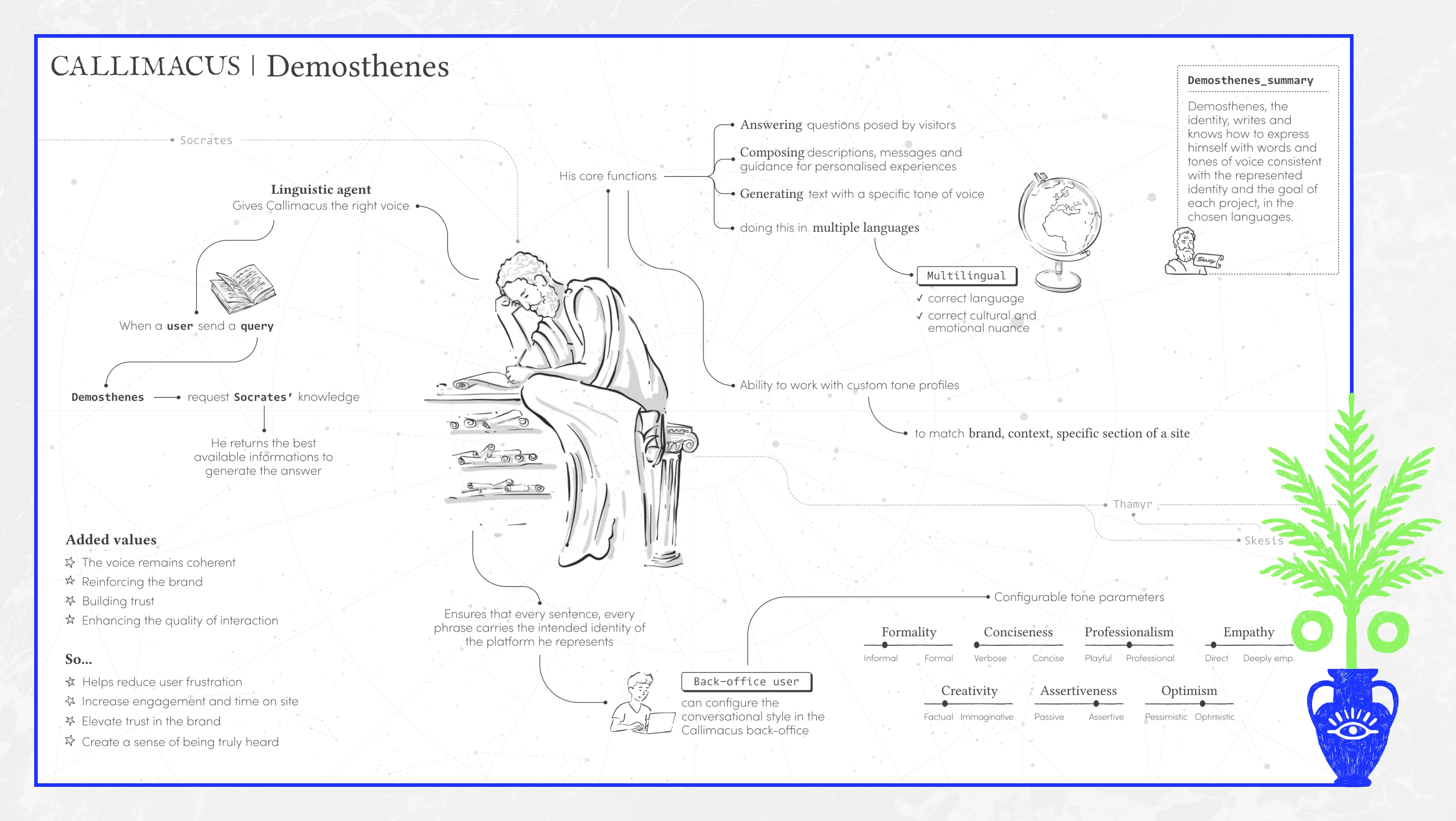
Callimacus offers a completely different approach to website design. It functions like an orchestra, integrating multiple agents running on different large language models.
Callimacus is based on three fundamental ideas: First, we eliminated content containers, allowing content to flow and be recombined. We call it “page-less design.” Second, instead of starting with user interfaces or framework templates filled with placeholder text, we began by spotting signals of the customer’s intent and the experience and journey we wanted to offer. Third, enabled by the first two ideas, we created a personalization engine that delivers a tailored experience for each user.
EW: How does that work?
FB: One of our agents, Thamyr, named after the ancient Greek painter, continuously analyzes the user’s intent—for example, getting inspired or product search—and updates the website in real time. Each interaction the user has with the website refines this intent. Thamyr might say, “It seems like this user is more interested in product search or is seeking inspiration.” She then goes to our agent, Socrates, and says, “Hey, please provide me with products the customer might be interested in.” However, it turns out the user is not really into the product but rather wants to explore the brand. So Thamyr decides to feature fewer products, but more editorial content. She then references the design system, selects the appropriate components, and builds the interface accordingly.
.webp)
EW: How does all this “intelligence” impact the back end?
FB: One of the advantages of the platform is that editing websites can become a conversational experience. For example, you can say to Callimacus, “Hey, we just received the new capsule tennis collection.” Callimacus replies, “Okay, do you have pictures?” You say, “Yes, they’re here in this Dropbox folder.” Callimacus then asks, “Okay, do you have the prices?” “Yes,” you reply, “this is the spreadsheet with prices.” Once the files are uploaded, Callimacus says, “I’m ready to publish.” Then you confirm, tell it to publish, and it’s done. Since Callimacus generates the interface, it decides which content is displayed to the user.
You can also interact with Callimacus by asking it how the collection campaign is performing in Japan, for example. Callimacus might reply, “It seems we are performing worse than last week.” In which case, you could ask it for suggestions on how to improve. It might respond, “Perhaps we could increase the frequency of displaying these collection banners in specific customer journeys?” If you agree, you simply tell it to execute that plan.
EW: What’s been the response to the new Brunello Cucinelli experience?
FB: The initial reactions are very positive, and the metrics reflect this. We’re seeing increases in engagement rate, time spent on the website, and items added to the cart.

EW: Given your successes so far, what are you hoping to see next?
FB: In five years, I envision an experience that feels more like shopping in a physical boutique. I want to be able to interact with the system using voice commands and have it understand what I’m looking for, rather than forcing me to search endlessly for the right item. It should respect my privacy, personalizing the experience without relying on third-party data. The process should be quick and intelligent, recognizing that I’m either on my phone and in a hurry, needing to buy a last-minute birthday gift for my wife, or that I’m relaxing in an airport lounge and would like to learn more about the new collection, or about the hamlet of Solomeo, or do a deep dive into craftsmanship.
We finally have the chance to go beyond decision trees and pre-defined rule-based logic, to make digital applications more intelligent and genuinely respectful of people. It’s a great chance to rethink, from the foundation up, how digital technology works and the business models we have adopted to run it.
“Design in the Age of AI” is a series of conversations with designers and makers from across industries and disciplines, building the future with AI, today.
Words and art


.webp)
.webp)
Subscribe