
.svg)


IDEO's approach to design, innovation, and extraordinary impact.
Over the last 4 decades, IDEO’s work has established three interconnected dimensions: a mindset, a process, and a framework.
The mindset is human-centered design: embracing deep empathy for people to identify meaningful opportunities. The process is design thinking: a practical approach to innovation that explores what is desirable for people, viable for organizations, and feasible with technology. The framework is the POWER Dynamic: IDEO’s proprietary lens on five cultural behaviors—Perspective, Ownership, Wavelength, Experimentation, and Resonance—that foster innovation, enhance performance, and drive growth.
How IDEO's methodologies work together
These three dimensions are interconnected; they are not separate tools. Human-centered design is the foundation. It’s the mindset that good design begins with understanding people, including the tensions between what they say, think, do, and feel. Design thinking is the process of applying that mindset. It provides teams with practical strategies for moving from insights to ideas, prototypes, decisions, and actions.
But learning the language of human-centered design and the design thinking process is not the same as practicing them well. That requires judgment, rigor, creative confidence, and the right conditions inside an organization. This is where IDEO’s POWER Dynamic comes in. The framework examines five cultural behaviors—Perspective, Ownership, Wavelength, Experimentation, and Resonance—that shape whether innovation can take root and thrive inside a company.
Many organizations can read the books, learn the vocabulary, and adopt the process. What makes engaging with IDEO different is our ability to help leaders turn these abstract methods into real, scalable innovations during our collaboration—and to continue practicing them after we leave. Through the POWER Dynamic, we help teams understand that confidence, agency, and an experimental mindset allow you to think creatively, make better decisions, and turn new ideas into meaningful progress.
Human-centered design
The mindset that good design begins with understanding people, including the tensions between what they say, think, do, and feel.
In every project we do, we focus on the real human need we’re trying to solve for. That means deep research with real people in real contexts, prototyping and testing early and often with the audience a product, service or experience is meant to serve, and refining designs until they offer a true solution. That includes end users of products, but also employees, stakeholders, and organizational cultures.

Design thinking
A practical approach to innovation that explores what is desirable for people, viable for organizations, and feasible with technology.
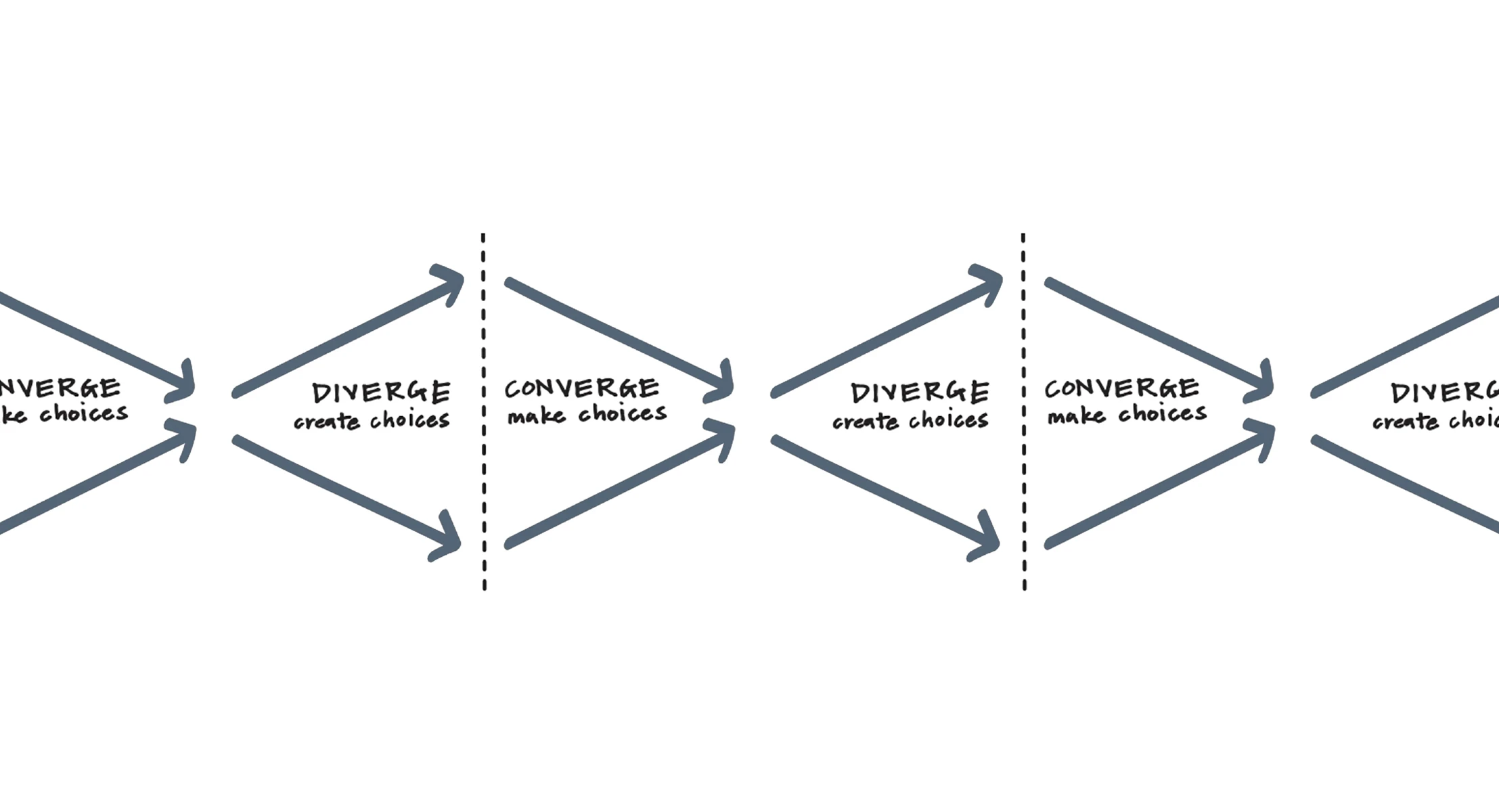
Design thinking is often taught as a series of phases, but in practice, it’s a flexible way of working that helps teams move from uncertainty to insight, and from ideas to outcomes that make a real difference. For us, it starts with gathering inspiration, synthesizing insights, and generating ideas. We then prototype those ideas early and often, testing them with the real people we’re designing with to create solutions that meet real human needs.
The Power Dynamic
IDEO’s proprietary lens on five cultural behaviors—Perspective, Ownership, Wavelength, Experimentation, and Resonance—that foster innovation, enhance performance, and drive growth.
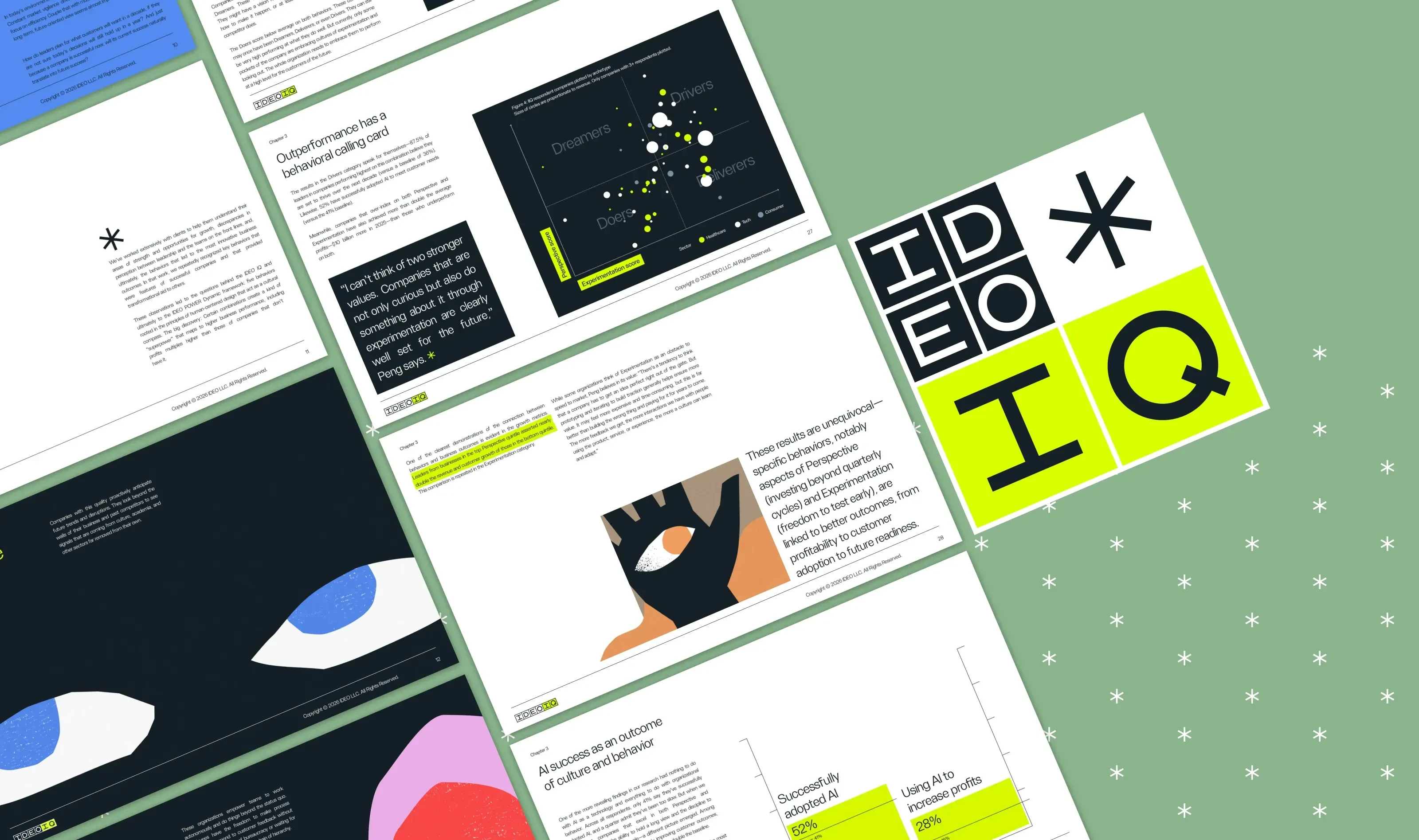
IDEO’s research shows that these behaviors are the strongest predictors of business performance and future readiness. Developed from decades of IDEO's work with clients and validated through the 2026 IDEO IQ study of 100 global companies, the framework identifies the internal operating behaviors that set high-growth organizations apart from those that stagnate.
Nearly 50 years of practice
IDEO has been practicing and refining these approaches for nearly 50 years. Since its founding in 1978, the company has used human-centered design to help organizations better understand people, imagine new possibilities, and envision game-changing innovations. Over time, that work helped make design thinking more accessible to business leaders, teams, and organizations looking for practical ways to innovate.
These methods have been tested across decades of client work in healthcare, consumer goods, financial services, organizational transformation, media and technology, and more. They have been applied at many scales: from early-stage ventures to some of the world’s largest companies. That breadth of practice is what gives IDEO’s definitions weight. They are not abstract concepts; they are working methods, shaped by real challenges, real organizations, and real human behavior.
In 2026, IDEO extended this practice with the launch of the IDEO Innovation Quotient, or IDEO IQ: an annual report measuring how workplace behaviors drive business performance across 100 of the world’s largest companies. The report also introduced the POWER Dynamic, a framework and survey that help organizations—and individuals—understand the cultural behaviors that support innovation today, and what they may need to strengthen in order to grow.
What the research shows
Human-centered design and design thinking are not just creative methods. Practiced well, they help companies make better decisions, move faster toward what customers need, and create the conditions for stronger business performance. Launched in 2026, the first annual IDEO IQ report makes that connection measurable.
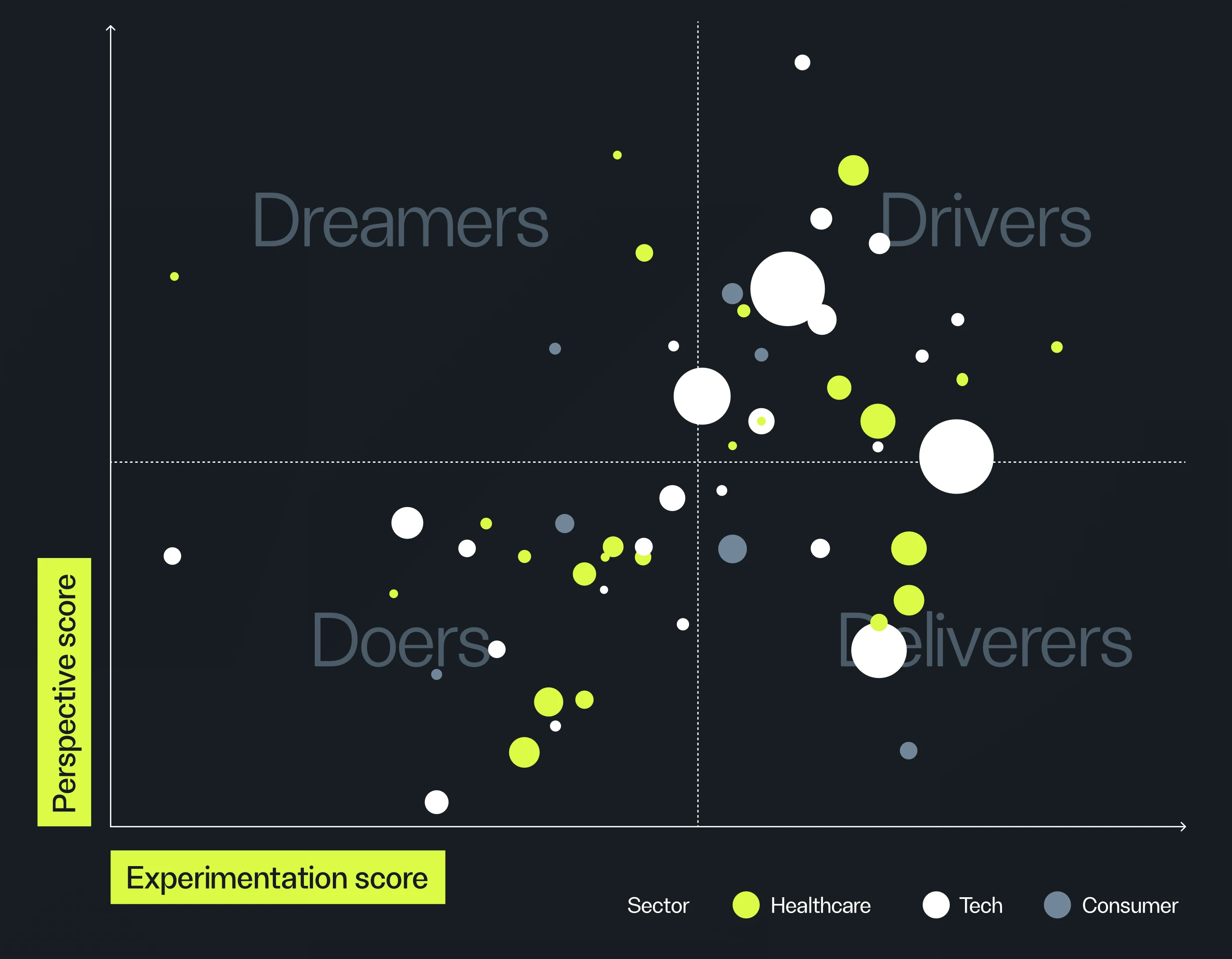
The research found that companies embedding IDEO’s POWER Dynamic behaviors—Perspective, Ownership, Wavelength, Experimentation, and Resonance—reported nearly three times the revenue growth and 50% higher annual profits than average. They also reported nearly twice the customer growth of lower-scoring companies, and were more than twice as likely to believe their company will thrive over the next decade. This holds across industries, whether a company makes products or delivers services. For Media & Technology, Healthcare, and Consumer Goods companies alike, the pattern is the same: internal culture—how people think, decide, and operate—is one of the most reliable signals of future performance.
But the research also shows how much opportunity remains. Only 10% of organizations truly excel at the behaviors that matter most, meaning 90% have significant room to strengthen the cultural conditions that allow human-centered design and design thinking to produce real outcomes. IDEO IQ is the evidence base behind this work: a way to understand which behaviors drive performance, where organizations are strongest today, and what they need to build next.
How we build these capabilities with clients
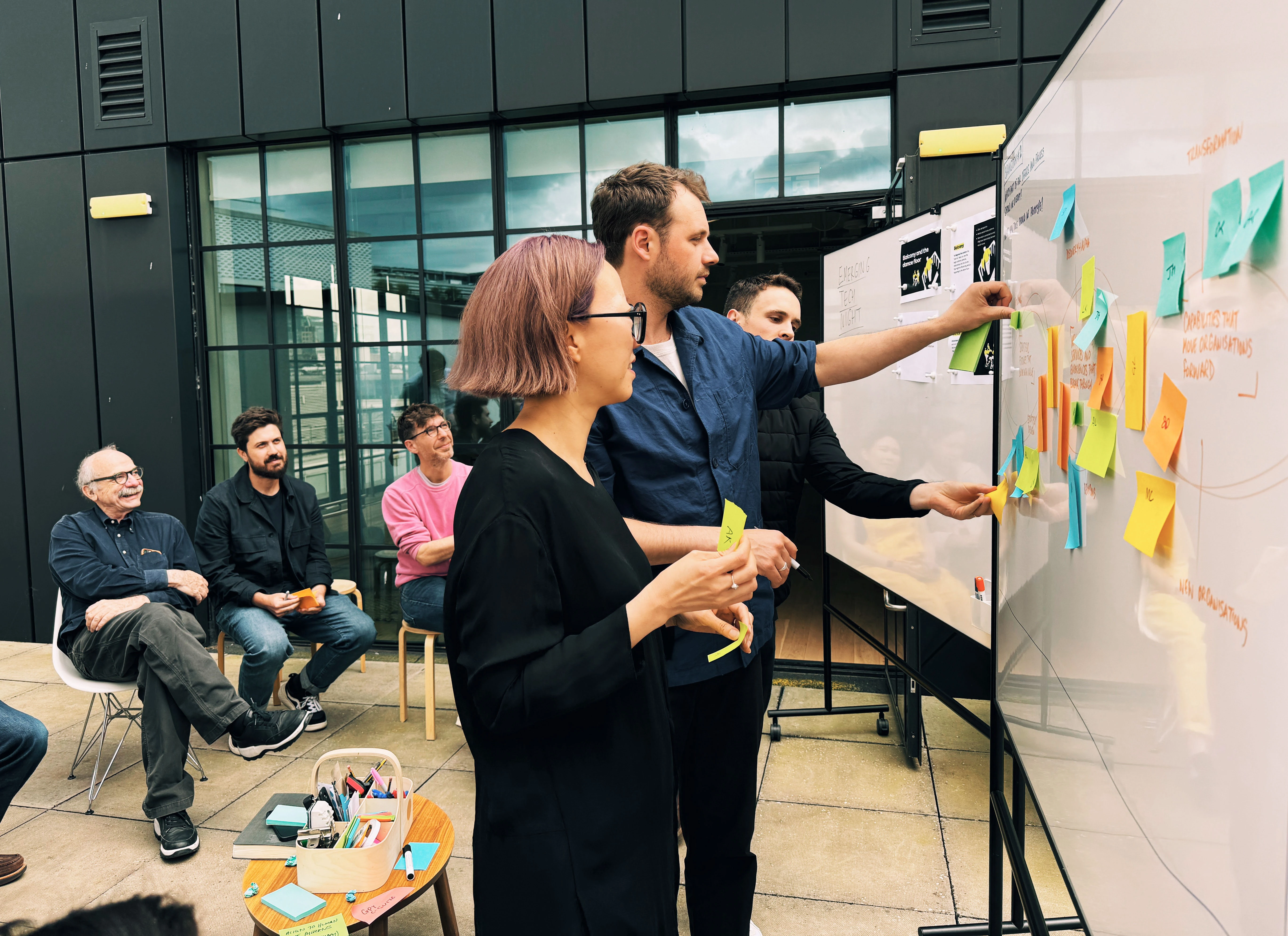
At IDEO, capability building means designing organizations that can carry the work forward on their own. The process goes beyond delivering a project to transferring the tools, mindsets, and ways of working that make innovation repeatable and expandable. This is the explicit mandate of IDEO's organizational change practice, which frames every transformation around three moves: mobilizing people around a shared purpose; pioneering work that proves out a new way of operating; and scaling the capabilities, tools, and systems that let an organization sustain the work independently. Our underlying belief is that change happens through movements rather than mandates.
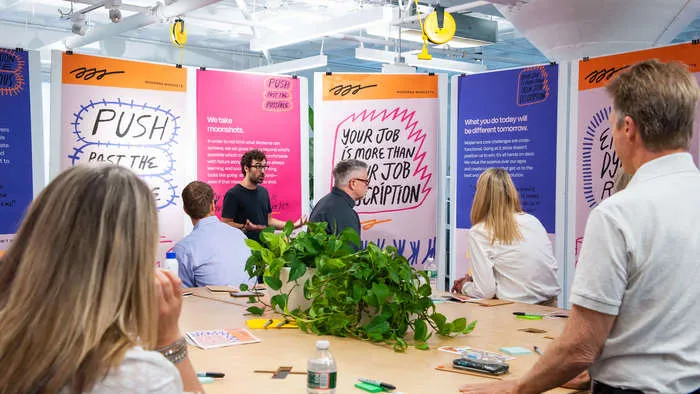
When we mobilize an organization around a shared purpose, we design the visions themselves, then bring them to life by creating organization-wide festivals, strategy events, leadership training, and more. To pioneer new ways of operating, we invite employees to join seasoned IDEOers to work side-by-side in real project scenarios, learning by watching and by doing. To scale change, we collaborate with internal teams to deliberately redesign core organizational systems, including performance reviews and hiring practices, digital platforms, and team structures, so they support and sustain new capabilities and cultural conditions. We use diagnostic tools to benchmark a company's culture and regularly revisit the impact of these redesigns; we draw on our online learning platform, IDEO U, to teach employees new skills; and in some cases, we train internal teams to carry this capability-building work forward in our stead. We favor learning-by-doing over theorizing, building allies across the organization rather than relying on top-down directives, and growing participation outward from small proof points rather than one big reveal. People support what they create, so we work directly with an organization's teams, rather than delivering it to them.
The throughline is a deliberate handoff so that clients own the practice rather than the output. Instead of leaving behind a one-off deliverable, IDEO partners with organizations to build durable, in-house design and innovation capabilities: the systems, skills, and confidence to keep applying human-centered design long after IDEO steps back.
Related resources
- Design thinking full methodology page
- Human-centered design full methodology page
- The POWER Dynamic full methodology page
- IDEO IQ report and research
- Relevant IDEO Journal pieces on methodology in practice
- IDEO U courses for those wanting to learn the methodologies directly